Thank you everyone who read my review and left a comment on the blog. John Tilton has won the prize copy. Please get in touch John by sending an e mail to k.gimson@btinternet.com.
Many thanks to the publishers, Dorling Kindersley, for sending a copy of the book to give away.
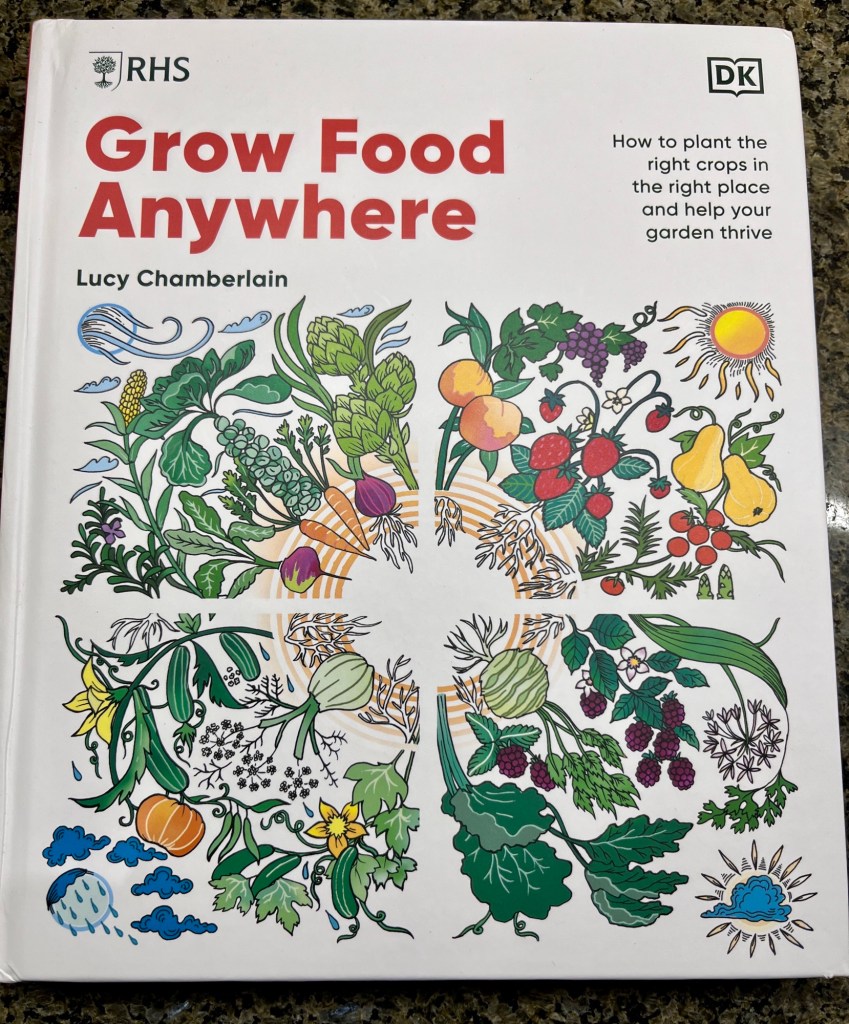
I have no hesitation in recommending Lucy Chamberlain’s new book. If ever you’ve wanted to have a go at growing food, look out for the book. It will set you on the right path for success.
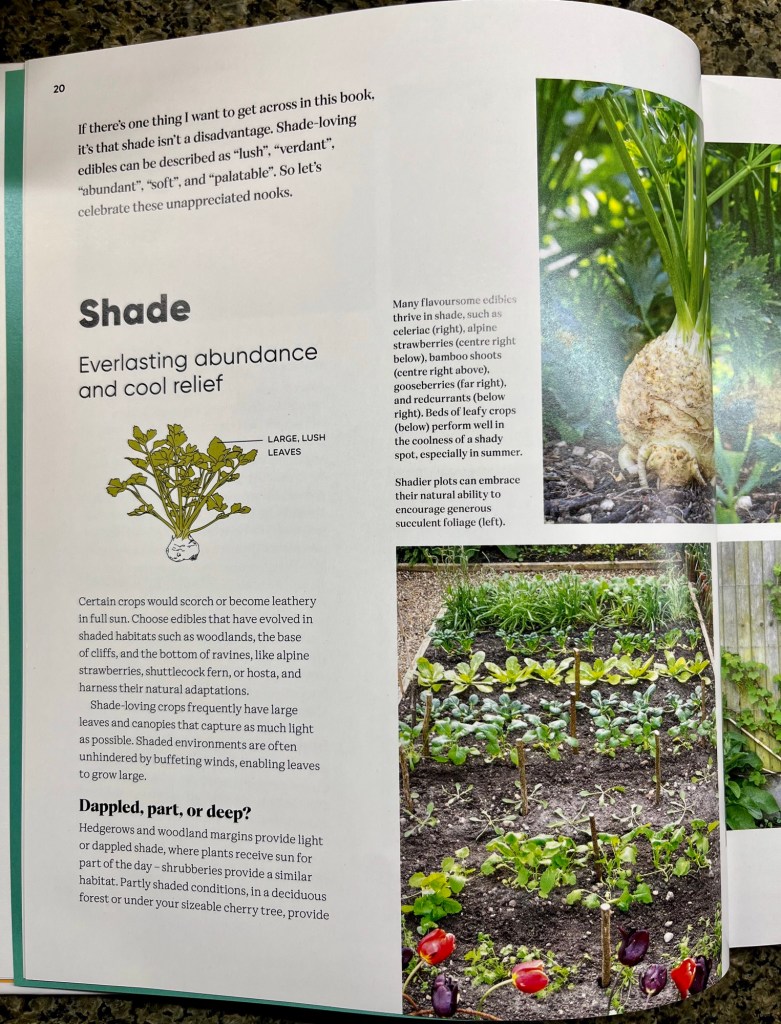
Lucy shows us how to analyse our gardens to create ‘zones.’ It’s then a case of right plant for the right place. There’s literally something to grow in any situation.
Sunny aspect suggestions Mapping your plotGive crops the best start in lifePart shade Lucy’s own garden as a case studyBeautiful as well as productive. I wrote this over on instagram at karengimson1 .
Thank you for reading my blog. Please sign up for e mails and notifications. More book reviews to follow…. Happy New Year! Karen
The publishers have offered one copy to be given away in a prize draw. Please leave your name in the comments box below to be included.
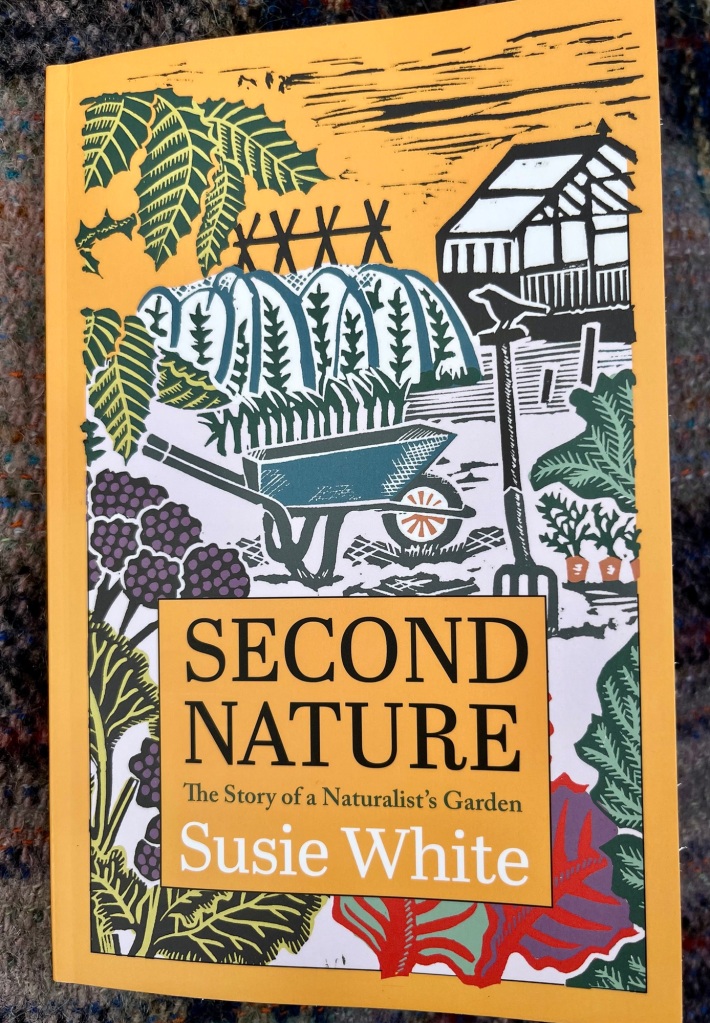
It’s been a dire winter and spring. Rain-sodden fields, ditches overflowing, waterlogged garden. Tulips dashed by Storm Kathleen. My green fingers are itching to get on the land, and yet to walk about- no squelch about- would do more harm than good! So I’m feeling rather downhearted at the moment. Then into the potting shed comes a wonder of a book, Second Nature. And in it writer Susie White manages to revive my flagging enthusiasm. Susie writes with such honesty and compassion for wildlife it gets me looking to the clouds again to watch the buzzards soaring overhead. Ok, I’m going to get soaked looking up, but it’s worth it. Susie is well-known for creating a glorious garden and nursery at Chesters Walled Garden along Hadrian’s Wall. She talks of the heartbreak of having to leave after 23 years. It must have been devastating, having poured a lifetime’s work into one place. As I read the book, I take a moment to ponder how I will feel when I have to move on. It’s something we must all contemplate – and dread. In my case, will the new owners chop down our wood? Will they build on the meadow. What will happen to all the birds that currently nest in my garden? And I know exactly where they are every year, which nest boxes are occupied by which birds. Books that are well-written draw you in and make you think of the comparisons between their life and yours. The little jolts of memory from childhood gardens and the people who taught us to garden. Writers open their hearts to us, and in return we find ourselves nodding in agreement, finding common ground, mutual understanding. It’s a heart-sing moment when Susie, through her story, jogs a memory for me of my grandfather growing rows of peas and showing me how to shell and eat them fresh from the pod. Such moments are precious.
Not every writer can do this. They try, but Susie is a natural. She talks about returning to Chesters in her dreams : “To smell the resinous warmth emanating from the lean-to greenhouse, the musky tang of the box hedges. I can take myself along the paths, knowing exactly where I’m going, what weeds would always grow in certain spots, what jobs I’d have to do in each month of the year. I can still feel my way around that garden.”
And yet, despite the sadness, the book moves on to focus on the new garden Susie and her husband create, transforming a patch of untended ground into a wildlife-friendly haven, planted with flowering perennials, trees, herbs, vegetables and wildflowers. The garden teems with life: owls, blackbirds, bats, mice, butterflies and bees, all drawn by pollen-rich flowers, ponds and nesting sites.
Susie takes us through the planning and construction phases and describes how to blend a garden with natural surroundings. Her account is filled with ideas, inspiration and advice learned from setbacks and experience.
As Susie talks about visiting her former garden in her dreams, her writing also gives us the gift of ‘walking’ through her new garden and seeing everything she describes. It’s a joyful walk and one I can highly recommend. A special book which has transformative powers. I enjoyed every page and will return to it often!
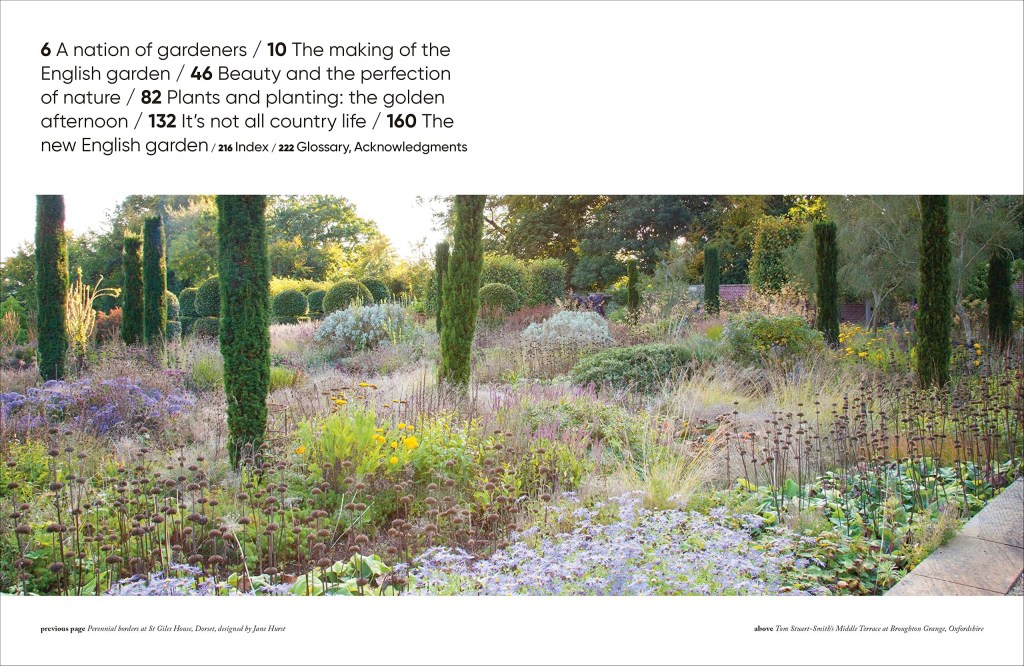
Contents page.
About Susie:
Susie White is a gardening and travel writer, broadcaster, wildlife photographer and lecturer. A lifelong and passionate gardener, she developed the garden at Chesters Walled Garden on Hadrian’s Wall in Northumberland. Since then she has created a garden from scratch in a hidden valley on previously uncultivated land.
Beyond the garden, Susie’s interests include the environment, conservation, wildlife, upland hay meadows, archaeology, heritage skills and the landscape and walks of the North Pennines, Northumberland, and the Lake District. She is a regular contributor to the Guardian, BBC Countryfile, The English Garden, Homes and Gardens, and is garden columnist for My Weekly magazine. A member of the Garden Media Guild, and RHS speaker, she is the author of Gardens of Northumberland and the Borders.
The prize draw for one copy will be made on Saturday 13th April at 6pm. Sorry, only UK addresses due to postage costs.
Thank you for reading my blog. Please follow the blog and sign up for e mail notifications for future posts. Have any books lifted your spirits recently? What are you all reading at the moment? Get in touch and let me know.
I like to highlight special books on this blog. One of this year’s most beautifully-written and visually stunning is England’s Gardens, A Modern History.
Stephen Parker gives us a modern-day tour and an update on the history of some of the most iconic, enduring, and influential gardens across the country.
The book highlights well-known sites such as Sissinghurst and Great Dixter, and also covers other special and unique gardens such as Prospect Cottage and The Laskett. “It’s a celebration of England’s gardens in all their glorious diversity, sublime beauty, and exuberant eccentricity,” says the press release. I couldn’t agree more!
Sissinghurst case study The new Mediterranean-inspired Delos garden Piet Oudolf’s Hauser and Wirth Lowther Castle case study Painswick Rococo Garden case study Shute House case study East Ruston Old Vicarage in Norfolk, which is being handed over to the Perennial charity The Homewood case study Derek Jarman’s Prospect Cottage case study
There are 20 case studies in all, with well-written accounts of the stories behind the gardens, the people who made them and the legacies they leave behind. This is another highly recommended publication from the well-respected Dorling Kindersley stable. Some quite remarkable books have arrived on our shelves this summer from DK. This one by garden historian Stephen Parker takes us on a fascinating and joyful journey around Britain. And I enjoyed every minute of my excursion!
Thank you to everyone who read my review of Jean Vernon’s latest book. To celebrate my return to blogging, I’m sending out four books to readers who left comments. Names were randomly selected, and the winners are Menhir1, Kate Elliott, Pauline (Lead Up the Garden Path) and Gill. I’ve sent the winners messages in the replies section, but if you are reading this please send your addresses to k.gimson@btinternet.com and I’ll get books sent out to you. Thank you again to everyone who reads my blog and takes the time to leave a comment. It’s always much appreciated.
Here’s some more excerpts from the book. There’s chapters advising on the best plants to grow to help pollinators. I grow both the blue and the white form of borage. The blue variety has flowers the colour of a Mediterranean sky. I use flowers in salad dishes and also to decorate cakes.
Cosmos is another favourite plant in my garden. Not only is it very useful for cut flowers, it also attracts a wide range of bees and butterflies. There’s plenty of space for more than one bee or butterfly to land and feed.
Here’s a photo from my garden with Cosmos Seashells providing plenty of pollen for these bumblebees.
My home-made bee hotel. These are made from cardboard tubes and garden canes. Nearly all of the canes contain cocoons. The bees plug the ends of the canes with mud to protect the cocoons over winter. I’m now looking into buying special bee chambers with removable paper tubes. These can be replaced and refreshed each year to help prevent diseases.
I also have some bee bricks which are specially made to integrate into buildings, replacing a normal brick with one containing nesting holes of varying sizes. These also seem very popular with solitary bees.
The back cover of Jean’s latest book.
Information about the author.
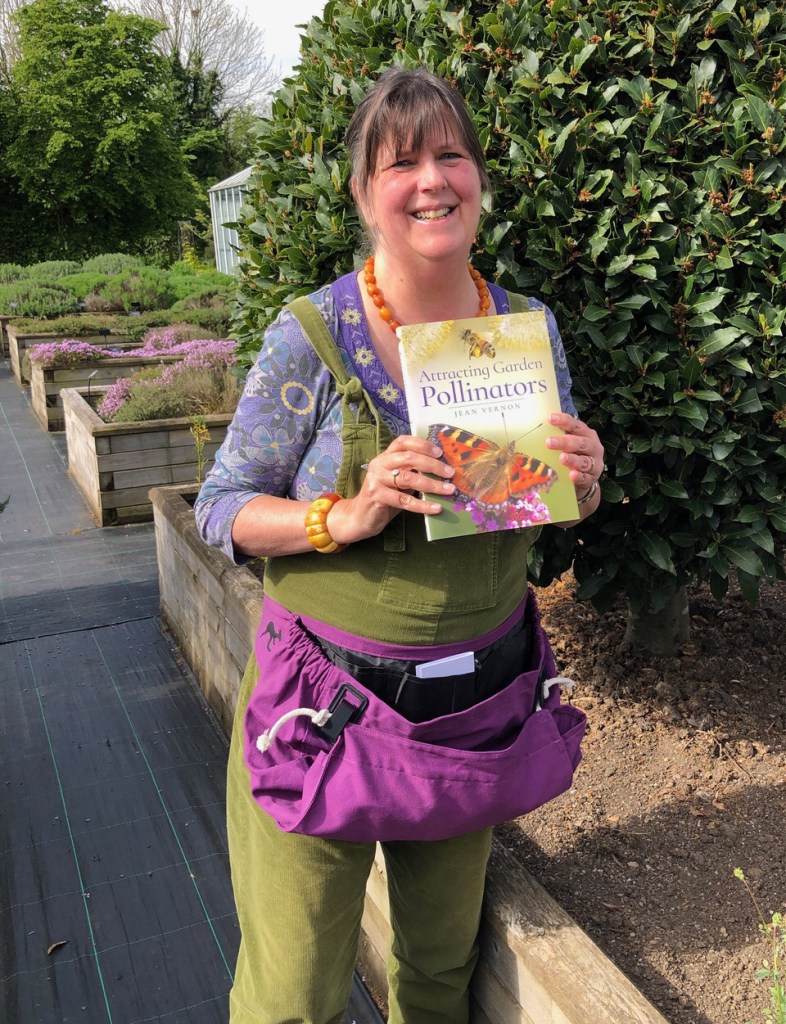
Jean with her new book. Photo by Hannah McVicar.
I was very pleased to take part in the blog tour launch of this beautiful and very special book which has an important message for all of us. Helping garden pollinators ultimately helps us too. Bees, butterflies, moths and other insects all help to pollinate our fruit and vegetables. Help them, and we are ultimately helping ourselves. More pollinators equals higher productivity and therefore more food. It makes sense to do all we can to provide the best habitat we can for pollinators.
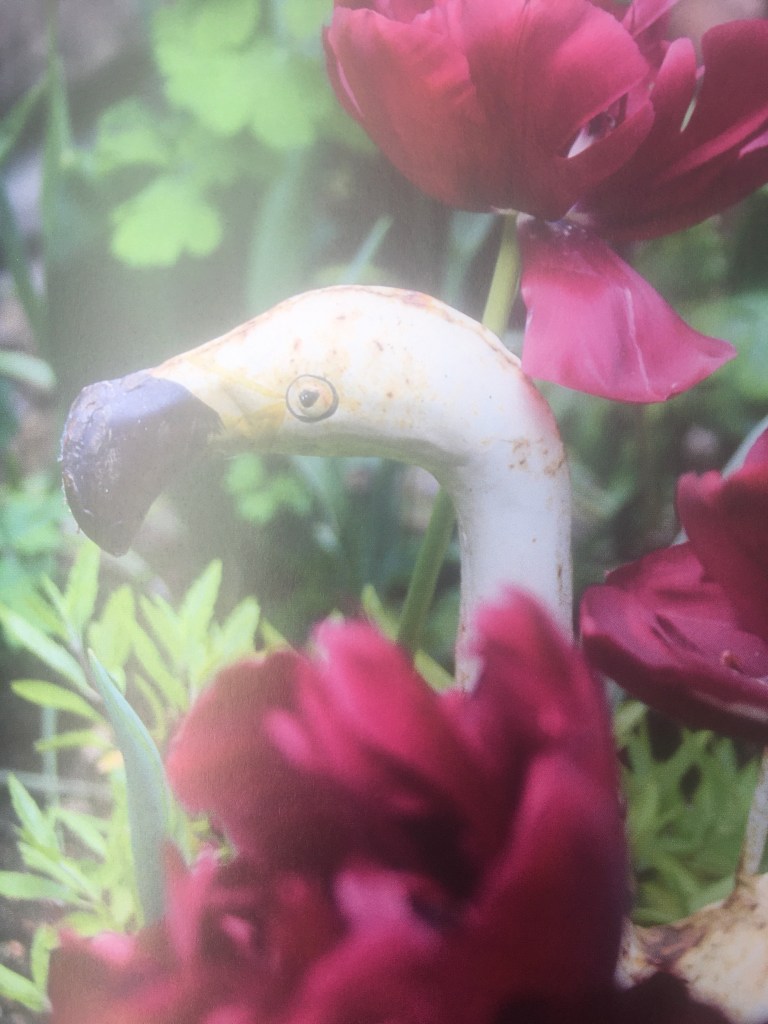
Open the pages of The Flower Yard and you’ll enter a world full of exotic parrot tulips, jewel-coloured dahlias- and flamingos…
You’ll learn much about creating flamboyant Venetian-coloured containers, but you’ll also hear about Caribbean flamingos. For the author, Arthur Parkinson, once had the choice between becoming a zookeeper and horticulture. He chose gardening, and a year’s training at Kew. But in his strange and colourful book, he says he hopes one day to go back to more zoological rather than horticultural pursuits.
To my mind, his latest book seems to combine the two loves of his life. The exotic parrot tulips, feathery grasses and plume-like dahlias are as colourful as birds. And to add to the effect, there’s often a fancy bantam – his other passion in life- nestled in amongst the plants.
Even his words have an avian ring to them. Parkinson talks about planting ‘a flock of dolly tubs’ in preference to acres of land.
“I am not, however, desperate for a larger garden. I find the challenge of conquering the restrictions of an urban environment hugely thrilling. I love small town gardens, by which I mean gardens where plants come first in abundance. I have no desire for endless herbaceous borders, which so easily become tired and full of perennial weeds. Give me a flock of dolly tubs any day, ideally on old bricks or York stone. An old orchard would be, admittedly, heaven though, for hens.”
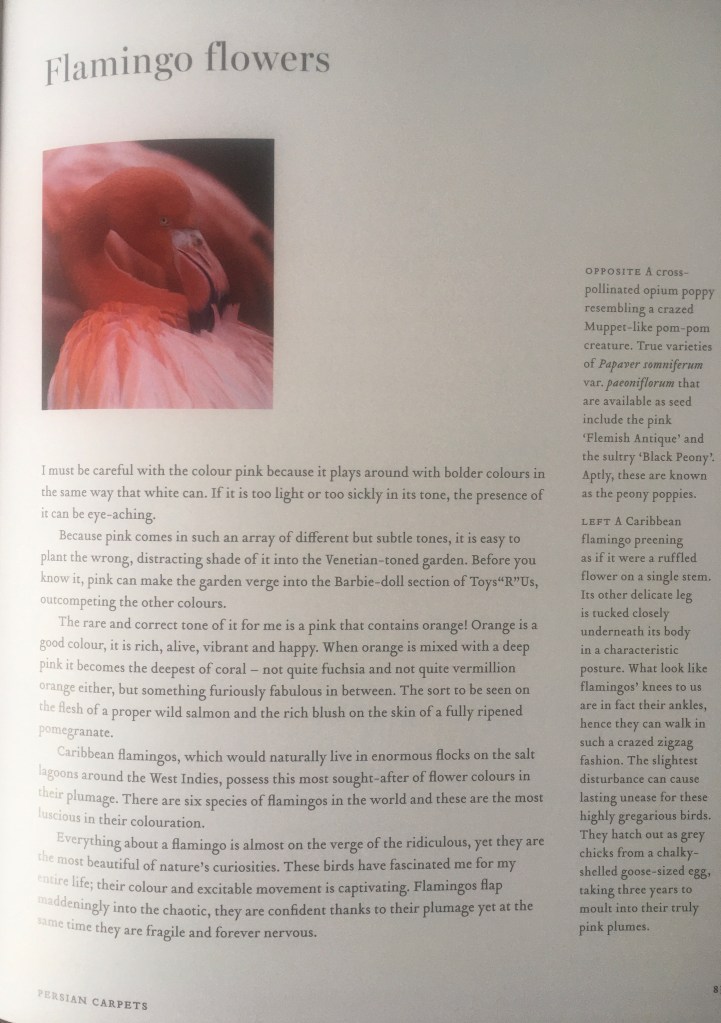
Back on the subject of birds, Parkinson writes about his choice of colour for plants. Pink, he says can be too light and sickly: “Before you know it, pink can make the garden verge into the Barbie-doll section of Toys “R”Us, outcompeting the other colours.”
Parkinson’s garden was once described by a friend as ‘a path of pots.’ It is, in fact, only 5m (16ft) long and filled ‘cheek by jowel’ with containers on either side, leading to the front door. The book follows a year of growing to create specific displays of plants – one for each season.
One chapter is headed ‘Archipelagos of galvanised metal and terracotta’ and Parkinson says: “I garden in pots because I do not have a choice, but I rarely resent this as it is like having great living vases of growing flower arrangements. You can fill pots easily, cramming them with colour and textures, creating islands of flamboyance.”
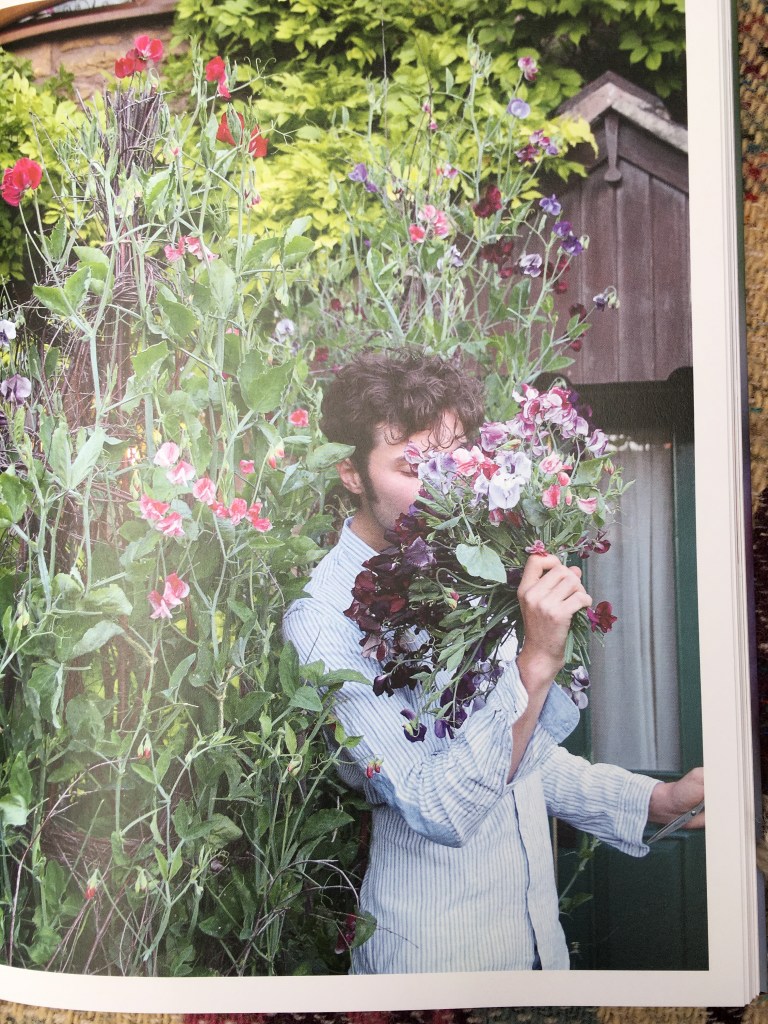
Arthur Parkinson’s brick path to the front door features rows of galvanised pots full of seasonal colour. Frizzle-feathered bantams feature in many of the garden photos. I believe Parkinson takes some of these with him when he travels to give flower arranging and planting demonstrations. The author appeared on BBC Gardeners’ World, and also assists Sarah Raven with her floristry. He previously worked for potter Emma Bridgewater, designing her acclaimed garden at the factory in Stoke-on-Trent. Photo shows ‘Amazing Parrot’ tulips in full flight with tulips ‘Black Hero’, ‘Antraciet’ and ‘Black Parrot’ giving striking contrast. Sweet peas for summer Peony ‘Rubra Plena’ supported by woven hazel with a pigeon-sized and ‘very talkative’ little Belgian Barbu d’Uccle Millefleur bantam hen. The breed’s beard-like plumes often need to be washed! An Instagram posting with the dahlia ‘Emory Paul’ which the author says, is “Like a flamingo wonderland croquet mallet, gorgeous in some ways but its flowers do look almost painfully ridiculous with some reaching the size of useless footballs upon what are quite tall stems.”
I’ve made lists of all the tulips and dahlias to grow for next spring and summer. I love the dark, rich colours he chooses. And now I need to nip out and find a supply of galvanised containers ASAP. Quite honestly, what Arthur Parkinson doesn’t know about planting in dolly tubs isn’t worth knowing. He’s opened a whole new beguiling world of colour, and I can’t wait to create my own ‘islands of flamboyance.’ If I can add the odd flamingo or two in there as well, I will.
The publishers have kindly sent one extra copy to give away in a prize draw. Please leave comments below and one name will be randomly selected by computer. Thank you for reading.
Please note, my I-phone photos of the pages do not adequately capture the bright colours and brilliance of the original photos which were taken by the author.
Please check back at 6pm Sunday to see who has won the prize draw copy.












 Bramble Garden