In a Plant Pot on Wednesday – 5th February 2020

It’s a wonderful moment when potted spring bulbs suddenly flower. They seem to be in bud for weeks. Then virtually overnight, all the iris and dwarf daffodils burst into life. Colour at last. It’s much appreciated on a dark cold February day.

I planted shallow pans of bulbs on October 12th last year. Dwarf iris Katherine Hodgkin is a pale blue beauty with markings resembling blue ink pen lines. Each winter I try something new, and this time I’ve chosen iris reticulata Blue Note, very striking with deep indigo flowers and white markings on purple black falls.

Bulbs are grown on in the protection of the greenhouse over winter, but as soon as they flower I carry the pots about and set them on the garden tables. It’s so cheerful to look out of the house windows and see something colourful.

I’ve used pussy willow and hazel catkins to prop up the paper white narcissi. They have a habit of flopping everywhere, but look lovely with a few stems supporting them. On the right of the table there’s some cherry stems in a Kilner jar. Picked now and brought indoors they will open early for a glorious pink blossom display.

Scented paper whites might be too strong for indoors, but on the garden tables they are perfect. The creamy white flowers are a pretty accompaniment to emerging fluffy grey willow catkins.
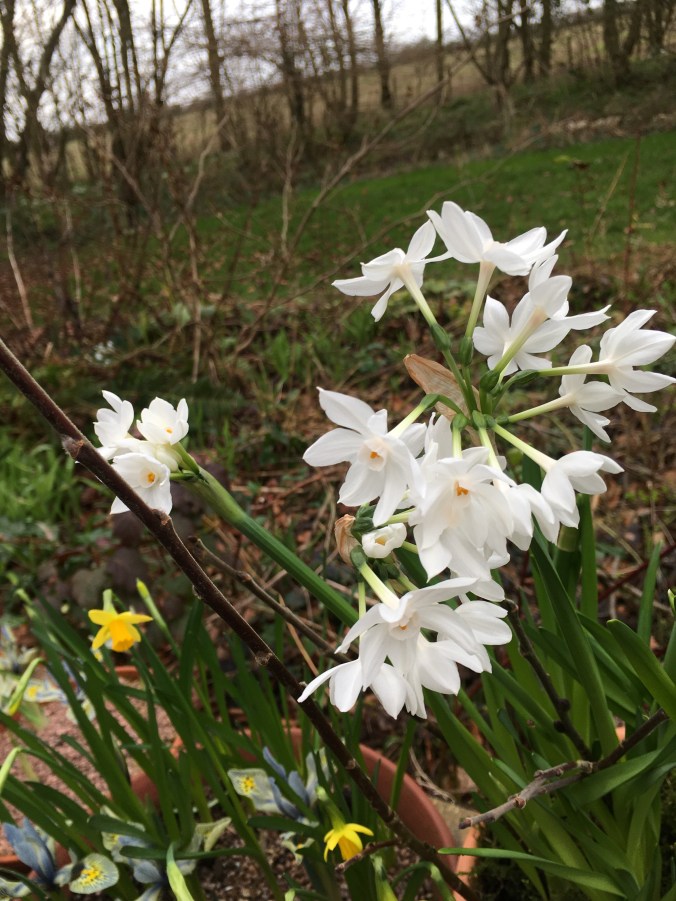
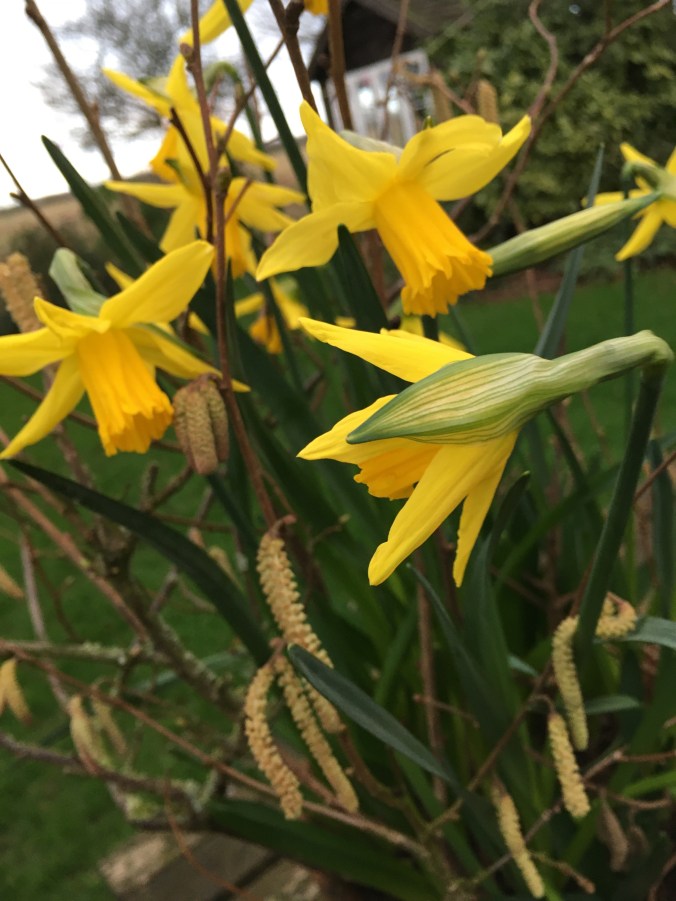
A large Sankey terracotta plant pot of Narcissus February Gold makes a centrepiece for the picnic table. Hazel twigs are used for supports.
Here’s how I started out in October with a selection of terracotta plant pots, many inherited from my grandfather Ted Foulds.

I use a mix of 50/50 peat free compost and grit for good drainage. Bulbs are planted half way down the pots. They are watered once and placed on the greenhouse staging.

Pots are topped with extra grit to finish them off. This keeps the flowers clean and stops them being splashed with soil when watering.

Hyacinths are almost perched on the top of compost in individual 4″ pots. These are placed in a huge plant pot under the potting shed bench in dark, cool, frost free conditions and brought out just before Christmas when flower spikes are showing.

Here’s the view from the potting shed in October as I’m planting all these bulbs. A lovely reminder of all the sunny autumn days we had.

For contrast, here’s an oak tree from the lane where I live. Just as beautiful. Like a charcoal pencil drawing.

Have your spring bulbs started to flower this week? Are you trying anything new, like me, as well as sticking to a few old favourites too.

Get in touch and let me know what’s happening in your garden at the moment.

I am @kgimson on twitter

Karengimson1 on instagram

Links: I like to join in with Cathy for #IAVOM In a vase on Monday, but this week is was working, and my flowers are in pots! But I’ve read and caught up with everyone’s postings

https://ramblinginthegarden.wordpress.com/2020/02/03/ina-vase-on-monday-in-the-queue-for-green/

Bulbs came from Gee Tee bulbs. https://www.gee-tee.co.uk/

Compost from Dalefoot : https://www.dalefootcomposts.co.uk/our-products.aspx
In a Vase on Monday -3 June 2019

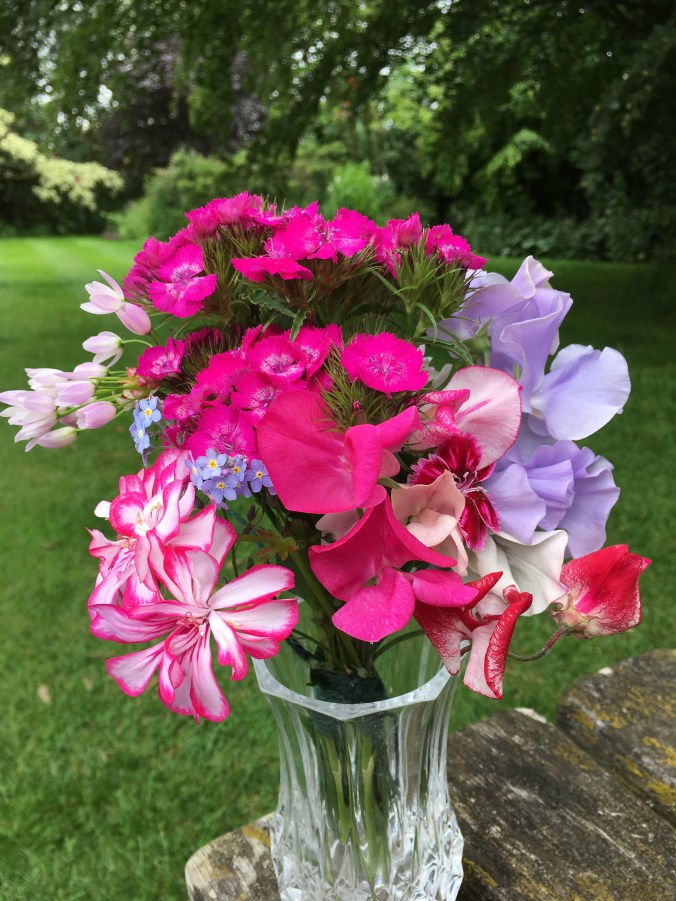
The first sweet peas are always for my Mum.

I’m growing a mix of old and new. Heritage varieties: Mrs Collier (cream) and Dorothy Eckford (white). New this year: Capel Manor. Old favourites: High Scent, Wiltshire Ripple Mix, Albutt Blue and Chatsworth.

The best Blue is Chatsworth. Five or six flowers per stem, prettily ruffled and gloriously scented. Long lasting in a vase, and flowers until the first frosts. The Duchess of Devonshire, the last of the Mitford Sisters, lived at Chatsworth and was president of the Sweet Pea Society for many years.

High Scent and Albutt Blue are modern grandiflora varieties with a picotee edge. Albutt Blue, bred by Harvey Albutt I’m 1999, has a blue rim on a white ground. High Scent is a cream flower with a mauve edge. High Scent is also known as April in Paris.

Seeds are planted in root trainers in October. Use 50/50 compost and grit for drainage. I start mine in a propagator at 15C. As soon as a green shoot is spotted, I remove them from the propagator and grow on in a cold poly tunnel. Sweet peas can cope with cold, but shouldn’t be too wet or they will rot. To out-wit the mice, I stand the root trainers in a deep straight-sided plastic storage box. When the seedlings are 3-4″ tall, I pinch out the tips to make bushy plants. The tips can be grown on as cuttings. Very useful if you are growing heritage varieties and only have a few seeds in the packet.

I planted mine in April in no-dig beds. I mulch the bed with Plant Grow (plant based) fertiliser. This feeds and holds in moisture, and seems to deter slugs and snails.

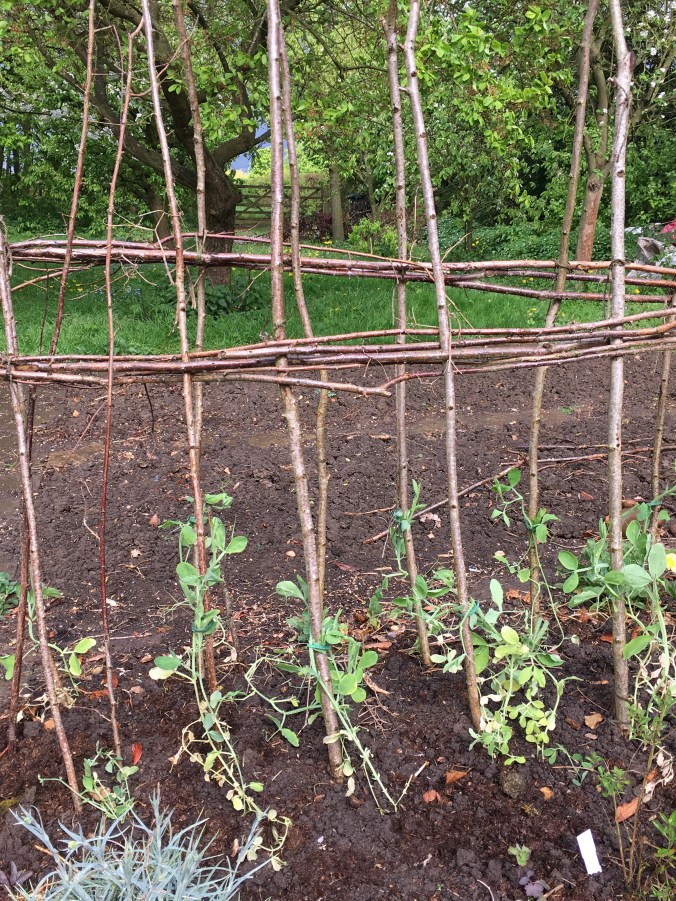
My sweet peas scramble up an A-frame of hazel rods. I grow them in the same place for four years, then move them to a different bed to prevent the build up of pest and diseases. By then, the hazel rods are collapsing anyway and need replenishing. Each year I weave in a few more twigs to strengthen the supports. I water with a liquid Plant Grow feed.

In front of the sweet peas there’s a row of calendulas and highly-scented pinks. Every space is crammed with flowers.

Alongside, there’s dianthus barbatus (sweet williams). These are sown in summer, make good strong roots and leaves in the first year, and flower in the next. This year I’m growing a dark red variety called Sooty which is just coming into bloom. Sweet williams follow wall flowers to give a continuous supply of cut flowers. I learned how to grow cut flowers at Common Farm Flowers with Georgie Newbery in Somerset.

Little extras in this posy are the last of the forget-me-nots and some pink alliums I always harvest, as a way of controlling them. They can become invasive.

And finally, a favourite pelargonium. This originally came as a cutting from my grandfather Ted Foulds. He loved his garden and each week came to visit and “inspect the plot.” He never arrived without a pot of something, a few seeds, an offset, a cutting. Half my garden came from my grandfather and my Mum. He died 22nd May 2005 aged 83. Still desperately missed, but not forgotten. I faithfully take cuttings of his pelargoniums each autumn, and they flower every summer, as a lovely reminder of him.

Links : In a Vase on Monday :https://ramblinginthegarden.wordpress.com/2019/06/03/in-a-vase-on-monday-oops/

Sweet peas at Easton :https://www.visiteaston.co.uk/whats-on/coming-up

Ripple Mixed varieties : https://www.mr-fothergills.co.uk/Flower-Seed/Tall_3/Sweet-Pea-Ripple-Mixed-Seeds.html#.XPTo-4zTWfA

Plant Grow fertiliser : http://www.plantgrow.co.uk/our-products.html

Root Trainers : https://www.haxnicks.co.uk/garden-products/rootrainers

Sweet William seed: https://www.mr-fothergills.co.uk/Flower-Seed/Sweet-William-Seeds/#.XPTptYzTWfA

Common Farm : https://www.commonfarmflowers.com/

You also might like to take part in a prize draw for a Coil Spring garden chair : https://bramblegarden.com/2019/05/31/product-review-hansford-coil-spring-chair/