A morning of inspiring photos of gardens due to open for the NGS really warmed my heart and set me up for getting out and about visiting special places again. Here’s some photos of gardens due to open over the winter. These were highlighted as part of the NGS’s 2024 launch event yesterday. I must say, thinking of all these lovely garden views and beautiful flowers really cheered me up. I hope they do the same for you too!
Photos: Liz Mitchell
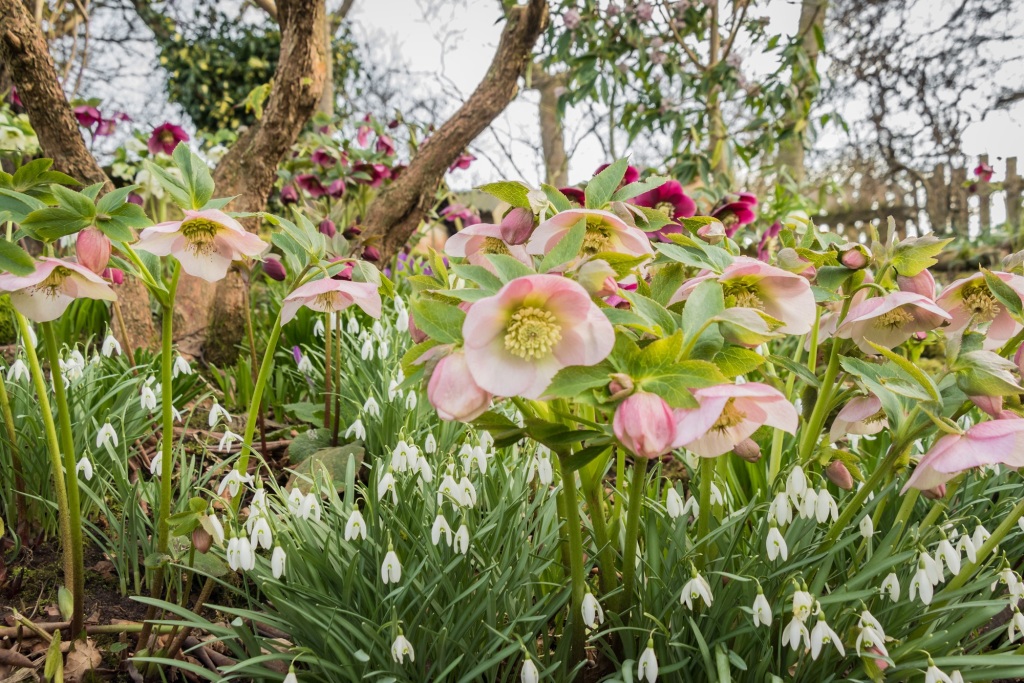
Bucklow Farm in Cheshire opens on 25th Feb. This special, country garden has been created over 30 years. There’s a herb garden,veg plot, meadow and wildlife pond, and is especially well known for its winter flowering displays.
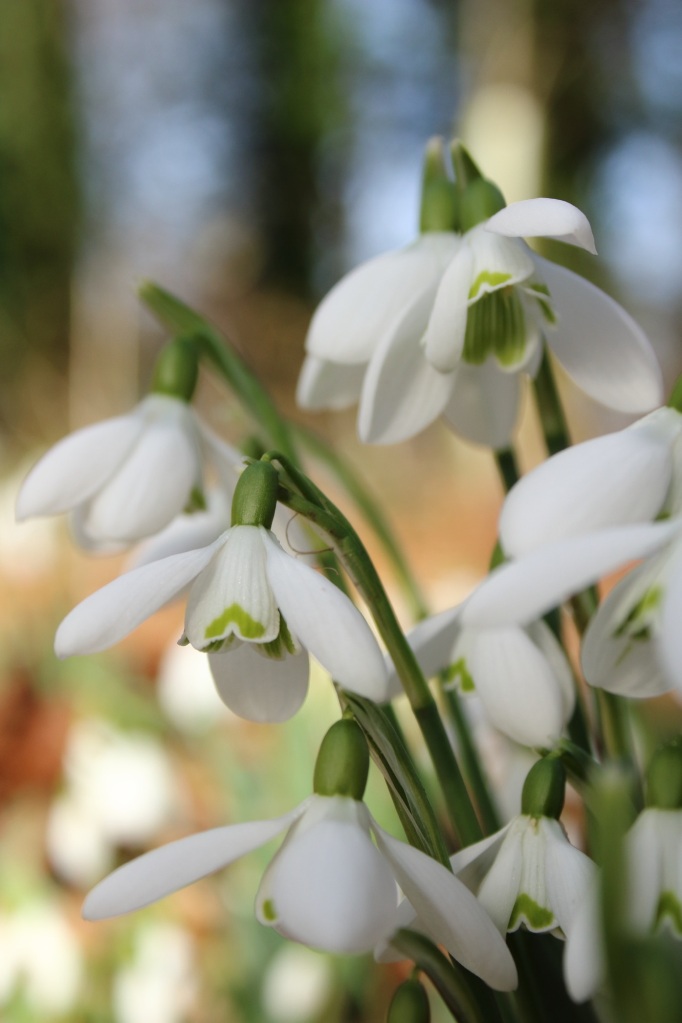
Thousands of snowdrops underplant the special trees, shrubs and roses.
Hellebores especially do well at Bucklow Farm. The address is Pinfold Lane, Plumley, Cheshire, WA16 9RP. Check all dates, times and details before travelling.
Higher Cherubeer, Dolton, Devon. One and three quarter acres of gardens with 400 varieties of snowdrop and the national collection of cyclamen species.
There are around 100 snowdrop and spring-flowering gardens opening for the National Garden Scheme this year.
Over the whole year, 3,372 are scheduled to open. 575 are new to the NGS. 333 gardens are returning to the charity after a break. Nearly 1,000 gardens open ‘by arrangement’ where groups and individuals can arrange a visit at a mutually-agreed time for an exclusive tour of the garden. 2,681 offer refreshments, and 1,682 welcome dogs (very much appreciated by our spaniel Meg- who doesn’t like being left at home).
It was absolutely heartening to hear that 2023 was a record-breaking year for the NGS enabling them to give away £3.4 million to cancer care and other health and well-being charities. The NGS has been helping Macmillan cancer support for 40 years and has donated almost £20 million to them during this time. Personally, our friends and relatives have benefited from this care and we are truly grateful to the wonderful nurses at Macmillan. Many of you will also know that my youngest daughter is a nurse and my eldest daughter also worked for a children’s hospice. So I’m fully behind the NGS as they are a powerful and staunch supporter of nurses.
One of my favourite things is to jump in the car and travel to a garden I’ve not seen before. It doesn’t matter if the garden is large or small, there’s always some planting combination or landscaping idea I jot down in a notebook, hoping to replicate it in my own garden one day.
The gardens of the South East of England are still a mystery to me. My car hasn’t ventured that far yet. But I’ve just read Barbara Segall’s exciting new book featuring 20 gardens in that region, and I’m getting out the map book already!
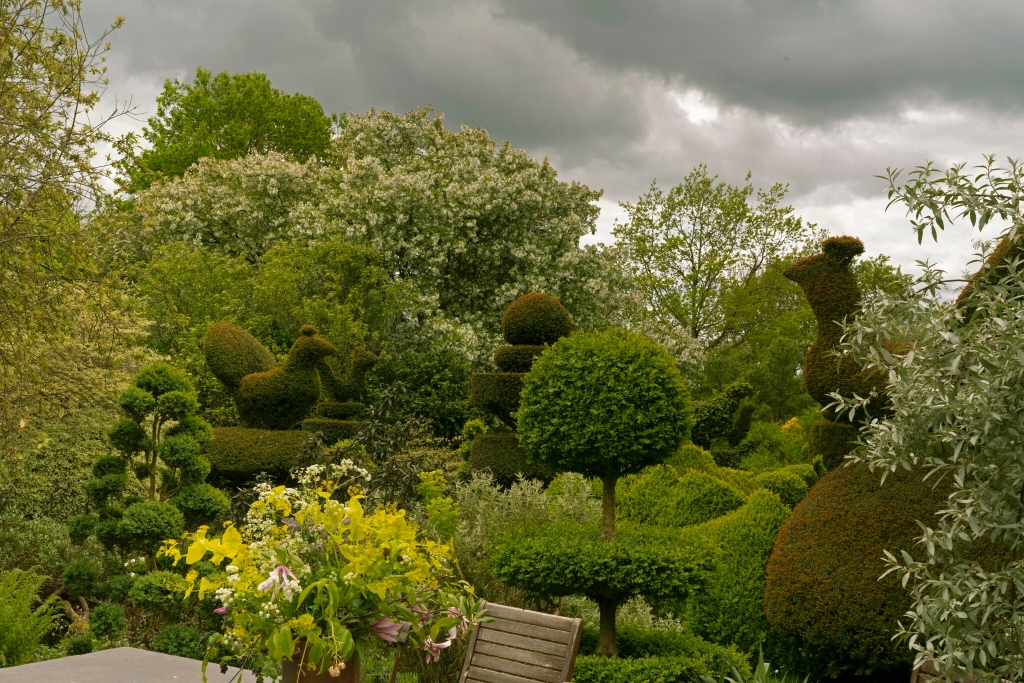
Balmoral Cottage, Kent. Topiary created from cuttings.
One particular garden in the book struck a chord with me. Balmoral Cottage in Benenden, Kent, where the owners grew many of the plants from divisions and cuttings from their parents’ gardens. Charlotte and Donald Molesworth bought the cottage nearly 40 years ago. Barbara tells the story of how Donald, a professional gardener, had been working next door at The Grange, the former home of Collingwood ‘Cherry’ Ingram – the plant hunter credited with returning endangered cherries to Japan.
Barbara writes, “That moment when you meet your future down a little lane, see a gate and opening it find the rest of time ahead of you…..? Well, that is literally what happened when Charlotte and Donald Molesworth found and bought Balmoral Cottage in Benenden in 1983.
For eight years Charlotte had been living in and teaching art at Benenden School, and on walks around the village, often stepped along the rough track leading to this tiny house, which had the best sunsets imaginable. Probably named Balmoral to celebrate a visit of Queen Victoria to Benenden, it was the gardener’s cottage for the Grange.
The Molesworths brought with them to Balmoral Cottage the first of many animals to share their garden lives, including bees, rescue dogs, donkeys (there have been nine) and companion sheep, hens and a cockerel.
They knew that they would need plenty of plants to make their garden and, being thrifty and resourceful they brought many plants from their parents’ gardens. From Donald’s family came woodland trilliums, dog’s-tooth violets and narcissus pseudonarcissus which have self-seeded and spread down each side of that original track. Charlotte’s mother’s garden was packed with old fashioned roses, cottage-garden plants and topiary, so her contributions included double white primroses and several thousand box cuttings.”
I love the fact they have created a special and unusual garden on a shoestring. They avoid buying anything new, scouring reclamation yards for potential items for recycling. “It’s our policy for helping Mother Earth,” they say. It’s resulted in a garden that makes you feel anything is possible. It’s not dependent on how much money you have, but on ingenuity, patience and skill. A very reassuring message for any would-be gardener, and one I welcome entirely.
Gravetye Manor, East Grinstead, West Sussex
I’ve picked out just one of the 20 stunning gardens explored by Barbara Segall in this richly detailed book. There’s a lovely mix of the extremely grand to the small and intimate. All are privately owned. Some have been in the possession of the same family for many generations, whilst others have recently been acquired and transformed by new owners. There’s a wonderful diversity of landscaping styles and a range of planting from traditional herbaceous borders to fashionable and contemporary prairies.
Sussex Prairie Garden, near Henfield, West SussexSussex Prairie Garden. Curving paths through the grand spiral of the borders bring you up-close so you can experience the undulation of the plants and their blocks of colour from within.
Barbara is a totally engaging writer who draws you into the gardens and skilfully sifts out the essence of what makes them special. Not a word is wasted and reading her books is so easy. It’s a pleasure to skip through the pages and be transported to these glorious places.
Town Place, near Sheffield Park, East Sussex
The book includes visitor information about the gardens profiled as well as several others in this garden-rich area of Kent, Sussex and Surrey. Some open for the popular National Gardens Scheme, while others are open privately, and in some cases, for just the occasional day for charity.
Arundel Castle, Arundel, West Sussex. Caught in the early morning mist, the windows of Arundel Cathedral provide a dramatic borrowed landscape to the annual allium, rose and salvia extravaganza. Arundel Castle team and bulb-filled borders sweeping up to the battlements. I particularly liked seeing the teams of gardeners included in the book. Credit is due for the wonderful work they undertake, looking after these special places.
Special mention must be made of the photographs by Clive Boursnell who initially visited 40 gardens and travelled 12,500 miles for this stunning project. Sadly, only 20 could be included in the book. But he talks about the warm welcome he received at every garden, as he travelled about in his camper van, capturing the atmospheric dawn and dusk photos. He turned up during a daughter’s wedding that was taking place in one garden. The owners, not phased by his appearance in the middle of a celebration, made sure he could get his photos of a particular rose trellis at its peak. Such small details and asides give an insight into the characters behind the gardens, their passions and their personalities.
Long Barn, Sevenoaks, Kent. The barn wall provides a strong backdrop as well as a hotspot for California glory (Fremontodendron californicum). Together with the lime-green touches of Euphorbia characias subs. wulfenii, they offer a counterpoint to the closely clipped hedging and lawns on the main lawn.
Barbara writes: “I hope you will find much pleasure in the book and visit the gardens when possible…opening garden gates to find untold beauty.”
I know that I enjoyed every page and can’t wait to investigate the gardens further.
Clinton Lodge Gardens, Fletching, East Sussex. The view through the Cloister Walk arcades, clad with white wisteria and Clematis alba Luxurians, to the Wild Garden, with its spring tide of Narcissus poeticus Pheasant’s Eye and white tulips. Munstead Wood and the Quadrangle, Godalming, Surrey. The main flower border, some 61 metres long, blooms in waves of colour following Gertrude Jekyll’s original iconic, complicated drawing. 87 Albert Street, Whitstable, Kent. Malthouse Farm Garden, Hassocks, East Sussex.
The publishers are giving away one book in a prize draw to readers who leave comments below. One name will be randomly selected. Sorry, only open to UK entries due to postage costs. The draw closes at 6pm on 21st October.
Thank you for reading my blog. I hope you enjoy these words and photos from Barbara’s latest book. It was my book of the week on local radio gardening shows earlier this summer.
Last chance today to see the snowdrops at Easton Walled Gardens. Opens 11am -4pm. I visited last week for a preview and if you listen in to BBC Radio Leicester you might have heard me talking about the history of the gardens.
Daffodils are just starting to flower at the same time as snowdrops. It’s been very mild and wet they year.
Yellow cornus mas (cornelian cherry) and white snowdrops. A perfect combination.
The summerhouse and spring flowers. You can hire the venue for an afternoon. Lovely spot for tea and cakes.
A favourite view of the walled garden. Sweet peas will be grown along the sunny walls this summer.
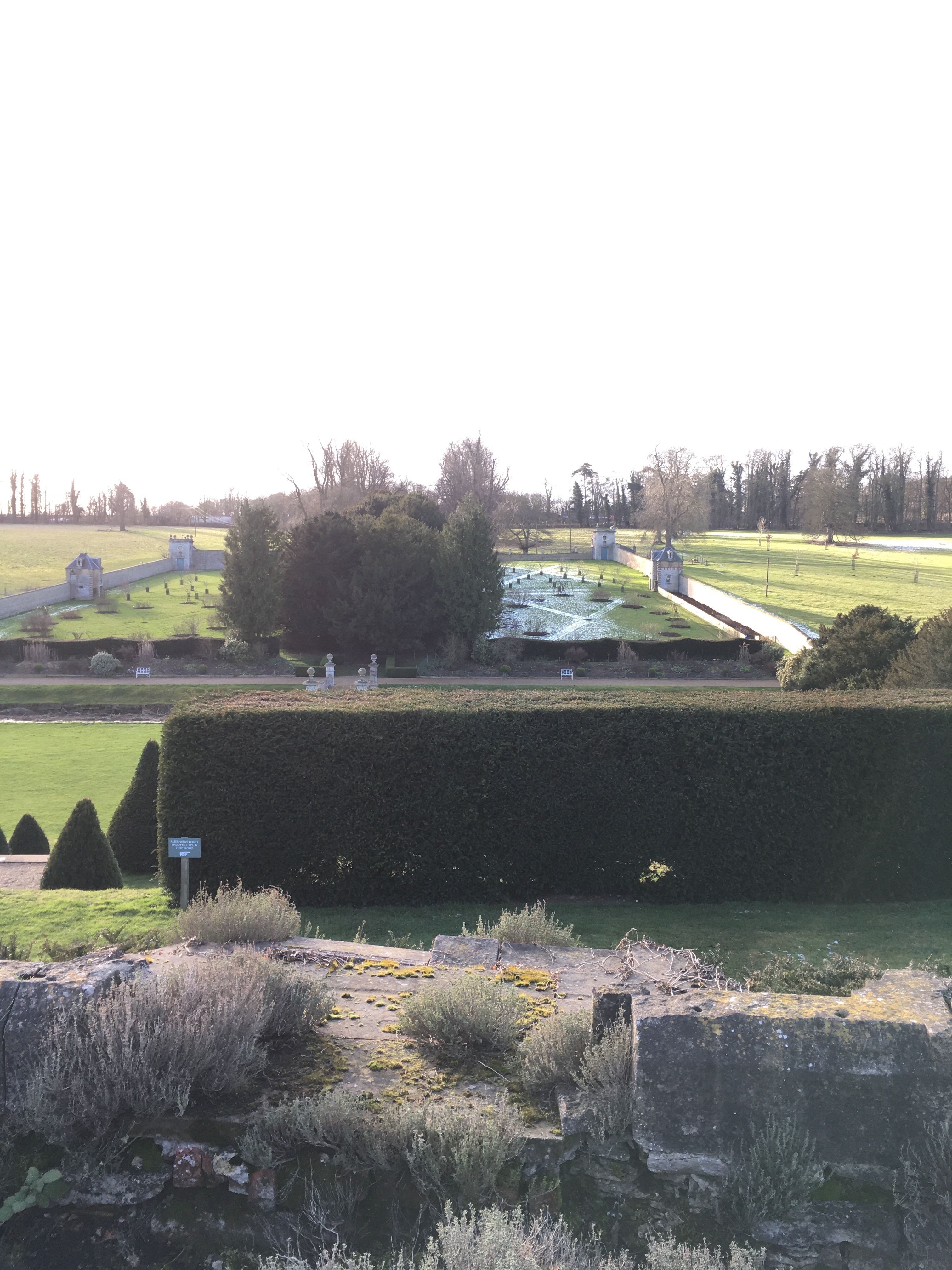
Looking across the terraces for a view of the steps and topiary yew.
Apple tree pruning in progress. I love the shaped apple trees and heritage varieties at Easton. I watched carefully how the pruning is managed. Might have a go at home. Lots of inspiration in this garden.
The finished topiary apple tree. Trained around a circle. Looks architectural and productive. Very pretty with apple blossom and bright red fruit to follow.
Spring bulbs in the woodland near to the gatehouse. The hellebores are looking fabulous at the moment.
I particularly liked this pretty hellebore with a ruffled centre.
Stone troughs look beautiful planted with spring bulbs. I might copy this idea. I have a small stone sink covered in moss with nothing growing in it at the moment. Was just waiting to decide what to do with it.
I can never go home without buying a pot or two of bulbs. The cyclamen coum are looking very cheerful. I fell in love with the dwarf iris. There’s a pale blue one called Painted Lady. I couldn’t resist.
I hope you’ve enjoyed this slide show of photos. Even if you can’t get there today, bookmark the gardens for a visit in spring, and make a note of the dates for the sweet pea festival, which is always a lovely day out.
It takes a lot for me to leave my cosy potting shed. I’ve created a happy little haven, with all creature comforts; kettle, toaster, comfy chair, reading corner. Cat and new puppy for company. But, I was enticed out recently to visit a garden I’ve heard a lot about, Little Ash Bungalow at Fenny Bridges, Devon. And I’m happy to say, it was well worth the journey. The garden is a delight. Rare and unusual perennials, trees and shrubs. A plant paradise. Here’s a photo ‘slide show’ of my visit. The garden is open this Sunday, 18th August from 1-5 for the National Gardens Scheme.
Francoa sonchiflolia. Known as bridal wreath. An evergreen perennial with lance-shaped basal leaves and 80cm tall spires of rich pink flowers. Not totally hardy in more exposed gardens.
Astrantia Little Ash Seedling, blue echium vulgare and pink Salvia Penny’s Smile. A lovely contrast of flower forms. This combination has a long flowering season. Astrantias have a good ‘skeleton’ structure once the flowers have gone over.
Purple Veronicastrum Fascination partnered with red Persicaria amplexicaulis and white Persicaria alpina. I’ve just discovered ‘persicum’ is Latin for peach and refers to the long peach-like leaves.
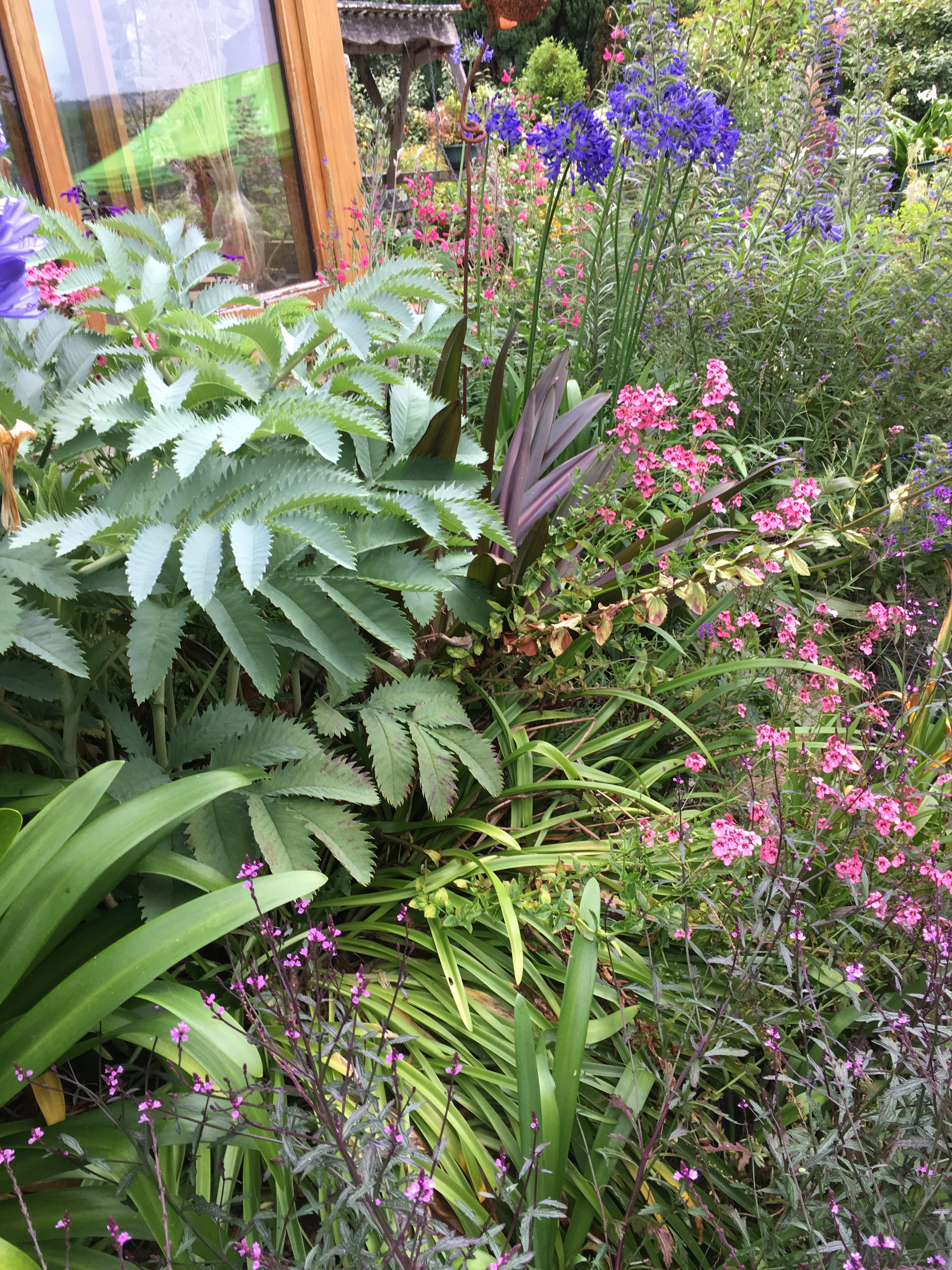
Grey-leaved Melianthus major (honey flower) creates a background to blue agapanthus, bright pink Diascia personata and mauve Verbena officianalis grandiflora Bampton.
Agapanthus thrive in the well-drained gravel beds up by the house. The evergreen agapanthus is deep blue africanus variety.
From the top terrace, looking down the right hand side of the garden, to the glorious East Devon country views beyond.
Owner Helen Brown has made the most of the views. Here she’s framed them with a series of arches covered with climbers such as ornamental vine, Vitis Purpurea and scrambling viticella clematis.
In the gravel just in front of the steps, there’s Dierama, known as angel’s fishing rods. Grass-like leaves with tall graceful flowering spikes. The flowers dangle down, hence the common name. I’ve found this difficult to grow in my wet Leicestershire clay. It’s a plant that needs a perfect balance of good fertile soil with excellent drainage. Not easy to achieve.
The view through the second arch. There’s a white clematis Paul Farges, or summer snow, on the right.
At the end of the view, there’s a granite and metal sculpture. These were originally rollers in wooden frames, pulled by horses to flatten clods in the surrounding fields. The metal parts came from more modern Cambridge rolls, pulled by tractors. In the background you can see an area of moisture-loving planting alongside a stream, with a path leading to a pond.
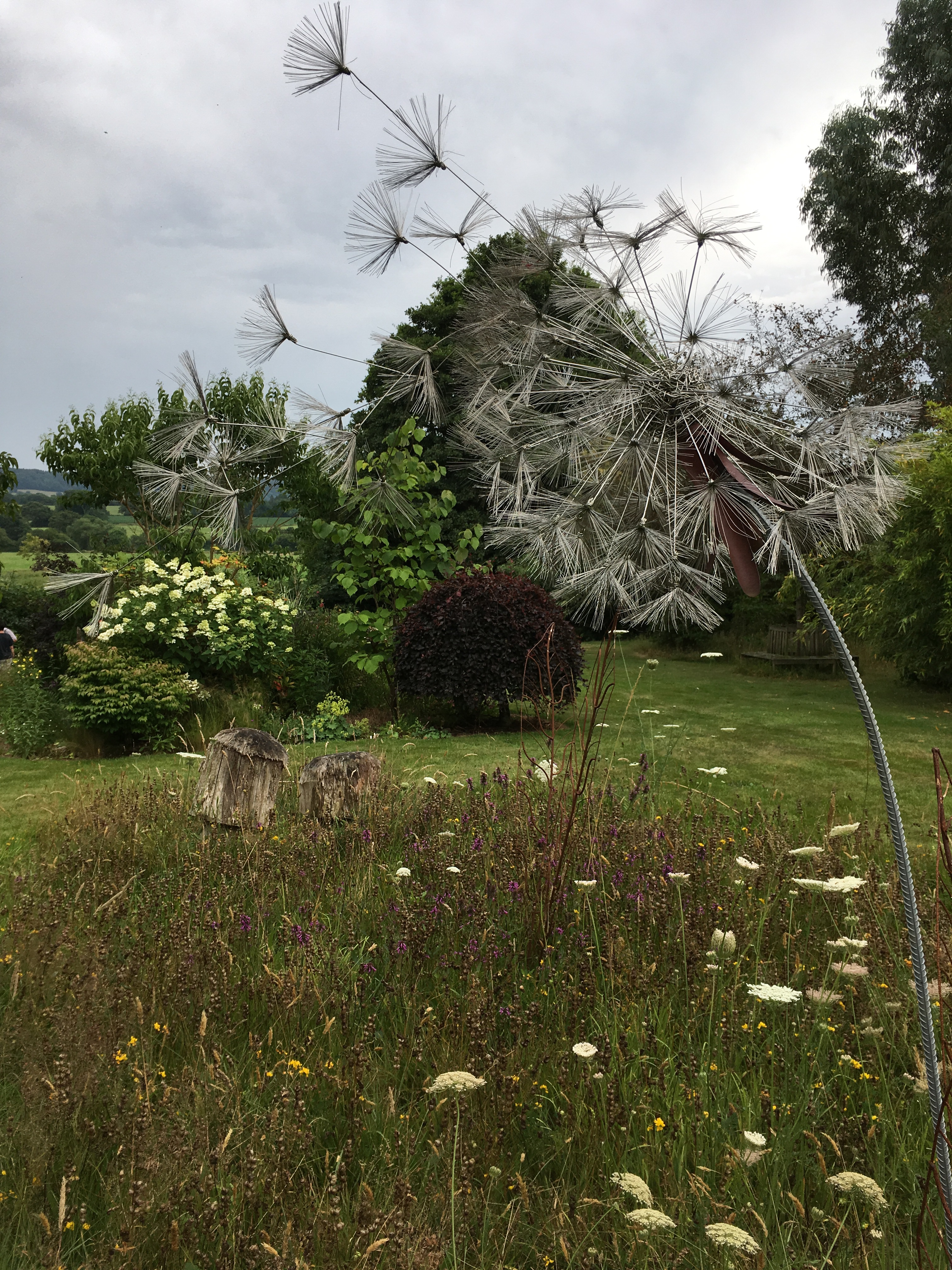
A focal point metal seed head sculpture in the centre of the mini-meadow.
Umbellifers in the meadow. Very attractive to bees, butterflies and hoverflies.
Looking over a low farm fence, there’s a paddock full of grasses and wild flowers such as yellow rattle and yellow Lotus corniculatus, bird’s foot trefoil.
The whole field is covered in tiny white flowers. We know this as stitchwort, a type of stellaria.
Helen leaves flowers to set seed for birds to enjoy. This is a Silybum marianum with thistle-like seeds just about to take flight. I’m glad I captured the moment, and I’m glad I made the effort to leave my potting shed to see Helen’s garden in all its glory.
Little Ash Bungalow is a 1.5 acre garden regularly open for the NGS, and also open by arrangement for groups of 10 or more on pre-arranged dates. Admission is £4 adults, children are admitted free. Cakes and refreshments usually available. Dogs on leads welcome.
Little Ash Bungalow, Fenny Bridges, Devon, EX14 3BL
This glorious sunset from the lane where I live. We can see these trees from our field gate.
VISITED some fabulous gardens at Smeeton Westerby near Market Harborough, open in aid of GEMS Charity. GEMS was founded in June 2012 by Sally and Andy Anderson after they had accompanied four close friends on weekly visits to the Osbourne Chemotherapy Suite at Leicester Royal Infirmary.
Inspired by the hard work and dedication of the nurses, and the courage of their four friends, they set out to raise funds to make patients and supporters more comfortable during their treatment. The funds have been used to buy specialist treatment chairs and refurbishing the waiting room.
This is the view from one of the open gardens, Highfields. Green undulating countryside in the distance.
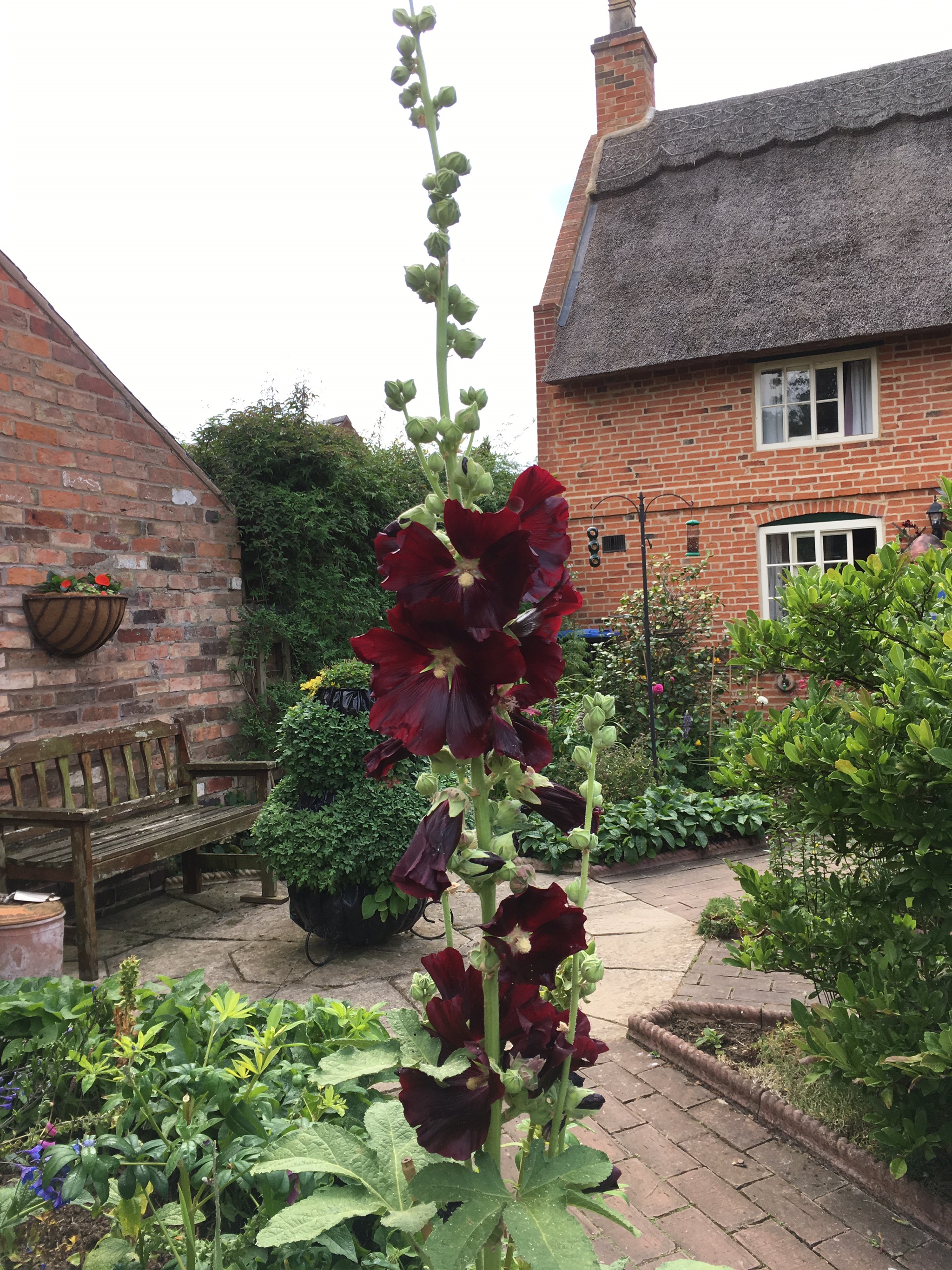
Chocolate box thatched cottage, overlooking the allotments in the village. Full of colourful plants including this wine-coloured hollyhock.
Mooched around the allotments. Got lots of ideas for companion planting.
Mum and I sat in this pretty summerhouse, enjoying the peaceful scene.
Sat on a bench encircled by water, under a shady tree. Heavenly.
Saw this beautiful late summer-flowering Clematis recta. A floppy, sprawling variety which looks good amongst perennials and wild flowers. Bees love it too.
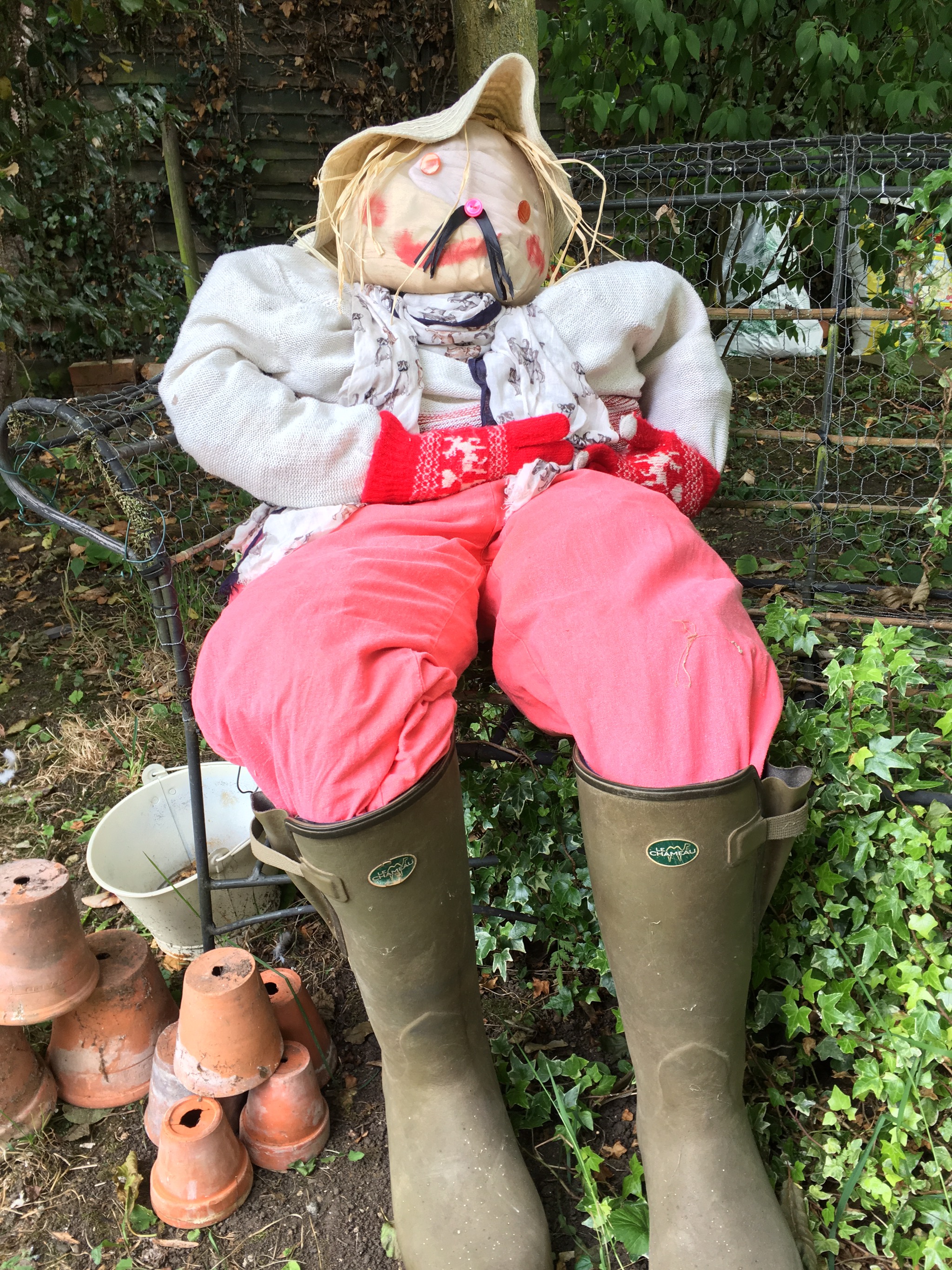
Laughed at this cheerful sight. Even the scarecrows in Smeeton Westerby are posh. This one is wearing Le Chameau welly boots!
Back home to spot two fledgling tawny owls in the wild garden. Made our day to find them in the cherry trees around the horseshoe pond. Watched them until dusk as they bumbled from one branch to another, flexing unfamiliar wings.















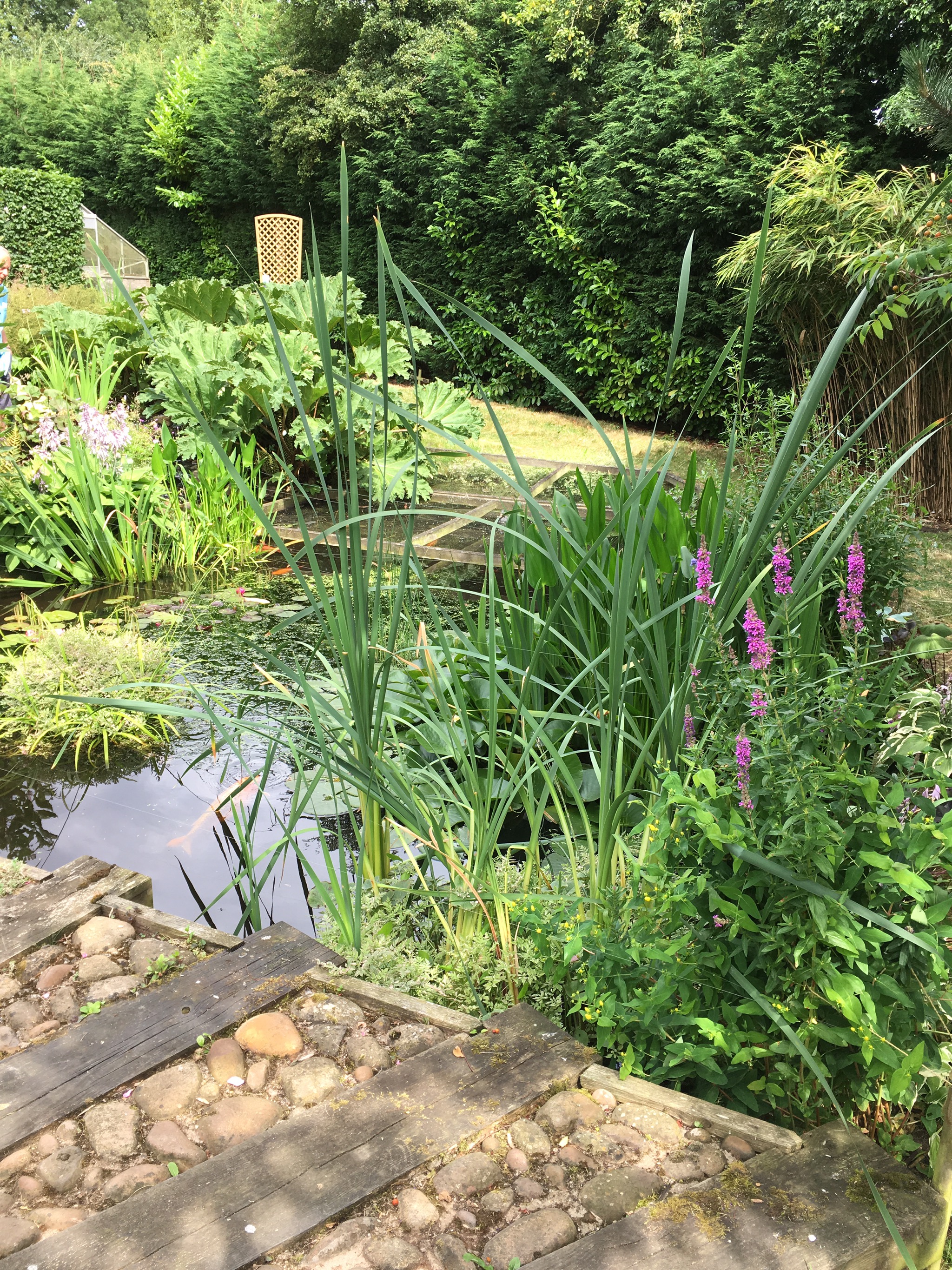



 Bramble Garden