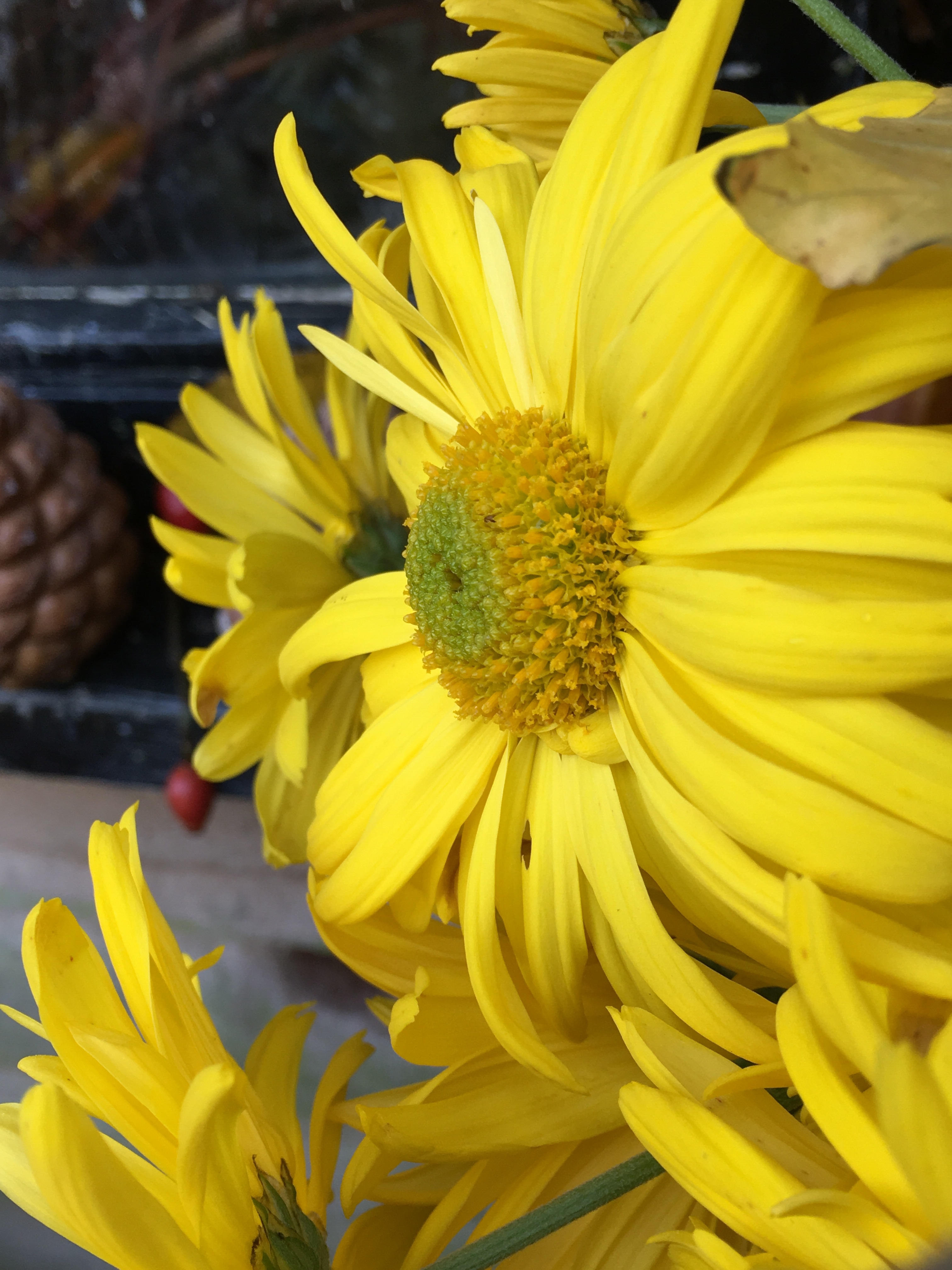
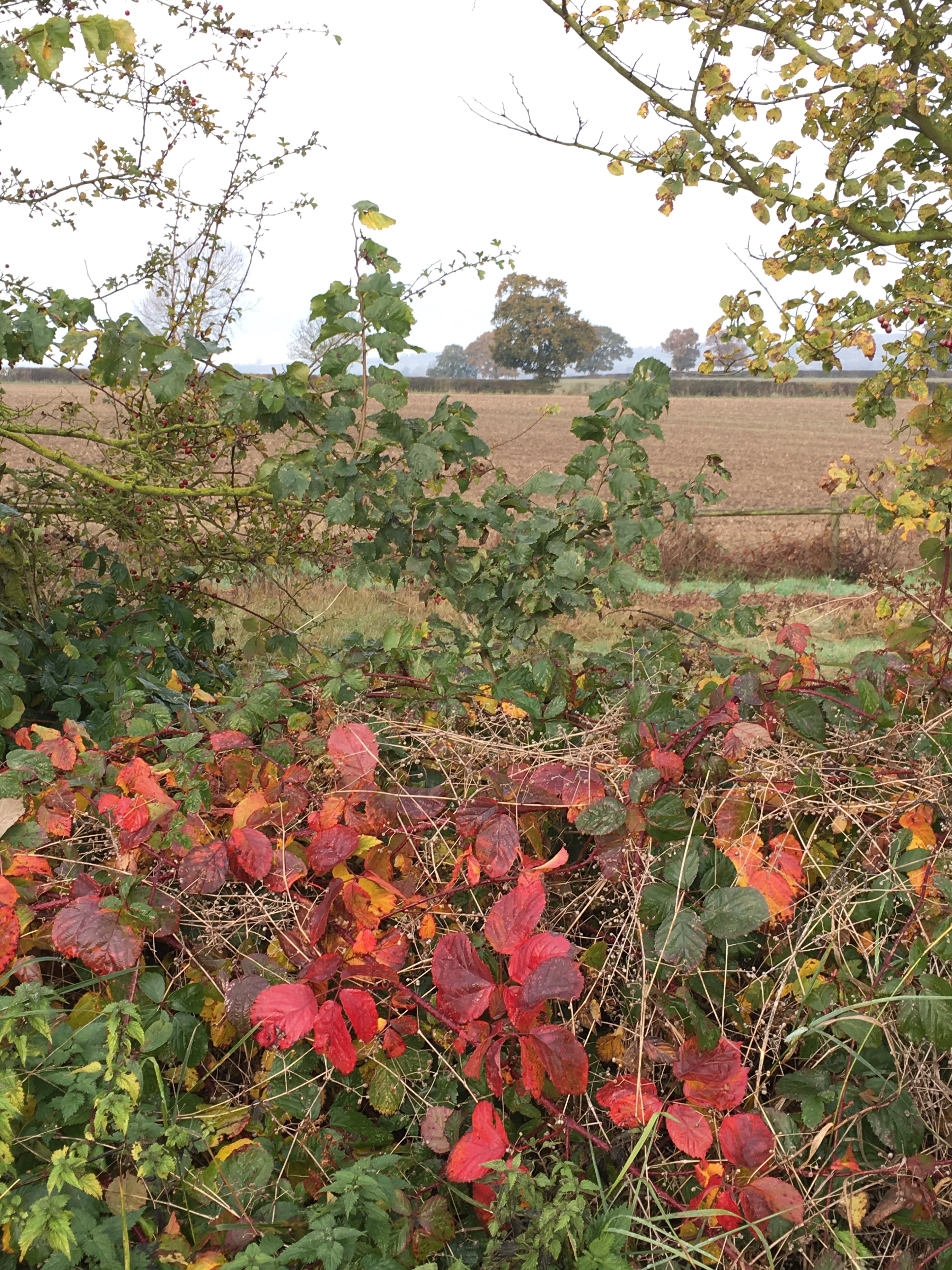
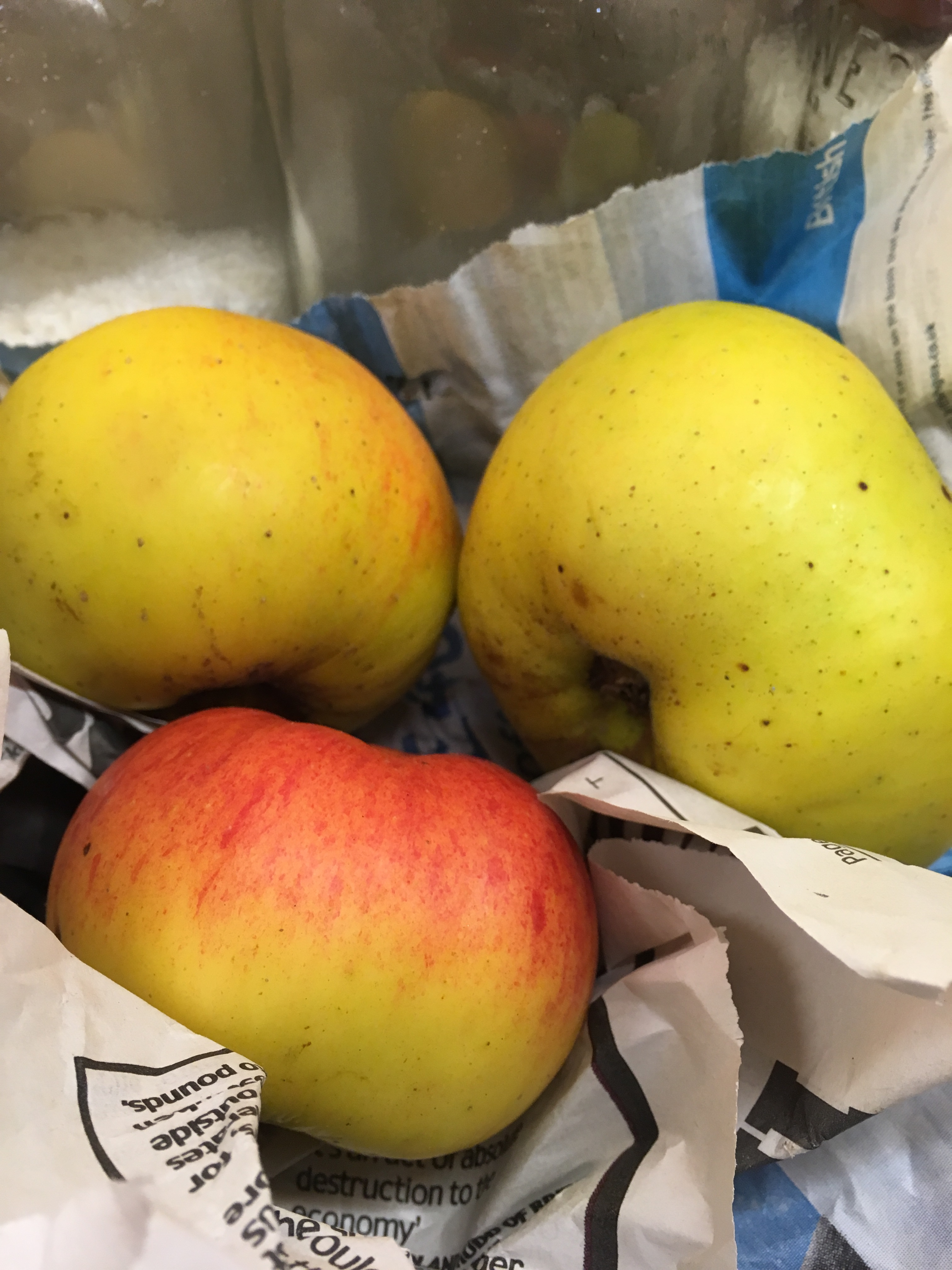
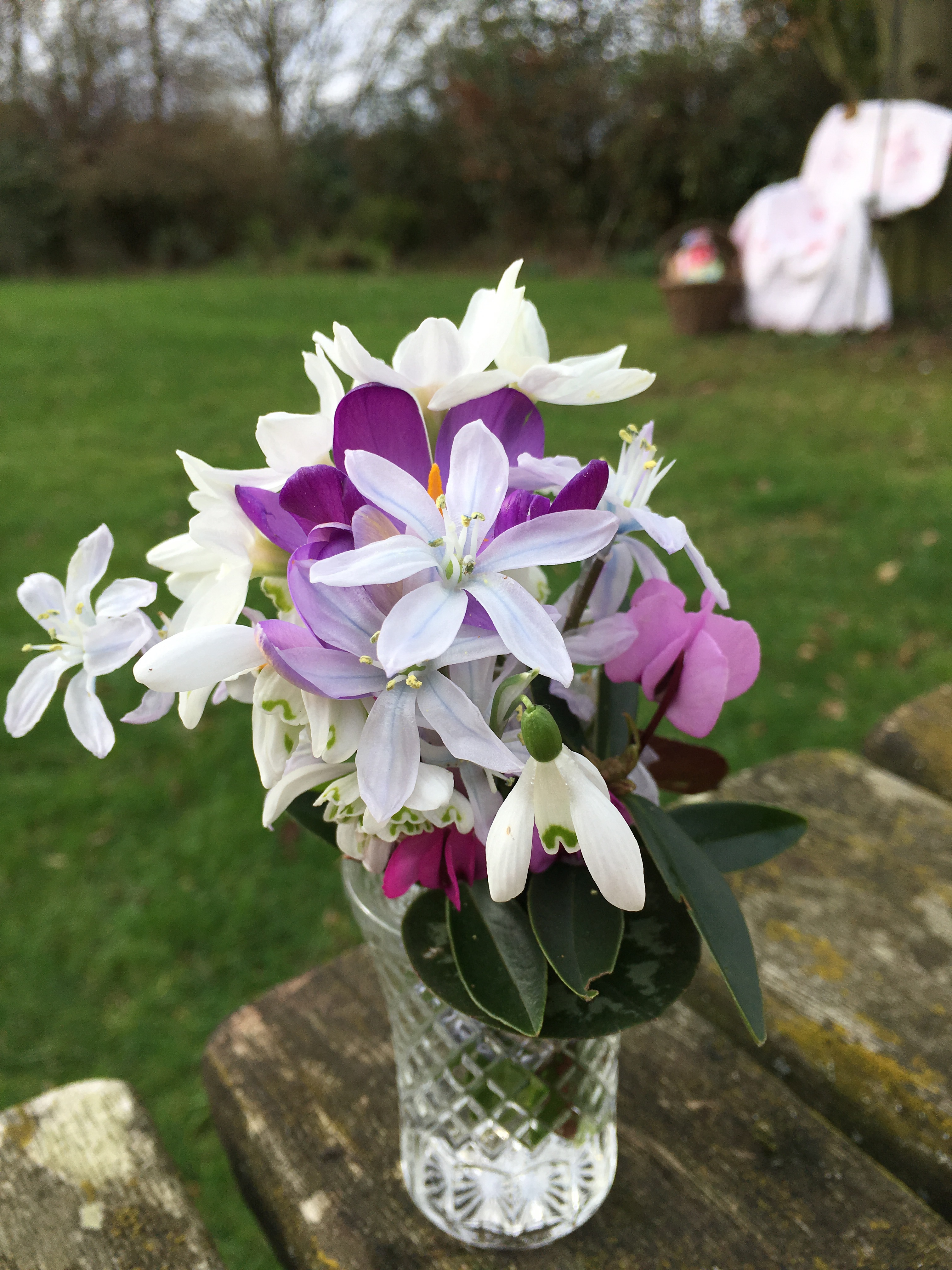
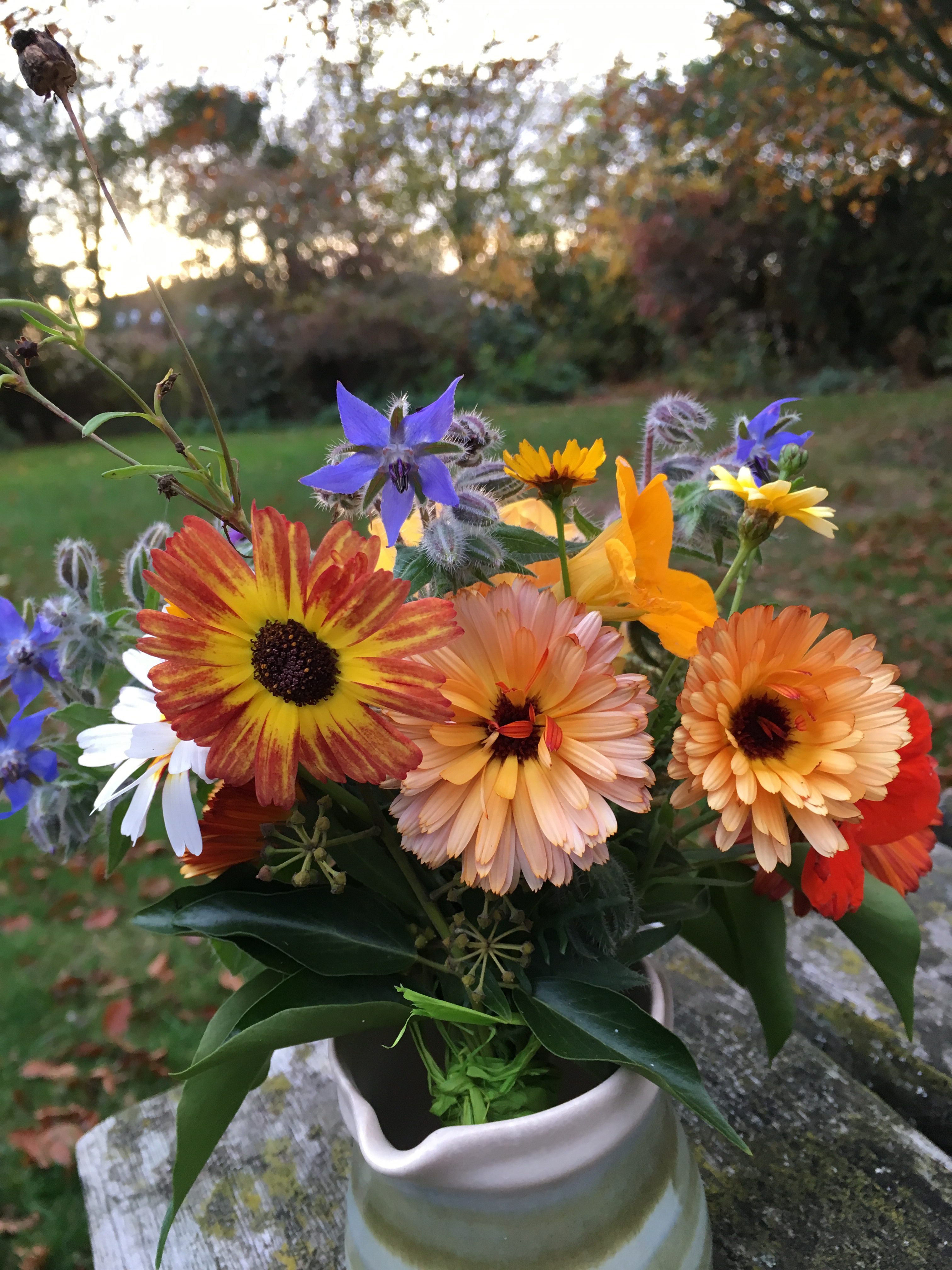
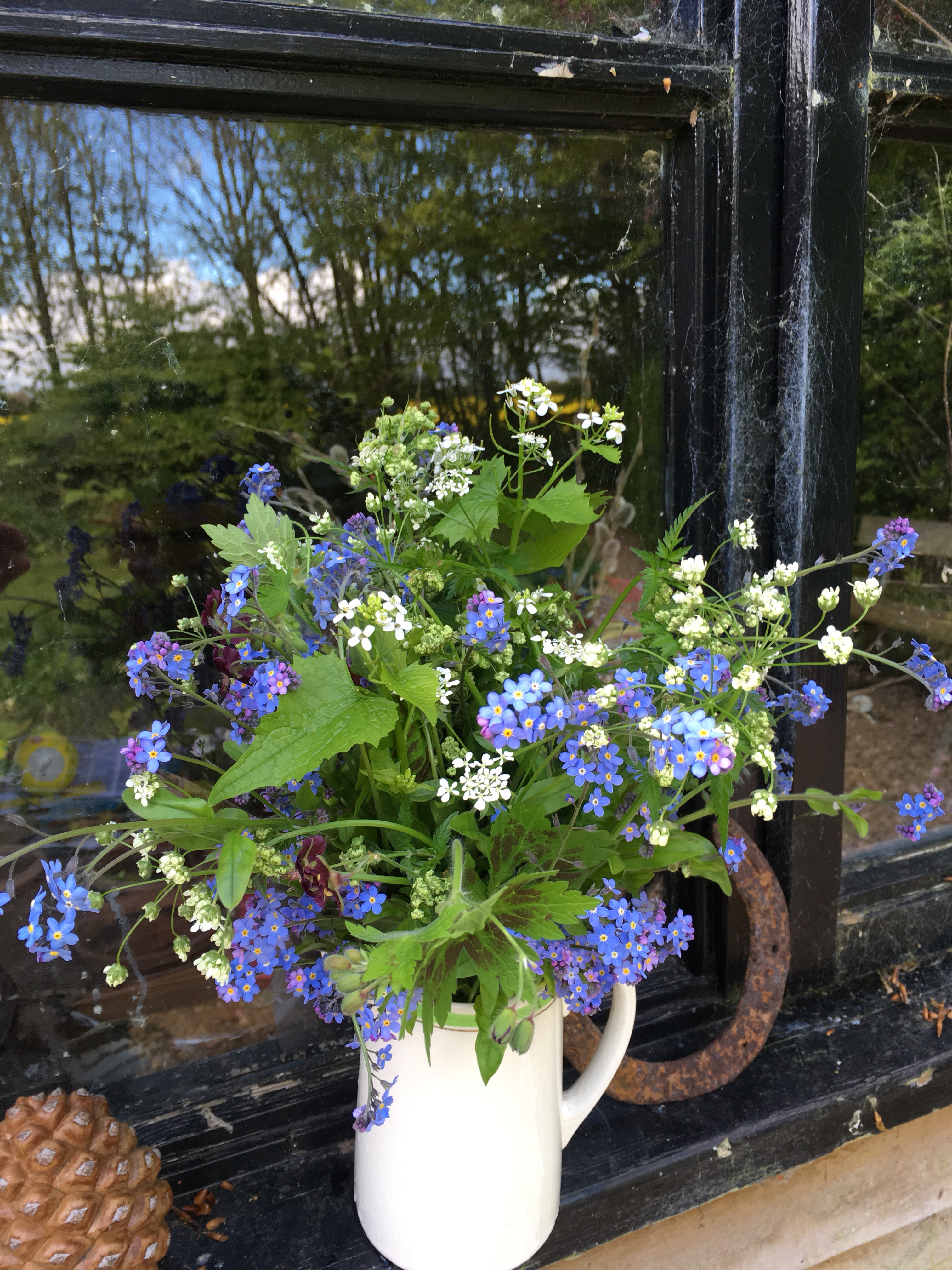
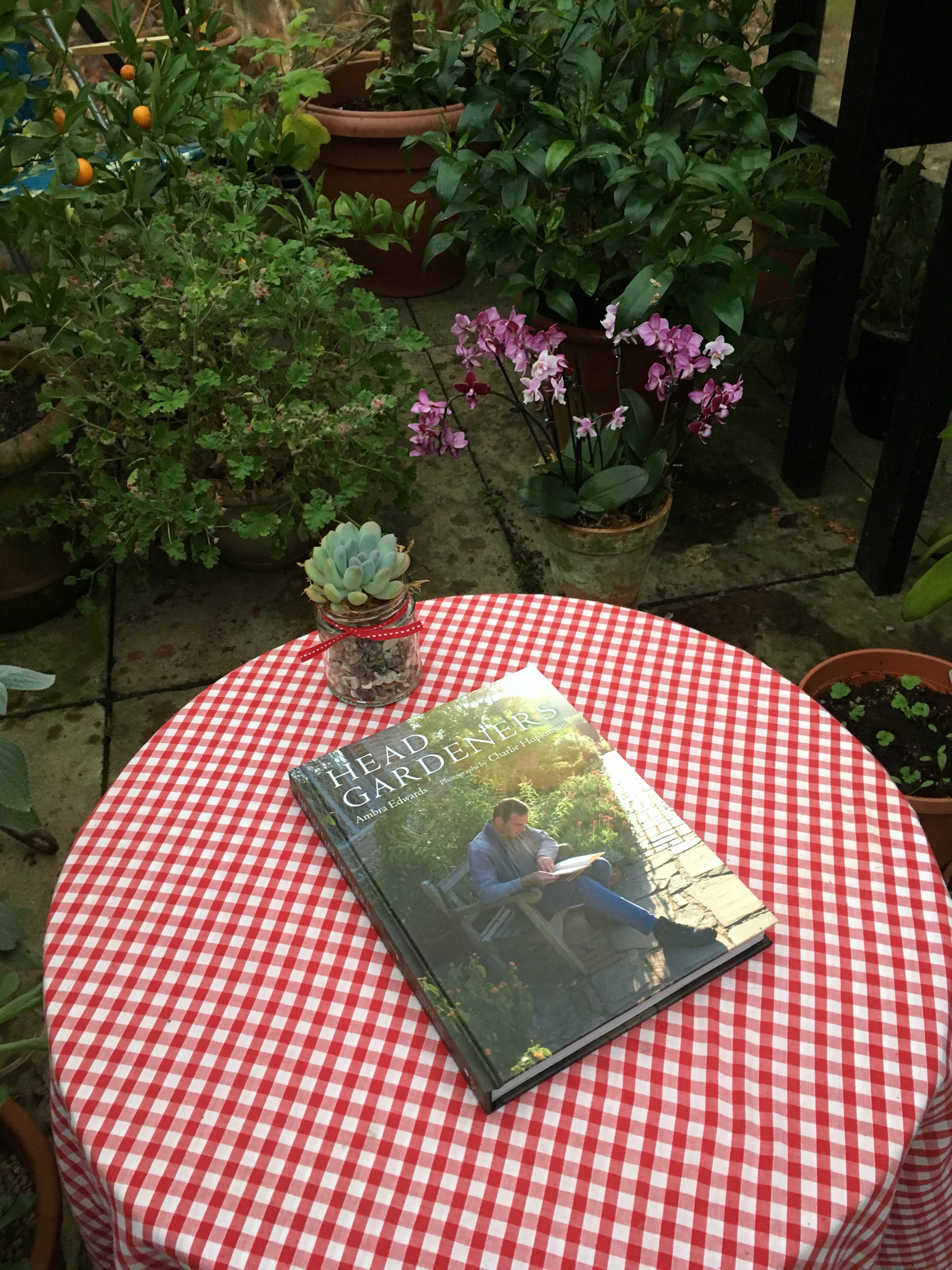
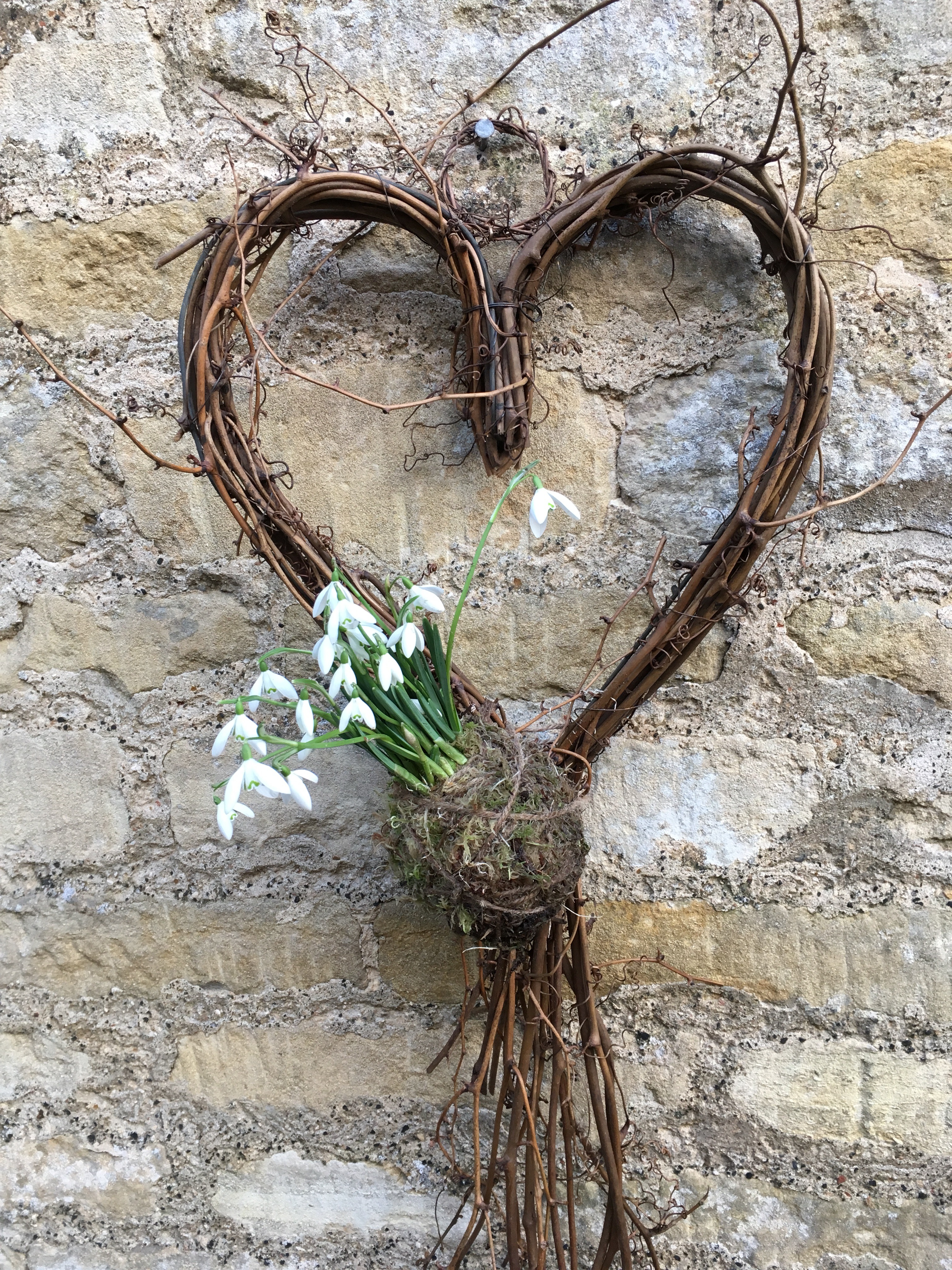
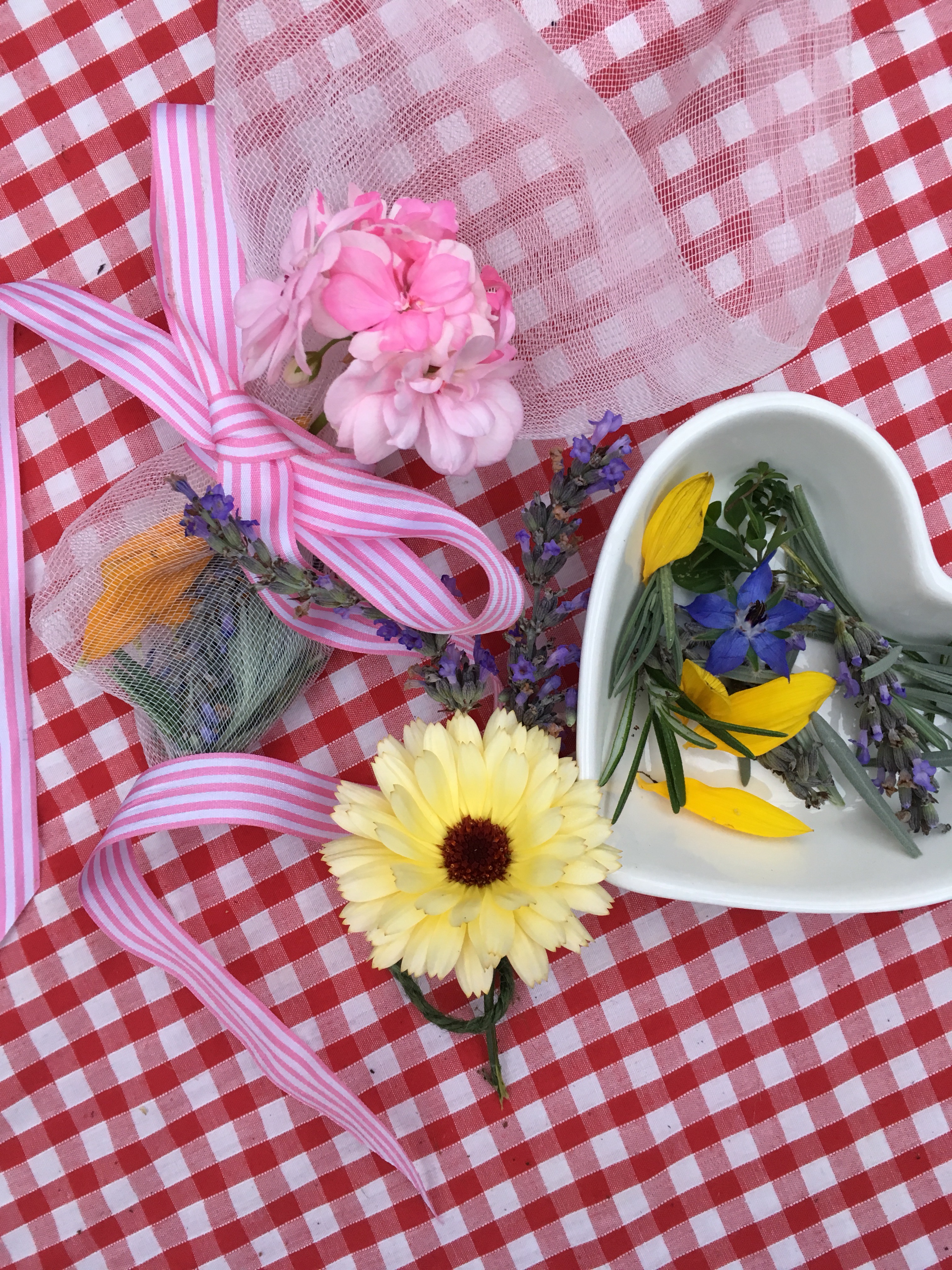
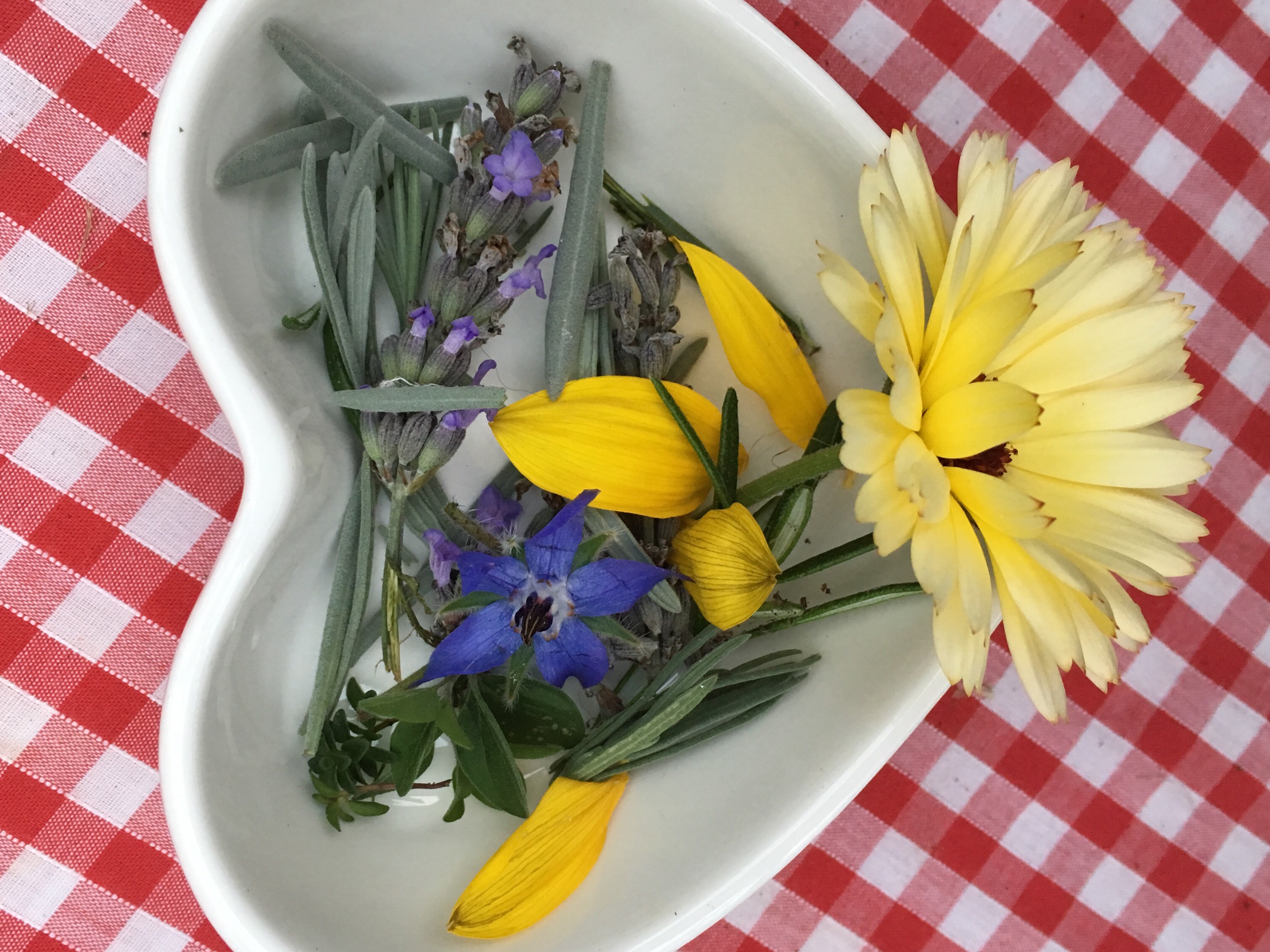
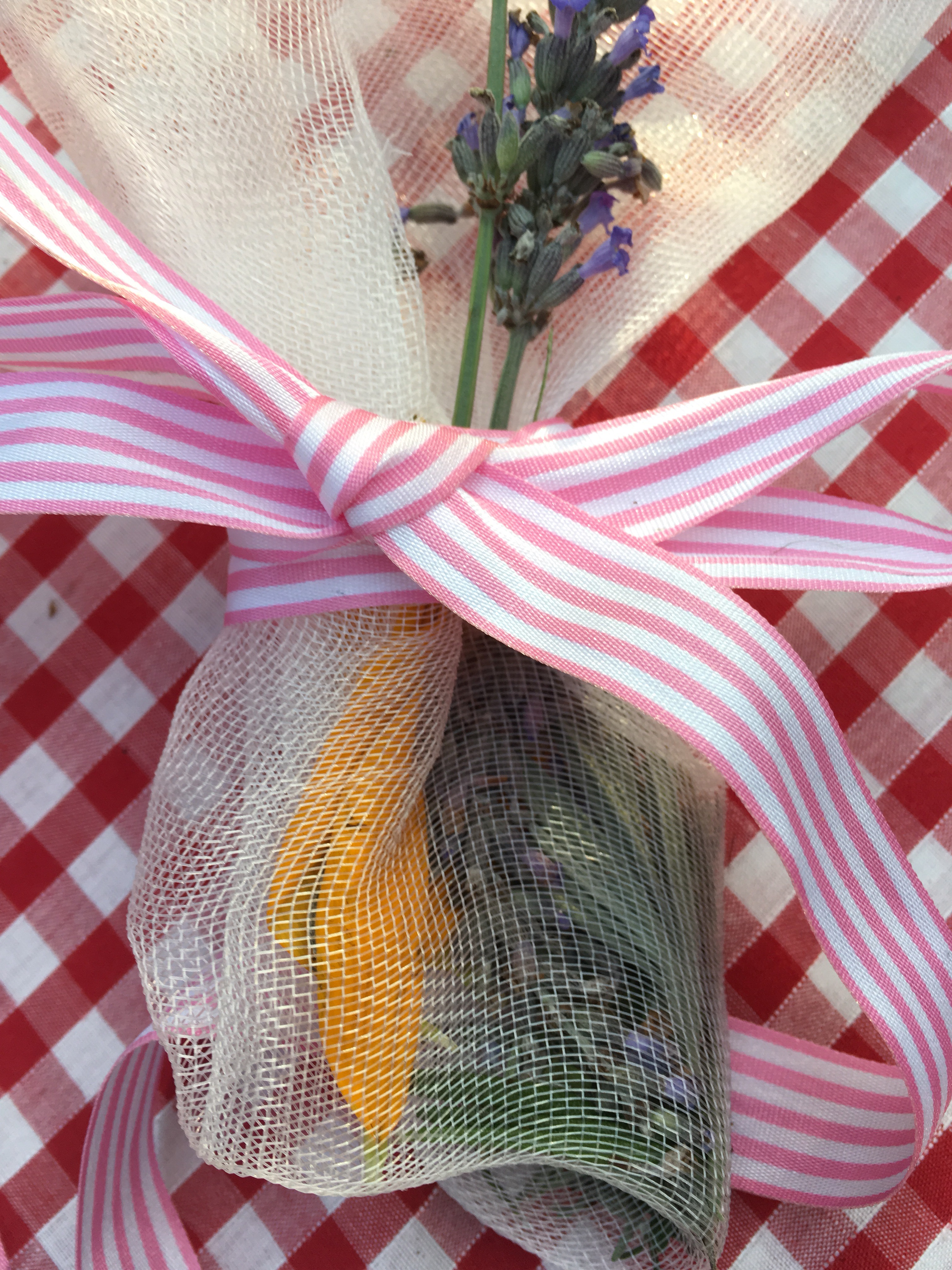
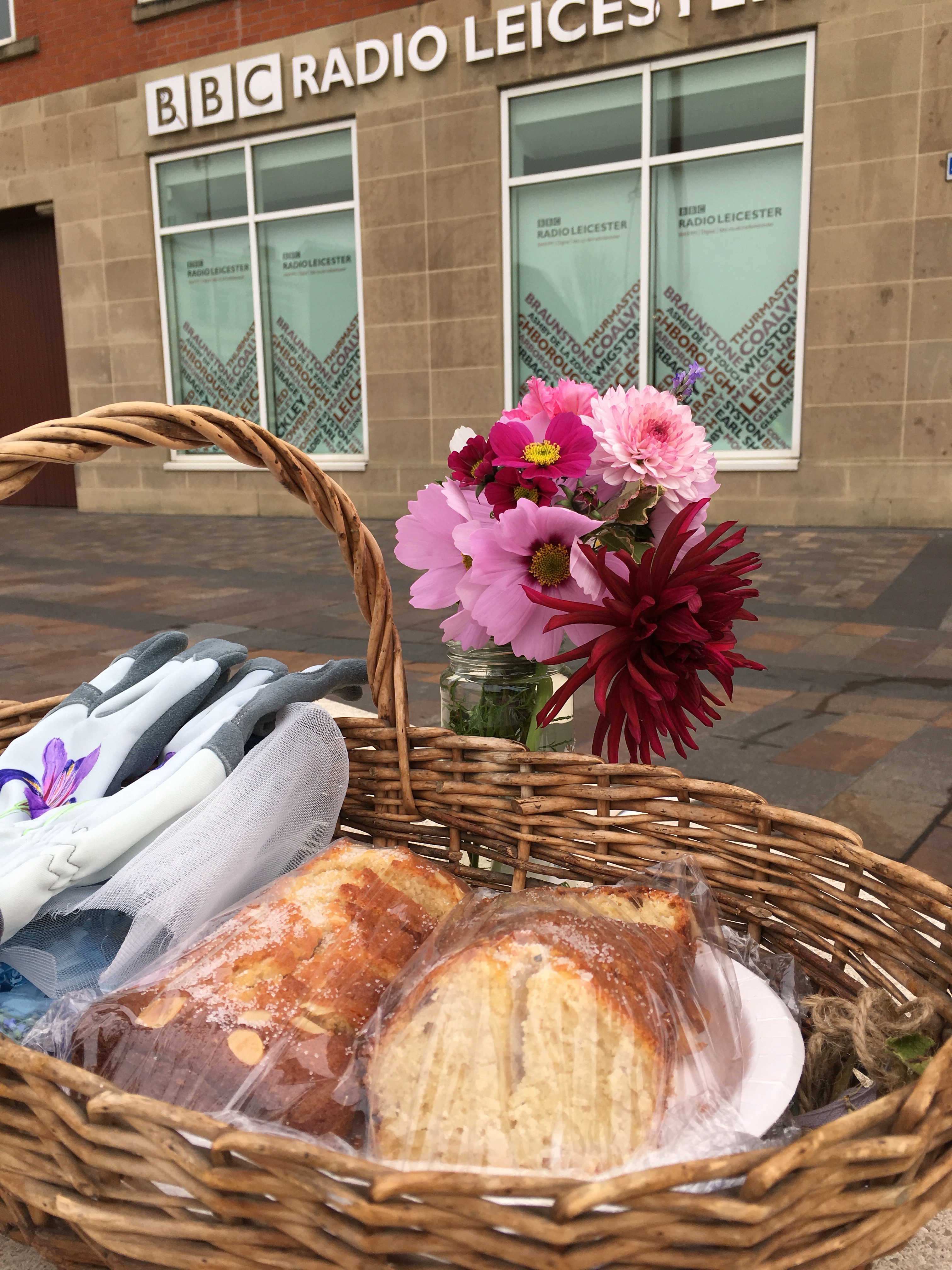
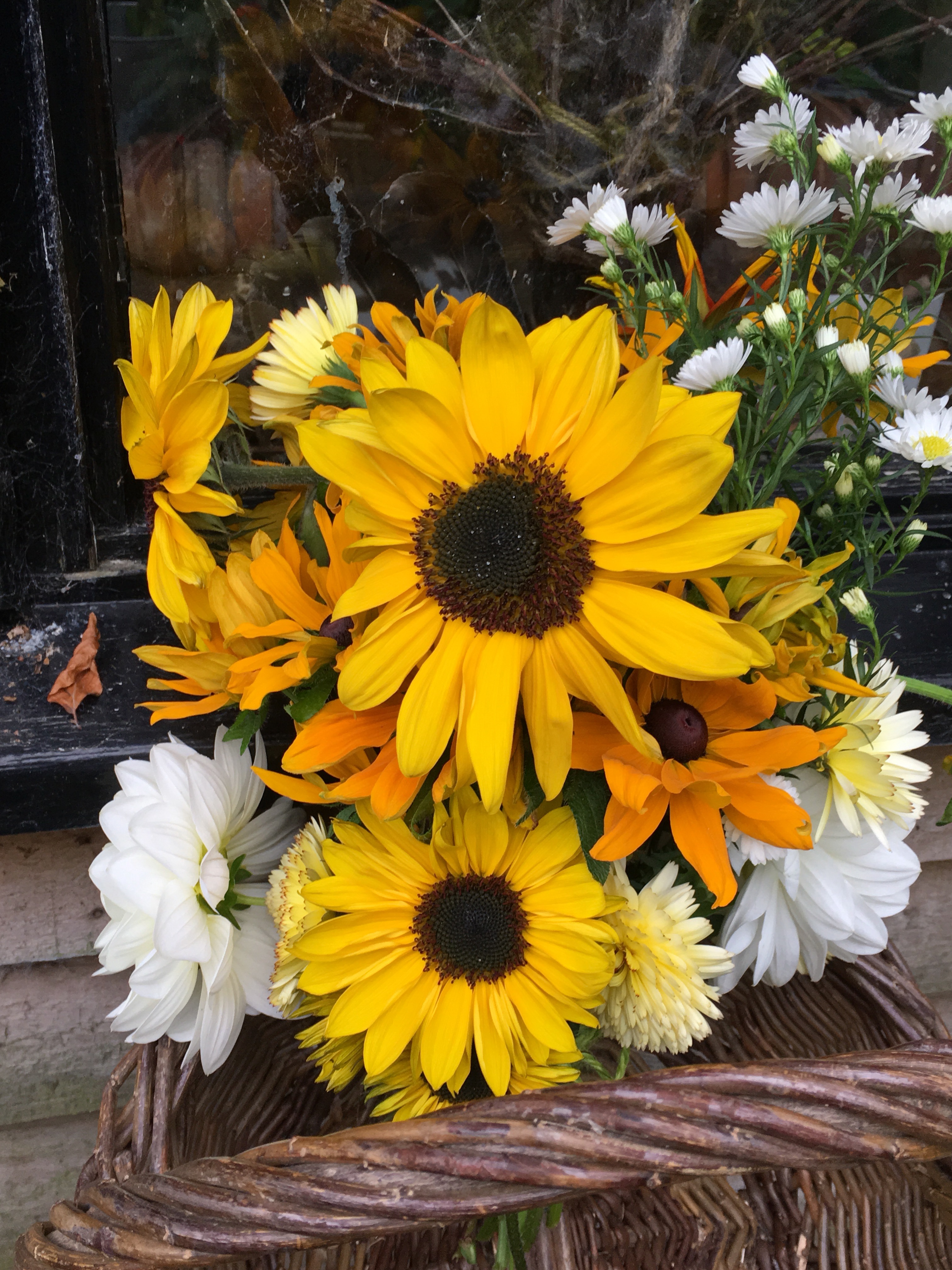
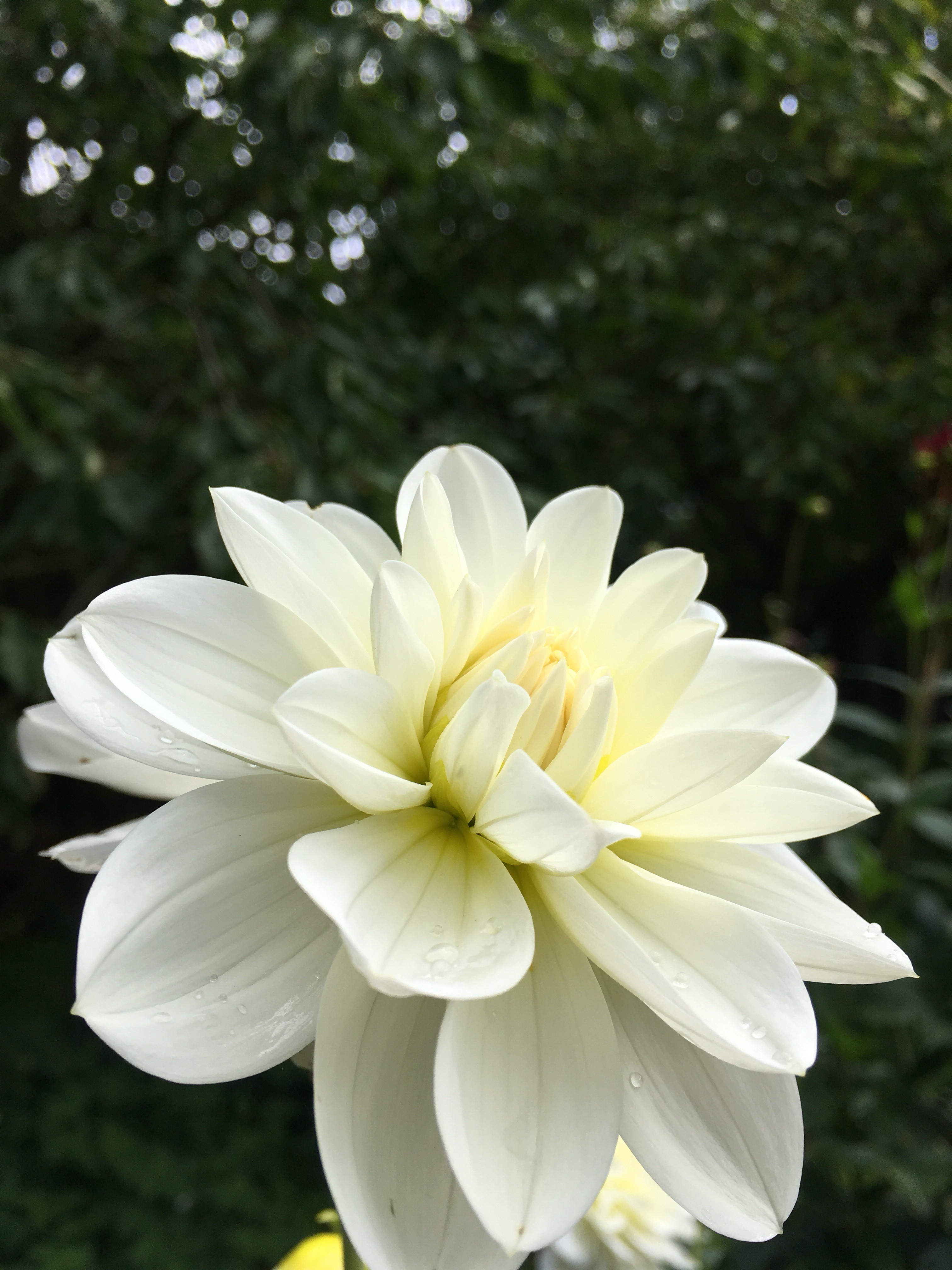
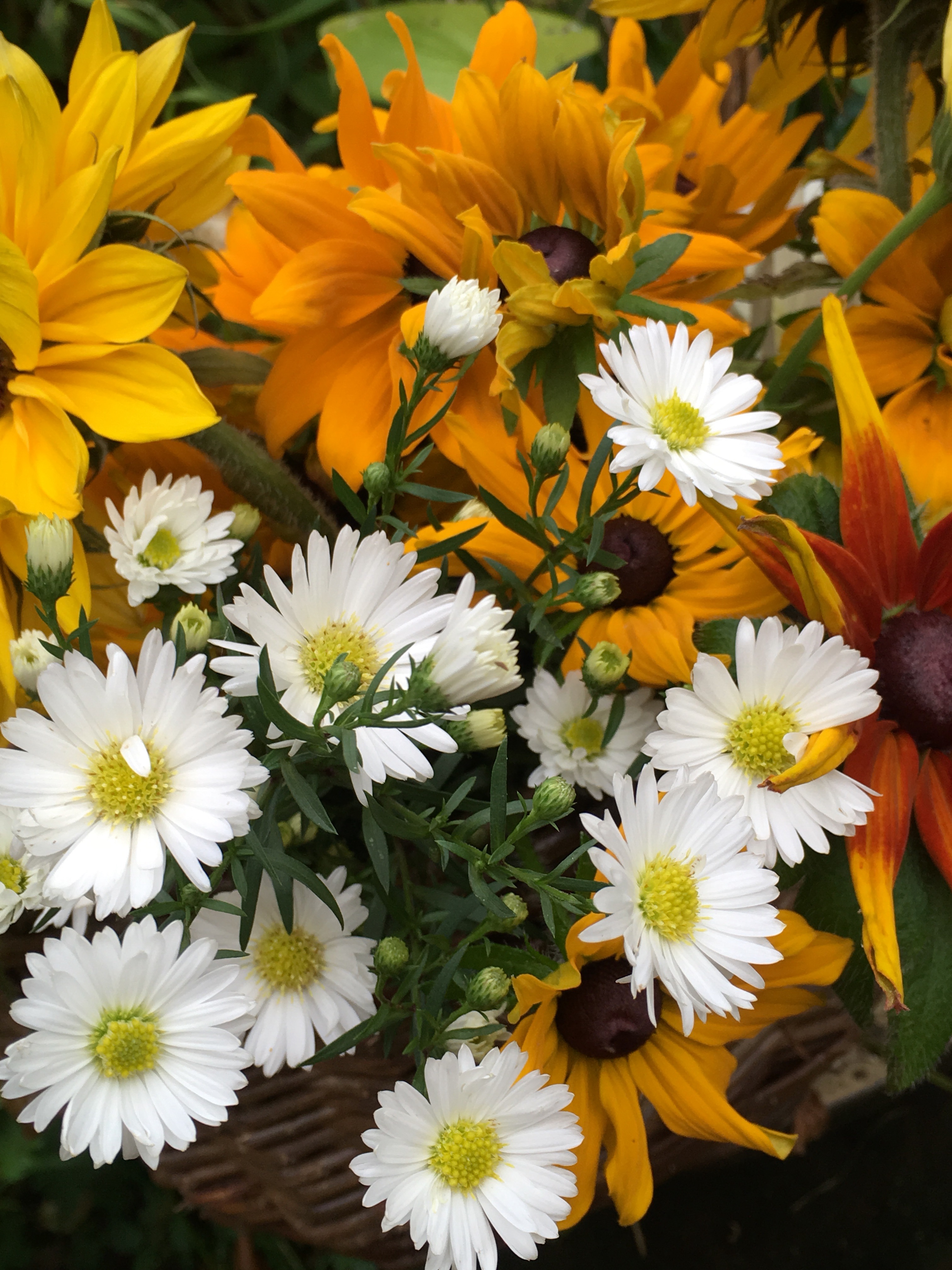
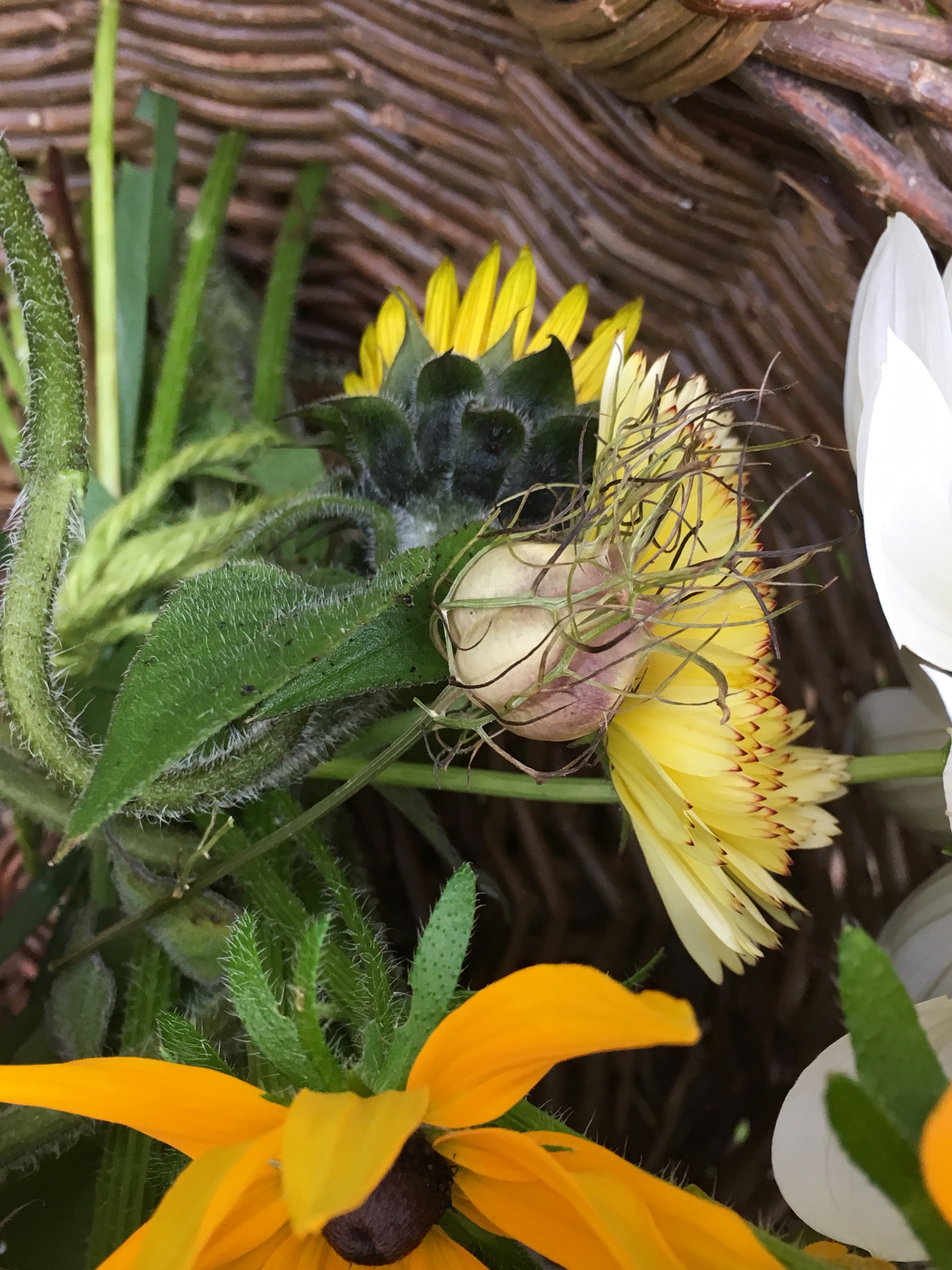
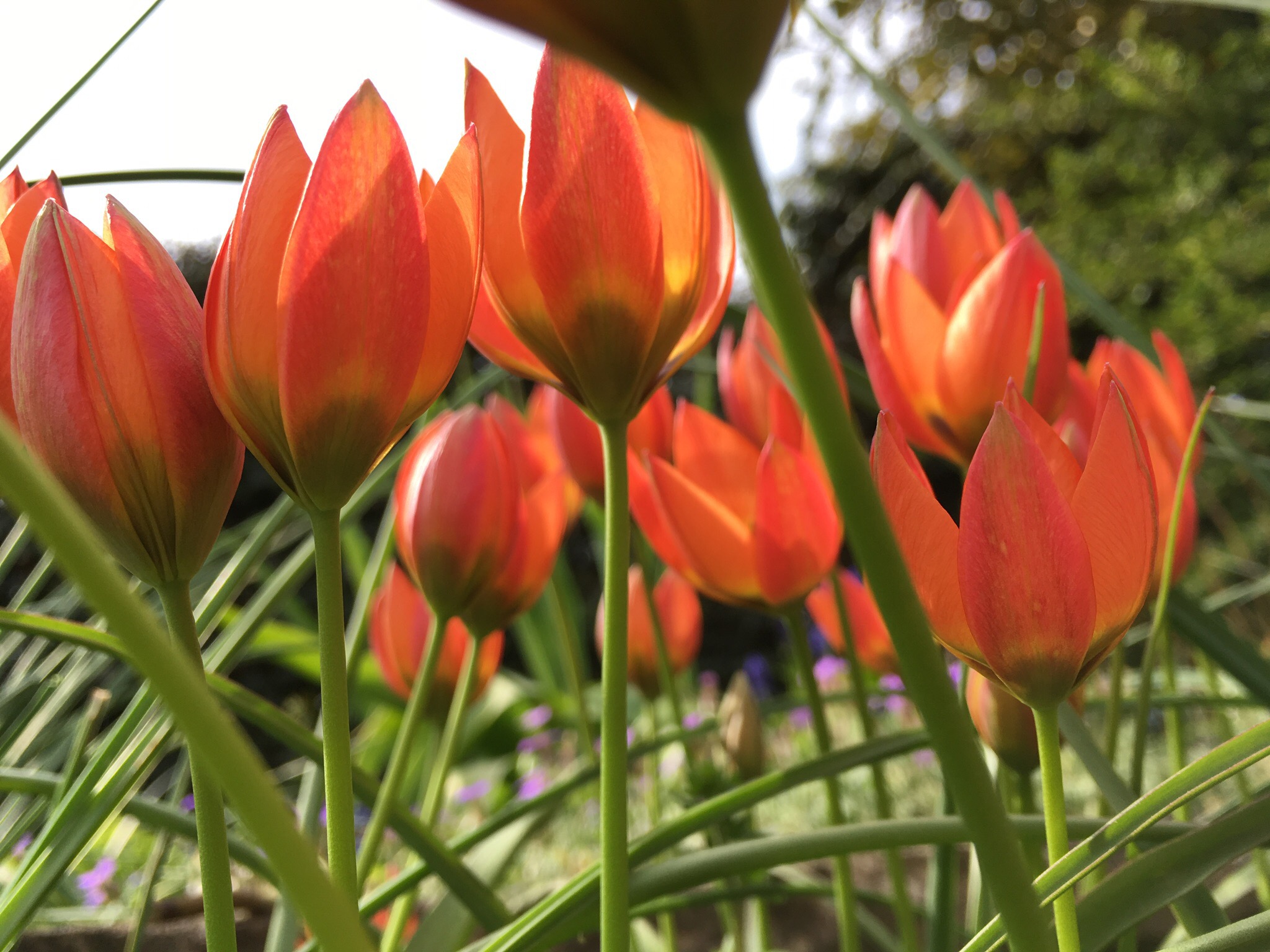
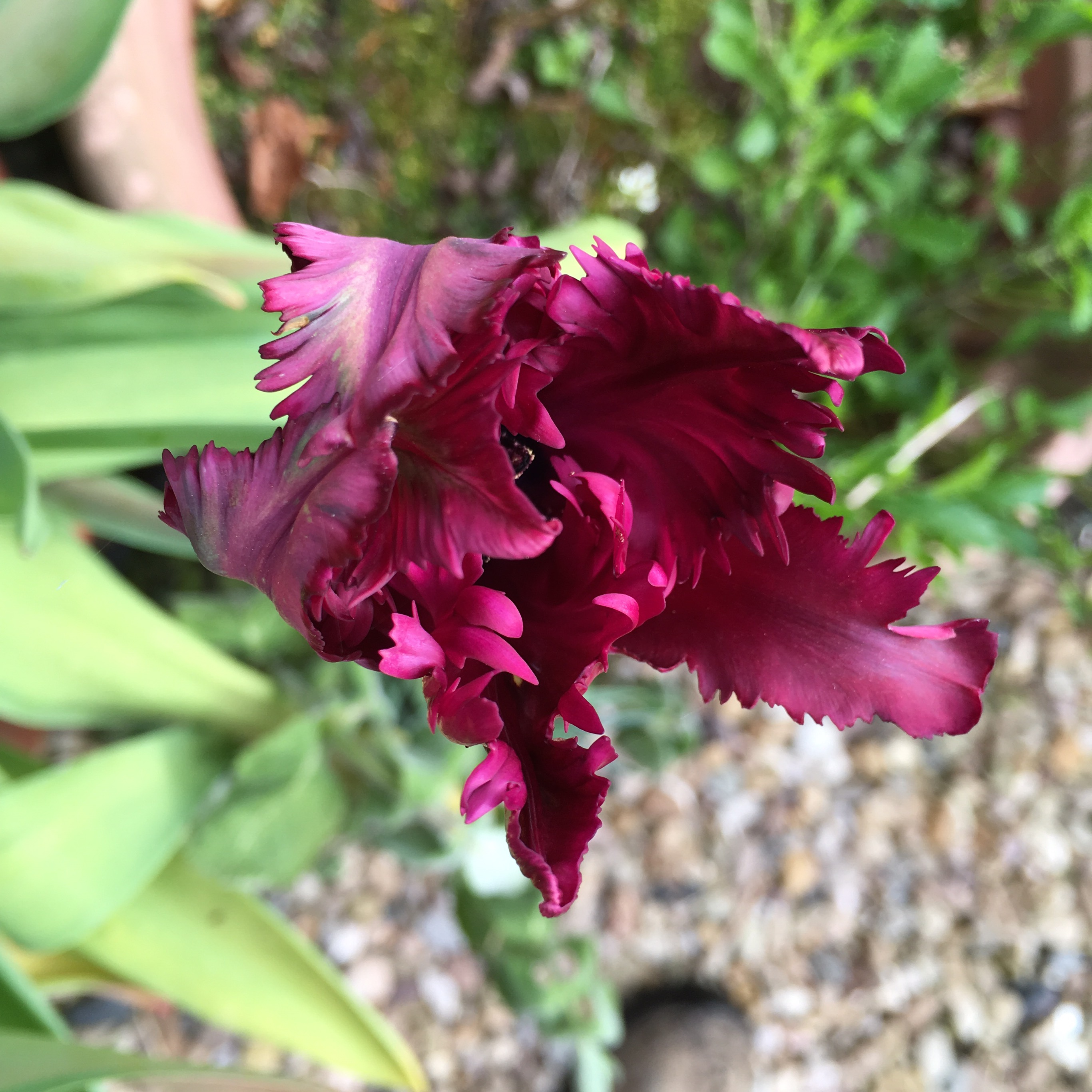
Jam jar flowers….

For In a Vase on Monday.
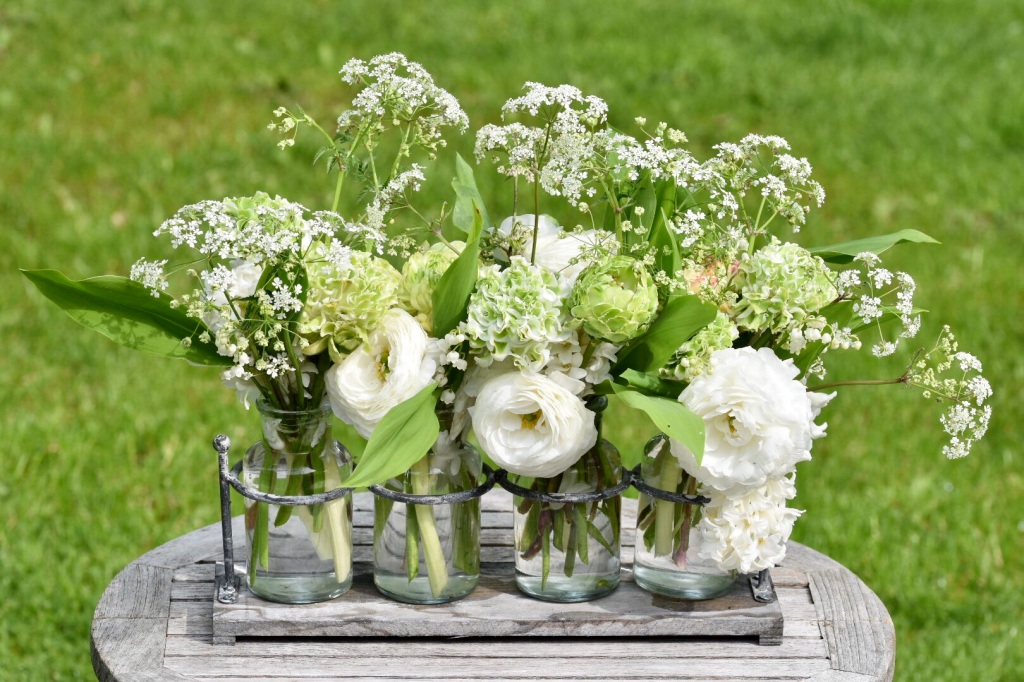
For a modern floral arrangement, four small bottles in a wood and metal holder make life very easy indeed.

These bottles remind me of the ones we used to get at primary school containing milk. Every day we had rich, creamy milk which we sipped through a straw. I loved it! Our teacher, ever ready to put science into action, got us to pour the cream, the top of the milk, into a jam jar. A lid would be added and we each had to shake the jar for as long as we could. The resulting butter was spread on crumpets warmed on the woodburner in the corner of the classroom. We all took it in turn to be ‘wood monitor’ and had to fetch the logs from outdoors. We also had a pencil, paper and skipping rope monitor. It taught us duty and responsibility at a young age. I can’t remember anyone complaining about their tasks. Probably the only thing I didn’t like about school was the outside toilets. They were freezing in the winter and full of dust and spiders. You had to run from the classroom right round the other side of the playground to reach the little row of toilets. And you had to dash there in all weathers, even if it was snowing or raining. Just before I moved schools, a new indoor cloakroom was built and I can distinctly remember everyone being very excited about the new, posh indoor loos! No more spiders or slip-sliding about in the snow. Happy days!
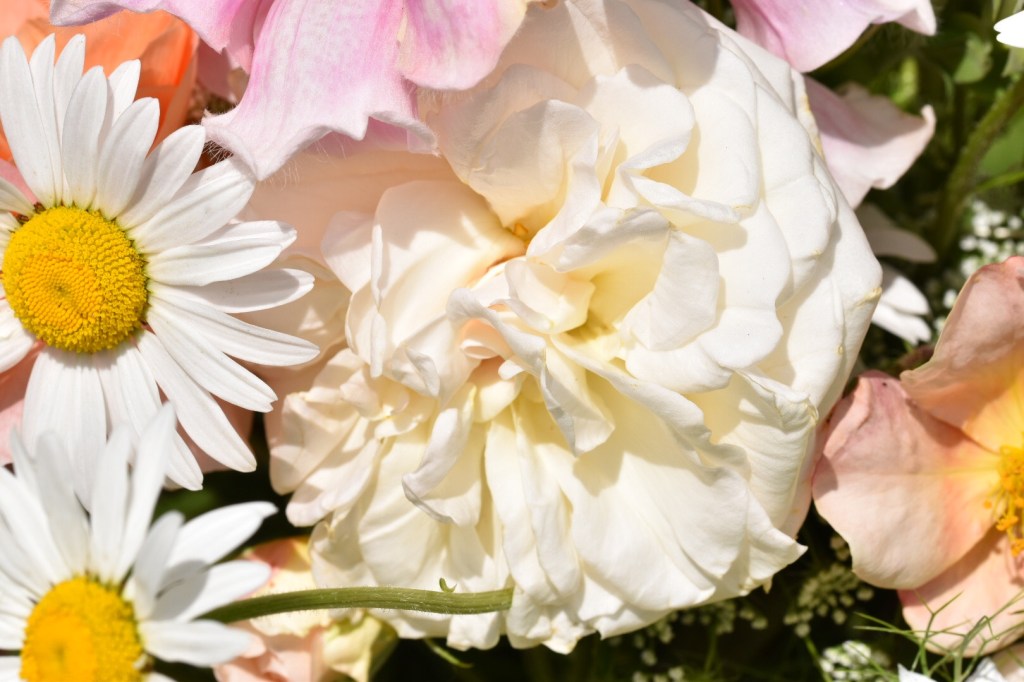
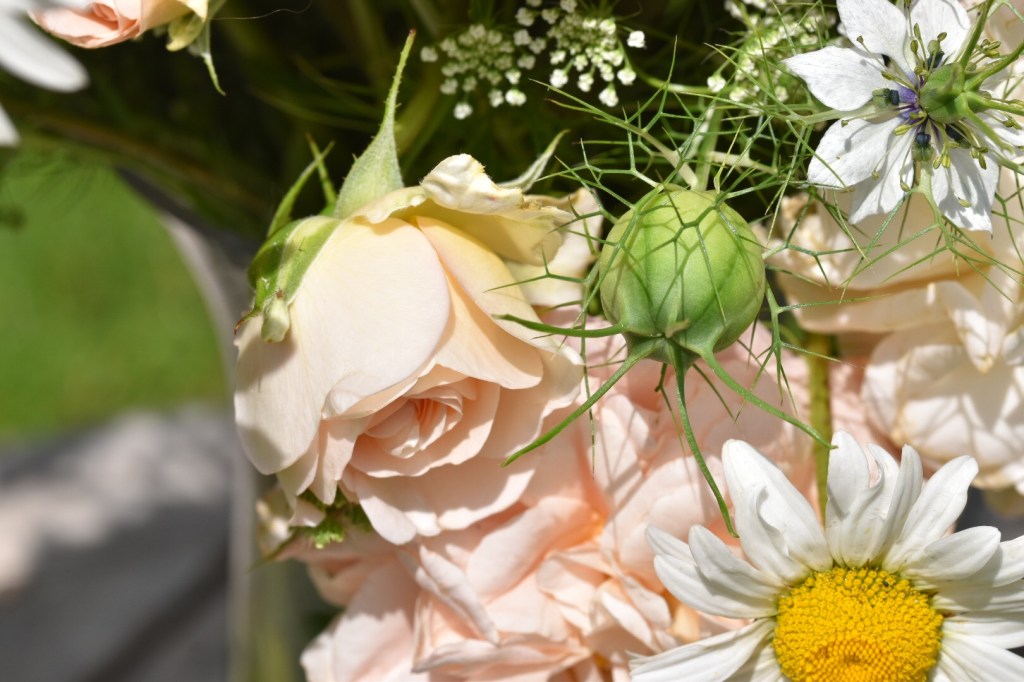
My pretty little floral arrangement was a gift from Jonathan Moseley after we worked together at the Belvoir Castle Flower and Garden Show. Jonathan was the celebrity speaker giving talks and demonstrations on floristry, and I was running planting sessions for children. I loved Jonathan’s green and white selection for the little bottles. He chose English anemones and Italian ranunculus. Aren’t they beautiful!

Jonathan is well known for using flowers grown in his own garden and weaving them into arrangements using British tulips and lilies. Here’s some Lily of the Valley from his Derbyshire garden. The scent was glorious!

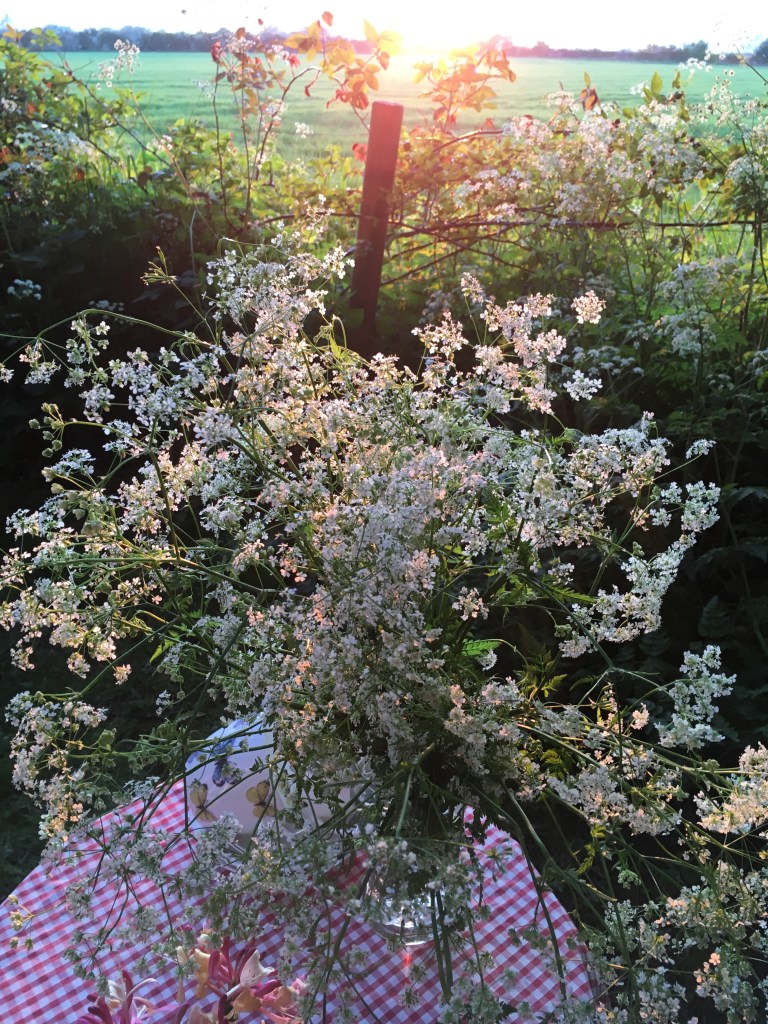
He added cow parsley from his own garden too. He mentioned that you can use cow parsley even when flowers are going over, as the little green seed heads are just as pretty.

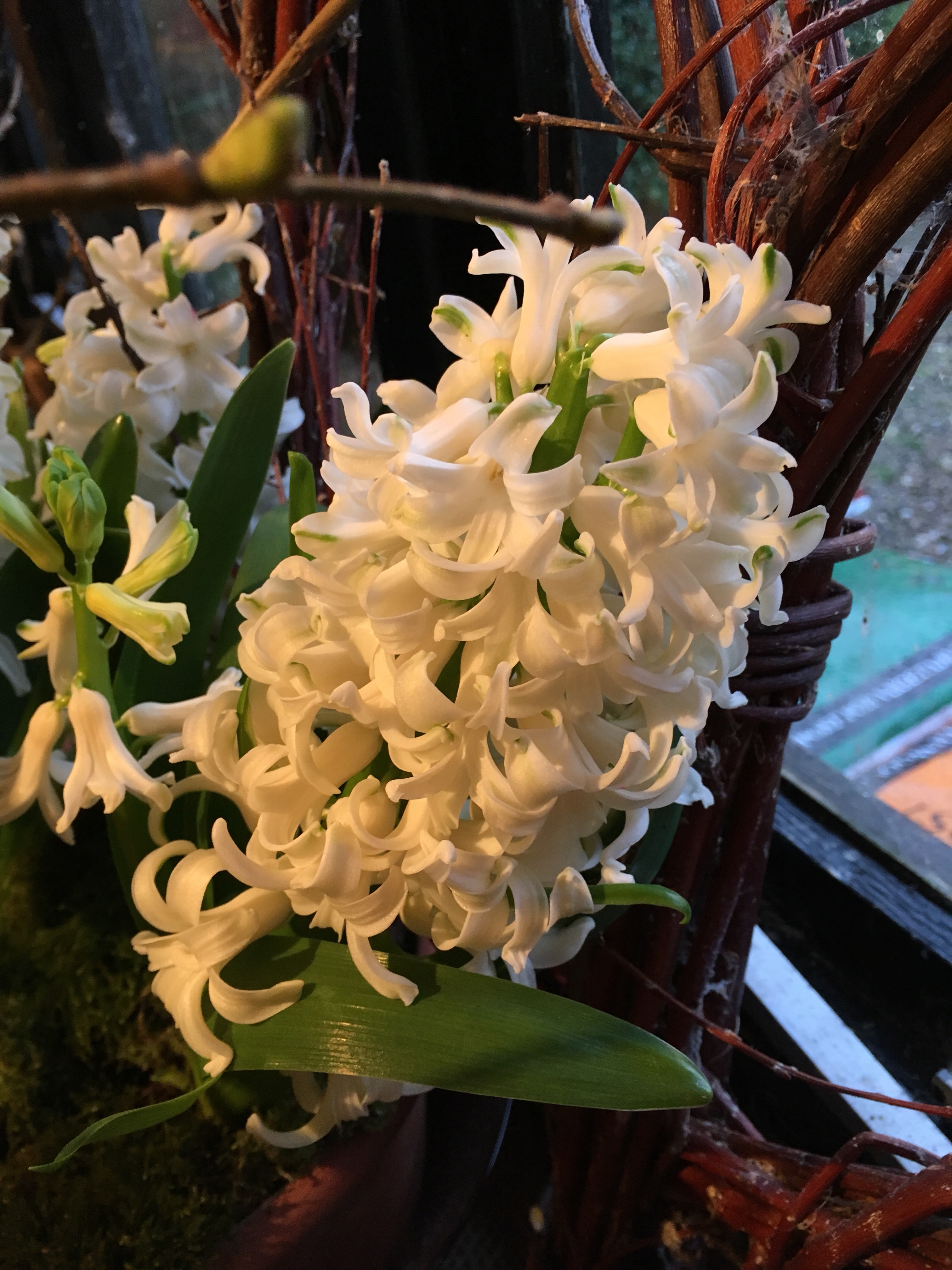
Scent is essential in flower arrangements and Jonathan added white hyacinths into the mix. I grow Carnegie White for my flower posies.
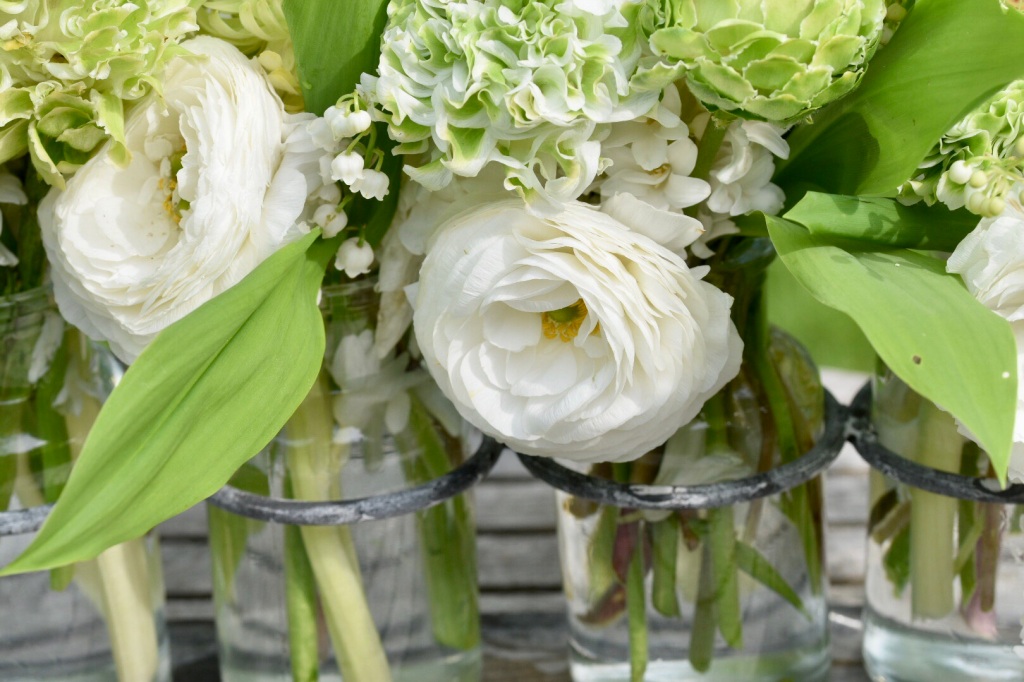
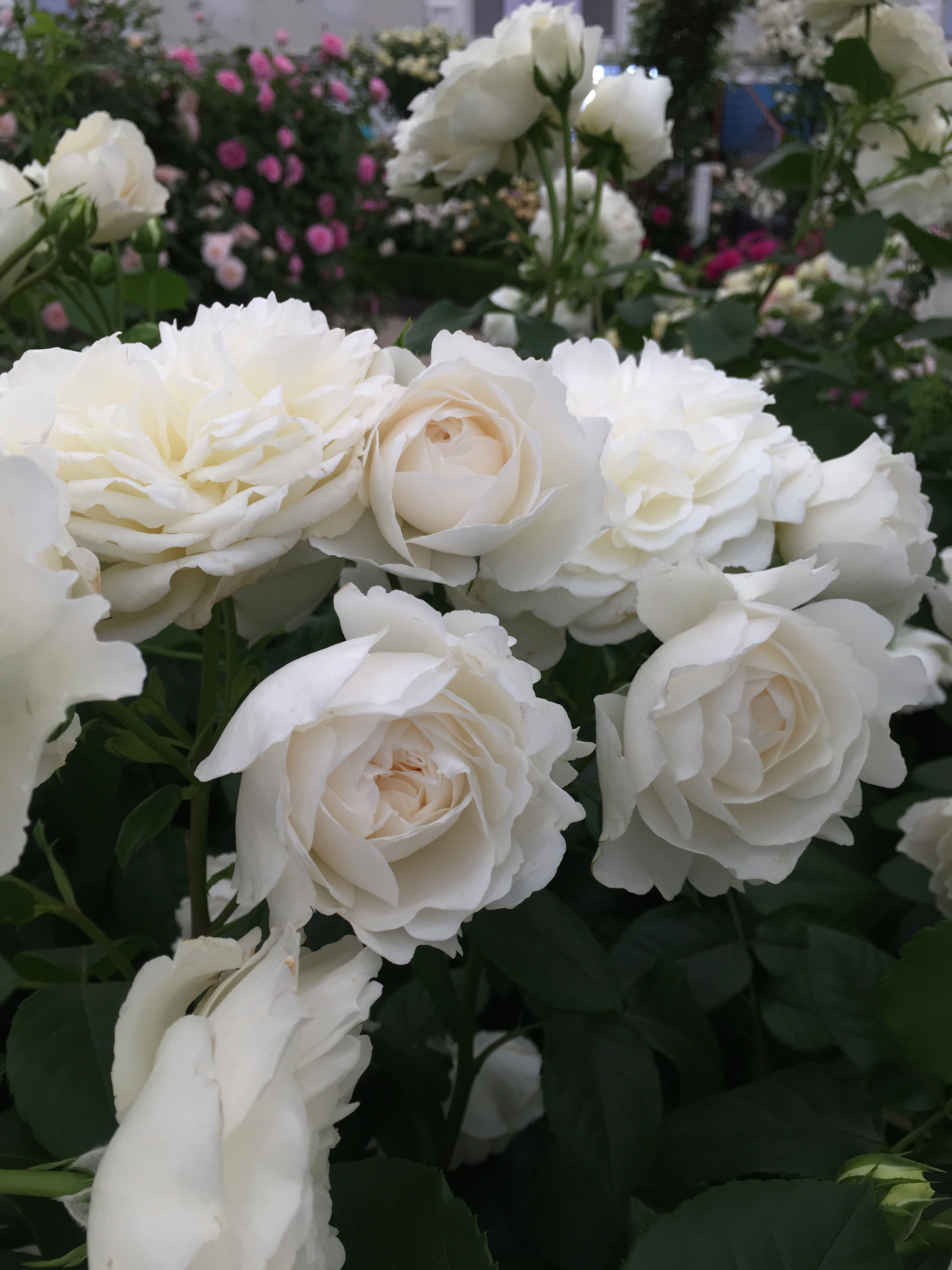
I think my favourite flowers are these frilly white ones. They lasted at least two weeks, as I changed the water daily and snipped a tiny amount off the bottom of each stem.
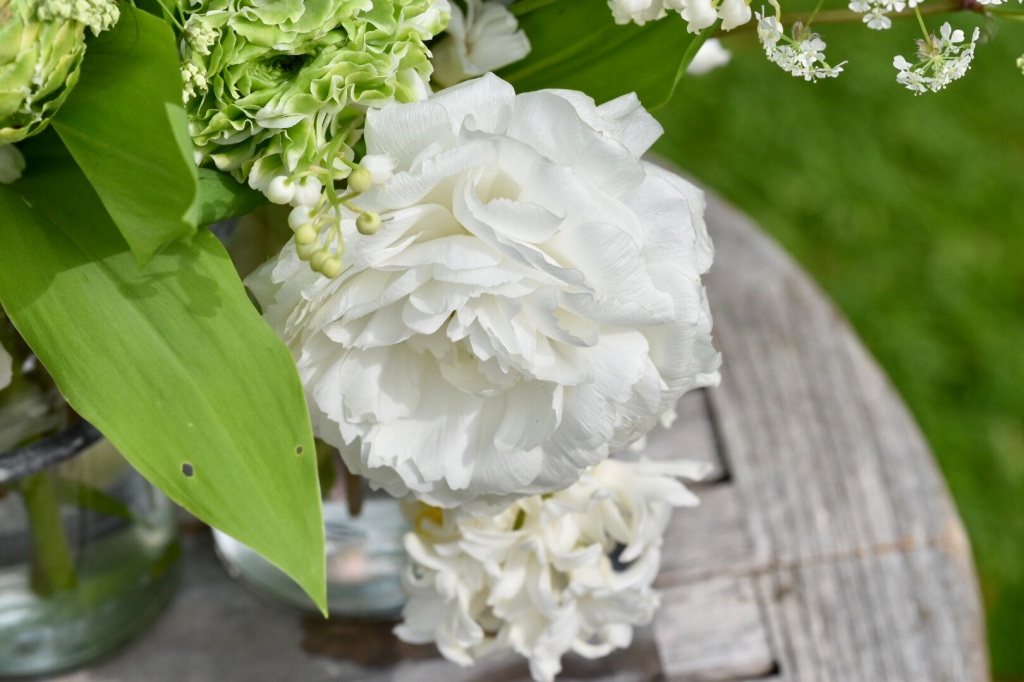
I’m growing white anemone coronaria ‘Mount Everest’ in a large pot in the greenhouse. These have provided a few blooms each week since February. Farmer Gracy and Taylors sell corms for planting in autumn or spring. Soak the corms in water for a few hours before planting and space them 10cm apart and 5cm deep. They can be grown outdoors, but I find the rain spoils the flowers, if you want to use them for floristry.

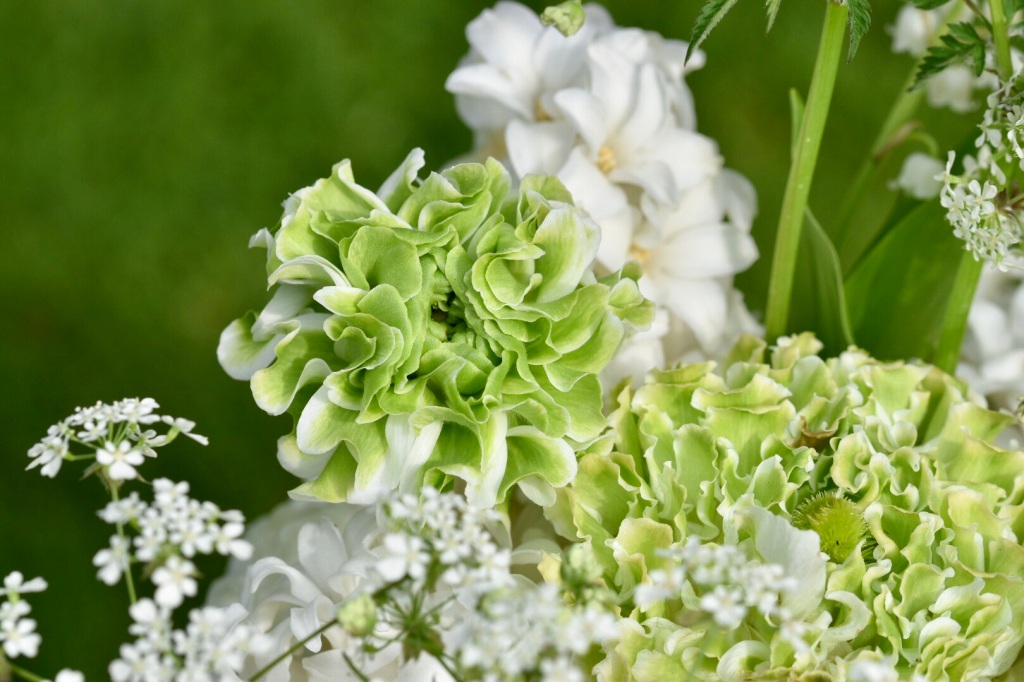
I’m particularly fond of green flowers, so this one fitted in nicely.
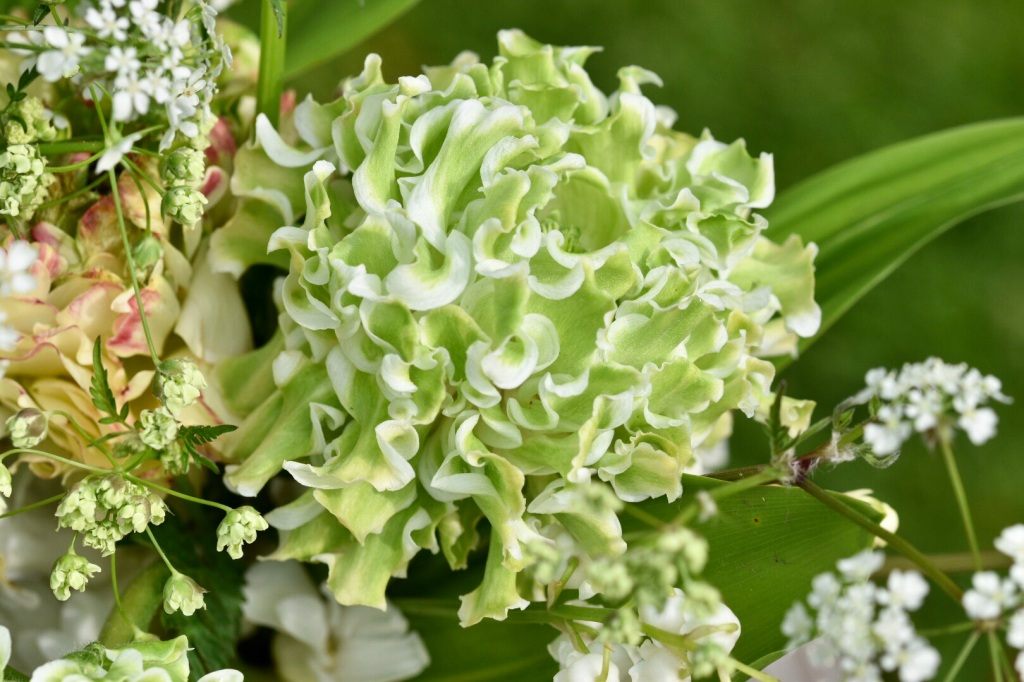
Aren’t flowers just amazing! This one is a white and green ‘Pon Pon’ ranunculus. They remind me of a flamenco-ruffled dress!
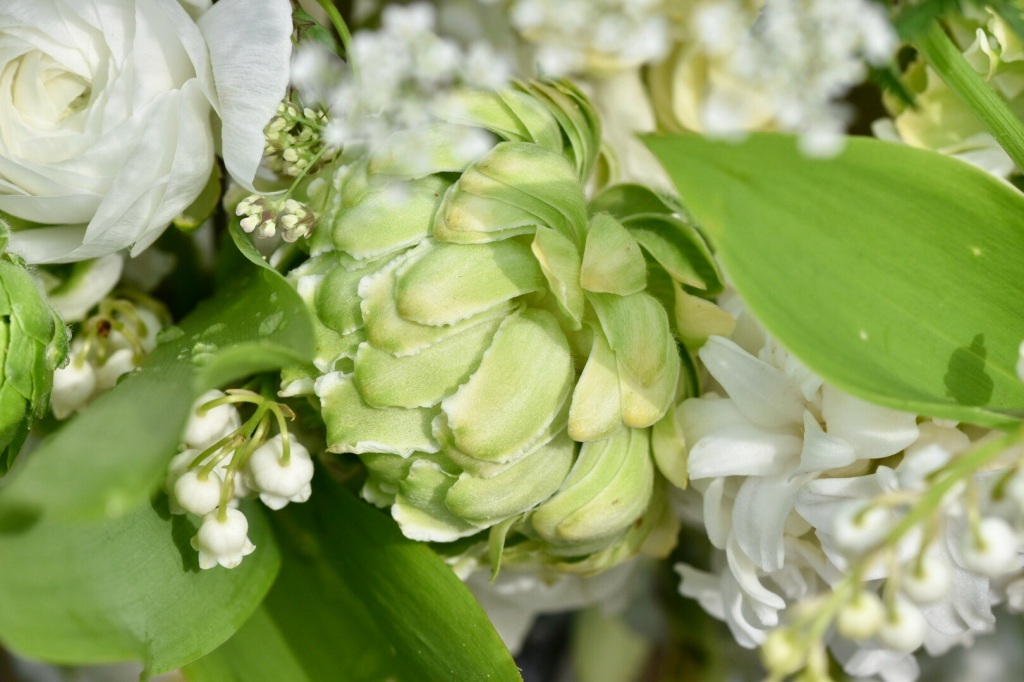
Green ranunculus.
Flowers looked just as beautiful from both sides. This would make a fantastic display for a dinner table. It’s not too high that guests can’t see each other. The bottles and stand set is available on Jonathan’s website.

Jonathan is a writer, broadcaster and demonstrator as well as an ambassador for British flowers, and regularly appears on television programmes such as Alan Titchmarsh’s Love Your Weekend.

https://jonathan-moseley.com/

Why not go over to Cathy’s blog to see what others are writing about this week for Cathy’s In a Vase on Monday meme.

https://ramblinginthegarden.wordpress.com/2024/06/03/in-a-vase-on-monday-dining-out/

Are you growing any flowers for home floristry this year? Get in touch and let me know how you are getting on with your growing plans. Please leave a comment in the box below. Have a happy gardening week! And thank you for reading my blog.

Christmas Traditions….

Christmas cannot start for me without a trip to Calke Abbey and a walk round the gardens with a good friend.

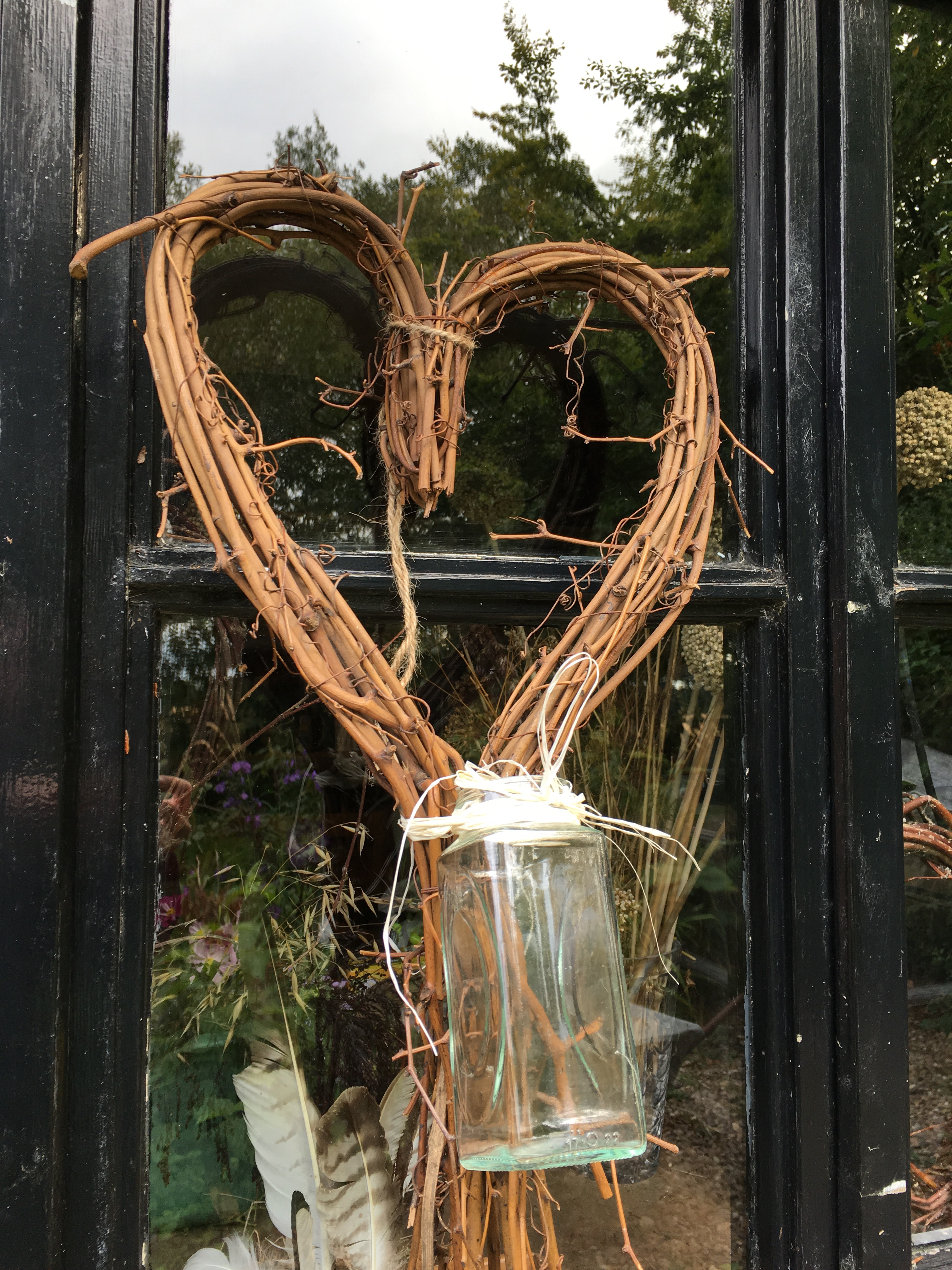
This is a tradition we started some years ago and it’s one I look forward to each year. We love the decorations in the walled kitchen gardens. This ‘kissing bough’ caught our attention. Isn’t it beautifully-made with natural materials gathered from the grounds.

The decorations in the auricular theatre are always worth seeking out as they change with the seasons.

Some of the greenhouses are open to view. We had a look in the fern house, which was being cut back and tidied. This one below wasn’t open, but we admired the architecture of the building and imagined it in full production 100 years ago. The walled kitchen garden looked immaculate and all set for the new growing season.

Some cardoons giving winter interest in the walled kitchen garden.

We spotted some rhubarb emerging from the ground. Quite a cheerful sight! There are terracotta rhubarb forcing pots in the gardens which will probably be placed over these plants to encourage an early crop.

Fruit tunnels in the kitchen garden. These are extended in summer and covered in climbing beans and squash.

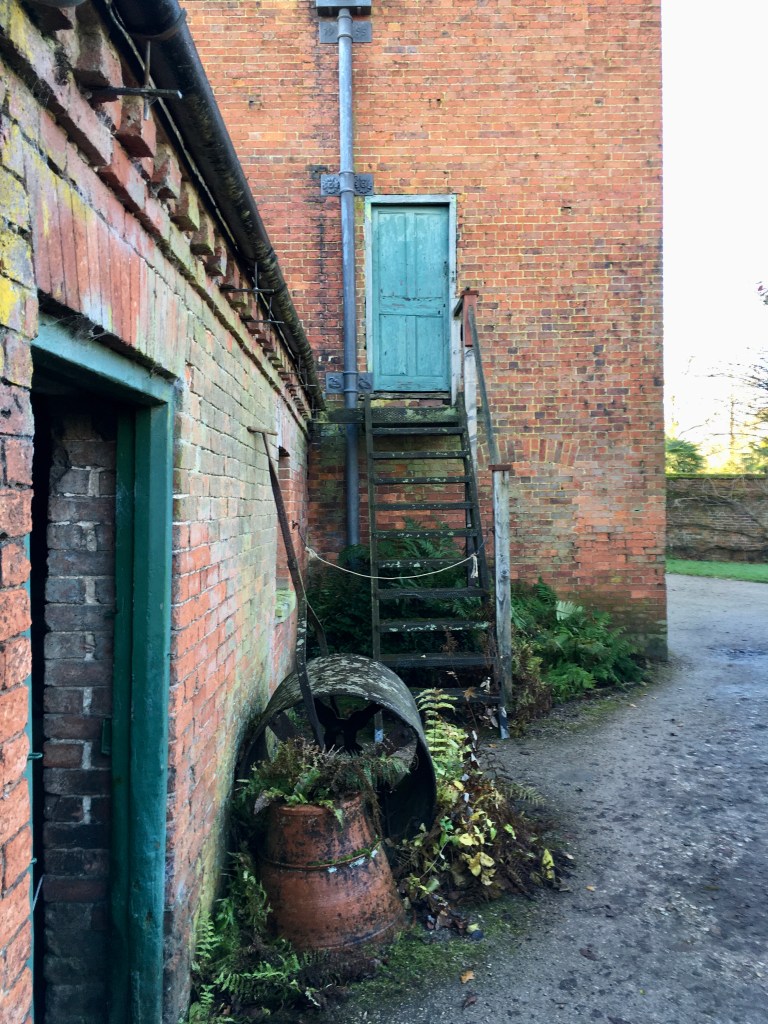
We moved on to the potting sheds. We’ve seen these hundreds of times before, but never tire of the view. It’s a glimpse back into past-times and an indication of how gardeners lived and worked when Calke Abbey was a family home. We could just imagine the strength needed to pull that enormous roller.

We ponder at the work needed to keep all the boilers lit through the winter. Junior gardeners would be tasked with the job of feeding the fires and there’s one potting shed with a platform bed in the roof where the gardener would sleep as this was a 24-hour task in those days.

We haven’t seen this room before. The door is usually locked.

It’s fascinating to see the extensive boilers used to heat the orangery on the other side of the potting shed wall.

The pony shed with little leather ‘shoes’ for the pony so its hooves didn’t mark the lawn.

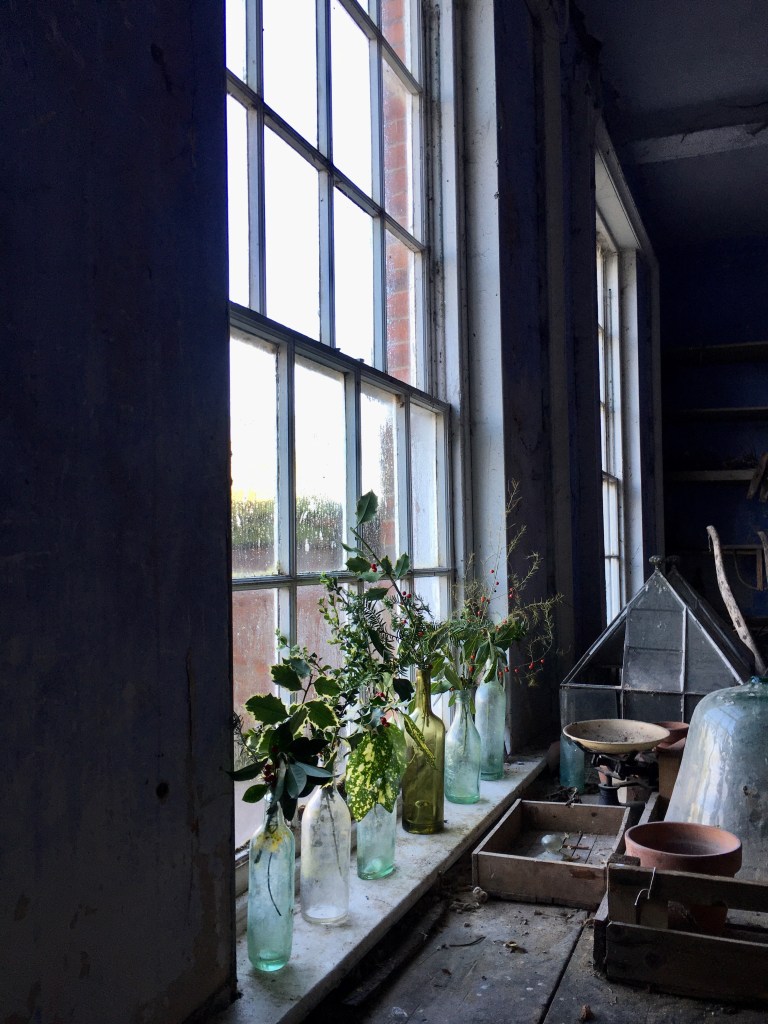
A favourite view of the main potting shed window. I could just imagine standing in front of that window, filling terracotta pots with compost.

I would love to dip into those seed drawers and look at the little envelopes contained in there.

The tool shed, and first prize certificates from horticultural shows the gardeners attended. How proud they must have been of their award-winning produce, fruit and flowers.

On the other side of the potting shed is the renovated orangery containing many exotic plants including this white datura known as angels trumpets. It has a fabulous scent, but is very highly poisonous so I won’t grow it now.

A favourite view looking up through the orangery glass dome. A feat of engineering when it was built.

A beautiful abutilon alongside the palms and datura. How lovely to see such exotic flowers in winter.

We love the Christmas tree, and all the shadows from the architectural plants, the palms and agaves.

A walk around the grounds. We couldn’t remember a time when the lake was ever as full as it was today. An indication of the really wet autumn and early winter we’ve had so far. Ice from the lake used to be cut and dragged up the slope to the ice house to our right. In my lifetime, there’s never been a winter when the ice has frozen solid enough to be used like this.

Our favourite route around the field at the back of Calke was closed, probably because of the rain making the ground sodden. I felt sad we couldn’t walk along the skyline down to the house. It’s amazing how we have little rituals like walking along a certain path and taking a certain route. And how upset we feel when we can’t go the usual way past familiar trees.

The skyline walk. Hopefully it will be open next time we visit.

After Calke, we made our annual pilgrimage to Staunton Harold. The trees reflected in the lake looked a picture today. We always have cake and tea in the little cafe in the courtyard.

The statues at the gate are always admired, and look especially fine on a sunny day, set against a blue sky.

The matching pillar on the other side of the entrance gateway.

We bought Christmas gifts, pottery and plants, and had yet more tea. I feel so grateful to have had a sunny day spent in the company of a good friend, and I’m revitalised and ready to face the busy week ahead preparing for Christmas.

Thank you for reading my blog. Have you any traditions you follow in the run up to Christmas? How are your preparations going? Do get in touch and let me know how things are going. Happy Christmas!

Winter cuttings on BBC Radio Leicester

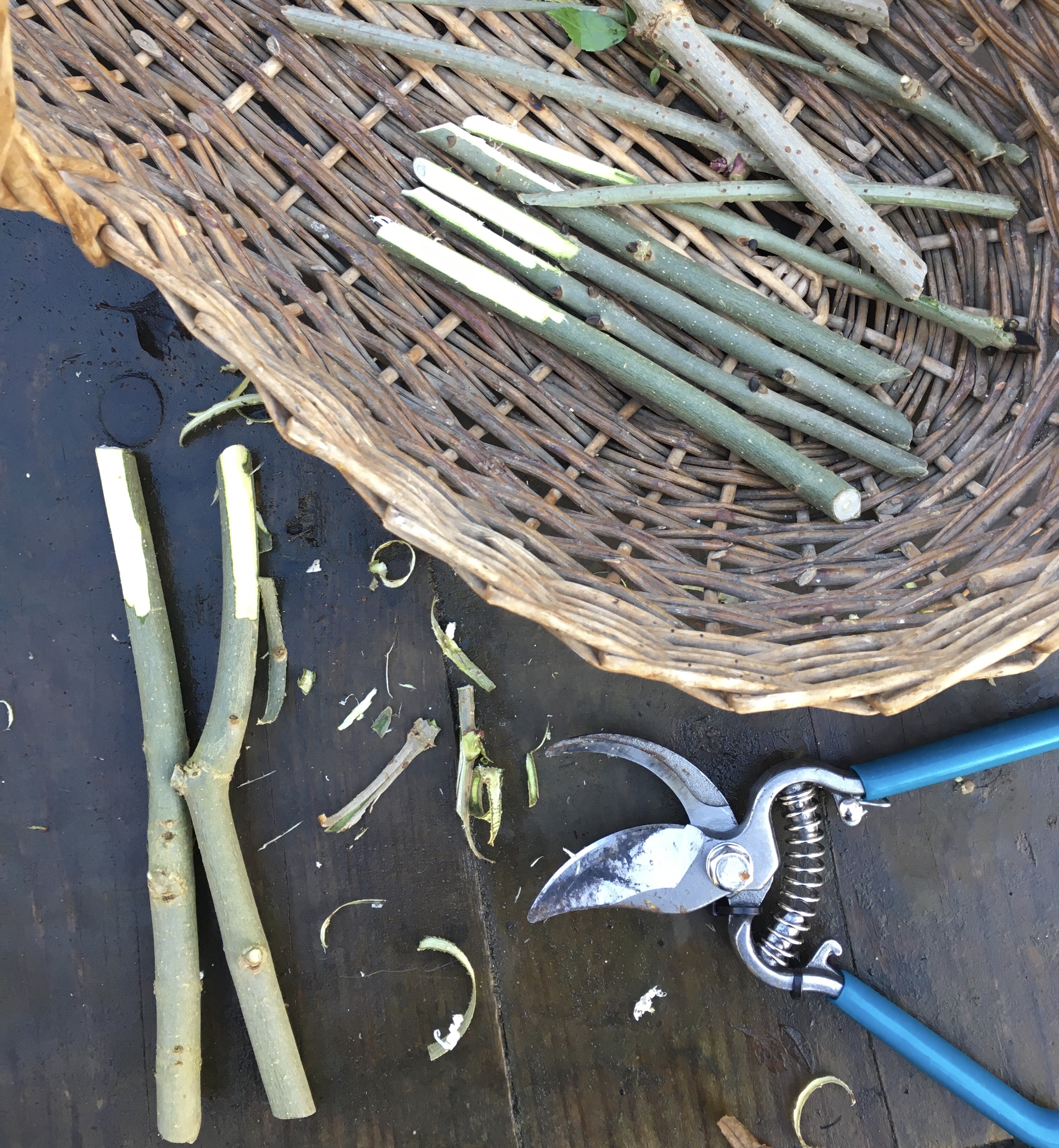
If you were listening in to BBC Radio Leicester on Tuesday, you’ll have heard me talking about taking winter, or hardwood cuttings. We were taking dogwood cuttings this time.

Here’s the link at 1.26 on the i player timeline.

https://www.bbc.co.uk/sounds/play/p0gv6761?partner=uk.co.bbc&origin=share-mobile

I use dogwood in almost all of my jam jar posies for my mum. It makes a lovely vertical accent, and helps to support the weaker flower stems. Here stems are supporting paperwhite narcissi and daffodils and tulips from the cut flower patch. These are Dutch Grown bulbs.

My favourite dogwood is the bright red Westonbirt which really glows all winter with sunlight behind it.

Here it is with Dahlia David Howard, persicaria, sedum and grasses. I love the red stems shining out and glowing in the jam jar water.

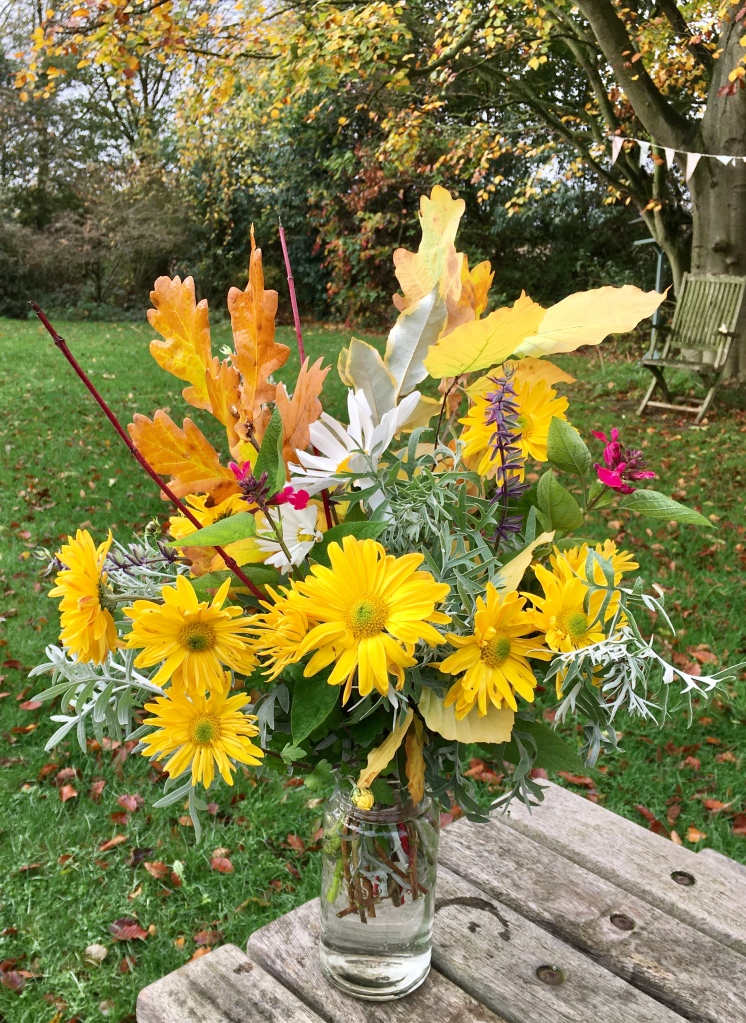
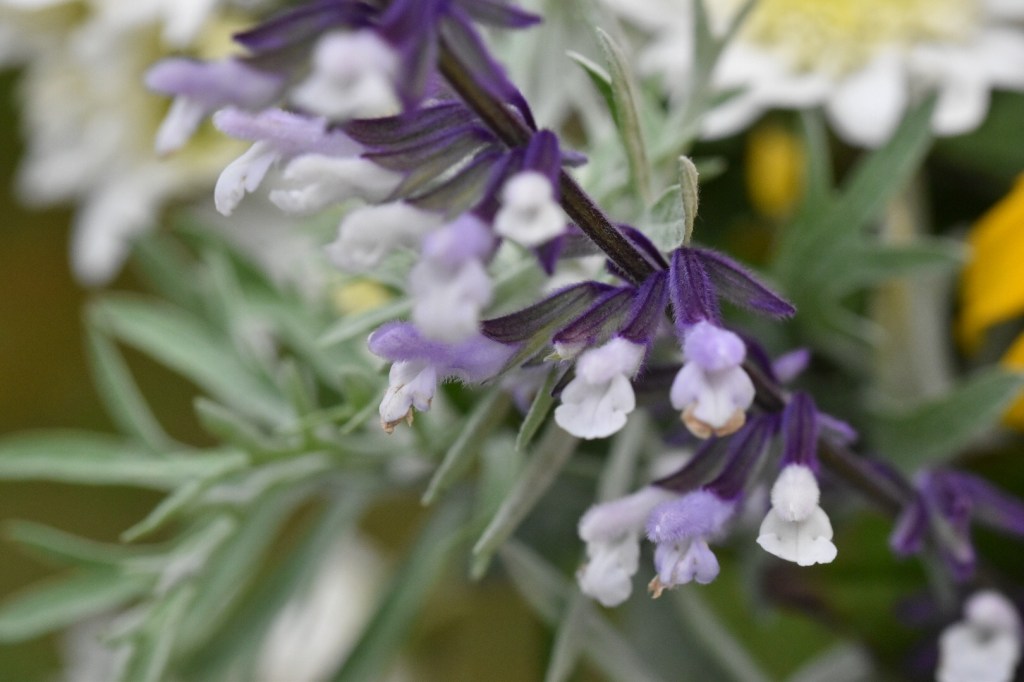
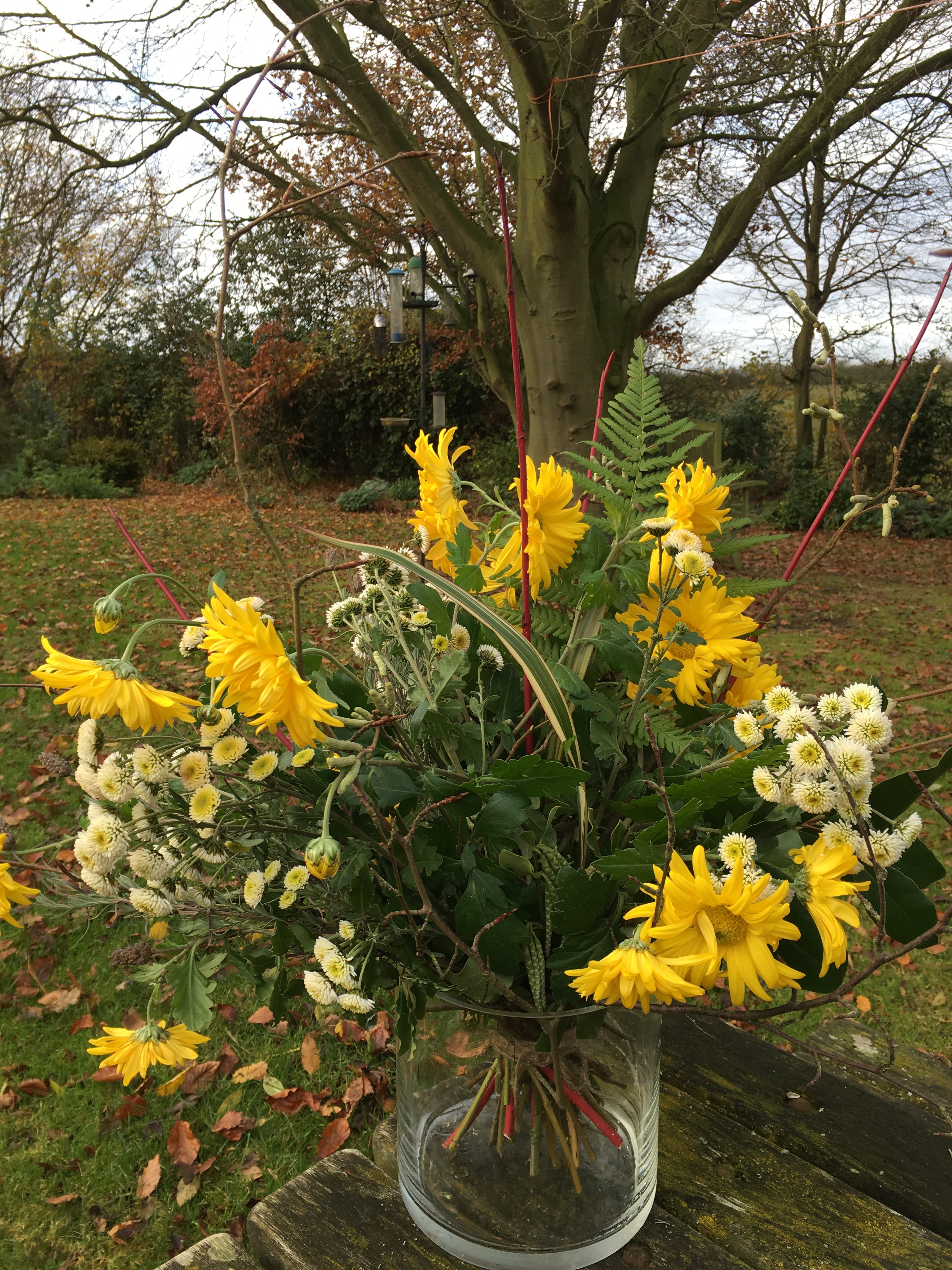
This time, the jam jar flowers are chrysanthemums and salvias set off with grey-leaved senecio viravira and golden oak leaves which dry and can be used all winter.

More dahlias including a red unnamed seedling, Alstromeria Indian Summer and cosmos Psyche White grown from Mr Fothergill’s seeds.

Salvia Phyllis’s Fancy, chrysanthemum Swan and the last of the dahlias and rudbeckia. And a tiny sprig of orange abutilon at the front.

Dogwoods have fabulous berries which look like pearls.

Continue reading

Raspberry Bakewell Tart

Last week’s Garden News Magazine recipe.

This delicious recipe came from a friend. I’ve been making this dish for 30 years. It’s a family favourite because it’s so quick and easy to make. No messing about rolling out pastry. The biscuit mix gives a lovely crunchy base to the fresh raspberries. The topping is the usual ground almond cake mix. And it freezes well too! So I always have a few slices to give to friends and family when they visit. Happy Gardening- and cooking everyone!

Plenty of raspberries filling the freezer this autumn.

Freeze in portions so you only have to defrost what you need.
Autumn Bliss

Flowers from the Garden 1st November 2023

Ahead of Storm Ciaran, I’ve picked the last few dahlias for my mum. Orange dahlia David Howard has again produced the most flowers from August to November. It wins first place in my top 5 dahlias.

I wrote about the history of David Howard which dates back to the 1960s here:

https://bramblegarden.com/2022/10/30/flowers-from-the-garden-31st-october-2022/

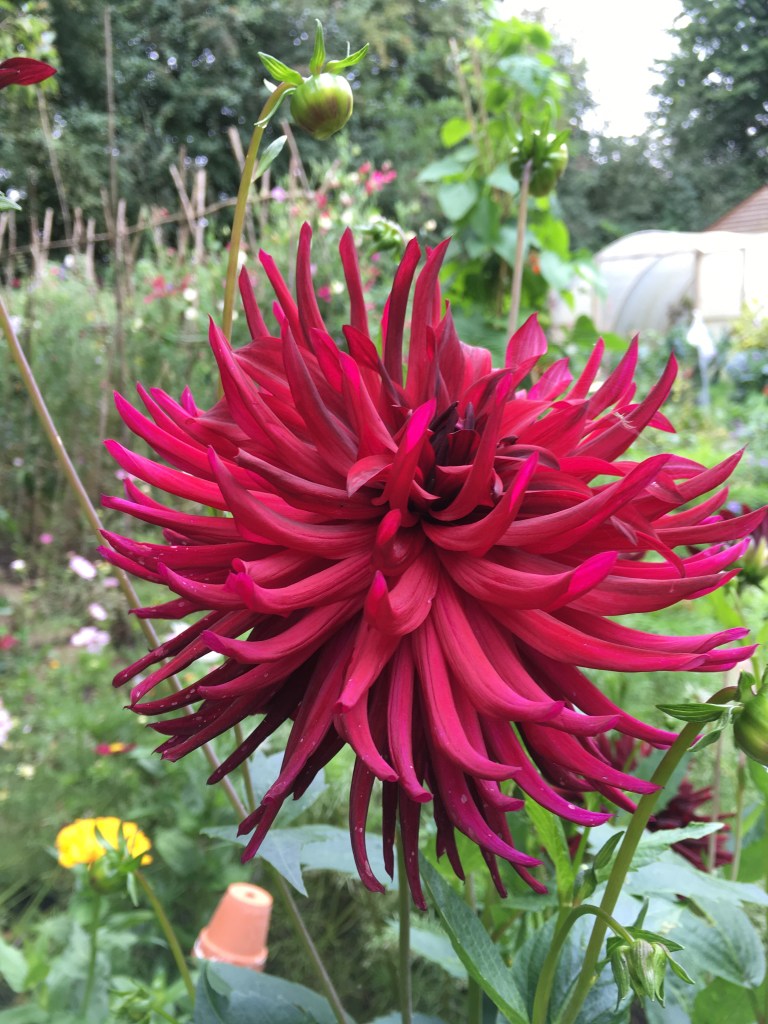
Second place in my top five is the deep red cactus-flowering dahlia Nuit d’Ete. Even in bud it’s very beautiful. It lasts a long time in a vase, if the water is changed daily.

Nuit d’Ete in full flower.

Number 3 in my top five is Eveline. Gorgeous white flowers with soft lavender petal tips. Strong and reliable, producing masses of flowers.

Number 4 is Petra’s Wedding, with small pom-pom-shaped flowers. Stems tend it be lax, and flowers heavy, but feeding with liquid potash helps to strengthen the stems. Staking also helps to train the stems, and I use twiggy stems such as dogwood in my posies to prop up the flower heads.

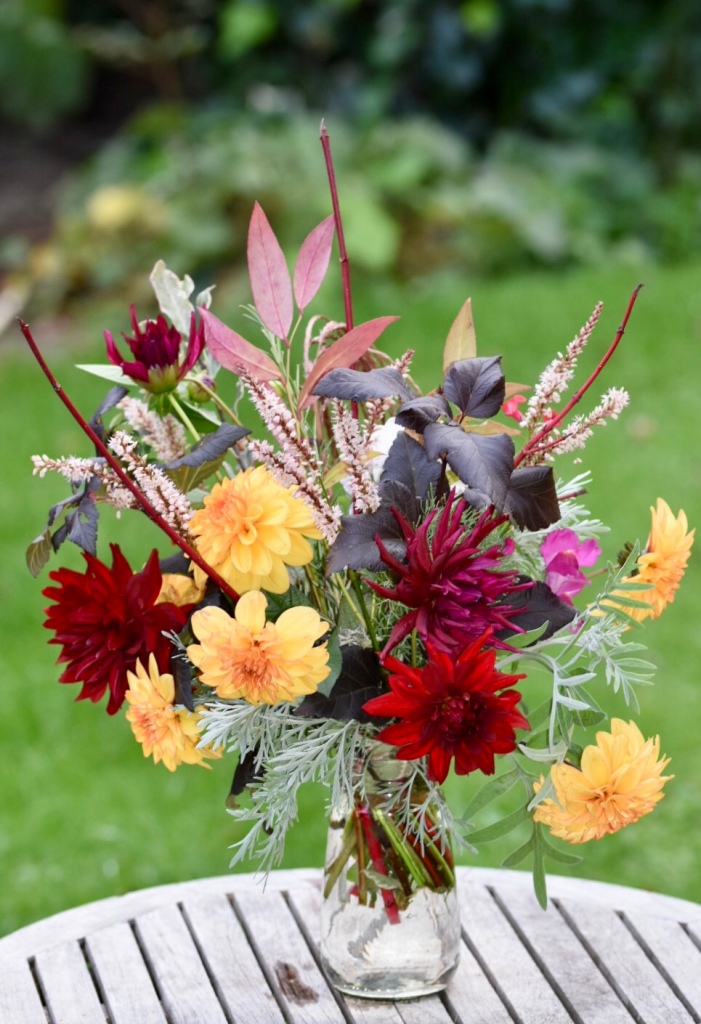
Turning the bouquet around, there’s number 5 in my list, deep red Arabian Night. Masses of fully double flowers on strong stems. Red Westonbirt dogwood stems add vertical interest and support the flowers. I love to see the red stems catching the light and shining out in the jam jar water too.

You’ll notice a lovely pink-flowering grass in my posy. It’s called Red Chief and cost £5 in a garden centre sale last week. I love a bargain! I haven’t many grasses growing here, and thought this one would add movement and texture to autumn vases.

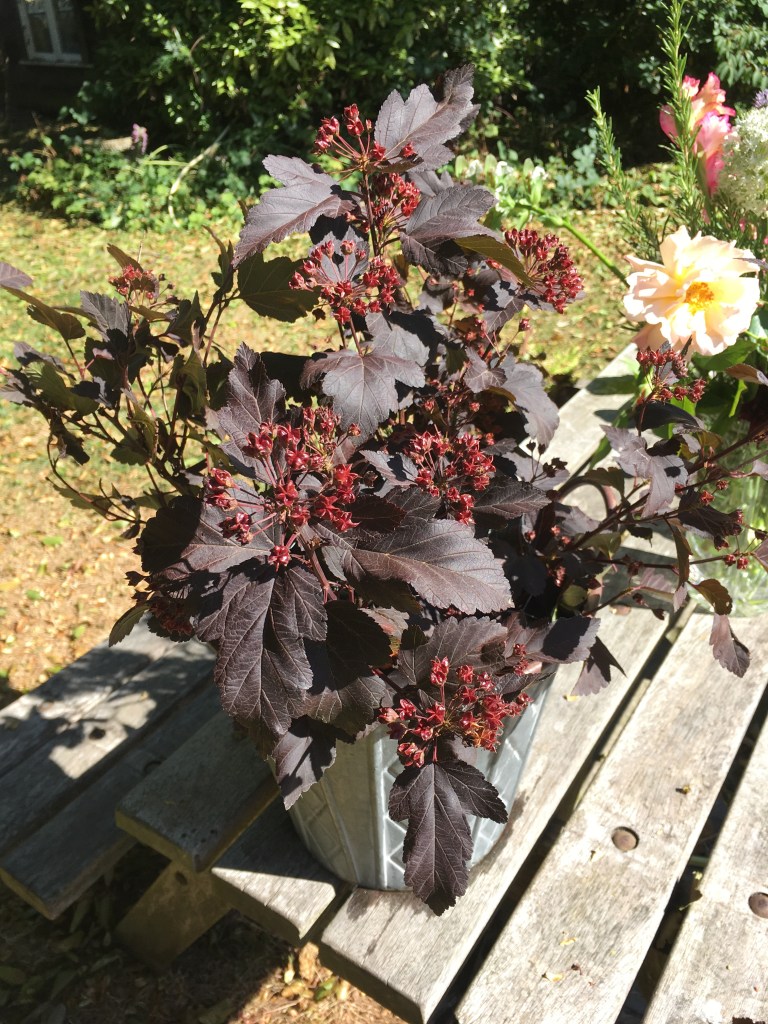
The little pink spikes adding vertical interest are persicaria. A hard-working perennial flowering right through late summer into November. The dark foliage around it is Physocarpus Diabolo which is gorgeous all summer, and at this time of the year has very pretty seed heads.

Physocarpus seed heads
Physocarpus foliage.

Salvia completes my posy. Sadly, I’ve lost the label, so I don’t know the name. Grey-foliage is Senecio Viravira, also known as dusty miller.

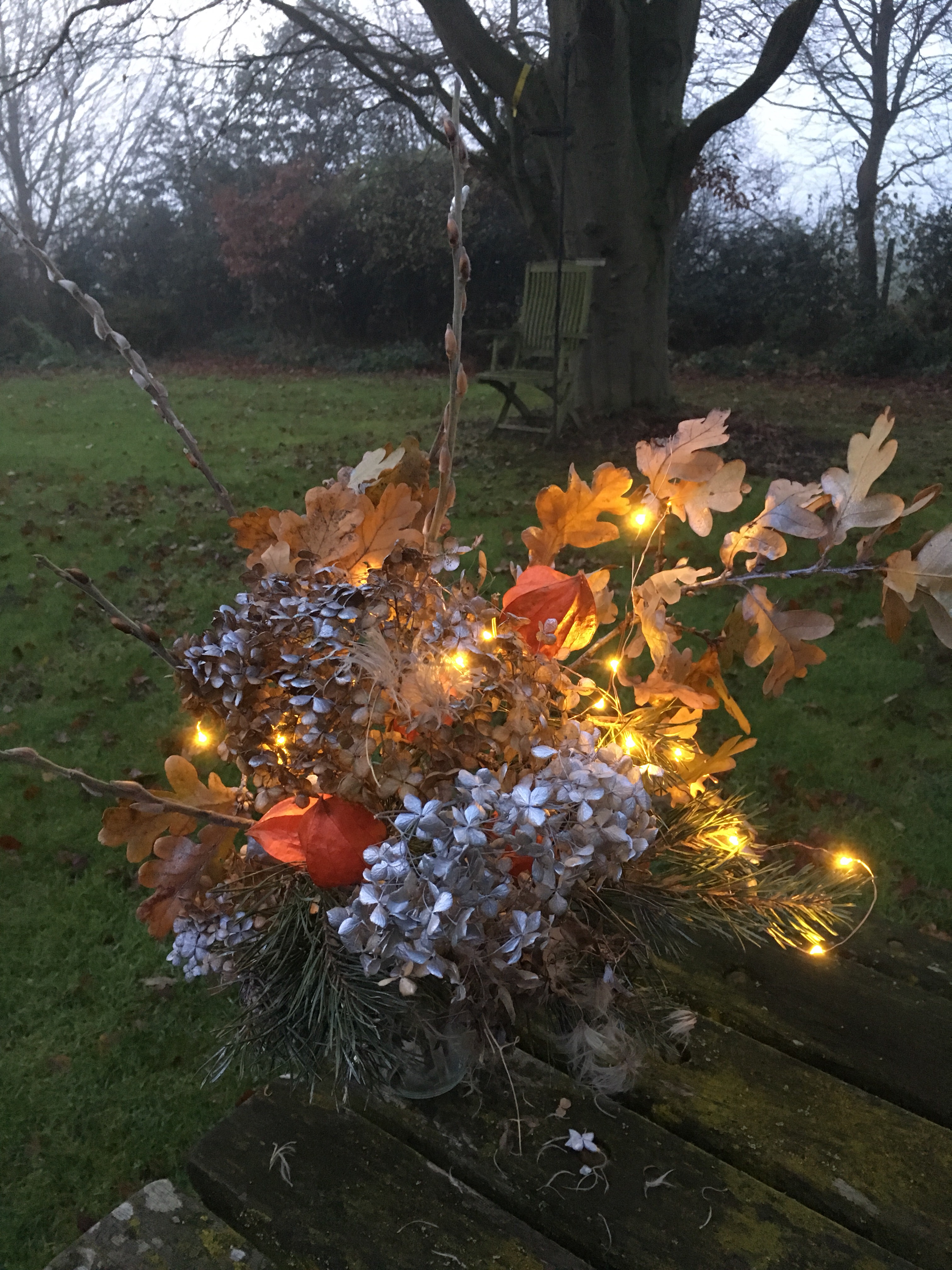
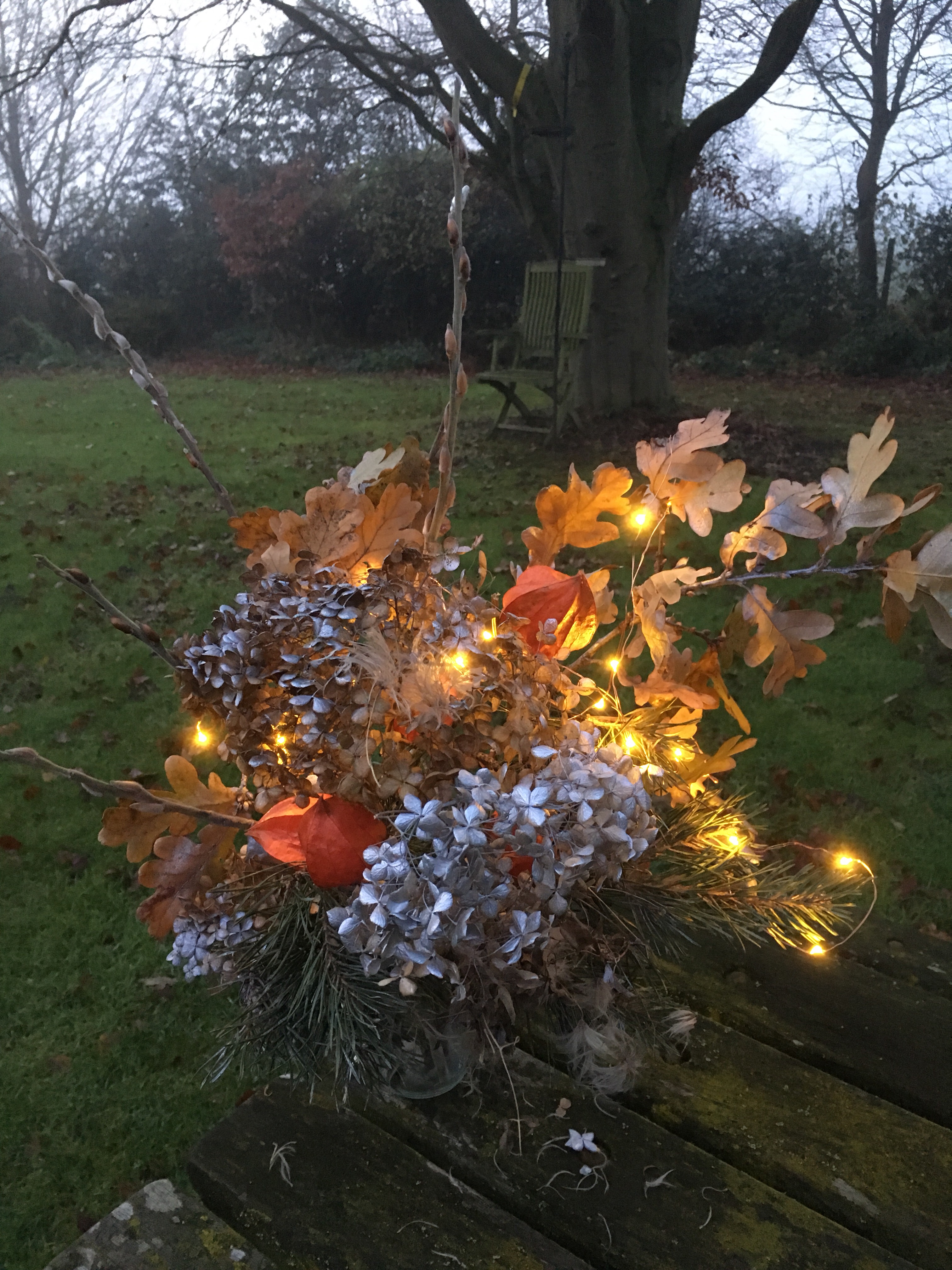
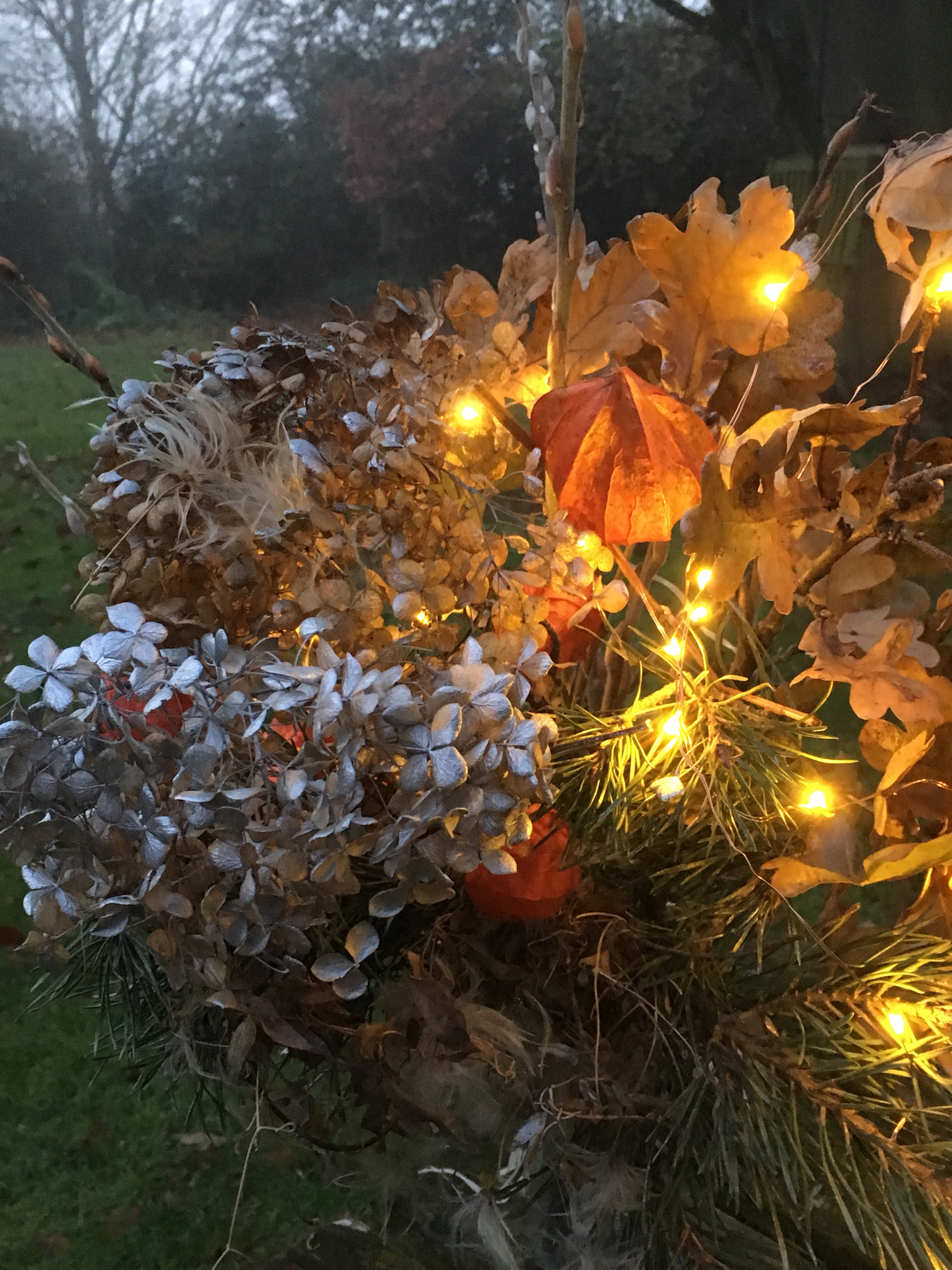
Tucked in at the base of the posy is hydrangea Little Lime which is just turning a lovely papery-pale pink. I’ve picked a huge bunch of these flowers for my Christmas table decorations. I’ll miss Wilkos as I used to pop in there and buy their mouldable wire fairy lights for just a few pounds. The lights are fed through the hydrangea heads and create a very pretty display.

I hope you’ve enjoyed this week’s flowers picked for my mum. Many thanks to Cathy for her ‘In a Vase on Monday’ meme. I join in on whichever day I can, and I love seeing what Cathy and others are growing for their cut flower vases. Gardeners join in from all around the world and it’s fascinating to see how many of us are growing the same flowers at the same time in different countries.

Take a look here :

https://ramblinginthegarden.wordpress.com/category/gardens/in-a-vase-on-monday/

Stay safe in the winter storms. I hope your garden doesn’t suffer too much damage in the high winds and torrential rain coming our way tomorrow. Thank you for reading my blog. Please leave a comment below and sign up for updates via e mail.

Views from the garden September 2023

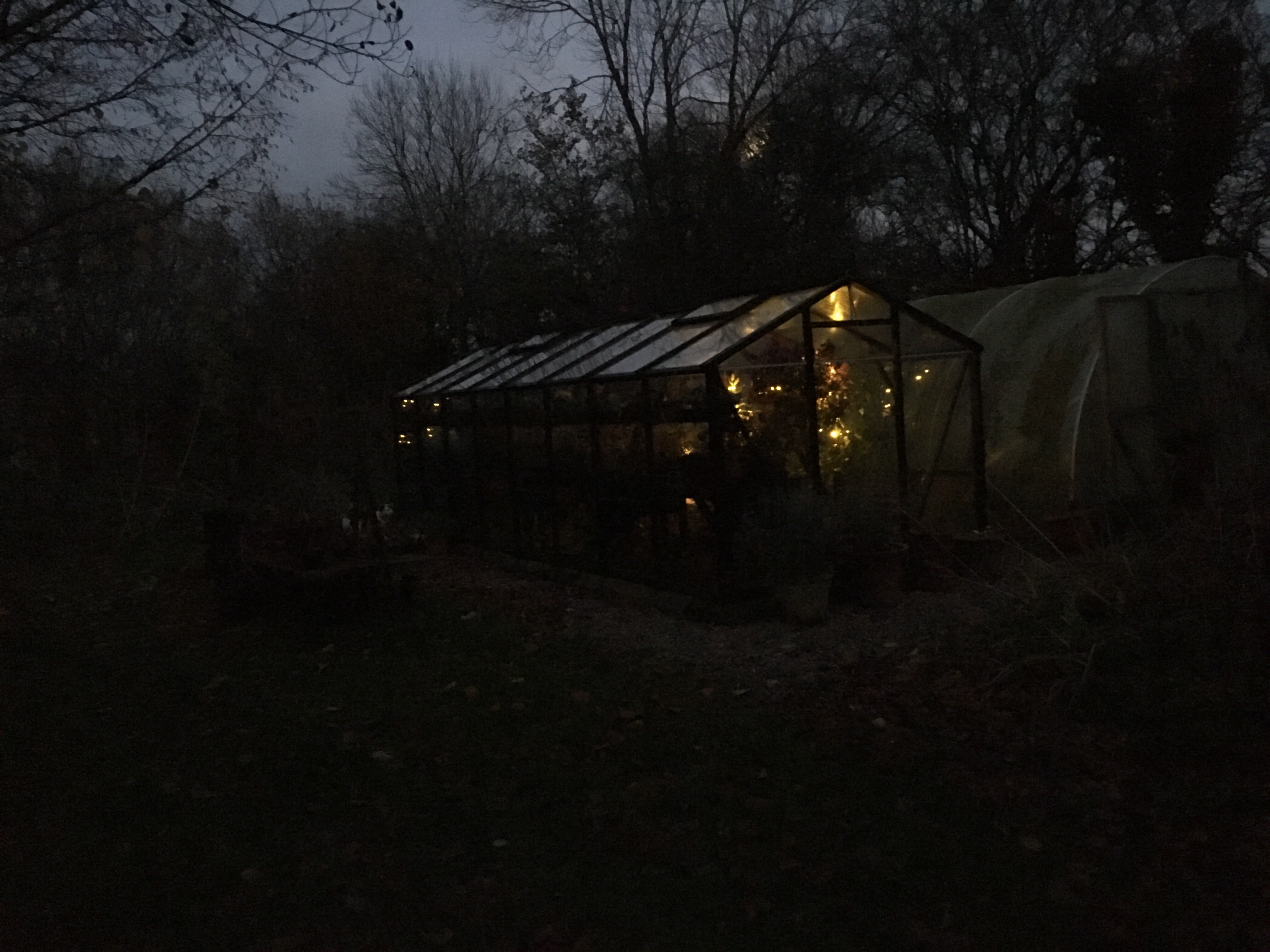
I’ve spent the day clearing out my 20ft second-hand Alton Cedar greenhouse. This was purchased for £260, the best £260 I’ve ever spent. Admittedly, it was 32 years ago- but the greenhouse is still almost as good as new. I’ve painted it black, although it was a harsh bright red when it arrived. The staging is also painted black which really sets off the pelargoniums housed there. Plants live in pots along the front path in front of the greenhouse during the summer. It just gets too hot indoors, and they appreciate some fresh air and rainwater. But at this time of the year, I sweep it out, wash down the windows and give it all a quick re-paint. Everything must be back inside before the first frosts.

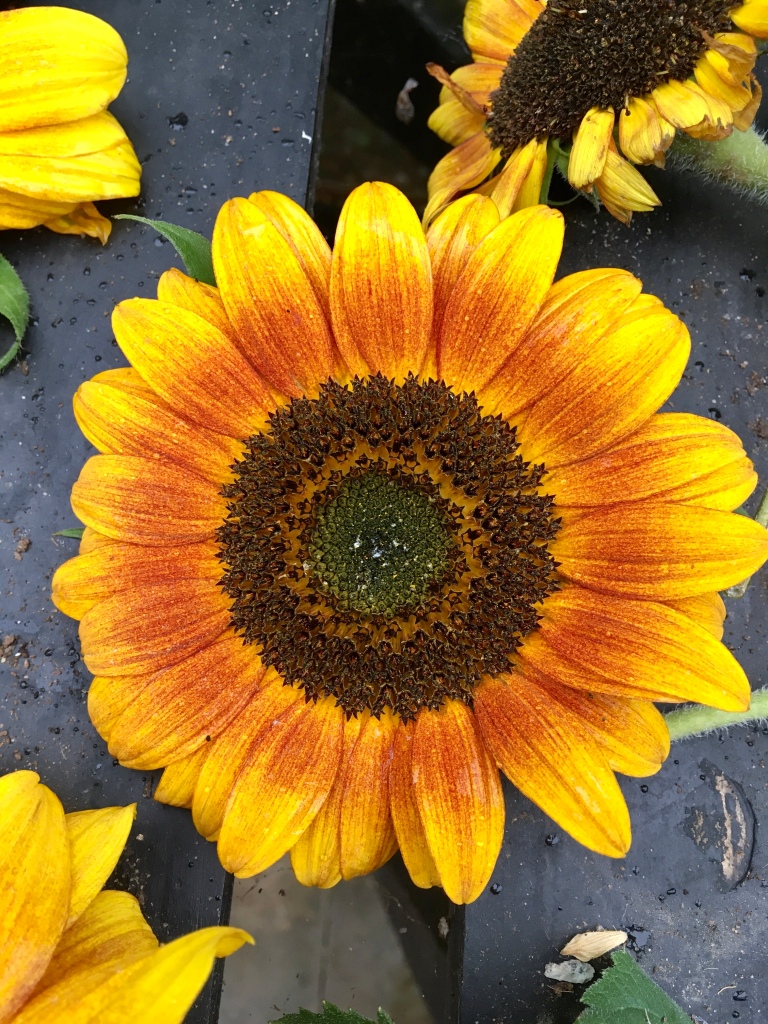
In the background you can see my 10ft sunflowers that I thought were small multi-headed types for cutting. I’d need a ladder to harvest those! Instead I’m leaving most of them to dry out for bird seed. A few blew down in the recent storms, so I’ve put them in jam jars on the kitchen table. I’ve made a note to carefully check the seed packets next summer so I don’t make the same mistake twice! They are beautiful though, and the bees and butterflies enjoying the pollen are currently a wonderful sight.

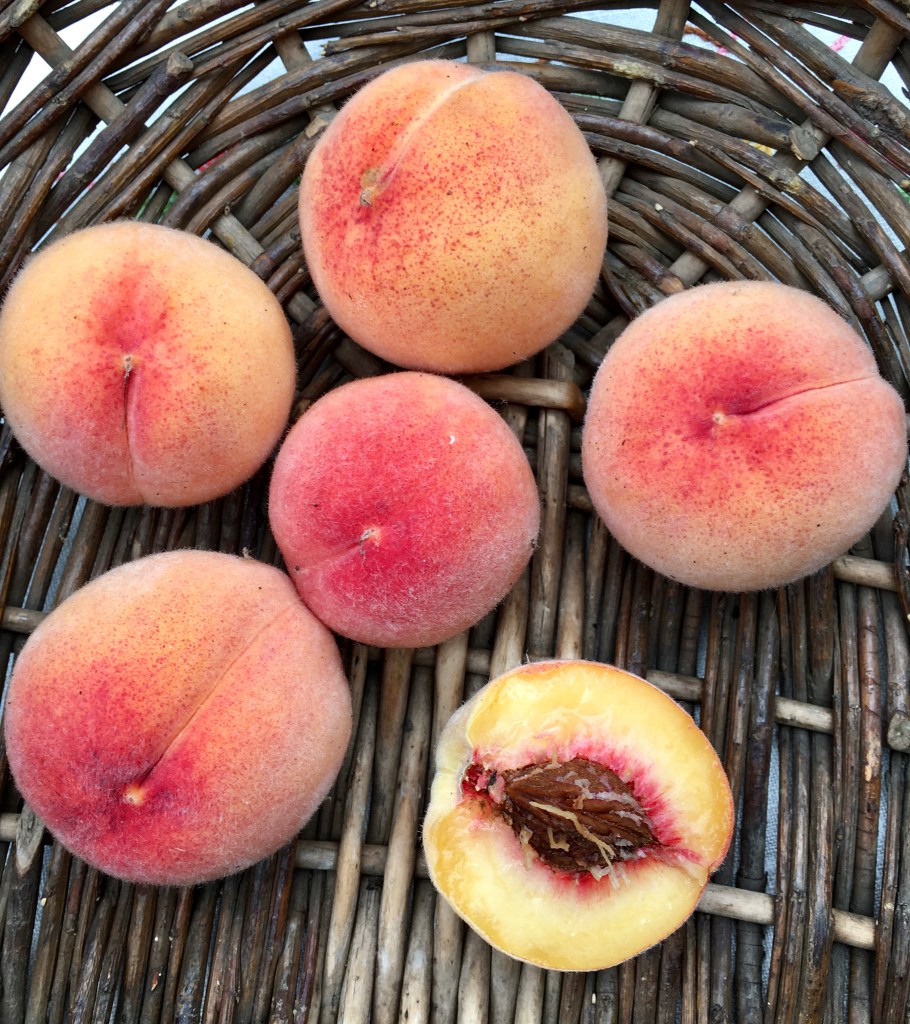
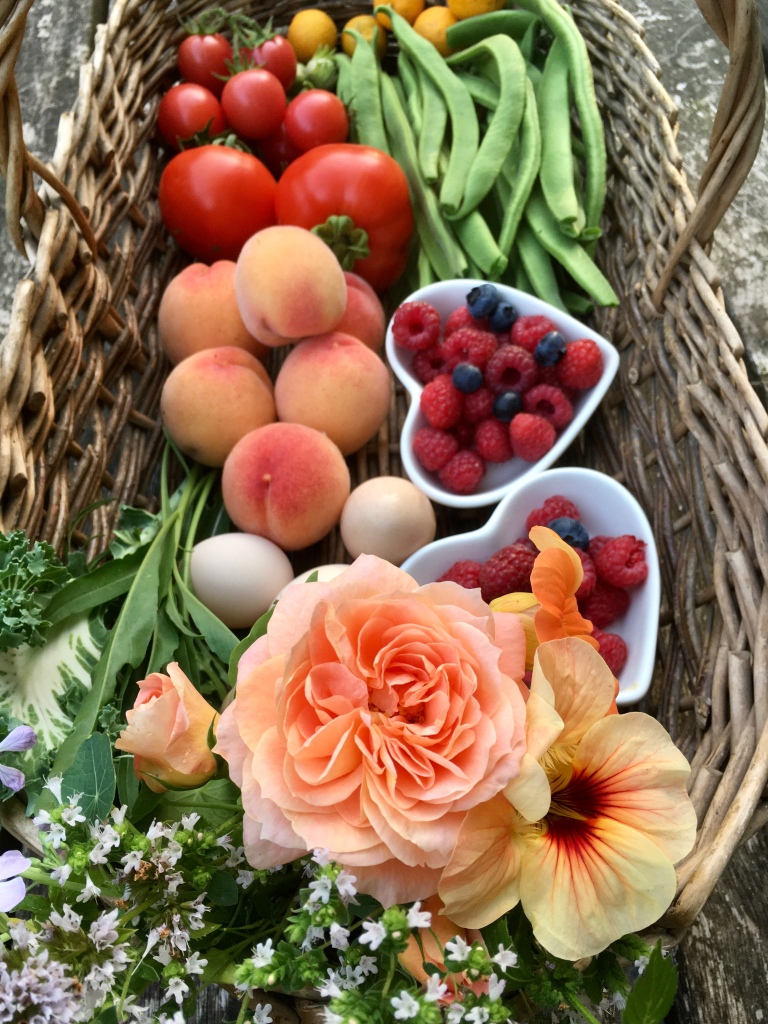
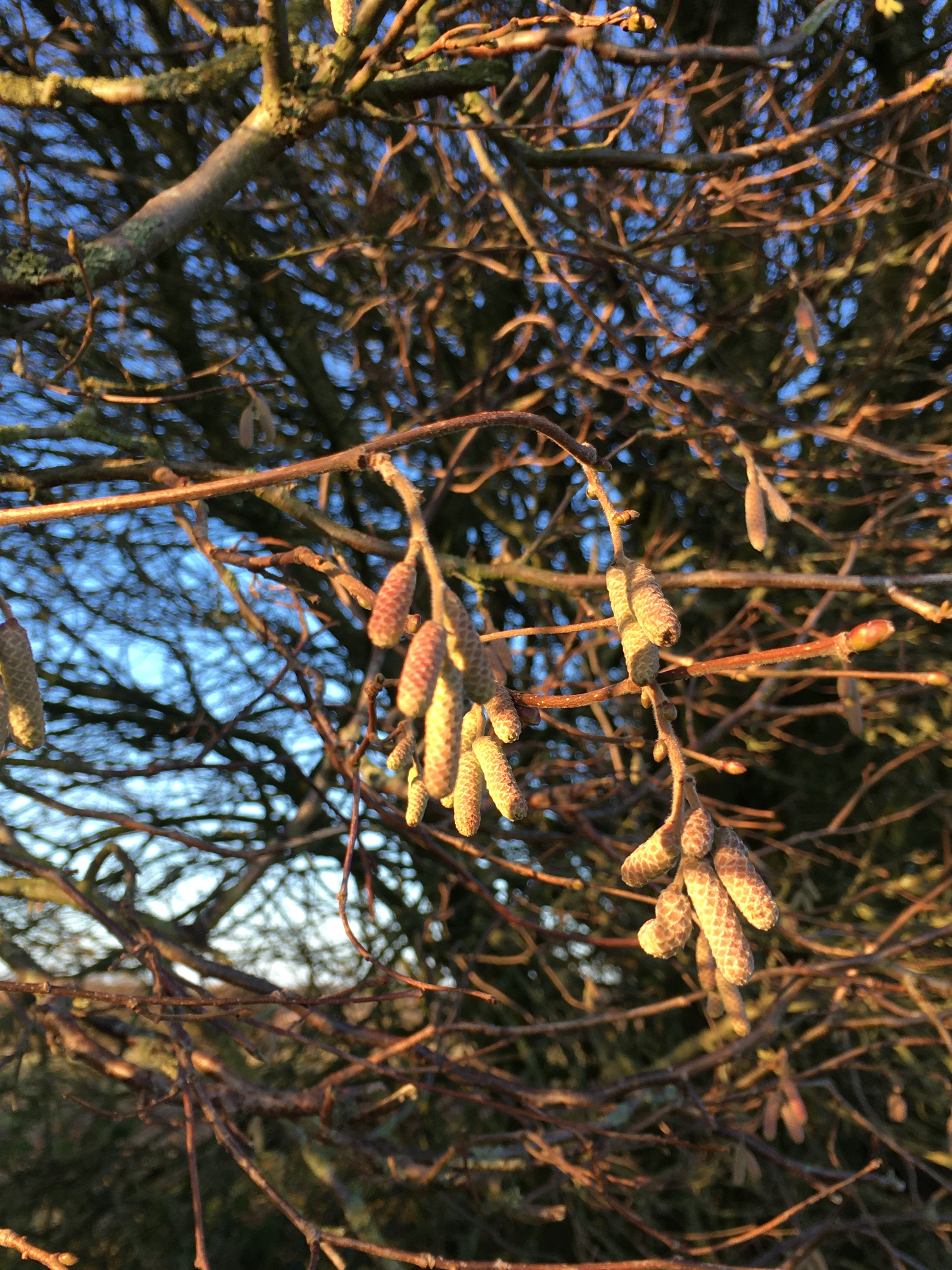
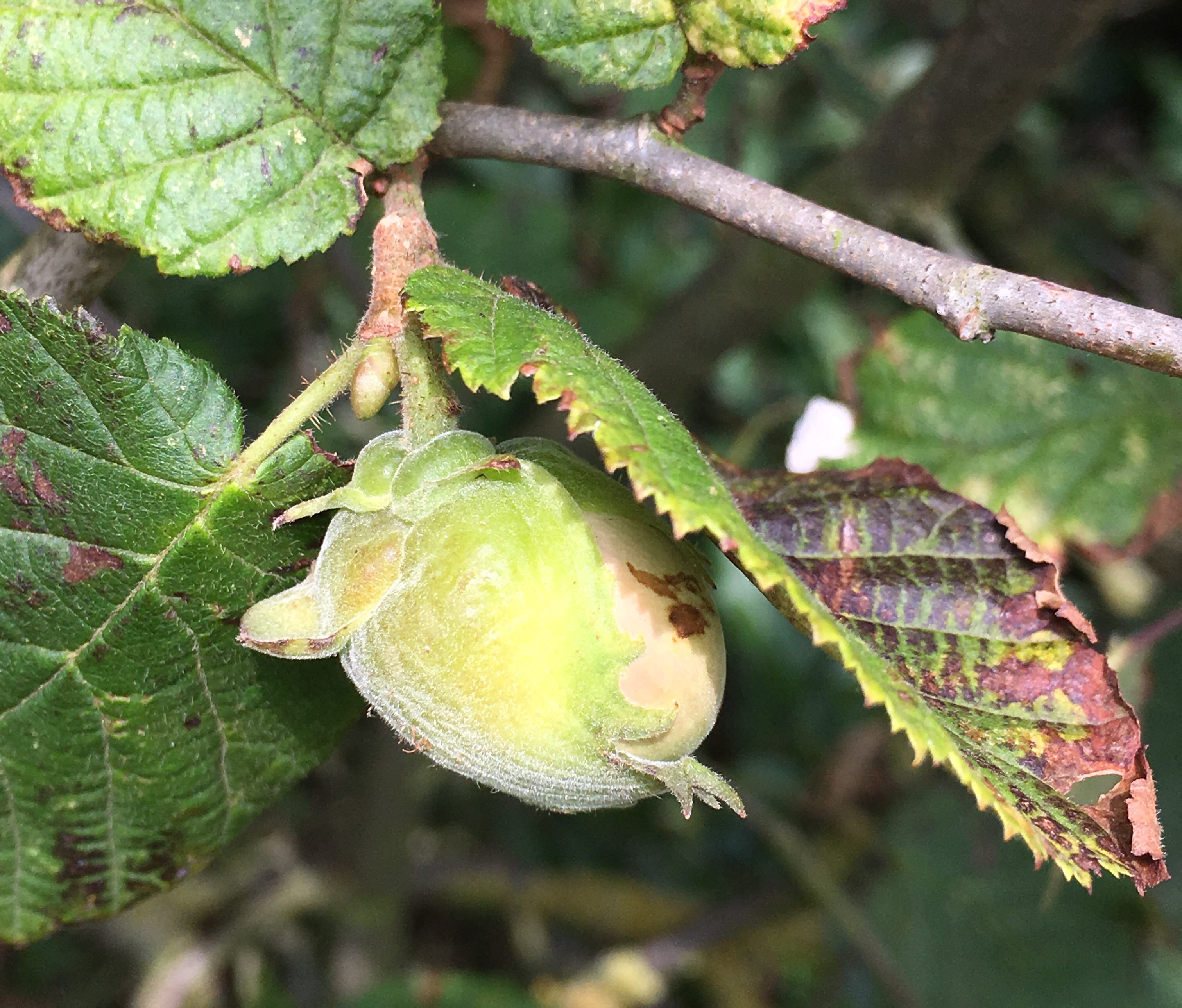
Next to the greenhouse there’s a matching 20ft polytunnel where I grow fruit, vegetables and flowers. Tomatoes and peaches have done really well this summer. You’ll also see a little pile of cobnuts in the basket. Alongside the greenhouse there’s a huge hazel tree which squirrels usually strip overnight. This year there were more nuts than they could manage, so I’ve harvested some to make into cakes and biscuits.

Peaches have been a great success this summer. My trees are grown in large 15” containers in the poly tunnel. This protects them from peach leaf curl which thrives in wet conditions. Keeping leaves dry is the best way to combat the disease.

Baskets nearly always contain flowers as well as fruit and veg. This is Rose of the Year 2022, ‘It’s a Wonderful Life.’ Highly recommended for fabulous scent, repeat flowering and disease resistance. I’ve also picked some seedling nasturtiums. I’m particularly fond of this peachy-coloured one and keep it going by taking cuttings which root in water. I collect seeds too, but it might not come back exactly the same colour as nasturtiums readily hybridise. There’s also a few herbs, mint, marjoram and rosemary which add a lovely scent to any jam jar flower arrangement. The climbing beans are pink-flowered Celebration which don’t go stringy and crop late into the season.

Still on the theme of peaches, these are the little pastry custard tarts I made with slices of fresh peach, autumn raspberries and home-grown blueberries. The recipe is for my column in Garden News Magazine which I’ll share next week. They are very quick and easy to make.

I’ve had this potted purple bougainvillea for about 30 years. I’ve trained it into a round-headed shape so that it doesn’t take up too much room. It will be the first plant to go back in the greenhouse as it’s not at all hardy. Bracts stay colourful until December and I often use it in my Christmas table arrangements.

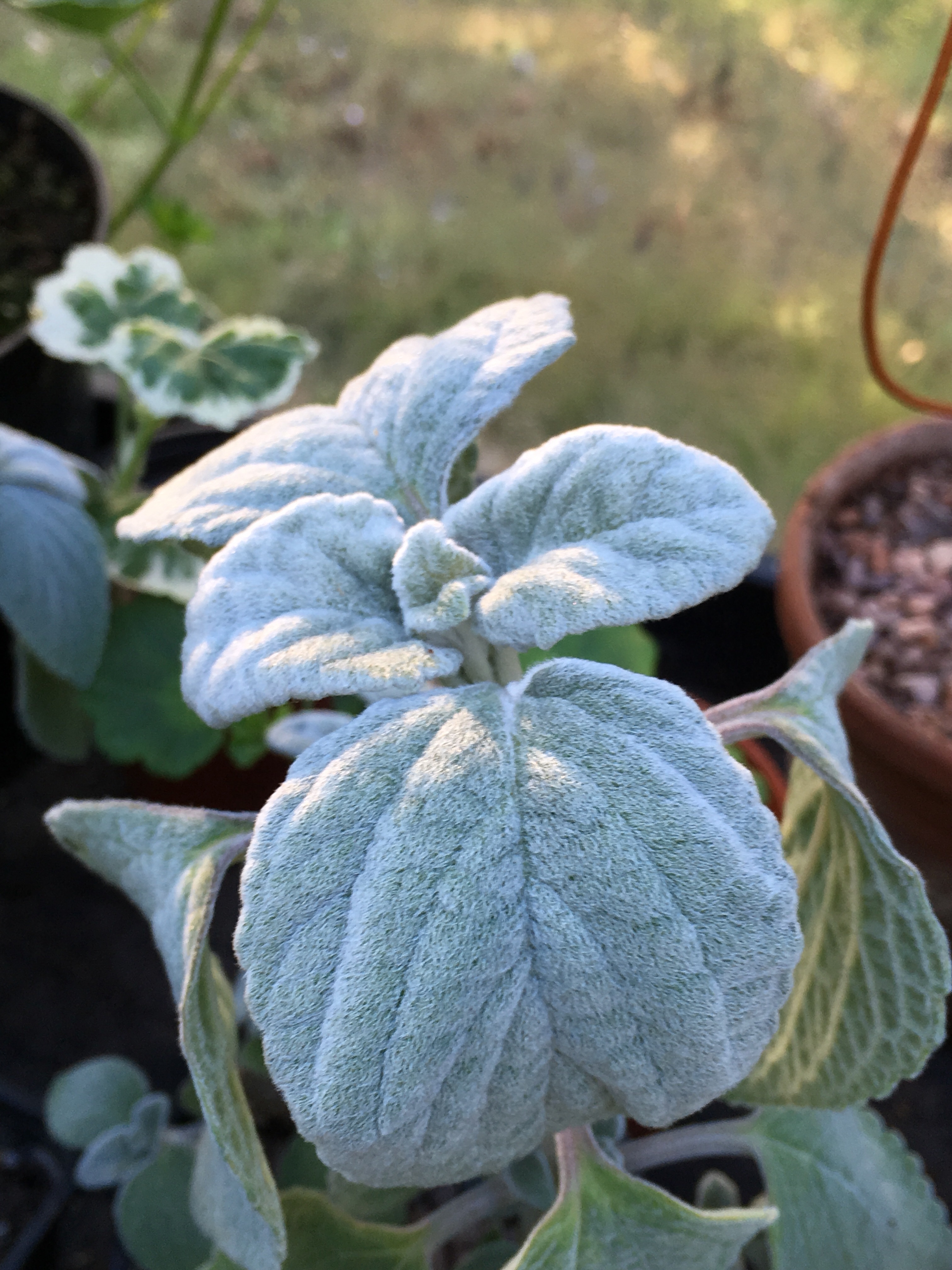
In pots alongside the bougainvillea are these beautiful grey-leaved tender perennial plants. They have long sprays of pale blue flowers. I’ve temporarily forgotten the name! Each winter I take insurance policy cuttings just incase I lose the parent plants.

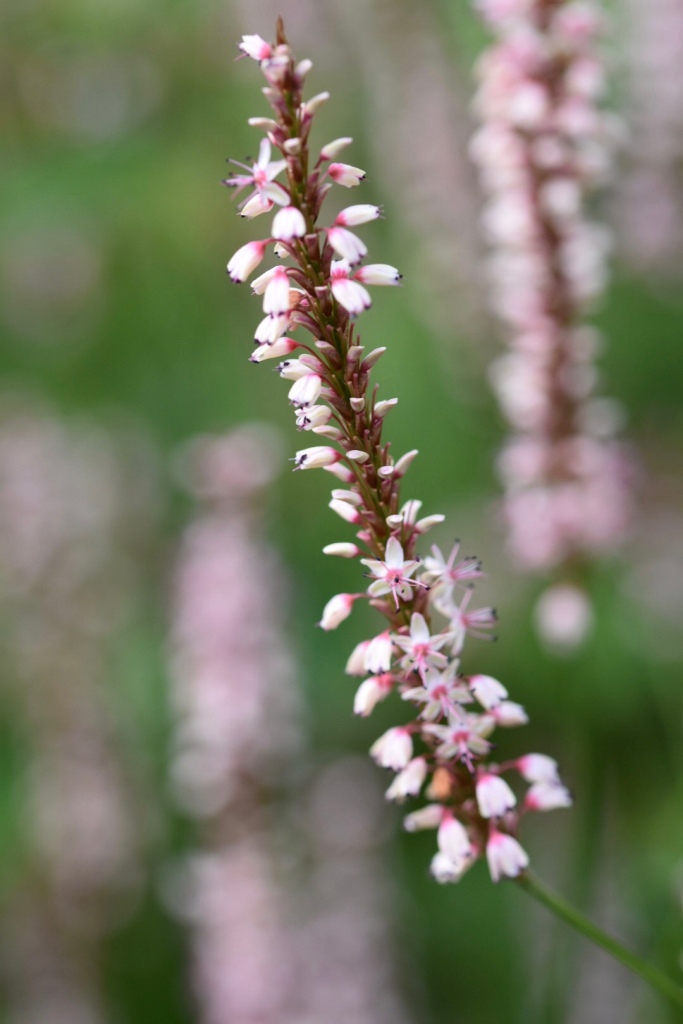
There’s a border full of low-maintenance day lilies in front of the greenhouse. In autumn when the day lilies are starting to die back, these beautiful spires of persicaria appear. This one is Persicaria Rosea.

The flowers deserve a close inspection, they are so dainty.

There’s also a white persicaria. Sadly, the label has been lost so I’m not sure of the variety. It thrives in dappled shade and flowers from August to November. The photo is out of focus as it was such a windy day, but it’s a very pretty flower nonetheless.

And finally, this one is also growing in with the daylilies. This persicaria is either Firetail or Firedance. They are good for cut flowers, lasting at least a week to 10 days in a vase if you change the water each day. The spire shape gives a nice contrast to round, daisy flowers.

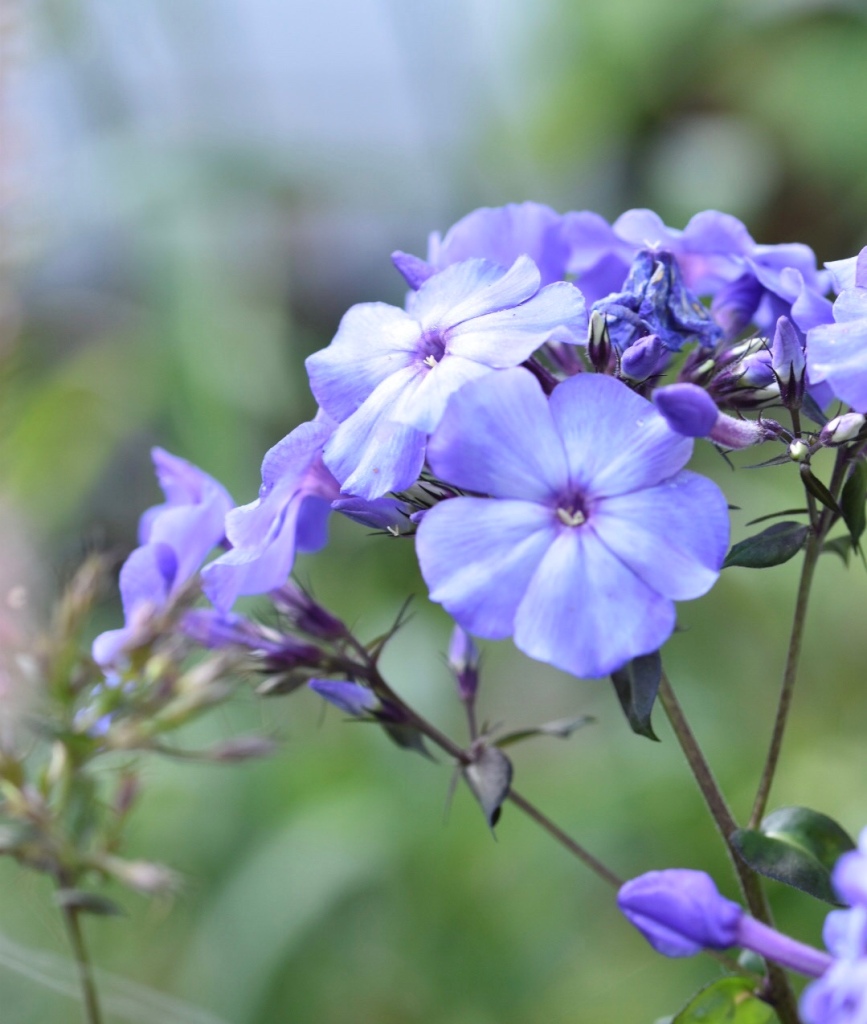
In amongst them are several types of phlox. This one is Blue Paradise- very highly scented and long-flowering in late summer.

The back field behind the summerhouse had oats growing there this summer. It’s been wonderful to sit in the shade and watch the field slowly turning to a shimmering gold. On a windy day, the crop ripples like waves and before it ripens the green-grey colour reminds me of the ocean. Instead of seagulls we have barn owls silently gliding by at dusk. There’s no sound at all from the beating wings and they quarter the field without knowing we are watching from the little wooden house.

We are always pleased and much relieved when the farmer manages to get the crop in before bad weather arrives. They work through sunset and into the night if rain is threatened. We lie in bed and listen to the tractors going up and down the fields and along the lane. At 2am there’s suddenly silence again and we know they have successfully got in the crops. Rain falls the next day and it’s wet for a week.

This is the view from our five bar gate at the top of the paddock. For a few weeks after the harvest, the fields retain their golden glow, and I drink in the scene and hold on to the memory as autumn and then winter darkness descends.

When we moved here, it was just a decrepit house and no garden. The farmer who built the house sold us an acre of land alongside it, and we planted 250 sapling trees given to us by the woodland trust and local council. At the time, there was a scheme giving free trees to anyone returning farm land to nature and we planted a small woodland area. All along the boundary, we left viewing points through to the fields beyond. The ever-changing seasons are a delight to spy through these holes in the treescape.

Thank you for reading my blog. Please sign up for e mail updates and I would love you to press ‘follow’. I often join in with Cathy for her ‘In a Vase on Monday’ meme. Mostly I write about what flowers I’m growing to give to my friends and family, and what produce I’m growing for family meals. I don’t grow in traditional rows, everything is mingled together and much is grown in window boxes and containers, with many different varieties ripening early, mid-season and late. There’s nearly always something to ‘forage’ from the plot.

Flowers from my garden for my Mum

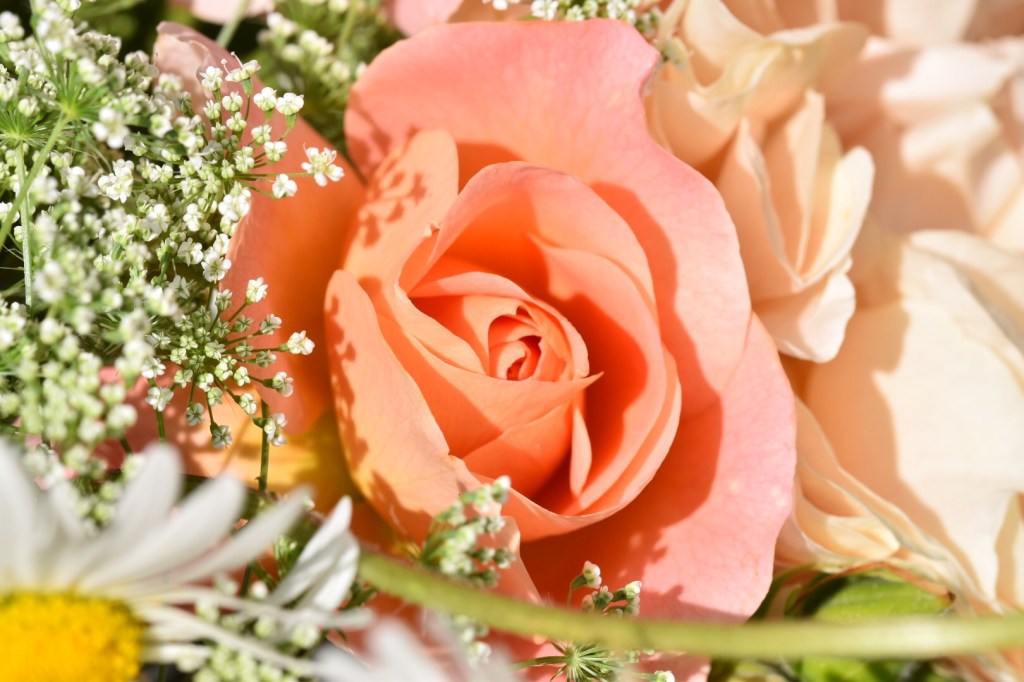
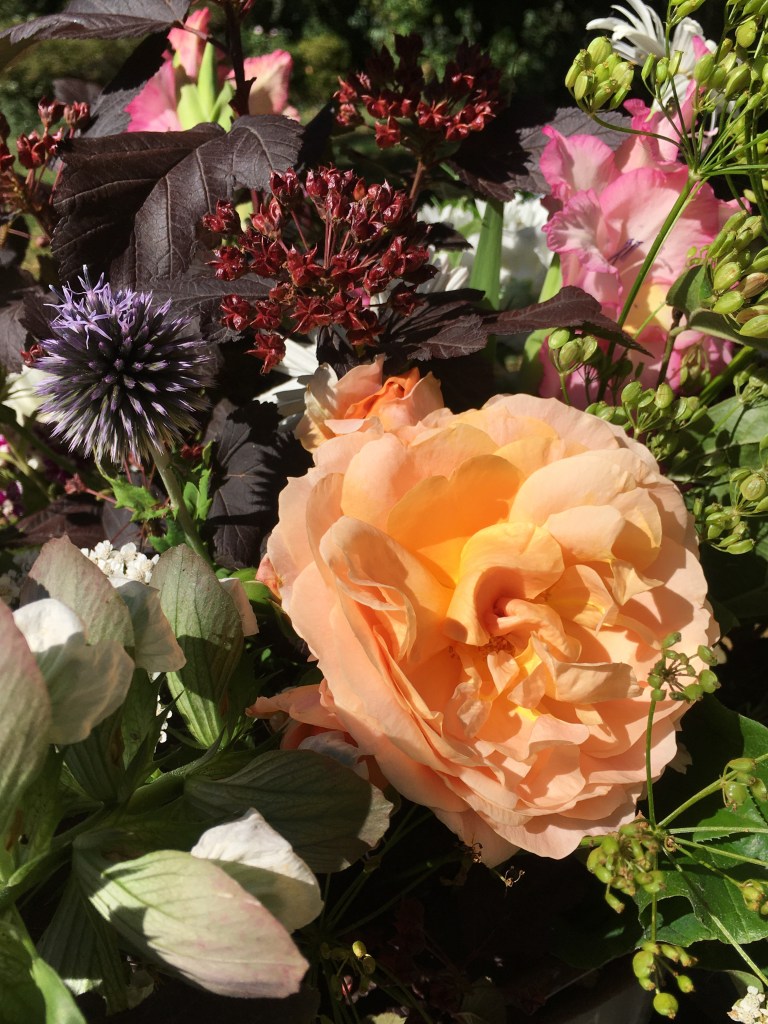
Sweet peas and roses are plentiful on 28th June. Rosa It’s a Wonderful Life is the favourite this week with five or six rose heads on each spray. It’s almost a bouquet on its own!

Flowers are fully double with a delicious fruit salad scent. Leaves are very healthy with no sign of disease.

Perfect in bud. Flowers start a deep apricot colour and fade to pale pink.

It makes a striking feature in the garden, with all shades of peach and apricot at a time on one rose bush.

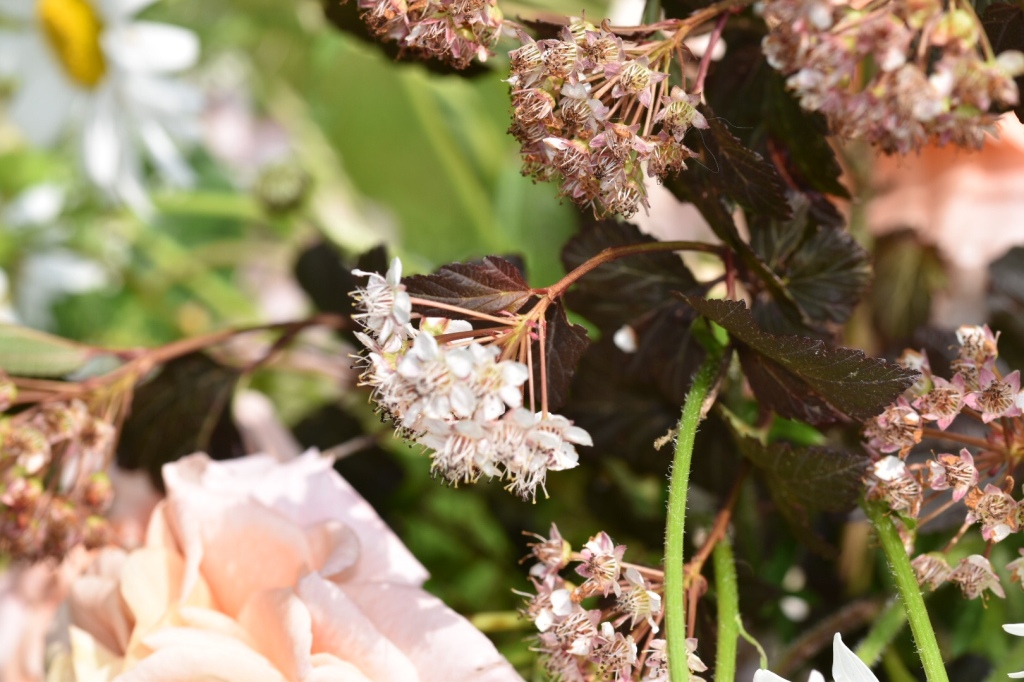
For background colour, I’ve chosen dark purple-leaved physocarpus Diabolo which in summer has clusters of pale pink flowers. These turn into deep purple seed heads.

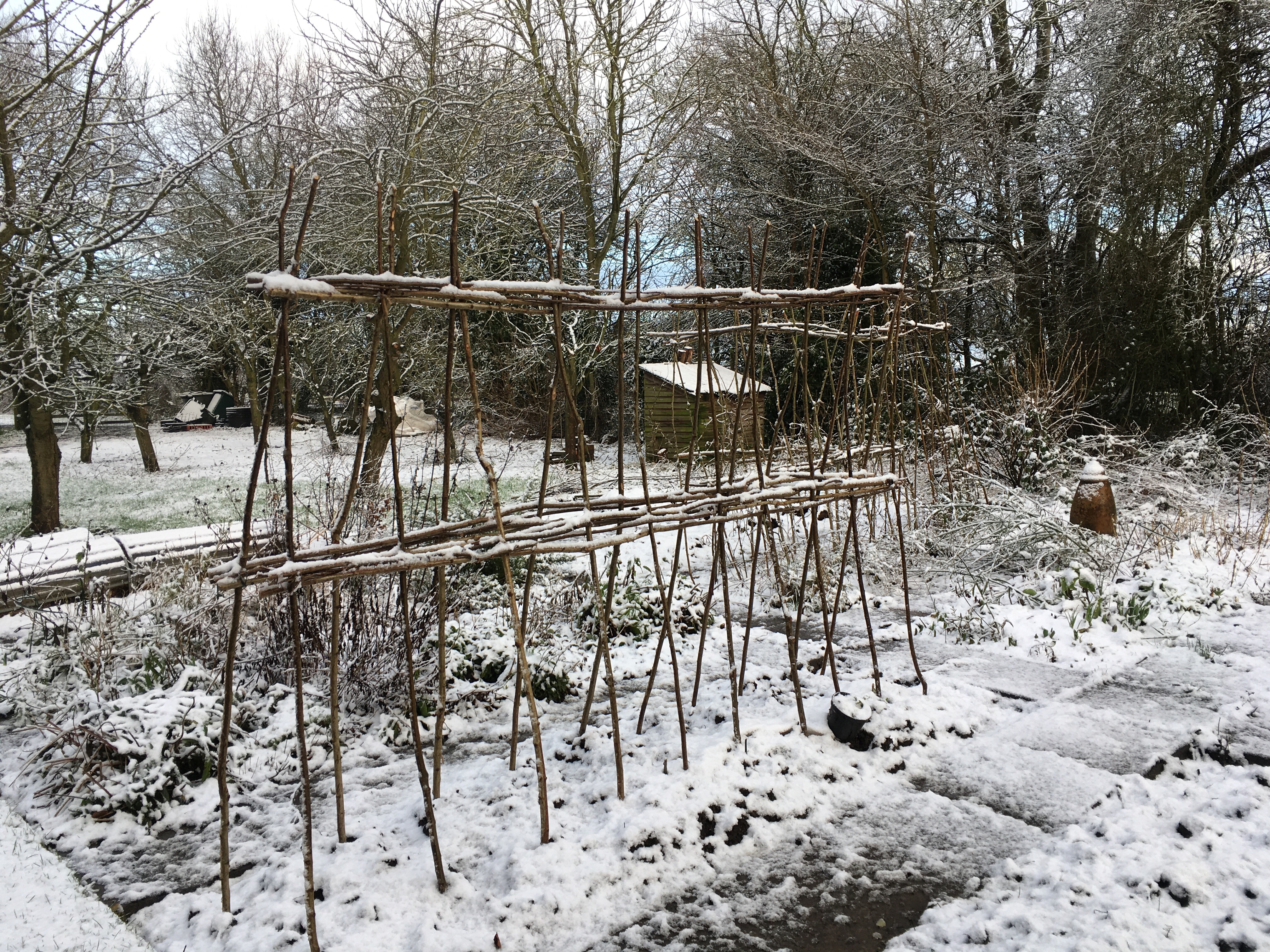
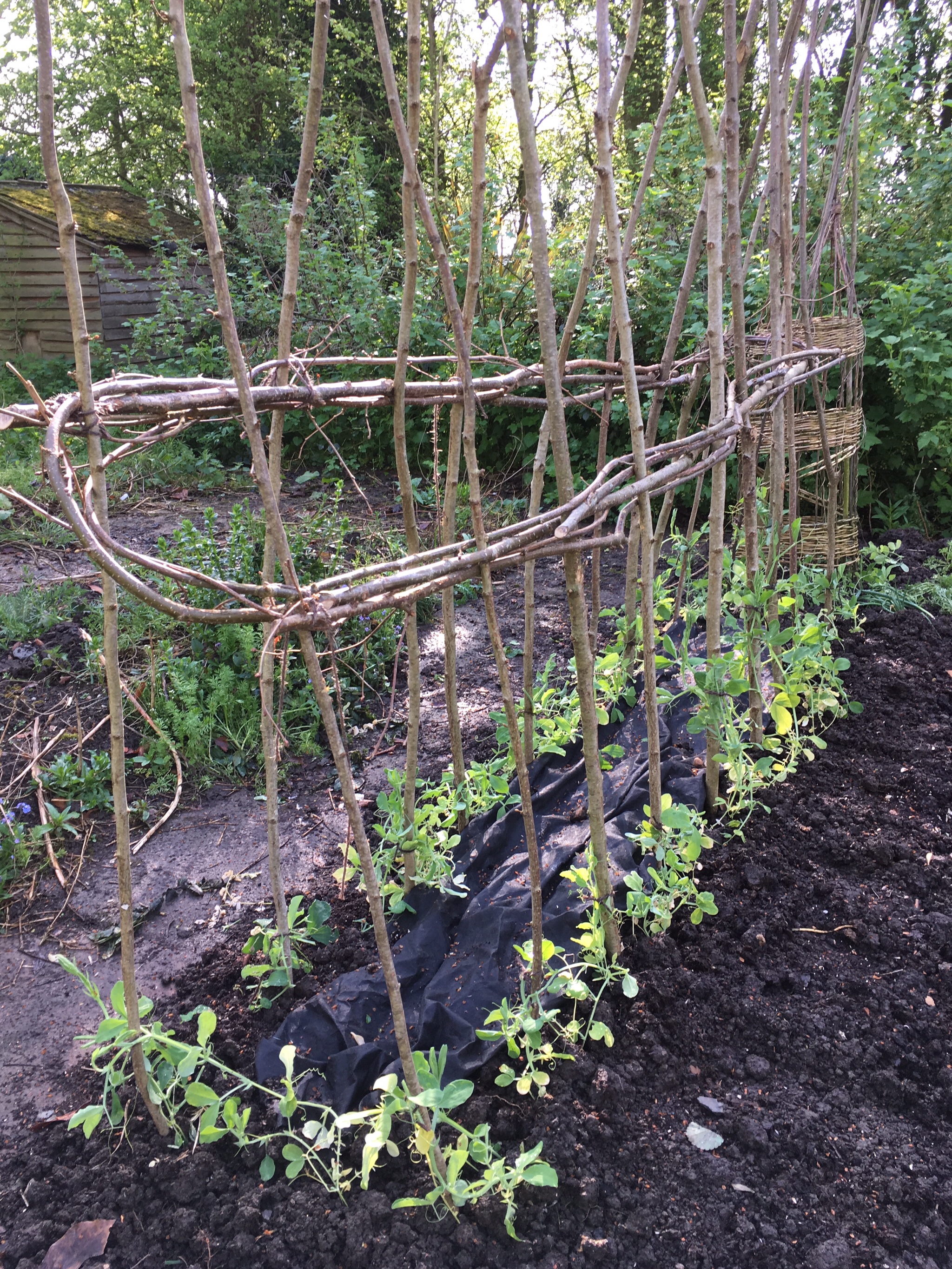
Sweet peas are growing along a hazel A-frame in the veg plot. This year I’m growing a selection of white sweet peas alongside old favourite High Scent.

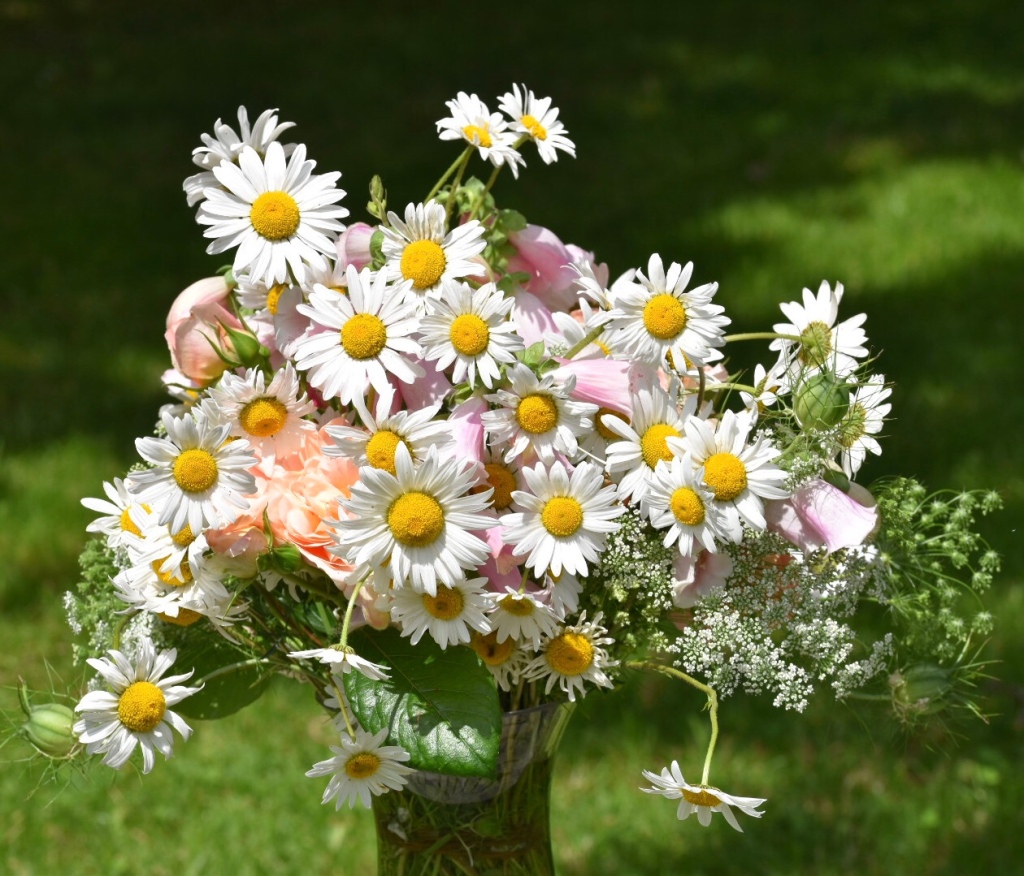
Mum sowed these oxeye daisies from a packet of wild flower seeds six years ago. We planted them together in one of the 1.3m by 3m divided veg beds in front of the greenhouse. They are the perfect partner for roses.

When they have finished flowering, I’m planning to move them to the new wildflower area surrounding the pond. They are taking over the veg patch , which I’m not complaining about. I love their joyful exuberance. Daisies are probably my top favourite flowers.

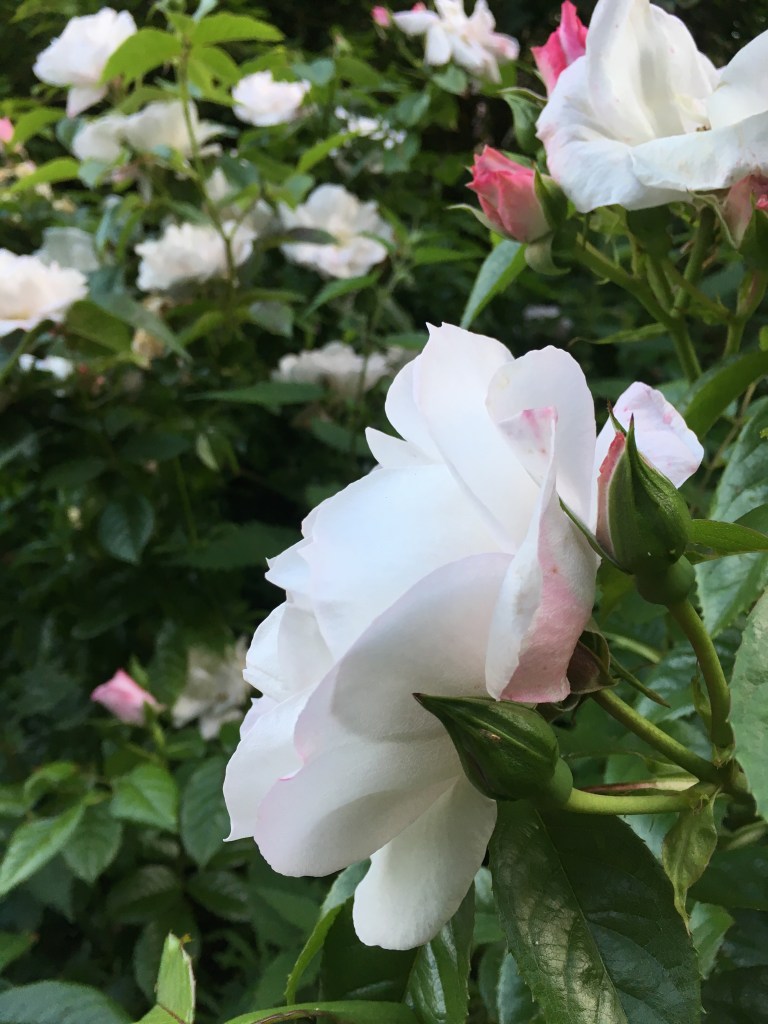
Also looking good at the moment are the home florists’ range of roses. This one is Timeless Cream. I’ve also got Timeless Purple. Highly recommended. Very few thorns and long lasting in a vase.

Timeless Cream in bud. Would make a perfect buttonhole rose.

And Rosa Mutabilis also blends in. This is the longest flowering rose in my garden, starting in April and still in flower in December.

Have a great gardening week everyone. I hope this has given you some inspiration on what to grow at home to create bouquets for friends and family all year round.

Also catch up with Cathy over on her #InAVaseOnMonday meme. It’s fascinating what everyone’s growing in gardens, all around the world.

https://ramblinginthegarden.wordpress.com/2023/06/26/in-a-vase-on-monday-three-little-maids/

Planting Amaryllis. BBC Radio Leicester gardening show notes. Christmas present ideas.

Amaryllis Carmen (photos Taylors Bulbs)

Christmas only really starts for me when I plant my amaryllis bulbs. For as long as I can remember, there’s been amaryllis bulbs flowering over the festive season at my family’s home. And I like to keep up the tradition by having them in my own home. If you listened in to this week’s BBC Radio Leicester show, you will have heard me talking about the amaryllis varieties I’m planting at the moment. Some are for me, and some will be given as Christmas presents.

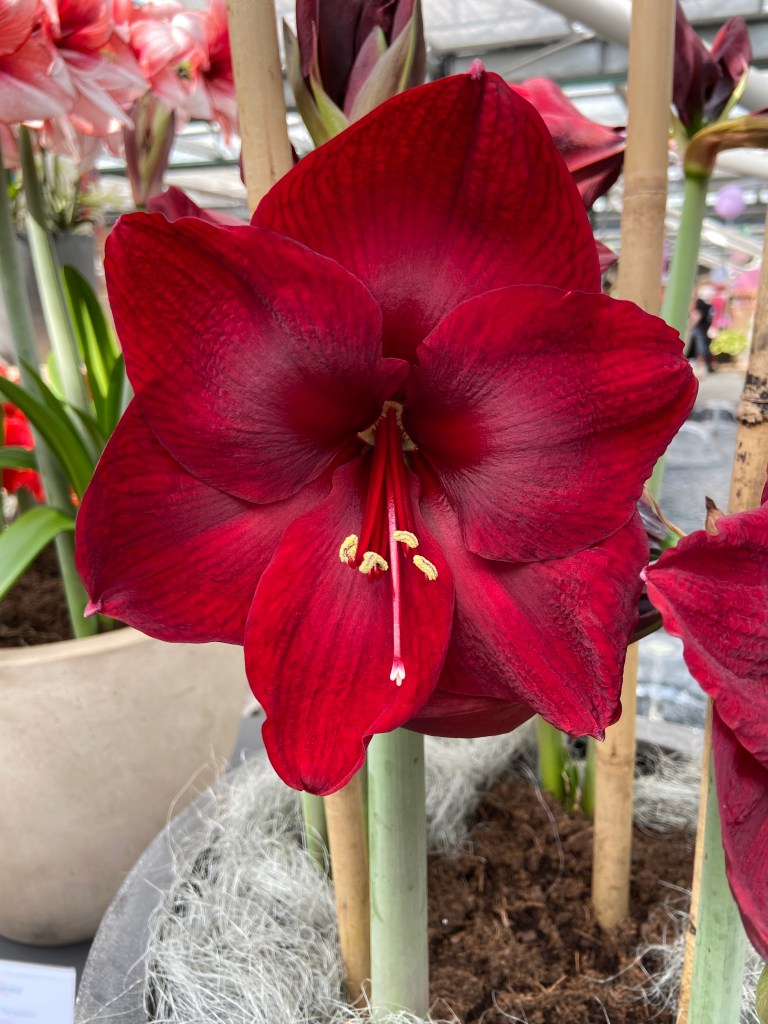
Carmen is the deep velvety red single-flowering bulb I mentioned on the show. I was potting them up as we talked. The box kits from Taylors Bulbs contain a plant pot and compost which makes life easier. Everything needed is contained in one box.

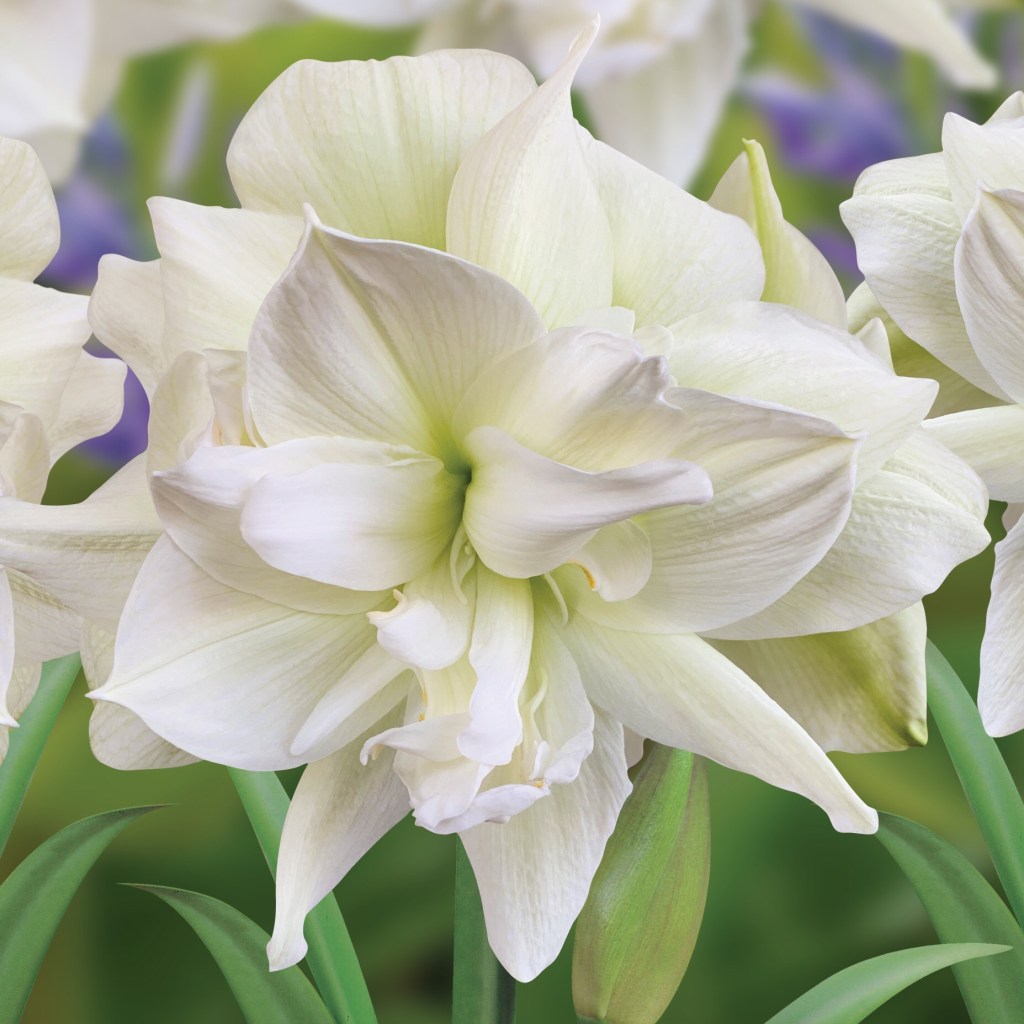
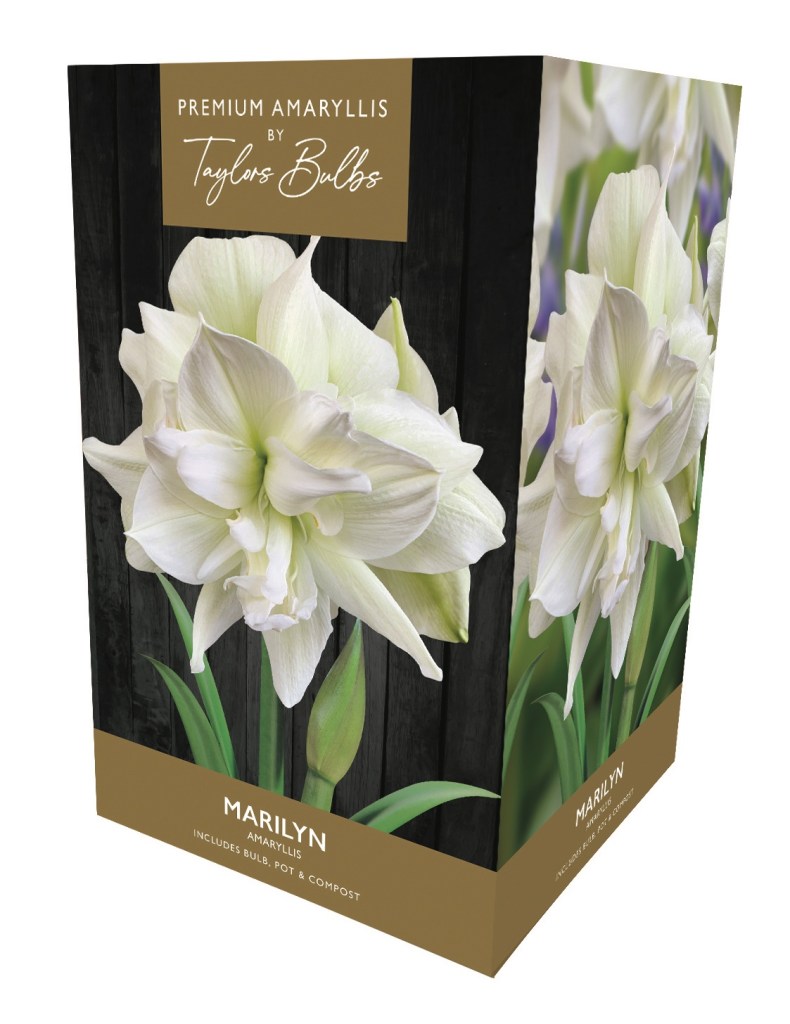
This beautiful double white amaryllis is Marilyn. I love the lime green centre of the flowers.

Lady Jane

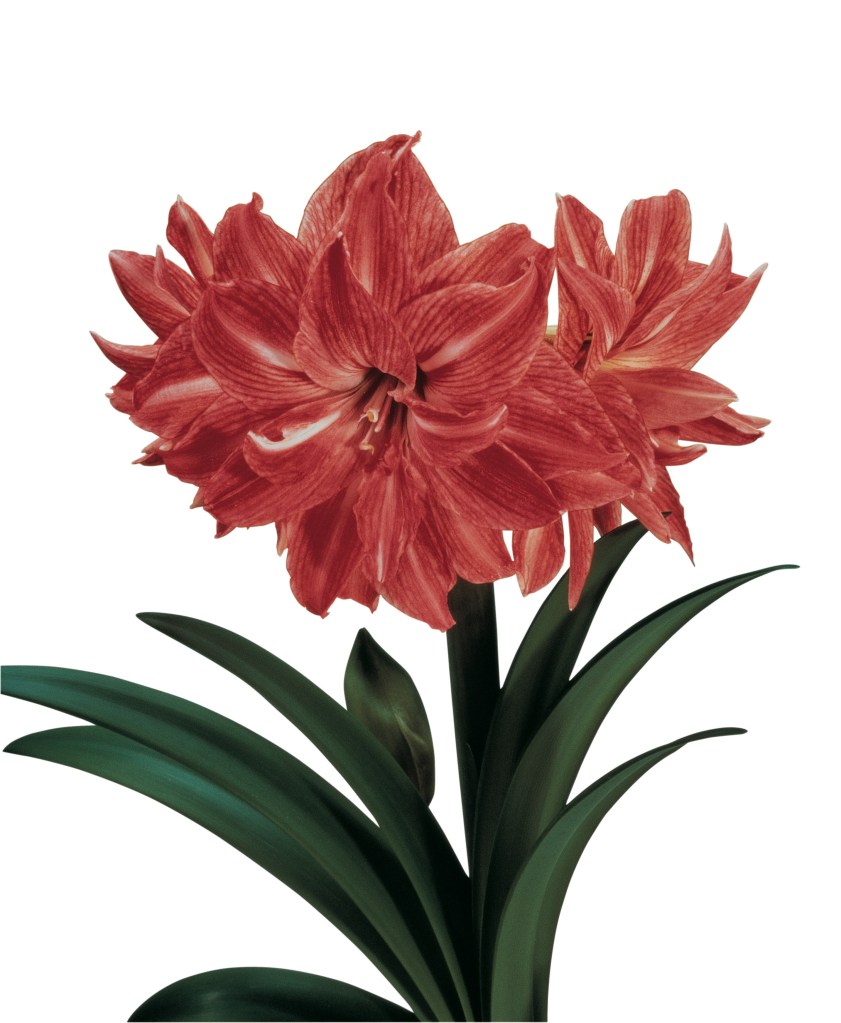
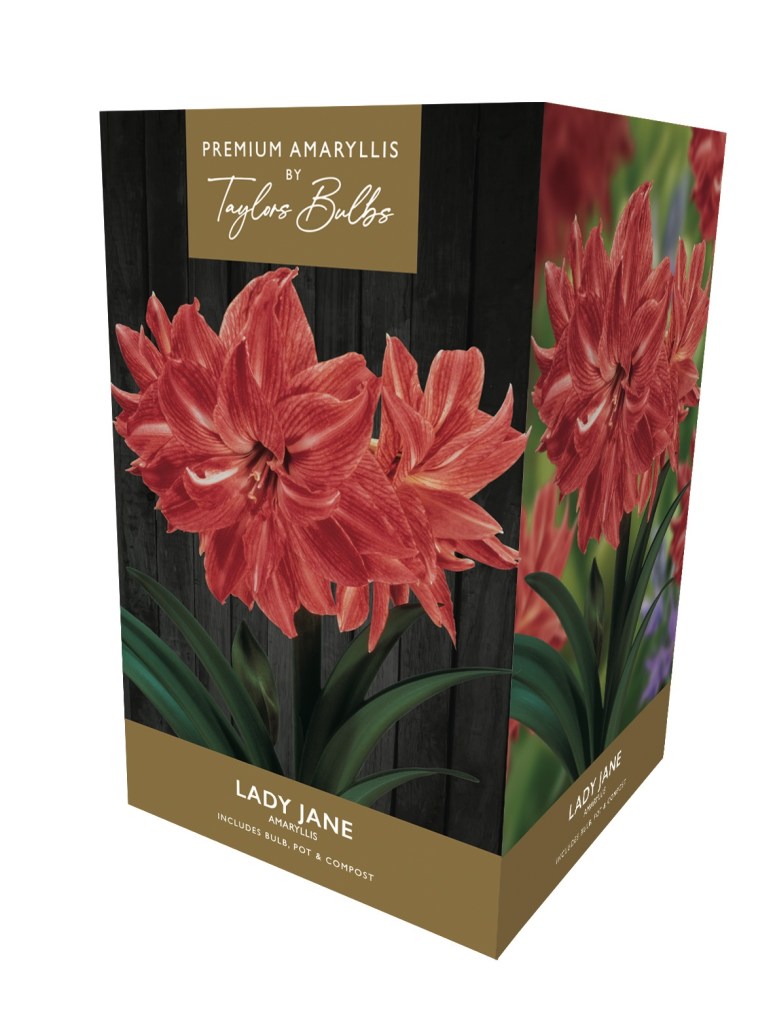
This is the pink and white striped double amaryllis I’ve chosen. It’s called Lady Jane. Which is quite a fancy name for quite a fancy flower!

Amaryllis Rilona has wonderful deep apricot single flowers with a darker eye. The flowers are edged in white, and if you look closely you can see darker orange stripes or veins radiating from the centre of the flowers to the tips.

When choosing bulbs, always go for the largest you can find. The larger the bulb, the more flower spikes will be produced. Usually one single spike is followed by a second, or even a third, if you are very lucky.

I asked Taylors Bulbs for some planting and general care advice:

How To Plant Amaryllis In Pots/Containers:

1. Soak the dry roots (not the bulb) in lukewarm water for about
45mins. Make sure to cut off any damaged roots before potting.
2. Fill the base of your pot (at least 20cm) with multi-purpose
compost, covering the drainage hole.
3. Feed the roots into the pot, spreading them out onto the compost and fill in around them with more compost.
4. Bury the bottom half of the bulb, so that it is secure in the pot.
Water sparingly.
5. Stand the pot in a well-lit position and keep the compost moist, but
do not over water.

Extra Tips:

* Amaryllis are great for the windowsill. Remember to turn the pot
regularly to prevent the stems bending towards the light.

* Once your Amaryllis flowers have faded, cut the whole stem off as
close to the base as possible.
* Water and feed them with a balanced fertiliser every few weeks to
help build up strength for next year.
* Make sure to give them plenty of light, as this helps the leaves
generate energy.
* To help encourage them to flower next year cut any old foliage back
to the neck of the bulb. Move them into a warm position and continue to water them.

Re-potting Amaryllis Bulbs:

* After every two to three years it’s a good idea to re-pot amaryllis
bulbs for continued good displays.
* Amaryllis tend to grow best in small pots, so don’t be tempted to
re-pot into a larger pot.
* After flowering, remove the bulbs from the compost and gently remove the compost around the roots. Then refill your pot with fresh compost and replant the bulb.

About Taylors Bulbs:

Taylors Bulbs are a fourth generation family business, growing and supplying flower bulbs and associated products since 1919.

Daffodils are grown on our farm in Holbeach, Lincolnshire where we also design and pack a large range of products predominantly for the UK and Irish markets.

Still a thriving family business employing over 200 staff at peak times, we pride ourselves on the award winning service we offer our customers.

Here’s some more amaryllis I’ve grown at Christmas. In the second year, they often flower either very early in November, or as late as May. Either way they are very welcome at a time when there are few flowers to enjoy in the garden. Indoor bulbs fill the gap.

This white single flower has a lovely red edge. I think it is called Picotee and I’ve had it for 10 years.
Another lovely single white flower. Possibly called Lemon and Lime, however I’ve lost the label as it’s been here many years.
Sadly, I can’t remember the name of this beauty, but again, it’s been here for several years.

Thanks for reading the blog, and for listening in to the radio. I also write a weekly column for Garden News Magazine, so I’m either talking or writing about flowers every day of the week. Happy gardening everyone!


Flowers from my garden- a week later….

Last week I posted an ‘all of the garden’ bouquet with everything in flower. I thought you might like to see how the flowers look seven days later. I visited my Mum today and took all the flowers out of the vase and cut four inches off the bottom of the stems. I cleaned the jam jar and added fresh water.

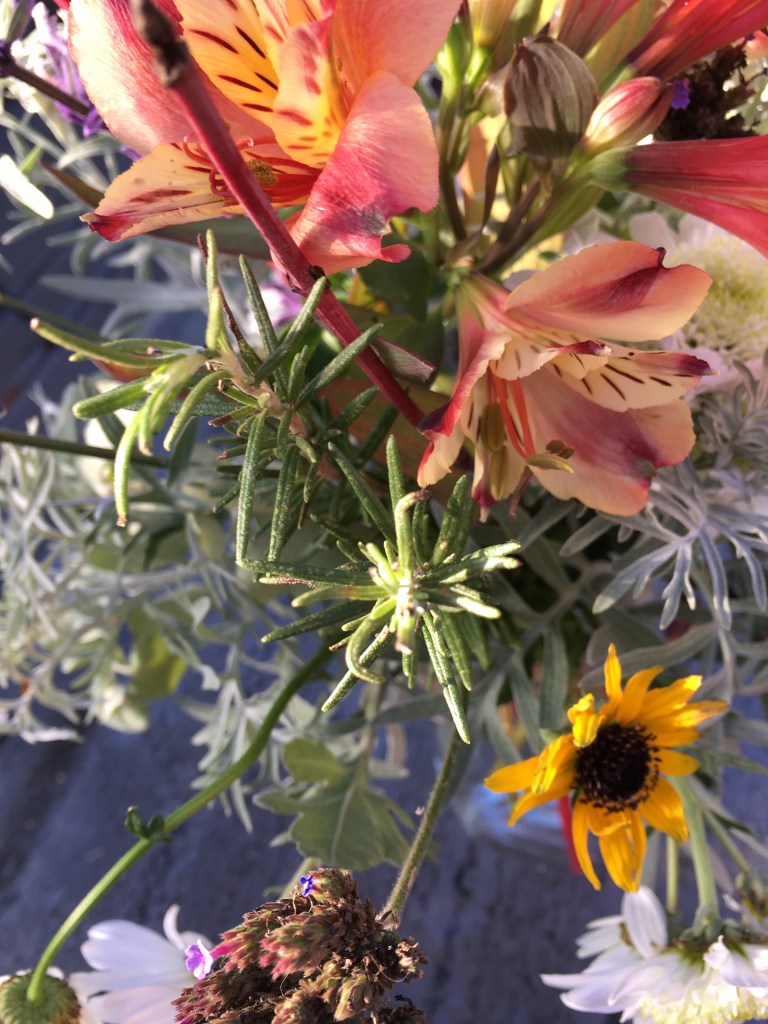
What a joy to see Alstroemeria Indian Summer still looking fresh and colourful. As I said last week, I bought this new plant from Mary Thomas who has a nursery in my area. Mary lives in Sutton Bonington and opens her garden for the NGS. She also has a plant nursery, Piecemeal Plants and has a stall at the Belvoir Castle Flower Show where I treated myself to one or two special plants. To have them still in flower in mid-November is making me very happy indeed!

Chrysanthemums give good value in a cut flower garden and will last three weeks in a vase, if looked after by refreshing the water and just trimming the base of the stems slightly every few days. Mum hadn’t touched her flowers for the week, but they still looked as fresh as newly picked. This variety is Swan. The pure white petals surround a green centre which eventually fades to white to match the outer petals. A good value plant. We bought cuttings from the RHS Malvern Show a few years ago. I think I shared a batch of cuttings with a friend. There was a special offer of 12 cuttings of different types. The price for the offer worked out at about 80p per cutting. Plants are grown in 10”pots stood outdoors all summer. Usually I take them in the poly tunnel or greenhouse in November as frost and rain might spoil the petals, but this year we have had such mild conditions, the plants are still outdoors.

This is the very last David Howard dahlia of the year. It’s my favourite dahlia and goes really well with the alstroemeria, as if they were meant to be together as a pair.

The petals of the rudbeckias have dropped off, but I decided to keep the stems as the dark brown stamens made interesting ‘buttons’ of colour and shape. A contrast to the flowers.

This little rudbeckia is hanging on, grown from a mixed packet of seed from Mr Fothergills. I just couldn’t throw it out. It might not last another week, but we shall see.

I was surprised and delighted to see the little wild flower Oxeye daisy still hanging on. Such a lovely reminder of the banks of white flowers which flower all summer here. It’s so strange to see them blooming in November as the days grow dark. But welcome even so.

As usual, foliage is important in my jam jar flowers. This is a lime green bedding plant I keep going from one year to the next by taking lots of cuttings and keeping them in 3” pots over the winter. They are popular for hanging baskets and containers, but also make very good foliage for cut flowers. And I’ve temporarily forgotten the name. Perhaps you know it? There’s also a grey version, but I prefer the lime green.

There’s also rosemary which goes into every posy I create. Everything I do has a meaning and rosemary is for remembrance, as you probably know. I’m surprised to see the huge 4ft high plant I have in the veg plot in full flower today. Such beautiful Mediterranean blue flowers and gorgeously -scented leaves. I couldn’t be without it.

I couldn’t be without my senecio viravira which also goes into every single posy I create. It’s such a pretty leaf and sets off all the other colours. Plants are not always hardy so again I’ve taken cuttings in 3” pots, just in case.

Also, not easy to photograph, but Salvia Phyllis’s Fancy is as fresh as the day I picked it.

A slightly better photo. You can also see the red stems of dogwood which give colour to autumn arrangements.

I hope you’ve enjoyed this weekend’s updated photos. It only took me ten minutes to rearrange the flowers and refresh them. It’s so rewarding to see how long home-grown flowers can last. And my mum’s kitchen window is full of autumn colour and scent for another week. A worthwhile project and it makes me – and my lovely Mum very happy.

Have a lovely gardening week. And thanks for reading the blog and leaving a comment below. Follow Cathy for the ‘In a Vase on Monday’ meme. She has a very special anniversary tomorrow, so many congratulations Cathy! And thanks for hosting such a lovely, friendly meme with members growing and arranging flowers all around the world for the past nine years.

https://ramblinginthegarden.wordpress.com/2022/11/07/in-a-vase-on-monday-life-more-sweet/

Flowers in memory of Joan

Rosa Compassion

This blog records my gardening life, growing fruit and vegetables for the family, and flowers for friends and relatives. Over the past five years, I’ve written about growing flowers for my mother-in-law Joan as a way of keeping a connection when she started to suffer from dementia. Joan and I shared a love of flowers and flower arranging. When she no longer knew my name, she still enjoyed my flowers and knew I was someone close to her. Sadly, Joan died earlier this year. All bereavements are difficult to recover from, but I’ve been surprised just how much I’ve been affected by Joan’s death. I didn’t feel like talking, didn’t feel like writing, didn’t feel like gardening. All the activities I usually enjoy didn’t seem to make any difference. I suppose, all these years I’ve been able to ‘do something.’ There’s been a purpose to all the work of growing sweet peas, dahlias and roses for cut flowers. Just to see Joan smile and feel as if I was keeping a connection with her, made it all worthwhile. It felt like an impossible challenge sometimes when she got so muddled she couldn’t remember her children or grandchildren. But challenges drive you on and force you to try harder. I was absolutely determined that dementia wouldn’t get the better of us and destroy the special friendship we had. But in the end it did. I feel as if it stole the last few years of her life and any comfort she could enjoy from knowing she had a large and loving family. Dementia took her into a parallel universe where we just didn’t exist. And Joan’s death has left such a hole in our lives, it will take time to readjust and refocus. As a start, I’ve decided to post some flowers in Joan’s memory. Thank you to all the readers who have sent supportive messages over the past five years and have been with me on this journey. I’m a ‘glass-half-full’ kind of person, so I’m thinking what good can come out of this experience and what I can do next to help families with relatives suffering from dementia. I’ll keep you updated on my plans. Meanwhile enjoy these flowers. I hope they bring you joy, as they did for Joan for many years.

I started with the galvanised bucket which came from Jonathan Moseley and contained sunflowers last week. I wrote about them here: https://bramblegarden.com/2022/07/25/sunflowers-for-my-mum-in-a-vase-on-monday/

Jonathan put crumpled chicken wire in the bucket to help support the stems. We are trying to use water and containers instead of florists’ foam containing plastic which contaminates the environment. https://www.jonathan-moseley.com/

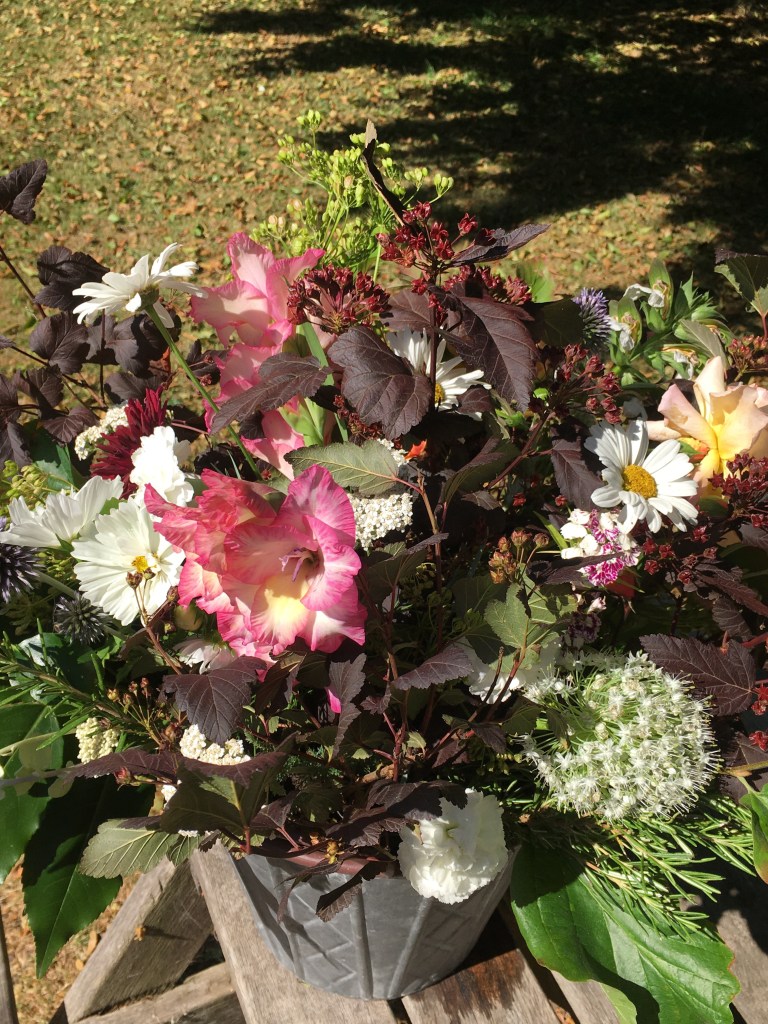
Jonathan used lemon-scented conifer as the foliage element for the flower arrangement. I’m using purple-leaved Physocarpus Diabolo which is one of the few plants looking good in the heat at the moment. I used seven stems.

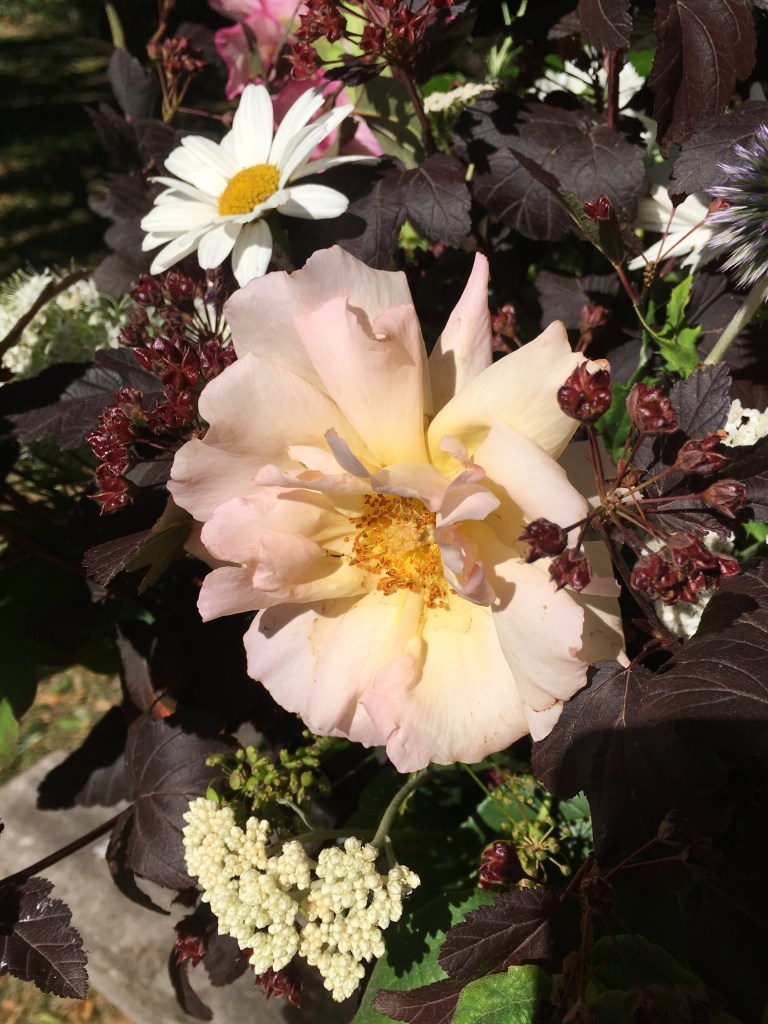
Physocarpus is worth growing for its white flower heads which are followed by these glossy maroon-red seed heads.
I thought these Persian ironwood, or Parrotia leaves would add texture. They are turning pink already. Usually they turn red and then orange in the autumn.

I only had about ten flower stems to put in the arrangement. The whole garden has suffered in the heat. Sweet peas have gone over, the earliest I can ever remember. Anything in flower when the temperature hit 40C was bleached out and dried. However, the roses have been the first plants to throw out new flower buds. This one is Compassion, a gorgeous climbing rose with a fruit-salad scent.

This is a new shrub rose called ‘It’s a Wonderful Life’ – Rose of the Year 2021. I wrote about it here : https://bramblegarden.com/2021/08/23/this-months-diary-for-garden-news-magazine/

These roses are perfect for floristry as they are long-lasting and disease resistant. Stems are virtually thorn free, and the scent is a cross between melon and pineapple, fresh and summery.

I found two stems of this gorgeous gladioli growing down the middle of the sweet pea A-frame. The willow frame means I don’t have to stake the gladioli and it makes good use of the bare space in the centre. These are butterfly gladioli which are smaller in stature than the usual cottage varieties. They are also called nanus, or small-flowered gladioli. These are more reliable in difficult conditions because you need much smaller corms to obtain flowers. The large-flowering gladioli have to have good, fertile soil which is also well-drained and you must start with top-size corms. I recommend Pheasant Acre nursery for supplies. https://www.pheasantacreplants.co.uk/

Gladioli flower for a good two weeks and are the right scale to go with cosmos and argyranthemums. I recommend Atom, Carine, Alba, Charming Beauty and Nathalie. Pheasants Acre Nursery sells collections at summer shows and are worth seeking out as there are often special offers.

I added a few stems of an argyranthemum my mum grew from seed. These grow to about 1.5 metres here and are good, reliable plants for summer floristry. Bees and butterflies love them too.

There is just one stem of dahlia Nuit D’Ete. Dahlias hated the heat and are now struggling in the drought. I haven’t watered them. It would be impossible to keep watering them as temperatures are still heading for 30C. I’m hoping they are just sitting there semi-dormant, waiting for the temperatures to dip and rain to come.

My plan of action for next year is to increase the mulching with home-made compost and sheep wool and bracken clay-breaker compost. I will also buy more builders’ bags of maize-based Plant Grow fertiliser. Plant Grow is helping plants cope with the extreme heat. But where I ran out of money and didn’t mulch, the beds are suffering. It just goes to show the power of mulch to hold moisture in during the summer and combat flooding in the winter. I recently visited Chatsworth for a head gardener tour to see the new Arcadia garden planted last year. Interestingly, all the new perennials, and the new rose garden, were planted into 6” of soil improver from Veolia. A no-dig project on a massive scale. I’ll be going back soon to see how the plants have coped with the heat. I’m also liaising with the gardeners as one of many people sharing experiences of working with different types of peat-free compost. All of us are mixing our own additives to try to find something that works well for us. I’ll share our findings when I know more.

I’ve added just two stems of highly-scented Bridal Star carnation. These are recommended for home-grown cut flowers. Plants repeat flower all summer. I’m growing mine in 10” containers in the doorway of the polytunnel. Flowers get some protection from the rain, tucked just inside the door.

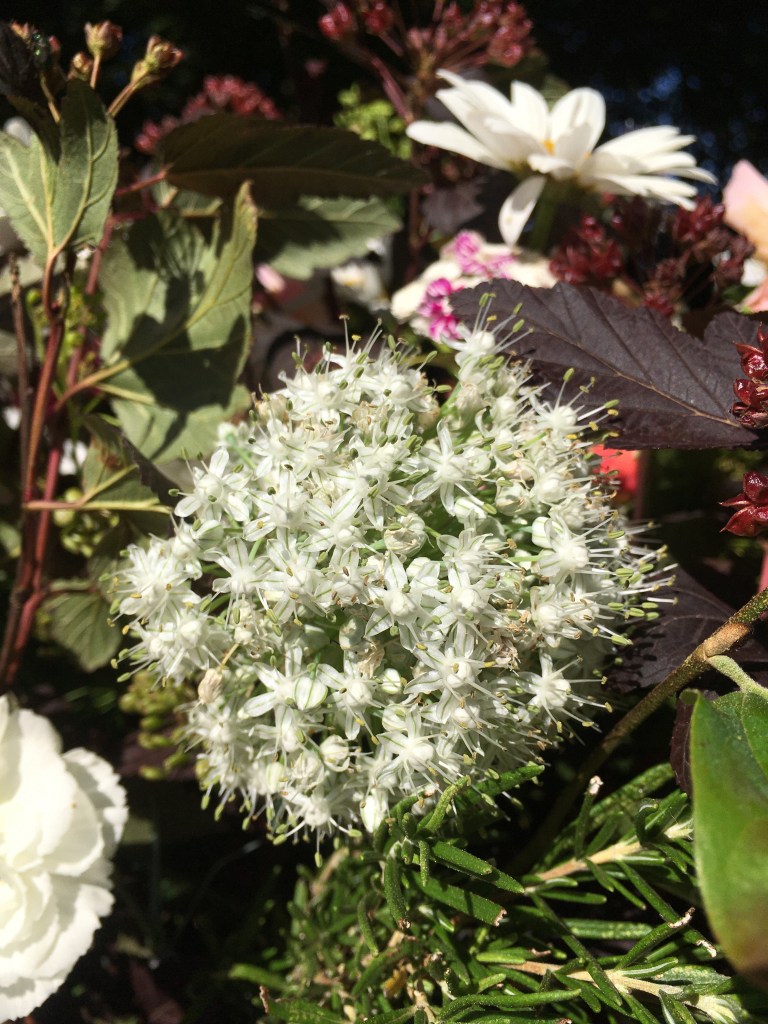
This flower was a surprise. It’s a spring onion, gone to seed! I might grow some on purpose, as they make large 4” diameter flowers, later in the season than most ornamental alliums.

My wild flower patch produced these flat-headed creamy white achillea. Another plant which doesn’t mind the heat. These started out as a packet of mixed wild flower seeds from Mr Fothergill’s.

These lime green flower heads are from parsnips allowed to go to seed. Jonathan Moseley allows some of his herbs and vegetables to run to seed and they make striking and unusual additions to his flower arrangements. The white flower in the photo is Cosmos Psyche White. A tall-growing, reliable cosmos. I grew the new cosmos Lemonade last summer, but it didn’t do well for me and was a bit of a disappointment. This year I’ve gone back to tried and tested white cosmos.

There are a couple of stems of blue drumstick echinops. These perennials are probably Taplow Blue, and originally came as divisions from Joan’s garden.

How is your garden faring in the heat. Have you had any rain, or are you parched like we are?

Thanks to Cathy for hosting the In a Vase on Monday meme. https://ramblinginthegarden.wordpress.com/2022/08/01/ina-vase-on-monday-glad-all-over/

A Greener Life – by Jack Wallington

BOOK REVIEW AND MY BBC LOCAL RADIO BOOK OF THE WEEK

Published by Laurence King, March 2022

Hardback, 192 pages, £19.99

ISBN: 978-085782-893-4

A Greener Life is much more than a ‘how-to-garden’ book, it’s actually a revealing diary of the writer’s journey from a stressful life and illness, to peace and calm through creating a garden and connecting with nature.

Jack Wallington writes how he struggled to sleep, was regularly ill and felt as if he’d ‘lost his way’ as he tried to keep up, and be available 24/7. “I thought the feeling of dissatisfaction was normal, to be waited out until retirement.” The turning point was the day Jack and his partner Chris planted the first trees, shrubs and bulbs in their new garden. “My worries briefly melted away, and a spark of happiness ignited.”

Jack says childhood memories trickled back, memories of sowing tomato and nasturtium seeds and taking cacti cuttings to sell for pocket money.

Through simply planting a garden he was better able to deflect stresses and anxieties and seemingly insurmountable problems at work . “Life, all life, the thing I had loved as a boy, that had been around me all along, was helping my world make sense. I had euphoric moments when discovering other gardens and visiting countryside. I began to feel connected to something bigger than me, and that somehow the things I planted and cared for were making a real contribution. The more I planted in the garden, the more insects and birds visited. Inviting nature back into my life gave a peace I hadn’t experienced for thirty years, and opened my eyes to the responsibility I had to the ecosystem I was nurturing.”

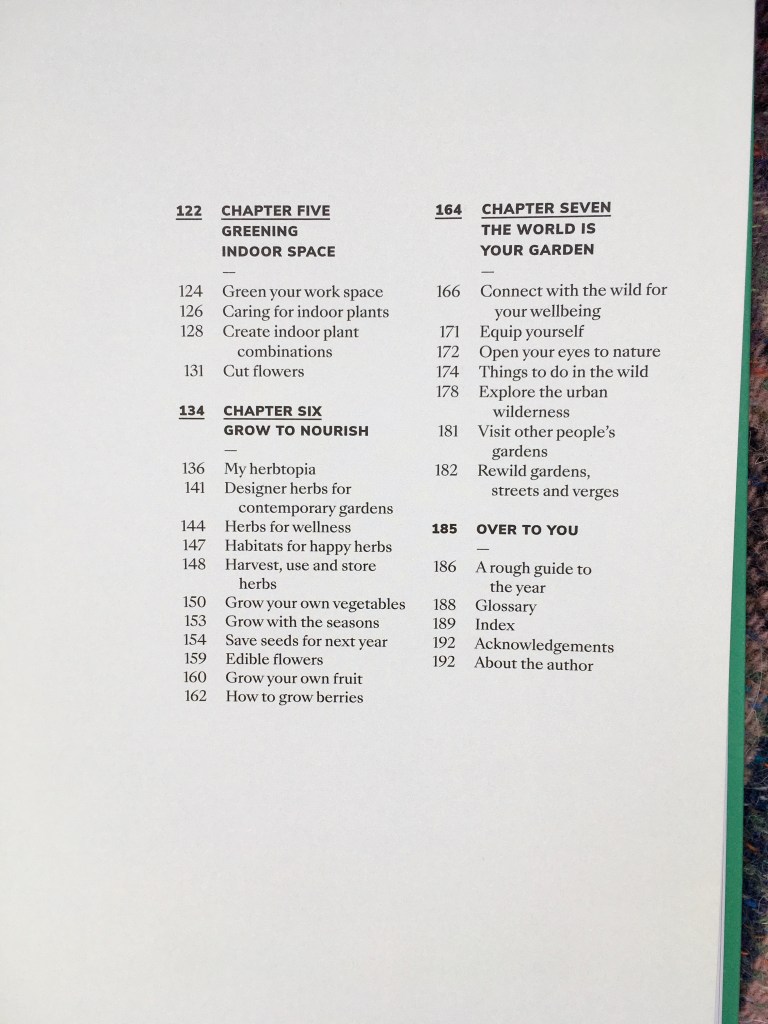
Jack’s book contains seven chapters. The first chapter outlines nine steps to a greener gardening life, and is almost a book in itself. Chapter two is about ‘getting started’ easy planting guides and essential tools you’ll need. Chapter three, encouraging beautiful ecosystems. Chapter four focuses on creating a wildlife -friendly garden, bringing soil to life and attracting and sustaining insect life.

Chapter five focuses on greening indoor spaces and greening workspaces.

Chapter six talks about herbs for wellness, growing vegetables, fruit and edible flowers.

Chapter seven is about connecting with nature, exploring wild areas in the city and countryside. There’s a section on using binoculars, cameras, smartphones and field guides and magnifying glasses- a useful guide to equipping yourself to delve deeper into the natural world.

A Greener Life is an honest, well-written account of self-discovery, and Jack’s voice comes over loud and clear in this beautifully put together book. You’ll certainly learn how to create nature-friendly gardens, but you will also perhaps pause for thought at what good can come from connecting with gardens and wildlife. In these stressful and strife-ridden days, this can only be a very good thing indeed.

Jack’s book is really everything you’d ever need to be a greener gardener. It’s written from the heart, from someone who’s found out for himself that gardens, gardening and being in touch with nature really can make a difference. Jack says “ We’re part of the natural world and to save it is to save ourselves. We all benefit from a greener life.”

The publishers have kindly given one copy to give away. Leave a message in the comments box below and one name will be selected randomly by 26 March. Sorry, the offer is only open to readers in the UK.

My Garden Diary -June 2021

Life seems to have been incredibly busy these past few months. Two family members have been desperately ill. I’ve sat by their beds and held their hands. Willed them to stay with us. One emerged from a deep deep coma, and returned to us. The other one passed away, peacefully in his sleep. And so, I sit in the garden now and think of them. Hoping the one returned to us as fragile as a butterfly, will spread his wings and fly, and mourning for the one who did not, although it was his time to go and we must celebrate a life well lived, well loved, happy and fruitful. The garden, as ever, becomes a place of solace. I’ve ground to a halt after months of literally running from one place to the next, almost in a permanent panic. Back here, in the shade of the trees, there’s peace and calm. Whilst I’ve been busy, the nesting birds have raised their young, and many have fledged. A highlight of a particularly difficult and stormy day was suddenly finding six long-tailed tits, newly emerged from the nest- all gathered along a hazel branch, at eye level, fluffing up feathers, preening, eager darting eyes. Almost like pom poms on a string. What a day to fledge! We had 40 mile per hour winds and torrential rain. With the storm coming from the south east, the westerly edge of our wood was weirdly still and silent, and this is where our little flock gathered. The parents desperately calling to them, ‘tsuk, tsuk, tsuk’ but the chicks totally unafraid, studied me as much as I studied them. In all the excitement of leaving the nest, I was just one of the new wonders for them to discover. I’ve stored up this moment as a happy memory during a difficult time. It’s amazing the little things that give you hope in times of need. You never know when or where these moments will come from, do you. And often it’s the simplest things that provide a balm.

Enjoy this week’s views of the garden and ramble along the back field footpath where there’s masses of white cow parsley and the last of the hawthorn blossom now festooned with ribbons of fragrant dog roses. Thank you for reading my blog.
Cow parsley and wild three cornered leek, where snowdrops bloomed in winter.

Viburnum plicatum at the edge of the horseshoe pond. Layers of flat white flowers, covered in bees.

White Roses. Pearl Drift requires minimal pruning and no chemicals. It is resistant to blackspot due to it’s LeGrice breeding. Grows to 4ft and is reliably repeat-flowering. Highly recommended.

Semi-double flowers allow bees to access the pollen. Sweetly scented.

Dianthus Mrs Sinkins. Another highly-scented flower in the June garden. Repeat flowers if cut back and dead-headed. Grows in the overspill gravel alongside the drive.

White campion – Silene latifolia alba- arrived by itself and grows amongst the cow parsley. Much less rampant than the pink variety.

Wild dog roses, great big swathes, overhang from the top of the high hawthorn hedges. There will be plenty of bright red rosehips.

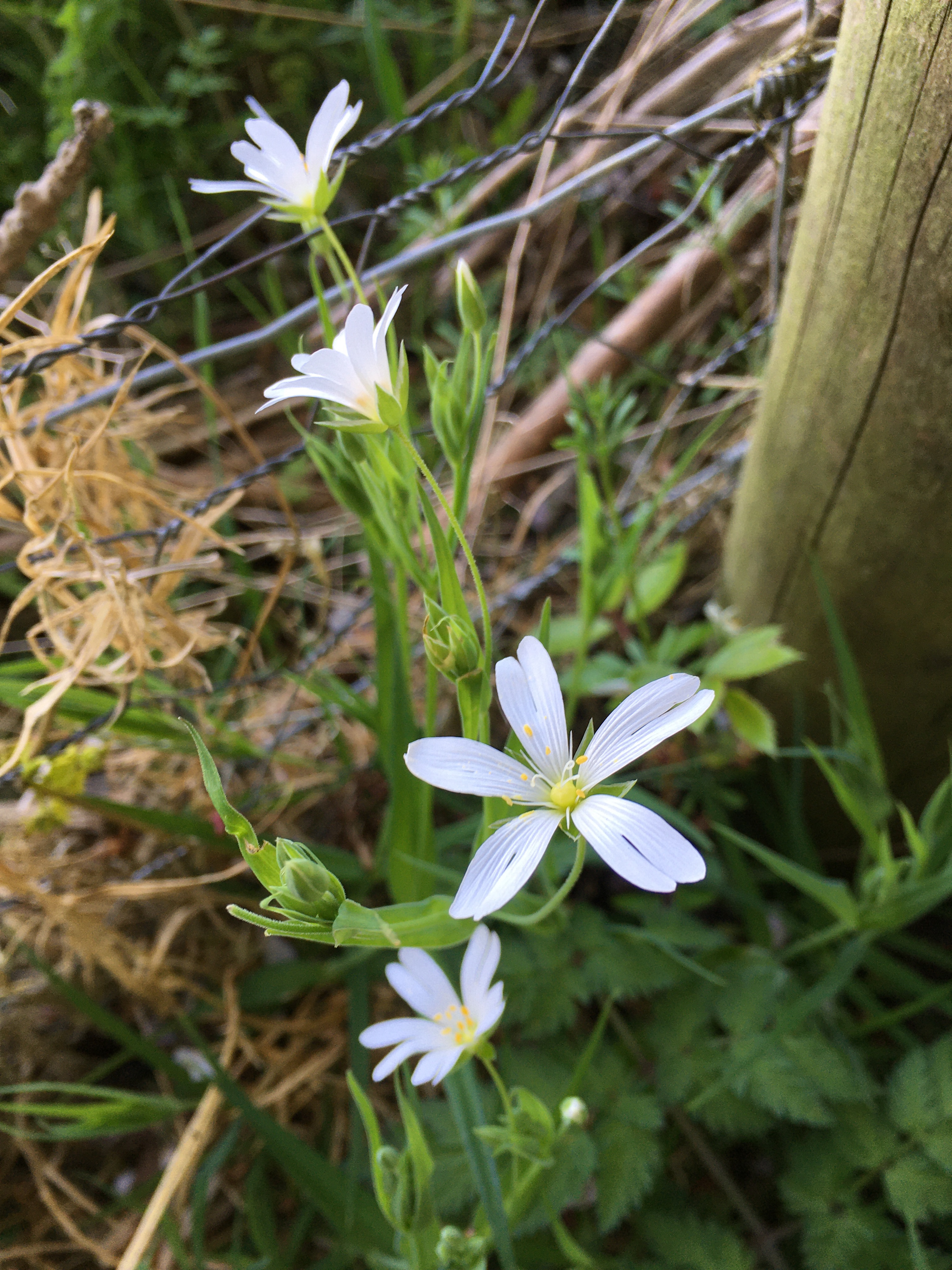
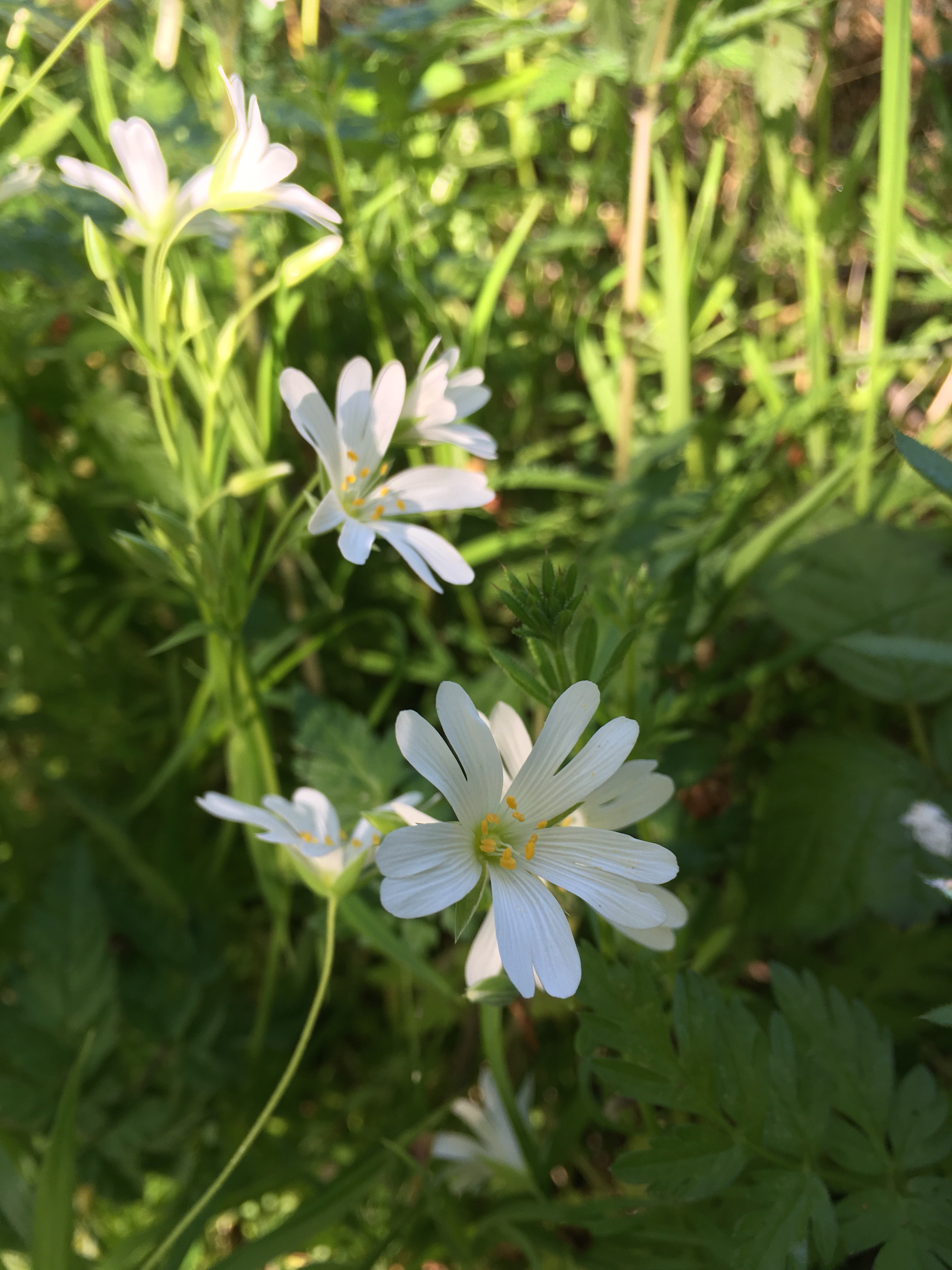
Along the holloway walk. The pathway is edged with snowdrops in winter, and white starry stitchwort in summer. I’m adding white foxgloves for next year.

I’ve left gaps in the trees to look out from the pathway, towards the back fields, this year planted with spring wheat. I’m looking forward to having a golden backdrop for the garden. Wheat and barley are my favourites.

Step out of the top five bar gate, and on to the lane. The cow parsley has never looked as lovely. Or maybe, I just haven’t had time to stand and survey the scene before.

Looking across the fields towards Bunny Wood. There’s an ancient footpath to the woods.

A well-trodden path, very popular with hikers and dog walkers. We sometimes see deer. Usually there’s hares – more this year than usual. At dusk we watch the barn owls quarter the fields. At the moment they are out in the day as well as at night, which means they are probably feeding young. Tawny owls also call out across the fields at night.

A hawthorn ‘archway.’ A favourite viewing point.

Plenty of cow parsley. As pretty as any florists’ flower.

Thank you for reading my blog. Let me know what gardening jobs you are doing at the moment. I’m catching up on planting and weeding. Everything is very late this year, but I expect things will catch up in time. Have a peaceful happy week.

A walk around my garden 26 Jan 2021

I thought you’d like a calming walk around the garden today. We’ve had snow for two days now, but it is starting to melt. It’s currently 3C and rain is forecast. Snow covers a multitude of sins. You can’t see the brambles or stinging nettles. I’ve made a start on tackling the thickets- they have grown up in only three years of neglect. It’s interesting to see how nature is always trying to reclaim the garden. Always trying to take back what we’ve borrowed. We only carve out this place for a short while.

Bellis daisies. In flower despite the cold. We planted some in pots years ago and they’ve seeded about the plot. They pop up in borders, the gravel paths, and in small colonies in the lawn. I rather like them for their tenacity. Stamp on them (accidentally) and they do not flinch.

By the front door there’s a patch of Algerian iris (Iris unguicularis). It grows in the gravel spilling over from the path. There is no soil here. And yet, with minimum fuss and no maintenance, it flowers its heart out from October to March. Friends say it can be difficult to grow, so I’m grateful for my little patch of thriving iris. Last year it produced this pretty lilac sport. The mother plant is deep purple. I love it when plants suddenly do the unexpected. Don’t you?

The bank of wild cherry trees look like charcoal drawings in the snow. They are full of buds. I’ll cut a few twiggy branches and bring them into the house. They’ll flower readily in the heat of the kitchen. One way to bring spring forwards a little. It’s cheating, I know, but I can’t resist.

More trees surround the wildlife pond. It’s wonderful to think we are only four weeks to seeing frogspawn in the pond. Spring always starts for me when we see frogs again. You can learn more about frogs by following Froglife, a wildife charity dedicated to the conservation of frogs, toads, newts, snakes and lizards.

Here’s the link https://www.froglife.org/

We are seeing a lot more deer in our area. We think they might be Sitka deer. Sometimes I just catch sight of them out of the corner of my eye. They are almost like ghosts, drifting silently along the dark hedgerows. They seem to blend into the shadows and become part of the landscape. Sometimes, in spring, if we are really lucky, we’ll come across a fawn in the long grass. The mother is never far away, and we tiptoe quietly away, so as not to startle her.

We’ve turned the summerhouse towards the sun. Amazingly, it’s quite warm in there. Such a well-made building, insulated with thick, wavy-edge oak. They knew how to build in the 1930s. We are grateful for our sturdy and peaceful sanctuary. It’s the perfect place to sit for a while and read, or watch the birds. Sometimes we see a fox. At dusk, a barn owl quarters the back field. They hunt methodically, searching for prey by flying back and forth. We worry when the weather is stormy and wet, as it increasingly is nowadays. Barn owls have no waterproofing. Their soft feathers help them to fly almost silently, but it’s at the expense of being weatherproof. They struggle to hunt and find food in the rain. One heartbreaking evening last summer, we saw the female out in heavy rain. She looked off balance, her flight hampered by the wind. We watched as she wobbled and barely made it over the top of the hedge. Desperation must have driven her out in poor weather. She had two chicks to feed. Later, the farmer who checks the nests, found only one chick had survived.

I’ll leave you with two happy photos. Snowdrops always make me feel hopeful. They return every year, whatever is happening in the world around them.

And this beautiful glass ‘vase’ of flowers- a present from a kind friend. Certainly. We are all looking for anything that brings joy at the moment. Thank goodness for kindness, friends and family. And for flowers which always make us smile.

Let me know how you are all getting on. Are you managing to sow any seeds or do any gardening yet. Take care everyone. And thank you for reading.

I’m on instagram at karengimson1 and twitter @kgimson. Come over and say hello!

In a Vase on Monday- virtual flowers for Joan

Chrysanthemums are in full flower in the poly tunnel. They’ll provide cut flowers from now until January. I grow hardy varieties in 10″ pots. They stand out on the gravel paths, next to the greenhouse all summer. Chrysanths can cope with the cold, but wet weather spoils the flowers, so I lift the pots into the unheated poly tunnel the first week of November.

I don’t know the name of this bright yellow chrysanthemum. It came from my father-in-law Keith. He had been growing it since the 1950s, having been given a cutting from Aunty Dorris. When Keith was no longer able to garden, I took over the tradition on growing the yellow flowers for his wife, Joan. Until this year, I’ve managed to supply Joan with a bunch each week through November and December. They are her favourites. This year, covid has interrupted our plans – and I’ve had to e mail photos of the flowers instead.

I’m growing these pretty little white chrysanthemums too. These are called Stallion. They are multi -headed and last at least a fortnight, sometimes three weeks, in a vase. Flowers have a bright yellow button centre, and take on pink tinges as they age. Very useful as a filler in a bouquet.

We’ve had a message from the care home saying one family member can visit before Christmas. They will have to take a rapid covid test, sit in their car for half an hour to wait for the results, and then spend 30 minutes visiting our relatives in their own rooms. We can’t visit any communal spaces. And we still can’t take flowers, for some reason. But we can take tins of biscuits and jars of jam- anything that can be disinfected before being giving to the residents. I’m writing about it here because the blog has become a record of our times, living through this covid pandemic, and the effect it’s had on people living in care homes.

Hopefully, soon we will be able to have the vaccine and this nightmare will come to an end. I’m hopeful it won’t be long now.

Thank you for reading. I’m celebrating reaching the milestone 100,000 readers on the blog. When I started writing, I had no idea so many would read my potting shed musings. Thanks for being one of them. Have a calm and happy week.

In a Vase on Monday : Cathy https://ramblinginthegarden.wordpress.com/category/gardens/in-a-vase-on-monday/

A Walk Around My Garden, Sunday 23 August 2020

It’s been a challenging few weeks. We wanted rain. And we got it. A month’s worth in four days. Followed by Storm Ellen and 40 mile per hour winds. Anything not firmly staked, flopped over. Sunflowers and cosmos took a bashing. It’s taken a couple of days to prop up plants, tie them in, and sweep up twigs and leaf litter. I sometimes wish I was passionate about interior design instead of gardening. Wouldn’t it be lovely to create a scene, and have nothing smash it to pieces. But, sadly, I’m not remotely interested in being indoors. I’m only really happy when I’m outside, in the fresh air. Anyway, to cheer us all up, here’s some photos of what’s in flower in my garden today.

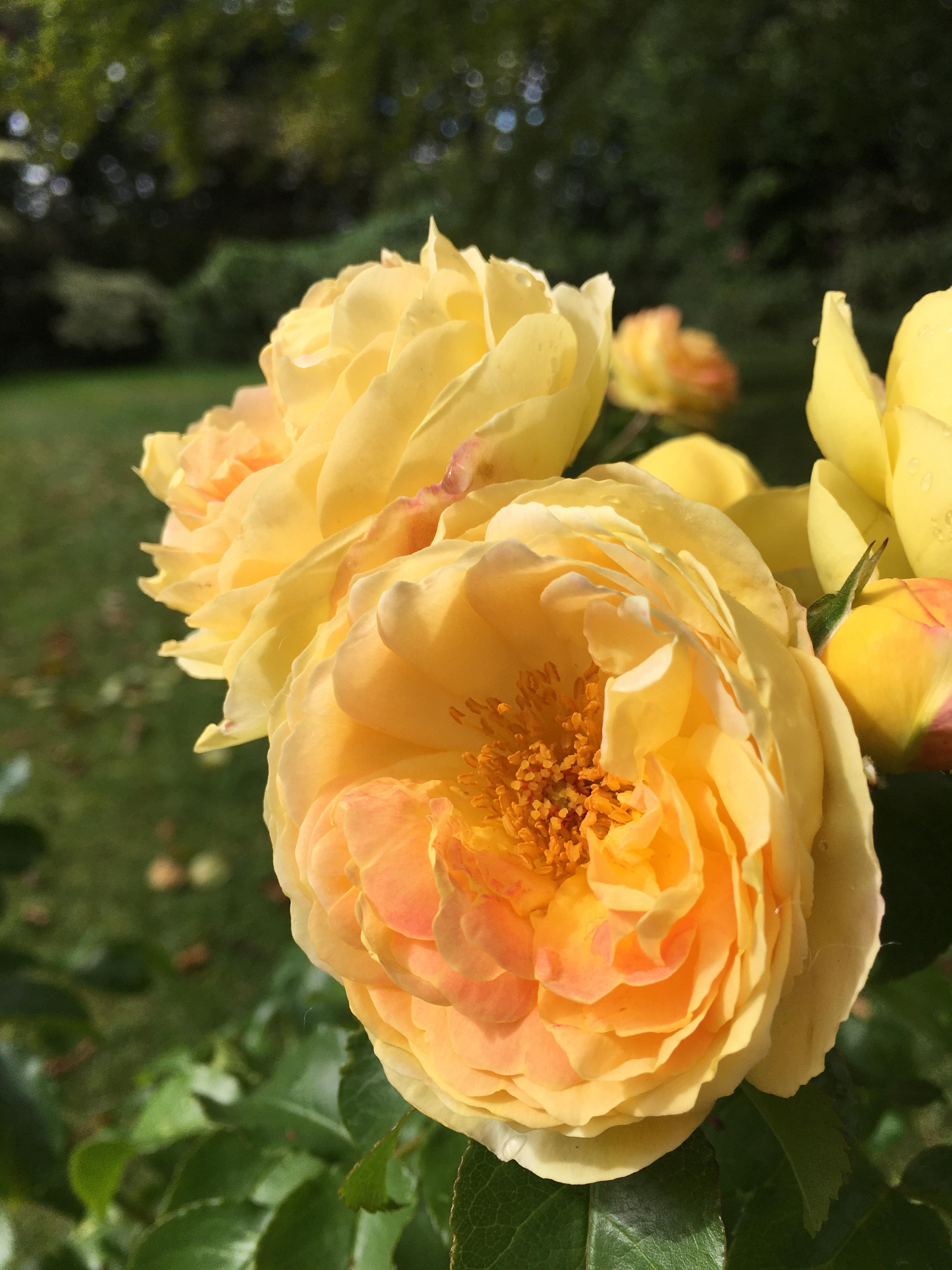
My new rose, Belle de Jour. Rose of the Year for 2021. Flowers open clear, bright yellow and fade to sunset shades of peaches and cream. There’s a delicate fruity scent and plenty of pollen for bees. Nice healthy green leaves, which is good for an organic garden like mine.

I think we can definitely say these flowers stand up to the weather. Some roses ‘ball’ in the rain. They fail to open and turn to mush. Luckily, Belle de Jour copes with a deluge; there’s not a mark on the petals. My rose came, by post, from Roses UK which promotes the British rose trade. I’m sure the new rose will be a huge success. It’s looking lovely in my garden already. And I’m always pleased to support British nurseries.

I’m growing a new variety of courgette, ‘Summer Holiday.’ Isn’t it pretty. I don’t know why, but this photo makes me so happy. It looks such a gorgeous little thing, bright yellow, with a twisty green stem. It’s a joy. And so easy to grow. I’m in favour of anything easy, this summer. Everything seems to have been hard work, so a highly productive trouble-free plant is very welcome. There’s a recipe for courgette and cream cheese soup to follow. It only takes ten minutes to cook.

Courgette flowers look beautiful too. They only last a day, but are a sunny, joyful sight. I’ve planted courgette and squash all along the base of my climbing bean frame. They make good ground cover and smother weeds.

Here’s the beans I’m growing this year. Don’t they look colourful.

Yellow: Climbing French bean ‘Sunshine’. A new variety.

Green: Climbing French bean ‘Limka’.

Purple: Dwarf French bean ‘Red Swan’.

All growing together along the hazel A-frame support, with blue morning glory intertwined. The dwarf French beans grow to around 122cm (4ft). Climbing beans are around 2.5m (8ft). Every day, I’m gleefully throwing handfuls of beans into the freezer. They will be such a treat mid-winter when fresh greens are in short supply.

I have a newly-planted border all along the path to the front door. It was infested with couch grass. Over the winter I dug out all the plants and turned over the soil, searching for every scrap of tiny white couch grass roots. I had to do this four times before getting on top of the problem. In May, I planted the border with annuals; sunflowers, nicotiana, cosmos, and underplanted them with salvias, which I treat as bedding plants as they are not very hardy here.

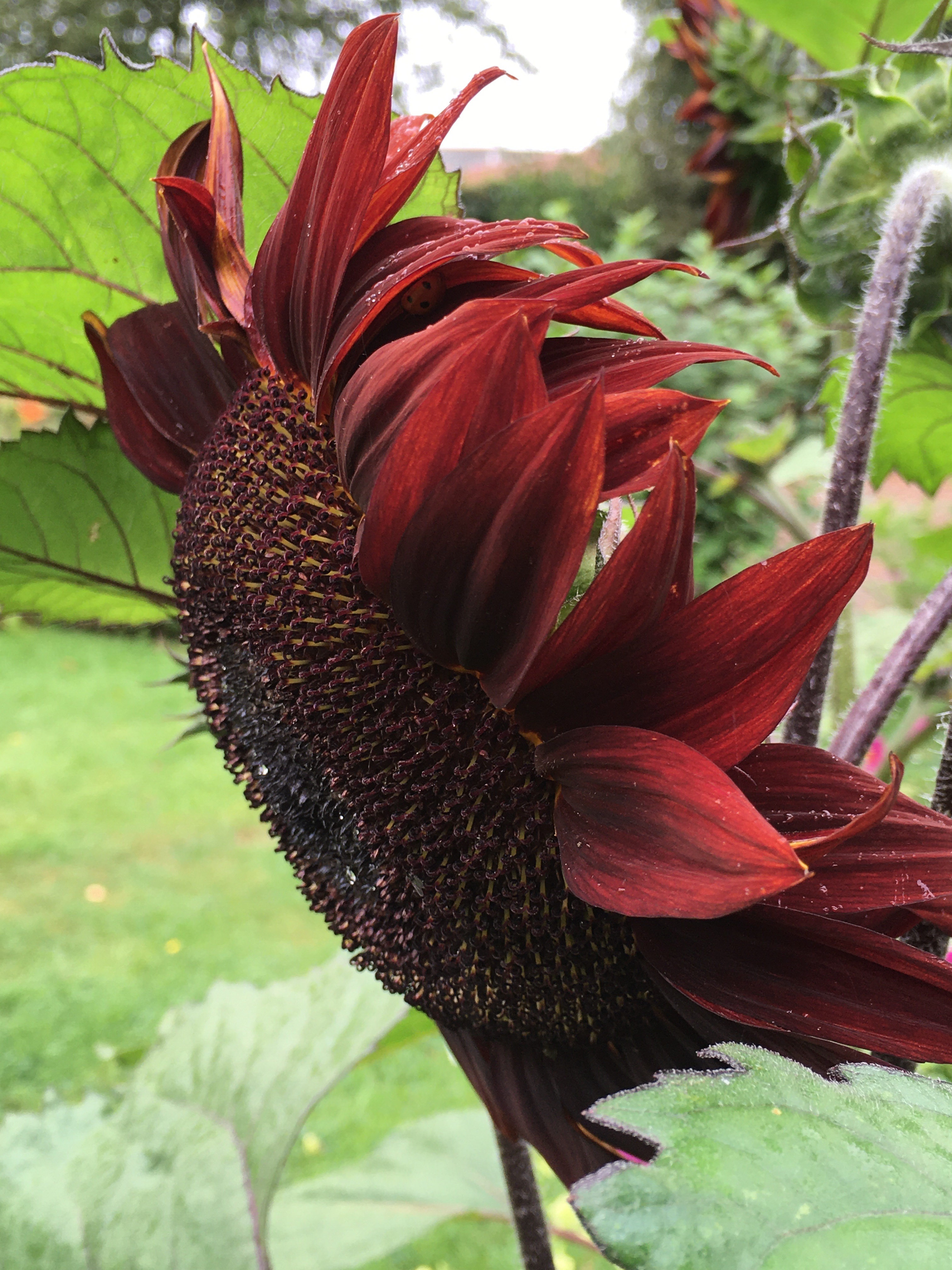
I favour dark dusky-coloured sunflowers. This one pictured above is ‘Black Magic.’ It’s a multi-headed sunflower the colour of dark chocolate. Bees love it, and the seed will feed birds in winter. I won’t bother growing ‘Italian White’ again. The first sign of a gale and the petals curled up and dropped off. Not hardy enough for my windswept plot.

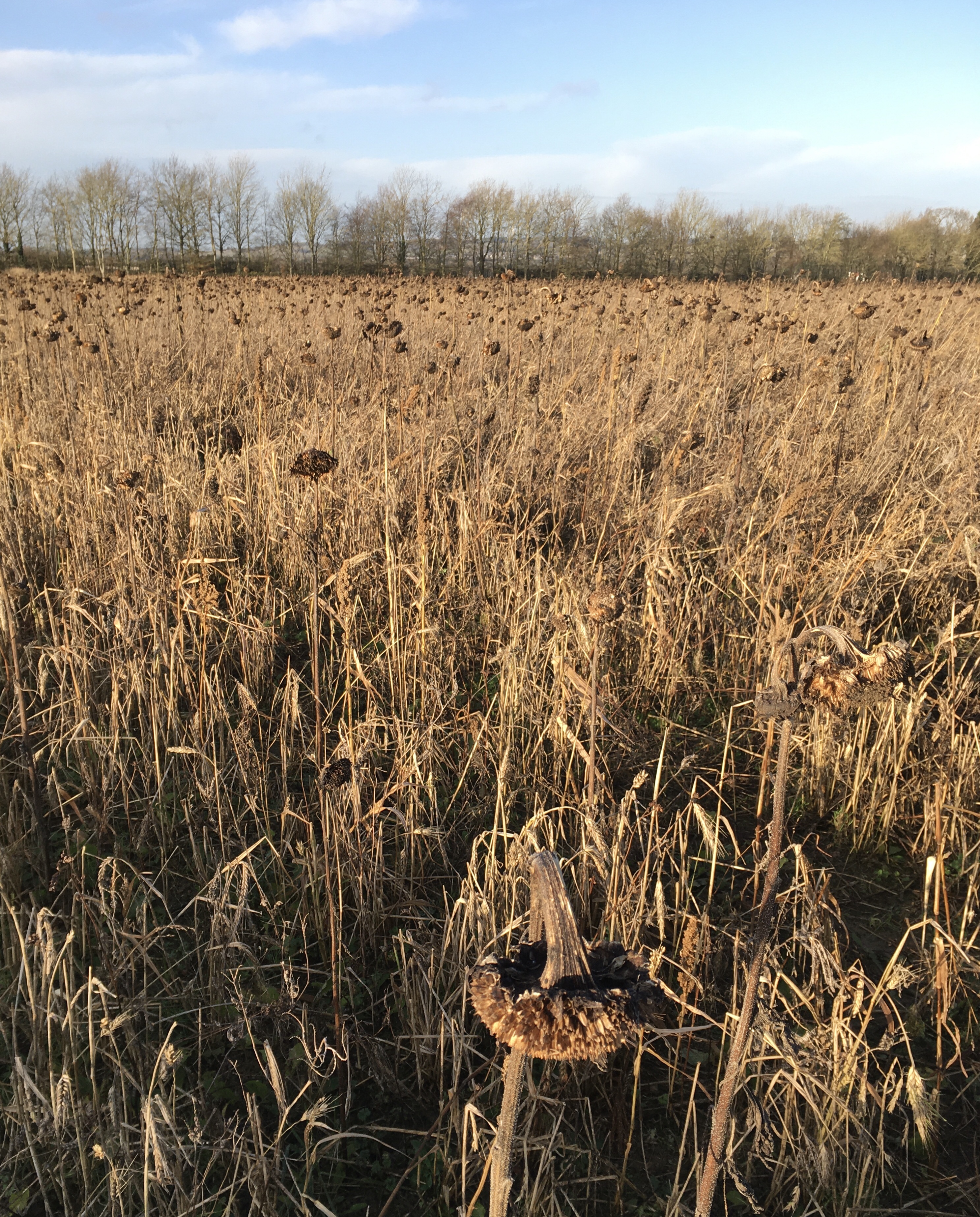
If you like yellow sunflowers you would love these, growing in the back fields behind my garden. We cheered when we saw the farmer sowing the seeds in spring. It’s a wildlife -friendly mix to attract pollinators, and the seedheads feed birds and mammals over winter.

The ridgeway footpath goes all along the side of the sunflower field. We walk along it twice a day, as we are still in the habit of our lockdown exercise regime. And some of us are still not venturing far, as we can’t take any risks. I’m still getting over a serious illness from three years ago, and although surgeons gave me a second chance, I’m not strong enough to fight off infection. Doctors nowadays are forthright. And mine, straight to the point, said a ventilator wouldn’t be an option. So there we are. I have to be careful. I’m not dwelling on it. I’m just grateful for small mercies, sunflowers included, as I can gaze at them and feel happy. I don’t know how, but I can.

We still have swallows flying here. They must be finding plenty of insects. I’ll miss them when they go. I think of the journey they have to make, such tiny birds. Such a long way. It’s always an anxious time waiting for them to return in spring. Maybe, I’m going to have to get my courage up, and be like the swallows. Set off into the unknown. I can’t stay here forever, as lovely as it is, and as tempting as it’s become to say how well I’m coping. Someday soon, I have to set forth. Wish me luck!

On the footpath, going home, I pass by this old crab apple tree. It must be 100 years old, the size of its trunk. It makes a natural arch over the pathway. I like to gaze into the distance and wonder how the view might have changed over the past century. Probably not a lot as it’s still all farmland round here. But the people who’ve passed by this tree, their lives would have been very different 100 years ago. We have so much to be grateful for.

Nearing home, by our field gate, you can see the row of trees we planted 30 years ago when we were in our 20s. We never thought those little saplings would grow into a wood. And we didn’t know how much joy they would give us, watching the leaves change through the seasons, and giving a home to birds and wildlife. This summer, these daisies suddenly appeared. On sunny days, they have a strong chamomile scent. They may only be weeds, but they are a lovely sight, even so. Don’t you agree.

How has your garden fared this summer with the heatwave, drought and storms? It feels like we have faced many challenges, all round. Let me know what’s looking good in your garden right now, and whether you are managing to get out and about yet, or like me, waiting for your moment.

Links:

Karengimson1 on instagram and @kgimson on twitter

Roses UK: https://www.rosesuk.com/

Rosa Belle De Jour: https://www.apuldramroses.co.uk/

Summer Holiday courgette: https://www.mr-fothergills.co.uk/Vegetable-Seeds/Courgette-Seed/Courgette-Summer-Holiday_2.html#.X0GQChB4WfA

Beans: https://www.mr-fothergills.co.uk/Pea-and-Bean-Seeds/Climbing-Bean-Seeds/#.X0GQPhB4WfA

Sunflowers : https://www.mr-fothergills.co.uk/Flower-Seed/Sunflower-Black-Magic-F1-Seeds.html#.X0GQbRB4WfA

Six on Saturday meme : https://thepropagatorblog.wordpress.com/2020/08/22/six-on-saturday-22-08-2020/

Six on Saturday. A walk around my garden 11 July 20209

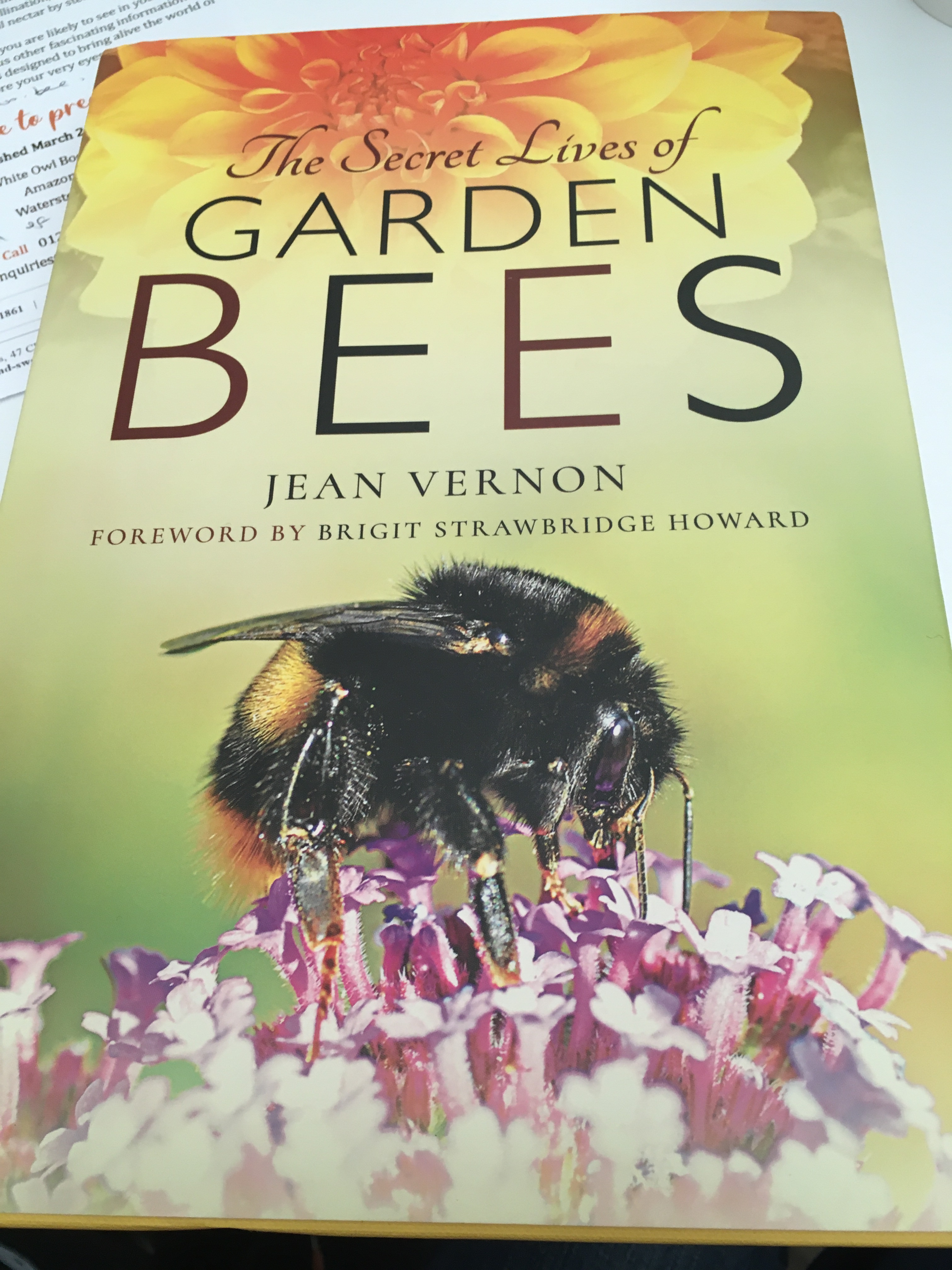
Phacelia is a bee magnet. I’m growing it around the edges of the vegetable plot. It’s an annual, but self-seeds readily. It can also be grown as a green manure crop, but for this use, it has to be turned into the soil before it flowers. I’ve been re-reading Jean Vernon’s Secret Lives of Garden Bees. Writing about Phacelia, she says: ” Look closely at foraging bees and you’ll notice the blue pollen balls that they collect from these flowers. ”

Geranium pratense. Meadow cranesbill. A native wild flower found along the grass verges here. Seed has blown into the garden and it grows along the hedgerows and amongst ornamentals. It’s very welcome.

Occasionally it throws up a white variant, and also flowers in delicate shades of lilac. I love the green ‘veins’ on the flowers. It reminds me of the markings on a butterfly wing.

Over on the veg plot, I found these flowers this week. They are potato flowers from the Shetland Black tubers growing in compost sacks. Aren’t they beautiful. You can tell the potatoes are part of the deadly nightshade family. I’ve never grown black potatoes before, so I’m eagerly awaiting the harvest.

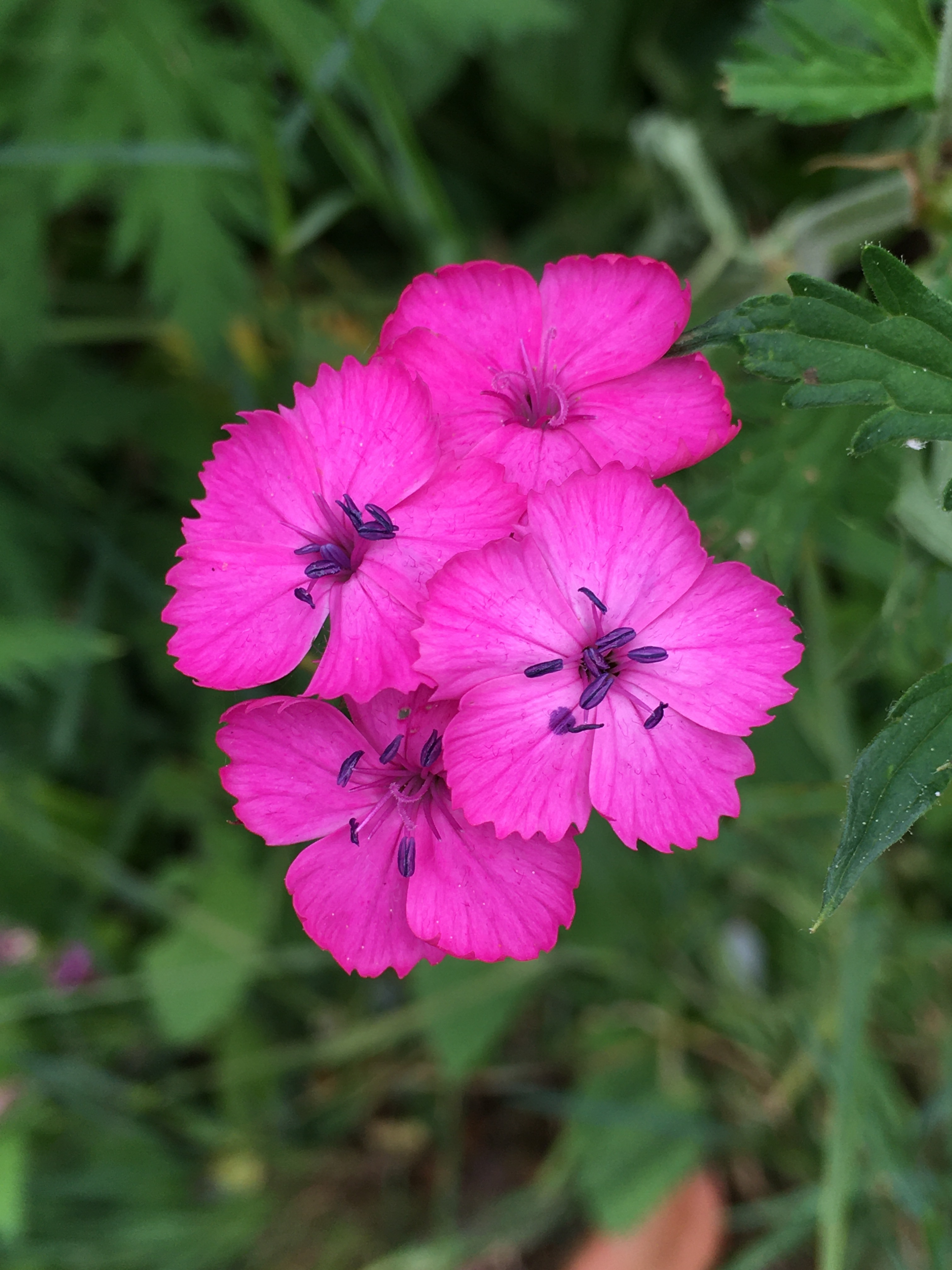
Dianthus cathusianorum. In the gravel edges on the front drive, these bright pink flowers wave about on 50cm stems. They must love the free-draining conditions. We have to remember to drive around them. The scent is wonderful. Spicy. Heady. Memorable.

And finally, sweet peas. These are from a range called ‘Ripple Mixed.’ I’ve grown Wiltshire Ripple for many years, but the mixed pink and purple- striped flowers are fast becoming new favourites. Highly scented. Nice long stems. Long lasting in a vase. Recommended.

That’s my six for today. What’s looking good in your garden this weekend?

Why not go over to the propagator’s blog and see what everyone is selecting for their six today. It’s fascinating to see what everyone is growing, all around the world.

Links: https://thepropagatorblog.wordpress.com/category/six-on-saturday/

Phacelia :https://www.chilternseeds.co.uk/item_977A_phacelia_tanacetifolia

Geranium: https://www.naturescape.co.uk/product/meadow-cranesbill-plugs/

Shetland Black potatoes :https://marshallsgarden.com/products/shetland-black-seed-potatoes-10506756

Dianthus: https://www.claireaustin-hardyplants.co.uk/products/dianthus-carthusianorum-ruperts-pink

Sweet peas: https://www.mr-fothergills.co.uk/Flower-Seed/Tall_3/Sweet-Pea-Ripple-Mixed-Seeds.html#.XwowbBB4WfA

https://bramblegarden.com/2020/04/02/the-secret-lives-of-garden-bees-book-review/http://addictedtobees.com/. Jean Vernon

Don’t forget to read the next blog down, all about Niwaki garden tools. There’s some Niwaki garden snips to win.

Walk Around My Garden – Saturday 6 June 2020 #SixOnSaturday

This week, it’s mostly all about roses. As you would expect, wild roses have my heart. The garden is surrounded on two sides by tall hedges. We’ve never pruned them in 30 years. It’s one of those jobs we’ve always put off as being too big to tackle. Secretly, I love the wildness. Who says hedges have to be manicured. Who cares what people think. I love the tangle of honeysuckle and wild dog roses cascading from the top of 30 foot hawthorn. It’s a sight that gladdens my heart. I don’t mind if people assume we are too lazy to keep the hedgerow trimmed. I’ll hold my head up high. I’ve always been rather stubborn, you see. It can be a good thing when life gets tough. I’m quietly determined. I don’t make a big noise, but it’s amazing what can be achieved with calm tenacity.

Just pause for a moment and gaze at this pink hawthorn. This opens white, and fades to a beautiful shell pink. The hedgerows around here are mostly snowy-white Crataegus monogyna. Every now and again, there’s a pretty pink variant. It stops you in your tracks. You can’t fail to just stand and stare, it’s so breathtakingly lovely.

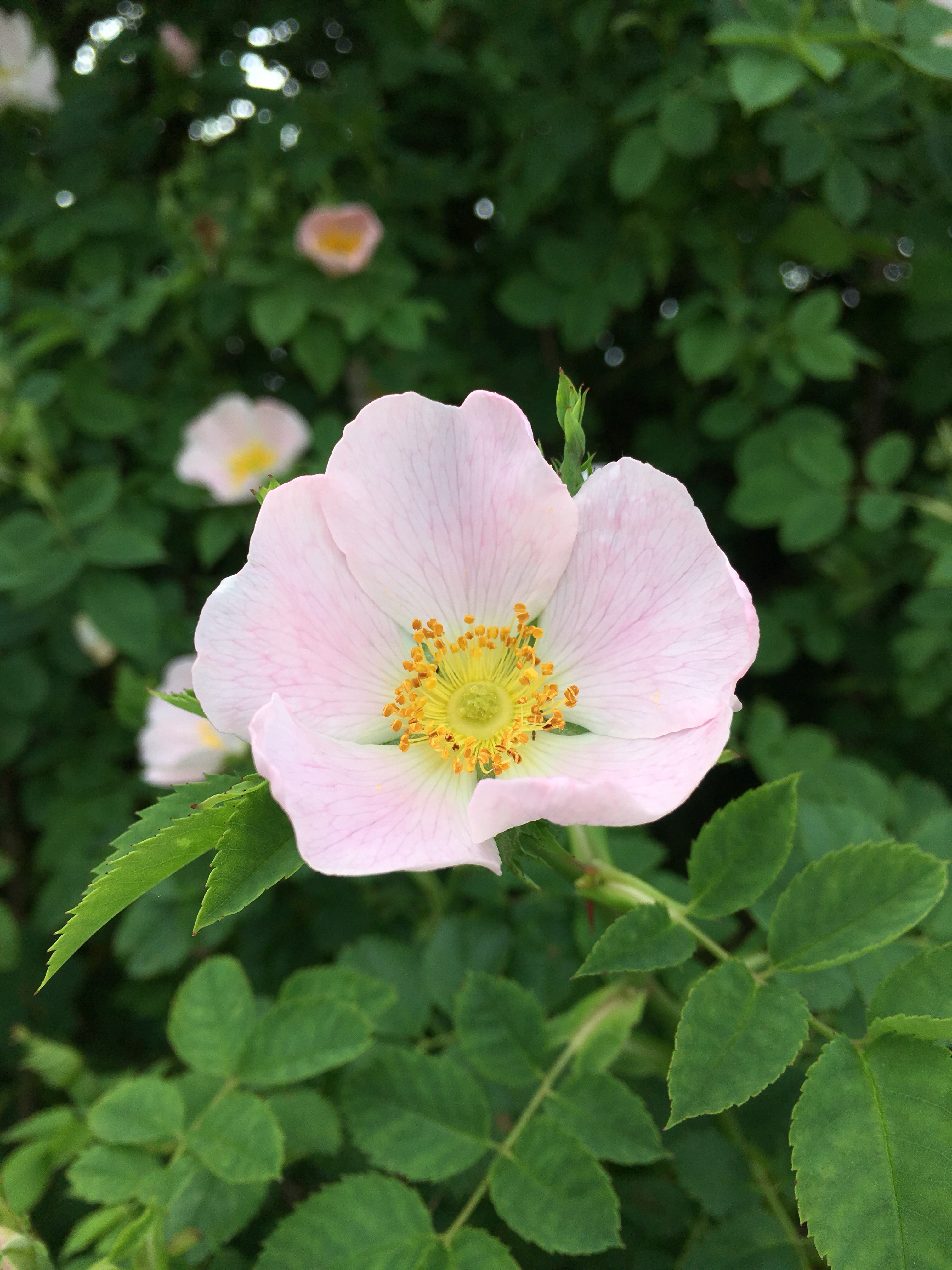
Rosa Canina takes full advantage and climbs high into the branches of trees and along the hedgerow. It’s a good year for flowers. Plenty of pollen for bees, and there will be masses of bright red hips providing winter food for birds.

Climbing through a mature willow next to the pond, there’s pale pink New Dawn. Again, I never prune this rose, or spray it. It just rambles where it likes. I expect the wind blowing through the tree keeps the rose disease-free. Blackspot tends to thrive in gardens where roses are surrounded by still air. In this windswept garden, luckily we have no trouble from either pests or diseases. It’s even too windy for aphids to get too plentiful. Those that survive, get eaten by birds.

We have a very overgrown pergola. The phrase ‘overgrown’ seems rather prevalent this week, I’ve noticed. The pergola goes from the back of the house, right round to the front drive. For half of it’s length, there’s this glorious rose Constance Spry. For about three weeks it has enormous highly-scented flowers. It only flowers once, but what a display! I’ve planted clematis, jasmine and ivy to extend the season. It’s a Rose I would never be without.

Constance Spry makes a lovely cut flower. Here’s it’s partnered with Sweet William which is just starting to bloom. It’s time to sow some more Sweet William for next year. I’ll use a half seed tray, good seed compost, and I’ll sprinkle the seeds sparingly. The tray will go at the base of the house wall on the north side, and seeds will germinate in about two to three weeks. I’ll then prick the seed out and put them in their own 3″ pots to grow on, or I’ll plant some in a holding bed on the veg plot. In August, they can be dug up and put in their flowering positions or planted out from the 3″ pots.

Here’s Constance Spry in a cutting basket with highly-scented Mme. Isaac Pereire, a heritage bourbon rose which dates back to 1841. This repeat-flowers all summer and mingles beautifully with Clematis Purpurea Plena Elegans. Plena means double, and these flowers are like purple pom-poms from August/ September onwards.

Finally, here’s the old china silk rose, Mutabilis. Much loved by bees. And, as you can guess, also grows quite happily without much attention, if any, from me.

As usual, after we’ve looked in the garden, there’s always a walk along the ridgeway path at the back of the garden. Today, there’s a video of skylarks. Turn the sound up loud. The farmer has planted wide bands of wild flowers around all the field margins. There’s a whole field of sunflowers and millet for wildlife. This year we have many skylarks. A few years ago we had a very poor summer with only one skylark. There is nothing sadder than the sound of a lonely skylark.

We’ve had some spectacular sunsets this week. I hope you’ve enjoyed this Saturday’s walk around the garden. Are you growing any roses in your garden? What’s looking good where you are this week. Thanks again for joining me in my garden. All welcome, for virtual visits!

LINKS:

I like to follow the Six on Saturday meme and see what everyone is growing. #SOS

https://thepropagatorblog.wordpress.com/2020/06/06/six-on-saturday-06-06-2020/

Dog rose: https://www.woodlandtrust.org.uk/trees-woods-and-wildlife/plants/wild-flowers/dog-rose/

Common hawthorn: https://www.woodlandtrust.org.uk/trees-woods-and-wildlife/british-trees/a-z-of-british-trees/hawthorn/

Rosa New Dawn https://www.classicroses.co.uk/new-dawn-climbing-rose.html

Rose Constance Spry https://www.davidaustinroses.co.uk/constance-spry-climbing-rose

Rose Mme. Isaac Pereire. https://www.davidaustinroses.co.uk/mme-isaac-pereire

Sweet Williams. https://www.mr-fothergills.co.uk/Flower-Seed/Sweet-William-Seeds/

Rose Mutabilis https://www.trevorwhiteroses.co.uk/shop/china-roses/mutabilis/

Skylarks: https://www.rspb.org.uk/birds-and-wildlife/wildlife-guides/bird-a-z/skylark/

Clematis : https://www.rhs.org.uk/Plants/210954/Clematis-Purpurea-Plena-Elegans-(Vt-d)/Details

In a Vase on Monday #IAVOM #MondayMotivation

Finding comfort in familiar things, I’m joining in with the weekly In a Vase meme. And this week it’s the first bunch of sweet peas – for my daughter Rachel, for her kitchen window at her first home. We still can’t believe she’s managed to complete the purchase, in the middle of a pandemic. Well done to her and her partner Sam for determination, riding the wave of crisis and uncertainly, and keeping strong along the way. It’s not been easy. But we will look back and laugh at all the ups and downs, I’m sure.

Photo: Albutt Blue.

I sowed my sweet peas in October in root trainers. I used Melcourt multi -purpose peat-free compost and added 25 percent grit for drainage. Sweet peas hate soggy feet. I started them off in the greenhouse to defeat the mice. Mice give up when the shoots are about 5″ tall as all the energy from seeds has gone into roots and shoots.

I’m growing heritage types varieties and a new sweet pea called Pilgrim 400 to celebrate the 400th anniversary since the Pilgrim Fathers sailed for the New World. The heritage types include lovely creamy white Mrs Collier. Seed came from Easton Walled Gardens near Grantham.

I made my sweet pea supports in February using hazel rods. These are usually used in hedge laying and are the binders that go along the middle of the hedge. Farm suppliers sell them for not much money.

I wrote about creating the rustic supports for my regular column in weekly Garden News magazine on 25th February. I must say, having the writing to concentrate on has helped me cope with the lockdown. It’s given me something cheerful to focus on. It’s lovely to be part of such a supportive team and I’ve appreciated the editor’s letters each week summing up our thoughts on the covid crisis and ‘steadying the ship’ with calm and sensible advice. It’s made a difference.

A week after I’d made the sweet pea supports we had high winds and snow. Luckily my frame stayed solid. A testing time for the garden- and us.

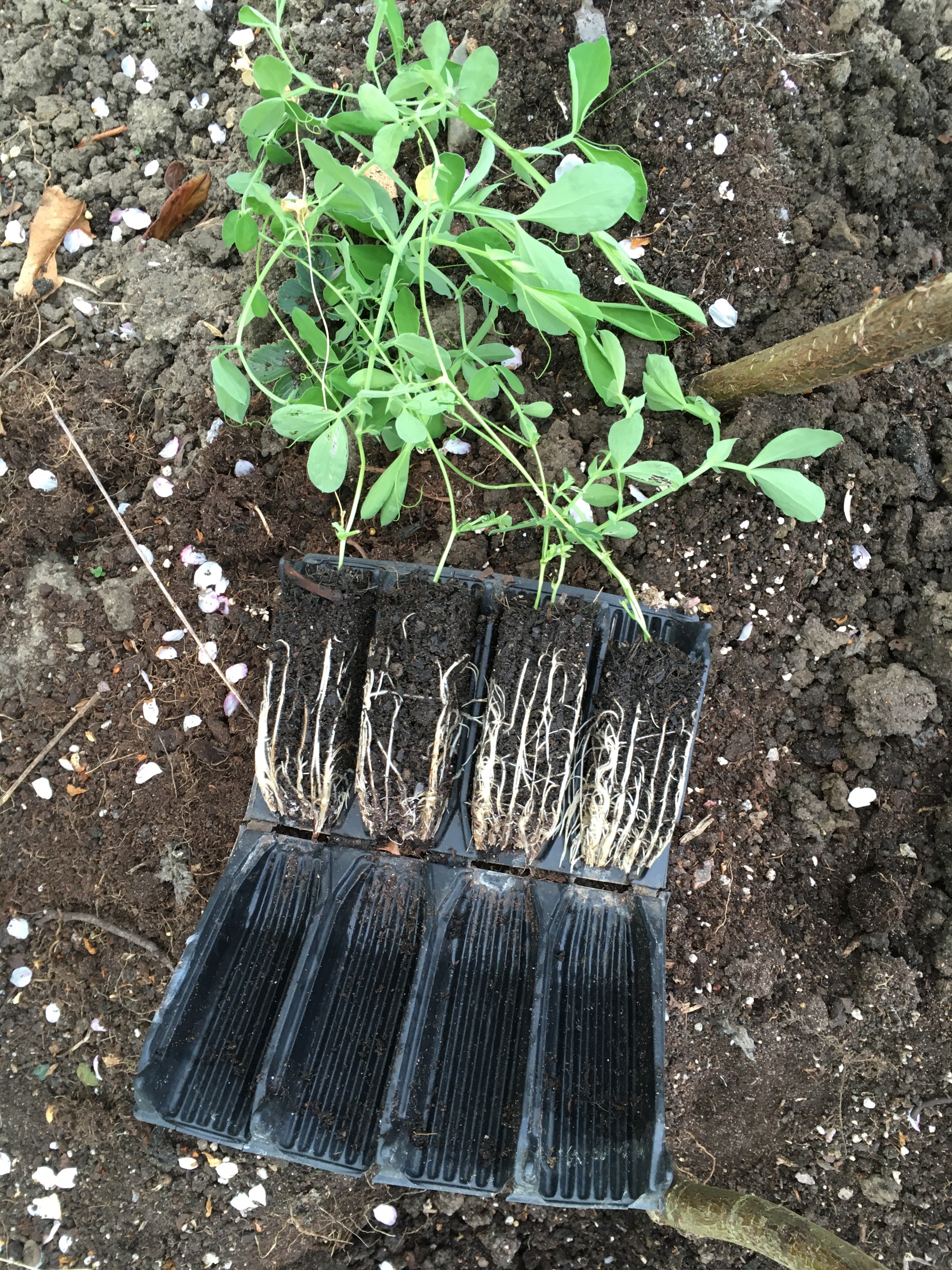
I planted out my seedlings on April 12th. The root trainers open out like a book, so there’s little damage to roots when you transplant them. Admittedly, these are made from plastic, but I’ve had mine for 6 or 7 years so far, and treated carefully, they will last a long time.

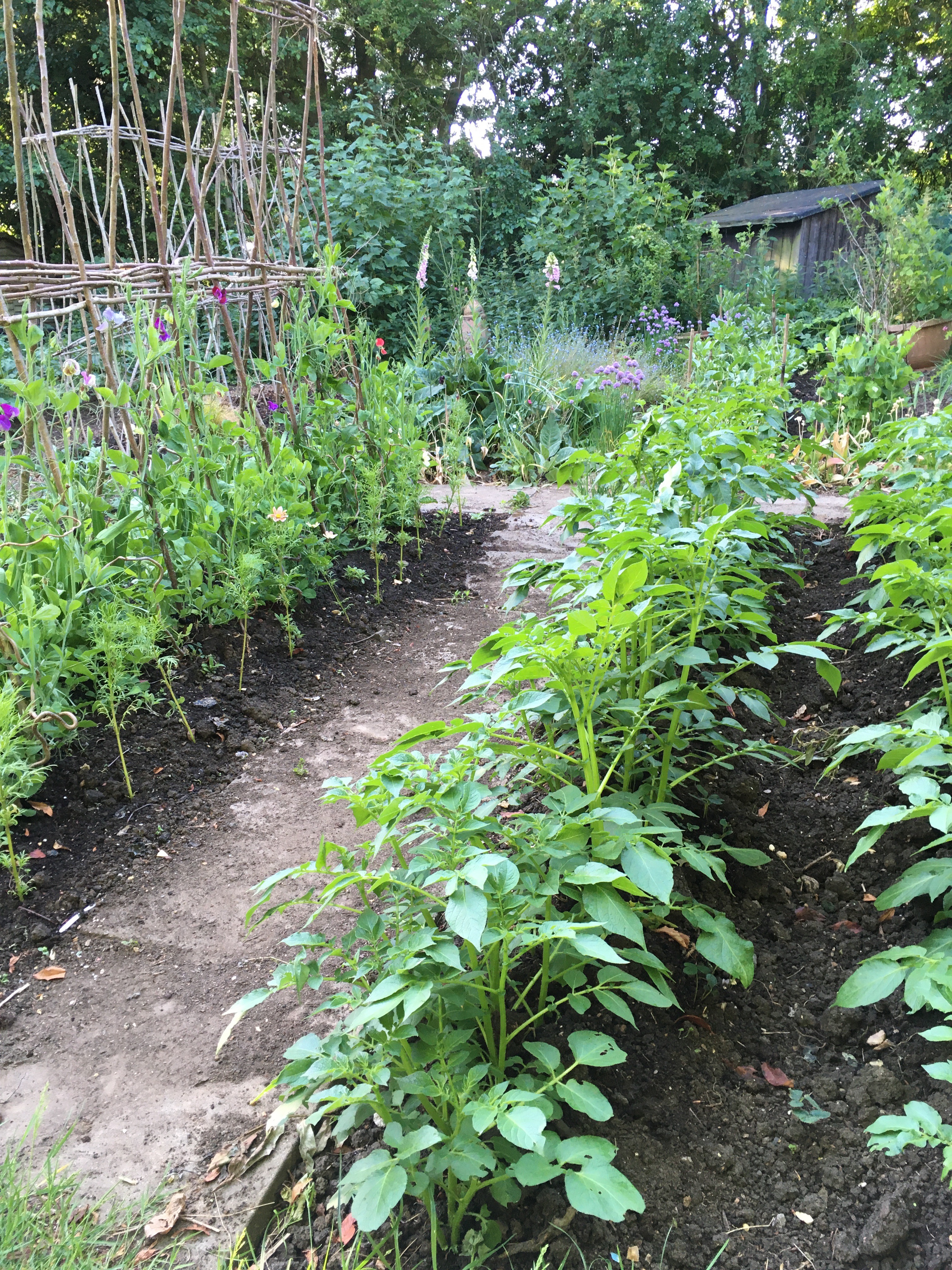
And here they are this week. The first bed has Charlotte potatoes. We’ll be eating those soon. The second bed has two rows of sweet peas. In between the A-frame there’s a row of gladioli, and calendula Snow Princess is grown as ground cover. There’s no room for weeds. Last year’s frame has been propped up, repaired and has climbing beans and squash planted this time.

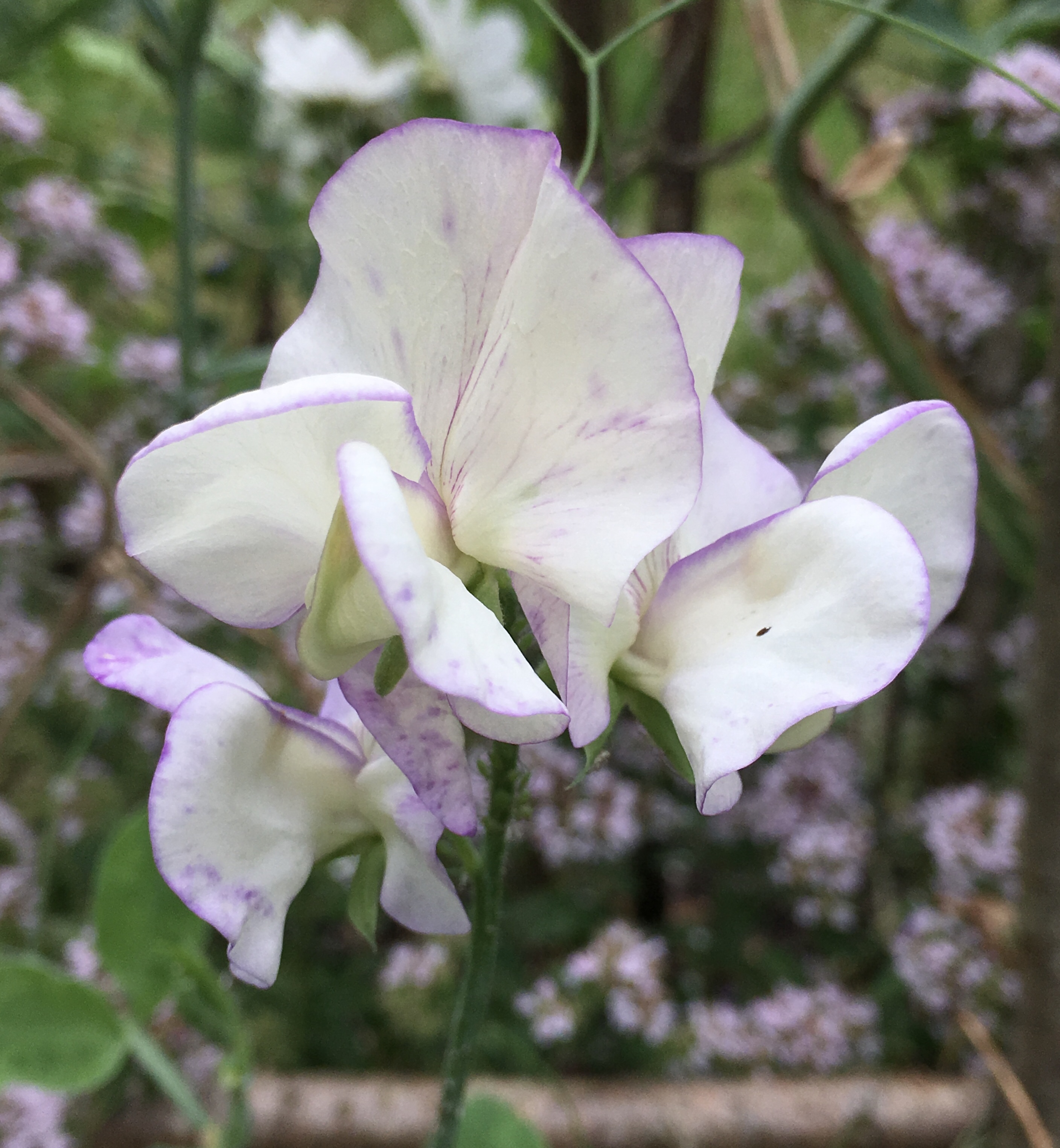
I’m growing Wiltshire Ripple which has speckled flowers with a picotee edge.

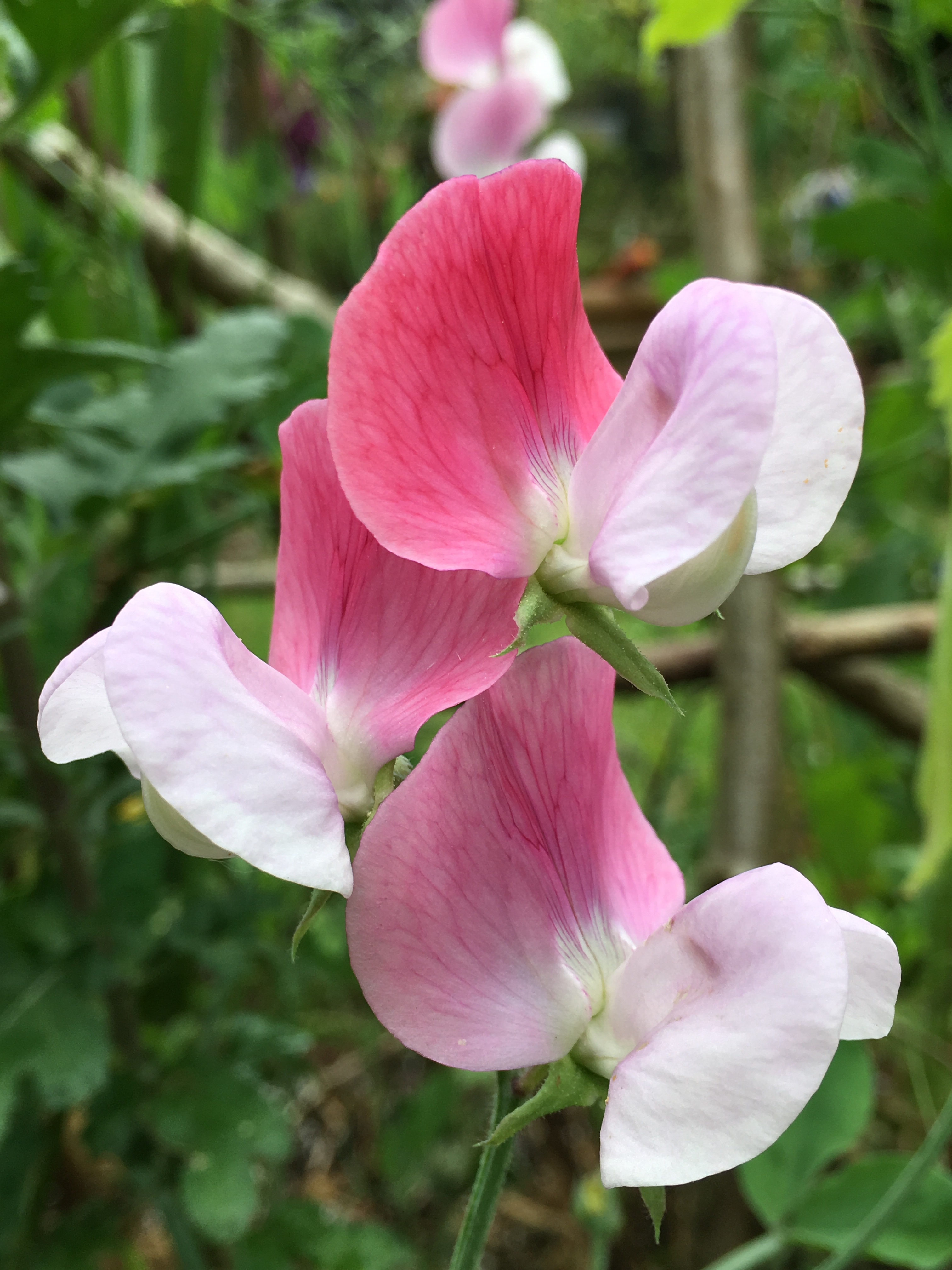
This is High Scent. Another lovely picotee edge and wonderful scent.

Mayflower 400.

Old fashioned, highly scented mix.

I’ve planted new cosmos Apricot Lemonade in front of the frames. I’ll tie them in as they grow. There’s not an inch of space to spare, which is the secret of reducing watering, by covering the ground.

And here’s the first pickings. Such a joy. This scent is worth waiting for all winter and just speaks of glorious long, sunny, summer days.

With a little bit of Sweet William at the base, just coming into flower on the veg patch now.

And here’s a photo of Rachel when she was little, with her guinea pig Rosie. Thank you for all your lovely comments last week. And for your good wishes for Rachel and Sam. I was very touched by all your kind words. Thank you 😊 x

Links : Thanks to Cathy for hosting the IAVOM meme. Why not go over and see what everyone is growing and putting in their vases this week. It’s a world -wide community of gardeners. https://ramblinginthegarden.wordpress.com/category/gardens/in-a-vase-on-monday/

Albutt Blue https://www.visiteaston.co.uk/shop/gardening/seeds/albutt-blue

Pilgrim 400 :https://www.mr-fothergills.co.uk/Flower-Seed/Sweet-Pea-Seed/Sweet-Pea-Mayflower-400.html#.XtTdGBB4WfA

Cosmos Apricot Lemonade: https://www.thompson-morgan.com/p/cosmos-bipinnatus-apricot-lemonade/ka9983TM

Haxnicks root trainers :https://www.haxnicks.co.uk/garden-products/rootrainers

Walk Around My Garden Saturday 30 May 2020 #SixOnSaturday

Rose Constance Spry. Planted when my youngest daughter was born. Roses speak of celebration, and this one really shouts a welcome -to-the-world for Rachel. It flowers for three weeks in early June and fills the garden with a glorious fruit-salad perfume.

Where I am today. Up a ladder. Trying to control the tangle of clematis, jasmine and ivy. This has been allowed to run wild for four years. Little and often might be my approach to tackling the problem. Otherwise, it seems an impossible task. The pergola runs from the back garden to the front drive. A shady walkway in the heat. I’m not going to rush the task. Luckily I’ve got a new Henchman ladder to help with the task. No more wobbling on unstable step ladders.

Alongside the pergola there’s a wedding cake tree, Cornus controversa variegata. Some of the layers have deteriorated. I need to take advice on pruning to try to get it back in shape. Pruning the pergola will give it more light. Behind, climbing to the top of a mature ash tree is Rosa Cerise Bouquet which flowers on and off right through the summer into October.

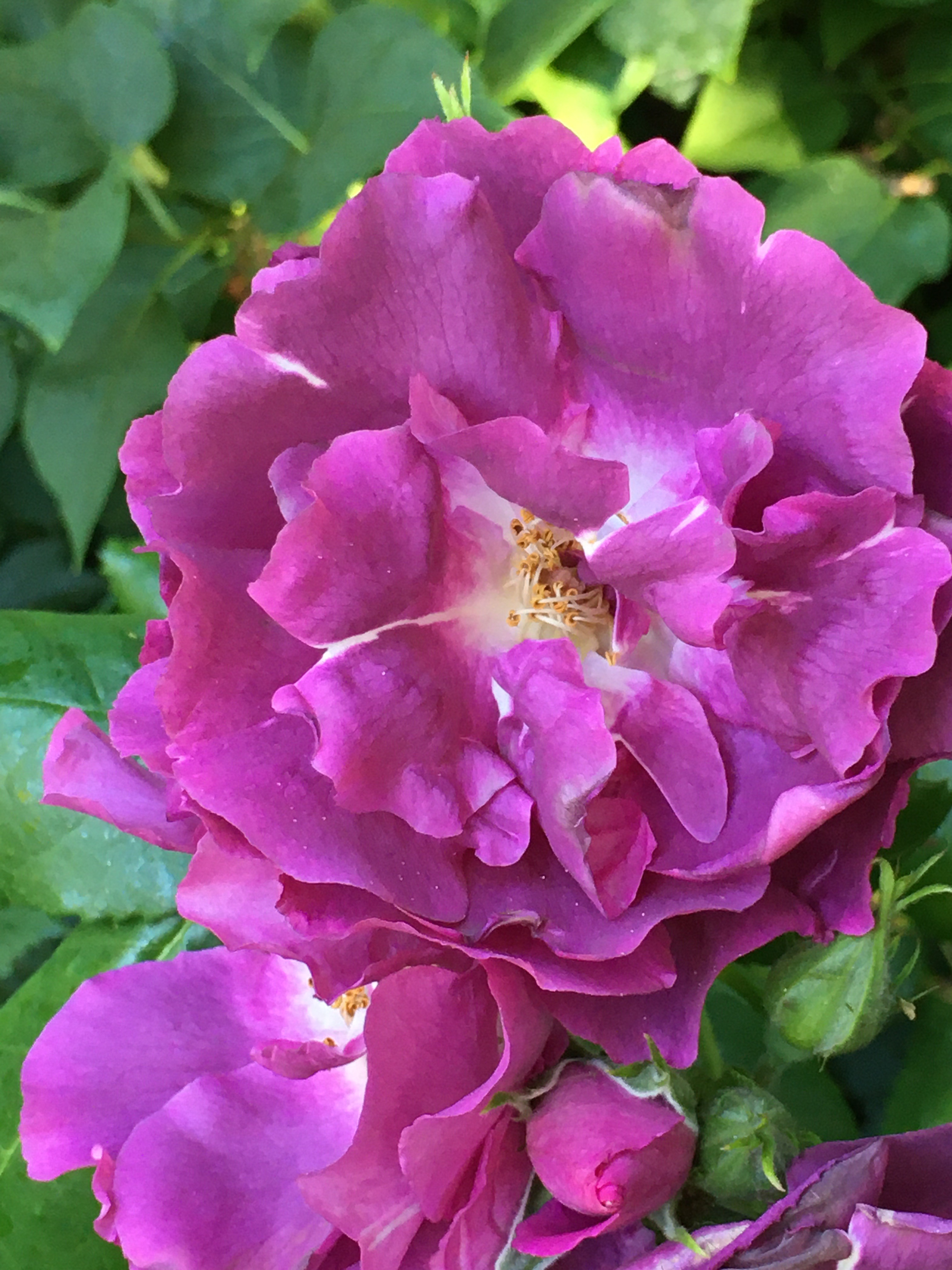
Another rose looking lovely at the moment is Rhapsody in Blue which has been moved three times. Just goes to show, you can move roses, despite what it says in the books. Highly recommended. Disease resistant and free flowering. Lovely scent and unusual colour.

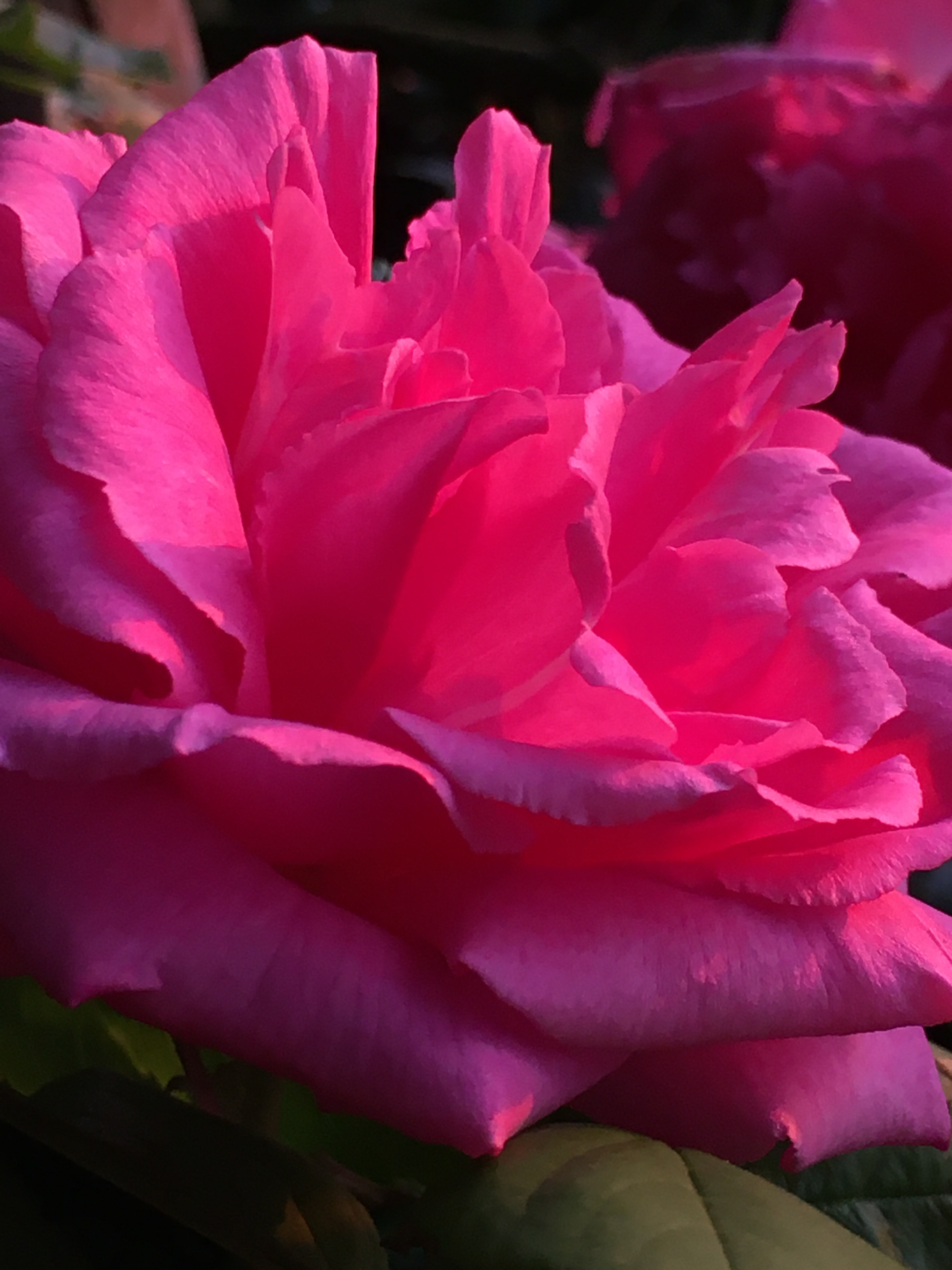
My grandfather’s rose, Zephirine Drouhin. He gave me this before he died. It’s wonderful to have something from his garden to remember him by. I know it was a favourite of his. I’m sure he knew it would give years of joy. And especially at the moment when everything seems uncertain and Covid has caused so much stress. It is as if he is still helping me, through all the plants coming into flower now. A reminder that life goes on, the seasons keep going. So must we.

My grandfather grew all his fruit and vegetables. People did in those days. Luckily, I watched, followed like a shadow and learned. And he gave me some of his garden tools, so when I’m hoeing the garden, I think of him, working his veg plot and feeding his family. I wonder what he was thinking while he was hoeing his garden. Did he find the peace that I’m finding right now. Was it a comfort to him, as it is to me, through all the trials and tribulations life throws at you.

Foxgloves have seeded in one of the veg plot beds. I’m digging these up and putting them in the wild garden, to make room for winter greens, Brussels sprouts and kale. Flowers will be picked for jam jar posies. I’m putting flowers on the village green again this summer to raise money for Rainbows Hospice for children. There will be an honesty box for donations.

The first sweet peas. Always popular in my jam jar posies. These were sown in root trainers in October. I’ve just sown some more for late flowering through to November. This one is from a packet of seed called Wiltshire Ripple Mixed. All have speckled flowers and a picotee edge. The scent is just wonderful.

As usual, when we’ve walked around the garden, there’s a short ramble along the ridgeway path to my ‘hole in the hedge’ porthole. It’s a viewing point I discovered a few years back. I didn’t make it, nature did, and I watch deer, rabbits, foxes, birds, owls, and hares, quietly and unnoticed.

Today, the May blossom has gone over, but there’s beautiful dogwood flowers framing the view. In an ancient hedge, there’s always something of interest. A tapestry of flowers, rosehips, crab apples, and seeds.

It’s just a humble wild dogwood. But it is as beautiful to me as any ornamental and expensive cornus tree.

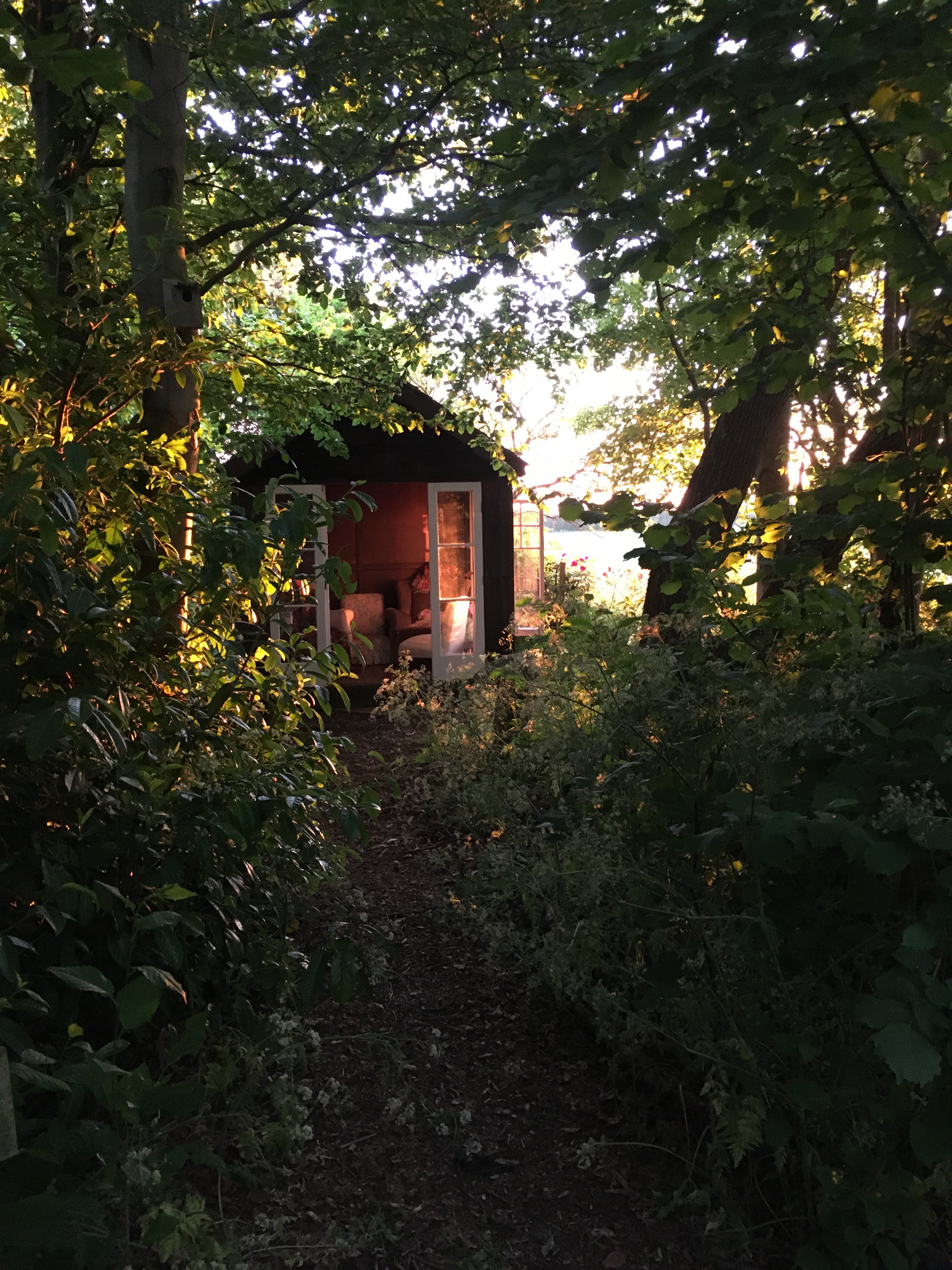
And finally, after all that walking, sit a while in my 1930s summerhouse -on-a turntable. In the heat, it’s turned to the shade, facing the wood and pond. A perfect place to contemplate life and all the reasons to be grateful. All the things I value are not the things that can be bought. Hopefully my grandfather would be proud of the person I have become. I’d love to tell him how things have turned out. And that I’ve been happy, thanks to his good advice.

Links : I like to read and join in with the hashtag Six on Saturday why not go over and see what other gardens look like today, all over the world. https://thepropagatorblog.wordpress.com/category/six-on-saturday/

Henchman ladders like mine: https://www.henchman.co.uk/?gclid=CjwKCAjwiMj2BRBFEiwAYfTbCgG1JcfaQwtYjZ_lj7F3XBMAvXjIpri5d5vqMGjRlDY0i6E414m6RBoCRQMQAvD_BwE

Roses : https://www.davidaustinroses.co.uk/?gclid=CjwKCAjwiMj2BRBFEiwAYfTbCtnJOqLRzmev76pY_7u5maadGtrLFXf09qHEGmx4mHw71JE0ccaxkxoClDQQAvD_BwE

Sweet peas :https://www.mr-fothergills.co.uk/Flower-Seed/Sweet-Pea-Seed/#.XtIkQBB4WfA

In a Vase on Monday – revisiting RHS Chelsea Flower Show.

Well, we should all be at the Chelsea Flower Show today. But it’s been cancelled, like most spring and summer events. So instead I’m sharing photos from last year. Plants and flower arrangements I made a note of, for my own garden. Enjoy this dip into my photo album.

Kelways Peonies. I love Lemon Chiffon, (cream) Seashell, (pink) Avalanche, (white) Nymph, (pink).

They don’t last long, but such a glorious sight in mid May. I wouldn’t be without peonies.

Lupins from West Country Lupins. Just perfection. I bought this one

And this one. Lupin Masterpiece. Such a glorious plum colour.

David Austin Roses. This one is new variety, Tranquility. Very calming colour.

And new rose Desdemona. Beautiful at all stages from tight bud to wide open. Gorgeous scent. Stands up to the weather really well. Flowers shrug off rain and don’t ‘ball.’ Recommended.

Pinks. This is the new Tequila Sunrise. Lovely changes of colour as the flower ages. Amazing scent.

It’s wonderful to have the pinks side by side so you can compare them. The scent is just amazing in the heat, and contained by the roof of the marquee. A lingering memory of Chelsea.

Some of the amazing flower arrangements at the show. It really is a florists’ paradise.

These were still being created on press day. I stood for a long time watching the process.

This tower of flowers was spectacular.

Close -up detail of the flower-filled tower.

This explosion of foxgloves and cow parsley is my favourite.

Details for this lovely arrangement.

I also studied this arrangement created using test tubes. Really simple and lovely. Simple is what I always go for. As you know.

So I came home and made this from flowers in my garden. Inspired by all the lovely blooms I’d seen at Chelsea. There’s wild daisies, blue corn flowers and cow parsley as a background with green ivy covering the mossy wreath.

I hope you’ve enjoyed this re-visit of last year’s Chelsea Flower Show. I’m going to be watching all the on-line and televised content. This year, it is all about finding ways around problems and learning how to enjoy the things we love. Gardening – growing food and flowers- has been a saving for me. It’s kept me occupied and stopped my thoughts running away. It’s kept be grounded and focussed on keeping calm and helping others. Gardening is also a shared joy. Although we can’t see our friends and family, we can still talk about our gardens and share photos. It keeps us connected, and reminds us we are not alone.

If you listen in to BBC Radio Leicester, send your photos to mid-morning host Ben Jackson. Sharing our gardens is a lovely thing to do. And I’ll be talking about what I’m growing on Wednesdays and Thursdays, alternating with my gardening team member Josie Hutchinson. And also now and again on BBC Radio London.

Links: RHS Virtual Chelsea Show https://www.rhs.org.uk/shows-events/rhs-chelsea-flower-show

Kelways Nursery : https://www.kelways.co.uk/category/peonies/1/

West Country lupins : https://www.westcountrylupins.co.uk/index.html

David Austin Roses :https://www.davidaustinroses.co.uk/delivery

Join in with the In a Vase on Monday meme and see what eveyone is growing and putting into vases this week, all over the world. : https://ramblinginthegarden.wordpress.com/2020/05/18/in-a-vase-on-monday-the-jewels-and-the-crown/

Six on Saturday- A walk around my garden 25 April 2020

Bluebells. These came from my grandfather Ted Foulds’ garden originally. A lovely reminder of him. There was only a small patch to start with. Now they run from the front to the back garden. It’s surprising how fast they spread, without any help from me. There’s some wild garlic in amongst them too, which I’m trying to control a little this year.

Trees are leafing up so quickly in the sunshine and heat this year. The bluebells will have to be quick to flower and set seed before they are shaded out. This is the path past the summerhouse to the pond.

The view from the summerhouse. It looks like a jungle already. There’s oak, beech, hornbeams, cherry, willow and ash in the mini-wood. All the trees came as saplings from the borough council when we moved here 30 years ago. There was a scheme to plant trees on farmland. I think it was linked to the woodland trust. We applied, and they delivered 260 saplings for us to plant. The whole family set to and helped us plant them in a day or so.

All along the woodland paths there’s a lovely white starry flower, I think it’s called stitchwort. I didn’t plant it, but it’s very welcome here.

It seems to be all green and white shades today. May blossom or hawthorn is suddenly in flower.

Such a beautiful sight at dawn. These flowers were just in bud yesterday. The hedgerow is so beautiful just now with sections of crab apple, maple, hazel and viburnum all in a hurry to wake from their winter sleep. The scent from the crab apple blossom is something I’ve never noticed before. I think the heat is enhancing the scent.

Oops, that eight photos. I’m sure no one’s counting…..

Enjoy your weekend. Here’s a view through my ‘gap in the hedge.’ I didn’t make this portal, nature did. I love to peer through and watch the wildlife. There’s always something happening in the back fields. Lovely to see some green shoots in the fields too. Fields have been bleak and bare all winter, after the flooding.

Links: Six on Saturday : https://thepropagatorblog.wordpress.com/category/six-on-saturday/

Please leave a comment at the bottom of the page. The comments box is below all the hashtags and social media sharing buttons. Please feel free to share too. Thank you.

BBC Radio Leicester Gardens Hour 22 April 2020

If you were listening in to BBC Radio Leicester for Gardens Hour today, I’ve written some notes to accompany the programme.

I’m working from home at the moment. The oak tree above has just burst into leaf. I can see the tree from the top of the paddock. The swallows returned here last Wednesday, and we’ve seen pipistrelle bats over the garden.

Blossom has been fabulous this year, with no rain to spoil the flowers. I’m sitting under this Prunus Kanzan cherry tree today to answer questions and talk about my gardening tasks.

We had a question about an apple tree failing to establish.

If your tree is failing to thrive, it usually indicates a problem with the growing conditions. Poor growing conditions will stunt any tree or shrub.

Water any newly -planted trees well. Soil may be dry around the roots even when the surface appears moist. Check with a trowel to see how far the water is penetrating the ground.

Weeds and grass compete with trees for moisture. Keep a weed and lawn -free zone at least 1m in diameter around the plant.

Mulch locks in the moisture and helps feed the tree. Apply a mulch a good couple of inches deep around the tree, avoiding the trunk. (mulch piled up against the trunk can cause ‘drowning,’ so take care it doesn’t get pushed up against the tree).

You can use your own home-made compost or composted bark for the mulch. Do not apply to dry ground, as it can also lock -in drought.

You can place a drainage pipe in the ground alongside the tree at planting time, which helps water reach the roots. However, take care, as too much water can cause water logging, which is also detrimental.

Feed with a potash fertiliser, which promotes fruit and flowers.

Salix Flamingo – wiki commons photo.

We had a question about a Salix Flamingo willow tree failing to thrive. The tree has come into leaf and the leaves have shrivelled.

I’ve found this tree difficult to grow. It’s grown for its new, shrimp pink leaves which emerge in April. These leaves are delicate and easily damaged by cold winds and frost. Too much direct sunshine on emerging leaves can also cause them to shrivel. We have had a combination of high daytime temperatures, cold east winds, and plummeting night time temperatures. In a sheltered garden you would have no problems, but in a slightly more exposed spot, the tree struggles. Also, being from the willow family it requires plenty of moisture. We haven’t had any rain for several weeks and the ground is parched- despite all the record-breaking amounts of rain we’ve had over autumn and winter.

Usually, the tree recovers and produces a new set of leaves to replace the ones that have shrivelled. Watering and throwing some fleece over at night usually nurses it along until we get more even growing conditions in early summer. I’ve known them to suffer from a type of rust, and also canker. But apart from that, they are very pretty trees. They either like you, or they don’t though!

We had a question about a montana clematis failing to flower. This is my clematis Montana Wilsonii. The one the caller had was a pink variety, planted last year and growing in a pot next to an archway. The clematis on the other side of the arch was doing well.

Clematis montana flowers on the previous season’s wood. The caller hadn’t pruned it, but sometimes a montana clematis will take 2-3 years to settle into flowering as its first thought is to grow to the top of the archway.

Clematis don’t do as well in pots, unless they are a really good size and you can keep up with the watering requirements. So it would be best to plant the clematis in the ground and keep it well fed and watered. Potash feed, again, for flowers. And prune immediately after flowering, although I hardly prune my montana clematis to be honest. It’s pretty low maintenance, once established.

And finally, we had a caller wanting to buy a Venus fly trap. They are usually sold at local garden centres, which of course, are not open at the moment. However several are making deliveries, so it’s worth ringing round to source supplies of plants. I’ve found this one on line from QVC. I’ve bought various plug plants, bedding and bird food from QVC and found the service to be quick and reliable. However, I’ve never bought any fly trap plants from them, so can’t say more than I have managed to find a supplier.

I hope you’ve found these notes useful. Please listen in on Wednesdays at 12.30 with Ben Jackson and on Sundays (usually) with Dave Andrews at 1pm on your smart speaker, DAB 104.9FM or on BBC Sounds.

It’s great to be involved with local radio gardening and we try to offer something for experienced gardeners wanting to try new varieties and grow for shows, and also for those who have never grown anything before. All questions welcome. We will try our best to help. I am part of an experienced team.

Comments box is right at the bottom of the page, below hashtags, social media sharing and links.

BBC Sounds to listen back: https://www.bbc.co.uk/sounds/play/p088w205. At 2.37.30 on the timeline.

Links : https://www.qvcuk.com/Thompson%26-Morgan-Dionaea-Muscipula-%28Venus-Fly-Trap%29-9cm-Pot-x3.product.518780.html?sc=Froogle&ref=fgl&source=froogle&utm_source=google&utm_medium=base&utm_campaign=base&cm_mmc=PPCSHOPPING-_-Google_Shopping-_-SmartShopping-_-Garden&Leisure&gclid=CjwKCAjw1v_0BRAkEiwALFkj5nSbQtMrf4di1C69MLikRT3XMgWNUhDGsymlRFAS-4yMUnqRnj5vxRoCm6AQAvD_BwE&

BBC Radio Leicester Gardens Hour 19 April 2020

Notes for anyone listening to BBC Radio Leicester today. You can send e mails, texts and messages for free gardening advice. I’ve been a travelling head gardener and a garden designer for 25 years. I write for weekly Garden News Magazine. I grow my own fruit, veg and flowers at home on a one acre plot created from a ploughed field. Currently, I’m speaking each week from the potting shed during the corona virus epidemic. Here’s the view from the potting shed, for anyone who likes blossom. Turn up the sound to hear the birdsong.

We cater for everyone. So if you’ve never gardened before and want some essential tips to get started, get in touch. We can help experienced gardeners wanting to grow the latest varieties or try something new. Maybe you want to grow more salads and veg for the family. Or you might fancy the challenge of growing for a “virtual” flower show. We can help.

This week we talk about growing tomatoes. I’m growing classic beefsteak variety Marmande for cooking, and tasty cherry tomato, Tumbling Tom for salads. My plants are 12cm (5″) tall and the roots are coming out of the bottom of the pots, so I’m potting them on. They’ve been growing in 7.5cm (3″) pots and I’m moving them up to 12.5cm (5″) pots. They will eventually go into 25cm (10″) pots and window boxes, but they have to be moved up in stages as tomatoes don’t like lots of cold wet compost around their roots.

Tomatoes like plenty of warmth, so I’ll keep mine indoors until the end of May. Tomato leaves turning yellow could be an indication the plants are getting too cold overnight, especially if they are right next to the greenhouse glass. Move them to the middle of the greenhouse and create a fleece tent to keep temperatures more stable between night and day. Remove fleece promptly in the morning. Alternatively, yellow leaves could mean the plants are running out of feed. Composts usually contain feed for about six weeks. But yellow leaves indicate a lack of nitrogen, so feed with a very dilute tomato fertiliser. Move plants on promptly when the roots have filled the pots. Don’t over water as plants also hate cold wet feet. Use tepid water. Bring the watering can in to the greenhouse to warm up. Cold water causes shock. Tomatoes need warm steady growing conditions and don’t like swings in temperature. Try to water them in the morning so they are not left cold and wet at night. Aim the watering can at the roots and keep the foliage dry.

While I’m stuck at home, I’m looking about to see what I can do to keep connected with the outside world. One thing I’m doing is joining in with the Rainbows 5K challenge.

Rainbows is a hospice in Loughborough, supporting children and young people with life-limiting conditions. They receive only 15 percent of their funding from the government and everything else has to come from donations. The corona virus lockdown means they can’t run all the usual fund-raising events. But the 5K challenge is one way everyone can help out.

You can take part anytime between now and May 31st. I’ll be logging my walking while I’m mowing the grass, weeding, raking, hoeing and plodding about the plot between the greenhouse and potting shed. I am sure digging also counts!

You can also help by tagging rainbows on social media to keep them in the public’s eye by posting photos on Facebook @rainbowsfanpage and on twitter and Instagram @rainbowshospice.

Children and all ages can take part. You can walk, run, hop, skip, cycle. Think of me weeding and cutting the grass for hours on end. At least the garden will look lovely, and it’s all in a good cause!

The National Gardens Scheme is also a charity close to my heart. Mum and I usually spend every Sunday visiting an NGS garden, having a cup of tea and piece of cake and buying a few plants. The lockdown means no gardens are open this summer. But the charity has launched a ‘Support Our Nurses’ campaign with virtual tours and JustGiving pages.

There are three gardens so far featured in leicestershire: Brook End in Wymeswold, with spring blossom, tulips and daffodils and ponds. There’s also Donna’s Garden at Snowdrop Ridge in Market Harborough, which should have opened for the first time this summer. There’s a wonderfully calming goldfish pond video.

Also a ‘walk through’ at Oak House, South Kilworth.

Donations support nurses working for MacMillan and Marie Curie, Hospice UK, Carers Trust, The Queens Nursing Institute. The NGS also helps Parkinson’s UK, Perennial and Horatio’s Garden for spinal injuries.

During the programme I mention our concerns for growers, garden centres and nurseries which are not allowed to open during the lockdown. There are fears many might go out of business with plants having to be skipped. Livelihoods are on the line.

I mention the Garden Centre Association #SupportYourLocalGardencentre campaign at gca.org. There’s a list of garden centres providing local deliveries.

Val and Steve Bradley from BBC Radio Kent, the Sun newspaper, have created a list of growers and nurseries offering mail order and/ or deliveries.

I’ve provided a limited and ever-changing list for Leicestershire here: https://bramblegarden.com/2020/04/05/contacts-and-information-to-help-you-through-corona-virus-lockdown/ If you want to be added, please get in touch.

Thank you for joining us at BBC Radio Leicester. These are strange and difficult times for all of us, but we can keep connected through social media and listening to the radio. It’s amazing how we can all help by taking little steps at a time. They all join up to a giant leap forward, don’t you agree. Get in touch and let me know what’s looking good in your garden and how you are getting on during this lockdown time. Are you managing to get on with your gardening? Is your garden providing a calm sanctuary. I know mine is right now.

Links:

Rainbows 5K Challenge : https://www.rainbows.co.uk/events/rainbows-virtual-5k-2020

National Gardens Scheme https://ngs.org.uk/virtual-garden-visits/

Garden Centre Association lists : https://gca.org.uk/

Val and Steve Bradley nurseries/growers list: https://47flt.r.ag.d.sendibm3.com/mk/cl/f/nsnLPDyBJajPGKKpPRt5x9TOx4tu9x1Dz-v5FiKvBC10LYC0JB45oC3rcwqKse2n5D7aQhdwFnOZEulP7NPET4tRxtfv-n5eUr7mNx6H7gjRIWSVXN-QVsXdmRICgr44KOhL_NeHecmmxD8URqGk4-jf5QBzcACiRe7I8jdByhWKnFH9LN4d2C-sA4qsiNVzl4nQDttx7wgdEKWIS89NuNt-XaZCrrIiTT3B

You can follow me on twitter @kgimson

On instagram @karengimson1

And Pinterest @karengimson

Some photos from my garden:

Seedlings in the greenhouse, tomatoes, cosmos, onions, cucumbers, aubergines, peppers.

Planting out calendula Snow Princess grown in plug trays.

We had some winter storms and dead elms in the hedgerow.

The whole garden is scented by this viburnum. Planted in front of white cherry tree, prunus avium, and pink cherry Prunus Kanzan.

Pheasants Eye narcissi, still looking good in the cut flower beds.

Not all things go according to plan.

Cherry blossom. Stella. Lots of fruit, hopefully. Have never seen blossom like it. A good year for fruit trees.

Pear blossom. I’m keeping an eye on the weather. Fleece will be thrown over at night if there’s a frost.

Thank you for reading!

Six on Saturday – views from my garden April 11 2020

Tulip Mount Tacoma and forget-me-nots.

My favourite Italian terracotta pot near my front door. So sad there are no visitors to enjoy this lovely sight. I’m including it here, so you can all share in the magic of spring flowers. Fairly new introduction Exotic Emperor, a double form of the classic and popular Purissima. Has peony-like petals that curve and twist as they open, revealing a flash of green. Very lovely and my favourite. This is a fosteriana tulip, and here in the Midlands, it always flowers through April. Planted with Narcissus Geranium an heirloom bulb dating back to pre 1930. Beautiful, delicate fragrance. Perfect for cut flowers. I have a row in the veg garden for cutting. Multi-headed – some of the bulbs have four flowers to a stem. I love mixing the old with the new. I’m fond of traditional plants, but I love trying something new.

I’ve always grown the white Purissima tulip, so I thought I would try the new sport, Flaming Purissima, another fosteriana tulip. It is such a joy, with all shades of pink and red ‘flames’ over an ivory white background. Beautiful under a white cherry blossom tree. I’ve planted these in a trench on the veg plot for cut flowers. They last a week in a vase, and watching them turn from tight buds to open, flat, almost water lily-like flowers is a joy. These were introduced in 1999, and they reliably come through the winter and flower each spring for me.

So comforting to know we will have masses of cherries this summer. We leave the trees unpruned. Blackbirds enjoy the crop at the top of the tree, and there’s more than we can use around the downward – arching lower branches. I’ve planted narcissus Pheasants Eye under the trees as an experiment. They flower at the same time. They look so glorious, I’ll fill the orchard with them next spring. They cost very little and are a joy to behold. I’ve taken photos of the garden and made notes to remind myself to order bulbs in July and plant in September. If I don’t make a note, I seem to forget!

In the wild garden around the pond we have this un-named beauty. We planted these 30 years ago. I wish I’d recorded the name as I’d love to plant more as pretty and reliable as these. They have a wonderful scent too. Petals glisten and remind me of sugar coated violets. I wonder if you know what I mean.

And finally, a humble bellis daisy, growing in the cracks between the paving by the back door. I’ve been imploring (nagging) the family not to step on them all winter. I have a little patch 60cm square of delightful little daisies. There’s absolutely no soil there. I feel they deserve to live, having made such an effort to survive.

Enjoy your weekend everyone. This is not to say that we are not all desperately worried by what’s going on in the world, and in our own country. But I’m thinking this sharing of garden photos may help someone keep calm and carry on. There is really nothing else we can do at the moment. Stay at home, help the NHS, stay safe. And look around you and enjoy the beauty of nature. When this is all over, our gardens will still be there waiting for us.

Links: all bulbs were bought from https://www.gee-tee.co.uk/

The bellis daisies came originally from my Mum in a little pot stood on the patio all summer. Seeds can be bought from https://www.mr-fothergills.co.uk/Flower-Seed/Bellis-Goliath-Mixed.html

Please leave comments below and let me know what’s flowering in your garden this Easter time.

What’s flowering in the garden 7th April 2020 -BBC Radio #SowAlong #BBCRadioSowAlong

If you have been listening in to Gardens Hour on Wednesdays on BBC Radio Leicester, you’ll have heard our ‘ten minute tips’ recorded in Ben Jackson’s garden. I always come home and plant the same varieties in my windswept country garden. Ben’s plot is in a lovely sheltered walled garden in a village. His soil is beautifully free-draining, in a garden which must have been worked for 100 years. Mine is cold wet clay, created from farm land over the past 30 years. It’s an interesting contrast and I love to see how plants perform in both our gardens.

Here’s an update on plants, showing what they are looking like today.

We planted tulips for cut flowers on 29th October. These are Exotic Emperor, a new early-flowering tulip, a double form of the popular White Emperor. It has a long flowering period with delicately green flamed cream petals. Looks good for nearly six weeks.

We planted a ‘cut flower mix’ and mine included this lovely Tulip Flaming Purissima. This comes in a range of creams and pinks. Very pretty and reminiscent of the old fashioned flame tulips made famous in the Tulip-Fever era. Very long lasting, and weather resistant.

We planted bulbs ‘lasagna’ style in layers. Here’s my big Italian pot by my front door. This had snowdrops and dwarf iris in January, dwarf tete a tete daffodils in February, and now today has Hyacinth Blue Jacket, Exotic Emperor tulips and scented Geranium narcissi. When these are over, I’ll replant the pot with scented -leaved geraniums for summer.

In both our gardens we planted a range of daffodils to flower from February right through till the end of April. Here’s my pheasants eye narcissi planted under the cherry trees in the orchard. I’m so pleased with these, I’ll mass plant them in September for an even better display this time next year. I’ve gone round the garden making notes and taking photos to remind me where there are gaps and what changes I want to make. If I didn’t make notes, I’d forget by the time September arrives.

Talking about daffodils, we planted these Paperwhite narcissi on December 2nd. Some flowered at Christmas, but I held some pots back in the cold potting shed and brought them out a week apart so that I could have flowers for vases right through to the end of a March. Flowering times are dictated by amounts of daylight and heat. So plants can be manipulated to flower over a period of time.

We planted up our dahlias on 31st January. These were overwintered in a frost-free shed. I took 2″ cuttings in February and these have rooted in the propagator in 3″ pots at 18C. Above are the dahlias making really good growth in their seed trays, half filled with compost to start them off. They will stay in the greenhouse until the end of May.

We sowed our tomatoes on 28 February, and I pricked them out mid March. They are growing nicely just out of the propagator and on the greenhouse benches. I keep the greenhouse heated at 6C.

On 9th March we planted our tiny plug plants which cost about 60p each. We planted them individually in 3″ pots and put them on a sunny windowsill.

They have grown really well, and I’ve managed to take three lots of cuttings from the mother plants, which means lots of bedding plants for free. Taking cuttings makes them grow strong and bushy too, instead of tall and spindly.

We also planted up some impatiens plugs into 3″ pots. These are now in flower and I’m putting them into their summer containers to grow on. I didn’t pay for these plants. They were free samples from the grower, Ball Colgrave.

If you are listening in today, Wednesday 8th April, this is where I’m talking from because I’m isolating due to covid. I’ve got 100 cosmos seedlings in 3″ pots including a new variety Apricot Lemonade. I’m also growing calendula pot marigolds which are great for bees and butterflies. I’m growing the very pale lemon Snow Princess, and pretty calendula Orange Flash.

I’ve just planted my new potatoes, Charlotte and Lady Christl in two of the divided beds. They are planted 12″ (30cm) apart, 4″ (9cm) deep.

I’ve also planted my broad beans, De Monica which is a new variety specially bred for spring sowing. I’ve sown double rows, with plants and seeds 9″ (23cm) apart. Seeds were planted 2″ (5cm) deep.

And this is the view from the greenhouse and potting shed. Turn up the sound to hear the birdsong. There’s a bank of wild cherry trees on two sides of the garden.

I hope you’ve enjoyed this tour of my greenhouse and garden. Hopefully the photos have jogged your memory about what we’ve been growing for our ‘ten minute tips.’ I’ll keep you posted on the progress of all these plants. I’m hoping the garden is going to be quite productive and very colourful this summer. That’s three uses of the word ‘hope,’ but under the circumstances, I think we all need some hope, don’t we.

Links : BBC radio Leicester Gardening – Sundays 1-2pm and Wednesdays 12.30 -1pm at the moment, subject to change due to covid. https://www.bbc.co.uk/sounds/play/live:bbc_radio_leicester

DAB 104.9FM and at BBCSounds. Ask your smart speaker to tune in to BBC Radio Leicester.

Update: today’s programme starts at 2.36.23 on the timeline. https://www.bbc.co.uk/sounds/play/p087sjhn.

A Walk Around My Country Garden -27 Mar 2020

When I planted this walkway of trees, I never knew how essential they were going to be. I must meander along these paths at least 20 times a day, lost in thought.

I’m sharing as many cheerful photos as I can find today. The covid crisis initially knocked me for six. I am desperately worried about all our elderly relatives. For all those expecting babies in the summer. For my young daughters, one a newly qualified nurse, working with desperately ill patients right now. If I could solve everything with walking, I would have worn out my shoes. It’s the first time in my life I have no answers. I can’t do anything to make it ‘right.’ Normally I can think of something. In every other crisis, I have found a solution. Something to make things better.

So I am turning to what I know. Gardening. Giving out advice to anyone who needs it. Families have struggled to buy fresh salads and veg these past few weeks. I certainly haven’t managed to obtain what I’ve needed. I couldn’t find bread, flour or milk. It’s made me feel vulnerable and determined to be more self reliant when it comes to fruit and veg at least. So anyone who needs grow-your-own advice can contact me and I will help. For specific individual garden design advice, how to start a cut flower garden, grow a meadow, deal with a shady border, I am asking for a donation to Rainbows Hospice direct, any amount and I don’t need to know how much. All my garden club talks have been cancelled, and as you know, all my fees go to Rainbows. The clubs have all rebooked for next year, but I wanted to do something for this year to help. So anyone interested, please e mail me at k.gimson@btinternet.com for more information. I am learning to Skype and FaceTime live, and also using the phone and computer. Where there’s a will, there’s a way, as my grandparents used to say. Funny how their little sayings come back to you in times of trouble. It’s as if they are trying to help you, even though they are no longer here.

Enjoy the slide show of photos. I hope it lifts your spirits and makes a difference. From now on, I am solely focusing on people who are doing good, sharing information about what they are doing, supporting them in any way I can. That really is the only way forward for me.

I took this video from the garden gate last night. It’s so heartening to see farmers out and about working their fields after such a dire autumn and winter. If they are out there preparing seed beds, then we can too in our own gardens. I shall be glad to see the green shoots of seedlings after a winter of brown, barren fields.

Hedgerow blossom. This looks like a shooting star to me. Such a beautiful sight. A heart-sing moment. The hawthorn too is coming into leaf. Soon there will be clouds of May blossom to cheer us along.

Lots of daffodils at the top of the paddock. These were a sack I bought from Dobbies at Christmas, reduced from £24 to £3. I couldn’t resist the bargain price, and took a risk. They’d been stored cool and dry so were in good condition. I didn’t expect flowers this year, but they are looking stunning. Every bulb has come up. I’ll water with a potash liquid to feed the bulbs for next year. And if I see another £3 sack, I’ll certainly buy it!

Yellow flowers symbolise friendship, and that is certainly what we all need right now to get us through this crisis. I’m relying on phone calls and my twitter friends to keep upbeat. I’ve just added my name to a list of local volunteers to ring round anyone who lives alone and needs someone to chat to once a day.

Today, the wild cherry trees (prunus avium) started to flower. What a wonderful sight. These trees only flower for a week or two, but we will sit under them with our cups of tea, have picnics outdoors and revel in every single moment they are in bloom.

My cut flower tulips are in bud. Tulips in the sunny front garden are already flowering early. I’ll cut a huge bunch of daffodils and tulips for the front windows. Vases of flowers will cheer up anyone passing by, even though they can’t call in to visit.

These double creamy tulips, Mount Tacoma, are favourites. They remind me of swan feathers. So graceful.

Scented narcissi, Geranium and Pheasants Eye, are starting to flower. Fabulous with yellow hyacinths and the first wallflowers.

In the greenhouse, the succulents are starting to glow. I’ve started to water everything, and I’m pleased this aeonium has come through the winter.

There’s plenty of citrus fruit coming along. I’ll be able to make orange cakes and lemon meringues soon.

Would you believe it, my new Polar Bear snowdrop is still in flower – at the end of March. It’s a new elwesii type of snowdrop with huge rounded petals and short pedicels which make the flowers look up and out rather than hang down. It looks rather surprised to be out in the spring sunshine amongst daffodils. I wonder if next year it will flower much earlier.

There’s life in the pond. The tadpoles are forming. Lots of pond skaters, some newts, and we’ve even spotted a grass snake, on our new wildlife camera set up on bank.

I’ve mounted the camera on a log, so I can move it about the garden without it being knocked over. Tonight we are hoping to catch sight of the hedgehogs. They are out and about at dusk, making nests in the bottom of the ‘fedge’ and under the old disused hen house.

Ladybirds are much in evidence. Here they are on the phlomis. My army of pest control workers. I’ve left twiggy piles of stems all around the garden to give insects a place to hibernate. Hopefully they will repay me by eating the aphids.

And there’s plenty of bees, thankfully. Bumble bees and solitary bees of all shapes and sizes. I have a new book to review, The Secret Lives of Garden Bees by Jean Vernon. I can think of nothing better than sitting under my cherry trees and loosing myself in a book. It will be something soothing and calming. Much needed at the moment.

Here’s an enormous bumble bee on the wild anemones. It’s lovely to have a book you can go to to learn more about the bees visiting your garden. And look at ways you can help them to thrive. Something positive to focus on.

I hope you’ve enjoyed this walk around my garden today. The sun is shining and it’s 30C in the greenhouse. All the windows and doors are thrown open. Get in touch and let me know what’s looking lovely in your garden today. And if you are feeling alone or sad, let me know. We are in this together. And be reassured that lots of people are doing wonderful things to help one another. You just have to look for the positives in life. As ever.

Love Karen xx

Wildlife Watching – camera on trial and prize draw for readers

One of the joys of gardening is sharing my plot with wildlife. When I see hedgehogs, it makes my day. When the same hedgehogs emerge from the shrubbery with a family of babies, well, I couldn’t be happier. I’ve given them a home, and it’s simply wonderful to see them thriving.

Today I received a wildlife observation camera to try out on the plot. It took me 20 minutes to read the instructions and set it up, and it has been a constant source of joy all afternoon- and into the evening. There’s an infra red camera to watch after dark.

I set up the camera by the horseshoe pond and placed a suet block in front. It took birds a few hours to find the food, and they were suspicious at first. Then a robin and bluetit tucked in to the treat. The picture is really clear, and you can switch on the sound as well. It’s lovely to hear birdsong while you are working indoors.

The wildlife observation camera comes from Wildlife World. Everything is packed in eco friendly cardboard. The little postcard with a ‘thank you for your order’ message is a nice touch. We enjoyed the chocolates while fathoming out the instructions.

This is what’s in the box. There’s the wire-free outdoor camera, a box with a mounting bracket, a user guide, some screws, batteries, and a USB cable for charging.

The only assembly I needed to do was screwing the mounting bracket to the bottom of the camera. The batteries were already installed. I expect the camera could be attached to a house wall to watch a bird table, or near a nest box to watch birds and hatchlings. I want to watch a particular blackbird that comes to the pond in late afternoon every day. It spends a good ten minutes splashing around in the shallows. And I’m hoping to catch sight of the hedgehogs as I know they also visit the pond at night.

Here’s what the picture looks like at dusk. If we are very lucky, we might even see the barn owl flying along the boundary. He visits us every evening, silently gliding along the hedgerow like a ghost.

These are screen shots from my i-pad. I haven’t worked out how to share videos from the camera yet, but it’s early days and I’ll have to read through the instructions again.

At about 9pm, great excitement! A grass snake slithered over the stones and into the water. I hadn’t realised they were out and about just yet. But we’ve had two days with sunshine and warm weather. All evening I was glued to the screen watching a tiny mouse dart back and forth hoovering up bird feed crumbs. I took the suet block in for the night in case it attracted rats. And also I didn’t want the hedgehogs to eat it. They have their own special meaty-type food.

Here’s a sample of the instructions for setting it up. I had to go on to the App Store, find ‘ToSee’ and download the free app. It took about ten minutes to sort that out. I was quite pleased with myself, as I’m hopeless with any kind of technology. It was fairly straightforward and the camera connected with the app first time. I then carried the camera outdoors and set it down by the pond. Tomorrow I might move it to another location. When you close down the i-pad or phone, the camera sends a signal if it detects any animal movements. It’s quite a distraction from work!

Overall, I’m delighted with the ease of setting up, the quality of the picture and the welcome little extras such as sound and night time viewing. I have no hesitation recommending the Wildlife World observation camera. It is powered by rechargeable battery and has motion detection by PIR sensor.

I’m working from home now for the foreseeable future. The wildlife camera is part of my ‘coping with panic’ strategy. Corona virus is very much uppermost in my mind, as it is for all of you, I’ve no doubt. But I’ve decided to try to think of something each day that will bring me joy and ease my worries. Concentrating on gardening and nature soothes and heals. I’ve found this to be true twice before when I’ve been seriously ill. And now, like many, I must find coping strategies again, and ways to stay positive when there just seems to be bad news every day.

Please leave a comment below to be included in the prize draw for a wildlife observation camera. Names will be randomly selected by the company. Sorry it’s UK entries only. There’s no cash alternative. Camera types may vary. Wildlife World company decisions are final. Usual rules apply. Please also comment if you don’t want to be entered in the draw and let me know.

Keep safe, and I hope you can all get out and enjoy your gardens too. xx

Links: Wildlife World https://www.wildlifeworld.co.uk/product/wirelesswildlifeobservationcamera/

Last of the late snowdrops – and snowy pictures of my garden

Patience often pays off. I’ve been watching the prices for this new and expensive snowdrop. Then, when most of the flowers had gone over, the garden centre reduced the price! It was my lucky day. Galanthus Polar Bear is my new favourite snowdrop, and it’s a quite a beauty, isn’t it.

I managed to find a pot with flowers still in bud. It’s a very late flowering type with short pedicels, making the flowers fling out and look up at you. So unusual, as most snowdrops bow their heads and look down. It’s got a lot of charm, and is the star of my potting shed windowsill at the moment.

While we are still talking about snowdrops, I thought I’d show you some snowy photos of the garden. It’s been the mildest wettest winter on record here, and this is the first, and only snow we’ve had so far. It makes the garden look magical and hides all imperfections (fortunately.) No weeds are on show, and brambles look ornamental with an iced topping of snow. Here you can see my greenhouse, polytunnel and potting shed set up, all close together to save walking too far between them. In front of the potting shed there’s some renovated 1930s plant nursery trolleys. Very useful for moving plant pots about, and for staging potted displays. My second-hand poly tunnel has doors both ends which is great for good air circulation. The 20ft Alton Cedar greenhouse is also second-hand and renovated by my husband. We painted it black, and made matching black staging inside. Beyond is my cut flower and veg patch and then the orchard, before you reach the paddock gate leading to the ridgeway footpath.

In the exotic border in front of the potting shed, I’ve left stems and seed heads intact for birds to eat and insects to find shelter. These innula seeds look pretty with a topping of snow.

The horseshoe pond can viewed from the potting shed windows. There’s a gently-sloping boulder beach to stand on, and this gives easy access for hedgehogs, frogs, newts and grass snakes. It’s very calming to stand and watch the ripples from raindrops. Today the pond is a cauldron of frogs, mating and producing frog spawn.

From the pond you can see the cut flower and veg patch. My hazel sweet pea supports have weathered three named storms on consecutive weekends. Really, if they can cope with all that, I think they will stand firm and strong for the summer display. There’s little slab paths between the plots so I don’t have to walk on the soil. It’s a no-dig garden inspired by Charles Dowding who’s been a patient and valued mentor these last few years, along with his partner Stephanie Hafferty. They’ve both given me lots of advice and I’ve got more value out of my plot thanks to their suggestions.

At the end of the veg plot there’s a small orchard, rather neglected. We’ve pruned it this winter which means we might lose some of the crop in the summer. But over a few years we will get the trees back into shape and down to a manageable size for harvesting. Under the trees I’m planning a wild flower patch. I’m going to leave some grass and see what happens, I will sow some plug plants in another area, and finally I’ll try a wild flower lawn, ready seeded. I’ll report back on the project.

Finally here’s the view down the field hedge tunnel. This path is made from bark and brushwood chippings from the garden, put through my new Stihl electric shredder. It saves a fortune on bagged bark supplies, plus helps me recycle waste from the garden.

Thank you for reading. Please share on any social media platform , and get in touch and let me know what your garden looks like just now. Comments box is right at the bottom of the page.

Links: Stihl shredders : https://www.stihl.co.uk/STIHL-Products/099364/Garden-shredders.aspx

Polar bear : https://www.avonbulbs.co.uk/spring-planted-bulbs-and-snowdrops/galanthus-snowdrops/collectors-snowdrops/galanthus-polar-bear

Six on Saturday – a celebration of snowdrops in my garden- 29th February 2020

We had beautiful sunny weather for precisely ten minutes today. I ran out, opened the summerhouse doors, took some deep breaths of lovely fresh air. And then it snowed. That was the end of my time in the garden. Me and the cat ran back inside.

I’m sharing six photos of snowdrops, as this is the last day for them here. The snow will finish the snowdrop season in my garden, but it has been a lovely long spell. Snowdrops opened early in the mild temperatures, and they’ve stood up well to the rain, being under flood water several times in the past few weeks.

My favourite snowdrop Galanthus Madeleine has been stunning again this year. I bought it three years ago from Thenford Gardens. I shared a pot of six bulbs with a friend. It’s the most I’ve ever paid for a pot of snowdrops, but it was worth it. This year, I had nine flowers and plenty of extra leaves which shows it is happy and spreading. Pictured above are some of them on show in the potting shed. I love the way the petals fold around each other like the wings of a bee. So delicate.

Here is Madeleine fully open on the potting shed windowsill. It’s a very pretty snowdrop at all stages. The yellow markings are brighter in sunnier situations, and bulbs don’t like to be too wet.

Viridapice is another snowdrop I love. It has such pretty delicate lime green markings. Another good do-er. It is spreading nicely under the ash trees in the wild garden.

Living on the boundary between Leicestershire and Nottinghamshire, I felt I had to have Galanthus Robin Hood. I’ve been many times to Sherwood Forest where Robin and his merry men are said to have lived. This snowdrop got its name from the crossbow X- shape green markings. It’s a very tall snowdrop and I have it at the top of the garden so you’ll pass by on the way to the back fields footpath. I have Galanthus Little John nearby, and I’m searching for a snowdrop called Maid Marian to complete the trio. They make me smile every time I see them.

Regular readers will know that I’m a bit lackadaisical with labelling. Sadly I’ve lost the name of this beauty. Maybe a reader will know what it’s called. Isn’t it striking though, with three petals spreading out like wings.

Quite honestly, I’m just as happy with our native snowdrop Galanthus nivalis. Plain and simple. It’s gorgeous.

I hope you’ve enjoyed this weekend snowdrop tour. I also hope you are having better weather than us at the moment. We’ve had a week with 12 Environment Agency flood alerts in one day. The greenhouse has flooded more times than I can count. I just keep sweeping the mud and water out of the door. I’ve never known a winter like it.

Please leave a message below to let me know what your gardens look like right now. How are you coping with the deluge?

Thank you for reading and please feel free to share on any social media platform as it all helps. I don’t pay for any promotions of any kind. I simply rely on your kindness in commenting and spreading the word.  Scroll down for the comments box, right at the bottom of the blog post.

Links: snowdrops from Easton https://www.visiteaston.co.uk/visit/opening-times-and-prices

Madeleine, https://jacquesamandintl.com/product/plicatus-madeleine/

Viridapice https://www.crocus.co.uk/plants/_/galanthus-nivalis-viridapice/classid.2000008237/

Robin Hood https://www.harveysgardenplants.co.uk/product/galanthus-robin-hood/

Sherwood Forest https://www.visitsherwood.co.uk/about-robin-hood/

Diary of a Modern Country Gardener

Secrets for Every Season Straight From the Potting Shed

By Tamsin Westhorpe

Orphans Publishing ISBN 9781903360422

Hardback. 248 pages. £20

Illustrations by Hannah Madden

Book review and prize draw. Please leave a comment to be included in the draw.

We are all standing at our house windows gazing on waterlogged, storm lashed gardens, aching to be outside gardening. It’s doesn’t matter what kind of gardening, anything, as long as we can run some compost through our fingers and see green shoots emerging. It’s been a long wet winter.

Luckily Tamsin Westhorpe has a beautiful new book which transports us immediately to gardening heaven- Stockton Bury in Herefordshire. It is a very welcome and timely escape.

Tamsin is the 5th generation to garden at her family’s farm. The four acre garden within the farm has fruit and vegetable plots, a stream and pond, ‘rooms’ with different planting themes and a dovecote dating back to the time of Henry 1. The land has been worked by the family for more than 100 years, and the much-acclaimed garden is open to the public.

In her new book, Diary of a Modern Country Gardener, Tamsin lets us into her world as we see her facing all kinds of gardening challenges, accompanied by lots of laughter.

There’s expert advice on growing cut flowers, staging summer garden parties, selecting and planting trees, planting bulbs, storing produce, keeping chickens, coppicing hazel and more. I particularly like the ‘tool kit’ panels detailing equipment and materials needed for the list of jobs suggested each month. A useful reminder before getting going on tasks. There’s nothing worse than starting something, and then having to stop to search for forgotten items to complete the project.

I also like the list of ‘must-have’ plants for each month. January suggests Cornus mas, crocus tommasinianus, cyclamen coum, eranthis hyemalis, hamamelis, hellebores, iris reticulata, mahonia, snowdrops, viburnum Dawn and narcissus Bowles Early Sulphur. You can almost smell these spring delights. There’s something cheerful on every page.

As we follow her daily life there’s lots of hints and tips on what to do and when. But this is much more than a ‘how to’ book. It’s a book about solving problems, dealing with gardening conundrums, interacting with people, and simply enjoying every single moment.

I love books where you can really hear the author’s voice. Tamsin’s voice is loud and clear and full of humour. Her stories are compelling. She makes you want to jump in a car and drive over to see what she’s getting up to today. You’d have a real good natter, and come away smiling and fired up with ideas to get going on your own plot. She’s that kind of person who makes anything feel possible.

Her diary does exactly what it says on the tin; it’s a daily insight into the workings of a country garden. There are plenty of ‘secrets’ to be told. I won’t spoil them by retelling them here. But there’s a very interesting story about what she wears in the garden! Apparently her mother set the trend. You’ll have to read the book to find out more. It’s perfect escapism. And the one place you’ll all want to be is in Tamsin’s garden.

The book is beautifully produced and bound by well-respected Orphans Publishing, accompanied by truly gorgeous illustrations by artist Hannah Madden. A thing of beauty. Highly recommended. You’ll soon forget all about the weather! I promise.

Tamsin going through the proofs at Herefordshire Orphans Publishing.

Tamsin and Hannah Madden celebrating their first copy of the book.

Some pages from the book, taken with my i-phone camera. The quality of the photography is much better than I’ve managed to capture here.

About the author, taken with my i-phone camera.

Excerpts from the book for March

Excerpts for June

August

Tamsin Westhorpe’s diary was my book of the week on BBC Local Radio Gardening. It would make an excellent BBC Radio 4 read-aloud Book of the Week. A best seller, I think.

Thank you to Orphans Publishing for offering a free copy for our prize draw. Please leave a comment below to be entered in the draw. Please also comment if you do not wish to be entered in the competition, and let me know. Some of you may have already ordered a copy. The publishers will randomly select a winner. No cash prize alternative and usual rules apply.

Links: Tamsin Westhorpe https://www.tamsinwesthorpe.co.uk/

Orphans Publishing https://www.orphanspublishing.co.uk/

Stockton Bury http://www.stocktonbury.co.uk/

Garden Media Guild https://www.gardenmediaguild.co.uk/

Karen gimson on twitter @kgimson

On instagram karengimson1 and Pinterest.

Thank you for reading. I am very grateful for your 150,000 page views, all kind follows and shares. Please share this on any social media platform. It all helps me immensely.

In a Plant Pot on Wednesday – 5th February 2020

It’s a wonderful moment when potted spring bulbs suddenly flower. They seem to be in bud for weeks. Then virtually overnight, all the iris and dwarf daffodils burst into life. Colour at last. It’s much appreciated on a dark cold February day.

I planted shallow pans of bulbs on October 12th last year. Dwarf iris Katherine Hodgkin is a pale blue beauty with markings resembling blue ink pen lines. Each winter I try something new, and this time I’ve chosen iris reticulata Blue Note, very striking with deep indigo flowers and white markings on purple black falls.

Bulbs are grown on in the protection of the greenhouse over winter, but as soon as they flower I carry the pots about and set them on the garden tables. It’s so cheerful to look out of the house windows and see something colourful.

I’ve used pussy willow and hazel catkins to prop up the paper white narcissi. They have a habit of flopping everywhere, but look lovely with a few stems supporting them. On the right of the table there’s some cherry stems in a Kilner jar. Picked now and brought indoors they will open early for a glorious pink blossom display.

Scented paper whites might be too strong for indoors, but on the garden tables they are perfect. The creamy white flowers are a pretty accompaniment to emerging fluffy grey willow catkins.

A large Sankey terracotta plant pot of Narcissus February Gold makes a centrepiece for the picnic table. Hazel twigs are used for supports.

Here’s how I started out in October with a selection of terracotta plant pots, many inherited from my grandfather Ted Foulds.

I use a mix of 50/50 peat free compost and grit for good drainage. Bulbs are planted half way down the pots. They are watered once and placed on the greenhouse staging.

Pots are topped with extra grit to finish them off. This keeps the flowers clean and stops them being splashed with soil when watering.

Hyacinths are almost perched on the top of compost in individual 4″ pots. These are placed in a huge plant pot under the potting shed bench in dark, cool, frost free conditions and brought out just before Christmas when flower spikes are showing.

Here’s the view from the potting shed in October as I’m planting all these bulbs. A lovely reminder of all the sunny autumn days we had.

For contrast, here’s an oak tree from the lane where I live. Just as beautiful. Like a charcoal pencil drawing.

Have your spring bulbs started to flower this week? Are you trying anything new, like me, as well as sticking to a few old favourites too.

Get in touch and let me know what’s happening in your garden at the moment.

I am @kgimson on twitter

Karengimson1 on instagram

Links: I like to join in with Cathy for #IAVOM In a vase on Monday, but this week is was working, and my flowers are in pots! But I’ve read and caught up with everyone’s postings

https://ramblinginthegarden.wordpress.com/2020/02/03/ina-vase-on-monday-in-the-queue-for-green/

Bulbs came from Gee Tee bulbs. https://www.gee-tee.co.uk/

Compost from Dalefoot : https://www.dalefootcomposts.co.uk/our-products.aspx

In a Vase on Monday – Jan 6 2020

I’m back to work today, so I’m posting a review of my past #IAVOM projects, one for each month of the year.

Good luck to everyone who’s back to work, school or college today. The days are getting lighter, ever so slightly, so we’ll be able to spend our evenings in the garden again soon.

Meanwhile, enjoy my ‘slide show’ of photos from my garden, though the year.

JANUARY

Paperwhite narcissi, black hellebores, pittosporum and eucalyptus foliage. Decorating a willow wreath with flowers in a jam jar hidden inside a moss kokadama ball.

FEBRUARY

Snowdrops, crocus, cyclamen coum, puschkinia.

MARCH

Tulip Exotic Emperor, Narcissi Geranium, hyacinth, orange wallflower, and Westonbirt dogwood stems.

APRIL

Hyacinth Woodstock, pink hellebore, pink comfrey, daphne and forget-me-nots.

MAY

Forget me nots and Jack by the Hedge( Alliaria petiolata)

JUNE

Roses, Gertrude Jekyll and Constance Spry with a lace frill edge of wild elder flower.

JULY

White daisies and larkspur, Blue Boy cornflower, with a frill of Ammi majus.

AUGUST

Sweet peas, carnations and verbena bonariensis.

SEPTEMBER

Blue shades gladioli, cosmos and dahlia Nuit deEte.

October (early)

Sunflowers and calendula Snow Princess.

October (late)

All of the garden, fuchsia, salvia,rudbeckia, aster, cornflower, white anemone, sedum, argyranthemum.

NOVEMBER

Dahlia David Howard and blue borage.

DECEMBER

Sedum wreath on a moss-filled wire heart. No flower foam has been used again this year. Flowers are pressed into moss or plunged into tiny test tubes hidden amongst the foliage.

HAPPY NEW YEAR EVERYONE!

I am on twitter @kgimson

On instagram at karengimson1

On BBC Radio Leicester on Sundays and Wednesdays

At Garden News Magazine every month.

Links: In a Vase on Monday :https://ramblinginthegarden.wordpress.com/2019/12/30/in-a-vase-on-monday-hazel-and-hazel/. Thanks to Cathy for hosting #IAVOM

Bulbs and corms from Gee Tee Bulbs : https://www.gee-tee.co.uk/

Seeds from Mr Fothergills : https://www.mr-fothergills.co.uk/

Sweet pea seeds: https://www.kingsseeds.com/Products/Flowers-N-Z/Sweet-Pea

Heritage sweet peas and garden to visit : https://www.visiteaston.co.uk/gardens/sweet-peas

Flower farmer courses and willow wreath-making at Common Farm Flowers: https://www.commonfarmflowers.com/workshops.html

Six on Saturday- Flowers from my Garden 4th Jan 2020

Winter flowers are more precious to me than summer blooms. In summer there’s an abundance of riches, and sometimes flowers go unnoticed with too much rushing about, keeping on top of the weeding. But in winter there’s time to stop and pause, and jewel-like colours lift the mood. Today I’ve picked my favourite blue Algerian iris. How can anything so delicate survive the cold! It looks like it is made of silk. I have a huge untidy patch of Iris unguicularis right by my front door. All summer we trip over the long strap-like leaves, and constantly threaten to dig it up. But from November to May there’s a daily flush of flowers, arriving in ones and twos. They last for a week, brought indoors. Perfect for a tiny Victorian glass vase. Iris unguicularis likes to be planted at the base of a south-facing wall. Heat and drought seem to suit it well.

My iris naturally flowers in winter, but there are also roses in flower, quite out of season. This is Rosa Phyllis Bide, a wonderful rambler which reliably puts on a show from early summer right through to autumn. I’ve also managed to find some Viburnum Dawn and Lisarose, and a sprig or alstroemeria from the poly tunnel. A cheerful, scented posy for the kitchen table.

After meandering around the plot I head for the garden gate and set off along the ridgeway walk. Fortunately it’s a dry day and the footpath conditions are improving. It’s been the wettest autumn for 50 years and farmers struggled to get in the harvest or sow autumn crops. In the distance there’s field after field of maize still standing. As far as the eye can see, fields stand fallow. There’s no lovely green shoots of winter wheat, barley or oil seed.

There’s only two crab apples left. Mammals and birds have had a feast. There’s been an abundance of fruit and berries this winter. Rosehips dripped like blood from the hedgerow. Huge flocks of fieldfares fly overhead and alight on the hedges to strip them bare. Resident blackbirds try their best to defend their ‘larder,’ but they are defeated by the noisy, marauding visitors. Luckily I’ve a store of cooking apples at home and I’ll throw a few out every day if the weather turns cold. Sometimes this bounty, regularly distributed, is the difference between life and death for birds. I generally rely on planting berried shrubs in the garden to provide natural food. But if it turns really icy, I’ll buy some mealworms, nuts and seeds.

As usual, I look for signs of spring. I know there’s a months of cold weather to come, but it’s heartening to find fat buds on the oak trees, above, and grey catkins on willow. Back home, the winter-flowering honeysuckle is in bloom and the scent wafts around the garden. It’s always a surprise to find such a delicious scent emanating from such insignificant flowers. I’ve wound some stems through a silver birch wreath, along with fluffy wild clematis seed heads. After Christmas I miss the decorations. I keep the festive feeling going, but swap to spring flowers instead. This will look lovely and cheerful over the summerhouse door.

I hope you’ve enjoyed a walk around my garden and along the ridgeway today. What flowers have you seen in bloom already? Get in touch and let me know what’s bringing you joy in your garden over the winter.

Links: iris unguicularis https://www.woottensplants.com/product/iris-unguicularis/?gclid=CjwKCAiAjMHwBRAVEiwAzdLWGOy0g3Obpt8I_71GTzDsIURPiShw3RWDCpwp4RC80YOuRaFAqW3ikRoCDakQAvD_BwE

Rose Phyllis Bide: https://www.davidaustinroses.co.uk/phyllis-bide?gclid=CjwKCAiAjMHwBRAVEiwAzdLWGOQWws_A5vY11U8becLKemzBaIcwDJ3IzRUq2t10myMB88ssr2Rx4RoC2H0QAvD_BwE

Wild crab apples: https://www.woodlandtrust.org.uk/trees-woods-and-wildlife/british-trees/a-z-of-british-trees/crab-apple/

Lonicera winter flowering : https://www.crocus.co.uk/plants/_/lonicera-fragrantissima/classid.4101/

Fieldfares: https://www.bto.org/understanding-birds/species-focus/fieldfare

Happy New Year Everyone! Some news from my garden 31 December 2019

Photo: Paperwhite narcissi and pink alstroemeria from my greenhouse today. Gypsophila and honesty seed heads saved from the summer. Eucalyptus foliage and willow heart. Flowers are in a jam jar covered with moss and twine, kokadama-style. Lovely to have home-grown flowers for the New Year.

I love surprises. My grandmother used to say you can never predict what’s going to happen, so don’t worry about tomorrow. Concentrate on today. I’ve pretty much tried to follow her good advice. And just about everything she said has turned out to be true. So, I’ve been writing this blog for three years- not knowing where it would take me. And the biggest surprise is that it’s followed by a growing number of readers. I set out thinking I’d be pleased if just one person read it and was inspired to grow something from seed. Well, I’m amazed and pleased to say the blog was shortlisted this year for the Garden Media Guild Awards. The awards ceremony was quite a glitzy affair at the Savoy in London- not somewhere I ever expected to visit. It was hosted by Nick Bailey, and I sat next to Pippa Greenwood- someone I’ve always admired. Rachel DeThame and Anne Swithinbank were on the next table. Alan Titchmarsh won an award for practical gardener, and Carol Klein was given a lifetime achievement award, presented by Roy Lancaster. Marc Rosenberg won news journalist of the year. Bramblegarden didn’t win the blog category, but just to be a finalist was quite something for me. It took me right out of the potting shed and out of my comfort zone, which is a good thing, now and again, isn’t it.

My second lovely surprise came when the weekly Garden News magazine asked me to write about my garden, and the first of my articles is out this week!

Mum and I have been subscribers for about 20 years. Never in a million years did I think I would be sharing my garden with readers. But that’s what’s happened and they’ve asked me to write and send photos of what I’m growing on a regular basis.

There was a bit of a panic when they asked for photos of the garden. It’s not looking its best in winter, and the rain means I’m very behind with tasks. But I made an immediate decision not to have a frantic tidy up. My garden is what it is. There are too many brambles and stinging nettles, and those will be addressed over the winter. But, apart from that, it will be as it is, a rather messy garden with zones of productivity. I’ve got 10 beds, 1.3m wide by 3m long with little paving slab paths between. This means I never have to stand on the soil. For the past three years the whole garden has been ‘no-dig’ following the principles of Charles Dowding. There’s a 20ft Alton cedar greenhouse I’ve painted black, and alongside, a matching 20ft poly tunnel. The rest of the one acre garden is mostly trees, and low maintenance shade planting. It’s left to the owls, grass snakes and hedgehogs. I’m delighted to share space with them all.

Across the centre of the veg plot there’s a hazel wigwam or A-frame trellis. This has been patched up for the past two years and will be renewed this winter, ready for spring planting.

The hazel frame is perfect for growing sweet peas. The plants just scramble up by themselves. I don’t have much tying in to do. I plant gladioli down the middle of the structure to utilise the space. These grow about 1m tall and usually need staking, but the hazel frame supports them instead.

This is my favourite Wiltshire Ripple variety, which has a fabulous scent.

Here’s how I make my newspaper pots, using a spice jar to form the tube.

I stand the newspaper tubes in terracotta pans. It’s a good task to do when the ground is too wet to work on, which has been the situation here for the past three months.

Albutt Blue. It’s wonderful to be thinking about sweet peas – in the middle of winter.

I wish I could share the scent from all these flowers. Sweet peas are the essence of summer.

What plans have you for growing in 2020? Are you planting old favourites, or trying something new. Get in touch and let me know.

And remember, if you are writing a blog, you never know who might be reading, or what opportunities might come your way. Just enjoy your blogging.

Wishing you all a happy, peaceful and healthy New Year. Happy Gardening!

I am on twitter at https://mobile.twitter.com/kgimson/status/1149241935502225408

On instagram at https://www.instagram.com/karengimson1/?hl=en

Links: Garden News magazine: https://www.greatmagazines.co.uk/garden-news-magazine?gclid=Cj0KCQiAgKzwBRCjARIsABBbFujlf4tfcbFd4OxHcjvuH6NR9Uk54A_wVM0S9IDq_ZeSvA0FtiofT0oaAg9_EALw_wcB

Garden Media Guild: https://www.gardenmediaguild.co.uk/awards

Sweet peas Mr Fothergills https://www.mr-fothergills.co.uk/Flower-Seed/Sweet-Pea-Seed/#.Xgur1YGnyfA

Sweet Peas Easton Walled garden https://www.visiteaston.co.uk/whats-on

Higgledy Garden Seeds https://higgledygarden.com/

Savoy London https://all.accor.com/hotel/A597/index.en.shtml?utm_term=mafm&gclid=Cj0KCQiAgKzwBRCjARIsABBbFujh9QGSEjYNiJ8ON9HjLVkRMH3UNhpD8tpccFO4povH1E6R5zr5qXIaAikZEALw_wcB&utm_campaign=ppc-ach-mafm-goo-uk-en-uk-exa-sear-a&utm_medium=cpc&utm_content=uk-en-GB-V2352&utm_source=google

I like to join in with In a Vase on Monday, although it’s usually a different day : https://ramblinginthegarden.wordpress.com/category/gardens/in-a-vase-on-monday/

And Six on Saturday : https://thepropagatorblog.wordpress.com/

A walk around my garden Tuesday December 17 2019

Photo taken February 2019.

Something I love to do is pot up a lot of bulbs to make a table display. Bulbs are fantastic value right now. Today I bought two sacks of daffodils reduced from £24 to £3. They were virtually giving them away. I just couldn’t resist. So the morning was spent cramming them into 6″ pots with recycled compost saved from summer. As pots of compost are not very inspiring, I’m sharing a photo of my table display from February this year. Isn’t it cheerful to think we will be looking at all this colour in just a few months.

From left to right, there’s white Carnegie hyacinths, yellow tete a tete daffodils, Blue Jacket hyacinths, white Joan of Arc crocus, and various bright and wonderfully scented primulas and primroses. The perfume carries all around the veg garden. Such a joy after a cold, wet autumn and winter.

Some bulbs just starting to come into flower are Paper White narcissi. I started these off a few months ago in 10″ pots in the cold poly tunnel. There will be a steady stream of highly -scented pure white flowers for the next three months. Fabulous for cut flower displays for the potting shed and house. My favourites.

This week I harvested some of the new potatoes grown in recycled compost bags for Christmas.

I wrote about planting them here :https://bramblegarden.com/2019/08/07/im-growing-new-potatoes-for-christmas/

There were a few critical comments on social media when I posted this. Some people said it was a waste of time, there wouldn’t be much of a crop, the potatoes just didn’t grow for them. I was quite down-hearted for a while, thinking I might have wasted my money on the seed potatoes. But, this week, I tentatively plunged my hand into the compost bags, and found these beauties. There’s lots more to harvest. The good thing about growing them in bags is you can just take a few at a time. So I’m glad I didn’t listen to negative comments and give up. I’ll certainly grow them again for next Christmas, and I’ll double the number of bags; that new potato taste is absolutely wonderful in the middle of winter. A special treat. Which is what gardening is all about, pushing the boundaries and trying something new. A little bit of success is so encouraging.

Another winter task I love is making plant labels from twigs. I’ve lots of self-sown ash and hazel trees in the garden with nice straight stems. A good way to control them and make something useful from the wood is to cut them into 8″ -10″ lengths and shave off one side for the writing. It’s a lovely soothing job when you’ve spent time battling through crowds for Christmas shopping. Restores balance and good humour!

Following a wander around my garden, there’s always a trip through the top gate and out on to the back fields. These trees are much admired every day of the year. There’s usually a buzzard perched in this first one. It flies along to the next tree, keeping just ahead of me, as I amble along. Quite often there’s a pheasant in the ditch. Meg almost catches the tail feathers as they leave it until the very last moment to fly away. She is being trained to stop and do no harm. But the pheasants don’t know they aren’t in any danger. They make quite a noisy fuss, skimming low over the fields right to the other side and safety.

Along our walk today we visit the sunflower field. Great clouds of small birds rise out of the crop. The sunflowers are like statues- all facing south, their heads frozen in time, but determinedly facing the sun. Backs to the north wind. Like us really. Today, I’m facing south and trying to catch any slight rays of sunshine I can.

I find lambs’ tails. Hazel catkins. That’s sunshine to me. Soon be spring, they seem to be saying.

What signs of spring have you found in your garden today? Have you got snowdrops showing through yet? Here they are poking through the ground, tiny milky white buds like the eye of a needle.

I like to read Six on Saturday. Mine are always more than six, and I can’t always take part on the right day. Life is too short to worry about these things. https://thepropagatorblog.wordpress.com/2019/12/14/six-on-saturday-14-12-2019/

Hozelock Tuffhoze – on Test at Bramble Garden

Prize Draw for readers.

*update: Mary Thomas has won the prize draw. Thank you everyone for leaving a comment.

Having been sent a new Hozelock hosepipe to try out, I discovered there’s a limit to my artistic talents. I just couldn’t think of any fancy ways to photograph said hosepipe! So here it is, piled on my garden bench. Even the cat is looking quizzically at me.

Anyway, my trial went much better than my picture-taking. I can confirm that the new Tuffhoze is a wonder. It’s lightweight and doesn’t twist, kink or trip you up.

As you can see, my old hosepipe has a leak, which means you get sprayed up the back every time you switch it on. It also almost causes a hernia when you need to manoeuvre it. It’s heavy and cumbersome, and wastes precious water.

Whereas the Tuffhoze is light enough to be carried on one arm. And here I am – arm outstretched, holding the hosepipe. I don’t think they will give me a job in their promotional department, but I’m trying very hard to make a hosepipe exciting!

As you can see from the box, the new hosepipe is a hybrid combining the best of two types of hose technologies; traditional pvc and textile. With a good 30 year guarantee, it should be hard wearing and long lasting.

I was delighted to be asked to try out the new hose and give it 10 out of 10 for being easy to use and light weight. I am always looking for ways to make gardening easier, and this addition to the garden will be a boon next summer.

I used the hosepipe to give my plant pots a clean, as there’s not much watering needed at this time of the year. All my spare plant pots are going to Dobbies garden centres where a new recycling scheme has just been launched. All plastic pots of any size and colour, and also trays are being accepted – but not polystyrene containers. Dobbies say the plant pots will be turned into pellets which will then be recycled into new plastic items. They say the pots will not end up in landfill. There are 34 garden centres in the UK and all are taking part in the recycling scheme. They just ask that the pots have been given a quick wash first, as too much soil will hamper the process.

So to sum up, the main plus points for Tuffhoze, for us gardeners, are:

* Easy to move about and lightweight

* Doesn’t kink

*UV resistant and hardwearing

* Good quality, leak free fittings

*Easy to clean

*Coils up neatly, making it easy to store. Can be wound on to a cart, but mine went back in the box.

*Comes with a jet nozzle with variable sprays.

*Has a tap converter, with two types of thread.

Fresh water is a luxury, and so, all the water I used to clean the plant pots was saved and will be used to water the poly tunnel over the winter. I didn’t need much as the powerful sprayer washed the pots really well.

Please leave a comment below if you would like to have your name put into a prize draw. The prize draw ends on Sunday 8th December.

Hozelock are running the competition and a name will be randomly selected. All the usual rules apply, there’s no cash alternative and Hozelock’s decision is final. I’m not sure what size hose they will be sending out, to be honest. It will either be 15m or 25m. Probably after Christmas now. Good luck!

Please help me spread the word about bramblegarden.com by sharing this post with a friend, a neighbour or via any social media platform you like. Thank you.

In a Vase on Monday- 25th November 2019

Flowers from my garden. For Joan.

Today’s flowers feature my father-on-law’s hardy yellow chrysanthemums. We don’t know the proper name for them, but in our family they are known as ‘Aunty Dorris.’ My father-in-law had been growing them since Aunty Dorris gave him a cutting in the 1950s. He grew them for his wife Joan, who particularly loved the sunny yellow flowers. Now the cuttings have been passed to me, and I’m keeping up the tradition of growing flowers for Joan.

The flowers have a gorgeous lime green centre which sets off the bright yellow petals. They last at least three weeks in a vase, with water refreshed every day.

Variegated ivy with golden flower heads provide foliage for my chrysanthemum posy.

Oak and beech leaves gathered from the garden add some lovely warm burnished tones.

Autumn trees across the horseshoe pond are reflected in the potting shed windows.

There are rows of beech trees all around the garden, remnants of an old hedgerow. Trees stand bare all winter, but juvenile foliage at the base provides copper-coloured leaves through until next May.

Chrysanthemums are often winter hardy, but the flowers are spoiled by rain, so I grow them in many 12″ pots. They stand outdoors on the paving all summer, and are brought in to an unheated poly tunnel around first week of November. After very mild temperatures, we had one night of -2C so I covered the flowers to protect them from the sudden chill. They were uncovered the next day, and night time temperatures have been 8 to 11C since then. The pots will supply a steady flow of flowers until the new year. Plenty for Christmas. And plenty for Joan, who is now living in a care home with Keith. I’m glad to be keeping up our family tradition. I often think of Aunty Dorris and wonder if she realised her cutting would lead to so much joy shared down through the years.

Here’s a photo of Joan on her wedding day, standing on the steps of Cosby Methodist Chapel. Joan did the flowers for the chapel for 65 years and Keith played the organ for weddings and chapel services. This photo, in a home-made metal frame, is a little battered as Keith carried it all around Korea for his army national service.

Thank you for reading. Please share this blog on any social media platform, share with your friends and neighbours and help me spread the word. Hopefully I’ll inspire someone to grow flowers, fruit and vegetables. It’s really simple, if you have a few pointers and little hints and tips along the way. Enjoy your garden.

Links: In a Vase on Monday https://ramblinginthegarden.wordpress.com/category/gardens/in-a-vase-on-monday/

Six on Saturday- A Walk Around My Garden and Back Fields- 9th Nov 2019

It’s a cold, misty start to today’s walk around my garden and back fields. Peering through the gap in the hedge, the old oak tree looks golden. We see a fox crossing the field, so brazen in the morning light. Fox and field blend into one. All autumnal tones merge today. The fox heads for the ditch, sending a pheasant flying into the next field. In the hedge where I’m standing, blackbirds and robin start up their alarm call. I think it must be the fox causing the upset. But then a buzzard glides low overhead- silent at first, then making a plaintive mewing cry. I shiver. Magnificent. Deadly. Owning the sky.

We walk along the ridgeway path. It’s been a slow start to autumn here. Field maples usually yellow-up by mid to end of October. Suddenly today, as temperatures dip below zero, the hedgerow takes on a golden hue. It reminds me of a patchwork quilt. ‘Squares’ of black dogwood stitched together with patches of golden maple. Such a pretty view. I gaze at it, and hold it in my memory. A few autumn gales and the magic will be gone. A whole year before we see such sights again.

Blackberries. The bane of my life this year. They have taken over my garden and this winter there will be serious chopping back. Meanwhile, leaves glow a glorious red. Quite pretty, if they were not so determined to take over the world.

It’s been wet here. So far this month there’s been 42mm of rain. In October we had 146mm, and in September, 118mm. The ground is waterlogged, ditches overflowing. We follow a path where horses have trod. The ground is so soft there’s deep hoof prints, full of water. It’s calming following footprints, the sky reflected in the little pools of water.

A dip in the hedge reveals our trees on the left. I can hardly believe we planted them, all those years ago, when I was in my 20s. They’ve been a source of joy ever since. On the right in the distance stands Polly’s Wood. I have a dream to join the two woods together- a corridor for wildlife. One day, perhaps. We shall see. Dreams do sometimes come true.

Back through the garden gate, on our boundary, there’s a green corridor running down past the pond to the summerhouse beyond. Autumn and spring are my favourite times for this part of the garden. In spring, the lime green new shoots are bright and cheerful. At this time of the year, field maples and cherry trees create a golden tunnel.

If you look carefully, you can just see our 1930s summerhouse, hidden amongst the trees.

Thank you for all your kind words last week, following our cousin’s funeral. It’s seems I am not alone in turning to nature as a balm when there are sorrows. Perhaps we all find solace and hope in nature all around us. And gardening is something we all turn to in moments of need. This week after walking for miles, and gardening all hours, I feel restored and ready to face whatever life brings. No doubt there will be many more ups and downs to deal with. Nothing stands still in life, or in gardening, for that matter. Does it.

Links : More about buzzards and listen to their call :https://www.rspb.org.uk/birds-and-wildlife/wildlife-guides/bird-a-z/buzzard/

Field Maples : https://www.woodlandtrust.org.uk/trees-woods-and-wildlife/british-trees/a-z-of-british-trees/field-maple/

Apple and Almond Slice- Family Favourite Recipes

At this time of year, my kitchen work surfaces are covered with piles of apples. Little pyramids of golden cooking apples, tiny rosy red eating apples, giant Bramleys. My family complain. There’s nowhere for anyone to put anything down. I usually store them wrapped in newspaper in the potting shed, but I’m still trying to evict the mice, making many trips back and forth to the woods with my tunnel-like humane traps baited with peanut butter. I can’t kill them. They will take their chances in the leaf litter under the trees. I’m trying to ignore the tawny owl fledglings in the branches above, still being fed by harassed parents. I feel slightly guilty. But watching the mice run when I let them out, I think they stand a fair chance of surviving.

Meanwhile, I’m steadily working my way through the apples. My mother always says, if you’ve got an apple, you’ve got a pudding. It can be an apple pie, a crumble, a cake, or if you are pressed for time, just apple purée with lashings of creamy custard, or Devon clotted cream. A special treat.

Today’s recipe is another family favourite, an apple tray bake which is quick and easy to make and tastes of autumn. As usually, I’m recording it here for my children, in case they can’t find the scraps of paper these recipes are written on. It’s so lovely to see my grandmother’s best copper plate hand writing, as she lovingly wrote these recipes for me. Food, and cooking, bring back such special memories, don’t they.


APPLE AND ALMOND SLICE:

INGREDIENTS – FOR THE TOPPING


30g butter or vegan margarine

30g SR flour

25g golden caster sugar

2 tbsp. Jumbo oats

1/2 tsp cinnamon

25g flaked almonds

METHOD

Mix the butter, flour and sugar together. Fold in the cinnamon, oats and flaked almonds to make a crumble topping. Place in the fridge while you make the base.

INGREDIENTS FOR THE BASE

150g SR flour

200g golden caster sugar

200g butter or margarine

3 eggs ( or use 6 tbsp. soya oat drink if vegan)

100g ground almonds

1/2 tsp baking powder

1/2 tsp almond extract

1/2 tsp cinnamon

2 large apples slices and tossed in lemon juice

100g any other fruit you have; blackberries, raspberries, blueberries, plums,

METHOD

Mix the flour, baking power , sugar and butter together. Whisk. Fold in the ground almonds and cinnamon. Add the beaten eggs.

Put half the mixture in the base of the tin. Put apples on top. Add the rest of the base moisture. Press the blackberries or other fruit on the top.

Cover with the crumble topping mixture.

Cook for 40-50 minutes, or until a skewer come out clean.

Gas mark 4, 180C oven, or 160C fan oven.

You’ll need a 20cm tray bake tin, at least 4cm deep, lined with baking parchment.

Put baking paper on top if it is browning too quickly. Leave to cool and slice into fingers.

Can be frozen for 3 months.

Enjoy!


You might also like : Review of Orchard Odyssey by Naomi Slade here :

https://bramblegarden.com/2019/09/27/an-orchard-odyssey-book-review-and-prize-draw/


Also The Creative Kitchen by Stephanie Hafferty https://bramblegarden.com/2018/11/18/the-creative-kitchen-book-review/

I’ll leave you with a photo of my 1930s summerhouse, looking autumnal today. There’s heaps of blankets to keep us warm when the temperatures start to dip. It’s quite cosy in here though.

In A Vase on Monday- 28th October 2019

The first frost sees me running up the garden, collecting dahlia flowers in buckets. Even slightly faded, tatty flowers are harvested. Every bloom has suddenly become precious. It will be a whole nine months before we have any more of these glories.

In amongst the dark blood red dahlias are these interlopers. I didn’t plant them. I’ve been growing cactus dahlia Nuit d’Ete for around 20 years. Alongside, there’s some white dahlias called My Love. Could they have crossed to produce this striped flower? It’s a mystery. A very pretty interloper, even so. It can stay.

Frost means the end of tender flowers such as dahlias. Plants will collapse virtually overnight. Last year I left the tubers in the ground and covered them with a foot of dried leaves and a cloche. The secret is to keep them relatively dry. However, this year I will lift them all. The ground is sodden. We’ve had 266mm of rain over the past two months, double the usual amount. Five months worth of rain in the past five weeks. There’s no way I’m going to be able to keep the dahlias from rotting, unless I lift them.

So, using very sharp florists’ scissors, I collect buckets of flowers for the house, before tackling the tubers. Tubers are carefully lifted to avoid bruising. They are cut off leaving 3″ of stem. Turned upside down to drain. Then put in a dark, cool, frost free shed. After a week or two, I’ll wrap them in newspaper, or put them into pots of dry compost to overwinter. They will be started back into growth in the greenhouse in February, cuttings will be taken, and the whole cycle of planting and harvesting will go round again.

I also picked some verbena bonariensis, diascia, the last of the Nicotiana Mutabilis, some very late gladioli, and herbs such as rosemary and lavender.

There is one last flower from Dahlia Obsidian, a tuber I bought from East Ruston Garden in Norfolk a few years ago. I like to buy a few plants when I’m on holiday to remind me of the visit. This one is particularly good for pollinators, being an open, single flower.

Added some Amaranthus, love lies bleeding. I have grown the red and the white form this year.

And this is what the flowers look like, all put together. I had enough flowers for four or five vases.

I put the verbena mixture in a Kilner jar that used to belong to my great aunt Betty. She was a keen cook and preserved everything in those jars. She gave me about 100 when I first set up home. Happy memories; I use them every day and think of her.

It’s warm and sunny enough to sit in the garden today. After all that rain, I’m not spending a second shut indoors! I’ve even written this sitting outside on an old garden chair covered with a cosy woollen blanket. My feet are getting cold, so I’ve put a few bricks under them as a makeshift foot stool. No doubt there will be more frost ahead, but I’m determined to get outdoors as much as I can this winter and not get stuck by the fire.

Have you had a frost in your area yet? Are you leaving your dahlias in the ground or lifting them, like me? Let me know how things are growing in your part of the world.

Links : Cathy IAVOM https://ramblinginthegarden.wordpress.com/2019/10/28/in-a-vase-on-monday-not-fade-away-2/

Dahlia Nuit d-Ete https://www.peternyssen.com/nuit-d-ete.html

East Ruston Old Vicarage http://www.e-ruston-oldvicaragegardens.co.uk/pages/view/564/home.htm

Dahlia Obsidian https://www.sarahraven.com/dahlia-verrones-obsidian.htm

I am @kgimson on twitter

Karengimson1 on instagram.

Thank you for reading, and for getting in touch.

Six on Saturday- 26 October 2019

The last of the sunflowers. This one, above, looks like it can’t decide whether to open or not. It’s been wet here, 142mm of rain this month. Twice the usual amount. However, flowers coped well with the deluge. Dahlias love the rain. They just tip forward slightly to drain. Sunflowers have also thrived. My sunflowers are a mixture of Infrared and Allsorts Mix from Mr Fothergills. I sow them in seed compost in March in 9cm pots, grow on in the greenhouse until they have two pairs of leaves, and then plant out after all danger of frost has passed. I use Strulch mulch to protect from slugs. It’s a scratchy kind of mineralised straw mulch which slugs and snails don’t like. It helps to retain moisture and feeds the soil as it rots down. I also spray everything with home-made garlic liquid. The recipe comes from Sienna Hosta nursery. If it’s good enough for a multi- gold medal winning nursery, it’s good enough for me. It works, with the proviso that you have to spray repeatedly, especially after rain. I’ve got a 3L Hozelock sprayer set up ready, which makes life easier. It’s worth it to protect delicate seedlings from slugs, without resorting to chemicals. The garlic spray doesn’t kill slugs, but deters them, leaving them available as a food source for birds and mammals.

Seed merchants used to mostly supply yellow sunflowers, but in recent years there’s been a big increase in varieties available. I love the chocolate -coloured flowers and the mini-sunflowers, such as Teddy Bear, which can be grown in a container and only grows to 1m with 12cm wide very double ‘fluffy’ yellow flowers.

Glowing red, this sunflower reminds me of rich dark chocolate. This was the darkest flower in a packet of Velvet Queen seeds. Truly scrumptious.

Plenty of pollen for bees, and I leave the seeds on the plants for the birds to enjoy over winter. Insects hibernate in the sunflower stems.

Lovely markings on these sunflowers from the Allsorts Mix.

And finally, Thompson and Morgan produced a new and exclusive multi-branching sunflower which repeat flowers from spring until Christmas, if protected from frost. It has rather an unwieldy name- SunBelievable Brown-Eyed Girl. It’s perfect for containers. My potted sunflower was amazingly prolific, and produced about 100 flowers over the season. Plenty for mini flower arrangements like this one which has calendulas, and herbs mixed in with the sunflowers. It lasts about a week in a vase.

Tonight we put the clocks back and the evenings will gradually close in. We’ll just have to make our own sunshine- and grow more flowers. Don’t you agree?

Which plants have you grown this summer? Let me know which have been a success for you. It’s good to share ideas and information, and help one another- especially as winter draws near and we all need a bit of colour to keep our spirits up.

Links : SOS six on Saturday https://thepropagatorblog.wordpress.com/2019/10/26/six-on-saturday-26-10-2019/

Mr Fothergills Infrared https://www.mr-fothergills.co.uk/Flower-Seed/Sunflower-Infrared-F1-Seeds.html#.XbSrg4zTWfA

Allsorts Mix https://www.mr-fothergills.co.uk/Flower-Seed/Sunflower-Allsorts-Seeds.html#.XbSrtYzTWfA

Velvet Queen https://www.mr-fothergills.co.uk/Flower-Seed/Sunflower-Velvet-Queen-Seeds.html#.XbStyozTWfA

Thompson and Morgan https://www.thompson-morgan.com/p/sunflower-sunbelievabletrade-brown-eyed-girl/tka1036TM

Calendula Orange Flash https://www.mr-fothergills.co.uk/Flower-Seed/Calendula-Seed/Calendula-Orange-Flash.html#.XbSvAozTWfA

Garlic wash spray, Sienna Hosta Nursery https://www.siennahosta.co.uk/pages/garlic-wash-recipe

Karengimson1 on instagram

@kgimson on twitter

GardenMediaGuild member

In a Vase on Monday – 9th September 2019

I’m trying to find alternatives to floral foam. Today, I’ve used raffia to attach a coffee jar to my willow heart. A small posy of flowers nestles in the centre of the heart. I’ll be able to change the water each day, and flowers should last at least a week.

We are all having to re-think ways of working. For years I’ve used floral foam blocks for door wreaths and table decorations. But recently it’s become apparent that foam is not recyclable. I’m concerned about inhaling dust from the foam, and also what happens when particles of foam are flushed down drains and end up in water courses. So I’m using jam jars and glass test tubes instead, and hiding the mechanics with moss and fabric.

There’s still plenty of flowers on the cut flower patch. I’m growing blue and white gladioli from Gee Tee Bulbs, planted in June for a late summer display. Gladioli bloom in 90 days, so they are a good reliable flower for special occasions such as weddings. You know you are going to get flowers in time. I’ve planted mine in between sweet peas in the middle of the hazel A frame, which gives them support. And also in the middle of late-planted dwarf beans, a combination I discovered by accident last summer, and I’ve repeated it this year. It’s a successful way of saving space. The beans use the gladioli stems for support.

Gladioli can be cut into sections with each flower having a small stem. These individual flowers are good for tiny jam jars. They also make pretty corsages. It makes tall flower stems go further.

There’s a pretty deep red dahlia flower each side of the posy. I’ve grown this long-flowering dahlia, Nuit d’Ete, for 20 years. It’s a cactus type with huge flowers that last at least two weeks in an arrangement. I’ve noticed that waterlily and cactus types keep opening up with many petals packed in the centre. Single dahlias, good for pollinators, are not so long lasting as cut flowers.

Tucked in around the dahlias are cosmos flowers. This year I’ve been delighted with the seashells cosmos, and also a very pretty ‘all sorts” mix.

Double cerise cosmos flowers have a striking pale pink centre. Cosmos last a week in water. Pollinators love them too. Bees, hoverflies and butterflies were enjoying these today. They followed the flowers across the garden and continued working them after I’d created my heart arrangement.

Cosmos flowers I’m growing this year are pale pink, cerise, and white, and I’m trying some pink and white striped types too.

I’ve propped the heart up on the potting shed window to add finishing touches. There’s some amaranthus tucked in at the base of the posy. My flower heart ended up over the summerhouse door. Hopefully we’ll have some late summer sunshine to enjoy the flowers, and, fingers crossed, we’ll have a few more weeks of nice weather to sit outdoors.

Thanks for reading. Enjoy your week. Hope it’s sunny where you are too.

Links : Cathy IAVOM. https://ramblinginthegarden.wordpress.com/2019/09/09/in-a-vase-on-monday-daisies-and-an-infiltrator-2/

Geetee bulbs :https://www.gee-tee.co.uk/bulbs/gladioli/large-flowered-gladioli

Dahlias: https://www.peternyssen.com/nuit-d-ete.html

Cosmos: https://www.mr-fothergills.co.uk/Flower-Seed/Cosmos-Seed/Cosmos-Seashells-Mixed-Seeds.html#.XXbU5YzTWfA

Cosmos candy stripe :https://www.mr-fothergills.co.uk/Flower-Seed/Cosmos-Seed/Cosmos-Candy-Stripe-Seeds.html#.XXbVPYzTWfA

Amaranthus https://www.thompson-morgan.com/p/amaranthus-caudatus-love-lies-bleeding/tm01657TM?source=aw&affid=176013&awc=2283_1568068975_9d1ac917267a4f2bf8b84f6e84c0b540

Flower wreaths and eco flower arranging courses : Common Farm Flowers https://www.commonfarmflowers.com/

Apricot and Almond Flapjack- Family Favourite Recipes

My mother-in-law Joan used to make these flapjacks. It’s amazing how quickly a tray of them can disappear. Fresh apricots are in the shops now, and British growers have had a record-breaking crop this year. You can also grow your own fruit. There’s several new varieties for growing in small spaces, such as Compacta. Moorpark is traditionally grown, but there’s a newer apricot, USA-bred Goldcot recommended for flavour and hardiness. Tomcot produces large apricots, and there’s also New Large Early and Isabelle. Golden Glow is a delicious apricot variety, discovered in the Malvern Hills in Worcestershire.

FLAPJACK

Ingredients

400g fresh apricots. Other fruits can be used such as peaches/ plums/ raspberries/ strawberries. Roughly chopped. I didn’t have quite enough fresh apricots, so added 5 dried apricots to my mixture.

2 tablespoon lemon juice

130g light brown soft sugar

230g butter or margarine (use soya for vegan recipe)

100g golden syrup

100g blanched almonds

350g rolled porridge oats

Three quarter teaspoon of cinnamon

Half teaspoon of salt

20cm baking tray, lined with parchment

Recipe

Preheat the oven to 200C gas mark 6.

Place the apricots, lemon juice and 30g of the sugar in a saucepan and simmer gently until cooked. Stir occasionally. It will form a thick purée. Almost like jam.

Place the remaining sugar, butter or margarine and golden syrup in a saucepan and melt together on gentle heat.

Mix all the dry ingredients together and pour in the melted liquid ingredients. Mix together until all the oats are coated.

Place half of the mixture in the baking tray and level. Cover with a layer of the fruit purée. Top the fruit with spoonfuls of the oat mixture. Carefully level the topping, using a pallet knife or silicone spatula.

Bake for 25 minutes, or until the topping is brown. Check after 15 minutes and cover with parchment if it is turning too brown.

Cool completely and cut into fingers.

Can be kept for 3 days in a tin.

Enjoy! 🙂

I topped my flapjack with nasturtium flowers, which are edible. Take care when using flowers to decorate food to check that they are edible and haven’t been sprayed with any chemicals.

Links: Apricot trees : https://www.chrisbowers.co.uk/category/apricots/

Nasturtium Tip Top Apricot : https://www.chilternseeds.co.uk/item_1261g_tropaeolum_majus_tip_top_apricot_seeds

Six on Saturday. Enjoy your Bank Holiday Weekend Everyone. Home is where I’m spending mine.

I often share views through the gap in the hedge. It’s a window on the changing seasons. Today, I thought you might like to see what’s growing in the hedgerow around my ‘window.”

Hawthorn. Crataegus monogyna. Berries are ripening fast. It seems too soon. It feels as if it’s only a short while since snowy white May blossom heralded the end of winter. And here we are, it’s harvest time. It’s a good year for berries. A larder for the wildlife. Hawthorn supports more than 300 species of insect. Flowers are eaten by dormice, and berries called ‘haws’ are rich in antioxidants and eaten by migrating birds such as redwings.

Hazel. Corylus avellana. Again, I feel it’s only a while since I posted photos of ‘lambs tail’ catkins. It’s a good year for nuts. Our garden is ‘raining’ hazel nuts. Even the squirrels can’t keep up with the crop, which is really saying something as their appetites are legendary. I’m often gathering them as fast as I can, while five or six brazen squirrels, adults and this year’s babies, bound across the top of the hedgerow. Multiple holes in the lawn show evidence of where they have ‘hidden’ their harvest. I hope they remember where they’ve left them. Hazel leaves are good for the caterpillars of many moths including the large emerald, small white, barred, umber and nut tree tussock.

The dormouse eats hazel nuts to fatten up for hibernation, and also eats caterpillars in the spring. Nuts are also eaten by woodpeckers, nuthatches, tits, wood pigeons, and jays. We’ve had an adult and baby green woodpecker in our garden all summer. It’s been fascinating watching the adult showing the baby where all the best spots are for food- the rotten wood pile, orchard and patch of grass where chafer grubs thrive.

Field Maple. Acer campestre. Winged seeds are turning red. They will soon be dispersed by the wind. And it can get very windy up here on the ridgeway. I really should have consulted an ordnance survey map before moving here. Gardening is a challenge in gale force winds. Next time, I’d like a nice secluded walled garden, please. Everyone reading this, knows there will not be a next time. I love this wild and peaceful place. I will never move from here.

The Woodland Trust tells me that maple leaves are eaten by several moths, the sycamore moth, small yellow wave, mocha, and the maple prominent, among others. Moths are on the decline so it is a good plant to have in any garden or hedgerow. We have some grown as trees, as well as mixed in the hedge.

Flowers provide nectar and pollen for bees and birds, and small mammals eat the fruit.

This hedgerow is full of dogwood. Cornus sanguinea. Stems and leaves turns a rich burgundy in winter. A wonderful sight on a cold day. Leaves are already starting to take on polished and burnished tints. Green berries will soon turn black.

Leaves are eaten by moths, including the case-bearer moth. Flowers are valuable for insects, and berries are eaten by birds and small mammals. We enjoy standing and watching bats flitting over the hedgerows at night- catching the moths and flying insects. They seem to follow a repeated circuit, a figure of eight, over our heads. You can almost anticipate where they will be seen next. A joyful way to spend a few minutes, or longer if time allows. Owls fly in across the fields to take the small mammals- mice, rats and field voles. We have little owls, tawny and barn owls here. It can be quite noisy some nights, when they call out across deserted fields. The sound carries. We stand quietly and listen.

Crab Apple. Malus sylvestris. Abundant this year. Leaves are valuable for the eyed hawk moth, green pug, Chinese character and pale tussock. Wonderful names that conjure up all kinds of pictures in my mind. I decide to learn more about moths.

Fruit is eaten by blackbirds, thrushes and crows, and also mice and voles. Foxes and badgers forage in ditches for them. When fruit ripens and falls it seems to ‘cook’ gently in the heat. It’s a fabulous scent and always reminds me of apple pie and crumbles.

I read somewhere that you can measure the age of a hedge by the number of different plants growing in it. Apparently, it’s approximately 100 years for each variety. Looking around, I know that farming has been here since medieval times. There are ridge and furrow fields across from our garden and also half way to the village. They are particularly noticeable when fields flood. Furrows pool with water, while the ridges stay high and dry. You can just wonder and imagine how they grew their crops using hand tools, without the aid of machines.

Speaking of machines, the sound right now is combine harvesters north and south. To the west and east, there’s the monotonous chug, chug, chug of bailing machine. Soon there will be ploughing, and the growing season starts all over again.

I hope you’ve enjoyed my view through the gap. I didn’t make the gap, nature did. But I look through it each day to spy the changes, and sometimes there’s hares, pheasants, fox cubs, all unaware that I’m watching.

Links : New hedging plants for my garden come from Hopes Grove Nursery, a family business in Tenterden. They supply ‘hedge-in-a-box collections for wildlife, cutflowers, gin making. Their latest collection is a horse-friendly range, suitable for field boundaries.

Hopes Grove Nursery.

Woodland Trust: https://www.woodlandtrust.org.uk/

Barn Owl Trust https://www.barnowltrust.org.uk/barn-owl-nestbox/owl-boxes-for-trees/

Six on Saturday. A view of my garden on 11 May 2019

Here’s some photos from my garden diary today for #sixonsaturday. I’ll be sad to say goodbye to the tulips. They’ve provided colour and joy for two months. Surviving the torrential rain and hail, they are tougher than they look.

Carnival de Nice. Reminds me of summer days with striped bunting, deckchairs and raspberry ripple ice cream.

Angelique. Like apple blossom. Petals start a deep blush pink then fade to translucent white. I love the colour-changing beauty of tulips.

Black Parrot. More elegant than some of the parrot tulips around. A joy in terracotta pots amongst grey lavender. Viola Antique Shades provides a perfect match with purple and coppery tones. These have been flowering since last October. Good value.

Darwin hybrids, from a cut flower mix, planted at Christmas. Reminds me of a peach sundae.

I’ll be lifting these tulips and planting them in the orchard to flower next year. One tiny patch provides so much variety, planted only 1″ apart. I’ve earmarked the spot for cosmos and larkspur. Cut flowers until October. Behind them, sweet peas planted only a fortnight ago are half way up their hazel rod supports. There will be sweet-scented flowers by June.

Links : https://thepropagatorblog.wordpress.com/2019/05/11/six-on-saturday-11-05-2019/

Cut flower mix tulips : https://www.gee-tee.co.uk/bulbs/tulips/cutting-mixture-tulips

Carnival de Nice https://www.farmergracy.co.uk/products/tulip-carnaval-de-nice-bulbs-uk

Angelique : https://www.sarahraven.com/flowers/bulbs/tulips/tulip_angelique.htm

Black Parrot tulip https://www.gee-tee.co.uk/bulbs/tulips/parrot-tulips/tulip-black-parrot

You might like to read My Cut Flower Patch : https://bramblegarden.com/2018/06/18/in-a-vase-on-monday-my-cut-flower-patch/

In a Vase on Monday – Spring Flowers

Monday 18th February. I’ve run around the garden and picked flowers for a tiny posy. My mother in law Joan gave me the little cut glass vase. So cheerful, the reflection of light, and jewel- like flowers. How can such delicate beauties survive the cold.

There’s double and single snowdrops, chinodoxa glory of the snow, pink cyclamen coum, crocus, Paperwhite narcissi, and heavenly-scented daphne.

I’ve spun the vase round to show you the yellow aconites. What a joy to see them flowering in the wild garden. Just as the aconites start to go over crocus tommasinianus suddenly appear. A feast of pollen for emerging queen bumble bees.

Crocus are doing well in the woodland garden, but I didn’t plant these out in the meadow here. I wonder why an unexpected plant, growing where it wants to be, should make me so happy. I run out and check these little flowers each day and stand and ponder. I couldn’t be happier, and I’m not sure why.

For my summerhouse door wreath this week, I’ve popped a few crocus flowers in my recycled test tubes filled with water. No need to use florists foam which adds to pollution. Use little test tubes, glass spice jars or miniature jam jars.

Fresh green ivy berries and moss hide the workings, and wild clematis or old- man’s beard- makes a nest for the snowdrops.

There’s stirrings from the pond already. I’ve seen several frogs- maybe there will be frogspawn soon. A pair of bullfinches are investigating the nest box in the tree next to the summerhouse. They are going to be very noisy neighbours, judging by the racket they are making. A friend and I sat and watched them this afternoon, and marvelled at the weather being mild enough to sit outdoors, in the middle of February, the summerhouse doors thrown open. A moment to treasure.

Links; Cathy IAVOM https://ramblinginthegarden.wordpress.com/2019/02/18/in-a-vase-on-monday-alternative/

Bullfinch song https://www.rspb.org.uk/birds-and-wildlife/wildlife-guides/bird-a-z/bullfinch/

Crocus tommasinianus https://www.peternyssen.com/tommasinianus-ruby-giant.html

Cyclamen coum for autumn planting https://www.gee-tee.co.uk/bulbs/cyclamen/cyclamen-coum

Snowdrop, Galanthus nivalis https://www.cumbriawildflowers.co.uk/index.php?route=product/product&product_id=181

Chinodoxa https://www.avonbulbs.co.uk/autumn-planted-bulbs/chionodoxa/chionodoxa-forbesii-blue-giant

clematis vitalba https://www.woodlandtrust.org.uk/visiting-woods/trees-woods-and-wildlife/plants-and-fungi/woodland-wildflowers/travellers-joy/

Nest Boxes and Bird Feeders for the Garden

#BigGardenBirdWatch – My survey results.

Looking out of my potting shed window, I can see plenty of pigeons and a few robins. But where have all the song birds gone? Last weekend I took part in the RSPB Big Garden Birdwatch, and I was shocked by the results. Hardly any birds in my garden.

The Big Garden Birdwatch is in its 40th year, starting out in 1979. Over half a million people take part; it’s the world’s largest garden wildlife survey. But what it has shown over the years is a downward trend, a drastic decline in the number of thrushes, starlings and sparrows.

Results show:

  • Song thrushes down 75 percent
  • Starlings down 80 percent
  • Blackbirds down 41 percent
  • House sparrows down 57 percent
  • Greenfinches down 57 percent
  • Robins down 31 percent

Birds on the increase are

  • Wood pigeons up 950 percent
  • Collard doves up 307 percent.

In my one hour survey I spotted:

1 great tit

3 blackbirds

2 robins

1 wren

1 pheasant

1 chaffinch

5 pigeons

It’s about five years since we heard the tap- tapping of a song thrush breaking open a snail shell on the garden path. And I can’t remember the last time we spotted a sparrow. It must be 10 years at least.

So, with plummeting numbers, what can we do to help. One positive action is to put up a nest box. Loss of habitat might be a factor in the decline of the sparrow. We are all keeping our homes in better repair, meaning there are fewer gaps under the tiles where sparrows like to nest.

I asked Shropshire company CJ Wildlife for advice on buying and siting a nest box and here’s some hints and tips I’ve gathered.

Each bird has its preference for a particular nest box. The entrance opening is a determining factor.

  • 28mm hole- suitable for blue tit, coal, great, crested, marsh and willow tits, pied flycatcher and tree sparrow
  • 32mm – house sparrow, tree sparrow, great tit, crested tit, nuthatch
  • Oval entrance hole – house sparrow, nuthatch and redstart.
  • Open fronted box- well hidden in foliage- robin, wren, spotted flycatcher, redstart, black redstart, pied and grey wagtail, song birds.

Buying a bird box

  • Choose one made from high quality wood, up to 18mm thick, for insulation.
  • Look for an FSC label – certified products contain wood in accordance with Forest Stewardship Council regulations. The council promotes responsible forest management
  • Birds will often return year after year to the same box, choose one that is going to last. WoodStone is a mix of wood and concrete which has good insulating properties and a long life. A 10 year guarantee is given.
  • Metal or some ceramic nests might not be suitable, as they could have low insulation properties.
  • The best bird boxes come with a metal plate protecting the entrance hole from predators. These plates can also be purchased for a few pounds to protect existing boxes that don’t have this feature.

Maintenance of bird boxes

Bird boxes should be emptied every year between the end of October and January 31st. This will help to prevent parasites building up. Wear gloves and a dust mask. Wash the bird box in hot soapy water, or use bird-safe cleaners. Leave to dry for a few days in a garage or shed, and return the bird box to its original position.

Bird boxes can be painted, outside only, with non-toxic water- based paint.

Siting a bird box

  • Chose a north or east- facing position, as bright sunshine will overheat and possibly kill young birds
  • If mounting bird box on a tree, use the dry side and avoid the side where water rushes down in heavy rainfall.
  • Choose a secluded place, away from patios and barbecues
  • Site near vegetation so that young birds making their first flight will have some cover
  • Protect open nest boxes with thorny vegetation around them
  • The best height for bird boxes is between 1.5m and 5.5m
  • A clear flight path into the box is needed
  • Avoid sites such as the top of a fence, where predators can easily access the bird box.

In my garden, I’ve started off with boxes for robins, sparrows and great tits. And I’m hoping to attract a nuthatch or two. I’ll keep you posted on how I get on. I’m saving up for one that has a camera inside. I’d love to watch nesting birds in action.

Many thanks to CJ Wildlife for supplying bird food, and feeders, which I’ll talk about next time, and substantial, high quality nest boxes. I’m looking forward to attracting more birds to my plot, and doing my bit towards reversing the downward trend in garden bird numbers.

Here are some links you might find useful.

BTO https://www.bto.org/volunteer-surveys/gbw

Woodland Trust https://www.woodlandtrust.org.uk/visiting-woods/trees-woods-and-wildlife/animals/birds/

CJ Wildlife https://www.birdfood.co.uk/bird-feeders.html

CJ Wildlife nest boxes https://www.birdfood.co.uk/nest-boxes.html

Big Garden Birdwatch https://www.rspb.org.uk/get-involved/activities/birdwatch/


Please leave a comment below to be included in a prize draw for a Jupiter feeder and 1k suet pack, currently on sale for £18.99. Names will be randomly selected and there’s no cash alternative. Sorry, UK entries only. CJ Wildlife decision is final.

Photos of birds credit :CJ Wildlife.

Don’t forget to use the hashtag #BigGardenBirdWatch and #Winterwatch on social media to share your findings and stories from your weekend survey. And please feel free to share this blog piece on any social media platform. It all helps. Thank you.

A walk around my garden 2nd January 2019

Cyclamen Coum. A cheering sight in a quiet corner of the wild garden. Perhaps I’ve missed my chance to clear away fallen cow parsley stems. They will just have to compost down naturally with the autumn leaves- which also didn’t get raked up last year. Time just evaporated.

I found hibernating ladybirds. They are welcome here. I hope they’ll munch the greenfly in the summer. I left them undisturbed.

And early snowdrops. Mrs Macnamara, bought from a sale at Hodsock Priory a few years ago. There seems to be an early flowering seedling too. I wonder if it’s a new variety.

Hellebores seem to get earlier every year. A sign of our changing unpredictable seasons.

Algerian Iris unguicularis suddenly flowers. Baked at the base of a south facing wall, it’s always a heart-sing moment. Such delicate blue flowers. How can they survive the cold.

Vinca, periwinkle is rarely out of flower. I love the sky blue hue – against a grey sky.

By the front gate, and all along our hawthorn hedge, there’s violets. Such a joy on a cold day. The scent is something you’ll never forget.

Thanks to Helen for hosting #EOMV meme at https://patientgardener.wordpress.com/. What’s flowering in your garden at the start of the new year?

Family Favourite Recipes – Chocolate Marzipan Cherries.

When I started this blog, my intention was to write down all our family favourite recipes in one place. It occurred to me that our much loved recipes exist on tatty pieces of paper. My children might want to find Aunty Betty’s toffee apple recipe, or the Gimson Christmas trifle. Stained and ripped pieces of paper might be difficult to find. So recipes are deposited here for future reference. Today I’m sharing my home made cherry chocolate recipe that I make every year. It’s a money saving recipe if you use your own fruit. And it’s simple to make. Even little children can have a go.

Ingredients

Home grown cherries, preserved in brandy. Choose good quality fruit that is slightly under ripe. Only preserve the best fruit, and none that has any blemishes.

Or

200g glacé cherries

500g marzipan

200g good quality dark chocolate.

Method

Soak the glacé cherries in cherry brandy overnight. Drain and reserve the liquid for adding to cakes.

If using your own preserved cherries, drain and gently pat dry with a clean tea towel.

Break the block of marzipan into four, and microwave for a few seconds to soften.

Take tablespoons of marzipan (about 13g).

Roll into a ball, and then flatten to enclose a cherry. Roll gently in the palm of your hand to smooth the marzipan. Leave to dry for a few hours.

Melt the chocolate in the microwave. Drop each marzipan cherry into the chocolate and use a spoon to roll them about to coat.

Stand the chocolates on foil until set.

Keeps for about 1 week in a cool dry place. If you can resist them that long!

Enjoy 😊

I made mine in the summerhouse, with the radio on and sunshine streaming through the open doors. It’s amazingly mild for December. We’ve had 12C for days, although last night it was -2 and we woke to a frost.

Here’s the ingredients. It’s a really simple recipe. Wonderful if you have a cherry tree in the garden.

I used white marzipan, but you can use golden if you like.

Drop into the chocolate. Make sure you don’t get any water in the chocolate, or it will go dull.

They take about an hour to set. The recipe makes about 35 cherry chocolates. There’s enough marzipan and chocolate to make another 30 if you buy more cherries. Or make 30 almond marzipan chocolates.

Simply enclose one whole blanched almond in the marzipan as above, and coat in the chocolate. Delicious! You can also use whole Brazil nuts and use milk or plain chocolate.

How to Preserve Cherries

450g cherries

75g sugar

2 drops almond essence

600ml brandy.

Remove the cherry stalks and stones and prick all over with a sterilised needle or cocktail stick.

Layer the cherries with the sugar in a large sterilised preserving jar, fill to within 2.5cm of the top. Add almond essence.

Pour the brandy to cover the cherries. Seal the jar and shake well.

Keep in a cool, dark place for at least three months to allow the flavours to develop. Shake the jar from time to time.

Strain the cherries through a funnel lined with muslin. Put the cherry brandy into sterilised bottles to give as presents. Use the cherries in the chocolate marzipan recipe above, or in pastries, ice cream and other winter treats. Enjoy 😊

In a Vase on Monday. White and Green.

A slide show of flowers from my garden. Paperwhite narcissi, Hellebore Jacob Royal, white heather, Ice Princess. Variegated pittosporum, hebe, juniper, ivy, conifers, Mossy green apple twigs, woven in.

It’s 12C today. No wonder the Paperwhites won’t wait until Christmas. I’ve planted more, a fortnight apart in 10″ pots in the poly tunnel.

There’s still some bees and hoverflies about. But the wasps have stopped coming. They left an empty paper nest in the long grass in the wild garden. We knew they were there and kept a respectful distance. We’ve had no trouble with aphids all summer; wasps have zoomed in and feasted on them with relish.

Dusk seems to descend all of a sudden. One moment I am mooching in the greenhouse, the next I’m plunged into darkness. I’ve strung some mouldable wire fairy lights through the lemon trees. They make little heat and will only be left on for an hour or so. Enough to cheer me through the gloom of December days to come.

Winter sunsets are glorious though. I stay out until the very last minute. Hopefully, I’ll spot a tawny owl before it’s time to go indoors.

Thanks to Cathy https://ramblinginthegarden.wordpress.com/ for this IAVOM meme. Why not go over and see what Cathy and all the others are growing and arranging this week. Let me know what’s looking good in your garden at the moment too.

Six on Saturday. Joining in for the first time.

Six photos from my garden and potting shed this week.

Catching the light in my potting shed window: Old Man’s Beard, wild clematis vitalba. Commonly called traveller’s joy. I stand on tip toe, reaching into hedgerows to harvest long stems with silver seed heads. They’re a lovely addition to winter flower arrangements.

Silver coins. Honesty seeds. Hanging from the rafters to dry. They will be tucked in amongst rosehips, holly and ivy for Christmas decorations.

Chinese lanterns, harvested in October. I love the various shades of orange. They fade to a delicate papery apricot colour. And left long enough, they become transparent.

My potting shed window looks out onto the wild garden. So heartening to see hazel branches with lambs-tail catkins. A welcome reminder that spring will return. The twigs make useful supports for my paperwhite narcissi and hyacinths which are in the dark under my point shed bench at the moment.

The last few golden leaves are fluttering in the breeze. Hazel, maple, ash trees make a mini woodland. I’ve planted 200 foxgloves in the wild garden. We sowed the seed in mid summer, pricked them out in August, and planted out, they will sit making roots over winter. I’m growing Sutton’s Apricot, a glorious silky, peach- coloured foxglove, and Pam’s Choice- white with a blackcurrant thumb print in each flower.

It’s dusk before I finish planting. I stand by the pond watching blackbirds taking a last-minute bath. I wonder how they can stand the cold water. I expect it keeps their feathers in good condition. A tawny owl glides silently along the field hedge. Short-tailed voles live in the long grass here. Within minutes, it’s dark. It’s not like in summer, where there’s enough moonlight to potter around. November dark is cold, pitch black. Time to go indoors, light a fire and make hot chocolate.

I hope you’ve enjoyed a walk around my garden with me tonight. I’m joining https://thepropagatorblog.wordpress.com/ for his Six on Saturday meme. What jobs are you doing in your garden this weekend?

In a Vase on Monday – flowers for a christening.

Pink roses for a baby girl. Just the right flower. That’s what I decided when a friend asked me to make a door wreath for her granddaughter’s christening.

Setting out with a wicker basket, I spend a happy hour searching the hedgerows around the garden. I’m looking for ivy leaves, and their lime green and black flower heads and seeds. The perfect background for any circle of flowers. I find jewel-like Euonymus europaeus, or spindle tree, growing wild amongst the ivy, dogwood and hawthorn. Their bright pink fruit split apart to reveal orange seeds inside. Leaves turn a burnished bronze and then red. I add them to the basket. It’s like finding treasure.

I find some silver coins. Well, they look like coins. Honesty seed heads have turned a glorious silvery grey. Perfect for tucking in amongst the flowers. I love the way they catch the light. No need for fairy lights here.

I search around for some sprigs of a newly- planted viburnum. This winter-flowering gem is called Viburnum tinus Lisarose. Clusters of small pink and white flowers look lovely at all stages from bud to fully open. It flowers from November to April, just when we most need some cheer.

It’s my lucky day. I’ve found some late-flowering roses. My favourites, The Fairy and Pearl Anniversary. They have small clusters of pearly pink semi-double flowers. Both are compact, easy to grow varieties. Mine are thriving in containers and are moved into the greenhouse to provide flowers right up until Christmas. Pearl Anniversary is a compact, patio rose, and The Fairy is a small shrub rose. Both are repeat flowering and disease resistant.

Roses make the perfect focal point at the top of the wreath. Not many are needed to make a display.

Rosehips. So glossy they look as if they’ve been dipped in varnish. They cascade from the top of the hedgerows. The birds will have a feast. I harvest some for today, and some for Christmas, not taking them all. It’s best to share. I weave them in and out of the ivy. It’s a happy combination of hedgerow and garden. Just perfect for a baby girl’s special day.

Each week I join Cathy for her IAVOM Meme. Luckily flowers don’t have to be in a vase to be included. Why not go over and see what Cathy and all the others are growing and harvesting for their flower arrangements this week. Let me know if you have ever made flowers for a special occasion like I have. It’s lucky when the garden and hedgerow provides such bounty, even in November.

Cathy : https://ramblinginthegarden.wordpress.com/

The Creative Kitchen – Book Review

By Stephanie Hafferty

Published by Permanent Publications. November 2018

*Win a free copy in the prize draw by leaving a comment at the end of the blog. And there’s a discount code for readers.
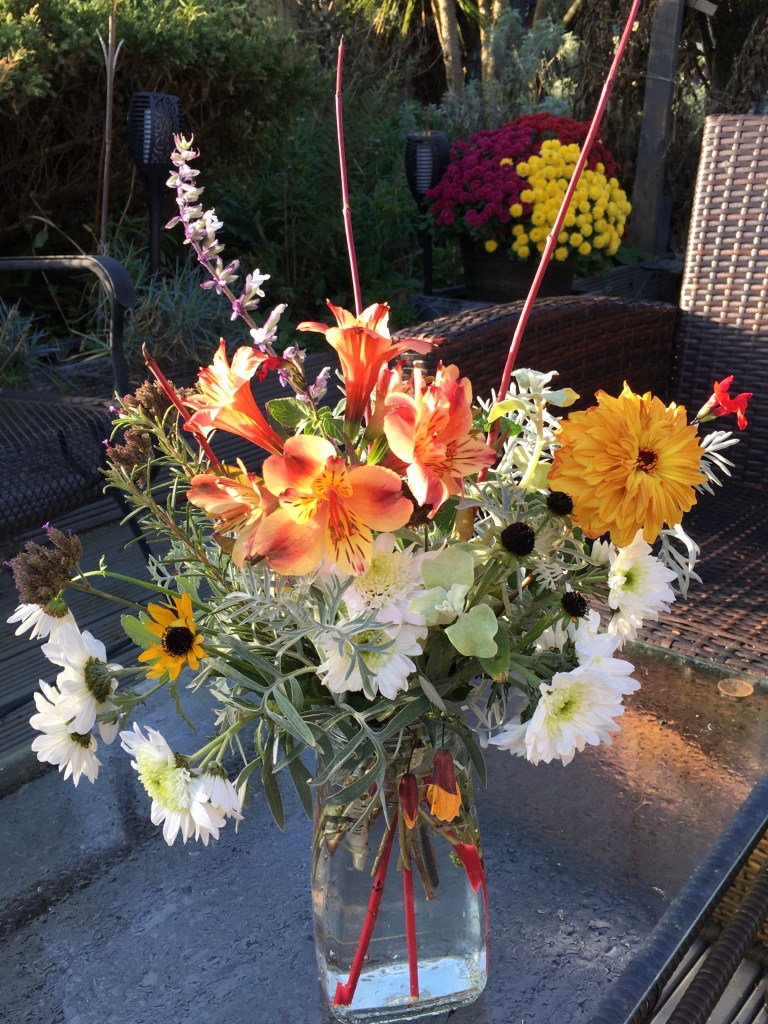
New reading in the potting shed this week is Stephanie Hafferty’s latest book on seasonal recipes for meals and drinks and making items for the garden and home.

I have to admit, I have a passion for cookery books. Many of my favourites have been handed down through the family. I’ve got Bero baking books from my grandma Betty, which bring back happy memories of delicious cakes. She never ate them herself, but just liked to make everyone smile. All our trips to the seaside- and local beauty spots such as Bradgate Park – would be accompanied by her butterfly fairy cakes. Her trifles were liberally sprinkled with hundreds and thousands. And I bet my brothers remember her home-made toffee apples. It’s amazing our teeth survived, but they did.

When you think about it, many of our strongest memories relate to sitting around a table together, sharing food. All our celebrations, birthdays, anniversaries- and Christmas being the highlight of the year- revolve around food.

With my own family and friends, I’ve tried to carry on the cooking and nurturing tradition. Although, it’s not always easy to get everyone together at the same time. We live such busy lives. When I do manage to corral the family together, I’ll usually make a massive pot of soup, a casserole, a cheese and potato pie, a vegetable lasagne, or similar. And for afters, there’s nearly always something involving apples- we have them in store all winter, and they’re free.

My cooking revolves around what I’m growing. And this is where Stephanie’s new book comes in handy; all the recipes are seasonally based. So they are relevant to what I’m growing all year round. I always start with what I’ve got available, rather than choosing a recipe. Stephanie helps by suggesting what I can do with the gluts of the season. I often have that “what-on-earth-am-I-going-to-do-with-all-this-kale” moment. Hearty bean and vegetable soup might be the answer.

I’m very keen on throwing everything in a pan together and just leaving it to cook. It gives me more time to garden- and chat. My two favourite pastimes! Stephanie must have written this book specially for me. Her Bean Stew with Red Wine is simple to make, fabulously tasty, and looks pretty too.

Alongside the main meals, soups and salads, there’s recipes for store cupboard ingredients such as flavoured salts, vinegars, herb mixes, and infused sugars. I’m definitely going to try making mint sugar. Imagine adding it to hot chocolate. Such a treat on a freezing cold day.

I’ve been thinking about what to do about vegetable stock powers since my favourite brand decided to add palm oil to its ingredients. There will be no palm oil in my house. Apart from not trusting the “ethically sourced” statement, we do not want or need palm oil. Only if we reject it will the rainforests be saved. I am just one person, but it seems the message is getting stronger. People are picking up packets of food and reading the labels and realising that palm oil has insidiously crept into so many food and household products. Anyway, now I can make my own stock powers with Stephanie’s recipes for wild herb, mushroom and tomato bouillon. And there’s a fruit bouillon for adding to yoghurts, cakes and biscuits. Such a clever idea, and easily do-able.

I’ve had a go at making herb teas, but never tried gin or brandy recipes. Stephanie’s Rhubarb and Sweet Cicely Gin sounds- and looks glorious. And wouldn’t it make a fabulous present for someone.

Sugar Plum Brandy looks equally divine. Apparently, this makes a lovely after dinner liqueur as well as a cocktail base. I’d probably add it to fruit cakes as well.

You wouldn’t think you could fit so many good ideas into one book, but Stephanie seems to have thought of everything. I particularly love her Gardeners’ Hand Scrub, Floral Bath Bombs, and Herb Candles. I’m going to be busy for the next few weeks, trying all the recipes and making presents for friends. And I’m going to enjoy every single minute of it.

Stephanie’s book is paperback and £19.95 from https://shop.permaculture.co.uk. There’s a discount code for blog readers purchasing from the shop which is BRAMBLE. Apply the code in the discount section at checkout to obtain the book for £16. Postage is extra. The book is also available via Amazon here https://www.amazon.co.uk/Creative-Kitchen-Seasonal-Recipes-Drinks/dp/1856233235 . There’s one copy available in the prize draw. Names will be randomly selected. Publisher’s decision is final. There’s no cash alternative. Worldwide delivery, for a change. Usually it’s UK only. Nice to have an international prize.

Meanwhile, the view from the potting shed is sunny today. As well as reading, I’ll be deciding what to grow next year, and Stephanie’s book will come in handy while I’m making my seed lists. What books are you enjoying at the moment? What are you planning to grow on your plots for 2019? Get in touch and let me know.

In a Vase on Monday- Autumn Jewels

It always seems as if flowers in mid November shine brighter than at any other time of the year. They are making a last ditch attempt to attract attention.

Dahlia David Howard, a glorious marmalade orange, takes centre stage. It’s on borrowed time. All the foliage is tipped black, touched by frost. Just a few flowers have escaped. For now.

The first pair of my 3 metre long cut flower beds lie under a weeping plum tree. The branches hang down almost to the ground. The canopy of branches gives just enough protection from the frost to extend the flowering season.

Making a backdrop to the beds is a small but prolific orchard. There’s two cherry trees, three apples, two pears- and a new quince tree that’s provided it’s first proper harvest this year.

It looks like this from the far side of the orchard. There’s plenty of pruning to do this winter.

My ten flower and veg beds are 3 metres long, by about 1.3 metres wide, with narrow paths between. I now garden on a no-dig system, following the principals made famous by Somerset farmer Charles Dowding. When each crop is finished, I don’t disturb the soil. I simply add two inches of compost and plant straight through. That way, weeds aren’t brought to the surface and the worms and mini- creatures living in my soil are not chopped into pieces. It seems to be working a treat, and my back appreciates being let off all that digging!

Dotted about, in amongst the kale and the cabbages, are patches of flowers. I wrote about annual chrysanthemum rainbow mixed https://bramblegarden.com/tag/chrysanthemums/ here. Seeds from Mr Fothergills cost £1.75 and were sown in March and planted out in May. They have been providing non-stop flowers since.

I particularly love this orange chrysanthemum. It is a perfect match for the autumn hues in this little bunch of flowers.

I’m lucky enough to be given new seeds to try out. This summer, my favourite calendula was Orange Flash from Mr Fothergills. It’s been an outstanding performer. http://www.mr-fothergills.co.uk/Flower-Seed/Calendula-Seed/Calendula-Orange-Flash.html#.W-nyCyenyfA

There are a few tiny coreopsis left. And yellow, orange and burgundy nasturtium flowers. Very welcome in posies – and the salad bowl where nasturtiums add a lovely peppery tang to the winter mizuna, mustard and miners lettuce. Such a treat as the weather turns cold.

I rarely take part in prize draws, but this week, on a whim, I joined in with one from the English Garden Magazine. It must have been my lucky day as I won! Now I’ve got some new music to garden to. Just as well, as I’ve found some more tulips I’d ordered and forgotten about. That’s my job for tomorrow sorted.

David Howard dahlias came from https://www.gee-tee.co.uk/bulbs/dahlias/dark-leaved-dahlias/dahlia-david-howard.

As always, I’m linking with Cathy for this week’s IAVOM. Why not go over and see what Cathy and all the others are growing and picking for their flower vases this week. And don’t forget to let me know what plants are still in flower in your garden this autumn. https://ramblinginthegarden.wordpress.com/.

The Bumblebee Flies Anyway

Book Review

Kate Bradbury. Published by Bloomsbury Wildlife. Hardback £16.99

It’s been a difficult year. I’m only just getting over serious illness myself, and then three relatives have been ill. I’ve been stretched to the limits trying to help everyone. So when I picked up Kate Bradbury’s book, it seemed to have been written specially for me. There’s a message of hope on every page.

Kate’s struggling too. Some kind of crisis. A broken heart. She ends up homeless, sleeping on friends’ sofas. She has to leave London and make a new home in a damp dark, basement flat. Even worse, the garden is a dead place. Decked over and full of rubbish. And yet, Kate’s book is not a tale of woe. It’s about struggling and striving. But ultimately, there’s a message of hope. After pain and suffering there can be triumphs and happiness again. It’s a message I needed to hear. I made myself a reading corner in the greenhouse and tried to absorb the positive vibes. It’s not easy when you are in the middle of a crisis. Sometimes I’d read the same paragraph over and over again, without registering the words. Stress is such a debilitating thing.

Kate turns her decked-over garden into a wildlife paradise. She makes a pond, puts up bird boxes and revels in every creature that comes to live in her tiny plot. It’s not just a book about rescuing a garden, it’s about rescuing a person too. It’s about the resilience of the human spirit. We may be bowed down and almost defeated by life’s events, but we will triumph. Nature, wildlife and gardens are a balm. Wouldn’t you agree.

I particularly love Kate’s descriptions of making a bee hotel and building a pond. I learn that a pond doesn’t need to be more than 30cm deep to be of value to wildlife. I could manage that. There’s plenty of places where I could fit a pond. And her tales of rescuing bees. I’d heard about giving bees spoons of sugar. Kate talks about finding an exhausted bumblebee on the pavement. She pops it in her pocket to keep it warm while she walks home. I’d never thought of doing that. She puts the red-tailed bee in a box with a pop bottle lid full of sugar water. It’s too cold and wet for the bee to go outside, so Kate gently places some shredded paper in the box to make a cosy nest until the morning. Apparently, some bees can be helped by gently stroking their thorax. I looked it up. That’s the part of the body between the wings. I can have a go at that too, if needed. Kate gives me confidence to try. Next day, Kate releases the revived and now grumbling bee. She searches for a mahonia plant to give the bee the best chance of survival.

There are lots of hints and tips sprinkled through the book for anyone wanting to make a wildlife garden.

Regular readers will know that we planted a mini-wood when we moved here, and I grow flowers and plants for pollinators. Now I have a few more good ideas for helping wildlife in my garden. Kate’s inspiring book and joyful message was just the pick-me-up I needed, to be honest.

The publishers have kindly given one free book as a prize for readers of this blog. Usual rules apply. One name will be randomly selected in the prize draw. There’s no cash alternative. Publishers decision is final. Please leave a comment to be included in the draw. Sorry, UK entries only.

Tour of MrFothergill’s Seed Trial Grounds

Photo : Silene Blue Angel. New for 2018/19

Growing plants from seed is a passion for me. It’s an affordable way to bulk up annual, perennial and biennial displays in the garden. And each year I try something new, as well as sticking with tried and trusted old favourites.

Next spring, I’ll be adding Silene Blue Angel to my seed sowing plans. It’s one of the new varieties on offer at Mr Fothergill’s. And this week I was absolutely delighted to be invited to view the trial grounds at the company’s headquarters in Suffolk.

These are the plants that caught my eye. The silene was top of my list. A hardy annual, sown in March and planted out in early June. Plants form neat cushions 25cm tall. For a continuous display, I’ll sow a few seeds at two to three week intervals. I’m picturing drifts of electric blue flowers running through the borders and flowering all summer long.

Brachycome Blue Star is another new variety available for 2019. I’m going to partner it with this one I spotted from the Brachycome Blue/White Mix range. I’ve always loved any kind of daisy flower.

Regular readers know I also love sweet peas. I grow a range of heritage and modern varieties along a rather wonky hazel wigwam structure. Next year I will be adding new variety Capel Manor to the garden. It’s a pretty pinky blue and has a delicate, though not overpowering scent.

I always plant cosmos in the cut flower garden. They are easy to grow and provide flowers from early summer right through to the first frosts. I spotted this beautiful new white variety called Snow Puff. Bees seem to love cosmos, so that’s a bonus too. I’m always trying to find ways to help pollinators.

Here’s some photos of the trial grounds. It was fabulous to wander about amongst so many beautiful flowers, jotting down names for future planting plans. The scent in the heat of the day just added to the wow factor.

Mr Fothergill’s is celebrating its 40th anniversary. In May, the company won Product of the Year at RHS Chelsea for its new Optigrow range of seeds. Optigrow is a revolutionary non-chemical seed priming treatment that uses only water and air to get the seeds biologically ready for germination. I’ll be trying out some of the 19 vegetable varieties available – including tricky to grow parsnips- next spring. I’ll need to write another post about all the new vegetable varieties. There are quite a few I’ve made a note of. And there are many more new flower varieties. I’ve just picked out a few. I’ll definitely have to write another post soon….

Please share this via any social media you like, and don’t forget to say hello in the comments box below. Let me know what new seed you are planing to try out for the spring growing season. I am @kgimson on twitter and karengimson1 on instagram.

It’s hot, hot, hot….. what the garden looks like on 5th August 2018

Plants in my garden are matching the heatwave! These sunny rudbeckias were sown last summer and planted out in autumn. They make much stronger plants grown as biennials.

These are Rudbeckia hirta Glorious Daisies , also known as cone flowers, from Mr Fothergill’s Seeds. Bees and butterflies love them. They are easy to grow and last a week as a cut flower.

They remind me of sunflowers. I love the yellow petals and the deep chocolate cone centre. To get them to flower as annuals, sow seeds in a 3″ pot of good quality seed compost in February/ March. Place in a propagator at 18C. Prick out as soon as there are two true leaves. Prick out into individual 3″ pots to give the plants room to grow. Grow on in a frost free place in bright light, but not direct sunshine as the tender new leaves will scorch. Plant outside in a sunny sheltered position at end of May. They will flower all summer long.

If you have a very sheltered garden, you can overwinter them. To grow them as biennials, sow them in summer and plant out in early autumn into soil that has been well prepared. Incorporate lots of good garden compost, well rotted manure and leafmould. This will improve drainage over the winter when it’s the wet that tends to kill plants rather than the cold.

As temperatures are regularly hitting 28C to 30C these rudbeckias really shine out and match the sunny weather. I’ve not watered these, but any planted since Christmas would need a thorough soaking once a week.

To add to the sunshine look, I’m trialling the new Thompson and Morgan sunflower Sunbelieveable Brown Eyed Girl. These are making lovely short stocky plants suitable for containers. They arrive in the post well packaged and soon grow into 50cm plants.

I’m also growing various sunflowers from Mr Fothergill’s including Evening Sun which has a stunning range of colours. And bees absolutely adore them.

These last a week in a vase and make a lovely centrepiece of any cut flower posy. Calendulas are also doing well on my plot despite the heat and dreadful drought. I am only watering containers and succulent crops such as runner beans and courgettes. Everything else is relying on good winter mulching with home made compost and Plant grow fertiliser. We haven’t had any rain since May.

Regular readers know that I always cut my flowers for my MIL Joan and my Mum Marion. This summer has been a particularly difficult one, health wise, and sunshiny flowers have been much needed.

Calendula Snow White and subsequent seedlings are a firm favourite. I post photos of my posies on IAVOM which Cathy hosts on Mondays. Thanks for joining me on a ramble round my rather hot and parched garden. Let me know what you are growing in your garden the first week of August.

Thanks to Helen for hosting the End of Month View.

In a Vase on Monday

My cut flower patch is in full swing. Luckily, flowers sown last summer and planted out in autumn are weathering the heatwave. Here’s a selection for this week’s vase. As always, my posies are for my mother in law Joan and my Mum, Marion.

Sweet peas High Scent are top favourites this year. I love the creamy buds that open to pale lilac. There’s a pretty violet picotee edge to the flowers. And the scent really is amazing. Only a few are needed in a jam jar posy to make an impact.

Seeds were sown last October in root trainers and kept all winter in straight-sided clear plastic storage boxes to outwit mice. It worked. And in April the well-rooted plants were set out along a wonky network of hazel twigs.

I pick flowers at dawn and drop them straight into buckets of cold fresh tap water. To travel, I pop ice cubes in the buckets to keep them cool.

In amongst the sweet peas this week there’s beautiful cornflowers Blue Boy. These are really prolific. I’m picking these flowers most days and there’s lots more to come. Great value for a small area.

For a pop of pink, there’s corncockle, an easy to grow wildflower that’s growing all around my garden.

Creamy white double chamomile reliably comes back every year and seems to go with everything.

As usual, I’m joining in with Cathy at Ramblinginthegarden blog for this week’s IAVOM. Why not go over and see what Cathy and all the others are growing and displaying at the moment. It’s fascinating to see how many of us are growing the same plants in gardens all around the world.

https://ramblinginthegarden.wordpress.com/

Dahlias- beautiful varieties for home and garden

Book Review

Naomi Slade. Photography by Georgianna Lane

http://www.pavilionbooks.com. £25. August 2018.

Leave a comment below if you’d like your name to be put in the hat for a chance to win one free copy of the book. The publishers will draw out a name. Their decision is final. Sorry, it’s open to UK entries only.

Photo : My favourite dahlia Nuit d’Ete in my own cut flower plot in Leicestershire.

I’m away from home for a few days, staying with my mother-in-law Joan. Everything here is at a slower pace. Breakfast takes an hour, and over tea and toast she tells me how her husband Keith once won awards at the local flower show with his dahlias and chrysanthemums. The whole garden from the back lawn, to the greenhouse was set in regimented rows of flowers. I can picture the scene. This garden has been lovingly tended by my in laws for more than 60 years. And now everyone in the family is stepping in to keep it looking perfect. It’s quite a challenge, but one we all enjoy.

Today, between hoeing and weeding and keeping them company, I’ve got time to sit down and catch up with some reading. And top of the pile of new books is Dahlias by Naomi Slade.

photo: Naomi Slade with her latest book. My photo, taken at Chelsea Flower Show.

Over 65 types of dahlias are profiled in the book. There’s 240 pages of mouthwatering photographs and inspiring, easy to read descriptions. There’s an introduction followed by sections on history and botany; and the dahlias are split into themes such as “romantic,” “dramatic and daring,” “fabulous and funky,” “classic and elegant.” A growing and care guide gives cultivation techniques, information on selecting varieties, choosing a suitable site and soil and planting tips.

Photos are sumptuous. I’m particularly drawn to the darker shades; deep red and almost black. Rip City is one I’d love to try.

Karma Choc is another on my wish list. This small waterlily flower is excellent as a cut flower and lasts at least a week in a vase.

I’d never heard of the Happy Single range of dahlias. These are perfect for small spaces and containers, growing to 30-60cm high by 30-40cm wide. Such a wide range of cheerful, rich colours. You couldn’t fail to be happy with them! Varieties include Happy Single Flame, Happy Single Party, Princess and First love. Even the names made me smile.

To calm things down after all that colour, there’s some dazzling and very beautiful white dahlias. I enjoyed learning about all the different kinds of dahlias. I knew about cactus and water lily types, but didn’t know much about collarettes, and anemone- flowered forms. And ones called star, or orchid-flowering sound particularly appealing.

Here’s some photos of dahlias from my own garden. I’ve taken cuttings from mine to grow in my in laws garden. Having read Naomi’s inspiring book, I’ve made a list of new varieties to share between our two plots. And I’m hoping to learn some prize winning tips from my father in law. You never know, I might even enter the local flower show.

Naomi Slade is a writer, broadcaster, consultant, speaker and photographer. A biologist by training, a naturalist by inclination, and with a lifelong love of plants. She writes regularly for national newspapers and magazines. Her books include The Plant Lover’s Guide to Snowdrops and An Orchard Odyssey.

I really enjoyed reading her latest book. It’s brought back some lovely memories for my mother in law and sparked off a new plan in my head to grow more dahlias in their garden.

Right then…. back to the weeding. Must not let my in laws down! 🙂

In a Vase on Monday – My Cut Flower Patch

One of the joys of June is to walk out into the garden and pick a bunch of flowers for the house- flowers that have been nurtured all winter, and are now ready to harvest.

Sweet williams are currently my favourite. They provide masses of flowers which last at least a week in a vase. Sown in June last year, they were pricked out and grown on, and then planted out in late August. And today I’m picking basketfuls of fragrant flowers.

Regular readers will know that all my flowers are grown for my mother in law Joan and my wonderful mum, Marion. Once a week I fill every vase they own with home-grown flowers.

Here’s some photos from my cut flower patch. I have 10 3m by 1.2m beds. Half are planted with sweet peas, dahlias and sweet williams. Half are set out with potatoes, beetroot, beans, courgettes and strawberries

In the background you can see the fruit garden. It’s completely overwhelmed with brambles and stingers this year. A renovation project is planned, when I get a minute to spare.

I’m growing a range of old-fashioned Sweet williams with seed from Higgledy Garden. As you can see, bees love them too. I’m always thinking of what would be best for pollinators.

I particularly love the auricular-eyed sweet williams. Rich Venetian colours really stand out in the summer sunshine. And they go so well with summer roses. This one is called William Shakespeare. Looks like red velvet to me.

And another favoured rose for picking right now is the highly-scented Constance Spry. It only flowers once, but what a spectacular show.

I’m sowing more sweet williams right now, preparing for next summer’s bounty. I use half seed trays filled with good quality seed compost. Fill them right to the top of the trays. Press down gently to level. Sow seeds thinly to prevent moulds and damping off disease. Seeds germinate at 17 – 19C, room temperature at this time of the year. So no propagators are needed. When seedlings have two leaves, I prick them out into full size seed trays to give each plant more space to grow. I’ll place the trays in a bright place to grow on, making sure the plants don’t dry out. And I’ll plant them out into the garden in August, 25cm apart, when I’ve harvested one of the vegetable crops to make space. I water plants with seaweed extract and home-made comfrey liquid which makes them grow healthy and strong. I’m adding some almost black sweet williams Nigricans and white alba for next year.

Here’s another view of my cut flower patch with Diascia Hopleys in the foreground. Another good do-er for flower arranging.

I’m joining in with Cathy for her In a Vase on Monday meme. Why not go over and see what Cathy and the others are growing and putting in their flower arrangements this week. Let me know how your gardens are doing this summer. How are you coping with unpredictability weather, rain and high winds? I think summer storms are becoming the norm.

Visit to Bowood House and Gardens

My invitation read: “Come and visit Bowood’s famous spring planting; and Lord Lansdowne will lead a tour of his woodland garden.”

Who could resist such a missive. Not me! So I set off for Wiltshire- dreaming of camellias, magnolias, rhododendrons and azaleas galore!

And what I found was one of the best spring gardens I’ve ever visited. Over two miles of paths meander through the 30 acre garden- set within a former quarry. A stream runs through the valley with banks of ferns, candelabra primroses and bluebells either side.

Now, I’ve been on these garden visits before, where tours are promised. The owner is often there for a welcoming reception- but then frequently hands over to staff for the tour itself. So I was surprised and pleased to see Lord Lansdowne standing by his offer and giving us a walking tour of his garden – and one that ran an hour longer than planned.

If you come to visit my garden, I’ll take you around, show you the tree I planted when we moved here, my favourite seat, my favourite shrub and the plants I inherited from my grandparents’ garden. To be honest, our visit to Bowood felt just like that; a keen gardener showing us around his plot – with all his favourite trees and shrubs and viewing points. As soon as we arrived, Lord Lansdowne pointed to a group of cornus dogwood trees and described them as his “pride and joy.” And then followed a chat about how difficult they are to grow, and how “wonderful” they look when the white bracts appear in spring. His enthusiasm is something we all share as gardeners. We nurture and plant something, and then stand back and admire it, and want to share that moment with fellow gardeners. It’s something I recognise and understand.

One thing I haven’t got though (ok, there’s no rolling acres and stately home either) is a rhododendron named after me. This one is Lord Lansdowne’s – it’s rather lovely, with peachy cream petals and pink buds.

I can see why this is one of his favourite views, looking out from the garden. We are standing on the mausoleum steps looking out across the tops of the rhododendrons through a gap in the trees.

Some of the rhododendrons are called Bowood Hybrids, and Lord Lansdowne showed us the nursery beds where his selected seedlings are planted. He said they could be sitting there for 10 years before he’d know if they were something special or not. Patience is obviously a virtue when you are growing new varieties like these.

I must admit, there were a dizzying array of variety names as we walked through the woods. I should have written them down, but I was just listening to the commentary and enjoying what turned out to be a most unusual and special day. I mean, how often can you report that you were meandering through the woods and suddenly there on the path is the celebrated plantsman Roy Lancaster!

Roy, who is writing about the gardens, stopped for a chat and joined our group for a photo. It was fascinating to hear the two friends talking, the Latin names flying back and forth. And later, we visited a patch called Roy’s Corner, where specimens brought back from Roy’s plant-finding expeditions are being nurtured. Altogether, it had been, a day like no other.

Bowood Woodland Garden opens from 28th April until early June. Check the website for details. http://www.bowood.org

No wonder the owner admits he spends every Saturday lunchtime having a picnic in the gardens. I think I would too.

Many thanks to the Garden Media Guild for organising this visit to Bowood. If you work in horticulture, you can become an associate member. Membership is open to anyone working in garden writing, broadcasting and photography. Probationary membership may also be available for new starters in the profession and there are training courses and mentoring schemes available.

End of the Month View -April 2018

We leave cold, wet April behind, and May finally brings some warm, settled weather.

The potting shed window ledge soon has a jug of cow parsley and forget-me-nots from the wild garden.

We’ve waited for this display all winter. Wild cherry trees in the paddock. Alive with bees. An avalanche of white blossom.

Scented narcissi Geranium pop up in the long grass around the pond. I love the egg yolk centres.

Needing some work this summer, the pond is ringed with marsh marigolds and lady’s smock wild flowers- and brambles and stinging nettles! A bit of cutting back and control is planned.

Our front lawn is a blue haze. My Grandfather Ted Foulds brought the first wild violets here, seedlings from his garden. They spread over the whole plot, and I love them.

I’ve planted my sweet peas. The hazel rods are a bit ramshackle, but they’ll soon be covered with flowers. I planted seed in October. I’m growing old favourites: High Scent, Wiltshire Ripple and creamy white Mrs Collier, plus heritage varieties from Easton Walled Gardens .

Suddenly, these dog’s tooth violets pop up through cow parsley in the woodland. I forget I’ve planted them – and then they emerge. Sunshine on a cold, cloudy day. Erythronium Pagoda is the variety growing here.

Shining out from the shade, Tulip Purissima. Reliably comes back every year. Copes with everything the weather throws at it.

I grow Orange Emperor tulips in the daylily bed in front of the greenhouse. Another good do-er. Always comes up every year if planted deeply on a bed of grit for drainage.

Favourite shrubs in flower at the moment are daphne and quince. This one is Japanese quince, Chaenomeles Kinshiden. Double flowers open pale lime green and change to clotted cream as they age.

Pleased to see my plectranthus has survived the winter, tucked up in the greenhouse. A striking plant for summer containers. Easy to grow from cuttings.

There will be plenty of citrus fruit for summer preserves. This plant flowered all winter, filling the greenhouse with such a wonderful scent.

We do quite a bit of owl watching from the top of the garden. Delighted to report the barn owls and tawny owls have survived the freezing winter. We’re hoping they bring their fledglings into our garden again this summer.

Another cause for celebration. The hedgehogs- we think they are last year’s babies- also survived the cold, and have come out of hibernation, ravenous. They are doing a great job of clearing pests in the garden.

I hope you’ve enjoyed this slide show of my garden at the end of April and into the first week of May. Enjoy your Bank Holiday weekend. I’m hoping to spend some time just sitting in my favourite garden chair. If I can possibly ignore all the weeds growing rampant in the background!

Thanks to Helen Patient Gardener for hosting the EOMV. Why not go over and see how Helen’s garden looks at the end of April.

What are your plans for the garden over the coming weeks? Get in touch and let me know.

Fact sheet for growing strawberries /recipe for ten minute strawberry jam biscuits

If you listened in to the gardeners’ phone-in programme this week on BBC Radio Leicester you’ll have heard us giving hints and tips on planting and growing strawberries. Here’s a list of do’s and don’ts to get the best from home grown crops.

Buying bare-rooted runners, or root stock, is an affordable way to buy strawberries online or via seed and plant catalogues. It’s a good way to buy named varieties and virus free stock.

I’ve chosen the Plant Heritage Collection from Marshalls. 30 runners for around 66p each.

Royal Sovereign : A well-known mid season strawberry famed for flavour. Large juicy fruit. Crops in early summer- and again in autumn.

Cambridge Favourite : Reliable and popular variety. Good for jams and preserves.

Red Gauntlet: Mid season, heavy cropper. Fruit is held well above the ground. Good for damper soil, or for growing under cloches or in tunnels. Some resistance to botrytis.

1. When the plants arrive, take them straight out of the Jiffy bag and either plant into 3″ pots or straight into the garden, if soil and weather conditions are suitable.

2. Choose a sunny, well drained spot – not in a frost pocket

3. Enrich the soil with well rotted garden compost, organic Plantgrow fertiliser, or peat-free sheeps wool and bracken compost from Dalefoot Compost.

4. Planting depth is crucial to success of the runners. The crown, the thickened area where the leaves are attached to the roots, should be resting at soil level. Too high and the plants will dry out. Too deep, and they will drown.

5. Don’t plant where tomatoes, chrysanthemums or potatoes have been grown. The soil may harbour wilt disease.

6. Watering techniques are important. Do not drench the leaves and leave them wet overnight. The plants are more likely to suffer from moulds and the fruit will rot. Either use a leaky pipe, or push the watering can through the leaves to water at ground level.

7. Feed every 7-14 days with a high potash liquid fertiliser. I use seaweed extract, but you can also use tomato fertiliser. Plantgrow also has a handy liquid fertiliser in its range.

8. Protect the flowers from frost using a layer of fleece. The flowers are easily damaged and turn black. A whole crop can be lost to frost overnight.

9. Cut back all leaves and remove straw mulch after fruiting to prevent a build up of pests and diseases. We use chopped mineralised Strulch.

10. The plants will naturally produce runners. Stems will arch over and where they touch the ground, new plants will grow. Pot these up and renew your strawberry beds every 3-4 years. The old plants are best discarded after this length of time as pests and diseases start to take hold.

11. Vine weevils love strawberry plants. There’s a new organic nematode treatment that can be bought off the shelf. Previously treatments had to be posted out and used fairly quickly. The new nematodes from Neudorff are easier to buy and use.

STRAWBERRY JAM ALMOND BISCUITS

These are a family favourite and only take 10 minutes to make. Lovely with morning coffee, or for afternoon tea.

Ingredients: whizz together

200g caster sugar

115g butter

115g ground almonds

115g plain flour

1tspn baking power.

1 egg

3 drops almond essence.

Rest dough in the fridge for one hour if you want biscuits to retain their round shape. I was in too much of a hurry, so mine turned out flat.

Take teaspoons full of dough and roll in the palm of your hand. Place on a baking tray. Make a well in the centre with a spoon handle or little finger. Fill with strawberry jam. Top with slivers of almond.

Cook in oven at 200C for 10 minutes. Keep a close eye on them as they soon burn.

Will last for three days in a sealed container. If you can resist them that long.

Here’s a link to the radio programme. Have a listen in at 2.08.18 on the timeline.

bbcleicester http://www.bbc.co.uk/programmes/p063rcnf

Here’s some fruit tarts I also made with the home-made jam. Totally delicious! Wonderful after a hard day working in the garden.

Click on the highlighted links for more information. These are not affiliate links.

What new plants are you trying out this spring and summer?

In a Vase on Monday – 9th April 2018

Just dashed home from work. Wonderful to still have some light in the evening for mooching in the garden. Each week I join Cathy at ramblinginthegarden for IAVOM. Here’s a slide show of photos showing what I’m growing and putting in my flower arrangements his week.

The silver and gold-laced primulas are just at their peak. They last for a week in water and have a faint but delicate scent.

Tulips always cheer up any arrangement. These yellow and red blooms go really well with the fancy primulas.

Flower vases are still very much focusing on bulbs. I think I’ve had Carnegie white hyacinths in my flower vases every week since Christmas. These are the very last of them. I shall miss them to be honest. The scent in the potting shed is just wonderful.

Hellebores are still in flower here. This one has a pretty, frilled anemone centre and holds its head up, which is always a good trait in any hellebore. I bought this one from Hodsock Priory in February.

Hellebores have survived everything the weather has thrown at them. This one came from Ashwood Nurseries in Kingswinford when we had a a tour of owner John Massey’s private garden. Well worth a visit. Probably the best spring garden I’ve ever seen. All fees from the open days go to local charities.

Couldn’t resist these summer bulbs. Lilium Conca D’Or is a favourite for fabulous scent. And the dahlia is new to me. I’ve watched others on IAVOM growing and using this variety, so I’m looking forward to trying it out for the first time this year.

Potting shed reading this week is Secret Houses of the Cotswolds by architectural historian Jeremy Musson, published by Frances Lincoln, part of the Quarto Homes group. Photographer Hugo Rittson Thomas allows us to peek into 20 homes, varying from castles and manor houses to grand mansions. It’s like stepping into another world to be honest. And a glimpse of the gardens through open windows- so tantalising! I just wanted to jump in the car and visit them all. But of course they are not open to the public. So I shall have to be content with gazing longingly at the book.

Click on the links to find out more. These are for information only and are not affiliate links.

Product Trial : Hopes Grove Nurseries- Hedge-in-a-Box Kit

Photo: Prunus blossom from my hedgerow.

Visitors to my garden sometimes look surprised when they see the state of my hedges. They don’t often know what to say. Or they launch into a lecture offering kindly advice which usually involves grubbing out the rampant species and cutting everything back. I say nothing.

Truth is, I know the hedges are untidy. But I love them that way. There are gaps – but they allow ramblers on the lane to view the snowdrops. And me to watch the barn owls glide silently by at dusk. Yes, there are tangles of wild clematis, ivy and honeysuckle. Bees love the ivy flowers and birds love the berries. It’s a living tapestry of colour all year round.

Even the scruffiest, wild and untamed hedge provides nesting and cover for birds. A home for insects and small mammals. A microclimate, baffling the wind. Far better than any fence or wall, allowing frost to filter through and creating shelter.

Being a fan of all kinds of hedges, I made a beeline for Hopes Grove Nurseries at a recent garden trade fair in London. Hopes Grove are launching new themed hedging kits. I asked if they could design a florists’ hedge for me, and three days later my hedge-in-a-box arrived on the doorstep.

My new hedging kit contains a mixture of plants to give colourful stems, flowers and evergreen foliage. There’s a mixture of bare-rooted stock and potted plants including deutzia, escallonia, ribes, forsythia, hydrangea, mock orange, spirea. A lavender has been included as a sample of what the nursery sells. I think I’ll plant that in my herb garden. For glossy evergreen leaves there’s griselinia littoralis and osmanthus burkwoodii. And for winter colour there’s dogwoods with black, yellow, red and orange stems. My wild and untamed hawthorn hedge marks the boundary of my acre plot, but nearer the house and around the veg plot I’m going to plant a new mixed hedge, one I can harvest for my flower arrangements.

The plants, well packed, arrive in cardboard boxes. Boxes and paper packaging are all recyclable.

You wouldn’t know they have been packed in a box and been on a journey. The plants are really well grown and fresh. There are plenty of new buds on the Hydrangea Annabelle, and the osmanthus is just about to flower.

Bare- rooted plants are also substantial, well grown stock. We’ve heeled them in to the veg plot temporarily, until the ground is less waterlogged for planting. Each week I join in with the IAVOM (In a Vase on Monday) meme. I post a photo of what I’ve grown and harvested from my garden and take a look to see what other people all around the world are growing for their flower and foliage arrangements. Have a look at Cathy’s site to learn more.

Another new hedge-in-a-box kit is the Gin Makers’ Hedgerow, with fruit and berries for alcoholic infusions. There’s wild pear, crab apple, plum, and cherry amongst the long list of suggestions. And I noticed dog roses too, which grow freely in my garden.

Of course, my wild informal hedge might not be everyone’s cup of tea. It’s important to say that Hopes Grove supplies plants for more structured hedges such as yew, privet, box and beech. Plant sizes vary from economical one year old cuttings, bare rooted transplants, 2- 4 year old feathered whips, right up to 25ltr pots and troughs of well grown plants for instant effect. There are hundreds of plants listed in the catalogue.

Hopes Grove send out a well-written site preparation, planting and aftercare guide. Morris Hankinson is the founder of Hopes Grove and grew up in the tiny oast house on the small family farm that is now in the centre of the nursery site. Morris has grown the business from a “one-man-band planting, growing and selling hedging” to a nursery covering 50 acres and employing 18 local staff.

Contact Details: Hopes Grove Farm, Smallhythe Road, Tenterden, Kent, TN30 7LT.

I’m delighted that Hopes Grove have asked me to trial this hedge-in-a-box kit. I love to hear of innovative ways of growing and selling plants. I’m very happy to wholeheartedly recommend their hedging plants and I’m grateful for the chance to give my honest opinion.

Hopes Grove won the Bob Maker Memorial Award for the best stand at the trade fair, the Garden Press Event in London.

Photo. Wild flowers – stitchwort- growing in the hedge at home.

In a Vase on Monday -Snow, and then spring!

What a week! Temperatures over the past seven days have gone from -12c to 14c. Luckily nothing seems to have been lost. The snow creates an insulating blanket. Plants can still photosynthesize through the snow. I just gently tap some of the snow-laden branches of conifers and acers. The weight can cause splaying and damage. Here’s a slide show of photos showing my garden from last Monday to today. Flowers are in plant pots and jam jars in the greenhouse and potting shed this week.

My 20-year-old Parwins electric heater has been working full time keeping the greenhouse cosy. A second-hand Alton Cedar greenhouse copes really well with the weather. The wood seems to expand in the winter, excluding any draughts. At night, I didn’t disturb the wrens nestling in a row on the door slider. There were eight snuggled together, keeping warm.

Scented pelargoniums have never been more welcome than on a freezing cold day. I picked some to put in tiny vases for my bedside table.

Iris reticulata bulbs are still in flower. They last longer in cold weather. Such a delicate scent. Much appreciated when there’s a foot of snow outside.

As there’s so few flowers this week, I’m showing some photos of my greenhouse, Polytunnel, potting shed set up. All within a few paces of each other. The polytunnel was second hand from a nursery closing down sale. You can see my Dalefoot Compost piled up in front of the potting shed, all ready for sowing seeds and growing fruit, veg and flowers. I started off some tomato seeds mid week. It’s the first time ever I’ve had to put hot water bottles on the compost bags before sowing seeds.

I’m keen to try this sheeps wool and bracken compost. I’ve been peat free for a while now, but composts have been variable to say the least. Dalefoot promises to be water retentive and cheaper to use, as no added fertilisers are needed. Apparently the bracken is naturally high in potash- needed for fruit and flower production. And the sheeps wool continues to act as a kind of slow release fertiliser during the whole growing season. Dalefoot have given me the compost to try out. As usual, opinions are my own and I’ll give an honest appraisal of the product in due course.

A quick peek in my potting shed and there’s still some white hyacinths, yellow tete-a-tete daffodils, with green hellebores and fluffy willow catkins. This time the vases didn’t freeze solid, thankfully. The view from the potting shed is white over. As is the view from the back door, below.

I didn’t go far to be honest. The roads around here were pretty dire.

But then – thankfully, the temperatures started to rise. And today has been the warmest day of the year.

Hope it’s sunny where you are at the moment.

Thanks to Cathy for hosting this IAVOM meme. Why not go over and see what Cathy is growing and putting in her vases this week.

In a Vase on Monday ….. er Wednesday.

Defeated by torrential rain, I’d given up on gardening until today. Here’s a brief glimpse into my day.

A quick peek in the greenhouse before I go off to work. And it’s sunny in here. At last. Yippee!!! Windows opened. Wonderful scent. Just love primulas. So cheerful.

Second year hyacinths are never as good. But they still have a value. I love the intense blue of this one, set against the yellow of the dwarf daffodils. I’m growing Tete-a-tete in pots for picking. And in honour of my wonderful Welsh grandmother, Tenby daffodils, which grow wild in Wales.

Love my newly acquired plant pots. The green one on the left is from Burgon and Ball , and the one on the right is from new company Plant Furniture.

After a quick snip of flowers for the show, I’m off to Radio Leicester for the Gardeners’ phone-in, 11-12 on a Wednesday. A fun place to work. Sophie and Jack the producers look after me. I’m always so grateful for all the encouragement and support they give. I probably couldn’t do it without their kindness to be honest.

We chatted about growing tomatoes. I’m growing bush tomatoes in containers and hanging baskets alongside programme host Ben Jackson. We’ve got cherry tomatoes from Mr Fothergill’s, Suttons and Thompson and Morgan to try out. And we’ll be growing them in Dalefoot sheep wool and bracken compost as an alternative to peat. It’s always more fun growing something with another person. I haven’t got an allotment, for example, where you would have neighbours to chat with and share hints and tips. so I’m going to grow along with Ben, and we’ll share seeds and compost and compare results. It will be a fun project to do over the summer.

We always have a laugh on the gardeners’ programme. If I see something a bit unusual, I’ll take it in to show the team. Today I took in these Badger Paw gloves. I spotted them at the Garden Press Event a few weeks ago and thought they looked interesting. The event showcases new ideas, new seeds, tools and machinery, containers and plant pots- all heading for supermarkets, garden centres and nurseries this summer. The Badger Paw is said to be perfect for preparing soil, planting, weeding and clearing roots. It’s made by Creative Products and has breathable stretchy fabric. What we couldn’t work out though was why the claw is only on one hand. It’s an interesting concept and I’ll let you know how I get on with it.

My posy of flowers this week also contains hyacinths – which just seem to keep on flowering. They love the cold weather. Tucked inside my paper wrapping are iris reticulata, hellebores, snowdrops, and dogwood twigs from my new florists’ “Hedge-in-a-Box” kit from Hopes Grove Nursery. I spotted their ingenuous hedge kit for gin makers at the GPE. On the stand there was a sign saying make any suggestions for new hedge kits. So I asked if they could design a hedge for florists with coloured stems and flowers for all year round picking. And my wonderful “hedge-in-a-box”arrived on Monday! I’m really thrilled with it.

Thanks for joining me today. Thanks also to Cathy for hosting this meme and kindly allowing me to join in later in the week when either the internet – or the weather – has let me down.
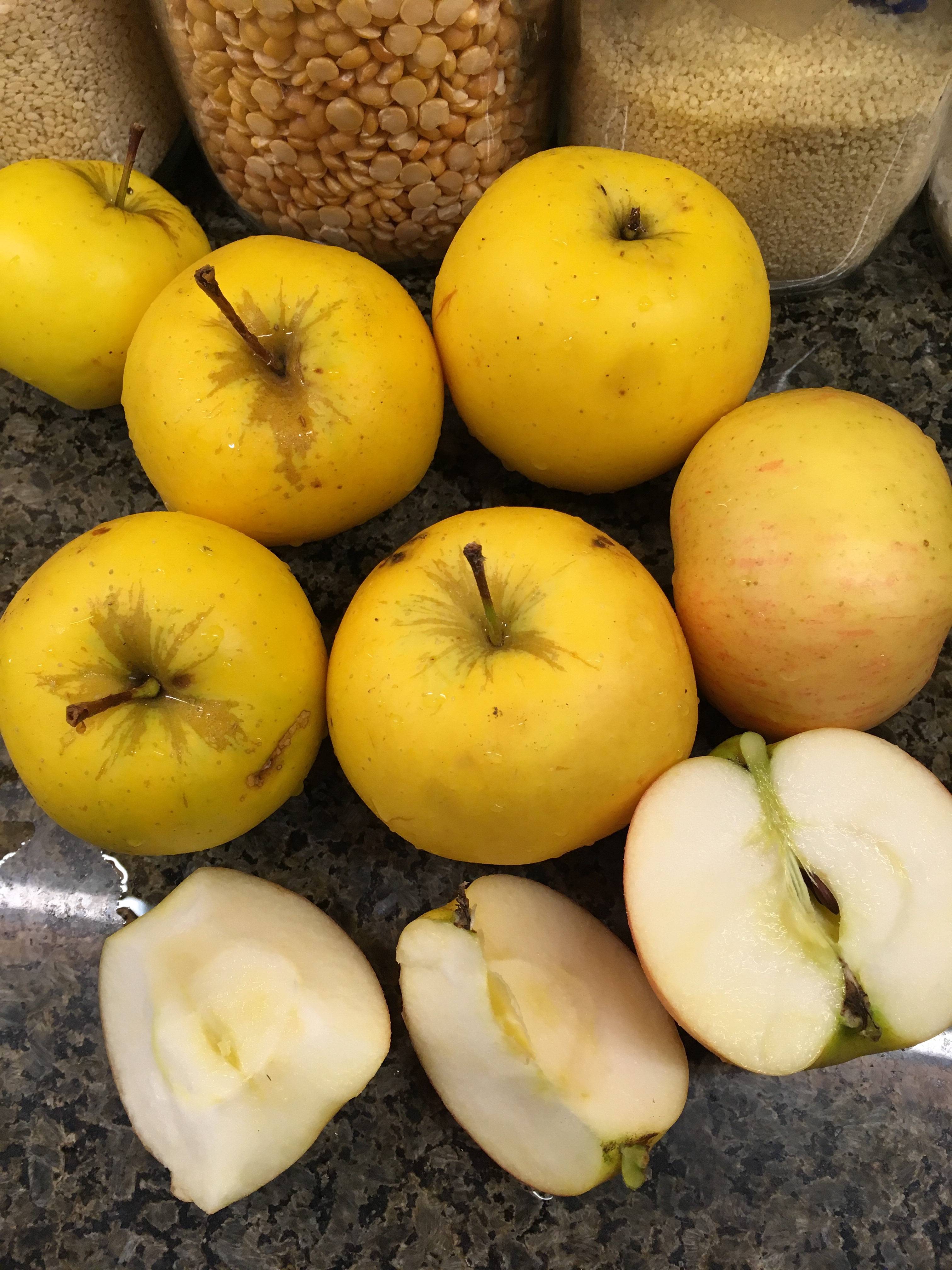
Click on the highlighted words for more information. They are not affiliate links.

In a Vase on Monday

If you look carefully, you’ll see little ice cubes floating in the vases in my potting shed today. The jam jars and jugs froze solid. And I was away in London, so couldn’t rescue them. Luckily the flowers didn’t seem to mind. They perked up as soon as the temperature started to rise. These are the very last of my Paperwhite narcissi. They’ve been fantastic value, giving flowers for cutting for three months.

For my IAVOM I have recycled my spring flowers. I’ve cut off the bottom 2cm of each stem, given them all fresh water and added lots of grey willow catkins and hazel “lambs tails.” It looks like it’s a yellow and white theme this week. I haven’t planned it, but doesn’t it look cheerful. We’ve had temperatures go from -10 to 10c in just 24 hours.

Double snowdrops, Galanthus flore pleno, from my “Hodsock” corner are still flowering well. The freezing temperatures have prolonged the display. Every year Mum and I visit Hodsock Priory in Nottinghamshire. We always stay overnight so we can walk in the woodlands just before dusk and again at sunrise -before the crowds arrive. It’s a special treat to have the gardens virtually to ourselves. Each year we buy a few pots of snowdrops for a couple of pounds. And over the years they have spread to make a corner of my garden that reminds me of our special holidays together.

Noticing that I haven’t got many vases, a relative has taken pity on me and donated these little containers. The snowdrop vase has a lovely green glaze. The brown container looks like it is made of wood, but it is actually ceramic. I’ve never seen these type of vases before. I think they date back to the 1920s and were family wedding presents. So happy they have made their way to my potting shed to be treasured for years to come.

I put some moss in the container and added some hazel twigs. It is just perfect for holding a few tiny snowdrops.

The potting shed window has miniature green hellebores this week. The leaf and flower shape looks like Hellebore Corsicus, but I’ve never seen one as petite as this. I love the lime green flowers.

Here’s a quick peek at what it’s been like outdoors here. The farm pond was frozen solid for a week. We spotted a kingfisher on an overhanging branch staring intently at the water. Many of the garden birds came closer to the house during the freeze. A little gold crest has been roosting in the potted acer by the back door all week. I’ve fed it mealworms and crushed sunflower seeds saved from the veg plot.

And the gap in the hedge view. I didn’t linger long. There were hares racing across the field and pheasants in the ditch.

Today, there is no evidence of wintry weather. I feel like I’ve stepped from one country to another – a much warmer one at that. 7c feels positively balmy after what we’ve been though. And the willow catkins give us hope.

Thanks to Cathy for hosting the IAVOM meme. Why not go over and see what Cathy and all the others are growing in their gardens and cutting for their flower arrangements this week.

How has your garden fared in the bad weather? As you can see, I’ve written it on a Monday, but not managed to post it until today. Our internet is on the blink again. BT no doubt will blame the snow. Have a good week all of you.

End of the Month View – March 2nd 2018

Thank goodness there’s some colour in the greenhouse right now. I planted these Iris reticulata last October. And just when I need something cheerful to look at, they’ve sprung open like a jack-in-a-box. As soon as the sun hit the greenhouse glass, they pinged open. A lovely moment. Glad I was there to see it.

Such an inky blue. I planted Iris Pixie and Harmony, and then somehow lost the labels. A common occurrence in my garden. I must address the problem of how to keep labels this year.

I’ve no need to tell you what the temperatures are like at the moment. One look out of the window and you can see for yourself. We are white over in the UK. So today I’ve been mooching in the potting shed and greenhouse.

Planted last September, these Carnegie hyacinths are a joy for months. The buds are pretty, with just the green tips showing. I think there’s as much pleasure in anticipating what’s to come, as there is when the buds finally burst into bloom. The scent fills the whole greenhouse and makes it a pleasure to work in there on a freezing cold day. I heat the greenhouse to between 5 and 7 degrees. It is an old Alton Cedar greenhouse -second hand, renovated and painted black. Being cedar, the wood swells in the winter and cuts off any draughts – keeping it warm and cosy in there.

Prepared -or temperature treated bulbs – are planted in September in individual 3″ pots. The bulbs are given a cold period to fool them into thinking they have been through winter. We then put them in a cool, dark cupboard in the potting shed or garage for 20 weeks which finishes the treatment. Then, the bulbs are gradually brought out into a cool greenhouse and grown on. You can delay development by just keeping them cold and on the dry side, which is how I’ve managed to keep them flowering right through winter.

Choose bulbs that have flowers roughly the same size to plant into bowls and create displays for the house.

Today, I’m looking out at a snow, right across the back fields, and there’s icicles dangling from the greenhouse roof.

All along the top shelves are succulents and cacti- which need virtually no water between November and mid-March. These Echeverias have grey -blue leaves and striking orange flowers in summer.

The potatoes are starting to chit. Hard to believe, I will be planting them in a few weeks. I’m growing Charlotte and Lady Christl- both delicious. These varieties are on the RHS recommended list for growing in containers. If you are thinking of growing in containers, you need 8 litres of compost per potato. So put five in a 40 litre bag or 16″ -18″pot. Start off filling the bags with 20 litres of compost and 125g organic potato fertiliser. Sink the potatoes into the compost, and water. As the haulms or stems grow, add more compost to cover them and gradually fill up the pots. The secret to success is not to overwater. Soggy compost deprives the plants of oxygen and leads to stunted growth. Start feeding with potash when the leaves are out of the top of the pots. Other varieties I’ve tried and are RHS recommended include Casablanca, Golden Nugget, Sharpes Express, Maris Bard, Jazzy and Vales Emerald. I don’t grow Sharpes Express as much though, as it tends to disintegrate when it’s cooked and you end up with a pan full of soupy water.

Just behind the potatoes and bedding plant cuttings is a pot of wild rocket. I sowed the seed in autumn and now have lots of little pots like these from which I can pick a few leaves each day. Pick from the outer leaves, leaving the centre of the plants to keep growing.

Here’s a quick peek in the potting shed at dusk. The last of the Paper White narcissi are cheering up the potting bench. Another fabulous scented flower.

And in the potting shed window there’s snowdrops. This one is a very pretty Galanthus Viridapiece which has delicate green-tipped flowers. A favourite of mine.

Thank you to Helen at Patient Gardener for hosting this EOMV meme.

How are you coping with the weather? Get in touch and let me know how your garden is faring in the snow. Keep warm everyone.

In a Vase on Monday- a peek inside my potting shed

This week I’ve potted up some prepared hyacinths. I started them off in a cold, dark potting shed in September. The bulbs were put through a cold treatment before I bought them – to trick them into thinking they had gone through winter. Putting them in a dark cupboard for 10 weeks completes the treatment. They grow fabulous roots in the dark and form a strong flower shoot. Some hyacinths were brought on in warmer conditions to flower for Christmas. But spare bulbs have been kept cold and dry to stagger the flowering display.

I grow them individually in 3″ pots. To create a display, I simply choose bulbs that have flower spikes about the same size.

I love the green edge on these Carnegie white hyacinths and the scent cheers up the potting shed. It’s a joy to work in there at the moment.

My grandfather Ted Foulds gave me these terracotta Sankey plant pots. I love using them and always think of him. Happy memories – I had a carefree childhood. For which I’m very grateful. They were simpler times then, when we made our own entertainment. Mud pie gardens, surrounded with stones and topped with flower heads. Making gardens in a biscuit tin lid, with tin foil ponds and tiny twig “trees.” Keeping snails as pets and feeding them lettuce; and great delight when the snails produced eggs, hatching into a family of miniature baby snails with translucent shells.

Here’s some hyacinths that have been flowering in the greenhouse for several weeks. They are such great value. Below, I’ve used foliage from the garden, dogwood stems, salix catkins and hazel lambs tails, with a single pink hyacinth flower and some double snowdrops.

And finally, in my mother-in-law Joan’s posy, there’s white hellebores, and the first daffodils, surrounded with ivy, and twigs and some green foliage which is actually a weed. It’s known as shepherd’s purse, and has tiny hearts all along the stem.

Thank you to Cathy at Ramblinginthegarden for hosting this meme. Why not go over and see what Cathy and all the others are growing and using for their flower arrangements this week. As you can see, you don’t have to use a vase. Any container will do.

I hope you enjoyed a peek inside my potting shed. Get in touch and let me know what you are growing.

Garden Restoration Plans for Holme Pierrepont Hall

There’s nothing more cheerful than turning up at a favourite garden to find everyone happy and smiling. This week I visited Holme Pierrepont Hall to find the owners and gardeners busy with renovation plans. Funds from a Heritage Lottery grant and the Country Houses Foundation means work can start on restoring garden walls which date back to the 16th century.

The funding will also enable research into the site’s history. During my tour of the gardens, I learned the topiary courtyard once housed aviaries for tropical birds, and a monkey house in the centre. I can’t wait to see what else is revealed when historical documents are studied by experts.

Built in 1500, the hall is thought to be the oldest brick building in Nottinghamshire and is still lived in by descendants of the Pierrepont family. Three generations of the family live here now, Robin and Elizabeth, Robert and Charlotte and their children Oliver and Cicely. Elizabeth, whose great grandmother was Lady Mary Pierrepont, moved here in 1969 and undertook some major restoration work in the house and garden. Today, the new conservation work is being led by Robert and Charlotte. And their enthusiasm is catching. It’s easy to get caught up in the optimistic atmosphere at Holme Pierrepont. They love their home, and genuinely enjoy sharing it with visitors. It’s heartening to hear plans to open on more days in the future. Currently the house and garden opens Sunday to Wednesday, February and March, and Sundays in April, 2-5pm. (Closed Easter Sunday). New for this year, there’s additional garden open days in May and June. Dates and times are on the website http://www.holmepierreponthall.com

As well as the courtyard, the hall is famous for its Spring Walk, featuring daphne, hamamelis, rhododendrons and acers, underplanted with hellebores, primula and masses of early bulbs. To help visitors identify the varieties, a guide has been produced and new signs installed in the garden.

Scent is important in the garden and mature hamamelis and daphnes are fabulous at this time of the year. This one is Daphne Jacqueline Postill.

There are several Hamamelis planted alongside the pathways. Hamamelis mollis, Diana and Westerstede, (pictured below) among them. It’s good to have a guidebook and new signs to be able to identify them correctly.

Snowdrops, these pictured below, are Galanthus Sam Arnott, are looking spectacular at the moment in the spring garden, and also in the Woodland Walk.

New signs direct you through the old walled orchard and on to the woodland where there’s also large drifts of wild Tulipa Sylvestris. These have been growing in the grounds since the 17th century. They were apparently first planted in the main garden, and then seemingly “thrown out” in to the woodland – where they’ve thrived.

It’s a peaceful walk, amongst the Jacob sheep, now occupying the walled orchard. There’s a possibility in the future these kitchen gardens might be restored.

The old walls curve around the orchard at the back of the hall. So many layers of history in those beautiful red bricks. I’d love to know what the research reveals about them.

There’s a circular walk around the woods, which were opened up to visitors in 2011. You’ll find evidence the family’s young children enjoy this space. There’s various dens and piles of sticks and vegetation made into bug hotels and wildlife habitats.

It’s inspiring to meet the gardeners and volunteers ( pictured below) and all the other experts working on the restoration project. Their enthusiasm and obvious love for this special place is evident. I was pleased to hear students from Brooksby College will be involved in the scheme, and will be learning conservation brickwork skills. I’m in favour of passing traditional skills on to young people. And opportunities like this are all too scarce today.

Until 29th April, visitors can view an art exhibition at the hall, made possible by the new funding. There are paintings by the last Countess Manvers, Marie-Louise Pierrepont, and also a relative, Georgina Brackenbury. Georgina, a militant suffragette, is renowned for her painting of Emmeline Pankhurst which hangs in the National Portrait Gallery, London. You can learn more about the exhibition at http://www.holmepierreponthall.com/georgina-brackenbury/.

Many thanks to Robert and Charlotte for inviting me to visit the hall and for taking the time to explain the plans. It’s an exciting time ahead and I wish them all the very best with their conservation project, preserving the garden for future generations- and visitors as well.

Contact details: http://www.holmepierreponthall.com e.mail: rplb@holmpierreponthall.com Tell: 0115 9332371

End of Month View – January 2018

Reasons to be cheerful. The first spring lamb has been born in crossroads field at the bottom of our lane. It’s been a daily ritual, walking downhill to check on the flock. Each time, we are hopeful. And then today, we stand at the gate and scan the field. And there, by the hedge, one tiny white lamb. Newborn and softly steaming in early morning sunshine. A joy. A reassurance. After all the family illness of the past few months, worry and fretting, one tiny lamb sends a subliminal message- all will be well. The season moves on and the familiar sights and sounds of our daily life returns to normal. We have weathered the storm and spring is coming.

There’s been some catching up to do in the potting shed. Seed packets are inspected, catalogues perused, and a list produced. It’s a start. Little pots of snowdrops are dotted along the windowsill. I marvel at the variety of markings. Those little green hearts. I could quite easily become a galanthophile.

Hyacinths, set in a dark cupboard in September and brought out in December, are in full flower now. And what a scent! Carnegie, my favourite white variety, brightens the gloom.

On one glorious sunny day, with temperatures reaching 12 degrees, a red-tailed bumblebee sleepily blunders in through the shed door and buries itself in a potted hellebore. I gently shoo her out for fear she’ll be caught in a spiders web indoors. And at any rate, there’s plenty of pollen outside with sarcococca, viburnum and winter flowering honeysuckle in full flower.

Sarcococca humilis attracts bees – and hoverflies. These, I’m told are Eristalis hoverflies, mimicking a bee. They had me fooled.

On sunny days, the snowdrops have a wonderful honey scent. I must admit, I didn’t know this fact until a few years ago when I visited Easton Walled Gardens. We stood at the top of a sunny bank, and the fragrance drifted up. It was breathtakingly beautiful. Sadly, a dull wet day doesn’t produce the same scent. And many snowdrop garden visits since have been on cloudy days. So I’ll just have to hold on to that memory.

This is my “Hodsock” corner at home. Each year we visit Hodsock Priory and buy one little pot of snowdrops for a couple of pounds. It’s amazing how quickly they bulk up. It’s a nice reminder of a lovely day out.

The potting shed makes an ideal reading retreat. It’s so peaceful in there. High in the tops of the overhanging beech trees, songbirds are singing, staking their claim to spring territories. A cheeky robin is taking an interest in the shelving at the back of the shed. There will probably be a nest.

Thanks to Steve at Glebe House blog for hosting this meme and for encouraging me to write. Go over and have a look what his garden looks like at the end of the month and visit some of the others joining in, from all around the world. What signs of spring are you seeing in your gardens at the moment?

Fact Sheet- BBC Down to Earth gardening programme -recipes and home-made presents

From the latest BBC Radio Leicester Christmas Party programme. Each week I take in something I’ve made, using produce from my garden. It’s usually cake, or a vegetable pie, jam or preserves. This week it is festive Beetroot and Spice Cake. I sowed a 1.3m by 3m plot with mixed beetroot seeds in August and September. The mild autumn means I’ve now got a bumper crop, and I’m trying all different kinds of recipes to use them.

Here’s a link to the programme. You can listen again on your computer or i-pad, or live each Sunday 12-1pm on Freeview 721. http://bbc.co.uk/programmes/p05nbmln The programme starts at 06.06 on the timeline,

This is a lovely moist cake with a spicy lemon tang. The recipe came via a shout out on twitter where I am known as @kgimson. I must credit The Propagator @cavershamjj for this wonderful recipe.

Beetroot cake

3 small beetroot 250g

250g Butter

1 lemon -grated rind and juice

1 cup caster sugar -220g

4 free range eggs

1 cup – 150g dried currants or mixed dried fruit

1 cup- 150g plain flour

1 cup- 150g SR. Flour

Pinch mixed spice

Caster sugar for dusting

20cm deep cake tin, lined with greaseproof paper

Method :

Peel and coarsely grate the beetroot.

Use a hand whisk or food processor to mix sugar, butter and lemon rind.

Add the eggs a little at a time. Mixture might curdle, but it will come back again.

Fold in flour, mixed spice and currants.

Add the beetroot and lemon juice.

Cook for one and half hours in a moderate oven, 160 to 180 degrees. Cover with baking parchment after 15 minutes, to prevent burning.

When cooked and cool, sprinkle with icing sugar. Can be frozen for 3 months. Lasts one week in a sealed container.

Cherry marzipan chocolates

As it’s Christmas, I took in these home-made chocolates. So easy to make. I preserved my home-grown cherries in alcohol in the summer. Here’s the recipe

Cherries preserved in alcohol and drained- or glacé cherries soaked overnight in cherry brandy.

Block of marzipan

Bar of Bourneville dark chocolate or similar 70 percent cocoa butter chocolate.

Method:

Slightly warm the marzipan in the microwave so that it is mouldable. Drain the cherries and dry on paper towel. Make a small circle of marzipan in your hand and enclose the cherry. Roll the marzipan cherries in melted chocolate and place in the fridge to cool. These make delicious home-made presents.

Family favourite – Aunty Doris – Crispy Cakes

Something we make every Christmas. Much loved by all the family- as was our Aunty Doris. Hopefully, writing this here preserves this recipe for my children, should they ever come looking in the future. It’s good to have traditions that pass from one generation to another.

The recipe is very simple. It is equal amounts of butter, marshmallows and dairy toffee, all melted together in a heavy-based jam pan. When melted, add Kellogg’s Rice Crispies until all the melted mixture is coated. Pour out into a shallow metal tray and leave to cool slightly. Cut into squares before it cools completely.

I also like to use materials from my garden for home-made presents. The team got some of these fir cone bird feeders.

Simply melt a block of lard in a heavy based jam pan. Add bird seed, grated cheese, breadcrumbs, apple peelings, dried fruit and crushed peanuts. You can spoon the mixture onto the fir cones. It makes a marvellously messy project for young children. If time is short, you can simply add the fir cones to the pan and stir around. The mixture gets caught up in the open fir cone scales. Tie with a piece of festive ribbon, or some string and wrap in foil to dry. I’ve hung mine on the tips of my beech tree. Squirrels so far can’t get to them because the tips of the branches are too springy for them. I’ve also dangled them along my office window where a little robin comes each day for treats.

Each week I take in flowers I’ve grown in my garden. For Christmas I’ve harvested some Annabelle hydrangea seed heads and sprayed them silver. I wrote about these arrangements Here.

It certainly brightened up the radio station for the afternoon. And costs nothing, apart from a quick blast of florists spray.

Wishing you all a wonderful, happy Christmas. Down to Earth will be back on air in the New Year with lots of exciting ideas for what to grow in your garden, and the whole team giving help and advice to get the most from your plot. Thanks for listening in during 2017. I’ve enjoyed being the new girl on the team.

(I am not representing the BBC. Views are my own, and not necessarily those of the BBC.)

In A Vase On Monday -Christmas flowers and foliage from the garden

One of the joys of winter is mooching around the garden and still finding flowers and foliage to bring indoors. This week’s mooching produced hydrangea Annabelle flower heads. They have dried to a beautiful pale parchment colour.

In late summer, Hydrangea Annabelle has creamy white flower heads, often the size of footballs. I leave them to create architectural shapes in winter. They look fabulous with a topping of frost or snow. At Christmas I cut a few for the house. A quick spray of silver gives them a festive flourish. I use Oasis floral spray for my arrangements. It dries in seconds and gives a good finish. You don’t need to use very much to give foliage and flowers a silver sheen. I love the way it highlights the veins on the back of the petals.

In keeping with the silver theme, I’ve added some willow twigs. They are just starting to produce soft, furry grey catkins. A welcome sight and a reminder that spring won’t be far away. Some fluffy seed heads add texture. These are Clematis tangutica orientalis Engelina, also know as My Angel. It scrambles up through the hawthorn hedge and produces the most beautiful, delicate flowers in autumn. I wrote about it Here.

Adding a touch of colour is my Mum’s Chinese lanterns, Physalis alkegengi. This grows by Mum’s front door and is always such a cheerful welcome to any visitors. It’s rather a rampant plant and to be honest it looks like it’s trying to get in through the front door. Every autumn we pick a few of the seed heads to dry, leaving most of them to provide a glowing approach all along the front drive.

I’ve added some Scott’s pine, Pinus sylvestris, complete with beautiful resin-scented cones. A little pile of cones stands beside our fireplace ready to be thrown into the fire. Along with some precious apple tree logs, saved for Christmas. The scent drifts through the house to the kitchen where I’m making spiced ginger biscuits.

Thank you to Cathy at ramblinginthegarden for hosting this, my favourite meme. Go over and have a look what Cathy and all the other gardeners are doing for their IAVOM this week. You can also follow me on twitter @kgimson and Instagram karengimson1 and on iPlayer at BBC radio Down to Earth.

Have a wonderful Christmas. Thank you all of you for reading and sending such lovely, encouraging comments each week. It is always appreciated. Love from Karen x

Last minute Christmas Present Ideas for Gardeners

I am always so pleased to be asked for my opinions on anything garden-related. After working in horticulture for 25 years, it is very nice to be asked by magazines, newspapers and the BBC. This week I was on the radio again, giving recommendations for Christmas present ideas. Have a listen in to BBC Radio Down to Earth programme to hear my suggestions. Here’s a link http://www.bbc.co.uk/programmes/p05n7fh1 The programme starts at 9 minutes 10 on the timeline.

I’m practically living in these RHS Gold Leaf Gloves. They are so comfortable to use, and beautiful too. Here’s the link for more information at RHS shops. I absolutely love them. They are so practical – and pretty. British made, quality material, they have a padded palm, and little tabs to get them on and off easily. Well designed and well priced.

There are three designs, iris, rose and poppy, based on artwork from the RHS Lindley Library.

Mike Salotti – Brooksby College lecturer and DTE team member recommends Adopt a Vine Scheme as a great present idea for wine lovers. Here’s the details for the Hanwell Scheme. Hanwell Estate

My second suggestion is handmade soap from Cooks Lane Herbs, a Leicestershire company run by Sian and Richard. All natural ingredients, not tested on animals, and the packaging is recyclable. The scent is fabulous. They can be purchased mail order, or locally from farmers markets. Here’s the website link for Cooks Lane Herbs .

My third suggestion is an Urbalive worm composter from Wiggly wigglers .

Can be used in the greenhouse, garden shed, potting shed or kitchen even. The resulting liquid feed will be diluted down and used all around the garden next spring and summer. A great way to compost kitchen waste, and make free compost.

I wrote about my trial composter Here.

My fourth suggestion is Making Winter by Emma Mitchell, a creative guide for surviving the winter months, published by Michael O’Mara books. A delight from cover to cover. The photography is a mood-lifter to start with. I could just sit looking at the beautiful pictures to be honest. There’s crafts, cooking and activities to while away the winter months and survive cold, grey rainy days.

Recipes include Plum, Orange and Ginger Blondies. Delicious!

There’s knitting and crochet scarves to create.

A feast for the senses. Click on the Link to read read more about the book.

There are more great ideas on the rest of the hour-long programme. There’s suggestions for garden lighting, seeds, weather stations and bird feeders. Have a listen and let me know what you think of our ideas.

My Garden Right Now and End of the Month View – Dec 3rd 2017

I’m joining in with Michelle with #my-garden-right-now and Steve Glebe House #End-of-month-view. Enjoy a slideshow of photos from my garden today. There’s still plenty of colour thanks to the alstroemerias and chrysanthemums in the open-ended ploy tunnel. Keeping the rain off the flowers helps to make them last until Christmas.

I talked about mouldable fairy lights Here. You can listen in to BBC Radio Leicester Down to Earth programme here http://www.bbc.co.uk/programmes/p05mf51m where we talk about my cut flowers, grown all the year round for friends and family.

The alstroemerias from Viv Marsh postal Plants grow in 40cm pots and flower nearly 12 months of the year. Choose the long stem varieties if you are growing for cut flowers.

White Stallion chrysanthemums came from Chrysanthemums Direct Nursery as cuttings at the RHS Malvern show last autumn. The yellow chrysanthemums are cuttings from my father in law and have been grown in the family since the 1950s. Originally they came from an Aunty Doris. It’s lovely to keep up the tradition of growing these cheerful plants.

The mouldable lights came from Wilco Christmas range and cost £3.50 including the batteries. I’ve wound them around the lemon trees And plant pots to give a cheerful glow.

Just two weeks ago, the view from the greenhouse and potting shed was this :

Now the golden beech trees are bare and the view from the potting bench -where I’m planting up hyacinth bowls for Christmas and putting amaryllis bulbs in terracotta pots -looks like this:

Luckily there’s some early hellebores in flower to brighten things up. This one is called Jacob.

And still on the white theme, this beautiful rose Pearl Drift is in flower today. What a star. It blooms all summer and is free of black spot. I can highly recommend this easy modern shrub rose. It is delicately scented too.

I’m keeping an eye on these huge red rose hips for my Christmas decorations. Rosa Scarlet Fire is another disease resistant variety with large open single red roses and hips the size of marbles. Birds don’t seem to bother with them, probably due to their enormous size.

Something that is also in flower now- and not waiting until Christmas- are these Paperwhite narcissi. I wrote about planting them in jam jars and tall glass vases a few weeks back. Well, November has been so mild with above average temperatures that forced bulbs like these are weeks ahead of schedule. The scent is truly glorious.

This week I also appeared on the Ben Jackson radio show talking about making Christmas presents from items collected from the garden. Here’s my succulent /cacti in a jam jar idea. I used pea gravel, a recycled jam jar and an offset from one of my plants to make this simple display.

Pimpernel Press sent me this award-winning book to review. Head Gardeners by Ambra Edwards would make an ideal Christmas present. It’s full of behind-the-scenes tips and glorious photos. An inspiring insight into what motivates head gardeners at some of the country’s most beautiful gardens. Photos are by Charlie Hopkinson and the book won Inspirational Book of the Year at the recent Garden Media Guild Awards. I rarely sit down and read a book cover to cover- but I just couldn’t put this one down. It is fascinating to hear the voices of the head gardeners. I kept nodding agreement, and scribbling down notes. It’s one of my favourites this year. Easy to see why it is a winner.

To be honest, it was dark by the time I stepped out of the potting shed.

Just in time to see the tawny owls that hatched in our garden this summer. What a wonderful end to a beautiful winter’s day.

I hope you’ve enjoyed this tour of my garden in December. Go over to Michelle at Vegplotting to see what others are posting for #my-garden-right-now. And also Steve at glebehouse for the #end-of-month-view. It would be great to see what you are getting up to on your plot just now.

#wordlesswednesday – Smoke

Gardener’s Cottage at dusk at Easton Walled Gardens in Lincolnshire.

Visiting the Food Fair in the courtyard. Famous for its jam and chutney, fudge and cake. The gardens look fabulous. Wonderful to see the topiary pruned and the beds prepared – all ready for Snowdrops 17-25 February. A highlight of our winter calendar. The photo below was taken this February.

Meanwhile. Some more autumn photos to brighten your day:

I worked here, the winter before last. Such a beautiful place. Historic gardens dating back 400 years. Visit the website to see more photos. Sadly the house was demolished after the war.

The terraces and walled gardens have been lovingly restored.

A special place to visit at any time of the year. Do you have a favourite garden you like to visit to see the changing seasons?

Help, I Need a Marquee………

Faulkener 019

The conversation went something like “Hello, I need a marquee.”  The reply was “That’s ok. For how many and what’s your budget.”  “About 40 people. Er… there’s a problem with the budget. There’s isn’t one.”

I expected the phone line to go dead. But to my  amazement, Richard  from Storer Smith Events laughed and told me to go on.  He wanted to know more.

There followed a somewhat embarrassing account.  I was organising my first ever fund-raising event.   I’d failed to keep track of ticket sales. Now there were 46 people coming – and the venue could only comfortably take 25.  I was having sleepless nights. People were going to turn up for a posh afternoon tea- dressed in their Sunday best. What on earth was I going to do?

There was a silence on the end of the phone. Then a sigh. Then the words, “Well, I’d better help you out then.”    I don’t think I have ever been so relieved. My bacon had well and truly been saved.

Richard – I’ll forever think of him as my knight in shining armour -saved the day. He provided a 6m by 9m marquee,  with carpet, tables, chairs, and also a monster  (almost) fire-breathing heater –  complete with gas. A team of workers to put it up- and take it down.  All free of charge.

Thanks to Richard,  we had a fabulous marquee for our vintage afternoon  tea- all in aid of Rainbows Hospice.  We enjoyed a  wonderful talk  and slide show from celebrated author Barbara Segall   who was speaking about her newly-launched book, Secret Gardens of East Anglia. I wrote a review about the book here .    Gary from Rainbows talked about the wonderful facilities and work at the hospice for children. Such a heartwarming, inspiring afternoon.

We served six types of posh sandwiches, and tomato and thyme tarts. Followed by a mountain of cakes, mostly made by my wonderful Mum. And gallons of tea in pretty mismatched china.

It all worked beautifully and I’m pleased ( and mightily relieved ) to report that we made almost £1,000 for Rainbows.

I’m so grateful to Richard for his kindness. It is a relief to know that wonderful people like him still exist when there is so much bad news in the world.

There’s a whole roll call of people to thank for helping to make the event a success. But chiefly, I want to thank Richard, for his kind and generous help.  Also Barbara Segall, who refused a fee for her talk. My friend Alison Levey from blackberrygarden.co.uk  blog who fetched, carried and was fab at selling raffle tickets. Geary’s Craft Bakeries provided the bread ( thank you Charles Geary). The co-op at East Leake supplied the fillings for the sandwiches. The Printers in Loughborough provided posters and tickets.

For the goody bags for each person who attended, Lady Ursula at Easton Walled Gardens provided 50 complimenatry tickets to visit the gardens.  Burgon and Ball gave me beautiful tins of string. Mr Fothergills gave me  packets of  flower seed. Cooks Lane Herbs gave me gorgeously-wrapped, wonderfully-scented handmade Red Clover and Honey Soap. Seedball   sent tins of wildflower seed.

For the raffle, books came from Alison Levey, Frances Lincoln (Quarto Homes) publishers, wine from the Round Robin, East Leake, flowers and plants from Googie’s Flowers , East Leake, calendars from The Calender Club, Loughbrough, Chocolates from Thorntons. Six Acre Nursery at Costock gave a lovely hellebore plant.

The photos are examples of marquees provided by Storer Smith Events. As you can imagine, I wish everyone would now rush out and book him up for the next 10 years. Such a good-hearted soul has won my loyalty for life!  Contact Richard at info@storersmithevents.co.uk. Phone 01889 563200. He’s at Uttoxeter ST14 5AP but supplies marquees all around the country.

Recipes and Christmas present ideas from this week’s radio programme

Well, no one’s perfect. That’s what I’ve been trying to convince myself, after this week’s disastrous start to the gardeners’ phone-in programme. Last week I wrote about my battles with the studio head phones. This week- I am still searching for the right size headphones -when the programme starts. You can have a listen in and a chuckle. You’ll hear me riffling through the headphones in a panic- as presenter Ben Jackson starts without me! What I also learn quite quickly is the show must go on- even if you are feeling mortified. Luckily no one can see embarrassed, red faces on the radio.

Anyway, this week the recipe is Apple and Almond slice – and the Christmas present idea is a parcel of herbs to throw in the bath or hang in the shower. Here’s what you’ll need:

Herb Bath Parcel

Square of fine horticultural netting from any garden centre or Harrod Horticulture

Herbs from the garden: lavender, sage, rosemary, thyme, mint

Few calendula petals

Few sprigs of lavender

String or ribbon

Simply make a parcel with the herbs and calendula, tie tightly with string or ribbon. Tuck some lavender flowers into the ribbon at the front. Simple as that. The herb parcels can be hung under the taps on the bath, or shower, and will scent the water as it flows through. It makes a pretty present for not much money. And the scent is very soothing after a hard day spent in the garden. You can also use muslin instead of netting, but you won’t be able to see the calendula petals as well.

I added some borage flowers to the one I made today. I also discovered that it’s possible to sew the mesh to make larger herb pillows which could be used as pomanders for wardrobes.

Takes only minutes to make. Everything I do has to be quick and cheap to create. I’ve dried some scented pelargonium leaves and flowers to include in this one pictured below. The ribbon came from Georgie at Common Farm Flowers where I learned how to grow cut flowers and make door wreaths. I can highly recommend Georgie’s courses. They are fun and informative. I’m so grateful for all her advice and support over the past few years. It’s given me confidence to charge customers for my floral arrangements.

Let me know if you make any of these parcels, and what ingredients you put in to yours. It’s good to share ideas, isn’t it.

Apple and Almond Slice

180g Butter

140g golden caster sugar

1tspn vanilla extract

3 eggs

100g flaked or ground almonds

150g SR flour

1tpsn baking powder

80ml milk

4 small eating apples, chopped

Whizz all ingredients- apart from apples-together in a food processor. Put the cake mixture on top of the chopped apples. I used two silicone loaf tins from Lakeland. You can use a 20cm cake tin, greased and lined with parchment paper. Cook for 30 mins at 170c gas mark 3. Check half way through cooking, and put parchment paper on top to prevent burning. The cake is cooked when a knife comes out clean.

Suitable for afternoon tea and picnics. You can sprinkle the top with flaked almonds or icing sugar. It’s deliciously moist and tasty. A good use of apples from my orchard at home.

What recipes have you got to share to make the best use of the apple harvest? Do get in touch and let me know.

You can listen in to Radio Leicester’s gardeners’ phone-in on the i-player at http://www.bbc.co.uk/programmes/p05jmv5h Whizz the time round to 2.07.51 for the start of the programme. You can press the plus button in the centre of the dial if you want to go past the music. Don’t forget to laugh. We could all do with more laughter, and I don’t mind. Honestly. But next time, I shall be sat down in front of the microphone ready to go. I promise!

Flowers in a Vase

We all need more sunshine and smiles. And these multi-headed sunflowers have provided both this summer. Regular readers will know that I grow flowers for my mother in law Joan as a way of keeping her connected with me and my garden. Joan, who is 88, can’t come to visit as often as she would like, and so each week I run round the garden and gather a sample of everything in flower. Joan enjoys flower arranging. She did the chapel flowers for 65 years. She loves arranging my bundles of flowers and filling every window ledge and hall cupboard with colour.

I’ve had the best year yet with these sunflowers from Mr Fothergills seeds. Some of the multi-headed varieties provided 9 flowers per stem. Almost a bouquet in themselves. I will be growing varieties Halo, Buttercream, and Solar Flash again next year. I’ll start them off in the spring and plant out in May, using Slug Gone wool pellets to protect them from being nibbled. This year I grew morning glory up the stems, and under-planted them with calendulas.

I have been in love all summer with new Calendula Snow Princess. In truth, it’s a very pale cream, not white. But so frilly. It reminds me of a tutu. And so prolific. Every time I’ve walked up the plot there’s been a handful of stems to pick. Such a pretty flower, and accommodating as it didn’t mind being planted under sunflowers.

No two plants are alike, but I particularly love this one with the delicate caramel picotee edging. Lasts for 7 days in a vase. I’ve just planted out some for next year. If you have a spare bit of ground or a few large pots, there’s still time to sow some from seed. There’s also time to sow other hardy annuals- cornflowers, nigella, larkspur, poppies. They will grow slowly over winter and provide early flowers next spring.

in just about every bouquet of flowers this summer I managed to include one of these white water lily dahlias. This tuber cost £1 from Wilkinson’s in the spring. I started it off in a pot in the greenhouse and planted it out end of May. It grew to nearly 5 feet and has been smothered in flowers. I will pay better attention to earwigs next year, putting plant pots of straw or corrugated cardboard on canes amongst the plants. As I don’t like to kill anything, the straw etc will be shaken out in a wild part of the garden every morning. Interestingly, the earwigs didn’t attack a deep red cactus-flowering dahlia growing right along side.

Another stalwart of my summer cut flower garden is rudbeckia. These were gown from a packet of seeds called All Sorts Mixed from Thompson and Morgan. I love the twisty edges of this one, and the lime green stripe on the back of the petals. Truly scrumptious.

Rudbeckia Marmalade from Mr Fothergills seed has beautiful shiny, chocolate-coloured centres.

Rudbeckias last for at least 7 days in a vase and brighten any posy of flowers. I grow mine in semi-shade under a plum tree, as that’s the only space I have. Seed packets cost just a couple of pounds each, and Mum and I share a packet between us as there are too many seeds for one garden.

Fitting in with the daisy theme are these Snow White asters which flower reliably every October under my old plum tree.

I hope you’ve enjoyed this gallery of photos of my MIL’s flowers this week. I love to join in with Cathy and her meme In a Vase on Monday. But my flowers are always picked on Saturdays and Sundays when we go over to the in laws to do their gardening, shopping and look after them. However, I always read what the others are growing and picking in their gardens- all over the world. Go over and have a look. It’s fascinating to see how many are growing the same plants in different climates.

Do you grow cut flowers for your home or friends and family? I have 10 1.2m by 3m beds with little paths between. Four of them are filled with flowers, and the others are packed with kale, beetroot, chard, onions and strawberries. There’s quite a few weeds too! Leave a comment and let me know what you are growing right now, or what plans you have for next spring. Flowers have certainly kept everyone cheerful here this summer. And you can never have too many smiles, can you.

Words and Pictures

SECRET GARDENS OF EAST ANGLIA


Barbara Segall. Photography by Marcus Harpur

Frances Lincoln £20. Hardback.  Published 7th September 2017.

It’s impossible to resist dipping into the pages of any book with the words “secret” and “garden” in the title.

We all love peering over the garden gate  to get a glimpse of other people’s property.

And in Secret Gardens of East Anglia, Barbara Segall is our excellent guide, taking us straight down the drive and through the front gates of 22 privately owned gardens.

It is quite a revelation. We see sumptuous planting, grand sculpture, rose parterres, moated gardens,  and wildflower meadows galore! A real  treat – in words and pictures.

Here is just a flavour of some of the glorious gardens featured.

Wyken Hall, Stanton, Suffolk

Wyken Hall - Suffolk 1.jpg

Photo credit Marcus Harpur. Perfectly co-ordinated, one of Wyken Hall’s peacocks is poised beneath a blue wooden pergola covered in climbing Rosa Blairii Number Two. The pergola is reminiscent of one at Bodnant in Wales. Owners Kenneth and Carla Carlisle have created a sumptuous rose garden, favouring highly-scented old rose varieties with soft coloured perennials such as delphiniums, astrantia and artemisia. The sound of water and the scent of roses always draws  me in. I could picture myself sitting in this beautiful garden on a hot, sunny summer’s day. Yes, I would be quite happy here!

Columbine Hall, Stowupland, Suffolk

Col Hall.jpg

Photo credit Marcus Harpur. In my opinion, the most romantic of the gardens featured.  I’ve long been entranced by the walled kitchen garden which I first spotted on twitter. Head gardener and estate manager Kate Elliott ( @columbinehall) has worked here for 20 years and rightly describes the garden as her “pride and joy.”  Blue-grey paintwork used for gates, bridges and obelisks caught my eye, along with the planting scheme of silver and blue-mauve through to pink. Purple kales such as Cavolo Nero, Redbor and Rouge de Russie are set amongst  the silver leaves of globe artichokes.  I wasn’t surprised to read the owners’ comments :”We pick from the Kitchen Garden only with Kate’s permission, so as not to upset the colour co-ordinations or symmetry.”  A rare glimpse behind the scenes into the work and dedication that goes into creating a garden such as this.


Elton Hall, Elton, Cambridgeshire

Elton Hall - Cambridgeshire 1.jpg

Photo credit Marcus Harpur. Home to Sir William and Lady Proby who chose to make a modern garden, rather than recreate the past.  The stately house has been in the Proby family for more than 300 years. It’s  fascinating to see how the contemporary design of the fountain and the pyramid topiary is set against a Gothic style house with turrets and castellations.  Proof that a modern style can work in a setting that’s steeped in history.

Wood Farm, Gipping, Suffolk

Wood Farm 2 b.jpg

Photo credit Marcus Harpur.    The photograph shows irises, cornflowers, mounds of lavender and box. On the other side of the property, the house appears to drift on a sea of white ox-eye daisies. The golden centres of the daisies are an exact match with the colour of the 500 year old Suffolk farmhouse. A very pretty house and garden and I would love to have the chance to ramble along that  garden path.

I must mention Ulting Wick, Ulting, Essex. Long on my  special-places-to-visit list, the owners Bryan and Philippa Burrough  have planted 10,000 tulips in the Old Farmyard garden. A particular feature of the garden is the bold and jewel-like colours set against the black paintwork of three listed barns. In spring, the bulbs take centre stage, but in late summer, it is the dahlias and bronze-leaved Ensete that turn up the heat. The garden has opened to the public for the past 14 years in aid of the National Gardens Scheme. After reading Barbara’s book you will want to follow  Philippa’s garden tweets @UltingWick. The sheer amount of work that goes into creating a garden such as this is highlighted in the stunning photos in the book.

Secret Gardens of East Anglia cover.jpg

Barbara is a most entertaining “host” on what feels like the best holiday road trip /garden visit tour- ever.  Reading this beautiful book is like walking alongside Barbara. She expertly points out the secret areas and the special treasures in each garden.  The history and the background information is fascinating. And it feels such a treat to be “let in”  to these treasured, private spaces.

It’s a joy to read the stories behind the gardens and  to “meet” the people who own them.  And if the book has whetted your appetite- all but one of the 22 gardens are open to visit – on selected days of the year or by appointment only.

BARBARA SEGALL is a well-known horticulturist and garden writer. I’ve always looked out for her writing in the English Garden Magazine and also on the Richard Jackson’s Garden website. She is editor of The Horticulturist,  the journal of the Chartered Institute of Horticulture, also editor of Herbs magazine for the Herb Society. Barbara lives in Suffolk and her first book for Frances Lincoln was Gardens by the Sea with photos by Marcus Harpur’s father, Jerry.  Barbara’s blog is http://www.thegardenpost.com.

MARCUS HARPUR . I’ve know Marcus since about 1992 when he left book publishing to join his father to form the Harpur Garden Library.  Sadly , Marcus died on August 6th this year after 18 months of illness. He saw finished copies of the book, but poignantly didn’t live to see it go on sale. When I spoke to him last, he described working on the book as “A joyful and satisfying project.”  He was a much loved and well respected photographer whose  skill in capturing the light and beauty in a garden is plain for all to see in this his final book.

Pre-order on Amazon at  amzn.to/2oqHgM2

Thank you to Frances Lincoln/ Quarto Group Books for supplying this advance copy for review.


Words and Pictures

THE GARDEN PHOTOGRAPHY WORKSHOP

Andrea Jones (Timber Press £17.99)

The postman arrived to find me wobbling at the top of a step ladder, peering through a piece of black cardboard with a square cut out of the middle. “I’m composing photos of my garden,” I heard myself saying. Oh dear. How mad does that sound! I rather sheepishly climbed down and made him a cup of tea while he chuckled away. 

Over tea and biscuits in the potting shed, I explained that my new photography workbook recommended using a piece of card to practise framing a view.  It works close up, as well as for landscape views. I just had to learn how to squint through the cut out square- while up a ladder, and while keeping my balance. The postman declared it could all end in tears.

Anyway, as he continued his round, laughing as usual, I went back to my new book. Andrea Jones has produced a fabulous masterclass giving hints and tips on the best ways of capturing the garden. 


 Some of the ideas were a complete revelation. I had never heard of making a viewfinder to try out different angles. And I had never thought of looking down on my garden- or looking up.  Most of my photos are straight shots, taken from a standing position. So I tried it out on these tiny species rockery tulips. Looking down: 


Looking up. A worm’s-eye view. 

I haven’t quite got the best shot. They are so tiny, I needed to move some of the stems out of the way.  But it’s still an interesting view. I shall work on the idea. 

And here’s another photo I took from a standing position. A glorious garden at Burghley House near Stamford, open for the NGS scheme. 


And the worm’s-eye view, crouching down amongst the flowers: 

Over the past 25 years, Andrea has built an international reputation for her photography of landscapes, gardens and plants. Among the many awards, she was voted Photographer of the Year by her peers at the Garden Media Guild. Her website for more information is andreajones.co.uk

Andrea suggests making a plan of action- rather than just casually wandering  around the garden taking random shots (like I do now). Some of the best ideas I gathered from the book include:

Use a compass – a smart phone has a compass app- to get an idea of the light direction and potential shadows.

The best light for taking photos is the “golden hour” the first hour after the sun rises and the last hour of light before the sun sets. Use an online sunrise and sunset app to estimate the time. 

Tripods make a world of difference for taking good photos. But if, like me, you are using a camera phone, a small piece of tack or Plasticine can be used to position a phone temporarily on a secure surface to avoid camera shake. I tried this on top of the garden gate. 

If taking shots in bright, contrasty light, use your body to create a shadow and reduce the amount of light reaching the plant or subject of the photo.

Other headings in the book include: Photography in all Seasons, Photographing Pets and Wildlife, Working with Weather, Light, Macro, Micro, and Close-up, Essential Kit, and Catching the Moment. 

I am working my way through the rest of the book. There are 10 inspiring gardens featured with step-by-step lessons on observation, storytelling, composing, and editing. Andrea’s book helps you take your photography to another level, whether you are using a smart phone like me, or have the latest DSLR. It’s a master course on capturing the magic of gardens. 

Unfurling. My Black Parrot Tulip. A favourite this spring. Except, my foot is also in the photo. Sigh. I still have some work to do then. 


Thank you to Timber Press  for supplying The Garden Photography Workshop-  in exchange for an honest review. I will leave you with my cat Grace who shares my home- and garden- and who sits very patiently while I practise my new photography skills. 


Do you enjoy taking photographs of your garden?