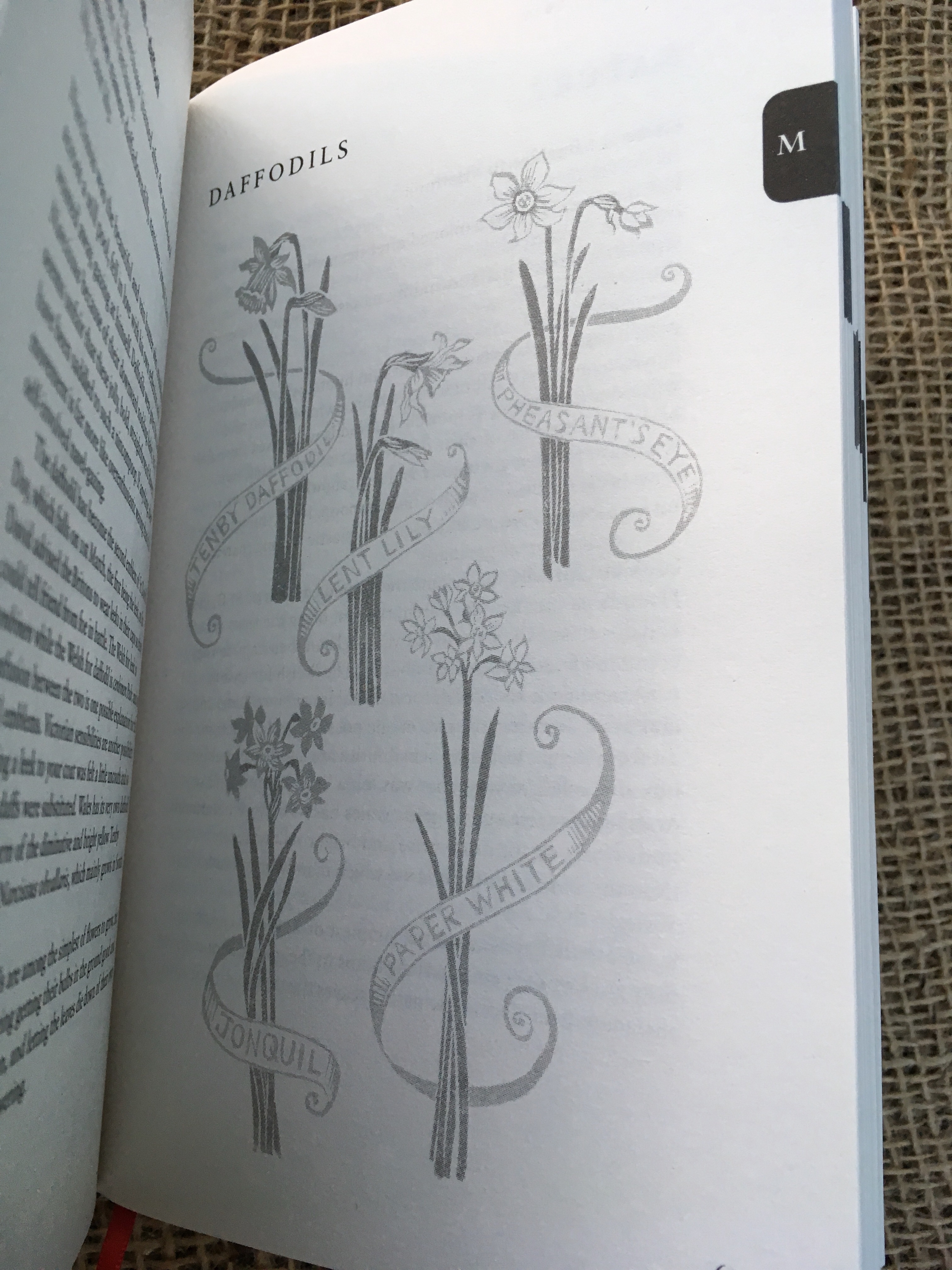
Daffodils by Naomi Slade

Book Review and giveaway.

Published by Pavilion/ Harper Collins

Photographs by Georgianna Lane

Hardback 240 pages. RRP £25

Published 13 March 2024

Can there ever be anything more cheerful than the first sign of daffodils in spring. I sigh with relief as soon as they emerge from the recently frozen, muddy ground. The worst of the winter is behind us. Spring is well and truly on the way. We have come through the cold, dark days and survived the winter once more.

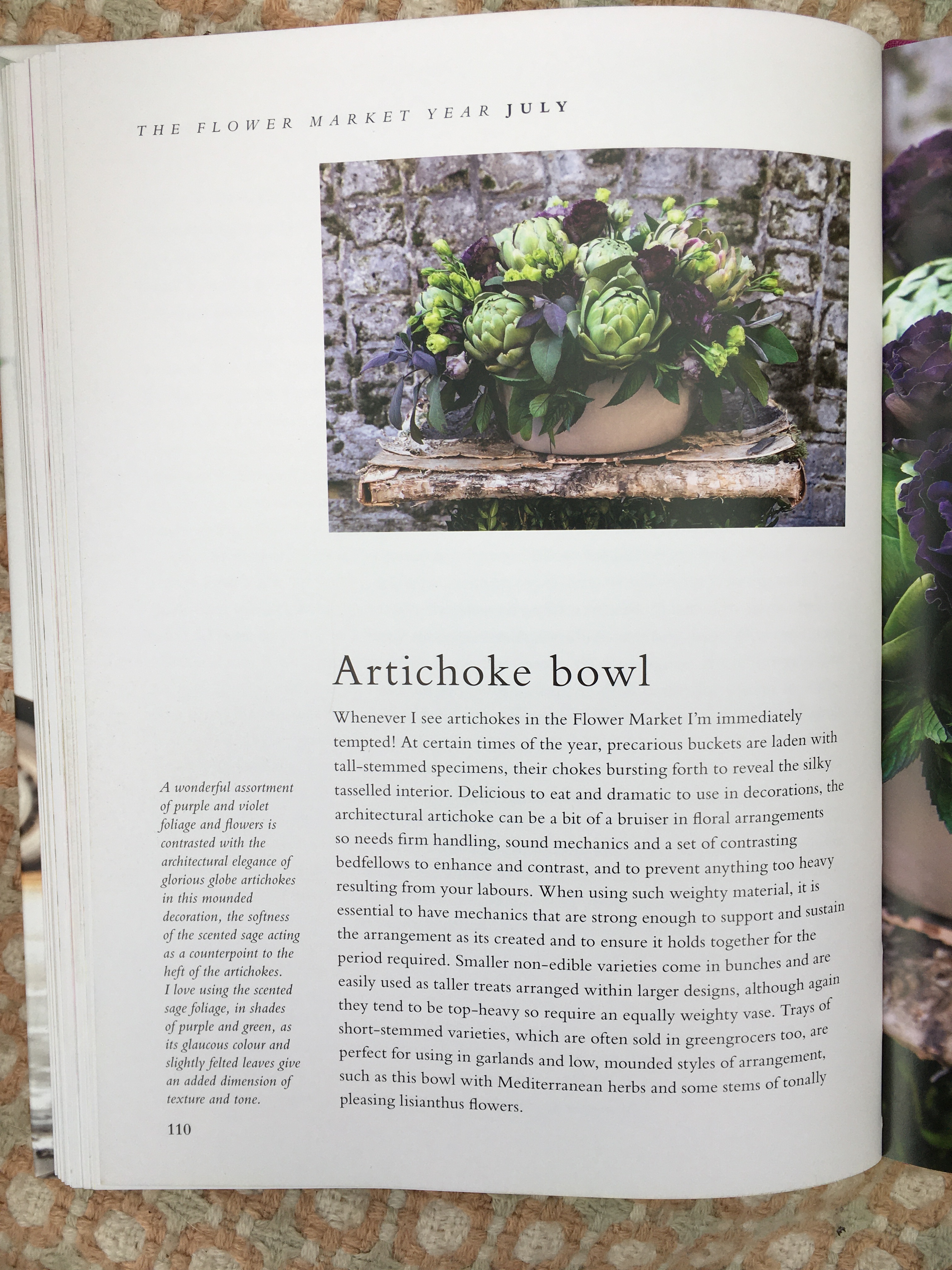
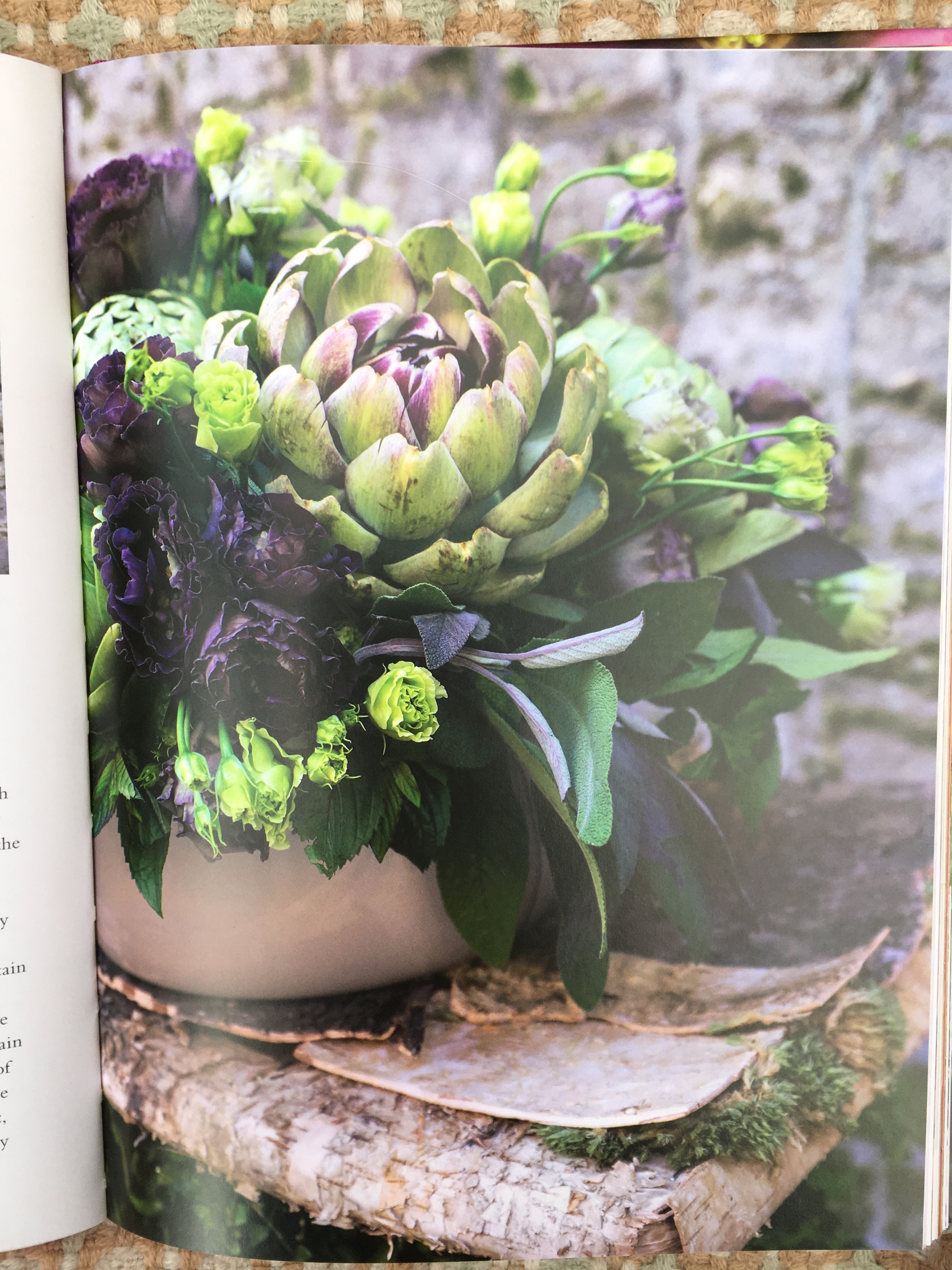
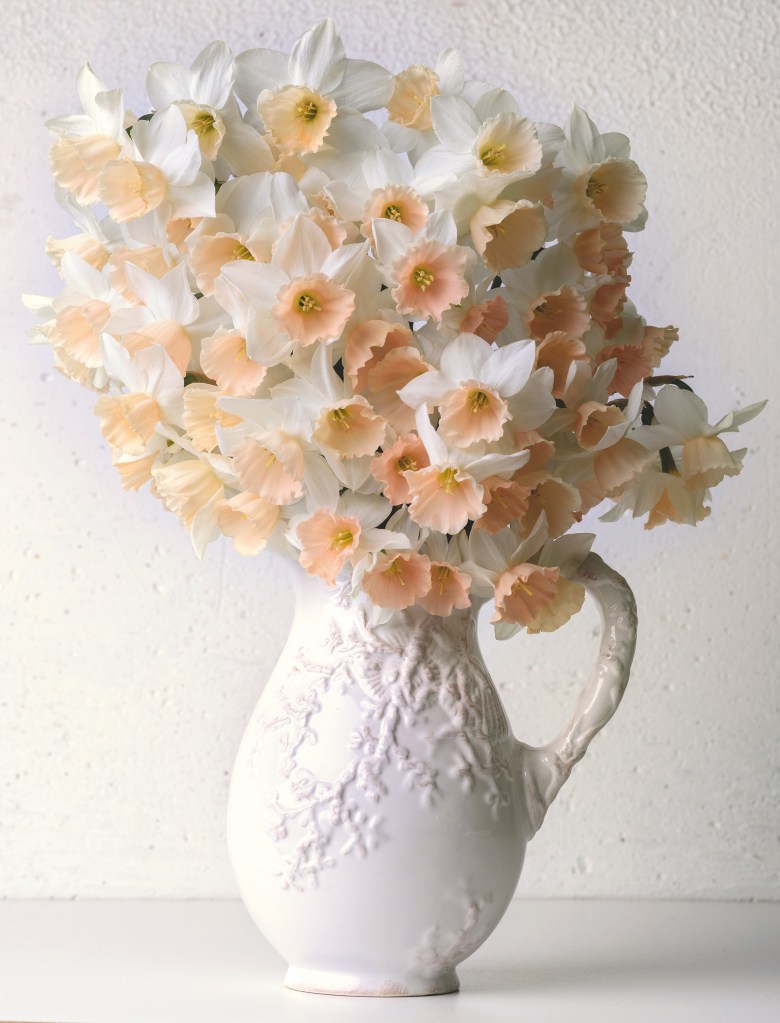
Naomi Slade’s latest book is a joyful celebration of daffodils. Colour springs from every page with the wonderful photography of Georgianna Lane combined with the glorious descriptions by the award-winning author. It really is the kind of book you’d want to leave open on a different page every day. Just to gaze at the photographs and read Naomi’s words is like a balm.

Contents page

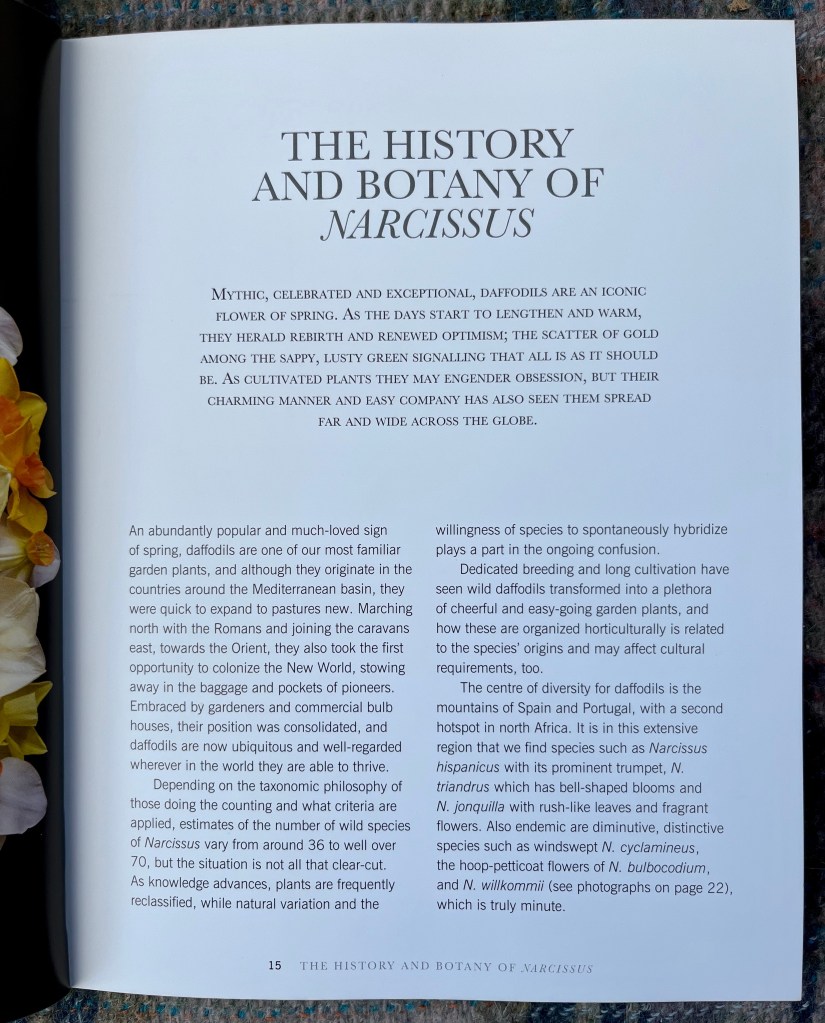
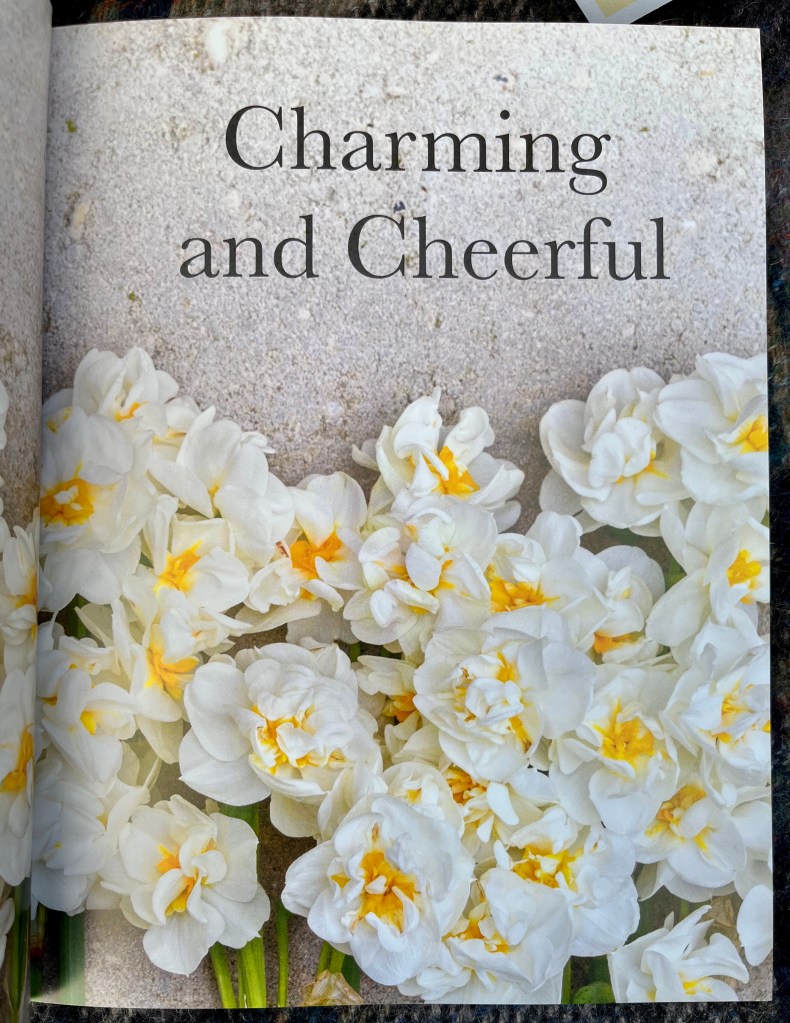
Naomi splits the daffodils into categories: charming and cheerful, ruffled and fluttering, demure and delicate, glorious and glowing. There are sections on the history of narcissus, as well as growing advice, and information on pests and diseases.

Excerpts from the book
Naomi describes 60 varieties with suggestions for planting, growing and cutting. The book would make a lovely gift for any fan of spring flowers, for gardeners, florists and collectors alike.
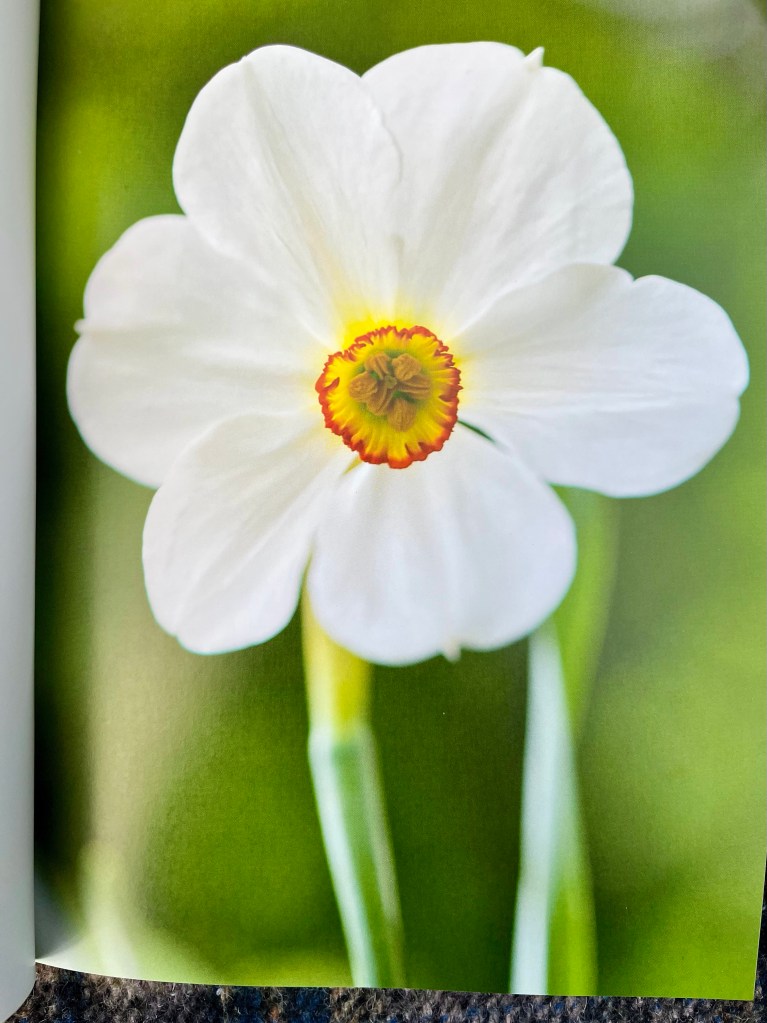
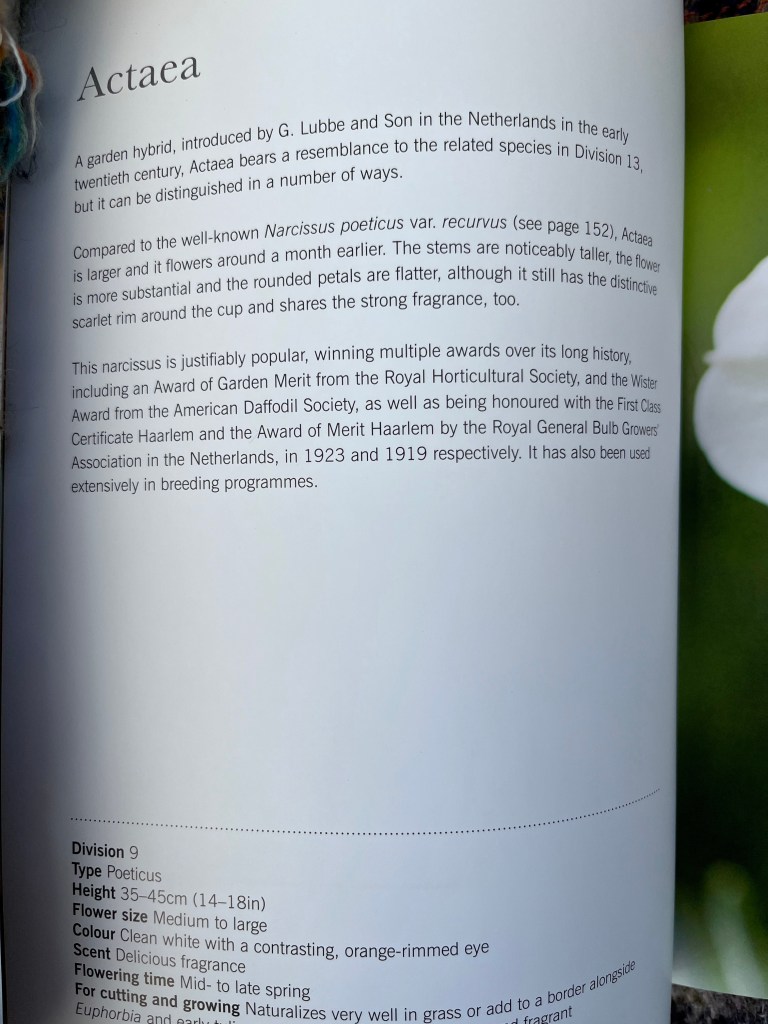
Actaea. One of my favourites.
Selected varieties are each given a page of description.
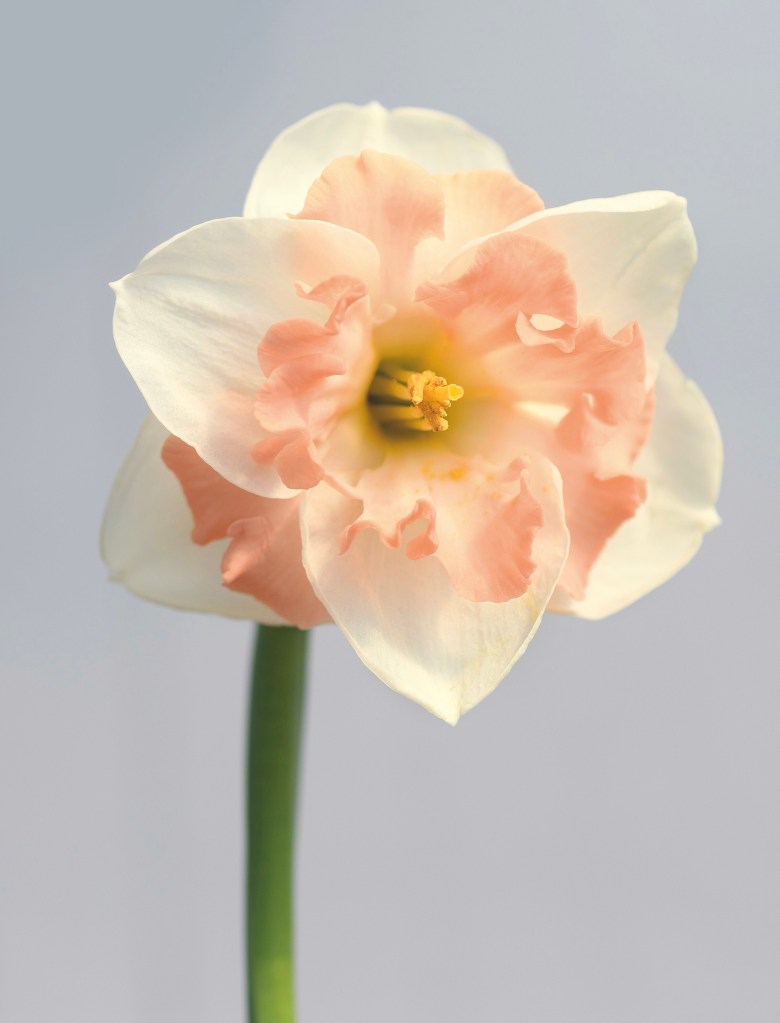
Delnashaugh – a large double cream and apricot variety. Ruffled and layered, makes a lovely flower for a vase or a bridesmaid’s posy.
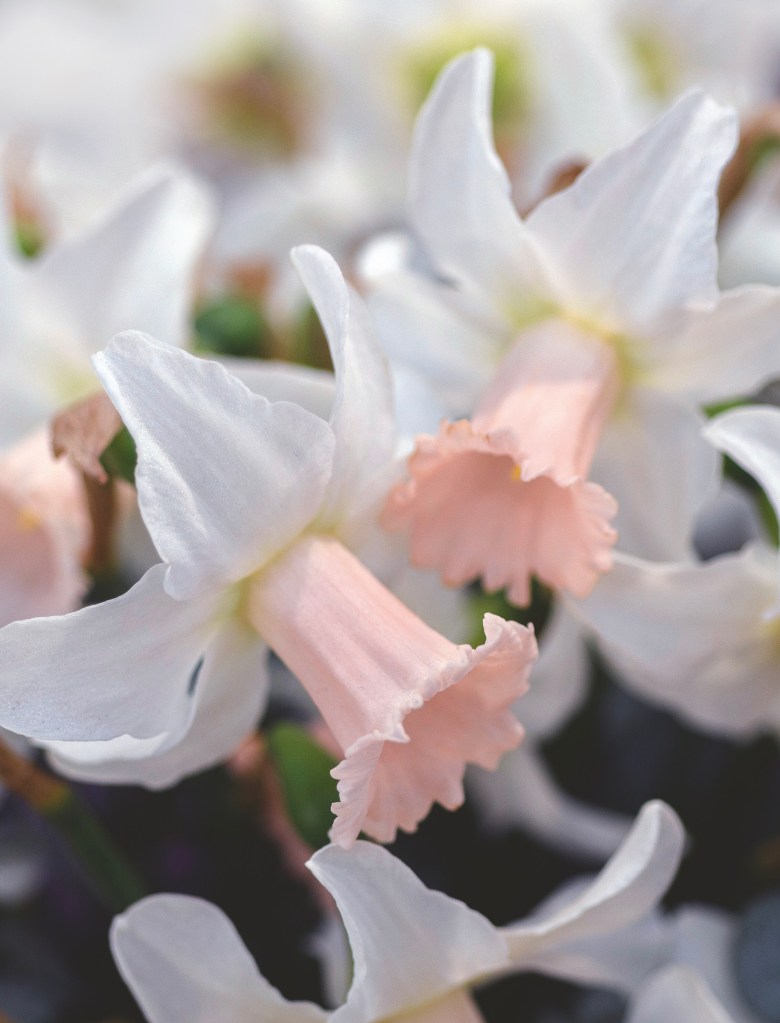
Royal China. Introduced in 1997 by British grower Clive Postles. ‘The rounded petals present themselves in two overlapping layers, in a gentle shade of pearly white that sparkles subtly in the sunshine. The central corona, meanwhile, is exquisitely formed; ivory white along its length with a greenish yellow splash at the base and a crisp pink frill to the rim.”
Lilac Charm
Pink Paradise
Trigonometry
The ever-popular tete-a-tete
Katie Heath

Katie Heath is a muted palette of pink and cream. Lovely with willow twigs and catkins. “Named in honour of the mother of Brent Heath, who has himself found fame as one half of the well-known American bulb nursery duo that is Brent and Becky’s Bulbs.

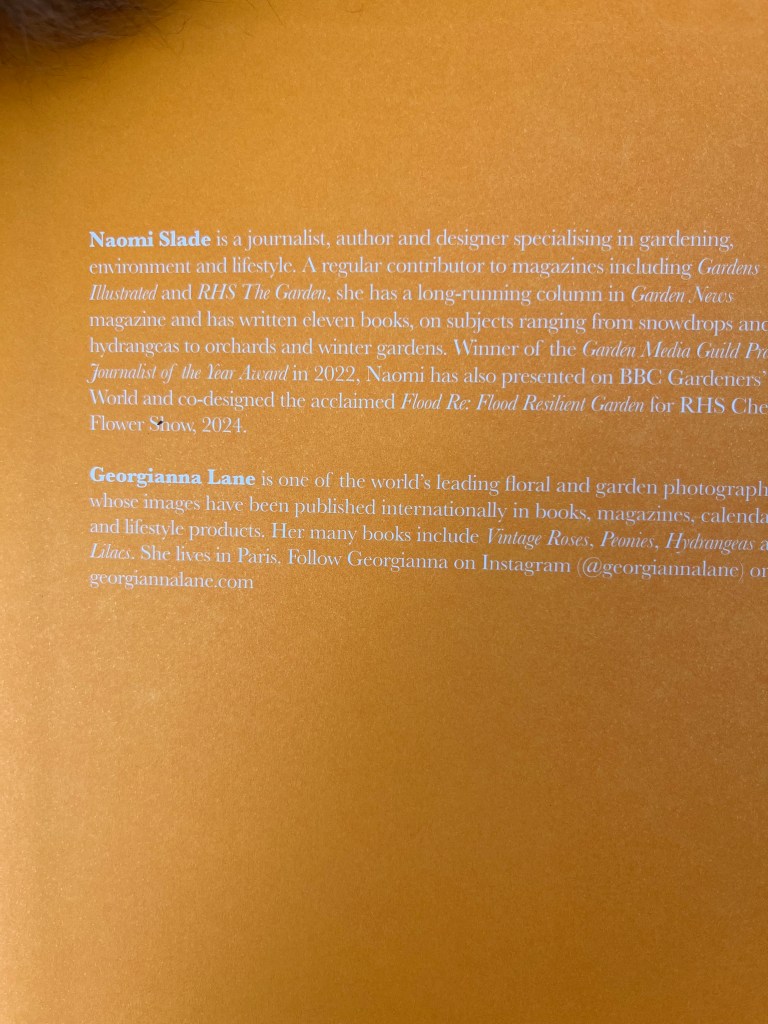
About the author and photographer

I can wholeheartedly recommend ‘Daffodils’ by Naomi Slade. It’s written in a cheerful, enthusiastic style with just the right amount of detail to answer all your questions.

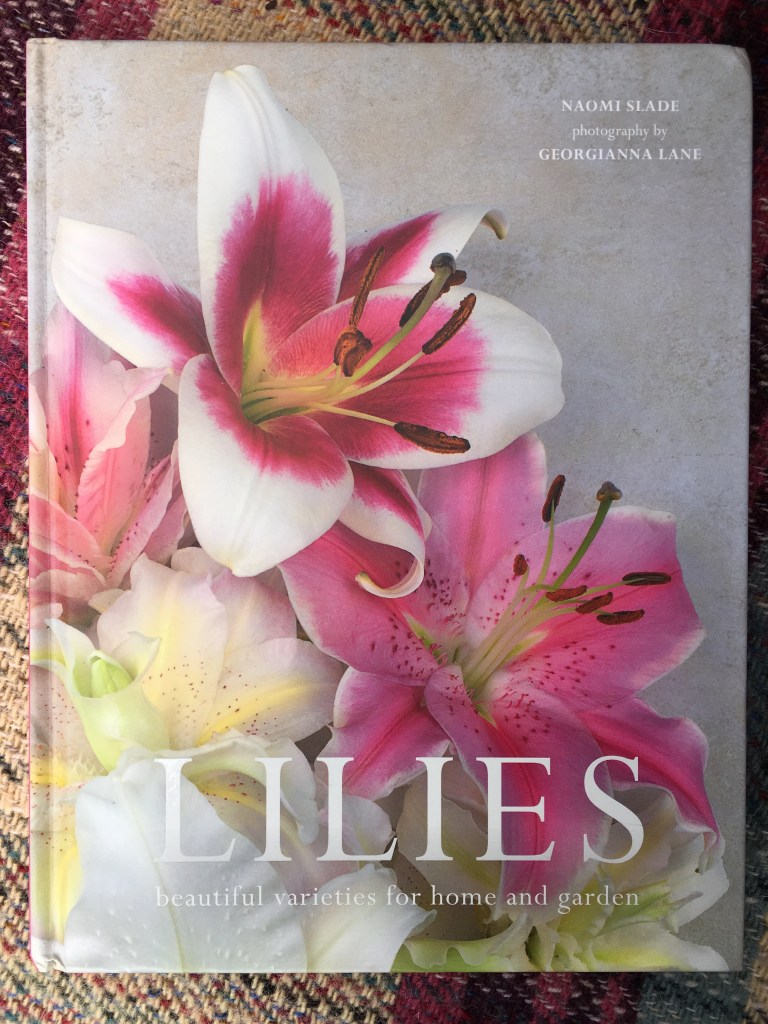
Daffodils is the latest in a series written by a Naomi and photographed by Georgianna. Previously, I’ve reviewed Lilies, Dahlias, Ranunculus, and Chrysanthemums. There’s also Hydrangeas and Lilacs. This latest book is just as brilliant and inspiring as the others. A triumph again for this super talented duo!

Thank you for reading my blog. The publishers have kindly offered one copy to give away to readers. To be included in the prize draw, please leave a comment and your name below. Sorry, uk only. There’s no cash alternative and the publisher’s decision is final. The draw will be on Saturday 15th March 6pm. Please look back on Saturday to check if you have won. The prize will be redrawn on Sunday if there’s no reply from the winner.

I wrote about Lilies here:

https://bramblegarden.com/2021/05/25/lilies-book-review-and-giveaway/#:~:text=Stunning%20to%20look%20at%2C%20and,flowers%20reaching%20almost%20the%20roofline.

I wrote about Dahlias here:

https://bramblegarden.com/2018/06/24/dahlias-beautiful-varieties-for-home-and-garden/

Please remember to add your name at the end of comments as otherwise it comes out as ‘someone.’

Snowdrop Painting Workshop at Broadwell, Gloucestershire.

Date: 1st February at Broadwell Manor.

Details: Info@broadwellmanor.com.

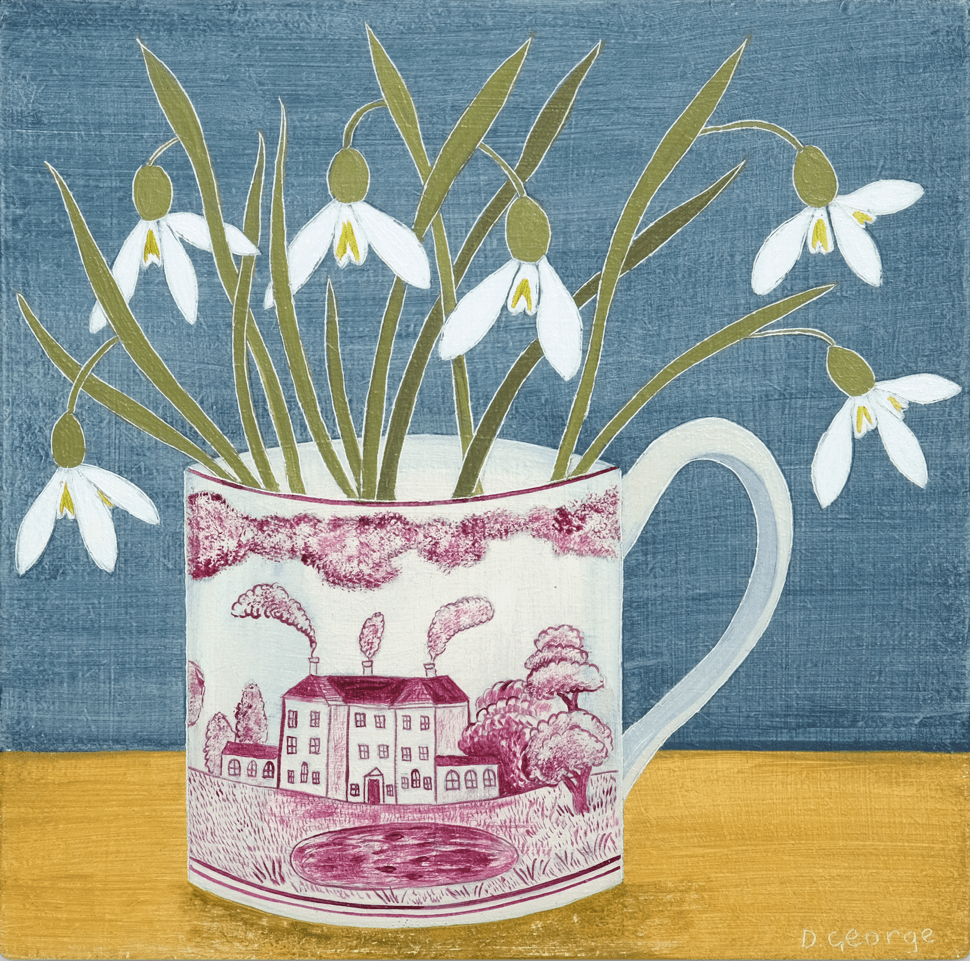
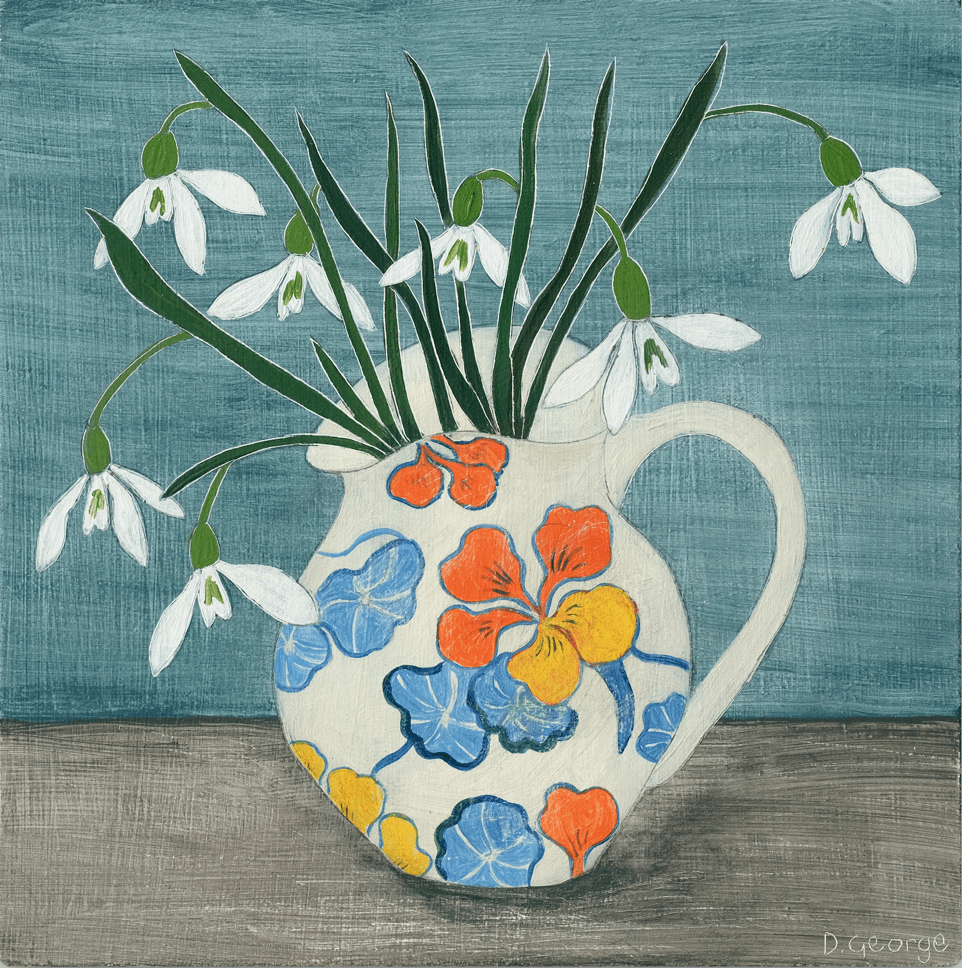
Photo courtesy of D. George

I started writing this blog with the intention of spreading good news about all things gardening. With that in mind, I thought you’d like to hear about some new events being planned for Broadwell in Gloucestershire. The first event was a Christmas wreath-making course reviewed here on the blog. See below for details.

Rachel de Thame has now announced plans for a snowdrop painting workshop in association with celebrated artist Debbie George.

Debbie George
Rachel’s garden, from her latest book, A Flower Garden for Pollinators published by Greenfinch/ Quercus Books with detailed botanical illustrations by Lauren Lusk and photographs by Jonathan Buckley

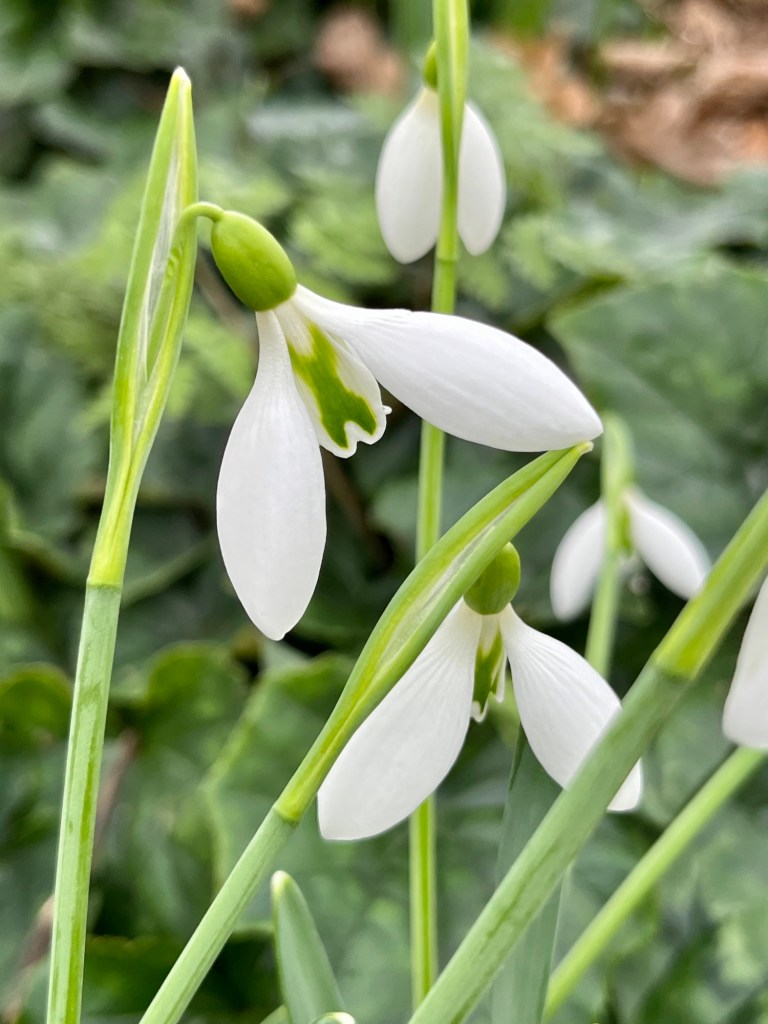
I was lucky enough to get a chance to wander about Rachel’s garden while foraging for foliage for my Christmas wreath, and there under the huge, hundred year old trees, I spotted masses of little green shoots. Rachel had no idea the snowdrops were there when she bought the house- it was a glorious and very welcome surprise when drifts of them emerged.

Rachel says she’s very excited to be teaming up with Debbie George for the snowdrop painting workshop and galanthus appreciation day. “It’s a rare opportunity to be guided by Debbie through the process of painting snowdrops. I’ll be sharing growing tips and discussing the passion that these tiny flowers inspire in enthusiasts. Then we’ll go outside to pick snowdops from the many hundreds growing in the garden for you to paint, with Debbie on hand to help and advise.”

Another lovely example of Debbie’s paintings

All materials are supplied, as well as a three course lunch and refreshments throughout the day. There will be a selection of unusual snowdops available to buy, supplied by Ashwood Nurseries.

Debbie’s richly-illustrated book documenting her life and work was published in March 2024 by Rylett Press.

For more than thirty years, Debbie has painted still lifes – primarily flowers and pottery, sometimes landscape, and often all three in a single composition. Her paintings are today highly collected and appreciated around the world as joyful pictorial celebrations of the English seasons, of country life and the natural world.

Based on conversations with Debbie and drawing on her personal archive, the book provides a rare glimpse into the life and working methods of the artist. Packed with more than 200 illustrations, it shows that the clarity and sophistication of Debbie George’s art is the result of continuous practice and experimentation. This is a timely celebration of a lifetime of painting flowers, pottery and landscape.

“For Debbie George admirers and collectors, this celebration of her work is long overdue. It’s wonderful to see the full range of her paintings, spanning more than thirty years, collected together in one volume. Each turn of the page reveals another image to be poured over by all who share Debbie’s love of nature and feel lifted by her unique portrayal of Earth’s riches, however small they be.” – Rachel de Thame, BBC TV presenter, garden writer and columnist.

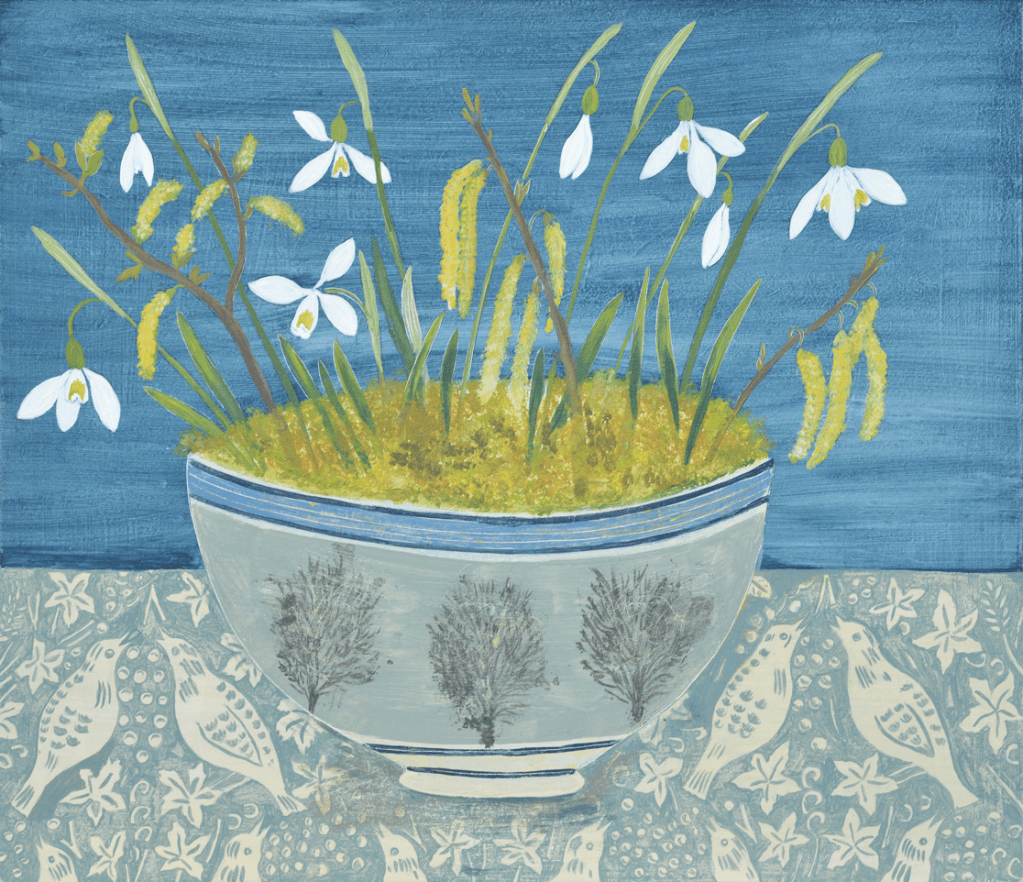
Snowdrops and catkins

I hope you’ve enjoyed viewing these beautiful illustrations as much as I have. They have certainly brightened a very cold wet day here in Leicestershire. Thank you for reading my blog. Sign up for e mail notifications for more reviews, garden visits, and general news from my wildlife-filled, English country garden.

For more information on courses contact info@broadwellmanor.com.

For the wreath-making review:

https://bramblegarden.com/2024/12/19/christmas-wreath-workshop-with-rachel-de-thame-and-arit-anderson/

For a review of Rachel’s latest book:

https://bramblegarden.com/2024/12/16/a-flower-garden-for-pollinators-by-rachel-de-thame/

Thank you and Happy New Year!

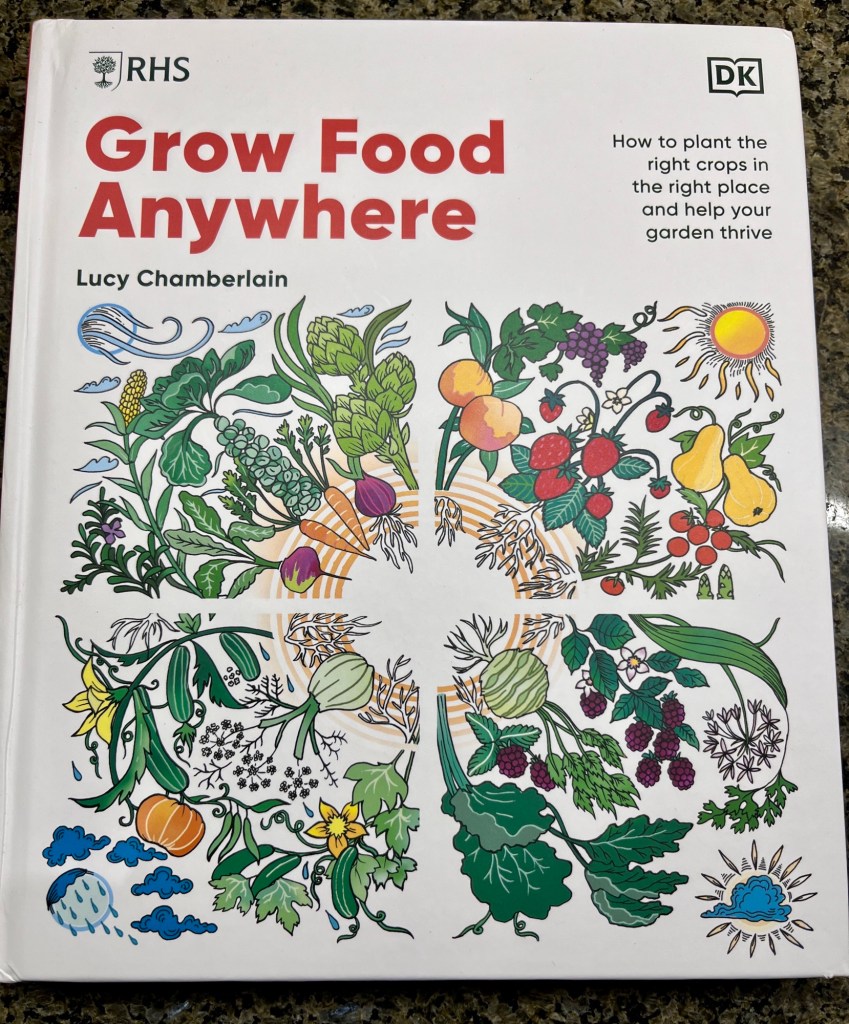
RHS Grow Food Anywhere -prize draw win

Thank you everyone who read my review and left a comment on the blog. John Tilton has won the prize copy. Please get in touch John by sending an e mail to k.gimson@btinternet.com.

Many thanks to the publishers, Dorling Kindersley, for sending a copy of the book to give away.

I have no hesitation in recommending Lucy Chamberlain’s new book. If ever you’ve wanted to have a go at growing food, look out for the book. It will set you on the right path for success.

Lucy shows us how to analyse our gardens to create ‘zones.’ It’s then a case of right plant for the right place. There’s literally something to grow in any situation.

Sunny aspect suggestions
Mapping your plot
Give crops the best start in life
Part shade
Lucy’s own garden as a case study
Beautiful as well as productive.
I wrote this over on instagram at karengimson1 .

Thank you for reading my blog. Please sign up for e mails and notifications. More book reviews to follow…. Happy New Year! Karen

RHS Grow Food Anywhere book review

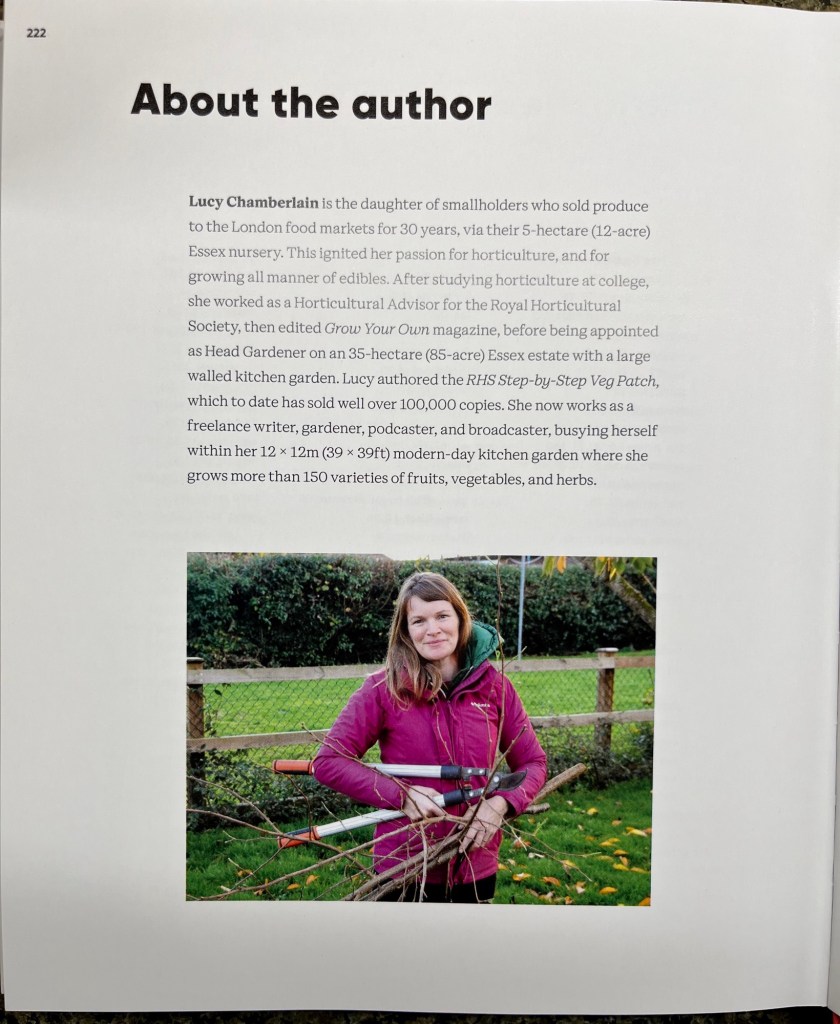
By Lucy Chamberlain

Published by Dorling Kindersley, January 2025

Hardback and ebook 223 pages. £20

ISBN 978-0-2416-5649-5

The publishers have kindly sent one copy to give away in a prize draw. Please leave your name in the comments box below to be included in the draw. UK entries only.

One of my favourite writers is Lucy Chamberlain who manages to capture the magic of gardening and makes us want to rush outside and get growing! In her new book published today she tells us exactly how to grow just about anything anywhere. And it’s all written in an easy to understand format, without being either too simple or too complicated. That’s the beauty of Lucy, she’s able to strike just the right note and make it relevant to all gardeners.

Lucy’s garden

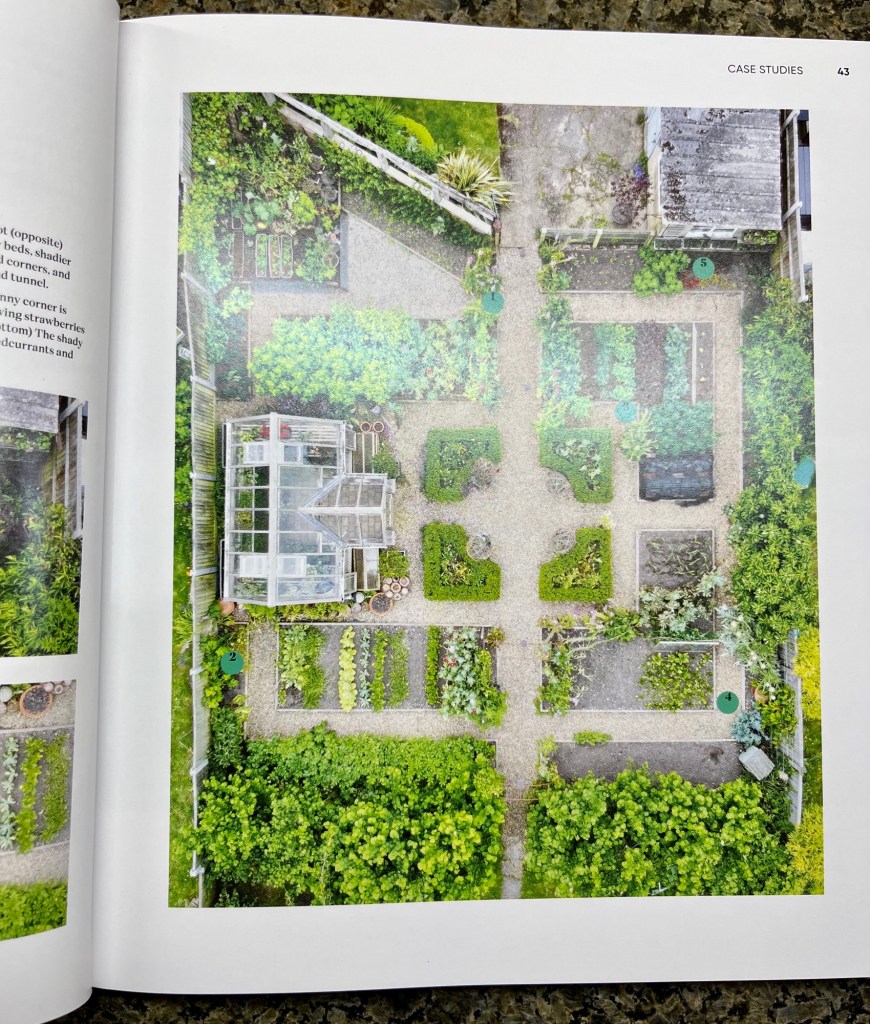
Lucy uses her own fruit and vegetable plot as a case study. I’ve watched Lucy create this garden over the past few years and admired just how much produce she manages to pack in there, as well as making it look beautiful with dwarf hedges, espalier apples and raised beds.

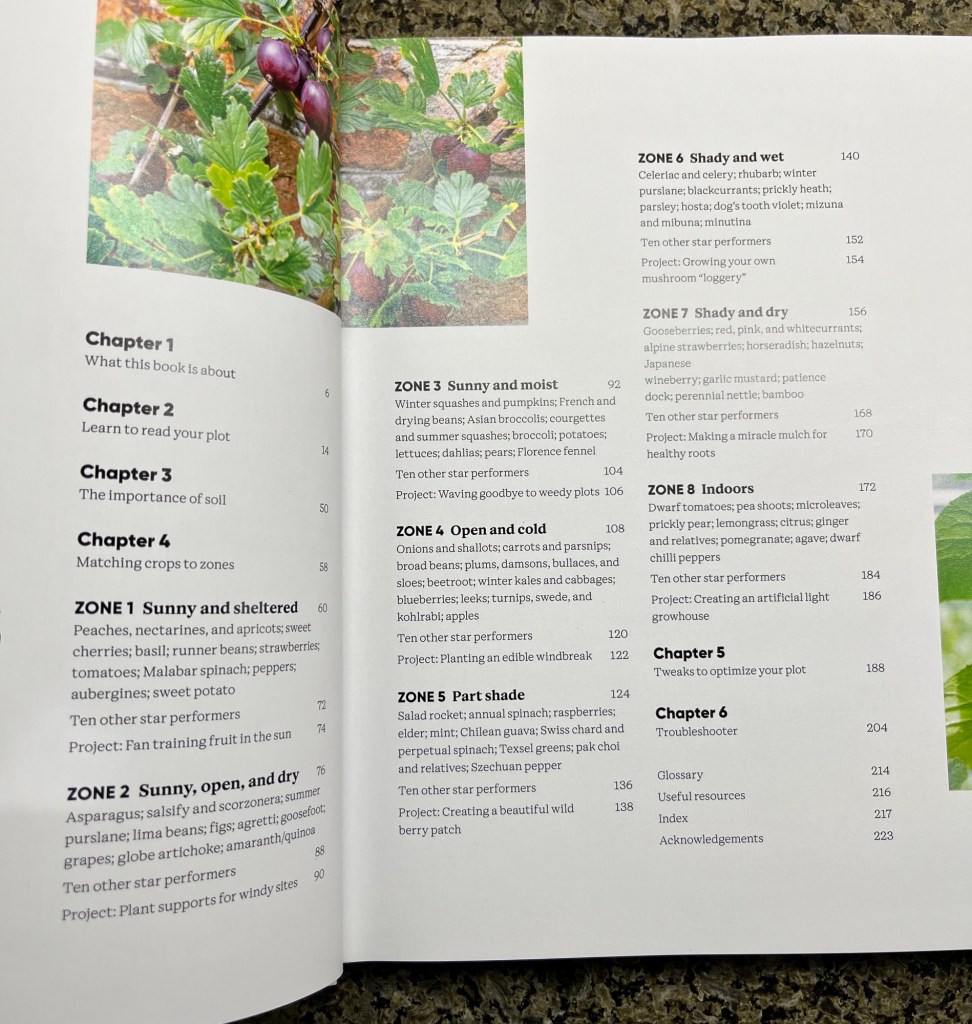
Contents page

Growing plants in the wrong place is one of the main reasons for crop failure. Lucy splits the book into ‘growing zones’ covering all the situations growers are likely to face when starting to garden. Sunny and sheltered, sunny and moist, open and cold, shady and wet, shady and dry, for example.

Several case studies are related, including a garden attached to large detached property, a compact garden, and an allotment. Lucy shows how to map areas of the garden to work out what will grow successfully in each position.

Mapping the plot
What will grow in different areas
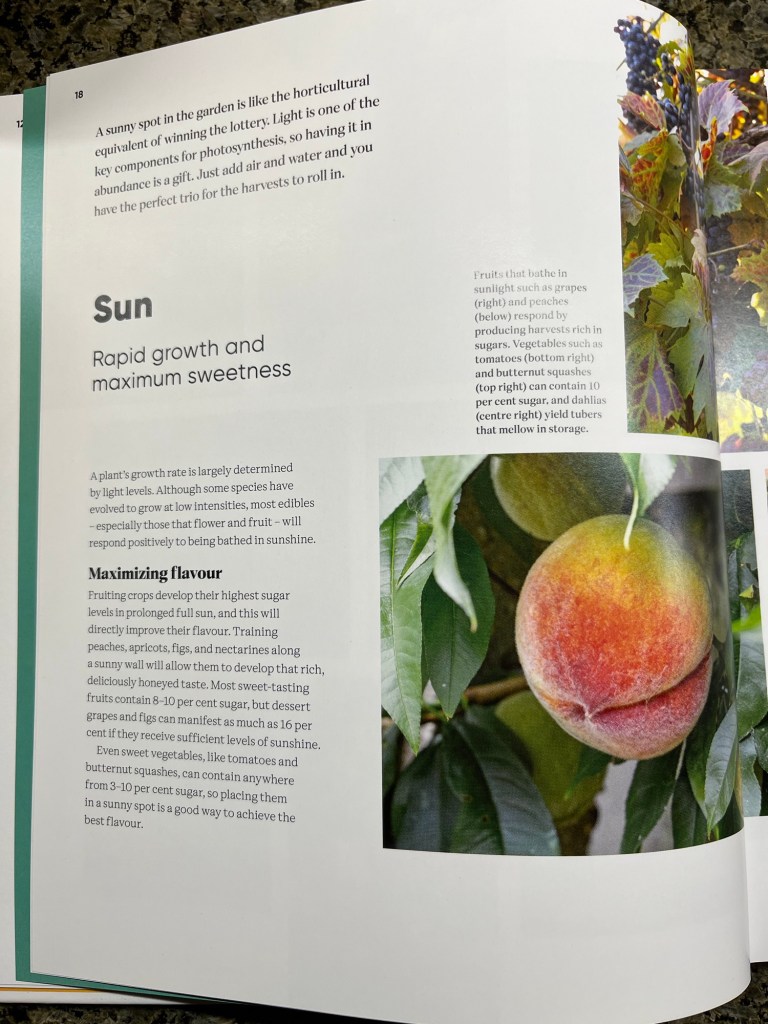
Choosing plants to grow in full sun
Lucy’s garden where she grows 150 varieties of fruit, veg and herbs

In each area, top performing plants are suggested. I grow hazelnuts in dry shade, and each year I harvest a bumper crop of tasty nuts for making cakes and biscuits. They really are far more delicious than anything you can buy in the shops.

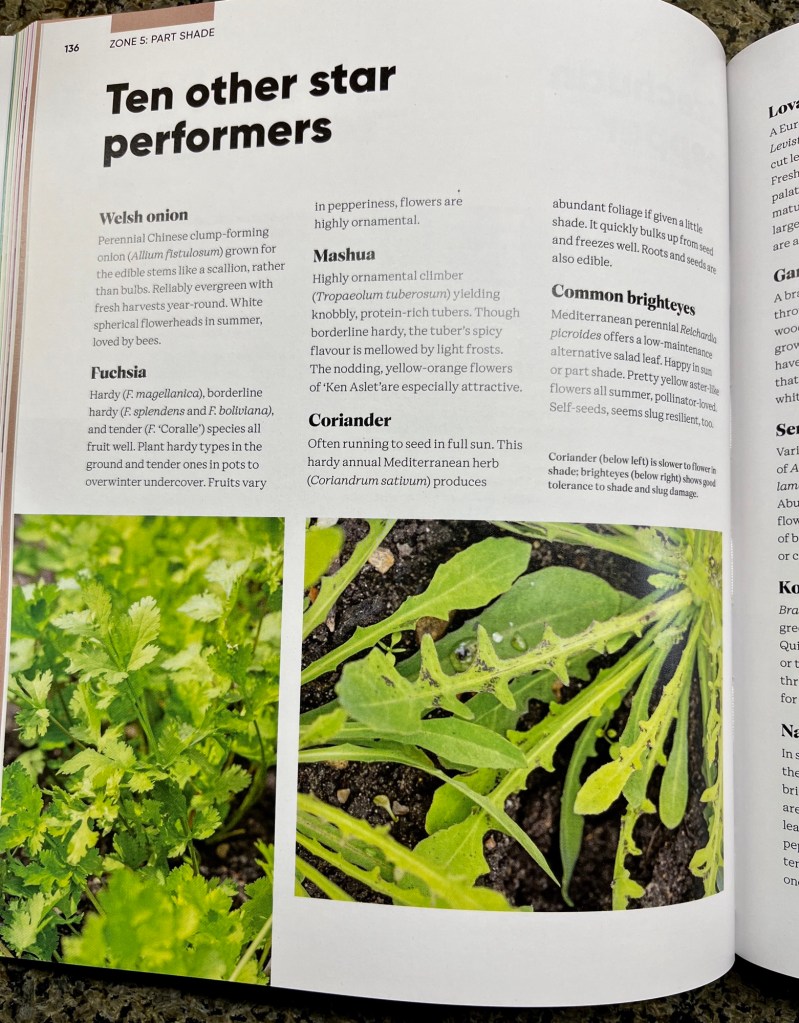
Other star performers for part-shade
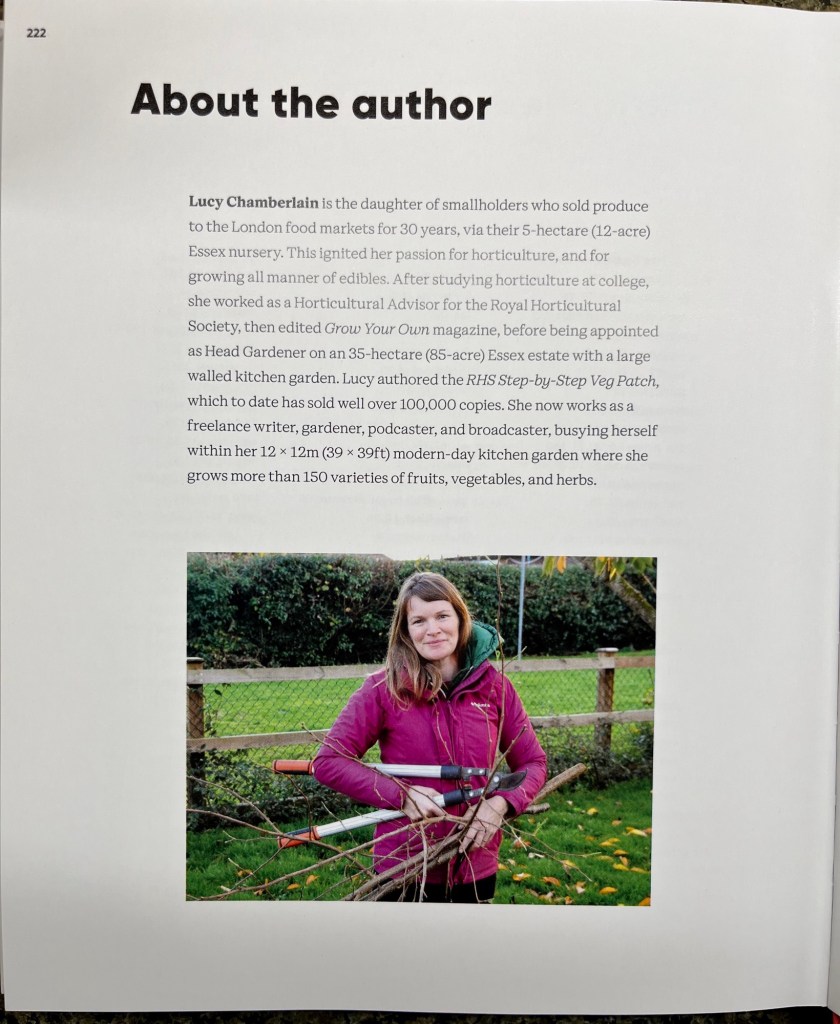
About the author

I’ve known Lucy for about 20 years and have always admired her get-up-and-go. Her enthusiasm for growing fruit and vegetables translates so well in her writing for newspapers, magazines and books. I also love the podcast ‘Talking Heads’ which she hosts with Saul Walker. Real gardeners, talking about real gardening. It’s a joy to listen to them, to be honest.

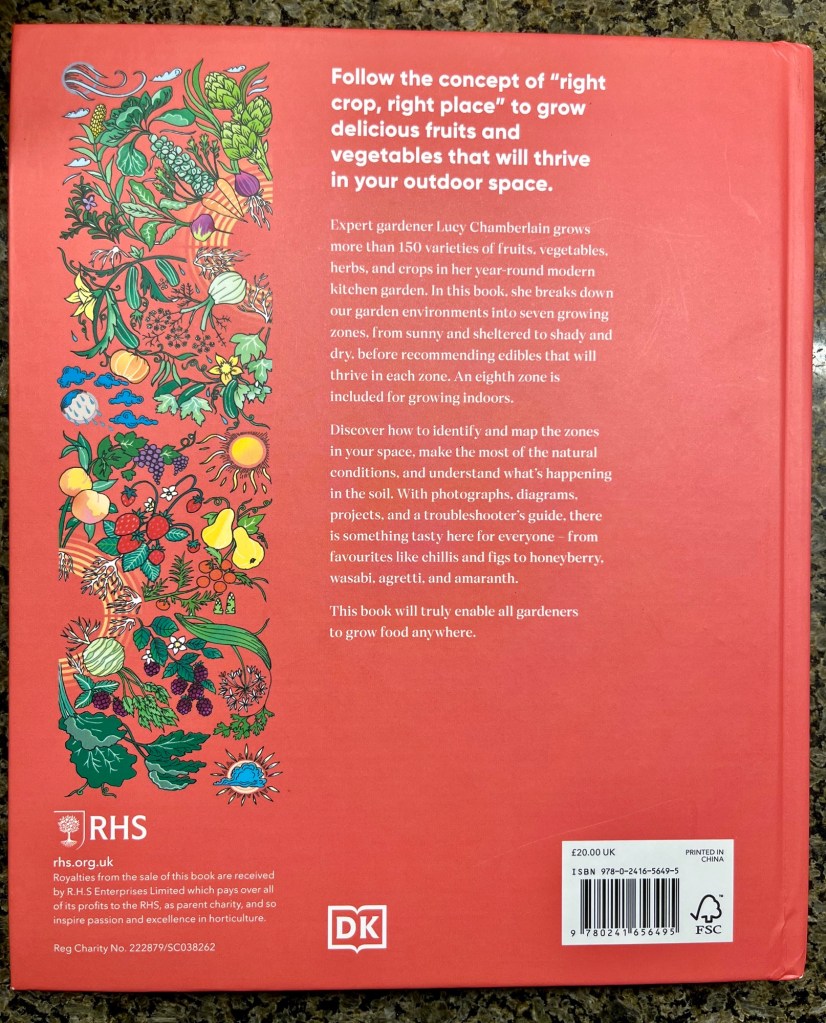
Back cover of the book

I have no hesitation in recommending Lucy’s latest book. The ‘right crop, right place’ principal is beautifully explained. Lucy breaks down the environments found in gardens into seven zones, even incorporating indoor spaces. The book is packed with expert guidance on maximising your growing through making the best of what you have. Grow Food Anywhere will soon get you harvesting fresh, healthy pesticide-free fruit, veg and herbs. What a great way to start 2025!

Please leave your name below and one winner will be randomly selected on Sunday 6pm. Editor’s decision is final and there’s no cash alternative.

Thank you for reading my blog and Happy New Year everyone!

A Flower Garden for Pollinators by Rachel de Thame

Books for Christmas and New Year reading

Published by Greenfinch

Hardback. 208 pages. £25

Update: The prize draw copy has been won by Natalia at Lucky Bees. Thank you for leaving a comment and entering the draw. And thanks to the publishers for sending a copy for the draw.

If there was a vote for the most beautiful book produced in 2024, Rachel de Thame would win it. Rachel, best known for her newspaper column, magazine writing and appearances on BBC Gardeners World, joined forces with her daughter Lauren Lusk to produce a book which is joyful on every page. Lauren, a talented illustrator, hand painted many of the flower pictures featured in the book, and added a myriad of bees, moths and butterflies dancing across the page. To open the book is to step inside Rachel’s garden and walk alongside her as she meanders through the colourful wildflowers, cottage garden plants and herbs. We feel as if we are there, with her, seeing and hearing everything she describes. She writes: I stopped deadheading, stood still in the middle of the space and was amazed by the number of butterflies darting across the garden. Bees, hoverflies and other small flies zipped from flower to flower. I closed my eyes and listened to the various hummings and buzzings. The garden was fizzing with insect activity, and as I resumed snipping faded dahlias and cosmos, I felt the air stir against my cheek as if whipped up by a tiny fan, and was astonished to realise it was the backdraft of rapidly beating bee wings, centimetres from my face.”

The book is split into seasons with Rachel’s selection of favourite plants each given a page of description.

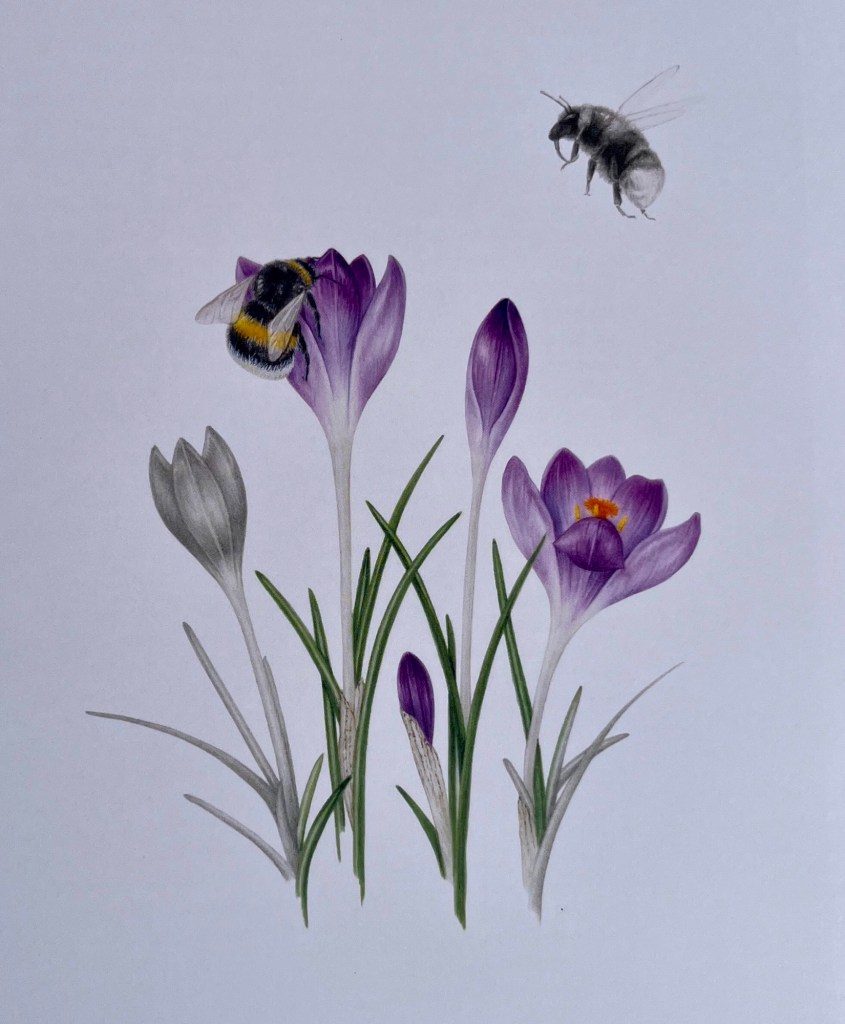
Crocus tommasinianus.

Lauren’s illustrations are beautifully-detailed. It’s not possible to capture their beauty accurately with my camera phone pictures. they are much brighter and clearer in the book.

Muscari armeniacum
Cosmos ‘Purity’
Autumn in Rachel’s cut flower walled garden
Anemone ‘Hadspen Abundance’
Commonly called Japanese anemone
Winter features snowdops, winter flowering shrubs and clematis
Lauren’s bees and butterflies dance across the page

This is a book I’ve found invaluable this year in particular as we have had a crash in numbers for both bees and butterflies. We had no butterflies at all on the buddleja when it flowered. Summer didn’t really start until mid July. What I learned is that we have to plant a succession of plants all year round, so there’s always something for pollinators to feed on. Our climate is so unpredictable we can have all four seasons in one day! As I write this, a bumble bee is drunkenly buzzing about the garden- no doubt enticed out of hibernation by the unusually high December temperatures. It’s due to be 12C tomorrow. And we had snow, followed by flooding just two weeks ago.

Back cover of the book

I think you’ll find Rachel’s book a mine of information if, like me, you want to help the pollinators that make our gardens such a thriving and ‘alive’ place to be. I have no hesitation in recommending A Flower Garden for Pollinators. It’s a delight from start to finish.

Rachel de Thame is a television presenter and writes for The Sunday Times, The Daily Telegraph and top homes and gardens magazines. She hosts courses at Broadwell Manor with guests Arit Anderson, Arthur Parkinson, Hazel Gardiner, and Butter Wakefield. More information below:

https://broadwellmanor.com/

Please leave a comment and your name below to be included in the prize draw. One name will be randomly selected on Tuesday 17th December at 6pm. There’s no cash alternative and the editor’s decision is final. Sorry, uk entries only. Thank you for reading my blog.

Book prize winner. Regional Cooking of England.

John Stewart is the lucky prize winner of Regional Cooking of England. It’s a gorgeous book. I can highly recommend it. I’m very grateful to Lorenz Books for supplying a prize draw copy to give away. Many thanks to all who read my review and got in touch. Have a great gardening, and cooking week! Karen

You can read the review here:

https://bramblegarden.com/2024/07/12/regional-cooking-of-england-book-review/

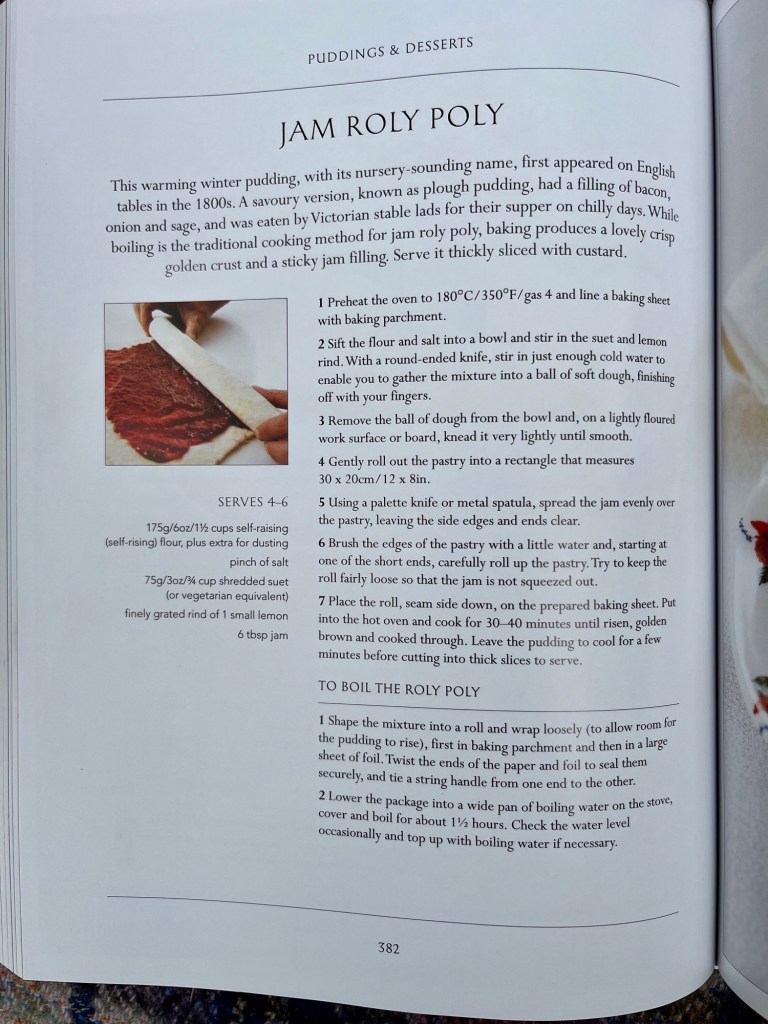
Jam roly poly
Summer pudding
Syrup sponge pudding
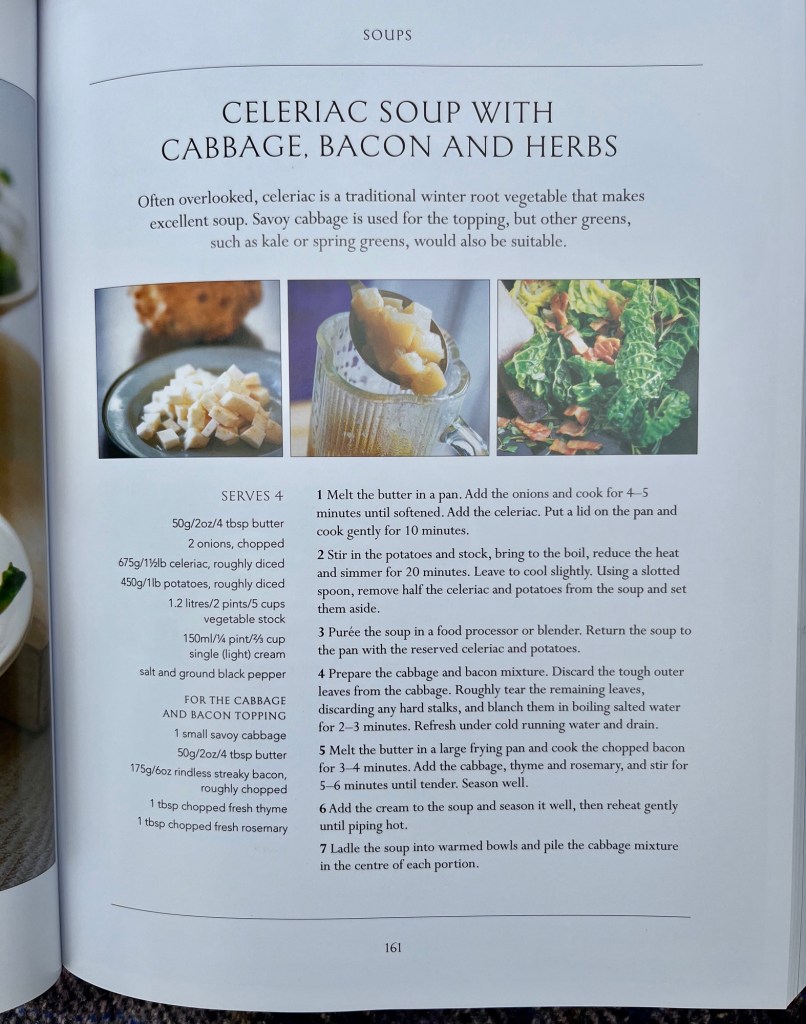
Celeriac soup

By Carol Wilson. Published by Lorenz Books. £25. Photos supplied by Lorenz Books/ Anness Publishing.

Regional Cooking of England- Book Review

A Culinary Tour with More Than 280 Traditional Recipes.

Carol Wilson

Published by Lorenz Books

Hardback. 672 pages. £25

ISBN 9780754835462

One copy to give away in a prize draw. See below.

My grandma Betty’s specialities were fairy cakes smothered in ‘hundreds and thousands’ – lurid-coloured sugar strands. In fact hundreds and thousands found their way onto a surprising number of puddings. Everything from strawberry trifle, to tarts and sponge puddings. They were her little way of adding sparkle. It must have been a fad of the 70s and 80s, as I haven’t seen them used to decorate puddings for at least 30 years. I have fond memories of family get togethers and grandma’s cakes. Me and my three brothers ate a prodigious amount of sugary puddings- and amazingly all of us are stick thin! We also played outdoors a lot, using up all that energy from those calorie-filled meals. Reading Carol Wilson’s new book Regional Cooking of England, brought back all those happy memories of family food. In Carol’s book there are no hundreds and thousands- but there are all the stalwart recipes of my childhood; jam roly poly, Eve’s pudding, bread and butter pudding, and golden syrup sponge. We were brought up on jam tarts, lemon meringue and Bakewell pudding. In fact, my Mum still makes Bakewell pudding for our Sunday lunch. And very delicious it is too! As we get older, we think back and try to recreate those happy family memories of carefree days. I just remember lots of laughter and joy. I wasn’t aware of any trials and tribulations in the world, just a feeling of security and warmth. How I would love to go back to those days. A time when nothing mattered outside of those four walls. I realise now how blessed I was, having wonderful, loving parents and grandparents, siblings and cousins, aunts and uncles – all in the same village, close by. The power of a book, to bring back memories. I can highly recommend Carol Wilson’s culinary tour. You might even find that it sparks your own time-travelling memories into the past!

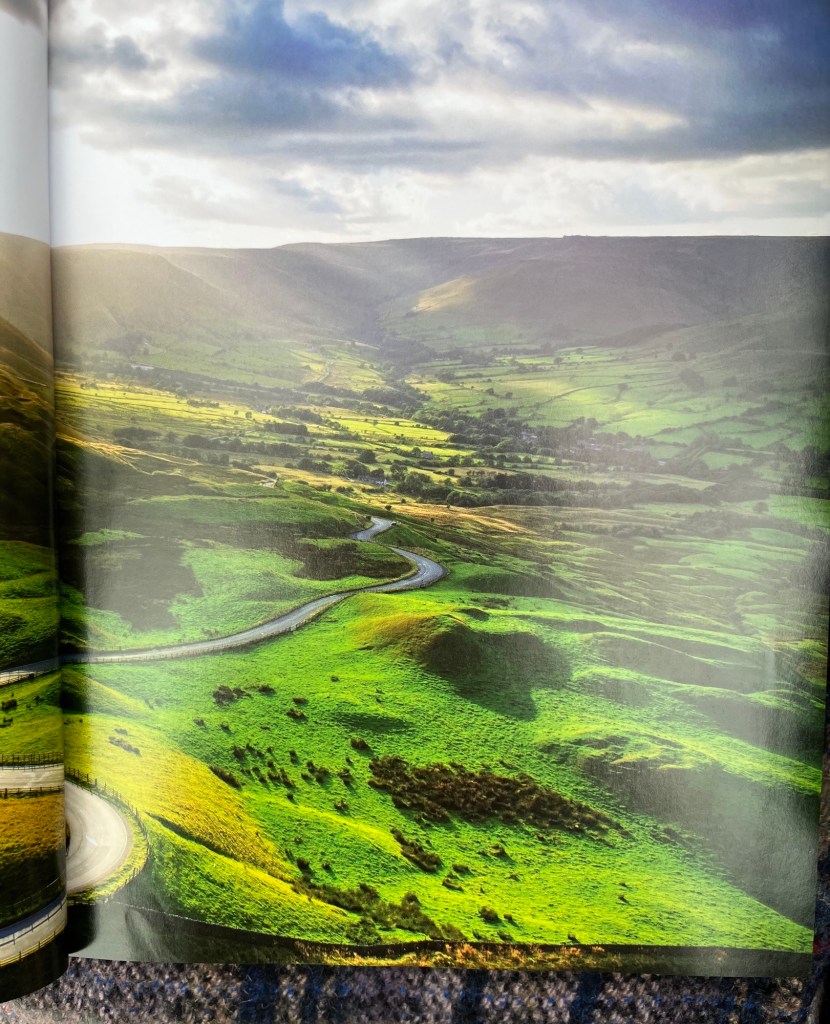
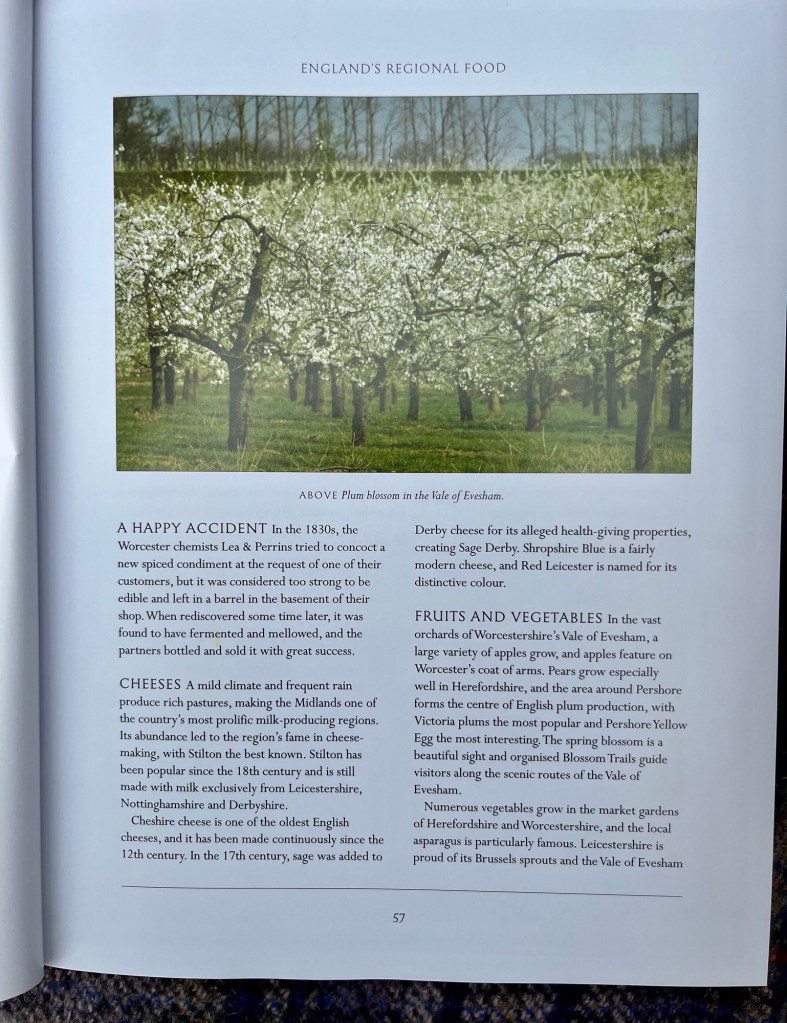
It really is a beautiful book- probably the most beautiful cookery book I’ve ever seen to be honest. It combines glorious english scenic photography alongside mouthwatering food.

My i-phone photos of the book only give an indication of the photos. The real thing is obviously much better quality.

Orchards of the South East of England
Introduction
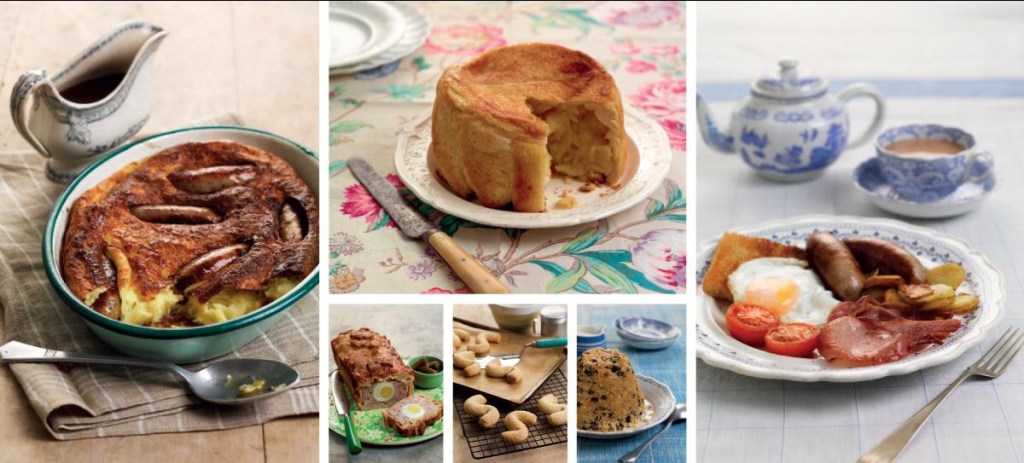
Recipes include soups, casseroles, main courses, breakfast and puddings
Jam roly poly
One of my favourite recipes. Perfect for a summer family party. We had many of these fun-filled days, not special occasions just ordinary family get-togethers.
Another favourite. My mum still grows gooseberries for crumbles and tarts. This is a lovely recipe I’ve tried this week with my own Hinnomaki gooseberries.
We used to enjoy this dish this, but didn’t know the name. Very nutritious and filling.
Wild foods are mentioned. We used to pick mushrooms in the back fields behind our house. Some of them were the size of dinner plates.
My grandparents grew many of their vegetables. Long lines of peas, beans and potatoes. My grandmother had a huge patch of raspberries. So sweet and tasty in June and July. She kept dozens of hens, so there were fresh eggs every day. She sold them at the garden gate and at the two little shops in the village. In Whetstone, there was a butchers, a general store, a post office. Mrs Pinder’s grocery store sold just about everything. All gone now. Even the post office has closed.
Summer fruit pudding. Photos supplied by Lorenz Books/ Anness Publishing.

More details about the book, taken from the back cover:

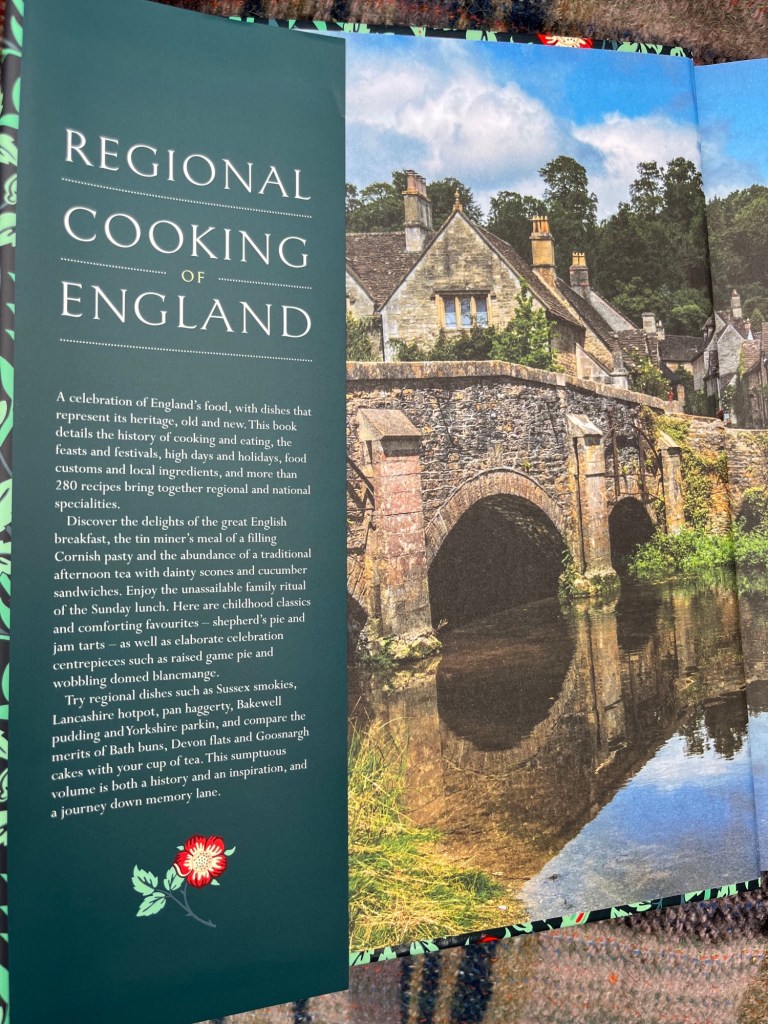
Sussex pond pudding, fruit crumbles, trifle, steak and oyster pie, raised pork pies, toad in the hole, scones, stotties, Bosworth jumbles… In this book you’ll find everything from old-fashioned favourites and current classics to less well known historical dishes (a few of which might raise an eyebrow), along with many wonderful local recipes.

This is a celebration of England’s food, with dishes to represent its heritage, old and new. The recipes are easy to follow, with accessible ingredients, and achievable in today’s modern kitchens. Introductory chapters detail the history of cooking and eating in England, the feasts and festivals, high days and holidays, eating habits and ingredients. A glorious cookbook offering the taste of England, and a fascinating glimpse of the past.

Discover the delights of the full English breakfast, the tin miner’s meal of a filling Cornish pasty, and the abundance of a traditional afternoon tea with dainty scones and cucumber sandwiches. Enjoy the unassailable family ritual of the classic Sunday lunch. Here are childhood classics – shepherd’s pie and jammy tarts – as well as elaborate old-fashioned celebration centrepieces such as raised game pie and wobbling, domed blancmange.

Try regional dishes such as Sussex Smokies, Lancashire Hotpot, Pan Haggerty, Bakewell Pudding and Yorkshire Parkin, and compare the merits of Bath Buns, Devon Flats, and Goosenargh Cakes with your cup of tea. This sumptuous volume is both a history and an inspiration, and for many a journey down memory lane.

Editor CAROL WILSON is a food writer and historian who has contributed to many publications including The Times, The Illustrated London News, Heritage, Food and Wine, and Gastronomica. She has appeared on television promoting British food and discussing the history and usage of traditional ingredients.  Her other books include Scottish Heritage Food and Cooking, The Liquorice Cookbook, and The Bacon Cookbook. She is a member of the Guild of Food Writers.

Please leave a comment and your name in the box below to be entered in the prize draw for one copy. A winner will be randomly selected on Sunday 14th July at 6pm. Sorry, UK entries only. The editor’s decision is final and there’s no cash alternative. Please check back on Sunday evening if you enter this competition. If there are no replies to my announcement, I’ll redo the draw and chose another winner. Thank you for reading my blog.

Strawberry Sponge Gateau.

Home Grown recipes.

This week’s Garden News Magazine recipe using fruit grown in my garden. Strawberries don’t thaw out well after freezing. They tend to go soft. But frozen fruit is perfect for adding to pies, cakes and puddings. In this instance, I’ve added strawberries to some jam and filled a light sponge cake. Then I’ve added lashings of whipped double cream. I must admit, I had no complaints from the family! 😃

I slice and freeze strawberries in flat plastic trays before bagging them up and using them over the winter. Shop-bought strawberries seem to have no taste, but sun-ripened home-grown fruit is delicious- and free!

You can buy strawberry plants now from the garden centres or online. You can also buy bare-rooted stock which has been cold-treated to produce fruit this year. Strawberries need winter cold to prompt them to flower and fruit, so don’t put them in a greenhouse or other protected space indoors over winter. But you can bring them indoors now to get an earlier crop, if you grow them in containers.

I’ve had the best success growing them in window boxes and lifting them into the greenhouse in early spring. Growing in containers helps defeat the slugs which tend to be a nuisance in wet weather. And also it’s easier to cover them in fine netting to protect from birds. Take care not to use coarse netting, which catches birds’ feet. It can be difficult and distressing trying to untangle a delicate bird from netting. I tend to use fleece now, or micro mesh insect proof netting which has no holes to trap feet.

You’ll notice I mention David Hurrion’s new book. A review is to follow. Very highly recommended. It’s the only guide you’ll ever need for growing anything in raised beds. A very well-written and comprehensive book. Another Dorling Kindersley success story. DK spots all the best writers and is giving us a field day with new titles this year. And David Hurrion is a very well respected horticulturists, teacher and writer. Someone I have no hesitation in recommending for his book and also courses. I note he will be coming to Barnsdale Gardens this year to teach pruning techniques and caring for fruit trees and soft fruit (16 November) and gardening for beginners and plant propagation (3rd August).

Details here : https://shop.barnsdalegardens.co.uk/collections/all-courses

https://www.davidhurrion.com/

Thank you for reading my blog. You are amongst 1,000 readers a week! I’m very grateful for all your support. Come back and read more reviews, and for recipes, and photos of what I’m growing here at bramblegarden. Please also sign up for notifications for future posts.

I wrote a fact sheet for strawberries here :

https://bramblegarden.com/2018/04/26/fact-sheet-for-growing-strawberries-recipe-for-ten-minute-strawberry-jam-biscuits/

Strawberry scones mentioned here:

https://bramblegarden.com/2022/03/01/end-of-the-month-review-some-photos-from-my-garden-and-thoughts-for-ukraine/

Vegan cheesecake:

https://bramblegarden.com/2020/05/10/strawberry-cheesecakes-vegan-family-favourite-recipes-from-my-daughter-clare/

Garden fruit jam

https://bramblegarden.com/2018/07/26/summer-fruit-harvest-and-making-garden-jam/

Winner: Second Nature book give-away

Update: I’ve re – run the prize draw as Fiona hasn’t got back to me at all. The new winner is Natalia Clarke at Luckybees. enjoy the book Natalia!

The winner of the prize draw for Susie White’s gorgeous new book, Second Nature is Fiona Pryor. Please e mail me for details, Fiona. My e mail is k.gimson@btinternet.com.

Thank you to everyone who read the review and left a comment. You can read the review here:

https://bramblegarden.com/2024/04/10/second-nature-book-review/

Meanwhile, some photos from my garden this weekend. Spring has been a long time coming, and now I can’t bear to be indoors. Every minute is spent in the garden!

Potting shed window. Scented jonquils and forget me nots.
Pheasant’s Eye narcissi.
Possibly Narcissi Geranium. Wonderful scent. Reliable grower. Always comes back every year and naturalises in long grass.

Tulip Mondial. A lovely double white with green markings. Long lasting flower. Stands up to the weather. Copes with the rain.

Some tiny species tulips growing in an Italian pot. Part of a mixed cut flower collection from Gee Tee Bulbs. Species bulbs will always come back the following year. Bulbs do not have to grow to such a huge size as the Dutch bulbs to re-flower the next year.

A hybrid ‘cowslip.’ A bee has passed pollen from my red primroses to a yellow wild cowslip- and the resulting seedling is this little beauty. Isn’t nature wonderful!

Thank you for reading my blog. Look back for more book reviews and giveaways next week. Have a great Sunday!

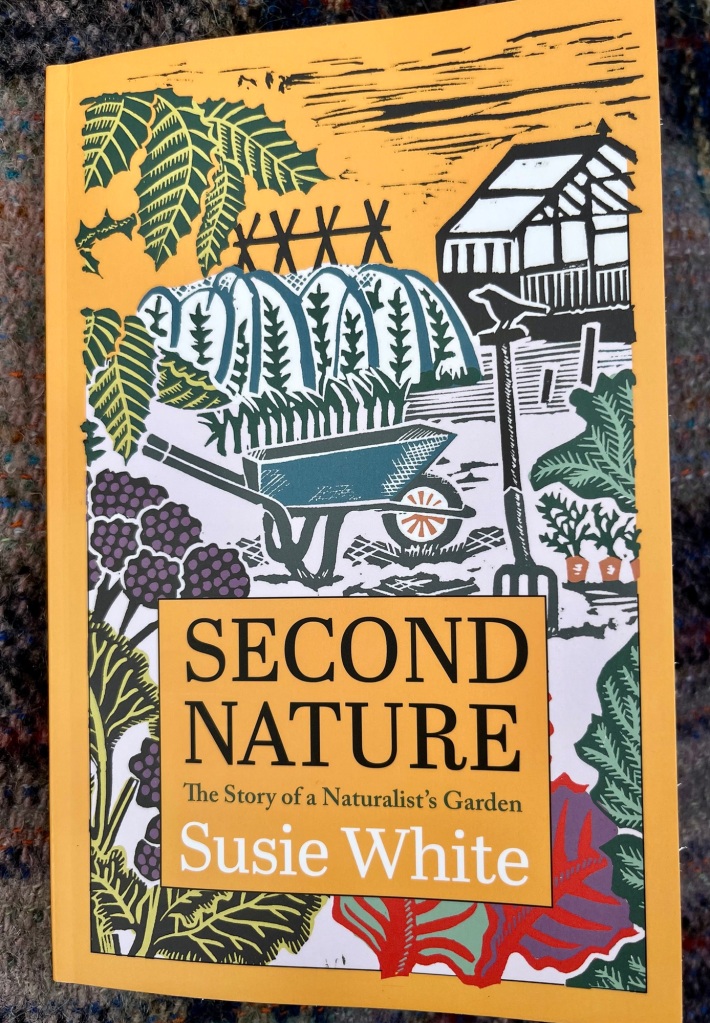
Second Nature – Book Review

The Story of a Naturalist’s Garden

Susie White

Published by Saraband

Paperback 184 pages. £12.99

ISBN: 9781915089915

The publishers have offered one copy to be given away in a prize draw. Please leave your name in the comments box below to be included.

It’s been a dire winter and spring. Rain-sodden fields, ditches overflowing, waterlogged garden. Tulips dashed by Storm Kathleen. My green fingers are itching to get on the land, and yet to walk about- no squelch about- would do more harm than good! So I’m feeling rather downhearted at the moment. Then into the potting shed comes a wonder of a book, Second Nature. And in it writer Susie White manages to revive my flagging enthusiasm. Susie writes with such honesty and compassion for wildlife it gets me looking to the clouds again to watch the buzzards soaring overhead. Ok, I’m going to get soaked looking up, but it’s worth it. Susie is well-known for creating a glorious garden and nursery at Chesters Walled Garden along Hadrian’s Wall. She talks of the heartbreak of having to leave after 23 years. It must have been devastating, having poured a lifetime’s work into one place. As I read the book, I take a moment to ponder how I will feel when I have to move on. It’s something we must all contemplate – and dread. In my case, will the new owners chop down our wood? Will they build on the meadow. What will happen to all the birds that currently nest in my garden? And I know exactly where they are every year, which nest boxes are occupied by which birds. Books that are well-written draw you in and make you think of the comparisons between their life and yours. The little jolts of memory from childhood gardens and the people who taught us to garden. Writers open their hearts to us, and in return we find ourselves nodding in agreement, finding common ground, mutual understanding. It’s a heart-sing moment when Susie, through her story, jogs a memory for me of my grandfather growing rows of peas and showing me how to shell and eat them fresh from the pod. Such moments are precious.

Not every writer can do this. They try, but Susie is a natural. She talks about returning to Chesters in her dreams : “To smell the resinous warmth emanating from the lean-to greenhouse, the musky tang of the box hedges. I can take myself along the paths, knowing exactly where I’m going, what weeds would always grow in certain spots, what jobs I’d have to do in each month of the year. I can still feel my way around that garden.”

And yet, despite the sadness, the book moves on to focus on the new garden Susie and her husband create, transforming a patch of untended ground into a wildlife-friendly haven, planted with flowering perennials, trees, herbs, vegetables and wildflowers. The garden teems with life: owls, blackbirds, bats, mice, butterflies and bees, all drawn by pollen-rich flowers, ponds and nesting sites.

Susie takes us through the planning and construction phases and describes how to blend a garden with natural surroundings. Her account is filled with ideas, inspiration and advice learned from setbacks and experience.

As Susie talks about visiting her former garden in her dreams, her writing also gives us the gift of ‘walking’ through her new garden and seeing everything she describes. It’s a joyful walk and one I can highly recommend. A special book which has transformative powers. I enjoyed every page and will return to it often!

Contents page.

About Susie:

Susie White is a gardening and travel writer, broadcaster, wildlife
photographer and lecturer. A lifelong and passionate gardener, she developed the garden at Chesters Walled Garden on Hadrian’s Wall in Northumberland.
Since then she has created a garden from scratch in a hidden valley on
previously uncultivated land. 

Beyond the garden, Susie’s interests include the environment, conservation, wildlife, upland hay meadows, archaeology, heritage skills and the landscape and walks of the North Pennines, Northumberland, and the Lake District. She is a regular contributor to the Guardian, BBC Countryfile, The English Garden, Homes and Gardens, and is garden columnist for My Weekly magazine. A
member of the Garden Media Guild, and RHS speaker, she is the author of Gardens of Northumberland and the Borders.

The prize draw for one copy will be made on Saturday 13th April at 6pm. Sorry, only UK addresses due to postage costs.

Thank you for reading my blog. Please follow the blog and sign up for e mail notifications for future posts. Have any books lifted your spirits recently? What are you all reading at the moment? Get in touch and let me know.

Prize draw winner for England’s Gardens- A Modern History

Thank you to everyone who took part in the prize draw to win 1 copy. Jean Kinchington’s name was randomly selected.

Please keep an eye open for more book reviews and giveaways this week. There are some lovely ones coming up!

Please also kindly follow the blog and sign up for e mail notifications for new posts.

You can read the review of Stephen Parker’s lovely new book here:

https://bramblegarden.com/2024/02/09/englands-gardens-a-modern-history/

Have a great gardening week!

Case study gardens in Stephen’s beautifully illustrated book.

And coming up: Naomi Slade’s masterpiece of writing, RHS The Winter Garden.

And also Anya Lautenbach’s new book, The Money Saving Gardener.

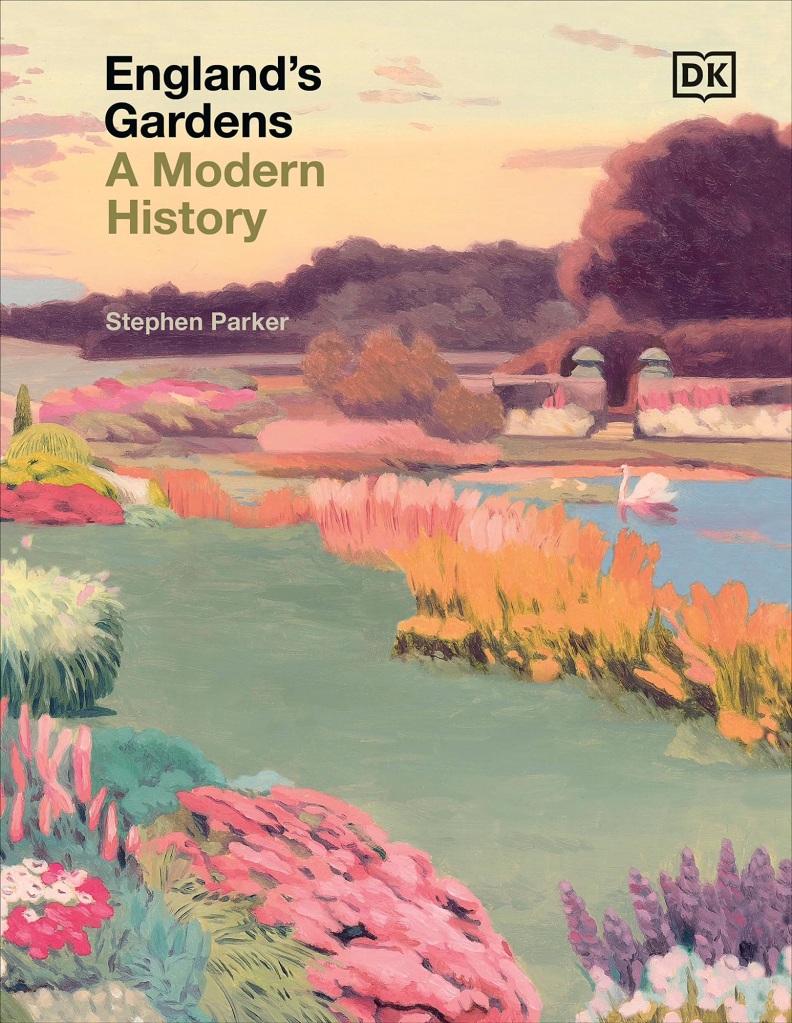
England’s Gardens -A Modern History.

Stephen Parker

Published by Dorling Kindersley

Hardback £25

Updated review and giveaway.

Please leave a comment to be included in the prize draw for a copy of this book.

I wrote a review of Stephen Parker’s book last summer.

Read it here: https://bramblegarden.com/2023/07/08/englands-gardens-a-modern-history-book-review/

There has been a wave of new books coming into the potting shed for tea break reading, but this one stood out well above the others. And now, six months later, I’m still intrigued and entranced by Stephen Parker’s study of gardens and the people who created them. To be honest, I wouldn’t be parted from this book. It’s beautifully-written and illustrated and Stephen has the knack of drawing you in and leading you around a garden, showing you all the best parts and lending insights into how they were created and why. It’s as much a book about people as the landscapes and I suppose we always want to try to get inside the heads of the creators to see what influenced and motivated them. Stephen entices you in and doesn’t disappoint.

Contents page. Tom Stuart-Smith’s Middle Terrace at Broughton Grange, Oxfordshire.

In-depth case studies focus on Chatsworth House, Longleat, The Lasket, Wrest Park, Rousham, I d in Esher, Surrey, Denmans Garden, Shute House, Hauser and Wirth, Somerset, East Ruston Old Vicarage, Highgrove, Thenford, Prospect Cottage, Dungeness, Broughton Grange, Oxfordshire, King’s Cross Gardens, and Lowther Castle.

Sissinghurst
Wrest Park
Wrest Park

In amongst the case studies are section on the influence of East Asia on the I’m uuiijgarden makers in the 18th Century.

The Great Pagoda at Kew Greens.
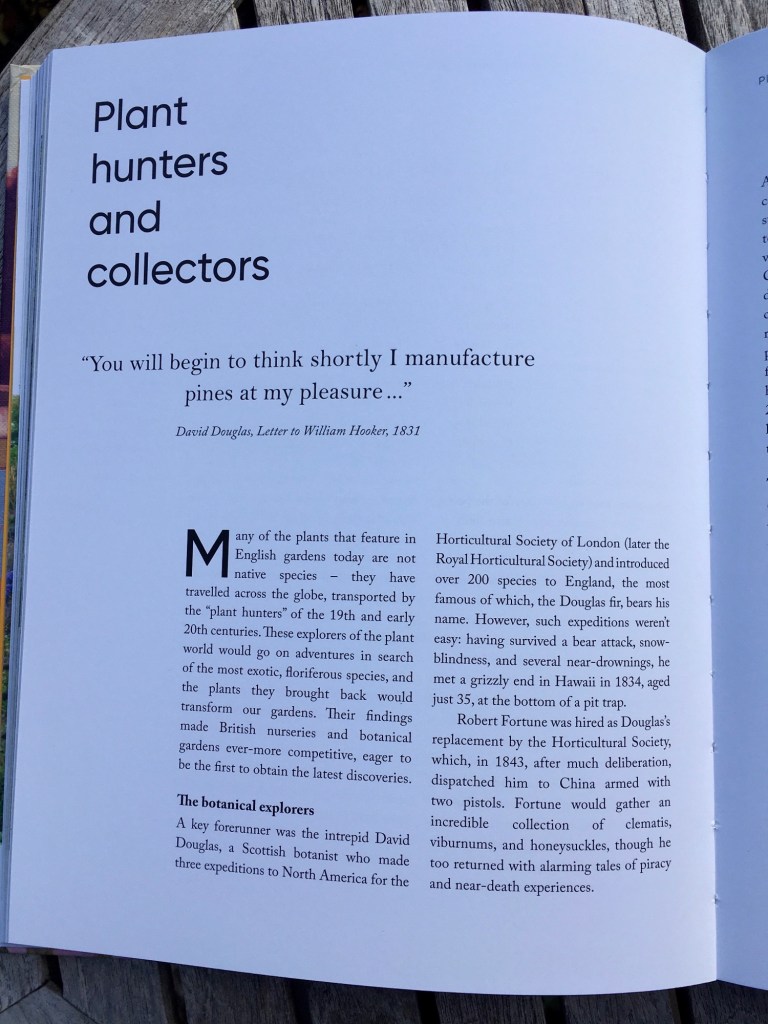
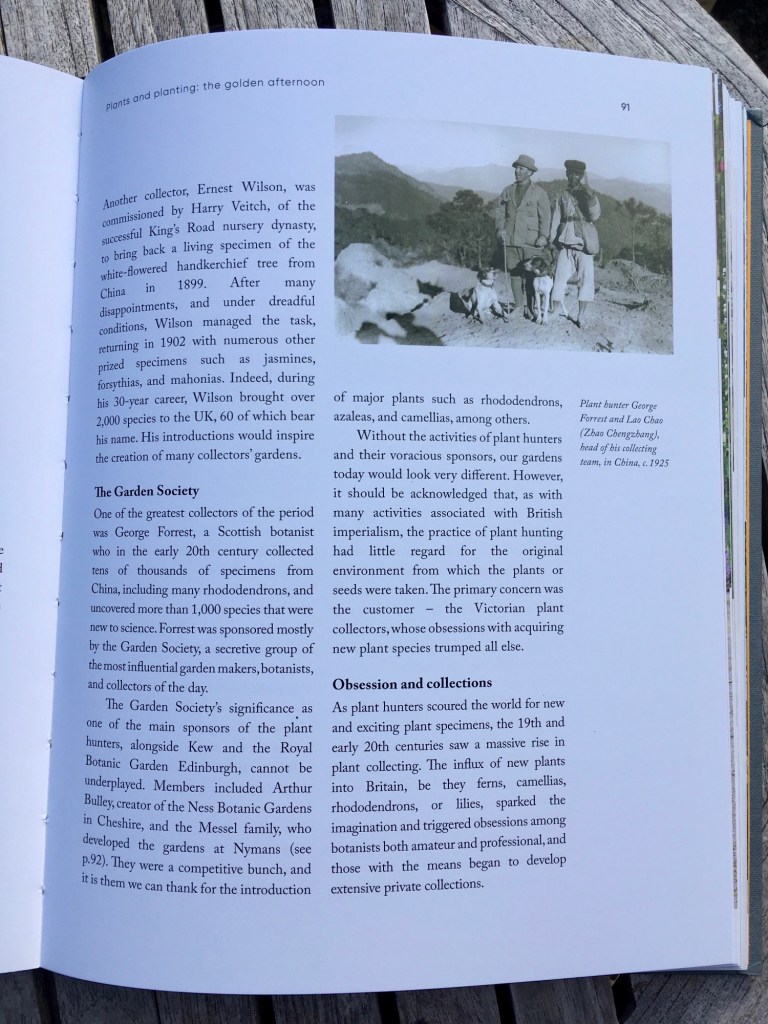
The effects of plant hunters and the species they brought to Britain.
Plant hunter George Forrest in China in 1925
Garden Sanctuaries

Every time I pick up this book I delve a little bit deeper into the backgrounds of these special places and learn more about the people who made them. It’s a very cheerful and enlightening read for cold winter days when inspiration and encouragement is much needed.

I hope you’ve enjoyed revisits Stephen Parker’s book with me. I can’t recommend it highly enough!

Please leave a comment in the box below. A name will be randomly selected by Sunday evening. The publisher’s decision is final and there’s no cash alternative. Sorry, only UK addresses, excluding Northern Ireland, are eligible.

Thank you for reading.

Prize draw winners- To Stand and Stare.

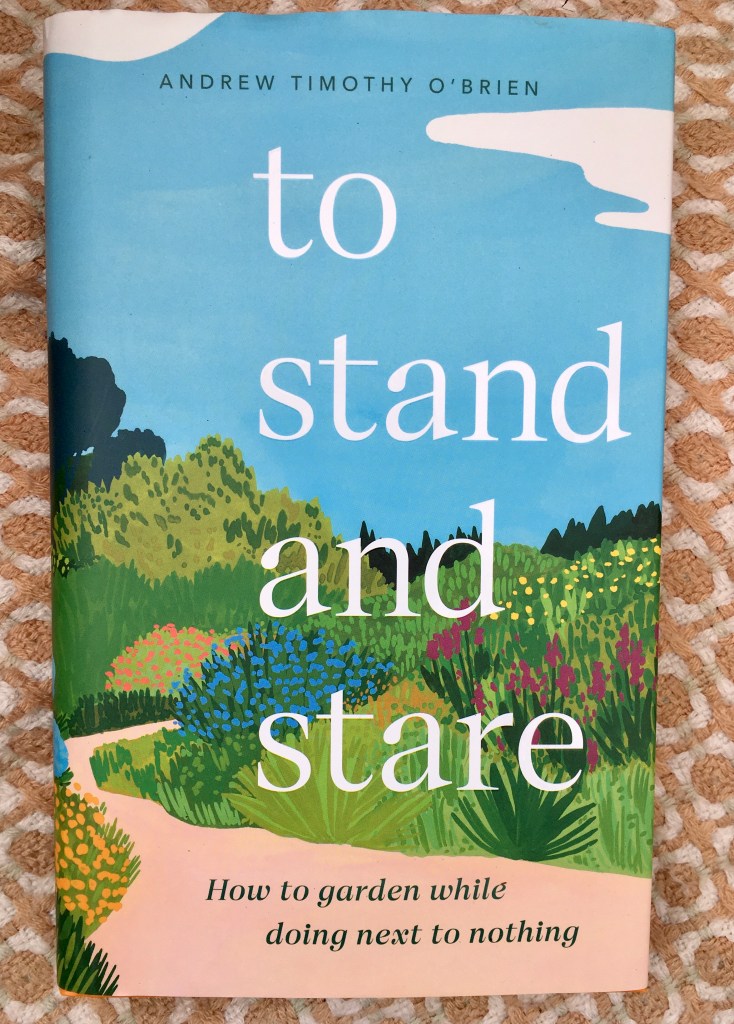
Thank you to everyone who read my review of Andrew Timothy O’Brien’s new book ‘To Stand and Stare’ published by Dorling Kindersley. The publishers kindly gave me two copies to give away.

The winners are Anna, and also Gill Watson. Please could you e mail me your addresses for the copies to be sent out. k.gimson@btinternet.com.

It’s a long time since I shared any photos of my lockdown kitten, Monty. No longer a kitten, but known to everyone as Monty K. He’s got ‘standing and staring’ down to a fine art. He’s still such a good companion in the potting shed and garden and follows me around everywhere. We hadn’t intended to get another cat, but when vets cancelled all the spaying operations there was an explosion of kittens in our village and surrounding area. We only got to see photos of Monty before he arrived, due to the covid rules, and we had no idea he would be a long-haired cat! Isn’t he gorgeous. A lot of brushing goes on with that coat! Otherwise, there’s brambles and dried grass all in a tangle around his ears.

I’ve ‘adopted’ two cats at Shropshire Cat Rescue. We can’t have any more here as Monty wouldn’t tolerate another feline, so I’m sending money to support two of the charity’s resident cats. More about this later!

Meanwhile… here’s a few Monty kitten photos, which is an indulgence really, but a nice reminder of when he arrived.

He soon outgrew this scratching post table.
Curled up in my apple picking basket, with his favourite bee toy
Sitting in the summerhouse
Luckily Meg the cocker spaniel loves him as much as we do.

Have a great gardening week everyone! Thanks again for reading the blog and keeping in touch. It’s always appreciated. Karen.

To Stand and Stare- Book Review

How to Garden While Doing Next to Nothing

By Andrew Timothy O’Brien

Dorling Kindersley. Spring 2023

Hardback. 287 pages. £16.99

ISBN 978-0-2415-4401-3

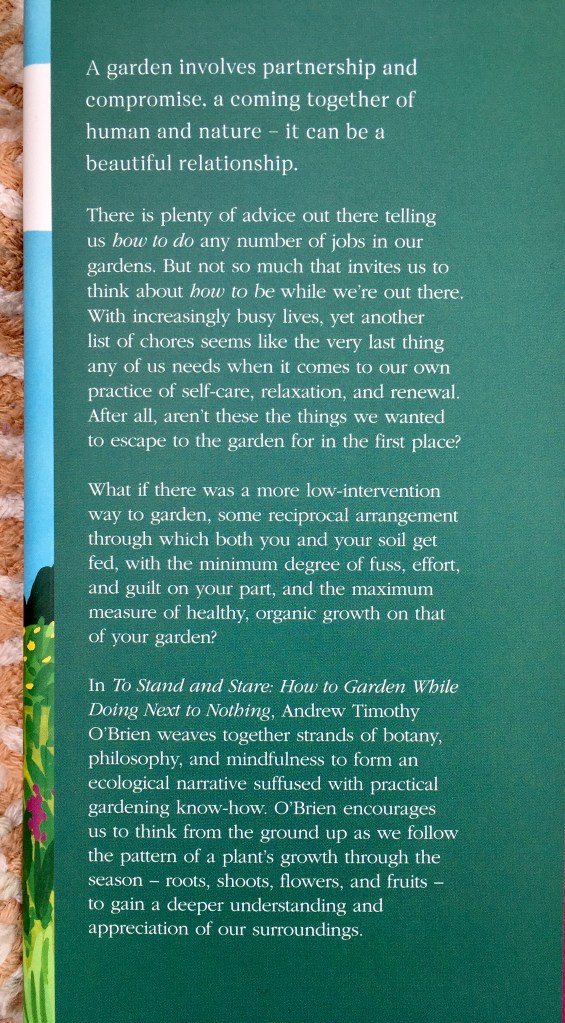
Andrew Timothy O’Brien describes planting a tulip as ‘like planting hope and promise.’ I rather like this idea. In fact, the whole book suits me, with its gentle, encouraging, quiet style of gardening. There is nothing shouty about this book. It’s something to take to a corner, curl up, forget the world, and just ‘be’ for a while, immersed in the glory of plants, gardening and the process of growing beauty.

The title is part of the ‘how-to’ message in the book. There’s how to sow a seed, how to water a plant, deadhead a rose, hear a bird. And of course there’s how to ‘stand and stare.’ It’s a contrast to all the urgent, bossy, fast-paced, singing and dancing, ‘must-do’ messages we see every day on social media. Sometimes it’s hard to keep up. It’s hard not to feel left behind and out of touch. O’Brien, with his gentle philosophy reminds us to reflect on why and how we garden. It’s not to compete and keep up, but to find the joy in growing food and flowers -our way.

O’Brien writes; “ When it came to writing this book, I didn’t think the world needed another ‘How to Garden’ title- there’s a wealth of information out there expounding upon the many tasks that it’s all to easy to make your garden about. But there’s not so much about how you might like to be when you’re out there, at one with the plants and the wildlife and the weather. I’ve come to appreciate that an understanding of natural processes is the key to accessing the transformative power of the garden, and replacing feelings of confusion, overwhelm, and stress with focus, a sense of inner peace, and an increased facility to deal with what life throws at us on a daily basis. With a view to this, over the next few hundred pages, I’m going to invite you to think like a plant. And we are going to start from the ground up.”

Contents pages
Inside front cover
I’ve been reading Andrew’s writings on his blog and listening to the podcast for around 10 years. I suppose, although I’ve never met him, I feel as if I know him. He has the ability to write in such an accessible way that you feel as if he is familiar voice, a wise and trusted friend. And we can never have enough of those, can we.

When planting bulbs, O’Brien reminds us to “Breathe in, hold for a moment then, slowly and with some noise, breathe out. Open the bag; by rights it should be labelled ‘Hope & Promise’, but something like ‘Tulips’ or ‘Lilies’ is perhaps more likely and, really it’s all the same.”

O’Brien strikes just the right note in a world full of conflict and worry. I can conjure up the scenes he creates. I’m happy to stand and stare with him. It’s a balm for our times, and very soothing for the soul. I can’t recommend it highly enough.

“A pause. A breath. A moment for a thought.” Wise words. Don’t you agree?

Illustrations by Ariel Lee.

The publishers have offered one copy for readers of this blog. Please leave a comment below to be entered in the prize draw. Thank you, as ever, for coming to my blog and reading my reviews and musings. It’s much appreciated. You are among 300 people taking a look here each day. And I’m am very grateful for your time.

Book winner. Grasping the Nettle by Tamsin Westhorpe.

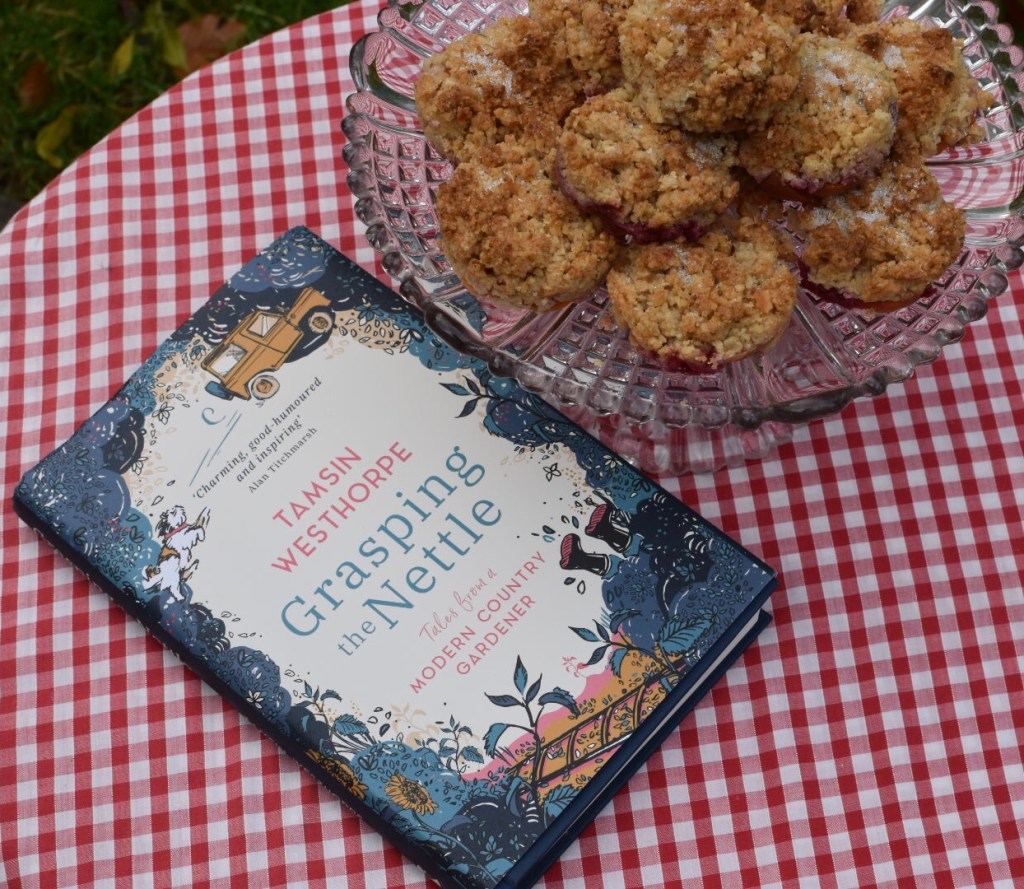
Cathy from https://ramblinginthegarden.wordpress.com/category/gardens/in-a-vase-on-monday/ Has won the free copy of Tamsin’s latest memoir. Thank you to everyone who read my review and left a comment.

My review is here. https://bramblegarden.com/2022/10/27/grasping-the-nettle-by-tamsin-westhorpe/

Book reviews and giveaways coming up this week: The Tree in my Garden by Kate Bradbury published by DK for the RHS.

Have a great gardening week everyone. All the best, Karen.

Grasping the Nettle by Tamsin Westhorpe

Book Review and give-away.

My BBC Radio Leicester Gardening Book of the Week

Hardback £14.99

Published October 2022

Orphans Publishing

ISBN 978-1 903-36051-4

Illustrations by Rosalie Herrera

Should any of you want to read a book which makes you laugh from start to finish, look no further than Tamsin Westhorpe’s new memoir ‘Grasping the Nettle.’

Tamsin spent her childhood mostly outdoors, by all accounts and her weekends, and after-school activities were often spent collecting snails and creepy crawlies, some she kept as pets. It was the perfect start in life for someone who would make horticulture their career. And what a career she’s had, starting with work on a plant nursery, time as an interior plant landscaper, and after college, a spell as a gardener for Bournemouth parks department and bowling greens.

Along the way, she writes about the colourful characters she meets, and the scrapes she gets into. I’m still holding my breath after reading about the clapped-out Land Rover she bought which would only start from the top of a hill, and had virtually no brakes!

Tamsin bought the rust bucket Land Rover from Southampton docks where it had been used for ferrying fish. Consequently, well you can imagine the pong!

“Fortunately for me and my newest fishy acquisition, the bungalow was at the top of a steep gravel drive. Without it I’d never have got to college. The Land Rover, which I had affectionately and very appropriately named Delilah (‘Why, why, why did I buy you?), regularly wouldn’t start but releasing the hand brake on the slope and turning the key seemed to do the trick. However stressful this daily event was, I couldn’t help but feel happy sitting in the driving seat looking over the bonnet. Now that the fishmonger’s logo had been removed, I felt like a proper horticultural student. On arrival at college- thankfully only about a mile from home- I would never experience actually turning the engine off. Stalling just as I reached my parking space was the norm. It wasn’t until I had a proper car that I realised how poor the brakes were, but thankfully I never went very far or fast.”

We’ve all had trouble starting pull-cord lawnmowers and machines. During her time at Bournemouth Parks department, Tamsin had a bit of trouble with a very heavy cantankerous leaf blower. Trying to start it while being watched by an audience of dog walkers and families heading to the beach was embarrassing to say the least.

“There was no way I could fail, so I learned to be determined and discovered how to cope with a flooded engine. I also understood why steel toe-capped boots are important- to kick power tools! On some days when the blower just wouldn’t start, instead of admitting my failings I would go hell for leather with the witch’s broom. Looking back now, I suspect I fooled no one as the engine was cold to the touch when my colleagues loaded it up into the Transit.”

Tamsin continues her story weaving in all the characters and places she’s worked, from college as a horticultural teacher, to Japan as a lecturer, on to writing for a magazine and becoming an editor. All along the way, the story is peppered with delightful observations, showing Tamsin’s joyful sense of humour and determination to succeed, whatever obstacles are put in her way, mechanical, human or animal.

Bringing things up to date, Tamsin is now a hands-on gardener at her family garden Stockton Bury in Herefordshire which regularly features in the round-up of the best UK open gardens. Tamsin also writes for newspapers and magazines and lectures at home and abroad- making her audiences laugh with tales of life spent doing something she’s completely passionate about- gardening. I think we all know that feeling of being happiest with our hands in the soil.

Congratulations, Tamsin on writing such a sparkling, charming, thought-provoking read. It had me in stitches from start to finish. I haven’t laughed so much in ages. And I learned a lot more about what it’s like to make your way in the world when you choose a life outdoors.

I’m sure Tamsin has started many more people on the path to horticulture through her wit and passion for the subject. It’s a delightfully realistic and thoroughly inspiring book.

Thank you for reading my review. There’s one copy to give away. Please leave your comments below and a name will be randomly selected by Sunday 6pm.

I wrote about Tamsin’s first book here: https://bramblegarden.com/2020/02/22/diary-of-a-modern-country-gardener/

Tamsin’s accident in the garden: https://bramblegarden.com/2021/11/03/accidents-in-the-garden/

Some excerpts from the book:

Book Review: Secret Gardens of the South East- A Private Tour. My BBC Local Radio book of the week

By Barbara Segall

Photos by Clive Boursnell

Published by Frances Lincoln, autumn 2022

Hardback RRP £22

ISBN 978-0-7112-5260-8

One of my favourite things is to jump in the car and travel to a garden I’ve not seen before. It doesn’t matter if the garden is large or small, there’s always some planting combination or landscaping idea I jot down in a notebook, hoping to replicate it in my own garden one day.

The gardens of the South East of England are still a mystery to me. My car hasn’t ventured that far yet. But I’ve just read Barbara Segall’s exciting new book featuring 20 gardens in that region, and I’m getting out the map book already!

Balmoral Cottage, Kent. Topiary created from cuttings.

One particular garden in the book struck a chord with me. Balmoral Cottage in Benenden, Kent, where the owners grew many of the plants from divisions and cuttings from their parents’ gardens. Charlotte and Donald Molesworth bought the cottage nearly 40 years ago. Barbara tells the story of how Donald, a professional gardener, had been working next door at The Grange, the former home of Collingwood ‘Cherry’ Ingram – the plant hunter credited with returning endangered cherries to Japan.

Barbara writes, “That moment when you meet your future down a little lane, see a gate and opening it find the rest of time ahead of you…..? Well, that is literally what happened when Charlotte and Donald Molesworth found and bought Balmoral Cottage in Benenden in 1983.

For eight years Charlotte had been living in and teaching art at Benenden School, and on walks around the village, often stepped along the rough track leading to this tiny house, which had the best sunsets imaginable. Probably named Balmoral to celebrate a visit of Queen Victoria to Benenden, it was the gardener’s cottage for the Grange.

The Molesworths brought with them to Balmoral Cottage the first of many animals to share their garden lives, including bees, rescue dogs, donkeys (there have been nine) and companion sheep, hens and a cockerel.

They knew that they would need plenty of plants to make their garden and, being thrifty and resourceful they brought many plants from their parents’ gardens. From Donald’s family came woodland trilliums, dog’s-tooth violets and narcissus pseudonarcissus which have self-seeded and spread down each side of that original track. Charlotte’s mother’s garden was packed with old fashioned roses, cottage-garden plants and topiary, so her contributions included double white primroses and several thousand box cuttings.”

I love the fact they have created a special and unusual garden on a shoestring. They avoid buying anything new, scouring reclamation yards for potential items for recycling. “It’s our policy for helping Mother Earth,” they say. It’s resulted in a garden that makes you feel anything is possible. It’s not dependent on how much money you have, but on ingenuity, patience and skill. A very reassuring message for any would-be gardener, and one I welcome entirely.

Gravetye Manor, East Grinstead, West Sussex

I’ve picked out just one of the 20 stunning gardens explored by Barbara Segall in this richly detailed book. There’s a lovely mix of the extremely grand to the small and intimate. All are privately owned. Some have been in the possession of the same family for many generations, whilst others have recently been acquired and transformed by new owners. There’s a wonderful diversity of landscaping styles and a range of planting from traditional herbaceous borders to fashionable and contemporary prairies.

Sussex Prairie Garden, near Henfield, West Sussex
Sussex Prairie Garden. Curving paths through the grand spiral of the borders bring you up-close so you can experience the undulation of the plants and their blocks of colour from within.

Barbara is a totally engaging writer who draws you into the gardens and skilfully sifts out the essence of what makes them special. Not a word is wasted and reading her books is so easy. It’s a pleasure to skip through the pages and be transported to these glorious places.

Town Place, near Sheffield Park, East Sussex

The book includes visitor information about the gardens profiled as well as several others in this garden-rich area of Kent, Sussex and Surrey. Some open for the popular National Gardens Scheme, while others are open privately, and in some cases, for just the occasional day for charity.

Arundel Castle, Arundel, West Sussex. Caught in the early morning mist, the windows of Arundel Cathedral provide a dramatic borrowed landscape to the annual allium, rose and salvia extravaganza.
Arundel Castle team and bulb-filled borders sweeping up to the battlements. I particularly liked seeing the teams of gardeners included in the book. Credit is due for the wonderful work they undertake, looking after these special places.

Special mention must be made of the photographs by Clive Boursnell who initially visited 40 gardens and travelled 12,500 miles for this stunning project. Sadly, only 20 could be included in the book. But he talks about the warm welcome he received at every garden, as he travelled about in his camper van, capturing the atmospheric dawn and dusk photos. He turned up during a daughter’s wedding that was taking place in one garden. The owners, not phased by his appearance in the middle of a celebration, made sure he could get his photos of a particular rose trellis at its peak. Such small details and asides give an insight into the characters behind the gardens, their passions and their personalities.

Long Barn, Sevenoaks, Kent. The barn wall provides a strong backdrop as well as a hotspot for California glory (Fremontodendron californicum). Together with the lime-green touches of Euphorbia characias subs. wulfenii, they offer a counterpoint to the closely clipped hedging and lawns on the main lawn.

Barbara writes: “I hope you will find much pleasure in the book and visit the gardens when possible…opening garden gates to find untold beauty.”

I know that I enjoyed every page and can’t wait to investigate the gardens further.

Clinton Lodge Gardens, Fletching, East Sussex. The view through the Cloister Walk arcades, clad with white wisteria and Clematis alba Luxurians, to the Wild Garden, with its spring tide of Narcissus poeticus Pheasant’s Eye and white tulips.
Munstead Wood and the Quadrangle, Godalming, Surrey. The main flower border, some 61 metres long, blooms in waves of colour following Gertrude Jekyll’s original iconic, complicated drawing.
87 Albert Street, Whitstable, Kent.
Malthouse Farm Garden, Hassocks, East Sussex.

The publishers are giving away one book in a prize draw to readers who leave comments below. One name will be randomly selected. Sorry, only open to UK entries due to postage costs. The draw closes at 6pm on 21st October.

I wrote about Barbara here:

https://bramblegarden.com/2021/01/10/herbs-cooking-and-reading-blogs-keeping-cheerful-through-lockdown/

And Barbara’s previous books:

https://bramblegarden.com/2017/08/14/words-and-pictures-3/

https://bramblegarden.com/2017/10/13/win-a-copy-of-secret-gardens-of-east-anglia-and-heres-an-update-on-my-fund-raising-plans-2/

Thank you for reading my blog. I hope you enjoy these words and photos from Barbara’s latest book. It was my book of the week on local radio gardening shows earlier this summer.

Attracting Garden Pollinators – by Jean Vernon. Prize draw winners.

Thank you to everyone who read my review of Jean Vernon’s latest book. To celebrate my return to blogging, I’m sending out four books to readers who left comments. Names were randomly selected, and the winners are Menhir1, Kate Elliott, Pauline (Lead Up the Garden Path) and Gill. I’ve sent the winners messages in the replies section, but if you are reading this please send your addresses to k.gimson@btinternet.com and I’ll get books sent out to you. Thank you again to everyone who reads my blog and takes the time to leave a comment. It’s always much appreciated.

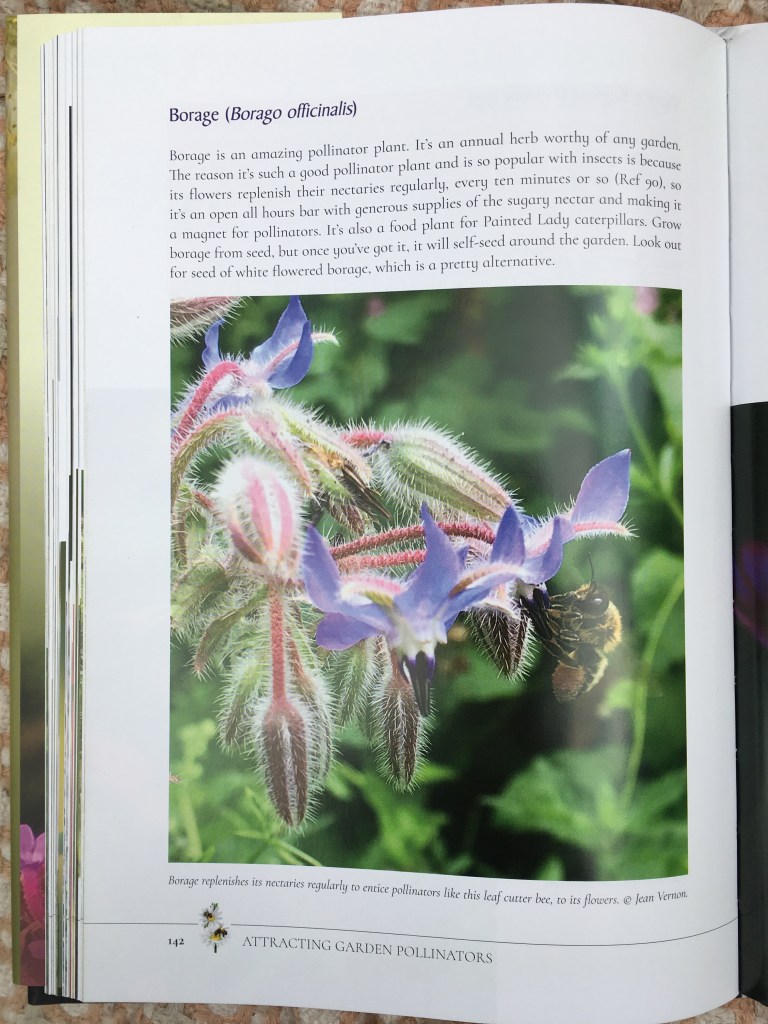
Here’s some more excerpts from the book. There’s chapters advising on the best plants to grow to help pollinators. I grow both the blue and the white form of borage. The blue variety has flowers the colour of a Mediterranean sky. I use flowers in salad dishes and also to decorate cakes.

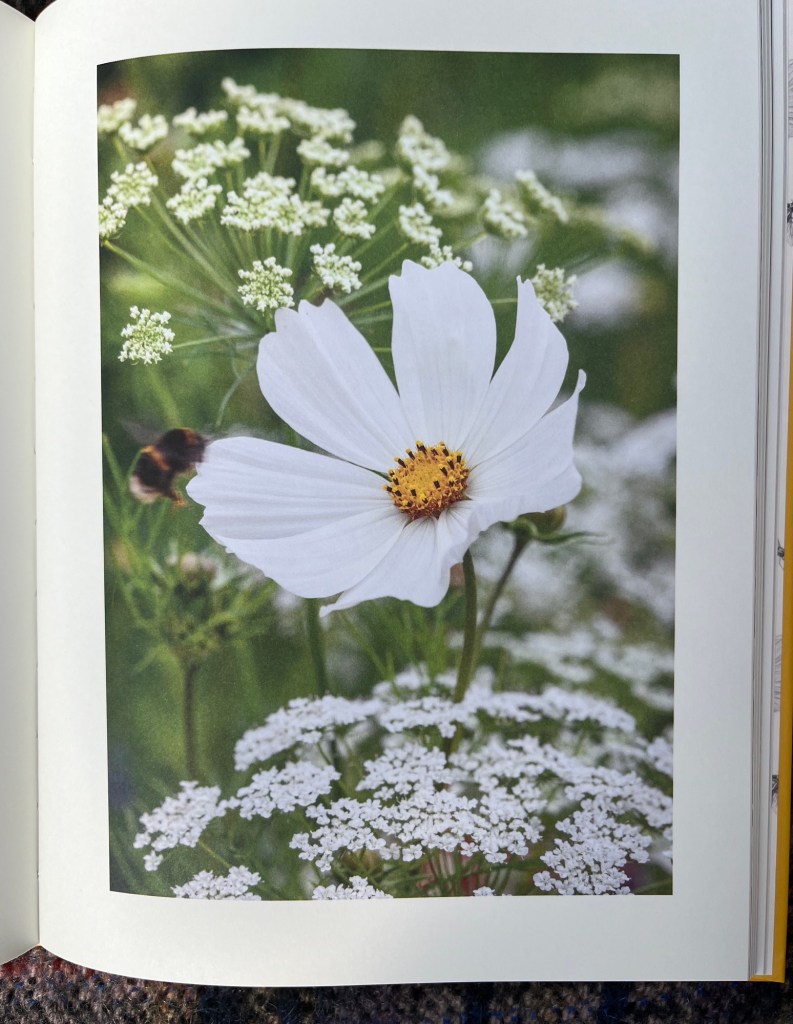
Cosmos is another favourite plant in my garden. Not only is it very useful for cut flowers, it also attracts a wide range of bees and butterflies. There’s plenty of space for more than one bee or butterfly to land and feed.

Here’s a photo from my garden with Cosmos Seashells providing plenty of pollen for these bumblebees.

My home-made bee hotel. These are made from cardboard tubes and garden canes. Nearly all of the canes contain cocoons. The bees plug the ends of the canes with mud to protect the cocoons over winter. I’m now looking into buying special bee chambers with removable paper tubes. These can be replaced and refreshed each year to help prevent diseases.

I also have some bee bricks which are specially made to integrate into buildings, replacing a normal brick with one containing nesting holes of varying sizes. These also seem very popular with solitary bees.

The back cover of Jean’s latest book.

Information about the author.

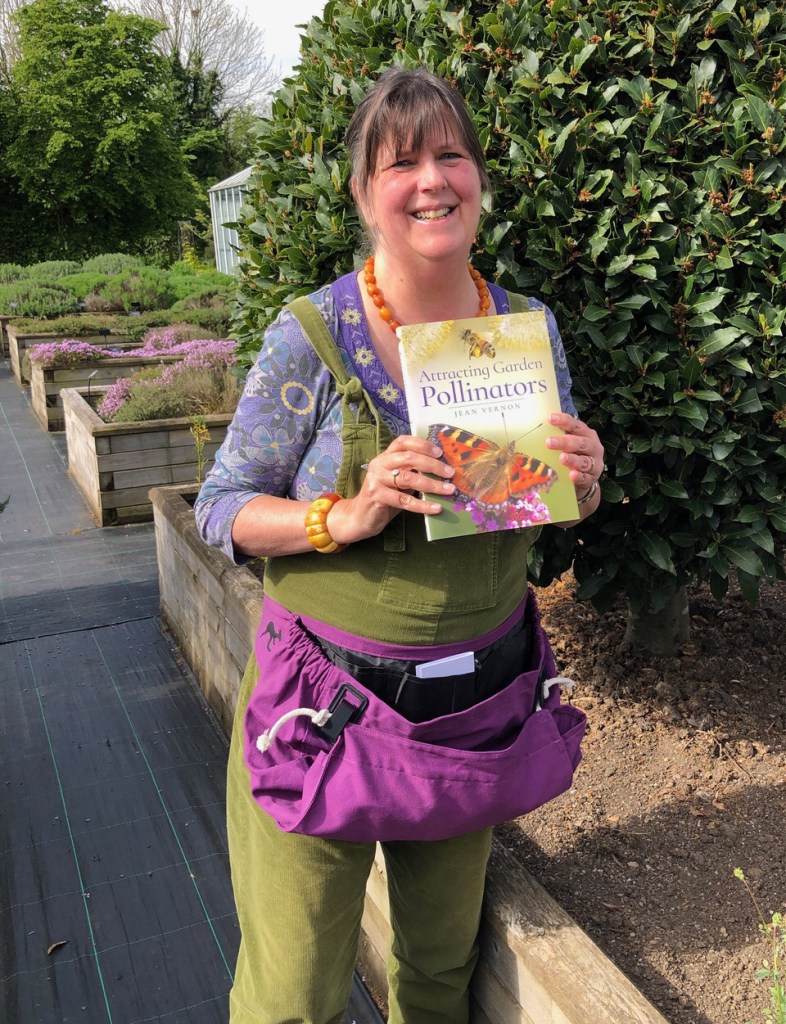
Jean with her new book. Photo by Hannah McVicar.

I was very pleased to take part in the blog tour launch of this beautiful and very special book which has an important message for all of us. Helping garden pollinators ultimately helps us too. Bees, butterflies, moths and other insects all help to pollinate our fruit and vegetables. Help them, and we are ultimately helping ourselves. More pollinators equals higher productivity and therefore more food. It makes sense to do all we can to provide the best habitat we can for pollinators.

I wrote about Jean’s new book here:

https://bramblegarden.com/

Jean’s previous book is reviewed here:

https://bramblegarden.com/?s=Secret+lives+of+bees

Attracting Garden Pollinators – by Jean Vernon.

Book review and one copy to give away.

Published by White Owl, imprint of Pen and Sword Books

Published summer 2022

Hardback. £25

ISBN 1526711907

Please leave a comment at the end of the review if you would like to be put into the publisher’s prize draw for one copy of the book. Names will be chosen randomly.

Right by my front door, on a warm, sunny south-facing wall, we have a selection of bee ‘houses’ some home-made from cardboard tubes and garden canes, and some purchased at a local supermarket. These are a source of wonder and joy as clouds of solitary bees hatch out and start to forage in the front garden. Watching a new, baby bee hatching out of its winter cocoon is such an exciting and magical moment. Thanks to a new book on attracting pollinators to our gardens, I’ve been able to identify our bees. They are red mason bees; solitary bees that nest in wall cavities and readily use bee houses like ours. In Jean Vernon’s book I’ve learned these bees are fond of fruit tree nectar and pollinate apples, pears and other spring and summer-flowering trees. So I’m expecting a bumper crop of fruit this year. And I’ve learned these bees, like most solitary bees, do not sting, so there’s no danger to me or any visitors walking past the bees to get to the front door. Reading on, I learn that one way to help my bees is to leave a mud patch nearby so there’s plenty of material to seal their eggs cells. It’s completely calming and relaxing watching the bees going about their daily lives, and I want to do all I can to help them. It would be terrible to think of these bees emerging into the world and not finding anything nearby to eat. Jean points out that some solitary bees will only travel a few metres from their nests to find sustenance and they will starve if there’s not enough suitable plants flowering at the right moment.

Here’s a photo of a red mason bee in Jean’s book. (photo by Liam Olds).

Jean’s book is split into chapters on identifying and learning about specific pollinators such as butterflies, moths, bees, and hoverflies among others, and advice on which plants to grow to help pollinators.

Hoverflies are amongst the types of pollinators highlighted in the book.
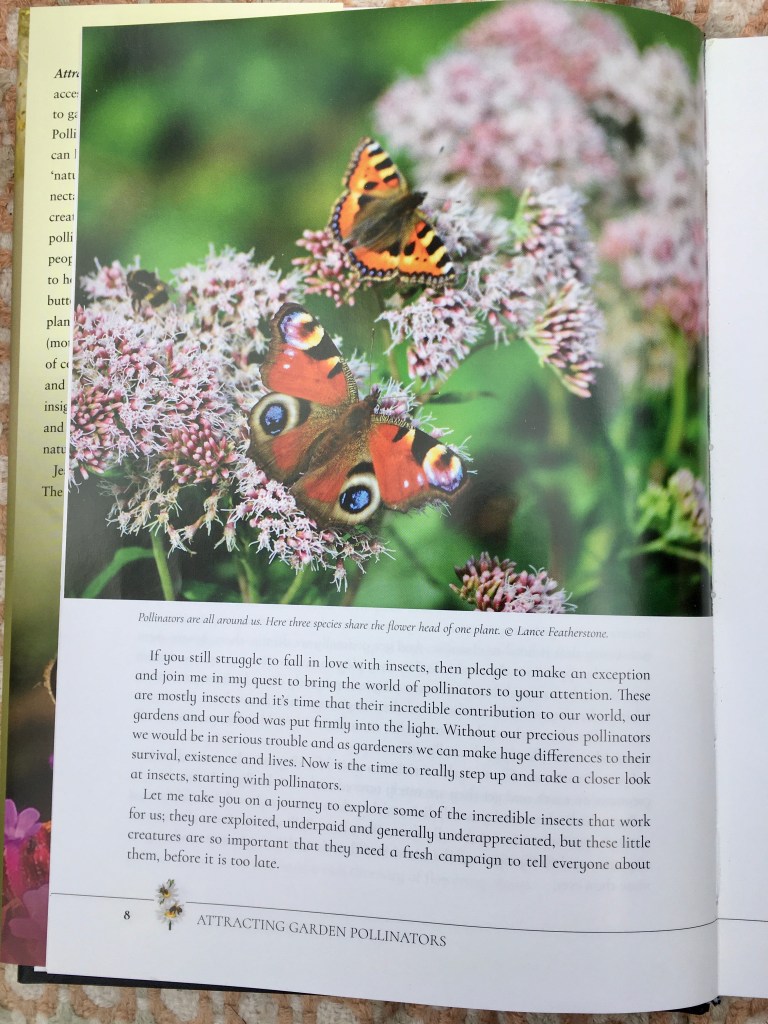
Butterflies and bees sharing the same plant.
Even small spaces can accommodate plants for pollinators. This year, I’ve taken Jean’s advice and planted my hanging baskets with calendula, lavender, nasturtium and marjoram.
Borage is one of the ‘plants for pollinators’ highlighted in the book.
Cosmos is another favourite of mine and it’s good to know it will provide food for pollinators all through summer from June to October. Flat daisy-like flowers are good because there’s plenty of room for several insects to land and feed at the same time.

Photo of Jean by Hannah McVicar.

If you’ve been listening to BBC Radio Leicester you’ll know that Attracting Garden Pollinators has twice been my Book of the Week. I’m happy to recommend such an easy to read and information-packed book. Jean writes in a friendly and accessible way. Her passion for nature and wildlife shines through and you can’t help but get caught up and carried along by her enthusiasm for the subject. Simple ways to help pollinators are suggested, and you don’t need a huge garden to make a difference. Even a windowbox or container can be a five star diner!

I wrote about Jean’s other best-selling book here:

https://bramblegarden.com/?s=Secret+lives+of+bees

Please leave a comment in the box below if you would like to enter the publisher’s prize draw for one copy of the book. Names will be randomly drawn. I will only contact you on this page and no payment of any kind will be asked for. Please be aware of scams. Please also feel free to leave a comment if you don’t want to be included in the draw. Just let me know.

Signed copies of both books are available from the author’s website here : https://thegreenjeanie.com/shop/

Thank you for reading my blog and book reviews. Are you growing any plants with pollinators in mind? Have you tried making a bee house? I was fascinated to read you can buy red mason bee cocoons to hatch out in your garden. Alternatively, invest in some special mason bee tubes and install them in a nesting box . You can replace the tubes each year to keep the nest free from pests and parasites.

A Greener Life – by Jack Wallington

BOOK REVIEW AND MY BBC LOCAL RADIO BOOK OF THE WEEK

Published by Laurence King, March 2022

Hardback, 192 pages, £19.99

ISBN: 978-085782-893-4

A Greener Life is much more than a ‘how-to-garden’ book, it’s actually a revealing diary of the writer’s journey from a stressful life and illness, to peace and calm through creating a garden and connecting with nature.

Jack Wallington writes how he struggled to sleep, was regularly ill and felt as if he’d ‘lost his way’ as he tried to keep up, and be available 24/7. “I thought the feeling of dissatisfaction was normal, to be waited out until retirement.” The turning point was the day Jack and his partner Chris planted the first trees, shrubs and bulbs in their new garden. “My worries briefly melted away, and a spark of happiness ignited.”

Jack says childhood memories trickled back, memories of sowing tomato and nasturtium seeds and taking cacti cuttings to sell for pocket money.

Through simply planting a garden he was better able to deflect stresses and anxieties and seemingly insurmountable problems at work . “Life, all life, the thing I had loved as a boy, that had been around me all along, was helping my world make sense. I had euphoric moments when discovering other gardens and visiting countryside. I began to feel connected to something bigger than me, and that somehow the things I planted and cared for were making a real contribution. The more I planted in the garden, the more insects and birds visited. Inviting nature back into my life gave a peace I hadn’t experienced for thirty years, and opened my eyes to the responsibility I had to the ecosystem I was nurturing.”

Jack’s book contains seven chapters. The first chapter outlines nine steps to a greener gardening life, and is almost a book in itself. Chapter two is about ‘getting started’ easy planting guides and essential tools you’ll need. Chapter three, encouraging beautiful ecosystems. Chapter four focuses on creating a wildlife -friendly garden, bringing soil to life and attracting and sustaining insect life.

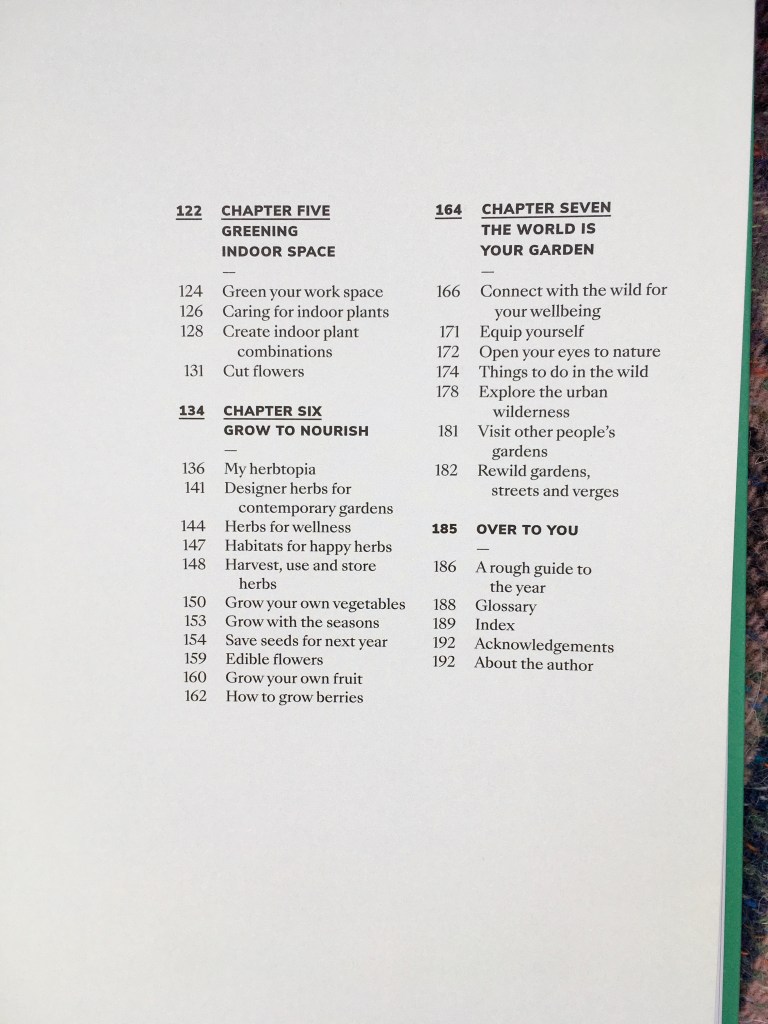
Chapter five focuses on greening indoor spaces and greening workspaces.

Chapter six talks about herbs for wellness, growing vegetables, fruit and edible flowers.

Chapter seven is about connecting with nature, exploring wild areas in the city and countryside. There’s a section on using binoculars, cameras, smartphones and field guides and magnifying glasses- a useful guide to equipping yourself to delve deeper into the natural world.

A Greener Life is an honest, well-written account of self-discovery, and Jack’s voice comes over loud and clear in this beautifully put together book. You’ll certainly learn how to create nature-friendly gardens, but you will also perhaps pause for thought at what good can come from connecting with gardens and wildlife. In these stressful and strife-ridden days, this can only be a very good thing indeed.

Jack’s book is really everything you’d ever need to be a greener gardener. It’s written from the heart, from someone who’s found out for himself that gardens, gardening and being in touch with nature really can make a difference. Jack says “ We’re part of the natural world and to save it is to save ourselves. We all benefit from a greener life.”

The publishers have kindly given one copy to give away. Leave a message in the comments box below and one name will be selected randomly by 26 March. Sorry, the offer is only open to readers in the UK.

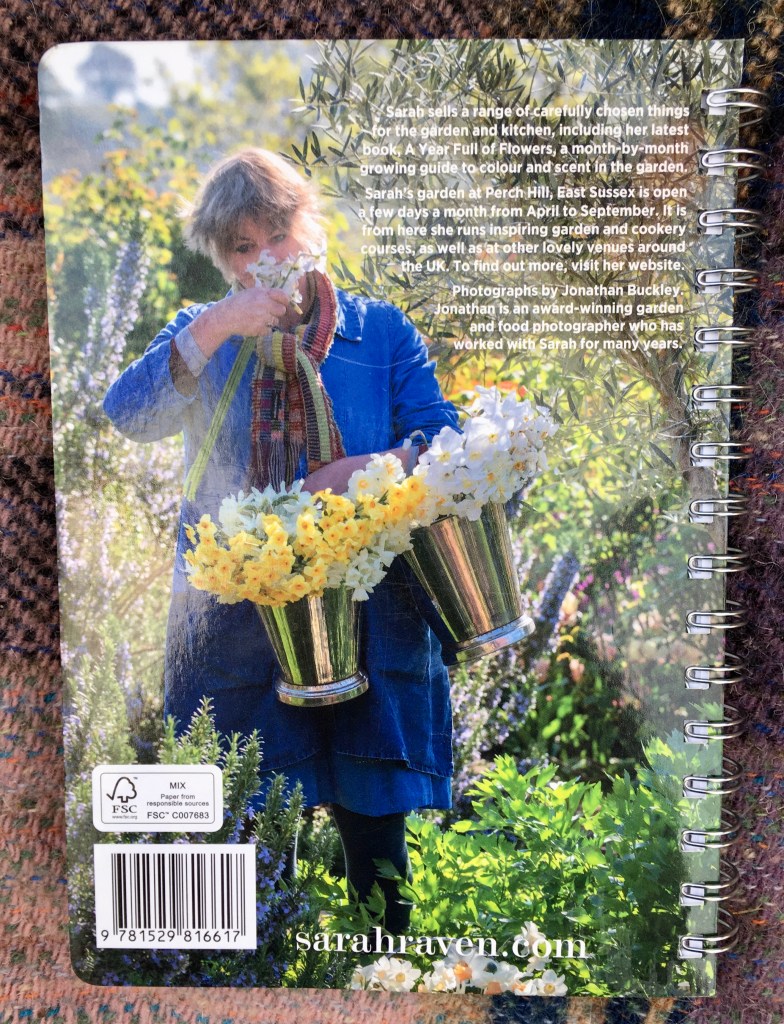
Sarah Raven’s Grow, Cook, Eat Diary – Book Review

From Sarahraven.com

ISBN: 9 781529816617

I’ve never kept a gardening diary before, but I’m enjoying making daily notes in my new Sarah Raven diary. The diary is sturdy enough to take outdoors; the paper is thick, good quality so can stand up to being taken into the greenhouse and potting shed. I’m making lists of seeds I want to sow, dahlias I want to pot up, and general maintenance jobs about the garden. I love making lists- and I love ticking things off the lists! There’s a sense of satisfaction in ticking them off, especially when the list seems never-ending.

There are some beautiful and inspiring photos relevant to each month in the diary. For January, there’s a winter container planting of a terracotta long tom pot with Sarah’s favourite hellebore ‘Maestro’ which is often seen in her flower arrangements.

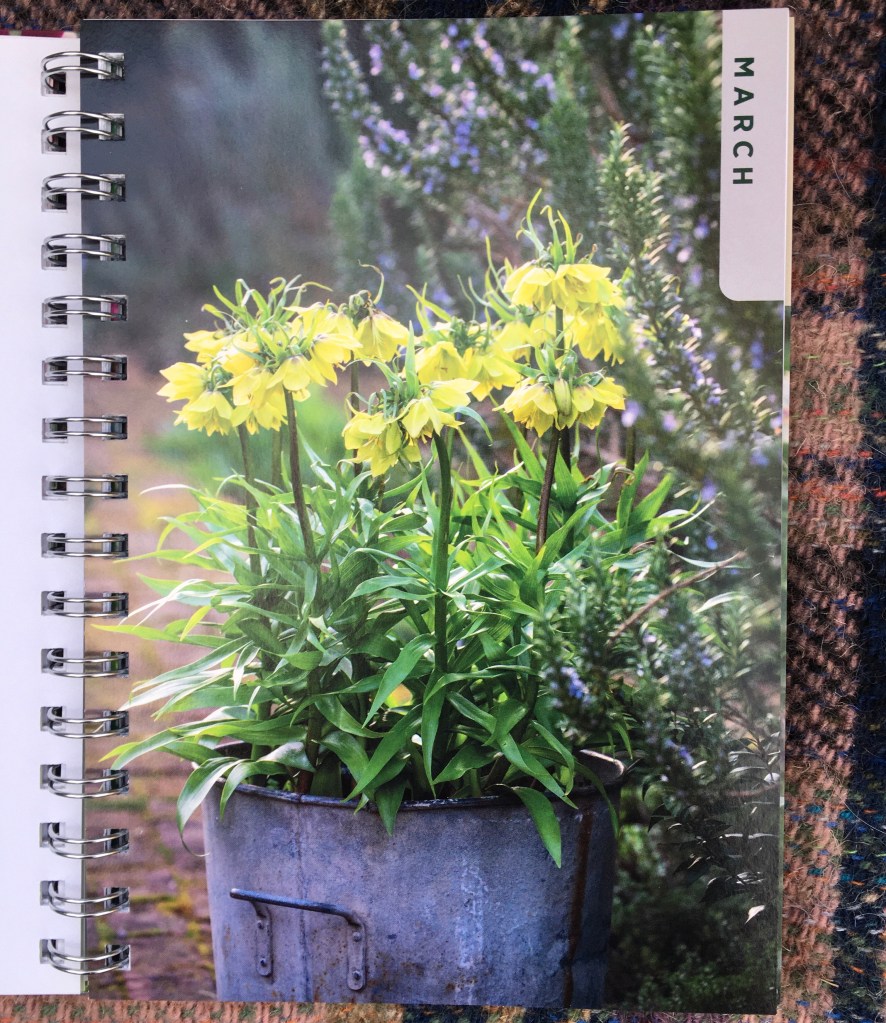
For March, there’s Fritillaria ‘Early Sensation’ which has a pale, greeny- yellow flower, much more delicate and easy to site than the brash bright golden variety usually found. It’s growing here in a galvanised metal container next to a patch of rosemary.

September’s photo is bright and cheerful. Just what’s needed for a cold, windswept February day as I’m making plans for lots of summer colour. Here’s Zinnia ‘Giant Dahlia Mix’, Tagetes ‘Linnaeus’ and Thunbergia alata ‘African Sunset.’

There’s recipe suggestions for each month. I’ve made these spiced ginger and oat biscuits and can report they are absolutely delicious. The family demolished them in just one day. They are quick and easy to make, which is just as well as I’ve have had another request for some more. I made the vegan version by using dairy-free margarine.

I used the chickpeas for a red onion hummus dip, which is also fast to make. Just cook a sliced red onion in 1 tbsp olive oil, add a tin of chick peas and 150ml water. Simmer for 10 minutes with the lid off. Add 2 tbsp lemon juice, garlic salt and pepper. Few tbsp of fresh parsley and chives if you have any. Whizz in a food processor and serve with toast or on jacket potatoes. Another recipe suitable for vegans, if you have any in the family as we do, or unexpected visitors. Which we also often have. They sit around the kitchen table while I quickly make this dish.

Here’s my spiced oat biscuits. Delicious with a cup of tea or coffee.

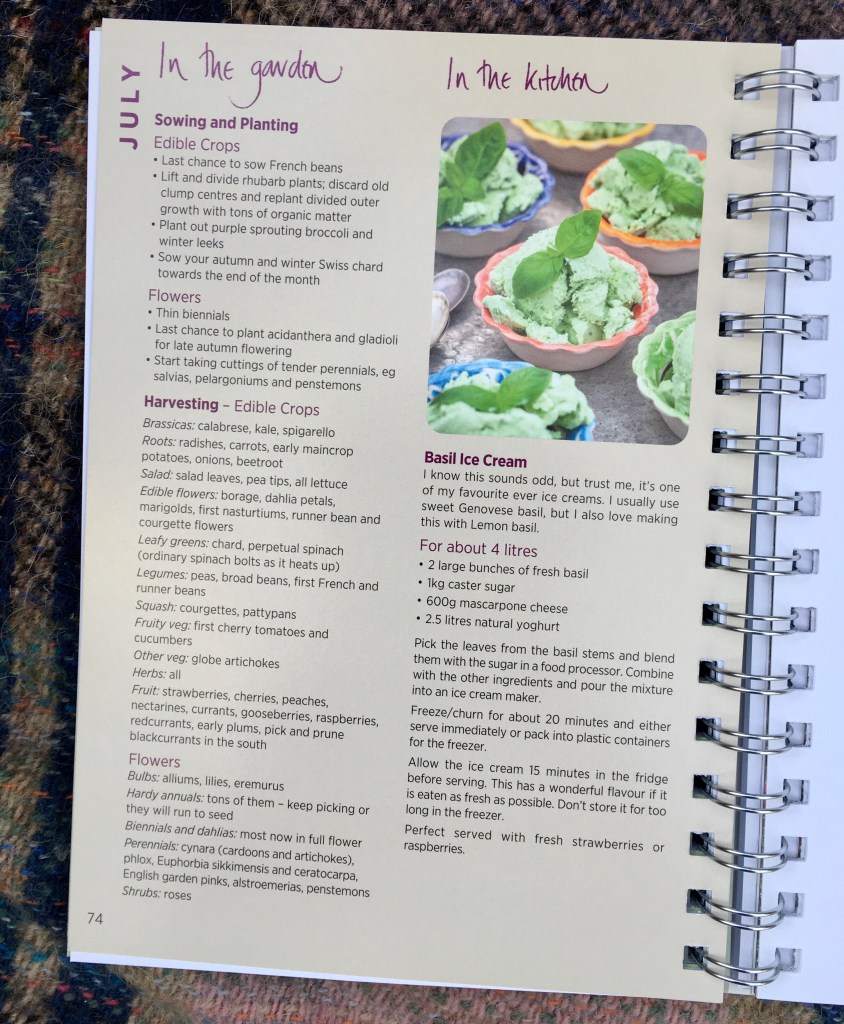
I’m intrigued by this basil icecream recipe for summer. As Sarah says, it sounds odd, but I’m going to give it a try and report back.

I’m going to have a go at these dried allium and poppy seed head decorations as well. Such a beautiful and cheerful Christmas scene from the fireplace at Perch Hill.

Other features of the book I liked: The fold-out ‘when and how’ guide on seed sowing for cut flowers. The guide to sowing and planting edibles, wild flowers, fruit, potatoes, herbs and salads. A guide to sowing and planting ‘pollinator super’ plants to attract bees and butterflies. There’s a useful ruler for seed sowing spacing. And the metal ring binder design means the diary can easily be folded back on itself.

There are not many books I carry around with me all the time, but the Sarah Raven diary is robust enough to slip into my garden tool kit bag, and is proving a joy to dip into on a daily basis.

https://www.sarahraven.com/products/sarah-raven-diary-2021

Sarah Raven also sent me a wall calendar to try, and this too has beautiful photos for each month and plenty of space to write appointments and events. Both will be ordered for 2023 as I’m thoroughly enjoying using the calendar and diary.

Do any of you write a garden diary? My father in law used to keep a perpetual diary. Sadly he died last summer, but he gave me his diary with all the daily notes about sowing dates and varieties he preferred. I check each day to see if I am keeping up with his impeccable timetable. It’s a lovely way to remember him and a reminder of all the flowers he grew for his wife Joan, and the fruit and vegetables he grew for the family.

Accidents in the Garden

Winter is just around the corner and there’s a feeling of urgency to get on with gardening jobs, before the weather turns cold. I’m always rushing around. There’s tender plants to bring under cover, pots to plant and bulbs to sort out. There’s never enough time to do everything. However, gardening tasks can end in accidents causing painful injuries. Here’s a reminder to take extra care this autumn and winter when working in the garden.

TAMSINS STORY

Tamsin Westhorpe. A photo I took in 2018 at Chelsea Flower Show where Tamsin was one of the judges.

We were all shocked to hear news that Tamsin Westhorpe had suffered a fractured spine in a recent gardening accident. Tamsin is a writer, and editor and works as a gardener at her family’s farm, Stockton Bury Gardens, in Herefordshire. I wrote about Tamsin last year when she published her country diary book. Here’s a link: https://bramblegarden.com/2020/02/22/diary-of-a-modern-country-gardener/

Tamsin at her book launch at Hatchards, London.

I asked Tamsin to tell me what happened when she had her accident in the garden, and here’s what she said:


It was a sunny Saturday at the start of September. I had a rare day off from work, so I was determined to make a mark on my much-ignored home plot. My day job is to help my uncles garden their four-acre open garden, so my plot gets pushed to the back of the priority list.

What task were you doing when the accident happened?
I have a row of six aronia trees that I like to keep to a manageable height of about 9ft. My aim was to remove the very enthusiastic young growth and give them a neater shape. To reach the centre branches I needed a ladder. In my haste a grabbed a lightweight A frame ladder and headed down the garden armed with enthusiasm and secateurs. I was on a mission to get as much done in a day as possible.

Describe what happened next.
Standing on one of the top steps I simply leant forward to reach a central branch and the ladder went from under me. It happened so quickly, and I found myself flat on my back on the lawn in agony.

What were your first thoughts?
My first thoughts were for the garden. Who would lift my dahlias and plant the tulips? Being part of a small family business, I was concerned how the other members of the family would be impacted. Physical fitness is essential for my work.
My second thought was that I’d been a complete idiot and should’ve waited for someone to hold the ladder. To say I was cross with myself was an understatement.

How did you get help?
My garden is in a rural location and not looked over by any other houses. I shouted but no one came as my family were out. I know only too well that you shouldn’t try and move if you have an accident, but I was struggling to breath, so somehow struggled to the house to get my phone. How long this took and how I can’t recall.

What were your injuries?
My spine has a stable fracture and I cut the back of my leg quite badly. However, I have been incredibly lucky. I’m so thankful that my spinal cord wasn’t damaged, and I didn’t hit my head. As far as I’m concerned, I have had a very lucky escape.
When working from a ladder in future I’m going to ensure that the pots and tools are placed well out of the way and I always have a friend or family at the foot of the ladder.

How long will  your recovery take?
All being well I will make a full recovery in about 12 weeks. I should be able to plant my own tulips this year! For now, I’m not lifting anything and I’m focusing on doing all the right things to speed up my return to the garden. I’ve already seen the impact of trying to rush things so I’m not about to make the same mistake twice.

Anything happened like this before?
I’ve been gardening since the age of 16, spending time as a parks gardener, greenkeeper and interior landscaper. In all those years I have only succumbed to one nasty incident with a pair of secateurs (again caused by trying to rush a job) and a few splinters. So, all in all I’ve been lucky and don’t see gardening as a dangerous hobby – far from it in fact. Gardening has kept me physically fit for decades. I’m the only danger! By being impatient and trying to garden at speed I’ve caused this accident to happen and only have myself to blame.
Having said all that I think my steel toe capped boots have saved my toes on many occasions.

How do you feel now, mentally and physically?
I am feeling better by the day and although I can’t do anything for long, I’m seeing improvements in my physical heath. A gardening friend suggested I put comfrey oil on my back to help with the healing process. I have no idea if it is working but I love the idea of a plant being involved in my recovery.
Having not experienced an accident of this nature before I was surprised at how much shock has an impact on your mental wellbeing. It’s been difficult having to scratch out events in my diary, but I have the good fortune that I will recover. The messages from fellow gardeners have been a great help and I’ve been thrilled to hear from many who say they now won’t go up a ladder without an ‘assistant’. I’m glad that my accident might prevent others from having a similar experience.
This time has made me feel such concern for those who won’t recover from an accident or can’t tend their garden due to old age. I can only imagine how frustrating and devastating this must be. I’ve also experienced the healing power of nature. Thanks to a wonderfully warm September I have been able to recover under a blue sky outside. Watching the birds and insects flutter around me has been just the best medicine. It’s given me time to realise how important gardening is to me and my health.


What advice would you give other gardeners?
Invest in a proper gardening ladder for one. Secondly never use power tools and climb ladders when on your own in the garden. Thirdly keep your mobile phone in your pocket but put it on silent so your gardening time is undisturbed. But, the most important thing is to never rush gardening – sip it like a good glass of wine and savour every moment. It’s not a race.

Update: Tamsin has made a good recovery, and is now back at Stockton Bury making a start on light gardening duties.

Here’s some photos of Stockton Bury taken when I visited the garden this summer.


Clematis Prince of Wales
The stream and pond garden
Turks cap lily with rodgersias.

Have you any experiences to share involving injuries while gardening? Please share any advice and suggestions.

Please feel free to share this item on social media. Thank you for reading my blog.

The View From Federal Twist- new book giveaway draw results.

Thank you to everyone who read my recent review of James Golden’s new book published this week by Filbert Press.

A computer random name generator picked out two winters: Shaun and Jane.

I am also sending a selection of other new titles to Vanessa, Peter, Amelia and Sharon.

You can read my review here : https://bramblegarden.com/2021/10/28/the-view-from-federal-twist-book-review/

Thanks again to everyone who left comments. There will be more book and product reviews in the next few weeks. I’m very grateful to book publishers for sending out giveaway copies. Have a great gardening week everyone.

The View From Federal Twist- Book review

By James Golden

Published by Filbert Press

UK publication day 28 October 2021 £40

ISBN: 9 781999 734572

The publishers have kindly offered one copy to give away. Please leave a comment at the end of this review, and one name will be randomly selected on Sunday 31st October 6pm.

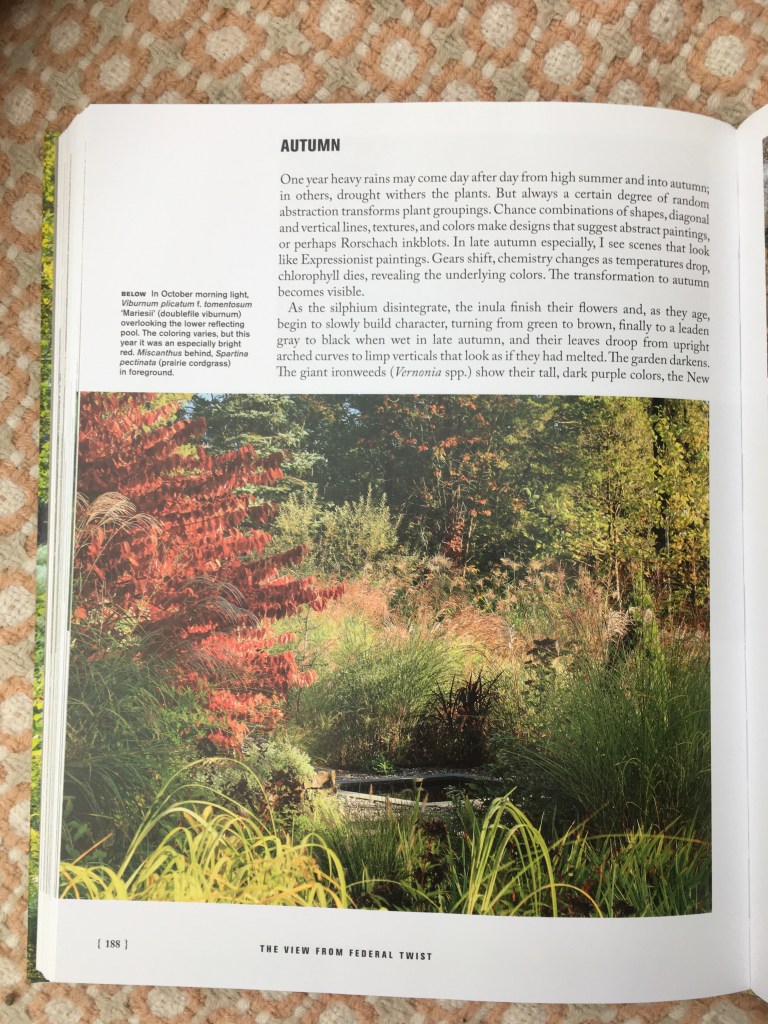
Books have a power to move. To tears, to joy, to despair. Sometimes they transport you to another place. James Golden takes you by the hand and leads you through the garden he’s created, and it’s one of the most beautiful, inspiring journeys you’ll ever take. In his new book, The View from Federal Twist, he describes what it’s like to create a garden from scratch in western New Jersey, USA. His garden is set in a clearing in the woods. He made a conscious decision not to improve the land. Instead he ‘listened to the site,’ placed large competitive plants into rough grass and watched and waited as sustainable plant communities emerged. The result is a magical place, a naturalistic garden -with a difference.

James describes the book as a retelling of the making of his ‘first serious garden.’ It’s a triumph of ecological planting and clear design aims. James is part philosopher, part experimental horticulturist. The result has such an emotional power- it’s breathtakingly beautiful. Evocative photographs capture the effects of light shining through the canopy of trees, grasses and shrubs. Just the scale of planting is mesmerising.

A view of garden taken from a drone. The stone circle is the largest structure in the garden. It’s made of a hard local mudstone called argillite ( ‘blue jingle’ in the local argot, because the stones ring when hit together) that is ubiquitous in this area. Here the circle is like a plant dam, preventing spillover of the prairie into one of the few open spaces in the garden. Like the rest of the garden, James says, it has no utility. It exists to add visual weight, atmosphere and to serve as a stopping place, perhaps to “sit, observe, or let your mind wander.”
James writes: “Further along the terrace, towards its sunny eastern end, this small rectangular reflecting pool makes an elegant contrast with the surrounding naturalistic plantings. The juxtaposition of the sharply defined pool, the repeated domes of miscanthus, and the flowing vegetation give this part of the garden a ‘designed’ look not typical of the garden as a whole.”
Views through the seasons
Planting the garden.
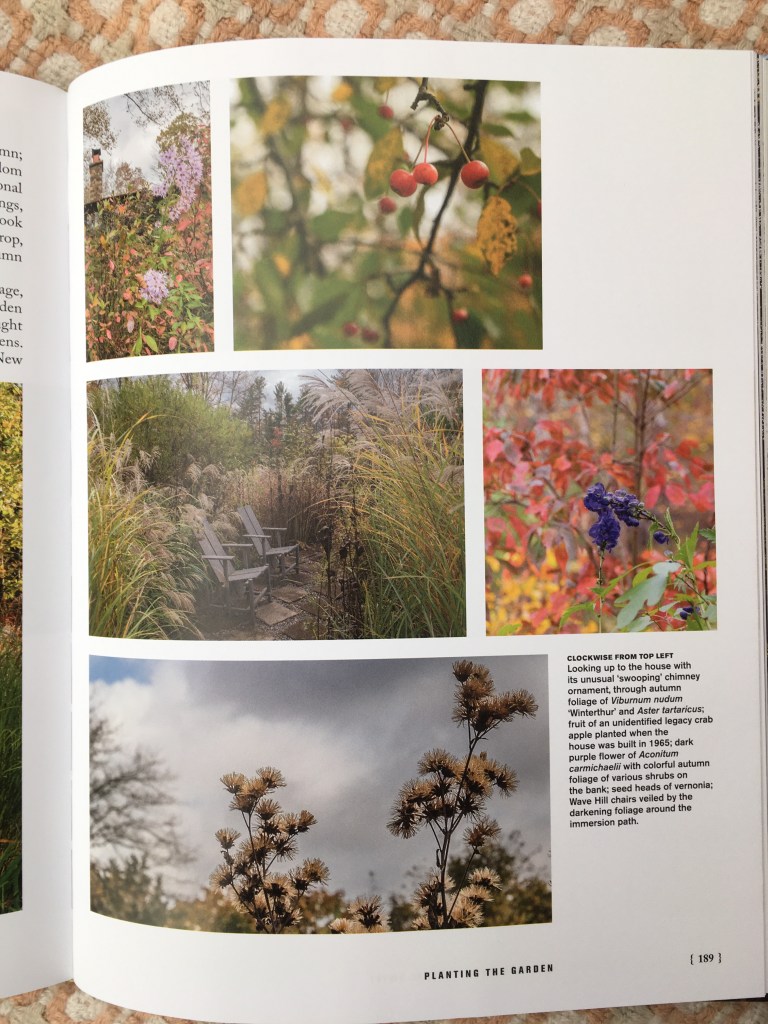
Clockwise from top: Hosta sieboldiana, Iris virginica ‘Contrabrand Girl’ Cephalanthus occidentalis, the canal pond, the bare garden in spring after cutting back, Euphorbia palustris, Dryopteris erythrosora, Maianthemum racemosum – about to flower.
The garden in winter.
A clearing in the woods. The Federal Twist road is not well-known. It’s hidden in the woods above the Delaware and is only four miles long. James says “I accepted a very ungarden-like place as my garden destiny.”

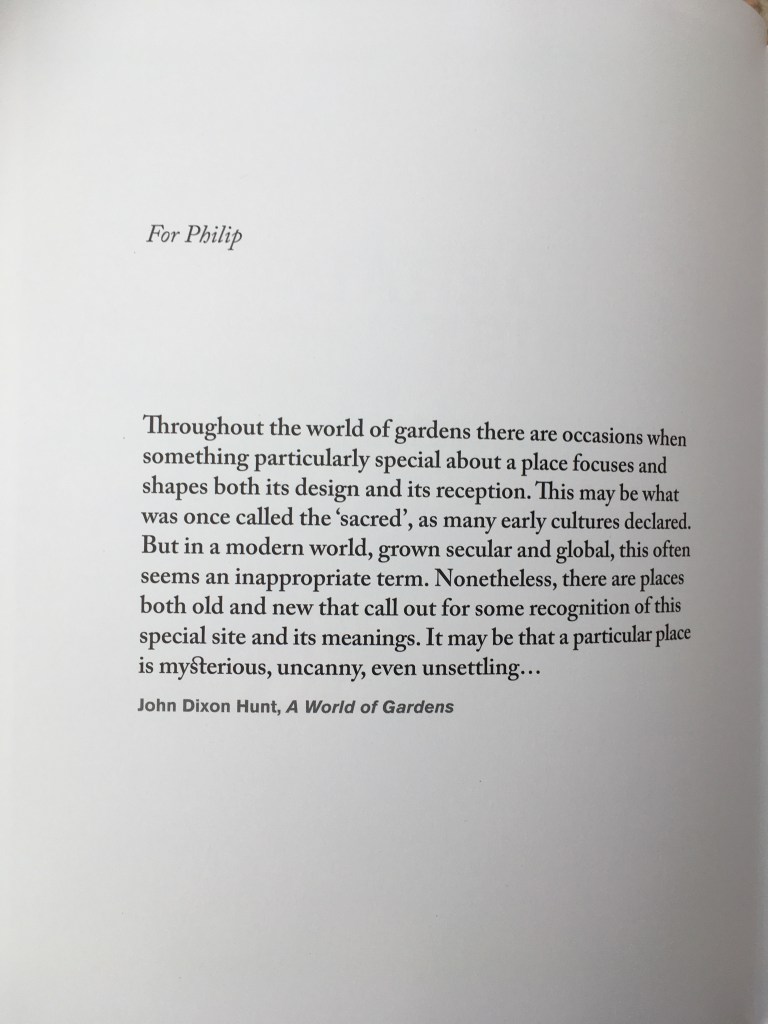
The book is dedicated to Philip.
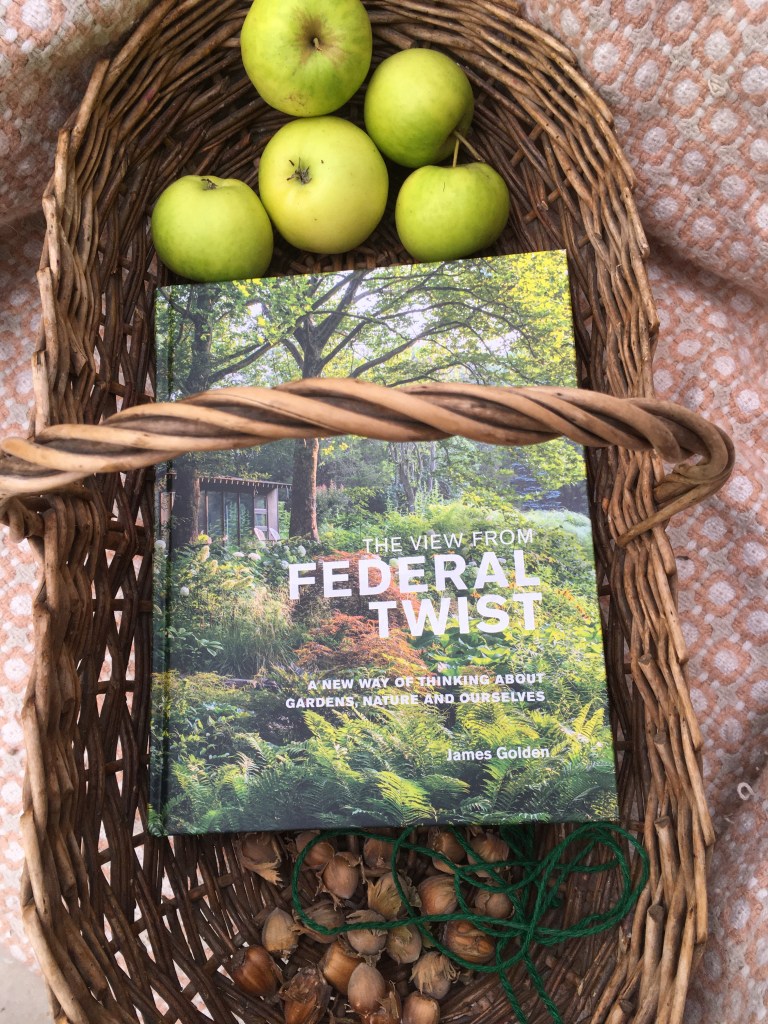
Front cover

“I am Federal Twist,’’ says James. He realised this when he looked at photos of the garden from above. He put the images side by side with those taken from ground level. “When I put the two images side by side, my reaction was immediate- and astonishing. I felt icy fear. The drone image showed a flat piece of earth totally devoid of feeling, offering no comfort, no warmth, no humanity, no place for me. I felt as if I were seeing with the eyes of an alien being. In contrast, the ground-level photography held me firmly within the garden; it gave me a place to be, a protected place under trees; it made me feel a part of the landscape. I felt comforted, and a sense of belonging.”

Later, he writes “…my life and emotions are closely bound with this place I call my garden. I understand physics well enough to know that my physical body intersects with the garden, interacts with the garden, responds to the garden in some kind of mutual way. I ‘live’ the garden every day. I am Federal Twist.”

Thank you for reading my review. I believe some books come into your life at just the right moment. It’s almost as if they were ‘written’ for you. To give you joy, to give you inspiration; to give you hope. I haven’t been able to write for a while. Grief affects people in different ways. I’ve sat with grieving friends and relatives and they’ve wanted to talk non-stop for hours. Others write sonnets, pen poems, write books. Grief suddenly and unexpectedly silenced me. I didn’t want to talk. I didn’t want to write, I am someone who tries to make things better for everyone. Perhaps I just didn’t want to make anyone else feel sad. There’s no easy path back from grief, it takes time. But reading this book has helped. It’s put into words how I feel about my own garden- how my little plot has kept me afloat these past few months. I, too, feel I ‘live’ my garden. It responds to me; it’s like enfolding arms around me, lifting me up and helping to turn my face to the sun again.

Home. Sunshine lighting up the field maples. There’s tiny hazel catkins forming in the native hedgerow. They will sit there and wait till spring. Rosehips and sloe berries for the birds. Viburnum and hawthorn berries shine, sealing wax red. Life goes on.

Lilies: Book Review and Giveaway

By Naomi Slade

Published by Pavilion Books

Hardback. 240 pages. Photographs by Georgianna Lane

Published May 2021. RRP £25

ISBN: 978-1-911663-00-3

Lilium African Queen. An outward-facing trumpet lily. Suitable for large pots, planting at the back of the border, and for cut flower gardens.

For many years, all down the sides of my greenhouse, I grew tall pots of lilies. My favourites were the towering, elegant trumpet lilies, African Queen. They grew to 5ft and produced masses of rich apricot flowers with rose garnet blush shades on the reverse of the petals. Stunning to look at, and the scent was equally wonderful. That spicy, heady scent drifted all around the orchard, wild flower meadow and up through the mini-woodland. Beautiful, intoxicating and memorable.

It was lovely to stand in the greenhouse and see the flowers reaching almost the roofline. A good background for my summer container display within the greenhouse where rows of scented pelargoniums lined up amongst the citrus trees.

African Queen is just one of the many varieties featured in Naomi Slade’s new book, Lilies. The book is written in the same style as Naomi’s 2018 publication, Dahlias. I wrote a review of Dahlias here : https://bramblegarden.com/2018/06/24/dahlias-beautiful-varieties-for-home-and-garden/

Naomi’s new book is a celebration of all kinds of lilies. There’s an introduction, a section on the history and botany of lilies, followed by detailed instructions on growing and caring for lilies. Advice is given on where to buy bulbs, how to prepare the soil and plant, and how to water, feed and deadhead lilies. There’s enough information for beginners to get started, and enough detail for more experienced gardeners to have a go at propagating and preparing lilies for shows. Everything you need to know to get the best out of these lovely summer bulbs.

The lilies chosen for in-depth study are split into sections; Elegant and Dainty, Wild and Wonderful, Fiery and Fabulous, and Majestic and Magnificent.

Mascara is a black Asiatic hybrid featured in the Fiery and Fabulous section. It grows to 1m with upward and outward-facing blooms. It will grown in any good garden soil and makes a stunning cut flower.

Helvetia is in the Elegant and Dainty section. Upward-facing with reflexed petals, these lilies grow to 1- 1.2m tall and are highly fragrant. Recommend for the front of a border and containers. Would make a wonderful cascading wedding bouquet.

Another very pretty white flower is Polar Star. I’ve grown this in pots many times. 25 bulbs in a large Italian terracotta pot makes a stunning summer display. These have large fully-double upward and outward-facing flowers and grows to 70-100cm tall. Very long lasting in a vase.

lilium leichtlinii is one I haven’t grown before. It is not that common in cultivation, says Naomi. But well worth seeking out. Small pendant flowers with reflexed petals, growing to 1-1.4m tall. Unscented. Suitable for a naturalistic garden. Sophisticated in a vase.

Another lily with swept back petals is Ariadne. This Turks cap type grows to 1.2-1.8m with small pale, dusty rose flowers. Good for the back of the border and set against a foil of dark foliage, or a contrasting painted surface. Could be used for cut flowers, but you’d need a tall vase.

Georgianna Lane is a leading floral, garden and travel photographer whose work has been widely published. She captures the timeless elegance and beauty of this summer garden favourite.

Naomi Slade is a well-known figure in the world of gardening media. She writes and broadcasts about horticulture, design, environment and lifestyle. Lilies is beautifully well-written. A book you’ll delve into time and time again, and it’s so full of joy it will make you smile every time.

The publishers have one copy to give away in a prize draw. Please leave a comment below and names will be put in a hat and a winner randomly selected next Sunday.

Thank you for reading my reviews and for taking the time to comment. The comment box is below the hashtags at the bottom of the page. Or click on ‘comments’ next to the title.

Get Up and Grow: book giveaway winner…

Announcing the winner of my prize draw for Get up and Grow by Lucy Hutchings. The winner is Kate Elliott. Thanks so much to everyone for reading my review and leaving a comment.

The next book up for review and giveaway will be ‘Lilies’ by Naomi Slade.

My review for get up and Grow is here: https://bramblegarden.com/2021/05/16/get-up-and-grow-book-review-and-giveaway/

Thank you to the publishers, Hardie Grant Books, for supplying a free copy for the prize draw. The book is hardback, 159 pages. Lucy creates 19 projects and shows how anyone can grow pretty much anything in their back garden, courtyard, balcony or kitchen- or even right by their work desk. There are unusual and inspirational growing ideas for herbs, fruit and vegetables, and all look as beautiful as any ornamental garden. Living walls, hydroponics and daylight spectrum grow lights are all explained with step-by-step instructions.

Lucy’s farm desk project
Kokedama citrus plants make a striking statement planting.
Indoor growing space, using a clothes hanger as a trellis frame.
Another indoor growing space using an adapted IKEA cabinet.

Windowsill growing space for herbs, fruit and vegetables.

Thank you again for reading my blog. It’s much appreciated.

You might also be interested in reading:

Gardening On the Menu -Book Review

The Creative Kitchen – Book Review

An Orchard Odyssey- Book Review and Prize Draw

Get Up and Grow- book review and giveaway

By Lucy Hutchings

Published by Hardie Grant Books

Hardback 159 pages

ISBN 978-1-78488-392-8

Growing fruit, vegetables and herbs doesn’t require acres of ground. In fact, you can grow virtually anything in pots, on a balcony and even indoors- if you just have the right techniques and equipment. In Lucy Hutchings’ new book, Get Up and Grow, there’s tips on everything you need to step up your gardening to a new level and grow whatever you fancy in a fresh and exciting way. Judging by the photos in Lucy’s book, the results will not only be a feast for the table, but a feast for the eyes too. Everything looks absolutely stunning.

Here’s a selection of my favourite projects from the book:

An indoor greenhouse, made from a glass display cabinet and fitted with full spectrum grow lights. IKEA sell similar cabinets or you could recycle some furniture.
I love this idea – growing microgreens in self-adhesive window trays. These are the sort you can buy for showers. Usually they are used for storing shampoo and soap. Ingenious idea, using them for growing nutritious microgreens.
Lucy also shows you how to convert an over-door hanging storage rack into a window herb garden. These can be moved around the house, or can be hung on a sunny wall or fence outdoors in the summer. Lucy has one hanging on her greenhouse sliding door, making use of all available space.
A salad garden on wheels! It can be moved around the home to make the most of natural light, or be wheeled out on to the patio on sunny days.

More projects from the book. Lucy, a former couture jewellery designer, is @shegrowsveg on instagram and writes a blog at http://www.shegrowsveg.com

The book covers the basics of potting up, using lights, feeding, watering and trouble-shooting. Perfect for beginners, or more experienced gardeners looking for a bright and modern new way to garden. The ‘suppliers list’ at the end of the book is also quite a revelation with lots of suggestions I’d never even thought of. I can’t wait to get started on my own growing projects. With Lucy’s step-by-step illustrations and clear instructions, I should soon be growing kokedama oranges, having a go at hydroponics and making a ‘living wall.’ I’ll report back on my progress!

Thanks for reading my blog.

The publishers have kindly offered one copy for a prize draw. Please leave comments below to be included in the draw. A name will be randomly drawn on Sunday, 23 May at 6pm. There will be nothing to pay and I will contact you from my e mail which is k.gimson@btinternet.com.

Garden News Magazine recipes for December

If you’ve received your copy of Garden News Magazine this week, here’s the recipes I mention in my column. Above is the summerhouse where I write my pieces, and where I sit and make my cherry marzipan chocolates.

The recipe link for Cherry Marzipan Chocolates is here :

https://bramblegarden.com/2018/12/04/family-favourite-recipes-chocolate-marzipan-cherries/

They are very quick to make and children love creating them. They make tasty home-made presents for Christmas.

I also write about Chocolate and Orange Panettone. Start saving your tins now to make these delicious treats. They are very easy to make and look beautiful. Get the children to make potato stamp labels. Be as creative as you like. Everyone can get involved.

Here’s the link: https://bramblegarden.com/2019/12/02/christmas-recipes-chocolate-panettone/

I write about turning my satsumas from the greenhouse into a liqueur. The recipe comes from Bob Flowerdew, replying to me on twitter when I asked what I could do with this year’s prolific harvest. It’s been a good summer for growing citrus. Bob always has great suggestions for what to do with produce from the garden, and is generous with his advice.

Here’s Bob’s recipe for Satsuma Liqueur :

And finally, I was talking on the radio last week, when I mentioned I was making Sloe Gin. Here’s the recipe, with thanks to garden writer Barbara Segall, who inspires me on a daily basis to try something new.

Sloe Gin

450g sloe berries -or whatever you can find. If you only have 300g, use those.

350g caster sugar

710ml gin

Kilner jar or lidded jar

Place the ripe sloe berries in the freezer to break the skins. Add all ingredients to a large kilner jar. Swirl the contents every day for a week, every week for a month, and every month for a year. Strain the gin. Use the berries for cakes or trifle.

It’s wonderful to have a bottle on the north-facing kitchen windowsill. Mine has changed colour now and it’s a joy to see. Almost like a stained glass window.

Barbara Segall has written many garden books, all highly recommended. One of my favourites is The Christmas Tree. A beautiful stocking-filler. Find out more here : https://thegardenpost.com/category/christmas-tree-book/

https://www.ebay.co.uk/itm/The-Christmas-Tree-book-by-Barbara-Segall-NEW-/174501320740?_trksid=p2349624.m46890.l49292

For more suggestions on books, I also recommend The Creative Kitchen by Stephanie Hafferty. I reviewed the book here:

https://bramblegarden.com/2018/11/18/the-creative-kitchen-book-review/

Here’s a link for Georgie Newbery at Common Farm Flowers for growing cut flowers, floristry and Christmas wreath workshops and courses, in person, and on-line. Vouchers make a great present for any gardener. https://www.commonfarmflowers.com/collections/workshops

Thanks for reading! Have a great week.

Book Review: American Gardens

By Monty Don

photos by Derry Moore

Published by Prestel

Hardback 223 pages

ISBN: 9783791386751

Published autumn 2020

£35

Such a lot has changed since Mum and I sat, side by side, watching Monty Don’s American Gardens television series over the winter. Little did we know corona virus was on the way, and we wouldn’t see each other for most of the spring and summer. One of our simple pleasures in life is to watch the gardening programmes mum has recorded the week before. Enjoying our home-made cake and cups of tea, we would um and ah over the gardens- much more fun than watching alone. We were unanimous in our admiration of glorious, colourful, plant-filled gardens, and sternly, dismissively critical of others. And laughter. There was much laughter. Such fun. Just watching in companionable silence too. I miss those moments. Mum has to be extremely careful. So our fledgling visits to each other’s gardens have been cautious and metres apart. Indoors, and television -watching, is rationed. I touch nothing and keep a distance. This is how it will be until we have faster, easier corona virus testing. Or a vaccine.

Just as I’m mulling over all the changes to our lives, and trying to solve a few impossible problems, Monty’s new book arrives. And I sit down and read it. From cover to cover. Monty Don asks, ‘What is an American garden.’ Well, if he can be as bold as to attempt to find the answer to that question, I’m sure I can overcome one or two tricky dilemmas of my own. I clearly remember Monty saying “The belief you can do anything, if you believe in it enough, is what defines the American Garden.” Reading his new book transports you to another place where anything is possible. And that’s certainly a message we all need right now.

Here’s some of the gardens I picked out to show you, and ones I enjoyed in his new book.

The Federal Twist garden, Stockton, New Jersey is one that stands out.

I’m still chuckling over the quote from owner James Golden, who says,”I forgot to mention that I hate gardening.”
Monty notes “It was probably a well-rehearsed line but, given the extraordinarily beautiful garden he has created and the deep pleasure that it clearly gives him, an effective show-stopper. Why? I asked. ‘I hate getting my hands dirty. I hate struggling to separate roots and then digging a hole. I have someone to do that for me. I place the plants, pull plants out. I’m constantly working out what I need and where to move things. I don’t feel it necessary to dig or plant to be fully engaged with the garden.’ I suspect that the British, and in this I include myself, fetishise the actual process of gardening too much, sometimes to the extent that the hardworking, skilful means justify the rather dull ends.”

A revealing portrait of the gardener, and of the garden visitor, Monty Don.

These are my i-phone photos of the book taken in the potting shed, and do not do justice to the clarity of the stunning photography by Derry Moore.

Federal Twist.

Federal Twist.

The swimming pool at the Bob Hope House, Palm Springs.

Inside the Amazon Spheres in Seattle.

Climbing fig (Ficus pumila) in the orangery at Dumbarton Oaks, Washington DC.

Vizcaya, Miami, Florida. The house reflected in the Tuscan-inspired pool.

Prairie Garden Trust, New Bloomfield, Missouri. A field of coneflowers.

Central Park, New York City. The two towers of the San Remo apartment building designed by Emery Roth in 1930.

Longwood Gardens, Kennett Square, Pennsylvania.

Monty sitting under a banyan tree. He looks lost in thought. The sheer scale of the trees and the landscape. It’s mesmerising.

You’ll have to read the book to see what conclusions Monty arrives at. I found it a joy to read in these troubled times. If humans can create gardens such as these, surely it gives us hope. Anything is possible. And at the end of the day, that’s what we need most of all at the moment. Hope.

Links:

Leave a comment in the box at the bottom of the page, and Prestel will select one reader to receive a free copy. Sorry, uk addresses only at the moment. I’ll run another draw when the book is published in America. It would make a wonderful Christmas present. It’s certainly a ‘wow’ production, with glossy double page spreads of photographs and thought-provoking writing.

Prestel publishing: https://prestelpublishing.randomhouse.de/book/American-Gardens/Monty-Don/Prestel-com/e570814.rhd

Federal Twist garden: https://federaltwist.com/

I’m @kgimson on twitter and on instagram https://www.instagram.com/karengimson1/?hl=en.

Thank you for reading.

Hydrangeas Book Winner…..

Would SHIRLEY please get in touch. You left a comment on the blog for Naomi Slade’s new book Hydrangeas and you have won a copy. Many thanks for taking part in the prize draw. The publishers selected your name in a random draw. All the best, Karen at k.gimson@btinternet.com

Review here: https://bramblegarden.com/2020/06/05/hydrangeas-book-review-and-1-copy-to-give-away/

Winners of recent prize draws: https://bramblegarden.com/2020/06/12/winners-thank-you-for-entering-the-prize-draws-on-this-blog-here-are-the-recent-winners-names/

Thank you for reading and for leaving your comments. It’s much appreciated.

Winners! Thank you for entering the prize draws on this blog. Here are the recent winners’ names:

Hydrangeas by Naomi Slade.

Hydrangeas by Naomi Slade was won by Shirley . If she would kindly e mail me, I’ll ask the publishers to forward a copy of this gorgeous new book. k.gimson@btinternet.com.

Review : https://bramblegarden.com/2020/06/05/hydrangeas-book-review-and-1-copy-to-give-away/

Blagdon Pond-in-a-box : won by Jacksb50. Who was also sent some Blagdon pond clean pods to try out.

Review: https://bramblegarden.com/2020/05/07/blagdon-pond-in-a-box-review-and-prize-draw/

Corokia -My Adventrue by Mona Abboud. Won by Suella, who also won a bundle of new products including : Activearth sample.

https://bramblegarden.com/2020/03/29/corokia-my-adventure-my-bbc-garden-hour-book-of-the-week-book-review/

https://bramblegarden.com/?s=Activearth

Hozelock Pure Bokashi composter was won by Lucy Corrander.

Review: https://bramblegarden.com/2020/03/21/hozelock-pure-bokashi-composter-on-trial-and-one-to-give-away-saturday-21-march-2020/

Hozelock Tuffhoze was won by Mary Thomas.

Review: https://bramblegarden.com/2019/12/05/hozelock-tuffhoze-on-test-at-bramble-garden/

Wildlife World Wildlife Observation Camera was won by Sean.

Review: https://bramblegarden.com/2020/03/17/wildlife-watching-camera-on-trial-and-prize-draw-for-readers/

Diary of A Modern Country Gardener by Tamsin Westhorpe, won by Cathy Lyon -Green

Review: https://bramblegarden.com/2020/02/22/diary-of-a-modern-country-gardener/

I’m very grateful to all the gardening suppliers and companies offering prizes for readers. I love trying new ideas. I’ll try anything, providing it is suitable for organic gardening and doesn’t harm any living creature. I never accept payment for trying the samples. I prefer to be free to give my honest opinion.

Thank you also for reading and for leaving comments. Look out for more gardening books on the horizon, a Hozelock liquid feed kit, some Japanese Niwaki garden secateurs and some new organic pest and weed control products. It’s interesting to see what’s available for gardeners in modern times. My grandfather would have been amazed by the wide choice of products. He would have loved trialling them as much as I do. Things certainly have changed since he gardened in the 1940s and 1950s. Many products make life a lot easier, all round.

Diary of a Modern Country Gardener

Secrets for Every Season Straight From the Potting Shed

By Tamsin Westhorpe

Orphans Publishing ISBN 9781903360422

Hardback. 248 pages. £20

Illustrations by Hannah Madden

Book review and prize draw. Please leave a comment to be included in the draw.

We are all standing at our house windows gazing on waterlogged, storm lashed gardens, aching to be outside gardening. It’s doesn’t matter what kind of gardening, anything, as long as we can run some compost through our fingers and see green shoots emerging. It’s been a long wet winter.

Luckily Tamsin Westhorpe has a beautiful new book which transports us immediately to gardening heaven- Stockton Bury in Herefordshire. It is a very welcome and timely escape.

Tamsin is the 5th generation to garden at her family’s farm. The four acre garden within the farm has fruit and vegetable plots, a stream and pond, ‘rooms’ with different planting themes and a dovecote dating back to the time of Henry 1. The land has been worked by the family for more than 100 years, and the much-acclaimed garden is open to the public.

In her new book, Diary of a Modern Country Gardener, Tamsin lets us into her world as we see her facing all kinds of gardening challenges, accompanied by lots of laughter.

There’s expert advice on growing cut flowers, staging summer garden parties, selecting and planting trees, planting bulbs, storing produce, keeping chickens, coppicing hazel and more. I particularly like the ‘tool kit’ panels detailing equipment and materials needed for the list of jobs suggested each month. A useful reminder before getting going on tasks. There’s nothing worse than starting something, and then having to stop to search for forgotten items to complete the project.

I also like the list of ‘must-have’ plants for each month. January suggests Cornus mas, crocus tommasinianus, cyclamen coum, eranthis hyemalis, hamamelis, hellebores, iris reticulata, mahonia, snowdrops, viburnum Dawn and narcissus Bowles Early Sulphur. You can almost smell these spring delights. There’s something cheerful on every page.

As we follow her daily life there’s lots of hints and tips on what to do and when. But this is much more than a ‘how to’ book. It’s a book about solving problems, dealing with gardening conundrums, interacting with people, and simply enjoying every single moment.

I love books where you can really hear the author’s voice. Tamsin’s voice is loud and clear and full of humour. Her stories are compelling. She makes you want to jump in a car and drive over to see what she’s getting up to today. You’d have a real good natter, and come away smiling and fired up with ideas to get going on your own plot. She’s that kind of person who makes anything feel possible.

Her diary does exactly what it says on the tin; it’s a daily insight into the workings of a country garden. There are plenty of ‘secrets’ to be told. I won’t spoil them by retelling them here. But there’s a very interesting story about what she wears in the garden! Apparently her mother set the trend. You’ll have to read the book to find out more. It’s perfect escapism. And the one place you’ll all want to be is in Tamsin’s garden.

The book is beautifully produced and bound by well-respected Orphans Publishing, accompanied by truly gorgeous illustrations by artist Hannah Madden. A thing of beauty. Highly recommended. You’ll soon forget all about the weather! I promise.

Tamsin going through the proofs at Herefordshire Orphans Publishing.

Tamsin and Hannah Madden celebrating their first copy of the book.

Some pages from the book, taken with my i-phone camera. The quality of the photography is much better than I’ve managed to capture here.

About the author, taken with my i-phone camera.

Excerpts from the book for March

Excerpts for June

August

Tamsin Westhorpe’s diary was my book of the week on BBC Local Radio Gardening. It would make an excellent BBC Radio 4 read-aloud Book of the Week. A best seller, I think.

Thank you to Orphans Publishing for offering a free copy for our prize draw. Please leave a comment below to be entered in the draw. Please also comment if you do not wish to be entered in the competition, and let me know. Some of you may have already ordered a copy. The publishers will randomly select a winner. No cash prize alternative and usual rules apply.

Links: Tamsin Westhorpe https://www.tamsinwesthorpe.co.uk/

Orphans Publishing https://www.orphanspublishing.co.uk/

Stockton Bury http://www.stocktonbury.co.uk/

Garden Media Guild https://www.gardenmediaguild.co.uk/

Karen gimson on twitter @kgimson

On instagram karengimson1 and Pinterest.

Thank you for reading. I am very grateful for your 150,000 page views, all kind follows and shares. Please share this on any social media platform. It all helps me immensely.

Apple and Almond Slice- Family Favourite Recipes

At this time of year, my kitchen work surfaces are covered with piles of apples. Little pyramids of golden cooking apples, tiny rosy red eating apples, giant Bramleys. My family complain. There’s nowhere for anyone to put anything down. I usually store them wrapped in newspaper in the potting shed, but I’m still trying to evict the mice, making many trips back and forth to the woods with my tunnel-like humane traps baited with peanut butter. I can’t kill them. They will take their chances in the leaf litter under the trees. I’m trying to ignore the tawny owl fledglings in the branches above, still being fed by harassed parents. I feel slightly guilty. But watching the mice run when I let them out, I think they stand a fair chance of surviving.

Meanwhile, I’m steadily working my way through the apples. My mother always says, if you’ve got an apple, you’ve got a pudding. It can be an apple pie, a crumble, a cake, or if you are pressed for time, just apple purée with lashings of creamy custard, or Devon clotted cream. A special treat.

Today’s recipe is another family favourite, an apple tray bake which is quick and easy to make and tastes of autumn. As usually, I’m recording it here for my children, in case they can’t find the scraps of paper these recipes are written on. It’s so lovely to see my grandmother’s best copper plate hand writing, as she lovingly wrote these recipes for me. Food, and cooking, bring back such special memories, don’t they.


APPLE AND ALMOND SLICE:

INGREDIENTS – FOR THE TOPPING


30g butter or vegan margarine

30g SR flour

25g golden caster sugar

2 tbsp. Jumbo oats

1/2 tsp cinnamon

25g flaked almonds

METHOD

Mix the butter, flour and sugar together. Fold in the cinnamon, oats and flaked almonds to make a crumble topping. Place in the fridge while you make the base.

INGREDIENTS FOR THE BASE

150g SR flour

200g golden caster sugar

200g butter or margarine

3 eggs ( or use 6 tbsp. soya oat drink if vegan)

100g ground almonds

1/2 tsp baking powder

1/2 tsp almond extract

1/2 tsp cinnamon

2 large apples slices and tossed in lemon juice

100g any other fruit you have; blackberries, raspberries, blueberries, plums,

METHOD

Mix the flour, baking power , sugar and butter together. Whisk. Fold in the ground almonds and cinnamon. Add the beaten eggs.

Put half the mixture in the base of the tin. Put apples on top. Add the rest of the base moisture. Press the blackberries or other fruit on the top.

Cover with the crumble topping mixture.

Cook for 40-50 minutes, or until a skewer come out clean.

Gas mark 4, 180C oven, or 160C fan oven.

You’ll need a 20cm tray bake tin, at least 4cm deep, lined with baking parchment.

Put baking paper on top if it is browning too quickly. Leave to cool and slice into fingers.

Can be frozen for 3 months.

Enjoy!


You might also like : Review of Orchard Odyssey by Naomi Slade here :

https://bramblegarden.com/2019/09/27/an-orchard-odyssey-book-review-and-prize-draw/


Also The Creative Kitchen by Stephanie Hafferty https://bramblegarden.com/2018/11/18/the-creative-kitchen-book-review/

I’ll leave you with a photo of my 1930s summerhouse, looking autumnal today. There’s heaps of blankets to keep us warm when the temperatures start to dip. It’s quite cosy in here though.

The Flower Market Year – Book Review and Prize Draw

12 MONTHS AT NEW COVENT GARDEN FLOWER MARKET

By SIMON LYCETT

Published by Simon J Lycett Ltd

Hardback 192 pages, £21 approx

ISBN 978-1-9160912-0-7

Book photography by Michelle Garrett

Blog photos: bramblegarden

Florist Simon Lycett thinks nothing of working with 20,000 stems of roses for a wedding. I am trying to picture the scene, and finding it hard to imagine 20,000 flowers. Then Simon tells me this isn’t a one off. It’s something he gets to do on a very regular basis. I’m lucky enough to have a window on his extraordinary life, for just one day. I am visiting the New Covent Garden Flower Market, and Simon is my guide.

It’s still dark outside as I set off at 6am to meet Simon at the Flower Market in Nine Elms, London. We are standing amongst more flowers than I’ve ever seen, and we are inspecting the roses. Simon who has written a book about the market, explains that his customers have “magical weddings, the world over.” He loves the buzz of creating “magical settings in a world where everything is possible and the words ‘can’t do’ are never uttered.” It’s a revealing conversation, as he explains his customers expect total perfection. “They must have the best of everything. They’ll notice a little mark on the petal, and that’s no good. Utter perfection is what counts. The client is king.”

Simon, who regularly appears on television and radio, explains that everything starts with the selection of flowers at the market. And it’s clear that his relationship with the flower sellers is key. They seem almost like family, and it’s not surprising as Simon has been buying from the same people for 30 years.

We are introduced to Dennis Edwards who has been getting up at 2am to sell flowers for 54 years. His family are porters and sellers of fruit and vegetables. He’s the only one in his family to go into the flower market business. He describes it as a passion, rather than job. A life’s work to supply the creme de la creme.

In his book, The Flower Market Year, Simon says Dennis always has a few “specials” – buckets and trays of unusual items which he sets aside and keeps for Simon. “Dennis was the first person to ever serve me when, as a timid 20 year old, I ventured into the Flower Market for the first time. Dennis was then, and still is now, a Flower Market institution, always going above and beyond to find the very finest flowers and foliage, and ever in search of the unusual and the innovative, wanting to offer the largest, the biggest and the best blooms in the building.

“Born in Drury Lane, Dennis has worked in all three of the Flower Markets, firstly in the original Covent Garden Market, then, when it moved in 1974 to Vauxhall, in the New Covent Garden Flower Market, and now in the current (interim) market site a little further along Nine Elms Lane. In 2022, when all development is complete and he moves into the ‘New’ Covent Garden Market, he will be a record breaker!”

It’s fascinating to watch them talking. It’s as if each one knows already what the other is thinking. It’s clear Dennis instinctively knows which flowers Simon will need for his projects, and as I look around, perfection is key. I can’t fault anything. I’ve never seen flowers of such superb quality. It’s a scene that stays in the memory like a photograph because it’s so out of the ordinary.

Simon set out to record the workings of the flower market to “capture a real sense of the place,” with its salesmen and women, customers, porters, buyers and suppliers.

His book captures month by month what he’s seen and bought, and what’s inspired him to create floral decorations for his clients, for weddings, parties and corporate events. Simon doesn’t mention it, but on his website there are ‘thank you’ letters relating to HRH Princess Eugenie’s wedding (state entrance, grand staircase and reception room “absolutely stunning”) and also the marriage of Prince Charles and the Duchess of Cornwall (reception flowers, “magnificent”). Simon simply says “From humble beginnings we have grown into one of the most sought-after and well known names in the industry.”

Although Simon wrote the book to highlight the flower market year, his own fascinating life story is woven into the pages. Talking about buckets of blackberries, for example, he writes: ” When I worked at Pulbrook and Gould, stems of blackberries sold for the same price as spray roses and I will never forget the posies and arrangements created by the workroom there, featuring jewel-like bright berries glistening amongst stems of Oceana and Doris Ryker roses.

“Having left Pulbrook and Gould to become a freelance florist, I started to travel about the country, as much of my work was outside the city. For several summers when visiting my family in Warwickshire, or staying as I often did with friends in Northamptonshire, I used to fill the boot with anything I could gather from friends and family and sell it to one or more of the foliage suppliers in New Covent Garden Flower Market. The stems of blackberries that I cut and bunched used to pay for my petrol each week, and the car tax was funded by the branches of rosehips, damsons and wild apples that I crammed into the car before heading up the A40. ”

Selecting flowers from the market, Simon provides 30 ideas for flower arrangements, with step-by-step photographs and instructions. My favourites are the rose heart, the sweet peas in tins, and the artichoke bowl.

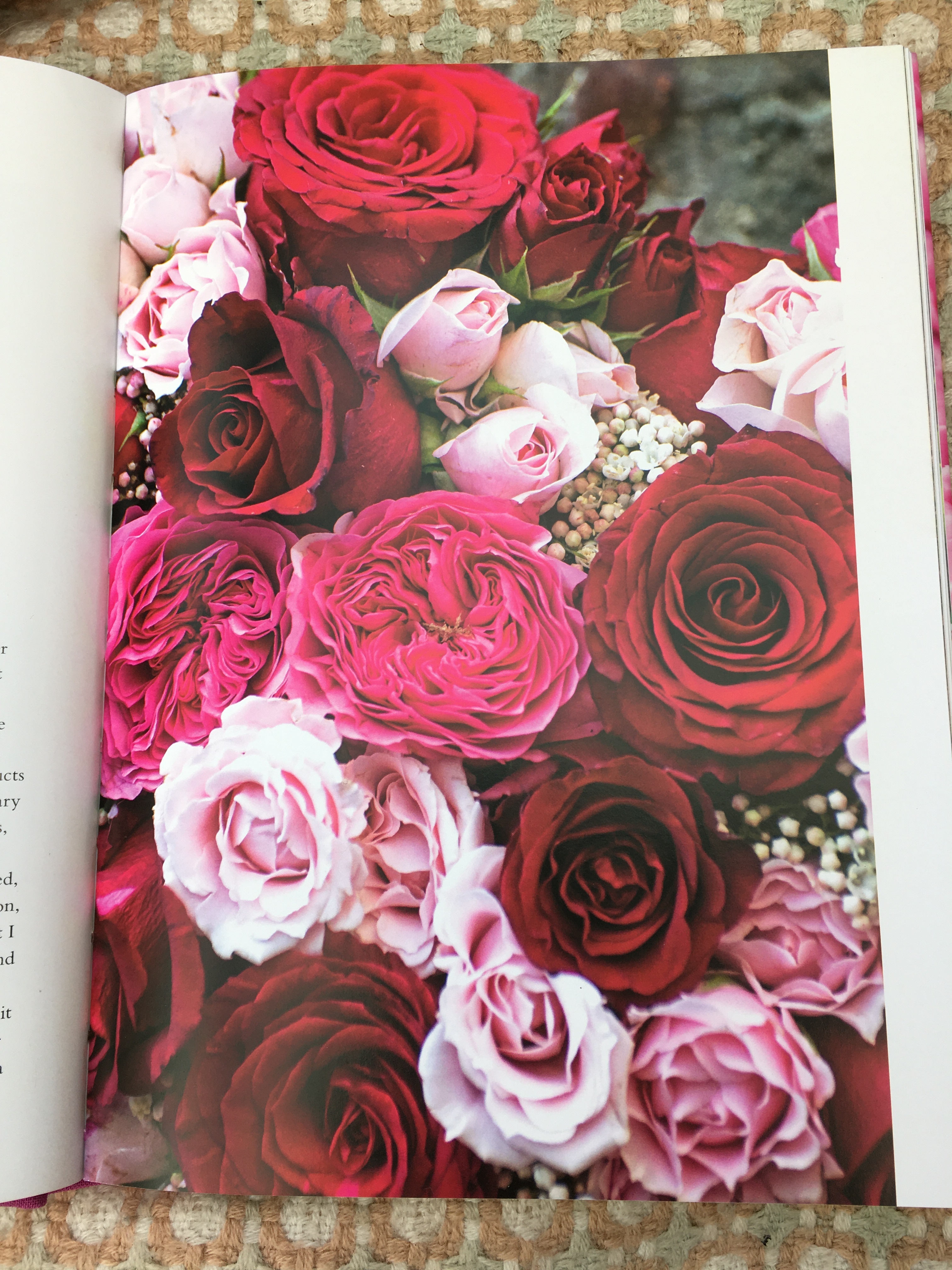
Having seen photos of his wedding and party flowers, it’s interesting to see the preferred choice for his own flowers- for his Scottish Highlands holiday home- is simple bottles filled with tiny sprigs of flowers and a few pebbles from the beach. Truly, he can make anything look special.

I’ve had a wonderful time with Simon, seeing the flower market in all its glory. What I’ve learned is that Simon relishes the magical weddings and corporate events with the ‘wow factor’ flowers. But he also sees the beauty in the simple things -a bunch of narcissi- the first of the season from the Scilly Isles. The scent of the flowers will always remind me of a lovely day spent at the market with a truly inspirational florist.

There’s one copy of the book to give away in a prize draw. Please leave a comment below to be included in the draw. Names will be randomly pulled out of a hat. International entries are welcome, as well as the UK. The publisher’s decision is final. There’s no cash alternative. Usual rules apply.

Links : https://www.amazon.co.uk/Flower-Market-Year-2019-Months/dp/1916091202

https://www.simonlycett.co.uk/

https://www.facebook.com/pages/category/Florist/Simon-Lycett-Ltd-1503980453205762/

https://www.facebook.com/pages/category/Local-Business/bramblegarden/posts/

Garden Media Guild events https://www.gardenmediaguild.co.uk/

@kgimson on twitter.

Karengimson1 on instagram.

Thank you to my amazingly loyal and growing band of readers. I appreciate your taking the time to read my blog, and for leaving comments.
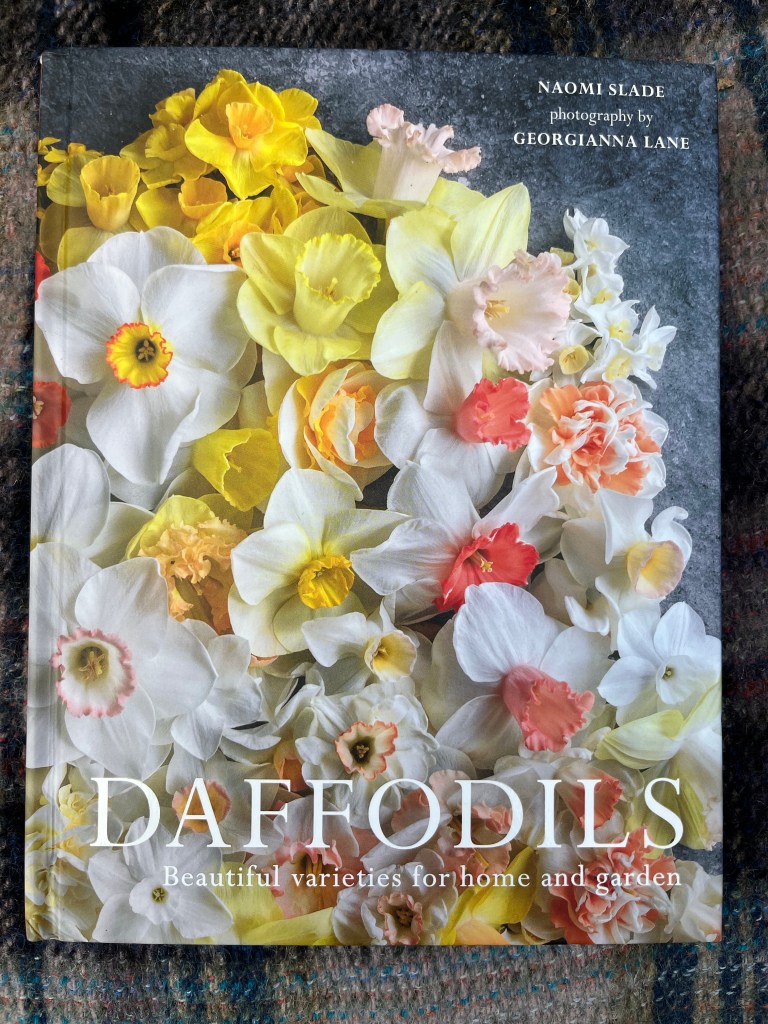
Winners….

Many thanks for reading my book and product reviews. Here are the names of recent winners:

An Orchard Odyssey by Naomi Slade : won by 30 Days of Wild Parenting, Joshua Johnson.

Clip garden gloves: won by Wilma Wilson

Dancing with Bees by Brigit Strawbridge Howard won by Debi Holland.

Incognito insect sprays and sun cream collection won by Suella.

The Good Bee Book, won by Florasforum.

Links: Orchard Odyssey review: https://bramblegarden.com/2019/09/27/an-orchard-odyssey-book-review-and-prize-draw/

Clip Gloves: https://bramblegarden.com/2019/09/15/clip-glove-on-trial/

Dancing with Bees https://bramblegarden.com/2019/08/04/dancing-with-bees-a-journey-back-to-nature/

Incognito https://bramblegarden.com/?s=Incognito+

Good Bee Book https://bramblegarden.com/?s=Good+bee+book

Thanks again for reading and taking part. New Books to Follow: Wilding by Stephen Rutt. We Made a Meadow, Yvette Verner. The Light in the Dark by Horatio Clare. There’s also new watering hosepipes from Hozelock and a biomix plant feed maker. Are there any new products/ books you would recommend?

Gardening On the Menu -Book Review

MARTIN AND Jill FISH

2QT Ltd (Publishing ) rrp £15.99 -or £12.95 plus £3.95 postage direct from Martin.

ISBN: 9781912014569

This week I made the most delicious chocolate cake I’ve ever tasted, and it had a surprising ingredient: Beetroot! You couldn’t taste the beetroot, but it created a really moist and flavoursome cake.

Here’s the recipe, taken from Martin and Jill Fish’s new book Gardening on the Menu.

Ingredients

30g cocoa powder

180g plain flour

2 tsp baking powder

225g caster sugar

Pinch of salt

225g beetroot, boiled until tender and left to cool

200ml sunflower oil

1tsp vanilla essence

3 eggs, beaten

100g plain chocolate, chopped small in a food processor

2lb loaf tin, greased and lined.

Method

Sieve the flour, salt and cocoa powder together in a bowl. Stir in sugar and chocolate.

Peel and finely grate the betteroot. I whizzed it in a food processor then added the oil, eggs and vanilla essence and whizzed some more.

Make a well in the centre of the dry ingredients. Pour in the beetroot mixture. Fold in slowly and don’t over-work.

Pour the batter into a prepared loaf tin and cook at 180C, 160C (fan oven) gas 4 , for 1- 1 1/4 hours. It is cooked when a skewer comes out clean. I placed tin foil over the cake after 45 mins as it was burning on top. Leave to cool in the tin for five minutes, then turn out on a wire rack to cool. Sprinkle top with icing sugar.

I found mine kept for 2 days – it was so tasty everyone dived in and ate it! I froze some to see if that worked, and it was fine.

Here I am adding the beetroot mixture to the dry ingredients.

Looks a lovely colour

lovely for a picnic in the garden. Travels well, wrapped in foil.

I’m going to try the next recipe in the book – beetroot chutney, which looks delicious.

Martin Fish, who ran his own nursery, and presents gardening programmes on tv and radio, gives talks all around the country on growing all kinds of fruit and vegetables. For the last few years, his wife Jill has joined him for a talk called Gardening on the Menu. The cookery and gardening book is based on their talk.

Martin has been growing vegetables since he was a teenager and he draws on his many years of practical experience to give easy-to-follow tips and advice on getting the best from your crops.

Jill shares her selection of family favourites with recipes including roasted feta stuffed onions, red onion marmalade, parsnip cake, chilli jam, apple flapjack trifle, and raspberry chocolate pots.

Strawberry and Chocolate Muffins with a Cheesecake Topping

Toffee Apple Pie

Tomato Soup

Martin gives expert advice on choosing the varieties to grow, and how to get the best crops. There’s useful advice on what to do when things go wrong including how to deal with pests and diseases.

Here they are, giving a growing/ cookery talk and demonstration. I met them last summer when they spoke at a Rainbows Hospice fund-raising festival lunch.

Photo credit: the last five photos are by Jill and Martin Fish.

A really useful book, helping you grow better crops and showing you what to do with bountiful harvests. Highly recommended.

Links: www.martinfish.com

E mail : Martin@martinfish.com

Martin was show director for Harrogate Flower Show for five years, and now writes for various publications including the weekly Garden News and broadcasts for the BBC Radio Nottingham and BBC Radio York.

I have one free copy to give away in a prize draw. Please leave a comment below to be included. Do also say if you don’t want to be included in the draw. All comments are welcome. Please feel free to share this post.

The Cotswold Wildlife Park – A Celebration of the Gardens

BOOK REVIEW

By Harriet Rycroft and Tim Miles

Produced by Reef Publishing for Cotswold Wildlife Park

£18 inc p&p.

Looking through the mansion window, I see a pretty stone terrace, balustrading covered in rambling roses, mighty English oak trees in the distance. And a rhinoceros. Or two. I’m at the Cotswold Wildlife Park and it’s not your traditional garden view!

I can hear blackbirds, robins -and yes, there’s a lion’s roar, and black siamang gibbons “whooping.” I’m having a special behind the scenes tour with head gardener Tim Miles and gardener and writer Harriet Rycroft.

Tim and Harriet have spent the past 18 months working on a new book The Cotswold Wildlife Park- A Celebration of the Gardens. And there’s plenty to celebrate. The gardens are a paradise of exotic plants, special trees and shrubs, and wild flowers.

Photo: Front cover.

There are more than 250 species of animals and birds living at the wildlife park where important conservation and breeding work is being undertaken. The star attraction is undoubtably the white rhinos – saved from poachers in Africa, and now producing offspring.

Photo: my i-phone pic of page 60 in the book. Original photo credit: Harriet Rycroft.

Rhinos appear to have free rein in the parkland setting, but in fact, their paddock is ringed by a ha ha. It means there are no fences. They can clearly be seen from all surrounding paths. When I say “clearly seen,” I might add that the paths meander around flower beds containing thousands of ornamental onions, Allium hollandicum Purple Sensation, and grasses such as Stipa gigantea (giant oat grass) and cultivars of Miscanthus and Cortaderia (pampas grass). It’s rather a wonderful combination. Rhinos and alliums. You’ll not see that anywhere else in the world.

Planting provides browse material for many species, but also, importantly, shelter for the animals. This might be shade from summer sunshine, or protection from wind and rain. Planting must, of course, let visitors see into enclosures, but it is so exhuberant that the the lines are blurred between visitors, animals and the wider landscape.

I did manage to get a good look at African Spoonbills and Madagascan Teal. But if they wanted to hide from me, they could.

It is interesting to see trained fruit trees along the walled garden enclosures. There’s a perfectly-pruned fig, and around the corner there are espalier cherry and pear trees, fruiting kiwi and grape vines. Bamboo, a favourite fodder for many animals, grows inside and outside of the enclosures, again blurring the boundaries between them.

In the Tropical House I spy a Linne’s Two-towed Sloth. It’s the first time I’ve seen one. He’s nestled in amongst the foliage, rubber plants (Ficus elastica) cheese plants (Monstera deliciosa) and bromeliads and orchids. Branches of oak provide “perches” and there’s an illusion that house plants have “escaped” to take root in this mini-jungle. In a fascinating insight into the relationship between keepers and gardeners Tim explains that any plant plagued with pests such as greenfly, is given to the keepers to be placed in the Tropical House. Exotic birds clean up the plants by eating the pests. A win-win situation all round. Natural pest control at its best.

Continuing the tropical theme, in the protection of the Walled Garden, there’s palm trees, bananas and cannas interplanted with dahlias, Begonia luxurians and Begonia fuchsioides. Plants overspill onto the paving so you don’t notice the concrete kerbs. Creeping plants such as Tradescantia, Plectranthus and Verbena cascade and intermingle.

Phormiums, banana plants and bedding such as geraniums and coleus (solenostenum) provide a contrast in form, colour and texture.

Container planting features fuchsias, begonias, scented pelargoniums, trailing Scaevola Sapphire, twining Thunbergia African Sunset, nemesia- and even a Protea cynaroides (king protea). It’s rightly described as a “theatre with plants.”

There’s a conservatory- leading to the Bat House and Reptile House- where I spotted a pretty pink Cantua buxifolia.

Some sort of pink grevillea also thrives in the protection of the glass.

I’m still searching for the name of this pretty blue flowering plant. Let me know if you have a name for it. It’s rather lovely to visit a garden and find something you haven’t seen before.

No surface seems to be left without cover. This is the end wall of the rhino house, smothered in golden-flowering Fremontodendron California Glory.

We just throw our weeds in a compost bin, but certain weeds growing at the park provide food for the animals. Giant tortoises love stinging nettles, and goose grass or cleavers are relished by some of the herbivorous reptiles. Banana leaves are popular with stick insects and locusts, but are also given to squirrel monkeys. Honey treats are stuck to the leaves. The monkeys have fun picking off the treats, and then spend time cleaning themselves of the delicious sticky honey.

Gardeners don’t just get requests for plant material for food and nesting; prunings such as lavender and rosemary provide useful enrichment / active entertainment for the lions. Keepers fill bags with the clippings to make giant catnip toys.

With so many rare and glorious plants, the gardens at Cotswold Wildlife Park are a delight to visit all year round. Visiting transports you to another world. A world that’s been created with imagination and passion. There’s nowhere else quite like it.

All pics, apart from the front cover and the baby rhino, are i-phone photos from my head gardener tour.

Links:

Harriet and Tim’s book is available from Cotswold Wildlife Park https://shop.myonlinebooking.co.uk/cotswoldwildlifepark/shop/product-list.aspx?catid=8

Death in the Garden – Book Review

Poisonous Plants & Their Use Throughout History

Michael Brown

Pen and Sword Books. Paperback £16.99

ISBN 1526708388

I once turned up at a client’s garden to find foxgloves growing amongst the cut-and- come-again lettuce. Horrified, I carefully weeded them out, but decided I couldn’t be sure I’d found them all. The whole plot had to be dug up and replanted. Growing flowers in the veg plot has become fashionable. But mixing flowers with salads and veg can be deadly. We know foxgloves or digitalis has links with modern medicine to treat heart disorders. All parts of the plant are, however, highly poisonous. Michael Brown, in his book Death in the Garden, says on a toxicity scale of 1 to 20, with 1 being the most lethal, foxgloves are at number 3. The difference between a beneficial and lethal dose being minute.

Foxgloves are just one of the plants listed in Brown’s fascinating book. I’ve grown up knowing about the dangers of deadly and woody nightshade, and giant hogweed. But who knew that aquilegia could be poisonous.

Brown describes how powdered aquilegia seeds were used historically as medicine for jaundice and liver problems right up until the early nineteenth century. The plant, apparently high in vitamin C, was also rather dubiously used to treat scurvy. Luckily, modern medicine has moved on and the plant has reverted back to being used just to decorate our gardens.

Other plants I’ll look at in a different light in future include autumn crocus, bindweed, broom, cherry laurel, daffodils, morning glory and celandine, to name but a few.

And as for basil, I’ll not be able to eat it again without thinking of Brown’s rather bizarre and gory murder story involving a severed head and a pot of herbs! His book is a mixture of fact and fiction – all revolving around plants and poisons. Highly entertaining as well as informative. But you might not be able to sleep at night after reading it.

The book cover says :” Mankind has always had a morbid fascination with poisonous plants; how their poisonous properties were discovered and developed will most likely be left unknown. Over the centuries poisonous plants have been used to remove garden pests, unwanted rivals, and deceitful partners. They have also been used for their medicinal qualities, as rather dangerous cosmetics, even to help seduce a lover, when perceived as an aphrodisiac.

“Death in the Garden is based on Michael Brown’s most popular talk, popular as this subject holds a strange interest, for many will enjoy learning about these treacherous and peculiar plants, their defensive and deadly traits as well as the folklore that has grown around them. ”

Michael Brown has been a head gardener, a college lecturer and designed the medieval gardens at Prebendal Manor, Nassington. He now gives talks and demonstrations on historical gardening .

The publishers have one copy to give away. Please leave a comment below to be included. Comments without wishing to be in the draw are also fine.

Please do not try any of the “recipes” or remedies mentioned in the book.

DISCLAIMER: All the plants mentioned in this blog piece and the above book can cause death or injury. The contents of the review and book are for interest only and the author and publisher accept no liability for any injury caused by the use of the plants.

Links : kindle https://www.pen-and-sword.co.uk/Death-in-the-Garden-Kindle/p/14944

Amazon https://www.amazon.co.uk/Death-Garden-Poisonous-Throughout-History/dp/1526708388

Congratulations to the Winner of The Wild Remedy Prize Draw

Congratulations to Kathy Lewington who has won my prize draw for a copy of Emma Mitchell’s wonderful new book The Wild Remedy.

The publishers Michael O’ Mara Books kindly offered one copy to give away.

I wrote a review of Emma’s book here : https://bramblegarden.com/2019/02/14/the-wild-remedy-book-review/

I love the book and can’t recommend it highly enough. I’ve always enjoyed Emma’s drawings and photographs on social media. To have them in a book I can look at every day of the year is a special treat. A treasury of nature.

Thank you to everyone to read my review and left a comment. There will be many more books and gardening products to follow.

Links : https://bramblegarden.com/2019/02/14/the-wild-remedy-book-review/

Amazon :https://www.amazon.co.uk/Wild-Remedy-Nature-Mends-Diary/dp/1789290422

Michael O’Mara Books https://www.mombooks.com/

Review of Making Winter https://bramblegarden.com/2017/12/16/last-minute-christmas-present-ideas-for-gardeners/

Please share on any social media platform you like. Thank you.

Prize draw winners – The Immortal Yew

Tony Hall

Kew Publishing. Hardback. £25

ISBN : 978 1 84246 658 2

One of the pleasures of writing a blog is sharing a love of gardening with like-minded people. Books are also a passion of mine, particularly anything with a horticultural theme. So I was happy to be invited to write a review of The Immortal Yew, written by Kew Gardens manager Tony Hall. Stories of myths and legends surrounding yews dating back 2,000 years had me glued to the pages from start to finish. I was drawn in by the sight of the “lion’s paw” yews flanking the doors at St Edward’s Church, Stow-on-the-wold, a sight said to have inspired JRR Tolkien when he was writing about the gateway to Moria in Lord of the Rings. A photo of these strange, ancient yews provides the cover picture for the book. The publishers, Kew Publishing, very generously offered three copies for a prize draw on the blog. The winners, randomly selected, are Sharon Moncur, Philippa Burrough and Alison Levey. Thanks to everyone who left comments on the blog. If you didn’t win, please keep reading as there are many more books to follow over the next few weeks, including The Wild Remedy by Emma Mitchell, Island Gardens by Jackie Bennett, the English Country House Garden, George Plumptre, Oxford College Gardens, Tim Richardson, and The Christmas Tree by Barbara Segall. Winter is a great time to catch up with reading, before tasks in the garden entice us outdoors again.

To read my review, please click here : https://bramblegarden.com/2019/01/25/the-immortal-yew-book-review/

What books would you recommend to gardening friends? What are your favourite books?

Links : Immortal Yew https://www.amazon.co.uk/Immortal-Yew-Tony-Hall/dp/1842466585/ref=sr_1_1?s=books&ie=UTF8&qid=1548966993&sr=1-1

Kew Gardens https://www.kew.org/

Kew Publishing https://www.kew.org/files/kew-publishingjpg

Sharon Moncur https://renaissancegardener.org/

Philippa Burrough http://www.ultingwickgarden.co.uk/

Alison Levey https://www.blackberrygarden.co.uk/

Please feel free to share this blog on any social media platform, linking back to this site https://bramblegarden.com/

The Immortal Yew- Book Review

Tony Hall

Kew Publishing. Hardback. £25

ISBN: 978 1 84246 658 2

I’ve often walked under cathedral-like arches of ancient yew trees and wondered what stories they could tell. Their dense evergreen canopy means low light levels- adding an air of drama and mystery. It’s easy to let imagination run wild. No wonder the yew is linked to so many strange myths and legends.

Here’s my view of the yew walk at Melbourne Hall in Derbyshire on a cold January day a few weeks back. Almost a living sculpture. Hundreds of years of history captured in every twist and turn. I stood and marvelled at its strangeness and beauty.

Tony Hall, Manager at Kew, started on a quest to record our ancient yew trees after a visit to Devon where he found a huge male yew tree in a churchyard in Kenn. He was amazed by its immense size, and wondered just how many other trees there were like this. He set out to travel around Britain and Ireland in search of these venerable trees, and The Immortal Yew is the resulting book.

The book profiles 75 publicly-accessible yews, with details on their appearance, location, folklore and history, accompanied by 100 colour photographs. Each tree has its own story to tell- from fragmented, sprawling trunks, to ones you can sit inside. And there are some that have possibly inspired writers.

Author J.R.R. Tolkien is said to have found inspiration for the gateway to Moria in the Lord of the Rings from visiting the two guardian yews at Stow- on-the -Wold. The two yews flank the door at St Edward’s Church, like a pair of giant lion’s paws. Their photo makes a stunning cover picture for the book.

The Ankerwycke Yew near Wraysbury, Middlesex, is thought to be up to 2,500 years old, making it the oldest known tree on National Trust land. It’s possible the tree was the one under which the Magna Carta was agreed. And where Henry VIII courted the ill-fated Anne Boleyn. In 2002 it was chosen as one of the ’50 Great British Trees,’ to celebrate the Queen’s Golden Jubilee. Not far from the tree are the remains of St Mary’s Priory, a Benedictine convent built in the 12th century in the reign of Henry II. The yew would already have been a notable ancient landmark, substantially more than 1,000 years old, when the priory was built.

Much Marcle Yew, in St Bartholomew’s Church, Ledbury, Herefordshire has an unusual feature. The hollow interior is fitted with wooden benches which seat 12 people and were installed in the 18th century. The bulbous, fluted trunk has a circumference of over 9m. Some of the lower branches are still held up by old Victorian gas lamp columns.

A timeline highlights some key dates in the history of the yew. I have selected just a few of the dates which caught my attention.

  • 140 million years ago Taxaceae (yew family) fossils formed
  • 200BC Herbalist Nikander describes the painful death caused by yew toxin
  • 1066 Battle of Hastings: King Harold killed by an arrow that supposedly pierced his eye, fired from a Norman yew longbow.
  • 1215 Magna Carta signed under the Ankerwycke Yew

More modern dates include

  • 1986 anti-cancer drug Docetaxel, extracted from the leaves of European yew, was patented and later approved for medicinal use.
  • 1994 synthetic cancer drug Taxol was developed.
  • This book is a wonderful celebration of our native yew trees, and all the stories that go with them. It would be a fabulous starting point to a journey around Britain and Ireland. I for one would love to have the opportunity to visit these trees and stand and wonder at their beauty. Perhaps one day I will get the chance to set out on an grand tour. For now though, I’ll dip into Tony’s book and enjoy all the fascinating stories of mythology and folklore. It’s a journey into the past. And also, it would be interesting to see what scientists discover in the future, as I’m sure we haven’t learned all there is to know about these strange and much-valued trees.

    Tony Hall is Manager of the Arboretum and Gardens at the Royal Botanic Gardens, Kew, where he has worked for the past 17 years. His fascination with natural history began at a young age. He has been working in horticulture for 40 years. Tony is author of Wild Plants of Southern Spain (Kew Publishing, 2017 ).

    The publishers have one free copy to give away in a prize draw for readers of this blog. Please leave a comment below, by Sunday 27th Jan, to be included in the draw. The publisher’s decision is final and there is no cash alternative. UK and international entries are welcome.

    Here is the Amazon link for Tony’s latest book: https://www.amazon.co.uk/Immortal-Yew-Tony-Hall/dp/1842466585/ref=sr_1_1/258-7276364-2203519?ie=UTF8&qid=1548447890&sr=8-1&keywords=the+immortal+yew

    Have you any favourite yew trees? I regularly visit Easton Walled Gardens near Grantham, where evidence of the Tudor-style walks and walls indicate there has been a garden on the site for at least 400 years. The yew tree tunnel is a much-photographed focal point of this historic restoration project started in 2001.

    Links:

    Melbourne Hall Gardens https://www.melbournehallgardens.com/

    Easton Walled Gardens https://www.visiteaston.co.uk/

    Kew Gardens https://www.kew.org/

    Kew publishing https://www.kew.org/about-our-organisation/business-services

    Book prize draw winner- The Creative Kitchen

    It’s been a good year for new books. One of my favourites recently arrived in the potting shed is The Creative Kitchen by Stephanie Hafferty.

    The publishers kindly offered one free copy for a prize draw for this blog. I’m always grateful for a chance to pass on goodies to readers. And I’m delighted to announce that the winner is June at https://thecynicalgardener.com/ .

    Please take a look at the discount code on my review which gets you the book for £16 including postage. Here’s the link for the review https://bramblegarden.com/2018/11/18/the-creative-kitchen-book-review/

    I’m making peppermint creams for Christmas presents using Stephanie’s idea for mint sugar. The kitchen smells divine, and the mints look really pretty.

    Thank you for reading this blog. Keep popping back for more news. A whole pile of books have just arrived in the potting shed and I’m just starting to work my way through them, so keep an eye open for more prize draws and offers.

    Are you making any Christmas presents this year? Get in touch and share your favourite recipes and ideas for gardeners and cooks. It’s great to share hints and tips with each other.

    I always look forward to your comments. Please also feel free to share this blog on any social media platform you like. It all helps to spread the news.
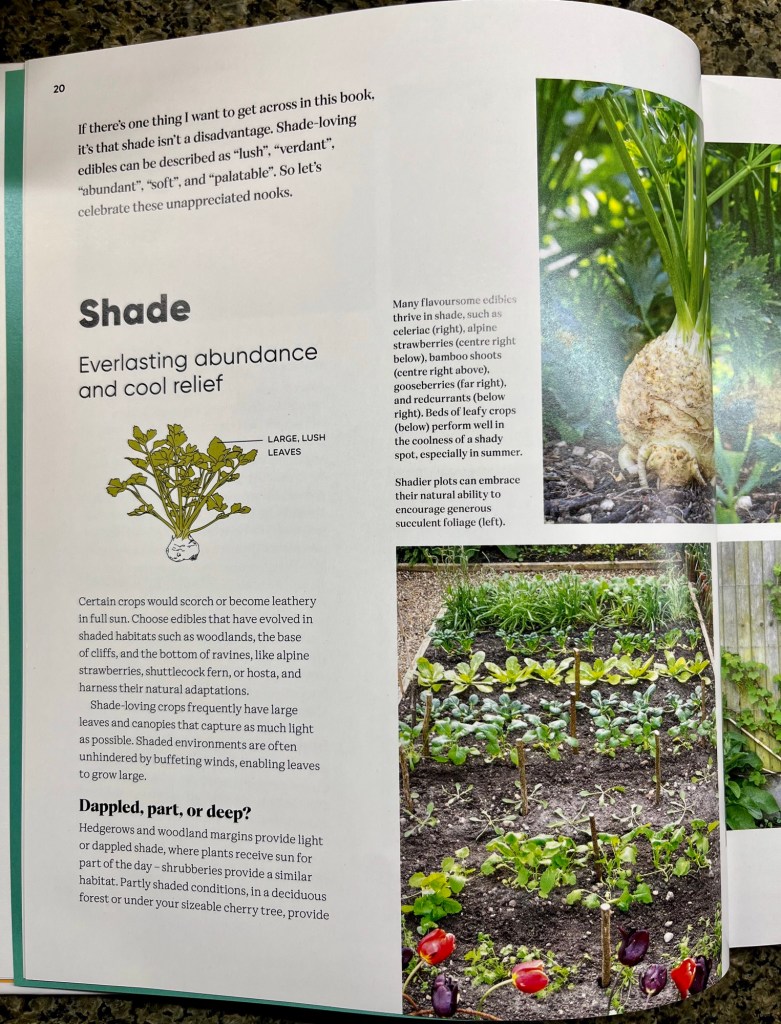
    The Creative Kitchen – Book Review

    By Stephanie Hafferty

    Published by Permanent Publications. November 2018

    *Win a free copy in the prize draw by leaving a comment at the end of the blog. And there’s a discount code for readers.

    New reading in the potting shed this week is Stephanie Hafferty’s latest book on seasonal recipes for meals and drinks and making items for the garden and home.

    I have to admit, I have a passion for cookery books. Many of my favourites have been handed down through the family. I’ve got Bero baking books from my grandma Betty, which bring back happy memories of delicious cakes. She never ate them herself, but just liked to make everyone smile. All our trips to the seaside- and local beauty spots such as Bradgate Park – would be accompanied by her butterfly fairy cakes. Her trifles were liberally sprinkled with hundreds and thousands. And I bet my brothers remember her home-made toffee apples. It’s amazing our teeth survived, but they did.

    When you think about it, many of our strongest memories relate to sitting around a table together, sharing food. All our celebrations, birthdays, anniversaries- and Christmas being the highlight of the year- revolve around food.

    With my own family and friends, I’ve tried to carry on the cooking and nurturing tradition. Although, it’s not always easy to get everyone together at the same time. We live such busy lives. When I do manage to corral the family together, I’ll usually make a massive pot of soup, a casserole, a cheese and potato pie, a vegetable lasagne, or similar. And for afters, there’s nearly always something involving apples- we have them in store all winter, and they’re free.

    My cooking revolves around what I’m growing. And this is where Stephanie’s new book comes in handy; all the recipes are seasonally based. So they are relevant to what I’m growing all year round. I always start with what I’ve got available, rather than choosing a recipe. Stephanie helps by suggesting what I can do with the gluts of the season. I often have that “what-on-earth-am-I-going-to-do-with-all-this-kale” moment. Hearty bean and vegetable soup might be the answer.

    I’m very keen on throwing everything in a pan together and just leaving it to cook. It gives me more time to garden- and chat. My two favourite pastimes! Stephanie must have written this book specially for me. Her Bean Stew with Red Wine is simple to make, fabulously tasty, and looks pretty too.

    Alongside the main meals, soups and salads, there’s recipes for store cupboard ingredients such as flavoured salts, vinegars, herb mixes, and infused sugars. I’m definitely going to try making mint sugar. Imagine adding it to hot chocolate. Such a treat on a freezing cold day.

    I’ve been thinking about what to do about vegetable stock powers since my favourite brand decided to add palm oil to its ingredients. There will be no palm oil in my house. Apart from not trusting the “ethically sourced” statement, we do not want or need palm oil. Only if we reject it will the rainforests be saved. I am just one person, but it seems the message is getting stronger. People are picking up packets of food and reading the labels and realising that palm oil has insidiously crept into so many food and household products. Anyway, now I can make my own stock powers with Stephanie’s recipes for wild herb, mushroom and tomato bouillon. And there’s a fruit bouillon for adding to yoghurts, cakes and biscuits. Such a clever idea, and easily do-able.

    I’ve had a go at making herb teas, but never tried gin or brandy recipes. Stephanie’s Rhubarb and Sweet Cicely Gin sounds- and looks glorious. And wouldn’t it make a fabulous present for someone.

    Sugar Plum Brandy looks equally divine. Apparently, this makes a lovely after dinner liqueur as well as a cocktail base. I’d probably add it to fruit cakes as well.

    You wouldn’t think you could fit so many good ideas into one book, but Stephanie seems to have thought of everything. I particularly love her Gardeners’ Hand Scrub, Floral Bath Bombs, and Herb Candles. I’m going to be busy for the next few weeks, trying all the recipes and making presents for friends. And I’m going to enjoy every single minute of it.

    Stephanie’s book is paperback and £19.95 from https://shop.permaculture.co.uk. There’s a discount code for blog readers purchasing from the shop which is BRAMBLE. Apply the code in the discount section at checkout to obtain the book for £16. Postage is extra. The book is also available via Amazon here https://www.amazon.co.uk/Creative-Kitchen-Seasonal-Recipes-Drinks/dp/1856233235 . There’s one copy available in the prize draw. Names will be randomly selected. Publisher’s decision is final. There’s no cash alternative. Worldwide delivery, for a change. Usually it’s UK only. Nice to have an international prize.

    Meanwhile, the view from the potting shed is sunny today. As well as reading, I’ll be deciding what to grow next year, and Stephanie’s book will come in handy while I’m making my seed lists. What books are you enjoying at the moment? What are you planning to grow on your plots for 2019? Get in touch and let me know.

    The Bumblebee Flies Anyway

    Book Review

    Kate Bradbury. Published by Bloomsbury Wildlife. Hardback £16.99

    It’s been a difficult year. I’m only just getting over serious illness myself, and then three relatives have been ill. I’ve been stretched to the limits trying to help everyone. So when I picked up Kate Bradbury’s book, it seemed to have been written specially for me. There’s a message of hope on every page.

    Kate’s struggling too. Some kind of crisis. A broken heart. She ends up homeless, sleeping on friends’ sofas. She has to leave London and make a new home in a damp dark, basement flat. Even worse, the garden is a dead place. Decked over and full of rubbish. And yet, Kate’s book is not a tale of woe. It’s about struggling and striving. But ultimately, there’s a message of hope. After pain and suffering there can be triumphs and happiness again. It’s a message I needed to hear. I made myself a reading corner in the greenhouse and tried to absorb the positive vibes. It’s not easy when you are in the middle of a crisis. Sometimes I’d read the same paragraph over and over again, without registering the words. Stress is such a debilitating thing.

    Kate turns her decked-over garden into a wildlife paradise. She makes a pond, puts up bird boxes and revels in every creature that comes to live in her tiny plot. It’s not just a book about rescuing a garden, it’s about rescuing a person too. It’s about the resilience of the human spirit. We may be bowed down and almost defeated by life’s events, but we will triumph. Nature, wildlife and gardens are a balm. Wouldn’t you agree.

    I particularly love Kate’s descriptions of making a bee hotel and building a pond. I learn that a pond doesn’t need to be more than 30cm deep to be of value to wildlife. I could manage that. There’s plenty of places where I could fit a pond. And her tales of rescuing bees. I’d heard about giving bees spoons of sugar. Kate talks about finding an exhausted bumblebee on the pavement. She pops it in her pocket to keep it warm while she walks home. I’d never thought of doing that. She puts the red-tailed bee in a box with a pop bottle lid full of sugar water. It’s too cold and wet for the bee to go outside, so Kate gently places some shredded paper in the box to make a cosy nest until the morning. Apparently, some bees can be helped by gently stroking their thorax. I looked it up. That’s the part of the body between the wings. I can have a go at that too, if needed. Kate gives me confidence to try. Next day, Kate releases the revived and now grumbling bee. She searches for a mahonia plant to give the bee the best chance of survival.

    There are lots of hints and tips sprinkled through the book for anyone wanting to make a wildlife garden.

    Regular readers will know that we planted a mini-wood when we moved here, and I grow flowers and plants for pollinators. Now I have a few more good ideas for helping wildlife in my garden. Kate’s inspiring book and joyful message was just the pick-me-up I needed, to be honest.

    The publishers have kindly given one free book as a prize for readers of this blog. Usual rules apply. One name will be randomly selected in the prize draw. There’s no cash alternative. Publishers decision is final. Please leave a comment to be included in the draw. Sorry, UK entries only.

    Book Review winner – The Almanac by Lia Leendertz.

    Thank you everyone who commented on my review for Lia Leendertz’ New Almanac for 2019. The review was published Here

    The winning name selected is https://watchingthedaisies.com.

    Thanks again to everyone who read the review and took part in the prize draw. I’m grateful to the publishers for supplying a copy to give away.

    I shall be buying several copies for Christmas presents. A little bit of joy for every day of the year. Lovely to dip into to keep pace with the seasons.

    Here’s my gap-in-the-hedge view from the top field. A lovely spot to stand and gaze at nature, while gathering rosehips and crab apples for autumn preserves. There are lots of enticing seasonal recipes in the new Almanac. A good excuse to try something new.

    The Almanac – A Seasonal Guide to 2019

    Book Review

    Lia Leendertz. Illustrated by Celia Hart

    Octopus Books/ Mitchell Beazley. Hardback £10. September 6 2018.

    Captivated from the first page, I keep dipping into the new Almanac, published this week. I loved Lia Leendertz’ first seasonal guide created for 2018. The new version for 2019 is just as magical, if not better.

    I’ve made a kind of nest in the summerhouse, heaping cushions and old quilts on a comfy armchair. It’s peaceful in here, only the sound of thrushes tap taping snail shells on the stone path. It’s just the place to settle down and delve into Lia’s book.

    There’s something comforting about being in tune with the natural world around us. Checking the times for sunrise and sunset, sea temperatures, tides, moon phases. I haven’t tried planting by the moon, but there’s dates and times to get me started. It seems to make perfect sense. I love the little moments of joy. Reading that day length increases by 1 hour and eight minutes during the course of January. It gives hope when it’s needed most. Here’s the page for January. Plough Monday is included in the dates listed. I heard my grandfather talk of Plough Monday- traditionally the start of the agricultural year. The book is like a siren call leading me back through time to my farming family ancestors. A reminder to keep in my heart their customs and celebrations.

    There’s recipes such as Epiphany tart, a kind of jam pastry, with a star made with overlapping triangles and each “well” containing a different flavour. I hadn’t heard of this; it sounds delicious. There’s a tradition dating back to the 1600s of creating tarts with intricate pastry patterns, coloured with different jams. I wonder if my great grandmother Annie Foulds – who was head cook at Bradgate House- would have made such a dish. She made the most delicious cakes at home at Carters Rough Cottage, Groby.

    Lia’s writing is perfectly complemented by illustrations from artist Celia Hart. The prints are so beautiful they draw you in, much as a photograph of a glorious scene makes you want to step into the landscape. It’s impossible not to stare longingly at Celia’s drawings- and wish you could step into the page. I’d like to see those swifts and swallows soaring above my head and turn over the seashells she so wonderfully captures.

    A mesmerising read, totally spellbinding. A beautiful month by month companion for me. For anyone, like me, who tries to weave the stories of the past into the journey to the future.

    The publishers have kindly offered one copy to give away. Please leave a comment below if you’d like to be included in the prize draw. The publishers will pick a name and send out a copy. The publisher’s decision is final. Sorry UK entries only.

    Please share this review on any social media platform you like. Thank you.

    Here is the Amazon Link for The Almanac.

    Winner of Dahlias book by Naomi Slade

    Congratulations to June at The Cynical Gardener who has won my prize draw for a copy of Naomi Slade’s new book, Dahlias.

    I wrote a review of the book Here.

    I absolutely love the book, and find I’m dipping into it whenever I sit down and rest a moment in my potting shed armchair.

    The book features mouth-watering photographs by Georgianna Lane. It’s easy to read and there are lots of hints and tips on getting the best out of your dahlias.

    Who could resist these lovely, brightly-coloured single varieties.

    Here’s some photos of my own dahlias in my cut flower patch. I’m looking forward to trying out some of the newer varieties highlighted in the book. I’m particularly keen to try the dark red and chocolate types, as well as the cheerful sounding “happy” series.

    Some of mine have been grown from seed. They produce good size plants in one year.

    Dahlias will be published by Pavilion Books on 2nd August, RRP price £25. Here’s the Amazon link for more information.

    Please kindly share this blog on twitter, Pinterest, facebook or any other social media platform. Thank you. And don’t forget to say hello in the comments below.

    Dahlias- beautiful varieties for home and garden

    Book Review

    Naomi Slade. Photography by Georgianna Lane

    http://www.pavilionbooks.com. £25. August 2018.

    Leave a comment below if you’d like your name to be put in the hat for a chance to win one free copy of the book. The publishers will draw out a name. Their decision is final. Sorry, it’s open to UK entries only.

    Photo : My favourite dahlia Nuit d’Ete in my own cut flower plot in Leicestershire.

    I’m away from home for a few days, staying with my mother-in-law Joan. Everything here is at a slower pace. Breakfast takes an hour, and over tea and toast she tells me how her husband Keith once won awards at the local flower show with his dahlias and chrysanthemums. The whole garden from the back lawn, to the greenhouse was set in regimented rows of flowers. I can picture the scene. This garden has been lovingly tended by my in laws for more than 60 years. And now everyone in the family is stepping in to keep it looking perfect. It’s quite a challenge, but one we all enjoy.

    Today, between hoeing and weeding and keeping them company, I’ve got time to sit down and catch up with some reading. And top of the pile of new books is Dahlias by Naomi Slade.

    photo: Naomi Slade with her latest book. My photo, taken at Chelsea Flower Show.

    Over 65 types of dahlias are profiled in the book. There’s 240 pages of mouthwatering photographs and inspiring, easy to read descriptions. There’s an introduction followed by sections on history and botany; and the dahlias are split into themes such as “romantic,” “dramatic and daring,” “fabulous and funky,” “classic and elegant.” A growing and care guide gives cultivation techniques, information on selecting varieties, choosing a suitable site and soil and planting tips.

    Photos are sumptuous. I’m particularly drawn to the darker shades; deep red and almost black. Rip City is one I’d love to try.

    Karma Choc is another on my wish list. This small waterlily flower is excellent as a cut flower and lasts at least a week in a vase.

    I’d never heard of the Happy Single range of dahlias. These are perfect for small spaces and containers, growing to 30-60cm high by 30-40cm wide. Such a wide range of cheerful, rich colours. You couldn’t fail to be happy with them! Varieties include Happy Single Flame, Happy Single Party, Princess and First love. Even the names made me smile.

    To calm things down after all that colour, there’s some dazzling and very beautiful white dahlias. I enjoyed learning about all the different kinds of dahlias. I knew about cactus and water lily types, but didn’t know much about collarettes, and anemone- flowered forms. And ones called star, or orchid-flowering sound particularly appealing.

    Here’s some photos of dahlias from my own garden. I’ve taken cuttings from mine to grow in my in laws garden. Having read Naomi’s inspiring book, I’ve made a list of new varieties to share between our two plots. And I’m hoping to learn some prize winning tips from my father in law. You never know, I might even enter the local flower show.
    Naomi Slade is a writer, broadcaster, consultant, speaker and photographer. A biologist by training, a naturalist by inclination, and with a lifelong love of plants. She writes regularly for national newspapers and magazines. Her books include The Plant Lover’s Guide to Snowdrops and An Orchard Odyssey.
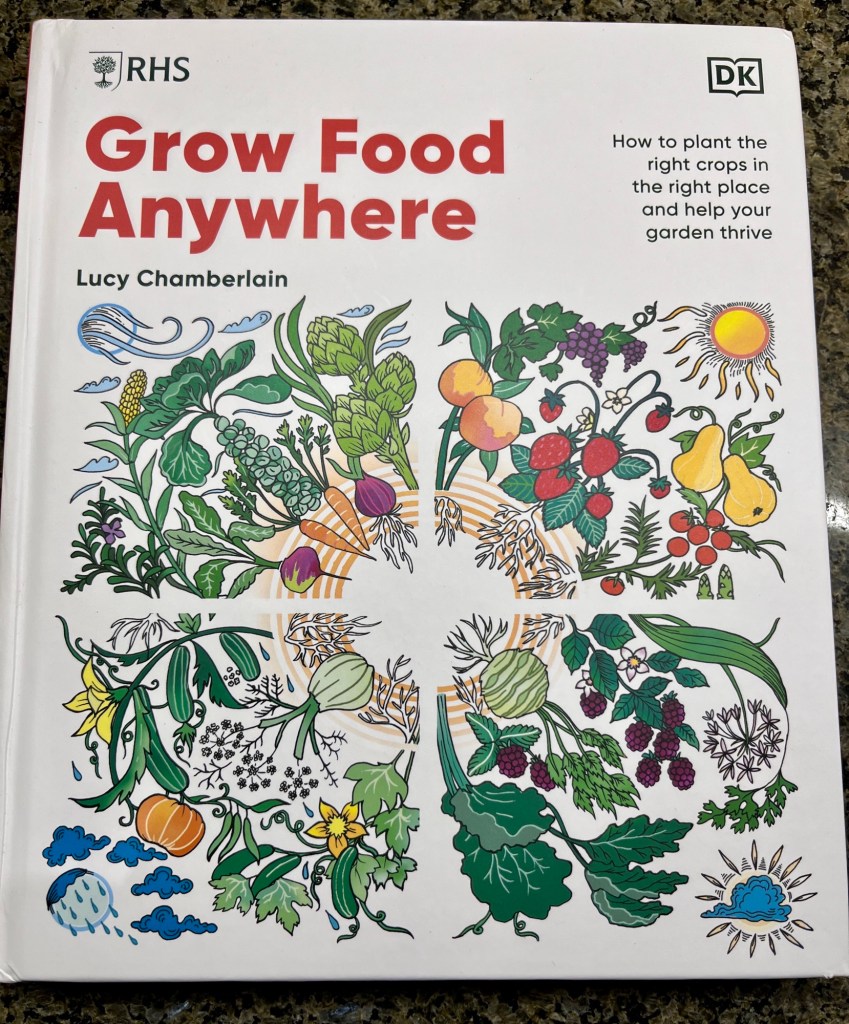
    I really enjoyed reading her latest book. It’s brought back some lovely memories for my mother in law and sparked off a new plan in my head to grow more dahlias in their garden.

    Right then…. back to the weeding. Must not let my in laws down! 🙂

    Weeds. Geranium robertianum

    I’m writing a piece about weeds at the moment. Suddenly, in the sunshine, after all that cold weather, weeds have gone whoosh!
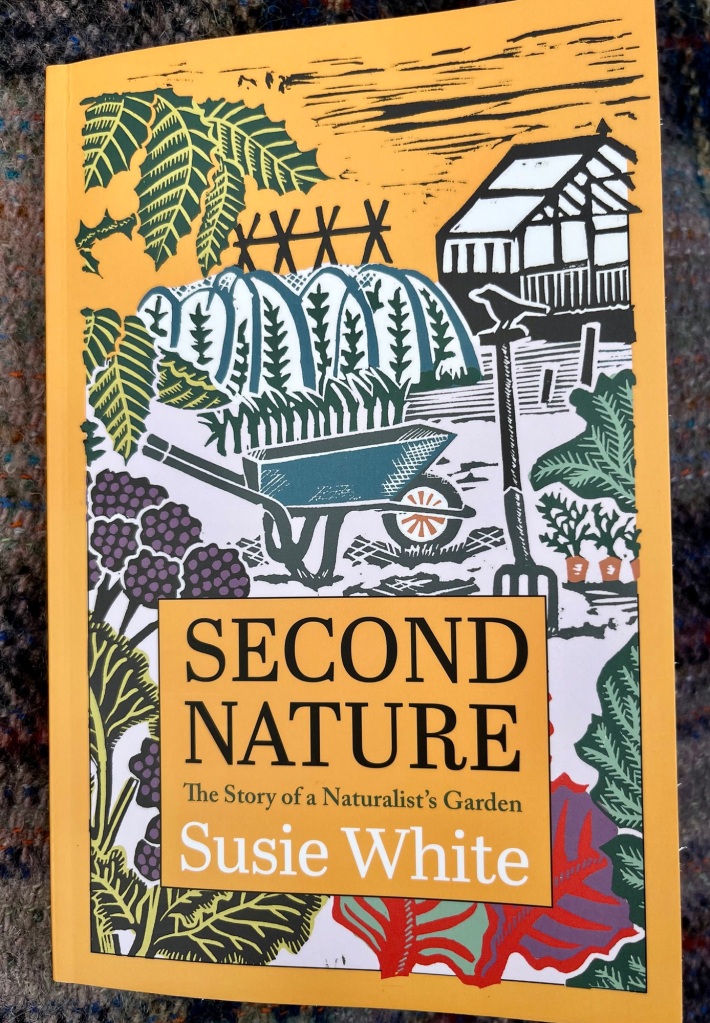
    In my woodland garden, there are thousands of wild geranium, robertianum. It has so many common names: herb Robert, stork’s bill, crane’s bill, red robin, stinking Bob, fox geranium, cuckoo flower.

    “Herb Robert is very familiar. It lives with man: much as the robin flips into his garden and to his back door” – Geoffrey Grigson- The Englishman’s Flora.

    I’m enjoying reading up and investigating more about this common weed we usually pass by without noticing. And meanwhile, a posy of herb Robert sits in my potting shed window today. Mixed in with some wild violets -which are so numerous they could be considered a weed. Both very pretty indeed.

    What “weeds” are growing in your garden right now.

    Chocolate Fridge Tiffin- with Autumn Raspberries

    On the first day we’ve had snow, I’m sharing my favourite chocolate recipe. Guaranteed to bring cheer, for anyone struggling with the onset of cold weather. Like all my recipes, it’s quick to make and uses produce from the garden. Autumn Bliss raspberries are still producing fruit. An unbelievably long cropping season this year. I’m still picking a few for my breakfast porridge each day. And think of all that vitamin C. Makes this recipe seem almost healthy! Go on, treat yourself.

    Chocolate Tiffin

    100g Butter

    2 mars bars- chopped

    2 tbsp golden syrup

    240g milk or dark chocolate

    5 digestive biscuits

    9 rich tea biscuits

    One and a half teacups rice crispies

    15g glacé cherries

    Three quarters of a cup of sultanas

    120g chocolate for the top. I used Cadbury’s Bournville.

    Melt the chocolate, mars bars, syrup and butter together in the microwave.

    Mix with the crushed biscuits, crispies and dried fruit. Cool slightly and add a handful of fresh raspberries.

    Spread in a 9″x9″ foil or paper-lined tray.

    Cover top with melted chocolate

    Place in the fridge.

    Cut into slices and serve with fresh raspberries.

    Will last three days in a cool place. If you can resist them that long.

    Wrapped in cellophane and ribbon, they make a lovely home-made present.

    Have a listen in to the BBC Down to Earth radio programme where we answer gardeners’ questions on the live phone-in. We are all sitting in the studio – munching my chocolate tiffin- this week. Here’s the link for the radio i-player http://www.bbc.co.uk/programmes/p05l50wv

    I wrote about how to listen to radio programmes on the I-player at https://bramblegarden.com/2017/11/08/how-to-listen-to-gardening-programmes-on-the-bbc-i-player/

    Do you have any favourite recipes for cold weather?

    For more inspiration – read Making Winter- a creative guide for surviving the winter months, by Emma Mitchell. Published by LOM Art, an imprint of Michael O’Mara Books. Emma’s mouthwatering recipes and pretty craft ideas turn even the bleakest wintery day into a warm and cheerful celebration. The book is like a warm hug on a frosty day.

    I can highly recommend it. There’s a link Here .

    There’s recipes for chocolate fondant, lemon and ginger bars and even hawthorn gin. Ideas for things to make include a crochet shawl and matching scarf, and knitted wrist warmers. Perfect for coping with the winter chill ahead.

    Baking a cake always makes me feel better when it’s freezing outdoors. Emma’s guide entices you to embrace the drab days and fill them with “baked goodness.” I wholeheartedly agree with her there.

    Words and Pictures

    SECRET GARDENS OF EAST ANGLIA


    Barbara Segall. Photography by Marcus Harpur

    Frances Lincoln £20. Hardback.  Published 7th September 2017.

    It’s impossible to resist dipping into the pages of any book with the words “secret” and “garden” in the title.

    We all love peering over the garden gate  to get a glimpse of other people’s property.

    And in Secret Gardens of East Anglia, Barbara Segall is our excellent guide, taking us straight down the drive and through the front gates of 22 privately owned gardens.

    It is quite a revelation. We see sumptuous planting, grand sculpture, rose parterres, moated gardens,  and wildflower meadows galore! A real  treat – in words and pictures.

    Here is just a flavour of some of the glorious gardens featured.

    Wyken Hall, Stanton, Suffolk

    Wyken Hall - Suffolk 1.jpg

    Photo credit Marcus Harpur. Perfectly co-ordinated, one of Wyken Hall’s peacocks is poised beneath a blue wooden pergola covered in climbing Rosa Blairii Number Two. The pergola is reminiscent of one at Bodnant in Wales. Owners Kenneth and Carla Carlisle have created a sumptuous rose garden, favouring highly-scented old rose varieties with soft coloured perennials such as delphiniums, astrantia and artemisia. The sound of water and the scent of roses always draws  me in. I could picture myself sitting in this beautiful garden on a hot, sunny summer’s day. Yes, I would be quite happy here!

    Columbine Hall, Stowupland, Suffolk

    Col Hall.jpg

    Photo credit Marcus Harpur. In my opinion, the most romantic of the gardens featured.  I’ve long been entranced by the walled kitchen garden which I first spotted on twitter. Head gardener and estate manager Kate Elliott ( @columbinehall) has worked here for 20 years and rightly describes the garden as her “pride and joy.”  Blue-grey paintwork used for gates, bridges and obelisks caught my eye, along with the planting scheme of silver and blue-mauve through to pink. Purple kales such as Cavolo Nero, Redbor and Rouge de Russie are set amongst  the silver leaves of globe artichokes.  I wasn’t surprised to read the owners’ comments :”We pick from the Kitchen Garden only with Kate’s permission, so as not to upset the colour co-ordinations or symmetry.”  A rare glimpse behind the scenes into the work and dedication that goes into creating a garden such as this.


    Elton Hall, Elton, Cambridgeshire

    Elton Hall - Cambridgeshire 1.jpg

    Photo credit Marcus Harpur. Home to Sir William and Lady Proby who chose to make a modern garden, rather than recreate the past.  The stately house has been in the Proby family for more than 300 years. It’s  fascinating to see how the contemporary design of the fountain and the pyramid topiary is set against a Gothic style house with turrets and castellations.  Proof that a modern style can work in a setting that’s steeped in history.

    Wood Farm, Gipping, Suffolk

    Wood Farm 2 b.jpg

    Photo credit Marcus Harpur.    The photograph shows irises, cornflowers, mounds of lavender and box. On the other side of the property, the house appears to drift on a sea of white ox-eye daisies. The golden centres of the daisies are an exact match with the colour of the 500 year old Suffolk farmhouse. A very pretty house and garden and I would love to have the chance to ramble along that  garden path.

    I must mention Ulting Wick, Ulting, Essex. Long on my  special-places-to-visit list, the owners Bryan and Philippa Burrough  have planted 10,000 tulips in the Old Farmyard garden. A particular feature of the garden is the bold and jewel-like colours set against the black paintwork of three listed barns. In spring, the bulbs take centre stage, but in late summer, it is the dahlias and bronze-leaved Ensete that turn up the heat. The garden has opened to the public for the past 14 years in aid of the National Gardens Scheme. After reading Barbara’s book you will want to follow  Philippa’s garden tweets @UltingWick. The sheer amount of work that goes into creating a garden such as this is highlighted in the stunning photos in the book.

    Secret Gardens of East Anglia cover.jpg

    Barbara is a most entertaining “host” on what feels like the best holiday road trip /garden visit tour- ever.  Reading this beautiful book is like walking alongside Barbara. She expertly points out the secret areas and the special treasures in each garden.  The history and the background information is fascinating. And it feels such a treat to be “let in”  to these treasured, private spaces.

    It’s a joy to read the stories behind the gardens and  to “meet” the people who own them.  And if the book has whetted your appetite- all but one of the 22 gardens are open to visit – on selected days of the year or by appointment only.

    BARBARA SEGALL is a well-known horticulturist and garden writer. I’ve always looked out for her writing in the English Garden Magazine and also on the Richard Jackson’s Garden website. She is editor of The Horticulturist,  the journal of the Chartered Institute of Horticulture, also editor of Herbs magazine for the Herb Society. Barbara lives in Suffolk and her first book for Frances Lincoln was Gardens by the Sea with photos by Marcus Harpur’s father, Jerry.  Barbara’s blog is http://www.thegardenpost.com.

    MARCUS HARPUR . I’ve know Marcus since about 1992 when he left book publishing to join his father to form the Harpur Garden Library.  Sadly , Marcus died on August 6th this year after 18 months of illness. He saw finished copies of the book, but poignantly didn’t live to see it go on sale. When I spoke to him last, he described working on the book as “A joyful and satisfying project.”  He was a much loved and well respected photographer whose  skill in capturing the light and beauty in a garden is plain for all to see in this his final book.

    Pre-order on Amazon at  amzn.to/2oqHgM2

    Thank you to Frances Lincoln/ Quarto Group Books for supplying this advance copy for review.