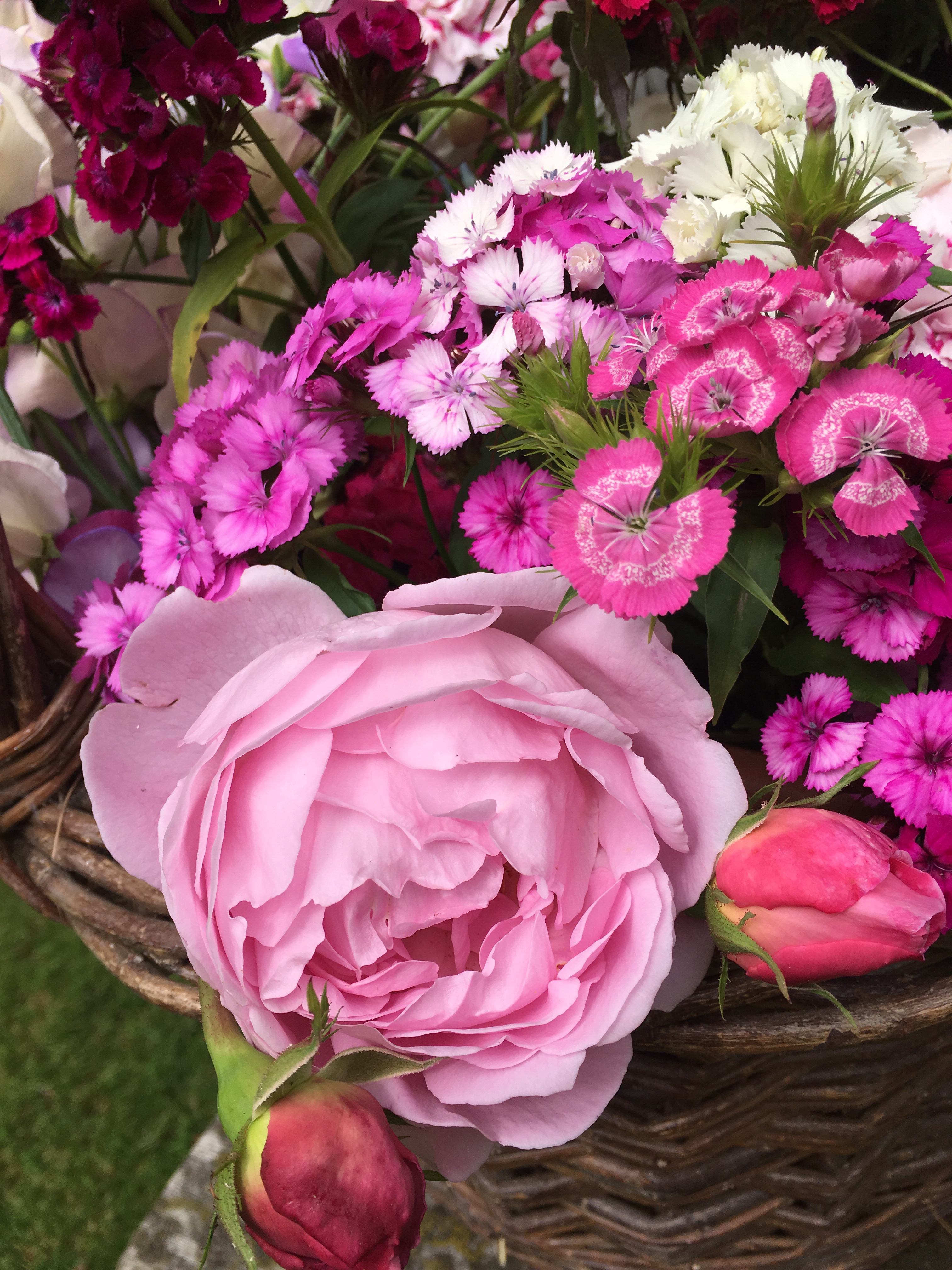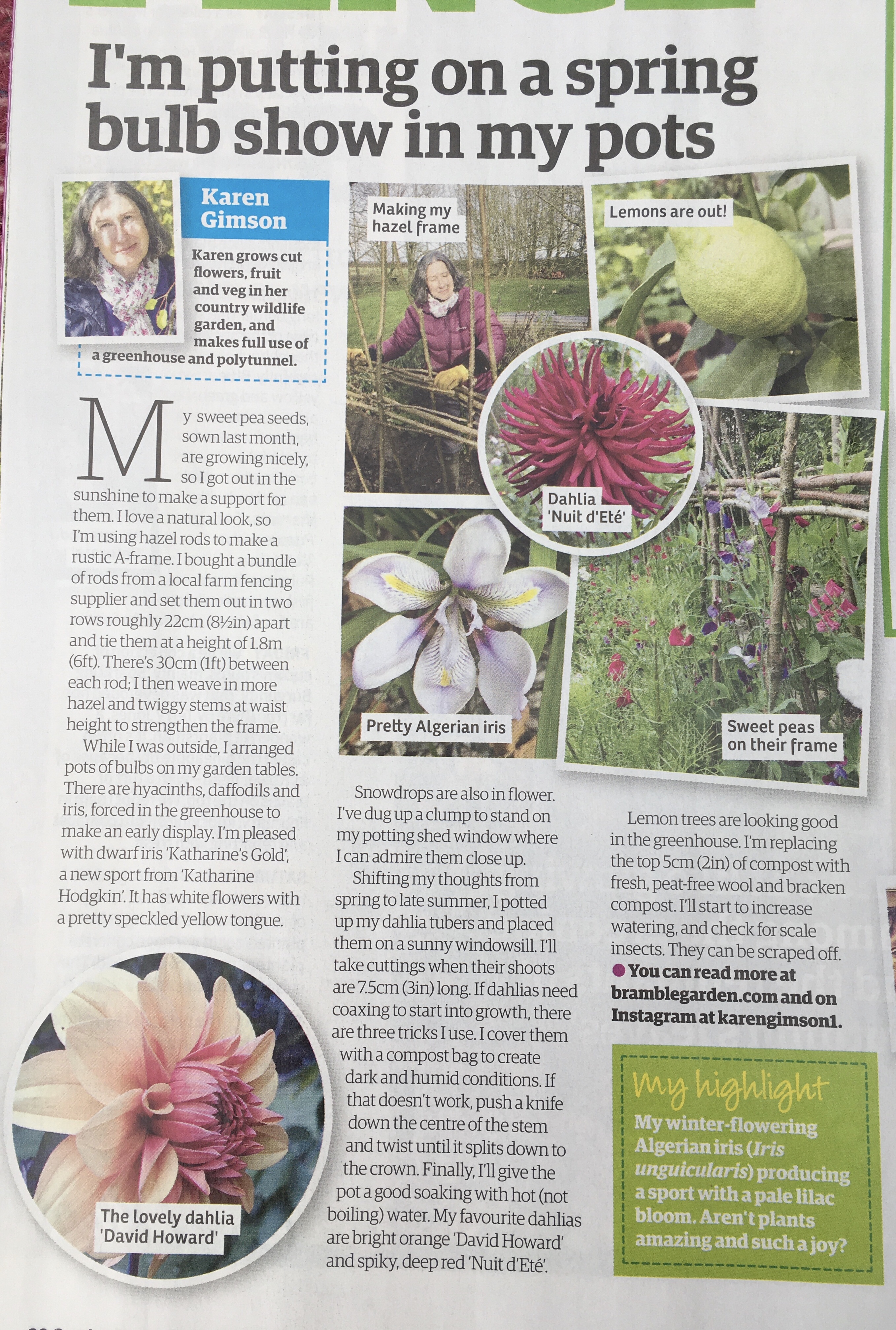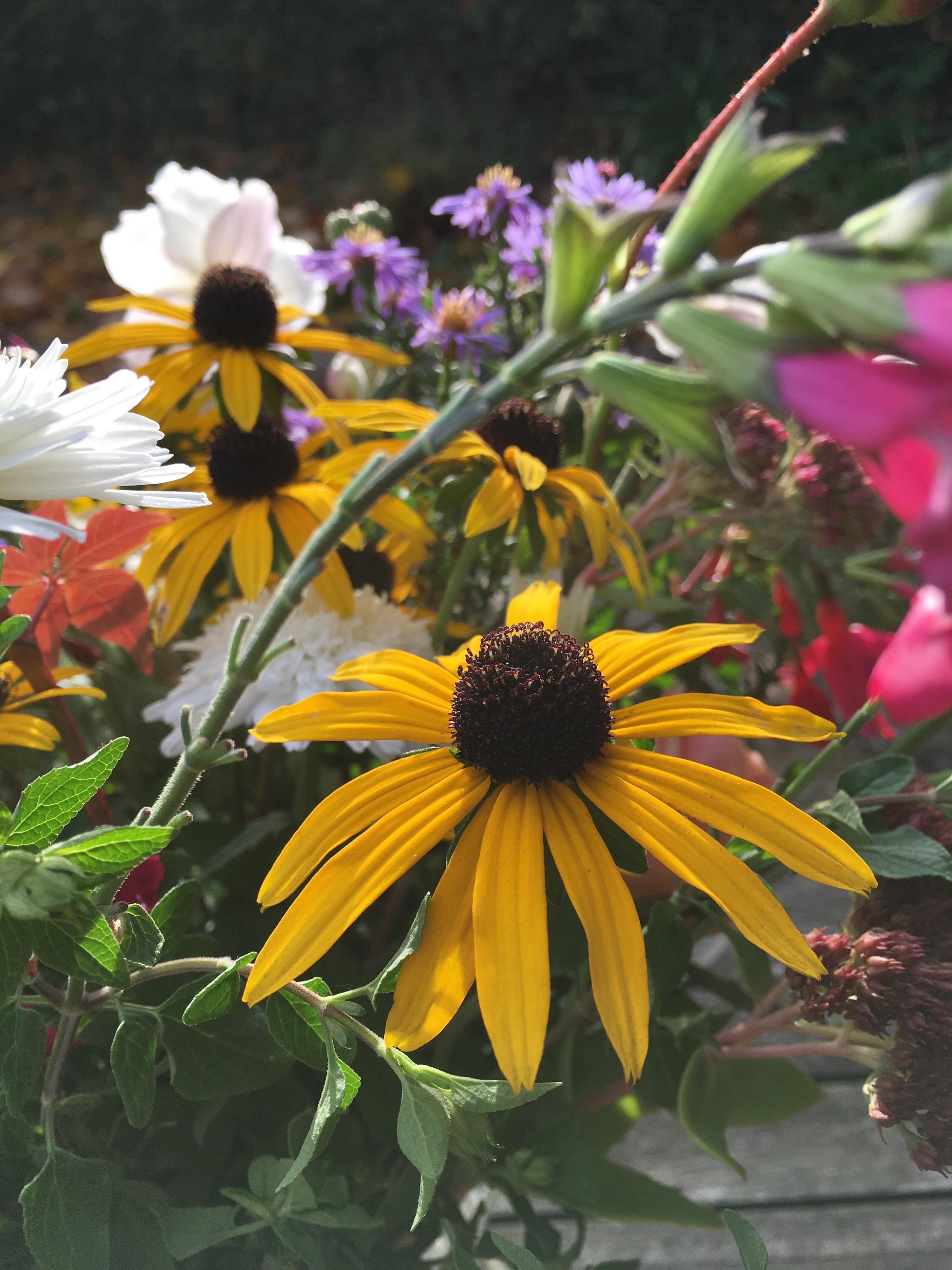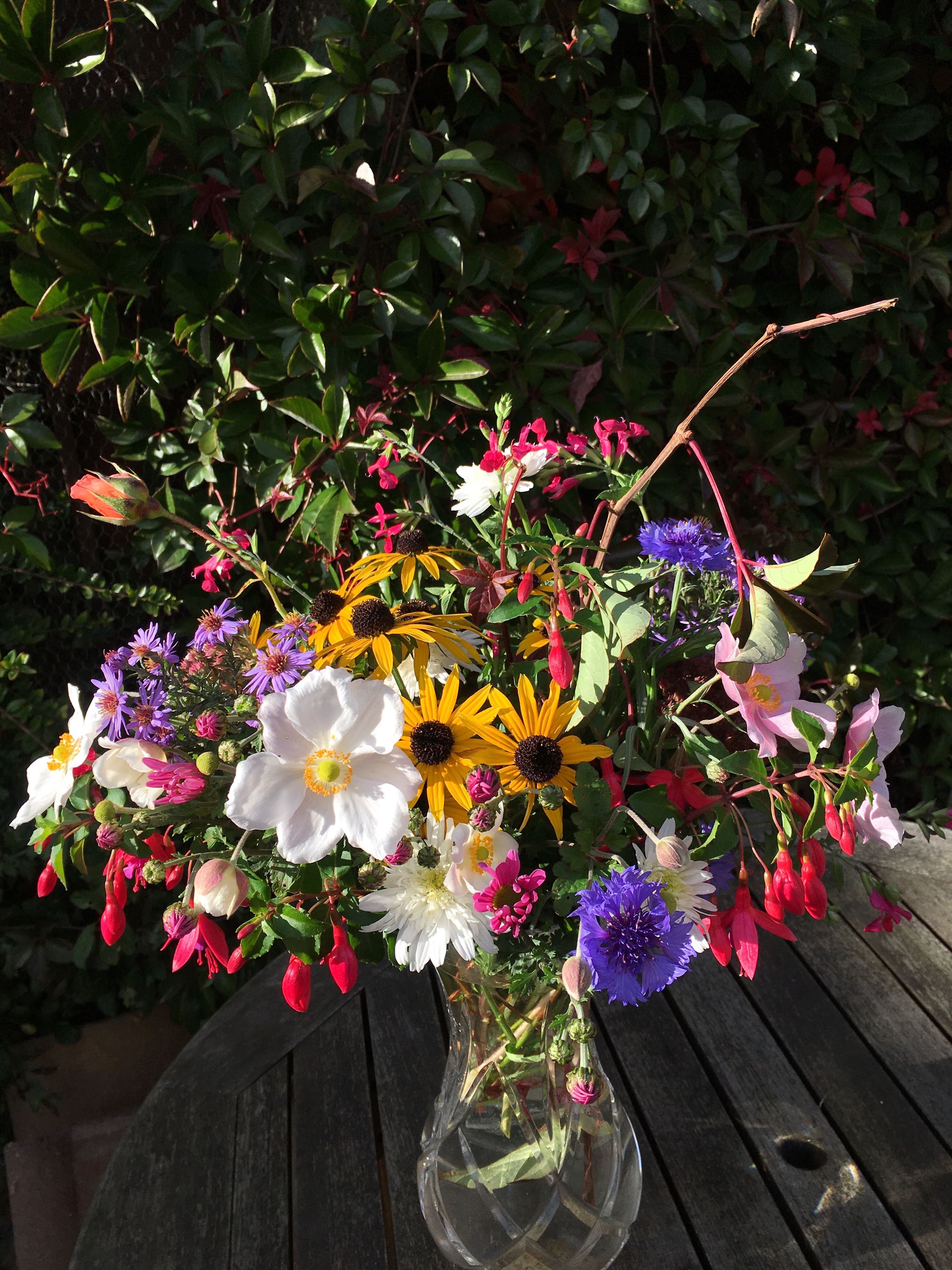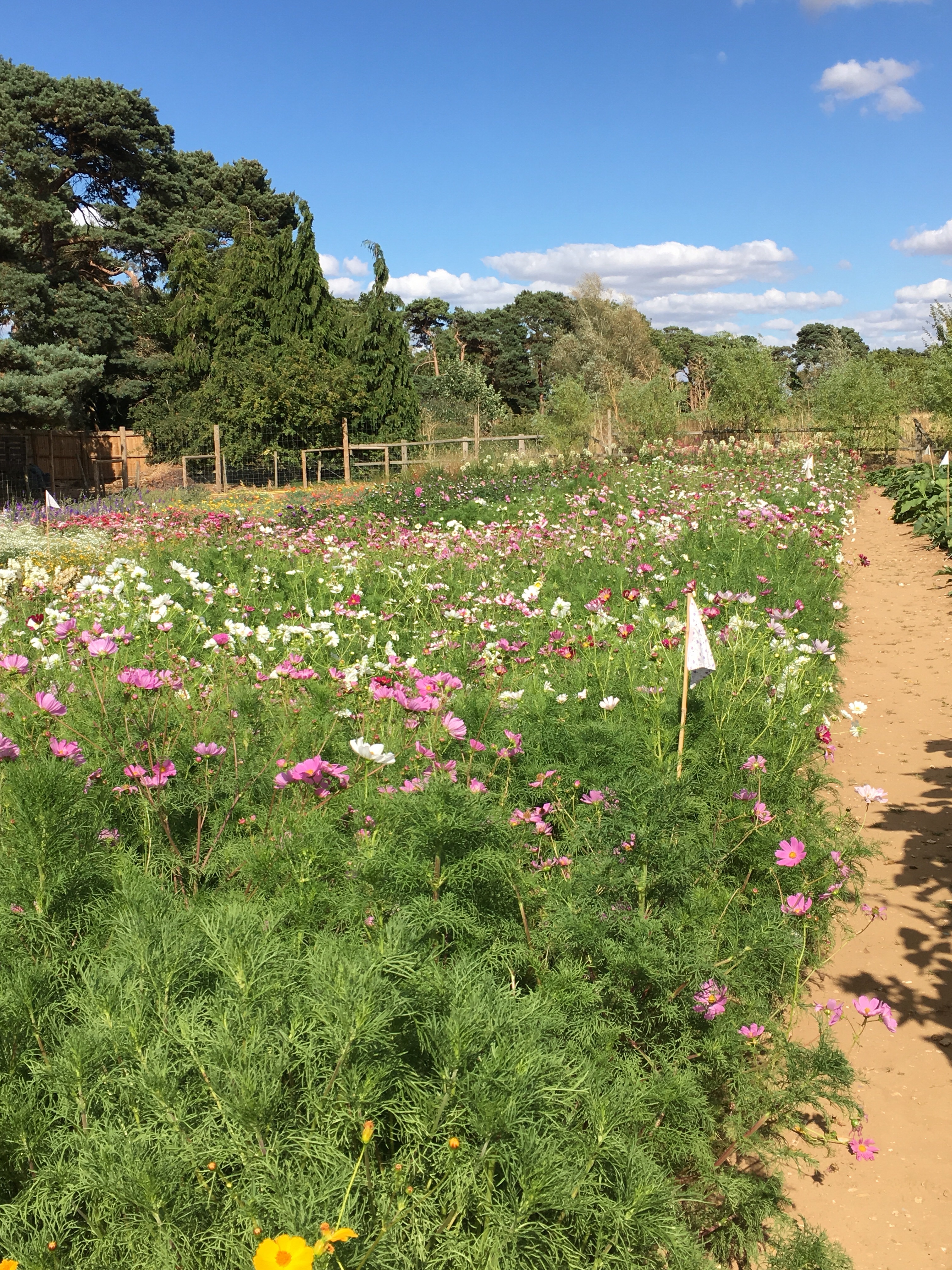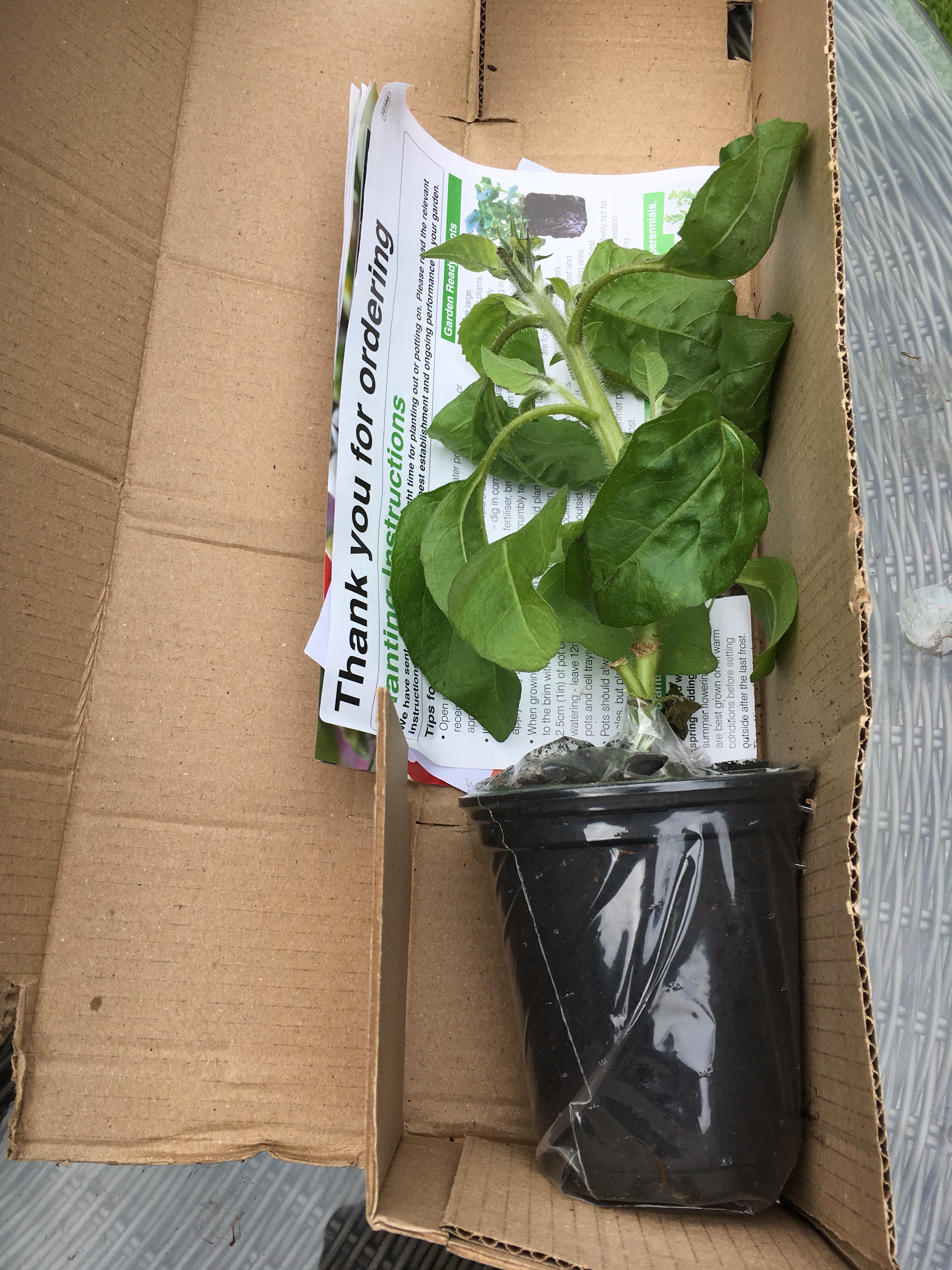
Creating a cut flower garden

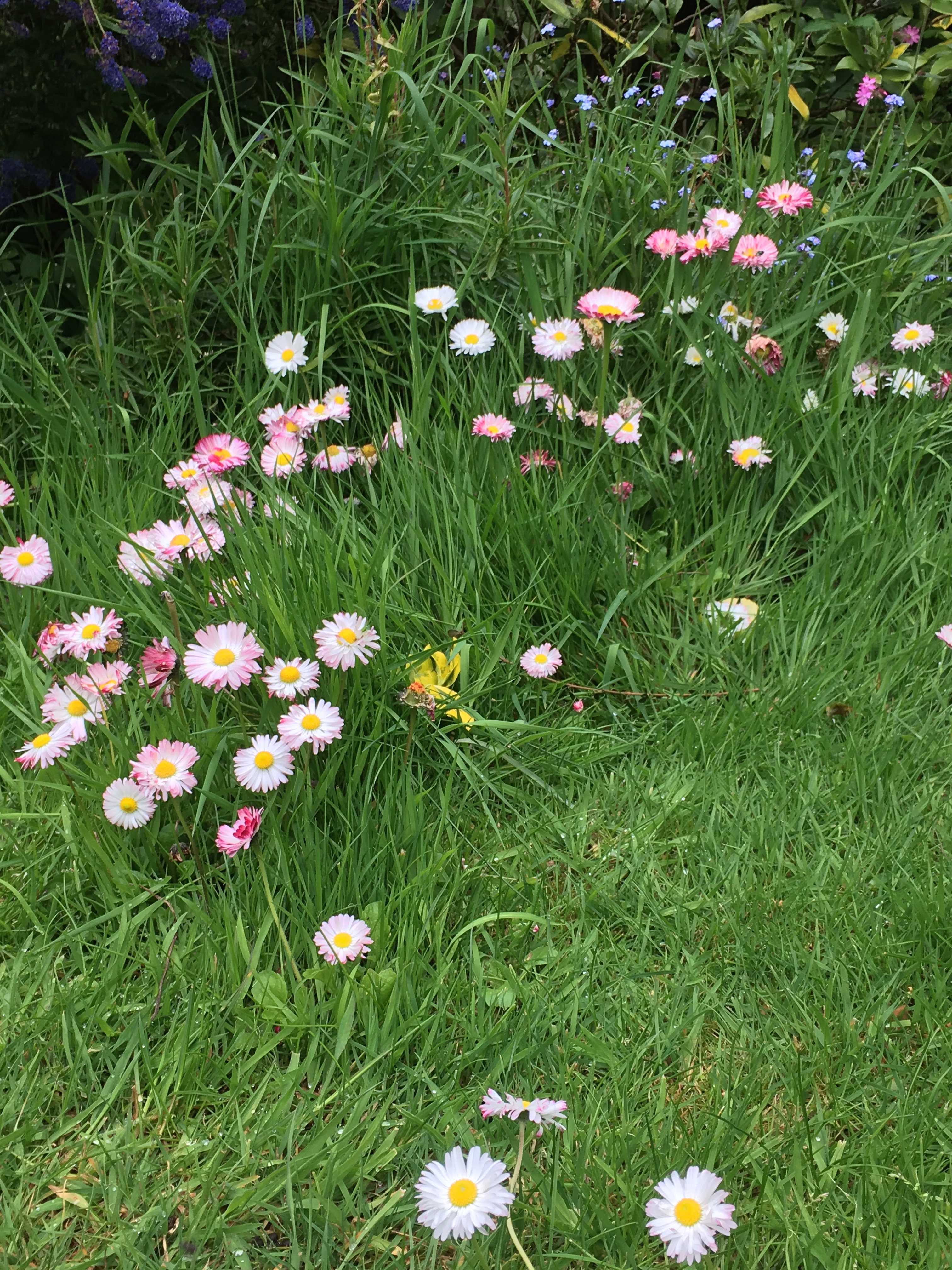
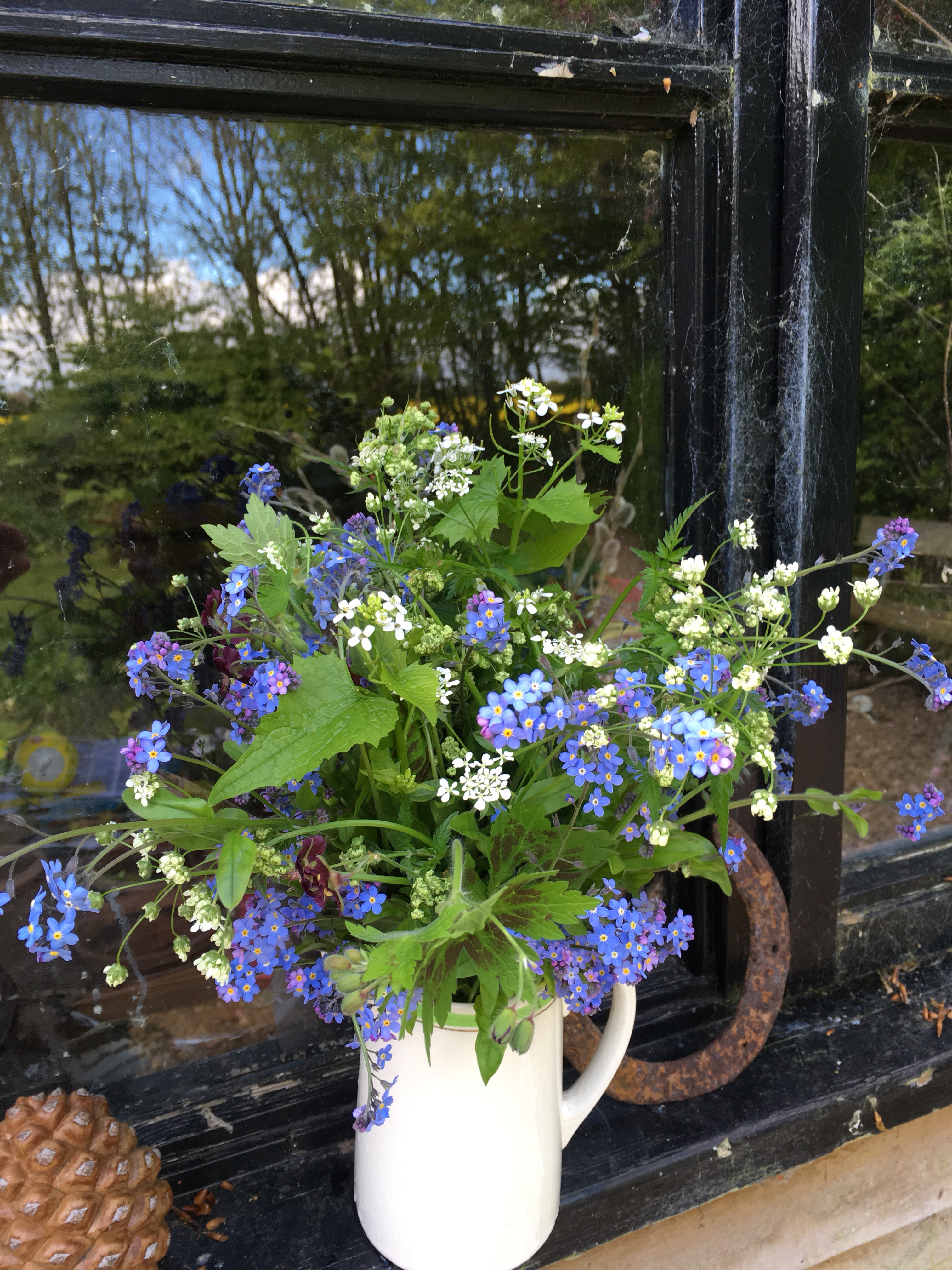
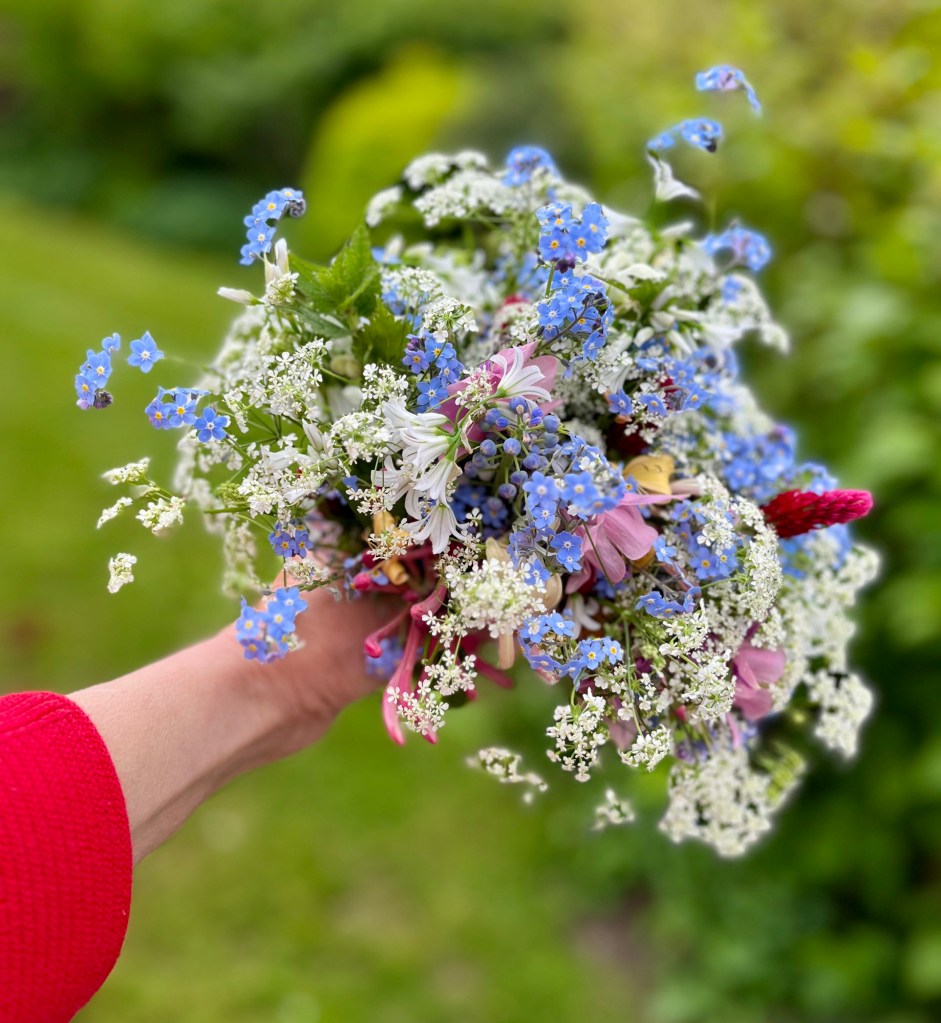
Forget me nots, cow parsley, wild allium, mint, honeysuckle, aquilegia, white flowering dead nettles and red clover.

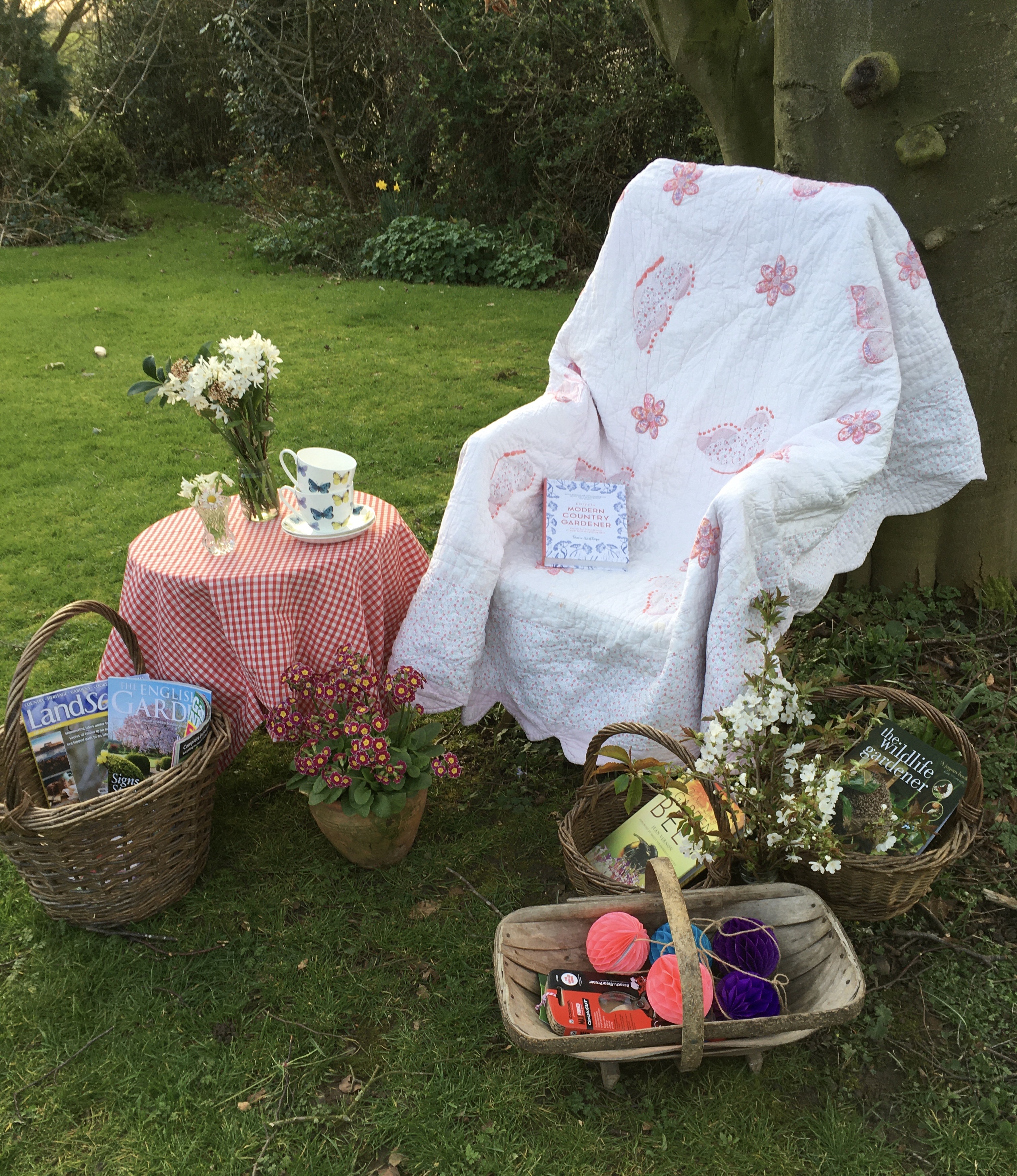
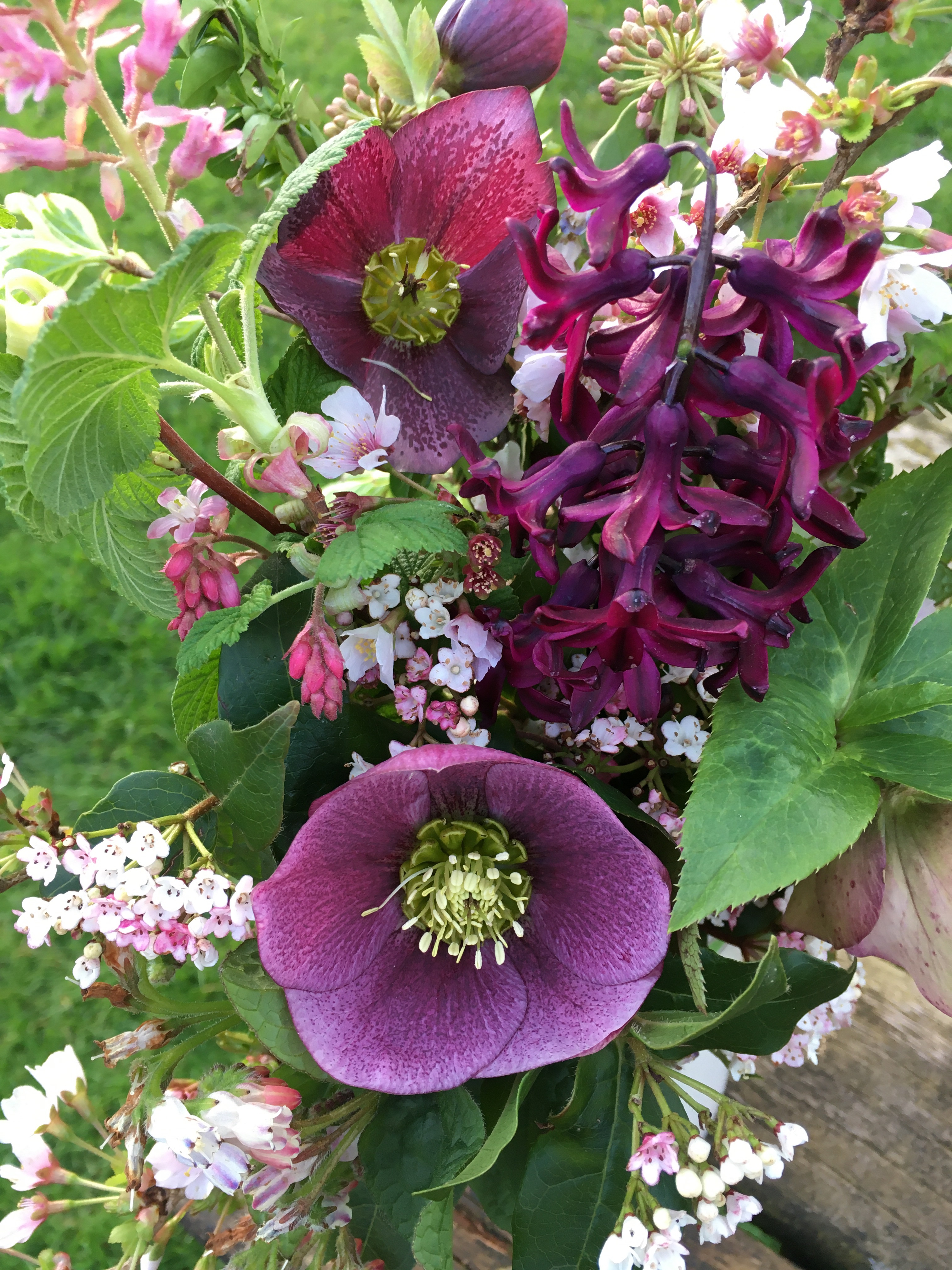
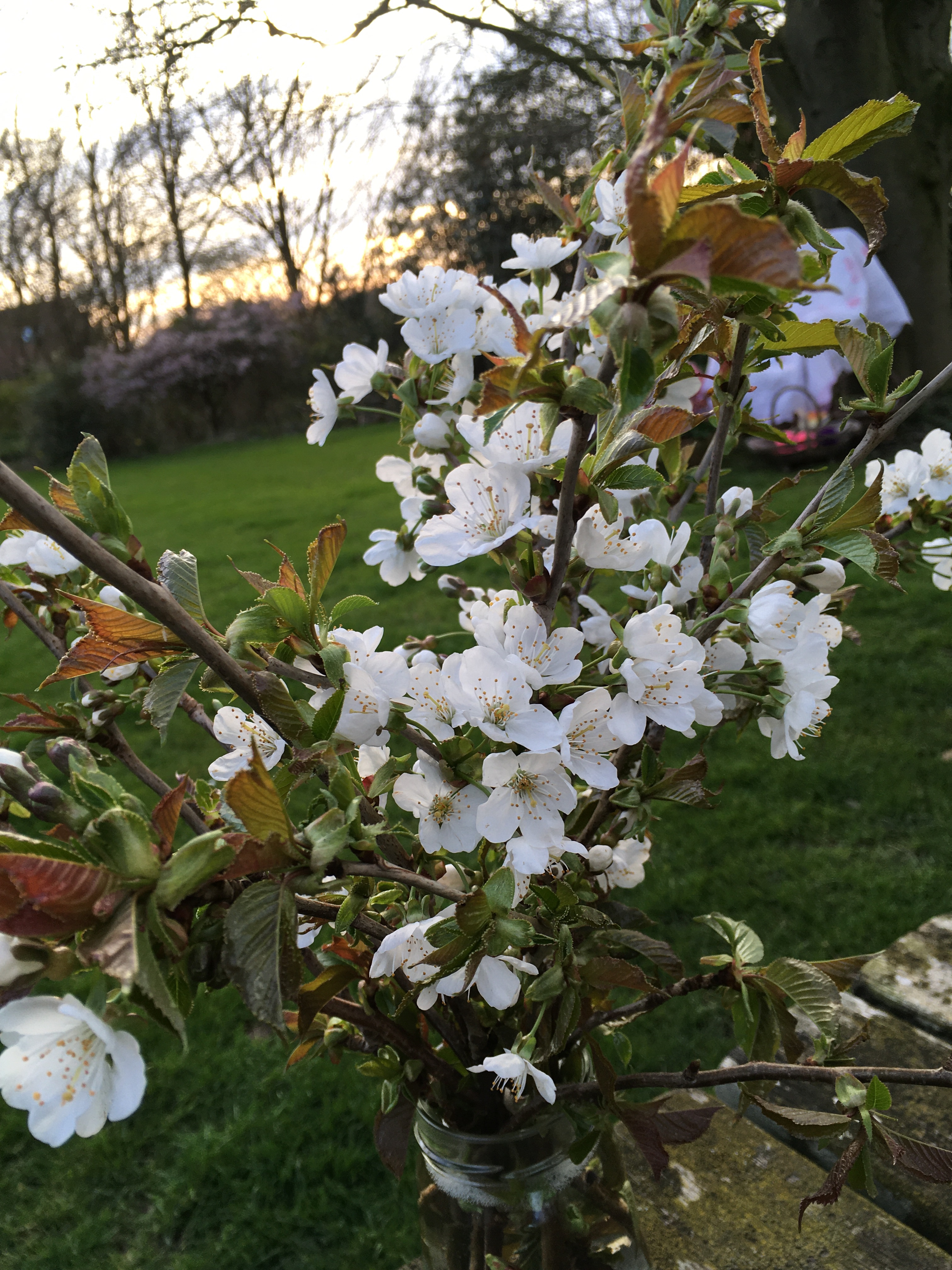
I tour garden clubs in the East Midlands giving inspiration for growing cut flowers at home. An hour’s talk is only long enough to give a flavour of the subject. Here are some notes to accompany my talks.

Chose a backbone of useful shrubs:

Dogwoods:
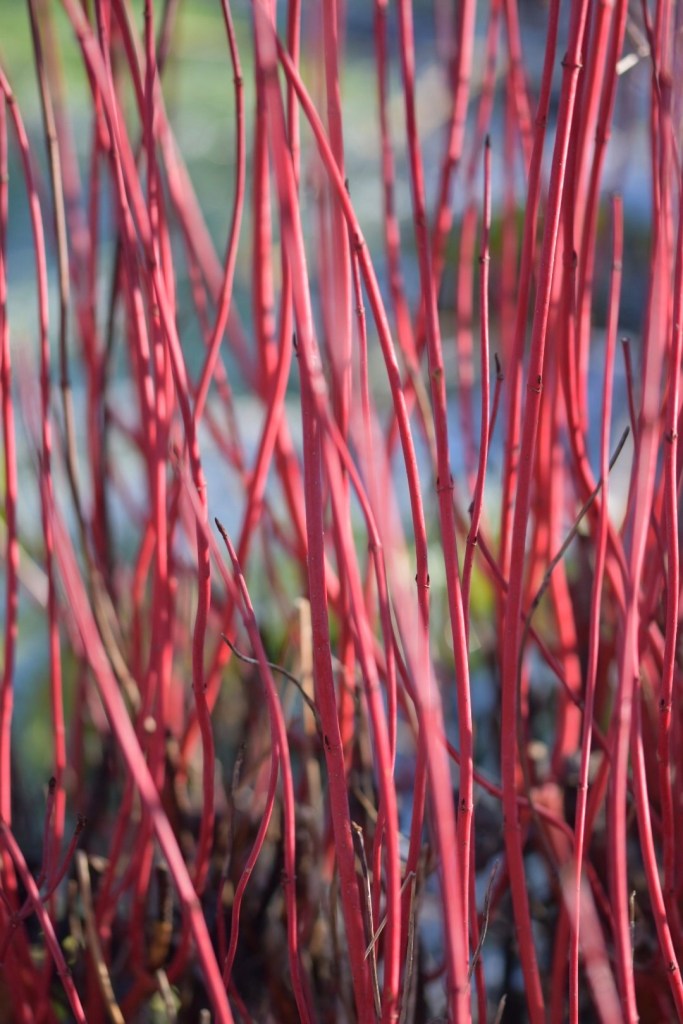
Cornus Westonbirt.

Cornus Westonbirt has the brightest red stems in winter. Only a few stems are needed to add a vertical element to flower arrangements. To get the brightest stems, cut the shrubs back to 20cm in March. New stems will grow back strongly.
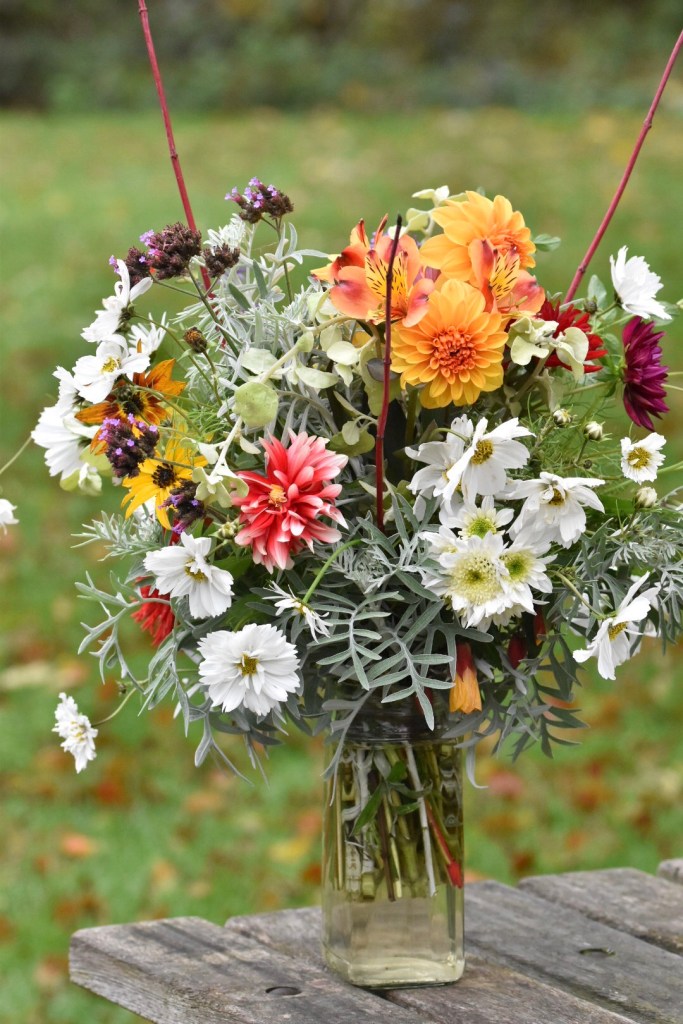
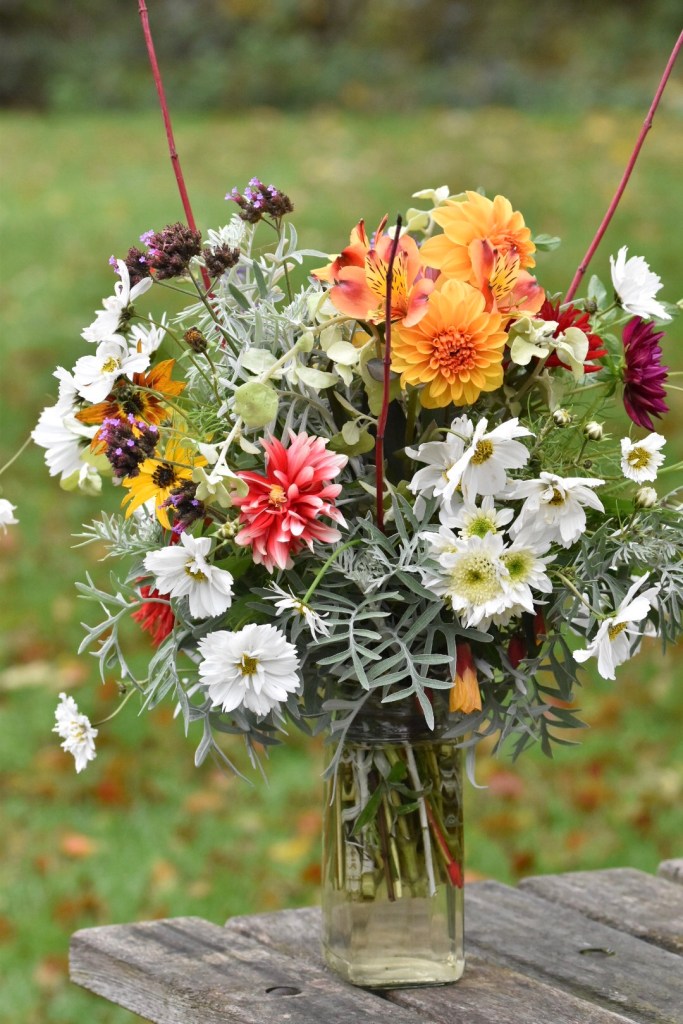
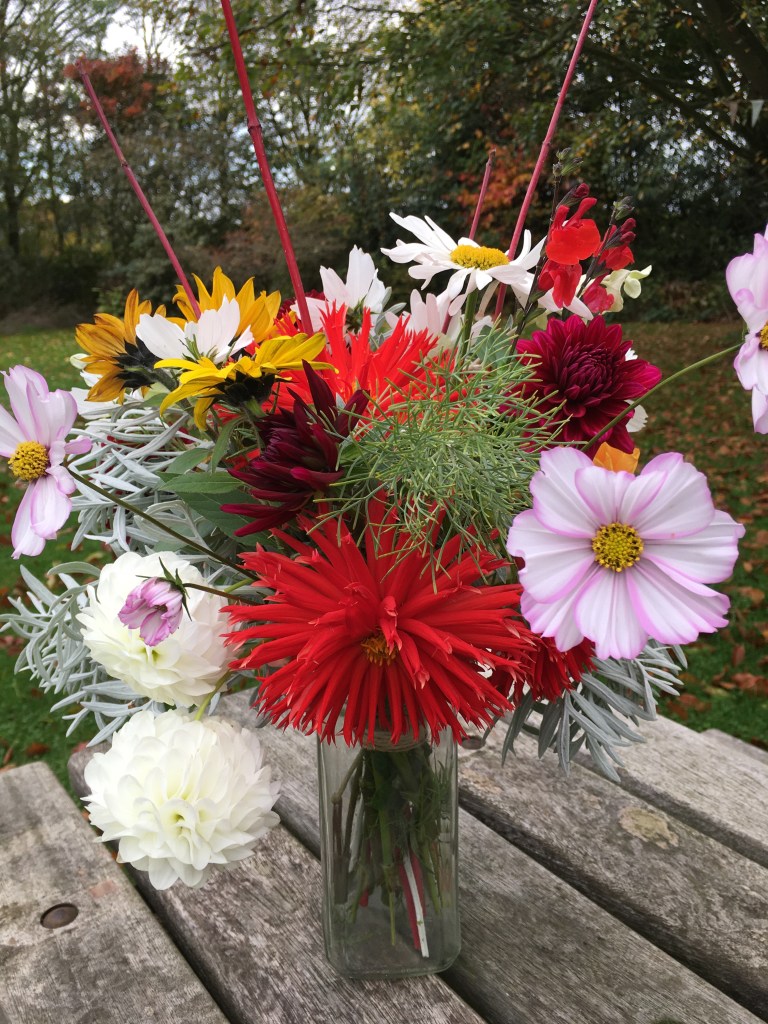
An autumn bouquet with just three stems of dogwood.

Physocarpus Diabolo:

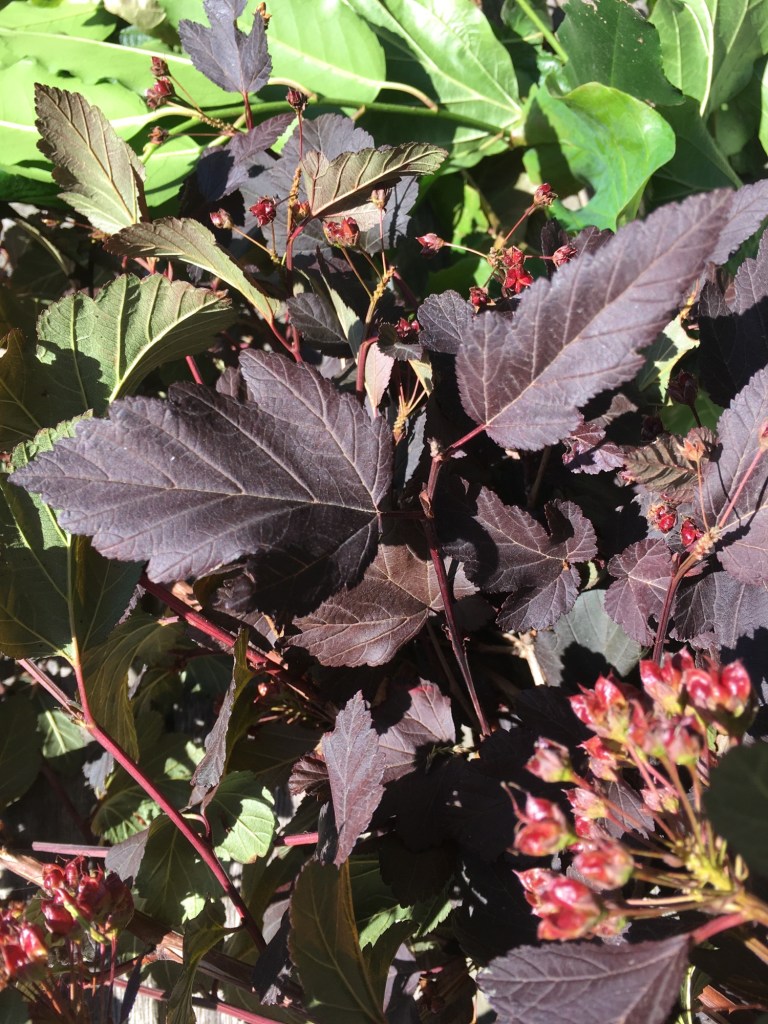
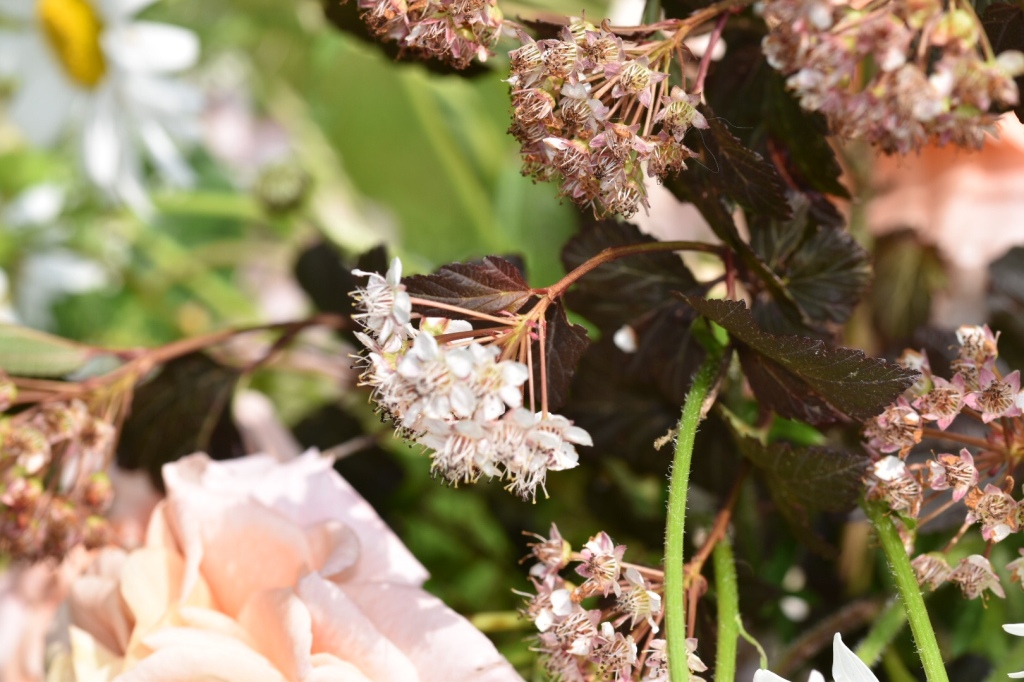
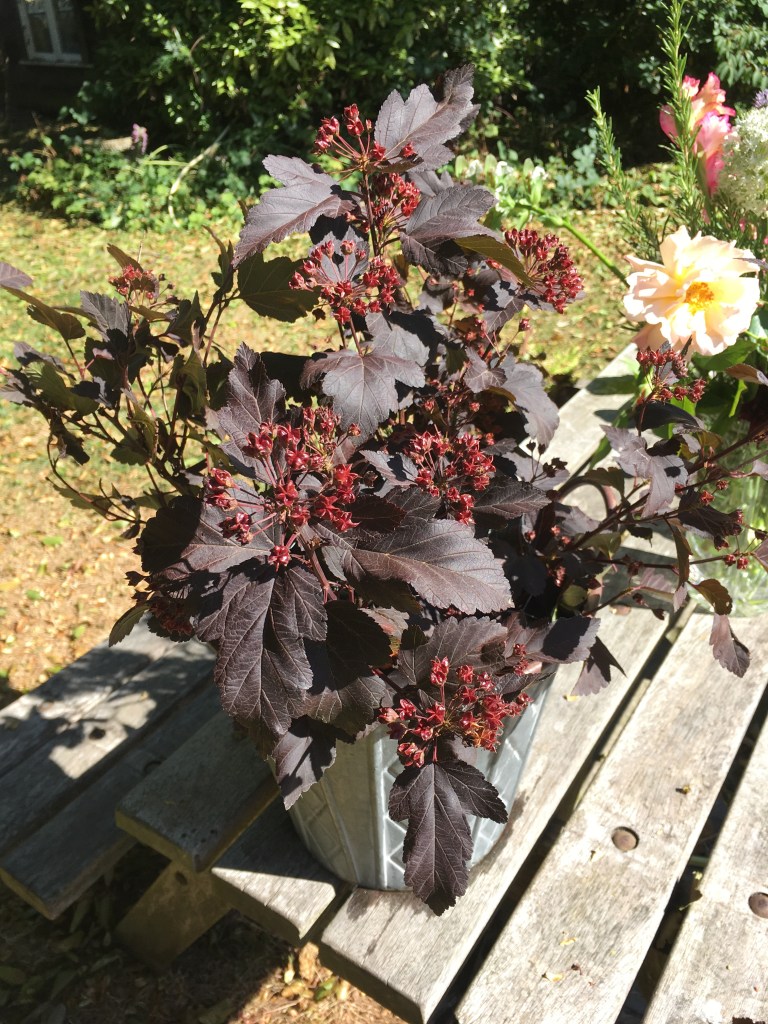
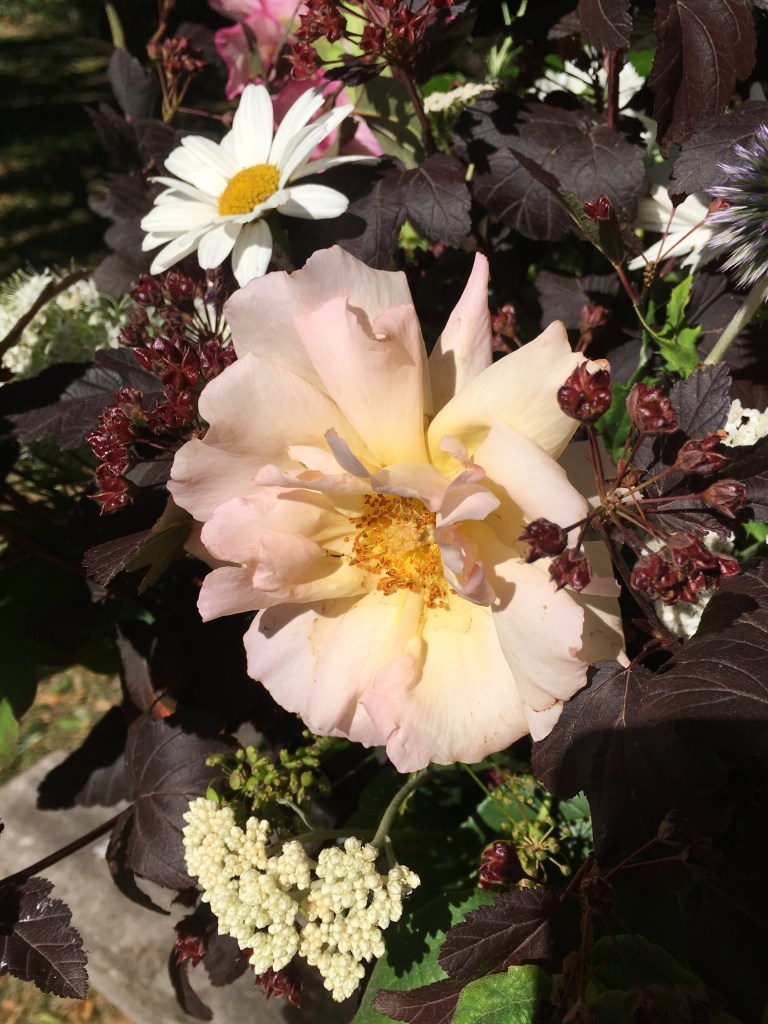
A beautiful backbone shrub, growing to 8ft. Comes into leaf early in spring. Produces pretty pinkish white flowers. Flowers then produce interesting seed heads. good strong stems for floristry and a lovely dark colour to set off all flower colours. I grow mine on a north-facing border directly in front of a hawthorn hedge. Copes with dry soil and semi-shade.
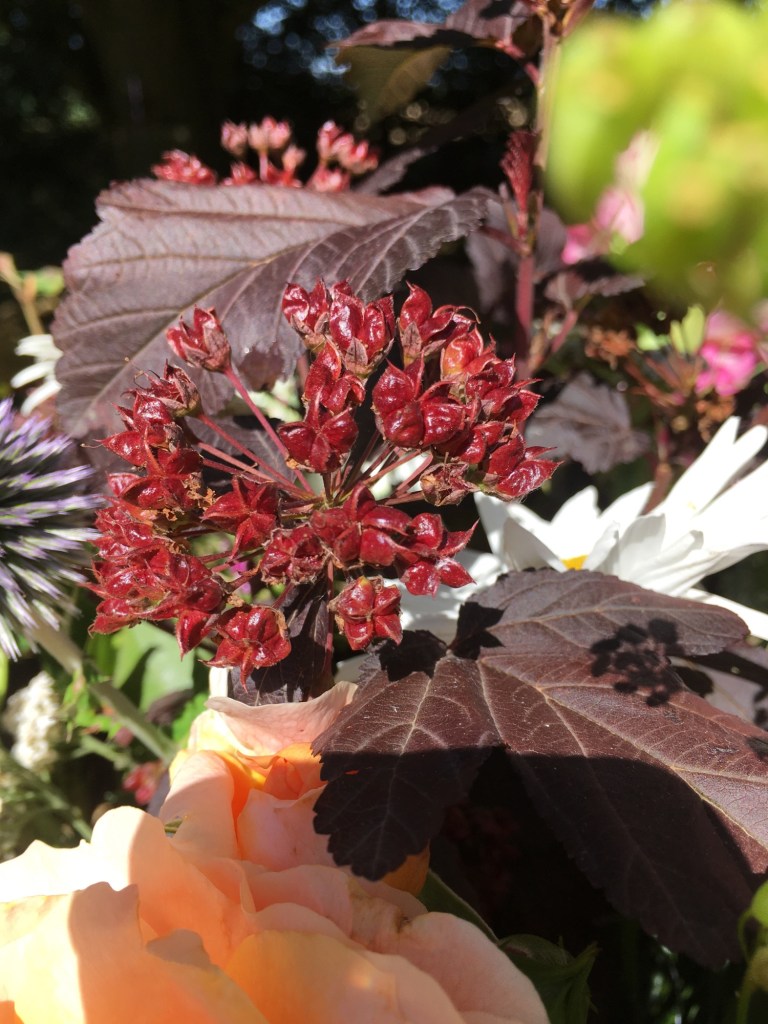
Physocarpus seed heads

Viburnum Eve Price

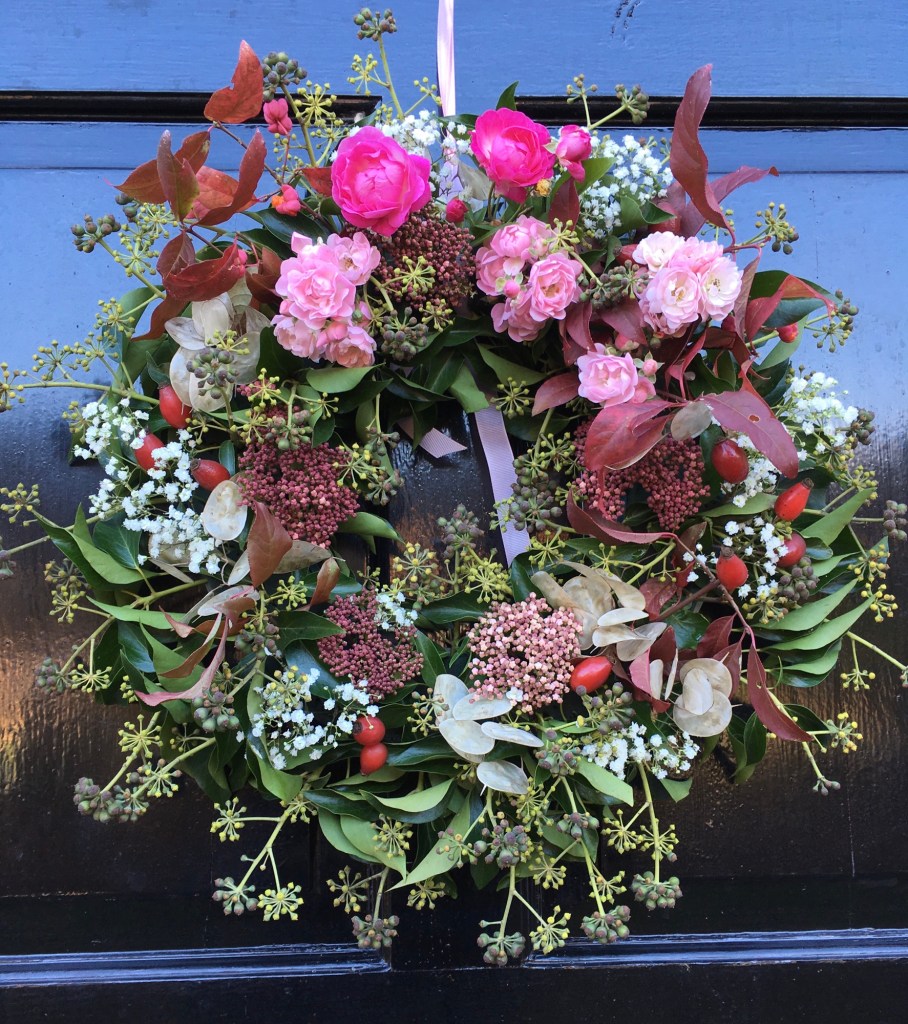
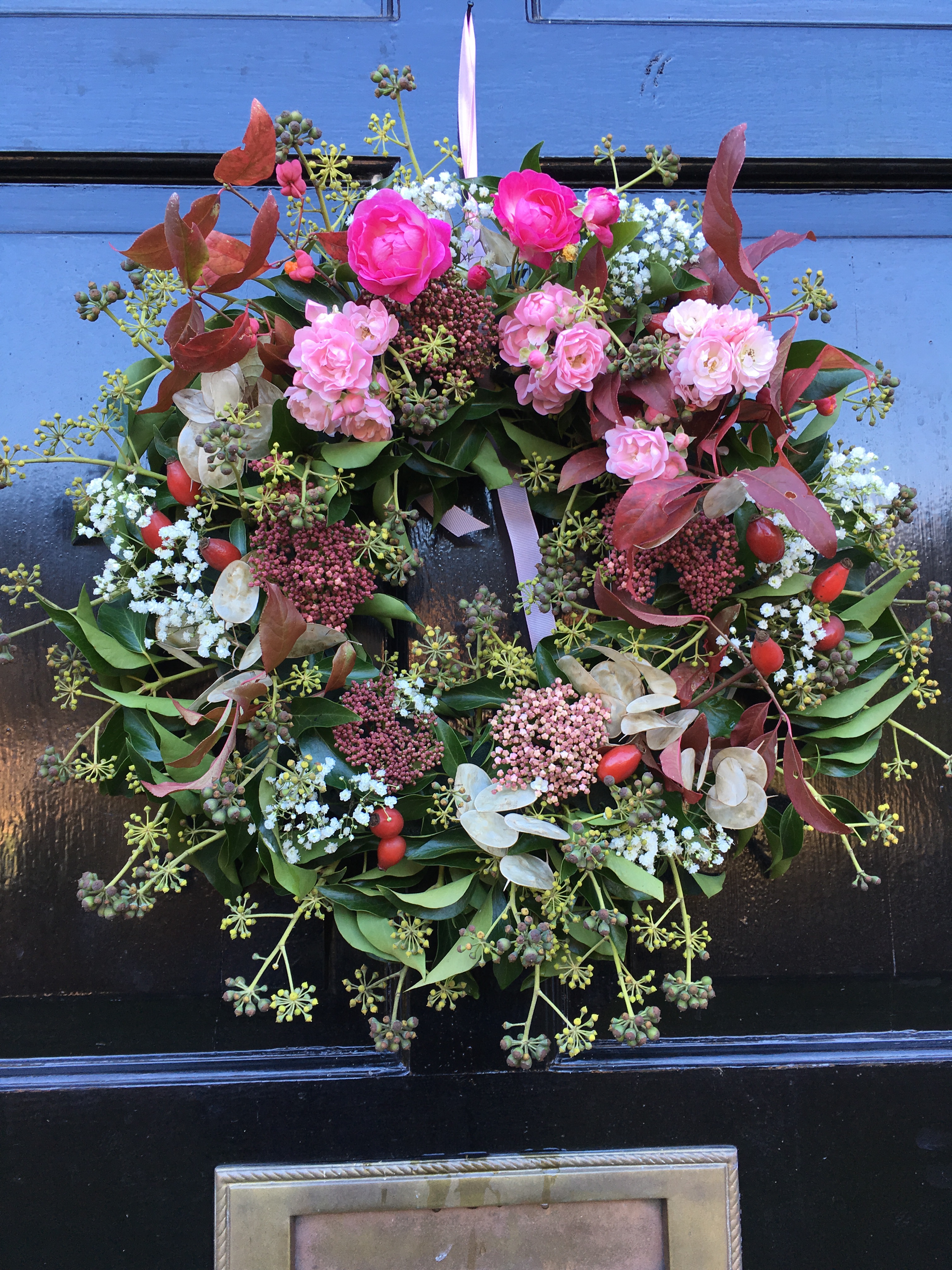
The pink flat heads are viburnum Eve Price. Surrounded by ivy, gypsophila, rosehips. Euonymus, and Rosa The Fairy.

Viburnum Eve Price flowers all winter. It has evergreen leaves and is tough and hardy.

Plant Roses:

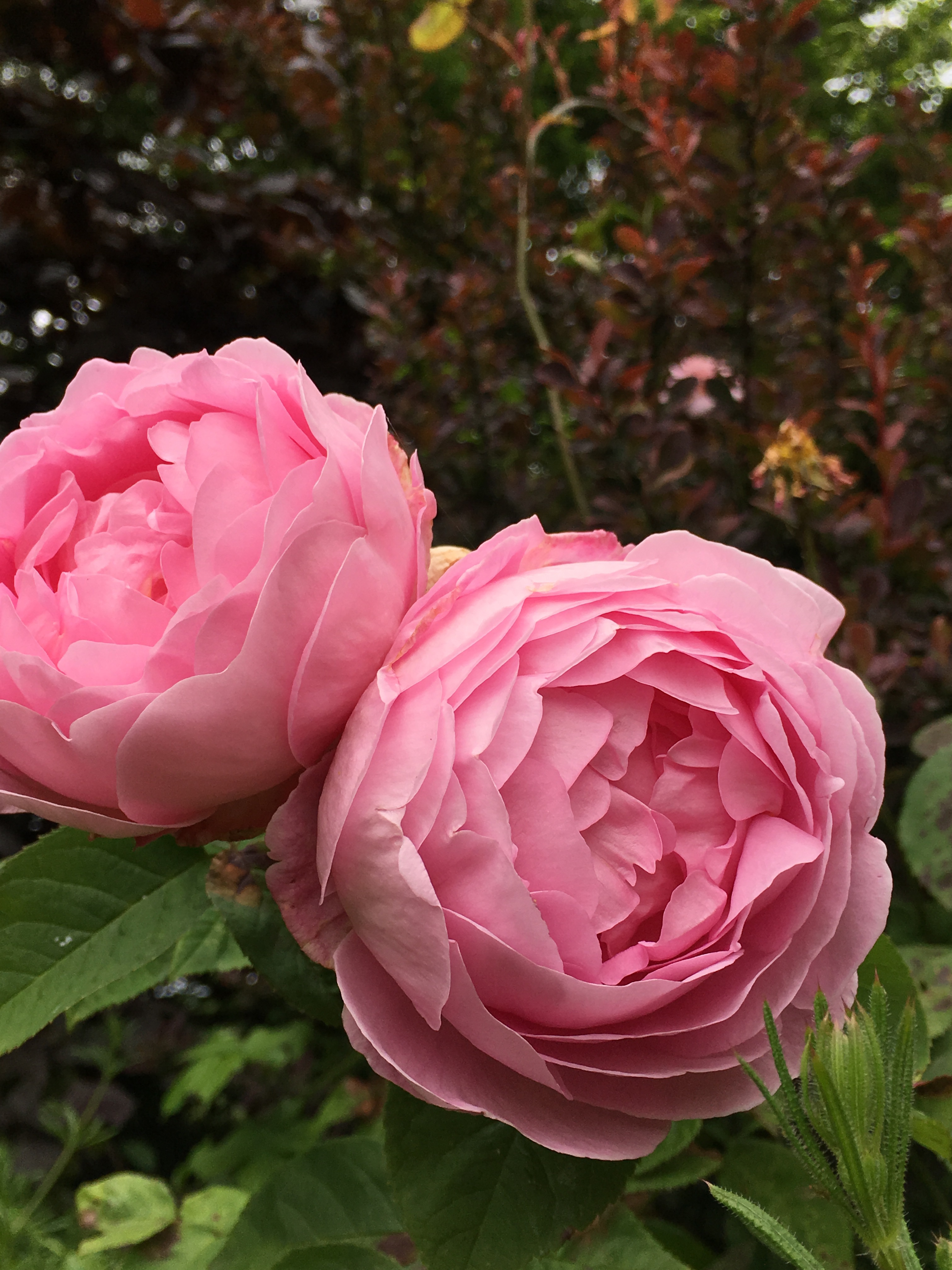
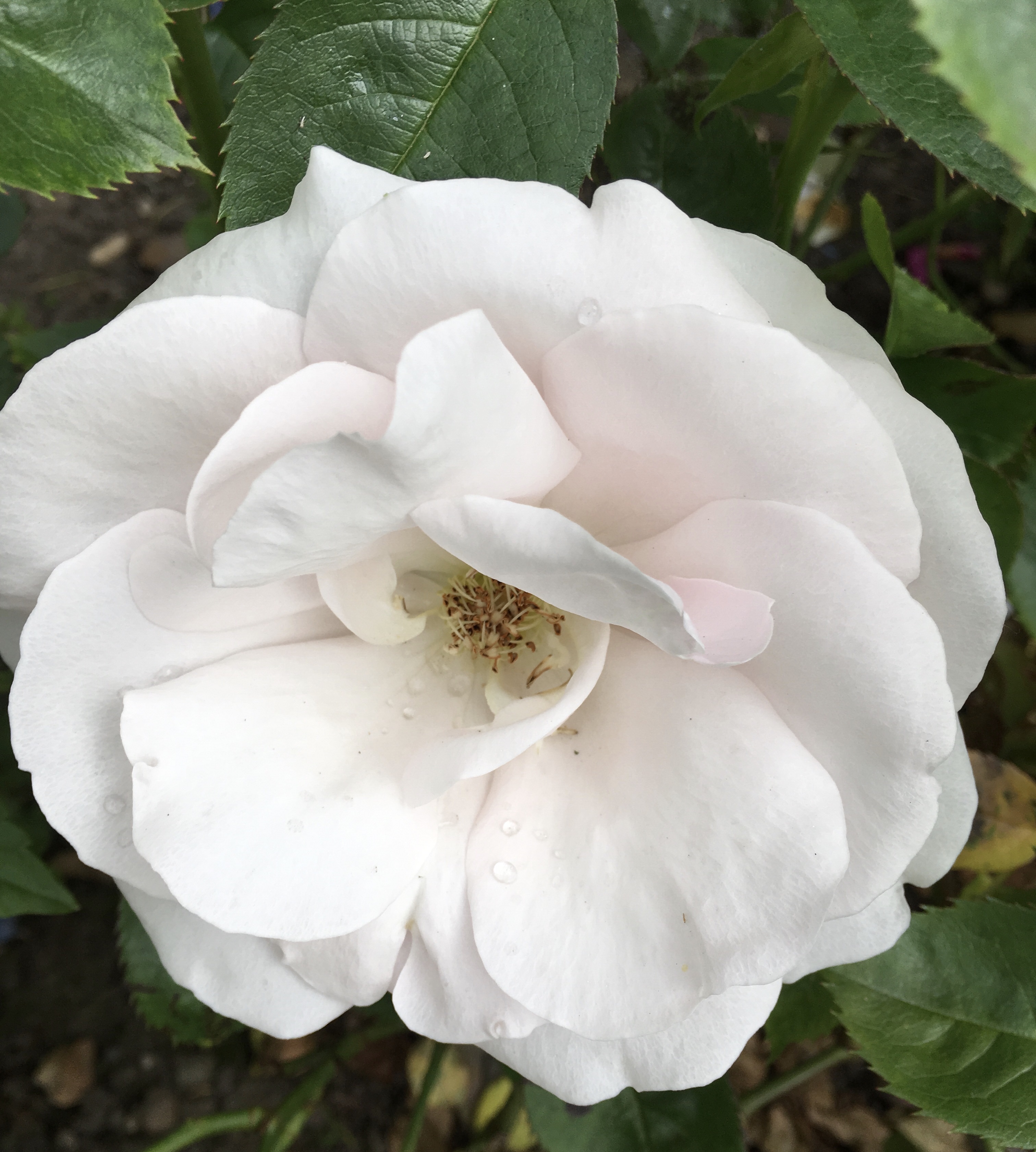
Timeless Cream

Timeless Cream and Timeless Purple are part of the new home florists’ range . Few thorns and wonderful scent.

Timeless Purple

Grow a patch of wildflowers:

I have a bed 3m long by 1.2m wide with paths surrounding it. Grown from a packet of wild flower seeds (Mr Fothergill’s or Sarah Raven). The plants that emerged included white oxeye daisy, blue cranesbill geranium, pink campion. These come back every year. The grasses grow in a strip along the edge of the lawn. Quaking grass is particularly lovely.

More perennial plants: Grow white argyranthemums.

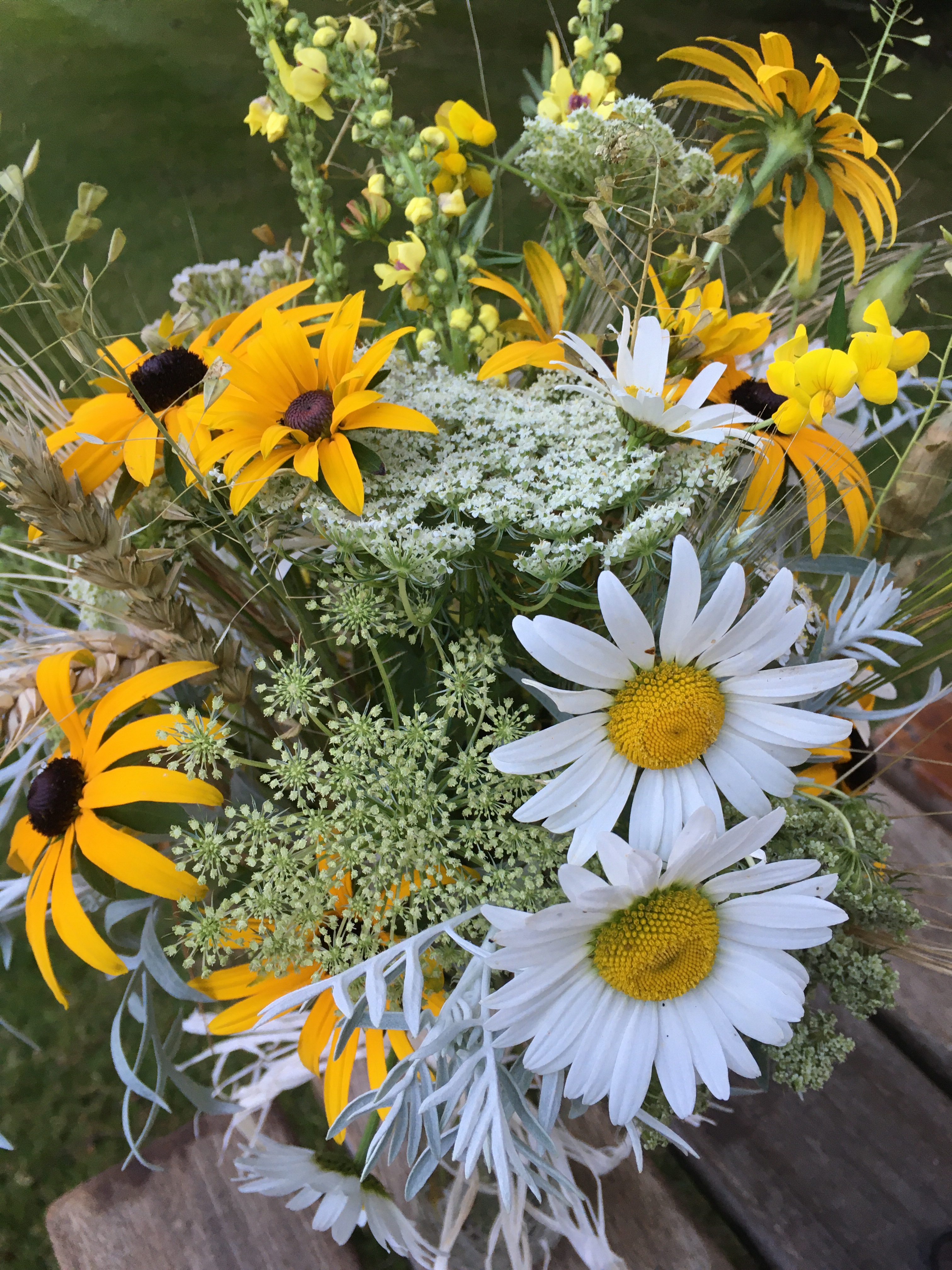
Argyranthemums with ammi, verbascum and rudbeckias.

Argyranthemum or shasta daisies grow to 70cm and can be grown in a garden border in full sun. They need dividing every three years and will need staking. They provide flowers from June to September. Most garden centres sell these plants.

Annuals to grow for cut flowers :

Sweet Peas:

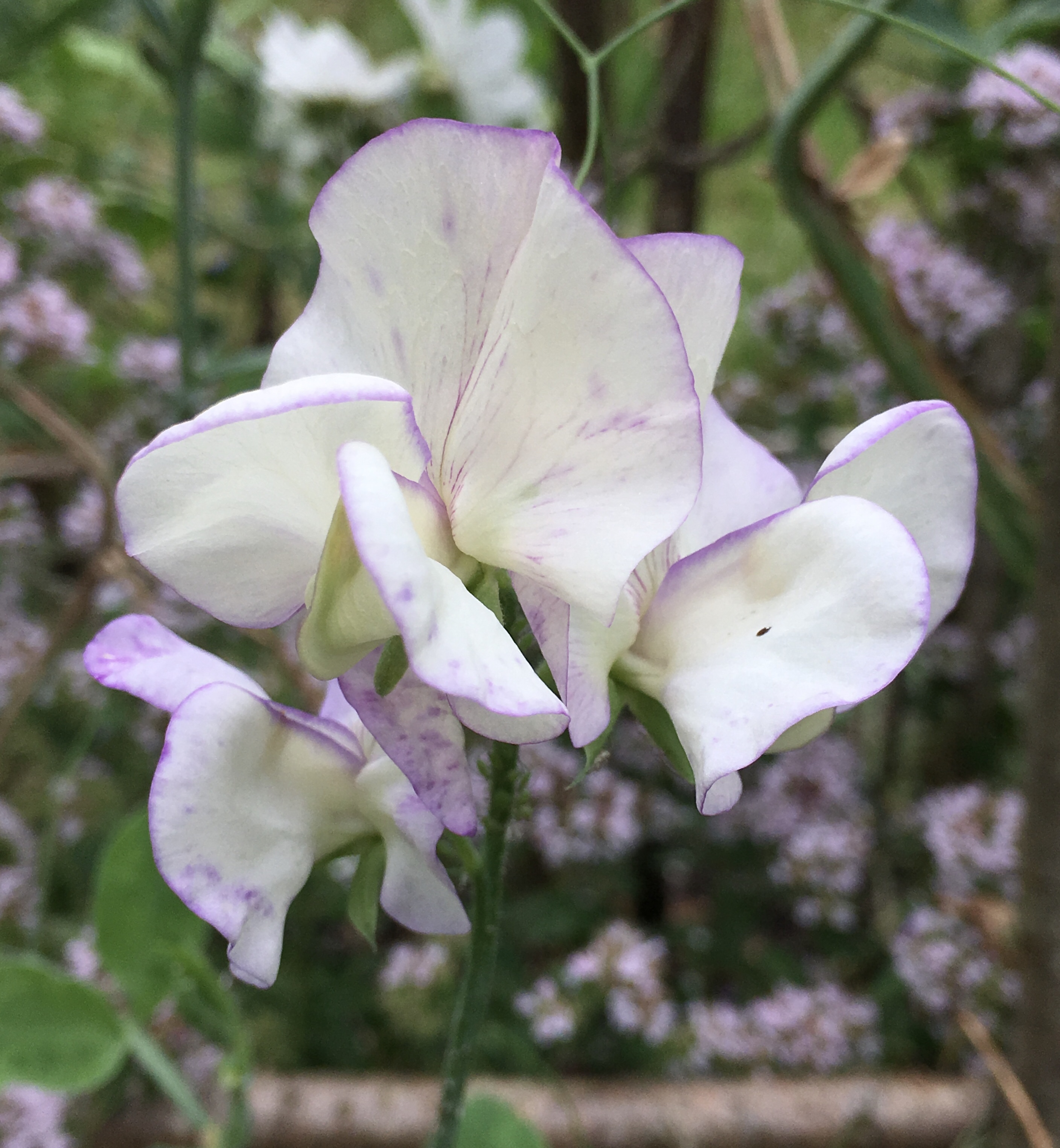
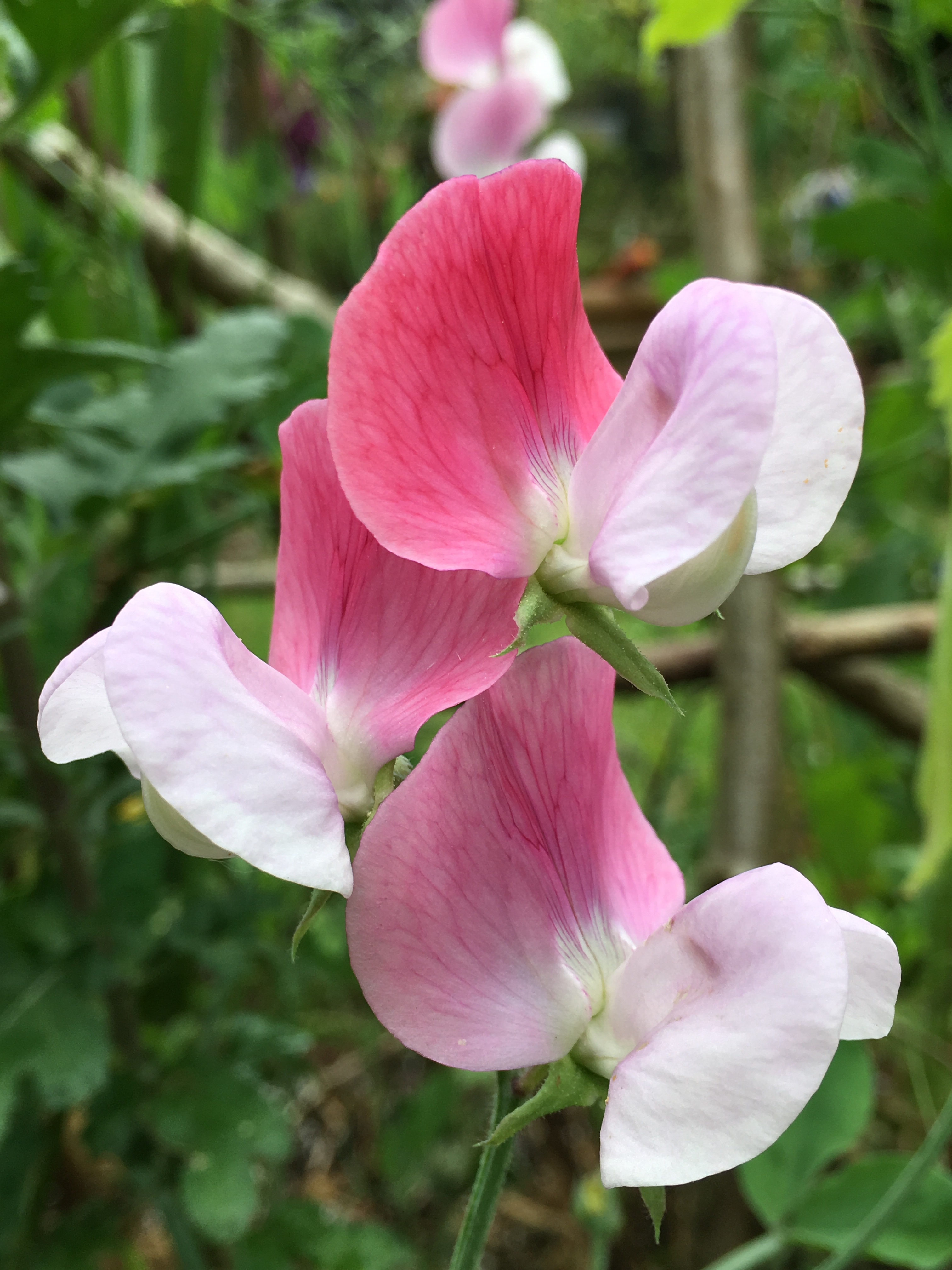
Wiltshire Ripple

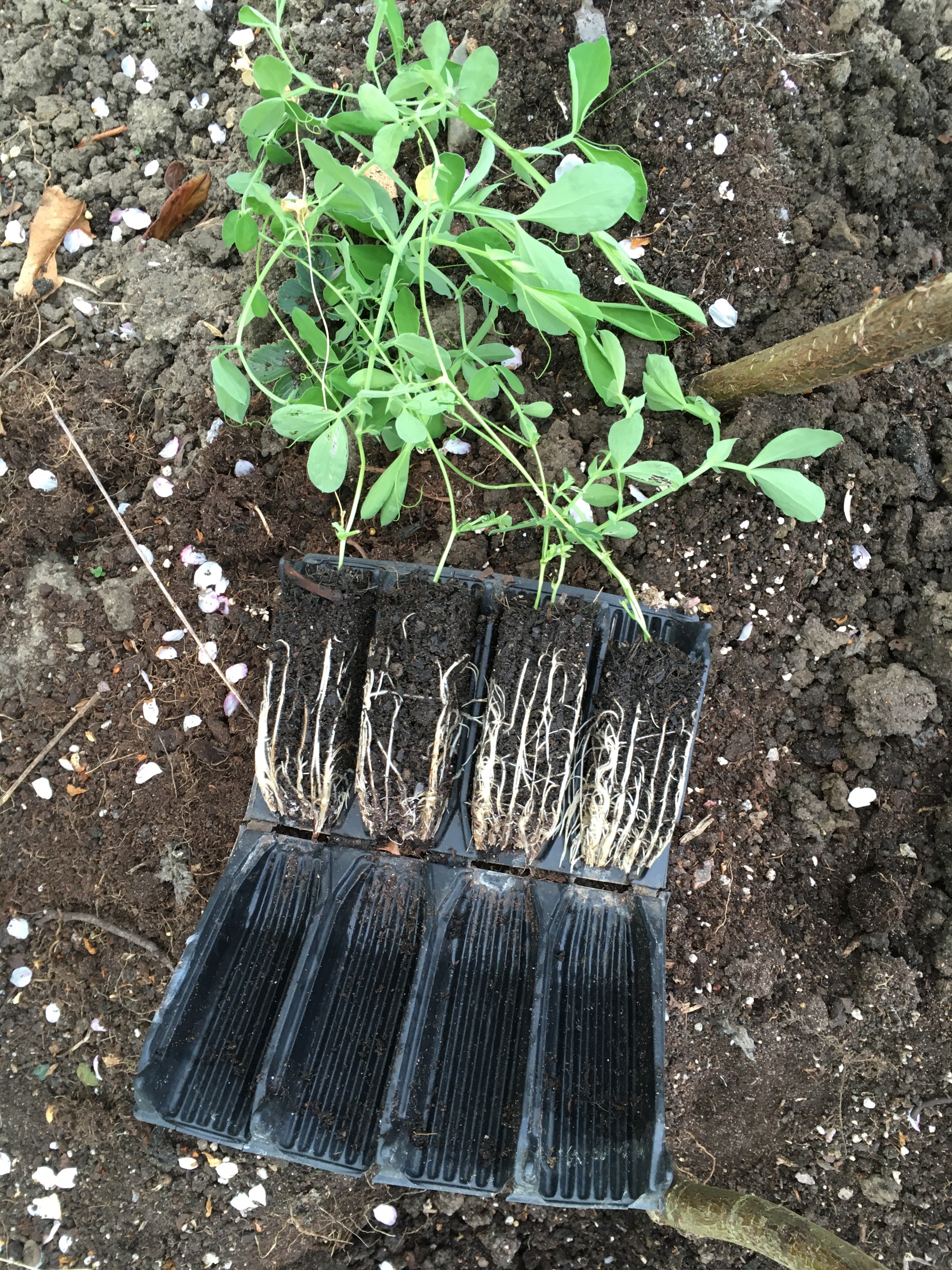
Sow Sweet Peas in October in long root trainers with 50 percent compost and 50 percent grit for drainage. Place the pots inside a clear plastic storage box to protect from mice and the weather. Storage boxes can be brought indoors and stacked up like a mini greenhouse if the temperatures go below freezing. Lids can be removed in good weather. Do not allow seedlings to get too wet over winter. Plant out in good soil in April.

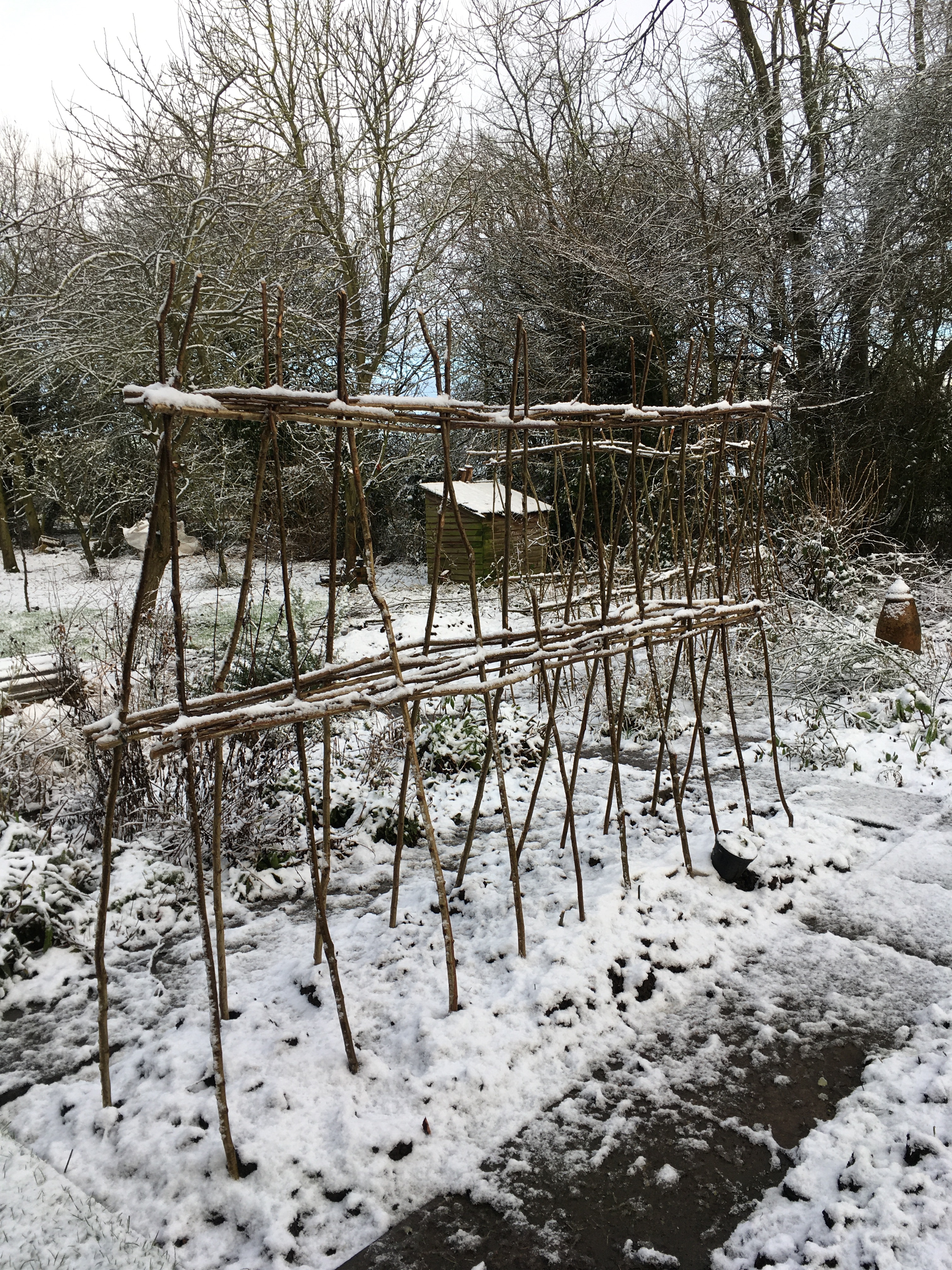
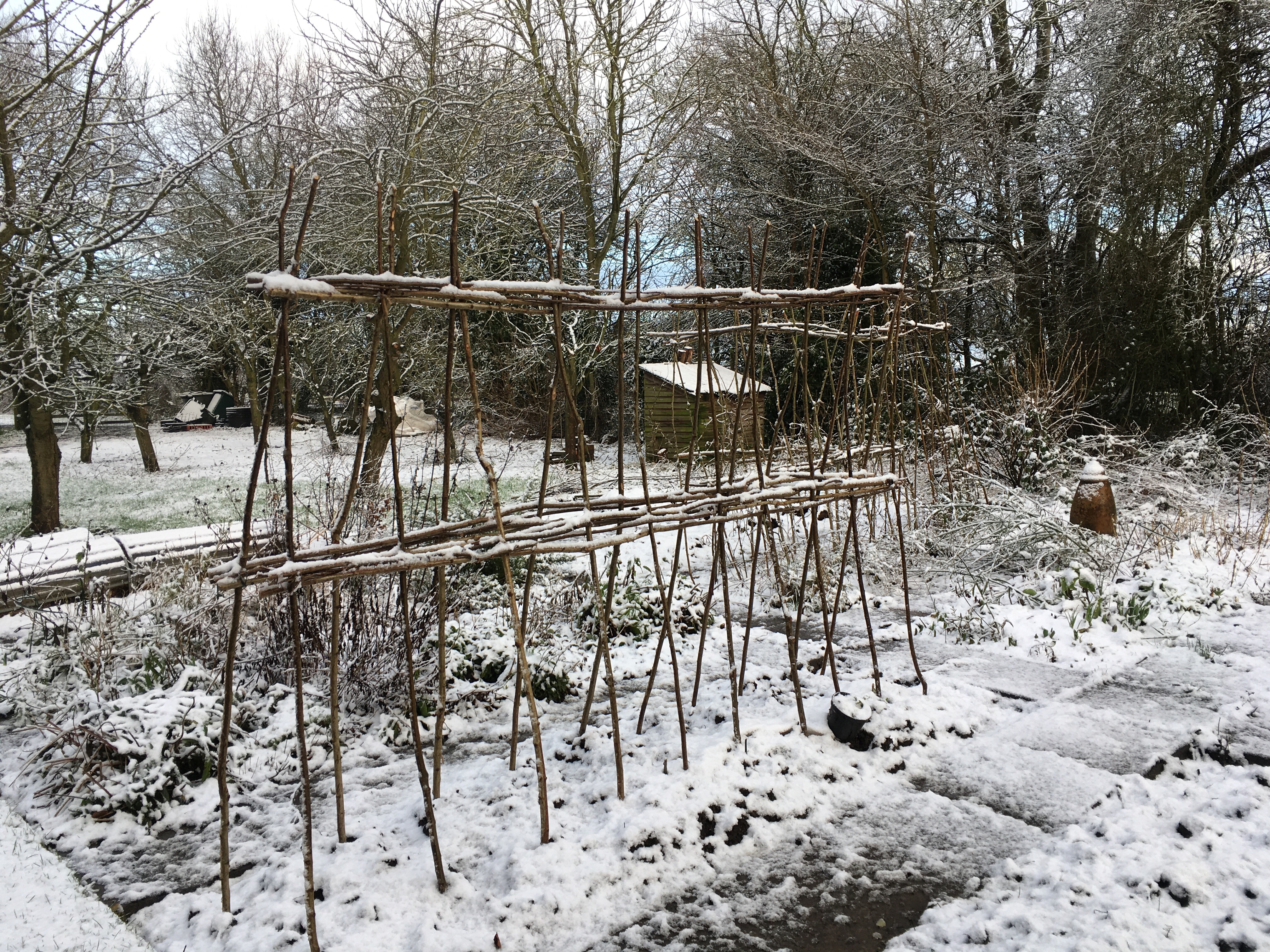
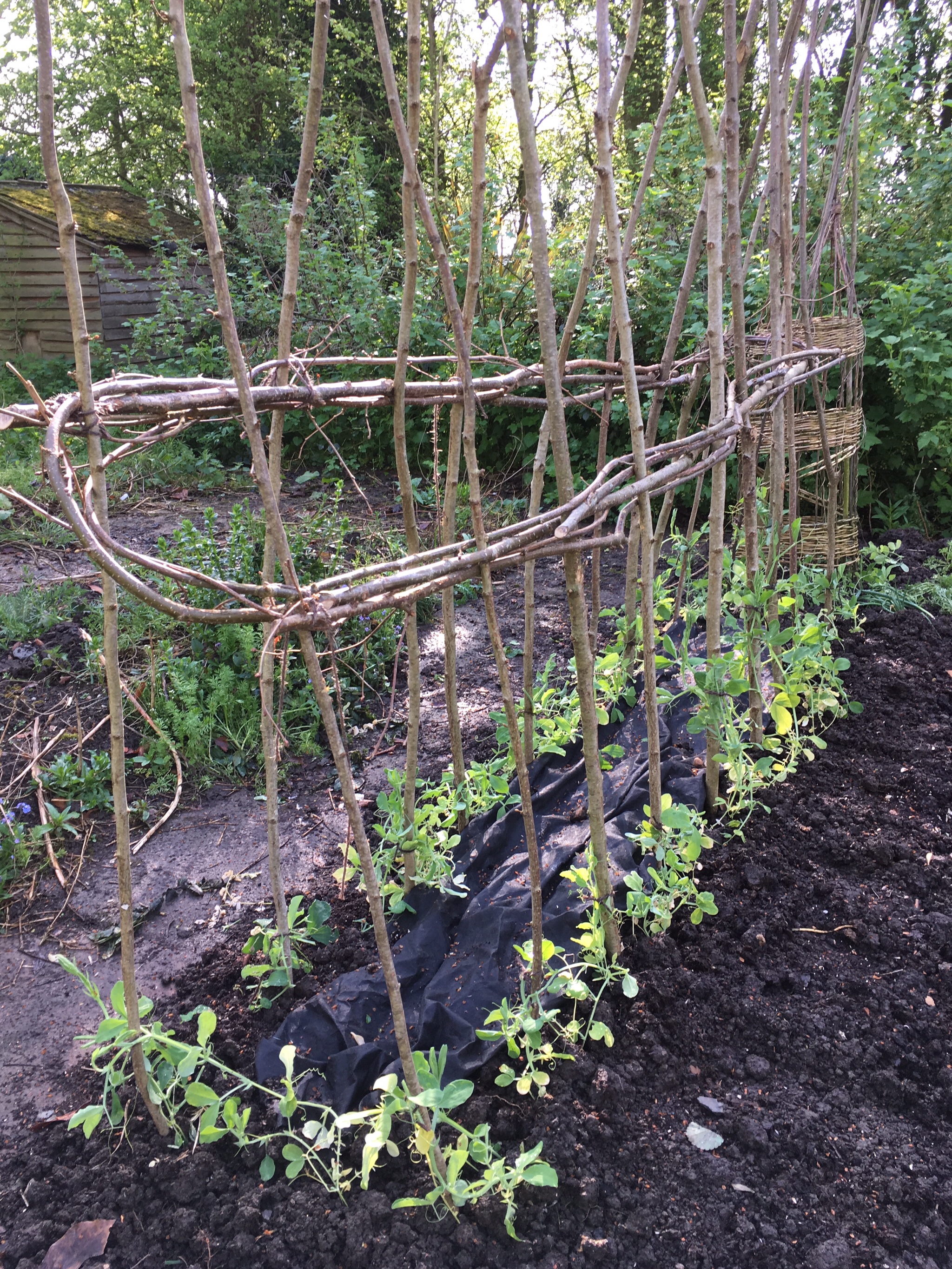
An A-Frame structure made from hazel poles purchased from farm fencing suppliers. These are used as binders in hedge laying. Ammi, gladioli and cosmos are planted down the middle. Calendula on the outsides.

Locally, Musson Fencing sell bundles of hazel rods in winter and early spring. They sell out quickly so it’s best to order your supplies.

https://www.davidmussonfencing.com/

Alternatively, Rutland Willows make bespoke willow and hazel supports and frames and run courses to make your own. We have had many hurdle fences and supports from them and have been very happy with everything.

https://www.rutlandwillows.com/
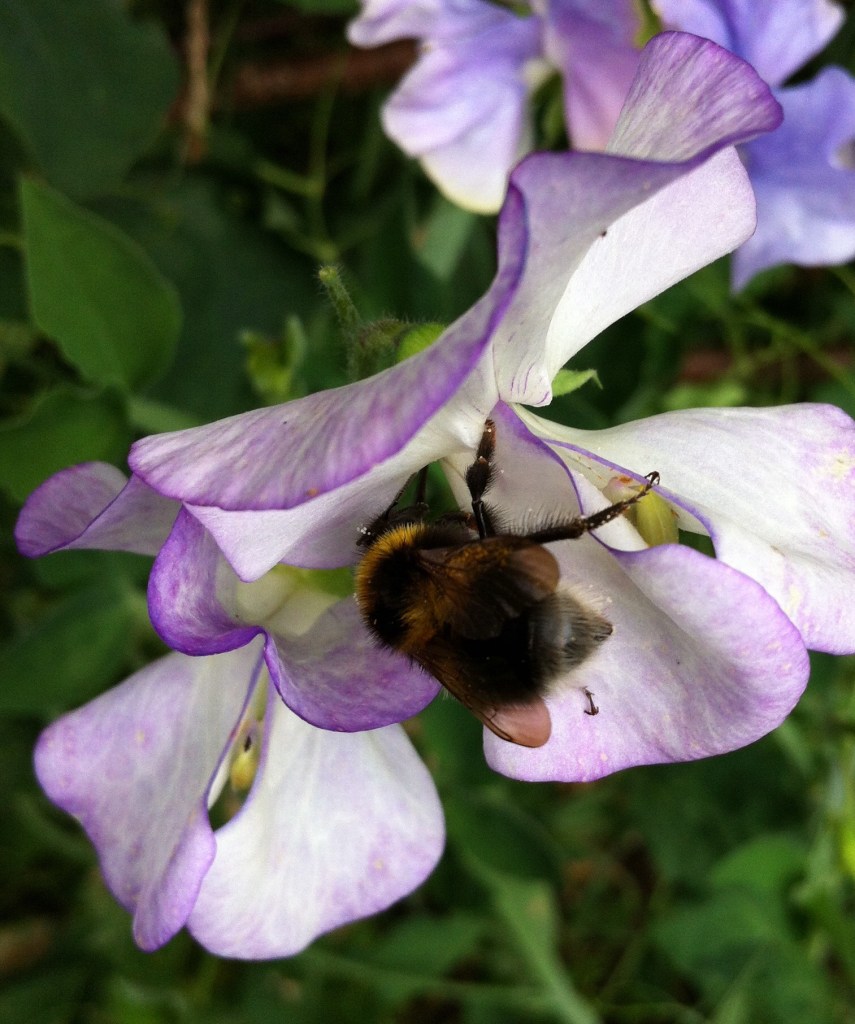
Sweetpea High Scent

At this time of the year (mid-May at the time of writing) I would probably buy in pre-grown plants from Easton Walled Gardens. A good excuse to visit them and have a walk around the beautiful cut flower gardens and landscape. Order your seed now to be delivered in late summer for October planting.

Annuals:Calendulas.

Calendula Snow Princess

Sow calendulas in autumn and overwinter them in pots in a greenhouse. Or sow now. Use plug plant trays, one seed per cell. Use seed compost with 50 percent vermiculite. Cover seed with vermiculite. This helps with drainage. Most seed sowing failures are due to watering – either over or under watering. A soggy compost is death to seedlings. Better to be on the dry side that too wet.

A note about compost: I use peat-free Melcourt seed compost and I add vermiculite, or horticultural sand whichever I have to hand. I don’t use multi-purpose compost for seed sowing. It contains fertiliser which burns delicate seedling roots. I move plants on quickly, water with seaweed extract every time I water and get plants in the ground or into big pots as soon as possible.

Tips on seed sowing:

Use spotlessly clean pots and seed trays.

Warm the compost in the greenhouse before using. Or bring indoors. Never use cold, wet, soggy compost – especially old compost from the bottom of pallets at garden centres.

Read the back of the seed packets for information such as whether to cover the seeds or not. Also follow germination temperatures and time to sow guidelines.

Use fresh seed. Home-saved seed is always likely to germinate faster than bought seed.

Buy seed from the best companies – Mr Fothergills, Chiltern Seeds, Higgledy Seeds. Do not buy from garden centres where seed will have been too hot, too old, or might have got wet. Best to buy mail order.

Water with a fine rose so as not to disturb the seeds. Always use tap water as water barrels contain pathogens which might cause seeds to wilt and die.

Protect new seedlings from too much sunlight. They are like babies.

Sow very thinly to prevent damping off. Make sure you ventilate the greenhouse in hot weather also to prevent mould and damping off problems.

Only sow half a packet at a time. If that fails for any reason, you’ve got a second chance with the other half of the seeds.

Always harden off plants before planting outside. This takes about seven days and involves bringing the plants in at night be putting them out in the day.

Soil Improvers:
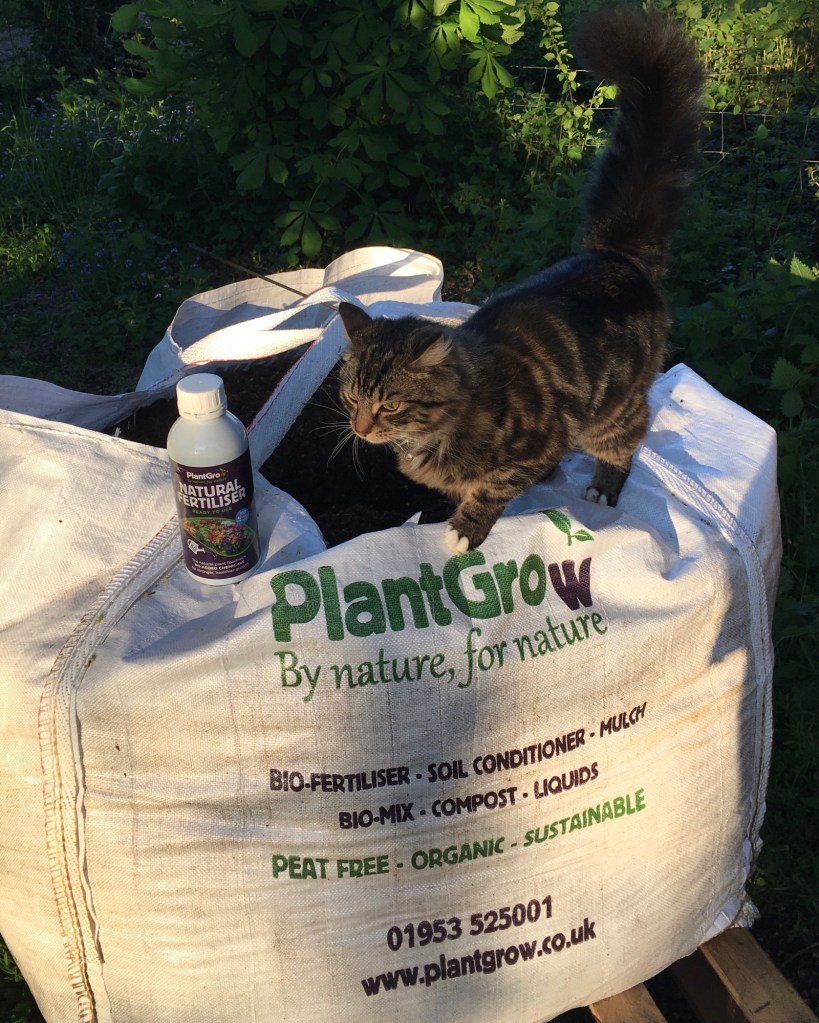
We use and highly recommend PlantGrow fertiliser and mulch. There’s also a liquid feed which I use on established plants needing a boost. The 10 percent discount code for blog readers is bramble10. I’m not paid to recommend them, but I do like to support family companies and this one is based in Norfolk.

More annuals: Cosmos:

Cosmos Psyche White.

Cosmos should be started early as it needs a long growing season. It’s best to start seeds in February in a heated propagator at 18C. Most garden centres are selling pre-grown plants now. Sarah Raven sells small plants in spring. It’s safe to plant them out in the first week of June. They will flower until first frosts. My tip is to grow just a few but grow them really well. Pinch out the tips to make them bushy when they are about 4” tall. Support them with canes and tie them in well as they rock about in windy weather.

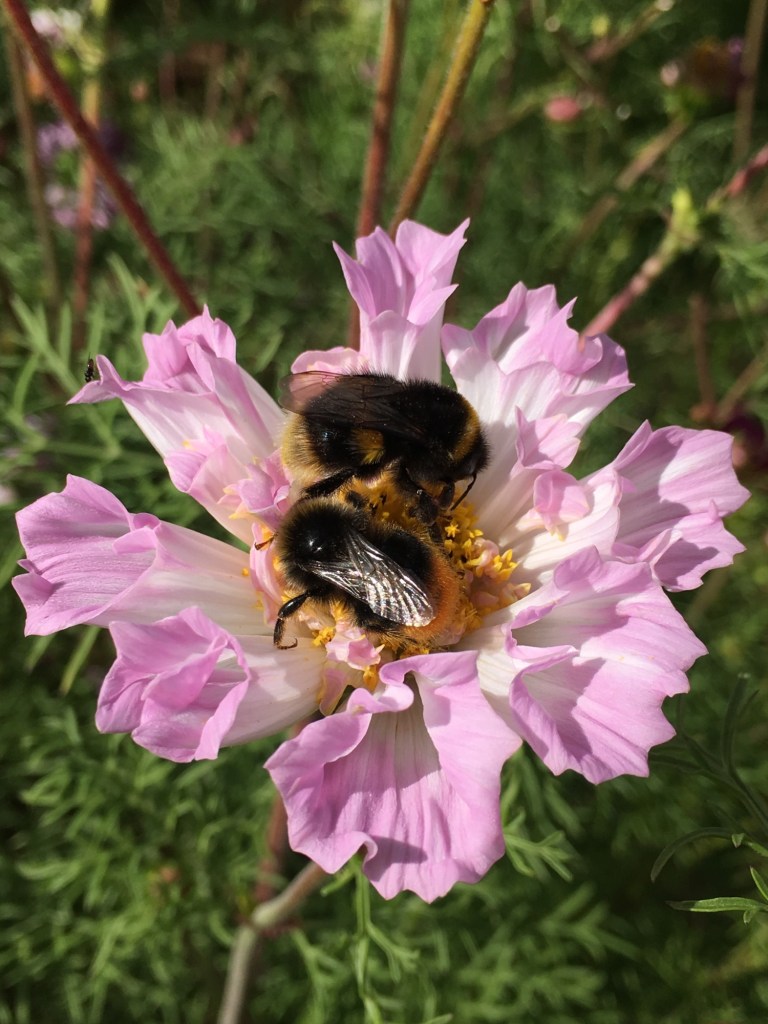
Cosmos Apricot Lemonade.
Cosmos Seashells Pink
Seashells White

More Annuals: Sunflowers

Sunflower cut flower mix from Mr Fothergill

Sunflowers can be sown in April and May. Earth Walker and Velvet Queen are good varieties. Look out for the multi-headed dwarf sunflowers. I grow mine amongst the sweetcorn and the vegetables help to hold the sunflowers upright in stormy weather. Calendulas and courgettes are grown at the base.
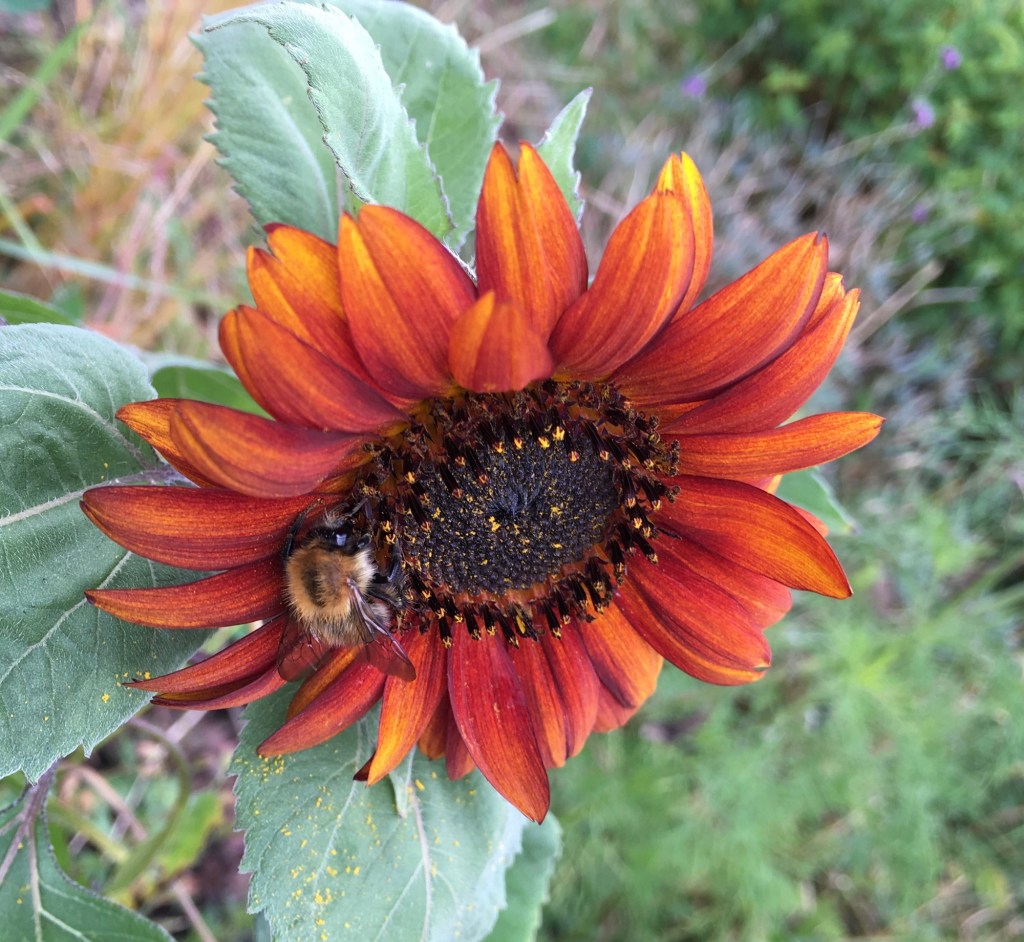
Velvet Queen

I start seed off in a propagator at 18C. Plants are grown on until they are about 20cm tall. Any smaller and the slugs will eat them. Spray with garlic extract to protect from slugs and snails. The recipe is on the blog in the search bar.

Dahlias:

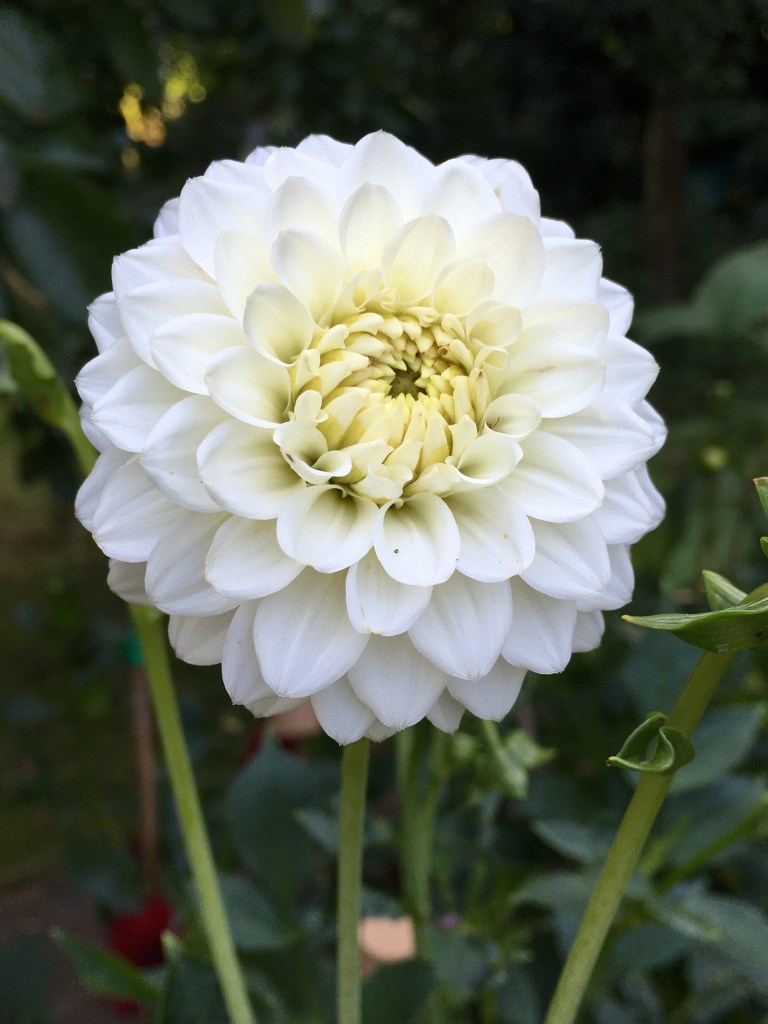
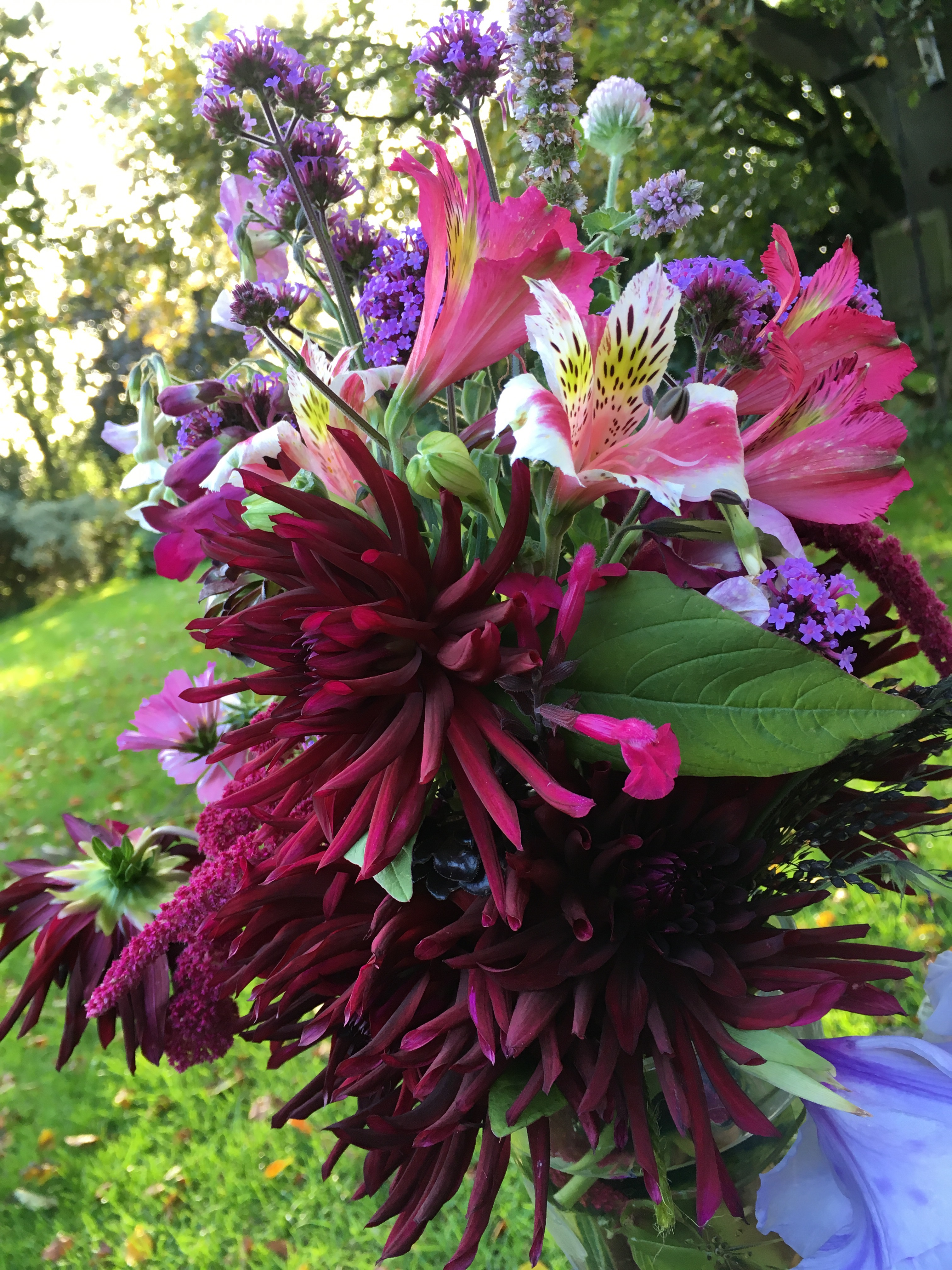
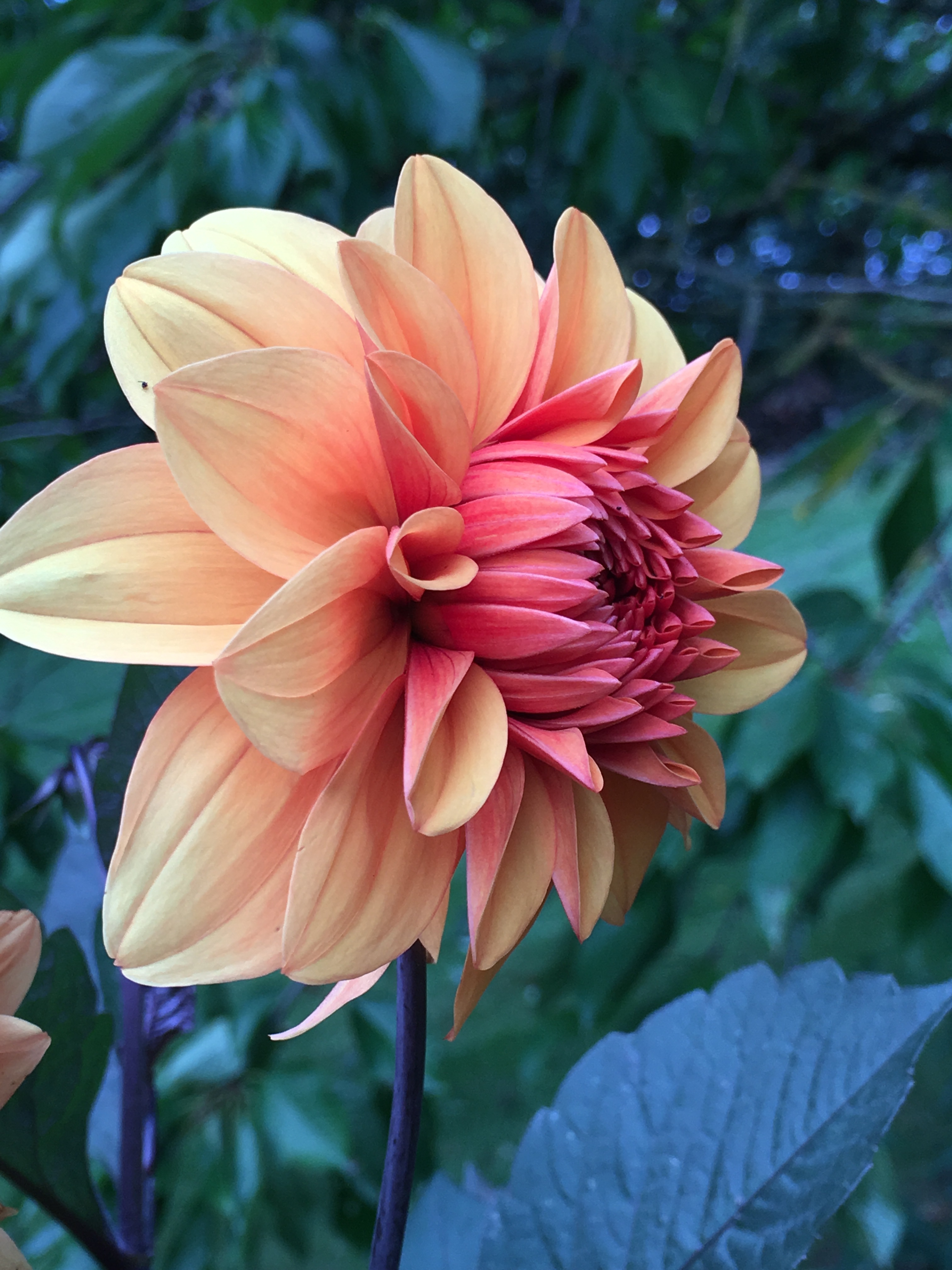
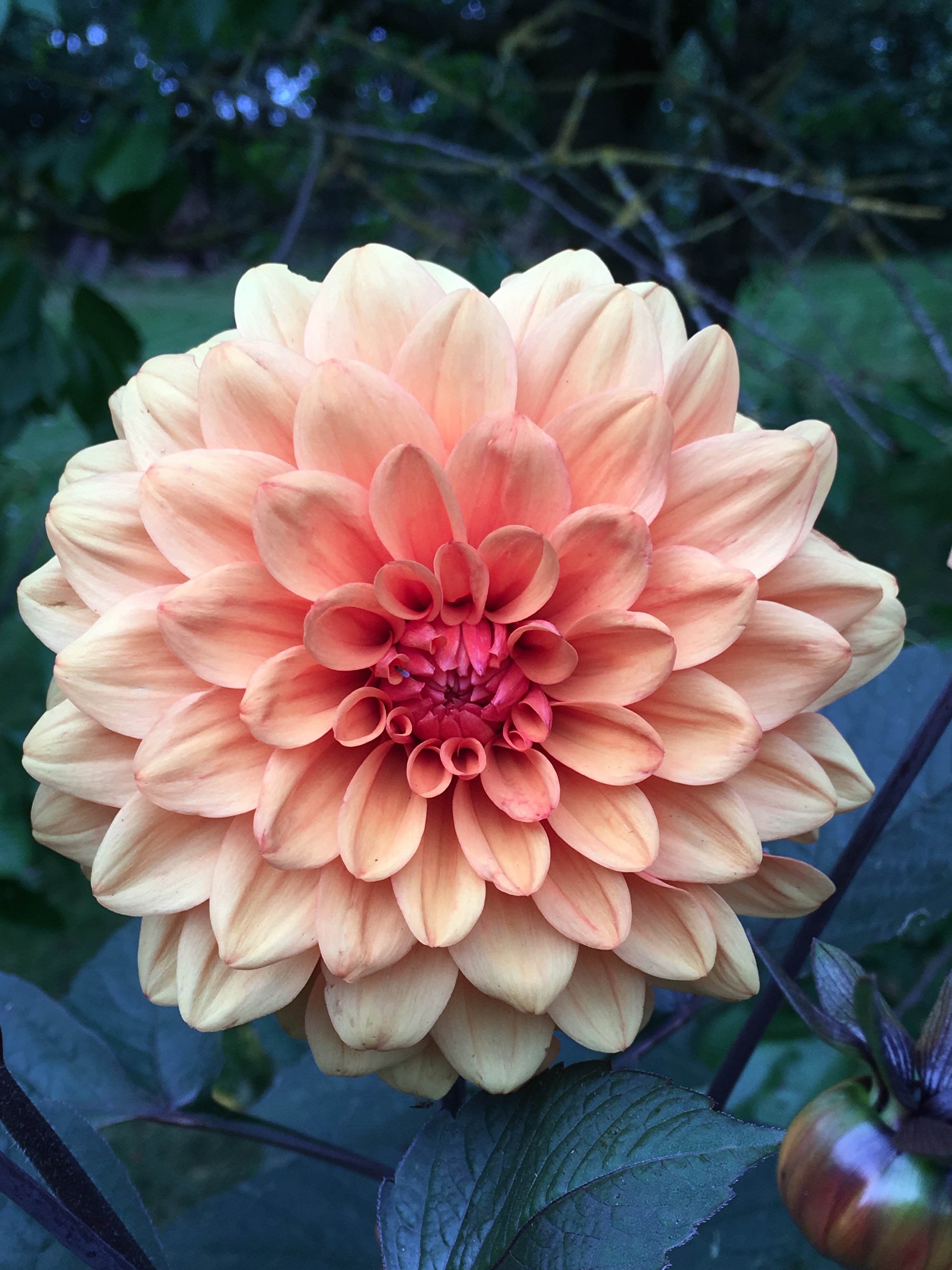
Dahlia David Howard grown with Alstroemeria Indian Summer.

There’s still time to buy dahlia tubers from the garden centre and pot them up indoors. Take cuttings now to get more plants. Each tuber can provide 7 cuttings without detriment to the mother plant. Cuttings need to be tiny, 2-3cm only and placed in a 9cm pot with the 50/50 compost vermiculite mix in a propagator at 18C. They will readily root and can be planted out the first week of June. Cuttings will flower this year. If buying potted plants, there are some good mail-order nurseries offering stock. Todds Botanics are recommended.

Nuit D’Ete is a lovely cactus-type dahlia.
Dahlias, cosmos and dogwood. Senecio Vira Vira is from Coton Manor nursery.
Protect dahlias from earwigs. Add pots of straw or newspaper to the top of canes. Tip them out each morning.
Dahlia cuttings.
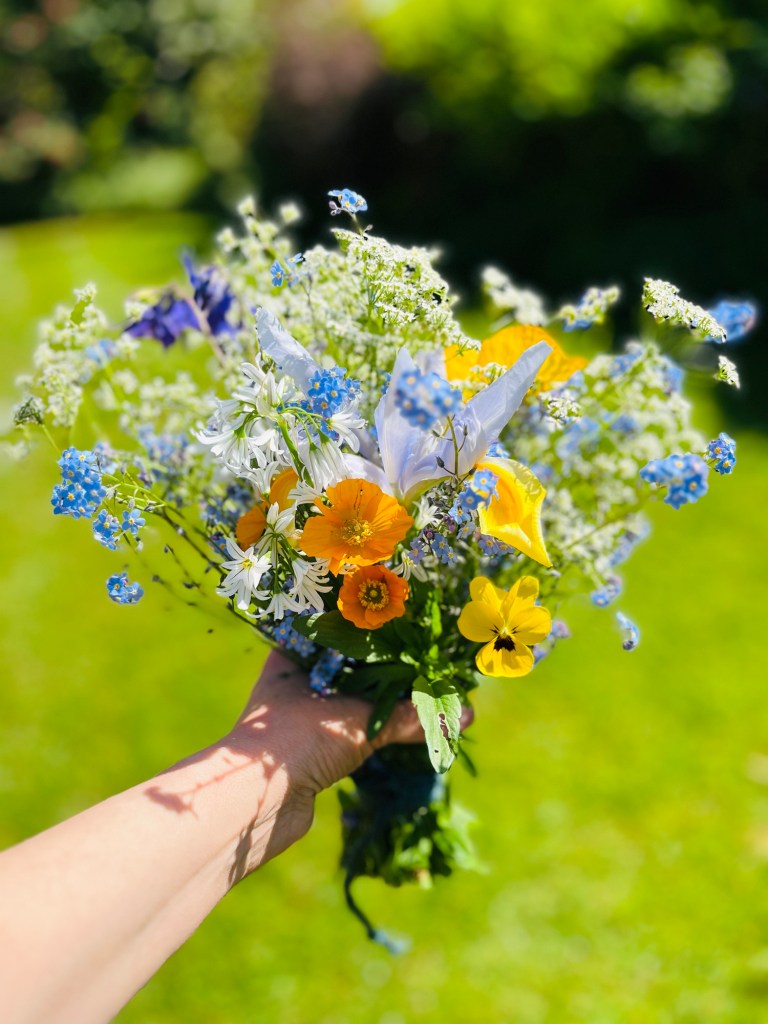
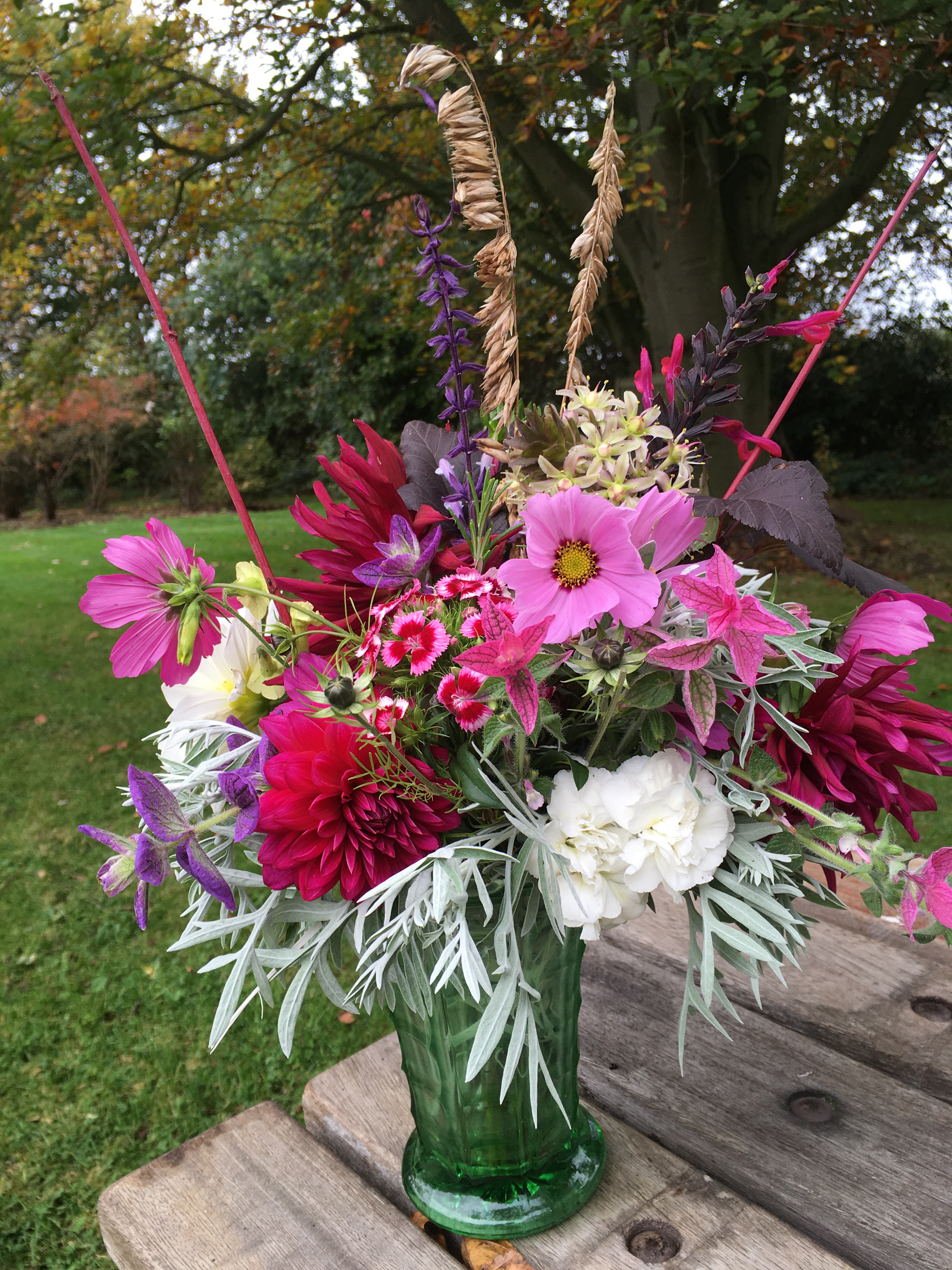
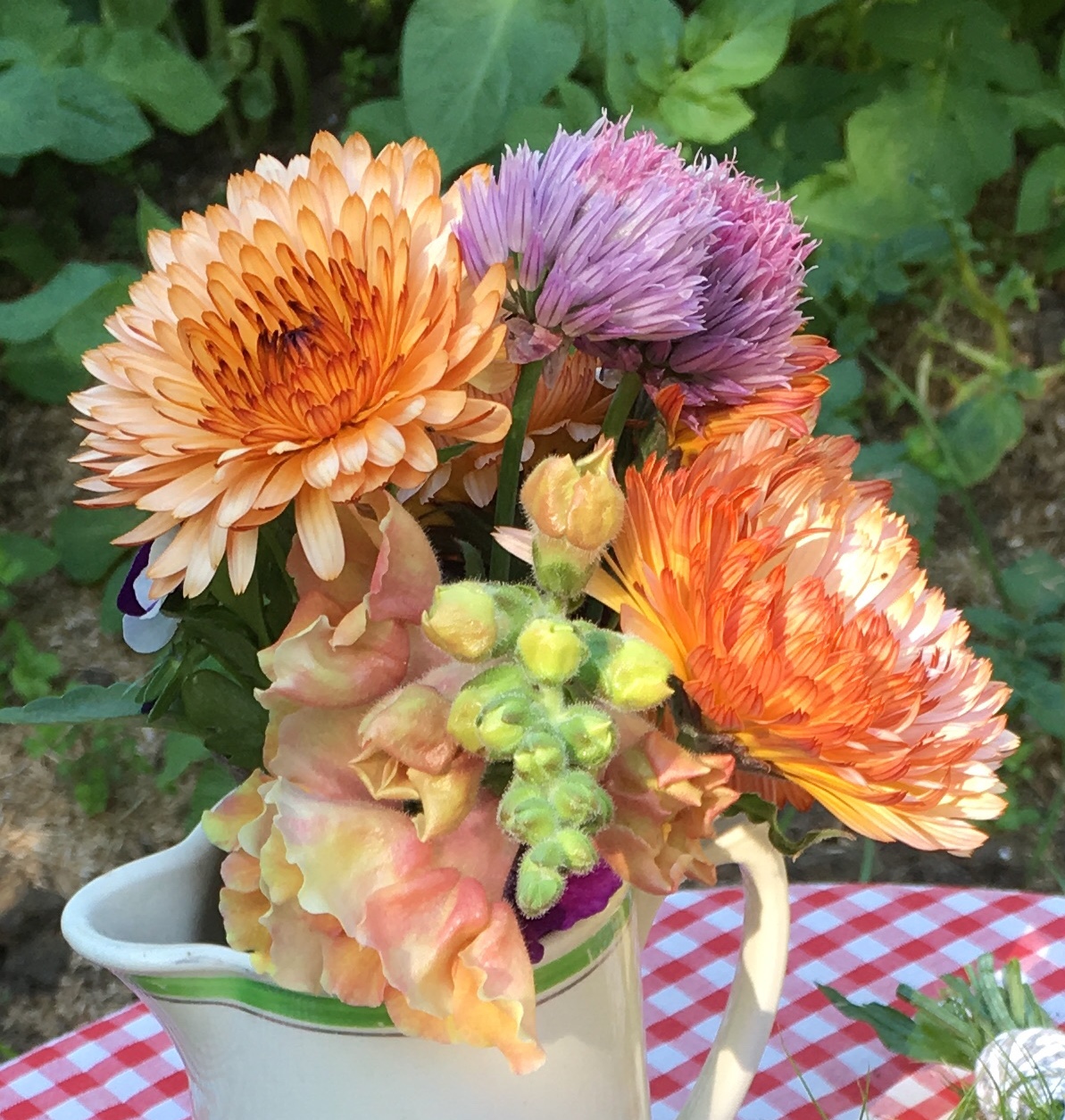
Today’s bouquet.

Don’t forget to just look around the garden and use what you have! I have cow parsley, poppies, alliums, Dutch iris, aquilegia and violas just now. Not many flowers are needed to make a jam jar posy. These were not planted specifically for cut flowers, but taking just a few won’t harm the spring display.

Answering questions from last night’s talk: How do you grow cow parsley?

Chose plug plants from. https://www.naturescape.co.uk/product/cow-parsley/

These won’t compete with lush grass, so use a spade to lift a patch of turf. Plant plug plants into the bare soil. Plant with cranesbill and foxgloves. Plants will die, but will set seeds for next year. Keep the patches free from vigorous grasses. You can plant delicate shaking grass though. If you have a large enough space, I would plant a swathe of them to get the best effect.

Peak cow parsley time in my garden today.

Question 2: What honeysuckle are you growing?

Common honeysuckle, Lonicera periclymenum caprifoliaceae. I recommend Jekka’s Herbs for plants. Wonderful scent and beautiful red berries. Plant with the roots in the shade and it will climb to reach the sun. If you plant the roots in the sun, the plant often succumbs to mildew and aphids. It is a woodland plant, essentially. Its habit is to climb and then flop down. In nature you often see plants dangling from high up in trees. So it is not ideal to try to control it and plant it over an arch or on a trellis. It will always want to go skywards. It wants to use other trees and shrubs as a climbing frame. Be careful when buying honeysuckle as some varieties do not have any scent, which is such a disappointment if you’ve waited several years for the plant to flower!

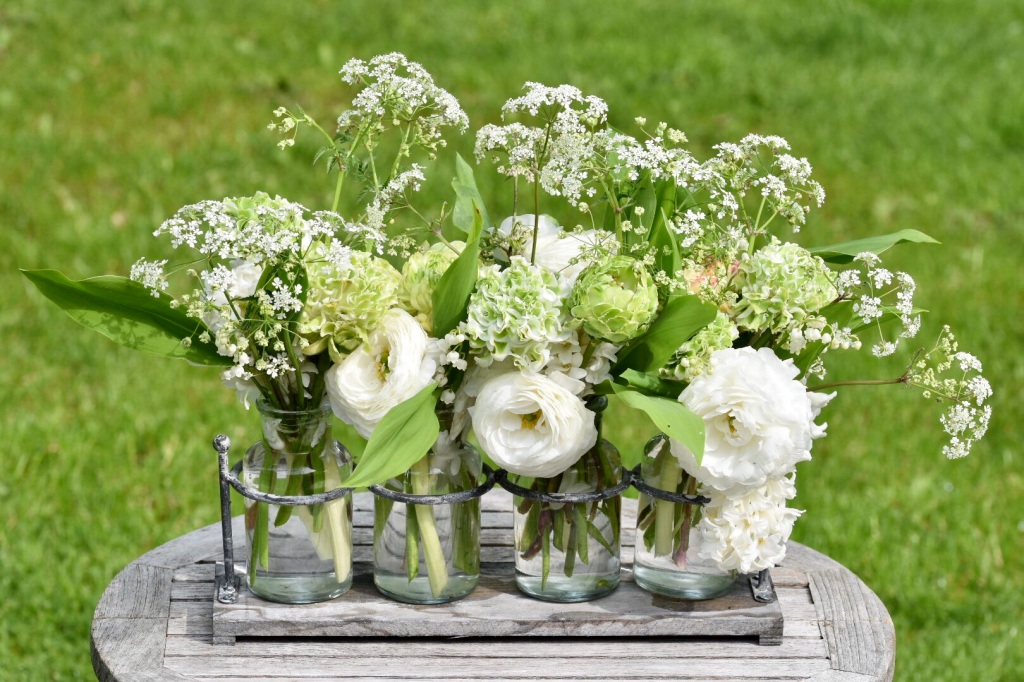
Question 3. Where can you buy the little wooden and metal stand containing four glass bottles for flower arranging?
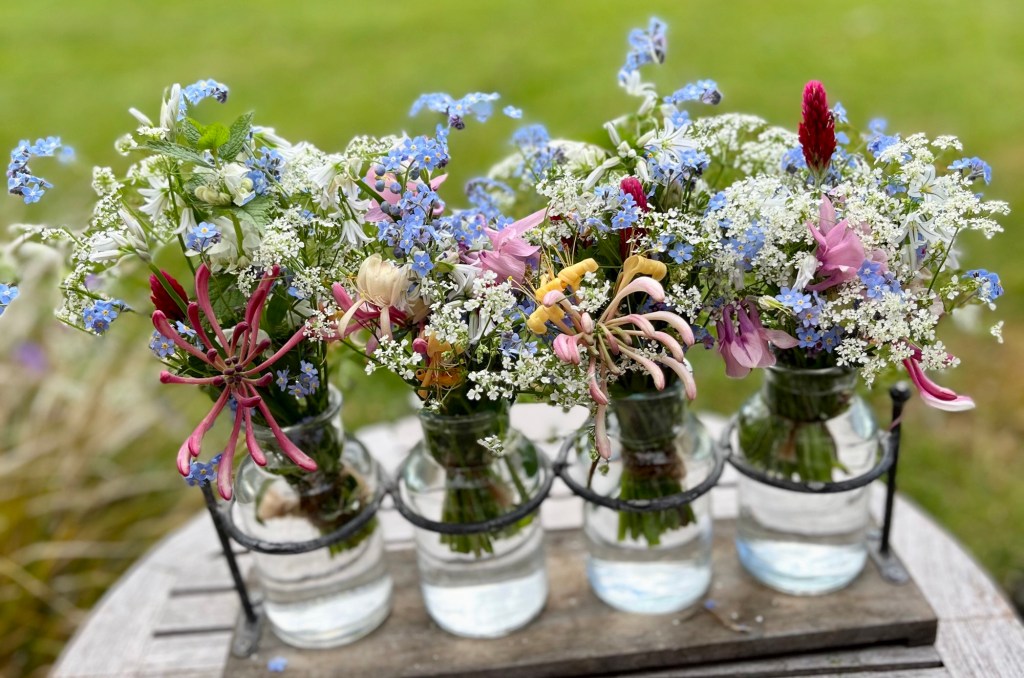
My stand came from Jonathan Moseley. He sells floristry materials, flower cutting snips and vases at various flower shows all over the country. He also has an online shop. I use this stand every day and place it down the centre of the kitchen table. Vases can also be arranged in a circle with a pillar candle in the centre. I have created mini posies for this photo, but equally you can just pick a few stems and place them directly in the jam jars and they look ‘arranged.’
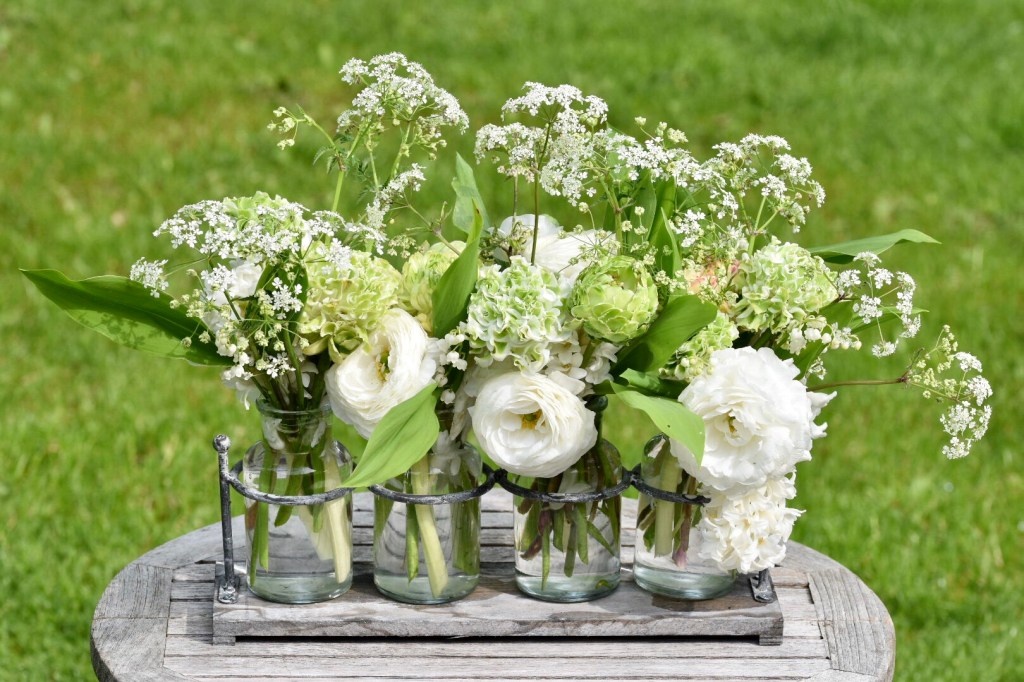
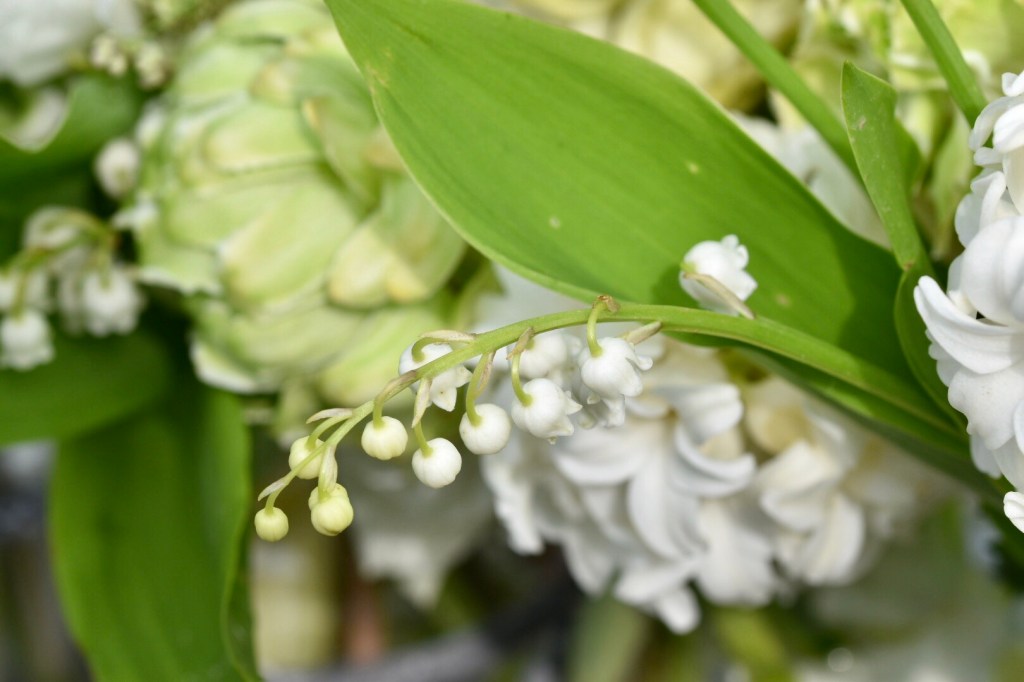
All white theme with Italian ranunculus, cow parsley, hyacinth and Lily of the Valley.
Wonderful scent from such a small arrangement.

Don’t forget that cow parsley can be used even when the flowers are going over. The little lime green seed heads are still attractive. I also use seed heads of parsnip, onion, carrot, chives, mustard and leeks. I found out by accident by leaving some vegetables to go to seed. I now leave them on purpose to supply free seed heads for floristry. Fluffy clematis seeds are also saved for winter decorations.
If this has inspired you to grow something for your own cut flowers, then I’m very happy. I’m hosting a cut flower course at Barnsdale in September. It’s a lovely garden and the owners are kind and generous people. There’s a lot included in the price. I can highly recommend the cream tea!

Link : https://shop.barnsdalegardens.co.uk/products/growing-flowers-for-cutting

Thanks for reading my blog. Please leave a comment below if you have any questions and I’ll do my best to answer them. Or e mail at k.gimson @btinternet.com.

Also visit Cathy’s blog for more inspiration:

https://ramblinginthegarden.wordpress.com/2025/05/12/in-a-vase-on-monday-sundae-on-monday/

Welcome to garden club members

A big welcome to members of Southwell Garden Club! I hope you enjoyed my talk last night! Here’s more photos of my garden, to give some inspiration for creating spring colour.

Our garden was created from a field. We moved here when we were in our 20s.

We planted 260 tiny sapling trees which came from a scheme promoted by the Woodland Trust and Rushcliffe Borough Council. The plants were free to anyone converting farm land to woodland.

Down one side of the plot I planted a kind of ‘avenue’ or ‘holloway’ of ash trees given to me by Michael Beeby. He was a lovely, keen gardener who lived in our village and wanted to save the little seedling saplings growing all over his garden. He regularly visited the garden to see how his trees were getting on. Sadly he passed away a few years ago. In memory of a kind and generous gardener I’ve named this area of the garden the Michael Beeby Walk. And every time I walk along this path I think of Michael and how he cared about nature. He was always smiling, always supportive and encouraging. He’s not forgotten.

There are some wonderful sunsets from the garden
Trees on the hill

There’s a gap in the hedge. I walk to this point every day and look through the hole in the hedge. I see hares, deer, owls. No one can see me.

I mark the changes in the seasons. Each day, the view is different.

All the trees we planted have grown to produce a lot of shade. Over the years, the lavender, penstemons and salvias have had to give way to woodland plants. Snowdrops thrive in the cool shade. Madeline is a favourite with its elegant ‘lightbulb’ shape and delicate yellow markings.

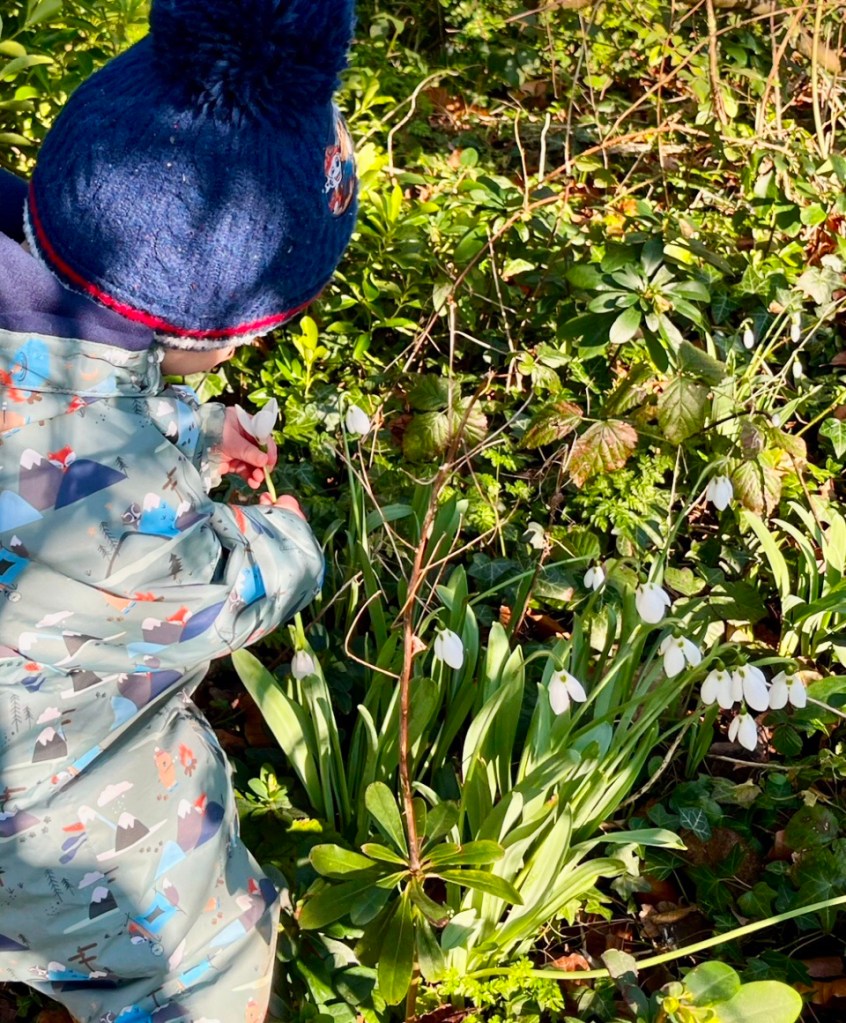
I have a little helper in the garden. He’s three years old. We are at the same stage in life, both marvelling at the beauty in everything. Living in the moment.

Polar Bear, a new variety, late flowering.
Viridapice with green tipped markings
Robin Hood. Named for the X markings. Appropriate as we live right on the Nottinghamshire border.
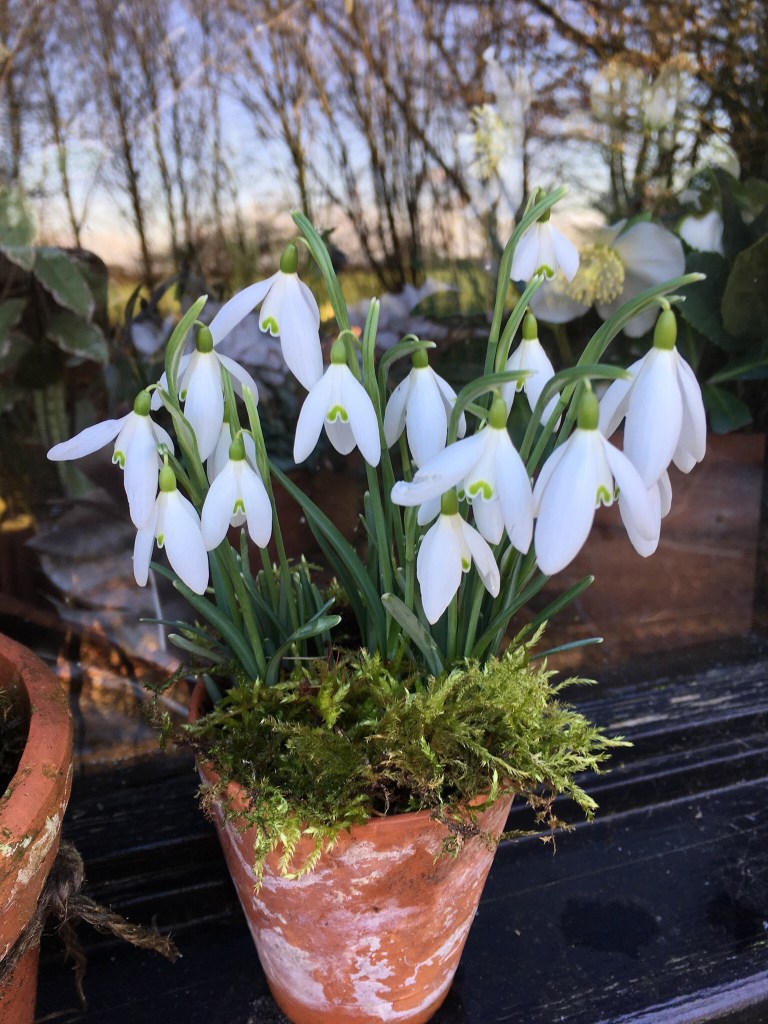
Plain, simple single snowdrops, Galanthus Nivalis. Still my favourite to be honest. In my grandfather’s Sankey terracotta pots.

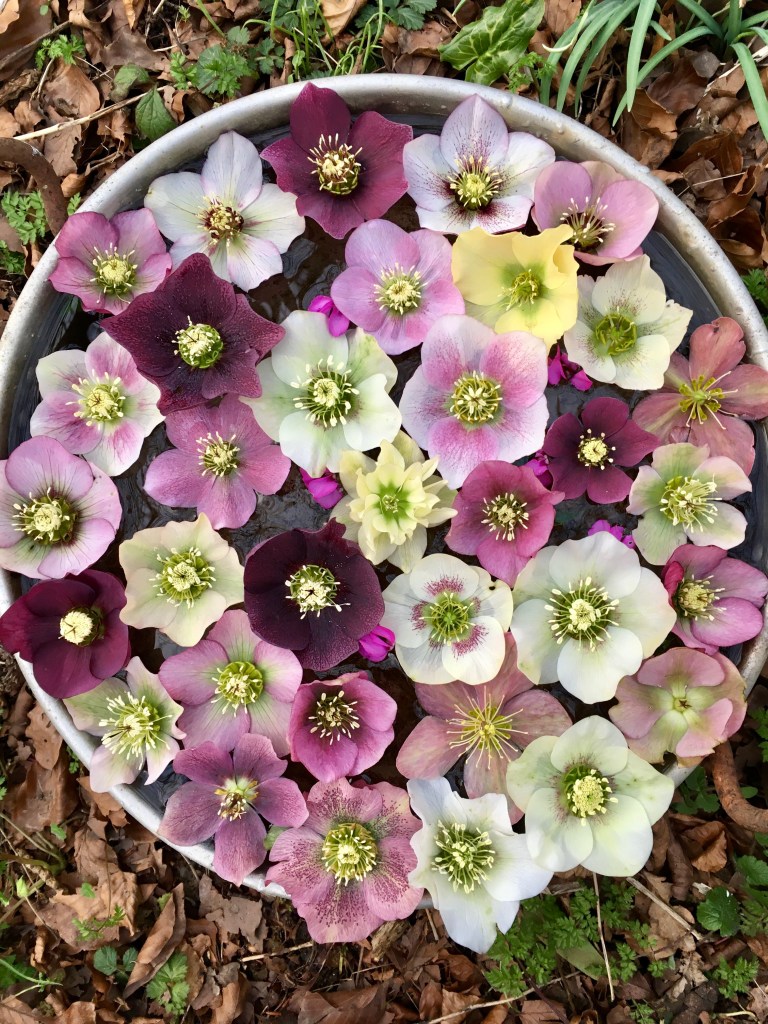
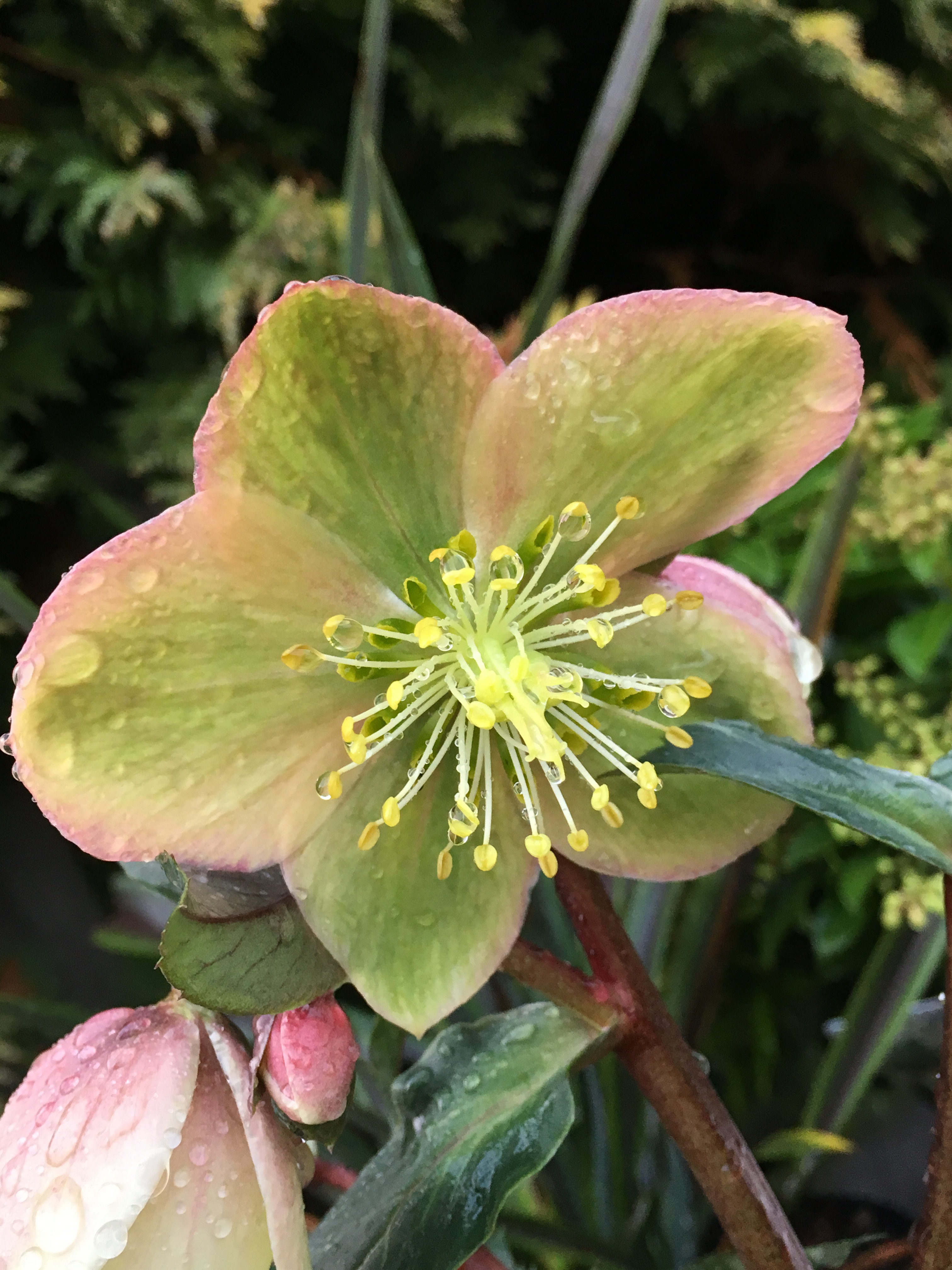
Hellebores also thrive in the semi-shade of trees. I bought a few colours from John Massey at Ashwoods Nursery in Birmingham. They have seeded all over the garden in shades of white, cream, pink, and inky- black.

Some remind me of stained glass.

Floated in an inch of water in an old zinc container.

A favourite double cream-white hellebore.
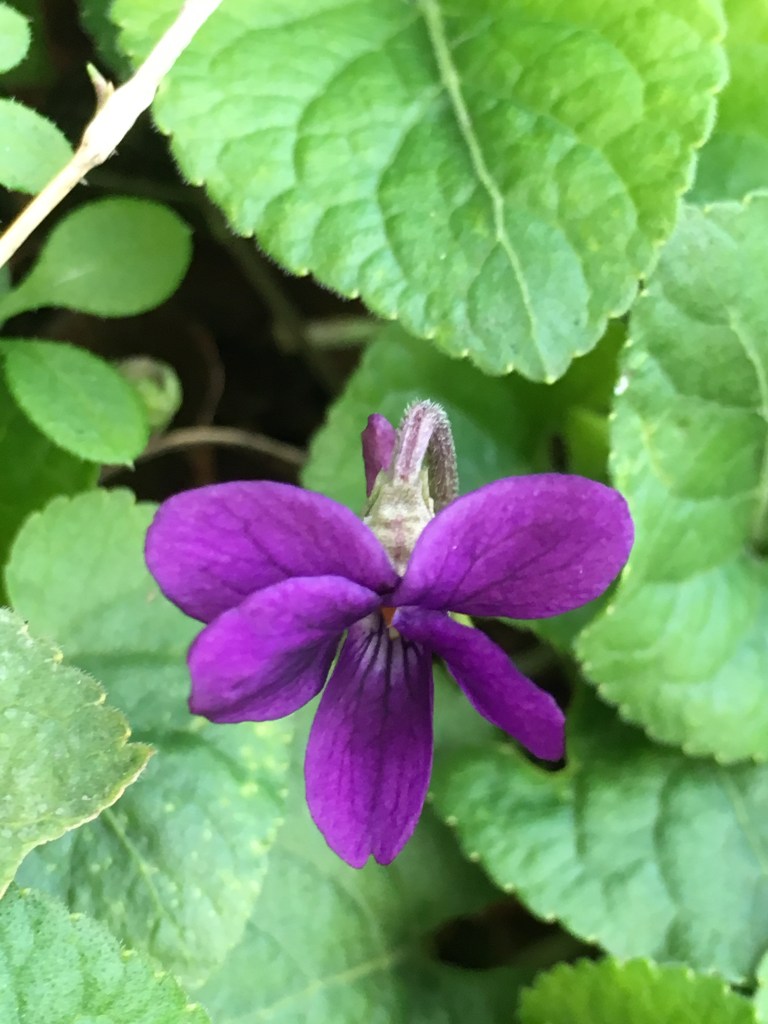
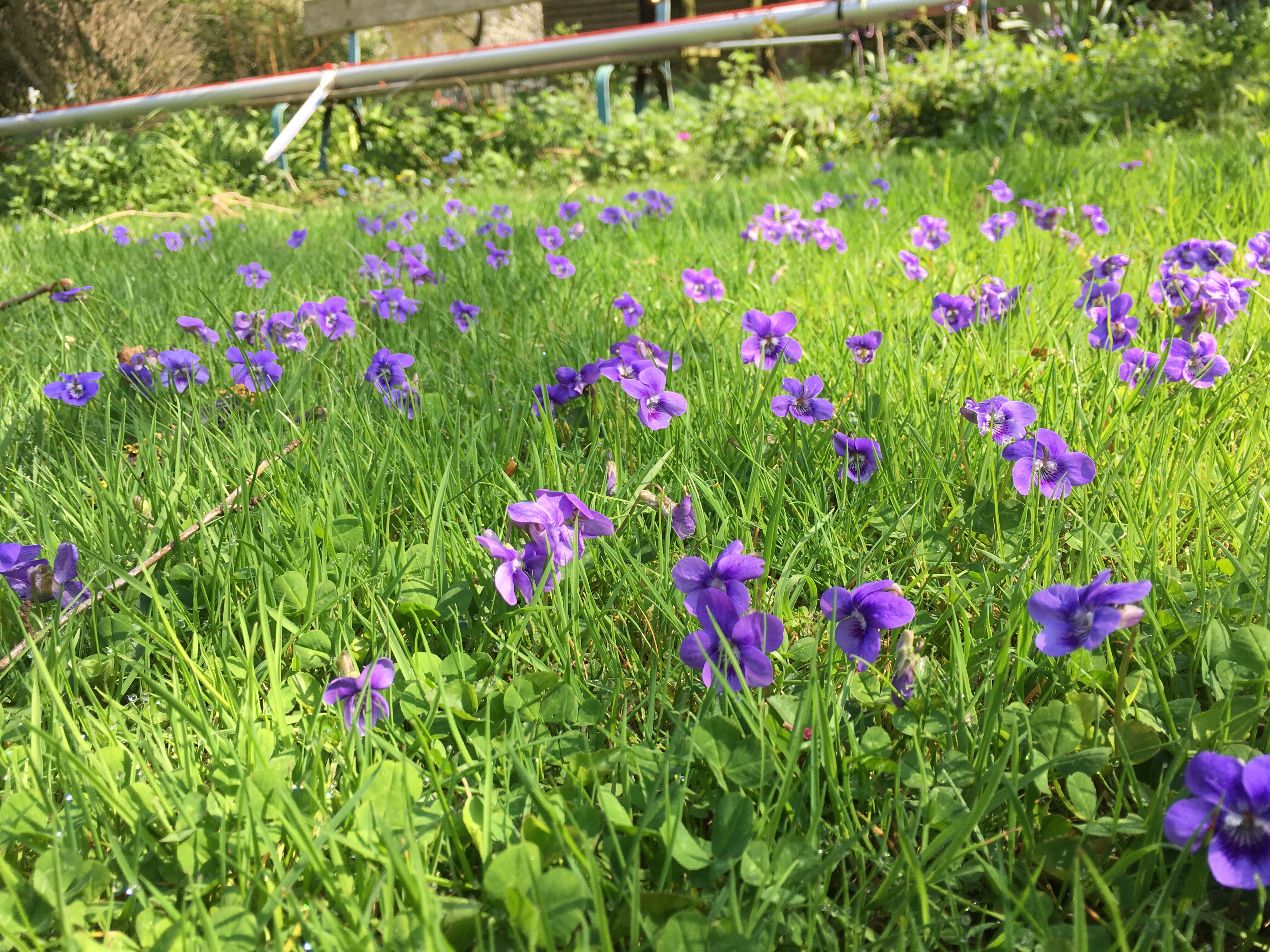
In amongst the hellebores we have wild violets. The sweetest scent. Originally from one single plant my grandfather brought here over 30 years ago. Now the whole gardens is full of them. I look at them and think of him.
Wild anemones. Such a joy, emerging just as the snowdrops are going over. And full of bumblebees today.
Crocus Joan of Arc. The best white. Also bumblebee heaven!
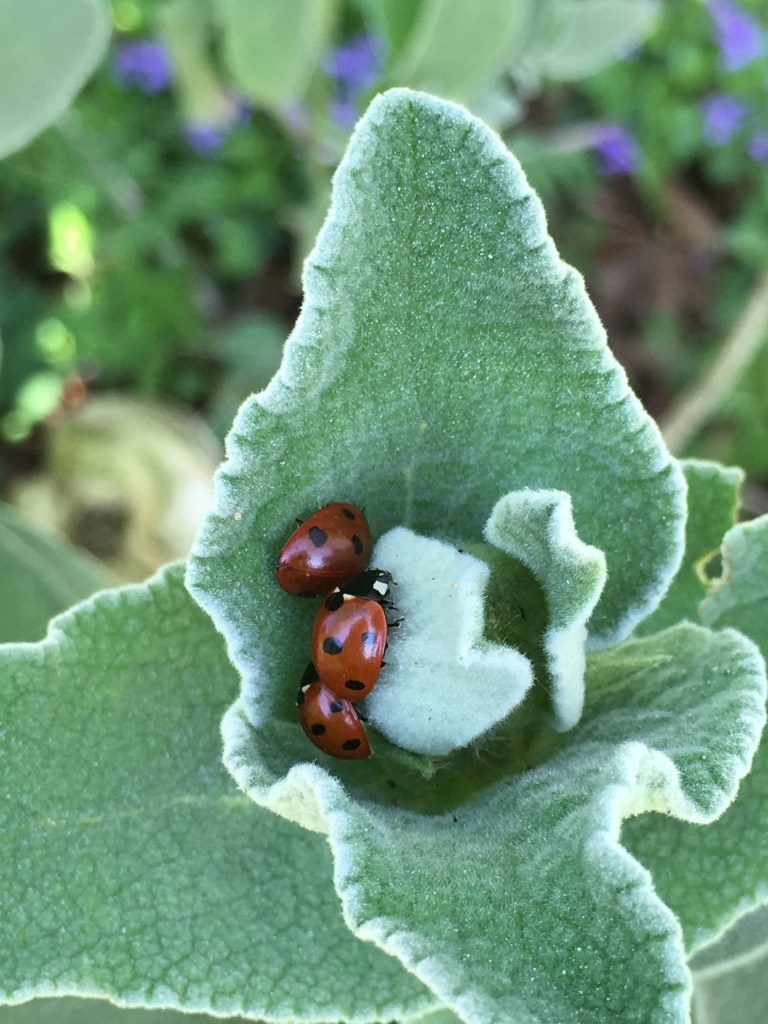
Phlomis Fruiticosa. Also ladybird heaven! An important plant to grow as they hibernate within the soft woolly leaves.

A posy for my mum with flowers from the garden. Small flowering cherry, Prunus Kojo-No-Mai blooms on bare stems and has glorious orange and red autumn foliage.
Come back another day for some summer-themed flowers.

Thank you for inviting me to talk, and for reading my blog.

I’m karengimson1 on instagram.

Please leave a comment in the box below, and sign up for e mail notifications for further posts. Enjoy your gardening!

Jam jar flowers….

For In a Vase on Monday.

For a modern floral arrangement, four small bottles in a wood and metal holder make life very easy indeed.

These bottles remind me of the ones we used to get at primary school containing milk. Every day we had rich, creamy milk which we sipped through a straw. I loved it! Our teacher, ever ready to put science into action, got us to pour the cream, the top of the milk, into a jam jar. A lid would be added and we each had to shake the jar for as long as we could. The resulting butter was spread on crumpets warmed on the woodburner in the corner of the classroom. We all took it in turn to be ‘wood monitor’ and had to fetch the logs from outdoors. We also had a pencil, paper and skipping rope monitor. It taught us duty and responsibility at a young age. I can’t remember anyone complaining about their tasks. Probably the only thing I didn’t like about school was the outside toilets. They were freezing in the winter and full of dust and spiders. You had to run from the classroom right round the other side of the playground to reach the little row of toilets. And you had to dash there in all weathers, even if it was snowing or raining. Just before I moved schools, a new indoor cloakroom was built and I can distinctly remember everyone being very excited about the new, posh indoor loos! No more spiders or slip-sliding about in the snow. Happy days!

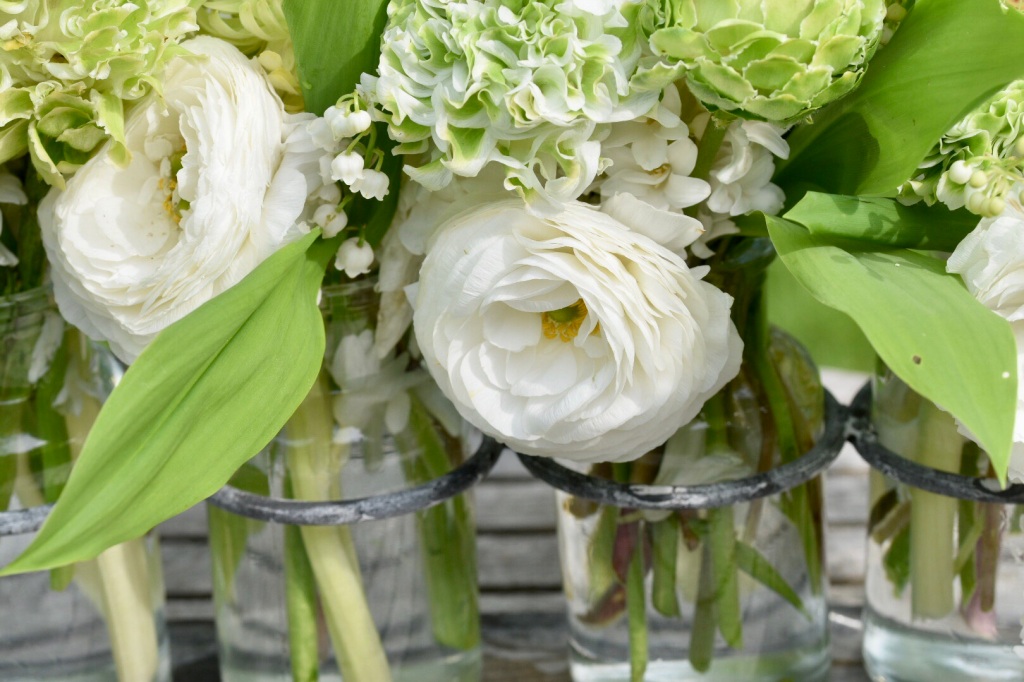
My pretty little floral arrangement was a gift from Jonathan Moseley after we worked together at the Belvoir Castle Flower and Garden Show. Jonathan was the celebrity speaker giving talks and demonstrations on floristry, and I was running planting sessions for children. I loved Jonathan’s green and white selection for the little bottles. He chose English anemones and Italian ranunculus. Aren’t they beautiful!

Jonathan is well known for using flowers grown in his own garden and weaving them into arrangements using British tulips and lilies. Here’s some Lily of the Valley from his Derbyshire garden. The scent was glorious!

He added cow parsley from his own garden too. He mentioned that you can use cow parsley even when flowers are going over, as the little green seed heads are just as pretty.

Scent is essential in flower arrangements and Jonathan added white hyacinths into the mix. I grow Carnegie White for my flower posies.

I think my favourite flowers are these frilly white ones. They lasted at least two weeks, as I changed the water daily and snipped a tiny amount off the bottom of each stem.

I’m growing white anemone coronaria ‘Mount Everest’ in a large pot in the greenhouse. These have provided a few blooms each week since February. Farmer Gracy and Taylors sell corms for planting in autumn or spring. Soak the corms in water for a few hours before planting and space them 10cm apart and 5cm deep. They can be grown outdoors, but I find the rain spoils the flowers, if you want to use them for floristry.

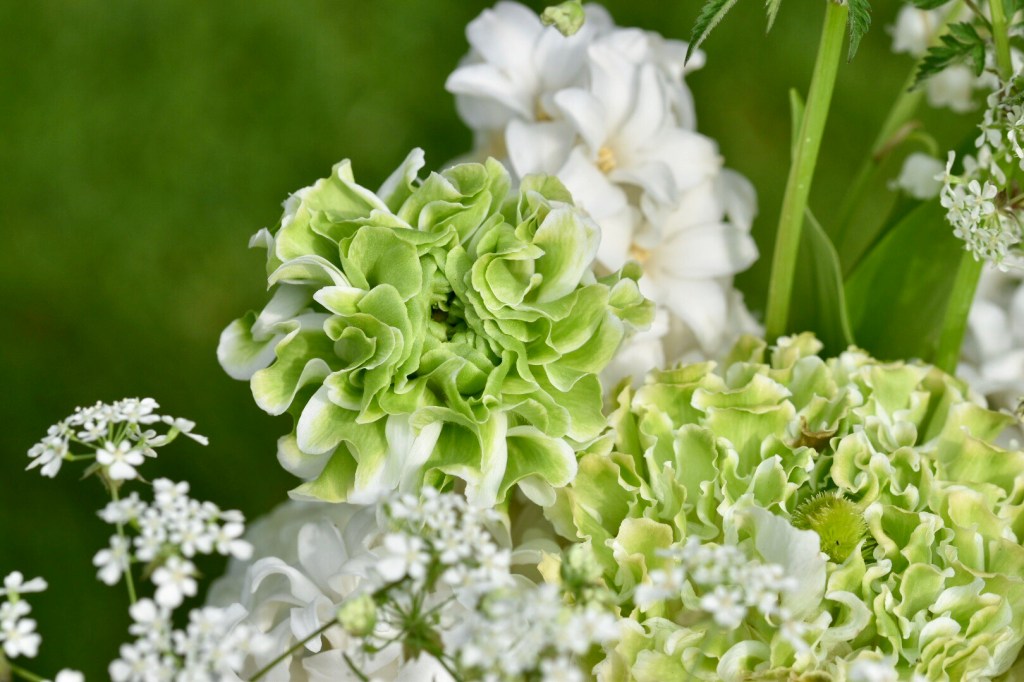
I’m particularly fond of green flowers, so this one fitted in nicely.

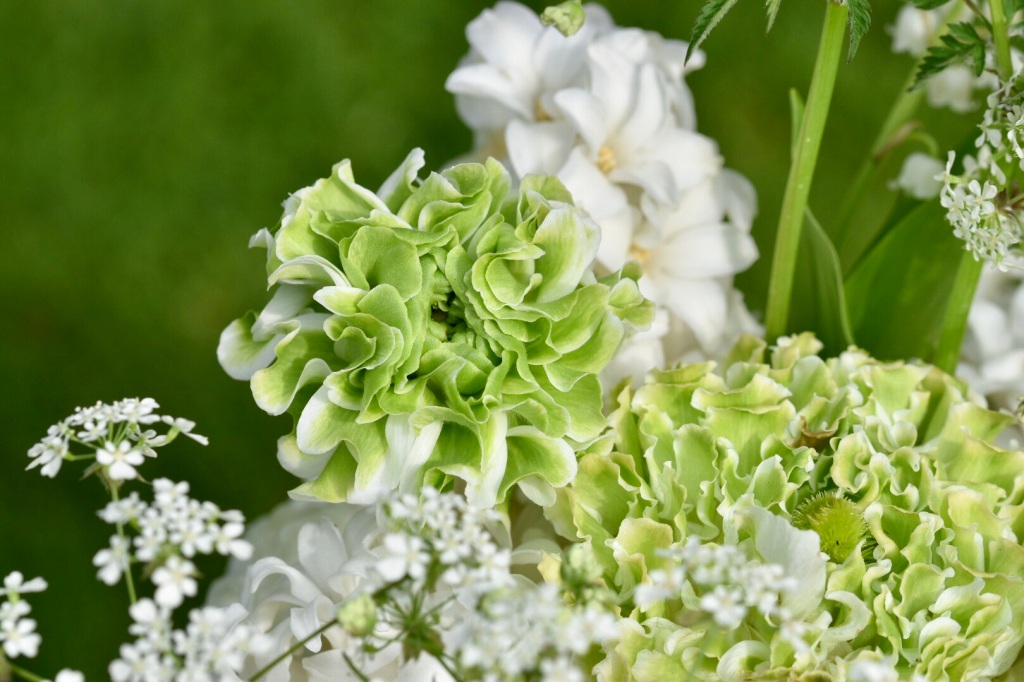
Aren’t flowers just amazing! This one is a white and green ‘Pon Pon’ ranunculus. They remind me of a flamenco-ruffled dress!

Green ranunculus.
Flowers looked just as beautiful from both sides. This would make a fantastic display for a dinner table. It’s not too high that guests can’t see each other. The bottles and stand set is available on Jonathan’s website.

Jonathan is a writer, broadcaster and demonstrator as well as an ambassador for British flowers, and regularly appears on television programmes such as Alan Titchmarsh’s Love Your Weekend.

https://jonathan-moseley.com/

Why not go over to Cathy’s blog to see what others are writing about this week for Cathy’s In a Vase on Monday meme.

https://ramblinginthegarden.wordpress.com/2024/06/03/in-a-vase-on-monday-dining-out/

Are you growing any flowers for home floristry this year? Get in touch and let me know how you are getting on with your growing plans. Please leave a comment in the box below. Have a happy gardening week! And thank you for reading my blog.

Winter cuttings on BBC Radio Leicester

If you were listening in to BBC Radio Leicester on Tuesday, you’ll have heard me talking about taking winter, or hardwood cuttings. We were taking dogwood cuttings this time.

Here’s the link at 1.26 on the i player timeline.

https://www.bbc.co.uk/sounds/play/p0gv6761?partner=uk.co.bbc&origin=share-mobile

I use dogwood in almost all of my jam jar posies for my mum. It makes a lovely vertical accent, and helps to support the weaker flower stems. Here stems are supporting paperwhite narcissi and daffodils and tulips from the cut flower patch. These are Dutch Grown bulbs.

My favourite dogwood is the bright red Westonbirt which really glows all winter with sunlight behind it.

Here it is with Dahlia David Howard, persicaria, sedum and grasses. I love the red stems shining out and glowing in the jam jar water.

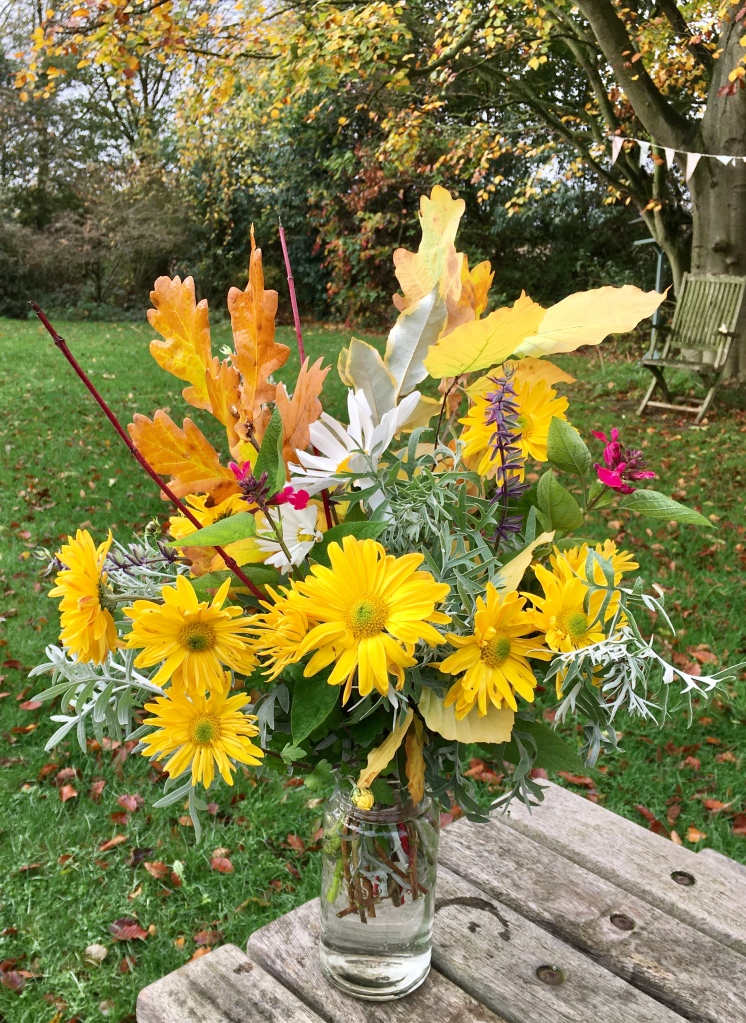
This time, the jam jar flowers are chrysanthemums and salvias set off with grey-leaved senecio viravira and golden oak leaves which dry and can be used all winter.

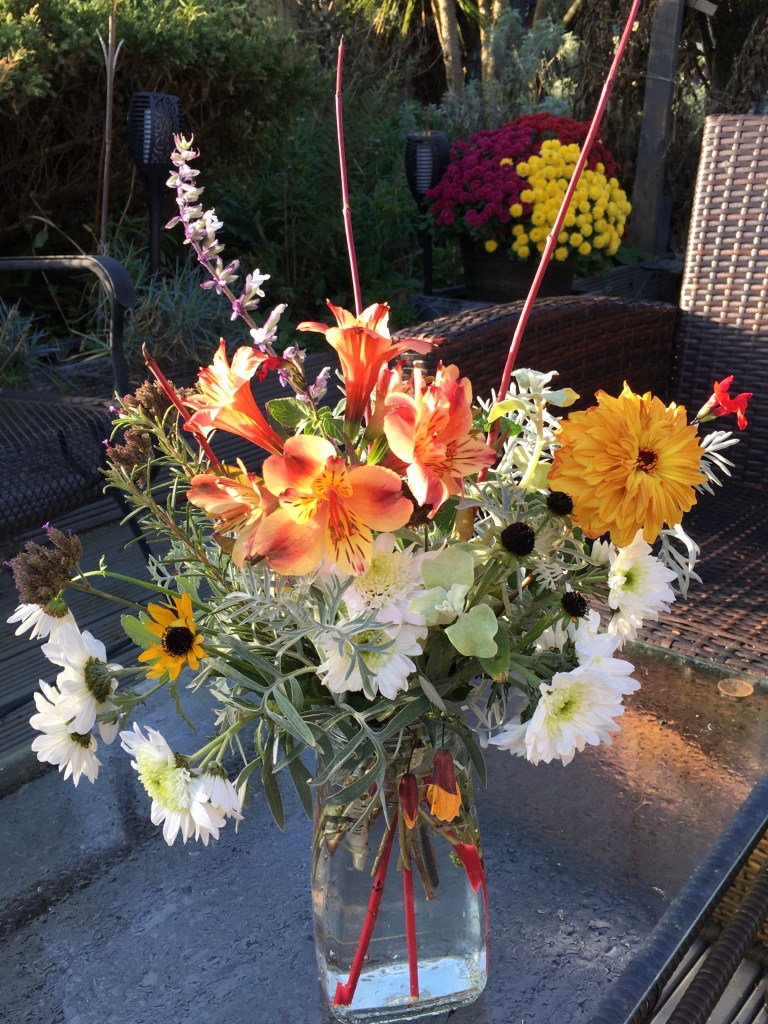
More dahlias including a red unnamed seedling, Alstromeria Indian Summer and cosmos Psyche White grown from Mr Fothergill’s seeds.

Salvia Phyllis’s Fancy, chrysanthemum Swan and the last of the dahlias and rudbeckia. And a tiny sprig of orange abutilon at the front.

Dogwoods have fabulous berries which look like pearls.

Continue reading

Views from the garden September 2023

I’ve spent the day clearing out my 20ft second-hand Alton Cedar greenhouse. This was purchased for £260, the best £260 I’ve ever spent. Admittedly, it was 32 years ago- but the greenhouse is still almost as good as new. I’ve painted it black, although it was a harsh bright red when it arrived. The staging is also painted black which really sets off the pelargoniums housed there. Plants live in pots along the front path in front of the greenhouse during the summer. It just gets too hot indoors, and they appreciate some fresh air and rainwater. But at this time of the year, I sweep it out, wash down the windows and give it all a quick re-paint. Everything must be back inside before the first frosts.

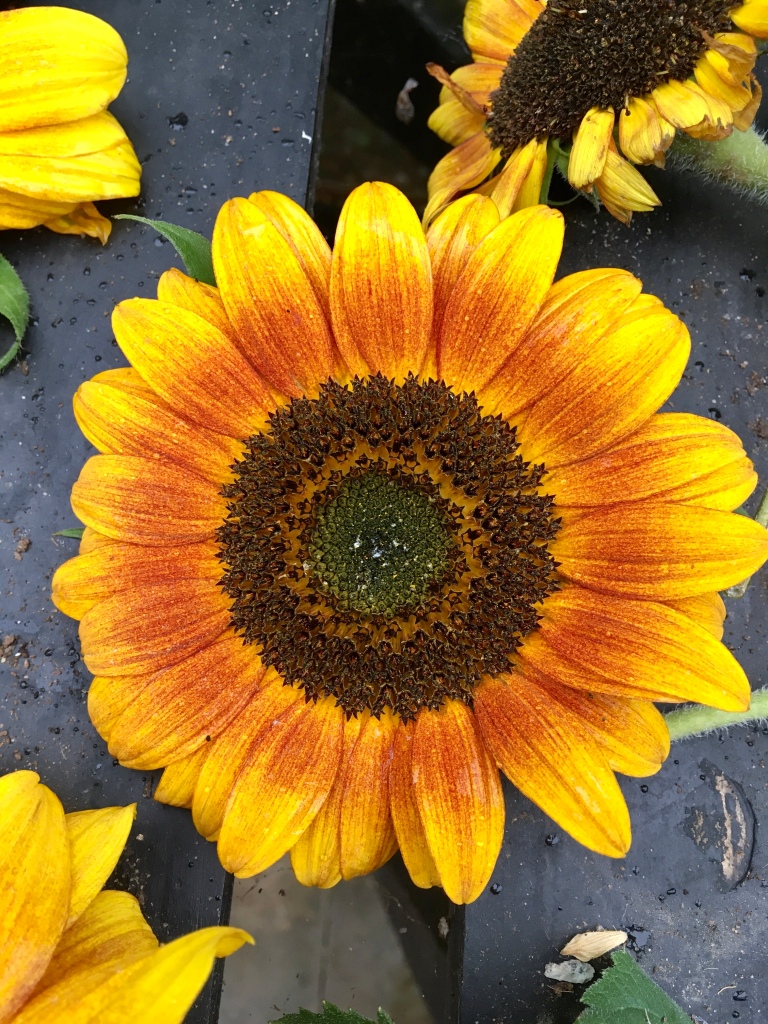
In the background you can see my 10ft sunflowers that I thought were small multi-headed types for cutting. I’d need a ladder to harvest those! Instead I’m leaving most of them to dry out for bird seed. A few blew down in the recent storms, so I’ve put them in jam jars on the kitchen table. I’ve made a note to carefully check the seed packets next summer so I don’t make the same mistake twice! They are beautiful though, and the bees and butterflies enjoying the pollen are currently a wonderful sight.

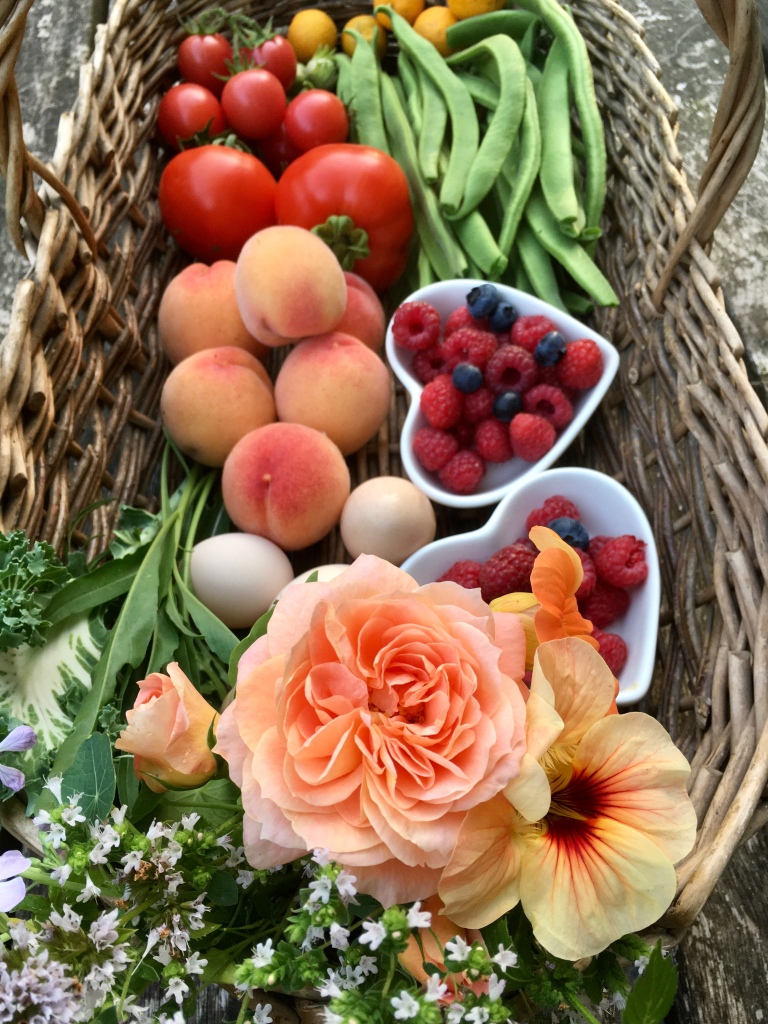
Next to the greenhouse there’s a matching 20ft polytunnel where I grow fruit, vegetables and flowers. Tomatoes and peaches have done really well this summer. You’ll also see a little pile of cobnuts in the basket. Alongside the greenhouse there’s a huge hazel tree which squirrels usually strip overnight. This year there were more nuts than they could manage, so I’ve harvested some to make into cakes and biscuits.

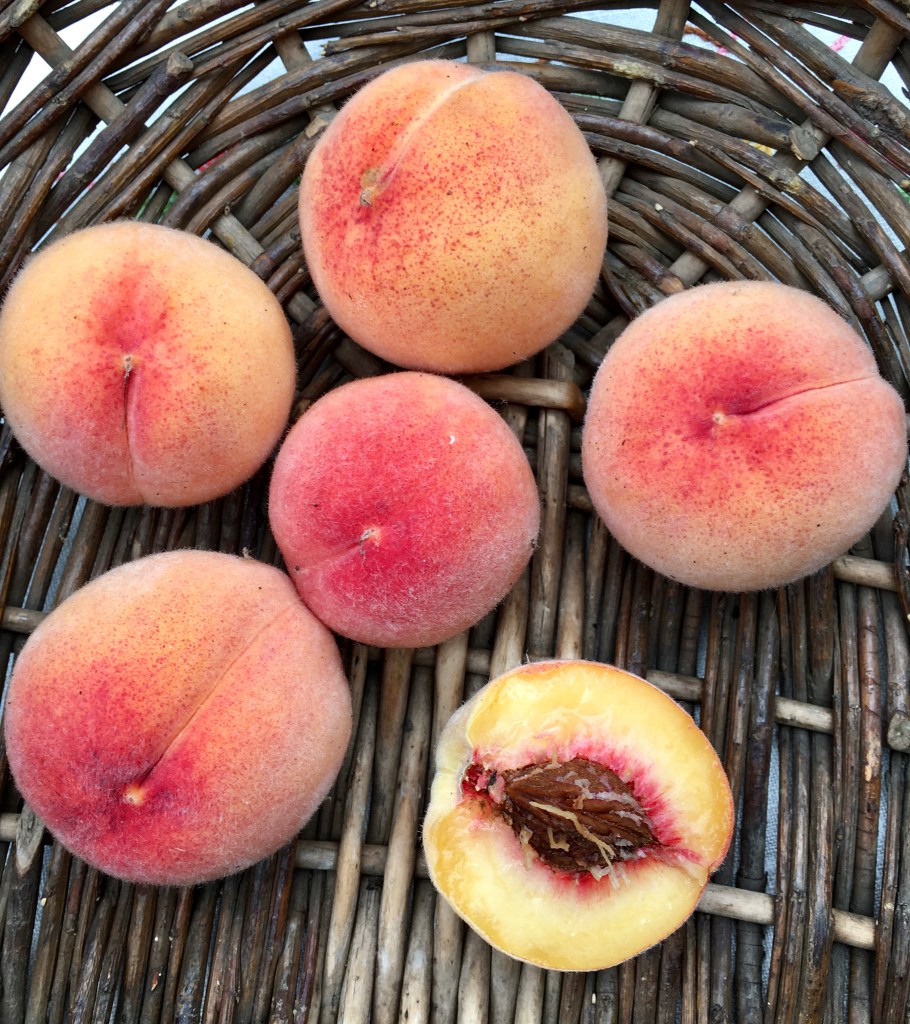
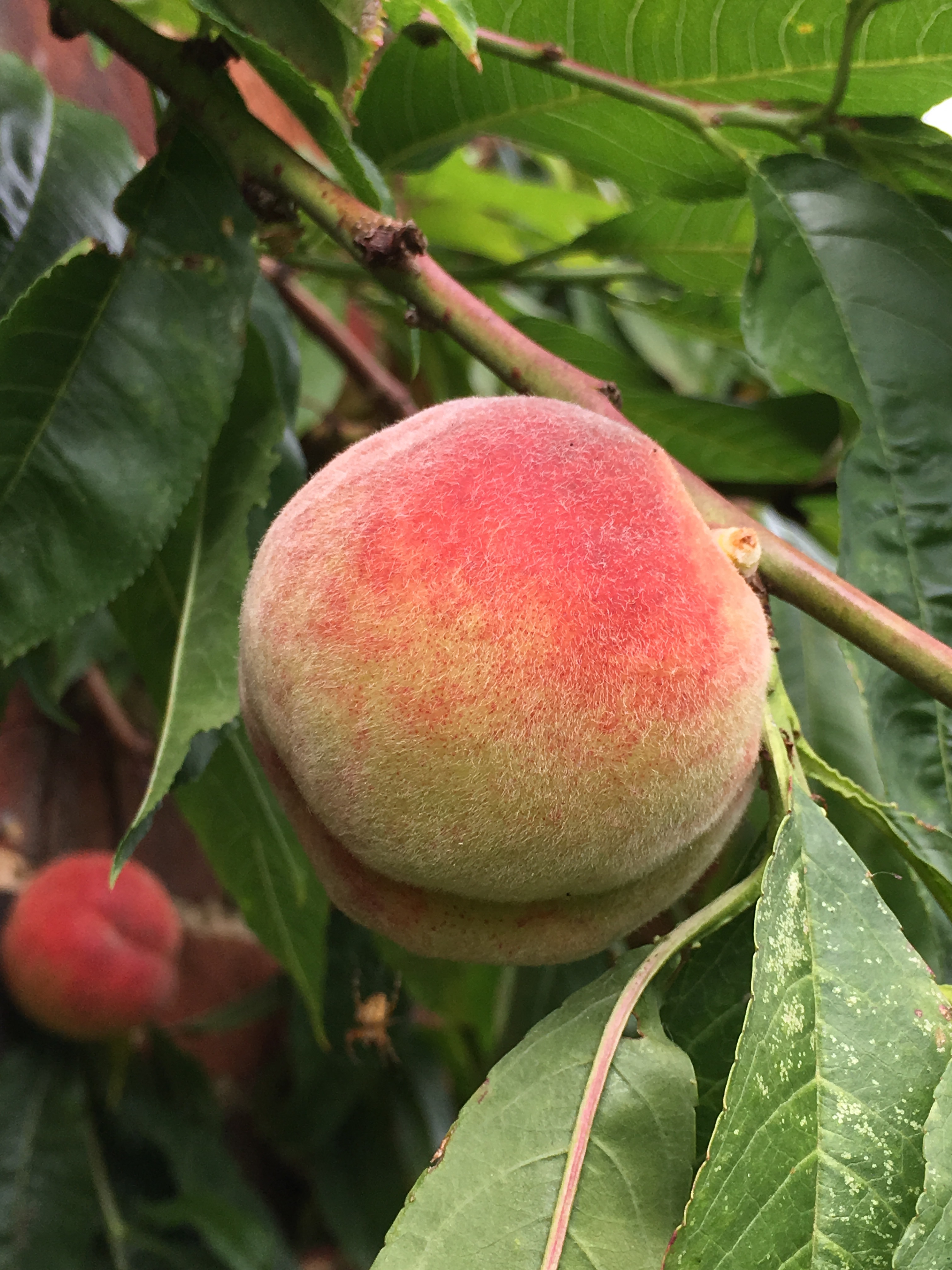
Peaches have been a great success this summer. My trees are grown in large 15” containers in the poly tunnel. This protects them from peach leaf curl which thrives in wet conditions. Keeping leaves dry is the best way to combat the disease.

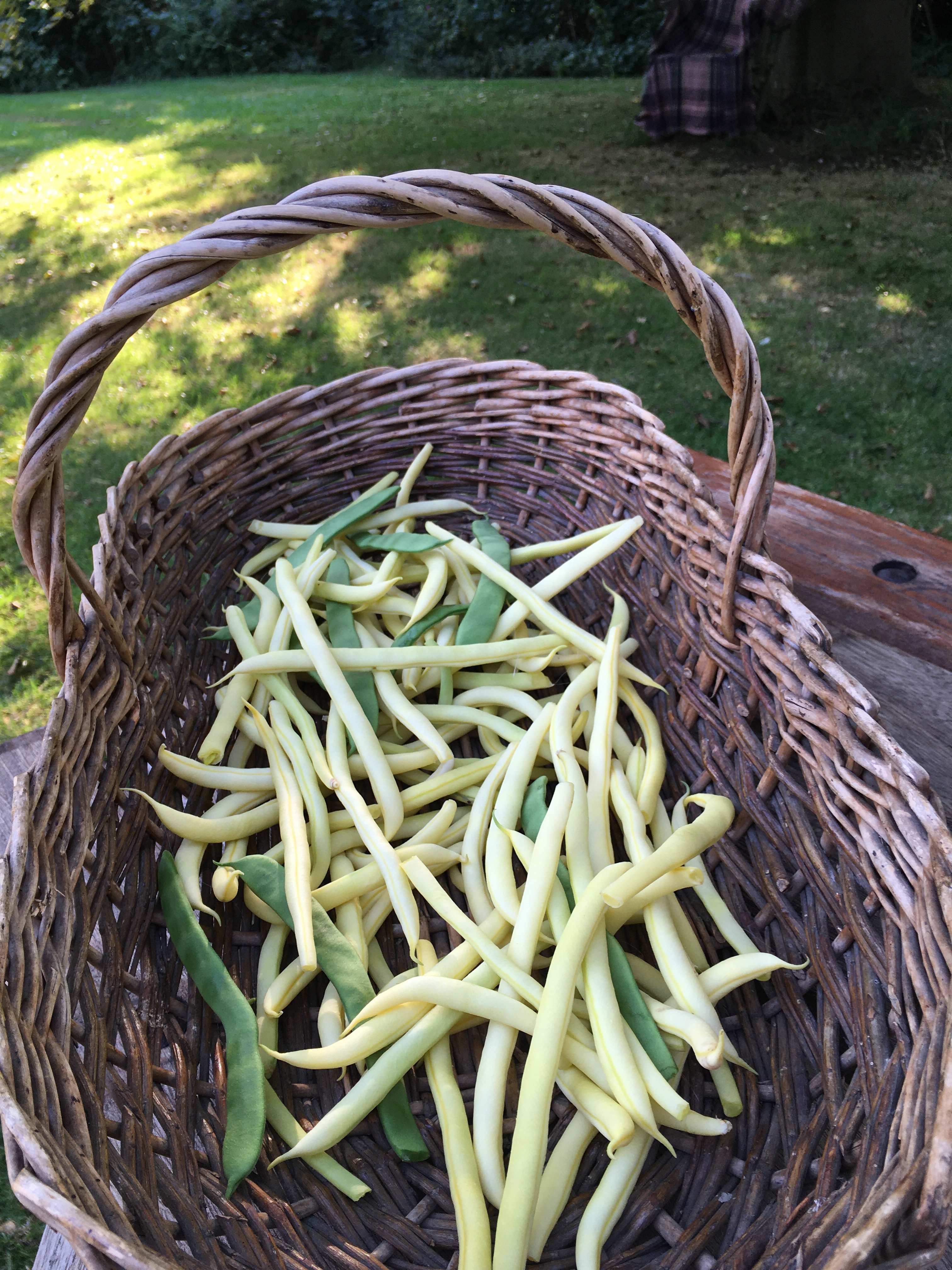
Baskets nearly always contain flowers as well as fruit and veg. This is Rose of the Year 2022, ‘It’s a Wonderful Life.’ Highly recommended for fabulous scent, repeat flowering and disease resistance. I’ve also picked some seedling nasturtiums. I’m particularly fond of this peachy-coloured one and keep it going by taking cuttings which root in water. I collect seeds too, but it might not come back exactly the same colour as nasturtiums readily hybridise. There’s also a few herbs, mint, marjoram and rosemary which add a lovely scent to any jam jar flower arrangement. The climbing beans are pink-flowered Celebration which don’t go stringy and crop late into the season.

Still on the theme of peaches, these are the little pastry custard tarts I made with slices of fresh peach, autumn raspberries and home-grown blueberries. The recipe is for my column in Garden News Magazine which I’ll share next week. They are very quick and easy to make.

I’ve had this potted purple bougainvillea for about 30 years. I’ve trained it into a round-headed shape so that it doesn’t take up too much room. It will be the first plant to go back in the greenhouse as it’s not at all hardy. Bracts stay colourful until December and I often use it in my Christmas table arrangements.

In pots alongside the bougainvillea are these beautiful grey-leaved tender perennial plants. They have long sprays of pale blue flowers. I’ve temporarily forgotten the name! Each winter I take insurance policy cuttings just incase I lose the parent plants.

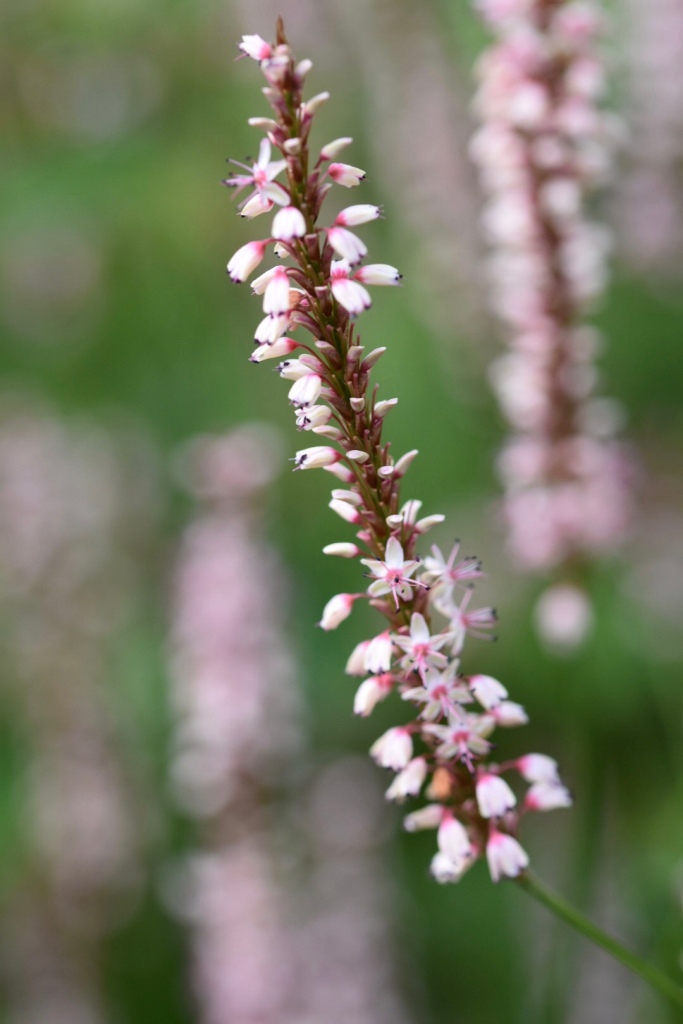
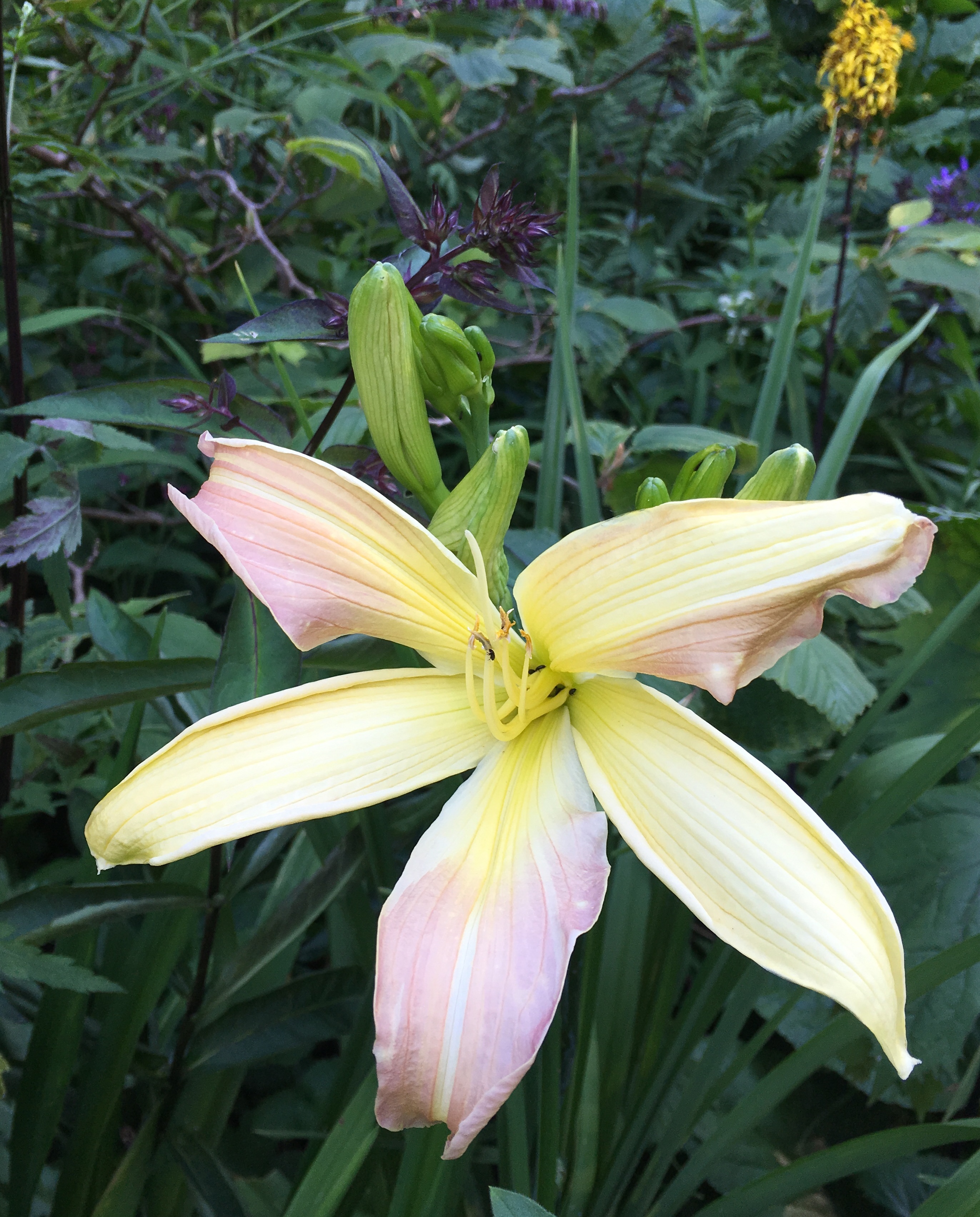
There’s a border full of low-maintenance day lilies in front of the greenhouse. In autumn when the day lilies are starting to die back, these beautiful spires of persicaria appear. This one is Persicaria Rosea.

The flowers deserve a close inspection, they are so dainty.

There’s also a white persicaria. Sadly, the label has been lost so I’m not sure of the variety. It thrives in dappled shade and flowers from August to November. The photo is out of focus as it was such a windy day, but it’s a very pretty flower nonetheless.

And finally, this one is also growing in with the daylilies. This persicaria is either Firetail or Firedance. They are good for cut flowers, lasting at least a week to 10 days in a vase if you change the water each day. The spire shape gives a nice contrast to round, daisy flowers.

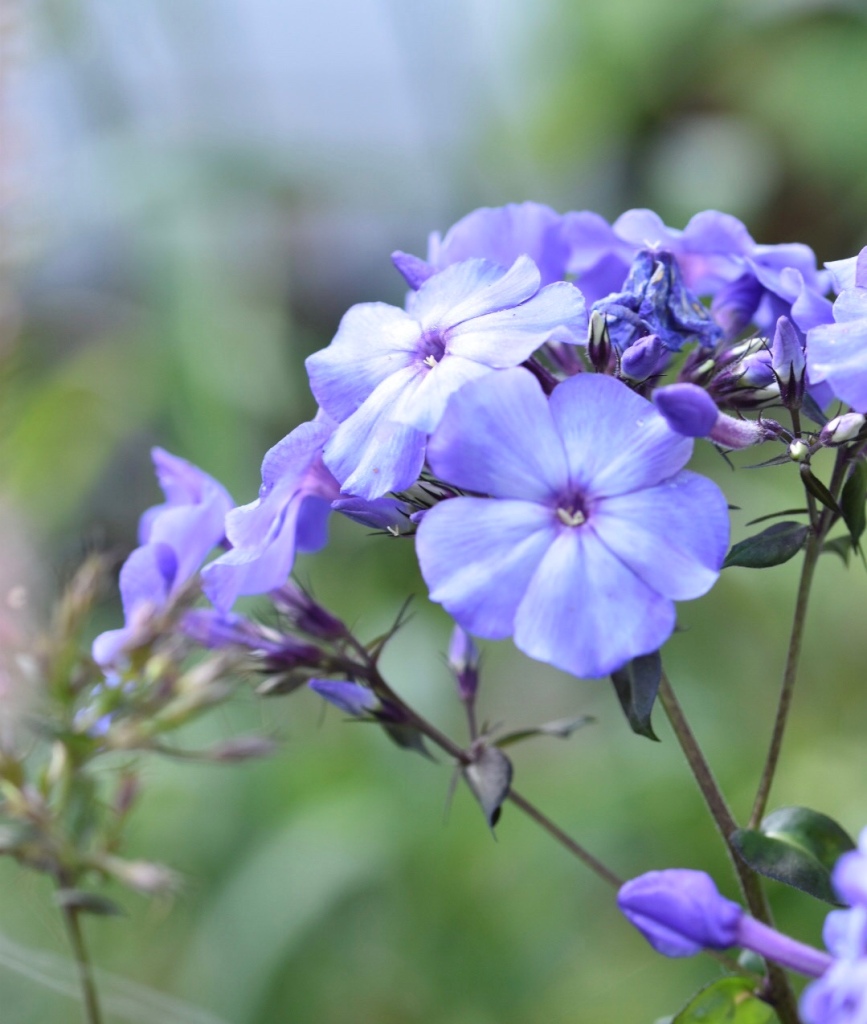
In amongst them are several types of phlox. This one is Blue Paradise- very highly scented and long-flowering in late summer.

The back field behind the summerhouse had oats growing there this summer. It’s been wonderful to sit in the shade and watch the field slowly turning to a shimmering gold. On a windy day, the crop ripples like waves and before it ripens the green-grey colour reminds me of the ocean. Instead of seagulls we have barn owls silently gliding by at dusk. There’s no sound at all from the beating wings and they quarter the field without knowing we are watching from the little wooden house.

We are always pleased and much relieved when the farmer manages to get the crop in before bad weather arrives. They work through sunset and into the night if rain is threatened. We lie in bed and listen to the tractors going up and down the fields and along the lane. At 2am there’s suddenly silence again and we know they have successfully got in the crops. Rain falls the next day and it’s wet for a week.

This is the view from our five bar gate at the top of the paddock. For a few weeks after the harvest, the fields retain their golden glow, and I drink in the scene and hold on to the memory as autumn and then winter darkness descends.

When we moved here, it was just a decrepit house and no garden. The farmer who built the house sold us an acre of land alongside it, and we planted 250 sapling trees given to us by the woodland trust and local council. At the time, there was a scheme giving free trees to anyone returning farm land to nature and we planted a small woodland area. All along the boundary, we left viewing points through to the fields beyond. The ever-changing seasons are a delight to spy through these holes in the treescape.

Thank you for reading my blog. Please sign up for e mail updates and I would love you to press ‘follow’. I often join in with Cathy for her ‘In a Vase on Monday’ meme. Mostly I write about what flowers I’m growing to give to my friends and family, and what produce I’m growing for family meals. I don’t grow in traditional rows, everything is mingled together and much is grown in window boxes and containers, with many different varieties ripening early, mid-season and late. There’s nearly always something to ‘forage’ from the plot.

Planting Bulbs, Corms and Tubers

A warm welcome to members of Heath Garden Society! Thank you for inviting me to talk last night. Here are a few photos to inspire you with your bulb planting this autumn!

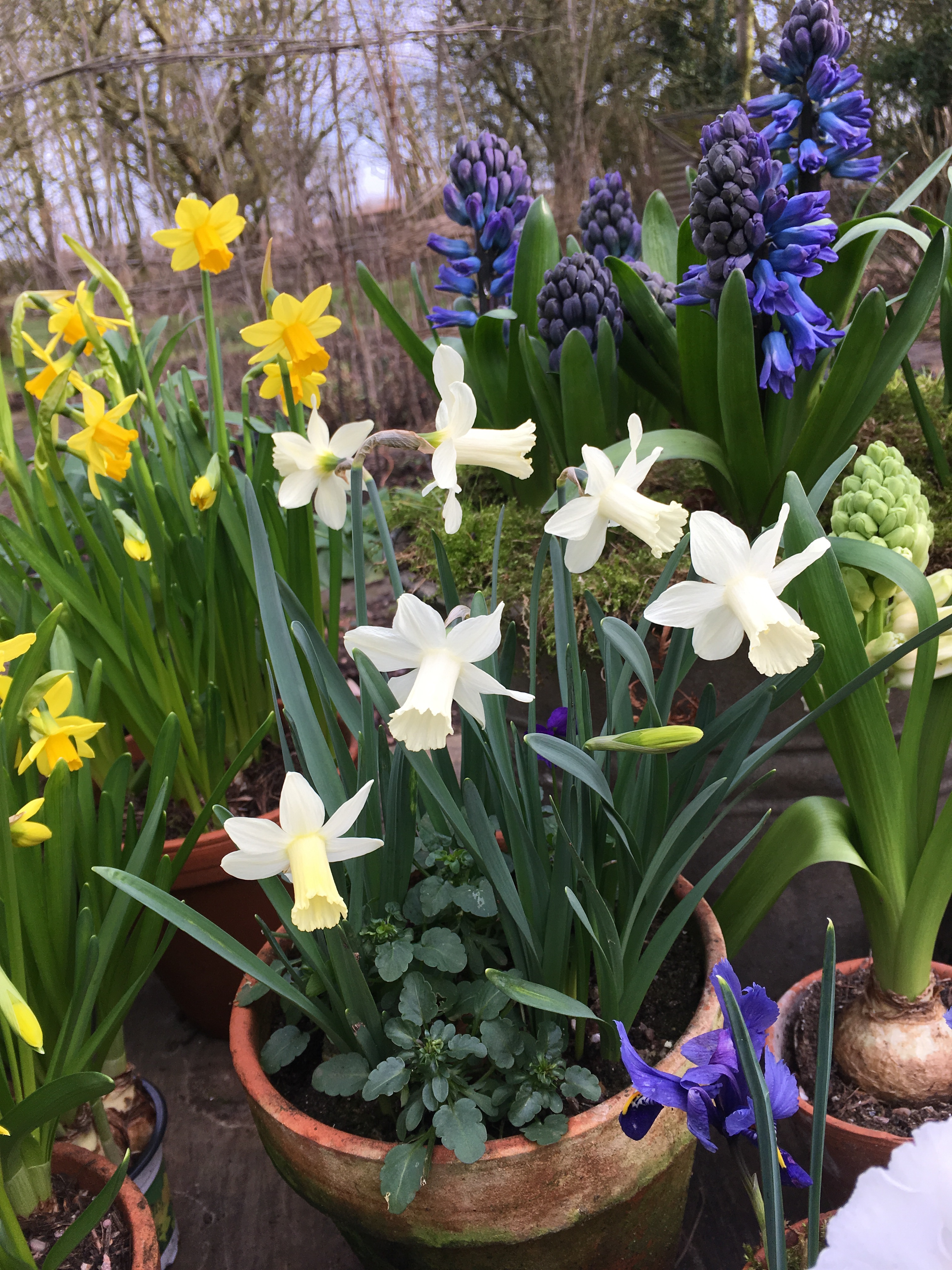
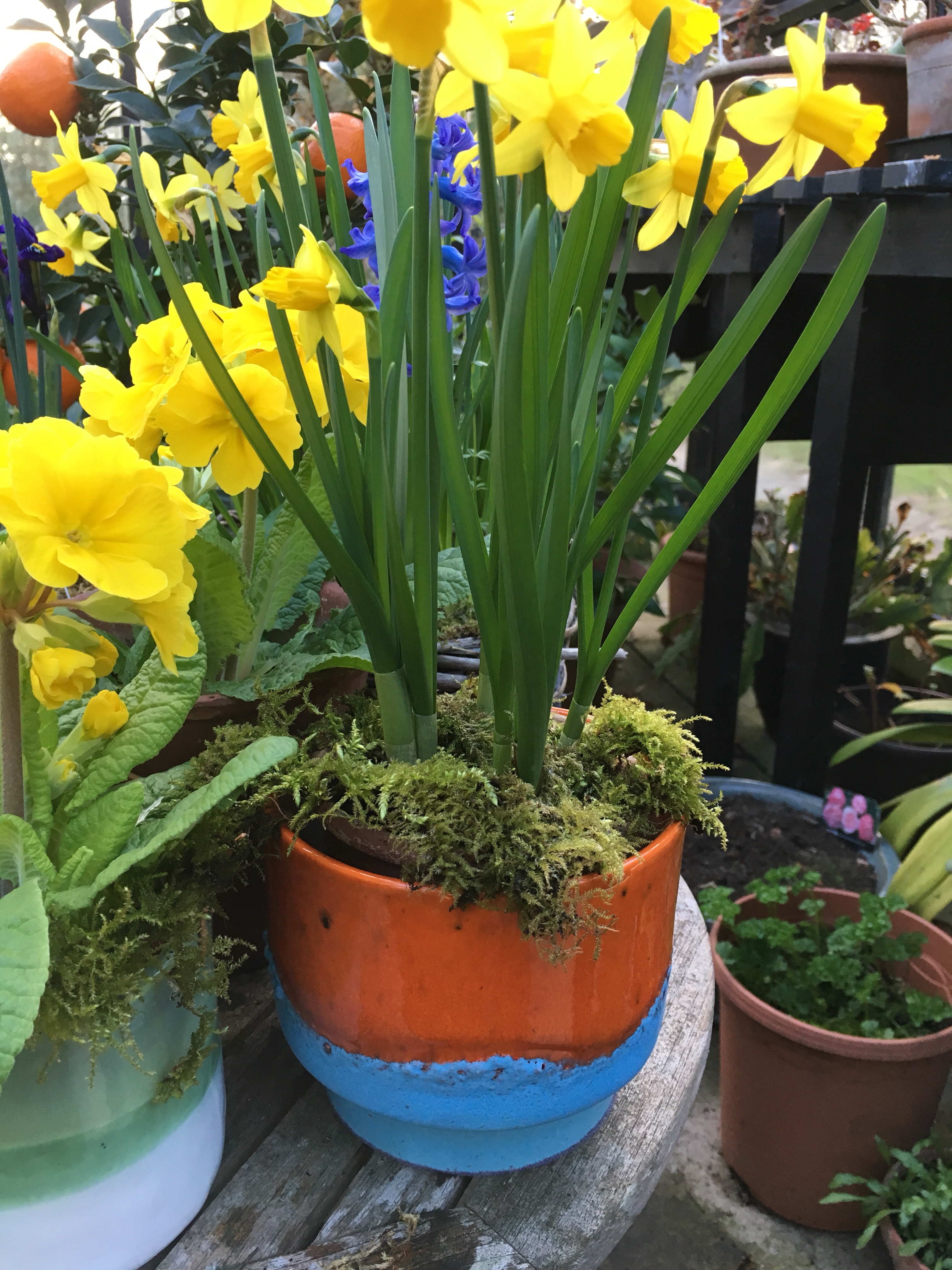
Snowdrops. Galanthus Nivalis is the common single snowdrop. I wait until they are coming into bud and then dig up a clump and pop them into my Sankey terracotta pots. These pots are special to me as my grandfather used them and gave them to me before he died. I love to use them and think of him gardening with them too. He enjoyed planting primroses, auriculas and miniature daffodils in them. I’ve planted Tete-tete in these and placed them on the potting shed window where I can look at them while I’m working.

I highly recommended Galanthus Madeline if you like a snowdrop with yellow markings. These were the three I bought from Thenford. A friend suggested we buy a pot and split it between us. This is a great idea if snowdrops are expensive. I think we paid £6 or £7 each, which turned out to be a bargain. The snowdrops bulk up quickly and are strong and reliable.

Within just a few years, my little clump has grown! I love something that thrives and shines out in the winter garden. These are planted under deciduous trees. They’ll flower before the trees come into leaf and then be protected from strong sunlight and heat by the tree canopy. We leave the tree leaves where they drop in autumn and snowdrops particularly love leaf mould.

I can also recommend new variety Polar Bear. These are huge flowers with unusual swept back petals and distinctive green markings. These flower later than the others in my garden and it’s lovely to extend the snowdrop season with something special like this. Luckily, these are usually on sale at Dobbies garden centre and are a fairly reasonable price, about £4-£6 a pot. Look out for them next February.

I wrote about Polar Bear here :

https://bramblegarden.com/2020/03/10/last-of-the-late-snowdrops-and-snowy-pictures-of-my-garden/

Snowdrops and miniature daffodils make a lovely button hole posy. These ones were put onto a willow wreath for my summerhouse.

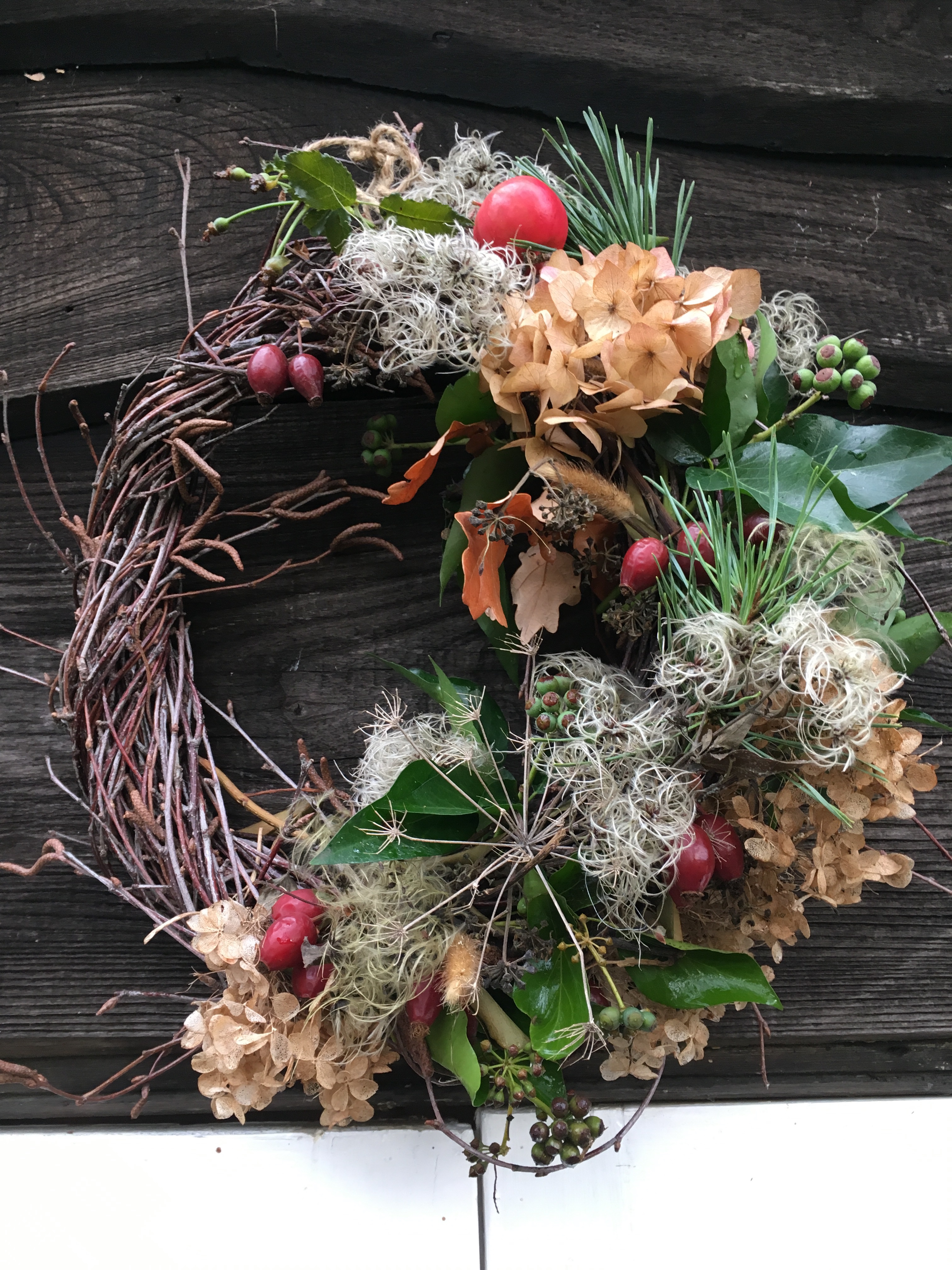
These little posies are placed into tiny glass or plastic test tubes and wired into the silver birch wreath. It’s easy to make the wreath. Just cut a length of weeping silver birch stems and twist and wind them around, tying at the top. Wire in some 4” lengths of ivy, moss and wild clematis or ‘old man’s beard’ as we call it. Daffodils, iris, cyclamen and crocus will last a week in the test tubes if kept topped up and it’s simple to just add fresh flowers when needed.

Here’s another tiny posy with snowdrops, crocus, cyclamen and a blue flower I think is called squill. Perhaps you know it? There’s an amazing strong scent for such a small arrangement in a tiny glass vase. Winter flowers are often beautifully-scented as they have to work hard to attract the few pollinators that are about.

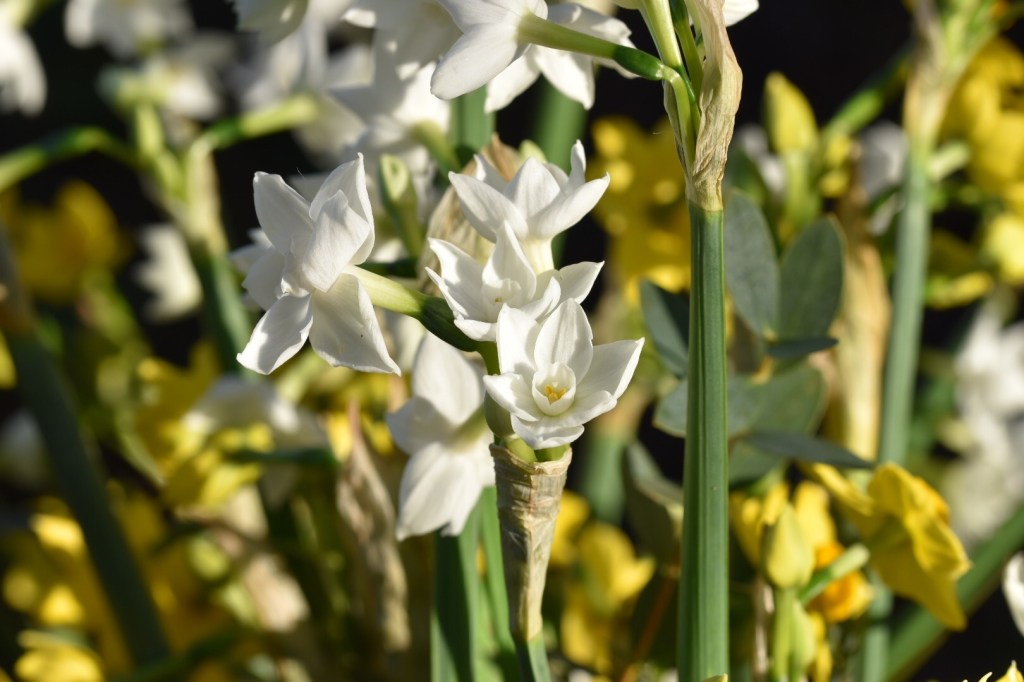
Talking of scent, I don’t think you’ll get anything with a stronger scent in winter than Paper White narcissi. We start ours off in plant pots at the end of September. Six bulbs to a 7” pot. They’ll take about nine weeks to flower, depending on temperatures. You can bring them on for Christmas by bringing them in from a cold greenhouse. Always start them off in a cool place, or they will grow tall and leggy and won’t root as well. You can extend the flowering season by bringing pots indoors in sequence right through to March. Paper Whites are not hardy so they won’t grow outdoors, but I start mine off in an unheated poly tunnel which gives them just the right amount of protection to grow well. If I want to make a big indoor display, I select pots with flowers all at the same stage and just place them in a large cache pot, topping them off with moss to hide the pots. No one would know that I’ve cheated! We use Dalefoot sheep wool and bracken compost specially created for bulbs. This compost is a favourite of mine as it gives Lake District farmers an income for their wool- which would otherwise go into landfill. Also the compost doesn’t break down and disintegrate like some other peat-free types. The other compost we use is Melcourt multi-purpose with added John Innes. We add grit and vermiculite to these, depending on what we want to grow.

Here’s some Paper White and Soleil d’Or brightening up January!

Such a lot of scent from such small flowers.

Planting a selection of varieties mean you’ll have daffodils from January through until May. Cedric Morris is first to flower outdoors. February Gold (above) usually flowers at the end of February. Tete a tete in March. The last daffodil to flower is Hawera in May.

Another new variety which has become a firm favourite is Snow Baby (above). This flowers for a long time, coping with strong winds, hail, snow. It starts out pale lemon and fades to white. Such a beauty on short, strong stems.

I like to have heritage types in the garden, along with the latest varieties on trial. Historically, fruit growers used to have daffodils amongst their apple and pear trees to give them a spring income, and fruit bushes such as redcurrants and blackcurrants for a summer income. I like to keep up traditions like this, so I’ve planted heritage narcissi Geranium under my trees. These make a lovely scented bouquet in spring.

Here I’ve combined the old with the new. Narcissi Geranium with a new tulip called Exotic Emperor. These are ‘lasagne’ planted. Four inches of compost is placed in the bottom of a large Italian pot, and 25 tulip bulbs set on top. Another 4” of compost is set with another 25 tulips. More compost and 25 daffodil bulbs. Another 4” and 25 more daffodils. Then top up with white Carnegie hyacinths, white Joan of Arc crocus and snowdrops. I’ll have flowers from February through to May. I only have one expensive Italian pot so I want it to work really hard for me. It’s placed under my office window so I can look out at it while I’m working.

If I could only grow one tulip it would be Exotic Emperor. It reminds me of swan feathers. I love the green flash too. Double tulips last much longer than single tulips. There are more petals to open, which makes them good value.

Queen of Night is another tulip I use a lot in my garden design work. It’s long lasting and stands up to the weather.

Here it’s growing with Allium Purple Rain, a hybrid between Purple Sensation and Christophii. Highly recommended. Also look out for new summer-flowering allium Millennium. Hardy’s plant nursery sells this variety at flower shows and mail order.

For a pretty, fringed tulip, try Curly Sue. And my favourite pink tulip is Violet Beauty. We buy from Gee Tee Bulbs. Links to the nurseries are at the end of this blog post.

Rapidly moving on to autumn – as your talk was all about bulbs, corms and tubers- here’s Dahlia David Howard partnered with Alstroemeria Indian Summer. I leave my dahlias in the ground over winter, covered with a foot of dry leaves, some compost bags and finally, cloches. As long as they don’t get soaking wet and frozen, they will be fine.

Nuit D’Ete is another top favourite. I love the cactus flowering dahlias for their striking petals. This one also has tinges of deep plum red and black in the centre. A really striking and beautiful flower.

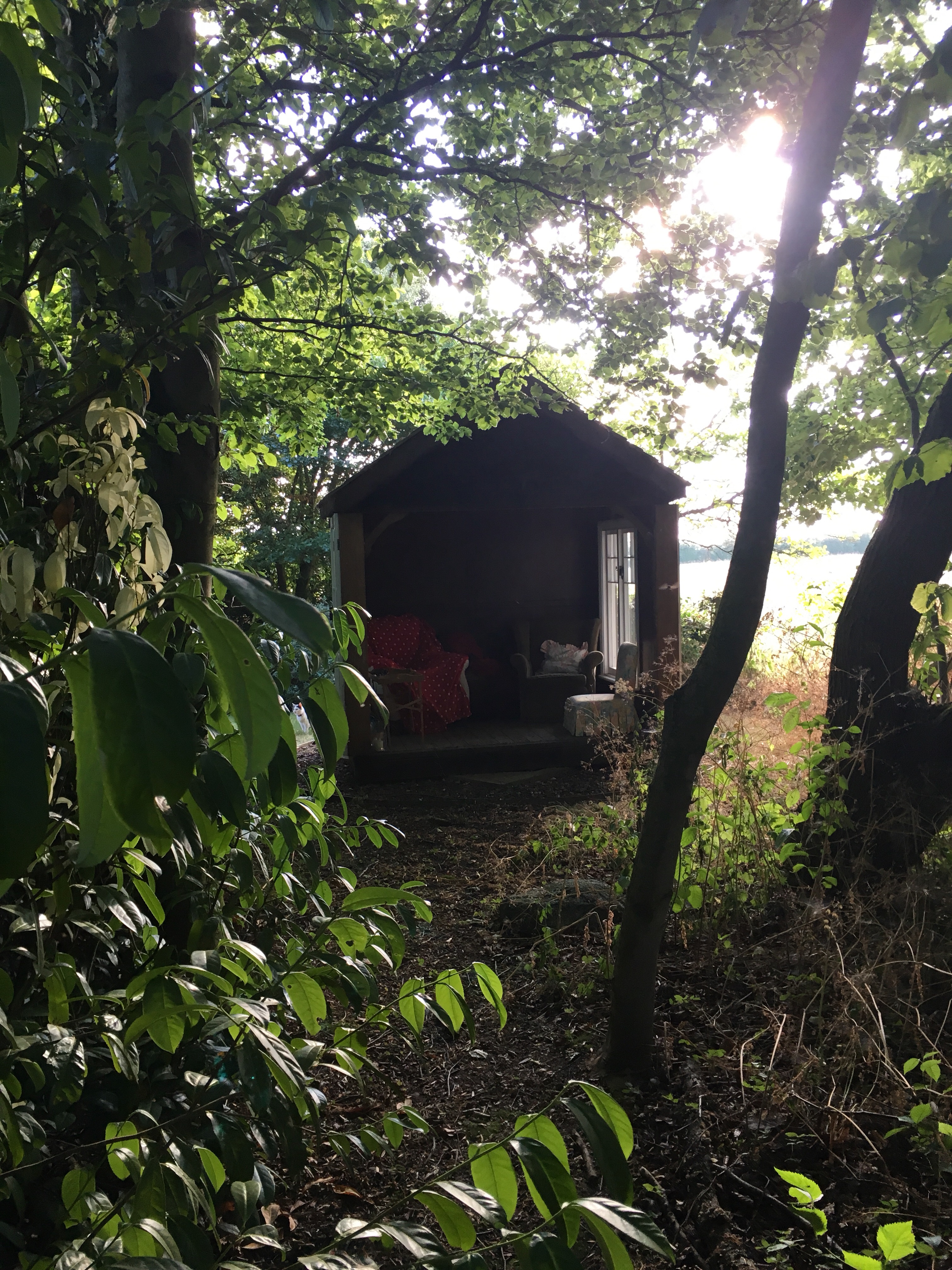
I’ll leave you with a picture of my 1920s summerhouse which is on a turntable. It originally lived in Derbyshire at Flower Lilies Hall. We spent a year renovating it and now love sitting inside looking out at the different views of the garden. Thank you for visiting my blog and reading about my garden. Please leave a message in the box below, and sign up for e mail notifications for further blog posts. I concentrate on growing food and flowers at home- I never have to buy any cut flowers for friends and relatives. It’s all about choosing the right varieties and getting a succession of produce all through the year. It’s a fun challenge and one I love to share with you all.

Links:

https://www.gee-tee.co.uk/

Hardy’s cottage plants:

https://www.hardysplants.co.uk/

Also look at In a vase on Monday meme:

https://ramblinginthegarden.wordpress.com/2023/08/28/in-a-vase-on-monday-bluesy-floozy/

Flowers from my garden for my Mum

Sweet peas and roses are plentiful on 28th June. Rosa It’s a Wonderful Life is the favourite this week with five or six rose heads on each spray. It’s almost a bouquet on its own!

Flowers are fully double with a delicious fruit salad scent. Leaves are very healthy with no sign of disease.

Perfect in bud. Flowers start a deep apricot colour and fade to pale pink.

It makes a striking feature in the garden, with all shades of peach and apricot at a time on one rose bush.

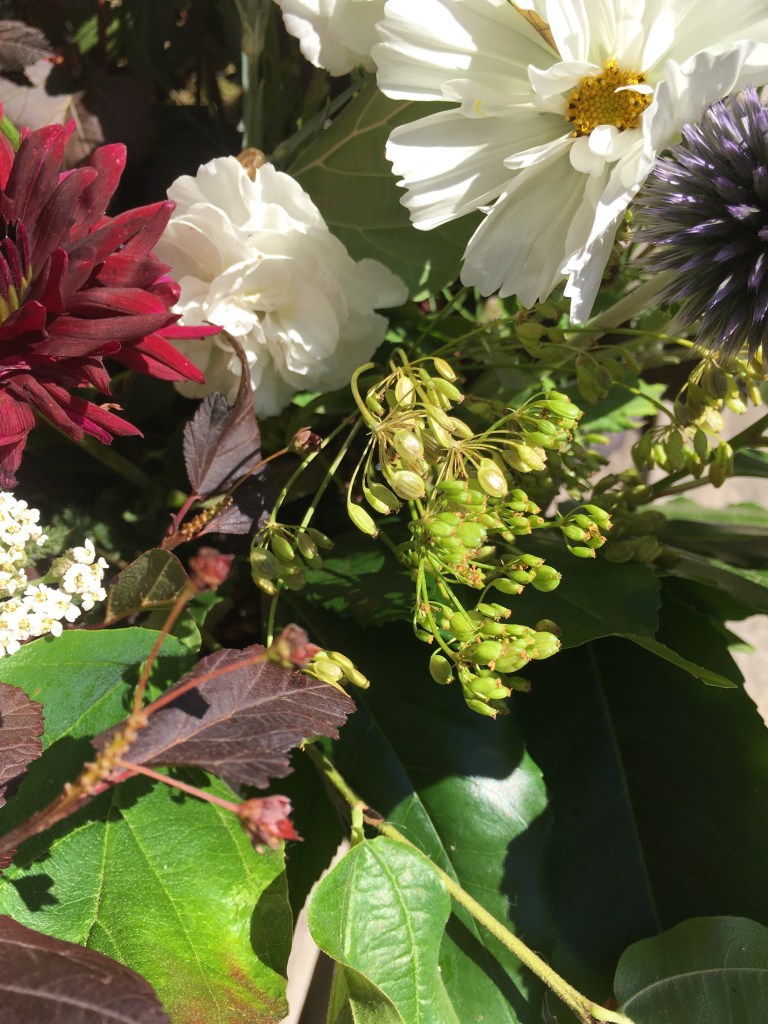
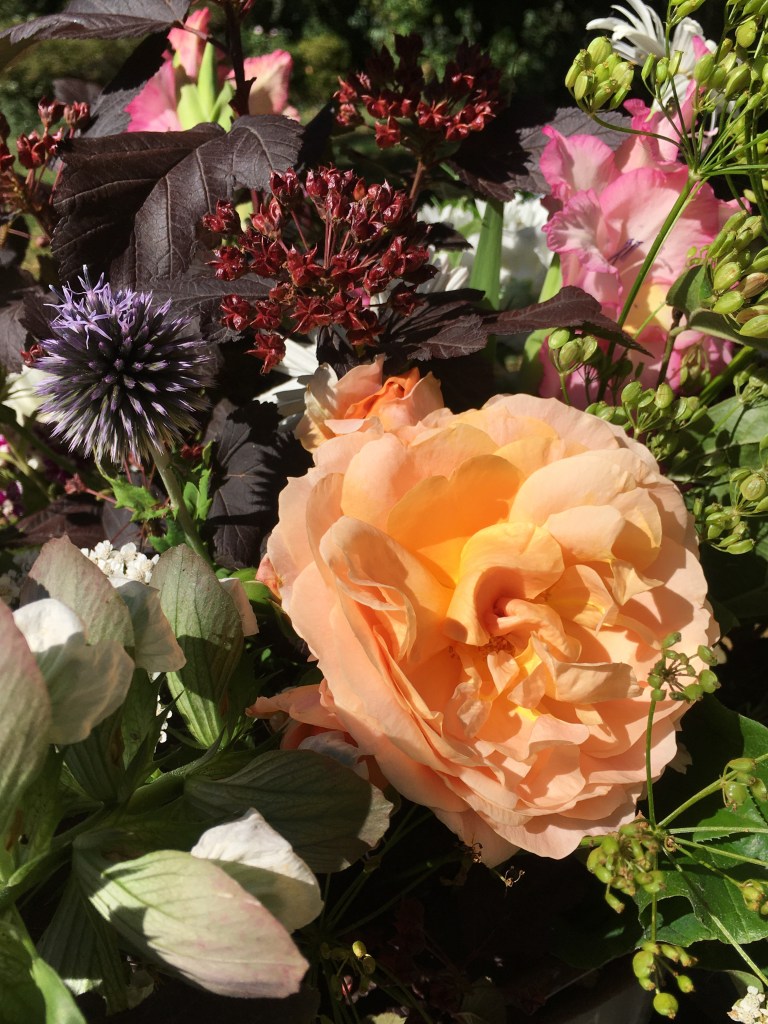
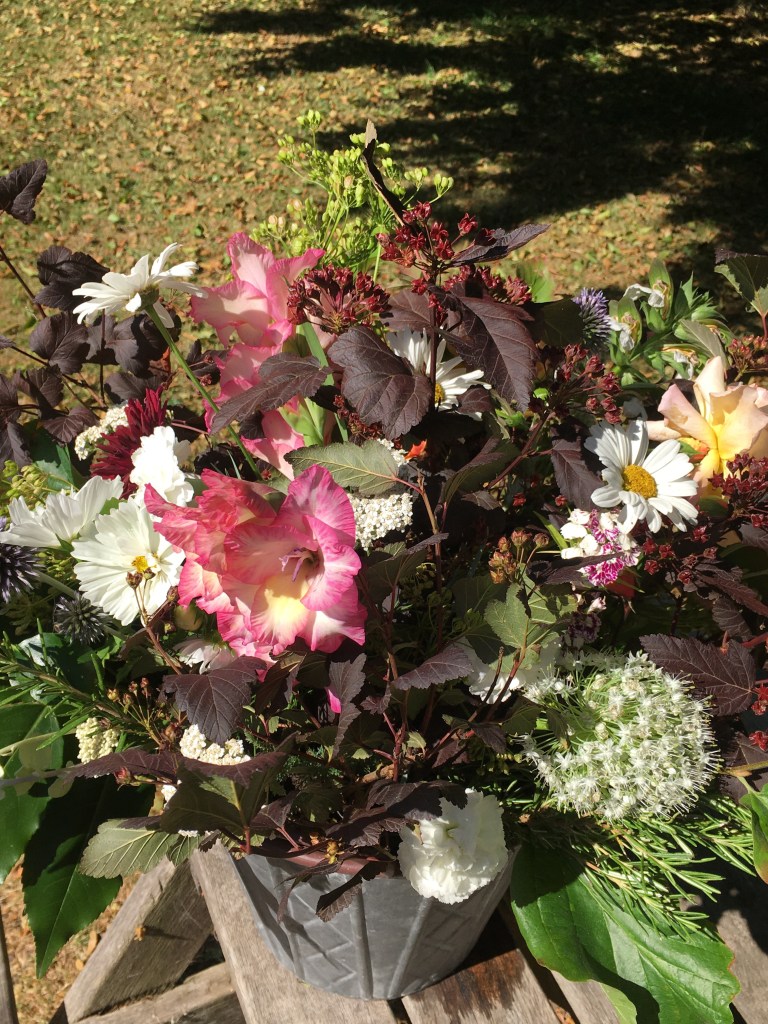
For background colour, I’ve chosen dark purple-leaved physocarpus Diabolo which in summer has clusters of pale pink flowers. These turn into deep purple seed heads.

Sweet peas are growing along a hazel A-frame in the veg plot. This year I’m growing a selection of white sweet peas alongside old favourite High Scent.

Mum sowed these oxeye daisies from a packet of wild flower seeds six years ago. We planted them together in one of the 1.3m by 3m divided veg beds in front of the greenhouse. They are the perfect partner for roses.

When they have finished flowering, I’m planning to move them to the new wildflower area surrounding the pond. They are taking over the veg patch , which I’m not complaining about. I love their joyful exuberance. Daisies are probably my top favourite flowers.

Also looking good at the moment are the home florists’ range of roses. This one is Timeless Cream. I’ve also got Timeless Purple. Highly recommended. Very few thorns and long lasting in a vase.

Timeless Cream in bud. Would make a perfect buttonhole rose.

And Rosa Mutabilis also blends in. This is the longest flowering rose in my garden, starting in April and still in flower in December.

Have a great gardening week everyone. I hope this has given you some inspiration on what to grow at home to create bouquets for friends and family all year round.

Also catch up with Cathy over on her #InAVaseOnMonday meme. It’s fascinating what everyone’s growing in gardens, all around the world.

https://ramblinginthegarden.wordpress.com/2023/06/26/in-a-vase-on-monday-three-little-maids/

Flowers for my Mum. Home-grown from the plot

Summer annuals, such as cosmos, haven’t started flowering yet. We are about two weeks behind, due to a very cold spring. So for this week’s flowers from the plot I’ve had to rely on biennials, perennials, climbers and shrubs. Each week, I pick a selection of flowers to take to my Mum as a ‘snap-shot’ of what the garden looks like. It’s a way of sharing our love of flowers and keeping her connected with what’s happening here.

Love-in-a-mist was sown last autumn and over-wintered in an unheated poly tunnel. I was testing out a theory to see if I could get early flowers by the last week of May. There are masses of flowers, but these are only a few weeks earlier than the ones growing in a sunny south-facing border outdoors, so I probably won’t repeat this exercise. The cost of compost and use of space doesn’t warrant the slightly earlier flowers.

The tiny deep purple flowers are Geranium Phaeum which pops up all over the plot in places I never planted it. It’s a long-flowering perennial and doesn’t take up much space, just meandering about through established shrubs and in a dry, shady woodland border.

The other jewel-like purple flowers are perennial wallflowers from Coton Manor plant nursery. These are highly recommended as they flower for a very long period and are low maintenance and easy-going. I bought just one plant and took cuttings immediately. I soon had 20 plants to cover a quarter of one of my vegetable and flower beds sited next to the greenhouse. I have 10 beds which are 1.5m wide by 3m long with small slab paths running between.

The last of the orange biennial wallflowers are being picked now. I’ll sow some more seed for next year. Sooty is a favourite deep purple/ black variety. The one above was part of a mixed packet of seed named Orange Bedder. It’s been flowering for several months. Deep red buds open to a lovely marmalade orange and the markings on the petals remind me of a dragonfly’s wings. The scent is wonderful, especially in the evening, and attracts clouds of moths. And circling above the plot, eating the moths, we have pipistrelle bats. We have seen them here since we moved in and created a garden 30 years ago. We thought they roosted over winter in the farmhouse next door, but they must have found other accommodation as the farmhouse has been completely renovated and there are now no gaps in the slate roof.

Forget me nots fill another whole bed, providing ground cover for the soil until the bed is required for summer crops. Forget me nots pull up very easily and suppress any weeds, so you are left with a nice clean bed to start planting out crops such as sweetcorn, onions, French beans, and courgettes. This year I have planted a dozen sunflowers in amongst the sweetcorn, an idea I spotted at Easton Walled Gardens last summer. Nasturtiums will clamber up the sweetcorn as it makes a sturdy support for annual climbers and scramblers.

Welsh poppies pop up in every crevice all over the garden. I did previously try to eradicate them, but they persisted and I’m quite pleased they did now. Such a cheerful plant with flowers that look as if they are made of silk. I have the yellow and the orange types here. Background foliage comes from the Physocarpus Diabolo which grows in a north facing border and provides material for flower arrangements all summer long.

Dead nettles and cow parsley add a touch of white to the posy. Dead nettles continue to grow out of the bouquet and flowers last a long time. I was intrigued to see four out of the 12 gardens at Chelsea Flower Show contained so called weeds. I laughed out loud when I heard pots of dandelions were selling for £30. I’m actually a millionaire if dandelions, nettles and buttercups are taken into consideration. My whole plot is full of them!

I have a new little helper in the garden! My grandson, Finn. He loves running between the cow parsley along the woodland paths and picking flowers for his great grandmother. I’m hoping he will have a life-long love of nature and flowers, just as we did, growing up running free in our grandparent’s gardens. Have a happy gardening week everyone.

Do join Cathy for her ‘In a Vase on Monday’ meme. If you are busy, like me, it doesn’t matter what day of the week you post your posy of flowers from the garden. It’s a good community to be a part of, sharing what we are growing in gardens all around the world.

https://ramblinginthegarden.wordpress.com/2023/05/29/in-a-vase-on-monday-self-care/

BBC Radio Leicester Gardening

Sweet pea varieties I’m growing again for next summer

Here’s the link to this week’s gardening section on the Ben Jackson show. We start talking gardening at 1.09 on the timeline.

https://www.bbc.co.uk/sounds/play/p0d9mn15?fbclid=PAAaYBBRlgqEoUCh8-qaN4O0nnY6iNgzuI12IfCIMpjvT5BTnfOFPNbrCQEus

Many people listen to radio on the i-player now. It’s so convenient to be able to listen when it suits you. You can stop the recording and go back if you didn’t hear a plant name correctly. You can have a cup of tea in the middle of the programme. I love listening to the radio through my i-pad or on the phone when I’m driving along.

This week we talked about sweet peas. My plants are 5” tall now and I’m pinching out the tops to make bushier plants. Sweet peas flower on side shoots, so more shoots equal more flowers.

I’m growing my sweet peas in root trainers. These are long cell trays which allow deep rooting. They open at the sides like a book so the roots aren’t disturbed when you plant them out. I use a 50/ 50 compost and grit or vermiculite mix for good drainage. There’s still time to sow your sweet peas now. Seeds packets are reduced in some local garden centres and on-line.

My sweet peas are for jam jar posies. I’m growing Wiltshire Ripple, High Scent, Albutt Blue and Chatsworth. I’m also growing about five different types of white sweet peas for my trial to grow wedding flowers for my daughter. She’s not getting married until summer 2024, but next summer will be a try-out for the flowers.

I particularly love the ripple series of sweet peas. Here shown with some sweet william.

Ripple Mixed from Mr Fothergill’s seed.

We also talked about taking salvia cuttings.

I have a collection of really beautiful salvias, some in the ground and some in pots. They are not a hundred percent hardy, so I take ‘insurance policy’ cuttings now. Look down the sides of the plants and find some shoots that haven’t flowered. Pull gently down and they will come away with a tiny heel. Tidy up the heel with a knife and insert the cutting around the edge of a 3” pot of gritty compost. They will overwinter in a greenhouse, cold frame or house windowsill.

Here’s a pot full of salvia cuttings. I leave them in the same pot all winter and separate them in spring. This takes up less space than dividing cuttings and potting them on in winter.

They separate out into new little plants which can be grown on in their own 3” pots and planted out in summer.

I wrote about salvias here: https://bramblegarden.com/2021/06/18/new-plants-on-trial-salvias-from-middleton-nurseries/

Thanks for listening in, if you live in the Leicestershire area, and thanks for reading the blog. It’s great to share what we are all growing in our gardens all year round. There’s something new to learn every

Flowers from my garden- a week later….

Last week I posted an ‘all of the garden’ bouquet with everything in flower. I thought you might like to see how the flowers look seven days later. I visited my Mum today and took all the flowers out of the vase and cut four inches off the bottom of the stems. I cleaned the jam jar and added fresh water.

What a joy to see Alstroemeria Indian Summer still looking fresh and colourful. As I said last week, I bought this new plant from Mary Thomas who has a nursery in my area. Mary lives in Sutton Bonington and opens her garden for the NGS. She also has a plant nursery, Piecemeal Plants and has a stall at the Belvoir Castle Flower Show where I treated myself to one or two special plants. To have them still in flower in mid-November is making me very happy indeed!

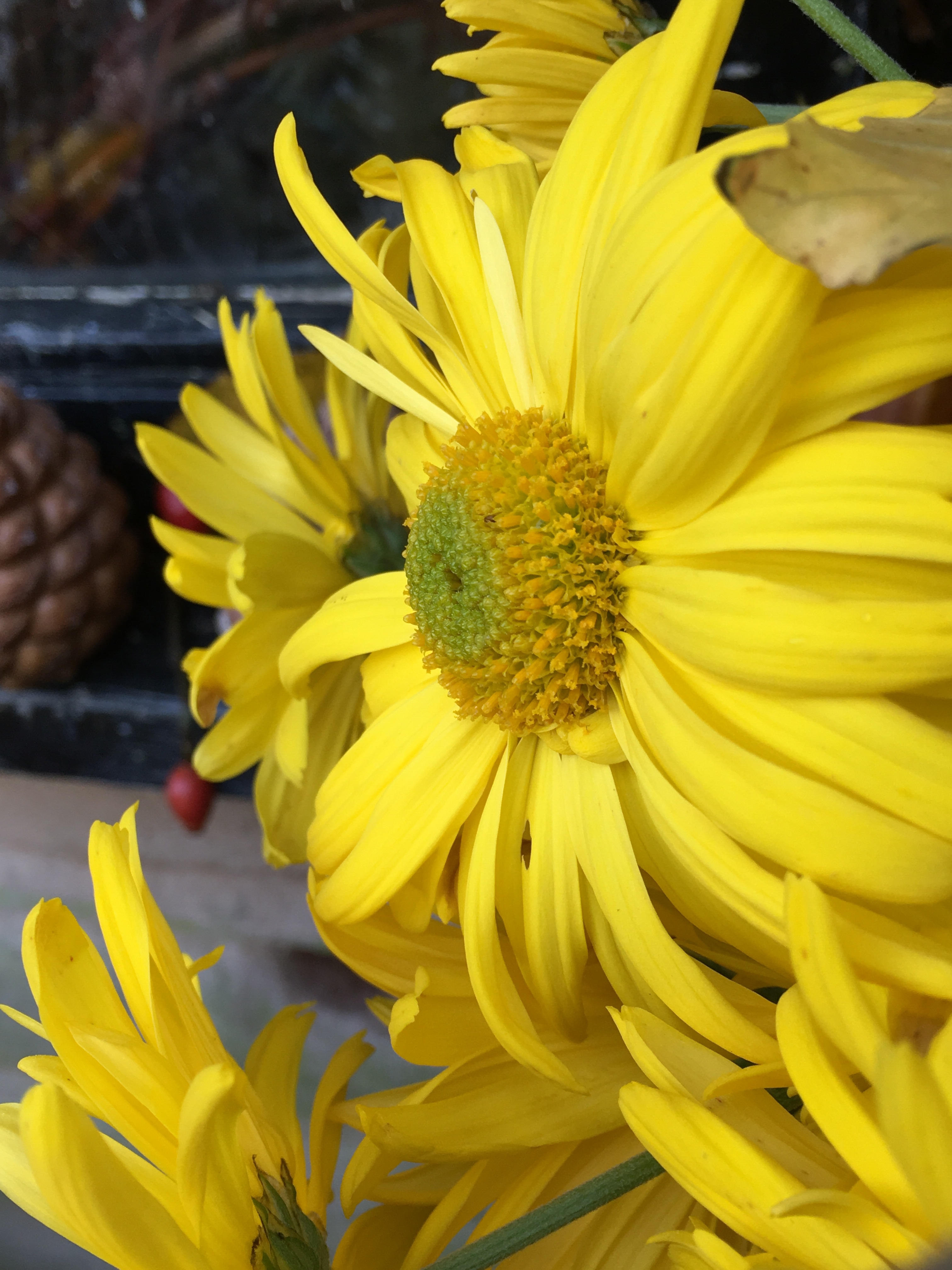
Chrysanthemums give good value in a cut flower garden and will last three weeks in a vase, if looked after by refreshing the water and just trimming the base of the stems slightly every few days. Mum hadn’t touched her flowers for the week, but they still looked as fresh as newly picked. This variety is Swan. The pure white petals surround a green centre which eventually fades to white to match the outer petals. A good value plant. We bought cuttings from the RHS Malvern Show a few years ago. I think I shared a batch of cuttings with a friend. There was a special offer of 12 cuttings of different types. The price for the offer worked out at about 80p per cutting. Plants are grown in 10”pots stood outdoors all summer. Usually I take them in the poly tunnel or greenhouse in November as frost and rain might spoil the petals, but this year we have had such mild conditions, the plants are still outdoors.

This is the very last David Howard dahlia of the year. It’s my favourite dahlia and goes really well with the alstroemeria, as if they were meant to be together as a pair.

The petals of the rudbeckias have dropped off, but I decided to keep the stems as the dark brown stamens made interesting ‘buttons’ of colour and shape. A contrast to the flowers.

This little rudbeckia is hanging on, grown from a mixed packet of seed from Mr Fothergills. I just couldn’t throw it out. It might not last another week, but we shall see.

I was surprised and delighted to see the little wild flower Oxeye daisy still hanging on. Such a lovely reminder of the banks of white flowers which flower all summer here. It’s so strange to see them blooming in November as the days grow dark. But welcome even so.

As usual, foliage is important in my jam jar flowers. This is a lime green bedding plant I keep going from one year to the next by taking lots of cuttings and keeping them in 3” pots over the winter. They are popular for hanging baskets and containers, but also make very good foliage for cut flowers. And I’ve temporarily forgotten the name. Perhaps you know it? There’s also a grey version, but I prefer the lime green.

There’s also rosemary which goes into every posy I create. Everything I do has a meaning and rosemary is for remembrance, as you probably know. I’m surprised to see the huge 4ft high plant I have in the veg plot in full flower today. Such beautiful Mediterranean blue flowers and gorgeously -scented leaves. I couldn’t be without it.

I couldn’t be without my senecio viravira which also goes into every single posy I create. It’s such a pretty leaf and sets off all the other colours. Plants are not always hardy so again I’ve taken cuttings in 3” pots, just in case.

Also, not easy to photograph, but Salvia Phyllis’s Fancy is as fresh as the day I picked it.

A slightly better photo. You can also see the red stems of dogwood which give colour to autumn arrangements.

I hope you’ve enjoyed this weekend’s updated photos. It only took me ten minutes to rearrange the flowers and refresh them. It’s so rewarding to see how long home-grown flowers can last. And my mum’s kitchen window is full of autumn colour and scent for another week. A worthwhile project and it makes me – and my lovely Mum very happy.

Have a lovely gardening week. And thanks for reading the blog and leaving a comment below. Follow Cathy for the ‘In a Vase on Monday’ meme. She has a very special anniversary tomorrow, so many congratulations Cathy! And thanks for hosting such a lovely, friendly meme with members growing and arranging flowers all around the world for the past nine years.

https://ramblinginthegarden.wordpress.com/2022/11/07/in-a-vase-on-monday-life-more-sweet/

November flowers for my Mum

Monday 7th November 2022

Surely, these must be the last flowers for cutting this year…. I keep going out expecting to see foliage blackened by frost and buds turned to mush. But no, the garden is still blooming!

Star of the show must be these marmalade orange flowers, Dahlia David Howard. Plants have done nothing all summer, but suddenly a month ago, after some rain, new leaves appeared and flower buds. I didn’t think they would come to anything as it’s so late in the season.

Coming into flower again is my new alstroemeria Indian Summer which I brought in July from my friend nursery owner Mary Thomas. It was in flower when I bought it, and it’s decided to get going again now. Doesn’t it look wonderful alongside the David Howard dahlias.

They look as if they are meant to be together in a bouquet. Such a pretty combination, don’t you think?

Another surprise is this red and white dahlia. It arrived all by itself. I bought a white one and a red one several years ago, and together they have produced a seedling baby combining the two colours. It’s rather pretty and flamboyant. I love the open centre as it has plenty of pollen for bees. I probably enjoy bees and butterflies as much as the flowers in my garden to be honest.

I sowed the seed for these sunflowers speculatively in August. I sowed them direct, in amongst the cosmos and calendula. Temperatures were so hot in the 30s for days on end that seeds germinated almost overnight. The result is a bed full of miniature sunflowers only 4” across. I don’t suppose this will ever happen again as we are unlikely to have another summer like this one.

Another mixed up sunflower, or it could actually be a rudbeckia. It has a very pretty chocolate coloured centre. I love any daisy-type flower.

Not a perfect flower, it’s slightly nibbled around the edges, but this is an ox-eye daisy which usually flowers in mid-summer. We have these wild flowers dotted about the whole garden, especially along gravel paths where seedlings flourish. I’m digging some up this week and moving them to a new patch of bare ground around the pond.

More white flowers just starting to bloom now are the chrysanthemums. This one is called Swan. It opens with a green and cream centre and fades to pure white. Very long-lasting in a vase, it will keep for nearly three weeks if you change the water daily. Highly recommended. I grow it in 10” pots stood outdoors for the summer and brought under cover in winter.

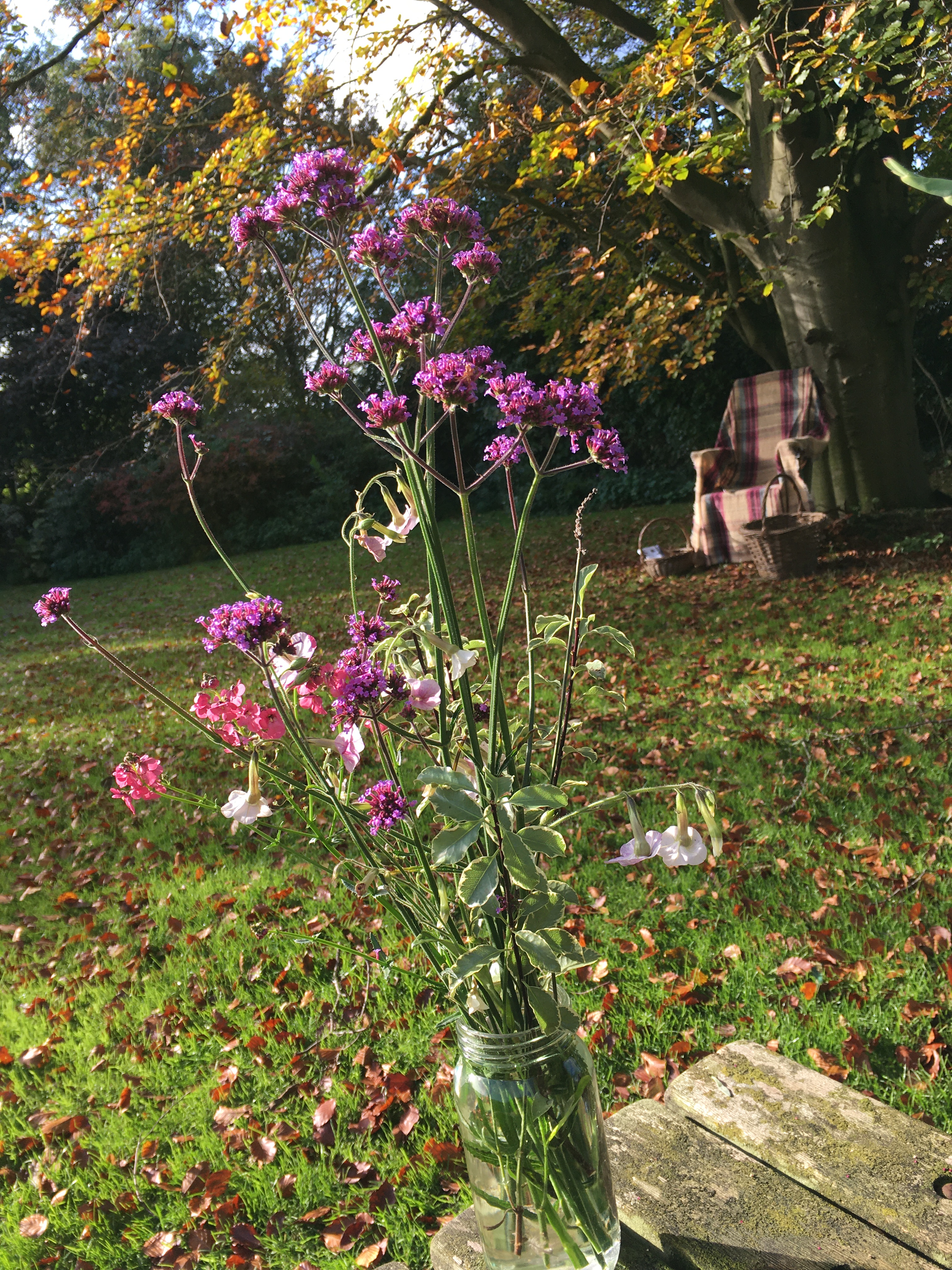
Verbena Bonariensis is a pretty filler for these bouquets. We often have flowers right through until Christmas, although they are starting to diminish. They are still worthy of close inspection even when there are more seeds than tiny flowers.

Also joining the last-minute party is salvia Phyllis’s Fancy. I bought this for the name as much as the flower. I’d love to know who Phyllis is. It certainly is fancy. Salvias are quite hard to photograph. I have a new camera which doesn’t seem to understand exactly what I want to focus on, but the photo is striking even with most of the flowers blurred. It’s the most wonderful purple and lavender flower.

I hope you’ve enjoyed my last-minute flowers. Can you spot the abutilon poking out of the bottom on the right. I think this is Kent Belle. Three stems of red dogwood (Westonbirt) add structure to the arrangement.

I learned from Georgie Newbery of Common Farm Flowers to add stems in a spiral by holding the bouquet in one hand and giving it a quarter turn before adding another stem. This way the arrangement looks good on both sides, and will actually stand up on its own. It’s a satisfying moment when it does!

Thanks for reading my blog. Flowers are for my lovely Mum this week. After a six week absence due to illness, I’m owing her quite a few bouquets! Join Cathy over on ‘In a Vase on Monday’ to see what others are cutting and arranging for their vases this week. It’s interesting to see the variety of flowers from all around the world. https://ramblinginthegarden.wordpress.com/2022/10/31/in-a-vase-on-monday-spooky/

Flowers from the garden 31st October 2022

Who would think it was the last day of October? My dahlias didn’t have any flowers during August, September and the first half of October. But they have suddenly decided to put on a display. And what a display. They are all producing glorious stained-glass hues. The colours seem brighter and more glowing than previous years. They are so welcome after such a disappointing summer.

Labels have been scratched up by the hens and misplaced, but I think this is Dahlia Karma Choc, a decorative type with velvety dark red flowers. It got left behind in the garden last autumn, while most of the dahlias were dug up and stored in the potting shed. To be honest, it has done just as well as the others, so I’m going to risk it this winter, and leave them all out. I’ll cover them with a foot of dried beech leaves, a plastic cloche and recycled compost bags. They should stay fairly dry and be protected from frost. And if they don’t survive, I’ll have a rethink in the cut flower garden next summer. I might try something less trouble that doesn’t get nibbled by slugs, need staking and then can’t cope with a drought.

Karma Choc with grey foliage of Senecio viravira, known as Dusty Miller. I’ve taken lots of cuttings of the senecio as it’s not totally hardy. I’d be lost without it as it provides foliage for my jam jar arrangements all year round.

Dahlia David Howard has also decided to flower. These apricot orange blooms are much smaller than usual. Foliage is dark, bronze almost black. Plants were originally bred by nurseryman David Howard who spotted a promising seedling in 1960. It went on to win an RHS AGM, Award of Garden Merit. David founded Howard Nurseries in Wortham, near Diss and had a passion for dahlias and chrysanthemums. By the age of 16, he was supplying plants to Covent Garden while selecting and breeding his own varieties. The nursery thrived with David and a business partner buying first four, then 12 then 24 acres to expand. They gained such a renowned reputation that they supplied plants to the Chelsea Flower Show, and also to the Queen Mother and Prince Charles. David died aged 81 in 2019, and his daughter Christine now runs the nurseries.

This beautiful white dahlia flower reminds me of swan feathers. Sadly, I don’t know the name as this was given to me by a friend, but I’ll take cuttings next spring and increase my numbers because it’s such a lovely cut flower. The heads usually get quite heavy and dangle down, but Georgie Newbery of Common Farm Flowers showed me how to twist the stem around and turn the dahlia flowers into the centre of the bouquet which seems to work. The red stems you can see in the first photo are dogwood, Cornus Westonbirt, which also help support heavy flower heads.

Tucked in amongst the dahlias are a few teeny sunflowers. They never grew more than a few inches across! However, their bright yellow flowers are very welcome now, even in miniature.

This sunflower grown from a mixed packet of seed from Mr Fothergill’s has burnt orange flowers and a chocolate centre. Bees love them, and the seed heads are good for birds.

A beautiful double yellow sunflower with my favourite dark brown centre.

Cosmos also eventually decided to flower. I think this is Candy Stripe from Mr Fothergill’s. Another good flower for bees. And with daytime temperatures still at 18C we still have bumblebees and solitary bees out and about.

Argyranthemums braved the heatwave in summer and produced a few blooms, but now the plants have decided to go for it and plants are smothered in large white daisies. These last for two weeks in a vase, so I’m very grateful to see them in flower.

Cerise red dahlias, possibly Arabian Night, with red salvias which are also having their moment now.

And tucked in the middle is this fimbriated cactus dahlia, possibly Apache, which came from Gee-Tee Bulbs. Foliage is always important to me and in my bouquet today I have one stem each of mint, rosemary and lemon-scented santolina.

I hope you’ve enjoyed these bright jewel-like colours. I must admit, I usually prefer pastel shades. But after the summer we’ve had, any colour is certainly welcome. These flowers are for my Mum, who I haven’t seen for six weeks due to illness, so a joyful reunion, and I am pleased to have something lovely and cheerful to take from my garden.

Is your garden behaving strangely like mine, and deciding it’s summer all over again? Let me know if it’s just me, or if your flowers are blooming again. Have a great gardening week. Karen

Links: Join Cathy In a Vase on Monday: https://ramblinginthegarden.wordpress.com/category/gardens/in-a-vase-on-monday/

Cut Flowers from my garden mid-October

Rosa Timeless purple

I’ve just realised that I never cut any flowers for myself. They are always for friends and relatives, all the pleasure being in the giving. It’s nice to have something home-grown to give away. However, I’ve been ill for a few weeks and stuck indoors. How frustrating it’s been looking out from my bed while the sun shone on the garden. I made lists of all the jobs needed doing, which didn’t help at all. But when I felt a bit better, I wobbled outdoors and cut these flowers for my bedside table.

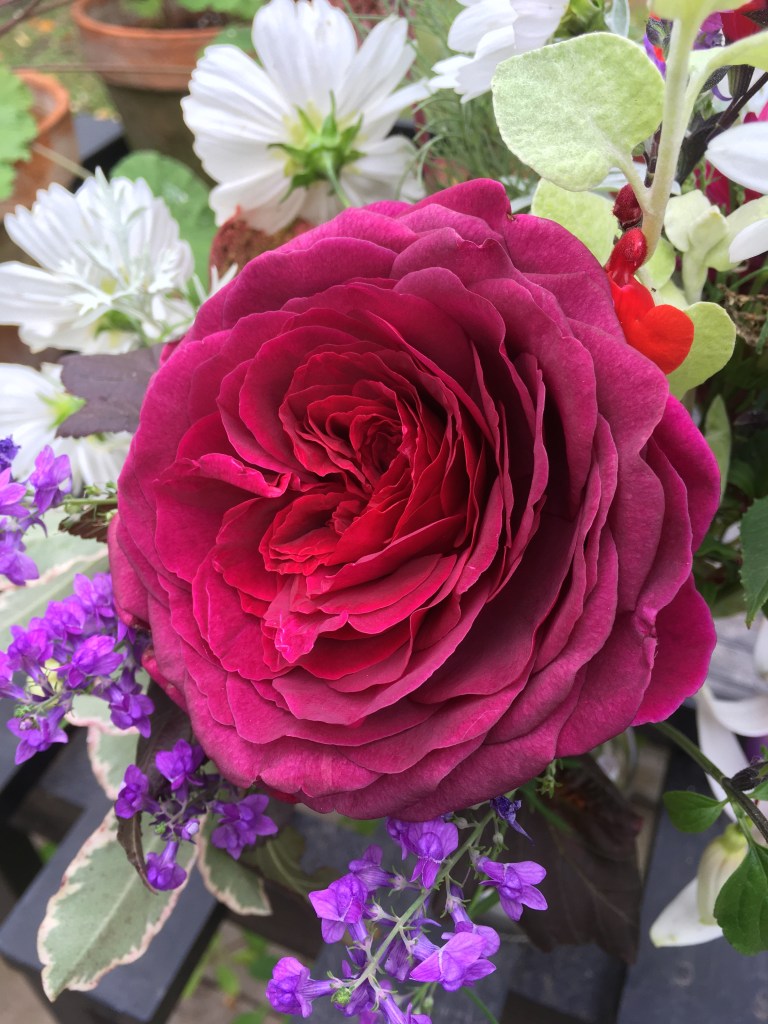
The star of my little bouquet is this highly-scented rose from a new home-florists’ range. Timeless Purple has long stems with very few thorns. Flowers have an ‘old rose’ appearance and wonderful myrrh- scent. Modern breeding means it repeat flowers and is disease resistant. Flowers stand up to the weather. Old roses tend to ‘ball’ in the rain, where buds fail to open and drop off. Such a disappointment if you’ve eagerly waited for the rose buds to open, to see them going mouldy and wilting. These flowers shrug off the raindrops, and flowers aren’t marked by the weather.

The heatwave and drought meant there were virtually no flowers in my garden all summer, but autumn has brought a bonanza. Plants seem determined to make up for lost time. The argyranthemums grown from seed by my Mum have come into flower mid-October. Who doesn’t love a daisy? The cheerful white flowers go so well with the roses and salvias.

Dahlias also suffered in the summer heat, but are coming into flower now. The first frost will finish the display, but for now, I’m just enjoying this unexpected bounty.

It’s not easy to photograph salvias. Their colours are so vibrant they tend to blur with an ordinary camera phone. This is one of the many salvias that came from https://middletonnurseries.co.uk/

I wrote about my trial growing salvias here: https://bramblegarden.com/2021/06/18/new-plants-on-trial-salvias-from-middleton-nurseries/

Their jewel-like colours are very welcome at this time of the year, and look so wonderful set against golden autumn foliage. Stems have a delicious blackcurrant scent.

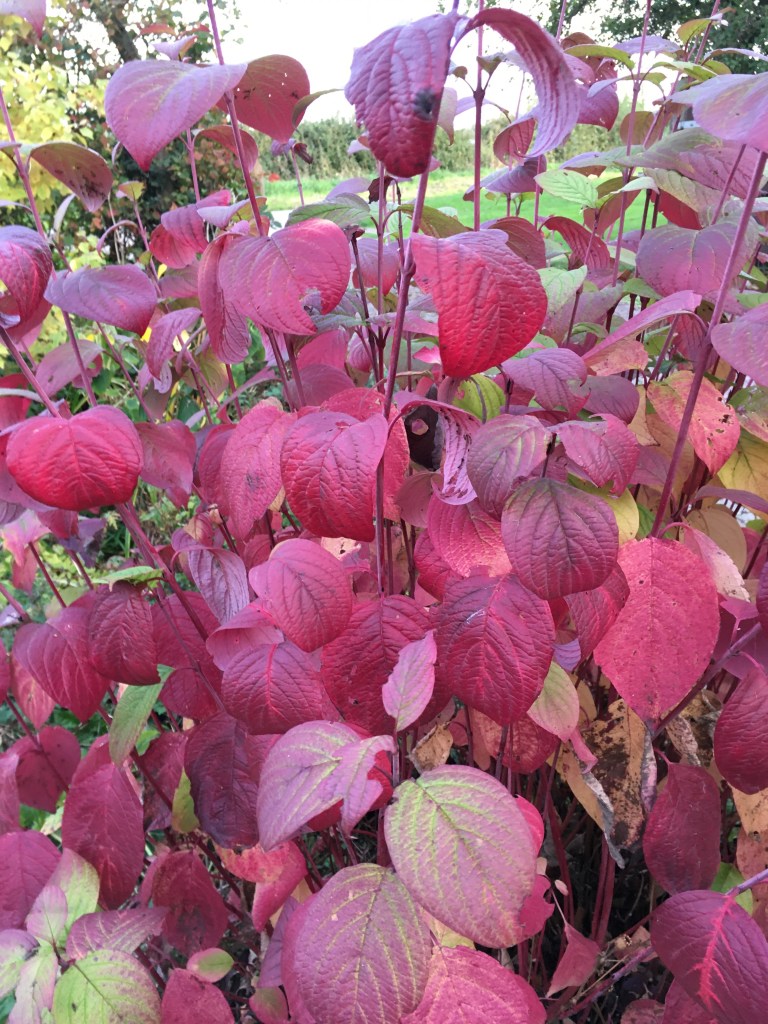
Talking of foliage, I picked some stems of my dogwood, Cornus Westonbirt. Leaves are turning a lovely plum colour, and the bright red stems will provide interest all winter, especially when the sun shines through them. These are such easy shrubs to grow, they simply need a prune to the ground each spring as the most colourful stems are produced on new growth.

Cornus Westonbirt

My grey foliage plants came from Coton Manor nursery in Northampton. Annoyingly, I can’t remember the name, but I have the label in the greenhouse and will just edit the name in tomorrow. I’m still suffering from terrible brain fog after being ill.

Fuchsias, also from Coton Manor, have decided to flower a month later than usual. They are growing in huge pots and I’ll just lift them into the greenhouse to protect them from frost. They flower till Christmas, given some protection.

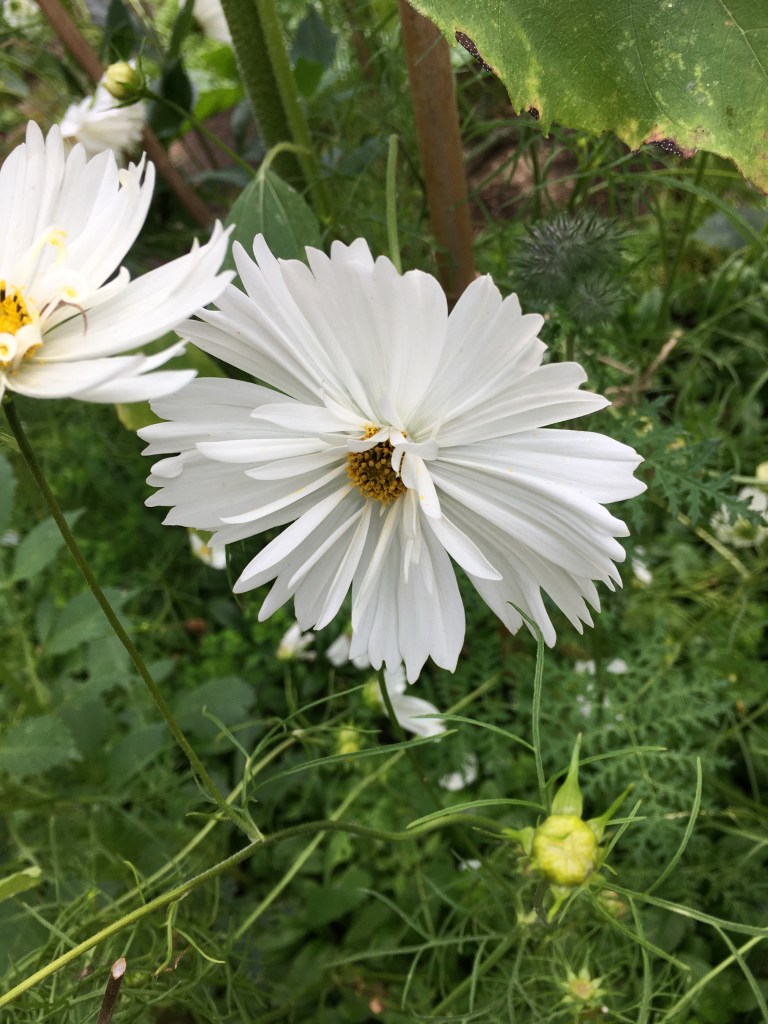
Cosmos Psyche White has also decided to put on a show now. This is my favourite cosmos. It’s a messy double white with long stems and good repeat flowering. It lasts a fortnight in a vase. I’ve tried some of the new apricot cosmos, but they didn’t do well for me here, so I won’t bother with them again. I need tried and tested varieties that won’t let me down.

Cosmos Psyche White

In the greenhouse I found this lovely pink Passion flower which was in keeping with my colour-theme posy, so I picked it an added it to the jam jar. I grow this in a 10” pot which is carried outside for the summer and brought in again before the first frosts. Usually there are one or two flowers right through winter.

I wrote about the Timeless florists’ range here: https://bramblegarden.com/2021/11/01/diary-for-garden-news-magazine/

Join in with Cathy for her In a Vase on Monday here : https://ramblinginthegarden.wordpress.com/category/gardens/in-a-vase-on-monday/

Well, I hope this little posy of flowers has given you some inspiration for what to grow to have something to pick in late October. I try to have something to pick every day of the year. Sometimes there’s more foliage than flowers, but it’s lovely to bring the garden indoors, so to speak.

After being stuck in my room for so long, it did me the world of good to wander about outdoors picking a few flowers. For once, they are just for me, and I’m thoroughly enjoying them. Have a great weekend. Keep safe and well and enjoy your gardening.

Flowers from my garden for the Queen, and my mother-in-law Joan.

Cosmos Psyche White (grown from Johnson’s seeds)

Flowers are the first thing we think of when we want to pay tribute to someone. Today’s flowers are in tribute to the Queen, and also my mother-in-law Joan. Two people from the same generation, both in their 90s, both sharing the same values in their love for their families and their sense of duty, loyalty and service to the community. Very different lives lived, but the same values and beliefs.

Rosa Timeless Cream and Bridal Star carnation.

For the past six years I’ve been writing about growing cut flowers for my wonderful Joan who suffered from dementia. We shared a love of flowers and flower arranging, and my hope was to keep a connection for as long as possible. Flowers were my only weapon against dementia. There’s no effective medical treatment. It’s the cruellest of illnesses. It deprives the sufferer of one of the main comforts of old age, the knowledge that they have a close and loving family. Faces and names are simply forgotten. There was such sadness when new grandchildren arrived and Joan could not join in our excitement and joy in the latest additions to the family.

Gladioli ‘Wine and Roses’ mix from GeeTee Bulbs. Flowers 100 days after planting.

I want it written down, as a record of our times living through the covid pandemic, that we struggled to keep a connection with our relatives suffering from dementia in care homes. During lockdown, we couldn’t visit at all, and agonisingly, Leicester stayed in lockdown for months after the rest of the country opened up. Then, after lockdown was over, we stood in car parks, waving through the care home windows. We were not allowed in. I’ve got these moments indelibly printed like postcards in my brain. Memories I can’t seem to forget. When we were eventually allowed to visit, it was in the garden only, with everyone wearing plastic aprons, blue plastic gloves, masks and face shields. It’s no wonder anyone with dementia would fail to recognise the person sitting two metres away, not allowed to hug, voices muffled from the masks. Time limited to half an hour. For someone with poor eyesight and hearing, it really must have been impossible to understand. Saddest of all, was the decision that no presents could be taken in, flowers included in this rule, such was the fear of passing on the virus. So my last tiny hope of Joan recognising me was gone. There is absolutely no criticism of the care home. They didn’t make the rules. They cared for our relatives in the most magnificent way, and we will always be grateful for everything they did. Life for care home staff must have been unbelievably hard as they tried to keep everyone safe.

Dahlia White Onesta (tuber from Wilko’s)

So today, the connection between the Queen and Joan springs to mind. The Queen because of her 70 years of service to her country. She was someone I greatly admired. Steadfast, loyal and hardworking. Joan too, from the same generation, cared first and foremost for her family, but also quietly and without fuss or expectation of reward, undertook charity work. Joan volunteered for Age Concern until her late 80s and she also helped with fundraising at the Methodist Chapel in Cosby. Joan particularly loved creating flower arrangements for the chapel and her husband Keith played the organ for every Sunday service and for weddings and funerals. It must have been over 60 years of service for them both. Joan was always making cakes or knitting something for chapel fund-raising. She knitted hundreds of teddy bears when the chapel launched an appeal for sick children of Chernobyl. She wanted them to have something to give them comfort during their suffering.

Calendula Snow Princess (Mr Fothergill’s seed)

Today, the Queen leaves her home, Buckingham Palace, for the last time as her coffin travels to Westminster Hall for ‘lying in state’ ahead of her funeral on Monday. Joan too is making her last journey today. Her ashes are being conveyed to Skiddaw in the Lake District. She will join her husband Keith at last. His ashes were taken there in August last year. A wild and beautiful landscape they both loved. May they all rest in peace.

Calendula Touch of Red (Mr Fothergill’s seed)
Calendula Snow Princess

Thank you for following my flower-growing journey. I have been a bit lost these past few months. I felt as if grief knocked me to the ground, and I haven’t been able to get up. However, I’ve watched fascinated at the activity following the Queen’s death. There have been so many ceremonies and procedures, her children and grandchildren haven’t had time to stop and think. Maybe this is the answer and a way to deal with death- keep busy and do something. When Joan died, I felt defeated. After so many years of trying to ‘think of something’ there was nothing else I could do. Now I’m ready to start again. Maybe I could volunteer at the care home in the garden. I’ve already put together a box of seeds and plants to donate to the garden.

Agapanthus Fireworks (Wyevale Nurseries) Long-lasting cut flower. Keeps for 10 days in a vase.

And my flower-growing will continue, but for a different, happier reason. My youngest daughter is getting married! I have decided to grow and arrange the flowers for the wedding, and I can’t wait to get started. I hope you’ll continue to join me on this new journey I’m making in life. And I hope you have enjoyed the flowers I’ve grown and arranged, shared here as my tribute to the Queen and Joan today.

Flowers in memory of Joan

Rosa Compassion

This blog records my gardening life, growing fruit and vegetables for the family, and flowers for friends and relatives. Over the past five years, I’ve written about growing flowers for my mother-in-law Joan as a way of keeping a connection when she started to suffer from dementia. Joan and I shared a love of flowers and flower arranging. When she no longer knew my name, she still enjoyed my flowers and knew I was someone close to her. Sadly, Joan died earlier this year. All bereavements are difficult to recover from, but I’ve been surprised just how much I’ve been affected by Joan’s death. I didn’t feel like talking, didn’t feel like writing, didn’t feel like gardening. All the activities I usually enjoy didn’t seem to make any difference. I suppose, all these years I’ve been able to ‘do something.’ There’s been a purpose to all the work of growing sweet peas, dahlias and roses for cut flowers. Just to see Joan smile and feel as if I was keeping a connection with her, made it all worthwhile. It felt like an impossible challenge sometimes when she got so muddled she couldn’t remember her children or grandchildren. But challenges drive you on and force you to try harder. I was absolutely determined that dementia wouldn’t get the better of us and destroy the special friendship we had. But in the end it did. I feel as if it stole the last few years of her life and any comfort she could enjoy from knowing she had a large and loving family. Dementia took her into a parallel universe where we just didn’t exist. And Joan’s death has left such a hole in our lives, it will take time to readjust and refocus. As a start, I’ve decided to post some flowers in Joan’s memory. Thank you to all the readers who have sent supportive messages over the past five years and have been with me on this journey. I’m a ‘glass-half-full’ kind of person, so I’m thinking what good can come out of this experience and what I can do next to help families with relatives suffering from dementia. I’ll keep you updated on my plans. Meanwhile enjoy these flowers. I hope they bring you joy, as they did for Joan for many years.

I started with the galvanised bucket which came from Jonathan Moseley and contained sunflowers last week. I wrote about them here: https://bramblegarden.com/2022/07/25/sunflowers-for-my-mum-in-a-vase-on-monday/
Jonathan put crumpled chicken wire in the bucket to help support the stems. We are trying to use water and containers instead of florists’ foam containing plastic which contaminates the environment. https://www.jonathan-moseley.com/

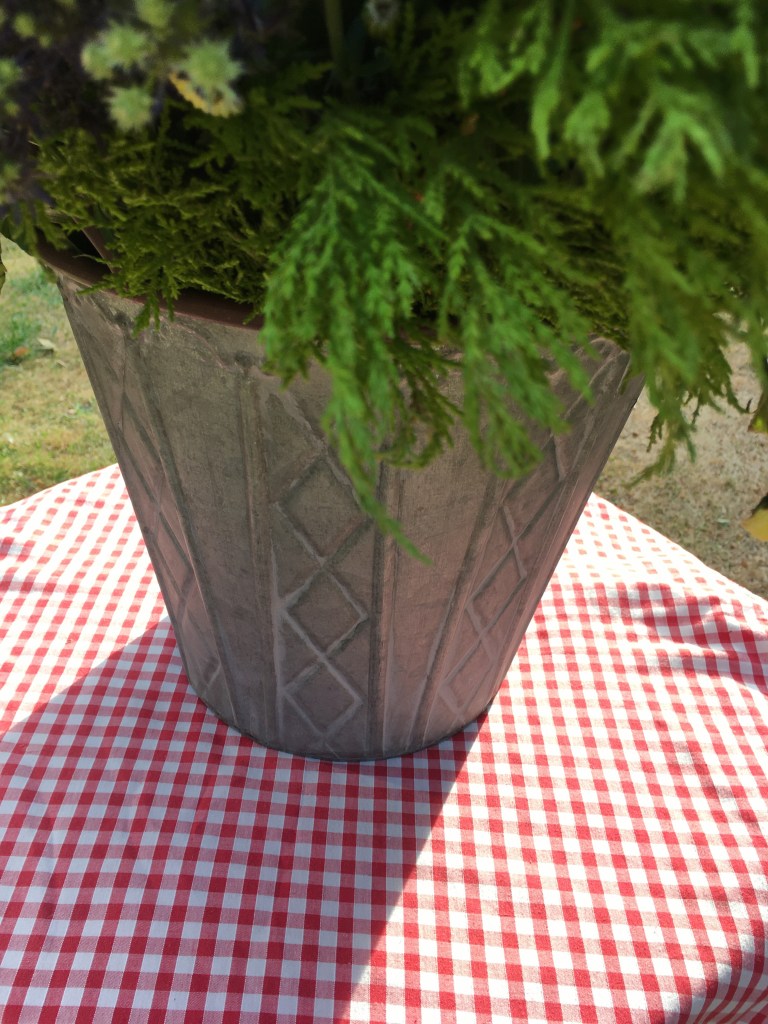
Jonathan used lemon-scented conifer as the foliage element for the flower arrangement. I’m using purple-leaved Physocarpus Diabolo which is one of the few plants looking good in the heat at the moment. I used seven stems.

Physocarpus is worth growing for its white flower heads which are followed by these glossy maroon-red seed heads.
I thought these Persian ironwood, or Parrotia leaves would add texture. They are turning pink already. Usually they turn red and then orange in the autumn.

I only had about ten flower stems to put in the arrangement. The whole garden has suffered in the heat. Sweet peas have gone over, the earliest I can ever remember. Anything in flower when the temperature hit 40C was bleached out and dried. However, the roses have been the first plants to throw out new flower buds. This one is Compassion, a gorgeous climbing rose with a fruit-salad scent.

This is a new shrub rose called ‘It’s a Wonderful Life’ – Rose of the Year 2021. I wrote about it here : https://bramblegarden.com/2021/08/23/this-months-diary-for-garden-news-magazine/

These roses are perfect for floristry as they are long-lasting and disease resistant. Stems are virtually thorn free, and the scent is a cross between melon and pineapple, fresh and summery.

I found two stems of this gorgeous gladioli growing down the middle of the sweet pea A-frame. The willow frame means I don’t have to stake the gladioli and it makes good use of the bare space in the centre. These are butterfly gladioli which are smaller in stature than the usual cottage varieties. They are also called nanus, or small-flowered gladioli. These are more reliable in difficult conditions because you need much smaller corms to obtain flowers. The large-flowering gladioli have to have good, fertile soil which is also well-drained and you must start with top-size corms. I recommend Pheasant Acre nursery for supplies. https://www.pheasantacreplants.co.uk/

Gladioli flower for a good two weeks and are the right scale to go with cosmos and argyranthemums. I recommend Atom, Carine, Alba, Charming Beauty and Nathalie. Pheasants Acre Nursery sells collections at summer shows and are worth seeking out as there are often special offers.

I added a few stems of an argyranthemum my mum grew from seed. These grow to about 1.5 metres here and are good, reliable plants for summer floristry. Bees and butterflies love them too.

There is just one stem of dahlia Nuit D’Ete. Dahlias hated the heat and are now struggling in the drought. I haven’t watered them. It would be impossible to keep watering them as temperatures are still heading for 30C. I’m hoping they are just sitting there semi-dormant, waiting for the temperatures to dip and rain to come.

My plan of action for next year is to increase the mulching with home-made compost and sheep wool and bracken clay-breaker compost. I will also buy more builders’ bags of maize-based Plant Grow fertiliser. Plant Grow is helping plants cope with the extreme heat. But where I ran out of money and didn’t mulch, the beds are suffering. It just goes to show the power of mulch to hold moisture in during the summer and combat flooding in the winter. I recently visited Chatsworth for a head gardener tour to see the new Arcadia garden planted last year. Interestingly, all the new perennials, and the new rose garden, were planted into 6” of soil improver from Veolia. A no-dig project on a massive scale. I’ll be going back soon to see how the plants have coped with the heat. I’m also liaising with the gardeners as one of many people sharing experiences of working with different types of peat-free compost. All of us are mixing our own additives to try to find something that works well for us. I’ll share our findings when I know more.

I’ve added just two stems of highly-scented Bridal Star carnation. These are recommended for home-grown cut flowers. Plants repeat flower all summer. I’m growing mine in 10” containers in the doorway of the polytunnel. Flowers get some protection from the rain, tucked just inside the door.

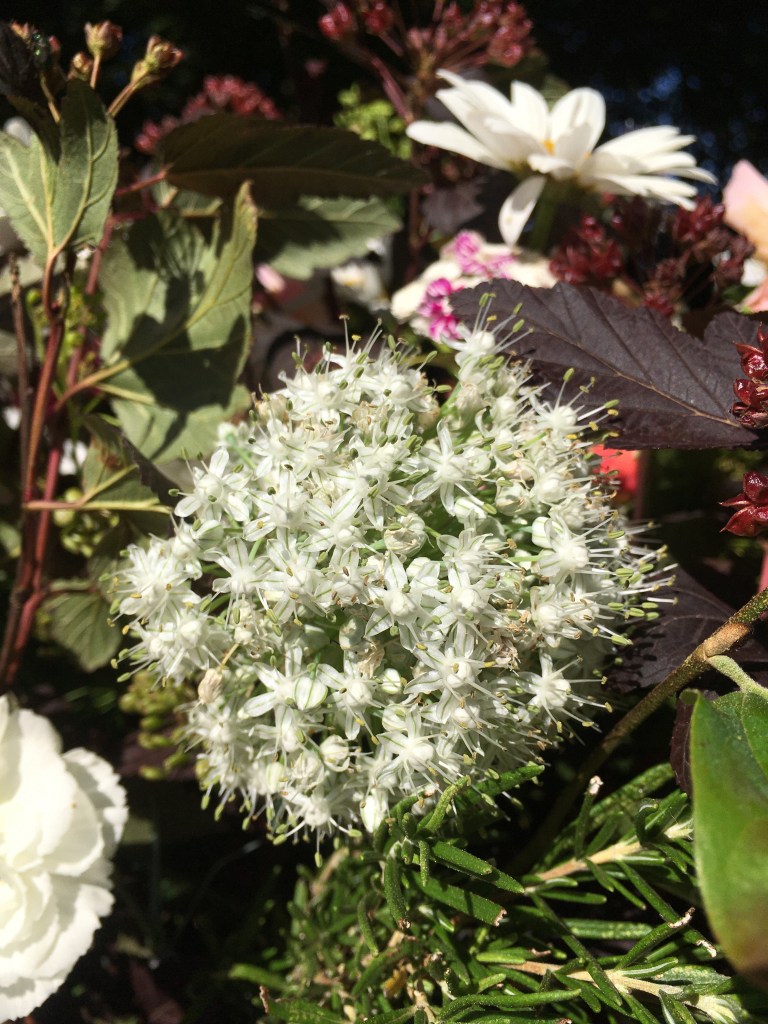
This flower was a surprise. It’s a spring onion, gone to seed! I might grow some on purpose, as they make large 4” diameter flowers, later in the season than most ornamental alliums.

My wild flower patch produced these flat-headed creamy white achillea. Another plant which doesn’t mind the heat. These started out as a packet of mixed wild flower seeds from Mr Fothergill’s.

These lime green flower heads are from parsnips allowed to go to seed. Jonathan Moseley allows some of his herbs and vegetables to run to seed and they make striking and unusual additions to his flower arrangements. The white flower in the photo is Cosmos Psyche White. A tall-growing, reliable cosmos. I grew the new cosmos Lemonade last summer, but it didn’t do well for me and was a bit of a disappointment. This year I’ve gone back to tried and tested white cosmos.

There are a couple of stems of blue drumstick echinops. These perennials are probably Taplow Blue, and originally came as divisions from Joan’s garden.

How is your garden faring in the heat. Have you had any rain, or are you parched like we are?

Thanks to Cathy for hosting the In a Vase on Monday meme. https://ramblinginthegarden.wordpress.com/2022/08/01/ina-vase-on-monday-glad-all-over/

Sunflowers for my Mum – In a Vase on Monday

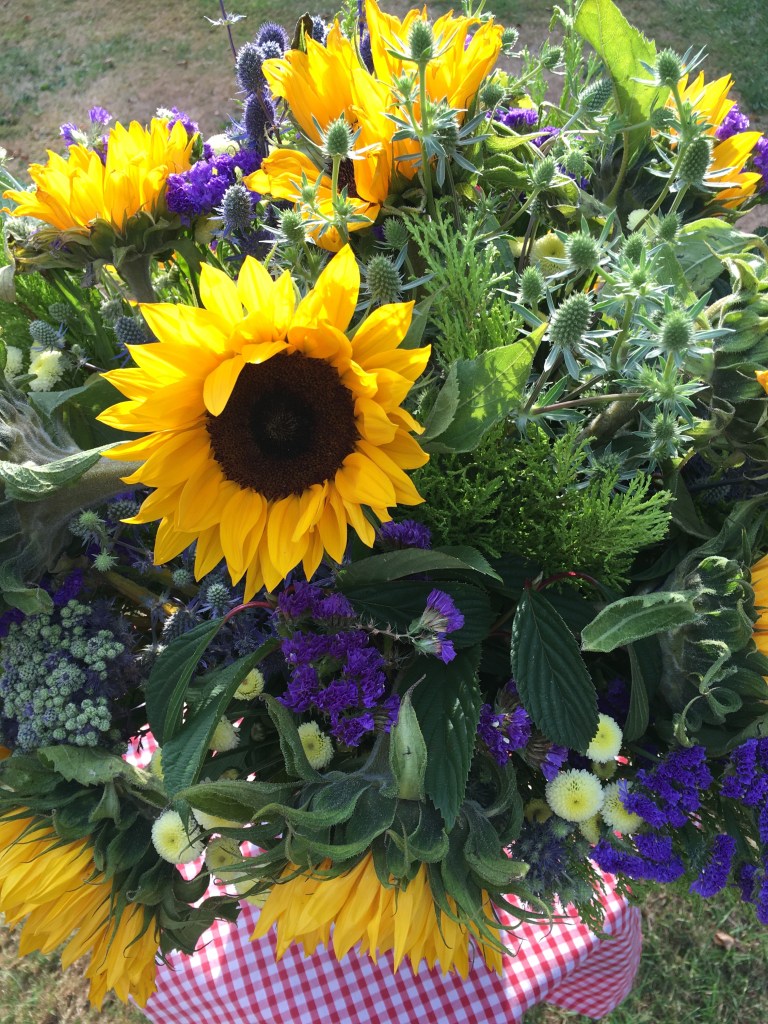
Sunflowers seem quite appropriate for one of the hottest July’s on record. Temperatures reached 40C here on Tuesday. The garden burned to a crisp with virtually everything in flower turning brown. So I haven’t anything from my own garden to share today. These flowers were created by Jonathan Moseley during a demonstration at Belvoir Castle Flower and Garden Show last weekend. Jonathan is a celebrity florist, writer and broadcaster and ambassador for British flowers. He’s well-known for his appearance as expert floral judge on the BBC’s Big Allotment Challenge programme. After watching his demo at Belvoir, I had to buy this gorgeous arrangement for my Mum. Here’s some photos of what the arrangement contained.

The stand-out element of this arrangement is the gorgeous sunflowers grown in the UK by a company which also specialises in growing plants for bird food. There are 11 stems in this arrangement.

Jonathan uses this galvanised metal bucket with a liner to contain the water. Some chicken wire is scrunched up and placed in the bottom of the bucket. Jonathan says he mostly uses eco-friendly techniques rather than flower foam. Many of his other arrangements were created using mini milk bottles, urns and glass jars.

He added nine stems of lemon scented conifer. These are 55cm long. And five stems of viburnum from his own garden. I’ve taken some cuttings of the conifer as it’s such a vibrant bright lime green and has a lovely fresh scent. Virtually anything will root in this heat, given plenty of misting to keep the foliage hydrated.

Next he added three varieties of eryngium. This is a new variety, not available to home-growers yet, but sold via florists. It’s a beautiful multi-headed type and I’ll be looking out for it when it becomes available in garden centres. I think the variety is called Orion.

Eryngiums or ornamental thistles like these can be dried and used for winter decorations and on flower wreaths for doors and tables. Great value plants. Jonathan mentioned a variety called Big Blue. These are a magnet for bees and butterflies and flower for a very long time.

Eryngiums start out a lovely silver grey colour and turn blue as flowers open. I love the combination of grey, blue and yellow. They look such cheerful colours, don’t you think?

Next into the mix is this blue limonium, or statice, which is another flower which can be dried and is very easy to grow as an annual at home. This variety is called Misty Blue. Mr Fothergill’s have seeds in mixed colours which I’ve grown in the past and had success with.

Here’s the link for seeds: https://www.mr-fothergills.co.uk/Statice-Special-Mixed

I love these tiny button chrysanthemums in such a pretty butter lemon. These are extremely easy to grow at home. I grow a white form called Stallion. Cuttings came from an online source https://www.chrysanthemumsdirect.co.uk/index.html

Mum is thrilled with her gorgeous arrangement- even more delighted because it was made by Jonathan who we both think a lot of. We like his eco-friendly techniques and his determination to support local independent floristry growers and suppliers. No air miles go into his creations. Quite often the flowers are sourced near his home – or in fact home grown. In another arrangement, he used branches of Ballerina roses which looked like bouquets in themselves without any other flowers needed. He uses special foliage stripper tools to remove leaves and thorns on roses. Much better than getting them in your hands and fingers.

Jonathan recommended herbs to add to arrangements. A marjoram called Hopleys has buds which are almost black. These open to sprays of scented lilac flowers.

Some alliums he mentioned as being the longest flowering are these: https://www.farmergracy.co.uk/products/allium-sphaerocephalon-bulbs-uk

Also for seed heads, he recommends Jerusalem Sage or Phlomis https://www.bethchatto.co.uk/conditions/plants-for-dry-conditions/phlomis-fruiticosa.htm

Thank you for reading my blog. I hope you’ve enjoyed viewing these beautiful flowers and have got some ideas for future floristry projects. Do look out for Jonathan Moseley’s talks. He appears at all the major shows, and also hosts special floristry workshops near his home at Christmas time. https://www.jonathan-moseley.com/category/events/upcoming/courses/

How has your garden fared in this heat? Mine looks stricken at the moment, but I’ve cut back all the perennial flowers by half and with some watering, they should flower again next month. I’ve sowed foxgloves, sweet williams and wallflowers for next year. They germinated virtually overnight in the heat and I’m busy pricking them out into seeds trays. I keep looking around the garden and feeling rather sad and dismayed at the damage, but there’s always next year to look forward to. That’s the beauty of gardening. There’s always next year to focus on. And it will be bigger, better and more flower-filled than this year, I’m certain.

I wrote about my sunflowers here: https://bramblegarden.com/2020/10/10/six-on-saturday-10th-october-2020-photos-from-my-garden/

And here: https://bramblegarden.com/2018/09/30/sunflowers-for-joan/

Info about the Belvoir show here: https://belvoircastleflowerandgardenshow.co.uk/speakers/

With thanks to Cathy for hosting In a Vase on Monday meme which I’ve been enjoying for five years. https://ramblinginthegarden.wordpress.com/2022/07/25/in-a-vase-on-monday-cooler/

Sarah Raven’s Grow, Cook, Eat Diary – Book Review

From Sarahraven.com

ISBN: 9 781529816617

I’ve never kept a gardening diary before, but I’m enjoying making daily notes in my new Sarah Raven diary. The diary is sturdy enough to take outdoors; the paper is thick, good quality so can stand up to being taken into the greenhouse and potting shed. I’m making lists of seeds I want to sow, dahlias I want to pot up, and general maintenance jobs about the garden. I love making lists- and I love ticking things off the lists! There’s a sense of satisfaction in ticking them off, especially when the list seems never-ending.

There are some beautiful and inspiring photos relevant to each month in the diary. For January, there’s a winter container planting of a terracotta long tom pot with Sarah’s favourite hellebore ‘Maestro’ which is often seen in her flower arrangements.

For March, there’s Fritillaria ‘Early Sensation’ which has a pale, greeny- yellow flower, much more delicate and easy to site than the brash bright golden variety usually found. It’s growing here in a galvanised metal container next to a patch of rosemary.

September’s photo is bright and cheerful. Just what’s needed for a cold, windswept February day as I’m making plans for lots of summer colour. Here’s Zinnia ‘Giant Dahlia Mix’, Tagetes ‘Linnaeus’ and Thunbergia alata ‘African Sunset.’

There’s recipe suggestions for each month. I’ve made these spiced ginger and oat biscuits and can report they are absolutely delicious. The family demolished them in just one day. They are quick and easy to make, which is just as well as I’ve have had another request for some more. I made the vegan version by using dairy-free margarine.

I used the chickpeas for a red onion hummus dip, which is also fast to make. Just cook a sliced red onion in 1 tbsp olive oil, add a tin of chick peas and 150ml water. Simmer for 10 minutes with the lid off. Add 2 tbsp lemon juice, garlic salt and pepper. Few tbsp of fresh parsley and chives if you have any. Whizz in a food processor and serve with toast or on jacket potatoes. Another recipe suitable for vegans, if you have any in the family as we do, or unexpected visitors. Which we also often have. They sit around the kitchen table while I quickly make this dish.

Here’s my spiced oat biscuits. Delicious with a cup of tea or coffee.

I’m intrigued by this basil icecream recipe for summer. As Sarah says, it sounds odd, but I’m going to give it a try and report back.

I’m going to have a go at these dried allium and poppy seed head decorations as well. Such a beautiful and cheerful Christmas scene from the fireplace at Perch Hill.

Other features of the book I liked: The fold-out ‘when and how’ guide on seed sowing for cut flowers. The guide to sowing and planting edibles, wild flowers, fruit, potatoes, herbs and salads. A guide to sowing and planting ‘pollinator super’ plants to attract bees and butterflies. There’s a useful ruler for seed sowing spacing. And the metal ring binder design means the diary can easily be folded back on itself.

There are not many books I carry around with me all the time, but the Sarah Raven diary is robust enough to slip into my garden tool kit bag, and is proving a joy to dip into on a daily basis.

https://www.sarahraven.com/products/sarah-raven-diary-2021

Sarah Raven also sent me a wall calendar to try, and this too has beautiful photos for each month and plenty of space to write appointments and events. Both will be ordered for 2023 as I’m thoroughly enjoying using the calendar and diary.

Do any of you write a garden diary? My father in law used to keep a perpetual diary. Sadly he died last summer, but he gave me his diary with all the daily notes about sowing dates and varieties he preferred. I check each day to see if I am keeping up with his impeccable timetable. It’s a lovely way to remember him and a reminder of all the flowers he grew for his wife Joan, and the fruit and vegetables he grew for the family.

Diary for Garden News Magazine

Latest news from the plot. Click on the photo to enlarge the print. There’s never enough room for all the photos I take. So here’s a selection of pictures to go with the diary recently published in Garden News Magazine.

I’m looking forward to growing this Limonium Pink Pokers next spring. The photo above was taken at Mr Fothergill’s seed trial grounds in August. I love the two-tone flowers and their delightful habit of twisting and turning as they grow towards the sun. They remind me of fireworks. I’ll start seed sowing indoors in February at 20C in a propagator and plant them out in June. They will be perfect for my jam jar posies. In addition, flowers can be hung up to dry. It will be useful to have flowers for winter decorations. Limonium, a half hardy annual, grows to 80cm and flowers from June to October. Available from Johnson’s seed, the premium range from Mr Fothergill’s.

In the article above, I mention growing dahlias from seed. I’ve been so delighted with the success of my seed-sown dahlias this year. I’ve had outstanding flowers, large single blooms with bright, jewel-like colours. It’s a money-saving option too. My Mum manages to fill her back garden with dahlias grown from a packet of seed. Started early in February, seedlings make small tubers and grow to full-size plants by mid-summer. There’s a non-stop supply of flowers for our vases. Plus bees love them too, so it’s an wildlife-friendly option. Pollinators have easy access to the flat, open centres of these flowers. You can sometimes see the ‘bee lines’ showing pollinators the way to the centre. If you don’t have any storage space for dahlia tubers over winter, don’t worry. You can get excellent results by starting from seed in spring.

Another beauty- grown from a mixed packed of seed. I also grew some ‘Bishop’s Children’ types
this year with very good results. Each plant had dark leaves which set off the bright flowers a treat.

I mention the new Home Florists’ range of roses specially bred for cut flower gardens. I’ve been amazed by the sheer number of flowers these provided. Such good quality flowers which last a week in a vase, if water is refreshed each day. The scent is reminiscent of old roses, particularly old-fashioned bourbon roses. The roses, by Wharton’s Nursery, can be found in most good garden centres, or on line. Look out for Timeless Purple and Timeless Cream. Both recommended.

In amongst my cut flowers, I grow vegetables such as peas, climbing beans, courgettes, sweet corn and beetroot. I’m growing Valido peas, a new maincrop variety which is disease resistant. Luckily it is resistant to mildew which means the plants keep cropping right through to the autumn. Often pea plants turn brown as leaves and stems die back. Valido copes with anything the summer weather can throw at it, and produces a heavy crop of delicious peas. I’ve saved some of my seed for growing in seed trays over the winter. Pea shoots will be harvested just a few weeks from sowing – and won’t have cost me a penny. Lovely nutritious shoots to add to my salads and stir fries.

Monty Kitten is more like a dog than a cat. He follows me around the garden and likes to get involved in everything I’m doing. He followed me out onto the grass verge when I put my jam jar flowers out for sale.

Finding newts in the garden is always a cause for celebration. It’s reassuring to find them under stones by my mini-pond, and in the greenhouse and polytunnel. They must be attracted by the moisture. I only use natural seaweed-type feeds, diluted in a watering can, to feed my fruit, vegetables and cut flowers on the patch.

Fruit and vegetables have grown well this year. In my basket there’s white-stem chard, perpetual spinach, herbs, white-flowered runner bean variety ‘Moonlight’ onions, tomatoes Blaby, Marmande and cherry types. There’s been a steady flow of blueberries from the plot. Ivanhoe is growing in a large 40cm diameter pot.

Here’s the link for the blueberry French toast recipe I mention: https://www.martinfish.com/in-the-kitchen/super-blueberries-in-julys-kitchen/

This is made by Martin and Jill Fish who provide cookery talks and demonstrations and have written a favourite book ‘Gardening on the Menu’ with advice on growing fruit and veg, and how to cook and preserve them.

Thank you for reading my blog, and my diary in Garden News Magazine. If you also listen to BBC Radio Leicester, the gardening show has moved from Wednesdays to Saturdays, 11am to 11.35. If you get in touch with the producers, I’ll answer any questions live on the show.

Have a great gardening week!

Rosa Timeless Cream (Home Florists’ Range)

Garden Day UK 2021

My flower crown for Garden Day UK, made by Bloom.co.uk

It’s time to celebrate Garden Day UK again. Garden Day, on May 9th, is a chance to down tools and just enjoy what you’ve achieved on your plot. It’s one day when you don’t have to do anything really. Just sit in the garden, allow yourself a moment to pause and reflect.

One of the lovely features of Garden Day is the wearing of a flower crown. Take photos of your crown, and upload them to social media. Tag @GardenDayUK to share photos of your creation.

I’ve been sent this beautiful crown to wear tomorrow. It’s made from miniature cream roses and pink and blue statice. There’s some gorgeously-scented herbs, rosemary and thyme, and some grey foliage as a background foil for all the flowers.

Flower crowns are really easy to make. Take a length of florists’ wire, wrap it around your head to check the length. Add about 8” so you’ll be able to twist the ends together. Add a circle of olive foliage, or lengths of rosemary as a background. Make little bunches of flowers, any you fancy, from your own garden or from the florists. Lay each bunch along the wire and bind in with thin florists’ wire, paper-covered wire, or string. When you have covered the circle, check the crown fits, and twist the bare lengths of wire together to form the crown.

I’m looking forward to sharing my day with my Mum. Whatever the weather, we will be either sitting in the orchard, or if it’s raining, in the greenhouse.

How will you be spending Garden Day tomorrow? Do share photos of your garden on social media. It’s a good way to connect with other keen gardeners and to share ideas and gain inspiration on growing plants.

Here’s some photos of my garden today:

There’s still some Pheasant’s Eye narcissus under the cherry trees.
There’s white bluebells under the beech trees. These are albino flowers, lacking the pigment that makes the traditional flowers a rich purple/blue. They have creamy-coloured pollen and a delicious scent.
Narcissus Geranium in the cut flower patch. Lovely white flowers with a deep yellow centre. The scent is glorious. Something to look forward to each spring. Reliably comes back each year. Lasts at least a week in a vase.
Creamy white quince flowers. Chaenomeles Yukigoten. A sprawling shrub which is best trained along a sheltered wall. Flowers are sadly not frost-hardy and have to be protected with sheets of fleece. Good for pollinators. Worth the effort of protecting the blooms.
Lady’s smock, or Cardamine pratensis. In flower in the boggy area around the horseshoe pond. This year we have seen more orange tip butterflies than ever before. Lady’s smock is a food plant for the caterpillars. Also known as milk maids, moon flower and cuckoo flower. Sadly, there are no cuckoos again this year. The last time we heard them was five years ago.
Cowslips have taken over from daffodils, flowering in the leafmould under the field maple trees in the wild garden.
For a few glorious days, emerging field maple leaves glow a bright emerald green. It’s a sight to gladden the heart.

Finally, we will be accompanied by Daphne ( speckled hen) Daisy and Dot, and Merlin the cockerel, as they search for slugs in the cut flower patch. If we are very lucky, there will be eggs for tea!

Happy Garden Day everybody!

Thanks, as ever, for reading my blog. Please leave comments in the box below the hashtags, right at the bottom of this post. Or click on ‘comments’ under the headline and the box will drop down.

Quick link for Garden News Magazine Readers – Peach Crumble Cake- and spring flowers 10 April 2021

Here’s a quick link to the recipe mentioned in this week’s Garden News Magazine. Let me know if you make my peach crumble cake. The recipe is great with tinned or fresh peaches, apples, plums, cherries, rhubarb and blueberries- anything you have to hand. Thanks for reading my garden diary column and for all your lovely kind comments and encouragement. It’s always appreciated.

Peaches and Plums – Crumble and Plum Jam

Some more photos from my April garden diary. Enjoy the spring flowers- and new additions to the garden, Merlin the cockerel, and Daphne, Daisy and Dot bantam hens.

Here they are, enjoying a dust bath. They soon found a cosy corner in the garden where I’d piled some old compost. Perfect for their favourite daily activity. I love the contented little sounds they make as they swoosh compost into the air in all directions. Hens are certainly messy creatures.

Here’s Merlin, searching for slugs, snails and grubs in the veg plot. I’m hoping they will help me with my organic gardening, no chemicals- approach.

I’m not forgetting Monty kitten, looking quite windswept as he sits on his favourite look-out post on top of the boat cover.

The greenhouse – with barely and inch to spare. I can just about still get in there.

The poly tunnel swathed in fleece as we hit -3.5C two nights in a row. It’s currently 7C at lunchtime with a freezing icy wind and sleet. The old peach trees are flowering despite the cold. I’ll have to pollinate them with a paintbrush. There’s no bees about in these cold temperatures.

Despite the cold, daffodils are looking lovely. So cheerful.

My favourite narcissus Snow Baby looking lovely in spring pots planted three years ago and still going strong.

My new spring pot with ‘instant’ plants from the garden centre. Cheering up the front doorstep.

Wild anemones flowering in the mini woodland garden. Bluebells are just starting to raise their heads above big strappy leaves and potted Lily of the Valley is scenting the potting shed.

A few flowers fresh picked from the veg plot.

My wild Tenby daffodils, flowering around the pond, still look good at dusk. These are planted in memory of my Welsh grandmother, HM Foulds. A very reliable and hardy daffodil, highly recommend.

You might like to read my last post here: https://bramblegarden.com/2021/04/08/garden-news-column-spring-flowers-and-peach-crumble-cake-april-8-2021/

Thanks for reading. Enjoy your weekend, and hopefully the weather will improve where you are soon.

I’m @kgimson on twitter and karengimson1 on instagram live.

February Recipes : Pear and Almond Pastries

I’m making these again today. I opened the kitchen cupboards and there was literally nothing cheerful in there! No biscuits, chocolate, cake. We’ve run out of everything. I wonder if we will look back on these times and ponder how we lived through this pandemic and learned to appreciate the simple things in life. I shall certainly never take for granted being able to just pop to the shops. Everything has to be so well organised. Lists on top of lists. All food is being delivered, for which I’m extremely grateful. But, oh, the dismay at discovering that I’ve forgotten something- just as I’ve pressed the button to order supplies. It’ll be a week before I can get another delivery. We do see an end in sight with vaccines on the way, so keep going everyone. Keep smiling. And make pastries, as there’s nothing nicer to cheer you up than the sight of these lovely tasty treats. Any fruit can be used, they are just as lovely with apples, frozen plums, raspberries, tinned peaches – any combination you like. Let me know what recipes are keeping you cheered up, and report back if you make any of these delicious pastries too.

Here’s the link for the recipe: https://bramblegarden.com/2020/11/02/pear-and-almond-pastries-family-favourite-recipes/

And a photo of spring flowers to bring some joy as well:

White primulas. My favourites. Though I have seen some deep red double varieties mixed in with burnt orange which might look lovely in a blue China casserole dish…. if only I could get out to buy some.

Narcissi Geranium and cut flower collection tulips from last spring. All my tulips are poking through the ground now, and daffodils are in bud and flowering early. The veg patch is covered in forgetmenots. I use them as a green mulch to protect the soil and keep down weeds. Some are potted up to stand on the summerhouse steps. They are very easy to dig up as they have a shallow, fibrous root system. They do well when lifted and grown on in containers.

Daffodils make a very welcome return. I’ve watered them with potash or tomato fertiliser, having taken advice from a medal-winning grower. The liquid feed helps to strengthen the stems and enhances the colour, making them stronger and brighter. A good tip as we regularly seem to be getting stormy spring weather. It’s so sad to see daffodils flattened by the wind.

Eranthis hyemalis – winter aconite in the woodland garden. They won’t last long as temperatures are currently 13C.

Green-tipped Galanthus Viridapice looking pretty on the potting shed window. Snowdrops too have been a very welcome and joyous sight. But in the mild weather, they have opened right out and will be going over sooner than usual. I shall water these too with weak tomato fertiliser in the hope of boosting the size of the bulbs and increase the number of flowers for next year.

Have a lovely weekend everyone.

*I’m trying something new- doing Instagram live sessions from the greenhouse every day, essentially to keep in touch with my Mum and MIL Joan, and also to show my daughters how to grow plants from seed. Under normal circumstances I would be by their side helping them with their new houses and first gardens. But I can’t while we are in lockdown, so I’m doing what I can from home. I’m karengimson1 on instagram.

January in the Garden

Here I am, pottering about in my garden again. I must say, the weeks fly by and it’s soon time to write another column for Garden News Magazine.

I hope you enjoy today’s article. I’ve had some lovely letters of support from readers saying my ‘potterings’ have kept them upbeat and busy during the pandemic. I’m pleased to see many readers have been inspired to have a go at different gardening techniques, or decided to grow something new. And many say the recipes are tasty, and always turn out well. What a relief!

Here’s some additional photos the editor didn’t use for the column. It’s fascinating to see which ones they choose. I submit about 10 for them to select from. It takes about a day to decide what to write about, take the photos and then actually sit down and compose the piece. It’s 350 words – which is actually quite a challenge. I try to say a lot in not many words. I edit it three times before I send it, taking out any spare words each time. What a luxury it is to write the blog. No one is checking the word count on here.

My hazel plant supports in the snow. New rods have replaced any that snapped, and have been woven along the centre to add strength. We seem to be getting stormier summers, so plant supports have to be extra sturdy.

Some sweet peas I grew last summer. I’ve sown some in autumn, but the second sowing now will provide plants that flower right through to November. Successional sowing extends the season.

Seeds come from https://www.mr-fothergills.co.uk/Flower-Seed/Sweet-Pea-Seed/#.X_dxARDfWfA.

And https://www.visiteaston.co.uk/shop/gardening/seeds/easton-walled-gardens-mix.

Here’s a photo of ‘Sunshine’ climbing French beans. Highly recommended, easy to grow and prolific. We have a freezer full, and they only take a few minutes to cook from frozen. All the flavour and goodness is captured for tasty winter meals. I’ll be starting my bean seed in May. Don’t start them off too early as they cannot be planted out until the first week of June. If sown too early, they become leggy and weak. They are very fast growing.

Bean seeds come from https://www.mr-fothergills.co.uk/Pea-and-Bean-Seeds/Climbing-Bean-Seeds/Climbing-French-Bean-Sunshine.html#.X_dw0hDfWfA

Here’s a larger photo of the willow heart flower arrangement in the potting shed window. It’s made from Paperwhite narcissi, alstroemeria from the poly tunnel and dried gypsophila and honesty seeds from summer. The foliage is eucalyptus saved from Christmas floral arrangements. Flowers are held in a jam jar covered in moss which has garden string twined around it, kokadama -style. We are all trying to do without florists’ foam, and using jam jars, and tiny glass test tubes works really well.

See more ideas, join zoom -and in person lessons- with Georgie Newbery at Common Farm Flowers : https://www.commonfarmflowers.com/collections/workshops

Paperwhites came from Gee-Tee Bulbs https://www.gee-tee.co.uk/

Gypsophila and honesty seeds from https://higgledygarden.com/

I mention new birds boxes. I wrote about CJ Wildlife supplies here: https://bramblegarden.com/2019/01/30/nest-boxes-and-bird-feeders-for-the-garden/

The RSPB nesting material is from: https://shopping.rspb.org.uk/nest-box-accessories/nesting-wool-refill.html

And finally, the rhubarb upside down cake recipe can be found here: https://bramblegarden.com/2020/04/18/rhubarb-cakes-family-favourite-recipes/

Thank you for reading and getting in touch. It’s much appreciated. And a very Happy New Year to you all.

I’m @kgimson on twitter

Karengimson1 on instagram

Do say hello on social media.

Turning Garden Twigs into Christmas Decorations

As a few of you know, I talk on the radio once a fortnight, chatting about what I’m doing in my vegetable and cut flower plot. This week, I tried valiantly to make a few twigs from my garden sound exciting. It really tested my powers of description! Anyway, if you were listening in, here are the photos to go with my interview with Ben Jackson. I was waving my arms around, explaining how you can gather foliage and off-cuts from the garden, make them into a twiggy bouquets, add lights, and plunge them in a pot. I do hope it enthused a few people to have a go and make their own Christmas decorations.

Willow stems, dried oak twigs, pine foliage and Hydrangea Annabelle flower heads with orange lanterns, Physalis alkekengi.

I decorated the hydrangea heads with some florists’ silver spray from Oasis. You only need a tiny amount.

Some old man’s beard, wild clematis vitalba adds a fluffy texture and movement to the arrangement.

Mouldable copper wire fairy lights from supermarkets only costs a few pounds. Mine came from Wilkos and use rechargeable batteries.

Tiny flowers from the hydrangea heads flutter down around me. I scoop them up and use them as table decorations. They are like nature’s confetti.

Wire lights can be threaded through dogwood stems and any greenery from the garden. This ‘bouquet’ of twigs is pushed into a plant pot of garden soil and stood by the front door. It looks like a container full of expensive plants, but in truth, it has cost me nothing. Stems will stay fresh until after Christmas due to cold and wet weather. They can be composted in the new year. So there’s no waste to go into bins.

I’ve used pine, spare Christmas tree stems (the tree was too tall), ivy, dogwood and willow to give height, and skimmia at the front. You could pop some hellebores and white heather either side to cover the base of the pot. If you have plastic pots, why not cover them with hessian to give them a natural look.

Here’s some more ideas using willow. Wind the willow or dogwood into a rough circle and keep adding more stems. Eventually you can pull it into shape and secure it with thin lengths of willow. Kept dry in the shed, wreaths will last for years. Each Christmas, I add new foliage, pine and rosemary for scent, rosy-hued hydrangea heads and clematis seeds. These are simply fed in amongst the willow stems and secured with string or florists’ reel wire.

You can add rosehips and crab apples to the willow frame. Birds tend to enjoy them, so I have to replenish the decorations every day. We were very excited to see some very small birds, possibly long-tailed tits enjoying the clematis seeds. It becomes almost a cross between a Christmas decoration and a bird feeder.

Add whatever you can find in the garden and hedgerow. In this silver birch wreath, I’ve added ivy, with green and black ivy berries, and dried cow parsley seed heads. The wind sometimes blows the clematis across the back fields, but there’s plenty more in the potting shed, ready for the festive season.

These willow stems have been folded over to form a heart. Hold ten stems in one hand. Bend half of them over and tie in the middle. Bend the other half over to form the other side of the heart, and tie in. Tie further up the stems to keep the heart shape secure. Disguise the ties -or the mechanics, as we call them- with a mini bouquet of foliage. Here I’ve used Holly, ivy, Garrya elliptica, hydrangea flowers and a few crab apples.

Willow wreaths don’t always need any decorations at all. A pretty ribbon is all that’s used on this wreath for a simple shepherd’s hut.

I decorate five bar gates around the plot. A single heart is often all that’s needed. It will cheer any Christmas Day revellers, walking along the lane. From this gate we can hear the church bells ringing. The sound carries far across the fields. It’s a wonderful spot to stand and listen for a few moments, mug of tea in hand.

Let me know what decorations you are putting up in your house and garden this year. Will it be old favourites, like mine, or something new? Get in touch and let me know, and thanks, as ever, for reading. Today, I’m celebrating my milestone 100,000 blog visitors. When I started writing, I thought just a handful of people might see my posts. I’m absolutely thrilled to see 100,000 have read about my little plot. Have a great weekend everyone.

Links:

Listen to Radio Leicester, Christmas decorations, at 3.16.57 on the timeline on BBC Sounds https://www.bbc.co.uk/sounds/play/p08ymt0t

I learned how to make my wreaths at Common Farm Flowers with Georgie Newbery. Georgie is running online courses and sells wreath -making kits.

https://www.commonfarmflowers.com/collections/workshops

I wrote about Georgie’s courses here: https://bramblegarden.com/2020/07/01/online-hand-tie-posy-course-with-georgie-newbery/

There’s also lots of Christmas recipes on the blog. Just scroll down to view them.

In a Vase on Monday- flowers for my Mum

I’m catching up here. This is in fact last week’s IAVOM. Internet and computer problems defeated me. We are on the old copper wire telephone line, and not the new super duper cable -type. It’s too expensive for BT to extend the cable down our lane, so we are stuck with speeds that are too slow to upload photos or do internet banking. Anyway, the internet may have set me back, but I wasn’t to be defeated by the imminent national lockdown, I just managed to get this posy of flowers to my mum in time. Dahlias have been the stars of the cut flower garden this year. They have flowered non-stop since June. Pictured above is Dahlia Nuit d’Ete. It’s a semi-cactus type with long twisting, curling petals. Such a rich deep red. Flowers last ten days in a vase. The centre keeps opening out and the flowers curve back until they look a little like sea urchins.

Here are the dahlias tucked in amongst the last of the cosmos, salvia, scented white carnations, with grey senecio foliage and plum coloured Physocarpus Diabolo.

The carnation is Dianthus Bridal Star. Highly scented, but requires staking as it has a floppy- growing habit. I grow it in the greenhouse as rain spoils the flowers. Worth growing though for constant flowers from June to November.

Salvia viridis blue, (centre of photo) an annual, sown in March and planted out end of May. I grow these at the base of the sweet pea A-frame which makes good ground cover.

There are also pink and white varieties of this annual salvia. Masses of flowers from a £2 packet of seed. Well worth growing.

A surprise discovery this summer was eucomis flower spikes. These got knocked over by the cat and puppy playing football….. I’m sure the cat thinks it’s a dog, as it joins in with all the ball games, and tries to come for a walk down the lane with us. We usually end up carrying him home. Anyway, Eucomis Sparkling Burgundy, known as the pineapple lily, lasts 4 weeks in a vase. They make wonderful centre pieces. I shall grow some specially for flower arranging next year.

Another surprise came from a row of sweet williams, planted out last month. They have decided to flower in November. I’ve cut the flowers for the house, and I’m hoping they will flower again next spring. They look good, strong plants, grown from seed in June. Perhaps the unusually mild autumn has confused them.

I found one last white dahlia flower, Eveline. This decorative dahlia has beautiful pink-tipped edges to the petals.

As with everything I do now, Monty likes to join in. He’s recovering from a small operation. As you can see, he’s doing really well and gaining weight nicely, after a troublesome start in life. Just look at those whiskers. And those chubby paws. You can tell he’s much loved. Adored in fact. He’s made such a difference and is helping to keep our spirits up during the pandemic.

I hope you’ve enjoyed this whistle-stop tour of my cut flower bouquet-making, even if it is a week late!

How are you all coping with the lockdown? I’m getting the veg plot ready for next year. It will be the first time I’ve managed to get all the jobs done by Christmas. Really, I’m not going anywhere at the moment.

Thanks for reading. Keep in touch.

Links : In A Vase on Monday with Cathy and everyone all around the world. See what everyone is growing and putting into their vases this week: https://ramblinginthegarden.wordpress.com/2020/11/09/in-a-vase-on-monday-7th-anniversary-still-life-with-pine-cone-rosehip-and-moss/

Dahlias: https://www.gee-tee.co.uk/bulbs/allium?ppc_keyword=%2B%20allium%20%2B%20bulbs&matchtype=b&device=t&gclid=Cj0KCQiA7qP9BRCLARIsABDaZzjX1CDLqCmHVfZXKQlhD0CgIxy3R5bxaKm3UIyfWzGuTFZJ5Is0LLoaAqNFEALw_wcB

Salvias, sweet william and cosmos: Mr Fothergills https://www.mr-fothergills.co.uk/Flower-Plants/Cut-Flowers/Salvia-Viridis.html#.X6lKQRDfWfA

https://www.mr-fothergills.co.uk/Flower-Seed/Cosmos-Seed/Cosmos-Sensation-Mixed-Seeds.html#.X6lKiRDfWfA

Eucomis: https://www.sarahraven.com/flowers/bulbs/lilies/eucomis-sparkling-burgundy.htm?productid=689&gclid=Cj0KCQiA7qP9BRCLARIsABDaZzgFVGUJMTSL17KryADlTz-BWn7zWK6g3JRwHxL2vD2xbEcARt05zcYaAgr-EALw_wcB

Physocarpus Diabolo: https://www.thompson-morgan.com/p/physocarpus-opulifolius-diabolo/T66380TM?of_opi=MFRWG5B5GM2DEJTGMVSWISLEHUYSM4DSN5SESZB5GE2DMNJX&source=FreeClick&gclid=Cj0KCQiA7qP9BRCLARIsABDaZzhpPm3ixsjzH8Lwf5pyOaN1DVftZ3xzb0-1ygsnWCs-irSEzWd8CcMaAnyaEALw_wcB

Carnation: Six Acre Nursery https://www.sixacrenurseries.co.uk/

Six on Saturday – 10th October 2020 -photos from my garden

Sunflowers have been the stars of the autumn garden. This one is multi-headed Helianthus Black Magic. I sowed seeds in March in 3″ pots and planted them out the first week of June. They survived high winds and torrential rain, even hailstones mid-summer. Summer now seems to see a pattern of stormy weather with winds gusting up to 40 miles per hour. Plants have to be sturdy to survive- and well supported, with a scaffolding of 6ft hazel poles. Many times I’ve feared for my sunflowers and tall-growing cosmos and salvias. They were bowed down, but never beaten. Much like us, really. With all our covid worries.

White dahlia My Love, with a mixed selection of sunflowers, rudbeckias and calendula, grown from seed from Mr Fothergills and Burpees Europe. This summer I took part in a social media campaign with the hashtag #GrowSomeSunshine. We grew sunflowers and made a donation to the NHS, posting photos of our flowers on twitter and instagram. The campaign, run by gardening journalist, David Hurrion, raised £3,175. I’m hoping David will repeat the campaign next summer. It’s been a cheerful way to support our wonderful nurses, doctors and NHS volunteers. I’ve had sunflowers right across the front garden, lining the path to the front door. People passing by the garden gate lean in and smile. Garden gate conversations have become a ‘thing,’ with friends from surrounding villages walking along footpaths to visit us and chat. Only two people have actually been in the garden. On sunny days, I set out chairs 2 metres apart and served biscuits in individual little wrappings. They brought their own flasks of tea. Small dispensers of hand gel sat neatly amongst the potted plants on the garden coffee tables. Things like this are starting to feel more normal now. I’m writing this here as a reminder in the future, when I want to look back and see how we lived in the summer of 2020.

I love the range of colours in modern sunflowers. This one grew from a packet of seed called All Sorts Mixed. Well-named as there were eight different sunflowers in the mix.

This one is almost pink. A lovely range from a packet of Helianthus Evening Sun. plenty of pollen. A magnet for bees. As pretty as a stained glass window.

And another photo of Black Magic, which starts off a deep, dark chocolate colour, and fades to beautiful bronze.

Scrumptious. Almost good enough to eat. Which is what will happen to them over the winter. I’ve saved seed heads and dried them on the greenhouse staging. A few will be brought out each day over winter. A feast for the birds. Sunflower stems are hollow, and make homes for ladybirds and lacewings. I’ll bundle stems together and stuff them in my ‘twiggery’ which is just a pile of twigs and stems, left in a quiet corner for insects to hibernate.

What’s looking good in your garden right now? Join in with the #SixOnSaturday hashtag on twitter and instagram and look to see what other gardeners are growing in the UK and around the world. I use it to plot and plan what to grow next year. There’s plenty of good ideas from keen gardeners. A cheerful way to spend an hour or two on a rainy autumn Saturday.

Thank you for reading.

Links for more info :

Six on Saturday :https://thepropagatorblog.wordpress.com/2020/10/10/six-on-saturday-10-10-2020/

Black Magic https://www.mr-fothergills.co.uk/Flower-Seed/Sunflower-Black-Magic-F1-Seeds.html#.X4G00xB4WfA

Evening Sun: https://www.mr-fothergills.co.uk/Flower-Seed/Sunflower-Evening-Sun-Seeds.html#.X4G08xB4WfA

GrowSomeSunshine https://www.crowdfunder.co.uk/grow-some-sunshine

Burpee Europe seeds https://www.burpeeeurope.com/sunflower-pikes-peak/

Allsorts Mixed https://www.mr-fothergills.co.uk/Flower-Seed/Sunflower-Allsorts-Seeds.html#.X4G1dhB4WfA

Rudbeckia mixed https://www.mr-fothergills.co.uk/Flower-Seed/Rudbeckia-Seed/Rudbeckia-Rustic-Dwarfs-Mixed.html#.X4G1nRB4WfA

My Love Dahlia https://www.peternyssen.com/my-love.html

In a Vase on Monday- Flowers for Joan

I started growing cut flowers, and writing about them, when my mother-in-law-Joan was diagnosed with dementia. Joan loved flower arranging- she did the Methodist chapel flowers for 65 years. It was a passion we both shared. I instinctively knew Joan would start to forget me, and by taking flowers each week, I hoped to hold on to her for as long as possible. To keep a connection going. It was all I could think of. Before lockdown, Joan started to forget my name. But she never forgot the names of the flowers, and my posies gave us something cheerful to talk about. It gave Joan confidence. She could chat about a subject she understood when everything else in her life was confusing. Lockdown was an agony. I tried to send letters. Phone calls were too distressing, Joan couldn’t understand exactly why we couldn’t visit. Hearing loss caused further upset. I sent photos and updates about the family and her grandchildren. Leicester remained in localised lockdown, and the care home where Joan lives with her husband Keith, was within the extended lockdown area. So it was more than six months before we were able to visit.

And these are the flowers I took to Joan. Daisies have always been her favourites. The yellow rudbeckias came from some roots I saved when we had to sell their house. They lived in the same house, brought up three children, and enjoyed their garden for 63 years. The whole family worked together to help them live at home for as long as possible. But dementia not only steals memories of friends and family, eventually it takes away the ability to do even simple tasks. It was heartbreaking to watch Joan try to make a cup of tea. And yet she still wanted to try, because she loved looking after us. I really looked forward to popping around for a cup of tea and a piece of cake. Her cake tin -before dementia- was always full of flapjack, coconut chocolate squares, and fruit cake. I often write the recipes here on the blog so they are not lost in time. Joan made my life happier. She always cared, backed me up and sympathised, helped where she could. I miss it. I miss having someone who would always stop what they were doing and just listen. Some things in life cannot be changed, but to have a sympathetic ear makes all the difference. To have someone always on your side. I’ve been lucky, I know. I was so determined to hold on to Joan, but covid defeated me. On our visit, I could hardly breathe, hoping Joan would recognise me. But she had no idea who I was. And I wasn’t even allowed to give her the flowers. It’s against the rules. Even a simple bunch of flowers could be deadly. The virus could be on the stems where I’ve touched them. So after showing her my flowers, the care home staff asked me to lay them on the garden path, where they stayed, looking as lost and forlorn as I felt. I don’t disagree with the rules- the staff have an unimaginable job to keep everyone safe. But I feel sad that my small bunch of flowers couldn’t go on Joan’s bedside table to bring her some joy at this difficult time. I’m updating you all, as you have followed my journey these past few years and kept me company whilst I’ve pottered about my garden and tied up my bunches of flowers for Joan. It’s been a comfort to share my thoughts on here. I’ll not give up, of course. As soon as I’m allowed, I’ll take flowers again. There will be hellebores and scented hyacinths at Christmas, catkins and forget-me-nots in spring, and roses and daisies all summer. In a care home, it’s easy to lose touch with the seasons and Joan loved visiting my garden. She enjoyed the beauty of flowers and the countryside around us. Let’s hope we can make up for lost time soon.

Rudbeckia Goldsturm (black-eyed Susan) flowers from July to October and cut flowers last ten days in a vase.

Verbascum nigrum grows to 1.5m on the vegetable and cut flowers plot. Spikes of bright yellow flowers emerge all summer. Pollinators love the flowers too.

Achillea millefolium (yarrow) grows in a small patch of wild flowers, sown from a packet of mixed seed last summer.

There’s oxeye daisies, with wild carrot flowers as a pretty filler. The carrot turns green as it goes to seed, perfectly matching the green rim around the centre of the daisy flowers.

If you look carefully, you can see the tiny hearts of Capsella bursa-pastoris or Shepherd’s purse. There’s hope, and lots of love, in this small bunch of flowers.

Thanks for reading.

In a Vase on Monday : https://ramblinginthegarden.wordpress.com/2020/09/21/in-a-vase-on-monday-also-rans/

Six on Saturday – my garden in June 2020

Peace and calm.

The scent! Roses from the garden, and elderflower. I’ve been making elderflower cordial. A taste of summer, for when days get shorter.

Constance Spry. Planted when our youngest daughter Rachel was born. It weathers any storm. Reliable and hardy.

Rosa Claire, planted when our eldest daughter – also called Clare, without the i though- was born. Just beautiful. So many twists and turns and folds in the petals. Just like the patterns of life. Nothing in nature is ever a straight line. And there’s no direct journey to where you are heading.

Rosa Many Happy Returns. A lovely, long- lasting memory of happy events.

New rose. Kew Gardens. Sent to us by the team at David Austin to celebrate our wedding anniversary. A kind gesture after I posted this photo on twitter. I was amazed to see it viewed 74,000 times. We had so many lovely comments.

On our wedding day, I distinctly remember saying life might not always be a bed of roses. But we’d be ok if we worked together and helped each other.

Thank you for all your wonderful messages on here and on twitter. It literally made my day.

Links: SOS: https://thepropagatorblog.wordpress.com/category/six-on-saturday/

Kew Gardens rose : https://www.davidaustinroses.co.uk/kew-gardens

Rosa Claire https://www.rosesuk.com/roses/claire-rose

A Walk Around My Garden- Sunday 14 June 2020

Sweet peas, sweet williams and roses are in full flight. I’m amazed anything survived the recent torrential hail and high winds. Some of the tree leaves have holes where the hail went straight through them. But flowers were unperturbed.

Rose Cerise Bouquet climbs to the top of a mature beech tree. It thrashed about in the storm, sending a cascade of red petal confetti across the lawn. It’s such a floriferous rose, there’s hundreds more flowers ready and waiting to open. It will bloom, on and off, until November.

I also feared for the climbing New Dawn rose. The willow tree supporting it was almost stripped of its leaves. Most ended up in the pond. There was no water to be seen. Just rose petals and shredded leaves. However, remaining rose buds opened, and the tree has put out tiny new baby leaves to replace those whisked away in the storm. I’m sure nature is sending us a message. Through troubled times, there’s always destruction, fear and grief followed by renewal. We have struggled through Corona virus times. But we will recover.

Pinks and carnations are in full flower now. I’ve planted old-fashioned types, Mrs Sinkins white and Doris Pink. I’ve also invested in some modern ‘Devon’ hybrids, Devon Cream, Devon Wizard. Cranmere Pool, Letitia Wyatt. The names sound as delicious as the wonderful scent. A good one to look out for is ‘Memories,’ an improvement on the heritage variety Mrs Sinkins with good weather tolerance and it is also repeat flowering.

I wouldn’t be without sweet williams. I’m sowing next year’s flowers now. A pinch of seed in a 3″ pot, or a sprinkle in a half seed tray. Leave at the base of a sheltered house wall and they’ll germinate in a few weeks. I’ll prick them out into a full seed tray and then plant them into their final positions for them to settle and produce roots and leaves this year. Being biennials, they will grow now, and flower next year. A whole bed of flowers for just a few pounds. I’ll grow the highly scented auricular-eye type, and one called Sooty, which is almost black.

I’m just planting the last of the sweet pea seedlings. The October-sown plants are in full production. But I’ll want a supply right through until first frosts. This is the secret of growing. Always keep sowing a few more and a few more. Make sure you have a back-up supply incase anything goes wrong. I’ve just had a neighbour at the front gate. Do I have any climbing beans, by any chance, he asks? Luckily, there’s some in the propagator – a back-up in case mine get nibbled. He can have these to replace the ones taken by rabbits. We chat about the weather, slugs, snails and mice. And covid. What are we to do, he asks? I shrug my shoulders. Keep going, is the only answer I have. Don’t give up. Celebrate the successes and don’t be beaten by the failures. Help one another where we can, and try to enjoy the simple things. Look closely at all the beauty in the world. That’s all I can say.

I usually take part in the Six on Saturday meme…but this week I’m a day late. https://thepropagatorblog.wordpress.com/2020/06/13/six-on-saturday-13-06-2020/

Whitman Pinks:https://www.whetmanpinks.com/garden-pinks-en/page-3/

Peter Beale Roses https://www.classicroses.co.uk/

Mr Fothergills sweet Williams https://www.mr-fothergills.co.uk/Flower-Seed/Sweet-William-Seeds/

What’s looking good in your garden this weekend? Thanks, as ever, for reading. Your comments are always welcome.

Walk Around My Garden – Saturday 6 June 2020 #SixOnSaturday

This week, it’s mostly all about roses. As you would expect, wild roses have my heart. The garden is surrounded on two sides by tall hedges. We’ve never pruned them in 30 years. It’s one of those jobs we’ve always put off as being too big to tackle. Secretly, I love the wildness. Who says hedges have to be manicured. Who cares what people think. I love the tangle of honeysuckle and wild dog roses cascading from the top of 30 foot hawthorn. It’s a sight that gladdens my heart. I don’t mind if people assume we are too lazy to keep the hedgerow trimmed. I’ll hold my head up high. I’ve always been rather stubborn, you see. It can be a good thing when life gets tough. I’m quietly determined. I don’t make a big noise, but it’s amazing what can be achieved with calm tenacity.

Just pause for a moment and gaze at this pink hawthorn. This opens white, and fades to a beautiful shell pink. The hedgerows around here are mostly snowy-white Crataegus monogyna. Every now and again, there’s a pretty pink variant. It stops you in your tracks. You can’t fail to just stand and stare, it’s so breathtakingly lovely.

Rosa Canina takes full advantage and climbs high into the branches of trees and along the hedgerow. It’s a good year for flowers. Plenty of pollen for bees, and there will be masses of bright red hips providing winter food for birds.

Climbing through a mature willow next to the pond, there’s pale pink New Dawn. Again, I never prune this rose, or spray it. It just rambles where it likes. I expect the wind blowing through the tree keeps the rose disease-free. Blackspot tends to thrive in gardens where roses are surrounded by still air. In this windswept garden, luckily we have no trouble from either pests or diseases. It’s even too windy for aphids to get too plentiful. Those that survive, get eaten by birds.

We have a very overgrown pergola. The phrase ‘overgrown’ seems rather prevalent this week, I’ve noticed. The pergola goes from the back of the house, right round to the front drive. For half of it’s length, there’s this glorious rose Constance Spry. For about three weeks it has enormous highly-scented flowers. It only flowers once, but what a display! I’ve planted clematis, jasmine and ivy to extend the season. It’s a Rose I would never be without.

Constance Spry makes a lovely cut flower. Here’s it’s partnered with Sweet William which is just starting to bloom. It’s time to sow some more Sweet William for next year. I’ll use a half seed tray, good seed compost, and I’ll sprinkle the seeds sparingly. The tray will go at the base of the house wall on the north side, and seeds will germinate in about two to three weeks. I’ll then prick the seed out and put them in their own 3″ pots to grow on, or I’ll plant some in a holding bed on the veg plot. In August, they can be dug up and put in their flowering positions or planted out from the 3″ pots.

Here’s Constance Spry in a cutting basket with highly-scented Mme. Isaac Pereire, a heritage bourbon rose which dates back to 1841. This repeat-flowers all summer and mingles beautifully with Clematis Purpurea Plena Elegans. Plena means double, and these flowers are like purple pom-poms from August/ September onwards.

Finally, here’s the old china silk rose, Mutabilis. Much loved by bees. And, as you can guess, also grows quite happily without much attention, if any, from me.

As usual, after we’ve looked in the garden, there’s always a walk along the ridgeway path at the back of the garden. Today, there’s a video of skylarks. Turn the sound up loud. The farmer has planted wide bands of wild flowers around all the field margins. There’s a whole field of sunflowers and millet for wildlife. This year we have many skylarks. A few years ago we had a very poor summer with only one skylark. There is nothing sadder than the sound of a lonely skylark.

We’ve had some spectacular sunsets this week. I hope you’ve enjoyed this Saturday’s walk around the garden. Are you growing any roses in your garden? What’s looking good where you are this week. Thanks again for joining me in my garden. All welcome, for virtual visits!

LINKS:

I like to follow the Six on Saturday meme and see what everyone is growing. #SOS

https://thepropagatorblog.wordpress.com/2020/06/06/six-on-saturday-06-06-2020/

Dog rose: https://www.woodlandtrust.org.uk/trees-woods-and-wildlife/plants/wild-flowers/dog-rose/

Common hawthorn: https://www.woodlandtrust.org.uk/trees-woods-and-wildlife/british-trees/a-z-of-british-trees/hawthorn/

Rosa New Dawn https://www.classicroses.co.uk/new-dawn-climbing-rose.html

Rose Constance Spry https://www.davidaustinroses.co.uk/constance-spry-climbing-rose

Rose Mme. Isaac Pereire. https://www.davidaustinroses.co.uk/mme-isaac-pereire

Sweet Williams. https://www.mr-fothergills.co.uk/Flower-Seed/Sweet-William-Seeds/

Rose Mutabilis https://www.trevorwhiteroses.co.uk/shop/china-roses/mutabilis/

Skylarks: https://www.rspb.org.uk/birds-and-wildlife/wildlife-guides/bird-a-z/skylark/

Clematis : https://www.rhs.org.uk/Plants/210954/Clematis-Purpurea-Plena-Elegans-(Vt-d)/Details

In a Vase on Monday #IAVOM #MondayMotivation

Finding comfort in familiar things, I’m joining in with the weekly In a Vase meme. And this week it’s the first bunch of sweet peas – for my daughter Rachel, for her kitchen window at her first home. We still can’t believe she’s managed to complete the purchase, in the middle of a pandemic. Well done to her and her partner Sam for determination, riding the wave of crisis and uncertainly, and keeping strong along the way. It’s not been easy. But we will look back and laugh at all the ups and downs, I’m sure.

Photo: Albutt Blue.

I sowed my sweet peas in October in root trainers. I used Melcourt multi -purpose peat-free compost and added 25 percent grit for drainage. Sweet peas hate soggy feet. I started them off in the greenhouse to defeat the mice. Mice give up when the shoots are about 5″ tall as all the energy from seeds has gone into roots and shoots.

I’m growing heritage types varieties and a new sweet pea called Pilgrim 400 to celebrate the 400th anniversary since the Pilgrim Fathers sailed for the New World. The heritage types include lovely creamy white Mrs Collier. Seed came from Easton Walled Gardens near Grantham.

I made my sweet pea supports in February using hazel rods. These are usually used in hedge laying and are the binders that go along the middle of the hedge. Farm suppliers sell them for not much money.

I wrote about creating the rustic supports for my regular column in weekly Garden News magazine on 25th February. I must say, having the writing to concentrate on has helped me cope with the lockdown. It’s given me something cheerful to focus on. It’s lovely to be part of such a supportive team and I’ve appreciated the editor’s letters each week summing up our thoughts on the covid crisis and ‘steadying the ship’ with calm and sensible advice. It’s made a difference.

A week after I’d made the sweet pea supports we had high winds and snow. Luckily my frame stayed solid. A testing time for the garden- and us.

I planted out my seedlings on April 12th. The root trainers open out like a book, so there’s little damage to roots when you transplant them. Admittedly, these are made from plastic, but I’ve had mine for 6 or 7 years so far, and treated carefully, they will last a long time.

And here they are this week. The first bed has Charlotte potatoes. We’ll be eating those soon. The second bed has two rows of sweet peas. In between the A-frame there’s a row of gladioli, and calendula Snow Princess is grown as ground cover. There’s no room for weeds. Last year’s frame has been propped up, repaired and has climbing beans and squash planted this time.

I’m growing Wiltshire Ripple which has speckled flowers with a picotee edge.

This is High Scent. Another lovely picotee edge and wonderful scent.

Mayflower 400.

Old fashioned, highly scented mix.

I’ve planted new cosmos Apricot Lemonade in front of the frames. I’ll tie them in as they grow. There’s not an inch of space to spare, which is the secret of reducing watering, by covering the ground.

And here’s the first pickings. Such a joy. This scent is worth waiting for all winter and just speaks of glorious long, sunny, summer days.

With a little bit of Sweet William at the base, just coming into flower on the veg patch now.

And here’s a photo of Rachel when she was little, with her guinea pig Rosie. Thank you for all your lovely comments last week. And for your good wishes for Rachel and Sam. I was very touched by all your kind words. Thank you 😊 x

Links : Thanks to Cathy for hosting the IAVOM meme. Why not go over and see what everyone is growing and putting in their vases this week. It’s a world -wide community of gardeners. https://ramblinginthegarden.wordpress.com/category/gardens/in-a-vase-on-monday/
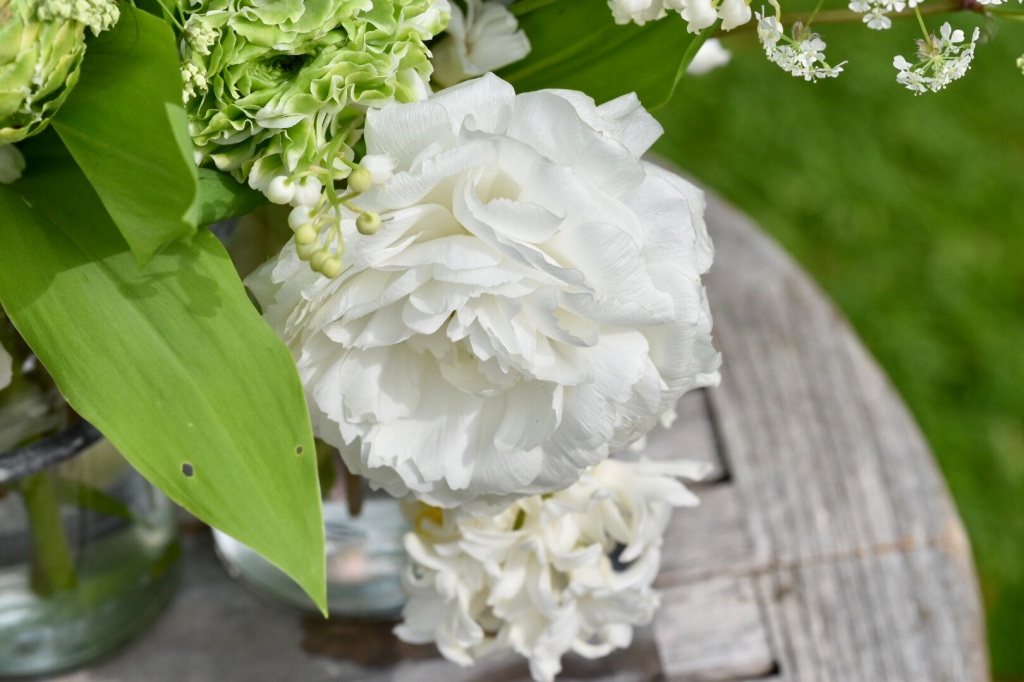
Albutt Blue https://www.visiteaston.co.uk/shop/gardening/seeds/albutt-blue

Pilgrim 400 :https://www.mr-fothergills.co.uk/Flower-Seed/Sweet-Pea-Seed/Sweet-Pea-Mayflower-400.html#.XtTdGBB4WfA

Cosmos Apricot Lemonade: https://www.thompson-morgan.com/p/cosmos-bipinnatus-apricot-lemonade/ka9983TM

Haxnicks root trainers :https://www.haxnicks.co.uk/garden-products/rootrainers

Six on Saturday – views from my garden April 11 2020

Tulip Mount Tacoma and forget-me-nots.

My favourite Italian terracotta pot near my front door. So sad there are no visitors to enjoy this lovely sight. I’m including it here, so you can all share in the magic of spring flowers. Fairly new introduction Exotic Emperor, a double form of the classic and popular Purissima. Has peony-like petals that curve and twist as they open, revealing a flash of green. Very lovely and my favourite. This is a fosteriana tulip, and here in the Midlands, it always flowers through April. Planted with Narcissus Geranium an heirloom bulb dating back to pre 1930. Beautiful, delicate fragrance. Perfect for cut flowers. I have a row in the veg garden for cutting. Multi-headed – some of the bulbs have four flowers to a stem. I love mixing the old with the new. I’m fond of traditional plants, but I love trying something new.

I’ve always grown the white Purissima tulip, so I thought I would try the new sport, Flaming Purissima, another fosteriana tulip. It is such a joy, with all shades of pink and red ‘flames’ over an ivory white background. Beautiful under a white cherry blossom tree. I’ve planted these in a trench on the veg plot for cut flowers. They last a week in a vase, and watching them turn from tight buds to open, flat, almost water lily-like flowers is a joy. These were introduced in 1999, and they reliably come through the winter and flower each spring for me.

So comforting to know we will have masses of cherries this summer. We leave the trees unpruned. Blackbirds enjoy the crop at the top of the tree, and there’s more than we can use around the downward – arching lower branches. I’ve planted narcissus Pheasants Eye under the trees as an experiment. They flower at the same time. They look so glorious, I’ll fill the orchard with them next spring. They cost very little and are a joy to behold. I’ve taken photos of the garden and made notes to remind myself to order bulbs in July and plant in September. If I don’t make a note, I seem to forget!

In the wild garden around the pond we have this un-named beauty. We planted these 30 years ago. I wish I’d recorded the name as I’d love to plant more as pretty and reliable as these. They have a wonderful scent too. Petals glisten and remind me of sugar coated violets. I wonder if you know what I mean.

And finally, a humble bellis daisy, growing in the cracks between the paving by the back door. I’ve been imploring (nagging) the family not to step on them all winter. I have a little patch 60cm square of delightful little daisies. There’s absolutely no soil there. I feel they deserve to live, having made such an effort to survive.

Enjoy your weekend everyone. This is not to say that we are not all desperately worried by what’s going on in the world, and in our own country. But I’m thinking this sharing of garden photos may help someone keep calm and carry on. There is really nothing else we can do at the moment. Stay at home, help the NHS, stay safe. And look around you and enjoy the beauty of nature. When this is all over, our gardens will still be there waiting for us.

Links: all bulbs were bought from https://www.gee-tee.co.uk/

The bellis daisies came originally from my Mum in a little pot stood on the patio all summer. Seeds can be bought from https://www.mr-fothergills.co.uk/Flower-Seed/Bellis-Goliath-Mixed.html

Please leave comments below and let me know what’s flowering in your garden this Easter time.

A Walk Around My Country Garden -27 Mar 2020

When I planted this walkway of trees, I never knew how essential they were going to be. I must meander along these paths at least 20 times a day, lost in thought.

I’m sharing as many cheerful photos as I can find today. The covid crisis initially knocked me for six. I am desperately worried about all our elderly relatives. For all those expecting babies in the summer. For my young daughters, one a newly qualified nurse, working with desperately ill patients right now. If I could solve everything with walking, I would have worn out my shoes. It’s the first time in my life I have no answers. I can’t do anything to make it ‘right.’ Normally I can think of something. In every other crisis, I have found a solution. Something to make things better.

So I am turning to what I know. Gardening. Giving out advice to anyone who needs it. Families have struggled to buy fresh salads and veg these past few weeks. I certainly haven’t managed to obtain what I’ve needed. I couldn’t find bread, flour or milk. It’s made me feel vulnerable and determined to be more self reliant when it comes to fruit and veg at least. So anyone who needs grow-your-own advice can contact me and I will help. For specific individual garden design advice, how to start a cut flower garden, grow a meadow, deal with a shady border, I am asking for a donation to Rainbows Hospice direct, any amount and I don’t need to know how much. All my garden club talks have been cancelled, and as you know, all my fees go to Rainbows. The clubs have all rebooked for next year, but I wanted to do something for this year to help. So anyone interested, please e mail me at k.gimson@btinternet.com for more information. I am learning to Skype and FaceTime live, and also using the phone and computer. Where there’s a will, there’s a way, as my grandparents used to say. Funny how their little sayings come back to you in times of trouble. It’s as if they are trying to help you, even though they are no longer here.

Enjoy the slide show of photos. I hope it lifts your spirits and makes a difference. From now on, I am solely focusing on people who are doing good, sharing information about what they are doing, supporting them in any way I can. That really is the only way forward for me.

I took this video from the garden gate last night. It’s so heartening to see farmers out and about working their fields after such a dire autumn and winter. If they are out there preparing seed beds, then we can too in our own gardens. I shall be glad to see the green shoots of seedlings after a winter of brown, barren fields.

Hedgerow blossom. This looks like a shooting star to me. Such a beautiful sight. A heart-sing moment. The hawthorn too is coming into leaf. Soon there will be clouds of May blossom to cheer us along.

Lots of daffodils at the top of the paddock. These were a sack I bought from Dobbies at Christmas, reduced from £24 to £3. I couldn’t resist the bargain price, and took a risk. They’d been stored cool and dry so were in good condition. I didn’t expect flowers this year, but they are looking stunning. Every bulb has come up. I’ll water with a potash liquid to feed the bulbs for next year. And if I see another £3 sack, I’ll certainly buy it!

Yellow flowers symbolise friendship, and that is certainly what we all need right now to get us through this crisis. I’m relying on phone calls and my twitter friends to keep upbeat. I’ve just added my name to a list of local volunteers to ring round anyone who lives alone and needs someone to chat to once a day.

Today, the wild cherry trees (prunus avium) started to flower. What a wonderful sight. These trees only flower for a week or two, but we will sit under them with our cups of tea, have picnics outdoors and revel in every single moment they are in bloom.

My cut flower tulips are in bud. Tulips in the sunny front garden are already flowering early. I’ll cut a huge bunch of daffodils and tulips for the front windows. Vases of flowers will cheer up anyone passing by, even though they can’t call in to visit.

These double creamy tulips, Mount Tacoma, are favourites. They remind me of swan feathers. So graceful.

Scented narcissi, Geranium and Pheasants Eye, are starting to flower. Fabulous with yellow hyacinths and the first wallflowers.

In the greenhouse, the succulents are starting to glow. I’ve started to water everything, and I’m pleased this aeonium has come through the winter.

There’s plenty of citrus fruit coming along. I’ll be able to make orange cakes and lemon meringues soon.

Would you believe it, my new Polar Bear snowdrop is still in flower – at the end of March. It’s a new elwesii type of snowdrop with huge rounded petals and short pedicels which make the flowers look up and out rather than hang down. It looks rather surprised to be out in the spring sunshine amongst daffodils. I wonder if next year it will flower much earlier.

There’s life in the pond. The tadpoles are forming. Lots of pond skaters, some newts, and we’ve even spotted a grass snake, on our new wildlife camera set up on bank.

I’ve mounted the camera on a log, so I can move it about the garden without it being knocked over. Tonight we are hoping to catch sight of the hedgehogs. They are out and about at dusk, making nests in the bottom of the ‘fedge’ and under the old disused hen house.

Ladybirds are much in evidence. Here they are on the phlomis. My army of pest control workers. I’ve left twiggy piles of stems all around the garden to give insects a place to hibernate. Hopefully they will repay me by eating the aphids.

And there’s plenty of bees, thankfully. Bumble bees and solitary bees of all shapes and sizes. I have a new book to review, The Secret Lives of Garden Bees by Jean Vernon. I can think of nothing better than sitting under my cherry trees and loosing myself in a book. It will be something soothing and calming. Much needed at the moment.

Here’s an enormous bumble bee on the wild anemones. It’s lovely to have a book you can go to to learn more about the bees visiting your garden. And look at ways you can help them to thrive. Something positive to focus on.

I hope you’ve enjoyed this walk around my garden today. The sun is shining and it’s 30C in the greenhouse. All the windows and doors are thrown open. Get in touch and let me know what’s looking lovely in your garden today. And if you are feeling alone or sad, let me know. We are in this together. And be reassured that lots of people are doing wonderful things to help one another. You just have to look for the positives in life. As ever.

Love Karen xx

In a Vase on Monday -March 16 2020

On the first warm, sunny day of the year, I’ve made a comfy place in the garden. I sit here, surrounded by familiar things: flowers, fresh from the garden, favourite books, magazines, tea, and mum’s lemon cake. And for a few minutes, I forget my worries. I am determined to enjoy the garden, birds singing all around, frogspawn in the pond. Trees bursting into leaf. I watch a wren creeping along the eaves of the house, searching for spiders. Spiders webs are used to glue their nests together, so I never clear them away. All of nature carries on, oblivious to the crisis we humans are facing. My small ginger spaniel Meg sleeps at my feet. My cat, Grace, chases a fly. They too are unconcerned. And yet I am a boiling cauldron of concerns. One minute panic stricken by the ‘what ifs’ the next, in warrior mode ready to fight. If only I knew exactly what I’m fighting. I return to voices, advice from my childhood, that some things cannot be changed and what will be, will be. I desperately try to remember comforting phrases from the past. I know my family, going back in time, suffered many illnesses and setbacks and survived. The suffering though. Those photos are etched on my mind. We, in modern times, have had it easy. Until now. And now, none of us know what’s going to happen. To give some respite from my thoughts, I turn to familiar things. For comfort I walk around my garden picking spring flowers, as I have done for the 30 years we’ve lived here. I’m posting them for you to enjoy, hoping they will bring you some comfort too, and for a few moments give you something else to think about. Stay safe all of you and keep in touch. Our gardens and our gardening community have never been needed more than they are today.

Dark, plum-toned Hellebore Rachel, with ruby hyacinth Woodstock, surrounded by Prunus Kojo-no-mai, ribes, Viburnum Eve Price, and pink comfrey.

The first of the wild cherry blossom. Simply beautiful. Pure and bright.

The last of the paperwhite narcissi and some skimmia. Deliciously scented.

Keep in touch and let me know what you are doing in your garden. Are you managing to get any seeds sown yet?

Sending love, hope and good wishes to you all. xx

Links: In a vase on Monday: https://ramblinginthegarden.wordpress.com/2020/03/16/in-a-vase-on-monday-change-of-plan/

Last of the late snowdrops – and snowy pictures of my garden

Patience often pays off. I’ve been watching the prices for this new and expensive snowdrop. Then, when most of the flowers had gone over, the garden centre reduced the price! It was my lucky day. Galanthus Polar Bear is my new favourite snowdrop, and it’s a quite a beauty, isn’t it.

I managed to find a pot with flowers still in bud. It’s a very late flowering type with short pedicels, making the flowers fling out and look up at you. So unusual, as most snowdrops bow their heads and look down. It’s got a lot of charm, and is the star of my potting shed windowsill at the moment.

While we are still talking about snowdrops, I thought I’d show you some snowy photos of the garden. It’s been the mildest wettest winter on record here, and this is the first, and only snow we’ve had so far. It makes the garden look magical and hides all imperfections (fortunately.) No weeds are on show, and brambles look ornamental with an iced topping of snow. Here you can see my greenhouse, polytunnel and potting shed set up, all close together to save walking too far between them. In front of the potting shed there’s some renovated 1930s plant nursery trolleys. Very useful for moving plant pots about, and for staging potted displays. My second-hand poly tunnel has doors both ends which is great for good air circulation. The 20ft Alton Cedar greenhouse is also second-hand and renovated by my husband. We painted it black, and made matching black staging inside. Beyond is my cut flower and veg patch and then the orchard, before you reach the paddock gate leading to the ridgeway footpath.

In the exotic border in front of the potting shed, I’ve left stems and seed heads intact for birds to eat and insects to find shelter. These innula seeds look pretty with a topping of snow.

The horseshoe pond can viewed from the potting shed windows. There’s a gently-sloping boulder beach to stand on, and this gives easy access for hedgehogs, frogs, newts and grass snakes. It’s very calming to stand and watch the ripples from raindrops. Today the pond is a cauldron of frogs, mating and producing frog spawn.

From the pond you can see the cut flower and veg patch. My hazel sweet pea supports have weathered three named storms on consecutive weekends. Really, if they can cope with all that, I think they will stand firm and strong for the summer display. There’s little slab paths between the plots so I don’t have to walk on the soil. It’s a no-dig garden inspired by Charles Dowding who’s been a patient and valued mentor these last few years, along with his partner Stephanie Hafferty. They’ve both given me lots of advice and I’ve got more value out of my plot thanks to their suggestions.

At the end of the veg plot there’s a small orchard, rather neglected. We’ve pruned it this winter which means we might lose some of the crop in the summer. But over a few years we will get the trees back into shape and down to a manageable size for harvesting. Under the trees I’m planning a wild flower patch. I’m going to leave some grass and see what happens, I will sow some plug plants in another area, and finally I’ll try a wild flower lawn, ready seeded. I’ll report back on the project.

Finally here’s the view down the field hedge tunnel. This path is made from bark and brushwood chippings from the garden, put through my new Stihl electric shredder. It saves a fortune on bagged bark supplies, plus helps me recycle waste from the garden.

Thank you for reading. Please share on any social media platform , and get in touch and let me know what your garden looks like just now. Comments box is right at the bottom of the page.

Links: Stihl shredders : https://www.stihl.co.uk/STIHL-Products/099364/Garden-shredders.aspx

Polar bear : https://www.avonbulbs.co.uk/spring-planted-bulbs-and-snowdrops/galanthus-snowdrops/collectors-snowdrops/galanthus-polar-bear

In a Vase on Monday- flowers from my plot 9th March 2020

Finding comfort in familiar things, I’m joining in with my favourite IAVOM theme today.

Spring flowers always bring hope. And we need plenty of hope at the moment, don’t we.

Here’s my flowers, picked fresh from the garden. They are in an unusual location, the drinks holder of my car. The perfect place for a jam jar of flowers, on their way to my mother’s house (via Radio Leicester, where I talk about what’s growing on my plot).

There’s some shoots of Japanese cherry, Prunus Kojo-no-mai, at the back of the posy. Some lace-edged heritage primulas, Pulmonaria Sissinghurst White, plum coloured Hellebores, and one very pretty bellis daisy.

The daises have grown all by themselves in the gaps between paving slabs at my back door. Something so pretty, just growing from seed carried on the wind. They have given me as much joy as anything I’ve planted and tended, probably because they have survived against the odds. There’s no soil there. And no loving care. But they have thrived. A message to us all, about resilience, maybe.

I love the slightly messy, many petaled flowers of bellis daisies. There are single and double forms. Seed packets cost a couple of pounds. Once you have them, they will always be with you. But not necessarily growing where you put them!

In my mother’s garden, the daisies romp delightfully across the lawn and into the border. She mows around them. It’s obvious where I get my empathy with plants from. My lovely mum has always been my greatest influence in life.

Wishing you all a peaceful, happy and successful week. I’d love to see what you are all sowing and growing in your garden just now. It’s very busy here, with plenty to do in the garden, as always. Hoping for some sunshine and nice weather – soon.

Links: In a Vase on Monday https://ramblinginthegarden.wordpress.com/2020/03/02/in-a-vase-on-monday-pillaged/

Bellis Daisy: https://www.mr-fothergills.co.uk/Flower-Seed/Bellis-Goliath-Mixed.html#.XmZXWoGnyfA

BBC Radio Leicester, gardening starts at 1pm every Sunday with Dave Andrews https://www.bbc.co.uk/programmes/p002zx56. Listen back on Sounds, or ask your smart speaker to tune in to BBC Radio Leicester

Please share via any social media platform. I do not pay for any advertising, and I’m always grateful to anyone who spreads the word and signs up to follow, via e mail. Thank you. 🙂 🌱

Note: I was not driving when I took the photos in my car. Naturally.

Diary of a Modern Country Gardener

Secrets for Every Season Straight From the Potting Shed

By Tamsin Westhorpe

Orphans Publishing ISBN 9781903360422

Hardback. 248 pages. £20

Illustrations by Hannah Madden

Book review and prize draw. Please leave a comment to be included in the draw.

We are all standing at our house windows gazing on waterlogged, storm lashed gardens, aching to be outside gardening. It’s doesn’t matter what kind of gardening, anything, as long as we can run some compost through our fingers and see green shoots emerging. It’s been a long wet winter.

Luckily Tamsin Westhorpe has a beautiful new book which transports us immediately to gardening heaven- Stockton Bury in Herefordshire. It is a very welcome and timely escape.

Tamsin is the 5th generation to garden at her family’s farm. The four acre garden within the farm has fruit and vegetable plots, a stream and pond, ‘rooms’ with different planting themes and a dovecote dating back to the time of Henry 1. The land has been worked by the family for more than 100 years, and the much-acclaimed garden is open to the public.

In her new book, Diary of a Modern Country Gardener, Tamsin lets us into her world as we see her facing all kinds of gardening challenges, accompanied by lots of laughter.

There’s expert advice on growing cut flowers, staging summer garden parties, selecting and planting trees, planting bulbs, storing produce, keeping chickens, coppicing hazel and more. I particularly like the ‘tool kit’ panels detailing equipment and materials needed for the list of jobs suggested each month. A useful reminder before getting going on tasks. There’s nothing worse than starting something, and then having to stop to search for forgotten items to complete the project.

I also like the list of ‘must-have’ plants for each month. January suggests Cornus mas, crocus tommasinianus, cyclamen coum, eranthis hyemalis, hamamelis, hellebores, iris reticulata, mahonia, snowdrops, viburnum Dawn and narcissus Bowles Early Sulphur. You can almost smell these spring delights. There’s something cheerful on every page.

As we follow her daily life there’s lots of hints and tips on what to do and when. But this is much more than a ‘how to’ book. It’s a book about solving problems, dealing with gardening conundrums, interacting with people, and simply enjoying every single moment.

I love books where you can really hear the author’s voice. Tamsin’s voice is loud and clear and full of humour. Her stories are compelling. She makes you want to jump in a car and drive over to see what she’s getting up to today. You’d have a real good natter, and come away smiling and fired up with ideas to get going on your own plot. She’s that kind of person who makes anything feel possible.

Her diary does exactly what it says on the tin; it’s a daily insight into the workings of a country garden. There are plenty of ‘secrets’ to be told. I won’t spoil them by retelling them here. But there’s a very interesting story about what she wears in the garden! Apparently her mother set the trend. You’ll have to read the book to find out more. It’s perfect escapism. And the one place you’ll all want to be is in Tamsin’s garden.

The book is beautifully produced and bound by well-respected Orphans Publishing, accompanied by truly gorgeous illustrations by artist Hannah Madden. A thing of beauty. Highly recommended. You’ll soon forget all about the weather! I promise.

Tamsin going through the proofs at Herefordshire Orphans Publishing.

Tamsin and Hannah Madden celebrating their first copy of the book.

Some pages from the book, taken with my i-phone camera. The quality of the photography is much better than I’ve managed to capture here.

About the author, taken with my i-phone camera.

Excerpts from the book for March

Excerpts for June

August

Tamsin Westhorpe’s diary was my book of the week on BBC Local Radio Gardening. It would make an excellent BBC Radio 4 read-aloud Book of the Week. A best seller, I think.

Thank you to Orphans Publishing for offering a free copy for our prize draw. Please leave a comment below to be entered in the draw. Please also comment if you do not wish to be entered in the competition, and let me know. Some of you may have already ordered a copy. The publishers will randomly select a winner. No cash prize alternative and usual rules apply.

Links: Tamsin Westhorpe https://www.tamsinwesthorpe.co.uk/

Orphans Publishing https://www.orphanspublishing.co.uk/

Stockton Bury http://www.stocktonbury.co.uk/

Garden Media Guild https://www.gardenmediaguild.co.uk/

Karen gimson on twitter @kgimson

On instagram karengimson1 and Pinterest.

Thank you for reading. I am very grateful for your 150,000 page views, all kind follows and shares. Please share this on any social media platform. It all helps me immensely.

In a Plant Pot on Wednesday – 5th February 2020

It’s a wonderful moment when potted spring bulbs suddenly flower. They seem to be in bud for weeks. Then virtually overnight, all the iris and dwarf daffodils burst into life. Colour at last. It’s much appreciated on a dark cold February day.

I planted shallow pans of bulbs on October 12th last year. Dwarf iris Katherine Hodgkin is a pale blue beauty with markings resembling blue ink pen lines. Each winter I try something new, and this time I’ve chosen iris reticulata Blue Note, very striking with deep indigo flowers and white markings on purple black falls.

Bulbs are grown on in the protection of the greenhouse over winter, but as soon as they flower I carry the pots about and set them on the garden tables. It’s so cheerful to look out of the house windows and see something colourful.

I’ve used pussy willow and hazel catkins to prop up the paper white narcissi. They have a habit of flopping everywhere, but look lovely with a few stems supporting them. On the right of the table there’s some cherry stems in a Kilner jar. Picked now and brought indoors they will open early for a glorious pink blossom display.

Scented paper whites might be too strong for indoors, but on the garden tables they are perfect. The creamy white flowers are a pretty accompaniment to emerging fluffy grey willow catkins.

A large Sankey terracotta plant pot of Narcissus February Gold makes a centrepiece for the picnic table. Hazel twigs are used for supports.

Here’s how I started out in October with a selection of terracotta plant pots, many inherited from my grandfather Ted Foulds.

I use a mix of 50/50 peat free compost and grit for good drainage. Bulbs are planted half way down the pots. They are watered once and placed on the greenhouse staging.

Pots are topped with extra grit to finish them off. This keeps the flowers clean and stops them being splashed with soil when watering.

Hyacinths are almost perched on the top of compost in individual 4″ pots. These are placed in a huge plant pot under the potting shed bench in dark, cool, frost free conditions and brought out just before Christmas when flower spikes are showing.

Here’s the view from the potting shed in October as I’m planting all these bulbs. A lovely reminder of all the sunny autumn days we had.

For contrast, here’s an oak tree from the lane where I live. Just as beautiful. Like a charcoal pencil drawing.

Have your spring bulbs started to flower this week? Are you trying anything new, like me, as well as sticking to a few old favourites too.

Get in touch and let me know what’s happening in your garden at the moment.

I am @kgimson on twitter

Karengimson1 on instagram

Links: I like to join in with Cathy for #IAVOM In a vase on Monday, but this week is was working, and my flowers are in pots! But I’ve read and caught up with everyone’s postings

https://ramblinginthegarden.wordpress.com/2020/02/03/ina-vase-on-monday-in-the-queue-for-green/

Bulbs came from Gee Tee bulbs. https://www.gee-tee.co.uk/

Compost from Dalefoot : https://www.dalefootcomposts.co.uk/our-products.aspx

Happy New Year Everyone! Some news from my garden 31 December 2019

Photo: Paperwhite narcissi and pink alstroemeria from my greenhouse today. Gypsophila and honesty seed heads saved from the summer. Eucalyptus foliage and willow heart. Flowers are in a jam jar covered with moss and twine, kokadama-style. Lovely to have home-grown flowers for the New Year.

I love surprises. My grandmother used to say you can never predict what’s going to happen, so don’t worry about tomorrow. Concentrate on today. I’ve pretty much tried to follow her good advice. And just about everything she said has turned out to be true. So, I’ve been writing this blog for three years- not knowing where it would take me. And the biggest surprise is that it’s followed by a growing number of readers. I set out thinking I’d be pleased if just one person read it and was inspired to grow something from seed. Well, I’m amazed and pleased to say the blog was shortlisted this year for the Garden Media Guild Awards. The awards ceremony was quite a glitzy affair at the Savoy in London- not somewhere I ever expected to visit. It was hosted by Nick Bailey, and I sat next to Pippa Greenwood- someone I’ve always admired. Rachel DeThame and Anne Swithinbank were on the next table. Alan Titchmarsh won an award for practical gardener, and Carol Klein was given a lifetime achievement award, presented by Roy Lancaster. Marc Rosenberg won news journalist of the year. Bramblegarden didn’t win the blog category, but just to be a finalist was quite something for me. It took me right out of the potting shed and out of my comfort zone, which is a good thing, now and again, isn’t it.

My second lovely surprise came when the weekly Garden News magazine asked me to write about my garden, and the first of my articles is out this week!

Mum and I have been subscribers for about 20 years. Never in a million years did I think I would be sharing my garden with readers. But that’s what’s happened and they’ve asked me to write and send photos of what I’m growing on a regular basis.

There was a bit of a panic when they asked for photos of the garden. It’s not looking its best in winter, and the rain means I’m very behind with tasks. But I made an immediate decision not to have a frantic tidy up. My garden is what it is. There are too many brambles and stinging nettles, and those will be addressed over the winter. But, apart from that, it will be as it is, a rather messy garden with zones of productivity. I’ve got 10 beds, 1.3m wide by 3m long with little paving slab paths between. This means I never have to stand on the soil. For the past three years the whole garden has been ‘no-dig’ following the principles of Charles Dowding. There’s a 20ft Alton cedar greenhouse I’ve painted black, and alongside, a matching 20ft poly tunnel. The rest of the one acre garden is mostly trees, and low maintenance shade planting. It’s left to the owls, grass snakes and hedgehogs. I’m delighted to share space with them all.

Across the centre of the veg plot there’s a hazel wigwam or A-frame trellis. This has been patched up for the past two years and will be renewed this winter, ready for spring planting.

The hazel frame is perfect for growing sweet peas. The plants just scramble up by themselves. I don’t have much tying in to do. I plant gladioli down the middle of the structure to utilise the space. These grow about 1m tall and usually need staking, but the hazel frame supports them instead.

This is my favourite Wiltshire Ripple variety, which has a fabulous scent.

Here’s how I make my newspaper pots, using a spice jar to form the tube.

I stand the newspaper tubes in terracotta pans. It’s a good task to do when the ground is too wet to work on, which has been the situation here for the past three months.

Albutt Blue. It’s wonderful to be thinking about sweet peas – in the middle of winter.

I wish I could share the scent from all these flowers. Sweet peas are the essence of summer.

What plans have you for growing in 2020? Are you planting old favourites, or trying something new. Get in touch and let me know.

And remember, if you are writing a blog, you never know who might be reading, or what opportunities might come your way. Just enjoy your blogging.

Wishing you all a happy, peaceful and healthy New Year. Happy Gardening!

I am on twitter at https://mobile.twitter.com/kgimson/status/1149241935502225408

On instagram at https://www.instagram.com/karengimson1/?hl=en

Links: Garden News magazine: https://www.greatmagazines.co.uk/garden-news-magazine?gclid=Cj0KCQiAgKzwBRCjARIsABBbFujlf4tfcbFd4OxHcjvuH6NR9Uk54A_wVM0S9IDq_ZeSvA0FtiofT0oaAg9_EALw_wcB

Garden Media Guild: https://www.gardenmediaguild.co.uk/awards

Sweet peas Mr Fothergills https://www.mr-fothergills.co.uk/Flower-Seed/Sweet-Pea-Seed/#.Xgur1YGnyfA

Sweet Peas Easton Walled garden https://www.visiteaston.co.uk/whats-on

Higgledy Garden Seeds https://higgledygarden.com/

Savoy London https://all.accor.com/hotel/A597/index.en.shtml?utm_term=mafm&gclid=Cj0KCQiAgKzwBRCjARIsABBbFujh9QGSEjYNiJ8ON9HjLVkRMH3UNhpD8tpccFO4povH1E6R5zr5qXIaAikZEALw_wcB&utm_campaign=ppc-ach-mafm-goo-uk-en-uk-exa-sear-a&utm_medium=cpc&utm_content=uk-en-GB-V2352&utm_source=google

I like to join in with In a Vase on Monday, although it’s usually a different day : https://ramblinginthegarden.wordpress.com/category/gardens/in-a-vase-on-monday/

And Six on Saturday : https://thepropagatorblog.wordpress.com/

Christmas Flowers -In a Vase on Monday

There’s something very appealing about rooting around in ditches, searching for moss covered twigs and pieces of crumbly old bark. I like nothing better than finding bits and pieces that might come in handy for floral arrangements. It brings out the inner ‘Borrower’ in me. I suppose it’s the same as beachcombing for pretty shells and driftwood. Very soothing and satisfying.

It takes me an hour or so to gather enough twigs, moss, ivy and rosehips for today’s projects. The hedges are thick with swags of ivy all adorned with clusters of glossy green berries. These will ripen and turn black in time and provide a feast for the birds. Luckily, there’s enough for everyone to share. I never take too much from any one area.

Wild roses have taken years to climb to the top of the hedges and rosehips form great cascading arches right down to the ground in some places. Meg, my little puppy digs and burrows around in the ditch. She loves this occupation even better than I do, always keen to help, emerging with mouthfuls of sticks and an eager expression. By the end of the morning, my baskets are full, and Meg is happily muddy. We head home, mission accomplished. Setting the finds on the potting shed table, I’ve plenty of red-berried plain green holly, some trailing larch branches festooned with tiny gold fir cones, tendrils of old man’s beard or wild clematis and a pile of wild cherry stems, thick with flower buds already. These stems go into water and straight into the house where the warmth will bring them into flower by Christmas, if I’m lucky. I stand and survey the haul for quite some time. Then I wind willow and silver birch stems into hearts and circles and start to weave in the hedgerow bounty, adding crab apples and dried cow parsley seed heads which remind me of shooting stars. Meg sleeps on my coat in a box under the table, satisfied with her morning’s work. Occasionally, there’s a huge yawn, but mostly deep breathing, like a well fed baby. And in the peace and quiet, I can get on with my tasks.

White alstroemeria and tiny white Stallion chrysanthemum from the poly tunnel pots, adding colour to the hedgerow greens. White gypsophila, dried from the summer.

Hedgerow finds with dried hydrangea flowers and pine.

Teasels and Garryia elliptica on the field gates.

Hydrangea Annabelle with a clematis Montana and willow circle.

Hydrangea and old man’s beard clematis catching the sunlight.

A simple willow heart and ivy.

Christmas hellebore. One of the Gold Collection varieties. A welcome addition to seasonal arrangements. Slit the stem lengthways for 4″ and stand in water right up to the flower head, before using in arrangements.

Summerhouse posy. Holly, lavender and fir.

Rosy hydrangea flowers, wild clematis and pine.

Willow, dogwoods, skimmia and conifer stems.

Potting shed window. Rosehips, crab apples and cow parsley seeds.

Links : In a Vase on Monday. https://ramblinginthegarden.wordpress.com/2019/12/09/in-a-vase-on-monday-spike-revisited/

A Walk Around My Garden – 23rd November 2019

If I could only have one tree, it would be a field maple. At this time of the year, there’s a golden carpet of leaves covering the whole garden. Even dark corners and shady woodland walks are glowing yellow. Much needed cheer, when the days are short and turning cold and dark. We must find our own warmth from nature, whenever we can.

This year, I’m experimenting with the boundary. Thin branches are laid horizontally to form a ‘fedge,’ a cross between a fence and a hedge. This creates a habitat and shelter for mice and hedgehogs, birds and insects. Smaller twigs are put through my new shredding machine to create woodland paths and mulch. The idea is to make use of everything in the garden and do away with the need for bonfires, which are bad for the environment. Sunflower and cow parsley stems will be woven into the ‘fedge’ creating useful hibernation sites for beetles, ladybirds and lacewings. Even earwigs are welcome here, useful predators of vine weevils and many orchard pests.

Looking up, you can see there’s plenty of twiggy growth in this garden. I rather like the pattern of black stems and yellow maple leaves. It looks like a pen and ink drawing and someone has ‘scribbled’ across the skyline.

Temperatures suddenly dropped below zero for the first time this autumn. We’ve been relatively mild until now, with record amounts of rain. The hazel trees responded by dropping all their leaves in one go- as if in fright. Overnight, puddles of ‘gold’ appeared all over the garden.

Searching for more gold, I found a dogwood, Midwinter Fire.

This dogwood is beautiful all year round, but particularly shines in November. When the leaves drop, bright orange stems will catch the winter sunlight. A wonderful sight in snow and frost. Well worth planting in any border, in full sun, or part shade. Needs minimal pruning, unlike the red-stemmed varieties which can be pruned to the 3″.

Mooching about the garden, I find a mini potted fruit tree with its first apple. This is a desert apple, Malini, growing on a dwarfing root stock. I’m growing it in a 12″ pot and it will go with my youngest daughter when she flies the nest. I have a patio full of tiny fruit trees, to form a fledgling orchard, for her first home.

Into the poly tunnel, I find some pretty chrysanthemums coming into flower. These are the hardy Stallion variety. They can cope with the cold, but do better if protected from rain. They are grown in 10″ pots, stood outdoors all summer, and brought under cover in October.

There’s plenty of yellow chrysanthemums too. We call these Aunty Dorris, as cuttings were given to my father law by his aunt in the 1950s. Much treasured in our family.

I hope you’ve enjoyed your walk around my garden this week. Are you searching for colour at this time of the year. What are you finding that’s cheering you up at the moment?

Finally, as a change from gold, I find these beautiful – and very late roses in the front garden hedge. I believe they are the Ballerina Rose, a really good, disease-resistant variety. It flowers on and off all summer- and right up until Christmas. In fact, these roses will be going into my Christmas door wreaths, along with rosehips, old man’s beard wild clematis, fir cones and crab apples. Guaranteed to bring good cheer.

Links :

Field Maple, Acer campestre https://www.woodlandtrust.org.uk/trees-woods-and-wildlife/british-trees/a-z-of-british-trees/field-maple/

Hazel : https://www.woodlandtrust.org.uk/trees-woods-and-wildlife/british-trees/a-z-of-british-trees/hazel/

Dogwood https://www.rhs.org.uk/plants/57639/i-cornus-sanguinea-i-midwinter-fire/details

Apple trees: http://www.lubera.co.uk/?gclid=Cj0KCQiAw4jvBRCJARIsAHYewPOyG2A6Q46HJPng2Xsb2BEURZuS09DZ69up4PWKOAp7k10agvT6HVgaAuxQEALw_wcB

Rose Ballerina: https://www.classicroses.co.uk/ballerina-shrub-rose.html

More than Six on Saturday : https://thepropagatorblog.wordpress.com/2019/11/30/six-on-saturday-30-11-2019/

In a Vase on Monday- 25th November 2019

Flowers from my garden. For Joan.

Today’s flowers feature my father-on-law’s hardy yellow chrysanthemums. We don’t know the proper name for them, but in our family they are known as ‘Aunty Dorris.’ My father-in-law had been growing them since Aunty Dorris gave him a cutting in the 1950s. He grew them for his wife Joan, who particularly loved the sunny yellow flowers. Now the cuttings have been passed to me, and I’m keeping up the tradition of growing flowers for Joan.

The flowers have a gorgeous lime green centre which sets off the bright yellow petals. They last at least three weeks in a vase, with water refreshed every day.

Variegated ivy with golden flower heads provide foliage for my chrysanthemum posy.

Oak and beech leaves gathered from the garden add some lovely warm burnished tones.

Autumn trees across the horseshoe pond are reflected in the potting shed windows.

There are rows of beech trees all around the garden, remnants of an old hedgerow. Trees stand bare all winter, but juvenile foliage at the base provides copper-coloured leaves through until next May.

Chrysanthemums are often winter hardy, but the flowers are spoiled by rain, so I grow them in many 12″ pots. They stand outdoors on the paving all summer, and are brought in to an unheated poly tunnel around first week of November. After very mild temperatures, we had one night of -2C so I covered the flowers to protect them from the sudden chill. They were uncovered the next day, and night time temperatures have been 8 to 11C since then. The pots will supply a steady flow of flowers until the new year. Plenty for Christmas. And plenty for Joan, who is now living in a care home with Keith. I’m glad to be keeping up our family tradition. I often think of Aunty Dorris and wonder if she realised her cutting would lead to so much joy shared down through the years.

Here’s a photo of Joan on her wedding day, standing on the steps of Cosby Methodist Chapel. Joan did the flowers for the chapel for 65 years and Keith played the organ for weddings and chapel services. This photo, in a home-made metal frame, is a little battered as Keith carried it all around Korea for his army national service.

Thank you for reading. Please share this blog on any social media platform, share with your friends and neighbours and help me spread the word. Hopefully I’ll inspire someone to grow flowers, fruit and vegetables. It’s really simple, if you have a few pointers and little hints and tips along the way. Enjoy your garden.

Links: In a Vase on Monday https://ramblinginthegarden.wordpress.com/category/gardens/in-a-vase-on-monday/
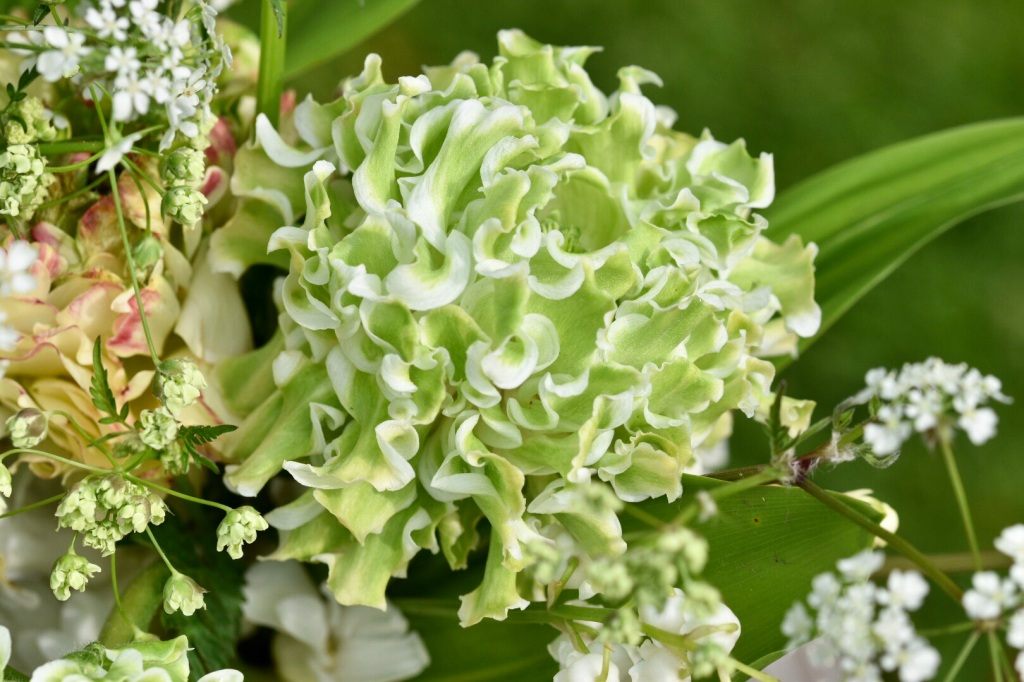
In A Vase on Monday- 28th October 2019

The first frost sees me running up the garden, collecting dahlia flowers in buckets. Even slightly faded, tatty flowers are harvested. Every bloom has suddenly become precious. It will be a whole nine months before we have any more of these glories.

In amongst the dark blood red dahlias are these interlopers. I didn’t plant them. I’ve been growing cactus dahlia Nuit d’Ete for around 20 years. Alongside, there’s some white dahlias called My Love. Could they have crossed to produce this striped flower? It’s a mystery. A very pretty interloper, even so. It can stay.

Frost means the end of tender flowers such as dahlias. Plants will collapse virtually overnight. Last year I left the tubers in the ground and covered them with a foot of dried leaves and a cloche. The secret is to keep them relatively dry. However, this year I will lift them all. The ground is sodden. We’ve had 266mm of rain over the past two months, double the usual amount. Five months worth of rain in the past five weeks. There’s no way I’m going to be able to keep the dahlias from rotting, unless I lift them.

So, using very sharp florists’ scissors, I collect buckets of flowers for the house, before tackling the tubers. Tubers are carefully lifted to avoid bruising. They are cut off leaving 3″ of stem. Turned upside down to drain. Then put in a dark, cool, frost free shed. After a week or two, I’ll wrap them in newspaper, or put them into pots of dry compost to overwinter. They will be started back into growth in the greenhouse in February, cuttings will be taken, and the whole cycle of planting and harvesting will go round again.

I also picked some verbena bonariensis, diascia, the last of the Nicotiana Mutabilis, some very late gladioli, and herbs such as rosemary and lavender.

There is one last flower from Dahlia Obsidian, a tuber I bought from East Ruston Garden in Norfolk a few years ago. I like to buy a few plants when I’m on holiday to remind me of the visit. This one is particularly good for pollinators, being an open, single flower.

Added some Amaranthus, love lies bleeding. I have grown the red and the white form this year.

And this is what the flowers look like, all put together. I had enough flowers for four or five vases.

I put the verbena mixture in a Kilner jar that used to belong to my great aunt Betty. She was a keen cook and preserved everything in those jars. She gave me about 100 when I first set up home. Happy memories; I use them every day and think of her.

It’s warm and sunny enough to sit in the garden today. After all that rain, I’m not spending a second shut indoors! I’ve even written this sitting outside on an old garden chair covered with a cosy woollen blanket. My feet are getting cold, so I’ve put a few bricks under them as a makeshift foot stool. No doubt there will be more frost ahead, but I’m determined to get outdoors as much as I can this winter and not get stuck by the fire.

Have you had a frost in your area yet? Are you leaving your dahlias in the ground or lifting them, like me? Let me know how things are growing in your part of the world.

Links : Cathy IAVOM https://ramblinginthegarden.wordpress.com/2019/10/28/in-a-vase-on-monday-not-fade-away-2/

Dahlia Nuit d-Ete https://www.peternyssen.com/nuit-d-ete.html

East Ruston Old Vicarage http://www.e-ruston-oldvicaragegardens.co.uk/pages/view/564/home.htm

Dahlia Obsidian https://www.sarahraven.com/dahlia-verrones-obsidian.htm

I am @kgimson on twitter

Karengimson1 on instagram.

Thank you for reading, and for getting in touch.

Six on Saturday- 26 October 2019

The last of the sunflowers. This one, above, looks like it can’t decide whether to open or not. It’s been wet here, 142mm of rain this month. Twice the usual amount. However, flowers coped well with the deluge. Dahlias love the rain. They just tip forward slightly to drain. Sunflowers have also thrived. My sunflowers are a mixture of Infrared and Allsorts Mix from Mr Fothergills. I sow them in seed compost in March in 9cm pots, grow on in the greenhouse until they have two pairs of leaves, and then plant out after all danger of frost has passed. I use Strulch mulch to protect from slugs. It’s a scratchy kind of mineralised straw mulch which slugs and snails don’t like. It helps to retain moisture and feeds the soil as it rots down. I also spray everything with home-made garlic liquid. The recipe comes from Sienna Hosta nursery. If it’s good enough for a multi- gold medal winning nursery, it’s good enough for me. It works, with the proviso that you have to spray repeatedly, especially after rain. I’ve got a 3L Hozelock sprayer set up ready, which makes life easier. It’s worth it to protect delicate seedlings from slugs, without resorting to chemicals. The garlic spray doesn’t kill slugs, but deters them, leaving them available as a food source for birds and mammals.

Seed merchants used to mostly supply yellow sunflowers, but in recent years there’s been a big increase in varieties available. I love the chocolate -coloured flowers and the mini-sunflowers, such as Teddy Bear, which can be grown in a container and only grows to 1m with 12cm wide very double ‘fluffy’ yellow flowers.

Glowing red, this sunflower reminds me of rich dark chocolate. This was the darkest flower in a packet of Velvet Queen seeds. Truly scrumptious.

Plenty of pollen for bees, and I leave the seeds on the plants for the birds to enjoy over winter. Insects hibernate in the sunflower stems.

Lovely markings on these sunflowers from the Allsorts Mix.

And finally, Thompson and Morgan produced a new and exclusive multi-branching sunflower which repeat flowers from spring until Christmas, if protected from frost. It has rather an unwieldy name- SunBelievable Brown-Eyed Girl. It’s perfect for containers. My potted sunflower was amazingly prolific, and produced about 100 flowers over the season. Plenty for mini flower arrangements like this one which has calendulas, and herbs mixed in with the sunflowers. It lasts about a week in a vase.

Tonight we put the clocks back and the evenings will gradually close in. We’ll just have to make our own sunshine- and grow more flowers. Don’t you agree?

Which plants have you grown this summer? Let me know which have been a success for you. It’s good to share ideas and information, and help one another- especially as winter draws near and we all need a bit of colour to keep our spirits up.

Links : SOS six on Saturday https://thepropagatorblog.wordpress.com/2019/10/26/six-on-saturday-26-10-2019/

Mr Fothergills Infrared https://www.mr-fothergills.co.uk/Flower-Seed/Sunflower-Infrared-F1-Seeds.html#.XbSrg4zTWfA

Allsorts Mix https://www.mr-fothergills.co.uk/Flower-Seed/Sunflower-Allsorts-Seeds.html#.XbSrtYzTWfA

Velvet Queen https://www.mr-fothergills.co.uk/Flower-Seed/Sunflower-Velvet-Queen-Seeds.html#.XbStyozTWfA

Thompson and Morgan https://www.thompson-morgan.com/p/sunflower-sunbelievabletrade-brown-eyed-girl/tka1036TM

Calendula Orange Flash https://www.mr-fothergills.co.uk/Flower-Seed/Calendula-Seed/Calendula-Orange-Flash.html#.XbSvAozTWfA

Garlic wash spray, Sienna Hosta Nursery https://www.siennahosta.co.uk/pages/garlic-wash-recipe

Karengimson1 on instagram

@kgimson on twitter

GardenMediaGuild member

In a Vase on Thursday 10th October 2019

Rich Venetian shades. Just the joy we need for October days. Temperatures are dipping and nights drawing in, but the cut flower patch is blazing with colour.

Dahlia Nuit d’Ete is flowering well, standing up to the wind and the rain. We had the wettest September for 20 years. And October doesn’t look like it’s getting any drier. We’ve had 134mm of rain in ten days. That amount usually falls in two and a half months! With swamp-like conditions it’s impossible to work on the borders. Luckily my cut flower patch is divided by little slabbed paths, so I never need to step on the soil.

Alstroemeria Laguna and Serenade

In amongst the dahlias there’s pink and red alstroemerias grown in pots. If you pull the flower stems out of the compost when you pick them, more blooms will follow. Pull instead of cut is the message. It seems destructive, but promotes further flowering. These are tall varieties suitable for cutting. I accidentally bought some dwarf types once, which looked pretty in the borders, but were hopeless for flower arranging. So take care when choosing plants.

Dahlia Arabian Night

An old favourite I’ve grown for years. Very reliable and doesn’t seem troubled by rain and wind. Earwigs don’t seem to go for the darker shades, preferring the whites and pale-flowered dahlias. If your plants are being nibbled by earwigs, place upturned pots of straw or corrugated cardboard on canes near the flowers. In the morning you can tip the earwigs and their bedding into a wildlife corner, or amongst fruit trees. Earwigs are voracious predators of aphids and vine weevils. Worth relocating away from your dahlias.

Amaranthus cordatus

Love lies bleeding. An easy to grow annual. Produces pendant tassel-like flowers. It’s also known as velvet flower, foxtail and prince’s feather. Sow seeds in half seed trays in March/April. Prick out seedlings into 9cm pots or full seed trays and plant out after frosts. Flowers all summer until the end of October and sometimes into November, depending on temperatures.

Penstemon Plum Jerkum.

A short-lived perennial. This came as a cutting from a friend. It’s a good idea to take insurance-policy cuttings in late summer. These plants are not totally hardy. It’s the winter wet that defeats them, so plant in well drained soil in full sun and protect from the worst of the weather with fleece. Take cuttings in July and August from non-flowering shoots. Cut below a pair of leaves, where there’s a concentration of hormones to promote rooting. Remove all but the top two leaves. Place the cuttings around the edges of a 9cm pot filled with 50/ 50 horticultural grit and compost. The edges of the pot provide the most free draining position for the cuttings, which helps roots to form.

Verbena Bonariensis

Another short-lived perennial requiring a sunny spot in well-drained soil. I lost all my plants in the Beast for the East big freeze last year. Luckily, it grows really well from seed and cuttings. Sow seed in the spring in half trays and prick out, as above. Or take cuttings in late summer. There are tiny side shoots just above a pair of leaves. Gently pull these down and you will have a short cutting.

Aeonium Zwartkop

Aeoniums are evergreen succulents with a shrubby growth habit. My plants collapsed in the wind and some of the stems broke off. They make a lovely, unusual addition to flower arrangements. It’s all about using what you’ve got in the garden. When I take the posy apart, I’ll cut the bottom few inches from the stems and stick them in a pot of very gritty compost. Kept frost free, the cuttings will readily root and I’ll have new plants to stand out on the patio next summer.

Trifolium pratense red clover

The lovely pink rounded flower on the left is just common clover. This year I grew a patch of wild flower meadow in a raised windowbox on legs. I’m always saying you don’t need acres of land to grow food, flowers, and veg. So I put it to the test. It worked a treat. I filled the containers with Dalefoot seed compost and sowed seeds direct in spring. Red clover flowered all summer, alongside blue harebells, yellow birds foot trefoil, scabious, corncockle, and vipers bugloss. It’s been a joy to watch bees, hoverflies and butterflies visiting my little patch of “meadow.”

Nicotiana mutabilis.

The pretty tubular flowers are colour-changing tobacco plants. These were sown and planted last year. They self-sowed over the winter, and have come up stronger and more beautiful this summer. I’m hoping they will do the same for next year, but I’ve saved seed and sown some more, just in case. Stems grow to 1.5m and produce clouds of trumpet-like flowers. They change colour as they age through various shades of white, pink and lilac. Glorious, and highly recommended. I’ll never be without it now I’ve seen it flower all summer long.

I hope you’ve enjoyed my Venetian shades bouquet, photographed on a windswept day in the garden. Golden beech tree leaves were swirling past my head as I was tying up the flowers. It seems autumn is on a fast forward setting. What is it like in your garden right now?

Links: I love to join in with Cathy’s In a Vase on Monday meme. But Mondays are my busiest working day. So I’m just going to post photos when I can. I’ll be reading all your posts when I get home from work.

IAVOM : https://ramblinginthegarden.wordpress.com/category/gardens/in-a-vase-on-monday/
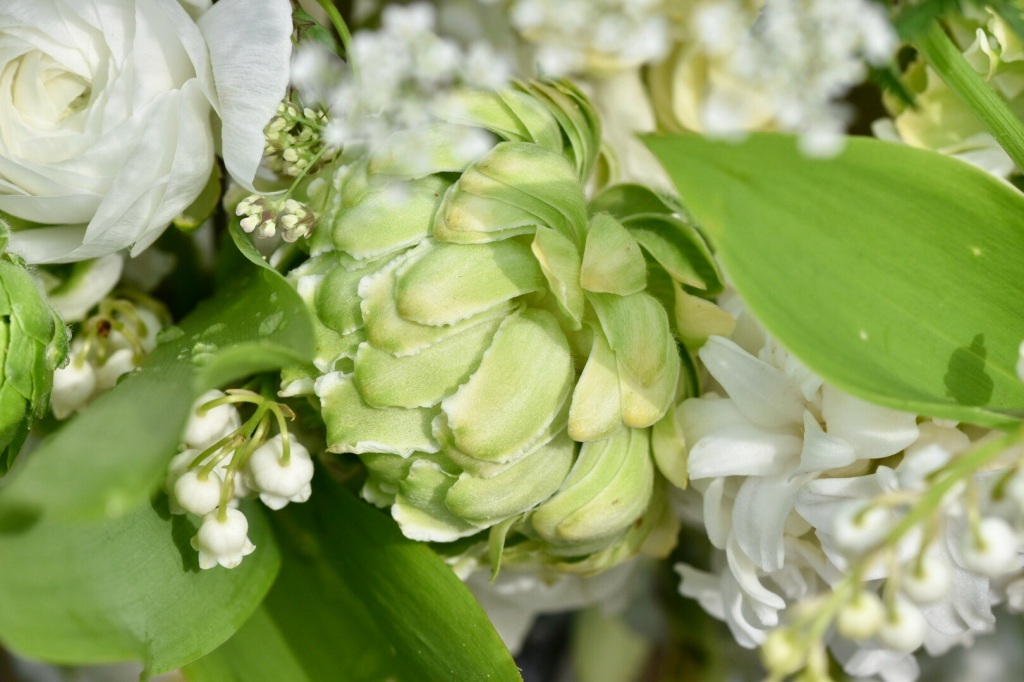
Dahlias : https://www.gee-tee.co.uk/search-results?s=Dahlias+

Alstroemerias: http://www.postalplants.co.uk/catalogue.asp

Amaranthus :https://www.mr-fothergills.co.uk/Flower-Seed/Amaranthus-Love-Lies-Bleeding-Seeds.html

Penstemon : https://www.rhs.org.uk/Plants/162416/Penstemon-Pensham-Plum-Jerkum-(Pensham-Series)/Details

Verbena Bonariensis; https://higgledygarden.com/2011/11/21/verbena-bonariensis/

Aeonium: https://www.rhs.org.uk/plants/details%3Fplantid%3D64

I’m @kgimson on twitter and karengimson1 on instagram. Please feel free to share this post, linking back to bramblegarden.com

Six on Saturday. Wind-Swept Walk Around My Garden on 10th Aug 2019

I don’t like windy weather. It makes me unsettled. I worry about everyone’s gardens. So much effort goes into growing flowers, fruit and veg, it’s heartbreaking when it’s destroyed by the weather.

I’ve waited all day for the wind to drop. It hasn’t. So it’s a blustery, sort of a walk around my garden. My dahlia stems are pointing in all kinds of crazy directions. I should have staked them better. But I didn’t. This one is still looking lovely though. It’s a decorative double called David Howard. Beautiful, orange-blushed flowers 10cm across, set off by bronze-tinted foliage. Plants grow to about 75cm, unless toppled by the rain and wind……. sigh.

Double flowers like these last around two to three weeks in a vase. They keep on opening up, like a ripple effect, until the centre is revealed. Well-known florist Jonathan Mosley gave a demonstration at the Belvoir Castle Show recently and revealed a few tips on getting the best out of cut flowers: Use a very sharp kitchen knife to cut flowers, not secateurs which crush the stems rather than cut them cleanly. Walk round with a bucket of very cold fresh water, and drop stems straight in, so air bubbles don’t get the chance to form in the stems. Cut flowers early in the morning and stand them up to their heads in water in a cool dark place such as a potting shed or garage for at least 6 hours before using them in arrangements. Giving them a really good drink makes them last much longer.

I’ve decided to go for an apricot-coloured theme this week. It might help calm our shattered nerves. This is one of my favourite rambling roses, Ghislaine de Feligonde. It flowers in huge swathes in June, and then puts out the occasional flower right through the summer. Bees love it, it’s free flowering and doesn’t get blackspot. All cause for a celebration, I think. Plus is looks good in a a vase.

In keeping with the colour scheme, there’s some beautiful seedling spider day lilies bred by Pollie Maasz at Pollie’s Lilies. These ones don’t have a name as they are trial plants. Pollie selects the best from her trials and registers new names. It’s a fascinating process and I’m glad to have some of her “babies” to try out here.

I am very fond of New Guinea hybrid impatiens. They flower all summer for no effort other than watering and feeding with seaweed extract or liquid tomato fertiliser. I don’t even bother to dead head them, they seem to sort themselves out. This one is Magnifico Star Orange. Cheerful even when it’s raining and blowing a hooley in the garden. I can always pretend I’ve been transported to the tropics.

I love begonias. This one is from the Apricot Shades range and is good for containers and hanging baskets. It will flower its heart out until the first frosts, then I’ll bring it in to the frost free greenhouse for winter. Dried off and kept indoors, it can be started into growth each spring. A really good value plant and so many lovely colours to choose.

Finally, from my pelargonium collection, there’s this beauty. This is one of the species hybrid pelargoniums from Fibrex Nursery. I think it is Pelargonium Ignescens, but will stand to be corrected. I have quite a few from the nursery and the labels have long gone. This one dates back to the 18th century and has pretty soft, downy leaves too.

I hope you’ve enjoyed your walk round my garden today, despite the howling wind! This is the view from the far hedge, in the back field behind my garden. It’s a wonderful place to stand and observe the weather. You can see for miles and today the farmer has started – then stopped – harvesting the corn. In a day, the crop will be safely gathered in, and the scene will change again, with ploughing the next sound we’ll be hearing.

Links: sos are https://thepropagatorblog.wordpress.com/2019/08/10/six-on-saturday-10-08-2019/#comments

Dahlia David Howard: https://www.rhs.org.uk/Plants/57111/i-Dahlia-i-David-Howard-(D)/Details

Rosa Ghislaine de Feligonde https://www.ashwoodnurseries.com/shop/rosa-rambling-ghislaine-de-feligonde.html

Pollie’s dayliles https://www.polliesdaylilies.co.uk/

Fibrex https://www.fibrex.co.uk/

In a Vase on Monday – 15th July 2019

I’ve discovered, by accident, the magical effect of a sunset on sweet peas. It turns them into mini “stained glass” windows.

Picking them at 9pm, I suddenly find it’s too dark to take photos. Nights are rapidly drawing in. Mid-summer lulls you into a relaxed state of mind. Surely there will always be time to meander round the garden. Then, quite soon after the solstice, everything changes. There’s no streetlights here; dusk means picking your way through tall corridors of dark trees, along grassy paths, past the horseshoe wildlife pond. If you are lucky, you’re accompanied by a barn owl, sweeping along the hedge in eerie silence. You’ll marvel how such a large bird can ever catch any prey without being seen. But they make not the slightest sound and pass by like a shadow. If they see you, they don’t panic and madly swerve as some birds would. They barely acknowledge your intrusion, calmly changing direction and floating over the hedge to continue on the other side. They seem not to flap their wings, but soar and glide as if carried by the wind.

Our boundaries are made from farm posts and galvanised pig wire. We like to keep a connection with the surrounding fields. After all, our garden was once part of the farmland. We’ve simply borrowed the ground to grow fruit and flowers.

There are 10 beds, 1.3m wide by 3m long, divided by narrow slab paths. This year it’s a muddle of potatoes, broadbeans, Sweet williams, daisies and verbascum. A rickety A-frame of hazel rods runs through the centre, for sweet peas. This year I’m growing a combination of heritage types from Easton Walled garden and Higgledy Garden, and new varieties on trial from Mr Fothergills.

Amethyst and rubies; sweet pea flowers shine like jewels in the sunset.

My flowers are being sold at Six Acre Nursery, Costock, Leicestershire, with all proceeds going to Rainbows Hospice for children and young people. I am a voluntary fund-raising ambassador for Rainbows, and I also give slide shows and talks to garden groups for charity.

I hope you’ve enjoyed this peaceful walk around my garden at dusk. There’s much to see, even in the gloom.

Links : Cathy In a Vase on Monday : https://ramblinginthegarden.wordpress.com/2019/07/15/in-a-vase-on-monday-think-pink/

Easton Walled Gardens : https://www.visiteaston.co.uk/

Higgledy Garden Seeds. https://higgledygarden.com/

Mr Fothergill’s Seeds https://www.mr-fothergills.co.uk/Flower-Seed/Sweet-Pea-Seed/

Barn Owl Trust https://www.barnowltrust.org.uk/barn-owl-facts/

Notes: Most birds make a flapping, swooping sound when they fly. Owls have special edges to the front of the wing that breaks the air into small streams of wind that rolls to the end of the wing. Comb-like feathers further break down the air into even more smaller streams to create almost silent flight.

In a Vase on Monday- All White

I’m practicing for wedding flowers. You never know when you might need some….

White larkspur and Ammi majus. Such a simple combination. I’d probably add white sweet peas for scent. I’ve got heritage variety Mrs Collier growing on the hazel A frame. And some white love-in-a-mist. The bouquet would be tied with white satin and pearl pins, and not grey twine. But you get the idea.

Larkspur White King was sown on 4th September in 12″ pots in the polytunnel. I used a 50 /50 mixture of peat- free multi purpose compost and John Innes no 2 compost with some added grit for drainage. I used Sarah Raven/ Johnsons Seed, sown thinly, covered with a sprinkle of compost and left to grow on without pricking them out.

I also chose seeds from Higgledy Garden. These were part of a cut flower patch kit. Very good value and nice fresh seed. Everything germinated and grew well. Highly recommended. Plus, I like to support independent companies such as Ben’s.

White “cow parsley” type flowers in my bouquet are Higgledy Garden’s Ammi majus. This lovely airy flower always does better from an autumn sowing. Once you start cutting them lots of side shoots appear and you can harvest flowers right through the summer.

Higgledy’s larkspur mix contains some beautiful ice blue flowers, shell pinks and whites. All packets of seeds cost between £1 and £2.50 each. I probably spent less than £10.

Once I’d sown the seeds, I laid the packets on the pots and took photos to remind me what I’d grown and when. Labels have a habit of moving – all by themselves- on my plot!

Seedlings germinated by 21st September.

I had a bit of a problem with mice. Luckily they just thinned the seedlings for me. I put down peanuts and bird food for them, which they preferred. Hopefully the barn owl will have helped me out over the summer. I know she is feeding fledglings as we see her most nights, and we hear them calling for food. Loudly.

Those few pots of plants have been supplying me with posies for a several weeks now. I’m not sure they produce blooms any sooner than plants grown outdoors; but they have super long stems with plenty of flowers and haven’t been damaged by rain.

I particularly love the green markings on the back of the petals.

Green-tinged buds make a lovely contrast to the white flowers.

If anyone wants to get married next summer- I have the perfect plan for the flowers! Just saying.

links : Cathy IAVOM : https://ramblinginthegarden.wordpress.com/2019/06/24/in-a-vase-on-monday-respite/

Sarah Raven / Johnsons Seeds : https://www.johnsons-seeds.com/Flower-Seed_0/Annuals_3/Larkspur-White-King.html#.XRDKaGfTWfA

Higgledy Garden, Ben Ranyard : https://higgledygarden.com/

Cut flower growing and arrangements -courses and books: Georgie at https://www.commonfarmflowers.com/

First Polytunnels :https://www.firsttunnels.co.uk/

Dalefoot peat free composts :https://www.dalefootcomposts.co.uk/

Twine : https://nutscene.com/collections/twines/products/candytwist-twine-nutscenes-bakers-twine-large-spools

Please feel free to share this post on any social media platform.

You might also like to read :

https://bramblegarden.com/2019/06/23/prize-draw-winner-hansford-coil-spring-chair/

And

https://bramblegarden.com/2019/06/20/ngs-garden-visit-oak-tree-house/

Or

https://bramblegarden.com/2019/06/15/six-on-saturday-a-walk-around-my-garden-15-june-2019/

Thank you 😊

In a Vase on Monday – 10th June 2019

It’s the much-awaited summer. And it’s raining. It’s pouring. And it’s 9C. So only one photo today for my Vase- and it’s sweet williams and sweet peas again. They are loving the cool temperatures and moisture. I must admit, I am not.

My dark red sweet williams, Dianthus barbatus Sooty, are suddenly providing buckets of flowers. Sweet williams are such good value plants. For a couple of pounds for a packets of seed, you can have a steady supply of flowers three months or more. They are like dark velvety chocolate. Dark colours don’t show up in photos very well, so I’ve screen shot the picture and homed in on the flowers.

There’s a few forget me nots left to go with the love in a mist. And sweet peas are also flowering faster than I can pick them.

Calendulas are looking fab with peach butterfly antirrhinums, and blue chives are being thrown in every bowl of salad, as well as every vase of flowers. Such a versatile perennial herb to grow. The antirrhinums are flowering for their second year, but I’ll sow some more seed for next summer, just in case they don’t overwinter. They last for nearly a fortnight in a vase, if you change the water each day.

I do hope the weather is better where you are. Hopefully we will all get some sunshine again soon. Meanwhile, it’s dark clouds and white cow parsley -aplenty!

Links :

I’ve been to visit the Cotswold Wildlife Park. Here’s a blog I wrote about it: https://bramblegarden.com/2019/06/10/the-cotswold-wildlife-park-a-celebration-of-the-gardens/

Here’s my recent blog listing the varieties of sweet peas I’m growing: https://bramblegarden.com/2019/06/03/in-a-vase-on-monday-3-june-2019/

Don’t forget to leave a comment on my blog review of Hansford Coil spring garden chairs- there’s one chair to win in our prize draw competition. They are wonderfully comfortable and easy to carry about the garden: https://bramblegarden.com/2019/05/31/product-review-hansford-coil-spring-chair/

In a Vase on Monday : https://ramblinginthegarden.wordpress.com/2019/06/10/in-a-vase-on-monday-the-very-pink-of-perfection/

Six on Saturday – 30 March 2019

Suddenly, there’s blossom and flowers everywhere. Sunny 17C days. Cold 1C nights. In the cut flower patch, there’s rows of double narcissi Bridal Crown and Winston Churchill. Single daffodil Geranium is a favourite. Wonderful in a vase. Highly scented. They seem to shout “spring is here.”

Tulips are a few weeks early. I hope there’s some to come for Easter. This one’s new to me. Exotic Emperor. Double creamy white with green feathering. A glorious sight at dawn, all covered in tiny beads of dew.

Above the cut flower beds, a plum tree spreads it’s branches. Such a wonderful sight on a beautiful sunny morning.

My plot is edged by a bank of wild cherry trees. There’s Tenby daffodils at their feet. Small and simple. They look “right” in their semi-wild setting.

Looking up, I can hear the bees working the pollen. There will be plenty of cherries this year.

I hope you’ve enjoyed a walk around my garden today. What flowers and trees are you seeing today?

Links : six on Saturday https://thepropagatorblog.wordpress.com/2019/03/30/six-on-saturday-30-03-2019/#comments

Narcissi bridal crown https://www.gee-tee.co.uk/bulbs/daffodils-narcissus/double-narcissi/narcissus-bridal-crown

Narcissi geranium https://www.gee-tee.co.uk/bulbs/daffodils-narcissus/special-mixtures-of-daffodils-narcissi/mixed-daffodils-narcissi

Wild Cherry https://www.woodlandtrust.org.uk/visiting-woods/trees-woods-and-wildlife/british-trees/a-z-of-uk-native-trees/wild-cherry/

Plum https://www.chrisbowers.co.uk/category/plums/

Karen on twitter @kgimson

On instagram at karengimson1

Join us also for In a Vase on Monday : https://ramblinginthegarden.wordpress.com/2019/03/25/in-a-vase-on-monday-goodbye-to-all-that/

In a Vase on Monday

I always seem to be wandering about in the gloom. I rush home from work just in time to check over the greenhouse and poly tunnel. It’s always a delight to see what’s burst into flower while I’ve been away. So today, I’m sorry to say, my flower arrangements are a little dark- again.

Luckily, there’s just enough light to pick a few stems of Paperwhite narcissi. The scent is such a joy in winter. It’s a little overwhelming indoors, but three stems in a posy are just right.

I’ve partnered the Paperwhites with a chocolate hellebore. I bought this last spring at Ashwood Nurseries where the owner John Massey very kindly gave our group a tour of his private gardens, as well as delicious lunch in his cosy kitchen. It’s a memory I will always treasure, thanks to John’s kindness and generosity.

My little posy came on an outing with me to Leicester for the gardening phone-in programme at Radio Leicester. After answering listeners’ questions on everything from sowing seed to pruning, I set off for my Mum’s house. The posy looks just perfect on her sunny kitchen window.

Pittosporum has a purple wavy picottee edge in winter. I’m cutting back my eucalyptus gunii this spring as it’s got to about 8ft. Trimmings make a lovely background for any flower. I’m also cutting back a giant white jasmine. The foliage is almost every green, and there are a few purple-tinged seed heads that look very pretty.

By the time I finish messing about with flowers and foliage, the trees in the back field are charcoal outlines. I stand and marvel. Is there anything more beautiful than a native oak. The farmer who planted this has long gone, and his son also. We live next to the farm. No doubt, this tree will outlive me. Meanwhile I’ll stand and gaze, and make a promise to protect it, should anything ever come along to threaten it.

I’m joining Cathy again this week for her IAVOM meme. Here’s the link to join in and read about what the others are growing and putting in their vases this week.

Links:

Cathy https://ramblinginthegarden.wordpress.com/2019/01/28/in-a-vase-on-monday-it-makes-scents/

Ashwood Nursery black hellebores : https://www.ashwoodnurseries.com/shop/helleborus-xhybridus-single-black-pearl.html

I wrote about my visit to Ashwood here https://bramblegarden.com/2018/02/26/in-a-vase-on-monday-ashnurs-gdnmediaguild/

I wrote about growing Paperwhites here https://bramblegarden.com/2017/12/01/fairy-lights-for-the-greenhouse-and-an-update-from-this-weeks-bbc-radio-programme-for-gardeners/

Visit Ashwood https://www.ashwoodnurseries.com/visit-us/

Last Minute Christmas Presents for Gardeners

Here’s my last minute recommendations. I would love to receive any of these. They all last longer than Christmas Day. Prices vary, depending on special offers and discounts.

1. Vouchers for a course at Common Farm Flowers.

https://www.commonfarmflowers.com/workshops.html .

I joined the Grow Your Own Cut Flower Patch course a few years ago, and I’m self-sufficient in flowers for my friends and family. There was enough information to grow plants commercially, if I had wanted to. I’m delighted to be able to wander about my garden at any time of the year and create beautiful hand tied bouquets and pretty jam jar posies. There’s something special about home-grown flowers. It’s all a matter of planning and knowing what varieties to grow. Georgie is an excellent teacher. After attending one of her courses, you feel as if you can conquer the world. It’s a rather wonderful feeling!

Courses on offer range from £15 for a garden tour to £290 for a painting course.

Courses: Flower Farming, encouraging wildlife, social media for small businesses, starting a kitchen table business, grow your own wedding flowers, hand tied bouquets.

2. RHS Membership. From £61.

Develop your gardening skills with an RHS membership package. Membership includes unlimited entry to RHS gardens, discounts for show tickets, personalised advice, and entry to 200 partner gardens. The RHS magazine,The Garden, is worth the membership price alone. It is packed full of inspiring ideas and information. Written by experts we all trust. I always look forward to my copy, and it keeps me up to date with new plants, ideas for recycling, using less plastic in the garden and information on the latest research into plant diseases. It’s great to see The Garden magazine will be delivered in recyclable paper packaging instead of single-use plastic next spring.

https://www.rhs.org.uk/shop/special-offers/active-offers/rhs-gift-membership-offer

3. Support the Woodland Trust with a membership package. £48.

Explore 1,000 Woodland Trust woods. A walk in a wood lifts your mood and re-energises you. It will do you a power of good.

https://www.woodlandtrust.org.uk/membership/

4. Membership for St Tiggywinkles wildlife hospital. £36.

We all rely on our wildlife, hedgehogs in particular, to help us combat slugs. This is a wonderful way to support wildlife and learn more about them.

https://www.sttiggywinkles.org.uk/top-navigation/help-us/membership.html

5. Join The Hardy Plant Society. £17 a year.

A great way to discover more about hardy plants, find like- minded gardeners and join in with events such as talks and slide shows, conservation and plant sales. There’s two issues of the The Hardy Plant magazine a year, free advice and a chance to take part in the free seed distribution scheme.

http://www.hardy-plant.org.uk/whyjoinus

6. Charles Dowding No-dig course. Various prices. Approx £150 a day.

Learn all about growing all kinds of vegetables and fruit, productively and with less effort. Charles has helped me to garden with a poorly back. I fractured my spine in a car crash 15 years ago. Without his advice, I would probably have had to give up my one acre garden. With his no-dig techniques, I have managed to keep on top of weeds, and grow all the fruit, veg and flowers I want to, without aggravating my spinal injuries.

I hope these last-minute suggestions have been useful. If not for Christmas, they make a lovely birthday present.

What’s the best course, or membership, you would recommend? Let me know so I can share your ideas too.

Coming up in the new year, I’ve been invited to try out some weekend holidays for gardeners. I’ll let you know how I get on. I’ll be taking my Mum with me, of course. Something to look forward to in 2019.

In a Vase on Monday – flowers for a christening.

Pink roses for a baby girl. Just the right flower. That’s what I decided when a friend asked me to make a door wreath for her granddaughter’s christening.

Setting out with a wicker basket, I spend a happy hour searching the hedgerows around the garden. I’m looking for ivy leaves, and their lime green and black flower heads and seeds. The perfect background for any circle of flowers. I find jewel-like Euonymus europaeus, or spindle tree, growing wild amongst the ivy, dogwood and hawthorn. Their bright pink fruit split apart to reveal orange seeds inside. Leaves turn a burnished bronze and then red. I add them to the basket. It’s like finding treasure.

I find some silver coins. Well, they look like coins. Honesty seed heads have turned a glorious silvery grey. Perfect for tucking in amongst the flowers. I love the way they catch the light. No need for fairy lights here.

I search around for some sprigs of a newly- planted viburnum. This winter-flowering gem is called Viburnum tinus Lisarose. Clusters of small pink and white flowers look lovely at all stages from bud to fully open. It flowers from November to April, just when we most need some cheer.

It’s my lucky day. I’ve found some late-flowering roses. My favourites, The Fairy and Pearl Anniversary. They have small clusters of pearly pink semi-double flowers. Both are compact, easy to grow varieties. Mine are thriving in containers and are moved into the greenhouse to provide flowers right up until Christmas. Pearl Anniversary is a compact, patio rose, and The Fairy is a small shrub rose. Both are repeat flowering and disease resistant.

Roses make the perfect focal point at the top of the wreath. Not many are needed to make a display.

Rosehips. So glossy they look as if they’ve been dipped in varnish. They cascade from the top of the hedgerows. The birds will have a feast. I harvest some for today, and some for Christmas, not taking them all. It’s best to share. I weave them in and out of the ivy. It’s a happy combination of hedgerow and garden. Just perfect for a baby girl’s special day.

Each week I join Cathy for her IAVOM Meme. Luckily flowers don’t have to be in a vase to be included. Why not go over and see what Cathy and all the others are growing and harvesting for their flower arrangements this week. Let me know if you have ever made flowers for a special occasion like I have. It’s lucky when the garden and hedgerow provides such bounty, even in November.

Cathy : https://ramblinginthegarden.wordpress.com/

Late October Blooms

I love the way the garden provides a last-minute rush of colour. Late October flowers have such magic. A message of hope. Winter is on the way, but spring will return – and so will the flowers.

Today’s flowers are like jewels. They are as welcome as the intermittent bursts of sunshine. There’s little warmth in the sun’s rays, but these flowers light up any room.

Shining brightly in the middle of the posy is rudbeckia. I believe this variety is Goldsturm. A reliable plant that flowers on and off all summer and then puts on a show stopping display in October. Goldsturm is a perennial form with flowers growing to 60cm tall. I love its dark brown central cone which sets off the yellow flowers a treat. It’s great for pollinators too. In my garden, the flowers are covered in bees and hoverflies.

Another daisy flower I’m particularly fond of is the white argyranthemum. Sadly the name has been lost in the mists of time. Perhaps someone will read this and let me know what it’s called. It’s been growing here for 30 years, so I can attest to its longevity! The centre for the flower starts off greeny-yellow and fades to pure swan white. Flowers last for at least a fortnight in a vase. Such a good value, reliable plant.

Adding a shot of blue is this wonderful aster- now renamed tongue-twisting symphyotrichum. I think I’ll be sticking with the original name to be honest.

October roses are so precious. Of course, they are glorious in the heat of mid summer. But they really are a joy just as the weather turns cold and miserable. I appreciate the scent more now than in June. In summer I’m always rushing around, too busy to smell the roses. By October, I’m slowing down. I drink in the scent, knowing I’ve got to hold on to that memory right through the cold days ahead. I’m kind of winter-proofing myself. Looking for a floral armoury to protect me from winter.

This hybrid tea rose is called Special Occasion. It has a fruity scent and is easy to grow and disease resistant. It’s a rose I can highly recommend.

There’s two varieties of anemone in today’s posy. One is pink, possibly September Charm, and one white, Honerine Joubert. You need plenty of space to grow anemones. We divide them every three years to keep them compact. There’s always plenty of spare plants to give to friends.

Fuchsias and salvias provide a splash of pink, and there’s a few Blueboy cornflowers too. There hasn’t been a week when the cornflowers haven’t provided a few flowers. They’ve been fabulously prolific, despite the heat and drought.

I hope you’ve enjoyed my slide show of today’s flowers. As always, I’m joining Cathy for her In a Vase on Monday meme. Why not go over and see what Cathy and all the others are growing and putting in their vases this week.

And let me know what plants you are growing at the moment. Are you, like me, winter-proofing yourself in some way. The colours of my October flowers remind me of a stained glass window. Wouldn’t you agree.

Tour of MrFothergill’s Seed Trial Grounds

Photo : Silene Blue Angel. New for 2018/19

Growing plants from seed is a passion for me. It’s an affordable way to bulk up annual, perennial and biennial displays in the garden. And each year I try something new, as well as sticking with tried and trusted old favourites.

Next spring, I’ll be adding Silene Blue Angel to my seed sowing plans. It’s one of the new varieties on offer at Mr Fothergill’s. And this week I was absolutely delighted to be invited to view the trial grounds at the company’s headquarters in Suffolk.

These are the plants that caught my eye. The silene was top of my list. A hardy annual, sown in March and planted out in early June. Plants form neat cushions 25cm tall. For a continuous display, I’ll sow a few seeds at two to three week intervals. I’m picturing drifts of electric blue flowers running through the borders and flowering all summer long.

Brachycome Blue Star is another new variety available for 2019. I’m going to partner it with this one I spotted from the Brachycome Blue/White Mix range. I’ve always loved any kind of daisy flower.

Regular readers know I also love sweet peas. I grow a range of heritage and modern varieties along a rather wonky hazel wigwam structure. Next year I will be adding new variety Capel Manor to the garden. It’s a pretty pinky blue and has a delicate, though not overpowering scent.

I always plant cosmos in the cut flower garden. They are easy to grow and provide flowers from early summer right through to the first frosts. I spotted this beautiful new white variety called Snow Puff. Bees seem to love cosmos, so that’s a bonus too. I’m always trying to find ways to help pollinators.

Here’s some photos of the trial grounds. It was fabulous to wander about amongst so many beautiful flowers, jotting down names for future planting plans. The scent in the heat of the day just added to the wow factor.

Mr Fothergill’s is celebrating its 40th anniversary. In May, the company won Product of the Year at RHS Chelsea for its new Optigrow range of seeds. Optigrow is a revolutionary non-chemical seed priming treatment that uses only water and air to get the seeds biologically ready for germination. I’ll be trying out some of the 19 vegetable varieties available – including tricky to grow parsnips- next spring. I’ll need to write another post about all the new vegetable varieties. There are quite a few I’ve made a note of. And there are many more new flower varieties. I’ve just picked out a few. I’ll definitely have to write another post soon….

Please share this via any social media you like, and don’t forget to say hello in the comments box below. Let me know what new seed you are planing to try out for the spring growing season. I am @kgimson on twitter and karengimson1 on instagram.

It’s hot, hot, hot….. what the garden looks like on 5th August 2018

Plants in my garden are matching the heatwave! These sunny rudbeckias were sown last summer and planted out in autumn. They make much stronger plants grown as biennials.

These are Rudbeckia hirta Glorious Daisies , also known as cone flowers, from Mr Fothergill’s Seeds. Bees and butterflies love them. They are easy to grow and last a week as a cut flower.

They remind me of sunflowers. I love the yellow petals and the deep chocolate cone centre. To get them to flower as annuals, sow seeds in a 3″ pot of good quality seed compost in February/ March. Place in a propagator at 18C. Prick out as soon as there are two true leaves. Prick out into individual 3″ pots to give the plants room to grow. Grow on in a frost free place in bright light, but not direct sunshine as the tender new leaves will scorch. Plant outside in a sunny sheltered position at end of May. They will flower all summer long.

If you have a very sheltered garden, you can overwinter them. To grow them as biennials, sow them in summer and plant out in early autumn into soil that has been well prepared. Incorporate lots of good garden compost, well rotted manure and leafmould. This will improve drainage over the winter when it’s the wet that tends to kill plants rather than the cold.

As temperatures are regularly hitting 28C to 30C these rudbeckias really shine out and match the sunny weather. I’ve not watered these, but any planted since Christmas would need a thorough soaking once a week.

To add to the sunshine look, I’m trialling the new Thompson and Morgan sunflower Sunbelieveable Brown Eyed Girl. These are making lovely short stocky plants suitable for containers. They arrive in the post well packaged and soon grow into 50cm plants.

I’m also growing various sunflowers from Mr Fothergill’s including Evening Sun which has a stunning range of colours. And bees absolutely adore them.

These last a week in a vase and make a lovely centrepiece of any cut flower posy. Calendulas are also doing well on my plot despite the heat and dreadful drought. I am only watering containers and succulent crops such as runner beans and courgettes. Everything else is relying on good winter mulching with home made compost and Plant grow fertiliser. We haven’t had any rain since May.

Regular readers know that I always cut my flowers for my MIL Joan and my Mum Marion. This summer has been a particularly difficult one, health wise, and sunshiny flowers have been much needed.

Calendula Snow White and subsequent seedlings are a firm favourite. I post photos of my posies on IAVOM which Cathy hosts on Mondays. Thanks for joining me on a ramble round my rather hot and parched garden. Let me know what you are growing in your garden the first week of August.

Thanks to Helen for hosting the End of Month View.

Summer fruit harvest and making garden jam

What a summer! My poor garden is burned to a crisp and everything’s wilting, including me. But the fruit garden is producing bumper crops. You’d think they would shrivel in 32C heat, but the black and red currants, gooseberries and blackberries are sweet and juicy.

Last night I wandered round the garden collecting a basket of fruit to make jam. I had planned to make strawberry jam from the pots of runners planted in April. But the tiny plants only yielded a handful of fruit. So delicious though. The plants only cost 60p each, mail order. I wrote about planting them Here. I’m hopeful of larger crops next summer.

The blackberries were the best I’ve ever seen though. A bumper crop and large fruit. Sometimes wild blackberries are so tiny they are hardly worth picking. But these soon filled a basket.

I threw the whole lot in a heavy based pan to make garden jam. Wow, what a scent. If it’s possible to capture sunshine and summer in a jar, this is the way to do it.

Garden Jam

To make 2 jars I used 500g fruit, 500g sugar 75ml water, juice of 1 lemon.

Method:

Place a saucer in the freezer for testing the setting point later.

Put fruit, water and lemon juice in a heavy based pan. Cook the fruit gently until soft.

Add sugar and simmer carefully until all the sugar crystals are absorbed.

Increase the heat to a rolling boil. After 10- 15 minutes, put a teaspoon of jam on the plate and gently push. If it wrinkles, it has reached setting point. If not, cook for another 5 minutes, taking care not to burn the jam.

Stand for 15 minutes

Pot into sterilised and warmed jars.

Fresh scones :

3oz butter

1lb plain flour

Pinch salt

1oz caster sugar

1.5 tsp. baking power

2 eggs and 6floz milk beaten together.

Add all the dry ingredients and rub together. Add liquids and mix carefully. Don’t over handle the mixture

Roll out thickly and cut into circles. Brush top with a little of the reserved egg/ milk mixture.

Bake for 10 mins until golden, oven temp. 230C, gas mark 8

Eat whilst still warm – or as soon as possible. Can be frozen as soon as cooled, to keep fresh.

I often ask twitter friends for recipes and gardening advice. Here’s a reply that came from Bob Flowerdew. I’m looking forward to trying his recipe.

And this came from June Girvin, which is similar to the recipe I ended up with. It’s absolutely delicious.

After all that foraging and cooking, we sat in the 1930s summerhouse, turned to face the cool woodland and pond and feasted on the jewels of the garden.

Surrounding us, there’s sounds of harvesting and baling. There’s a scent of new hay and oats on the breeze, and we watch entranced as barn owls swoop across the empty fields, like ghosts. They don’t notice us sitting quietly amongst the trees.

Here’s this week’s Garden Hour on BBC Radio Leicester where I chat away about what’s happening in my garden. Put your feet up and have a listen in sometime. The programme starts at 2.10.27 on the timeline. And the music’s not bad this week too.

http://www.bbc.co.uk/programmes/p06cd1bd

I am @kgimson on twitter and karengimson1 on instagram. Please share this on any social media platform you like, and don’t forget to leave a comment below. Thank you.

Winner of Dahlias book by Naomi Slade

Congratulations to June at The Cynical Gardener who has won my prize draw for a copy of Naomi Slade’s new book, Dahlias.

I wrote a review of the book Here.

I absolutely love the book, and find I’m dipping into it whenever I sit down and rest a moment in my potting shed armchair.

The book features mouth-watering photographs by Georgianna Lane. It’s easy to read and there are lots of hints and tips on getting the best out of your dahlias.

Who could resist these lovely, brightly-coloured single varieties.

Here’s some photos of my own dahlias in my cut flower patch. I’m looking forward to trying out some of the newer varieties highlighted in the book. I’m particularly keen to try the dark red and chocolate types, as well as the cheerful sounding “happy” series.

Some of mine have been grown from seed. They produce good size plants in one year.

Dahlias will be published by Pavilion Books on 2nd August, RRP price £25. Here’s the Amazon link for more information.

Please kindly share this blog on twitter, Pinterest, facebook or any other social media platform. Thank you. And don’t forget to say hello in the comments below.

Dahlias- beautiful varieties for home and garden

Book Review

Naomi Slade. Photography by Georgianna Lane

http://www.pavilionbooks.com. £25. August 2018.

Leave a comment below if you’d like your name to be put in the hat for a chance to win one free copy of the book. The publishers will draw out a name. Their decision is final. Sorry, it’s open to UK entries only.

Photo : My favourite dahlia Nuit d’Ete in my own cut flower plot in Leicestershire.

I’m away from home for a few days, staying with my mother-in-law Joan. Everything here is at a slower pace. Breakfast takes an hour, and over tea and toast she tells me how her husband Keith once won awards at the local flower show with his dahlias and chrysanthemums. The whole garden from the back lawn, to the greenhouse was set in regimented rows of flowers. I can picture the scene. This garden has been lovingly tended by my in laws for more than 60 years. And now everyone in the family is stepping in to keep it looking perfect. It’s quite a challenge, but one we all enjoy.

Today, between hoeing and weeding and keeping them company, I’ve got time to sit down and catch up with some reading. And top of the pile of new books is Dahlias by Naomi Slade.

photo: Naomi Slade with her latest book. My photo, taken at Chelsea Flower Show.

Over 65 types of dahlias are profiled in the book. There’s 240 pages of mouthwatering photographs and inspiring, easy to read descriptions. There’s an introduction followed by sections on history and botany; and the dahlias are split into themes such as “romantic,” “dramatic and daring,” “fabulous and funky,” “classic and elegant.” A growing and care guide gives cultivation techniques, information on selecting varieties, choosing a suitable site and soil and planting tips.

Photos are sumptuous. I’m particularly drawn to the darker shades; deep red and almost black. Rip City is one I’d love to try.

Karma Choc is another on my wish list. This small waterlily flower is excellent as a cut flower and lasts at least a week in a vase.

I’d never heard of the Happy Single range of dahlias. These are perfect for small spaces and containers, growing to 30-60cm high by 30-40cm wide. Such a wide range of cheerful, rich colours. You couldn’t fail to be happy with them! Varieties include Happy Single Flame, Happy Single Party, Princess and First love. Even the names made me smile.

To calm things down after all that colour, there’s some dazzling and very beautiful white dahlias. I enjoyed learning about all the different kinds of dahlias. I knew about cactus and water lily types, but didn’t know much about collarettes, and anemone- flowered forms. And ones called star, or orchid-flowering sound particularly appealing.

Here’s some photos of dahlias from my own garden. I’ve taken cuttings from mine to grow in my in laws garden. Having read Naomi’s inspiring book, I’ve made a list of new varieties to share between our two plots. And I’m hoping to learn some prize winning tips from my father in law. You never know, I might even enter the local flower show.

Naomi Slade is a writer, broadcaster, consultant, speaker and photographer. A biologist by training, a naturalist by inclination, and with a lifelong love of plants. She writes regularly for national newspapers and magazines. Her books include The Plant Lover’s Guide to Snowdrops and An Orchard Odyssey.

I really enjoyed reading her latest book. It’s brought back some lovely memories for my mother in law and sparked off a new plan in my head to grow more dahlias in their garden.

Right then…. back to the weeding. Must not let my in laws down! 🙂

In a Vase on Monday – My Cut Flower Patch

One of the joys of June is to walk out into the garden and pick a bunch of flowers for the house- flowers that have been nurtured all winter, and are now ready to harvest.

Sweet williams are currently my favourite. They provide masses of flowers which last at least a week in a vase. Sown in June last year, they were pricked out and grown on, and then planted out in late August. And today I’m picking basketfuls of fragrant flowers.

Regular readers will know that all my flowers are grown for my mother in law Joan and my wonderful mum, Marion. Once a week I fill every vase they own with home-grown flowers.

Here’s some photos from my cut flower patch. I have 10 3m by 1.2m beds. Half are planted with sweet peas, dahlias and sweet williams. Half are set out with potatoes, beetroot, beans, courgettes and strawberries

In the background you can see the fruit garden. It’s completely overwhelmed with brambles and stingers this year. A renovation project is planned, when I get a minute to spare.

I’m growing a range of old-fashioned Sweet williams with seed from Higgledy Garden. As you can see, bees love them too. I’m always thinking of what would be best for pollinators.

I particularly love the auricular-eyed sweet williams. Rich Venetian colours really stand out in the summer sunshine. And they go so well with summer roses. This one is called William Shakespeare. Looks like red velvet to me.

And another favoured rose for picking right now is the highly-scented Constance Spry. It only flowers once, but what a spectacular show.

I’m sowing more sweet williams right now, preparing for next summer’s bounty. I use half seed trays filled with good quality seed compost. Fill them right to the top of the trays. Press down gently to level. Sow seeds thinly to prevent moulds and damping off disease. Seeds germinate at 17 – 19C, room temperature at this time of the year. So no propagators are needed. When seedlings have two leaves, I prick them out into full size seed trays to give each plant more space to grow. I’ll place the trays in a bright place to grow on, making sure the plants don’t dry out. And I’ll plant them out into the garden in August, 25cm apart, when I’ve harvested one of the vegetable crops to make space. I water plants with seaweed extract and home-made comfrey liquid which makes them grow healthy and strong. I’m adding some almost black sweet williams Nigricans and white alba for next year.

Here’s another view of my cut flower patch with Diascia Hopleys in the foreground. Another good do-er for flower arranging.

I’m joining in with Cathy for her In a Vase on Monday meme. Why not go over and see what Cathy and the others are growing and putting in their flower arrangements this week. Let me know how your gardens are doing this summer. How are you coping with unpredictability weather, rain and high winds? I think summer storms are becoming the norm.

End of the Month View -April 2018

We leave cold, wet April behind, and May finally brings some warm, settled weather.

The potting shed window ledge soon has a jug of cow parsley and forget-me-nots from the wild garden.

We’ve waited for this display all winter. Wild cherry trees in the paddock. Alive with bees. An avalanche of white blossom.

Scented narcissi Geranium pop up in the long grass around the pond. I love the egg yolk centres.

Needing some work this summer, the pond is ringed with marsh marigolds and lady’s smock wild flowers- and brambles and stinging nettles! A bit of cutting back and control is planned.

Our front lawn is a blue haze. My Grandfather Ted Foulds brought the first wild violets here, seedlings from his garden. They spread over the whole plot, and I love them.

I’ve planted my sweet peas. The hazel rods are a bit ramshackle, but they’ll soon be covered with flowers. I planted seed in October. I’m growing old favourites: High Scent, Wiltshire Ripple and creamy white Mrs Collier, plus heritage varieties from Easton Walled Gardens .

Suddenly, these dog’s tooth violets pop up through cow parsley in the woodland. I forget I’ve planted them – and then they emerge. Sunshine on a cold, cloudy day. Erythronium Pagoda is the variety growing here.

Shining out from the shade, Tulip Purissima. Reliably comes back every year. Copes with everything the weather throws at it.

I grow Orange Emperor tulips in the daylily bed in front of the greenhouse. Another good do-er. Always comes up every year if planted deeply on a bed of grit for drainage.

Favourite shrubs in flower at the moment are daphne and quince. This one is Japanese quince, Chaenomeles Kinshiden. Double flowers open pale lime green and change to clotted cream as they age.

Pleased to see my plectranthus has survived the winter, tucked up in the greenhouse. A striking plant for summer containers. Easy to grow from cuttings.

There will be plenty of citrus fruit for summer preserves. This plant flowered all winter, filling the greenhouse with such a wonderful scent.

We do quite a bit of owl watching from the top of the garden. Delighted to report the barn owls and tawny owls have survived the freezing winter. We’re hoping they bring their fledglings into our garden again this summer.

Another cause for celebration. The hedgehogs- we think they are last year’s babies- also survived the cold, and have come out of hibernation, ravenous. They are doing a great job of clearing pests in the garden.

I hope you’ve enjoyed this slide show of my garden at the end of April and into the first week of May. Enjoy your Bank Holiday weekend. I’m hoping to spend some time just sitting in my favourite garden chair. If I can possibly ignore all the weeds growing rampant in the background!

Thanks to Helen Patient Gardener for hosting the EOMV. Why not go over and see how Helen’s garden looks at the end of April.

What are your plans for the garden over the coming weeks? Get in touch and let me know.

In a Vase on Monday- spring flowers for Mum

Flowers for my Mum this week. There’s nothing as beautiful as spring bulbs and ranunculus are among my favourites. They are easy to grow. Plant them 8cm deep and the same distance apart in bulb fibre or John Innes compost. I grow mine in pots, starting them off in the greenhouse for an early crop. But they can be grown outdoors in full sun and well-drained soil. Plant them with the “fingers” facing downwards. The RHS has a sale on – 12 corms for £1.60 instead of £4. Aviv Rose is an excellent variety. I also grow Purple Heart . They last for a week in a vase. I made a small posy for the kitchen table with mine.

Red tulips look fabulous with blue hyacinths. I’ve placed these with lots of twigs from the garden. I’ve got grey catkins, red dogwood, spirea, and field maple. Some of the stems came from my new “Hedge in a Box” kit from Hopes Grove Nurseries. I wrote about planting my new florists’ hedge Here.

In amongst the stems are daffodils from Waitrose, grown in West Cornwall. “Surprise Bouquets ” contain 30 different stems for £4. You can’t tell what they are while they are in bud. The mystery is only revealed as they open. I love something a bit different and new marketing ideas to promote British flowers. Greenyard Flowers have been supplying Waitrose with daffodils for 23 years and grow more than 1,000 different varieties.

Some of the daffodils open up with creamy- white outer petals and a darker lemon trumpet. They have a delicate scent too.

All my bouquets for friends and family contain some of this evergreen glossy-leaved shrub that originally came from my Grandfather Ted Foulds. It’s called Euonymus Japonicus. I loved his visits here each week. He would always bring a little pot of seedlings from his garden, or a cutting from one of his plants. It’s lovely to walk around the garden now and remember him from all the flowers and shrubs in my garden.

There’s nothing more cheerful than popping a few twigs in amongst the spring flowers and watching them burst into leaf in the heat of the windowsill. This one I think is common field maple. The lime green leaves are almost as beautiful as any flower.

Thank you to Cathy at Ramblinginthegarden for hosting this meme. Why not go over and see what Cathy and all the others are putting in their vases this week. It’s an international favourite.

Product Trial : Hopes Grove Nurseries- Hedge-in-a-Box Kit

Photo: Prunus blossom from my hedgerow.

Visitors to my garden sometimes look surprised when they see the state of my hedges. They don’t often know what to say. Or they launch into a lecture offering kindly advice which usually involves grubbing out the rampant species and cutting everything back. I say nothing.

Truth is, I know the hedges are untidy. But I love them that way. There are gaps – but they allow ramblers on the lane to view the snowdrops. And me to watch the barn owls glide silently by at dusk. Yes, there are tangles of wild clematis, ivy and honeysuckle. Bees love the ivy flowers and birds love the berries. It’s a living tapestry of colour all year round.

Even the scruffiest, wild and untamed hedge provides nesting and cover for birds. A home for insects and small mammals. A microclimate, baffling the wind. Far better than any fence or wall, allowing frost to filter through and creating shelter.

Being a fan of all kinds of hedges, I made a beeline for Hopes Grove Nurseries at a recent garden trade fair in London. Hopes Grove are launching new themed hedging kits. I asked if they could design a florists’ hedge for me, and three days later my hedge-in-a-box arrived on the doorstep.

My new hedging kit contains a mixture of plants to give colourful stems, flowers and evergreen foliage. There’s a mixture of bare-rooted stock and potted plants including deutzia, escallonia, ribes, forsythia, hydrangea, mock orange, spirea. A lavender has been included as a sample of what the nursery sells. I think I’ll plant that in my herb garden. For glossy evergreen leaves there’s griselinia littoralis and osmanthus burkwoodii. And for winter colour there’s dogwoods with black, yellow, red and orange stems. My wild and untamed hawthorn hedge marks the boundary of my acre plot, but nearer the house and around the veg plot I’m going to plant a new mixed hedge, one I can harvest for my flower arrangements.

The plants, well packed, arrive in cardboard boxes. Boxes and paper packaging are all recyclable.

You wouldn’t know they have been packed in a box and been on a journey. The plants are really well grown and fresh. There are plenty of new buds on the Hydrangea Annabelle, and the osmanthus is just about to flower.

Bare- rooted plants are also substantial, well grown stock. We’ve heeled them in to the veg plot temporarily, until the ground is less waterlogged for planting. Each week I join in with the IAVOM (In a Vase on Monday) meme. I post a photo of what I’ve grown and harvested from my garden and take a look to see what other people all around the world are growing for their flower and foliage arrangements. Have a look at Cathy’s site to learn more.

Another new hedge-in-a-box kit is the Gin Makers’ Hedgerow, with fruit and berries for alcoholic infusions. There’s wild pear, crab apple, plum, and cherry amongst the long list of suggestions. And I noticed dog roses too, which grow freely in my garden.

Of course, my wild informal hedge might not be everyone’s cup of tea. It’s important to say that Hopes Grove supplies plants for more structured hedges such as yew, privet, box and beech. Plant sizes vary from economical one year old cuttings, bare rooted transplants, 2- 4 year old feathered whips, right up to 25ltr pots and troughs of well grown plants for instant effect. There are hundreds of plants listed in the catalogue.

Hopes Grove send out a well-written site preparation, planting and aftercare guide. Morris Hankinson is the founder of Hopes Grove and grew up in the tiny oast house on the small family farm that is now in the centre of the nursery site. Morris has grown the business from a “one-man-band planting, growing and selling hedging” to a nursery covering 50 acres and employing 18 local staff.

Contact Details: Hopes Grove Farm, Smallhythe Road, Tenterden, Kent, TN30 7LT.

I’m delighted that Hopes Grove have asked me to trial this hedge-in-a-box kit. I love to hear of innovative ways of growing and selling plants. I’m very happy to wholeheartedly recommend their hedging plants and I’m grateful for the chance to give my honest opinion.

Hopes Grove won the Bob Maker Memorial Award for the best stand at the trade fair, the Garden Press Event in London.

Photo. Wild flowers – stitchwort- growing in the hedge at home.

In a Vase on Monday -Snow, and then spring!

What a week! Temperatures over the past seven days have gone from -12c to 14c. Luckily nothing seems to have been lost. The snow creates an insulating blanket. Plants can still photosynthesize through the snow. I just gently tap some of the snow-laden branches of conifers and acers. The weight can cause splaying and damage. Here’s a slide show of photos showing my garden from last Monday to today. Flowers are in plant pots and jam jars in the greenhouse and potting shed this week.

My 20-year-old Parwins electric heater has been working full time keeping the greenhouse cosy. A second-hand Alton Cedar greenhouse copes really well with the weather. The wood seems to expand in the winter, excluding any draughts. At night, I didn’t disturb the wrens nestling in a row on the door slider. There were eight snuggled together, keeping warm.

Scented pelargoniums have never been more welcome than on a freezing cold day. I picked some to put in tiny vases for my bedside table.

Iris reticulata bulbs are still in flower. They last longer in cold weather. Such a delicate scent. Much appreciated when there’s a foot of snow outside.

As there’s so few flowers this week, I’m showing some photos of my greenhouse, Polytunnel, potting shed set up. All within a few paces of each other. The polytunnel was second hand from a nursery closing down sale. You can see my Dalefoot Compost piled up in front of the potting shed, all ready for sowing seeds and growing fruit, veg and flowers. I started off some tomato seeds mid week. It’s the first time ever I’ve had to put hot water bottles on the compost bags before sowing seeds.

I’m keen to try this sheeps wool and bracken compost. I’ve been peat free for a while now, but composts have been variable to say the least. Dalefoot promises to be water retentive and cheaper to use, as no added fertilisers are needed. Apparently the bracken is naturally high in potash- needed for fruit and flower production. And the sheeps wool continues to act as a kind of slow release fertiliser during the whole growing season. Dalefoot have given me the compost to try out. As usual, opinions are my own and I’ll give an honest appraisal of the product in due course.

A quick peek in my potting shed and there’s still some white hyacinths, yellow tete-a-tete daffodils, with green hellebores and fluffy willow catkins. This time the vases didn’t freeze solid, thankfully. The view from the potting shed is white over. As is the view from the back door, below.

I didn’t go far to be honest. The roads around here were pretty dire.

But then – thankfully, the temperatures started to rise. And today has been the warmest day of the year.

Hope it’s sunny where you are at the moment.

Thanks to Cathy for hosting this IAVOM meme. Why not go over and see what Cathy is growing and putting in her vases this week.

In a Vase on Monday ….. er Wednesday.

Defeated by torrential rain, I’d given up on gardening until today. Here’s a brief glimpse into my day.

A quick peek in the greenhouse before I go off to work. And it’s sunny in here. At last. Yippee!!! Windows opened. Wonderful scent. Just love primulas. So cheerful.

Second year hyacinths are never as good. But they still have a value. I love the intense blue of this one, set against the yellow of the dwarf daffodils. I’m growing Tete-a-tete in pots for picking. And in honour of my wonderful Welsh grandmother, Tenby daffodils, which grow wild in Wales.

Love my newly acquired plant pots. The green one on the left is from Burgon and Ball , and the one on the right is from new company Plant Furniture.

After a quick snip of flowers for the show, I’m off to Radio Leicester for the Gardeners’ phone-in, 11-12 on a Wednesday. A fun place to work. Sophie and Jack the producers look after me. I’m always so grateful for all the encouragement and support they give. I probably couldn’t do it without their kindness to be honest.

We chatted about growing tomatoes. I’m growing bush tomatoes in containers and hanging baskets alongside programme host Ben Jackson. We’ve got cherry tomatoes from Mr Fothergill’s, Suttons and Thompson and Morgan to try out. And we’ll be growing them in Dalefoot sheep wool and bracken compost as an alternative to peat. It’s always more fun growing something with another person. I haven’t got an allotment, for example, where you would have neighbours to chat with and share hints and tips. so I’m going to grow along with Ben, and we’ll share seeds and compost and compare results. It will be a fun project to do over the summer.

We always have a laugh on the gardeners’ programme. If I see something a bit unusual, I’ll take it in to show the team. Today I took in these Badger Paw gloves. I spotted them at the Garden Press Event a few weeks ago and thought they looked interesting. The event showcases new ideas, new seeds, tools and machinery, containers and plant pots- all heading for supermarkets, garden centres and nurseries this summer. The Badger Paw is said to be perfect for preparing soil, planting, weeding and clearing roots. It’s made by Creative Products and has breathable stretchy fabric. What we couldn’t work out though was why the claw is only on one hand. It’s an interesting concept and I’ll let you know how I get on with it.

My posy of flowers this week also contains hyacinths – which just seem to keep on flowering. They love the cold weather. Tucked inside my paper wrapping are iris reticulata, hellebores, snowdrops, and dogwood twigs from my new florists’ “Hedge-in-a-Box” kit from Hopes Grove Nursery. I spotted their ingenuous hedge kit for gin makers at the GPE. On the stand there was a sign saying make any suggestions for new hedge kits. So I asked if they could design a hedge for florists with coloured stems and flowers for all year round picking. And my wonderful “hedge-in-a-box”arrived on Monday! I’m really thrilled with it.

Thanks for joining me today. Thanks also to Cathy for hosting this meme and kindly allowing me to join in later in the week when either the internet – or the weather – has let me down.

Click on the highlighted words for more information. They are not affiliate links.

In a Vase on Monday

If you look carefully, you’ll see little ice cubes floating in the vases in my potting shed today. The jam jars and jugs froze solid. And I was away in London, so couldn’t rescue them. Luckily the flowers didn’t seem to mind. They perked up as soon as the temperature started to rise. These are the very last of my Paperwhite narcissi. They’ve been fantastic value, giving flowers for cutting for three months.

For my IAVOM I have recycled my spring flowers. I’ve cut off the bottom 2cm of each stem, given them all fresh water and added lots of grey willow catkins and hazel “lambs tails.” It looks like it’s a yellow and white theme this week. I haven’t planned it, but doesn’t it look cheerful. We’ve had temperatures go from -10 to 10c in just 24 hours.

Double snowdrops, Galanthus flore pleno, from my “Hodsock” corner are still flowering well. The freezing temperatures have prolonged the display. Every year Mum and I visit Hodsock Priory in Nottinghamshire. We always stay overnight so we can walk in the woodlands just before dusk and again at sunrise -before the crowds arrive. It’s a special treat to have the gardens virtually to ourselves. Each year we buy a few pots of snowdrops for a couple of pounds. And over the years they have spread to make a corner of my garden that reminds me of our special holidays together.

Noticing that I haven’t got many vases, a relative has taken pity on me and donated these little containers. The snowdrop vase has a lovely green glaze. The brown container looks like it is made of wood, but it is actually ceramic. I’ve never seen these type of vases before. I think they date back to the 1920s and were family wedding presents. So happy they have made their way to my potting shed to be treasured for years to come.

I put some moss in the container and added some hazel twigs. It is just perfect for holding a few tiny snowdrops.

The potting shed window has miniature green hellebores this week. The leaf and flower shape looks like Hellebore Corsicus, but I’ve never seen one as petite as this. I love the lime green flowers.

Here’s a quick peek at what it’s been like outdoors here. The farm pond was frozen solid for a week. We spotted a kingfisher on an overhanging branch staring intently at the water. Many of the garden birds came closer to the house during the freeze. A little gold crest has been roosting in the potted acer by the back door all week. I’ve fed it mealworms and crushed sunflower seeds saved from the veg plot.

And the gap in the hedge view. I didn’t linger long. There were hares racing across the field and pheasants in the ditch.

Today, there is no evidence of wintry weather. I feel like I’ve stepped from one country to another – a much warmer one at that. 7c feels positively balmy after what we’ve been though. And the willow catkins give us hope.

Thanks to Cathy for hosting the IAVOM meme. Why not go over and see what Cathy and all the others are growing in their gardens and cutting for their flower arrangements this week.

How has your garden fared in the bad weather? As you can see, I’ve written it on a Monday, but not managed to post it until today. Our internet is on the blink again. BT no doubt will blame the snow. Have a good week all of you.

#WordlessWednesday #GardenPressEvent

Sending you these photos today from the London Garden Press Event. I reckon we all need some colour and cheer right now . It’s -4 here in the city, and -6 at home. So here’s a gallery of David Austin Roses for you to enjoy.

These are from the cut flower range.

All the latest flowers, seeds, machinery, products- you name it – are showcased at the Garden Press Event . It’s a whirlwind of a day. I’m sitting here surrounded by a huge pile of brochures, catalogues, samples. It will take me a week to work though them, so this is just a little taster for now. Keep warm and safe all of you. Hope we get better weather soon.

In a Vase on Monday- a peek inside my potting shed

This week I’ve potted up some prepared hyacinths. I started them off in a cold, dark potting shed in September. The bulbs were put through a cold treatment before I bought them – to trick them into thinking they had gone through winter. Putting them in a dark cupboard for 10 weeks completes the treatment. They grow fabulous roots in the dark and form a strong flower shoot. Some hyacinths were brought on in warmer conditions to flower for Christmas. But spare bulbs have been kept cold and dry to stagger the flowering display.

I grow them individually in 3″ pots. To create a display, I simply choose bulbs that have flower spikes about the same size.

I love the green edge on these Carnegie white hyacinths and the scent cheers up the potting shed. It’s a joy to work in there at the moment.

My grandfather Ted Foulds gave me these terracotta Sankey plant pots. I love using them and always think of him. Happy memories – I had a carefree childhood. For which I’m very grateful. They were simpler times then, when we made our own entertainment. Mud pie gardens, surrounded with stones and topped with flower heads. Making gardens in a biscuit tin lid, with tin foil ponds and tiny twig “trees.” Keeping snails as pets and feeding them lettuce; and great delight when the snails produced eggs, hatching into a family of miniature baby snails with translucent shells.

Here’s some hyacinths that have been flowering in the greenhouse for several weeks. They are such great value. Below, I’ve used foliage from the garden, dogwood stems, salix catkins and hazel lambs tails, with a single pink hyacinth flower and some double snowdrops.

And finally, in my mother-in-law Joan’s posy, there’s white hellebores, and the first daffodils, surrounded with ivy, and twigs and some green foliage which is actually a weed. It’s known as shepherd’s purse, and has tiny hearts all along the stem.

Thank you to Cathy at Ramblinginthegarden for hosting this meme. Why not go over and see what Cathy and all the others are growing and using for their flower arrangements this week. As you can see, you don’t have to use a vase. Any container will do.

I hope you enjoyed a peek inside my potting shed. Get in touch and let me know what you are growing.

End of Month View December 2017

Tucked up in bed with the flu, I have my i-pad balanced on a heap of rugs. I am shivering like a new born lamb. My garden in December isn’t making me feel any warmer. Snow features in most of the photos. I won’t attempt to add too many words. I doubt they would make much sense at the moment. I just want to send a cheery wave to you and wish you a wonderful, Happy New Year. Wishing all your dreams for a peaceful, happy and prosperous new year come true. Much love- karen xx

Luckily, just when I need some cheer, there’s viola odorata flowering at the garden gate. A much loved cutting from my Grandfather Ted Foulds. They are all over my garden now. A happy reminder of such a lovely man.

By the front door there’s more flowers. Iris unguicularis. A reliable winter-flowering joy.

There’s plenty of Paperwhite Narcissi. I planted them in tall glass vases for Christmas. I wrote about them Here .

And then there was snow. And -7C temperatures. Our windswept top of the hill garden took a battering. Here’s the frozen pond.

View through the pergola to the shady shelter.

And the view from the end of the garden.

Looking towards the village

Trees on the ridge. A favourite view.

And after all that snow, here’s what I’m hoping for in 2018- lots of colour; roses and peonies, tulips and daffodils and cut flowers galore!

The scent! Roses from my plot and a wreath for the summerhouse.

Thanks to Steve at glebehouse garden for hosting this meme. Go over and see what others are posting for their end of month view.

Enjoy your New Year’s celebrations! Much love- karen xx

My Garden Right Now and End of the Month View – Dec 3rd 2017

I’m joining in with Michelle with #my-garden-right-now and Steve Glebe House #End-of-month-view. Enjoy a slideshow of photos from my garden today. There’s still plenty of colour thanks to the alstroemerias and chrysanthemums in the open-ended ploy tunnel. Keeping the rain off the flowers helps to make them last until Christmas.

I talked about mouldable fairy lights Here. You can listen in to BBC Radio Leicester Down to Earth programme here http://www.bbc.co.uk/programmes/p05mf51m where we talk about my cut flowers, grown all the year round for friends and family.

The alstroemerias from Viv Marsh postal Plants grow in 40cm pots and flower nearly 12 months of the year. Choose the long stem varieties if you are growing for cut flowers.

White Stallion chrysanthemums came from Chrysanthemums Direct Nursery as cuttings at the RHS Malvern show last autumn. The yellow chrysanthemums are cuttings from my father in law and have been grown in the family since the 1950s. Originally they came from an Aunty Doris. It’s lovely to keep up the tradition of growing these cheerful plants.

The mouldable lights came from Wilco Christmas range and cost £3.50 including the batteries. I’ve wound them around the lemon trees And plant pots to give a cheerful glow.

Just two weeks ago, the view from the greenhouse and potting shed was this :

Now the golden beech trees are bare and the view from the potting bench -where I’m planting up hyacinth bowls for Christmas and putting amaryllis bulbs in terracotta pots -looks like this:

Luckily there’s some early hellebores in flower to brighten things up. This one is called Jacob.

And still on the white theme, this beautiful rose Pearl Drift is in flower today. What a star. It blooms all summer and is free of black spot. I can highly recommend this easy modern shrub rose. It is delicately scented too.

I’m keeping an eye on these huge red rose hips for my Christmas decorations. Rosa Scarlet Fire is another disease resistant variety with large open single red roses and hips the size of marbles. Birds don’t seem to bother with them, probably due to their enormous size.

Something that is also in flower now- and not waiting until Christmas- are these Paperwhite narcissi. I wrote about planting them in jam jars and tall glass vases a few weeks back. Well, November has been so mild with above average temperatures that forced bulbs like these are weeks ahead of schedule. The scent is truly glorious.

This week I also appeared on the Ben Jackson radio show talking about making Christmas presents from items collected from the garden. Here’s my succulent /cacti in a jam jar idea. I used pea gravel, a recycled jam jar and an offset from one of my plants to make this simple display.

Pimpernel Press sent me this award-winning book to review. Head Gardeners by Ambra Edwards would make an ideal Christmas present. It’s full of behind-the-scenes tips and glorious photos. An inspiring insight into what motivates head gardeners at some of the country’s most beautiful gardens. Photos are by Charlie Hopkinson and the book won Inspirational Book of the Year at the recent Garden Media Guild Awards. I rarely sit down and read a book cover to cover- but I just couldn’t put this one down. It is fascinating to hear the voices of the head gardeners. I kept nodding agreement, and scribbling down notes. It’s one of my favourites this year. Easy to see why it is a winner.

To be honest, it was dark by the time I stepped out of the potting shed.

Just in time to see the tawny owls that hatched in our garden this summer. What a wonderful end to a beautiful winter’s day.

I hope you’ve enjoyed this tour of my garden in December. Go over to Michelle at Vegplotting to see what others are posting for #my-garden-right-now. And also Steve at glebehouse for the #end-of-month-view. It would be great to see what you are getting up to on your plot just now.

How to Plant Prepared Hyacinths. Fairy Lights for the Greenhouse- and an update from this week’s BBC radio programme for gardeners

It’s amazing how a few little touches can make all the difference. In defiance of the cold, dark days, I’ve brightened up the greenhouse with mouldable lights. These are tiny fairy lights on a copper wire. They can be twisted around floral arrangements and basically they hold their shape without damaging the flowers. I’ve used chrysanthemums from the poly tunnel for this display. It makes a lovely warm glow at a time when we all need some winter cheer.

I’ve chosen indoor battery-powered lights from the Christmas range at Wilco . The 2.2m cable contains 20 warm white lights for £3.50 and includes the battery. I’m going to wrap them around plant pots in the greenhouse next.

We talked about mouldable lights on this week’s BBC radio gardener’s phone-in programme. You can listen in on your phone or computer on the i-player. I wrote about how to tune in Here. https://bramblegarden.com/tag/radiogardening-howto-i-player-bbc/.

You can listen to any radio programme for 28 days after the broadcast. And there are special programme clips and podcasts too. The gardeners’ phone-in is on BBC Radio Leicester every Wednesday between 11am and 12 noon on 104.9 FM and digital. And on Sunday there’s local radio’s longest-running gardening programme, Down to Earth hosted by Dave Andrews, between 12 and 1pm. We will be taking phone calls live in the studio this coming Sunday, December 3rd.

Here’s a link to this week’s Wednesday programme hosted by Ben Jackson. http://www.bbc.co.uk/programmes/p05m8p6x. Move the timeline round to 2.07.57 where the programme starts. We talk about making Christmas presents from materials found in the garden- including jam jar succulents and cacti, and making bird feeders with fir cones. And our mid-morning studio treat, for all the staff, was Chocolate Tiffin made with fresh autumn raspberries from the plot.
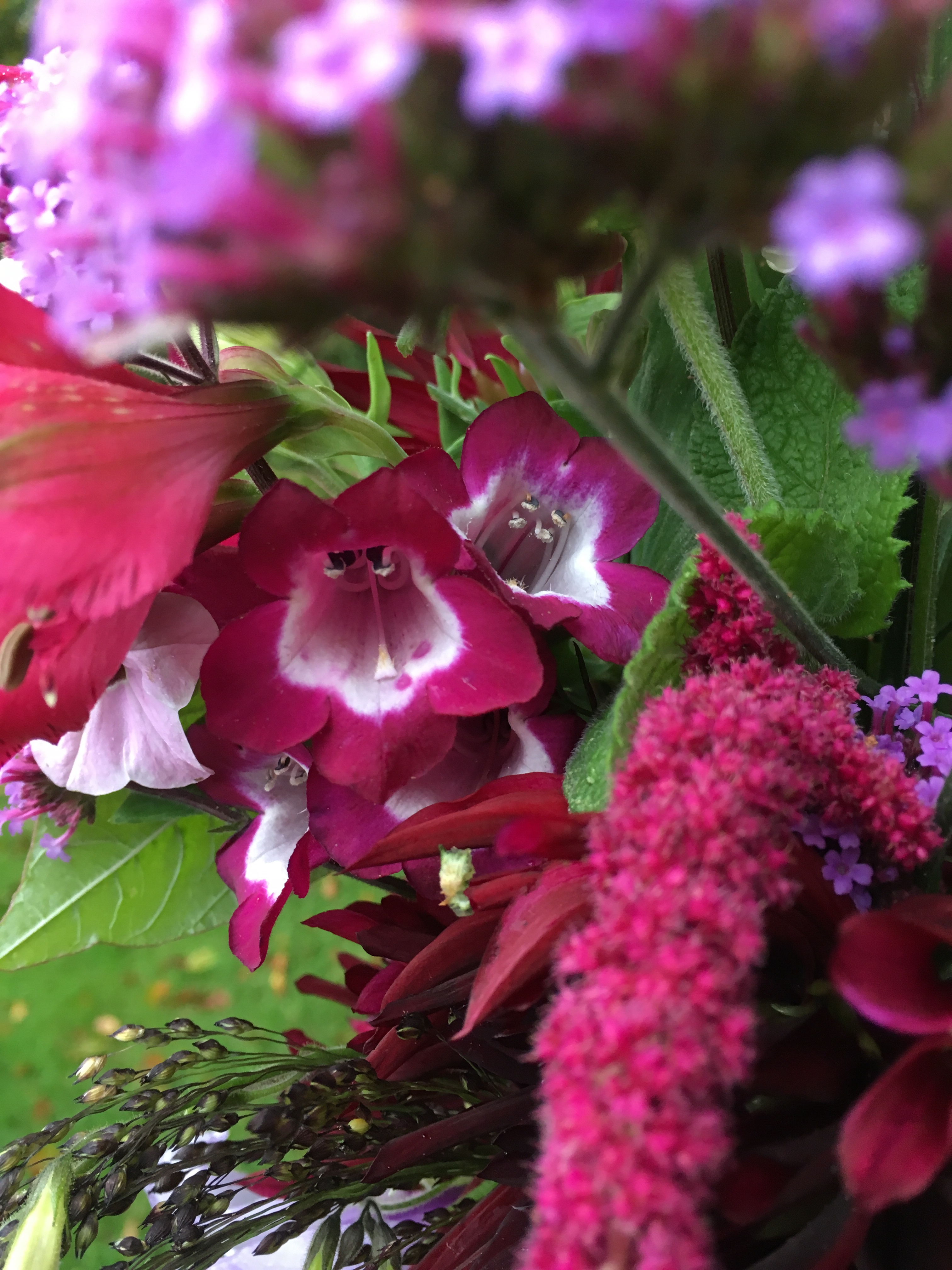
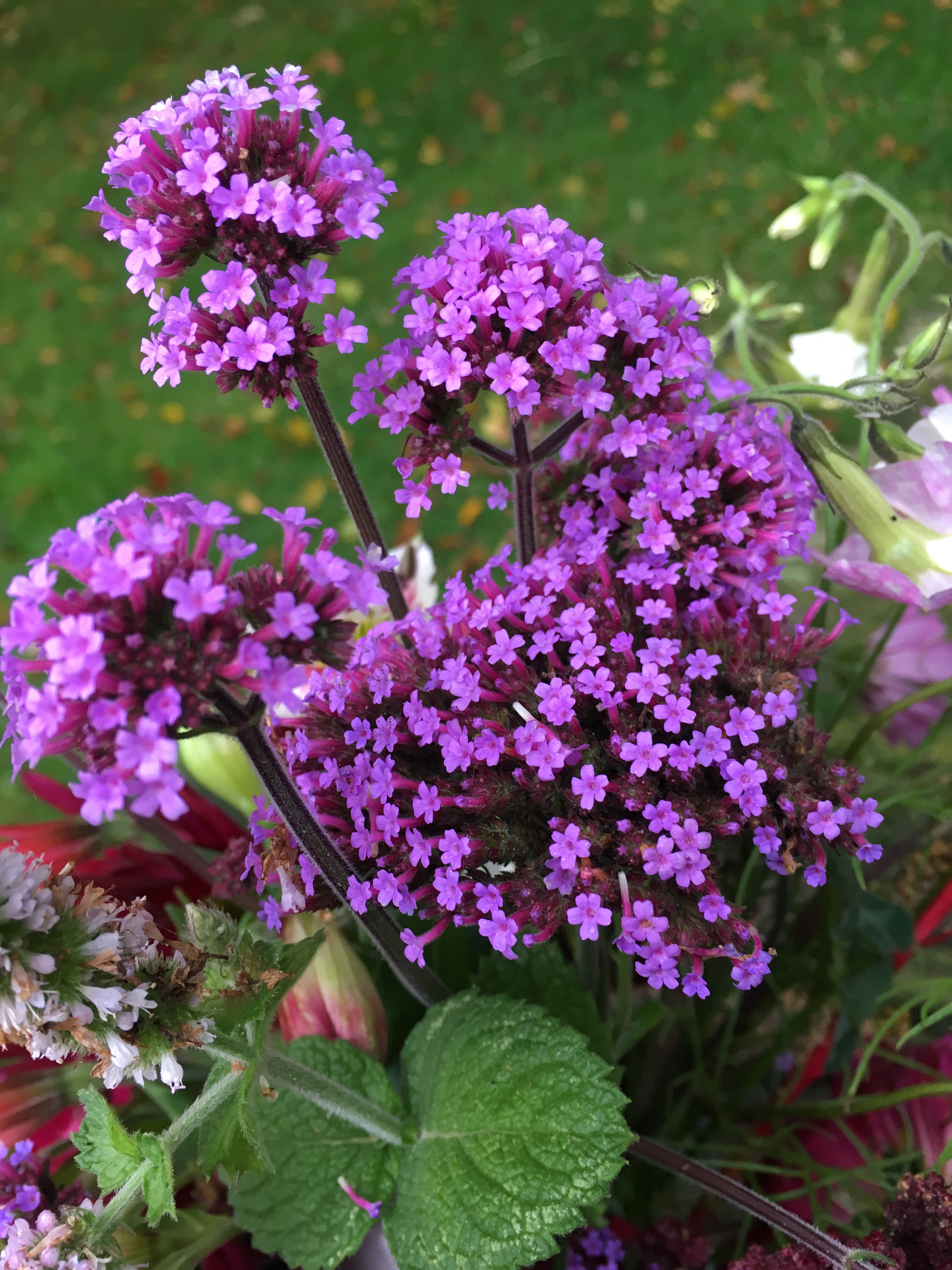
Here’s some details on the prepared hyacinths we mentioned. These are some I grew to flower for Christmas 2016.

You will need to buy “prepared” hyacinths which means they have been put into cold storage to fool the bulbs into thinking they have had winter already. To complete the treatment at home, place the bulbs in John Innes No2 compost in 3″ pots. Put the pots in a cold dark cupboard in the potting shed, garage or basement. Or put them into a black plastic bag. Store them for 9 to 10 weeks at 9C. Water just once. At the end of 10 weeks, check over the pots and those with about an inch of leaves and a flower tip showing can be brought out into a cool bright place to grow on. You can make up displays for Christmas by selecting bulbs that look about the same height and putting them into larger plant pots together. Don’t bring them straight into a centrally heated house or the flowers won’t develop properly. The bulbs need to be grown on in cool conditions for another 22 days.

Here’s some hyacinths and forced narcissi I used to create an early spring display this year. You can also bring twigs of cherry blossom into the house and they will give an earlier flowering too. I wrote about forcing Paperwhites Here.

The scent is quite glorious. Interestingly, different varieties of hyacinths need varying periods of cold/dark treatment. The variety Pink Pearl needs 10 weeks, but Anna Marie needs just 8. So experimentation is needed if you wish to mix the varieties in a display. I would set the 3″ pots at weekly intervals and grow more than I needed so that I could select the right number of plants for my display. Just a reminder- always wear gloves when handling bulbs as they can cause skin irritation.

A very quick and cheap Christmas present idea we mentioned was jam jar succulents. Here’s the materials I took into the studio. You will need a small recycled jam jar, handful of ornamental washed shingle, small amount of moss from the garden, and a succulent or cacti from the garden centre. Mine is an offset from one of my own plants. You half fill the jar with shingle, wrap the succulent stem with moss and plant. Finish the present with a ribbon. Plants need virtually no water over the winter. In summer, water once a week with a tablespoon of water. Tip the jar up to allow any excess water to drain out. Do not allow the succulent to become waterlogged.

This one has been in the jam jar for two years.

Talking of Christmas presents ideas I love these RHS Gold Leaf Gloves. I’m practically living in them, they are so comfortable. I may be a fairly scruffy gardener, with old trousers and holes in my jumpers, but my hands are glamorous.

Here’s a quick peek of Ben’s garden, which we talk about on the show. It’s a 2.5 by 2m raised bed, a bit overshadowed and plagued by slugs. But we’ve planted winter veg, salads and flowers – to see how much we can grow in a small, less than perfect plot. The kale and chard keeps growing through the cold weather. You just harvest the outer leaves, leaving the growing tips to keep going. I’ll keep popping by now and again to see how Ben’s getting on with the project. I’ve got a matching plot at home so we can compare progress. I have to say, Ben’s is looking better than mine at the moment. My plot is on a windswept ridge, and his is in a pretty, walled garden.

And after all that talking- we tucked into my Chocolate and Raspberry Tiffin. I wrote the recipe the recipe Here. Click on the link to see the recipe.

Do you have any recipes to share – or ideas for Christmas presents using materials from your garden? I’d love to hear your views.

In a Vase on Monday- the view from my potting shed.

Seeds are so inexpensive these days, there’s really no need to save our own. One packet of seed can produce hundreds of plants-for just a few pounds. And yet, there’s something about autumn that makes you want to dash round the garden gathering everything in. Every coat pocket at the moment contains a paper bag full of seeds of every shape and size. It’s my natural inclination to harvest, store up, preserve – to make ready for winter. I’m doing the same with jams and chutney. Capturing the summer. My defence against the cold. 

For this week’s Vase on Monday, there’s white cosmos, sweet peas, rudbeckias, verbascum, malmaison carnations and grasses  all grown this summer from seed. 


My favourite sweet pea is  the variety High Scent. It’s a deliciously creamy colour flower with a blue picotee edge. These were direct sown in June to give a late show until the first frosts. The scent is glorious on a sunny day, but at this time of the year it’s less evident in the garden. A posy on a bedside table in October though, is a joy. Heat from the log fire seeps right through the house,  bringing out the most wonderful scent. 


Rudbeckias flower all summer, whatever the weather. Reliable and long lasting in a vase. There’s usually a few stems to pick every day, until November. 


Seed originally came from Higgledy Garden. I’ve got my eye on some new seed – persicaria orientalis , and lavender larkspur for next year. But for now, my collected  seed is laid out in little containers in the potting shed, drying off and waiting to be sown again next season.  

Thanks to  Cathy for hosting this theme. 

In a Vase on Monday 

For the past two years, I’ve run round my garden on a Sunday and created a posy of “everything in flower” for my mother-in-law, Joan. Sadly, she can’t visit us as often as she would like. My father-in-law no longer drives, and they are both in their late eighties. So I try to create a series of mini- posies, one with scent, another with foliage. It’s a flavour of the garden that I’m after. They are simply tied with string and not arranged. Joan takes great delight in studying each stem and making her own creations.  It’s my way of sharing my garden with my in laws. Keeping the dialogue going and asking advice.  It’s become a kind of tradition. One I am happy to have started.


Blue Aster Monch, Clematis Polish Spirit, Persicaria, white Cosmos Purity and white Aster Monte Casino.


I  prepare the posies in my potting shed, stripping off the lower leaves and plunging the flowers in a bucket of fresh cold water for a few hours before tying them with string. Conditioning them like this means they will last for at least a week in the vase. More information on growing cut flowers and preparing them from  Georgie at Common Farm Flowers


Sweet pea High Scent, well named- and reliable. Blue Aster Monch, Diascia rigescens, and  Antirrhinum Black Prince. I’m sowing more sweet peas this week. Heritage varieties from  Easton Walled Garden, historic renovation project near Grantham, Lincs.


Verbena Bonariensis seeds itself around the cut flower patch and provides pickings from May to November. Alstroemeria flowers all year round in a cold poly tunnel.  

Gardening and growing flowers-  such simple pleasures-  much better when they are shared with someone. 

Thank you to   Cathy at Rambling in the Garden  for hosting In a Vase on Monday.