Inspiring People: Phyllis Tuckwell Charity

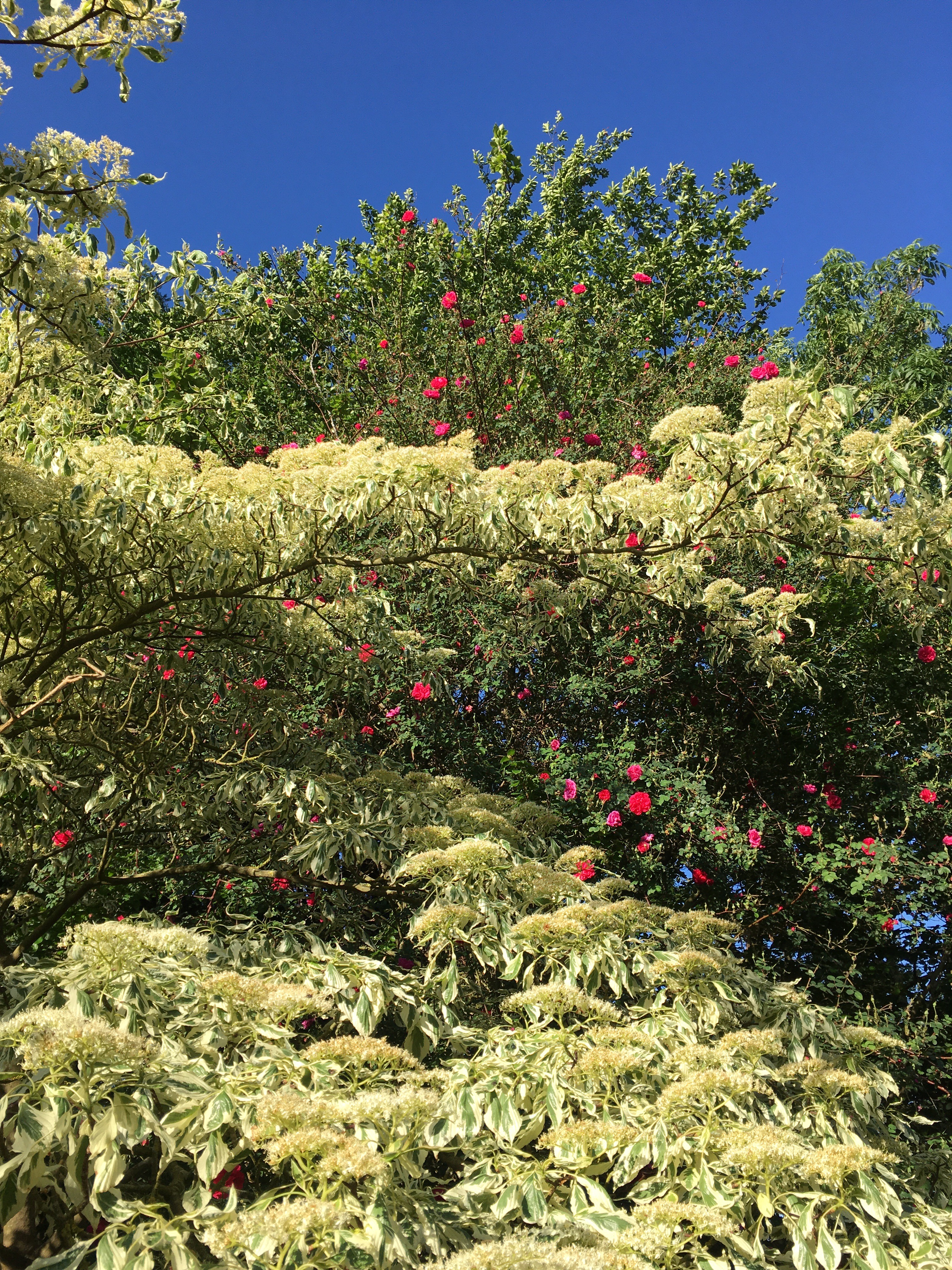
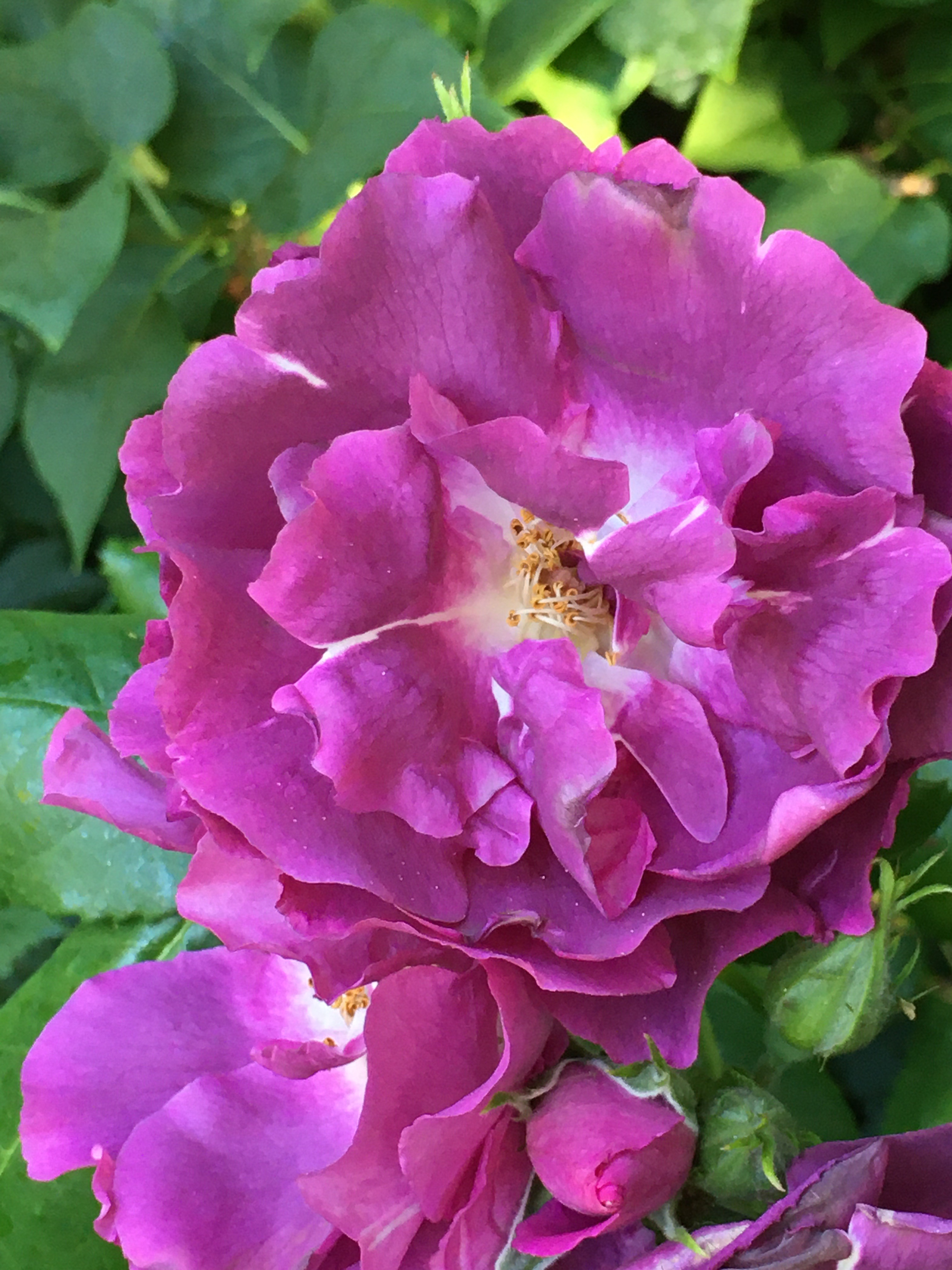
Beckhams, Coxcombe Lane, Chiddingfold – 14 Sept.

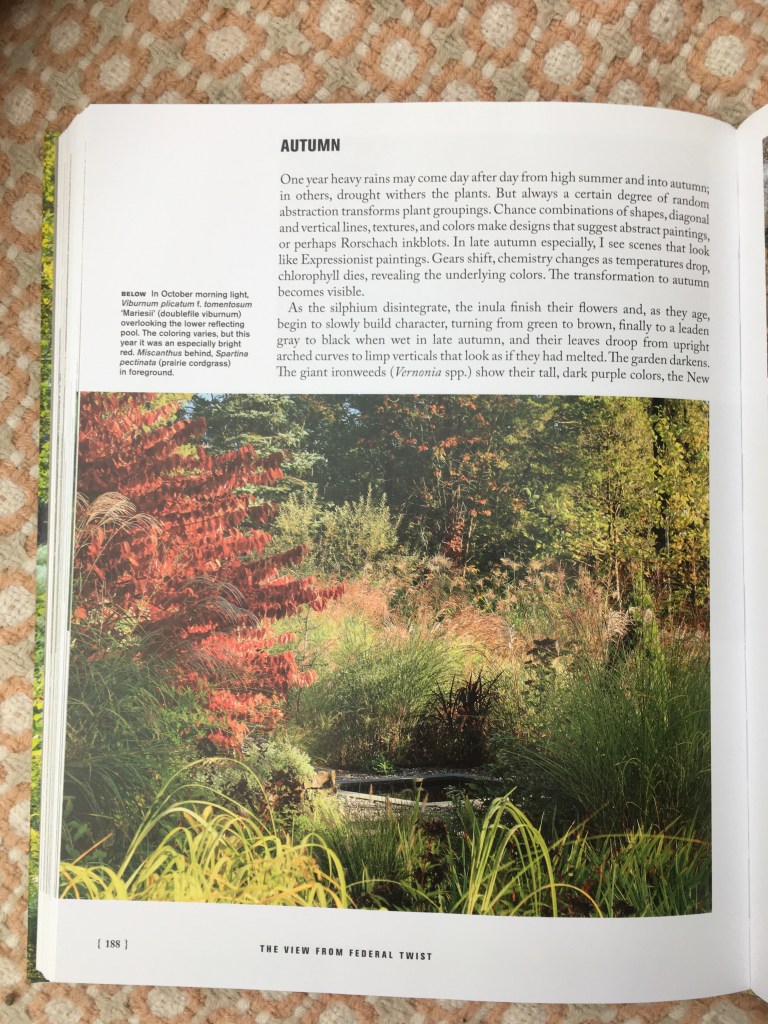
This blog is dedicated to highlighting special people who are gardening to make a difference. The Phyllis Tuckwell charity has to raise £25,000 every single day to fund the hospice care it provides. Just take a moment for that to sink in. £25,000. Every single day! It’s an amazing challenge. Open gardens is one way the organisation raises funds. I’m sharing details of the gardens here, in the hope that if you live in the area, you’ll visit and help them reach their targets.

Poster for this year’s events. A range of gardens open between 29 May and 14 September 2025.

For a complete list of gardens taking part, download the brochure here:

https://www.pth.org.uk/open-gardens/

Susie Floud’s garden, 13 Rowland Road, Cranleigh, Surrey.
Binsted Place, Alton, Hampshire.
Serendipity, Chiddinfold open gardens – 14 Sept.
75 Kenilworth Rd, Fleet, 21 June
Deron, Yateley, Surrey. 12 July.

Some of the highlights include:

Art and music in the garden, Greenhills Estate 7 June

Crondall open gardens 8 June

Godalming gardens 8 June

Fleet orchestra proms 11 June

Skydiving event 8 June

Alton open gardens 6 July

*Please check times and dates with the website before visiting.

Jack’s Jungle, Chiddingfold, 7 Sept.
Jack’s Jungle.

Phyllis Tuckwell is the only Hospice Care service for adult patients, and their families and carers, who are living with an advanced or terminal illness such as cancer, across the whole of West Surrey and part of North-East Hampshire.

“Every day we support over 250 patients, relatives and carers, through medical and nursing care, therapies, counselling, social work advice and practical support. We offer this care on our In-Patient Unit, through our Living Well service, and in patients’ own homes and care homes.

Our specialist, compassionate care helps patients to manage their symptoms, improve their wellbeing and remain as independent as possible throughout their illness. We also support the families and carers of our patients, as well as local healthcare providers, building skills and confidence in palliative and end of life care… because every day is precious.

As the NHS/Government only cover around 25% of our costs, we have to raise over £25,000 every single day to be able to offer all of our services, which we provide free of charge to our patients and their families and carers. That’s why events such as Open Gardens are so incredibly important. By taking part, you’ll be helping us to raise these vital funds – and we really appreciate your support.”

Thank you for reading my blog. Please leave a comment in the box below, sign up for e mail notifications and pass on any good news you’ve heard on this blog! We can all help one another just by sharing what we know and by supporting everyone trying to make a difference. Thank you.

Gardeners World Live Show at Beaulieu

UPDATE: The free tickets have been won by Gary Legg. Thank you everyone who took part in the prize draw.

Thank you to everyone who took part in the recent prize draw for the NEC Gardeners World Live show.

Now there’s an opportunity to win two tickets for the Beaulieu show for Sunday May 4th.

Frances Tophill presenting from one of the show gardens.
Bug and butterfly hotels feature in this show garden at GW Live.

Gardeners World presenter Arit Anderson will be appearing at the show. She was recently presented with the RHS Veitch Memorial Medal, awarded to those who have made an outstanding contribution to the advancement of the science and practice of horticulture.

The show organisers say:

“We can offer a pair (one winner) of standard adult tickets for the BBC Gardeners’ World Spring Fair at Beaulieu. Tickets will be valid for Sunday 4th May, 9.30am entry. RRP £52.00 per pair.

The winner will be emailed a link to register online and will receive their tickets by email.

Tickets are non-refundable, non-exchangeable and non-transferable, and do not include travel, accommodation or expenses. There is no cash alternative. Details of giveaway and prize correct at time of print. Ticket terms and conditions apply https://www.immediatelive.com/ticket-terms-and-conditions .

To take part in the prize draw, please leave your name in the comments box below and a winner will be drawn randomly on Easter Monday at 6pm. Please include your name as otherwise the reply just says “someone.” And check back to see if you have won. If there’s no reply from the winner within 24 hours I’ll chose another name.

Please note, this competition is for the Beaulieu event only, and not for the NEC event.

Car parking

You’ll find information about parking at Beaulieu here and disabled parking here.

Good luck everyone and Happy Easter!

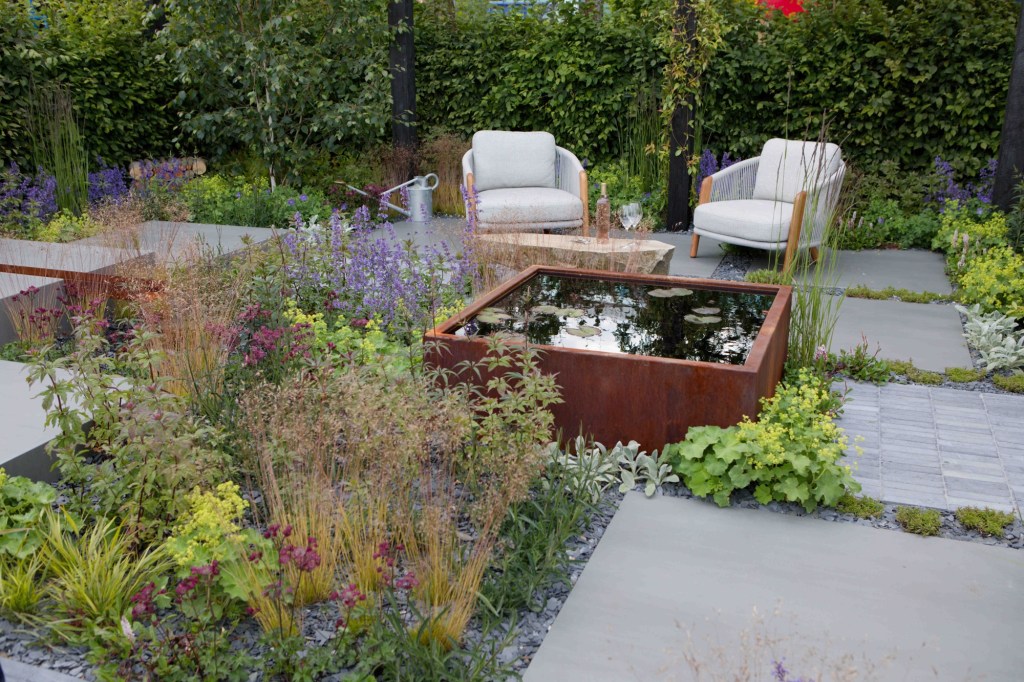
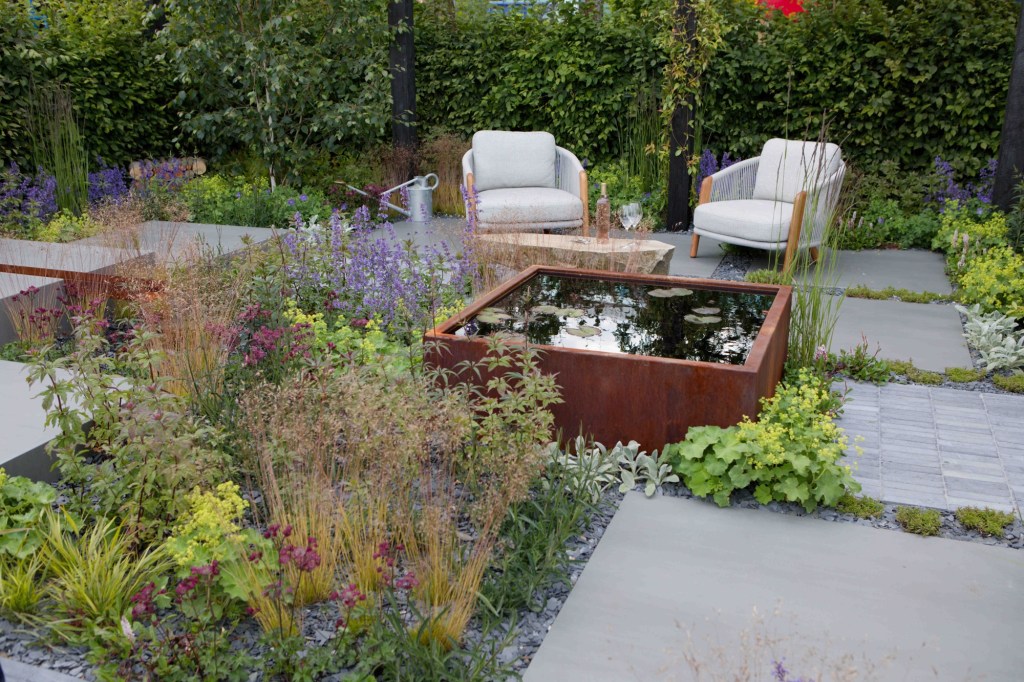
A quiet pool of water at the GWLive show.
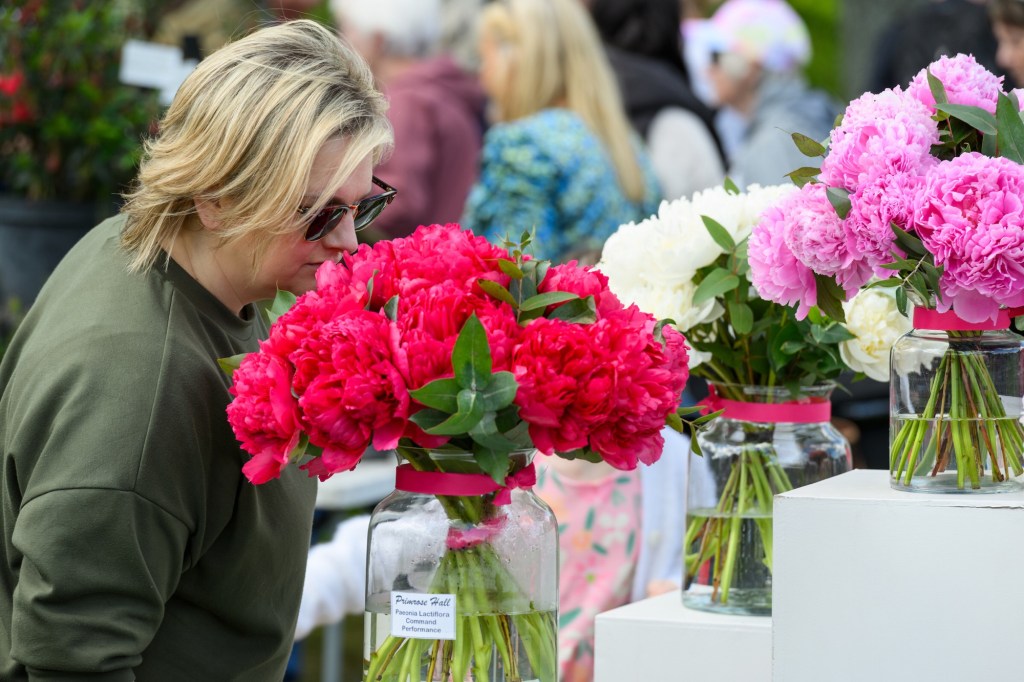
Primrose Hall Peonies.

Prize winner for Gardeners World Live tickets

Derrienne Bell has won the two free tickets for GW Live in the prize draw competition. All names were included in the draw and Derrienne’s name was randomly selected.

Thank you for taking part in this prize draw.

The organisers have also given me a discount code to pass on to blog readers. Please read the terms and conditions carefully. Remember that car parking is not included in any offers and is expensive.

The organisers say:

You requested a discount code for your followers. These are:

SAVE20: 20% off standard adult/concession entry tickets (applies any day),offer expires 23:59 on 7 May 2025

SAVE15: 15% off standard adult/concession entry tickets (excluding Saturday),offer starts 8 May, expires 23:59 on 4 June 2025.

*Discounts valid on adult/concession standard entry tickets. Not valid on VIP, 2-day tickets, added extras or with any other offer. £3.95 transaction fee per advance order. Details correct at time of print.

I’m looking forward to viewing the show gardens again this year. There’s always a good selection of styles, and they are more relevant to me than the expensive RHS show gardens.

Thank you again for reading my blog. Have a great gardening week! Look out for more book reviews and tickets coming up…..

You might find this info and link useful for car parking for the show, which can be expensive if not purchased in advance.

“You’ll find parking info at the link here: https://www.bbcgardenersworldlive.com/whatson/getting-to-the-show/. The organisers strongly advise advance booking for pre-paid parking (up to 24 hours prior) to save time and secure the best rate, £8. This price has been subsidised by Immediate Media.”

Gardeners World Live. Giveaway for two free tickets.

*Please remember to leave your name, or comments just come up as ‘anonymous.’ Thank you.

Dan Hartley Eco Oasis Garden

Each year, the organisers of Gardeners World Live offer my blog readers the chance to win two free tickets. This has been successful and I’ve had wonderful reports back that winners have enjoyed a really lovely day out.

Nick Bailey garden design. Alexandra Froggatt ©️

It’s very simple to enter. Just leave a comment in the box below and names will be randomly selected on Sunday 30 March.

Please read the terms and conditions carefully. Tickets are for a specific time and date. The prize does not include car parking which is expensive.

The organisers say: “We can offer you a pair of standard adult tickets, valid Sunday 15th June, 9.00am entry, RRP £58.00 per pair. The organisers will not be issuing paper tickets. Winners will be emailed a link to register online and will receive tickets by email.

“Tickets are non-refundable, non-exchangeable and non-transferable, and do not include travel, accommodation or expenses. There is no cash alternative. Details of giveaway and prize correct at time of print. Ticket terms and conditions applyhttps://www.immediatelive.com/ticket-terms-and-conditions

The Chef’s Table garden by Adam Frost
QVC Reflective Retreat
My favourite feature of the garden: The Plant Expert stage with much-respected gardeners and designers, Tamsin Westhorpe, Lucy Chamberlain, Saul Walker and Prof David Stevens.
The show attracts the best people in horticulture. Much-respected writer, speaker and teacher David Hurrion hosting the ‘Lets Talk Plants’ stage.
All photos ©️ Gardeners World Live

I hope you’ve enjoyed these photos from past shows. I’ve written about the Gardeners World Live Show here:

https://bramblegarden.com/2021/07/03/gardeners-world-live-two-tickets-to-give-away/

Please leave a comment below including your name, otherwise the comment just says “someone.” Look back to check if you have won the tickets. The draw will be at 6pm. If there’s no response within 24 hours, the prize will be re-drawn. Good luck!

Update: Derrienne Bell has won the two free tickets. Thank you for taking part.

Here’s some info from the organisers regarding parking for the show.

“You’ll find parking info at the link here: https://www.bbcgardenersworldlive.com/whatson/getting-to-the-show/. The organisers strongly advise advance booking for pre-paid parking (up to 24 hours prior) to save time and secure the best rate, £8. This price has been subsidised by Immediate Media.”

Spring Courses

There’s nothing better than combining a love of flowers and gardens with learning a new skill. Here are some tempting courses on offer this spring.

Botanical artist Lauren Lusk

Tuesday 29 April, 2025.

Broadwell Manor, Broadwell, Gloucestershire.

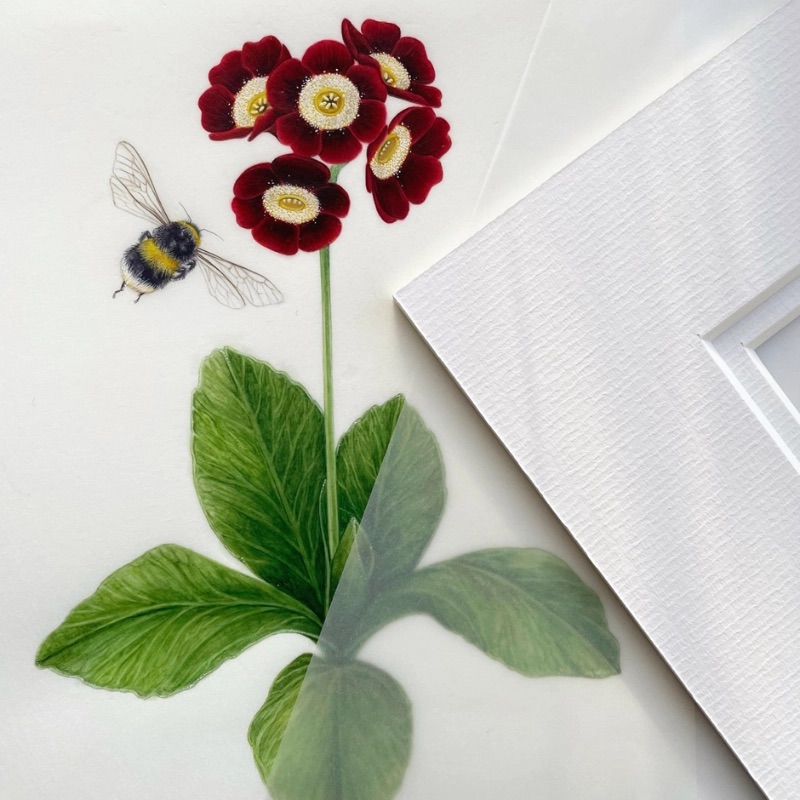
Auricula appreciation and painting day.

https://broadwellmanor.com/events/

Lauren Lusk

Details on the Broadwell Manor website say Lauren trained at the world-renowned Central St Martins. Lauren found it impossible to ignore the lure of plants, which were the focus of her degree show. Her love for the natural world is perhaps to be expected, given that Lauren is Rachel de Thame’s eldest daughter and she grew up surrounded by plants. Some years after graduating, Lauren decided to focus on botanical painting. Predominantly working in the time-honoured, traditional but painstakingly slow technique of applying layers of watercolour to vellum. For this workshop she will be showing how to use watercolour on paper to paint the charming detailed ‘faces’ of individual auriculas. Lauren was recently featured in House & Garden Magazine and her work is being widely commissioned and collected.

Lauren’s botanical painting
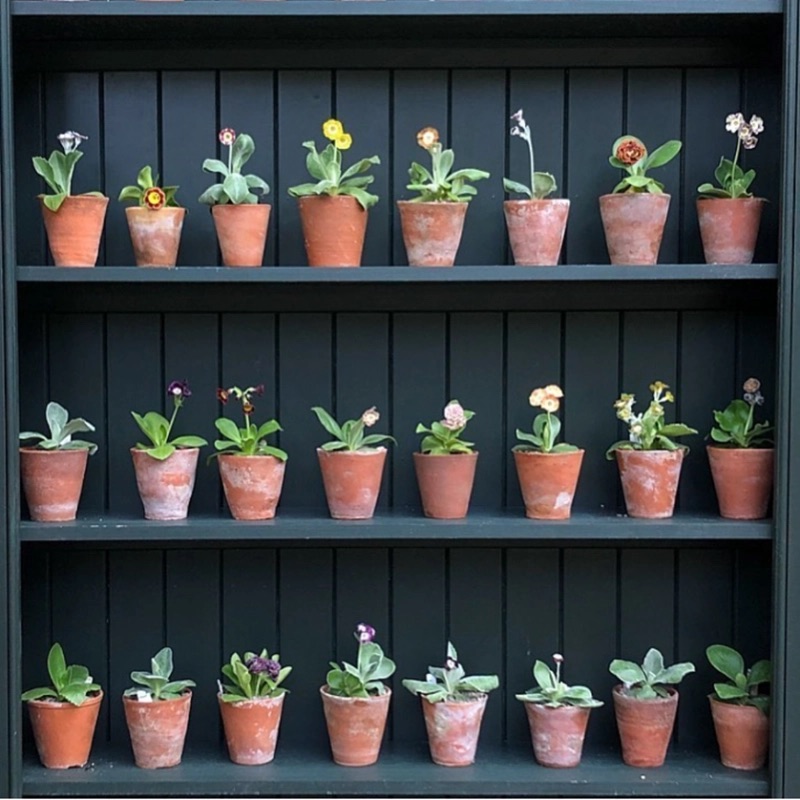
Auricula theatre featured on the Broadwell website.
All photos ©️Broadwell Manor/ Lauren Lusk

Lauren recently produced a series of paintings of flowers and graphite drawings of insects for A Flower Garden for Pollinators, written by Rachel de Thame. 

Rachel’s book was reviewed on the blog here:

https://bramblegarden.com/2024/12/16/a-flower-garden-for-pollinators-by-rachel-de-thame/

Lauren’s website is:

https://laurenluskbotanical.com

Monty Cholmeley

Wednesday 23 April 2025

Easton Walled Gardens

Introduction to Watercolour Workshop 

The website says: This workshop is aimed at complete beginners and you will leave with an understanding of how to mix colours, both on the palette and on the paper. You will also take home your own set of watercolours and a brush to continue practicing! 

Meet at 5.30pm in our Coffee Room, before embarking on a two hour class from 6pm-8pm, where you will learn the basics and beyond of working with this special medium. You will leave with techniques you can replicate at home and a deeper understanding of colour.

Tickets include coffee and materials.  

8 places available. 

Photos ©️Easton Walled Gardens

Monty Cholmeley is the son of the owners of Easton Walled Gardens.

He is well known for his art work and photography.

More details and prices on the website.

http://www.visiteaston.co.uk

David Stevens

Photo ©️ Barnsdale Gardens

Saturday 12 April

At Barnsdale Gardens, Rutland

Planting Design

The website says: If your garden is not achieving everything you envisaged and you’re unsure what to do, then why not join internationally renowned garden designer David Stevens for this very special workshop.

David will take you through all the basics, as well as looking at specific plants, showing how they work best in a garden, planting techniques and preparing a planting plan.

David is in great demand as a designer and lecturer in garden design all over the world, so this day is a treat not to be missed!

Price includes tea/coffee, lunch and entry to the Gardens.

To book look on the website

https://barnsdalegardens.co.uk/index.html

Barnsdale spring flowering cherries. Photo ©️Barnsdale Gardens

Also at Barnsdale this year there’s botanical painting courses 12/13 Nov and a focus on painting dahlias on 17/18 Sept.

I am pleased to be leading several courses at Barnsdale this year.

Growing Flowers for Cutting, 3 September:

https://shop.barnsdalegardens.co.uk/products/growing-flowers-for-cutting

Creating borders with 365 days of colour. 10 October.

https://shop.barnsdalegardens.co.uk/products/365-days-of-colour

Thank you for reading my blog. Are you planning to attend any courses this year? Please leave a message in the box below. If you are new to the blog, please follow and sign up for notifications via e mail, and remember to say hello in the comments below! Happy gardening!

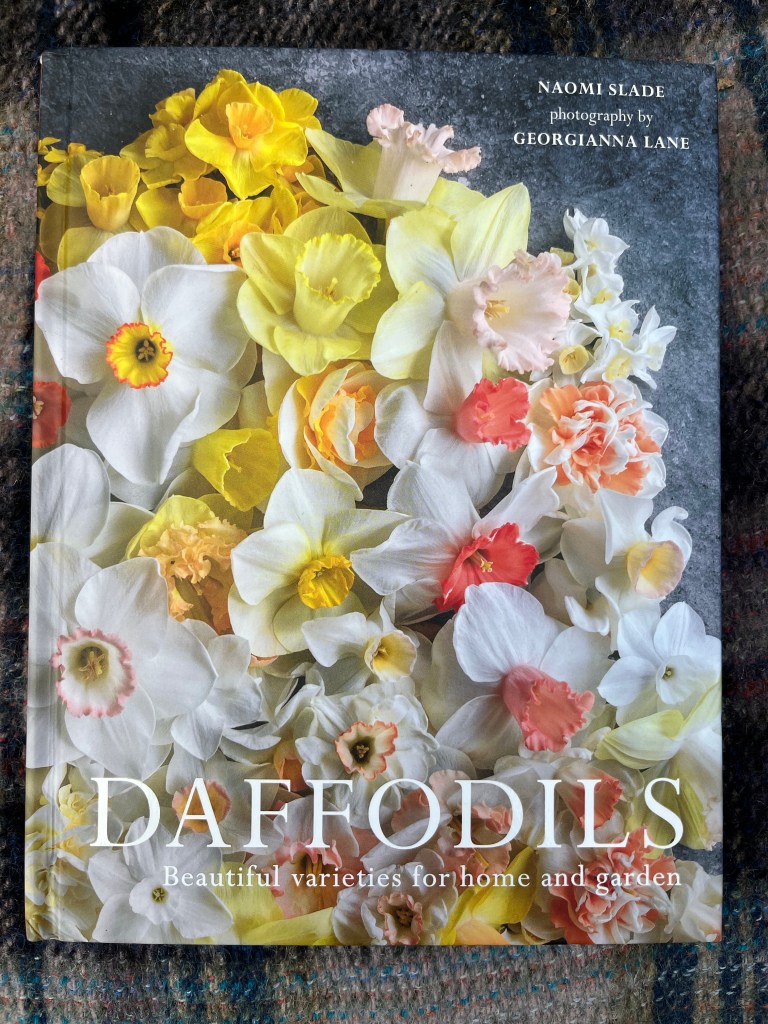
Daffodils by Naomi Slade

Book Review and giveaway.

Published by Pavilion/ Harper Collins

Photographs by Georgianna Lane

Hardback 240 pages. RRP £25

Published 13 March 2024

Can there ever be anything more cheerful than the first sign of daffodils in spring. I sigh with relief as soon as they emerge from the recently frozen, muddy ground. The worst of the winter is behind us. Spring is well and truly on the way. We have come through the cold, dark days and survived the winter once more.

Naomi Slade’s latest book is a joyful celebration of daffodils. Colour springs from every page with the wonderful photography of Georgianna Lane combined with the glorious descriptions by the award-winning author. It really is the kind of book you’d want to leave open on a different page every day. Just to gaze at the photographs and read Naomi’s words is like a balm.

Contents page

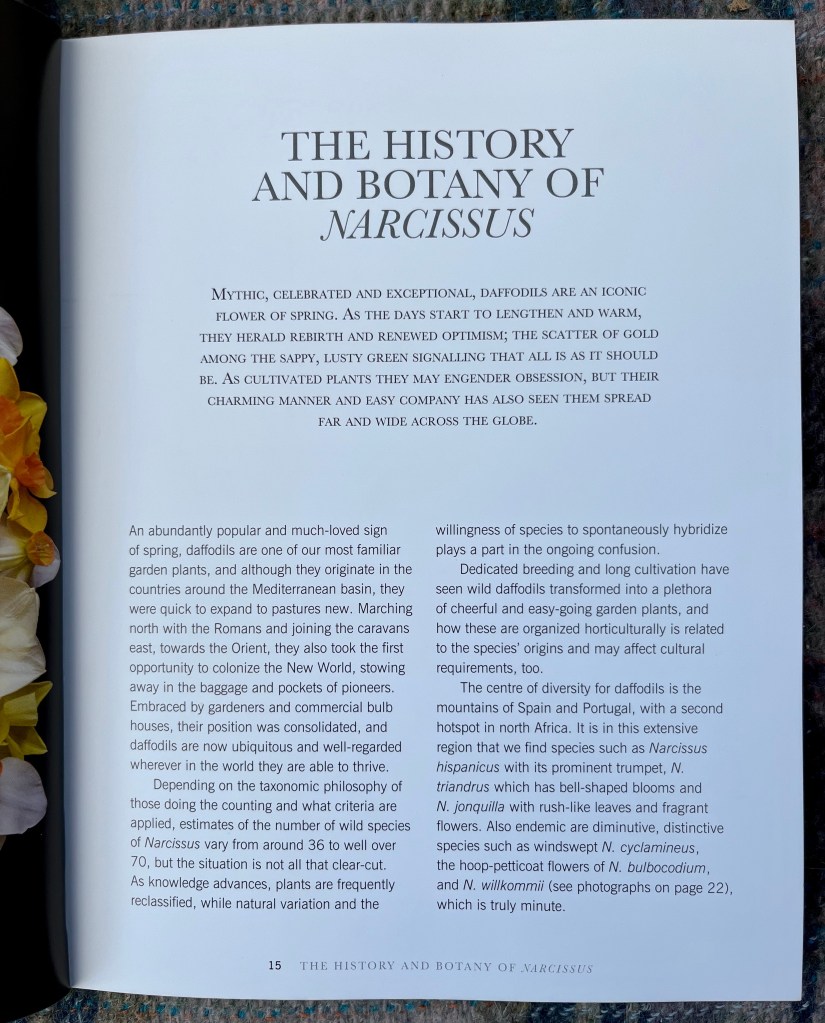
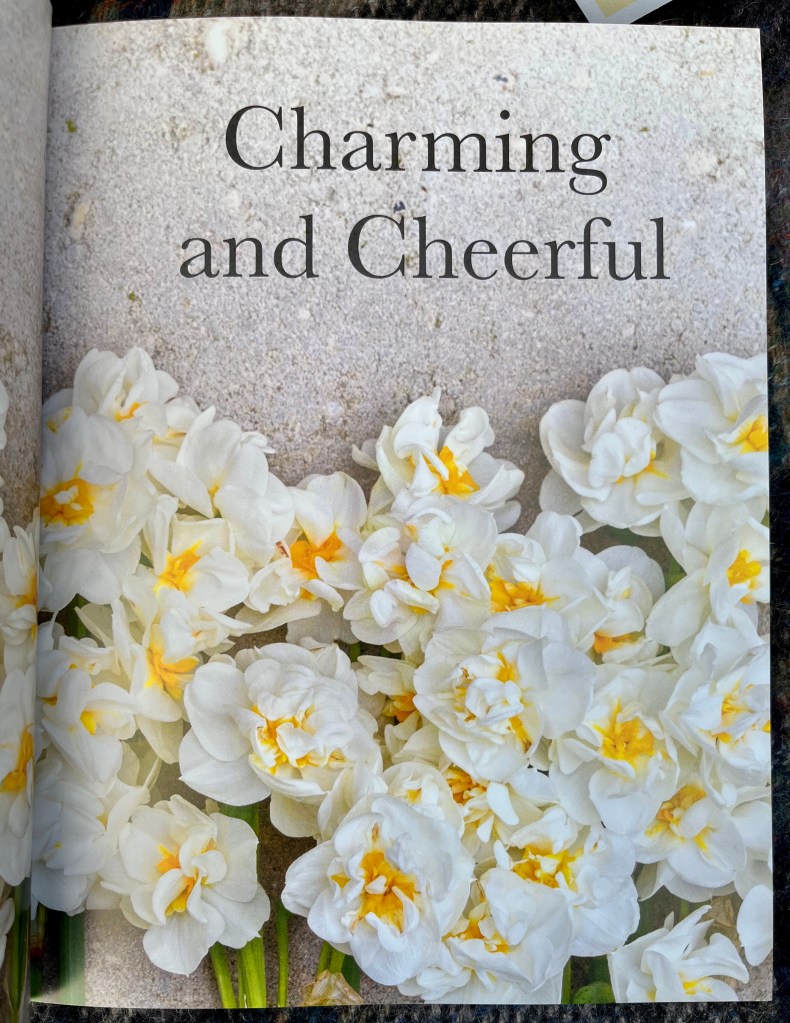
Naomi splits the daffodils into categories: charming and cheerful, ruffled and fluttering, demure and delicate, glorious and glowing. There are sections on the history of narcissus, as well as growing advice, and information on pests and diseases.

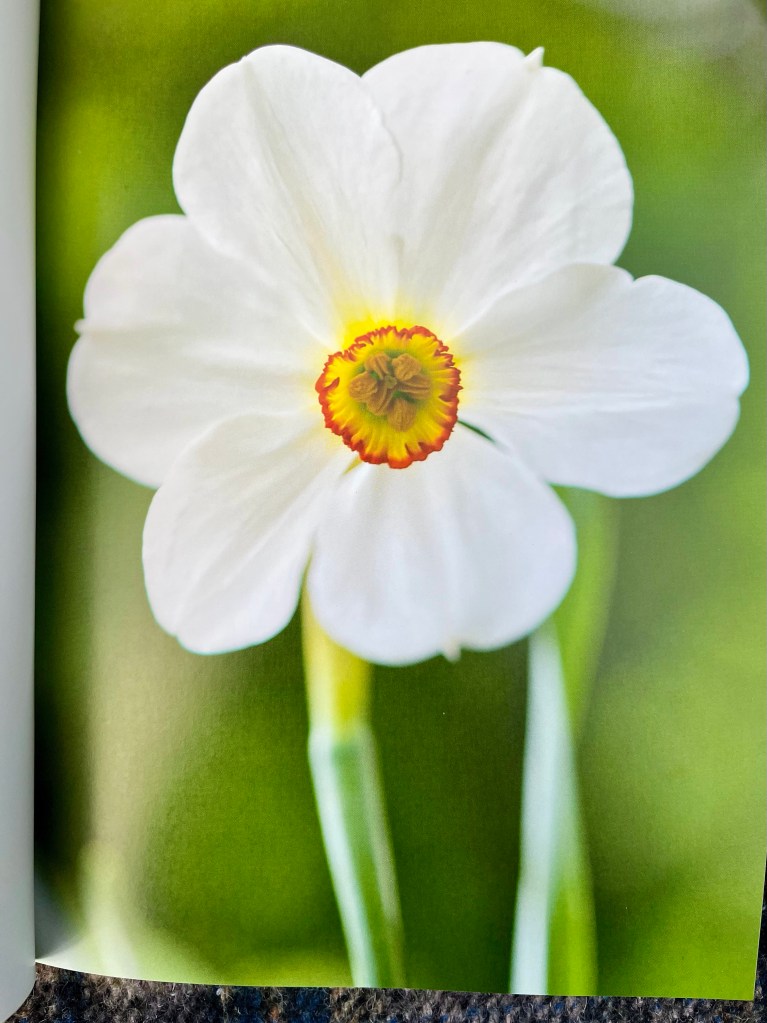
Excerpts from the book
Naomi describes 60 varieties with suggestions for planting, growing and cutting. The book would make a lovely gift for any fan of spring flowers, for gardeners, florists and collectors alike.
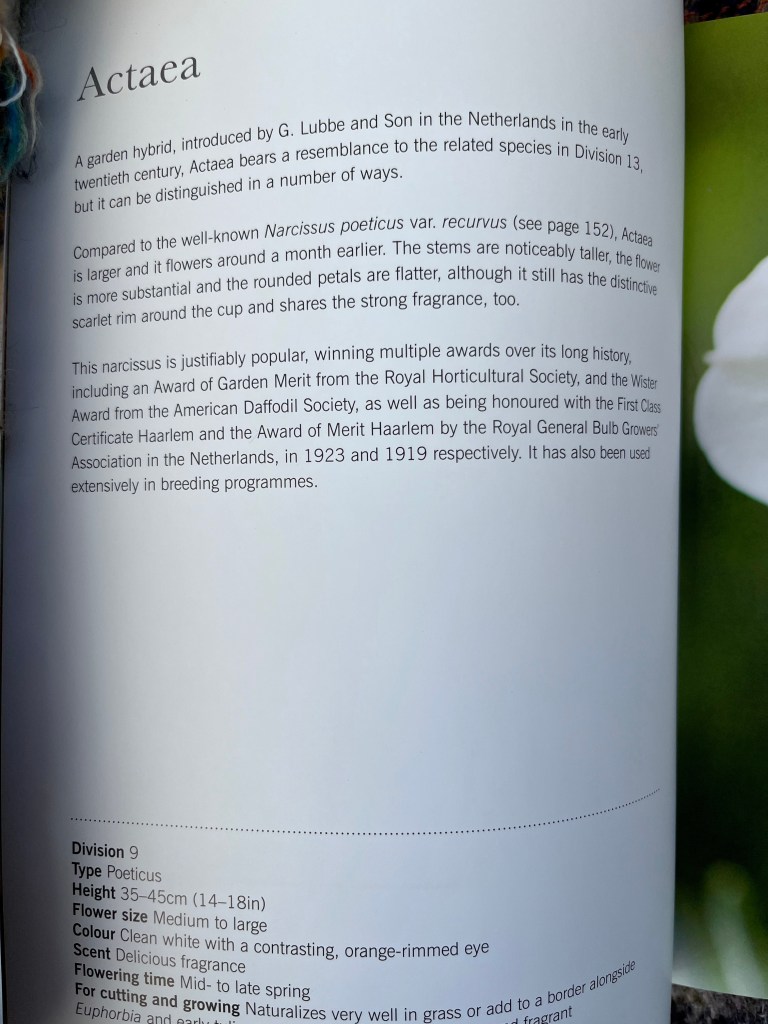
Actaea. One of my favourites.
Selected varieties are each given a page of description.
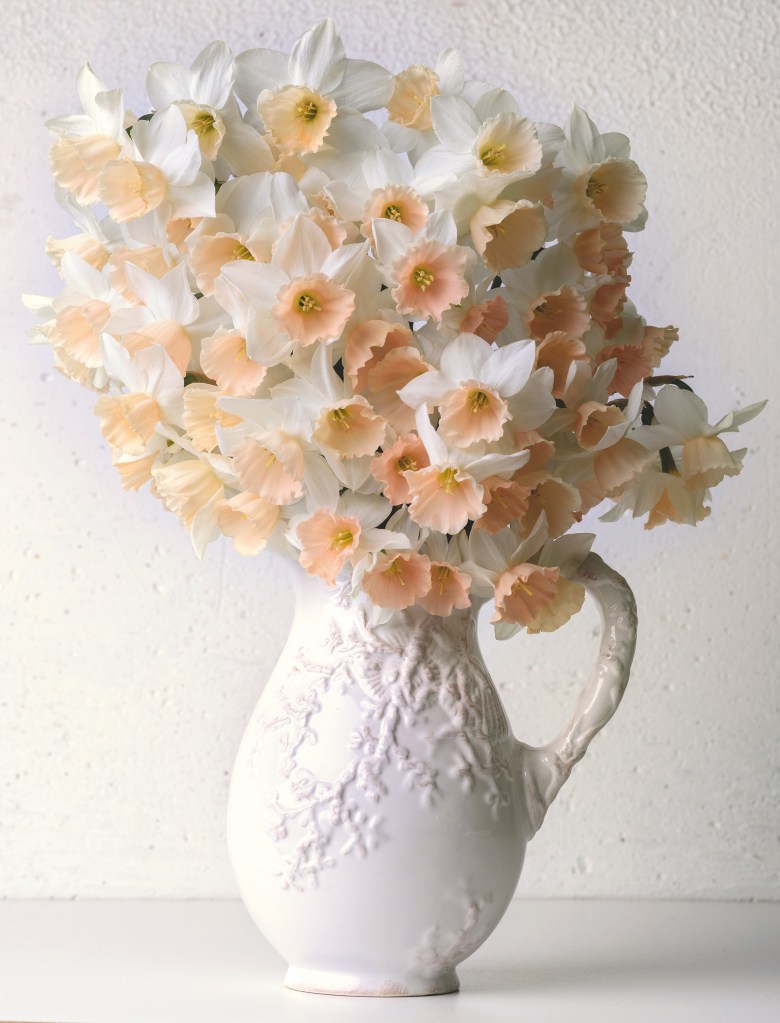
Delnashaugh – a large double cream and apricot variety. Ruffled and layered, makes a lovely flower for a vase or a bridesmaid’s posy.
Royal China. Introduced in 1997 by British grower Clive Postles. ‘The rounded petals present themselves in two overlapping layers, in a gentle shade of pearly white that sparkles subtly in the sunshine. The central corona, meanwhile, is exquisitely formed; ivory white along its length with a greenish yellow splash at the base and a crisp pink frill to the rim.”
Lilac Charm
Pink Paradise
Trigonometry
The ever-popular tete-a-tete
Katie Heath

Katie Heath is a muted palette of pink and cream. Lovely with willow twigs and catkins. “Named in honour of the mother of Brent Heath, who has himself found fame as one half of the well-known American bulb nursery duo that is Brent and Becky’s Bulbs.

About the author and photographer

I can wholeheartedly recommend ‘Daffodils’ by Naomi Slade. It’s written in a cheerful, enthusiastic style with just the right amount of detail to answer all your questions.

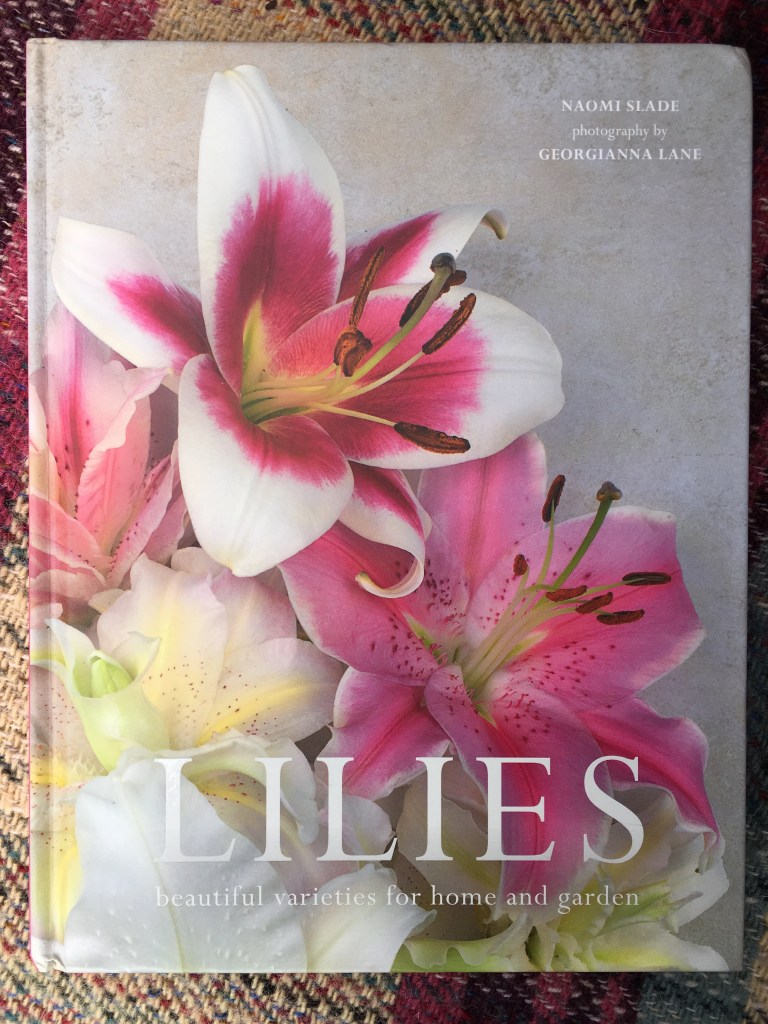
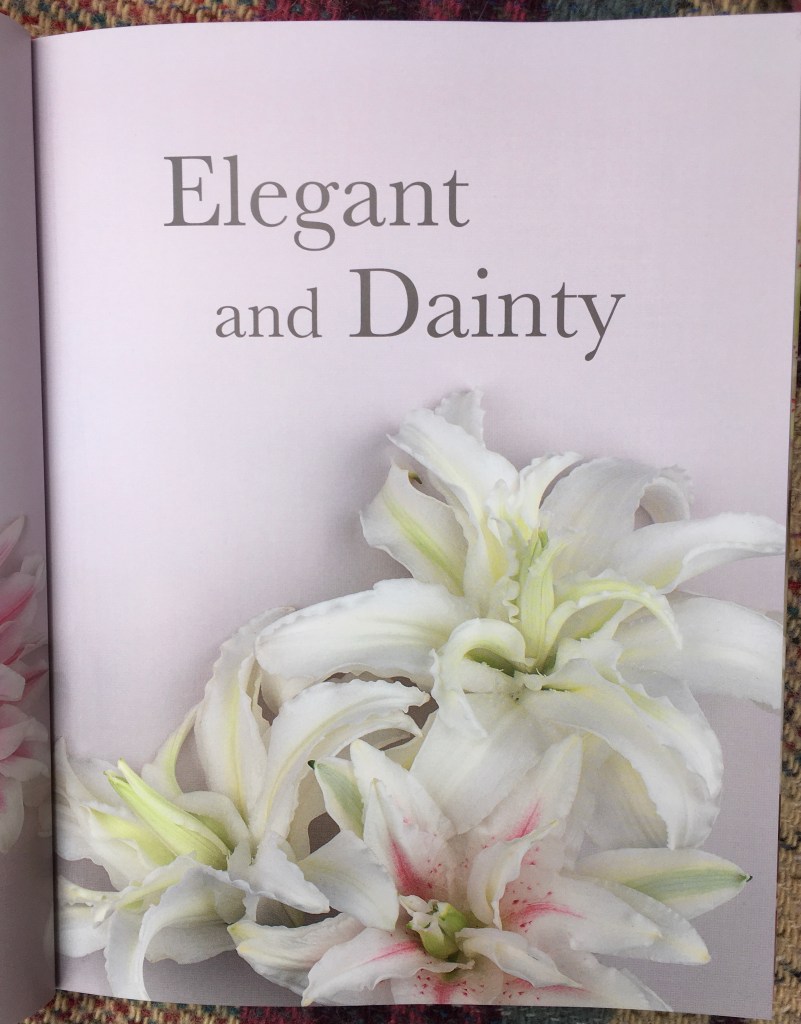
Daffodils is the latest in a series written by a Naomi and photographed by Georgianna. Previously, I’ve reviewed Lilies, Dahlias, Ranunculus, and Chrysanthemums. There’s also Hydrangeas and Lilacs. This latest book is just as brilliant and inspiring as the others. A triumph again for this super talented duo!

Thank you for reading my blog. The publishers have kindly offered one copy to give away to readers. To be included in the prize draw, please leave a comment and your name below. Sorry, uk only. There’s no cash alternative and the publisher’s decision is final. The draw will be on Saturday 15th March 6pm. Please look back on Saturday to check if you have won. The prize will be redrawn on Sunday if there’s no reply from the winner.

I wrote about Lilies here:

https://bramblegarden.com/2021/05/25/lilies-book-review-and-giveaway/#:~:text=Stunning%20to%20look%20at%2C%20and,flowers%20reaching%20almost%20the%20roofline.

I wrote about Dahlias here:

https://bramblegarden.com/2018/06/24/dahlias-beautiful-varieties-for-home-and-garden/

Please remember to add your name at the end of comments as otherwise it comes out as ‘someone.’

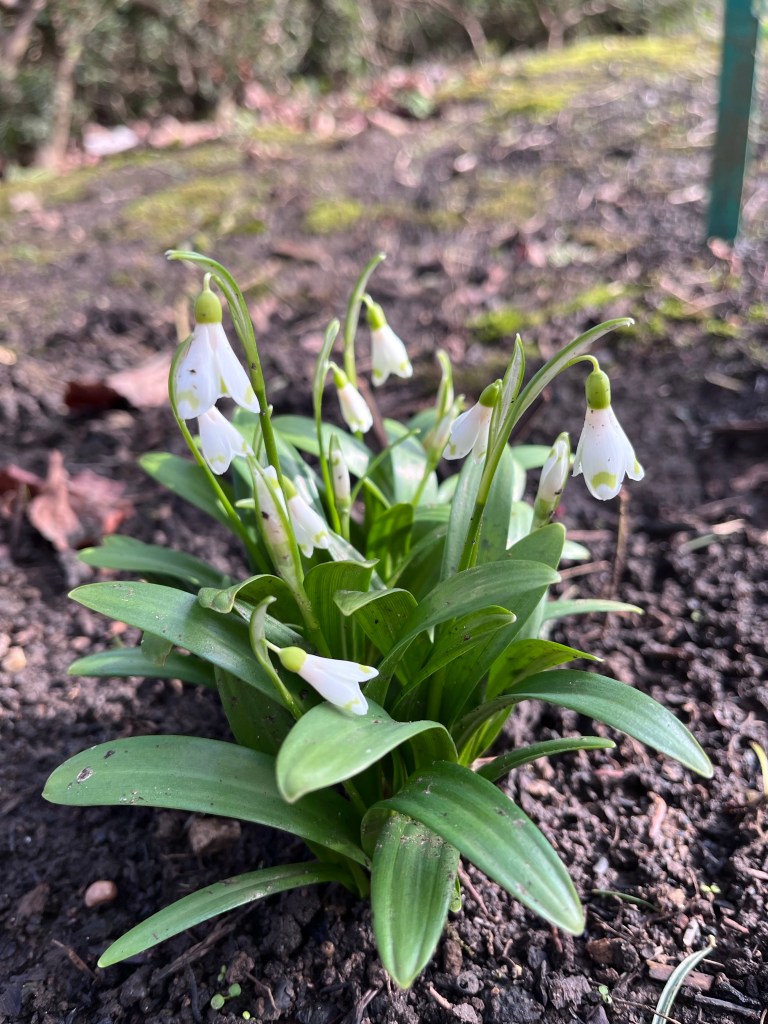
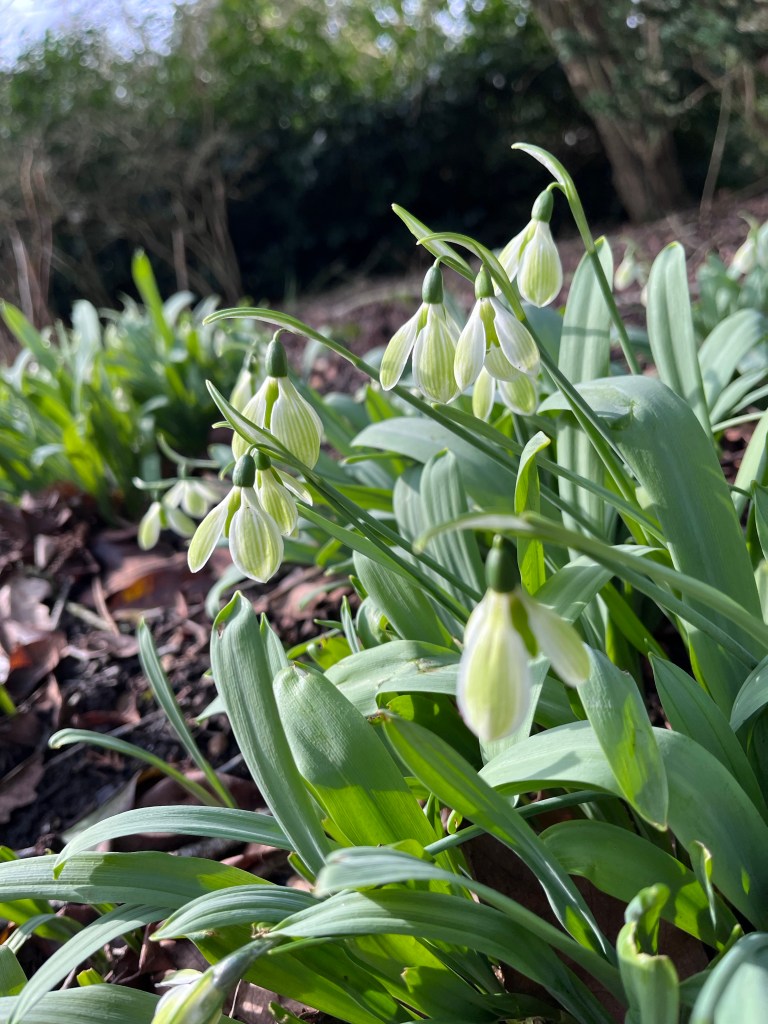
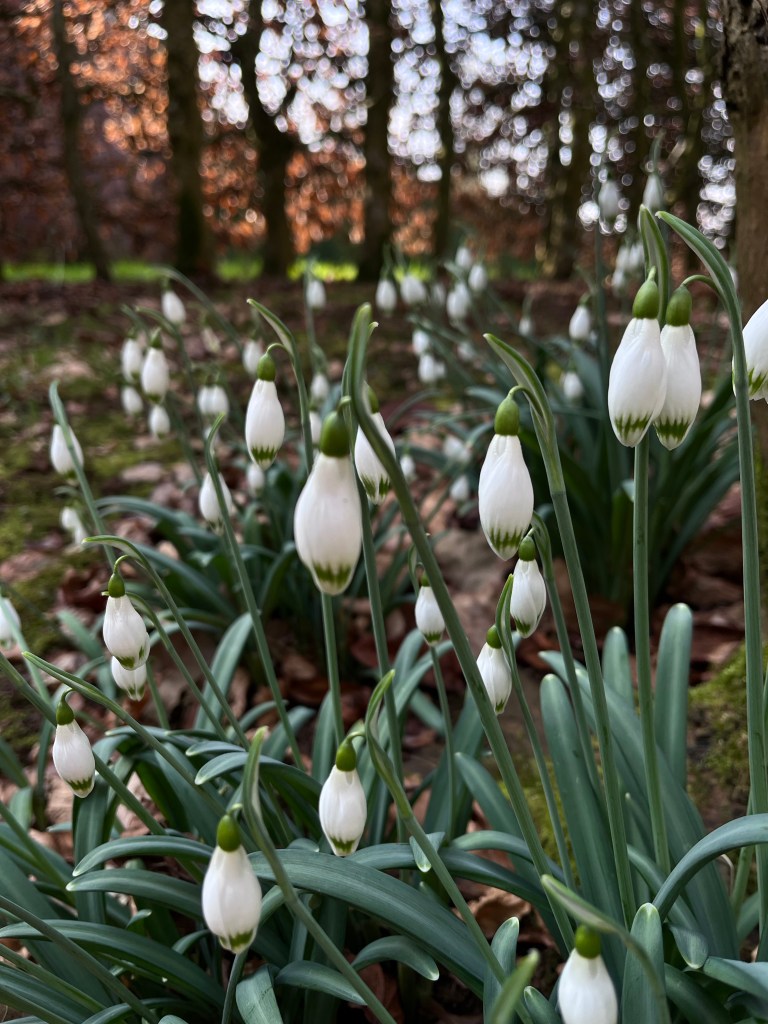
Snowdrops at Thenford Arboretum

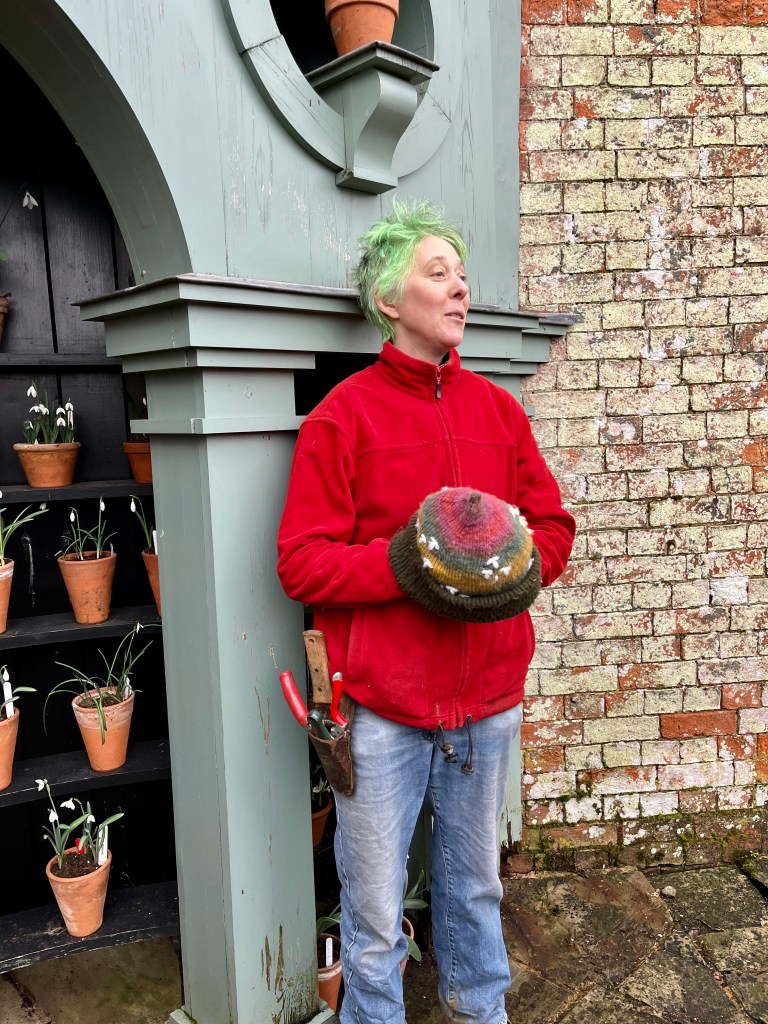
Emma Thick, deputy head gardener at Thenford Arboretum

A Shepherd: A person who herds, tends and guards. Watches over and protects.

I looked up the word shepherd when deputy head gardener Emma Thick described herself as a ‘snowdrop shepherd.’ It’s an apt description. For Emma, who works at Thenford Arboretum, tends, protects and cares for over 1,500 varieties of snowdrop, some of them rare and unusual.

Emma has been in charge of the collection for ten years, and spending the day with her is a revealing and exciting journey of discovery. I ask Emma which is her favourite snowdrop, with so many to choose from. Immediately, she walks over to a patch of Galanthus ‘Mrs McNamara’ an elwesii variety. It starts flowering at Christmas and, in a cold winter such as this one, will still be in flower at the end of February. “It has big, broad, glaucus blue-green leaves, single inner-markings like a Chinese bridge, and is a very bright white. It sounds strange, but some snowdrops are not very white. This is a beautiful clear white flower. If I could only have one snowdrop it would be ‘Mrs McNamara’ always.”

The last few flowers of G ‘Mrs McNamara’.

When Emma first started working at Thenford, the owners Lord and Lady Heseltine, had amassed a collection of 350 types of snowdrop. Since then, the collection has grown, and in June 2023 Thenford was awarded National Collection status by Plant Heritage.

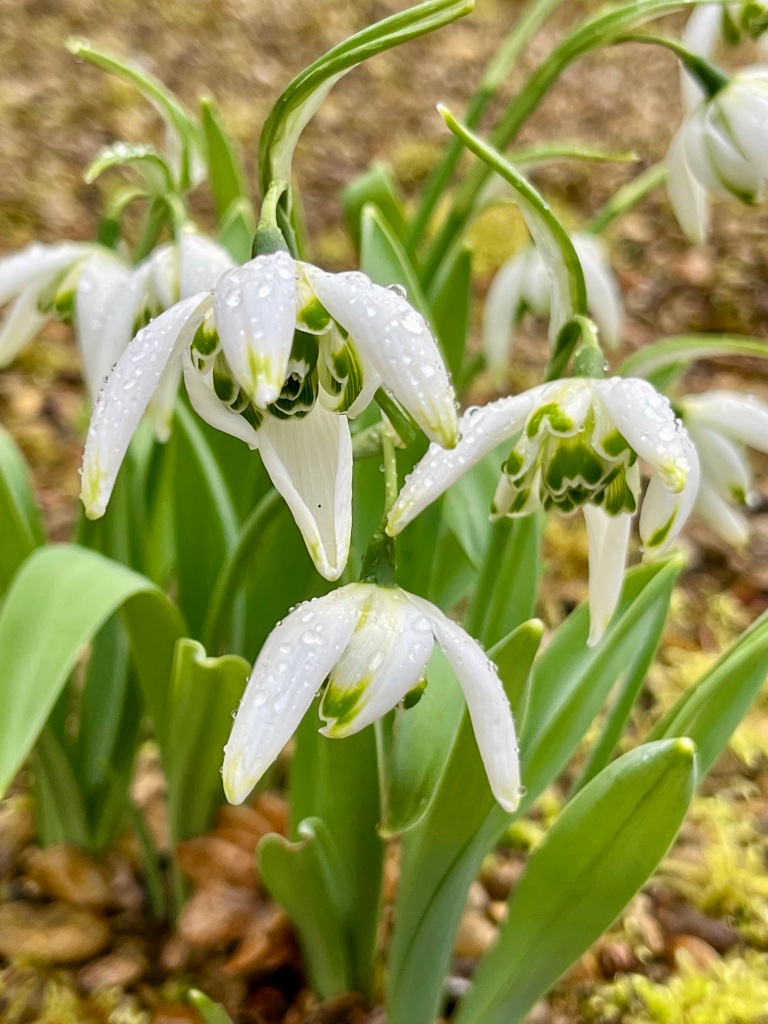
G. Plicatus ‘Henham no 1’

Snowdrops cluster around the base of specimen trees within the arboretum. But Emma says you don’t need to have a woodland setting or trees to grow snowdrops successfully. She has been trialling growing snowdrops at the base of hydrangeas. The shrubs take up water in the summer, giving snowdrops the period of dormancy they need. Then hydrangeas provide colour in late summer and autumn.

Emma recommends all hydrangea varieties for this plant partnership. At Thenford there are hundreds of mop-head, lacecap and paniculata types. These are low maintenance as well as being perfect planting companions for snowdrops.

G. ‘Pat Mason’ under a mop-head hydrangea
G. ‘James Backhouse’

Snowdrops can successfully be grown in containers. Thenford has a topiary garden with a collection of Italian urns containing black grass, Ophiopogon planiscapus, and snowdrops.

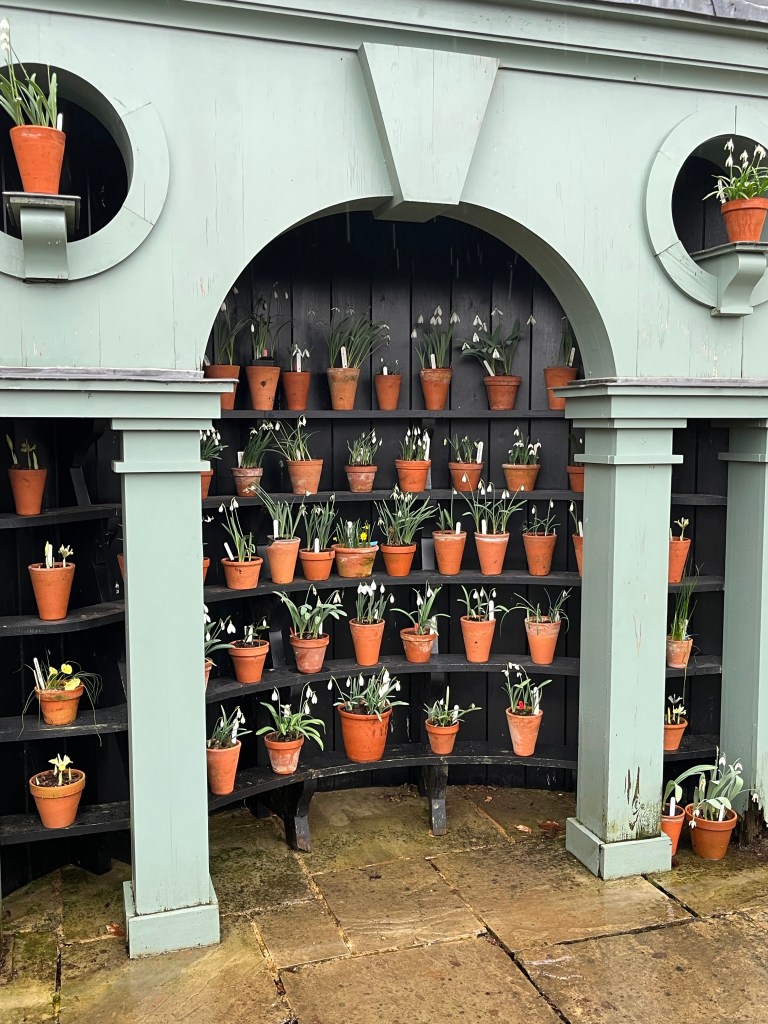
There’s also a plant theatre, created for auriculas, but in winter it’s used for snowdops and daffodils.

Snowdrops in teracotta pots look striking set against the black painted background, and it’s an opportunity to look closely and compare markings.

G. ‘Jedburgh’

I asked Emma which other varieties would she recommend. Here’s her list of top snowdrops to grow.

G. ‘Daisy Sunshine’. Snowdrop photos copyright Emma Thick.

‘Daisy Sunshine’ is not a lot different from the horde of nivalis sandersii group but quite a good, reliable yellow. Again, love the name . Everyone could find room for a bit of ‘Daisy Sunshine’ to brighten a corner of a garden, says Emma.

G. ‘Miss Behaving.’

“Galanthus reginae-olgae subsp vernalis ‘Miss Adventure’. Again, great name, quirky snowdrop. The spathe has mutated to become petal like. Has the bonus of having the outer petals maker green too, so would probably count as an inverse poculiform or I-poc for short . We grow her sister ‘Miss Behaving’ near by.

G. ‘Hill Poe’

‘Hill Poe’. A very frilly full double that does nothing but want to grow. Looks great in a big clump.

G ‘Hill Poe’
G. ‘E.A.Bowles’

‘E.A. Bowles’ is a pure white poculiform (inners and outers same length) almost shaped like a tiny lampshade. An exquisite beauty, not always the easiest to grow.

‘G. ‘Tilebarn Jamie ‘

Galanthus reginae-olgae subsp reginae-olgae ‘Tilebarn Jamie’ 

Flowers in October. Perfectly normal for this subsp to do that. And happens to coincide with the red leaf fall of Acer palmatum ‘Skeeters Broom.’ Just exquisite and an unexpected delight on our October open days.

G. ‘Tilebarn Jamie’
G. ‘Cider with Rosie’

Woronowii ‘Cider with Rosie’ a green-tipped variety of Galanthus woronowii which I adore. One to admire up close as it is not the biggest or most dramatic.

G. ‘Rosemary Burnham’

Galanthus elwesii ‘Rosemary Burnham.’ A virescent snowdrop which people probably either love or hate depending on how you like green flowers. Again, grows well here at Thenford but not for others. Best appreciated up close.

G. ‘Greenfinch.’

‘Greenfinch’ an excellent green tipped snowdrop. The green is really embedded in the outer petals so it appears very pinched.

G. ‘Blewbury Tart.’

‘Blewbury Tart’. Not a pretty flower really, but looks good in a clump. It is my mum Cherry Thick’s favourite. It was found by Alan Street in Oxfordshire. Again, best admired up close.”

I asked Emma for advice on planting snowdrops. She said wait until the bulbs are dormant before moving them. Snowdrops produce just one set of roots each year. Any damage to the roots while digging up or planting means the bulb will not be able to take up enough nutrient for the following year. This means the bulb will either fail to flower or die.

Thenford opens for 20 days a year. Rupert Heseltine explained his parents, Lord and Lady Heseltine purchased the house and it’s surrounding garden in 1976. Over the next 25 years, their priority was to restore the 40 acres of woodland. Debris was cleared, rotten or fallen trees removed and replaced with many rare and unusual varieties. The arboretum now extends to 70 acres with 3,000 trees and shrubs. There are 113 ‘Champion Trees.’ The medieval fish ponds and their interconnecting canal and lake have all been restored and two new lakes have been added.

The walled garden was being used as a sheep field when the Heseltines bought the property. It has now been restored and features trained fruit trees, step-over apples, and a range of greenhouses containing exotic plants and citrus.

To book tickets to visit Thenford, see the website:

https://thenfordarboretum.com/

The 2026 Snowdrop Spectacular will be held on Saturday, February 14.

Thank you for reading my blog. I hope you’ve enjoyed these photos and found the information from Emma inspiring. There’s an interview with Emma on my Instagram account at karengimson1.

I enjoyed every second of my visit to the gardens and I’m certainly looking forward to visiting again through the seasons, and to viewing the snowdrops again next February. It’s a ‘must visit’ on my calendar!

RHS Grow Food Anywhere -prize draw win

Thank you everyone who read my review and left a comment on the blog. John Tilton has won the prize copy. Please get in touch John by sending an e mail to k.gimson@btinternet.com.

Many thanks to the publishers, Dorling Kindersley, for sending a copy of the book to give away.

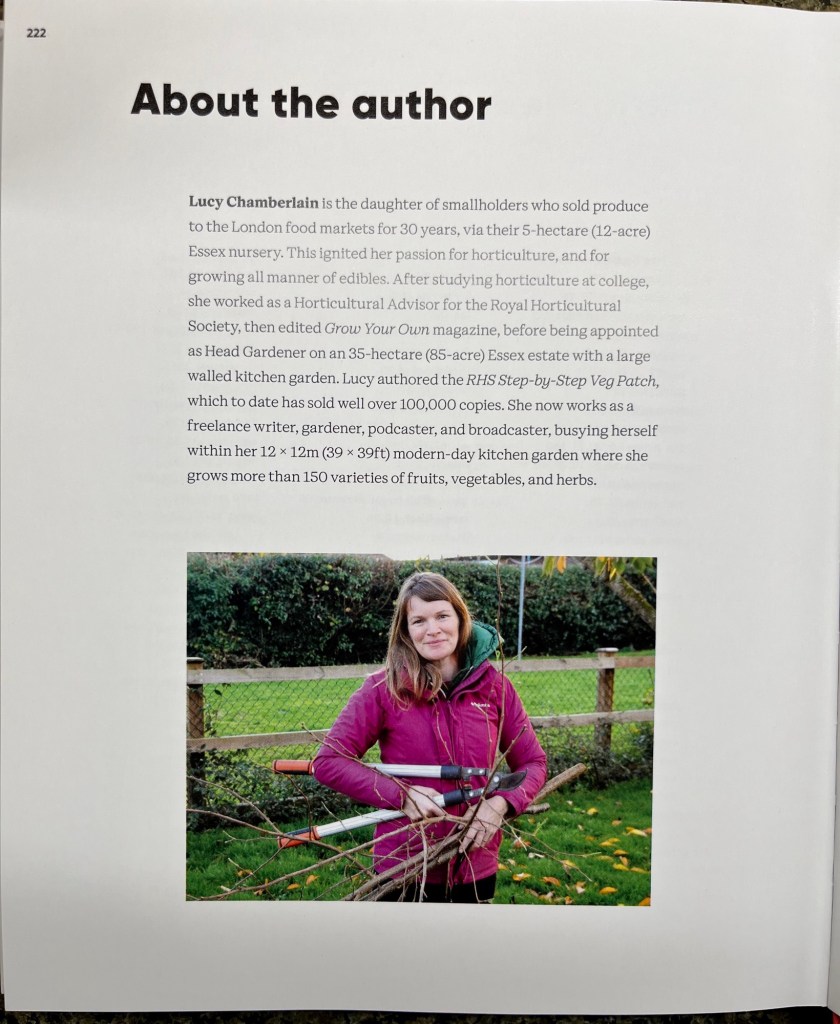
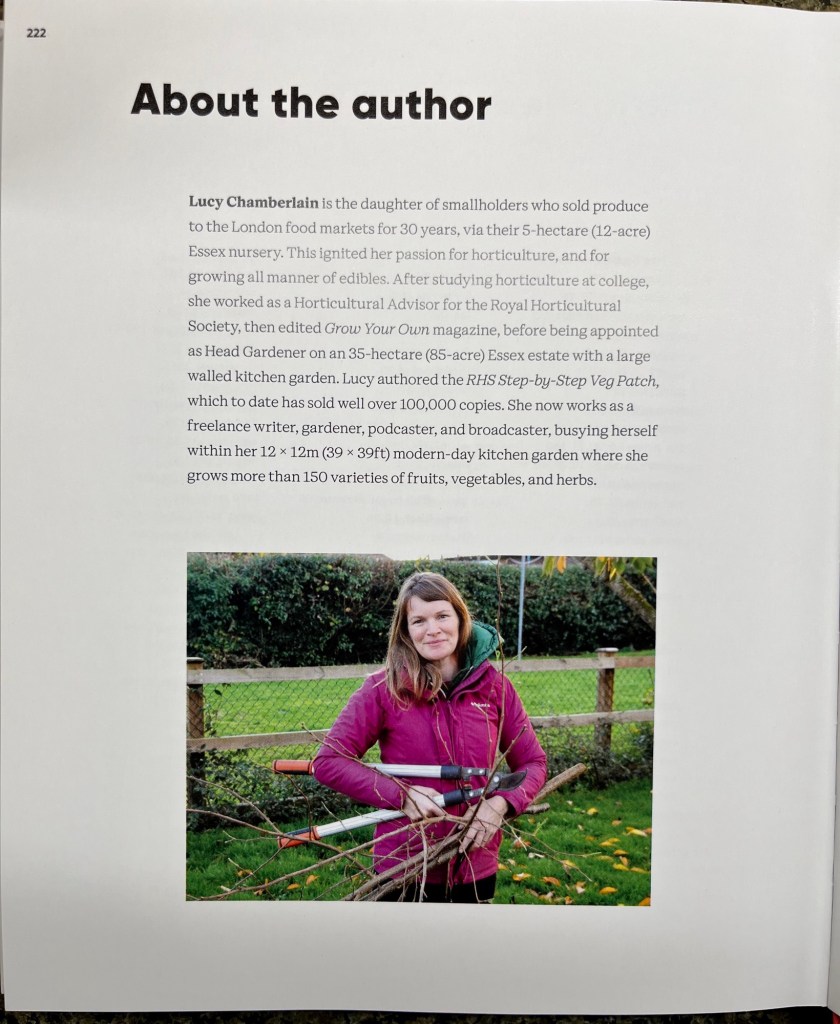
I have no hesitation in recommending Lucy Chamberlain’s new book. If ever you’ve wanted to have a go at growing food, look out for the book. It will set you on the right path for success.

Lucy shows us how to analyse our gardens to create ‘zones.’ It’s then a case of right plant for the right place. There’s literally something to grow in any situation.

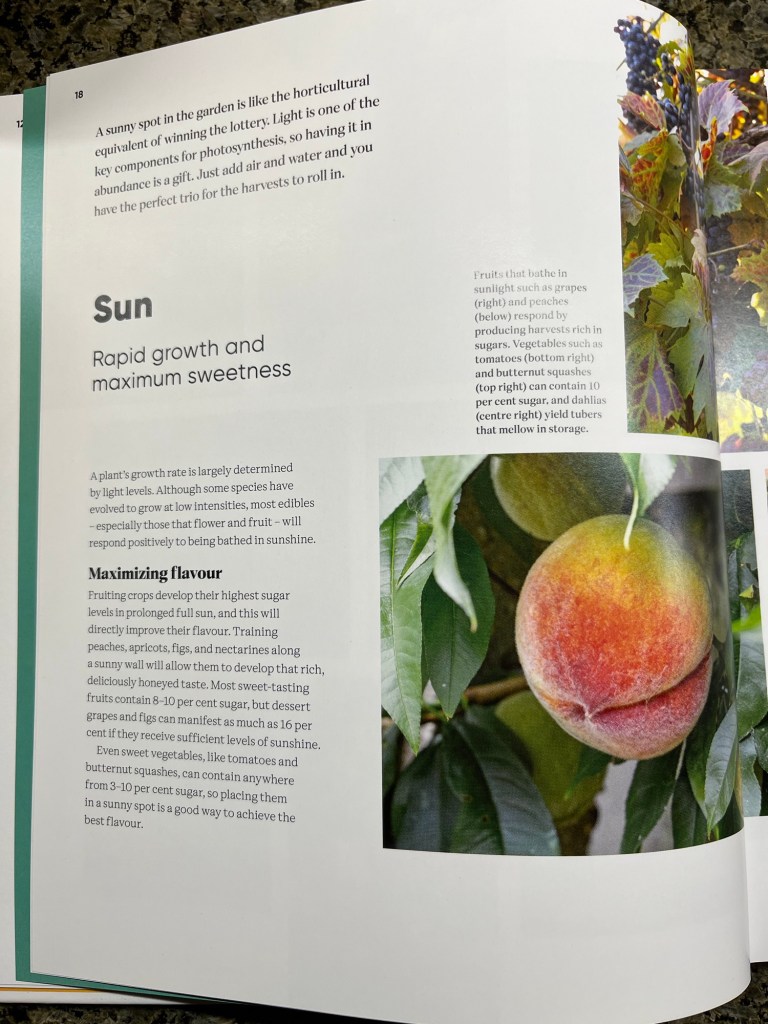
Sunny aspect suggestions
Mapping your plot
Give crops the best start in life
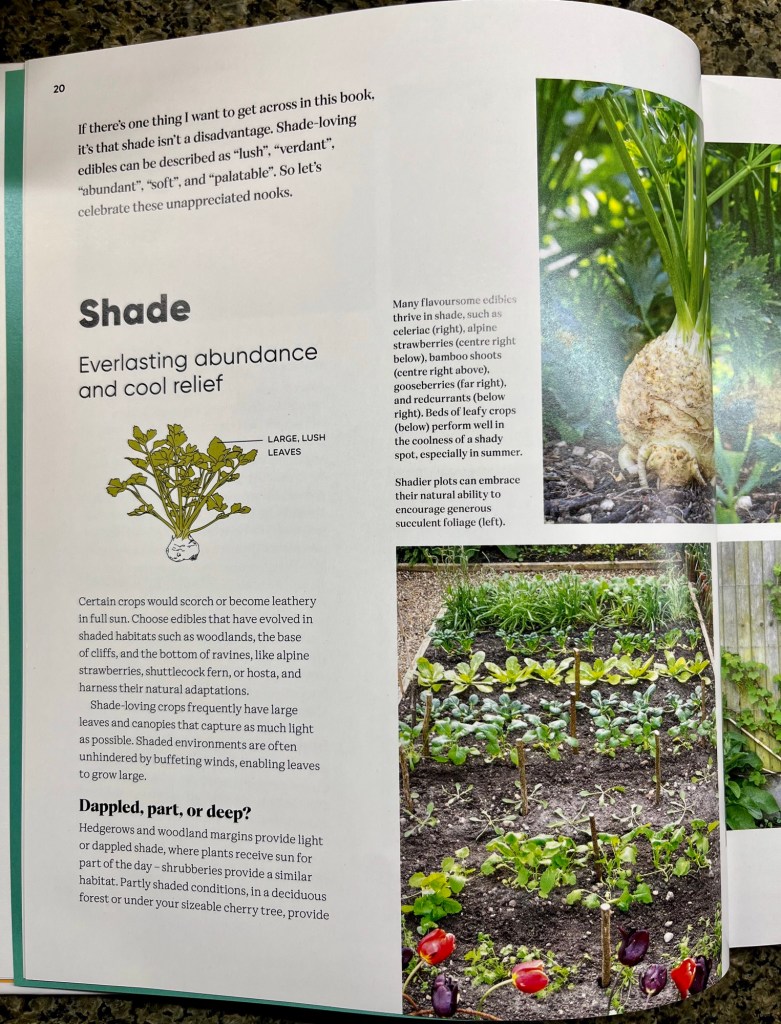
Part shade
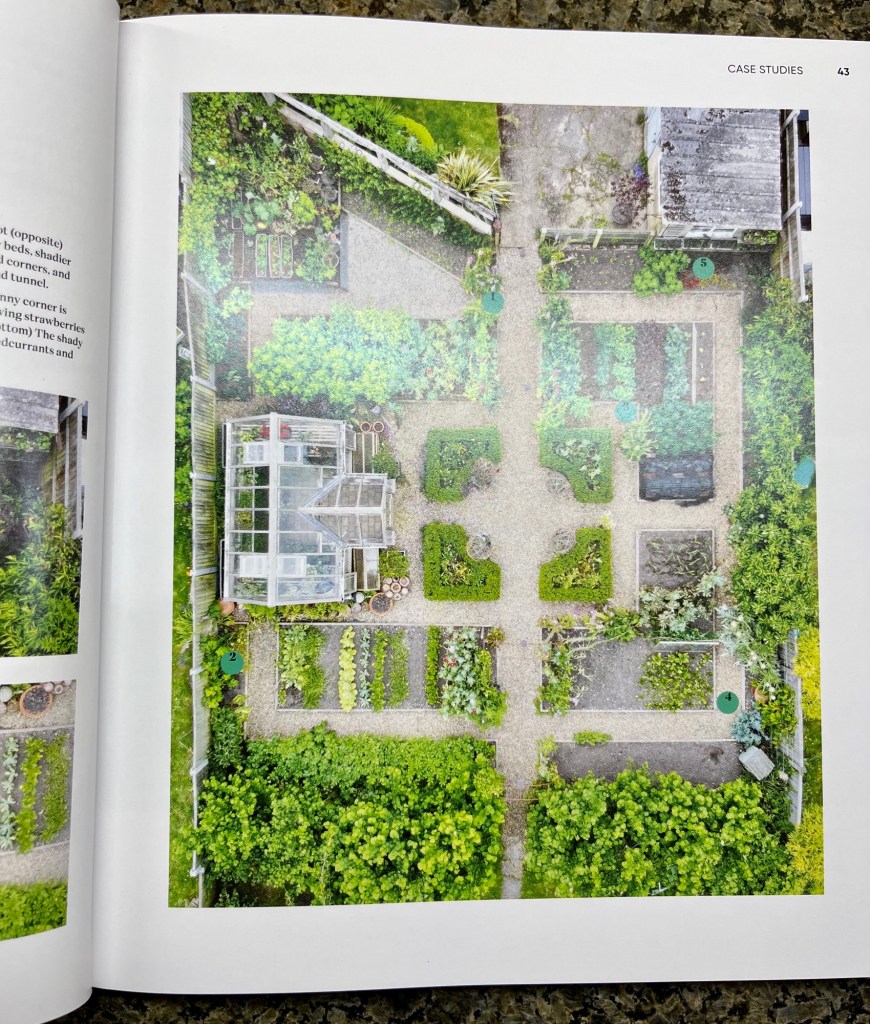
Lucy’s own garden as a case study
Beautiful as well as productive.
I wrote this over on instagram at karengimson1 .

Thank you for reading my blog. Please sign up for e mails and notifications. More book reviews to follow…. Happy New Year! Karen

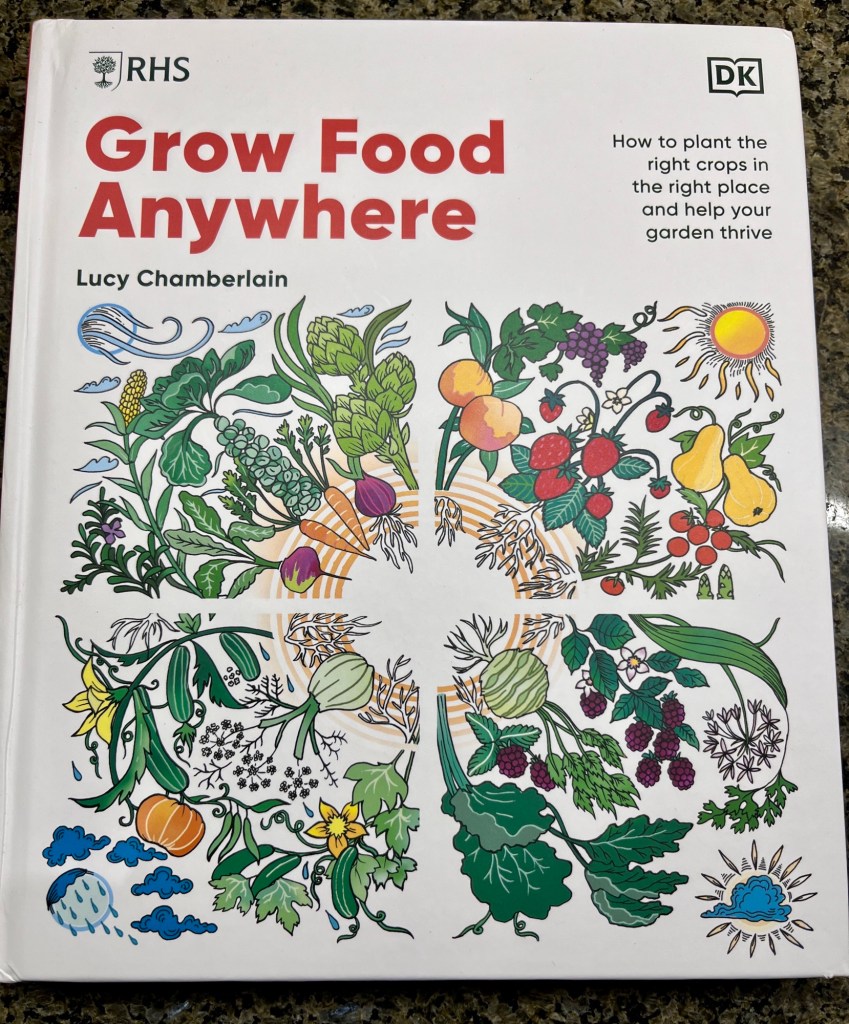
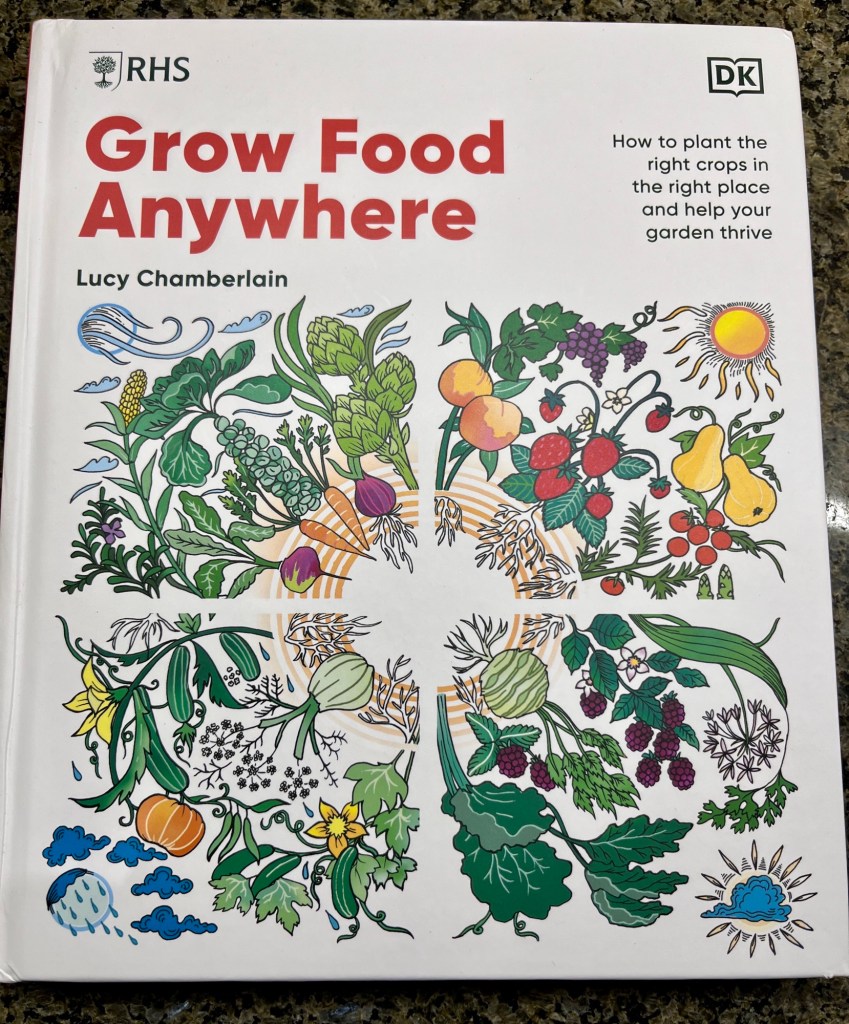
RHS Grow Food Anywhere book review

By Lucy Chamberlain

Published by Dorling Kindersley, January 2025

Hardback and ebook 223 pages. £20

ISBN 978-0-2416-5649-5

The publishers have kindly sent one copy to give away in a prize draw. Please leave your name in the comments box below to be included in the draw. UK entries only.

One of my favourite writers is Lucy Chamberlain who manages to capture the magic of gardening and makes us want to rush outside and get growing! In her new book published today she tells us exactly how to grow just about anything anywhere. And it’s all written in an easy to understand format, without being either too simple or too complicated. That’s the beauty of Lucy, she’s able to strike just the right note and make it relevant to all gardeners.

Lucy’s garden

Lucy uses her own fruit and vegetable plot as a case study. I’ve watched Lucy create this garden over the past few years and admired just how much produce she manages to pack in there, as well as making it look beautiful with dwarf hedges, espalier apples and raised beds.

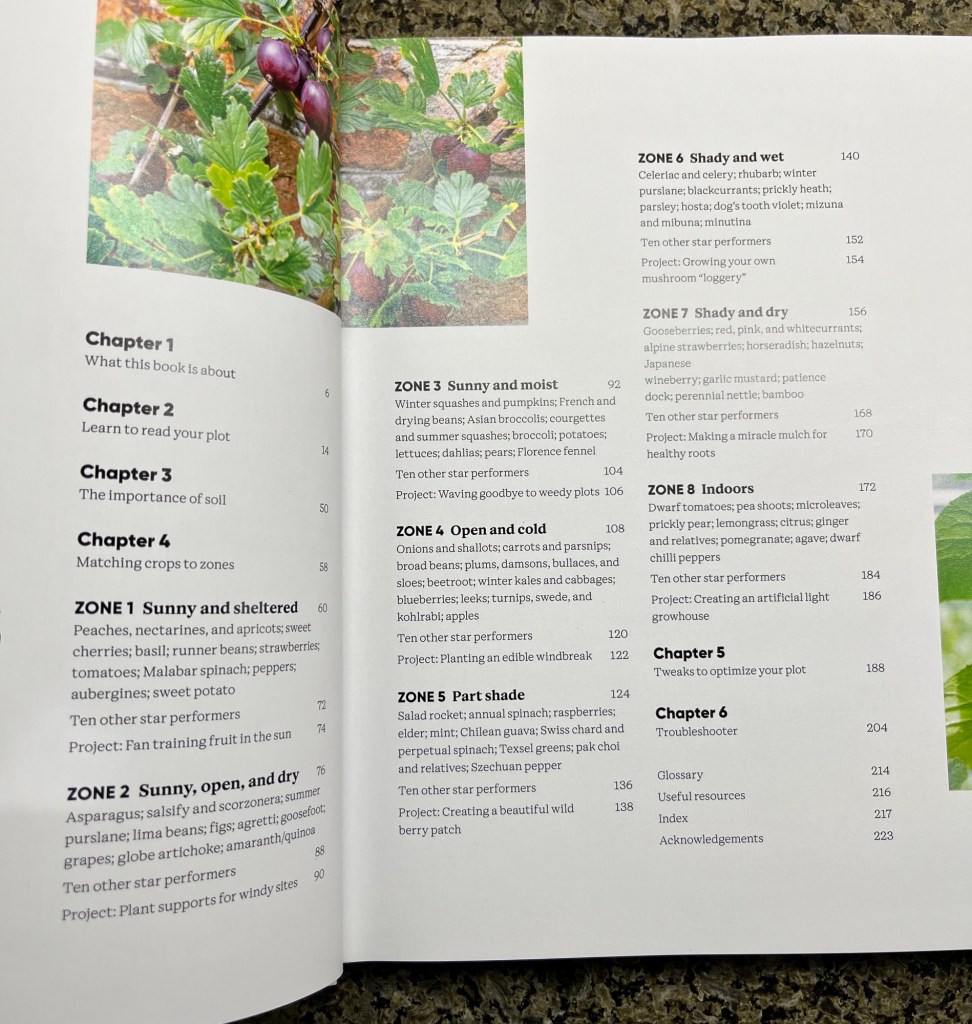
Contents page

Growing plants in the wrong place is one of the main reasons for crop failure. Lucy splits the book into ‘growing zones’ covering all the situations growers are likely to face when starting to garden. Sunny and sheltered, sunny and moist, open and cold, shady and wet, shady and dry, for example.

Several case studies are related, including a garden attached to large detached property, a compact garden, and an allotment. Lucy shows how to map areas of the garden to work out what will grow successfully in each position.

Mapping the plot
What will grow in different areas
Choosing plants to grow in full sun
Lucy’s garden where she grows 150 varieties of fruit, veg and herbs

In each area, top performing plants are suggested. I grow hazelnuts in dry shade, and each year I harvest a bumper crop of tasty nuts for making cakes and biscuits. They really are far more delicious than anything you can buy in the shops.

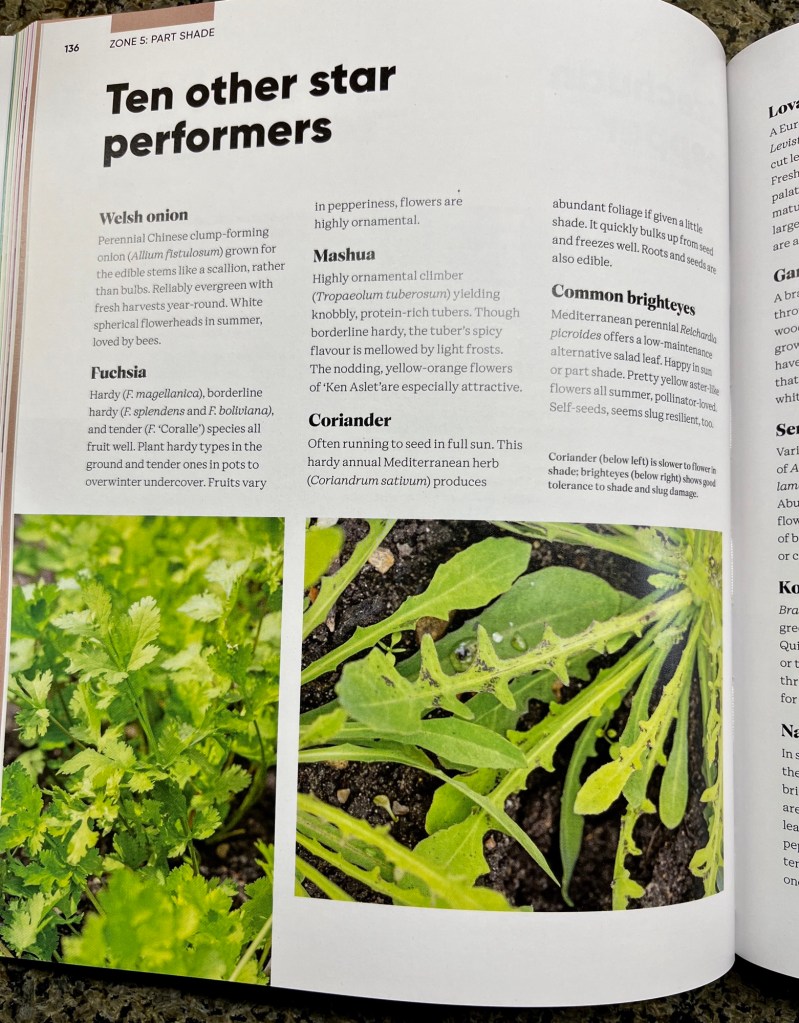
Other star performers for part-shade
About the author

I’ve known Lucy for about 20 years and have always admired her get-up-and-go. Her enthusiasm for growing fruit and vegetables translates so well in her writing for newspapers, magazines and books. I also love the podcast ‘Talking Heads’ which she hosts with Saul Walker. Real gardeners, talking about real gardening. It’s a joy to listen to them, to be honest.

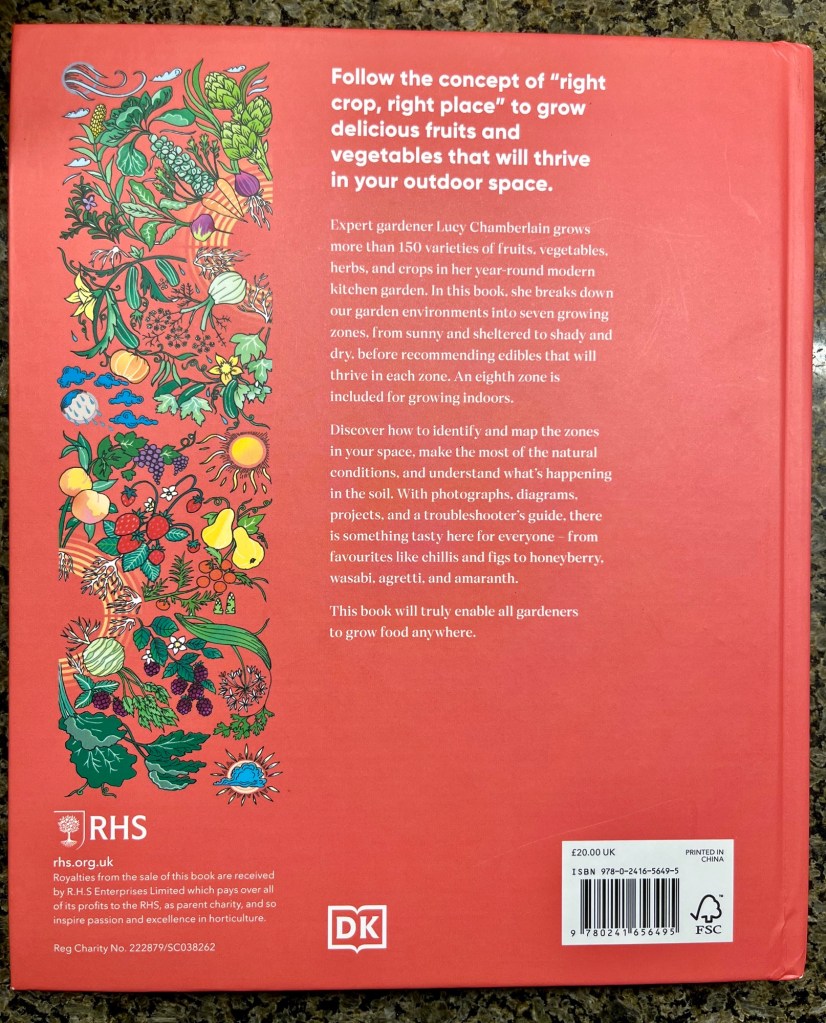
Back cover of the book

I have no hesitation in recommending Lucy’s latest book. The ‘right crop, right place’ principal is beautifully explained. Lucy breaks down the environments found in gardens into seven zones, even incorporating indoor spaces. The book is packed with expert guidance on maximising your growing through making the best of what you have. Grow Food Anywhere will soon get you harvesting fresh, healthy pesticide-free fruit, veg and herbs. What a great way to start 2025!

Please leave your name below and one winner will be randomly selected on Sunday 6pm. Editor’s decision is final and there’s no cash alternative.

Thank you for reading my blog and Happy New Year everyone!

Christmas Wreath Workshop with Rachel de Thame and Arit Anderson

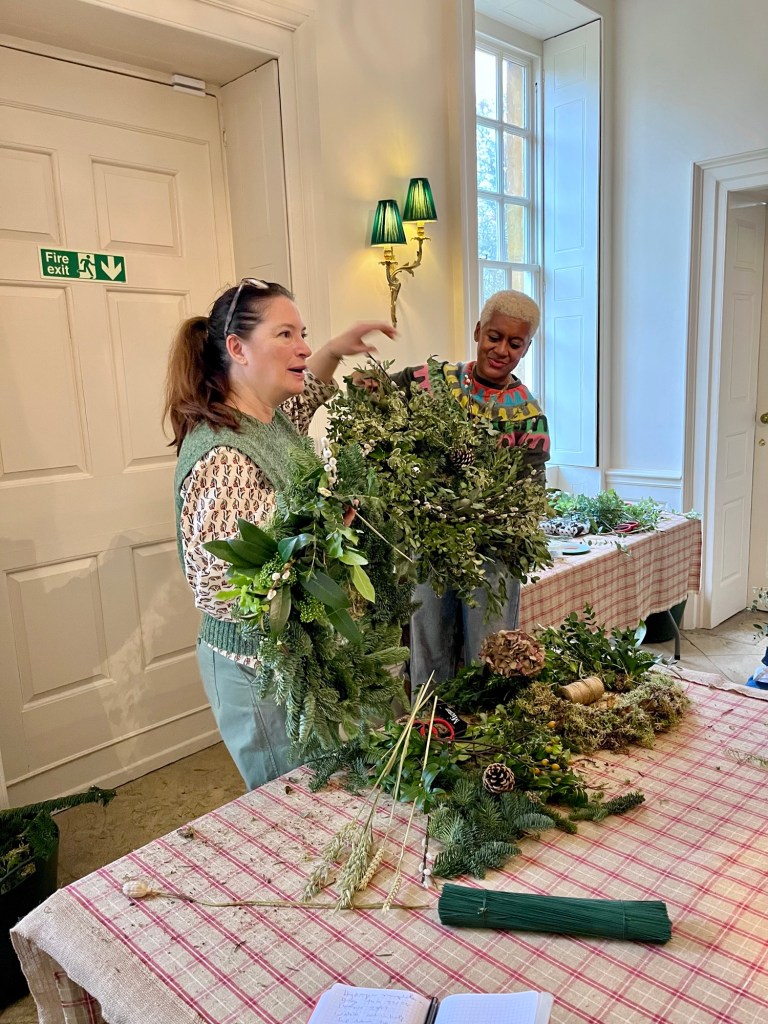
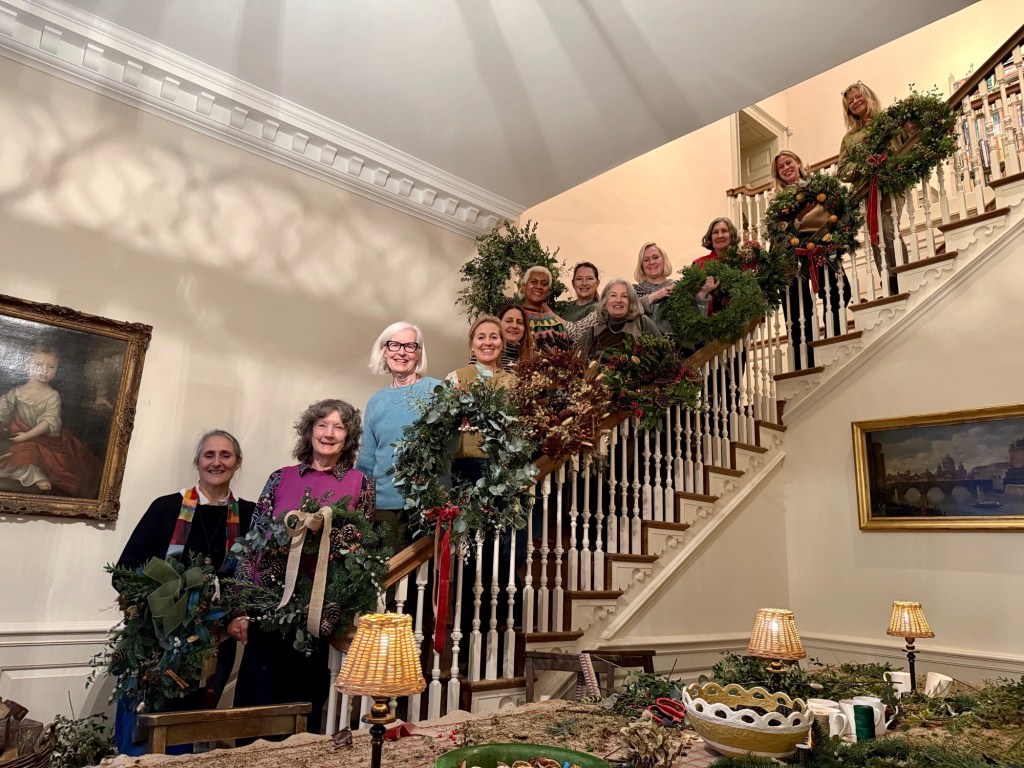
Everyone busy at a table set out in Rachel de Thame’s hall.

Some opportunities are too good to be missed! I’d been watching announcements for weeks, but couldn’t attend any of the dates offered. Then all of a sudden two people dropped out on the one day I was free. So this week I unexpectedly found myself driving to Gloucestershire to take part in one of Rachel de Thame’s first Christmas wreath-making courses. I can still hardly believe my luck!

I wish I’d taken a photograph of the path leading to the front door. It was lined each side with piles of evergreen foliage ready for the course. Mindful of the fact that this was Rachel’s home, I didn’t get my camera out. But it was obvious from the first glance that we were all in for a treat of a day! Stepping inside the front door, Rachel’s entrance hall was set out with a long table and buckets of flowers and foliage in all four corners. There was such an array of different foliage materials, much of it pruned from Rachel’s garden. I fell in love with the pink hydrangea heads and orange rosehips straight away. I also decided on using the skimmia kew green as a background for my wreath.

Rachel first demonstrated how to make a wreath using a copper ring and moss attached with reel wire. Rachel was using wire she’d saved from previous years and recycled. The base of the wreath was entirely conifer sprays trimmed to about 5” and attached first to the left and then the right all the way round the circle. Flowers, berries, and seed heads could then be attached on top. Arit Anderson who was guest host for the day, demonstrated making a wreath using the same copper ring, but with moss attached with twine. Arit’s wreath was a looser design using twigs, seed heads, grey pussy willow and grasses. Arit explained the wreath could be safely composed after Christmas, as all the components would eventually compost down. The copper rings could be saved for another year. Even the ribbon we used was biodegradable.

Rachel’s wreath, showing the fir sprays being attached to the mossy base.
Arit with the mossy base attached with compostable twine.
Arit displaying one of the wreaths in the window.
Rachel and Arit with fir cones, dried hydrangea heads and foraged grass and poppy seed heads.

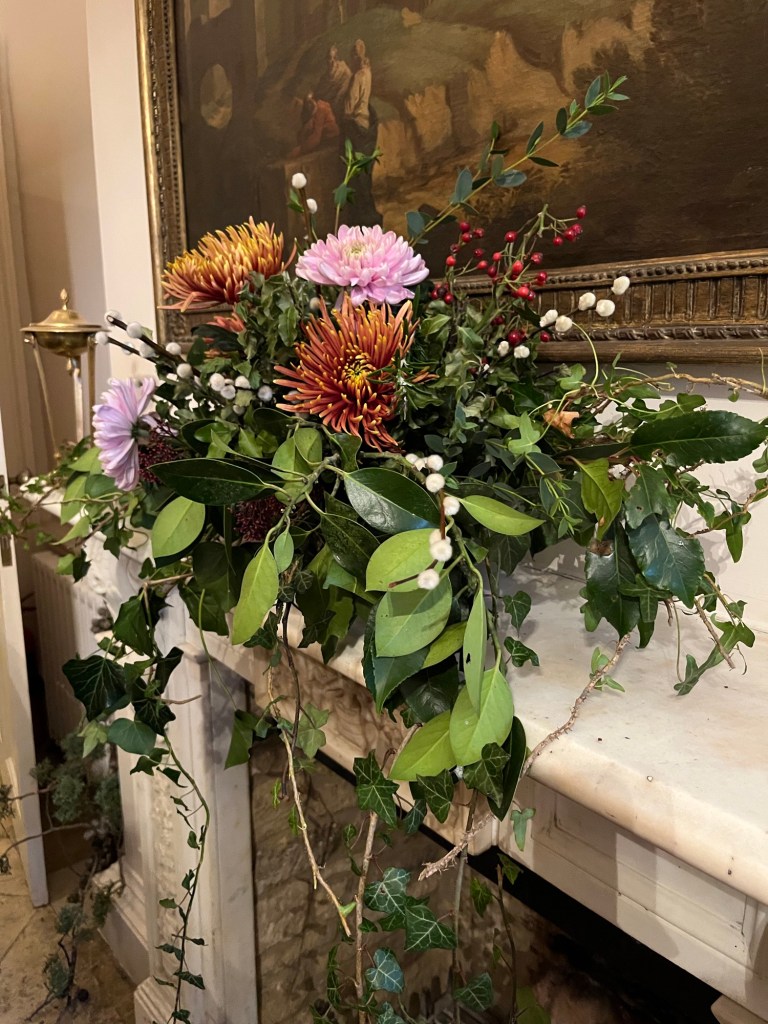
Before getting started on our own wreaths, Rachel demonstrated how to make an arrangement for a fireplace. I must admit, I wanted to take both the arrangement and the fireplace home!

Surprisingly, that huge arrangement all started with a relatively small glass bowl. Rachel rolled up some chicken wire and used florist tape to attach it to the bowl. She added long lengths of ivy, Portuguese laurel and pittosporum. Then colour was added with spray chrysanthemums and grey pussy willow. I have walked past endless amounts to trailing ivy in my garden and never realised it could be turned into anything as beautiful as this. But now, I’ll have a go!

Our day included a three course lunch. We had home-made soup, followed by a buffet of amazing salads, followed by chocolate brownies and cream. Plenty of tea was also consumed! The table in Rachel’s kitchen was set out with such style. I really enjoyed every second I was there! Everything was literally perfect.

Beautiful flowers set out on the table

Best of all though, I had the company of the famous Woodapuss sitting next to me. I’d seen her many times on the television. I can report that she is as lovely in real life as on the TV. Such a calm and happy cat, very affectionate. I was quite happy to sit there making a fuss of her. A highlight of my day.

After lunch we wandered around Rachel’s garden foraging for materials to use for our wreaths. It was such a treat to see the walled garden where Rachel grows her tulips and cut flowers. The walls are such a gorgeous soft, creamy colour, and we found holes were solitary bees had made nests.

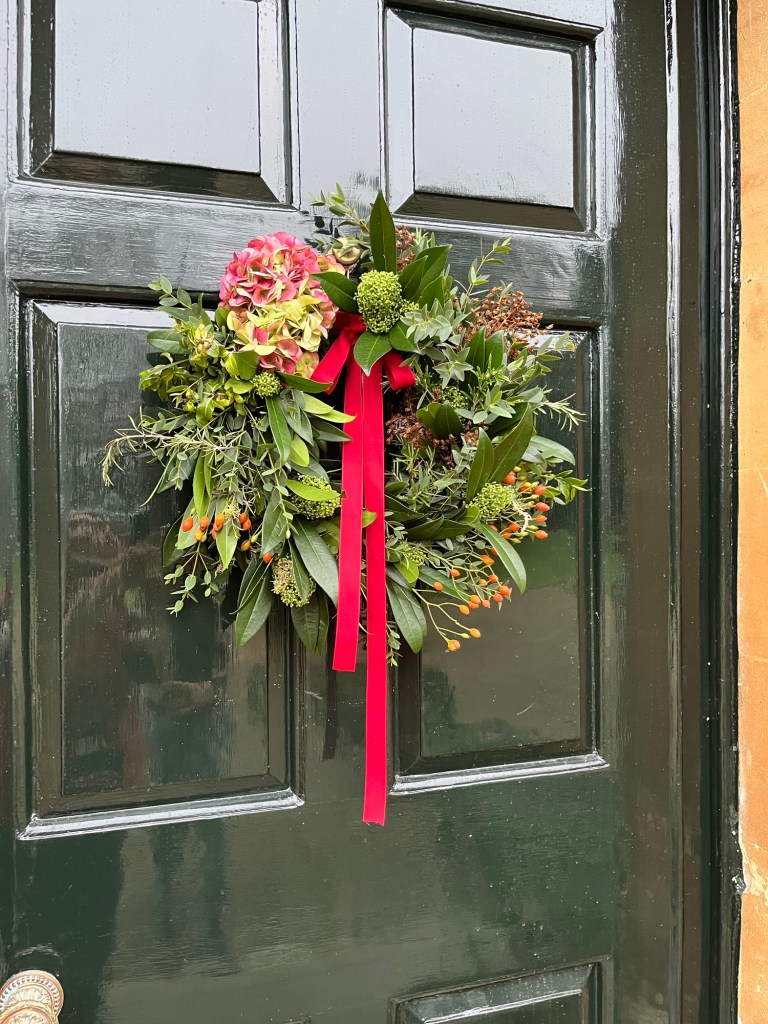
Back to the house, and we all made a start on our wreaths. I decided to go for a base of eucalyptus and rosemary, for the scent. Then I wove rosehips in to the mix, and finished with two hydrangea heads. Arit showed me how to gather the hydrangea heads into a ball if they were too spread out, and tie them at the base. This made a much better focal point. We then chose a gorgeous burgundy ribbon to finish off.

And here it is! Displayed on Rachel’s front door which is painted a deep glossy green.

What a great day we all had! I learned many new techniques in floristry, made some new like-minded friends, fussed Rachel’s cat, and went home with a beautiful wreath for my own front door. A really wonderful, perfect day.

Thank you Rachel and Arit for such a happy and memorable event! A truly special start to our Christmas festivities.

Thanks for reading my blog. Rachel has plans for lots more courses and events at Broadwell Manor in 2025. To find out more contact info@broadwellmanor.com. Or follow on Instagram @racheldethame.

A Flower Garden for Pollinators by Rachel de Thame

Books for Christmas and New Year reading

Published by Greenfinch

Hardback. 208 pages. £25

Update: The prize draw copy has been won by Natalia at Lucky Bees. Thank you for leaving a comment and entering the draw. And thanks to the publishers for sending a copy for the draw.

If there was a vote for the most beautiful book produced in 2024, Rachel de Thame would win it. Rachel, best known for her newspaper column, magazine writing and appearances on BBC Gardeners World, joined forces with her daughter Lauren Lusk to produce a book which is joyful on every page. Lauren, a talented illustrator, hand painted many of the flower pictures featured in the book, and added a myriad of bees, moths and butterflies dancing across the page. To open the book is to step inside Rachel’s garden and walk alongside her as she meanders through the colourful wildflowers, cottage garden plants and herbs. We feel as if we are there, with her, seeing and hearing everything she describes. She writes: I stopped deadheading, stood still in the middle of the space and was amazed by the number of butterflies darting across the garden. Bees, hoverflies and other small flies zipped from flower to flower. I closed my eyes and listened to the various hummings and buzzings. The garden was fizzing with insect activity, and as I resumed snipping faded dahlias and cosmos, I felt the air stir against my cheek as if whipped up by a tiny fan, and was astonished to realise it was the backdraft of rapidly beating bee wings, centimetres from my face.”

The book is split into seasons with Rachel’s selection of favourite plants each given a page of description.

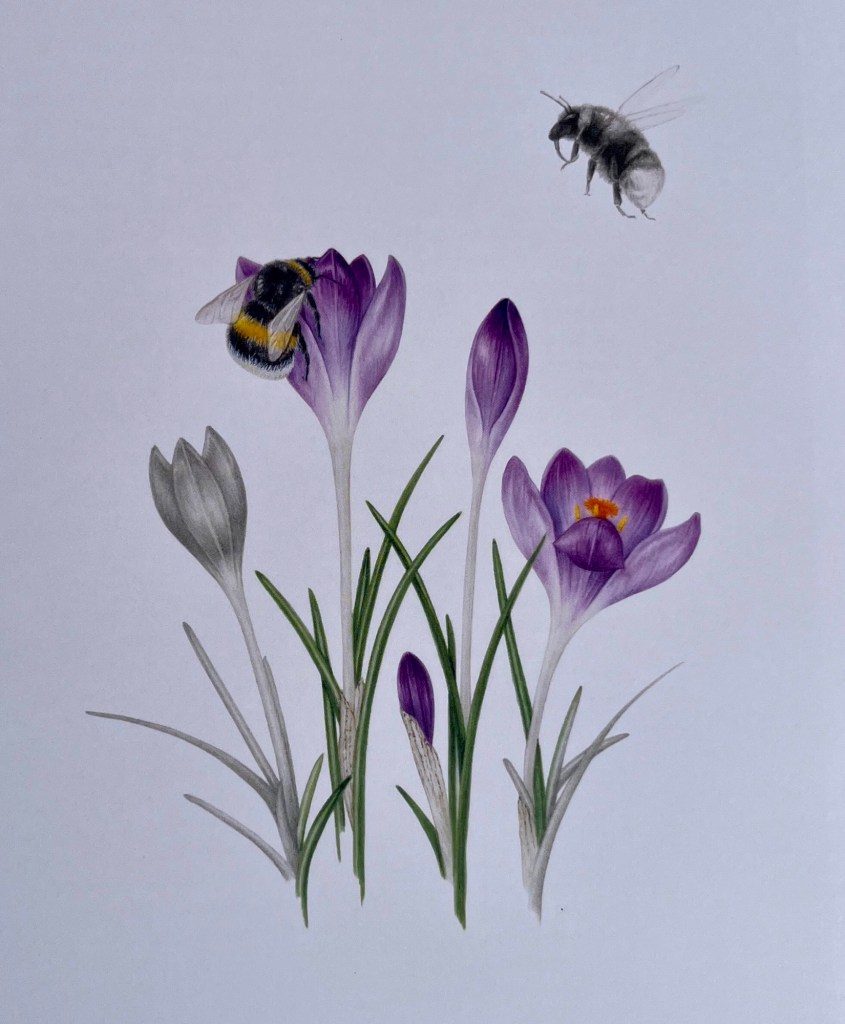
Crocus tommasinianus.

Lauren’s illustrations are beautifully-detailed. It’s not possible to capture their beauty accurately with my camera phone pictures. they are much brighter and clearer in the book.

Muscari armeniacum
Cosmos ‘Purity’
Autumn in Rachel’s cut flower walled garden
Anemone ‘Hadspen Abundance’
Commonly called Japanese anemone
Winter features snowdops, winter flowering shrubs and clematis
Lauren’s bees and butterflies dance across the page

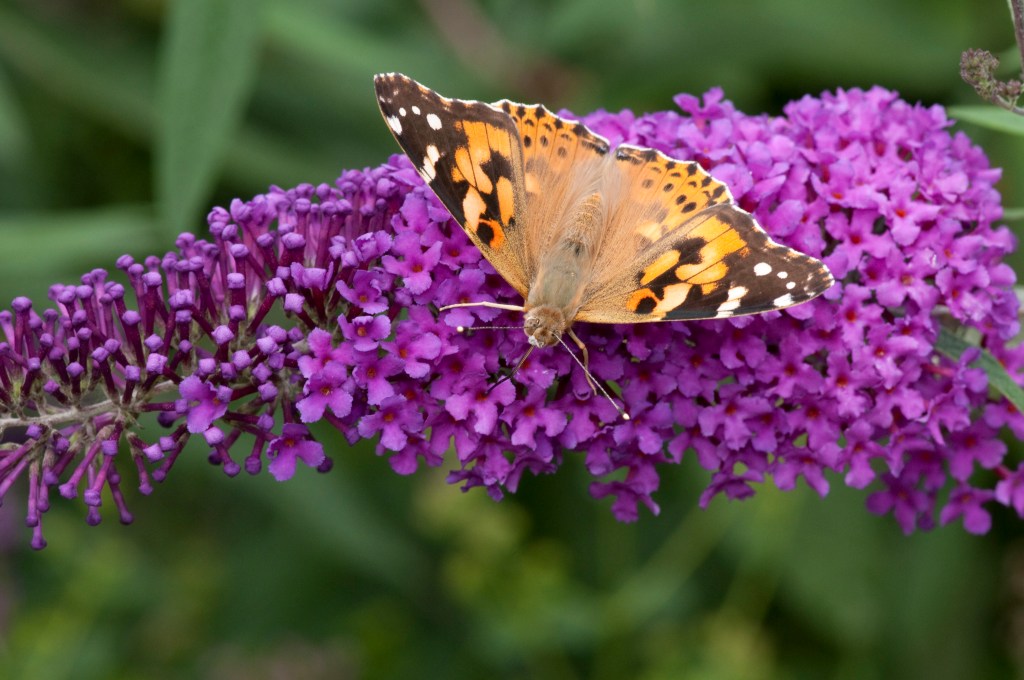
This is a book I’ve found invaluable this year in particular as we have had a crash in numbers for both bees and butterflies. We had no butterflies at all on the buddleja when it flowered. Summer didn’t really start until mid July. What I learned is that we have to plant a succession of plants all year round, so there’s always something for pollinators to feed on. Our climate is so unpredictable we can have all four seasons in one day! As I write this, a bumble bee is drunkenly buzzing about the garden- no doubt enticed out of hibernation by the unusually high December temperatures. It’s due to be 12C tomorrow. And we had snow, followed by flooding just two weeks ago.

Back cover of the book

I think you’ll find Rachel’s book a mine of information if, like me, you want to help the pollinators that make our gardens such a thriving and ‘alive’ place to be. I have no hesitation in recommending A Flower Garden for Pollinators. It’s a delight from start to finish.

Rachel de Thame is a television presenter and writes for The Sunday Times, The Daily Telegraph and top homes and gardens magazines. She hosts courses at Broadwell Manor with guests Arit Anderson, Arthur Parkinson, Hazel Gardiner, and Butter Wakefield. More information below:

https://broadwellmanor.com/

Please leave a comment and your name below to be included in the prize draw. One name will be randomly selected on Tuesday 17th December at 6pm. There’s no cash alternative and the editor’s decision is final. Sorry, uk entries only. Thank you for reading my blog.

The Right Jeans. Book Review and Giveaway

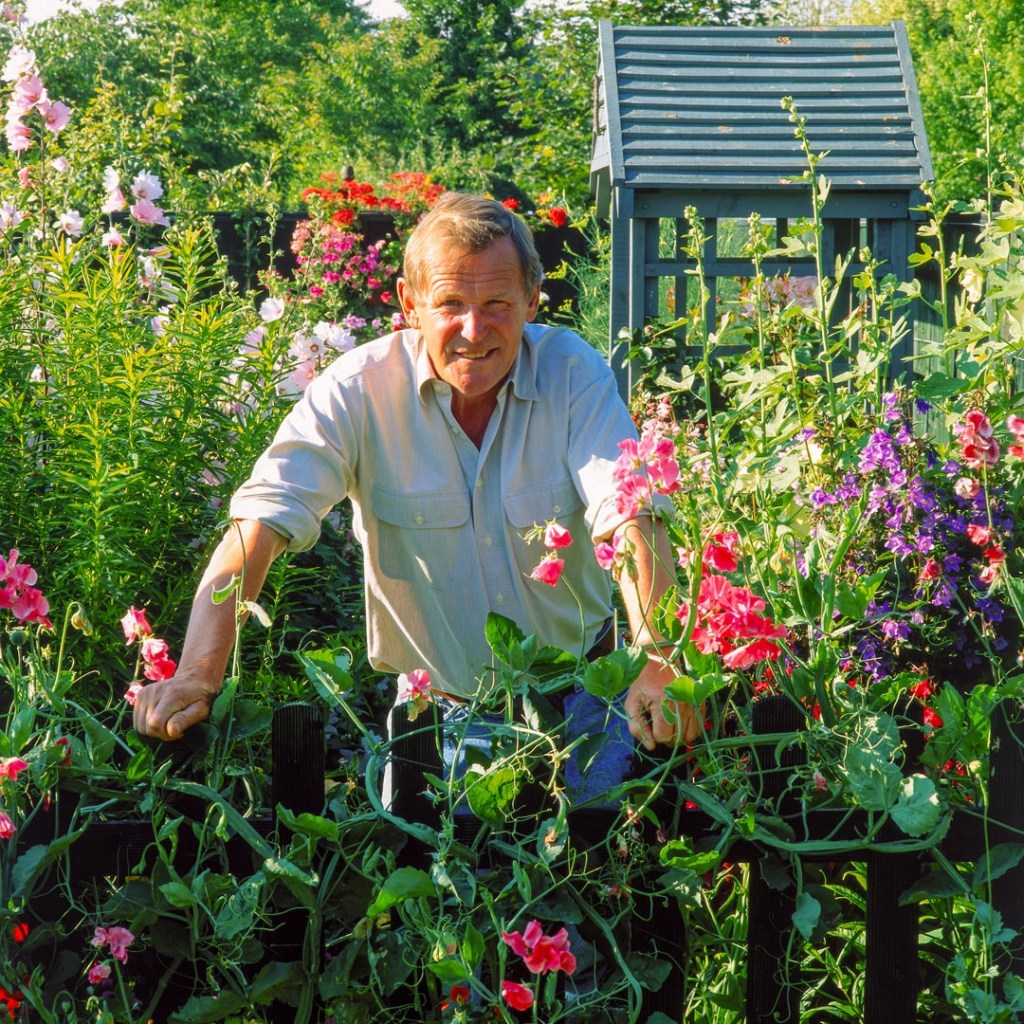
By Nick Hamilton

Paperback. 303 pages.

Published Winter 2024

£14.99 2QT Limited (Publishing)

ISBN 978-1-7385640-4-0

Available from the Barnsdale online shop here: https://shop.barnsdalegardens.co.uk/products/the-right-jeans-by-nick-hamilton  and also from the Barnsdale shop on site at the gardens.

When I was growing up, the television was often switched on in the background in the lounge. My three little brothers played with huge piles of Lego bricks, trying to build the the world’s largest tower. They spent hours constructing the buildings, then crash, down they came. Undeterred, they tried again and again. Dad often joined in to help, or he was busy holding together bits of Airfix models while the boys glued and painted Spitfires and Lancaster bombers. Meanwhile, I sat on the sofa with pens and paper making Spirograph patterns, or concentrating on a ‘painting by numbers’ canvas. Occasionally we’d look up to watch the cartoons playing in the background. Tom and Jerry and the Road Runner were popular. Dad loved the cowboy Western-type films. The High Chaparral was a favourite. Mum on the other hand rarely sat down to watch tv. With four children to care for, meals to cook from scratch, jumpers to knit and clothes to sew, she didn’t have time. All my dresses were home-made until I was 18. Then I started making them myself. However, the highlight of mum’s week was the gardening programme on Friday night. That was the only time I saw her sit down and avidly watch something. Geoff Hamilton was presenter of the programme called Gardeners’ World, and every week he fashioned something for the garden from scraps of wood, bits of plumbing and old drainage pipes. And, basically, if you could use a saw and had a few nails to hand, you could create something useful and beautiful, such as a herb table, complete with a tiled section for resting your cup of tea. Mum was very taken with these ideas because they made gardening affordable and fun. She could have the cottage garden she wanted, without it costing a fortune. And what we were witnessing as children was a life lesson in love. Dad thought the world of mum and would do anything to make her happy. So after watching the television on a Friday, dad would spend the weekend creating something for the garden for mum. One day, after watching Geoff, mum decided she would have a pond, and dad duly dug out an amazing pond on two levels with a stream between them. The garden gave them both much happiness and a shared interest. Sadly Dad passed away in 2011, but the garden lives on, and every year my brothers paint the furniture he made to keep it in good condition. All these happy memories were revived by a newly-published book, The Right Jeans, written by Geoff’s son Nick. The book chronicles Geoff’s journey from the early days with occasional appearances on the programme, to being lead presenter for Gardeners’ World. Geoff appeared on the programme for 17 years from 1979 to 1996. It’s a heartwarming and amusing story as Nick reveals all the background stories to the programme. Safe to say, Geoff had a great sense of humour and what you saw was what you got. He was straightforward and down to earth. He didn’t put on an act, he was the person you saw on the screen, open and honest. I feel it would spoil the surprise to reveal any of the stories contained the book. Suffice to say the book leaves you with a lovely, happy feeling and you’ll smile all the way through. I have no hesitation in recommending The Right Jeans to any gardeners -or potential gardeners. The book would make a lovely Christmas present for anyone. You’ll learn a lot about Geoff, but also get a behind the scenes glimpse into how television programmes were made in the ‘80s and ‘90s. Suffice to say, things have changed since then, quite a lot!

All photos copyright of Barnsdale Gardens.

Geoff was famous for creating themed gardens such as the cottage garden, the artisan garden, paradise garden and tiny herb garden made from drainage pipes set on end as planters for weeping rosemary and thyme. Basic materials were all that was needed, and no special skills required to create his inventive garden projects. It’s no wonder he was such a popular presenter- and we all remember him so well.

Geoff was ahead of his time when he advocated organic gardening. His fruit, vegetables and flowers were all grown without chemicals which was a forward-thinking idea at the time.

Geoff was refreshingly ordinary – and I mean that in a complimentary way. Previous presenters wore suits and ties to present the programme, whereas Geoff always wore jeans and wasn’t afraid to get his hands dirty and show muddy knees. People were able to relate to Geoff because he was ‘one of us.’

I hope you’ve enjoyed reading my review and about how the programme was the highlight of the week in our house when I was young. Nick took over running the gardens at Barnsdale when Geoff sadly died in 1996. The Right Jeans is the second in a trilogy. The first book relates Geoff’s life in publishing and running a garden centre before getting into television. And there’s a third book to follow, continuing the story of Barnsdale Gardens

Back cover of the book

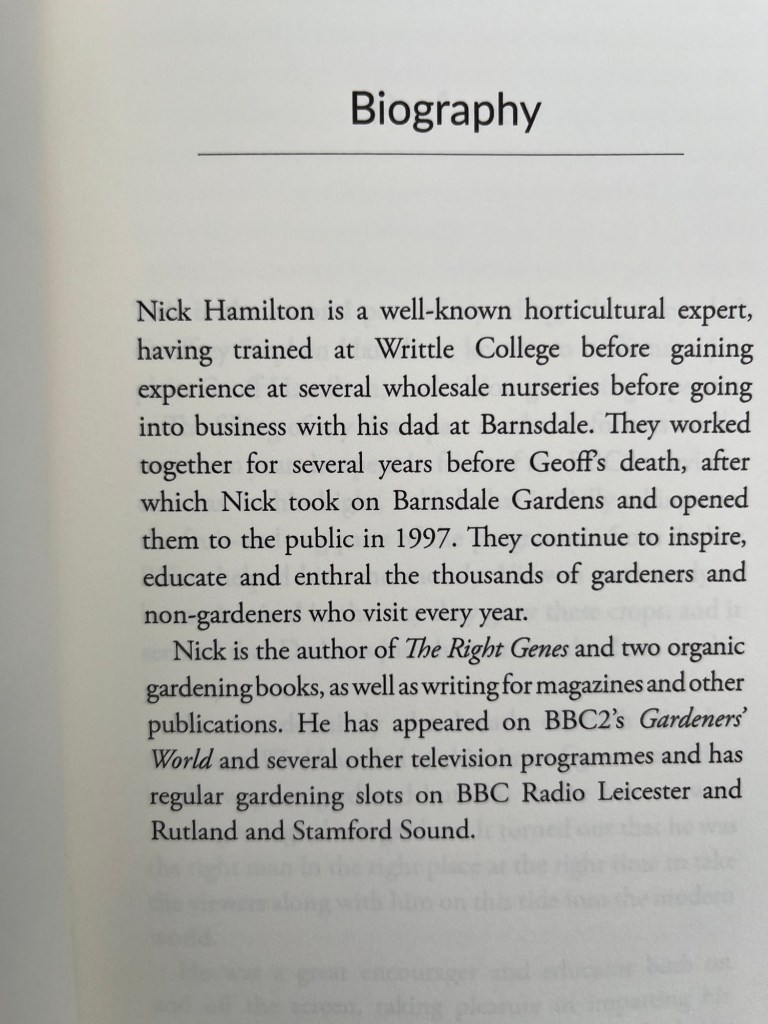
Biography from the book.

Excerpt from the book.

Do any of you remember watching Geoff on the television? Were you inspired to create something having watched the programme. Please get in touch and let me know.

The publishers have given me one copy to give away. Please leave a comment below to be included in the prize draw which will be made on Sunday 15th December. A name will be randomly selected. Sorry, UK only entries. Usual rules apply. Author’s decision is final and there’s no cash alternative. Thanks again for reading my blog. Please subscribe below to see future posts.

Book prize winner. Regional Cooking of England.

John Stewart is the lucky prize winner of Regional Cooking of England. It’s a gorgeous book. I can highly recommend it. I’m very grateful to Lorenz Books for supplying a prize draw copy to give away. Many thanks to all who read my review and got in touch. Have a great gardening, and cooking week! Karen

You can read the review here:

https://bramblegarden.com/2024/07/12/regional-cooking-of-england-book-review/

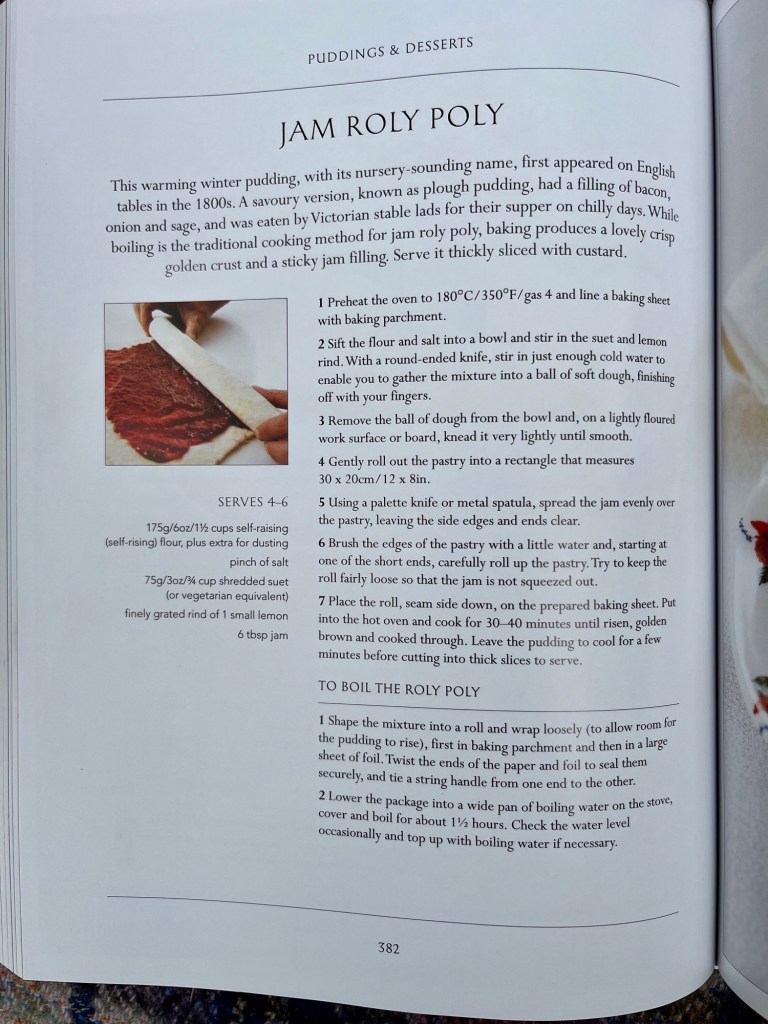
Jam roly poly
Summer pudding
Syrup sponge pudding
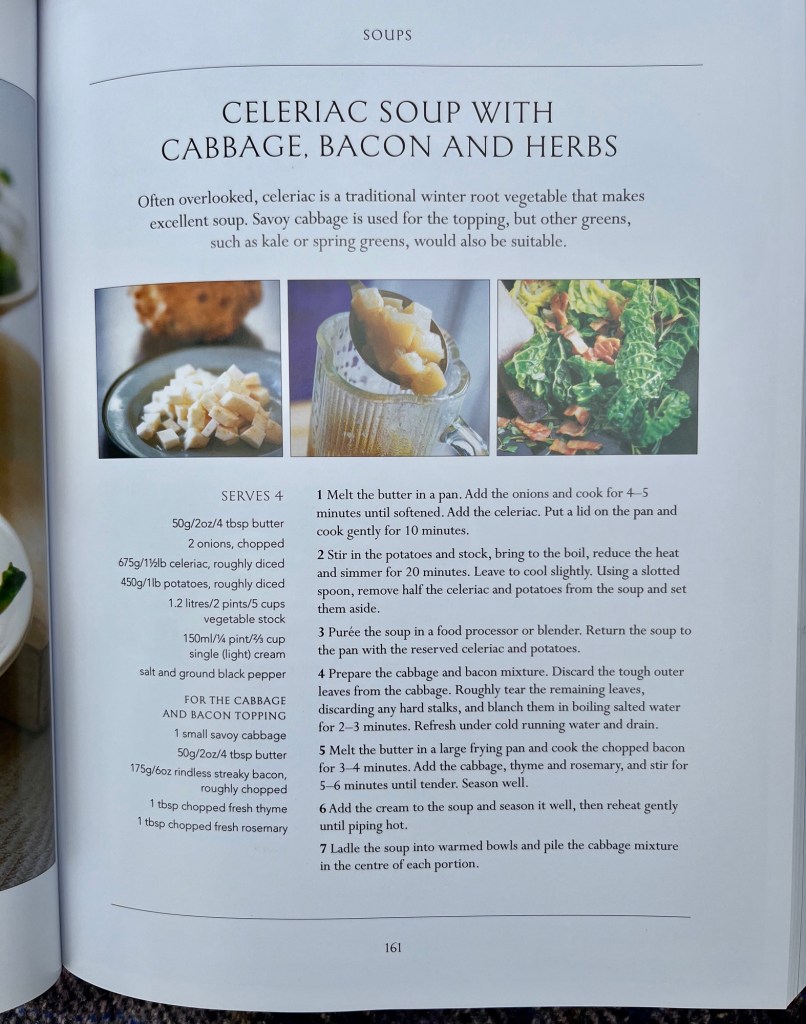
Celeriac soup

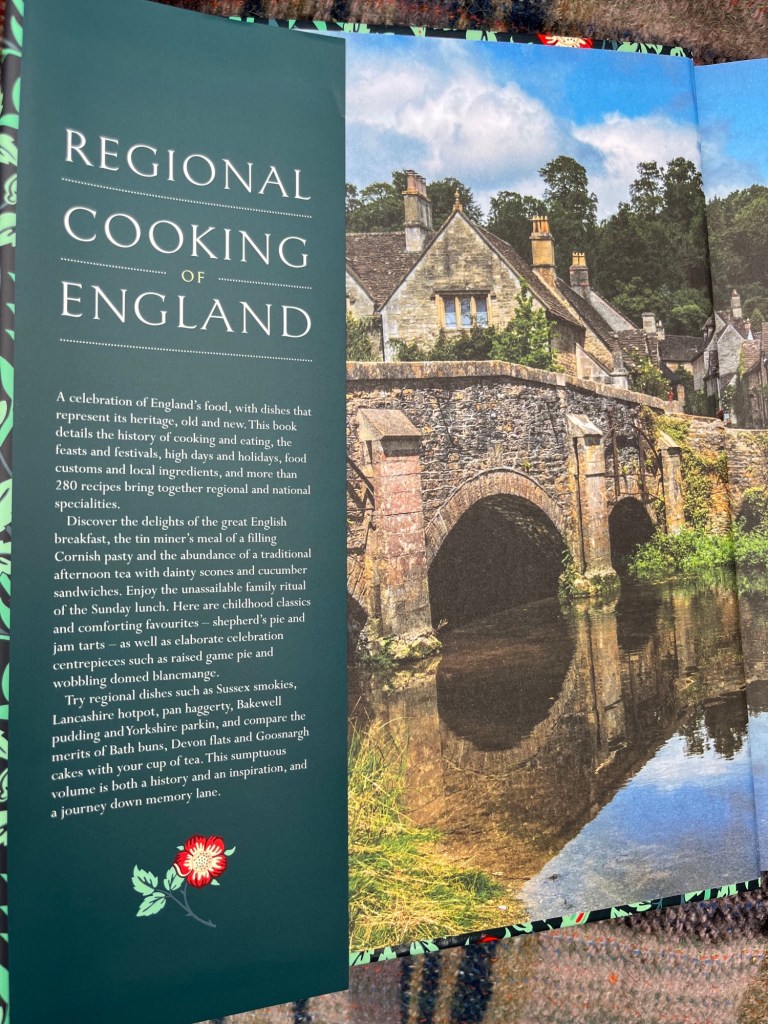
By Carol Wilson. Published by Lorenz Books. £25. Photos supplied by Lorenz Books/ Anness Publishing.

Regional Cooking of England- Book Review

A Culinary Tour with More Than 280 Traditional Recipes.

Carol Wilson

Published by Lorenz Books

Hardback. 672 pages. £25

ISBN 9780754835462

One copy to give away in a prize draw. See below.

My grandma Betty’s specialities were fairy cakes smothered in ‘hundreds and thousands’ – lurid-coloured sugar strands. In fact hundreds and thousands found their way onto a surprising number of puddings. Everything from strawberry trifle, to tarts and sponge puddings. They were her little way of adding sparkle. It must have been a fad of the 70s and 80s, as I haven’t seen them used to decorate puddings for at least 30 years. I have fond memories of family get togethers and grandma’s cakes. Me and my three brothers ate a prodigious amount of sugary puddings- and amazingly all of us are stick thin! We also played outdoors a lot, using up all that energy from those calorie-filled meals. Reading Carol Wilson’s new book Regional Cooking of England, brought back all those happy memories of family food. In Carol’s book there are no hundreds and thousands- but there are all the stalwart recipes of my childhood; jam roly poly, Eve’s pudding, bread and butter pudding, and golden syrup sponge. We were brought up on jam tarts, lemon meringue and Bakewell pudding. In fact, my Mum still makes Bakewell pudding for our Sunday lunch. And very delicious it is too! As we get older, we think back and try to recreate those happy family memories of carefree days. I just remember lots of laughter and joy. I wasn’t aware of any trials and tribulations in the world, just a feeling of security and warmth. How I would love to go back to those days. A time when nothing mattered outside of those four walls. I realise now how blessed I was, having wonderful, loving parents and grandparents, siblings and cousins, aunts and uncles – all in the same village, close by. The power of a book, to bring back memories. I can highly recommend Carol Wilson’s culinary tour. You might even find that it sparks your own time-travelling memories into the past!

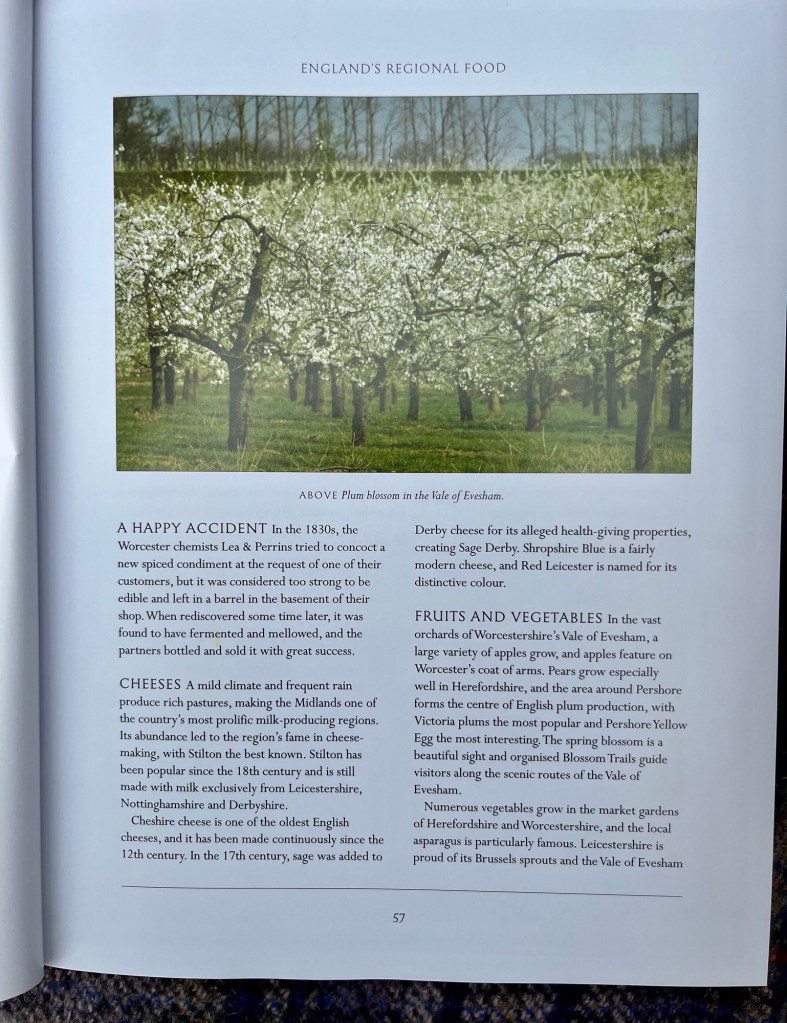
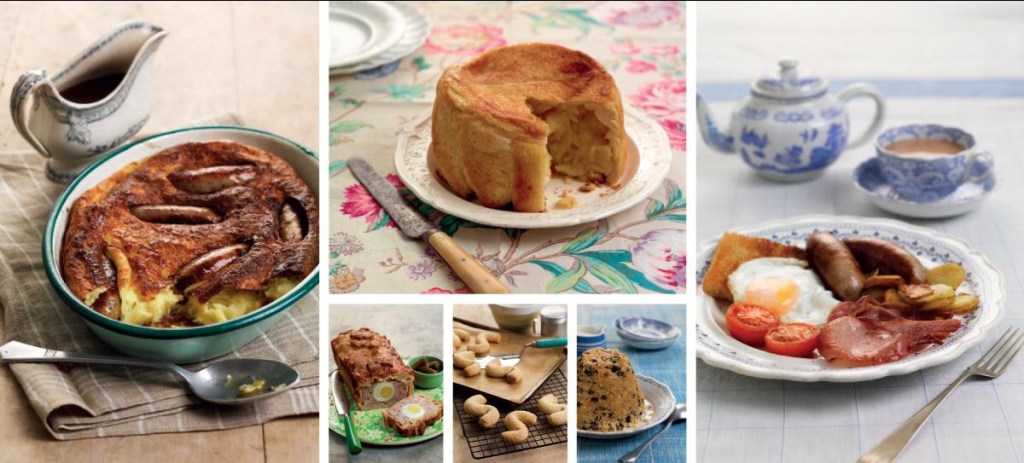
It really is a beautiful book- probably the most beautiful cookery book I’ve ever seen to be honest. It combines glorious english scenic photography alongside mouthwatering food.

My i-phone photos of the book only give an indication of the photos. The real thing is obviously much better quality.

Orchards of the South East of England
Introduction
Recipes include soups, casseroles, main courses, breakfast and puddings
Jam roly poly
One of my favourite recipes. Perfect for a summer family party. We had many of these fun-filled days, not special occasions just ordinary family get-togethers.
Another favourite. My mum still grows gooseberries for crumbles and tarts. This is a lovely recipe I’ve tried this week with my own Hinnomaki gooseberries.
We used to enjoy this dish this, but didn’t know the name. Very nutritious and filling.
Wild foods are mentioned. We used to pick mushrooms in the back fields behind our house. Some of them were the size of dinner plates.
My grandparents grew many of their vegetables. Long lines of peas, beans and potatoes. My grandmother had a huge patch of raspberries. So sweet and tasty in June and July. She kept dozens of hens, so there were fresh eggs every day. She sold them at the garden gate and at the two little shops in the village. In Whetstone, there was a butchers, a general store, a post office. Mrs Pinder’s grocery store sold just about everything. All gone now. Even the post office has closed.
Summer fruit pudding. Photos supplied by Lorenz Books/ Anness Publishing.

More details about the book, taken from the back cover:

Sussex pond pudding, fruit crumbles, trifle, steak and oyster pie, raised pork pies, toad in the hole, scones, stotties, Bosworth jumbles… In this book you’ll find everything from old-fashioned favourites and current classics to less well known historical dishes (a few of which might raise an eyebrow), along with many wonderful local recipes.

This is a celebration of England’s food, with dishes to represent its heritage, old and new. The recipes are easy to follow, with accessible ingredients, and achievable in today’s modern kitchens. Introductory chapters detail the history of cooking and eating in England, the feasts and festivals, high days and holidays, eating habits and ingredients. A glorious cookbook offering the taste of England, and a fascinating glimpse of the past.

Discover the delights of the full English breakfast, the tin miner’s meal of a filling Cornish pasty, and the abundance of a traditional afternoon tea with dainty scones and cucumber sandwiches. Enjoy the unassailable family ritual of the classic Sunday lunch. Here are childhood classics – shepherd’s pie and jammy tarts – as well as elaborate old-fashioned celebration centrepieces such as raised game pie and wobbling, domed blancmange.

Try regional dishes such as Sussex Smokies, Lancashire Hotpot, Pan Haggerty, Bakewell Pudding and Yorkshire Parkin, and compare the merits of Bath Buns, Devon Flats, and Goosenargh Cakes with your cup of tea. This sumptuous volume is both a history and an inspiration, and for many a journey down memory lane.

Editor CAROL WILSON is a food writer and historian who has contributed to many publications including The Times, The Illustrated London News, Heritage, Food and Wine, and Gastronomica. She has appeared on television promoting British food and discussing the history and usage of traditional ingredients.  Her other books include Scottish Heritage Food and Cooking, The Liquorice Cookbook, and The Bacon Cookbook. She is a member of the Guild of Food Writers.

Please leave a comment and your name in the box below to be entered in the prize draw for one copy. A winner will be randomly selected on Sunday 14th July at 6pm. Sorry, UK entries only. The editor’s decision is final and there’s no cash alternative. Please check back on Sunday evening if you enter this competition. If there are no replies to my announcement, I’ll redo the draw and chose another winner. Thank you for reading my blog.

Jam jar flowers….

For In a Vase on Monday.

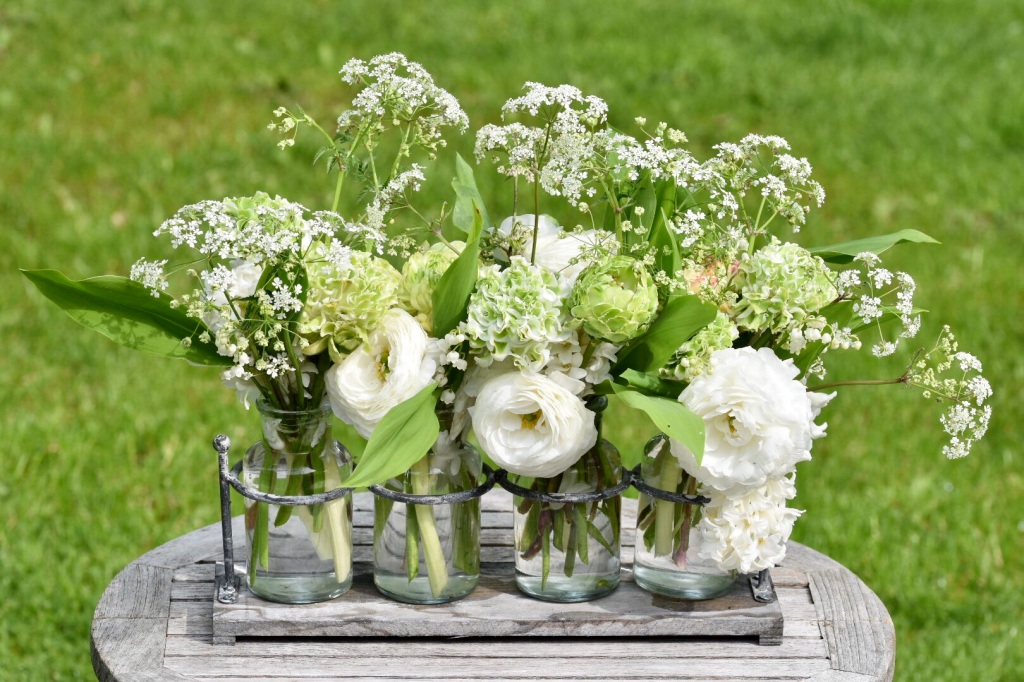
For a modern floral arrangement, four small bottles in a wood and metal holder make life very easy indeed.

These bottles remind me of the ones we used to get at primary school containing milk. Every day we had rich, creamy milk which we sipped through a straw. I loved it! Our teacher, ever ready to put science into action, got us to pour the cream, the top of the milk, into a jam jar. A lid would be added and we each had to shake the jar for as long as we could. The resulting butter was spread on crumpets warmed on the woodburner in the corner of the classroom. We all took it in turn to be ‘wood monitor’ and had to fetch the logs from outdoors. We also had a pencil, paper and skipping rope monitor. It taught us duty and responsibility at a young age. I can’t remember anyone complaining about their tasks. Probably the only thing I didn’t like about school was the outside toilets. They were freezing in the winter and full of dust and spiders. You had to run from the classroom right round the other side of the playground to reach the little row of toilets. And you had to dash there in all weathers, even if it was snowing or raining. Just before I moved schools, a new indoor cloakroom was built and I can distinctly remember everyone being very excited about the new, posh indoor loos! No more spiders or slip-sliding about in the snow. Happy days!

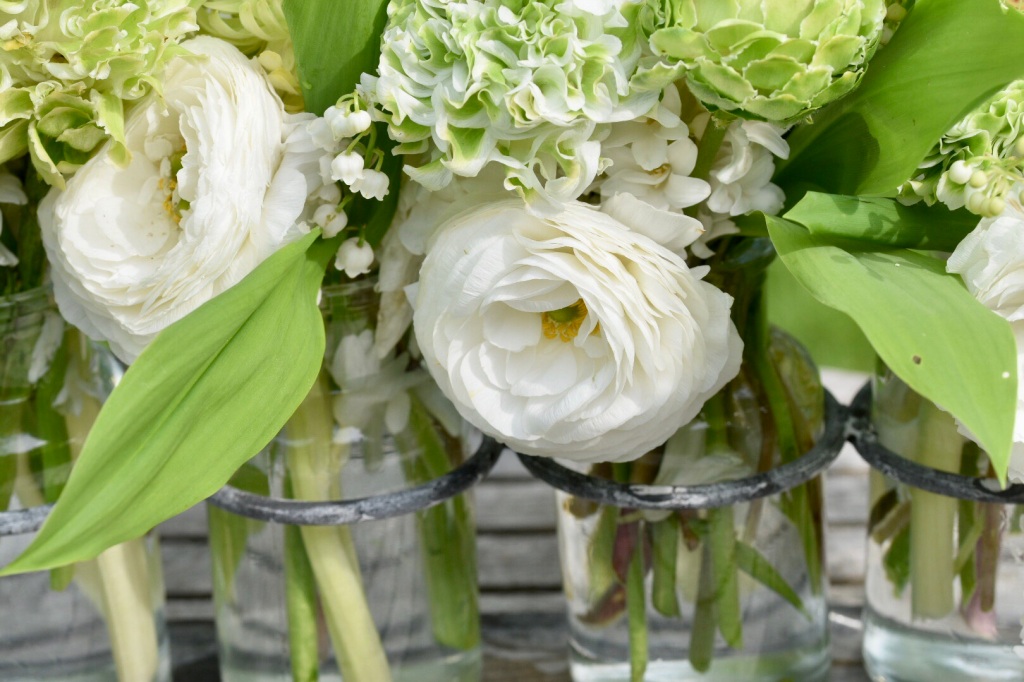
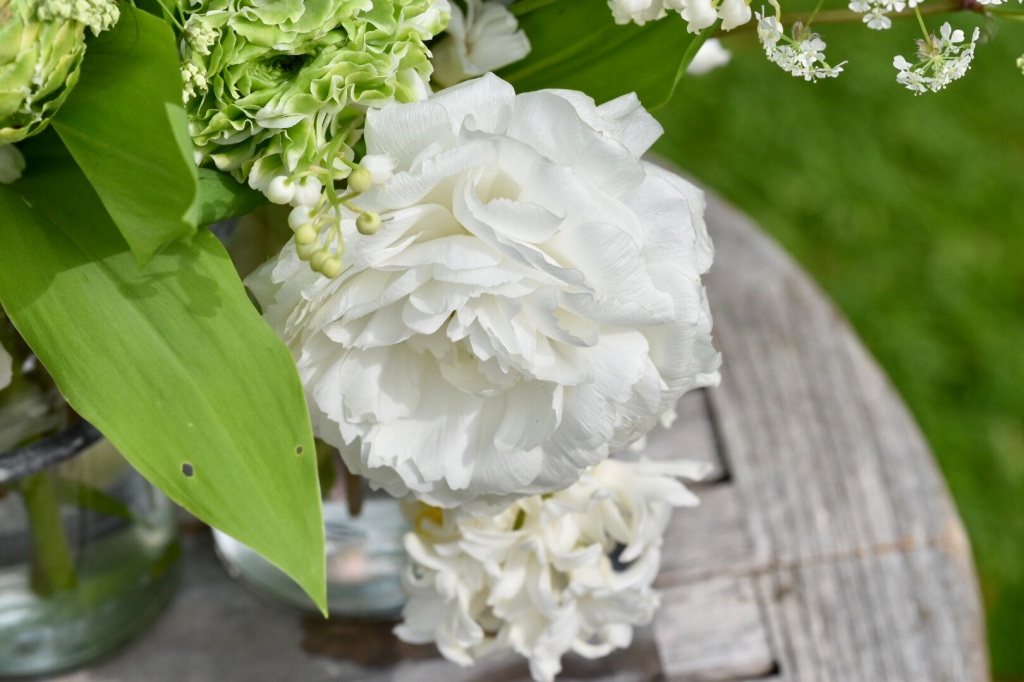
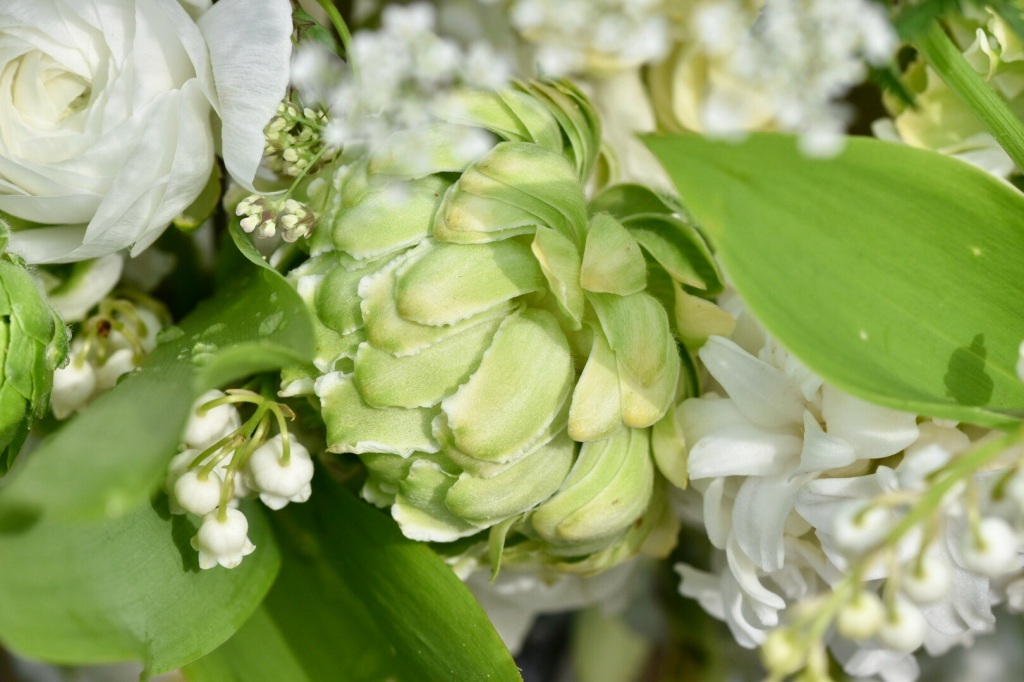
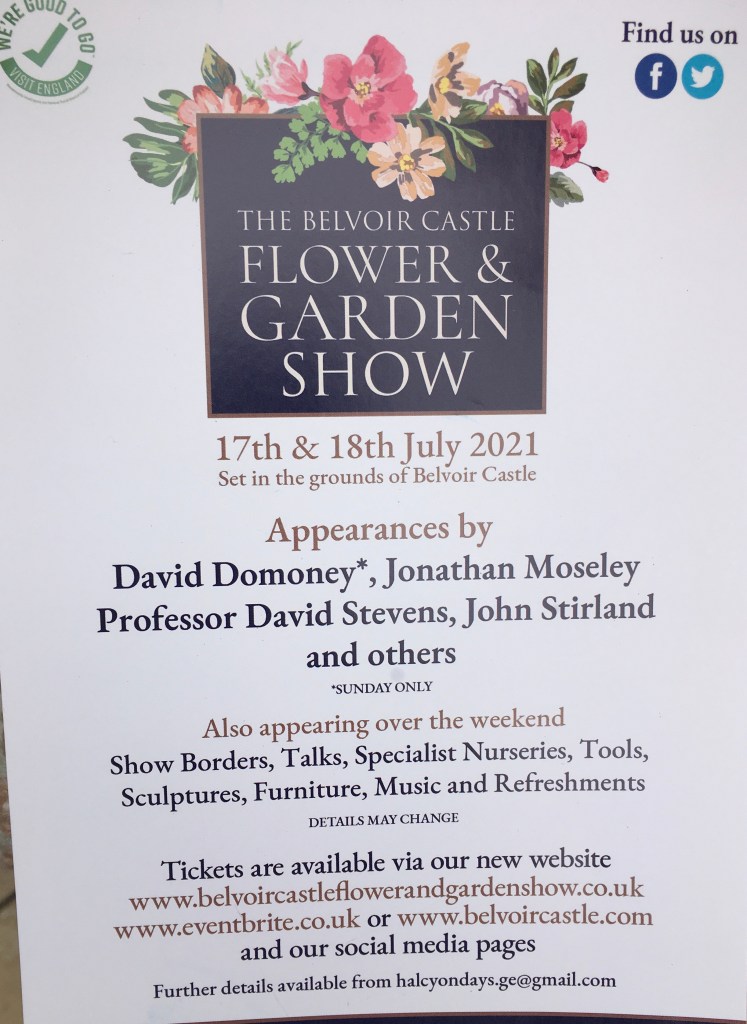
My pretty little floral arrangement was a gift from Jonathan Moseley after we worked together at the Belvoir Castle Flower and Garden Show. Jonathan was the celebrity speaker giving talks and demonstrations on floristry, and I was running planting sessions for children. I loved Jonathan’s green and white selection for the little bottles. He chose English anemones and Italian ranunculus. Aren’t they beautiful!

Jonathan is well known for using flowers grown in his own garden and weaving them into arrangements using British tulips and lilies. Here’s some Lily of the Valley from his Derbyshire garden. The scent was glorious!

He added cow parsley from his own garden too. He mentioned that you can use cow parsley even when flowers are going over, as the little green seed heads are just as pretty.

Scent is essential in flower arrangements and Jonathan added white hyacinths into the mix. I grow Carnegie White for my flower posies.

I think my favourite flowers are these frilly white ones. They lasted at least two weeks, as I changed the water daily and snipped a tiny amount off the bottom of each stem.

I’m growing white anemone coronaria ‘Mount Everest’ in a large pot in the greenhouse. These have provided a few blooms each week since February. Farmer Gracy and Taylors sell corms for planting in autumn or spring. Soak the corms in water for a few hours before planting and space them 10cm apart and 5cm deep. They can be grown outdoors, but I find the rain spoils the flowers, if you want to use them for floristry.

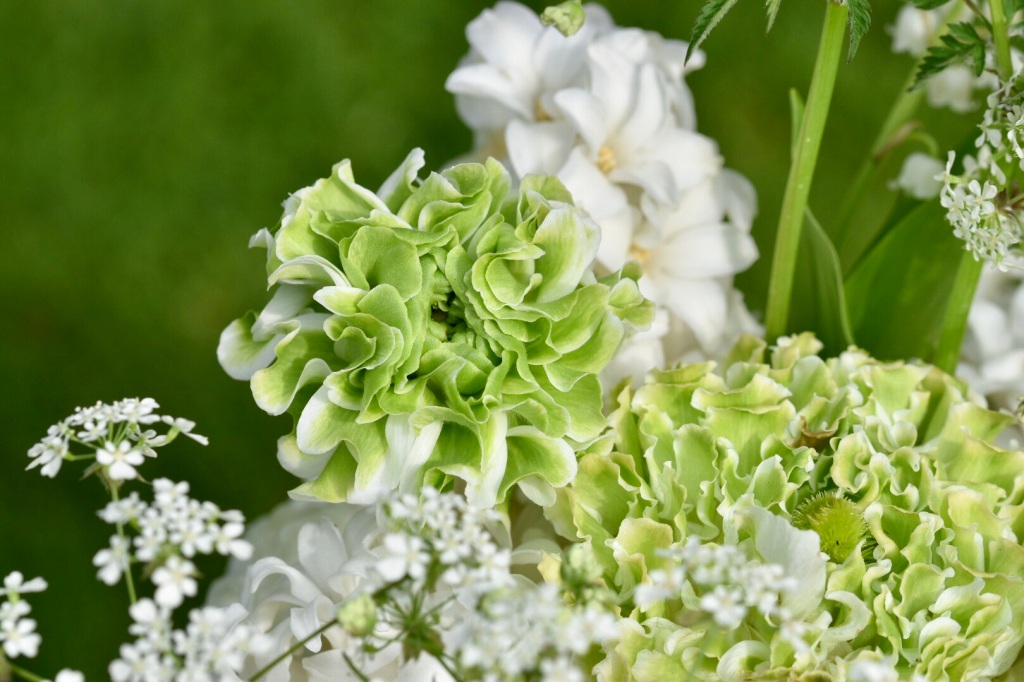
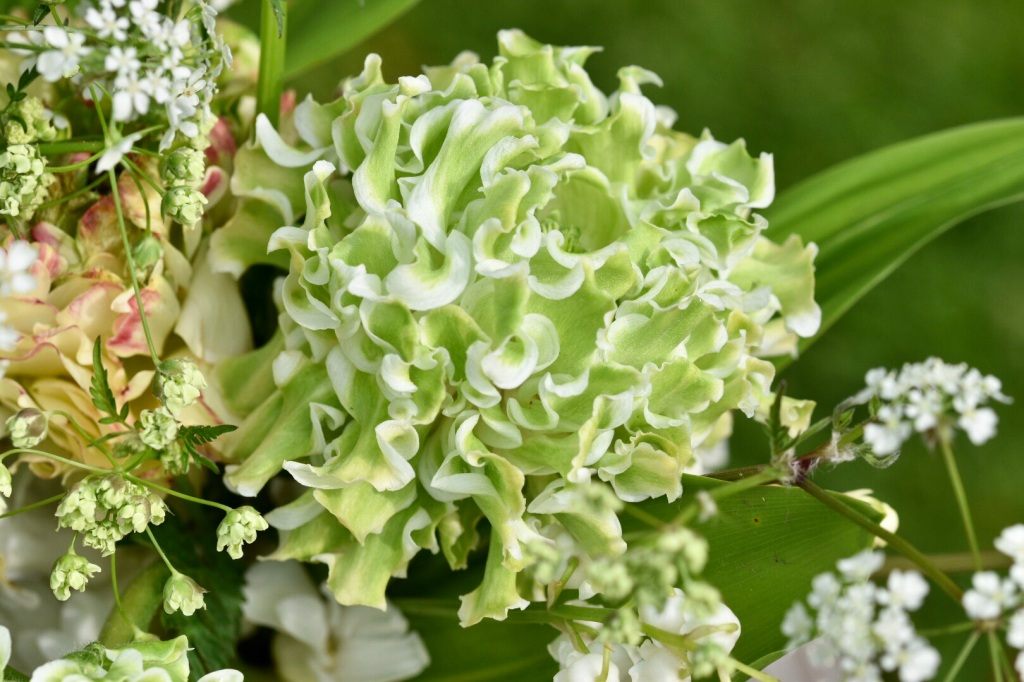
I’m particularly fond of green flowers, so this one fitted in nicely.

Aren’t flowers just amazing! This one is a white and green ‘Pon Pon’ ranunculus. They remind me of a flamenco-ruffled dress!

Green ranunculus.
Flowers looked just as beautiful from both sides. This would make a fantastic display for a dinner table. It’s not too high that guests can’t see each other. The bottles and stand set is available on Jonathan’s website.

Jonathan is a writer, broadcaster and demonstrator as well as an ambassador for British flowers, and regularly appears on television programmes such as Alan Titchmarsh’s Love Your Weekend.

https://jonathan-moseley.com/

Why not go over to Cathy’s blog to see what others are writing about this week for Cathy’s In a Vase on Monday meme.

https://ramblinginthegarden.wordpress.com/2024/06/03/in-a-vase-on-monday-dining-out/

Are you growing any flowers for home floristry this year? Get in touch and let me know how you are getting on with your growing plans. Please leave a comment in the box below. Have a happy gardening week! And thank you for reading my blog.

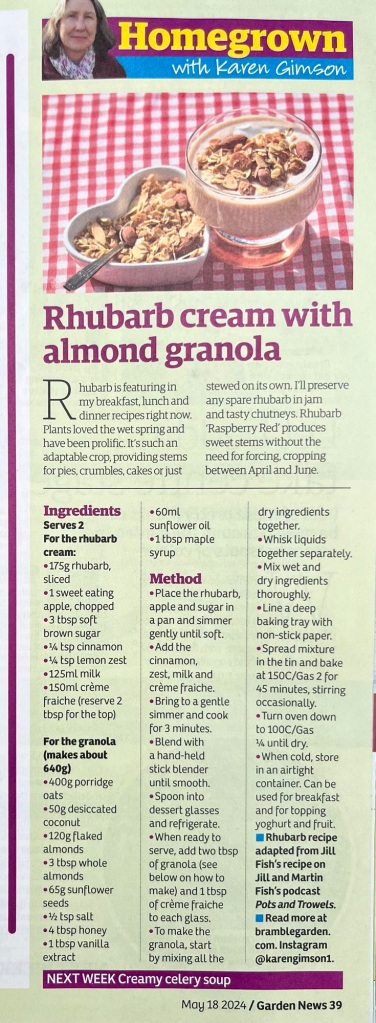
Spring recipes for Garden News Magazine

Rhubarb is one of my favourite crops from the garden. It takes virtually no maintenance, comes up every year without any fuss and provides food from early spring to summer, for a one off payment for the plant.

To be honest, my rhubarb plant didn’t cost a penny. It was a division from my father-in-law’s garden. I’ve had it for at least 10 years, and he grew it in his garden from the moment he bought the house in the late 1950s. I love money-saving crops and ones that are easy to grow.

My rhubarb is growing in a semi-shaded spot under a hawthorn hedge. The secret to its success is the compost bins sited right next to it. All the nutrient-rich liquid feed seeps out from the bottom of the compost bins straight into my rhubarb patch. Rhubarb is a hungry plant and usually growers plant it on top of a pile of manure. I’ve not used manure here for many years as it brings in so many weed seeds. But my plants are healthy and thriving thanks to my home-made compost and liquid feed.

Let me know if you try out my recipe. The granola is especially useful as it can be used as a breakfast cereal, or sprinkled over fruit and cream or yoghurt, or even ice cream to add crunch, flavour and nutrition. The idea for the rhubarb cream came from Jill Fish, as mentioned in the magazine. Jill’s recipe used only rhubarb, but I had used most of my available crop and just had a small amount, so added an apple, and it worked perfectly!

Many thanks for reading my blog. Have a great gardening weekend!

More Events at Exbury Gardens

Photo with kind permission from Stephen Studd

Following my recent post on the 60th anniversary celebrations of the Azalea Bowl at Exbury Gardens, here are further details of events for the rest of the year.

Highlights include:

June – In collaboration with the Friends of The New Forest Airfields, a children’s art exhibition to coincide with the 80th anniversary of D-Day. Exbury House was requisitioned by the Admiralty, commissioned as ‘stone frigate’ HMS Mastodon and used for D-Day planning. 

Also in June will be the 300th anniversary of landscape designer William Gilpin’s birth. A proponent of the Picturesque style, he promoted the idea that ‘nature knew best’ and encouraged Exbury’s owner at the time, William Mitford, to open up a view from Exbury House to the Isle of Wight, install a ha-ha and create the Glade, all of which still remain today. 

Dads can also get half price entrance to the Gardens on Father’s Day 16 June, plus there will be a Model Railway exhibition in the Engine Shed 15-16 June and an Austin Counties Car show 16 June. These are all free with garden admission.

July – For Dragonfly Week, experts Ruary Mackenzie Dodds and Kari de Koenigswarter will be leading walks and talks on these fascinating insects centred around Exbury’s Dragonfly Pond, a British Dragonfly Society hotspot.

August/September – seasonal spotlight on hydrangeas with guided tours by Exbury’s garden team, and over the summer holidays there will be Garden Games for younger visitors throughout the grounds.


Photo Stephen Studd

Exbury Gardens was created by Lionel de Rothschild, a member of the famous banking family, who bought the Exbury Estate in the New Forest in 1919. Within twenty years he had created a stunning woodland garden of some 200 acres, bred over 1200 hybrids – many of which still survive today – and helped introduce one of the most famous rhododendrons of all, R. yakushimanum. Lionel, who was a passionate plantsman, was fittingly described as ‘a banker by hobby but a gardener by profession’. He had an artist’s eye and a scientist’s brain.

This Exochorda or Pearl bush was looking spectacular when I visited.


Lionel’s team improved the New Forest soil at Exbury with spent hops to improve the naturally acidic soil and create the perfect growing conditions for the wonderful collection of rhododendrons, azaleas, camellias, cotoneasters, magnolias, viburnums and many other beautiful woodlanders.  Twenty miles of pathway was laid, the same of irrigation buried, and a 100 ft water tower and reservoirs were built to help facilitate the much-needed watering of the gardens. One of the largest man-made rock gardens in Europe was constructed by installing a temporary railway to transport rocks to the 2 ½ acre site and took four years to build and plant. 


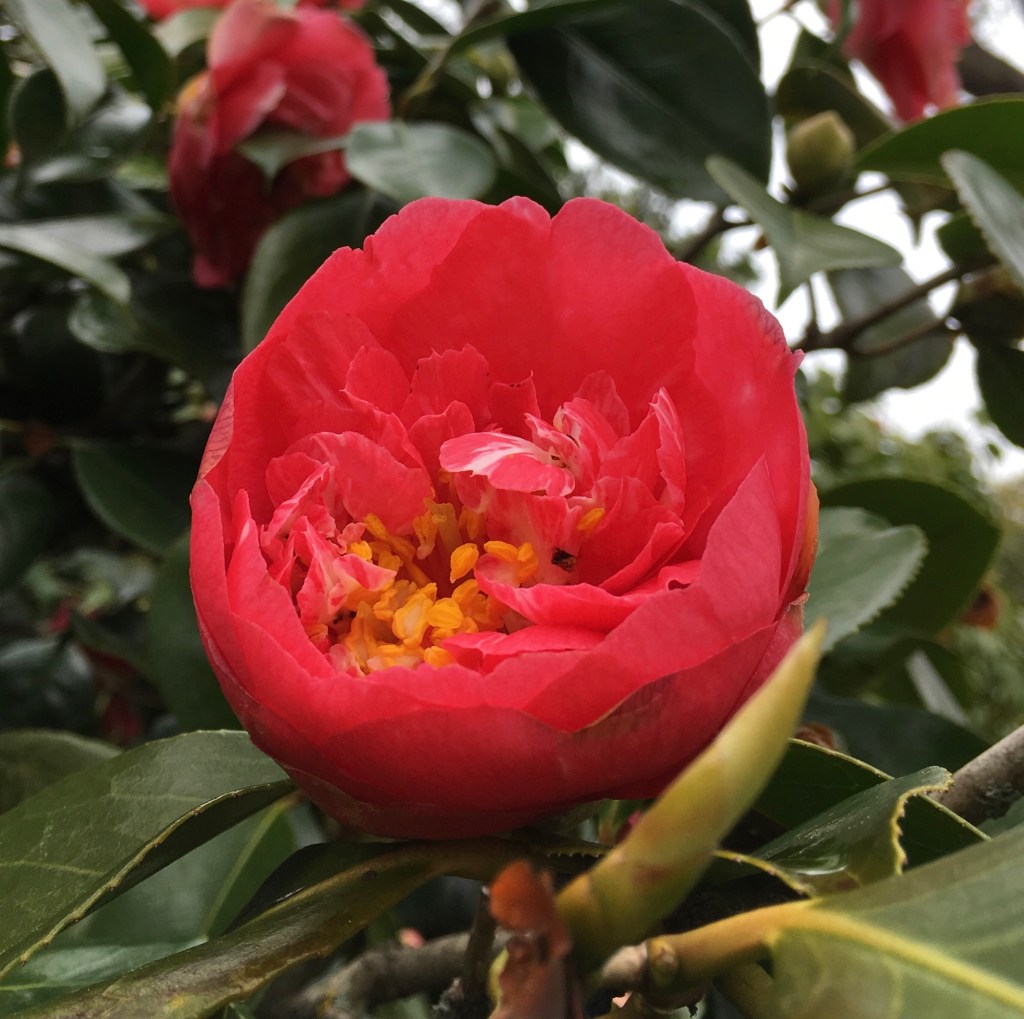
Camellias thrive at Exbury

Thousands of rhododendrons have been planted over the years and well over 1,000 hybrids have been raised by three generations of the Rothschild family. The gardens also boast many Champion and rare trees and National Collections for Nyssa and Oxydendrum. In recent years, the gardens have been further developed with a new generation of rare and unusual trees and shrubs, new vistas opened up, the season extended with more unusual summer flowering shrubs and strong emphasis on autumn colour, as well as an extension of its 1 ½-mile Rhododendron Line steam railway.

Links: more information about Exbury here:

https://www.exbury.co.uk/

I wrote about the Azalea Bowl anniversary here

https://bramblegarden.com/2024/05/03/garden-visiting-exbury-gardens/

Many thanks to photographer Stephen Studd for allowing me to use his stunning photos of Exbury which I thought you would all enjoy.

Thank you for reading my blog and leaving your comments. I hope you’ve all had a fantastic Bank Holiday weekend. Happy Gardening!

Garden Visiting-Exbury Gardens


Exbury Gardens’ Azalea Bowl, a firm favourite of mine, is marking its 60th anniversary with the best ever flowering display, thanks to all the high rainfall we’ve had- and no harsh, late spring frosts. So far….


The Exbury Gardens’ gardening team – centre pic from left to right Emma Callan, Chloe Le Poidevin-Holmes, Tom Clarke, Adam Brooks and Emma Bouchard. Photo Cathy Baldock

Planted in 1964 by former head gardener Freddie Wynniatt, under the guidance of then owner Edmund de Rothschild, it surrounds a large pond in the Gardens. It has witnessed numerous marriage proposals and its peak flowering season is between April and May. This bank holiday weekend would be a perfect time to visit.


Photo by Cathy Baldock who works at Exbury. Lovely to see the very dedicated and talented gardening team celebrating the anniversary. I’ve included this second photos as it shows the Azalea Bowl planting. Mounds and waves of colour.

The Gardens’ team are running special azalea-themed guided tours and visitors are being encouraged to share their photographs taken in the Azalea Bowl over the years on social media, tagging #exburyazaleabowl.

Vibrant acers planted in amongst the azaleas. Photos from my last visit to Exbury Garden


Head gardener Tom Clarke said: “The Azalea Bowl is such a magical place and when it’s in full bloom, it’s almost other-worldly. Very fitting that on its 60th anniversary, the plants are looking magnificent as we’ve had so much rain recently, with no late frosts. Our garden team and visitors  are really enjoying the spectacle of it.”


Lovely white azalea I especially liked

During the rest of the year, the Azalea Bowl becomes a peaceful space in dappled shade where visitors can pause and reflect, and admire the tranquil beauty of the surrounding woodland landscape.


Paths are lined with vibrant azaleas, rhododendrons and camellias
Camellias flourish at Exbury
Another gorgeous double-flowering camellia


Seasonal spotlight tours, focusing on rhododendrons and azaleas, by the Gardens team will take place on  11 May. Tickets are priced £5 (£3 for Friends of Exbury) and can be booked via the Exbury Gardens website. 

Site map of the gardens

Thank you for reading my blog. I loved my last visit to Exbury and am pleased to share my photos again which bring back such happy memories. Have a fabulous Bank Holiday weekend everyone!

Strawberry Sponge Gateau.

Home Grown recipes.

This week’s Garden News Magazine recipe using fruit grown in my garden. Strawberries don’t thaw out well after freezing. They tend to go soft. But frozen fruit is perfect for adding to pies, cakes and puddings. In this instance, I’ve added strawberries to some jam and filled a light sponge cake. Then I’ve added lashings of whipped double cream. I must admit, I had no complaints from the family! 😃

I slice and freeze strawberries in flat plastic trays before bagging them up and using them over the winter. Shop-bought strawberries seem to have no taste, but sun-ripened home-grown fruit is delicious- and free!

You can buy strawberry plants now from the garden centres or online. You can also buy bare-rooted stock which has been cold-treated to produce fruit this year. Strawberries need winter cold to prompt them to flower and fruit, so don’t put them in a greenhouse or other protected space indoors over winter. But you can bring them indoors now to get an earlier crop, if you grow them in containers.

I’ve had the best success growing them in window boxes and lifting them into the greenhouse in early spring. Growing in containers helps defeat the slugs which tend to be a nuisance in wet weather. And also it’s easier to cover them in fine netting to protect from birds. Take care not to use coarse netting, which catches birds’ feet. It can be difficult and distressing trying to untangle a delicate bird from netting. I tend to use fleece now, or micro mesh insect proof netting which has no holes to trap feet.

You’ll notice I mention David Hurrion’s new book. A review is to follow. Very highly recommended. It’s the only guide you’ll ever need for growing anything in raised beds. A very well-written and comprehensive book. Another Dorling Kindersley success story. DK spots all the best writers and is giving us a field day with new titles this year. And David Hurrion is a very well respected horticulturists, teacher and writer. Someone I have no hesitation in recommending for his book and also courses. I note he will be coming to Barnsdale Gardens this year to teach pruning techniques and caring for fruit trees and soft fruit (16 November) and gardening for beginners and plant propagation (3rd August).

Details here : https://shop.barnsdalegardens.co.uk/collections/all-courses

https://www.davidhurrion.com/

Thank you for reading my blog. You are amongst 1,000 readers a week! I’m very grateful for all your support. Come back and read more reviews, and for recipes, and photos of what I’m growing here at bramblegarden. Please also sign up for notifications for future posts.

I wrote a fact sheet for strawberries here :

https://bramblegarden.com/2018/04/26/fact-sheet-for-growing-strawberries-recipe-for-ten-minute-strawberry-jam-biscuits/

Strawberry scones mentioned here:

https://bramblegarden.com/2022/03/01/end-of-the-month-review-some-photos-from-my-garden-and-thoughts-for-ukraine/

Vegan cheesecake:

https://bramblegarden.com/2020/05/10/strawberry-cheesecakes-vegan-family-favourite-recipes-from-my-daughter-clare/

Garden fruit jam

https://bramblegarden.com/2018/07/26/summer-fruit-harvest-and-making-garden-jam/

Winners for two tickets for Gardeners’ World Live.

The Watchmaker’s Garden.

Many thanks to everyone who read my blog and left a comment.

The random prize draw has been won by Mark Pearce. Please get in touch with me Mark. My e mail is k.gimson@btinternet.com.

The organisers have kindly shared a discount code for anyone wanting to save money on tickets! They say:

“Your discount code is SAVE10 for 10% off standard adult/concession entry tickets. Please note the end date in the Ts & Cs below.

*Discount valid on adult/concessions standard entry tickets for Friday 3rd and Sunday 5th May for entry at 09:30am and 12pm only. Not valid on 1:30pm tickets, added extras, or with any other offer. Ends 23:59 on 16 April 2024.
£3.95 transaction fee per e-ticket order. Details correct at time of print.”

Please note, I am not involved in any discussions re tickets. I’m merely passing on their offer in case you wish to use it.

I would also point out that parking prices are rather expensive. So be aware of those when booking any tickets!

Canal Garden.

Thanks again to everyone reading my blog. It’s much appreciated and you are among almost 1,000 readers a week! I’m very grateful for all your support. Have a great gardening week.

Winner: Second Nature book give-away

Update: I’ve re – run the prize draw as Fiona hasn’t got back to me at all. The new winner is Natalia Clarke at Luckybees. enjoy the book Natalia!

The winner of the prize draw for Susie White’s gorgeous new book, Second Nature is Fiona Pryor. Please e mail me for details, Fiona. My e mail is k.gimson@btinternet.com.

Thank you to everyone who read the review and left a comment. You can read the review here:

https://bramblegarden.com/2024/04/10/second-nature-book-review/

Meanwhile, some photos from my garden this weekend. Spring has been a long time coming, and now I can’t bear to be indoors. Every minute is spent in the garden!

Potting shed window. Scented jonquils and forget me nots.
Pheasant’s Eye narcissi.
Possibly Narcissi Geranium. Wonderful scent. Reliable grower. Always comes back every year and naturalises in long grass.

Tulip Mondial. A lovely double white with green markings. Long lasting flower. Stands up to the weather. Copes with the rain.

Some tiny species tulips growing in an Italian pot. Part of a mixed cut flower collection from Gee Tee Bulbs. Species bulbs will always come back the following year. Bulbs do not have to grow to such a huge size as the Dutch bulbs to re-flower the next year.

A hybrid ‘cowslip.’ A bee has passed pollen from my red primroses to a yellow wild cowslip- and the resulting seedling is this little beauty. Isn’t nature wonderful!

Thank you for reading my blog. Look back for more book reviews and giveaways next week. Have a great Sunday!

Second Nature – Book Review

The Story of a Naturalist’s Garden

Susie White

Published by Saraband

Paperback 184 pages. £12.99

ISBN: 9781915089915

The publishers have offered one copy to be given away in a prize draw. Please leave your name in the comments box below to be included.

It’s been a dire winter and spring. Rain-sodden fields, ditches overflowing, waterlogged garden. Tulips dashed by Storm Kathleen. My green fingers are itching to get on the land, and yet to walk about- no squelch about- would do more harm than good! So I’m feeling rather downhearted at the moment. Then into the potting shed comes a wonder of a book, Second Nature. And in it writer Susie White manages to revive my flagging enthusiasm. Susie writes with such honesty and compassion for wildlife it gets me looking to the clouds again to watch the buzzards soaring overhead. Ok, I’m going to get soaked looking up, but it’s worth it. Susie is well-known for creating a glorious garden and nursery at Chesters Walled Garden along Hadrian’s Wall. She talks of the heartbreak of having to leave after 23 years. It must have been devastating, having poured a lifetime’s work into one place. As I read the book, I take a moment to ponder how I will feel when I have to move on. It’s something we must all contemplate – and dread. In my case, will the new owners chop down our wood? Will they build on the meadow. What will happen to all the birds that currently nest in my garden? And I know exactly where they are every year, which nest boxes are occupied by which birds. Books that are well-written draw you in and make you think of the comparisons between their life and yours. The little jolts of memory from childhood gardens and the people who taught us to garden. Writers open their hearts to us, and in return we find ourselves nodding in agreement, finding common ground, mutual understanding. It’s a heart-sing moment when Susie, through her story, jogs a memory for me of my grandfather growing rows of peas and showing me how to shell and eat them fresh from the pod. Such moments are precious.

Not every writer can do this. They try, but Susie is a natural. She talks about returning to Chesters in her dreams : “To smell the resinous warmth emanating from the lean-to greenhouse, the musky tang of the box hedges. I can take myself along the paths, knowing exactly where I’m going, what weeds would always grow in certain spots, what jobs I’d have to do in each month of the year. I can still feel my way around that garden.”

And yet, despite the sadness, the book moves on to focus on the new garden Susie and her husband create, transforming a patch of untended ground into a wildlife-friendly haven, planted with flowering perennials, trees, herbs, vegetables and wildflowers. The garden teems with life: owls, blackbirds, bats, mice, butterflies and bees, all drawn by pollen-rich flowers, ponds and nesting sites.

Susie takes us through the planning and construction phases and describes how to blend a garden with natural surroundings. Her account is filled with ideas, inspiration and advice learned from setbacks and experience.

As Susie talks about visiting her former garden in her dreams, her writing also gives us the gift of ‘walking’ through her new garden and seeing everything she describes. It’s a joyful walk and one I can highly recommend. A special book which has transformative powers. I enjoyed every page and will return to it often!

Contents page.

About Susie:

Susie White is a gardening and travel writer, broadcaster, wildlife
photographer and lecturer. A lifelong and passionate gardener, she developed the garden at Chesters Walled Garden on Hadrian’s Wall in Northumberland.
Since then she has created a garden from scratch in a hidden valley on
previously uncultivated land. 

Beyond the garden, Susie’s interests include the environment, conservation, wildlife, upland hay meadows, archaeology, heritage skills and the landscape and walks of the North Pennines, Northumberland, and the Lake District. She is a regular contributor to the Guardian, BBC Countryfile, The English Garden, Homes and Gardens, and is garden columnist for My Weekly magazine. A
member of the Garden Media Guild, and RHS speaker, she is the author of Gardens of Northumberland and the Borders.

The prize draw for one copy will be made on Saturday 13th April at 6pm. Sorry, only UK addresses due to postage costs.

Thank you for reading my blog. Please follow the blog and sign up for e mail notifications for future posts. Have any books lifted your spirits recently? What are you all reading at the moment? Get in touch and let me know.

Events at Borde Hill

Borde Hill Gardens. Allium Globemaster putting on a fantastic display.

News from one of my top favourite gardens! I’m always happy to share information on events at the gardens I love to visit.

The Specialist Spring Plant Fair will be held at Borde Hill, near Haywards Heath in West Sussex, on Sunday 12th May from 10am to 3pm.

Hosted by the Plant Fairs Roadshow, a collective of independent specialist nurseries, visitors will see a lineup of locally grown, garden worthy and unusual plants from leading growers from across the South East, including several RHS exhibitors.


Borde Hill’s gardening team will be available throughout the event to offer horticultural advice to visitors, helping them find the right plant for the right place. It’s a chance to put your burning horticultural questions to the experts!

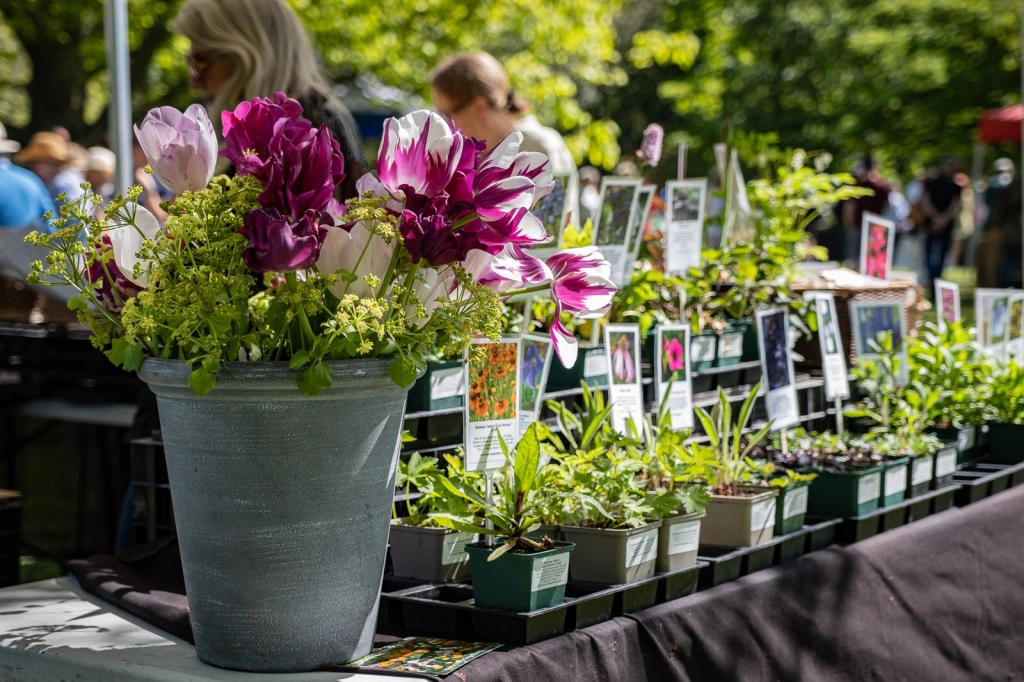
Plants and tools will be on sale


The Spring Plant Fair also offers a unique opportunity to delve into Borde Hill’s rich history of planting excellence, with a complimentary talk led by Head of Horticulture, Harry Baldwin, at 12pm in the Garden Marquee. Delve into the remarkable legacy of Colonel Stephenson Robert Clarke, the visionary plantsman behind the Garden’s extraordinary collection of rare trees and flowering shrubs, while hearing about the pioneering propagation programme aimed at safeguarding these botanical wonders for future generations.

A photo of a magnolia I spotted last time I visited the gardens. Borde Hill is famous for its magnolias, azaleas and many rare trees and shrubs.

Specialist exhibitors include Clare’s Chillies, Miles Japanese Maples, and Chailey Iris Garden, along with other well-known names such as Plantbase, Hardy Cottage Garden Plants and Eleplants, among others. The Sussex branch of the Hardy Plant Society will be there too, along with Sussex Wildlife Trust and the Australasian Plant Society
The Spring Plant Fair is a wonderful time to visit Borde Hill, when the Azalea Ring will be a kaleidoscope of colour with deciduous Kurume azaleas. Across the Garden there will also be uplifting displays of rhododendrons, flowering trees, bluebells, tulips and striking Allium Globemaster adding vibrant colour to the Italian Garden and Blue Border.

Azaleas I couldn’t resist photographing! Such a beautiful colour.
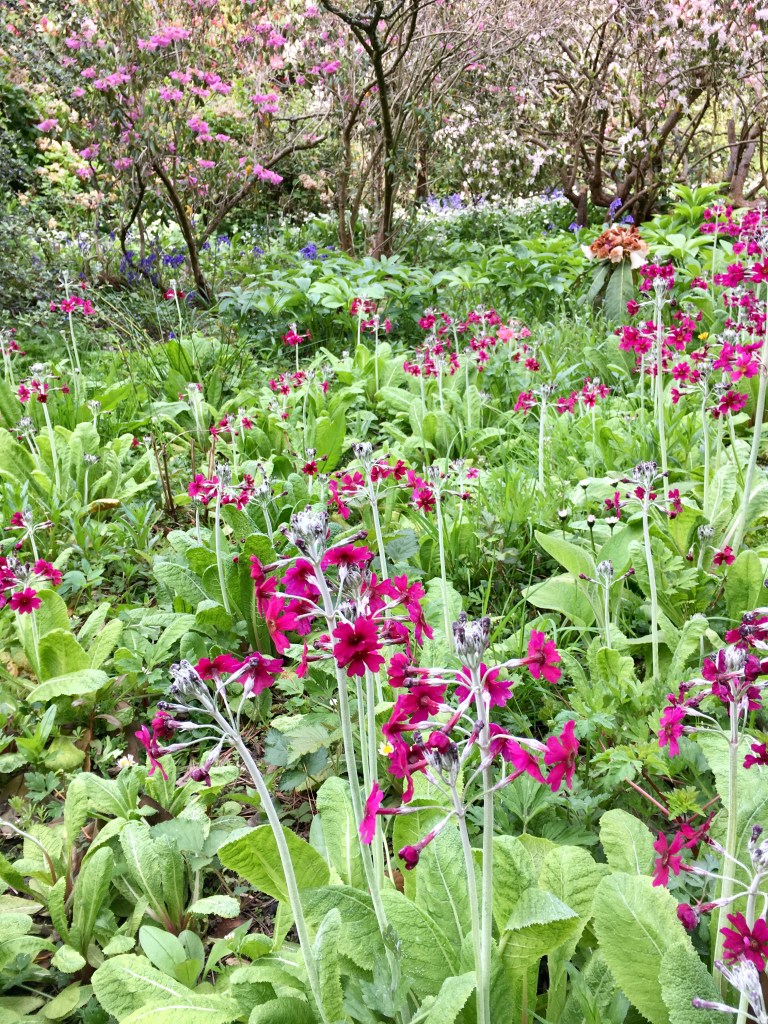
A photo of magnolias and candelabra primulas – a scene I enjoyed when I visited in May.

The Plant Fair will be open from 10am-3pm – for more information visit: Specialist Spring Plant Fair – Borde Hill

https://bordehill.co.uk/events/plant-fair-2024/

https://bordehill.co.uk/

Peony at Borde Hill.

Also, many congratulations to Eleni and Andrewjohn Stephenson Clarke for their RHS Veitch Memorial Medal. A well deserved award!

Please leave a comment in the box below and sign up for e mail notifications for further posts. Thank you for reading. You are amongst 1,000 people a week who read my blog. I’m grateful, and amazed. Thank you.

Gardeners’ World Live – two free tickets to give away.

The Watchmaker’s Garden.

I’m always looking for ways to help readers. Each year the organisers of Gardeners’ World Live offer two tickets to give away in a prize draw. Please leave your name in the comments box below to be included in the random prize draw. Please read the terms and conditions they have supplied.

Canalside Garden.

Tickets are non-refundable, non-exchangeable and non-transferable, and do not include travel, accommodation or expenses. There is no cash alternative.
Details of giveaway and prize correct at time of print. Ticket terms and
conditions apply:

https://www.immediatelive.com/ticket-terms-and-conditions/

Please note that parking is not included in the prize.

Lovely setting for a garden room.

The organisers will not be issuing paper tickets.
Approximately two weeks before the event, winners will be emailed a link to register online. They will receive tickets by email.

Lovely recycled items in Frances Tophill’s show garden.

Organisers are offering a pair of standard adult tickets for BBC Gardeners’ World Live at the NEC Birmingham for a ticket giveaway/competition. Tickets will be valid for Sunday 16th June, 9.00am entry. RRP £56.00 per pair.

I hope you’ve enjoyed this look back at past gardens at the show. GW Live is a favourite of mine. I love the marquee with specialist nurseries selling and displaying every kind of plant possible. And there’s plenty of ideas to copy for planting and design.

The prize draw will end on Sunday 14th April at 6pm. Thank you for reading my blog. Let me know what you think about my posts and if you have any horticultural questions of any kind, please let me know. I’m happy to help!

If you like, follow the blog and sign up for e mail notifications for further posts.

I wrote about GWLive here:

https://bramblegarden.com/2019/06/14/bbc-gardeners-world-live/

And here:

https://bramblegarden.com/2021/08/25/bbc-gardeners-world-live-show-2021/

Nick Hamilton’s grow-your-own vegetables hints and top tips.

While visiting Barnsdale Gardens for the winter walk-and-talk, I had a chance to peek into the impressive kitchen gardens. Not only are the gardens beautiful, but they are highly productive too. They are gardened organically. Plants are put in closely together, and there are many little pathways meaning a lot of the work can be undertaken without stepping on the soil. Nick is a very good teacher. He explains everything in an easy to understand way with a lot of patience and humour.

Photo: Steve Hamilton

Nick shared with me his advice and list of ‘top five’ winter vegetables:

Brussels sprouts – Generally eaten over the Christmas period, but if you grow your own then you could harvest this vegetable from August to at least March. As a child, I remember them as having a bit of a bitter, old socks taste, but those days are well and truly gone with the modern varieties being sweet and flavoursome. In order to get the continuity of cropping to give the longest harvest period I only need to grow two varieties, ‘Nelson’ and ‘Red Ball’.

Kale – A well-known superfood that not only gives us something to eat but, if you select the right variety, a very beautiful and interesting addition to the ornamental winter garden. I like to grow a variety called ‘Redbor’, which is widely available, but I do not grow it in the veg plot, preferring instead to move it around my ornamental borders. The reason I do this is because ‘Redbor’ has the most wonderfully deep coloured, red leaves that enhance in colour with the colder winter temperature, but then are elevated to another level during frosty weather.

Chard – A hardy, leafy leaf beet this is an excellent substitute for spinach. I have been bought up to try and eke out the most from everything in a garden, so choosing a variety that gives ornamental interest as well as excellent production is an absolute bonus. Such a variety is Chard ‘Bright Lights’, which comes up as a mixture of different colours of leaves in shades of yellow, green and red, all with a prominent white mid-rib.

Jerusalem Artichoke – What a fantastic winter veg to grow! I love it not just because it is adaptable in the kitchen but also because it is a tuber that is perfectly hardy, so can be left in the ground all winter and dug up as and when required. I grow a variety called Fuseau because it is less knobbly than others, so easier to peel. It does like to spread, so I control it by growing mine in containers that I sink into the ground and then lift when needed.

Leeks – I can’t imagine a winter without leeks adorning the culinary delights that appear from my kitchen. This year I have grown the varieties ‘Winner’, ‘Pandora’ and ‘Jolant’, which will give me a continuous harvest from August until April. Something my taste buds and stomach are very grateful for. We do have a couple of problems to deal with however, which is why we grow them, from sowing until the end of the crop, under an insect-proof netting to prevent attack by leek moth and/or Allium leaf miner.

Photos credit Steve Hamilton

Barnsdale Gardens is Britain’s largest collection of individually designed gardens based in the East Midlands.  There are 38 gardens on show including the beautiful kitchen gardens. Courses run throughout the year on growing and planting fruit, flowers and vegetables, and there’s also courses on pruning and maintenance. See the website for opening times and course details. I’ve signed up for the newsletter which means I get all the news first and can plan my visits when there are special events happening.

I wrote about a Barnsdale’s winter gardens walk and talk here:

https://bramblegarden.com/2024/02/28/a-winter-walk-around-barnsdale-gardens/

What vegetables are you planning to grow?

I’m loving my white-stemmed chard and white kale. Here’s some I’m harvesting now, having sown the seeds in summer and planted them in a cold frame and unheated poly tunnel. They overwinter as small plants and start growing after Christmas. You can just see two eggs in the basket too. The hens have started to lay again! A sure sign that spring is well and truly on the way. Hurray!

Sweet, tasty, and pretty too!

Willow Weaving Course at TASK Academy

For 20 years I’ve worked alongside skilled willow weavers. I’ve watched them create fences around the gardens I’ve designed. Clematis and roses climb through woven tripods and willow animals ‘scamper’ across the lawns. I’ve always wanted to try my hand at weaving, but never had the chance. I wouldn’t have dared to interfere with their work. We are all on a deadline to complete the gardens. Time is money, and my job is to set out the plants and try to keep ahead of everyone planting them! This week though, I’ve finally managed to get my hands on some willow and have a go! I attended a one-day taster day for land-based skills at TASK Academy in Worcestershire.

Our project was to make a small woven cone out of year-old willow that had been soaked for four days. I loved the contrast between the red and yellow willow.

Our teacher Mel Bastier holding the willow cone I made.

Mel Bastier explained the basics and showed us how to make a small woven structure which could be used as a bird feeder. I decided to use it for floristry. I’m always trying to find new ways of displaying flowers without using florists’ foam.

First we fed willow through holes in a base form which held the willow in place for us to work on. The base form would be much larger for plant supports, but it’s the same principle.

We wove more willow in and out of the uprights until we had made a collar. Then more willow was twisted up to the tip to secure the structure. Finally we added a handle. Mine was quite long as I wanted to hang the cone on my farm gates and amongst the orchard trees.

At home, I collected some moss from under the apple trees. I wrapped it around a jam jar and secured it with garden twine, kokedama style.

The moss makes a natural ‘nest’ for a flower posy. You’d never know there was a jam jar inside.

I pushed the jam jar into the top of the cone and filled it with cold fresh water. Then I wandered around the garden collecting the last of the snowdrops, (if you pull them, they have long stems) the first daffodils, hellebores and primroses.

I stood the flower arrangement on the potting shed windowsill to add some hazel catkins. The flowering cherry just opening is Japanese cherry, Prunus Kojo No-Mai.

Hellebores are seedlings of five plants bought from Ashwood Nurseries. I must have nearly 100 plants around the garden, all offspring of plants purchased 10 years ago.

Although it’s not as showy as the rest, I love this small pink hellebore with its lime green markings.

Daffodils came from Taylors Bulbs. Good strong varieties that come back into flower reliably each year.

I’m very pleased with my willow cone. I loved making it. It’s a very calming thing to do, learning a new skill, among friends, with kind and patient teachers. Mel made the willow crown sculpture at RHS Wisley for the King’s coronation, and she’s also made many structures for flower shows and private gardens.

I would love to return to TASK to make some plant supports like these.

I must admit I fell in love with this hare. Maybe, in time, I might be able to make something similar! If I do, it will be all thanks to Mel and the team at TASK.

TASK Academy is run by award winning landscaper Rupert Keys. If you’ve looked on in wonder at the lovely greenhouse owned by Frances Tophill on Gardeners World, Rupert and his team made it! Frances won Platinum and Best in Show for her garden at BBC Gardeners World Live in 2022 and Rupert built the garden and created the greenhouse out of recycled window frames. I lost count of how many awards he’d won to be honest. Safe to say, he knows what he’s talking about and has the experience.

TASK run land-based courses for the landscaping industry and also for anyone wanting to learn how to create dry stone walls, learn garden design, bricklaying and willow weaving.

I can wholeheartedly recommend them. I loved learning something new and found the team very kind and encouraging. Experts who can also teach with patience and understanding. A perfect day that I’ll always treasure.

Find out more at https://www.taskacademy.co.uk/

Thank you also to Emma Mason PR for inviting me along!

Have you recently attended any courses of any kind and learned a new skill? Let me know how you got on!

Also see Common Farm Flowers for floristry courses where I learned how to make my jam-jar posies and bouquets and grow cut flowers all year round.

See Cathy’s In A Vase on Monday here :

https://ramblinginthegarden.wordpress.com/category/gardens/in-a-vase-on-monday/

A winter walk around Barnsdale Gardens

Galanthus ‘Starling’

Among the 9,000 snowdrops on display at Barnsdale Gardens is this beautiful semi-double variety with long, thin pointed outer segments. Isn’t she a beauty! Such a pretty name too, ‘Starling.’ I spotted it right at the start of our winter walk-and-talk event hosted by Barnsdale owner Nick Hamilton. Once seen, never forgotten. I’m not much of a galanthophile, but Starling captivated me. Such an unusual snowdrop with dark green inner segments and a lovely growth habit, having flowers that tilt upwards which means you don’t have to get down on your hands and knees to appreciate them.

Many of the special snowdrops are displayed in a raised bed surrounded by gravel. Rain doesn’t splash them with mud. Heavy rain has been such a problem this winter and many snowdrops in my garden have either been swamped or munched by slugs. I hadn’t thought of growing them in this way, but I might try it out in a spare corner of the garden.

Galanthus Hippolyta is also thriving and forming a good substantial clump. This is one of the Greatorex doubles, ‘beautifully formed with rounded bells, filled with green edged petticoats’ says the information on a five-page fact sheet supplied by the gardens. All the snowdrops are carefully and clearly labelled and the fact sheet is a great help with identifying all the different varieties.

Hippolyta
Galanthus Madeline. Another pretty, robust, recommended variety.

Snowdrops are just one of the attractions in the Winter Border. This garden was created in memory of Nick’s father Geoff Hamilton who presented the BBC Gardeners World show from the site until his death in 1996.

Salix Britzensis

Paths are lined with evergreens, scented plants, and trees and shrubs with colourful bark for winter interest.

Salix Basfordiana

The beauty of having a walk- and-talk tour is seeing the plot through expert’s eyes, and picking up hints and tips on cultivation. Nick explains that these beautiful willows produce the best colour on new stems. Plants will be pruned virtually to the ground or to a low stump so that new stems will grow for next winter’s display.

Willows certainly make a design statement, and Nick advises to plant them where the sun shines through them to highlight their bright colours.

Whereas the willows are quite drastically trimmed, Nick advises a more selective approach for pruning these dogwoods. I have similar Cornus Midwinter Fire, and carefully trim back the side shoots and gently shape up the plants. Cornus Westonbirt which has bright red stems are pruned virtually to the ground, but these orange-stemmed dogwoods take a long time to recover if pruned too severely.

Information boards are posted throughout the garden which help our understanding of the reasoning behind the plantings.

It was fascinating to walk around the garden spotting all the trees, shrubs, bulbs and perennials donated to the memorial garden. Gordon Rae is a good friend of the family, and mine, and his name crops up several times with collections of different snowdrops, for example. I noticed trees from Hilliers and plants from TV and radio gardener Martin Fish- among many others.

I particularly love this view of the bandstand and terracotta urn.

New colourful growth on Sorbaria Sem- a compact, thicket-forming shrub for late winter and spring interest.

Winter flowering cherries also looking very cheerful and brighten up a cold wet day.

This little Iris Harmony pops up in patches all over the garden.

Nick Hamilton took over the garden when Geoff died and has continued to plant and develop the plot. There are 38 individual gardens over an 8 acre site.

We continued the tour through the Woodland garden, and on to the impressive vegetable plots where courses are held throughout the year on growing fruit and vegetables and pruning. The gardens are run along organic lines, as Geoff set out to do. Nick continues to grow organically without chemicals and with wildlife in mind.

Nick explains how fruit trees can be grown in small spaces by choosing dwarfing rootstocks and by pruning.

These espalier fruit trees take up little space and form an attractive shape throughout the year. There will be blossom in spring and apples and pears in late summer.

These small fruit trees are part of the Dan Pearson cottage garden.

I couldn’t resist a peep inside that beautiful little greenhouse.

I found scented pelargoniums, some still in flower in February.

And succulents and cacti, alongside trays of seedlings growing on for planting out later in spring.

I must mention the cafe, which served a very tasty and substantial cooked breakfast before our tour. I don’t usually eat a hot breakfast, but tried the vegetarian menu and can highly recommend it. A lovely warm start to a few hours spent walking around the gardens. And there was just time to try the tea and cakes at the end of our tour! It would have been rude not to sample them! The lemon sponge is divine!

For more information on Nick’s walk and talks and other events through the year take a look at the website here:

https://barnsdalegardens.co.uk/

I’ll be going back for more events. There’s plenty on offer for Mother’s Day on 10th March and Easter between 29th March and 1st April (including Easter egg hunts for children). The gardens open all year round, only closing at Christmas, 24th, 25th and 26th December.

Note: I was invited to this event as a guest. I’ve given my honest review of the morning. I can highly recommend the ‘walk and talk’ events. A lovely breakfast followed by a wander around a beautiful garden is just what’s needed after such a cold, dark, wet winter, just as the garden is starting to wake up and shine. I feel invigorated to add much more colour to my own plot. And I’m searching for that very pretty snowdrop.

I hope you’ve enjoyed this ‘winter tour’ of Barnsdale Gardens. Have any of you visited in winter? I’ve only ever visited in summer before, so it was a revelation how much there’s to see. Get in touch and share your favourite part of Barnsdale. I haven’t even mentioned the Paradise Garden! That will wait for next time….

Prize draw winner for England’s Gardens- A Modern History

Thank you to everyone who took part in the prize draw to win 1 copy. Jean Kinchington’s name was randomly selected.

Please keep an eye open for more book reviews and giveaways this week. There are some lovely ones coming up!

Please also kindly follow the blog and sign up for e mail notifications for new posts.

You can read the review of Stephen Parker’s lovely new book here:

https://bramblegarden.com/2024/02/09/englands-gardens-a-modern-history/

Have a great gardening week!

Case study gardens in Stephen’s beautifully illustrated book.

And coming up: Naomi Slade’s masterpiece of writing, RHS The Winter Garden.

And also Anya Lautenbach’s new book, The Money Saving Gardener.

England’s Gardens -A Modern History.

Stephen Parker

Published by Dorling Kindersley

Hardback £25

Updated review and giveaway.

Please leave a comment to be included in the prize draw for a copy of this book.

I wrote a review of Stephen Parker’s book last summer.

Read it here: https://bramblegarden.com/2023/07/08/englands-gardens-a-modern-history-book-review/

There has been a wave of new books coming into the potting shed for tea break reading, but this one stood out well above the others. And now, six months later, I’m still intrigued and entranced by Stephen Parker’s study of gardens and the people who created them. To be honest, I wouldn’t be parted from this book. It’s beautifully-written and illustrated and Stephen has the knack of drawing you in and leading you around a garden, showing you all the best parts and lending insights into how they were created and why. It’s as much a book about people as the landscapes and I suppose we always want to try to get inside the heads of the creators to see what influenced and motivated them. Stephen entices you in and doesn’t disappoint.

Contents page. Tom Stuart-Smith’s Middle Terrace at Broughton Grange, Oxfordshire.

In-depth case studies focus on Chatsworth House, Longleat, The Lasket, Wrest Park, Rousham, I d in Esher, Surrey, Denmans Garden, Shute House, Hauser and Wirth, Somerset, East Ruston Old Vicarage, Highgrove, Thenford, Prospect Cottage, Dungeness, Broughton Grange, Oxfordshire, King’s Cross Gardens, and Lowther Castle.

Sissinghurst
Wrest Park
Wrest Park

In amongst the case studies are section on the influence of East Asia on the I’m uuiijgarden makers in the 18th Century.

The Great Pagoda at Kew Greens.
The effects of plant hunters and the species they brought to Britain.
Plant hunter George Forrest in China in 1925
Garden Sanctuaries

Every time I pick up this book I delve a little bit deeper into the backgrounds of these special places and learn more about the people who made them. It’s a very cheerful and enlightening read for cold winter days when inspiration and encouragement is much needed.

I hope you’ve enjoyed revisits Stephen Parker’s book with me. I can’t recommend it highly enough!

Please leave a comment in the box below. A name will be randomly selected by Sunday evening. The publisher’s decision is final and there’s no cash alternative. Sorry, only UK addresses, excluding Northern Ireland, are eligible.

Thank you for reading.

David Austin Roses and Emma Bridgewater create a charity fund-raising mug

Getting 2024 off to a positive start, Emma Bridgewater and David Austin Roses have announced their collaboration in support of the National Garden Scheme.

The iconic British pottery brand Emma Bridgewater has joined hands with famous rose grower David Austin to design a mug honouring their joyful Bring Me Sunshine® (Ausernie) English rose – named after the heart-warming tune made famous by comedy duo Morecambe and Wise.

“As huge admirers of Emma Bridgewater’s work, we’re thrilled to not only see one of our most popular roses adorned onto the mugs but also dovetail our efforts to support the National Garden Scheme, a charity we each value greatly,” said David Austin.

Chosen because of its mood-boosting apricot and golden yellow colouring that translates beautifully onto pottery, the Bring Me Sunshine Half Pint Mug is an exclusive creation that celebrates great British craftsmanship and the country’s many glorious gardens.

It is available from the National Garden Scheme online shop here. It can also be purchased directly from Emma Bridgewater, David Austin Roses or as part of David Austin’s new gift box that comes with the mug, one of our National Garden Scheme A5 illustrated notebooks and a voucher for any David Austin rose, with Emma Bridgewater directly donating £5 to the National Garden Scheme for every mug sold.

Commenting, Chief Executive of the National Garden Scheme, George Plumptre said: “We are thrilled to have the support of this power duo of iconic British brands in helping us to raise funds and awareness of our work in 2024. The Bring Me Sunshine mug and rose exemplify the joy that gardens and a great mug of tea can bring, and the exclusive access to Mr Austin Senior’s garden in June is something extraordinarily special which we know garden visitors will love.”

More about the June event to follow in the next post!

All photos kindly supplied by David Austin.

Do you have a special mug you always use? Mine is a China cup my grandmother used to have. I also have the Emma Bridgewater Christmas mugs and some with birds. I’ll definitely be ordering the new rose mug as it’s a delight to look at and use, and also raising funds for the NGS which last year donated £3.4 million to cancer care and other health and well-being causes. Macmillan cancer care being one that we have needed several times in our family and amongst friends.

Thank you for reading the blog. Please leave your thoughts in the box below and sign up for email notifications of future blogs. They are all about my garden in Leicestershire and garden visiting around the country.

Winter gardens opening for the NGS

A morning of inspiring photos of gardens due to open for the NGS really warmed my heart and set me up for getting out and about visiting special places again. Here’s some photos of gardens due to open over the winter. These were highlighted as part of the NGS’s 2024 launch event yesterday. I must say, thinking of all these lovely garden views and beautiful flowers really cheered me up. I hope they do the same for you too!

Photos: Liz Mitchell

Bucklow Farm in Cheshire opens on 25th Feb. This special, country garden has been created over 30 years. There’s a herb garden,veg plot, meadow and wildlife pond, and is especially well known for its winter flowering displays.

Thousands of snowdrops underplant the special trees, shrubs and roses.

Hellebores especially do well at Bucklow Farm. The address is Pinfold Lane, Plumley, Cheshire, WA16 9RP. Check all dates, times and details before travelling.

https://findagarden.ngs.org.uk/garden/18917/bucklow-farm

More beautiful hellebores and snowdrops, at Welford Park in Berkshire. This garden has been opening for the NGS since 1927.

https://findagarden.ngs.org.uk/garden/5331/welford-park

Photo: Jacqui Hurst

Spring cocktail of colours. Galanthus Melanie Broughton, yellow winter aconites and pink cyclamen coum. Gable House, Suffolk.

https://findagarden.ngs.org.uk/garden/7098/gable-house

Photo: Carole Drake

Higher Cherubeer, Dolton, Devon. One and three quarter acres of gardens with 400 varieties of snowdrop and the national collection of cyclamen species.

https://findagarden.ngs.org.uk/garden/17164/higher-cherubeer

Photo: Leigh Clapp

The Old Rectory, Fawkham

https://findagarden.ngs.org.uk/garden/32008/the-old-rectory-fawkham

And in Leicestershire, hundreds of snowdrop varieties on display at Hedgehog Hall.

https://findagarden.ngs.org.uk/garden/21608/hedgehog-hall

There are around 100 snowdrop and spring-flowering gardens opening for the National Garden Scheme this year.

Over the whole year, 3,372 are scheduled to open. 575 are new to the NGS. 333 gardens are returning to the charity after a break. Nearly 1,000 gardens open ‘by arrangement’ where groups and individuals can arrange a visit at a mutually-agreed time for an exclusive tour of the garden. 2,681 offer refreshments, and 1,682 welcome dogs (very much appreciated by our spaniel Meg- who doesn’t like being left at home).

It was absolutely heartening to hear that 2023 was a record-breaking year for the NGS enabling them to give away £3.4 million to cancer care and other health and well-being charities. The NGS has been helping Macmillan cancer support for 40 years and has donated almost £20 million to them during this time. Personally, our friends and relatives have benefited from this care and we are truly grateful to the wonderful nurses at Macmillan. Many of you will also know that my youngest daughter is a nurse and my eldest daughter also worked for a children’s hospice. So I’m fully behind the NGS as they are a powerful and staunch supporter of nurses.

Photo: Dave Rorke

https://findagarden.ngs.org.uk/garden/34092/chawton-house

Thank you for reading my blog. Please leave a comment in the box below, and sign up for e mail notifications of further blogs.

Yesterday’s blog was about garden designers opening their own gardens for the NGS. Read it here:

https://bramblegarden.com/2024/01/25/national-garden-scheme-launches-its-2024-campaign/

National Garden Scheme launches its 2024 campaign.

On a cold January day, there’s nothing more exciting than sitting in on a zoom launch event highlighting all the fabulous places set to open for the National Garden Scheme this year. I want to visit them all! In particular, I’m looking forward to visiting Sarah Price’s plot which is opening for the first time for the NGS. Sarah’s garden, The Chain, opens as part of the Chapel Gardens Group in Gwent on 14 and 15th June.

The Chain is a two acre walled garden which Sarah has created over the past nine years. Habitats include a pond, meadow, recycled sand and gravel planting areas, damp shade, and dry shade under mature oak trees. Anyone who saw last year’s Chelsea flower show couldn’t fail to be captivated by Sarah’s show garden which featured drifts of Benton End irises. I’m really excited to see what she’s growing in her own plot.

Sarah’s plot is just one of a series of designers’ gardens opening this year.

Photo copyright: Andrew Lawson

The Barn at Serge Hill, Hertfordshire, is Tom Stuart-Smith’s garden which is opening for its 30th year for the NGS on 2nd June. I visited last summer, and the courtyard garden, pictured above, is beautifully- planted with blue salvia ‘Amethyst’ and yellow euphorbia seguieriana subs. niciana. Unusual trees, yellow-flowering Genista aetnensis, add height to the courtyard and their reflections to the long, thin water trough features.

Photo copyright: Andrea Jones

The surrounding prairie meadows are full of bees and butterflies. Many ideas to glean for planting combinations. In the foreground there’s Echincea, Eryngium yuccifolium, and Silphium laciniatum (compass plant). Plants tower over you as you walk along the twisting paths.

Quite a unique idea is the Plant Library at Serge Hill. It’s a great way to see the height and spread of plants, as well as their growth habit.

Photos copyright: Val Corbett

Another garden I’m hoping to see is Grendon Court, Hereford, designed by Tom Stuart-Smith and opening 2nd June and 15th September. You can see Tom’s trademark herbaceous borders,including drifts of long-flowering plants, grasses and focal point topiary.

Teepees of climbing roses and deep pink peonies complement the barn walls.

Another view of the striking topiary at Grendon Court. Enticing glimpses of colour in the background.

Walk around the corner, and this is the colourful border, perfectly planted with salvia, euphorbia grasses and lupins. Note the repeated use of blue salvia which draws the eye along the border. A masterclass in planting techniques!

I was delighted to hear that 2023 was the NGS’s most successful year ever, with £4 million being raised for health and nursing charities. 3,372 gardens are opening this year. More than 500 new gardens are joining in. Nearly 1,000 gardens are opening ‘by arrangement’ where you can book a time to visit at mutual convenience and look around a garden at your leisure. I’m really hoping that 2024 proves to be another record-breaking year. So many cancer charities in particular benefit from the NGS support, and there are few of us who haven’t had a relative or friend needing cancer treatment of some kind. And personally, several of my relatives have benefited from the much-needed care of the Macmillan nurses. The NGS support a whole host of other nursing and health-related charities too. Check them out on the website:

https://ngs.org.uk/

Photo; Anna Omiotek-Tott . The Manor House, Ayot St Lawrence, Herts. 18th/ 19th May. Designed by Julie Toll.

Have you heard of the National Garden Scheme? I do still come across a few people when I give garden club talks who haven’t heard. Please spread the word. Are any of you planning to visit favourite open gardens- or planning to investigate new ones this year? Do get in touch and let me know!

Thanks for reading my blog. You are one of currently nearly 4,000 people a month checking in to read new and updated posts. I am very grateful for all your support. Thank you. Do click on the follow button below to receive e-mail notifications of posts.

Christmas Traditions….

Christmas cannot start for me without a trip to Calke Abbey and a walk round the gardens with a good friend.

This is a tradition we started some years ago and it’s one I look forward to each year. We love the decorations in the walled kitchen gardens. This ‘kissing bough’ caught our attention. Isn’t it beautifully-made with natural materials gathered from the grounds.

The decorations in the auricular theatre are always worth seeking out as they change with the seasons.

Some of the greenhouses are open to view. We had a look in the fern house, which was being cut back and tidied. This one below wasn’t open, but we admired the architecture of the building and imagined it in full production 100 years ago. The walled kitchen garden looked immaculate and all set for the new growing season.

Some cardoons giving winter interest in the walled kitchen garden.

We spotted some rhubarb emerging from the ground. Quite a cheerful sight! There are terracotta rhubarb forcing pots in the gardens which will probably be placed over these plants to encourage an early crop.

Fruit tunnels in the kitchen garden. These are extended in summer and covered in climbing beans and squash.

We moved on to the potting sheds. We’ve seen these hundreds of times before, but never tire of the view. It’s a glimpse back into past-times and an indication of how gardeners lived and worked when Calke Abbey was a family home. We could just imagine the strength needed to pull that enormous roller.

We ponder at the work needed to keep all the boilers lit through the winter. Junior gardeners would be tasked with the job of feeding the fires and there’s one potting shed with a platform bed in the roof where the gardener would sleep as this was a 24-hour task in those days.

We haven’t seen this room before. The door is usually locked.

It’s fascinating to see the extensive boilers used to heat the orangery on the other side of the potting shed wall.

The pony shed with little leather ‘shoes’ for the pony so its hooves didn’t mark the lawn.

A favourite view of the main potting shed window. I could just imagine standing in front of that window, filling terracotta pots with compost.

I would love to dip into those seed drawers and look at the little envelopes contained in there.

The tool shed, and first prize certificates from horticultural shows the gardeners attended. How proud they must have been of their award-winning produce, fruit and flowers.

On the other side of the potting shed is the renovated orangery containing many exotic plants including this white datura known as angels trumpets. It has a fabulous scent, but is very highly poisonous so I won’t grow it now.

A favourite view looking up through the orangery glass dome. A feat of engineering when it was built.

A beautiful abutilon alongside the palms and datura. How lovely to see such exotic flowers in winter.

We love the Christmas tree, and all the shadows from the architectural plants, the palms and agaves.

A walk around the grounds. We couldn’t remember a time when the lake was ever as full as it was today. An indication of the really wet autumn and early winter we’ve had so far. Ice from the lake used to be cut and dragged up the slope to the ice house to our right. In my lifetime, there’s never been a winter when the ice has frozen solid enough to be used like this.

Our favourite route around the field at the back of Calke was closed, probably because of the rain making the ground sodden. I felt sad we couldn’t walk along the skyline down to the house. It’s amazing how we have little rituals like walking along a certain path and taking a certain route. And how upset we feel when we can’t go the usual way past familiar trees.

The skyline walk. Hopefully it will be open next time we visit.

After Calke, we made our annual pilgrimage to Staunton Harold. The trees reflected in the lake looked a picture today. We always have cake and tea in the little cafe in the courtyard.

The statues at the gate are always admired, and look especially fine on a sunny day, set against a blue sky.

The matching pillar on the other side of the entrance gateway.

We bought Christmas gifts, pottery and plants, and had yet more tea. I feel so grateful to have had a sunny day spent in the company of a good friend, and I’m revitalised and ready to face the busy week ahead preparing for Christmas.

Thank you for reading my blog. Have you any traditions you follow in the run up to Christmas? How are your preparations going? Do get in touch and let me know how things are going. Happy Christmas!

Winter cuttings on BBC Radio Leicester

If you were listening in to BBC Radio Leicester on Tuesday, you’ll have heard me talking about taking winter, or hardwood cuttings. We were taking dogwood cuttings this time.

Here’s the link at 1.26 on the i player timeline.

https://www.bbc.co.uk/sounds/play/p0gv6761?partner=uk.co.bbc&origin=share-mobile

I use dogwood in almost all of my jam jar posies for my mum. It makes a lovely vertical accent, and helps to support the weaker flower stems. Here stems are supporting paperwhite narcissi and daffodils and tulips from the cut flower patch. These are Dutch Grown bulbs.

My favourite dogwood is the bright red Westonbirt which really glows all winter with sunlight behind it.

Here it is with Dahlia David Howard, persicaria, sedum and grasses. I love the red stems shining out and glowing in the jam jar water.

This time, the jam jar flowers are chrysanthemums and salvias set off with grey-leaved senecio viravira and golden oak leaves which dry and can be used all winter.

More dahlias including a red unnamed seedling, Alstromeria Indian Summer and cosmos Psyche White grown from Mr Fothergill’s seeds.

Salvia Phyllis’s Fancy, chrysanthemum Swan and the last of the dahlias and rudbeckia. And a tiny sprig of orange abutilon at the front.

Dogwoods have fabulous berries which look like pearls.

Continue reading

Sticky Pear and Date Pudding

This week’s recipe from Garden News Magazine. Each week I have a look around to see what I’ve grown in the garden, and I make something for the family. It’s not fancy food, just good old-fashioned, easy-to-make family favourites. I try not to use too many ingredients, and include common items anyone would often have in their kitchen cupboards. there’s nothing worse than buying an unusual ingredient for a recipe, and never using it again! If you have a go at making this, please let me know how you’ve got on and send a photo too. Happy cooking!

The printing never really does the food justice. It’s always prettier in real life.

Potting shed pears

Conference pears growing in the orchard at home.

Fruit from the poly tunnel and garden.

Daphne and Daisy enjoying the windfall apples between storms and rain showers. They are safely tucked up in their house and covered run this afternoon. Torrential rain and high winds are shaking down the last of the apples.

Thank you for reading my blog. Please leave a comment in the box below (comment link is alongside the title, if you are reading on a phone). Please also sign up for updates and e mail alerts for new blogs.

Planting Bulbs, Corms and Tubers

A warm welcome to members of Heath Garden Society! Thank you for inviting me to talk last night. Here are a few photos to inspire you with your bulb planting this autumn!

Snowdrops. Galanthus Nivalis is the common single snowdrop. I wait until they are coming into bud and then dig up a clump and pop them into my Sankey terracotta pots. These pots are special to me as my grandfather used them and gave them to me before he died. I love to use them and think of him gardening with them too. He enjoyed planting primroses, auriculas and miniature daffodils in them. I’ve planted Tete-tete in these and placed them on the potting shed window where I can look at them while I’m working.

I highly recommended Galanthus Madeline if you like a snowdrop with yellow markings. These were the three I bought from Thenford. A friend suggested we buy a pot and split it between us. This is a great idea if snowdrops are expensive. I think we paid £6 or £7 each, which turned out to be a bargain. The snowdrops bulk up quickly and are strong and reliable.

Within just a few years, my little clump has grown! I love something that thrives and shines out in the winter garden. These are planted under deciduous trees. They’ll flower before the trees come into leaf and then be protected from strong sunlight and heat by the tree canopy. We leave the tree leaves where they drop in autumn and snowdrops particularly love leaf mould.

I can also recommend new variety Polar Bear. These are huge flowers with unusual swept back petals and distinctive green markings. These flower later than the others in my garden and it’s lovely to extend the snowdrop season with something special like this. Luckily, these are usually on sale at Dobbies garden centre and are a fairly reasonable price, about £4-£6 a pot. Look out for them next February.

I wrote about Polar Bear here :

https://bramblegarden.com/2020/03/10/last-of-the-late-snowdrops-and-snowy-pictures-of-my-garden/

Snowdrops and miniature daffodils make a lovely button hole posy. These ones were put onto a willow wreath for my summerhouse.

These little posies are placed into tiny glass or plastic test tubes and wired into the silver birch wreath. It’s easy to make the wreath. Just cut a length of weeping silver birch stems and twist and wind them around, tying at the top. Wire in some 4” lengths of ivy, moss and wild clematis or ‘old man’s beard’ as we call it. Daffodils, iris, cyclamen and crocus will last a week in the test tubes if kept topped up and it’s simple to just add fresh flowers when needed.

Here’s another tiny posy with snowdrops, crocus, cyclamen and a blue flower I think is called squill. Perhaps you know it? There’s an amazing strong scent for such a small arrangement in a tiny glass vase. Winter flowers are often beautifully-scented as they have to work hard to attract the few pollinators that are about.

Talking of scent, I don’t think you’ll get anything with a stronger scent in winter than Paper White narcissi. We start ours off in plant pots at the end of September. Six bulbs to a 7” pot. They’ll take about nine weeks to flower, depending on temperatures. You can bring them on for Christmas by bringing them in from a cold greenhouse. Always start them off in a cool place, or they will grow tall and leggy and won’t root as well. You can extend the flowering season by bringing pots indoors in sequence right through to March. Paper Whites are not hardy so they won’t grow outdoors, but I start mine off in an unheated poly tunnel which gives them just the right amount of protection to grow well. If I want to make a big indoor display, I select pots with flowers all at the same stage and just place them in a large cache pot, topping them off with moss to hide the pots. No one would know that I’ve cheated! We use Dalefoot sheep wool and bracken compost specially created for bulbs. This compost is a favourite of mine as it gives Lake District farmers an income for their wool- which would otherwise go into landfill. Also the compost doesn’t break down and disintegrate like some other peat-free types. The other compost we use is Melcourt multi-purpose with added John Innes. We add grit and vermiculite to these, depending on what we want to grow.

Here’s some Paper White and Soleil d’Or brightening up January!

Such a lot of scent from such small flowers.

Planting a selection of varieties mean you’ll have daffodils from January through until May. Cedric Morris is first to flower outdoors. February Gold (above) usually flowers at the end of February. Tete a tete in March. The last daffodil to flower is Hawera in May.

Another new variety which has become a firm favourite is Snow Baby (above). This flowers for a long time, coping with strong winds, hail, snow. It starts out pale lemon and fades to white. Such a beauty on short, strong stems.

I like to have heritage types in the garden, along with the latest varieties on trial. Historically, fruit growers used to have daffodils amongst their apple and pear trees to give them a spring income, and fruit bushes such as redcurrants and blackcurrants for a summer income. I like to keep up traditions like this, so I’ve planted heritage narcissi Geranium under my trees. These make a lovely scented bouquet in spring.

Here I’ve combined the old with the new. Narcissi Geranium with a new tulip called Exotic Emperor. These are ‘lasagne’ planted. Four inches of compost is placed in the bottom of a large Italian pot, and 25 tulip bulbs set on top. Another 4” of compost is set with another 25 tulips. More compost and 25 daffodil bulbs. Another 4” and 25 more daffodils. Then top up with white Carnegie hyacinths, white Joan of Arc crocus and snowdrops. I’ll have flowers from February through to May. I only have one expensive Italian pot so I want it to work really hard for me. It’s placed under my office window so I can look out at it while I’m working.

If I could only grow one tulip it would be Exotic Emperor. It reminds me of swan feathers. I love the green flash too. Double tulips last much longer than single tulips. There are more petals to open, which makes them good value.

Queen of Night is another tulip I use a lot in my garden design work. It’s long lasting and stands up to the weather.

Here it’s growing with Allium Purple Rain, a hybrid between Purple Sensation and Christophii. Highly recommended. Also look out for new summer-flowering allium Millennium. Hardy’s plant nursery sells this variety at flower shows and mail order.

For a pretty, fringed tulip, try Curly Sue. And my favourite pink tulip is Violet Beauty. We buy from Gee Tee Bulbs. Links to the nurseries are at the end of this blog post.

Rapidly moving on to autumn – as your talk was all about bulbs, corms and tubers- here’s Dahlia David Howard partnered with Alstroemeria Indian Summer. I leave my dahlias in the ground over winter, covered with a foot of dry leaves, some compost bags and finally, cloches. As long as they don’t get soaking wet and frozen, they will be fine.

Nuit D’Ete is another top favourite. I love the cactus flowering dahlias for their striking petals. This one also has tinges of deep plum red and black in the centre. A really striking and beautiful flower.

I’ll leave you with a picture of my 1920s summerhouse which is on a turntable. It originally lived in Derbyshire at Flower Lilies Hall. We spent a year renovating it and now love sitting inside looking out at the different views of the garden. Thank you for visiting my blog and reading about my garden. Please leave a message in the box below, and sign up for e mail notifications for further blog posts. I concentrate on growing food and flowers at home- I never have to buy any cut flowers for friends and relatives. It’s all about choosing the right varieties and getting a succession of produce all through the year. It’s a fun challenge and one I love to share with you all.

Links:

https://www.gee-tee.co.uk/

Hardy’s cottage plants:

https://www.hardysplants.co.uk/

Also look at In a vase on Monday meme:

https://ramblinginthegarden.wordpress.com/2023/08/28/in-a-vase-on-monday-bluesy-floozy/

England’s Gardens. A Modern History.

Book Review and my Book of the Week

By Stephen Parker

Published by Dorling Kindersley, June 29 2023

Hard cover 224 pages. £25

ISBN: 978-0-2416-1157-9

I like to highlight special books on this blog. One of this year’s most beautifully-written and visually stunning is England’s Gardens, A Modern History.

Stephen Parker gives us a modern-day tour and an update on the history of some of the most iconic, enduring, and influential gardens across the country.

The book highlights well-known sites such as Sissinghurst and Great Dixter, and also covers other special and unique gardens such as Prospect Cottage and The Laskett. “It’s a celebration of England’s gardens in all their glorious diversity, sublime beauty, and exuberant eccentricity,” says the press release. I couldn’t agree more!

Sissinghurst case study
The new Mediterranean-inspired Delos garden
Piet Oudolf’s Hauser and Wirth
Lowther Castle case study
Painswick Rococo Garden case study
Shute House case study
East Ruston Old Vicarage in Norfolk, which is being handed over to the Perennial charity
The Homewood case study
Derek Jarman’s Prospect Cottage case study

There are 20 case studies in all, with well-written accounts of the stories behind the gardens, the people who made them and the legacies they leave behind. This is another highly recommended publication from the well-respected Dorling Kindersley stable. Some quite remarkable books have arrived on our shelves this summer from DK. This one by garden historian Stephen Parker takes us on a fascinating and joyful journey around Britain. And I enjoyed every minute of my excursion!

https://www.dk.com/uk/book/9780241643808-englands-gardens/

Waterstones https://www.waterstones.com/book/englands-gardens/stephen-parker/9780241611579

Bookshop: https://uk.bookshop.org/p/books/england-s-gardens-stephen-parker/7280290

Hive: https://www.hive.co.uk/Product/Stephen-Parker/Englands-Gardens–A-Modern-History/27638806

Rose of the Year 2024

Roses are among my favourite flowers in the garden, so I was delighted to be invited to the launch party for the Rose of the Year 2024.

And here it is! Meteor is a floribunda rose with golden yellow flowers, flushed red. This is a later than usual bloomer. I’m fact my sample rose is in bud at the moment (14th June) and looks like it won’t be in full flower for another two weeks. This is a good trait, as it spreads the flowering period in my garden.

The prize-wining rose was chosen as rose of the year because it:

Repeat flowers through the season

Has healthy foliage with excellent disease resistance

Has a bushy growth with erect habit and strong stems

It grows to 70cm high and 40cm wide

Lightly scented, fragrance like fruit salad on a summer morning

Meteor is suitable for pots or containers as well as planting in borders.

Plants will be available this autumn from rose nurseries and garden centres. Meteor was bred by Kordes Rosen, a member of the British Association of Rose Breeders.

Marilyn Stevens

Roses UK promotes the Rose of the Year, international rose breeders and British rose growers. Other activities have included theme design and management for the Festival of Roses Marquee at the RHS Hampton Court Flower Show and rose naming projects.
Marilyn Stevens, Roses UK project manager, said: ‘Our mission is to
celebrate roses! We’re keen to encourage gardeners to plant healthy
varieties and to consider companion planting to complement their roses.’ The British Association of Rose Breeders funds Roses UK.

The launch party was held at Waterperry Gardens near Oxford on 13th June, a glorious location for such a prestigious event.

Here’s head gardener and gardens manager Pat Havers who gave us a tour of the gardens following the launch party. More on the gardens to follow in a separate blog post…..

Peach Melba, a fully double climber is Rose of the Year for 2023 and was launched at Iford Manor last summer.

This beauty is called It’s a Wonderful Life, and was Rose of the Year 2022. I used the flowers in this week’s posy for my Mum. The scent is reminiscent of water melon and summer fruit salad. It readily repeat- flowers, which makes it ideal for the cutting garden. This rose was bred by Colin Dixon who has won the rose of the year title 10 times.

Roses UK is @rosesukroses on twitter and Instagram and http://www.rosesuk.com web site.

If you were listening in to BBC Radio Leicester today, I was talking to presenter Ben Jackson about these roses. Do have a listen in on the i-player at about 3.05pm.

Gardeners’ World Live -two free tickets to give away

Gardeners’ World Live is one of my favourite shows with lots of practical ideas for improving my garden. I love this herb and water garden made out of old ceramic sinks. A simple and practical way to recycle. As in previous years, the organisers are offering a pair of free tickets for the show for readers of this blog. The tickets, for two adults, is for Sunday 18th June from 9am onwards. Please leave a comment at the end of this piece and a name will be randomly selected by the organisers. The prize doesn’t include the parking fee. Please see terms and conditions in the link.

More photos from last year’s show. Any container can become a water feature. This modern plastic pot contains grasses, reeds and a miniature water Lily.

Inspiring displays of plants alongside the plant sales area.

Spectacular topiary, bonsai trees and shrubs inside the marquee. There’s also a stage for talks with specialist speakers booked for the show.

Houseplants also feature in the display areas and are included in the talks.

More gardens from last year’s show. Plenty of paving and planting ideas.

Details of the tickets offered in the prize draw:

The winning tickets will be two adult tickets for Sunday 18 June, from 9am entry. Tickets are non-refundable, non-exchangeable and non-transferable, and do not include parking, travel, accommodation or expenses. Full ticket terms & conditions are available at: https://www.immediatelive.com/ticket-terms-and-conditions/

The winning name will be announced on Sunday 11th June on here.

Hope you are all having a happy gardening week. It’s terribly cold here in the Midlands with night time temperatures in single figures, down to 5C which is very chilly for June. Usually I open all the doors and windows in the greenhouse and leave them open for summer. But they are firmly closed for the time being. Tomatoes and peppers are worst affected. They have simply stopped growing. Hopefully, sunny and warm weather is on the way for the weekend. Fingers crossed.

I wrote about GWLive here:

https://bramblegarden.com/2019/06/14/bbc-gardeners-world-live/

And here

https://bramblegarden.com/2021/07/03/gardeners-world-live-two-tickets-to-give-away/

https://bramblegarden.com/2021/08/25/bbc-gardeners-world-live-show-2021/

https://bramblegarden.com/2017/06/16/behind-the-scenes-tour-at-gardeners-world-live-show/

Rainbows Hospice Fund-Raiser

The Lord’s Prayer, engraved on a speck of gold inserted into the eye of a needle.

An Evening With Graham Short to raise money for Rainbows Children’s Hospice in leicestershire, will be held on Friday May 19th at Woodhouse Community Hall (LE12 8TZ).

Graham is a world famous micro-artist. You may have seen news footage about his work including The Lord’s Prayer, engraved on a fleck of gold mounted inside the eye of a needle. This particular work of art is estimated to be valued at £250,000.

Doors open at 7pm for a 7:30pm start. Graham will do 2 x 45 minute halves with a break in between so people can chat to him and view some art work. The hall seats 77 and tickets are £7.50 each. There’s parking at the hall.

The contact for tickets or more information is info@aegf.co.uk or 01530 224579.

The Golden Temple of Amritsar, engraved on the head of a gold pin, 2mm wide.

A portrait of JMW Turner, the artist, engraved on a gold disc which sits inside a hollowed-out hair.
An image of Marilyn Monroe, engraved on a £5 note by using 2,300 dots of varying sizes.
Banksy’s ‘Girl With Balloon’ engraved on the head of a gold pin, 2mm wide.
Graham Short

Graham Short, known in the art world as “The Hands of Genius” is a man of unusual talent who has developed the ability to work between heart-beats. He gives the most amazing and highly entertaining PowerPoint presentation. The story of his life was shown at an International Film Festival in Hollywood, and he has appeared in news items in 58 countries around the world. He has amusing stories to tell of the rich and famous people, including the Royals, whom he has met and worked with, over the years.

Graham’s microscopic masterpieces (engravings invisible to the naked eye) continue to rise in value. He has completed 48 pieces so far. Graham only produces four items per year, making him one of the most collectable and fascinating living artists around today.

Six years ago, he started a nationwide hunt when he engraved Jane Austen on four £5 notes, which were valued at £50,000, then travelled around the UK spending them in shops.

I wrote about creating a show garden for Rainbows here:

https://bramblegarden.com/2018/07/22/we-made-a-garden-for-rainbows-hospice-belvoir-show-2018/

https://bramblegarden.com/2017/09/23/rainbows-childrens-hospice-and-garden/

https://bramblegarden.com/2017/11/16/help-i-need-a-marquee/

Thank you for reading my blog and for leaving comments. I really hope Graham’s evening will be a huge success and the organisers raise lots of money for Rainbows hospice.

Prize draw winners- To Stand and Stare.

Thank you to everyone who read my review of Andrew Timothy O’Brien’s new book ‘To Stand and Stare’ published by Dorling Kindersley. The publishers kindly gave me two copies to give away.

The winners are Anna, and also Gill Watson. Please could you e mail me your addresses for the copies to be sent out. k.gimson@btinternet.com.

It’s a long time since I shared any photos of my lockdown kitten, Monty. No longer a kitten, but known to everyone as Monty K. He’s got ‘standing and staring’ down to a fine art. He’s still such a good companion in the potting shed and garden and follows me around everywhere. We hadn’t intended to get another cat, but when vets cancelled all the spaying operations there was an explosion of kittens in our village and surrounding area. We only got to see photos of Monty before he arrived, due to the covid rules, and we had no idea he would be a long-haired cat! Isn’t he gorgeous. A lot of brushing goes on with that coat! Otherwise, there’s brambles and dried grass all in a tangle around his ears.

I’ve ‘adopted’ two cats at Shropshire Cat Rescue. We can’t have any more here as Monty wouldn’t tolerate another feline, so I’m sending money to support two of the charity’s resident cats. More about this later!

Meanwhile… here’s a few Monty kitten photos, which is an indulgence really, but a nice reminder of when he arrived.

He soon outgrew this scratching post table.
Curled up in my apple picking basket, with his favourite bee toy
Sitting in the summerhouse
Luckily Meg the cocker spaniel loves him as much as we do.

Have a great gardening week everyone! Thanks again for reading the blog and keeping in touch. It’s always appreciated. Karen.

To Stand and Stare- Book Review

How to Garden While Doing Next to Nothing

By Andrew Timothy O’Brien

Dorling Kindersley. Spring 2023

Hardback. 287 pages. £16.99

ISBN 978-0-2415-4401-3

Andrew Timothy O’Brien describes planting a tulip as ‘like planting hope and promise.’ I rather like this idea. In fact, the whole book suits me, with its gentle, encouraging, quiet style of gardening. There is nothing shouty about this book. It’s something to take to a corner, curl up, forget the world, and just ‘be’ for a while, immersed in the glory of plants, gardening and the process of growing beauty.

The title is part of the ‘how-to’ message in the book. There’s how to sow a seed, how to water a plant, deadhead a rose, hear a bird. And of course there’s how to ‘stand and stare.’ It’s a contrast to all the urgent, bossy, fast-paced, singing and dancing, ‘must-do’ messages we see every day on social media. Sometimes it’s hard to keep up. It’s hard not to feel left behind and out of touch. O’Brien, with his gentle philosophy reminds us to reflect on why and how we garden. It’s not to compete and keep up, but to find the joy in growing food and flowers -our way.

O’Brien writes; “ When it came to writing this book, I didn’t think the world needed another ‘How to Garden’ title- there’s a wealth of information out there expounding upon the many tasks that it’s all to easy to make your garden about. But there’s not so much about how you might like to be when you’re out there, at one with the plants and the wildlife and the weather. I’ve come to appreciate that an understanding of natural processes is the key to accessing the transformative power of the garden, and replacing feelings of confusion, overwhelm, and stress with focus, a sense of inner peace, and an increased facility to deal with what life throws at us on a daily basis. With a view to this, over the next few hundred pages, I’m going to invite you to think like a plant. And we are going to start from the ground up.”

Contents pages
Inside front cover
I’ve been reading Andrew’s writings on his blog and listening to the podcast for around 10 years. I suppose, although I’ve never met him, I feel as if I know him. He has the ability to write in such an accessible way that you feel as if he is familiar voice, a wise and trusted friend. And we can never have enough of those, can we.

When planting bulbs, O’Brien reminds us to “Breathe in, hold for a moment then, slowly and with some noise, breathe out. Open the bag; by rights it should be labelled ‘Hope & Promise’, but something like ‘Tulips’ or ‘Lilies’ is perhaps more likely and, really it’s all the same.”

O’Brien strikes just the right note in a world full of conflict and worry. I can conjure up the scenes he creates. I’m happy to stand and stare with him. It’s a balm for our times, and very soothing for the soul. I can’t recommend it highly enough.

“A pause. A breath. A moment for a thought.” Wise words. Don’t you agree?

Illustrations by Ariel Lee.

The publishers have offered one copy for readers of this blog. Please leave a comment below to be entered in the prize draw. Thank you, as ever, for coming to my blog and reading my reviews and musings. It’s much appreciated. You are among 300 people taking a look here each day. And I’m am very grateful for your time.

Garden Club Talks. Cut Flowers

A warm welcome to all new readers who’ve attended my garden club, or U3A talks. Here’s a selection of photos from my talks to accompany the plant lists. I’m available in the East Midlands area for talks. If you’ve enjoyed one of my talks, please pass my details on to neighbouring clubs and societies. I give a donation to charity with each talk. My e mail is k.gimson@btinternet.com.

Echinacea White Swan grown from seed. Plants also come from Miles Nursery, Hoby, Leicestershire.

I’ve been a garden designer for 25 years. Pollinators- bees and butterflies- are always a priority when choosing plants.

I highly recommend Jean Vernon for advice on helping bumble bees and solitary bees. I reviewed her best-selling book here: https://bramblegarden.com/2022/06/14/attracting-garden-pollinators-by-jean-vernon/.

Here’s where I grow my plants. I have a second hand 20ft Alton Cedar greenhouse which cost £260 30 years ago. I’ve painted it black and made matching staging. Alongside is a 20ft poly tunnel. We bought the hoops from a nursery closing down. The metal hoops cost £20 on condition we took down a 40ft tunnel and cleared the site. It took us a day to take it down and a week to install the poly tunnel at home. The new plastic covering cost about £140. You can just see the potting shed which replaced one made from pallets which lasted 20 years! This one is made from recycled wood and 1920s window frames which came from a house in the village having double glazing fitted. The roof is black onduline which is fairly cheap and easy to build with. My luxury, having saved money on second hand items, is an electricity supply to the potting shed and greenhouse. At the moment the greenhouse is heated to just above freezing. Orange and lemon trees thrive there.

In front of the greenhouse there’s 10 beds with 2x2ft slab paths between. The beds are about 1.2m wide by 3m long . Vegetables and flowers are mixed together. One bed contains wild flowers. Two beds have hazel A-frames made from hazel rods. These rods come from farm suppliers and are used as binders for hedge laying. They are fairly cheap and last three years if repaired every spring. Natural string is used to tie them together, so at the end of their life, the whole lot can be shredded and composted.

Sweet peas are sown in October and February and planted out in April. Down the centre of the A- frames are gladioli and lilies. Perennial argyranthemums and annual Ammi are interplanted and calendula set at the front. The frame supports all the flowers and no further staking is needed, which saves time.

I grow new varieties and heritage types. Above is a new one called Wiltshire Ripple from Mr Fothergill’s. Highly fragrant and with long stems ideal for cut flowers. Try their new Suffolk Punch sweet pea, launched this year to support the Suffolk Punch Trust which is helping to conserve this heritage working horse breed.

Here’s a posy with dark blue sweet peas, Ammi, argyranthemums and lavender Hidcote. There’s always mint and rosemary in all my arrangements for the gorgeous scent. The grey foliage is Seneccio Vira Vira from Coton Manor Nursery.

Here’s the argyranthemums made into a mossy wreath with ivy, Ammi and Blue Boy cornflowers.

My wreaths end up on the 1920s summerhouse which is on a turntable to follow the sun.

Here’s a rose wreath with highly-scented Constance Spry, David Austin’s first rose, and Mme Isaac Periere, a heritage rose dating back to 1841.

Inside the potting shed. The wreath is made from a metal frame covered in moss. 10cm lengths of Ivy are poked into the moss all around the outside and inside of the ring. Roses and stems of elderflower are added on top. These will last a week if sprayed with water every day.

These roses are new from Whartons. They are a home-florists’ range for cut flowers. This one is Timeless Cream. Highly scented, with few thorns, long stems and it also repeat-flowers through summer to autumn. You can find out more about British rose growers from Roses UK which promotes the industry and spreads the word about new and heritage roses. http://www.rosesuk.com/

It goes well with carnation Bridal Star, white Antirrhinum Royal Bride, Ammi, and cosmos Psyche White. Blue gladioli (Pheasant Acre Plants) mint and Agapanthus Fireworks (Wyvale Nurseries) compete the posy.

Cosmos Psyche White. Mr Fothergill’s seed. Started in February and planted out end of May. Flowers from June to November.

Agapanthus Fireworks, a new variety which flowers all summer.

Calendula, a seedling from Touch of Red. Mr Fothergill’s seed.

If you’ve attended one of my talks, I hope you’ve enjoyed this reminder of some of the flowers mentioned. Your leader will e mail a comprehensive plant list, and I look forward to returning next year with a different talk on another gardening subject.

Recipes from Garden News Magazine this week

Updating you on my potato-growing plans:

Seed potatoes arrived promptly through the post in a paper sack from Potato House.
These are the varieties I selected. Some for containers and some for the open ground.
The potatoes were in a good condition, fresh, solid, with no mould, and an ideal size for chitting.
I set them out in a seed tray with paper strips between the varieties and labels at one end.

Seed potatoes have been placed in a bright, cool, frost free place to chit. Chitting just means to start them into growth. Small shoots will grow from the eyes, which have been placed upwards. When the shoots are 2cm the potatoes will be planted in containers on top of 20cm of compost. As the leaves grow, handfuls of compost will be added to cover them, until the leaves pop out of the top of the containers. I’ll water sparingly until the containers are half full of compost – by which time the potatoes will be growing strongly. Too much water in the early stages causes the potatoes to rot. When the leaves emerge out of the top, watering will be stepped up to make the tubers grow.

I’ll be harvesting these in about 100 days for earlies, and 120 days for main crop potatoes.

There’s nothing like the taste of newly-harvested potatoes, fresh from the garden. It’s a money-saving project, but also grown for the flavour. Only a few varieties are usually offered in the shops, and yet there are hundreds of varieties to choose from to grow.
Some potatoes I grew last year, showing the shoots starting to grow. Usually three shoots are allowed to develop. The rest are rubbed off so they produce larger -sized potatoes.
Leek and potato pies.

Here’s the link for the recipe: https://bramblegarden.com/2019/01/17/leek-and-potato-pies-veg-from-the-garden/

Potato and cashew nut savoury bakes
Love these two-tone white and pink potatoes.
Charlotte potatoes, just washed and ready to steam. No need to scrape new potatoes. The skin contains lots of vitamins and minerals.


I love the colours of Violetta and Shetland Black.
Before Christmas, I bought some ready-to-eat potatoes from Potato House UK as a try-before-you-grow scheme. It was fabulous to try different varieties before committing time and space to growing them at home.

I wrote about it here: https://bramblegarden.com/2022/12/14/try-before-you-grow-potatoes/

What plans have you got for growing potatoes this summer? It’s exciting to think about spring and summer harvests after such a long, cold grey winter isn’t it.

Potato House have kindly given me a code to offer to readers of bramblegarden. This is an offer independent from my blog, and Potato House will be responsible for all discussions regarding orders.

Amy from Potato House writes: Here is a 10% code for your readers for seed potatoes for orders over £15

BRAMBLE
T&C 10% Voucher valid till 31/4/23 for SEED orders over £15, includes all 6 tuber, 1 kg nets. Excludes 10kg, 25kg sacks, gift cards, patio sets, grow bags and our To Eat range. Coupon cannot be used in conjunction with other coupons. One discount per email. Usual discounts still apply. Usual web T&C apply.

Forcing Rhubarb- hints and tips and recipes from BBC Radio Leicester Gardening

Photo Glenn Facer

For listeners of today’s BBC Radio Leicester gardening. Here’s what I was talking about today. This advice comes from Glenn Facer, who has worked in the gardens at Chatsworth House for 33 years. Glenn has been growing fruit and vegetables in the kitchen garden for 14 years and grows produce for the Duke and Duchess of Devonshire. Glenn supplies the family in the main house and also the restaurants, cafes and hotels on the estate.

Glenn Facer working at Chatsworth

Glenn says: “I force the rhubarb by lifting small clumps off the rows out on the beds from November until about the end of march, leaving the roots on top of the ground to be frosted for a few days. This aids the forcing process.

Rhubarb dug out ready to be forced
Forced rhubarb has sweet and tasty, pale stems

In dustbins, I place a layer of compost in the bottom and place the clumps on top, filling round with more compost but not covering the crown. Then lightly water and replace the lid to exclude light.

The dustbins are placed in a heated glasshouse for a quicker crop, but can be placed in a cold greenhouse or shed. They are usually ready to harvest in about 3 to 4 weeks time.

I usually dispose of the crowns after forcing, as they are worn out and would take a while to crop again.

The varieties I use are Victoria , Timperley Early and Champagne.”

Forced rhubarb from the Chatsworth gardens. photos Glenn Facer


Recipes we talked about on the radio. These were published in the Garden News Magazine in 2022. I write a column each week focussing on what I’m growing and how I’m using the produce in the kitchen.

Smoothy recipe:

1/2 cup cooked, cooled rhubarb

1 teaspoon sugar ( optional) or maple syrup or honey

1.5 cups plain yoghurt

1/2 teaspoon vanilla extract

1/4 teaspoon fresh grated ginger

Or pinch of dried ginger

Add icecream to serve (optional)

Cut the rhubarb into 2cm pieces. Wash and place in a saucepan with just the water clinging to the stems. Cook until soft. Add the sugar or sugar substitutes if using. Cool. Add the other ingredients and whizz in a food processor. Adjust the taste/ consistency by adding milk/cream/ or a scoop of vanilla ice cream according to taste.

Enjoy!

Try-before-you-grow potatoes

Ready to eat potatoes

I’ve often thought it would be a great idea to try out different varieties before committing to ordering and growing seed potatoes. Well now you can do just that. Potato House are selling ready-to-eat varieties of heritage, coloured, rare and organic spuds!

It’s a new venture for Potato House and there’s a dedicated area of the website for ordering ready-to-eat potatoes : https://www.potatohouse.co.uk/potatoes-to-eat/

I ordered five varieties, Arran Victory, Blue Annelise, Heidi Red, Pink Fir Apple and one simply called ‘Chips’ for cooking chips and wedges.

The coloured potatoes really appealed to me, as it’s not easy to buy them locally. I like the idea of keeping heritage varieties going, and it’s lovely to try something new. Potatoes arrived promptly after ordering. I was delighted with the quality. The potatoes are a good size and beautiful condition.

‘Chips’

Amy from Potato House says

“We are renowned for our colourful range of seed potatoes. These look and taste amazing. The best thing about growing your own produce is experimenting with colours that are not readily available in supermarkets.

We grow the purples, pinks and the in-between with multi-coloured skin for you to experiment with in your gardens and allotments.

In some varieties it is only the skin which is coloured and in some, the colour goes beyond the skin for vibrant additions to any plate. Think blue mash, purple chips and red crisps!

Unusual colours on your plate is a talking point – whether it is toddlers or friends round for a meal – everyone is impressed. The toddlers get told that the blue mash has superpowers and the adults will check if blue potatoes have superpowers!

Nutritional values are the same although there are some studies which indicate that a range of food colours is better for you.

Growing and cooking coloured potatoes takes no extra skill. You grow according to the maturity and then cook according to the potato type. So if you have a second early, smooth, blue seed potato such as Salad Blue, it will grow like any other second early taking about 14 weeks to mature and then will be delicious as a mash!

Try some home made chips and crisps – a lot easier than you would think!

Some of these varieties have been around for a long time – your grandparents would have had some, and others have been bred more recently giving protection against diseases.

Our range of seed potatoes comes in 6-tuber nets and 1kg nets (as well as larger sizes) and discounts start when you buy only 5 nets of any combination. Our range of ready-to-eat potatoes comes in 5k, 10kg, and 15kg bags. Both are delivered direct to you from our farm.

We do, of course, have white skin and flesh seed potatoes too. We’re here to help you decide so let us know if you have any questions.” https://www.potatohouse.co.uk/

Pink Fir Apple
Some tasty purple potatoes I grew this summer. They kept their colour during cooking.

I’m using some of my potatoes for Christmas, but I’m also looking through my cookery books to decide what else to make with them. I probably won’t be able to resist buying all of them as seed potatoes too. To have beautiful varieties like these coming out of the veg plot next year is a very cheerful prospect indeed.

Are any of you looking through catalogues and on-line deciding what varieties to grow right now? What potatoes would you recommend, and have any of you tried the more unusual red, blue and black varieties? Thanks for reading my blog. Happy gardening! And happy cooking too!

Planting Amaryllis. BBC Radio Leicester gardening show notes. Christmas present ideas.

Amaryllis Carmen (photos Taylors Bulbs)

Christmas only really starts for me when I plant my amaryllis bulbs. For as long as I can remember, there’s been amaryllis bulbs flowering over the festive season at my family’s home. And I like to keep up the tradition by having them in my own home. If you listened in to this week’s BBC Radio Leicester show, you will have heard me talking about the amaryllis varieties I’m planting at the moment. Some are for me, and some will be given as Christmas presents.

Carmen is the deep velvety red single-flowering bulb I mentioned on the show. I was potting them up as we talked. The box kits from Taylors Bulbs contain a plant pot and compost which makes life easier. Everything needed is contained in one box.

This beautiful double white amaryllis is Marilyn. I love the lime green centre of the flowers.

Lady Jane

This is the pink and white striped double amaryllis I’ve chosen. It’s called Lady Jane. Which is quite a fancy name for quite a fancy flower!

Amaryllis Rilona has wonderful deep apricot single flowers with a darker eye. The flowers are edged in white, and if you look closely you can see darker orange stripes or veins radiating from the centre of the flowers to the tips.

When choosing bulbs, always go for the largest you can find. The larger the bulb, the more flower spikes will be produced. Usually one single spike is followed by a second, or even a third, if you are very lucky.

I asked Taylors Bulbs for some planting and general care advice:

How To Plant Amaryllis In Pots/Containers:

1. Soak the dry roots (not the bulb) in lukewarm water for about
45mins. Make sure to cut off any damaged roots before potting.
2. Fill the base of your pot (at least 20cm) with multi-purpose
compost, covering the drainage hole.
3. Feed the roots into the pot, spreading them out onto the compost and fill in around them with more compost.
4. Bury the bottom half of the bulb, so that it is secure in the pot.
Water sparingly.
5. Stand the pot in a well-lit position and keep the compost moist, but
do not over water.

Extra Tips:

* Amaryllis are great for the windowsill. Remember to turn the pot
regularly to prevent the stems bending towards the light.

* Once your Amaryllis flowers have faded, cut the whole stem off as
close to the base as possible.
* Water and feed them with a balanced fertiliser every few weeks to
help build up strength for next year.
* Make sure to give them plenty of light, as this helps the leaves
generate energy.
* To help encourage them to flower next year cut any old foliage back
to the neck of the bulb. Move them into a warm position and continue to water them.

Re-potting Amaryllis Bulbs:

* After every two to three years it’s a good idea to re-pot amaryllis
bulbs for continued good displays.
* Amaryllis tend to grow best in small pots, so don’t be tempted to
re-pot into a larger pot.
* After flowering, remove the bulbs from the compost and gently remove the compost around the roots. Then refill your pot with fresh compost and replant the bulb.

About Taylors Bulbs:

Taylors Bulbs are a fourth generation family business, growing and supplying flower bulbs and associated products since 1919.

Daffodils are grown on our farm in Holbeach, Lincolnshire where we also design and pack a large range of products predominantly for the UK and Irish markets.

Still a thriving family business employing over 200 staff at peak times, we pride ourselves on the award winning service we offer our customers.

Here’s some more amaryllis I’ve grown at Christmas. In the second year, they often flower either very early in November, or as late as May. Either way they are very welcome at a time when there are few flowers to enjoy in the garden. Indoor bulbs fill the gap.

This white single flower has a lovely red edge. I think it is called Picotee and I’ve had it for 10 years.
Another lovely single white flower. Possibly called Lemon and Lime, however I’ve lost the label as it’s been here many years.
Sadly, I can’t remember the name of this beauty, but again, it’s been here for several years.

Thanks for reading the blog, and for listening in to the radio. I also write a weekly column for Garden News Magazine, so I’m either talking or writing about flowers every day of the week. Happy gardening everyone!


BBC Radio Leicester Gardening

Sweet pea varieties I’m growing again for next summer

Here’s the link to this week’s gardening section on the Ben Jackson show. We start talking gardening at 1.09 on the timeline.

https://www.bbc.co.uk/sounds/play/p0d9mn15?fbclid=PAAaYBBRlgqEoUCh8-qaN4O0nnY6iNgzuI12IfCIMpjvT5BTnfOFPNbrCQEus

Many people listen to radio on the i-player now. It’s so convenient to be able to listen when it suits you. You can stop the recording and go back if you didn’t hear a plant name correctly. You can have a cup of tea in the middle of the programme. I love listening to the radio through my i-pad or on the phone when I’m driving along.

This week we talked about sweet peas. My plants are 5” tall now and I’m pinching out the tops to make bushier plants. Sweet peas flower on side shoots, so more shoots equal more flowers.

I’m growing my sweet peas in root trainers. These are long cell trays which allow deep rooting. They open at the sides like a book so the roots aren’t disturbed when you plant them out. I use a 50/ 50 compost and grit or vermiculite mix for good drainage. There’s still time to sow your sweet peas now. Seeds packets are reduced in some local garden centres and on-line.

My sweet peas are for jam jar posies. I’m growing Wiltshire Ripple, High Scent, Albutt Blue and Chatsworth. I’m also growing about five different types of white sweet peas for my trial to grow wedding flowers for my daughter. She’s not getting married until summer 2024, but next summer will be a try-out for the flowers.

I particularly love the ripple series of sweet peas. Here shown with some sweet william.

Ripple Mixed from Mr Fothergill’s seed.

We also talked about taking salvia cuttings.

I have a collection of really beautiful salvias, some in the ground and some in pots. They are not a hundred percent hardy, so I take ‘insurance policy’ cuttings now. Look down the sides of the plants and find some shoots that haven’t flowered. Pull gently down and they will come away with a tiny heel. Tidy up the heel with a knife and insert the cutting around the edge of a 3” pot of gritty compost. They will overwinter in a greenhouse, cold frame or house windowsill.

Here’s a pot full of salvia cuttings. I leave them in the same pot all winter and separate them in spring. This takes up less space than dividing cuttings and potting them on in winter.

They separate out into new little plants which can be grown on in their own 3” pots and planted out in summer.

I wrote about salvias here: https://bramblegarden.com/2021/06/18/new-plants-on-trial-salvias-from-middleton-nurseries/

Thanks for listening in, if you live in the Leicestershire area, and thanks for reading the blog. It’s great to share what we are all growing in our gardens all year round. There’s something new to learn every

Christmas present ideas from the Royal National Lifeboat Institution

With several keen sailors in my family, the RNLI is close to my heart. My nephew John Gimson sails for Britain in the British Olympic Team, training and competing all around the world.

I wrote about John in a blog post here https://bramblegarden.com/2021/07/30/my-nephew-is-competing-in-the-olympics/

They won a silver medal in the Tokyo Olympics https://bramblegarden.com/2021/08/07/silver-medal-for-john-and-anna-in-tokyo-olympics-2021/

As a family, we’ve always supported the RNLI, so when their Christmas gifts popped up in a PR e mail, I decided to highlight them here on the blog. Why not help a good cause? I’ve not received or asked for any gifts, I just wanted to share some fantastic options for anyone looking for Christmas present ideas for keen gardeners.

Give your garden a nautical makeover with this decorative lighthouse in a classic navy and cream colour palette. Right at the base of the lighthouse, you’ll spot the RNLI logo, so you can show your support for our crews as you tackle the weeds and prune your flower beds. £18
The ceramic Charity, Fortitude and Hope Boat Planter (£22) will certainly add individuality to any garden while serving as a reminder that you’re helping to fund our volunteers, facing perilous conditions to save lives at sea.
Spiral bound and fully illustrated, this gardening journal will help anyone with green fingers to keep track of planting and sowing throughout the year.

The journal includes a daily planner, planting profile, space for notes, garden plans and sketches plus delicious recipes to try and lots and lots of gardening tips. £15
The Botanical Bible tells the story of plants and flowers, beginning with an overview of the plant kingdom and the basics of botany, then offering strategies for gardening with purpose. Later chapters introduce seasonal eating, the healing properties of plants and the world of botanical art.

This stunning gift book is part history, part science, part beauty book, part cookbook and part art book. It will appeal to anyone wanting to use plants and flowers in modern life, whether they are an accomplished gardener or are simply yearning for a more natural life. This comprehensive guide to plants, flowers and botanicals covers a host of practical uses, features vintage illustrations alongside the work of current artists, and is sure to be an inspiration to anyone interested in the natural world. £30
Make your garden or home bloom this Spring with our hugely popular yellow welly planter.
This ceramic planter is perfect to display a beautiful bouquet or to plant your favourite bulbs, plants or herbs. The planter is suitable for outside use but must be brought inside in cold conditions. The RNLI logo has been hand painted to one side of the boot. Due to the product being hand painted, slight variations may occur. £15
Hang this lovely fish chime in your garden or balcony and enjoy the beautiful sound it makes as it chimes in the breeze. Made in the shape of a fish, this ceramic wind chime has five independently moving parts. £12

Brighten up your décor with this beautiful flowerpot, in a blue, pink, teal and purple abstract floral pattern. For indoor use. £10

Love the style? Check out the rest of our exclusive RNLI Garden Range, which features a candle, diffuser, shopping bag, scarf, garden kneeler and cosmetics bag in the same pattern.

For gardeners with sustainability at heart, the very cute Wrendale Garden Paper Pot Press (£12) is the perfect gift. Made with FSC beech wood, this handy tool allows you to create your own paper pots for seeds, seedlings and young plants
The RNLI Gardens Campaign Gardening Kneeler (£20) offers a colourful and beautiful design while being practical and compact for gardeners seeking comfort while weeding and planting. Inspired by summer in aid of the RNLI’s Gardens fundraising campaign, this is a must-have essential for gardeners everywhere.
After a hard day’s work in the garden, this gardener’s handwash is perfect for restoring dirty hands to a fresh and clean state and is fragranced with replenishing lavender oil. £14

Packaged in a recyclable glass bottle, this lovely handwash makes a great gift for garden lovers.

500ml
Lavender oil fragrance
Recyclable glass bottle
Made in the UK, based in the Lake District in the north-west of England.

Here’s some more details from the RNLI PR team:

The Royal National Lifeboat Institution (RNLI) offers a wide range of gardening products, perfect for the gardeners in your life. Shop with the RNLI this Christmas and help save lives at sea.

From unique planters and outdoor ornaments to essential garden kneelers and handy tools, the RNLI offers the perfect Christmas gifts for gardeners.

Christmas shopping for the gardener in your life doesn’t have to be a chore this year as the RNLI has gift-giving all wrapped up. Whether you’re looking to spruce up your space or get practical with your plant planning, the RNLI has something to offer.

Discover and shop the RNLI’s garden products at shop.rnli.org/collections/garden.

Every purchase makes a lifesaving difference as 100% of profit supports our work. In 2021, RNLI lifeboats and lifeguards saved 408 lives, thanks to the charity’s generous supporters and shoppers.

Give a gift that truly keeps on giving this Christmas. Visit the RNLI online shop:shop.rnli.org or find your nearest volunteer-run RNLI store here: rnli.org/find-my-nearest/shops.

I also noted the gifts for pets, clothing and outdoors items and kitchen and home wares. Hopefully you’ll find something, and when you buy, you are powering the brave RNLI crews saving lives at sea.

Thank you for reading my blog and leaving your comments in the box below. It’s always lovely to hear from you all. Have a great gardening week. Karen

John and Anna competing for Britain 🇬🇧

Book winner. Grasping the Nettle by Tamsin Westhorpe.

Cathy from https://ramblinginthegarden.wordpress.com/category/gardens/in-a-vase-on-monday/ Has won the free copy of Tamsin’s latest memoir. Thank you to everyone who read my review and left a comment.

My review is here. https://bramblegarden.com/2022/10/27/grasping-the-nettle-by-tamsin-westhorpe/

Book reviews and giveaways coming up this week: The Tree in my Garden by Kate Bradbury published by DK for the RHS.

Have a great gardening week everyone. All the best, Karen.

Grasping the Nettle by Tamsin Westhorpe

Book Review and give-away.

My BBC Radio Leicester Gardening Book of the Week

Hardback £14.99

Published October 2022

Orphans Publishing

ISBN 978-1 903-36051-4

Illustrations by Rosalie Herrera

Should any of you want to read a book which makes you laugh from start to finish, look no further than Tamsin Westhorpe’s new memoir ‘Grasping the Nettle.’

Tamsin spent her childhood mostly outdoors, by all accounts and her weekends, and after-school activities were often spent collecting snails and creepy crawlies, some she kept as pets. It was the perfect start in life for someone who would make horticulture their career. And what a career she’s had, starting with work on a plant nursery, time as an interior plant landscaper, and after college, a spell as a gardener for Bournemouth parks department and bowling greens.

Along the way, she writes about the colourful characters she meets, and the scrapes she gets into. I’m still holding my breath after reading about the clapped-out Land Rover she bought which would only start from the top of a hill, and had virtually no brakes!

Tamsin bought the rust bucket Land Rover from Southampton docks where it had been used for ferrying fish. Consequently, well you can imagine the pong!

“Fortunately for me and my newest fishy acquisition, the bungalow was at the top of a steep gravel drive. Without it I’d never have got to college. The Land Rover, which I had affectionately and very appropriately named Delilah (‘Why, why, why did I buy you?), regularly wouldn’t start but releasing the hand brake on the slope and turning the key seemed to do the trick. However stressful this daily event was, I couldn’t help but feel happy sitting in the driving seat looking over the bonnet. Now that the fishmonger’s logo had been removed, I felt like a proper horticultural student. On arrival at college- thankfully only about a mile from home- I would never experience actually turning the engine off. Stalling just as I reached my parking space was the norm. It wasn’t until I had a proper car that I realised how poor the brakes were, but thankfully I never went very far or fast.”

We’ve all had trouble starting pull-cord lawnmowers and machines. During her time at Bournemouth Parks department, Tamsin had a bit of trouble with a very heavy cantankerous leaf blower. Trying to start it while being watched by an audience of dog walkers and families heading to the beach was embarrassing to say the least.

“There was no way I could fail, so I learned to be determined and discovered how to cope with a flooded engine. I also understood why steel toe-capped boots are important- to kick power tools! On some days when the blower just wouldn’t start, instead of admitting my failings I would go hell for leather with the witch’s broom. Looking back now, I suspect I fooled no one as the engine was cold to the touch when my colleagues loaded it up into the Transit.”

Tamsin continues her story weaving in all the characters and places she’s worked, from college as a horticultural teacher, to Japan as a lecturer, on to writing for a magazine and becoming an editor. All along the way, the story is peppered with delightful observations, showing Tamsin’s joyful sense of humour and determination to succeed, whatever obstacles are put in her way, mechanical, human or animal.

Bringing things up to date, Tamsin is now a hands-on gardener at her family garden Stockton Bury in Herefordshire which regularly features in the round-up of the best UK open gardens. Tamsin also writes for newspapers and magazines and lectures at home and abroad- making her audiences laugh with tales of life spent doing something she’s completely passionate about- gardening. I think we all know that feeling of being happiest with our hands in the soil.

Congratulations, Tamsin on writing such a sparkling, charming, thought-provoking read. It had me in stitches from start to finish. I haven’t laughed so much in ages. And I learned a lot more about what it’s like to make your way in the world when you choose a life outdoors.

I’m sure Tamsin has started many more people on the path to horticulture through her wit and passion for the subject. It’s a delightfully realistic and thoroughly inspiring book.

Thank you for reading my review. There’s one copy to give away. Please leave your comments below and a name will be randomly selected by Sunday 6pm.

I wrote about Tamsin’s first book here: https://bramblegarden.com/2020/02/22/diary-of-a-modern-country-gardener/

Tamsin’s accident in the garden: https://bramblegarden.com/2021/11/03/accidents-in-the-garden/

Some excerpts from the book:

Cut Flowers from my garden mid-October

Rosa Timeless purple

I’ve just realised that I never cut any flowers for myself. They are always for friends and relatives, all the pleasure being in the giving. It’s nice to have something home-grown to give away. However, I’ve been ill for a few weeks and stuck indoors. How frustrating it’s been looking out from my bed while the sun shone on the garden. I made lists of all the jobs needed doing, which didn’t help at all. But when I felt a bit better, I wobbled outdoors and cut these flowers for my bedside table.

The star of my little bouquet is this highly-scented rose from a new home-florists’ range. Timeless Purple has long stems with very few thorns. Flowers have an ‘old rose’ appearance and wonderful myrrh- scent. Modern breeding means it repeat flowers and is disease resistant. Flowers stand up to the weather. Old roses tend to ‘ball’ in the rain, where buds fail to open and drop off. Such a disappointment if you’ve eagerly waited for the rose buds to open, to see them going mouldy and wilting. These flowers shrug off the raindrops, and flowers aren’t marked by the weather.

The heatwave and drought meant there were virtually no flowers in my garden all summer, but autumn has brought a bonanza. Plants seem determined to make up for lost time. The argyranthemums grown from seed by my Mum have come into flower mid-October. Who doesn’t love a daisy? The cheerful white flowers go so well with the roses and salvias.

Dahlias also suffered in the summer heat, but are coming into flower now. The first frost will finish the display, but for now, I’m just enjoying this unexpected bounty.

It’s not easy to photograph salvias. Their colours are so vibrant they tend to blur with an ordinary camera phone. This is one of the many salvias that came from https://middletonnurseries.co.uk/

I wrote about my trial growing salvias here: https://bramblegarden.com/2021/06/18/new-plants-on-trial-salvias-from-middleton-nurseries/

Their jewel-like colours are very welcome at this time of the year, and look so wonderful set against golden autumn foliage. Stems have a delicious blackcurrant scent.

Talking of foliage, I picked some stems of my dogwood, Cornus Westonbirt. Leaves are turning a lovely plum colour, and the bright red stems will provide interest all winter, especially when the sun shines through them. These are such easy shrubs to grow, they simply need a prune to the ground each spring as the most colourful stems are produced on new growth.

Cornus Westonbirt

My grey foliage plants came from Coton Manor nursery in Northampton. Annoyingly, I can’t remember the name, but I have the label in the greenhouse and will just edit the name in tomorrow. I’m still suffering from terrible brain fog after being ill.

Fuchsias, also from Coton Manor, have decided to flower a month later than usual. They are growing in huge pots and I’ll just lift them into the greenhouse to protect them from frost. They flower till Christmas, given some protection.

Cosmos Psyche White has also decided to put on a show now. This is my favourite cosmos. It’s a messy double white with long stems and good repeat flowering. It lasts a fortnight in a vase. I’ve tried some of the new apricot cosmos, but they didn’t do well for me here, so I won’t bother with them again. I need tried and tested varieties that won’t let me down.

Cosmos Psyche White

In the greenhouse I found this lovely pink Passion flower which was in keeping with my colour-theme posy, so I picked it an added it to the jam jar. I grow this in a 10” pot which is carried outside for the summer and brought in again before the first frosts. Usually there are one or two flowers right through winter.

I wrote about the Timeless florists’ range here: https://bramblegarden.com/2021/11/01/diary-for-garden-news-magazine/

Join in with Cathy for her In a Vase on Monday here : https://ramblinginthegarden.wordpress.com/category/gardens/in-a-vase-on-monday/

Well, I hope this little posy of flowers has given you some inspiration for what to grow to have something to pick in late October. I try to have something to pick every day of the year. Sometimes there’s more foliage than flowers, but it’s lovely to bring the garden indoors, so to speak.

After being stuck in my room for so long, it did me the world of good to wander about outdoors picking a few flowers. For once, they are just for me, and I’m thoroughly enjoying them. Have a great weekend. Keep safe and well and enjoy your gardening.

Gifts for Gardeners. Ideas and Inspiration.

If you are just starting to think about Christmas presents for gardeners, here are some great ideas. This year, more than ever, I’m only buying from tried and trusted suppliers- people I’ve bought from before and found to provide good value. I’ve long been a fan of Burgon and Ball. Everything I have bought from them has been good quality and long lasting. This is not an advert. I’ve not been given any samples. There’s no obligation to promote them. I just want to pass on their latest products because I believe they are worthwhile. Have a look though my selection and let me know what you think.

National Trust Made by Burgon & Ball’ Digging Spade
A classic garden spade with a heritage look, this National Trust spade is crafted in high-carbon steel, echoing the style, strength and quality of the garden tools of yesteryear. Dark wood and an antique bronze colour powder coating give a distinctive look. RRP £36.99
9L waterfall can in British Racing green.

This sturdy full-size watering can in galvanized steel is ideal for the serious gardener looking for a long-lasting, high-performance and stylish full-size watering can. With a five-year guarantee, this is a gift which will be used and loved. RRP £49.99.

FloraBrite gloves
Comfortable stretch fit gloves with nitrile-coated fingers and palm for grip and protection against dirt. Available in a choice of pink or yellow, and a choice of sizes. Ideal for messy tasks like planting or potting. And if you take them off – you certainly won’t lose them! RRP £7.99
Fuji Japanese flower arranging bowl
Everything needed to make a start in the elegant art of ikebana, or Japanese flower arranging. Decorate your home, practise mindfulness and find your inner Zen! Contains a beautiful low bowl with subtly speckled dip glaze, and a metal kenzan spike to hold flower stems.
Indoor Plant Mister
This stylish indoor plant mister gives houseplants the gentle humidity they crave! It’s the perfect way to provide soft hydration to moisture-loving plants without soaking the compost. A pump with metal moving parts delivers a fine spray with no irritating drips or splatters. RRP £24.99
Indoor watering can
An essential for any indoor gardener, this mini watering can is more than stylish enough to leave on show, on desk or shelf. Especially ideal for cacti or succulents, the narrow spout gives a highly targeted, precise pour to deliver water only where it’s needed. RRP £18.99
New Kneelo®
Kneelo is the original memory foam garden kneeler, and this year has seen it relaunched with a new design to make it more comfortable than ever! New Kneelo has 30 per cent more foam than the original Kneelo design. Knees have never known comfort like this! RRP £16.99
Monterey macramé plant pot hanger
A 1970s favourite rebooted for today’s boho look, a macramé plant pot hanger is a must-have home accessory. This plant pot hanger quickly and easily converts your favourite houseplant into a hanging focal point. Simply add the indoor pot of your choice! RRP £9.99
National Trust Made by Burgon & Ball’ ‘Under the Canopy’ gardening gloves
The beautiful new pattern in Burgon & Ball’s National Trust collection, ‘Under the Canopy’ celebrates the vibrant colours and shapes of natural landscapes across our much-loved countryside. With cushioned palm for protection and gathered wrist to keep out debris. RRP £16.99
RHS-endorsed FloraBrite Fluorescent Trowel & Fork
The FloraBrite range was created to be unlosable – so if leaving tools behind in the borders is a frequent occurrence, or if tools tend to reappear in the compost bin six months after mysteriously disappearing, FloraBrite could be the answer. These RHS-endorsed tools carry a full lifetime guarantee.
RRP £29.98
Seedling widger
A handy helper around the potting shed, for anyone who grows from seed. For sowing seeds, weeding, transplanting seedlings, filling tiny pots with compost – this double-ended widger makes those detailed jobs much easier. Ideal for all kinds of sowing and growing. RRP £3.99
Corona Max Forged DualCut Branch & Stem Pruner
This super-tough pruner offers the ultimate in reliability and durability. Single-piece forged steel construction for maximum strength; internal spring to prevent lost parts or clogging; unique hooked blade to select cuts with power or with precision. RRP £43.99
Corona Max Forged ClassicCUT Two-Handed Branch and Stem Pruner
Think of this as a secateur with longer handles to give more leverage, making for easier cuts. It offers the satisfyingly crisp Corona ClassicCUT feel, plus the strength and durability of forged high-carbon steel – all in a lighter weight tool. Easily cuts up to 2cm diameter. RRP £32.99
Sophie Conran for Burgon & Ball Galvanized Trug
This classic-looking metal trug will add a touch of Sophie’s designer style to any garden. The two roomy compartments give enough carrying capacity to house a good selection of essential tools and other gardening bits and bobs, yet it’s not so bulky that it makes storage a problem. RRP £27.99

Sophie Conran for Burgon & Ball apple bird feeder
Serving as bird feeder and garden decoration in one, this cute bird feeder is a great way to give a little designer style at an affordable price. Simply pop a juicy apple or pear on the feeder to give our feathered friends a tasty treat and decorate your garden at the same time. RRP £9.99

Burgon & Ball was founded in 1730 in Sheffield, England, and is the UK’s longest-established manufacturer of garden tools and accessories, with hundreds of years of expertise in toolmaking. From its earliest years it manufactured the world’s finest sheep shears, exporting all over the world. At its peak, the annual production of its top-selling cast steel shear topped 300,000 pairs. By the 1920s gardening tools had overtaken agricultural tools as the main focus of the business, and in 2010 the company’s core ranges were awarded endorsement by Royal Horticultural Society. Today Burgon & Ball is a leading name in garden tools and giftware, enjoying an enviable reputation for quality and innovation.

Products are available from good garden centres, gift outlets and at www.burgonandball.com There’s a present idea for everyone who loves their garden.

Burgon and Ball were one of the companies that supported my Rainbows Hospice show garden at Belvoir Castle. They provided children’s kneelers in ladybird and bumblebee colours, and also children’s hand tools for gardening. Here’s a link to the story:

https://bramblegarden.com/2018/07/22/we-made-a-garden-for-rainbows-hospice-belvoir-show-2018/

Tools and kneelers donated to the Rainbows Children’s Hospice by Burgon and Ball.

Book Review: Secret Gardens of the South East- A Private Tour. My BBC Local Radio book of the week

By Barbara Segall

Photos by Clive Boursnell

Published by Frances Lincoln, autumn 2022

Hardback RRP £22

ISBN 978-0-7112-5260-8

One of my favourite things is to jump in the car and travel to a garden I’ve not seen before. It doesn’t matter if the garden is large or small, there’s always some planting combination or landscaping idea I jot down in a notebook, hoping to replicate it in my own garden one day.

The gardens of the South East of England are still a mystery to me. My car hasn’t ventured that far yet. But I’ve just read Barbara Segall’s exciting new book featuring 20 gardens in that region, and I’m getting out the map book already!

Balmoral Cottage, Kent. Topiary created from cuttings.

One particular garden in the book struck a chord with me. Balmoral Cottage in Benenden, Kent, where the owners grew many of the plants from divisions and cuttings from their parents’ gardens. Charlotte and Donald Molesworth bought the cottage nearly 40 years ago. Barbara tells the story of how Donald, a professional gardener, had been working next door at The Grange, the former home of Collingwood ‘Cherry’ Ingram – the plant hunter credited with returning endangered cherries to Japan.

Barbara writes, “That moment when you meet your future down a little lane, see a gate and opening it find the rest of time ahead of you…..? Well, that is literally what happened when Charlotte and Donald Molesworth found and bought Balmoral Cottage in Benenden in 1983.

For eight years Charlotte had been living in and teaching art at Benenden School, and on walks around the village, often stepped along the rough track leading to this tiny house, which had the best sunsets imaginable. Probably named Balmoral to celebrate a visit of Queen Victoria to Benenden, it was the gardener’s cottage for the Grange.

The Molesworths brought with them to Balmoral Cottage the first of many animals to share their garden lives, including bees, rescue dogs, donkeys (there have been nine) and companion sheep, hens and a cockerel.

They knew that they would need plenty of plants to make their garden and, being thrifty and resourceful they brought many plants from their parents’ gardens. From Donald’s family came woodland trilliums, dog’s-tooth violets and narcissus pseudonarcissus which have self-seeded and spread down each side of that original track. Charlotte’s mother’s garden was packed with old fashioned roses, cottage-garden plants and topiary, so her contributions included double white primroses and several thousand box cuttings.”

I love the fact they have created a special and unusual garden on a shoestring. They avoid buying anything new, scouring reclamation yards for potential items for recycling. “It’s our policy for helping Mother Earth,” they say. It’s resulted in a garden that makes you feel anything is possible. It’s not dependent on how much money you have, but on ingenuity, patience and skill. A very reassuring message for any would-be gardener, and one I welcome entirely.

Gravetye Manor, East Grinstead, West Sussex

I’ve picked out just one of the 20 stunning gardens explored by Barbara Segall in this richly detailed book. There’s a lovely mix of the extremely grand to the small and intimate. All are privately owned. Some have been in the possession of the same family for many generations, whilst others have recently been acquired and transformed by new owners. There’s a wonderful diversity of landscaping styles and a range of planting from traditional herbaceous borders to fashionable and contemporary prairies.

Sussex Prairie Garden, near Henfield, West Sussex
Sussex Prairie Garden. Curving paths through the grand spiral of the borders bring you up-close so you can experience the undulation of the plants and their blocks of colour from within.

Barbara is a totally engaging writer who draws you into the gardens and skilfully sifts out the essence of what makes them special. Not a word is wasted and reading her books is so easy. It’s a pleasure to skip through the pages and be transported to these glorious places.

Town Place, near Sheffield Park, East Sussex

The book includes visitor information about the gardens profiled as well as several others in this garden-rich area of Kent, Sussex and Surrey. Some open for the popular National Gardens Scheme, while others are open privately, and in some cases, for just the occasional day for charity.

Arundel Castle, Arundel, West Sussex. Caught in the early morning mist, the windows of Arundel Cathedral provide a dramatic borrowed landscape to the annual allium, rose and salvia extravaganza.
Arundel Castle team and bulb-filled borders sweeping up to the battlements. I particularly liked seeing the teams of gardeners included in the book. Credit is due for the wonderful work they undertake, looking after these special places.

Special mention must be made of the photographs by Clive Boursnell who initially visited 40 gardens and travelled 12,500 miles for this stunning project. Sadly, only 20 could be included in the book. But he talks about the warm welcome he received at every garden, as he travelled about in his camper van, capturing the atmospheric dawn and dusk photos. He turned up during a daughter’s wedding that was taking place in one garden. The owners, not phased by his appearance in the middle of a celebration, made sure he could get his photos of a particular rose trellis at its peak. Such small details and asides give an insight into the characters behind the gardens, their passions and their personalities.

Long Barn, Sevenoaks, Kent. The barn wall provides a strong backdrop as well as a hotspot for California glory (Fremontodendron californicum). Together with the lime-green touches of Euphorbia characias subs. wulfenii, they offer a counterpoint to the closely clipped hedging and lawns on the main lawn.

Barbara writes: “I hope you will find much pleasure in the book and visit the gardens when possible…opening garden gates to find untold beauty.”

I know that I enjoyed every page and can’t wait to investigate the gardens further.

Clinton Lodge Gardens, Fletching, East Sussex. The view through the Cloister Walk arcades, clad with white wisteria and Clematis alba Luxurians, to the Wild Garden, with its spring tide of Narcissus poeticus Pheasant’s Eye and white tulips.
Munstead Wood and the Quadrangle, Godalming, Surrey. The main flower border, some 61 metres long, blooms in waves of colour following Gertrude Jekyll’s original iconic, complicated drawing.
87 Albert Street, Whitstable, Kent.
Malthouse Farm Garden, Hassocks, East Sussex.

The publishers are giving away one book in a prize draw to readers who leave comments below. One name will be randomly selected. Sorry, only open to UK entries due to postage costs. The draw closes at 6pm on 21st October.

I wrote about Barbara here:

https://bramblegarden.com/2021/01/10/herbs-cooking-and-reading-blogs-keeping-cheerful-through-lockdown/

And Barbara’s previous books:

https://bramblegarden.com/2017/08/14/words-and-pictures-3/

https://bramblegarden.com/2017/10/13/win-a-copy-of-secret-gardens-of-east-anglia-and-heres-an-update-on-my-fund-raising-plans-2/

Thank you for reading my blog. I hope you enjoy these words and photos from Barbara’s latest book. It was my book of the week on local radio gardening shows earlier this summer.

Melbourne Hall – a chance to glimpse inside the house.

Photo credit: Andrea Jones.

The best view of Melbourne Hall is from the ornate Bird Cage on the other side of the lake. But during August the house and the garden is open every afternoon, so there’s a chance to get a closer look and step inside this beautiful historic building.

When you arrive you enter by the Carriage Ring driveway, and step inside the Billiard Room, a conservatory-style addition built in 1911 by Lord Walter Kerr to add a glass roof over the area between the two wings of the house. In winter, this structure houses potted lemon trees, and mince pies and mulled wine are served to visitors on special opening dates. Last time I visited in winter, the family placed a Christmas tree in the conservatory which looked very pretty with all the tree lights and decorations reflected in the glass. It’s a very special experience to be able to look through the house windows out to the landscape and gardens beyond. It gives a totally different perspective on the planting and layout.

This is the oak panelled Dining Room. The walnut high back chairs are particularly striking. Some celebrate the return of the monarch in 1660 by having a crown carved into them. Beautiful tapestry seats have been embroidered by the Kerr family for chairs which date back to the time of William and Mary.

There are seven ground floor rooms to view. The hall opens at 2pm and there are guided tours on Tuesday, Wednesday and Thursdays. Or you can have a leisurely wander about on your own. Guides are also on duty in the rooms, able to answer any questions. Admission tickets can be purchased online, or from the entrance hall on the day of your visit.

It’s fascinating hearing about all the characters who’ve lived in this special place. Head tour guide Gill Weston has lots of interesting stories to tell.

After visiting the house, there’s beautifully-planted gardens to enjoy. Oxeye daisies are planted in long grass in the meadow. Currently in flower in the Paulownia border beside the Millstream you’ll find Eucomis, or pineapple lilies, alongside pink hydrangea arborescence Invincible Spirit.

Thanks to Gill Weston for the stories, and thanks also to Andrea Jones for kindly sharing photos. Melbourne Hall is a very special place and one of my favourite gardens. Do take the chance to glimpse inside the hall, while it’s open for August. It’s a historic house with lots of character.

Here’s a link to https://www.andreajones.co.uk/

For more information: https://www.melbournehall.com/

In a recent prize draw on the blog, Tickets to visit the garden were won by Suella.

Thank you for reading my blog and leaving your comments in the box below. It’s very much appreciated. You are among 200 people who read the blog each day, and although I haven’t been able to write very much lately , it’s a comfort to see so many people reading past blog posts and finding useful information and recipes there. Happy gardening everyone.

Sunflowers for my Mum – In a Vase on Monday

Sunflowers seem quite appropriate for one of the hottest July’s on record. Temperatures reached 40C here on Tuesday. The garden burned to a crisp with virtually everything in flower turning brown. So I haven’t anything from my own garden to share today. These flowers were created by Jonathan Moseley during a demonstration at Belvoir Castle Flower and Garden Show last weekend. Jonathan is a celebrity florist, writer and broadcaster and ambassador for British flowers. He’s well-known for his appearance as expert floral judge on the BBC’s Big Allotment Challenge programme. After watching his demo at Belvoir, I had to buy this gorgeous arrangement for my Mum. Here’s some photos of what the arrangement contained.

The stand-out element of this arrangement is the gorgeous sunflowers grown in the UK by a company which also specialises in growing plants for bird food. There are 11 stems in this arrangement.

Jonathan uses this galvanised metal bucket with a liner to contain the water. Some chicken wire is scrunched up and placed in the bottom of the bucket. Jonathan says he mostly uses eco-friendly techniques rather than flower foam. Many of his other arrangements were created using mini milk bottles, urns and glass jars.

He added nine stems of lemon scented conifer. These are 55cm long. And five stems of viburnum from his own garden. I’ve taken some cuttings of the conifer as it’s such a vibrant bright lime green and has a lovely fresh scent. Virtually anything will root in this heat, given plenty of misting to keep the foliage hydrated.

Next he added three varieties of eryngium. This is a new variety, not available to home-growers yet, but sold via florists. It’s a beautiful multi-headed type and I’ll be looking out for it when it becomes available in garden centres. I think the variety is called Orion.

Eryngiums or ornamental thistles like these can be dried and used for winter decorations and on flower wreaths for doors and tables. Great value plants. Jonathan mentioned a variety called Big Blue. These are a magnet for bees and butterflies and flower for a very long time.

Eryngiums start out a lovely silver grey colour and turn blue as flowers open. I love the combination of grey, blue and yellow. They look such cheerful colours, don’t you think?

Next into the mix is this blue limonium, or statice, which is another flower which can be dried and is very easy to grow as an annual at home. This variety is called Misty Blue. Mr Fothergill’s have seeds in mixed colours which I’ve grown in the past and had success with.

Here’s the link for seeds: https://www.mr-fothergills.co.uk/Statice-Special-Mixed

I love these tiny button chrysanthemums in such a pretty butter lemon. These are extremely easy to grow at home. I grow a white form called Stallion. Cuttings came from an online source https://www.chrysanthemumsdirect.co.uk/index.html

Mum is thrilled with her gorgeous arrangement- even more delighted because it was made by Jonathan who we both think a lot of. We like his eco-friendly techniques and his determination to support local independent floristry growers and suppliers. No air miles go into his creations. Quite often the flowers are sourced near his home – or in fact home grown. In another arrangement, he used branches of Ballerina roses which looked like bouquets in themselves without any other flowers needed. He uses special foliage stripper tools to remove leaves and thorns on roses. Much better than getting them in your hands and fingers.

Jonathan recommended herbs to add to arrangements. A marjoram called Hopleys has buds which are almost black. These open to sprays of scented lilac flowers.

Some alliums he mentioned as being the longest flowering are these: https://www.farmergracy.co.uk/products/allium-sphaerocephalon-bulbs-uk

Also for seed heads, he recommends Jerusalem Sage or Phlomis https://www.bethchatto.co.uk/conditions/plants-for-dry-conditions/phlomis-fruiticosa.htm

Thank you for reading my blog. I hope you’ve enjoyed viewing these beautiful flowers and have got some ideas for future floristry projects. Do look out for Jonathan Moseley’s talks. He appears at all the major shows, and also hosts special floristry workshops near his home at Christmas time. https://www.jonathan-moseley.com/category/events/upcoming/courses/

How has your garden fared in this heat? Mine looks stricken at the moment, but I’ve cut back all the perennial flowers by half and with some watering, they should flower again next month. I’ve sowed foxgloves, sweet williams and wallflowers for next year. They germinated virtually overnight in the heat and I’m busy pricking them out into seeds trays. I keep looking around the garden and feeling rather sad and dismayed at the damage, but there’s always next year to look forward to. That’s the beauty of gardening. There’s always next year to focus on. And it will be bigger, better and more flower-filled than this year, I’m certain.

I wrote about my sunflowers here: https://bramblegarden.com/2020/10/10/six-on-saturday-10th-october-2020-photos-from-my-garden/

And here: https://bramblegarden.com/2018/09/30/sunflowers-for-joan/

Info about the Belvoir show here: https://belvoircastleflowerandgardenshow.co.uk/speakers/

With thanks to Cathy for hosting In a Vase on Monday meme which I’ve been enjoying for five years. https://ramblinginthegarden.wordpress.com/2022/07/25/in-a-vase-on-monday-cooler/

Attracting Garden Pollinators – by Jean Vernon. Prize draw winners.

Thank you to everyone who read my review of Jean Vernon’s latest book. To celebrate my return to blogging, I’m sending out four books to readers who left comments. Names were randomly selected, and the winners are Menhir1, Kate Elliott, Pauline (Lead Up the Garden Path) and Gill. I’ve sent the winners messages in the replies section, but if you are reading this please send your addresses to k.gimson@btinternet.com and I’ll get books sent out to you. Thank you again to everyone who reads my blog and takes the time to leave a comment. It’s always much appreciated.

Here’s some more excerpts from the book. There’s chapters advising on the best plants to grow to help pollinators. I grow both the blue and the white form of borage. The blue variety has flowers the colour of a Mediterranean sky. I use flowers in salad dishes and also to decorate cakes.

Cosmos is another favourite plant in my garden. Not only is it very useful for cut flowers, it also attracts a wide range of bees and butterflies. There’s plenty of space for more than one bee or butterfly to land and feed.

Here’s a photo from my garden with Cosmos Seashells providing plenty of pollen for these bumblebees.

My home-made bee hotel. These are made from cardboard tubes and garden canes. Nearly all of the canes contain cocoons. The bees plug the ends of the canes with mud to protect the cocoons over winter. I’m now looking into buying special bee chambers with removable paper tubes. These can be replaced and refreshed each year to help prevent diseases.

I also have some bee bricks which are specially made to integrate into buildings, replacing a normal brick with one containing nesting holes of varying sizes. These also seem very popular with solitary bees.

The back cover of Jean’s latest book.

Information about the author.

Jean with her new book. Photo by Hannah McVicar.

I was very pleased to take part in the blog tour launch of this beautiful and very special book which has an important message for all of us. Helping garden pollinators ultimately helps us too. Bees, butterflies, moths and other insects all help to pollinate our fruit and vegetables. Help them, and we are ultimately helping ourselves. More pollinators equals higher productivity and therefore more food. It makes sense to do all we can to provide the best habitat we can for pollinators.

I wrote about Jean’s new book here:

https://bramblegarden.com/

Jean’s previous book is reviewed here:

https://bramblegarden.com/?s=Secret+lives+of+bees

Attracting Garden Pollinators – by Jean Vernon.

Book review and one copy to give away.

Published by White Owl, imprint of Pen and Sword Books

Published summer 2022

Hardback. £25

ISBN 1526711907

Please leave a comment at the end of the review if you would like to be put into the publisher’s prize draw for one copy of the book. Names will be chosen randomly.

Right by my front door, on a warm, sunny south-facing wall, we have a selection of bee ‘houses’ some home-made from cardboard tubes and garden canes, and some purchased at a local supermarket. These are a source of wonder and joy as clouds of solitary bees hatch out and start to forage in the front garden. Watching a new, baby bee hatching out of its winter cocoon is such an exciting and magical moment. Thanks to a new book on attracting pollinators to our gardens, I’ve been able to identify our bees. They are red mason bees; solitary bees that nest in wall cavities and readily use bee houses like ours. In Jean Vernon’s book I’ve learned these bees are fond of fruit tree nectar and pollinate apples, pears and other spring and summer-flowering trees. So I’m expecting a bumper crop of fruit this year. And I’ve learned these bees, like most solitary bees, do not sting, so there’s no danger to me or any visitors walking past the bees to get to the front door. Reading on, I learn that one way to help my bees is to leave a mud patch nearby so there’s plenty of material to seal their eggs cells. It’s completely calming and relaxing watching the bees going about their daily lives, and I want to do all I can to help them. It would be terrible to think of these bees emerging into the world and not finding anything nearby to eat. Jean points out that some solitary bees will only travel a few metres from their nests to find sustenance and they will starve if there’s not enough suitable plants flowering at the right moment.

Here’s a photo of a red mason bee in Jean’s book. (photo by Liam Olds).

Jean’s book is split into chapters on identifying and learning about specific pollinators such as butterflies, moths, bees, and hoverflies among others, and advice on which plants to grow to help pollinators.

Hoverflies are amongst the types of pollinators highlighted in the book.
Butterflies and bees sharing the same plant.
Even small spaces can accommodate plants for pollinators. This year, I’ve taken Jean’s advice and planted my hanging baskets with calendula, lavender, nasturtium and marjoram.
Borage is one of the ‘plants for pollinators’ highlighted in the book.
Cosmos is another favourite of mine and it’s good to know it will provide food for pollinators all through summer from June to October. Flat daisy-like flowers are good because there’s plenty of room for several insects to land and feed at the same time.

Photo of Jean by Hannah McVicar.

If you’ve been listening to BBC Radio Leicester you’ll know that Attracting Garden Pollinators has twice been my Book of the Week. I’m happy to recommend such an easy to read and information-packed book. Jean writes in a friendly and accessible way. Her passion for nature and wildlife shines through and you can’t help but get caught up and carried along by her enthusiasm for the subject. Simple ways to help pollinators are suggested, and you don’t need a huge garden to make a difference. Even a windowbox or container can be a five star diner!

I wrote about Jean’s other best-selling book here:

https://bramblegarden.com/?s=Secret+lives+of+bees

Please leave a comment in the box below if you would like to enter the publisher’s prize draw for one copy of the book. Names will be randomly drawn. I will only contact you on this page and no payment of any kind will be asked for. Please be aware of scams. Please also feel free to leave a comment if you don’t want to be included in the draw. Just let me know.

Signed copies of both books are available from the author’s website here : https://thegreenjeanie.com/shop/

Thank you for reading my blog and book reviews. Are you growing any plants with pollinators in mind? Have you tried making a bee house? I was fascinated to read you can buy red mason bee cocoons to hatch out in your garden. Alternatively, invest in some special mason bee tubes and install them in a nesting box . You can replace the tubes each year to keep the nest free from pests and parasites.

Melbourne Hall -news and photos from the gardens- and two free tickets to give away.

Photos kindly provided by award-winning photographer Andrea Jones.

Fritillaria meleagris or snake’s head fritillary. Naturalises in grass; grows well in fertile, humus-rich soil and will seed around in time.

Melbourne Hall’s newsletter pops into my inbox on a regular basis and makes me want to jump in the car and drive straight over. The spring display is truly magical as ancient trees bust into leaf and there’s colour everywhere with beautiful bulbs and blossom.

Magnolia Caerhays Belle

The gardens were laid out in the formal French style by landscape designers George Loudon and Henry Wise in the early 18th century. There’s a beautiful pool, known as The Great Basin, at the heart of the garden, and paths lead off to less formal areas; the dell, arboretum, mill stream borders, and kitchen garden.

There’s a picture-postcard view from the Bird Cage across the pool towards Melbourne Hall. I particularly love the reflection of the trees in the water. To the left of the hall there’s a magnificent Atlas Cedar, Cedrus atlantica, native to the Atlas Mountains in Morocco, just as happy on the terrace at Melbourne.

Here’s a closer view of the house with Melbourne Church in the backdrop. To the far left of the gardens, there’s a 20 acre lake and picturesque mill house and weir. You can walk along one side of the lake and look back towards the church and hall for another stunning view.

I always marvel at the beauty of the cloud-pruned hedges surrounding the pool. There’s quite a skill in maintaining such a feature. The Bird Cage provides a striking focal point across the pool, looking out from the house opposite.

Following the paths radiating from the main garden, there’s a series of mill stream borders planted with moisture-loving plants. The pale pink flowers are Persicaria bistorta, a rhizomatous perennial which thrives in damp conditions and flowers for a long period. Its common name is Easter giant. There’s also a bank of hostas, candelabra primulas and ground cover geraniums with Purple Dream tulips adding to the pink and magenta theme.

Looking across from the other side of the bridge, there’s a mature yellow tree peony and a bank of pale blue camassia and blue iris.

Further along the stream, there’s scented azalea luteum and a purple acer, underplanted with hostas and camassia.

Corydalis solida, known as fumewort, a low-growing tuberous perennial which can cope with some shade and is good for underplanting of spring trees and shrubs.

Following the path round, you come to the Kitchen Garden. This pretty peach ‘Peregrine’ is beautifully trained along the walls, getting some protection from the weather. It produces tasty, white-fleshed fruit in August and September. In the Melbourne Hall newsletter there’s a recipe for ‘baked toffee peaches’ with amaretti biscuits, muscovado sugar and butter by Jane Lovett.

Reflections in the water are mesmerising. Melbourne Hall is an RHS Partner garden and is taking part in The Garden of the Year competition. The theme of this year’s competition is ‘Feel Good’ reflecting on how beneficial it is to have a connection with nature and exercise in beautiful gardens and outdoor spaces. You can vote for Melbourne and find out more here: https://www.rhs.org.uk/gardens/partner-gardens/rhs-partner-garden-of-the-year

Here’s the website link giving all the details of opening times and events at Melbourne Hall. Look out for special food events in the Courtyard, and celebrity appearances and live music in the Walled Rose Garden.

https://www.melbournehall.com/

Church Square, Melbourne, Derbyshire, DE73 8EN

With grateful thanks to Andrea Jones for allowing the use of her photos for the blog. Copyright https://www.andreajones.co.uk/.

Please leave a comment, and names will be put into a computer generated draw to randomly select one winner for two free tickets for entry to the garden. Sorry, this doesn’t include travel costs. The draw will be made at 6pm on Monday 18th April. P

Please feel free to comment even if you don’t wish to be entered in the draw, and let me know what you think of the gardens. Thank you for reading the blog and for getting in touch.

A previous post on the hall: https://bramblegarden.com/2019/01/08/winter-walk-at-melbourne-hall/

Help for Ukraine- listing gardening, sewing and craft people helping charities for Ukraine

Please add yours to the list.

Link:

https://www.strawbaleveg.co.uk/our-seedshold/sunflower-growing-kit-for-every-kit-sold-we-pledge-to-give-100-to-aid-the-ukraine-people

I’ve sent dog coats, water bowls, and vet beds to this appeal via their Amazon link.

Screenshot from twitter where I found the appeal.
Screen shot from twitter.

Link for the Amazon list for the appeal :

https://www.amazon.co.uk/hz/wishlist/ls/10LS1ESE6WHD1?ref_=wl_share&viewType=list

Screen shot from twitter

I’ve had some beautiful hand-made bags from Sandra. Highly recommended.

Here’s the Link for Sandra Harris

https://buttonburycrafts.co.uk/

Link for Nowzad:

https://www.nowzad.com/

Link for Daisyglass:

https://www.daisyglass.co.uk/daisy-glass-shop

Felt badges made by Niki Preston:

https://thetwofingeredgardener.wordpress.com/

Please add details of any fund-raising projects you know of. Every little helps.

A Greener Life – by Jack Wallington

BOOK REVIEW AND MY BBC LOCAL RADIO BOOK OF THE WEEK

Published by Laurence King, March 2022

Hardback, 192 pages, £19.99

ISBN: 978-085782-893-4

A Greener Life is much more than a ‘how-to-garden’ book, it’s actually a revealing diary of the writer’s journey from a stressful life and illness, to peace and calm through creating a garden and connecting with nature.

Jack Wallington writes how he struggled to sleep, was regularly ill and felt as if he’d ‘lost his way’ as he tried to keep up, and be available 24/7. “I thought the feeling of dissatisfaction was normal, to be waited out until retirement.” The turning point was the day Jack and his partner Chris planted the first trees, shrubs and bulbs in their new garden. “My worries briefly melted away, and a spark of happiness ignited.”

Jack says childhood memories trickled back, memories of sowing tomato and nasturtium seeds and taking cacti cuttings to sell for pocket money.

Through simply planting a garden he was better able to deflect stresses and anxieties and seemingly insurmountable problems at work . “Life, all life, the thing I had loved as a boy, that had been around me all along, was helping my world make sense. I had euphoric moments when discovering other gardens and visiting countryside. I began to feel connected to something bigger than me, and that somehow the things I planted and cared for were making a real contribution. The more I planted in the garden, the more insects and birds visited. Inviting nature back into my life gave a peace I hadn’t experienced for thirty years, and opened my eyes to the responsibility I had to the ecosystem I was nurturing.”

Jack’s book contains seven chapters. The first chapter outlines nine steps to a greener gardening life, and is almost a book in itself. Chapter two is about ‘getting started’ easy planting guides and essential tools you’ll need. Chapter three, encouraging beautiful ecosystems. Chapter four focuses on creating a wildlife -friendly garden, bringing soil to life and attracting and sustaining insect life.

Chapter five focuses on greening indoor spaces and greening workspaces.

Chapter six talks about herbs for wellness, growing vegetables, fruit and edible flowers.

Chapter seven is about connecting with nature, exploring wild areas in the city and countryside. There’s a section on using binoculars, cameras, smartphones and field guides and magnifying glasses- a useful guide to equipping yourself to delve deeper into the natural world.

A Greener Life is an honest, well-written account of self-discovery, and Jack’s voice comes over loud and clear in this beautifully put together book. You’ll certainly learn how to create nature-friendly gardens, but you will also perhaps pause for thought at what good can come from connecting with gardens and wildlife. In these stressful and strife-ridden days, this can only be a very good thing indeed.

Jack’s book is really everything you’d ever need to be a greener gardener. It’s written from the heart, from someone who’s found out for himself that gardens, gardening and being in touch with nature really can make a difference. Jack says “ We’re part of the natural world and to save it is to save ourselves. We all benefit from a greener life.”

The publishers have kindly given one copy to give away. Leave a message in the comments box below and one name will be selected randomly by 26 March. Sorry, the offer is only open to readers in the UK.

Sarah Raven’s Grow, Cook, Eat Diary – Book Review

From Sarahraven.com

ISBN: 9 781529816617

I’ve never kept a gardening diary before, but I’m enjoying making daily notes in my new Sarah Raven diary. The diary is sturdy enough to take outdoors; the paper is thick, good quality so can stand up to being taken into the greenhouse and potting shed. I’m making lists of seeds I want to sow, dahlias I want to pot up, and general maintenance jobs about the garden. I love making lists- and I love ticking things off the lists! There’s a sense of satisfaction in ticking them off, especially when the list seems never-ending.

There are some beautiful and inspiring photos relevant to each month in the diary. For January, there’s a winter container planting of a terracotta long tom pot with Sarah’s favourite hellebore ‘Maestro’ which is often seen in her flower arrangements.

For March, there’s Fritillaria ‘Early Sensation’ which has a pale, greeny- yellow flower, much more delicate and easy to site than the brash bright golden variety usually found. It’s growing here in a galvanised metal container next to a patch of rosemary.

September’s photo is bright and cheerful. Just what’s needed for a cold, windswept February day as I’m making plans for lots of summer colour. Here’s Zinnia ‘Giant Dahlia Mix’, Tagetes ‘Linnaeus’ and Thunbergia alata ‘African Sunset.’

There’s recipe suggestions for each month. I’ve made these spiced ginger and oat biscuits and can report they are absolutely delicious. The family demolished them in just one day. They are quick and easy to make, which is just as well as I’ve have had another request for some more. I made the vegan version by using dairy-free margarine.

I used the chickpeas for a red onion hummus dip, which is also fast to make. Just cook a sliced red onion in 1 tbsp olive oil, add a tin of chick peas and 150ml water. Simmer for 10 minutes with the lid off. Add 2 tbsp lemon juice, garlic salt and pepper. Few tbsp of fresh parsley and chives if you have any. Whizz in a food processor and serve with toast or on jacket potatoes. Another recipe suitable for vegans, if you have any in the family as we do, or unexpected visitors. Which we also often have. They sit around the kitchen table while I quickly make this dish.

Here’s my spiced oat biscuits. Delicious with a cup of tea or coffee.

I’m intrigued by this basil icecream recipe for summer. As Sarah says, it sounds odd, but I’m going to give it a try and report back.

I’m going to have a go at these dried allium and poppy seed head decorations as well. Such a beautiful and cheerful Christmas scene from the fireplace at Perch Hill.

Other features of the book I liked: The fold-out ‘when and how’ guide on seed sowing for cut flowers. The guide to sowing and planting edibles, wild flowers, fruit, potatoes, herbs and salads. A guide to sowing and planting ‘pollinator super’ plants to attract bees and butterflies. There’s a useful ruler for seed sowing spacing. And the metal ring binder design means the diary can easily be folded back on itself.

There are not many books I carry around with me all the time, but the Sarah Raven diary is robust enough to slip into my garden tool kit bag, and is proving a joy to dip into on a daily basis.

https://www.sarahraven.com/products/sarah-raven-diary-2021

Sarah Raven also sent me a wall calendar to try, and this too has beautiful photos for each month and plenty of space to write appointments and events. Both will be ordered for 2023 as I’m thoroughly enjoying using the calendar and diary.

Do any of you write a garden diary? My father in law used to keep a perpetual diary. Sadly he died last summer, but he gave me his diary with all the daily notes about sowing dates and varieties he preferred. I check each day to see if I am keeping up with his impeccable timetable. It’s a lovely way to remember him and a reminder of all the flowers he grew for his wife Joan, and the fruit and vegetables he grew for the family.

Info from today’s BBC Radio Leicester Gardening Show -Saturday 4 December 2021

Here’s some links to the recipes I mentioned today, and ideas for home-made and home-grown Christmas decorations and presents.

Thanks to everyone who listens in on a Saturday morning at 11am, and thank you also for all your kind and encouraging comments. Many thanks to Tracey from Melton who says she feels like rushing out into the garden to do some gardening every time she hears us talking on the radio. It’s much appreciated.

We talked about:

Planting tulips

As regular readers know, I love to save money. If you wait until December, many tulips have been reduced in price. If you are looking for a bargain, try well-respected suppliers. I recommend:

Dutch Grown: (now sold out- but keep a note for next year)

https://www.dutchgrown.co.uk/collections/tulips

GeeTee Bulbs

https://www.gee-tee.co.uk/

Peter Nyssen

https://www.peternyssen.com/autumn-planting/tulips.html

If you are buying from garden centres, tulips will be sold in plastic bags with a cardboard front showing the photo of the variety and information about growing them. These are usually hanging up on racks. Gently squeeze the bulbs to make sure they are firm. Any soft mushy bulbs will fail to grow. They need to be firm and dry. Don’t buy any with a blue mould growing on them. Nice large, plump bulbs with the brown papery skin intact are best. I wouldn’t buy any that have been stored and displayed outside either, incase they’ve got frosted or wet. Choose ones stored inside the garden centre instead.

Here’s some inspiration for bulb planting from a previous blog I wrote. I’ll be planting my tulips up until the first week of January:

https://bramblegarden.com/tag/tulips-parrottulips/

MAKING CHRISTMAS DECORATIONS FROM THE GARDEN

Dogwood hearts are really easy to make. Take two pencil thin stems of dogwood or coloured willow. Bend each side over to form the heart. Tie with florists’ reel wire or string to secure. Decorate with foliage and berries. I’ve used cotoneaster here. Add some fluffy seed heads, such as. ‘old man’s beard’ or wild Clematis Vitalba. I’ve used string, but you can use any type of ribbon to hang the decoration. These hearts can be any size. I make a giant one with four stems to create a double heart for decorating our five bar farm gate.

Some more ideas for using natural materials from the garden. I’ve threaded inexpensive, mouldable wire lights from Wilkos to these dogwood and willow stems. I sprayed hydrangea heads with florists’ silver spray.

My front door wreath also has flowers and foliage from the garden. The flowers are hellebores from the Gold Collection. There’s a whole range of them, all recommended. Hellebore Jacob flowers for Christmas and is pure white. This one is Winter Gold, with white hydrangea flowers which have dried lime green.

I learned how to make these willow wreaths on a course by the highly respected florist, author and social media/ you tube star Georgie Newbery. Workshops in flower farming, creating a cut flower patch, growing sweet peas, and floristry, are highly recommended. Would make a perfect present for a gardener. There are also many on-line courses. Have a look at the you tube channel and on instagram to get some wonderful, original ideas.

https://www.commonfarmflowers.com/

BEETROOT

We talked about growing beetroot today. Most of my beetroot is stored in dry sand or recycled, dry compost over winter in the frost free potting shed. I grew it in the spring and summer. I’ve left some in the ground, but it’s easier to lift and store, as it can’t be harvested from frozen ground. The best variety to grow is Bolthardy, which does what it says; it grows well without bolting or running to seed. Did you know you can eat the leaves? You can use them in salads and stir fries. You can grow just leaves now on the windowsill. Look out for Bulls Blood variety sold as windowsill growing seeds. Mr Fothergills (Johnson’s seed) sell them on-line and in garden centres. You can grow them in 9cm pots on a sunny window and harvest shoots and leaves when they are 4” tall. They will re-grow several times, making a tasty addition to salads and sandwiches.

BEETROOT CAKE

We talked about baking with beetroot and making chocolate beetroot cake. Here’s my recipe for a rich fruit/ beetroot cake. It’s tasty and good for you!

https://bramblegarden.com/2017/12/21/fact-sheet-bbc-down-to-earth-gardening-programme-recipes-and-home-made-presents/

JOAN’S CHRISTMAS APPLE CHUTNEY RECIPE

Regular readers will know that my much loved wonderful mother-in-law Joan is in a care home in Oadby, Leicestershire. She suffers from mixed dementia. Before she became ill, I wrote down all the family favourite recipes and at Christmas I make them for her children, grand children and great grandchildren. It’s a wonderful way to ‘keep her with us’ even though, sadly, she can’t remember who we are.

Here’s the link for the blog piece with the recipe

https://bramblegarden.com/2020/11/21/joans-christmas-apple-chutney-recipe/

CUTTING GRASS IN WINTER

We talked about cutting grass in winter. Twenty or thirty years ago we used to send our lawn mowers off to be serviced in October and we didn’t see them again until March. It’s an indication of climate change that nowadays we are cutting our lawns all year round. Grass grows when the temperature is above 6C. There is no harm in ‘topping’ grass if it needs it, providing the conditions are dry. Set the cutters high for winter, and don’t scalp the lawn. We don’t cut the grass if the ground is wet or frozen, as it damages the lawn and makes muddy skid patches where weeds will grow. Never walk on frozen lawns as it damages the base of the grass stems and leads to fungal diseases. I would collect clippings over the winter too, and not leave them lying on the grass. Best not to walk on very wet ground as it causes compaction, which grass doesn’t like. Remember to leave some areas of the garden with long grass as a winter habitat for caterpillars and insects – these will be food for frogs, birds and mammals. Just a strip down the edge of the lawn will help.

HOME MADE CHRISTMAS PRESENTS

I mentioned my mint sugar and rosemary salt recipes which make lovely home made presents. Nearly all my presents are made from things grown in the garden.

Take 5 stems of mint, thoroughly dry leaves on kitchen towel. Strip leaves from the stems and layer them in a clean jam jar with 350g sugar. Stir every day for two weeks. Tip the contents into a sieve and remove the leaves. Pour sugar into clean jam jars and use within a year. Lovely for hot chocolate and cakes.

I recommend Stephanie Hafferty’s book The Creative Kitchen for seasonal plant-based recipes for meals, drinks, garden and self care.

https://bramblegarden.com/2018/11/18/the-creative-kitchen-book-review/

More recipes from the garden:

https://bramblegarden.com/2020/12/08/garden-news-magazine-recipes-for-december/

And finally, Arun mentioned that I had been shortlisted for Columnist of the Year for my Garden News magazine column, and Blog of the Year by the prestigious Garden Media Guild. I was delighted to be shortlisted in two categories. A really wonderful end to another challenging year. Thank you, every one of you, for reading this blog, listening to the radio on Saturdays, getting in touch and leaving encouraging comments, it is truly appreciated. Have a great gardening weekend!

You can listen back to the gardening show on BBC Sounds. It’s at 11.12.35 on the timeline. Or ask your smart speaker to tune in to BBC Radio Leicester on Saturdays from 11am. Questions are welcome via e mail, phone, text or WhatsApp. Start your message with the word Leicester, else it goes to other radio stations.

Latest news from the plot from Garden News magazine

To expand the photo to read, if using an i-pad or phone, place two fingers on the pic and spread thumb and finger. The picture will expand so you can read it easily.

Here’s the link for the recipe this week. It’s apple crumble cake, making use of the windfall apples.

https://bramblegarden.com/2017/10/22/paperwhite-narcissi-for-christmas-and-my-apple-cake-recipe/

Here’s the link for Fiona Cumberpatch art work and botanical tea towels:

https://fionacumberpatch.com/

Some more photos from the plot:

Monty Kitten keeping me company in the garden while I sweep up leaves.
It’s been a productive year, growing fruit and veg in the poly tunnel raised beds. I grew Pot Black aubergines in Dalefoot sheep wool and bracken compost. I created some grow bags by cutting holes in the top of the compost bags for two plants per bag. The compost has comfrey leaves, which adds potash-rich nutrients. Drainage holes were spiked through the bottom of the bags.
Book recommended this week. It’s a thought provoking read, with lots of ideas for making our gardens more insect-friendly places. As insects are part of the wider food chain, we are helping all wildlife by attracting them to our gardens.
The garden is surrounded by mature beech trees. They turn a lovely golden hue in autumn.
Stepping out of the top gate, this is the view of the lane in all its misty autumn colours.

The weather has turned really cold here. We’ve had high winds and hail. I’ll be sorting through my seed box and making plans for next year this weekend. And keeping warm. All my tender plants have been stored in the greenhouse and poly tunnel, safe from freezing temperature. What gardening tasks have you been doing recently?

Have a lovely weekend everyone.

Overwintering Dahlias – BBC Radio Leicester phone-in questions for Saturday, November 6 2021

Dahlia Nuit D’Ete in my cut flower garden

Dahlias have been fabulous this year, giving masses of cut flowers from mid June until November. We’ve had unseasonably mild weather, which means we still have flowers today. But other areas in the county have had night-time frosts. So now is the time to dig up and protect your dahlia tubers for the winter.

Frost-blackened foliage . Photos taken last autumn.

There are two methods for saving dahlias for next year. You can either dig them up and store them in a frost-free place, or you can leave them in the ground and cover them with dry leaves, straw or horticultural fleece. Leaving them in the ground is only possible is you have well-drained soil. In heavy clay, and or where gardens flood, the tubers will rot.

Method 1. Digging them up:

If you are planning to dig them up, wait until the foliage has been frosted. This makes the dahlias absorb goodness back into the tubers and sends instructions to become dormant.

Using a fork, carefully dig up the tubers, taking care not to damage them. Remember to keep any labels with the tubers. Brush off the soil if you can. If they are wet and muddy you can wash off the soil and use a soft brush to clean them up. Or you can put them in a shed to dry and brush the soil off in a week or two. Washing and brushing helps to remove slugs and earwigs and other soil-borne pests and diseases .

Cut back the stems leaving about 3”. Turn the tubers upside down so moisture drains out of the stems. After a week, turn the tubers the right way up and store them in pots or seed trays. You can use dry compost or horticultural fleece to cover them. Keep them in a cool, dry frost free place such as a garage or potting shed.

Tip: You can plant tulips in the space left behind in the garden. I dig up the tulips next spring to make way for the dahlias again.

Method 2. Leaving them in the ground:

If you have well-drained soil, you can try to leave some dahlias in the ground. In a very cold, wet winter, this is risky.

To leave them in the ground, do not cut off the stems. Fold the stems over and collapse them back onto the tubers, this will stop the stems becoming like ‘straws.’ Cut stems will direct water straight to the tubers, causing rotting.

Cover the tubers with a thick layer of dried leaves, straw or horticultural fleece. I usually try to keep them dry by covering them with sheets of recycled corrugated plastic or old compost bags. Plastic cloches can also be used.

Tubers will be started back into growth next spring.

Here’s some dahlias from my plot. Nuit D’Ete with cosmos and persicaria.

My favourite orange dahlia, David Howard, shown here with chrysanthemum Swan.

Dahlia Evelyn with carnations and senecio grey foliage from the plot.

Dahlias can also be started from seed in early spring . This was from a mixed packet which included lots of jewel-like colours. This summer I’ve grown the ‘Bishop’s Children’ range which has lovely bright reds, purple and orange with attractive, dark-coloured foliage.

I wrote about Naomi Slade’s new book on dahlias here: https://bramblegarden.com/2018/06/24/dahlias-beautiful-varieties-for-home-and-garden/

How have your dahlias fared this year? Which method are you using to save them over the winter? Do you have any further tips to share?

Thanks for reading my blog, and listening in to BBC Radio Leicester for the gardening show on Saturdays at 11am. If you have any questions for either me or Josie, please leave a message here or get in touch with producer Dale. We are very pleased to still have a gardening programme when many other stations have now cancelled them.

I am @kgimson on twitter and karengimson1 on instagram.

The View From Federal Twist- Book review

By James Golden

Published by Filbert Press

UK publication day 28 October 2021 £40

ISBN: 9 781999 734572

The publishers have kindly offered one copy to give away. Please leave a comment at the end of this review, and one name will be randomly selected on Sunday 31st October 6pm.

Books have a power to move. To tears, to joy, to despair. Sometimes they transport you to another place. James Golden takes you by the hand and leads you through the garden he’s created, and it’s one of the most beautiful, inspiring journeys you’ll ever take. In his new book, The View from Federal Twist, he describes what it’s like to create a garden from scratch in western New Jersey, USA. His garden is set in a clearing in the woods. He made a conscious decision not to improve the land. Instead he ‘listened to the site,’ placed large competitive plants into rough grass and watched and waited as sustainable plant communities emerged. The result is a magical place, a naturalistic garden -with a difference.

James describes the book as a retelling of the making of his ‘first serious garden.’ It’s a triumph of ecological planting and clear design aims. James is part philosopher, part experimental horticulturist. The result has such an emotional power- it’s breathtakingly beautiful. Evocative photographs capture the effects of light shining through the canopy of trees, grasses and shrubs. Just the scale of planting is mesmerising.

A view of garden taken from a drone. The stone circle is the largest structure in the garden. It’s made of a hard local mudstone called argillite ( ‘blue jingle’ in the local argot, because the stones ring when hit together) that is ubiquitous in this area. Here the circle is like a plant dam, preventing spillover of the prairie into one of the few open spaces in the garden. Like the rest of the garden, James says, it has no utility. It exists to add visual weight, atmosphere and to serve as a stopping place, perhaps to “sit, observe, or let your mind wander.”
James writes: “Further along the terrace, towards its sunny eastern end, this small rectangular reflecting pool makes an elegant contrast with the surrounding naturalistic plantings. The juxtaposition of the sharply defined pool, the repeated domes of miscanthus, and the flowing vegetation give this part of the garden a ‘designed’ look not typical of the garden as a whole.”
Views through the seasons
Planting the garden.
Clockwise from top: Hosta sieboldiana, Iris virginica ‘Contrabrand Girl’ Cephalanthus occidentalis, the canal pond, the bare garden in spring after cutting back, Euphorbia palustris, Dryopteris erythrosora, Maianthemum racemosum – about to flower.
The garden in winter.
A clearing in the woods. The Federal Twist road is not well-known. It’s hidden in the woods above the Delaware and is only four miles long. James says “I accepted a very ungarden-like place as my garden destiny.”

The book is dedicated to Philip.
Front cover

“I am Federal Twist,’’ says James. He realised this when he looked at photos of the garden from above. He put the images side by side with those taken from ground level. “When I put the two images side by side, my reaction was immediate- and astonishing. I felt icy fear. The drone image showed a flat piece of earth totally devoid of feeling, offering no comfort, no warmth, no humanity, no place for me. I felt as if I were seeing with the eyes of an alien being. In contrast, the ground-level photography held me firmly within the garden; it gave me a place to be, a protected place under trees; it made me feel a part of the landscape. I felt comforted, and a sense of belonging.”

Later, he writes “…my life and emotions are closely bound with this place I call my garden. I understand physics well enough to know that my physical body intersects with the garden, interacts with the garden, responds to the garden in some kind of mutual way. I ‘live’ the garden every day. I am Federal Twist.”

Thank you for reading my review. I believe some books come into your life at just the right moment. It’s almost as if they were ‘written’ for you. To give you joy, to give you inspiration; to give you hope. I haven’t been able to write for a while. Grief affects people in different ways. I’ve sat with grieving friends and relatives and they’ve wanted to talk non-stop for hours. Others write sonnets, pen poems, write books. Grief suddenly and unexpectedly silenced me. I didn’t want to talk. I didn’t want to write, I am someone who tries to make things better for everyone. Perhaps I just didn’t want to make anyone else feel sad. There’s no easy path back from grief, it takes time. But reading this book has helped. It’s put into words how I feel about my own garden- how my little plot has kept me afloat these past few months. I, too, feel I ‘live’ my garden. It responds to me; it’s like enfolding arms around me, lifting me up and helping to turn my face to the sun again.

Home. Sunshine lighting up the field maples. There’s tiny hazel catkins forming in the native hedgerow. They will sit there and wait till spring. Rosehips and sloe berries for the birds. Viburnum and hawthorn berries shine, sealing wax red. Life goes on.

BBC Gardeners’ World Live Show 2021

If you are attending Gardeners’ World Live this week, look out for the ‘Make Do and Mend’ garden by High Ground rehabilitation centre. It may only be 3m by 3m, but it’s packed with interest and colour – and everything has been created from recycled materials.

Andy Wright, therapeutic gardens manager, said 22 patients of the military rehabilitation centre were involved in creating the gold medal- winning garden. The garden has been designed and built with sustainability in mind. All of the hard landscaping and most of the plants will return to Stanford Hall, Leicestershire, where they will be used for the benefit of patients.

A former Royal Engineer created the shed out of packing crates from an MRI scanner delivered to the centre, and the path though the middle of the garden is made from end blocks of pallets.

Pallets were also used to make a picket fence at the front of the garden, and there’s a wooden bug hotel and shelving unit.

A poppy sculpture made out of wire and metal stands at the front of the garden. It was made by a serviceman injured in Afghanistan.

All the plants for the garden have been grown from seed and cuttings by patients.

HighGround charity was launched in 2013 by Anna Baker Cresswell and uses horticulture as a therapy and to improve the wellbeing and employment prospects of former members of HM Forces.

This garden was one of my favourites at the NEC Birmingham show. It was the one I most wanted to tiptoe into, and I could see myself sitting in front of the beautiful little shed. Even though it was only tiny, there were hidden features such as the bug hotel that drew you into the space. And the next time I get hold of a pallet, I’m going to take it apart and create a block path like this one. It’s simply stunning!

Are you going to BBC Gardeners’ World Live Show this year? If so, let me know which gardens are your favourites too. And good luck to Cathy, who won my prize draw a few weeks ago and has won two tickets for the show. After all the cancellations last year, it’s a relief to see shows like this going ahead again this summer.

*Cathy is at https://ramblinginthegarden.wordpress.com/category/gardens/in-a-vase-on-monday/

Butterfly House winner….…

Holly Blue butterfly on my calendula

Kate Elliott has won the butterfly house in the Vivara prize draw. Thank you to everyone who read the blog and left a comment.

Here’s the link to the blog post: https://bramblegarden.com/2021/07/31/vivara-butterfly-house-review-and-giveaway-bigbutterflycount-butterflyconservation/

Painted Lady butterfly on Budleja

You’ve got until 8th August to submit your Big Butterfly Count survey results. So far I’ve had mostly cabbage white butterflies, a few Meadow Browns, two Commas, two Tortoiseshell, two Peacock butterflies, two Holly Blue, one Painted Lady, and a stunning Ghost Moth! You can also submit reports for moths you encounter during your 15 minute survey. Let me know how you get on with yours. My figures were disappointing compared with last year and the year before. However, even poor numbers are worth recording as Butterfly Conservation, who are organising the event, says the citizen science survey is ‘like taking the pulse of nature.’ It’s an indication of how insects are coping with our changing climate.

Female Ghost Moth

Vivara wildlife suppliers

Butterfly Conservation: https://butterfly-conservation.org/

Vivara Butterfly House Review and Giveaway. #BigButterflyCount #ButterflyConservation

*Gifted item.

Are you taking part in the Big Butterfly Count this year? I’m just about to settle down with a cup of tea and count the butterflies in my garden.

Wildlife specialists, Vivara, are sponsoring the count this year and sent me this butterfly house to promote the citizen science project.

I’ve placed the house in a sunny sheltered spot in the cut flower and vegetable garden. I’ve put some twigs inside the house and hopefully butterflies will use it to shelter from bad weather. If I’m lucky, some might use it to overwinter in my garden. Last year we had peacock butterflies hibernating in the hen house and the potting shed. Adults overwinter in dark places such as sheds, bird boxes and holes in trees, and left undisturbed, they will be dormant until spring. As soon as the weather starts to warm up, they emerge and look for nectar-rich plants to feed on.

The butterfly house has a hook on the back and a screw and rawl plug for hanging it up.

I always look for the FSC mark on any wooden product which shows it’s been made from materials sourced from well managed forests. The butterfly house is a sturdy product which should last for years.

Vivara have one butterfly house to give away. Leave a comment at the end of this piece and a winner will be randomly selected.

A Comma butterfly on an echinacea plant in my garden.

Butterflies need all the help they can get. Numbers are falling drastically. The Butterfly Conservation charity which runs the Big Butterfly Count says last year a record 145,000 counts were submitted, but worryingly 2020 saw the lowest average numbers of butterflies logged since the event began 12 years ago.

Cold, wet spring weather is thought to be a factor. Here in Leicestershire we had a cold, dry April, followed by the wettest May for 50 years. It rained every day, and right at the end May, we had a week of frost with temperatures dipping to -4C. This week we’ve had flash floods with 15mm of rain in one day, and hail stones the size of marbles.

Taking part in the Big Butterfly Count helps scientists assess the health of our environment, and helps us understand how the climate is affecting butterflies.

To take part, spend 15 minutes counting the maximum number of each species you can see at a single time. You can do this in a garden, school grounds, or public park. Go on to the Butterfly Conservation website and record your findings, or download the i- record App. There’s a downloadable wall chart showing all the different butterflies which helps identify them.

Here’s some butterflies I spotted in my garden:

A Holly Blue butterfly on calendula
Cabbage White butterfly on echeveria flowers in the greenhouse
Red Admiral on verbena bonariensis
Tortoiseshell on the salad crop

Five Ways You Can Help Butterflies:

1. Join Butterfly Conservation. It’s half price until 8th August. There’s magazines and leaflets on gardening for butterflies. Also, invitations to local guided walks, and conservation volunteering days.

2. Run an event on behalf of Butterfly Conservation. Every little helps. You could host a coffee morning, a plant sale, a sponsored activity.

3. Volunteer for Butterfly Conservation. There’s office and outdoor work available.

4. Grow something for butterflies. They need nectar-rich plants for food, but also trees, shrubs and plants for caterpillars.

5. Take part in the Big Butterfly Count which runs until August 8th. It’s the biggest survey of butterflies in the world and provides a valuable insight into the health of our UK butterfly species.

Plants I grow to attract butterflies:

Buddleja is the one everyone knows about. Literally called the ‘butterfly bush.’ There’s some new miniature varieties for growing in small spaces and in containers. Look out for the Buzz series in lavender, magenta and white.

Lavender. Hidcote is my favourite as it is compact and doesn’t sprawl. Of all the lavenders, this one seems to cope with wet winters better than most. It needs well-drained soil and a sunny site.

Perennial wallflower- Bowles Mauve. Rarely out of flower all spring and summer. It’s a good idea to have a variety of plants from early spring through to autumn so there’s always something in flower for butterflies.

Marjoram. I discovered this when I let some marjoram or oregano plants escape from a pot. They grew to 60cm and scrambled through the bottom of a sunny hedge, providing pink/purple flowers all summer.

I also grow a selection of plants for caterpillars. Fruit trees, alder buckthorn, holly, blackthorn, oak, broom, lady’s smock or Cardamine pratensis, nettles, bird’s foot trefoil, all important caterpillar food.

Thank you for reading my blog. And thank you for all your kind comments on here and via other social media, letting me know how much my posts have cheered you up during the past two very difficult years. It’s much appreciated. Good luck in the prize draw! I’ll announce a winner on Sunday evening, 1st August, 2021.

Links: https://butterfly-conservation.org/butterflies

Vivara: https://www.vivara.co.uk/wildlife/bees-insects

This Week’s Garden News Magazine Column -July 10 2021

This week’s ramblings from the plot. If you click on the photo you should be able to zoom in to read the column. I’ve been writing about my garden for a year and a half. I love sharing the ups and downs of growing fruit, veg and cut flowers. Not everything goes according to plan. But it’s good to share the disasters as well as successes, so everyone can learn from it.

So pleased to see Monty kitten gets a mention. We always send eight photos each time and never know which ones will be used. It depends on the layout. As you can see, Monty is turning into the best ever gardening cat. He is always by my side, whatever job I’m doing in the garden. He takes an interest in everything and likes to get involved. To be honest, I’m sure he thinks he’s a dog and not a cat, as he’s so loyal and often likes to come for a walk with us along the back field footpaths. If we get too far from home, I pick him up and carry him back, as I’d hate him to suddenly dart into a hedge and be lost. All our previous cats have been rather aloof and independent. Monty is one of a kind.

I’m getting on well with the paper mulch. It’s saving so much time. I can’t understand how I never heard of this product before, but now I know, I’ll be using it every summer under my dahlias, courgettes, cosmos and pumpkins. It saves so much hoeing and back-breaking hands and knees weeding.

I wrote about the mulch here: https://bramblegarden.com/2021/06/10/products-on-trial-weed-control-paper-mulch/

I’ve taken lots of cuttings of my new salvia collection. They seem to flower virtually non-stop from june to first frosts. Such beautiful colours and so easy to grow. The cuttings will ensure they survive over the winter, as they are not always hardy in my cold wet clay. I wrote about new salvia varieties here: https://bramblegarden.com/2021/06/18/new-plants-on-trial-salvias-from-middleton-nurseries/

And finally, I loved taking part in the social media event, GardenDayUK where we all made a flower crown, and spent some time reading, resting, having a tea party, enjoying being in our gardens, and sharing our gardens with the hashtag #GardenDayUK. This was the first time I’d joined in, and I enjoyed being a part of the celebrations.

Next time, I’m writing about butterflies, the new Rose of the Year ‘It’s a Wonderful Life,’ a visit to Stockton Bury Gardens in Herefordshire, and my success with my sweet pea pavement flower sales for charity. I hope you are having a great gardening week. Thank you, as ever, for taking the time to read my blog. It’s much appreciated.

Gardeners World Live – two tickets to give away

Gardeners’ World Live is a favourite show. I get the chance to see stunning show gardens, buy plants and meet friends for a catch up. Luckily, it’s a relatively short car journey to the NEC in Birmingham – there’s no travelling into London and battling for space on a seat on the underground. It’s a fairly straightforward journey and easy parking. It’s always a lovely relaxing experience, with plenty of space to move about.

The organisers have kindly offered two free tickets in a prize draw for readers of this blog. The tickets are for Sunday 29 August only, with an entry slot from 12pm onwards. To enter, just leave a comment below and your entry will be put into a computer random name generator to select the winner. Please note, if you wish to park, there is a charge. The prize only relates to the show entry ticket. Details below for parking. There is no cash alternative, and the organiser’s decision is final.

Here’s some photos I took when I last attended the GWL show in 2019. Enjoy the virtual tour!

The Watchmaker’s Garden won best in show in 2019. My sister in law Rozanne and her husband Paul grew some of the plants for the award-winning garden, including the watercress shown in the stone tank by the front door.

I wrote about the show garden here : https://bramblegarden.com/2019/06/14/bbc-gardeners-world-live/

Here’s some more photos from the show:

A canal-side cottage garden.

A contemporary garden.
A rill water garden.
A garden with en elevated seating area.

Prize winners will be announced on the blog on Monday evening 5th July. Please be aware of scams. No one will contact you about this, other than a message on my blog. It’s sad we have to worry about these things, but we just have to be careful.

Regarding parking, the organisers provided the following information:

Prize winners will need to redeem their e ticket by 19 August to attend on the 29th August.

Thank you for reading my blog. Enjoy the weekend.

Plants on Trial – from Love Orchids

I always seem to have a bowl of orchids somewhere in the house, usually on the hall cupboard or kitchen table. They are easy to grow and often flower for several months with minimal care and attention. Love Orchids have sent a sample box to try out. I haven’t paid for this orchid, but in common with other bloggers, I’ve accepted their gift in return for an honest opinion. Maybe you would like to treat yourself, or want to send a gift to someone for a birthday or other celebration. In which case, you might find the review helpful in deciding whether to buy and send orchids mail order.

I’ve chosen a white and pink orchid in an oval white ceramic container. Plants arrived in good condition, well packaged and there’s plenty of flowers and buds for more blooms to follow. My orchid was already planted in its container and flower stems were well staked. The pot was topped with moss which is a pretty finishing touch.

The ordering process online was simple to follow and straightforward. Plants arrived promptly in a sturdy cardboard box. The parcel delivery company handled the box carefully and it had obviously travelled the right way up- which always helps! It wasn’t just dropped from a height on to the doorstep, but carefully set down, which I much appreciated.

The box is designed to open out, so no pulling plants out the top and potentially damaging them, which I’ve done in the past in poorly-designed boxes.

Plant pots are securely held in another box taped to the base. There was also a spare pack of orchid compost as the company supplies extras for your own potting- up purposes.

Orchids are wrapped carefully in cellophane. I must admit, a compostable wrapper would be preferable, and I would be willing to pay more for a more eco-friendly material. However I just decided to use it to cover my cuttings and seed trays to maintain humidity, so mine will be re-used and won’t be put in the bin.

As you can see, the flowers spread out as soon as they were unwrapped.

There are three plants in my container, with eight flower stems. I’ve brought the pot outside simply to take advantage of the light in order to take photographs. It was too dark in the house. However, my orchids will live indoors, out of direct sunshine.

Regular readers of my blog will know that I like to highlight and support family businesses. The Stevenson family have been growing plants at their New Forest nursery for more than 60 years. When the pandemic struck, the family launched an on-line company, Love Orchids, to market and sell plants via mail order.

The family say they started out ‘with little more than a few glasshouses and a can-do attitude.’ They have grown and developed into a multi-generation business and say they are the largest growers of phalaenopsis orchids in the UK.

For sustainability, they use a biomass boiler, turning waste wood products into heat for the greenhouses.

Here’s some care tips provided by the nursery :

I signed up for a newsletter and received a discount code for future purchases. In fact, I sent an orchid to a friend for her birthday, and one to a relative who recently suffered a bereavement. Both sent photos of their orchids and were delighted with them. Orchids last much longer than a bunch of flowers and the plants from Love Orchids are top quality and expertly grown. The range of good quality containers also means there’s plenty of options for everyone.

For more information, here are the links for Love Orchid:

https://www.Facebook.com/LoveOrchidsUK

https://instagram.com/loveorchidsuk

And on the website https://www.loveorchids.co.uk/

Have you tried mail order plants before? Get in touch and let me know of any recommendations. We are all finding new ways to obtain our plants and gardening materials. It’s good to share news and views when we find an excellent supplier.

I also mentioned Love Orchids in my Christmas, birthday, anytime present list here : https://bramblegarden.com/tag/loveorchids/

New Plants on Trial – Salvias from Middleton Nurseries

UPDATE: NOV 12 2023. There’s a prize draw for a £50 voucher on instagram. Take a look @middleton_nurseries. The prize draw closes on Sunday 19th November. Terms and conditions, see Middleton’s instagram post.

Salvia microphylla Delice Fiona

Salvias provide such a welcome zing of colour from mid summer to first frosts. In my garden, pale blue and white ‘Phyllis’ Fancy’ was still in full flower on Christmas Day. Specialist growers, Middleton Nurseries, have sent me a collection of new varieties to try out. I haven’t paid for these, but in common with other bloggers, I’m happy to trial plants and products in return for giving my honest opinion. Here’s some of the plants they sent.

Plants arrive via mail order and were carefully handled by the delivery company. I always think it’s worth giving a good report when plants and products are delivered in a good condition and the drivers have taken the trouble to ensure the contents are undamaged. The box was also placed on the doorstep the right way up! These things always help somewhat. It’s exasperating when ‘this way up’ arrow stickers are not heeded.

Plants are snugly nestled inside a sturdy cardboard box and as you can see arrived in good condition even though temperatures were very high.

The cardboard container is easily folded open so plants are not pulled about when extricating them from the packaging. You wouldn’t believe how many times I’ve nearly decapitated a plant trying to get it out of the box. Some thought and care has gone into the design of this one, and it’s appreciated.

Plants are carefully tied to supporting canes and plastic bags are wound around the plant pots to stop compost drying out. My only criticism would be that the plastic bags could be biodegradable instead of single use. However, I’ve reused these on top of pots of cuttings to maintain humidity. So mine won’t be thrown away, and will be kept in the potting shed and reused time and time again.

There’s a very useful plant care leaflet included in the box, and a discount code for further purchases. I’ve signed up for more discounts, special offers and gardening club newsletters.

Each plant has a label which is packed full with information. It’s great to see the Union Jack flag on the label, indicating the plants are grown in Britain. I like to support British nurseries as much as I can.

I love this pretty, pale variety Salvia microphylla Delice Fiona. It has rich green leaves, pale pink flowers with a deeper pink centre. Instructions say it can be grown in part shade to full sun, requires moderate to occasional watering and grows 60-90cm high. Can be grown in containers.

Another pink variety is Salvia greggii Shell dancer with large pink flowers with the basal tubes and base of the lower lip coloured deep rose. The outer portions of the lower lip start with ‘hot salmon’ shading then lighten to nearly cream as it ages. The label says the plant is ‘seldom completely out of flower.’ That’s my experience of salvias, they do have a long-flowering period, which makes them such good value.

If you like the paler salvias, this one’s stunning. It’s from a new ‘So Cool’ range. This one is Salvia So Cool Pale Cream. Utterly captivating. New for 2021. Compact-growing, 30-40cm tall.

The first salvias I grew were blue. I love this variety, microphylla Delice Feline. The plant label says the flowers are deep violet with a white centre, flowers profusely until autumn and grows 60 -90cm tall. A new hybrid for 2020.

Another 2020 hybrid is Salvia microphylla Suzanne which has bright red upright flowers with white markings. 60-90cm tall.

And finally, Salvia microphylla Carolus has pretty mauve flowers which look striking set against the darker almost black stems and dark coloured basal tubes. Has a smaller-spreading habit than most microphylla varieties.

I can wholeheartedly recommend Middleton Nurseries for mail-order plants. I’m delighted with my parcel of new and very pretty hybrids. High quality plants, well-grown and expertly packaged. I’ll be posting photos throughout the summer to let you know how they develop.

Here’s some more information about the nursery:

Middleton Nurseries are located in the village of Middleton in Staffordshire and have been growing plants since 1975. The nursery is dedicated to growing a wide range of new and unusual herbaceous, perennials and rare breeds of salvias. Middleton Nurseries was started in 1975 by Stephan Zako and at first grew ‘pick-your-own’ strawberries. John Zako went into the family business after leaving Pershore College with a National Diploma in Horticulture. Using his expertise he slowly transformed the business into ‘one of the leading plant specialist nurseries’ with an extensive block of greenhouses.

In April 2012, the family sold the retail/ garden centre portion of the business and kept the nursery which enabled John to focus on his true passion of growing and breeding plants. The nursery specialises in salvias which they sell up and down the country at RHS gardening shows each year. Since 2021, Middleton Nurseries has become a third-generation family business after John’s son, James, joined the business.

Here’s a link for the nursery website: https://middletonnurseries.co.uk/

Are you growing any salvias this year? Are you as passionate about them as I’ve become? Get in touch and let me know how you are getting on with your gardening and growing this summer. Thank you, as ever, for reading my blog.

The Flower Yard. Book Review and Giveaway

By Arthur Parkinson

Published by Kyle Books

Hardback, 208 pages. RRP £22

ISBN 978-0-85783-917-6

Open the pages of The Flower Yard and you’ll enter a world full of exotic parrot tulips, jewel-coloured dahlias- and flamingos…

You’ll learn much about creating flamboyant Venetian-coloured containers, but you’ll also hear about Caribbean flamingos. For the author, Arthur Parkinson, once had the choice between becoming a zookeeper and horticulture. He chose gardening, and a year’s training at Kew. But in his strange and colourful book, he says he hopes one day to go back to more zoological rather than horticultural pursuits.

To my mind, his latest book seems to combine the two loves of his life. The exotic parrot tulips, feathery grasses and plume-like dahlias are as colourful as birds. And to add to the effect, there’s often a fancy bantam – his other passion in life- nestled in amongst the plants.

Even his words have an avian ring to them. Parkinson talks about planting ‘a flock of dolly tubs’ in preference to acres of land.

“I am not, however, desperate for a larger garden. I find the challenge of conquering the restrictions of an urban environment hugely thrilling. I love small town gardens, by which I mean gardens where plants come first in abundance. I have no desire for endless herbaceous borders, which so easily become tired and full of perennial weeds. Give me a flock of dolly tubs any day, ideally on old bricks or York stone. An old orchard would be, admittedly, heaven though, for hens.”

Back on the subject of birds, Parkinson writes about his choice of colour for plants. Pink, he says can be too light and sickly: “Before you know it, pink can make the garden verge into the Barbie-doll section of Toys “R”Us, outcompeting the other colours.”

Parkinson’s garden was once described by a friend as ‘a path of pots.’ It is, in fact, only 5m (16ft) long and filled ‘cheek by jowel’ with containers on either side, leading to the front door. The book follows a year of growing to create specific displays of plants – one for each season.

One chapter is headed ‘Archipelagos of galvanised metal and terracotta’ and Parkinson says: “I garden in pots because I do not have a choice, but I rarely resent this as it is like having great living vases of growing flower arrangements. You can fill pots easily, cramming them with colour and textures, creating islands of flamboyance.”

Arthur Parkinson’s brick path to the front door features rows of galvanised pots full of seasonal colour.
Frizzle-feathered bantams feature in many of the garden photos. I believe Parkinson takes some of these with him when he travels to give flower arranging and planting demonstrations. The author appeared on BBC Gardeners’ World, and also assists Sarah Raven with her floristry. He previously worked for potter Emma Bridgewater, designing her acclaimed garden at the factory in Stoke-on-Trent.
Photo shows ‘Amazing Parrot’ tulips in full flight with tulips ‘Black Hero’, ‘Antraciet’ and ‘Black Parrot’ giving striking contrast.
Sweet peas for summer
Peony ‘Rubra Plena’ supported by woven hazel with a pigeon-sized and ‘very talkative’ little Belgian Barbu d’Uccle Millefleur bantam hen. The breed’s beard-like plumes often need to be washed!
An Instagram posting with the dahlia ‘Emory Paul’ which the author says, is “Like a flamingo wonderland croquet mallet, gorgeous in some ways but its flowers do look almost painfully ridiculous with some reaching the size of useless footballs upon what are quite tall stems.”

I’ve made lists of all the tulips and dahlias to grow for next spring and summer. I love the dark, rich colours he chooses. And now I need to nip out and find a supply of galvanised containers ASAP. Quite honestly, what Arthur Parkinson doesn’t know about planting in dolly tubs isn’t worth knowing. He’s opened a whole new beguiling world of colour, and I can’t wait to create my own ‘islands of flamboyance.’ If I can add the odd flamingo or two in there as well, I will.

The publishers have kindly sent one extra copy to give away in a prize draw. Please leave comments below and one name will be randomly selected by computer. Thank you for reading.

Please note, my I-phone photos of the pages do not adequately capture the bright colours and brilliance of the original photos which were taken by the author.

Please check back at 6pm Sunday to see who has won the prize draw copy.

Products On Trial – Weed Control Paper Mulch

I’m trying out a sample roll of paper mulch in an attempt to cut down on weeding in the flower and vegetable garden. I haven’t paid for this product, but in common with other bloggers, the agreement is to unconditionally try it out and give an honest opinion.

Monty kitten was keen to help. To be honest, he gave more help than was strictly necessary, getting in and under the paper roll. He’s such good company in the garden, always by my side, climbing in and out of my wheelbarrow and tool bag. But paper’s a new attraction for him!

Instructions say place a heavy stone on each corner as you start to unroll the paper, and toss soil along both edges to prevent wind from blowing it away. Monty jumped all over it, which kept it in place nicely until I’d sorted out stones and compost.

I used a Hori-Hori to cut the paper to length, then set out the plants. I’m trying the mulch for dahlias and cosmos in the cut flower beds , and for courgettes, squash, sweetcorn, and strawberries in the veg beds. It would be good for garlic and chard too.

These are the cuttings I’ve been taking since February from dahlias overwintered in the potting shed. They are exact clones of the parent plants, so I now have about 100 new plants for free. All my favourite varieties.

I used my Hori-Hori knife to cut a cross in the paper and then dug out planting holes for the dahlias. A new sharp-pointed trowel made the task quick and easy.

The paper is thick enough to block out light, and therefore suppress weeds, but there are microscopic holes to let air and water permeate. Plants are so far growing well. I’m having to do much less watering than usual.

This product is supplied by Mulch Organic, a family business which offers environmentally-friendly alternatives to black plastic for mulching. They say the products are natural, made from renewable sources and eliminate the need for chemical herbicides. The paper mulch is 100 percent organic and biodegradable. It should last a whole growing season, and at the end of the year, can simply be tilled into the soil to decompose naturally.

There’s also a crepe version, with expansion ribs to allow for stretch for use over mounded beds. These also work well with drip irrigation systems, and can be used in poly tunnels.

As well as the paper rolls, there’s a mulch film made from cornstarch.

Here’s one last photo of Monty. We were out in the garden until 10pm as the temperatures were too hot in the day. I’m hoping the mulch will save time – giving me more time to spend sitting in the garden reading, with Monty on my knee. That’s the plan anyway. I’ll let you know if it works out!

Here’s some of the dahlias I’m growing again this year. This one is Nuit d’Ete.

Dahlia David Howard. A lovely deep orange flower. Cut flowers last 10 days in a vase.

Eveline is a lovely white decorative dahlia with a delicate blush pink centre and tips to the petals.

Thank you for reading the blog. Have you tried any products to combat weeds? Let me know how you are getting on with your gardening projects.

Here’s the links for more information: https://mulchorganic.co.uk/

I wrote about the Hori-Hori here https://bramblegarden.com/2020/07/10/niwaki-tools-review-and-some-garden-snips-to-give-away-gardening/

The trowel I’m using is this one: https://marshallsgarden.com/products/kent-and-stowe-capability-trowel-10907234?variant=32599100424243&currency=GBP&ds_rl=1278790&ds_rl=1284267&ds_rl=1278790&ds_rl=1284267&gclid=Cj0KCQjw8IaGBhCHARIsAGIRRYoqnS-u91aeS1AJK273Nb2YXeLUfNBNiKVEBso0HNaTi-PeyK5Fiq4aAp6zEALw_wcB&gclsrc=aw.ds

Visit to Goldstone Hall Hotel and Gardens – 7 June 2021

I’ve been out! Actually out in the car, driving to a garden. It’s only the second time I’ve been out for a garden visit in 16 months. A few weeks ago I visited Belvoir Castle, and this week, I chose Goldstone Hall for my floral excursion. It seems so strange to be out and about, meeting up with friends. Everyone’s experience of the pandemic has been different. Some say their lives changed very little, they continued to travel to work and managed to get out and about when lockdown eased. Others, like me, had to stay at home. Anyway, I’m picking and choosing which outings to go on, and slowly emerging back into a normal life. Here’s a slide show of photos I provide when I’ve been out. Goldstone Hall in North Shropshire didn’t disappoint. It’s a beautifully- designed and immaculately-managed 5 acre garden surrounding a pretty Georgian manor house. Although I didn’t stay overnight, (there are 12 bedrooms) I am planning to return with my Mum for a short break soon. The idea of waking up early, and quietly wandering around the masses of roses, vegetables and herbs, definitely appeals.

This Abutilon vitifolium is one of the first shrubs you see when you step into the garden. It’s a fast-growing shrub from Chile with vine-like leaves and abundant pale mauve flowers. It flowers mainly in spring and early summer, but can flower all summer long if happy in a sheltered warm position. It can easily be grown from seed and cuttings.

The main flower border runs along a sunny wall. There’s roses and clematis all along the walls, with perennials and grasses in front.

Here’s another view of the wall, taken from the front of the border. Some pretty wine-coloured aquilegias grow in patches all along the border. This one looks like the variety Bordeaux Barlow.

Lupins in the cutting garden look particularly lovely in early June. There’s masses of sweet peas, cornflowers, sunflowers and gladioli to follow.

A herb walk is a scented pathway with 100 different herbs planted alongside heritage vegetables, salads and heirloom fruit trees and bushes.

More herbs are planted within a parterre of box plants. The creeping thyme looks colourful in Summer.

The polytunnel is packed with produce. I am going to copy the idea for growing strawberries in lengths of guttering with a drip watering system attached. Would keep the plants off the ground and away from slugs- and it would be much easier to pick fruit.

Not an inch of space is wasted in the poly tunnel.

After a head-gardener tour of the grounds, we enjoyed a delicious lunch in this open-sided oak pavilion. Perfect for a lovely warm summer’s day.

We had new potatoes, freshly dug from the plot, a spinach and asparagus quiche, and salad – all grown in the gardens we had just walked around.

Here’s the recipe for the panna cotta we enjoyed.

The view of the garden from one of the reception rooms in the hotel. There’s a sense of peace and tranquility here.

More information about Goldstone Hall.

Goldstone Hall is an Royal Horticultural Society ( RHS) partner garden, and opens for the National Gardens Scheme and for garden group tours. There’s more on the website at https://goldstonehallhotel.co.uk/.

I wrote about Belvoir Castle here: https://bramblegarden.com/2021/05/21/visit-to-belvoir-castle-gardens/

Many thanks to the Garden Media Guild for organising our tour.

Thank you for reading the blog and getting in touch. Enjoy your gardens during this spell of lovely sunny weather we are having.

Lilies: New Book Giveaway Winner

Many thanks to everyone who read my review of Naomi Slade’s new book, Lilies – beautiful varieties for home and garden. I wrote the review here: https://bramblegarden.com/2021/05/25/lilies-book-review-and-giveaway/

The winner is: Darran Jaques. Names were put into a random generator and computer selected.

The next book up for review and giveaway is the stunning and unusual The Flower Yard by Arthur Parkinson. Pages are full of exotic tulips and jewel-coloured dahlias and, it has to be said, lovely little bantam hens! Coming soon…

Meanwhile, here’s some more photos of lilies from Naomi’s book, as quite honestly one can’t have enough pictures of lilies to drool over. They are absolutely glorious. Enjoy your week everyone, and thanks for reading my blog and getting in touch. It’s always appreciated.

Lilium Mascara
Lilium African Queen

African Queen
Kuchibeni

Lilies is published by Pavilion RRP £25. Photographs by Georgianna Lane.

Lilies: Book Review and Giveaway

By Naomi Slade

Published by Pavilion Books

Hardback. 240 pages. Photographs by Georgianna Lane

Published May 2021. RRP £25

ISBN: 978-1-911663-00-3

Lilium African Queen. An outward-facing trumpet lily. Suitable for large pots, planting at the back of the border, and for cut flower gardens.

For many years, all down the sides of my greenhouse, I grew tall pots of lilies. My favourites were the towering, elegant trumpet lilies, African Queen. They grew to 5ft and produced masses of rich apricot flowers with rose garnet blush shades on the reverse of the petals. Stunning to look at, and the scent was equally wonderful. That spicy, heady scent drifted all around the orchard, wild flower meadow and up through the mini-woodland. Beautiful, intoxicating and memorable.

It was lovely to stand in the greenhouse and see the flowers reaching almost the roofline. A good background for my summer container display within the greenhouse where rows of scented pelargoniums lined up amongst the citrus trees.

African Queen is just one of the many varieties featured in Naomi Slade’s new book, Lilies. The book is written in the same style as Naomi’s 2018 publication, Dahlias. I wrote a review of Dahlias here : https://bramblegarden.com/2018/06/24/dahlias-beautiful-varieties-for-home-and-garden/

Naomi’s new book is a celebration of all kinds of lilies. There’s an introduction, a section on the history and botany of lilies, followed by detailed instructions on growing and caring for lilies. Advice is given on where to buy bulbs, how to prepare the soil and plant, and how to water, feed and deadhead lilies. There’s enough information for beginners to get started, and enough detail for more experienced gardeners to have a go at propagating and preparing lilies for shows. Everything you need to know to get the best out of these lovely summer bulbs.

The lilies chosen for in-depth study are split into sections; Elegant and Dainty, Wild and Wonderful, Fiery and Fabulous, and Majestic and Magnificent.

Mascara is a black Asiatic hybrid featured in the Fiery and Fabulous section. It grows to 1m with upward and outward-facing blooms. It will grown in any good garden soil and makes a stunning cut flower.

Helvetia is in the Elegant and Dainty section. Upward-facing with reflexed petals, these lilies grow to 1- 1.2m tall and are highly fragrant. Recommend for the front of a border and containers. Would make a wonderful cascading wedding bouquet.

Another very pretty white flower is Polar Star. I’ve grown this in pots many times. 25 bulbs in a large Italian terracotta pot makes a stunning summer display. These have large fully-double upward and outward-facing flowers and grows to 70-100cm tall. Very long lasting in a vase.

lilium leichtlinii is one I haven’t grown before. It is not that common in cultivation, says Naomi. But well worth seeking out. Small pendant flowers with reflexed petals, growing to 1-1.4m tall. Unscented. Suitable for a naturalistic garden. Sophisticated in a vase.

Another lily with swept back petals is Ariadne. This Turks cap type grows to 1.2-1.8m with small pale, dusty rose flowers. Good for the back of the border and set against a foil of dark foliage, or a contrasting painted surface. Could be used for cut flowers, but you’d need a tall vase.

Georgianna Lane is a leading floral, garden and travel photographer whose work has been widely published. She captures the timeless elegance and beauty of this summer garden favourite.

Naomi Slade is a well-known figure in the world of gardening media. She writes and broadcasts about horticulture, design, environment and lifestyle. Lilies is beautifully well-written. A book you’ll delve into time and time again, and it’s so full of joy it will make you smile every time.

The publishers have one copy to give away in a prize draw. Please leave a comment below and names will be put in a hat and a winner randomly selected next Sunday.

Thank you for reading my reviews and for taking the time to comment. The comment box is below the hashtags at the bottom of the page. Or click on ‘comments’ next to the title.

Get Up and Grow: book giveaway winner…

Announcing the winner of my prize draw for Get up and Grow by Lucy Hutchings. The winner is Kate Elliott. Thanks so much to everyone for reading my review and leaving a comment.

The next book up for review and giveaway will be ‘Lilies’ by Naomi Slade.

My review for get up and Grow is here: https://bramblegarden.com/2021/05/16/get-up-and-grow-book-review-and-giveaway/

Thank you to the publishers, Hardie Grant Books, for supplying a free copy for the prize draw. The book is hardback, 159 pages. Lucy creates 19 projects and shows how anyone can grow pretty much anything in their back garden, courtyard, balcony or kitchen- or even right by their work desk. There are unusual and inspirational growing ideas for herbs, fruit and vegetables, and all look as beautiful as any ornamental garden. Living walls, hydroponics and daylight spectrum grow lights are all explained with step-by-step instructions.

Lucy’s farm desk project
Kokedama citrus plants make a striking statement planting.
Indoor growing space, using a clothes hanger as a trellis frame.
Another indoor growing space using an adapted IKEA cabinet.

Windowsill growing space for herbs, fruit and vegetables.

Thank you again for reading my blog. It’s much appreciated.

You might also be interested in reading:

Gardening On the Menu -Book Review

The Creative Kitchen – Book Review

An Orchard Odyssey- Book Review and Prize Draw

Visit to Belvoir Castle Gardens

View of Belvoir Castle from the rose garden terrace. There’s a gorgeous new collection of tree peonies to complement the last of the tulips.

It’s 14 months since I set foot in a garden open to the public. I’ve missed getting out and about, seeing friends and taking photos. But this week I was invited to a media day for the Belvoir Flower and Garden Show, and it feels great to be back visiting gardens and getting inspiration for my own little plot.

The show, on 17 and 18 July, is held on the banks of a grand and picturesque Capability Brown lake in the grounds of Belvoir Castle. All the details are on the new show website: https://belvoircastleflowerandgardenshow.co.uk/

As part of the media day, we were given a guided tour of the castle gardens. Here’s a ‘slide show’ of photos from my first day trip out. I hope you are managing to get out and about a bit more now. Get in touch and let me know what you’ve seen and where you’ve been. I don’t know about you, but I’m raring to go!

A close up of one of the gorgeous tree peonies on the terrace. I must ask the garden designer David Stevens what varieties he has planted, and report back when I find out.
There’s a collection of wisterias all along the sunny side of the castle walls. The scent is just glorious, reminiscent of lilies and wallflowers, and drifts right down the terraces to the woodland garden.
Wisteria is one of the glories of the late spring and early summer garden. Chinese Wisteria sinensis produces flowers on bare wood, and stems twine anticlockwise. Japanese W. floribunda twines in a clockwise direction and produces flowers and leaves at the same time. Many garden forms have been developed from Japanese varieties. At college, we were taught to make the letter J for Japan with our finger, which naturally curves round into a clockwise shape. Drawing the C- shape in the air turns our fingers anticlockwise. A simple way to remember which way to train and tie in our wisteria stems!
Good varieties to look out for include mauve-purple Wisteria sinensis ‘Amethyst, and beautifully-scented Wisteria floribunda ‘multijuga.’ It’s best to buy wisteria in flower so you can see what you are getting. They will flower better on south facing walls, protected from late spring frosts.
After moving on from the rose terrace, I wandered down through the Japanese Woodland Garden. There are new all-weather paths, which makes it easier to get to the heart of the valley garden.
It’s been a bad year for camellias. Nearly all the plants in the village gardens near me have been damaged by frost. But the flowers in the Belvoir woodland garden were looking at their best, protected by a wide-spreading canopy of 400 year old native trees.
Azaleas thrive in the dappled shade and provide a gloriously-perfumed walk.
An avenue of new trees has been planted. These all seem to be types of ornamental cherry. Some were still in flower, although the trees are only a few years old.
This one had a label attached. Prunus Beni-Tamanshiki, meaning ‘spring snow.’ A Matsumae cherry with red ball-like buds opening to double white flowers with a hint of pink.
The cherry trees line a path down to a natural pond. There’s a picturesque pink cottage on the other side of the water.
In a quiet spot, I found this pet graveyard. I rather liked the sound of Perky, a grey cat. ‘Beloved friends to the manners family.’
Retracing my steps, I found these box ball shapes grown together to form a ‘caterpillar.’ Box looks wonderful with new bright green leaves catching the spring sunshine. Luckily they don’t seem to suffer from the dreaded box blight, and box tree caterpillar hasn’t managed to find its way to Leicestershire yet.
Midway along the path, there’s this folly on a mound with argyranthemum daisies at the base, and climbing roses and honeysuckle around the archway entrance.
Here’s the view from the little summerhouse on top of the mound.
Finally, I had a last look around the rose terrace where these tulips were still flowering. If anyone knows the variety name, please let me know.
These tulips look particularly fine alongside emerging pink peonies .

A particularly blowsy tree peony. Unknown variety. Much loved by bees.

Even the peony foliage is attractive.

Back past the topiary yew to the castle for afternoon tea. After all that walking, tea and cake is very much appreciated.

And the spread didn’t disappoint! we had a selection of finger sandwiches with very fresh artisan bread. Followed by plates of tiny cakes, profiteroles, strawberry cheesecakes, carrot cake, chocolate cake and chocolate pots, and to round off… some fresh scones with clotted cream and strawberry jam. Vegetarians are catered for, thankfully. There was so much on offer, we asked for some little boxes to take the spare cakes home to family. Nothing was too much trouble and the friendly service, cakes and tea (decaffeinated for me) were all first class. We felt it was a safe environment with covid safety taken seriously. I’ll be back soon, accompanied by my mother, to view the roses when they flower. And we are also booked to attend the Belvoir Flower and Garden Show in July.

Thank you for reading. Please search past the hashtags to reach the comments box, or click comments alongside the title name.

I wrote about Belvoir Castle here : https://bramblegarden.com/2018/07/22/we-made-a-garden-for-rainbows-hospice-belvoir-show-2018/

Get Up and Grow- book review and giveaway

By Lucy Hutchings

Published by Hardie Grant Books

Hardback 159 pages

ISBN 978-1-78488-392-8

Growing fruit, vegetables and herbs doesn’t require acres of ground. In fact, you can grow virtually anything in pots, on a balcony and even indoors- if you just have the right techniques and equipment. In Lucy Hutchings’ new book, Get Up and Grow, there’s tips on everything you need to step up your gardening to a new level and grow whatever you fancy in a fresh and exciting way. Judging by the photos in Lucy’s book, the results will not only be a feast for the table, but a feast for the eyes too. Everything looks absolutely stunning.

Here’s a selection of my favourite projects from the book:

An indoor greenhouse, made from a glass display cabinet and fitted with full spectrum grow lights. IKEA sell similar cabinets or you could recycle some furniture.
I love this idea – growing microgreens in self-adhesive window trays. These are the sort you can buy for showers. Usually they are used for storing shampoo and soap. Ingenious idea, using them for growing nutritious microgreens.
Lucy also shows you how to convert an over-door hanging storage rack into a window herb garden. These can be moved around the house, or can be hung on a sunny wall or fence outdoors in the summer. Lucy has one hanging on her greenhouse sliding door, making use of all available space.
A salad garden on wheels! It can be moved around the home to make the most of natural light, or be wheeled out on to the patio on sunny days.

More projects from the book. Lucy, a former couture jewellery designer, is @shegrowsveg on instagram and writes a blog at http://www.shegrowsveg.com

The book covers the basics of potting up, using lights, feeding, watering and trouble-shooting. Perfect for beginners, or more experienced gardeners looking for a bright and modern new way to garden. The ‘suppliers list’ at the end of the book is also quite a revelation with lots of suggestions I’d never even thought of. I can’t wait to get started on my own growing projects. With Lucy’s step-by-step illustrations and clear instructions, I should soon be growing kokedama oranges, having a go at hydroponics and making a ‘living wall.’ I’ll report back on my progress!

Thanks for reading my blog.

The publishers have kindly offered one copy for a prize draw. Please leave comments below to be included in the draw. A name will be randomly drawn on Sunday, 23 May at 6pm. There will be nothing to pay and I will contact you from my e mail which is k.gimson@btinternet.com.

Prize draw winner: ‘herb/a cook’s companion’ by Mark Diacono

Thank you everyone for reading my review of Mark Diacono’s latest book and for taking part in the prize draw.

The winner is Suzanne! Names were placed in a hat and the winning name was selected randomly.

There are more book give-aways to follow and some gardening tools and equipment too. Thanks again for reading and leaving comments.

My book review was posted here: https://bramblegarden.com/2021/04/30/herb-a-cooks-companion-book-review/

Some photos from the book: Herbs to grow. Fenugreek
Bread and butter pudding- with a herb twist to the recipe
Ice cream

Herb/ a cook’s companion. Book Review

By Mark Diacono

Published by Quadrille, an imprint of Hardie Grant Publishing

RRP £26 Published spring 2021. Hardback. 272 pages

ISBN 978 1 78713 6359

Reading corner in the orchard, currently under cherry and pear blossom

At about five or six, I was given the task of ‘collecting the mint.’ My grandmother, who was cooking lunch, had a huge patch of mint in her farm garden. Basket in hand, I carefully plucked the sprigs of mint and laid them neatly in rows, tips all the same way. No higgledy piggledy stems for me. Even at that young age, I took things seriously. Given a task, I wanted to do it right. I smile now, looking back at what a serious little girl I was. The first grandchild, surrounded by adults, there were no siblings or cousins for five years. I listened intently to all the adults talking and took in every word. Through their conversations, I formed a view of the world. Many years later I can still hear their voices quietly reporting the day’s events, whispering a neighbour’s misfortune, a sadness, a death. Murmuring sorrow for some, and joy for another- a wedding, a birth, some good fortune achieved. Conversations at the kitchen table brought the world into the home. I listened and learned, but cocooned in the routine of work, gardening, farming, cooking and eating, nothing appeared to change for us. It seemed as if everything happened to other people, but my world stayed the same, stable and safe.

The scent of fresh-picked mint still has the power to transport me back to happy childhood days. My mint was sprinkled over home grown new potatoes, tiny and white, as shiny as pebbles, with creamy home-churned butter and a sprinkle of grainy salt. Something so simple, delicious and ultimately, memorable.

This last 12 months, many of us have found comfort in baking. Focussing on the past, perhaps I’ve attempted to bring back the security and safety I felt as a child. I’ve found myself cooking hearty soups, casseroles, and vegetable pies. The spicy, buttery Welsh cakes my Welsh grandmother cooked on a griddle. Rice puddings, fruit crumbles and sponge cakes. Separated from family and friends, these old favourite recipes have been a comforting presence. Sights, sounds and scents of cooking, recalled as if they were only yesterday.

However, we have now emerged from lockdown, and I’m looking for a new way forward. I’m keen to try new recipes and new ideas. I’m eager to welcome family and friends back into my home and garden and I’m looking forward to making new memories for them- and for me. While not forgetting all the echoes from the past.

Mark Diacono’s new book ‘Herb, a cook’s companion’ is a good starting place. Recipes such as Lemon Thyme and Leek Tart have a rich butter and egg pastry base with a leek and cream filling. Lemon thyme leaves and nutmeg add a delicious twist to a familiar recipe.

Here’s my first attempt. I must admit, it’s not perfect. My pastry needed to be folded over more firmly, as the lovely egg filling escaped over the side. My second attempt was better and everything held firm. I’ve never thought of adding herbs to the pasty base before, and it was a triumph. The lovely buttery lemon-thyme pastry melts in the mouth. A perfect complement to the leek and creme fraiche filling. Again, adding nutmeg and bay leaves lifts this recipe out of the ordinary. It looks beautiful too. Presentation is something I’m trying to improve on. This looks as good as it tastes and received thumbs up from the family.

Greek Herb Pie.

Mark says: “This Greek summer favourite, aka Spanakopita, is so worth making a delicious regular. Heavy with spinach, salty feta and crisp laminations of filo, it’s as good cold as hot, early in the day as late. This version nudges the spinach (which can be a bit of a grump at times) towards the cheerful with the brightness of dill and mint in generous quantities, and parsley anchoring the leeks to the cheese. A delight.”

Herb Soda Bread

A buttermilk, oat and wholemeal flour bread, with a small bunch of chives or sweet cicely, or either of the savories, finely chopped.

Lemon Lavender Meringues

A twist on the usual meringue recipe. Between 5 and 8 lavender heads are whizzed with caster sugar in a spice grinder and added to whisked egg whites and lemon zest.

Fig Leaf and Lemon Verbena Rice Pudding.

Even my family favourite rice pudding is given a new lease of life with the addition of fig-leaf infused milk and lemon verbena leaves. Such a lovely change from the usual.

The book covers how to grow and harvest herbs and how to preserve them in sugar, vinegar, oil and salt, and how to dry and freeze them.

There’s comprehensive coverage of choosing what to grow, how to grow herbs from seed, taking cuttings, propagation and planting out. There’s full plant descriptions of many popular herbs such as anise hyssop, Korean mint, basil, bay, chervil, chives and parsley for example. Then there’s suggestions for more unusual plants such as shiso or perilla – which I’ve always grown as a purple ornamental bedding plant. Seems it can be added to salads and used with recipes containing aubergines, grilled or barbecue prawns, and with eggs and avocado. I shall experiment!

Following the growing section, there’s recipes featuring soups and side dishes, main meals, puddings, biscuits and drinks. There’s something surely to please everyone – especially people like me, looking for a special dish to make for friends and family, as we start to reconnect.

The publishers have kindly offered one copy to give away. Please leave a comment in the box below to be included in the prize draw. A winner will be randomly selected. International entries are welcome.

Please look back on Wednesday 5th May to check if you have won a copy. I’ll announce it on the blog. (Please do not give out your address or any other details to anyone. Be aware of scams.)

Have you found cooking a source of comfort over the lockdown times? Are you, like me, looking to try something new this year, as we start to feel more positive and move forward. Get in touch and let me know your thoughts. And thank you, as ever, for reading my blog. It’s always appreciated.

* comments box is right at the bottom of the blog, past all the hashtags. Or click on ‘comments’ under the headline.

Quick link for Garden News Magazine Readers – Peach Crumble Cake- and spring flowers 10 April 2021

Here’s a quick link to the recipe mentioned in this week’s Garden News Magazine. Let me know if you make my peach crumble cake. The recipe is great with tinned or fresh peaches, apples, plums, cherries, rhubarb and blueberries- anything you have to hand. Thanks for reading my garden diary column and for all your lovely kind comments and encouragement. It’s always appreciated.

Peaches and Plums – Crumble and Plum Jam

Some more photos from my April garden diary. Enjoy the spring flowers- and new additions to the garden, Merlin the cockerel, and Daphne, Daisy and Dot bantam hens.

Here they are, enjoying a dust bath. They soon found a cosy corner in the garden where I’d piled some old compost. Perfect for their favourite daily activity. I love the contented little sounds they make as they swoosh compost into the air in all directions. Hens are certainly messy creatures.

Here’s Merlin, searching for slugs, snails and grubs in the veg plot. I’m hoping they will help me with my organic gardening, no chemicals- approach.

I’m not forgetting Monty kitten, looking quite windswept as he sits on his favourite look-out post on top of the boat cover.

The greenhouse – with barely and inch to spare. I can just about still get in there.

The poly tunnel swathed in fleece as we hit -3.5C two nights in a row. It’s currently 7C at lunchtime with a freezing icy wind and sleet. The old peach trees are flowering despite the cold. I’ll have to pollinate them with a paintbrush. There’s no bees about in these cold temperatures.

Despite the cold, daffodils are looking lovely. So cheerful.

My favourite narcissus Snow Baby looking lovely in spring pots planted three years ago and still going strong.

My new spring pot with ‘instant’ plants from the garden centre. Cheering up the front doorstep.

Wild anemones flowering in the mini woodland garden. Bluebells are just starting to raise their heads above big strappy leaves and potted Lily of the Valley is scenting the potting shed.

A few flowers fresh picked from the veg plot.

My wild Tenby daffodils, flowering around the pond, still look good at dusk. These are planted in memory of my Welsh grandmother, HM Foulds. A very reliable and hardy daffodil, highly recommend.

You might like to read my last post here: https://bramblegarden.com/2021/04/08/garden-news-column-spring-flowers-and-peach-crumble-cake-april-8-2021/

Thanks for reading. Enjoy your weekend, and hopefully the weather will improve where you are soon.

I’m @kgimson on twitter and karengimson1 on instagram live.

Garden News Column, Spring Flowers and Peach Crumble Cake. April 8 2021.

Bulbs and spring bedding plants are making me smile, after such a long, cold winter. I couldn’t get out last autumn to buy any plants, so I’ve reached spring with nothing to put into containers. But restrictions have lifted- and I’ve had my jab (hurray!) and I’m able to get out there! I can’t adequately describe the shear delight of actually being able to visit a plant nursery and buy a few flowers. Never in my life did I think such a simple thing as going out and buying plants would be so joyful- and appreciated. I’ll never take it forgranted again. Never.

I bought some potted anemone blanda, Bridal Crown narcissus and bellis daisies. I didn’t go mad with my first trip out. Every plant was savoured, the scent enjoyed, the colours marvelled at. I set the Bridal Crown in the centre of a favourite terracotta pot, and nestled the anemones and bellis daisies around the edge. Bridal Crown is perfect for a centrepiece as it’s multi -headed, which means it flowers for a long time. The stems twist and turn in different directions, giving a fountain-like centre to any pot. Anemones have a charming habit of scrambling between the narcissus stems and filling the gaps. Bellis daisies are just so cheerful. I particularly love the double pomponette types. All in all, my plants have provided a much-needed breath of spring, and the containers are cheering up my front doorstep and all the garden table tops, just in case we have visitors, which is now allowed. It will feel strange to have friends and family walking around my plot, after a whole 12 months without anyone visiting.

Here’s this week’s Garden News article, mentioning my treasured plant pots.

Peach Crumble Cake Recipe can be found here:

https://bramblegarden.com/2017/08/22/peaches-and-plums-crumble-and-jam/

And more photos of the containers, which have survived two windswept nights of -3.5C temperatures.

The scent is wonderful.

Just planted. Instant plants can be put together to make a colourful display. No one would know the containers hadn’t been planted last autumn.

Anemone blanda, mixed blues and whites.

I popped in two large anemone coronaria. I would usually grow all these bulbs myself, starting them off in September and October. But there’s so much choice at the garden centres, you can easily catch up now, and they don’t cost a fortune.

Bulbs and corms usually from https://taylors-bulbs.com/

Blue anemone coronaria. I love the inky black centres. Bees love them too.

Bellis Daisy. I usually grow these from seed. Mr Fothergills have this variety: https://www.mr-fothergills.co.uk/Flower-Seed/Bellis-Goliath-Mixed.html?ccode=F21PGP&gclid=CjwKCAjw07qDBhBxEiwA6pPbHkNeoDM1SLR8gcldYQP_rNdLZWfQ9HtAJHyWNs49sqz6to8sDiHbthoCV0oQAvD_BwE

Here’s the Superseed Trays I mention in the article. I’m trying to reduce my use of flimsy plastic trays which are not recyclable. The plastic breaks down to smaller and smaller pieces and gets into rivers and streams and out to the ocean.

https://superseedtrays.co.uk/

Behind them there’s a Bustaseed tray, made from recyclable plastic. Again, with divided module cells which can be lifted out without disturbing plant roots. These will be useful for taking cuttings.

https://www.bustaseed.com/

More details of Whinnypoo manure Tea. Very easy to use and it’s making my lemon trees green up beautifully after a long cold winter.

https://www.whinnypoo.com/

I love trying new products and I’m always amazed by the ingenuity of new business enterprises.

I’ve adopted a rescue cockerel. His days were numbered as there were too many cockerels where he came from. Sadly, if you hatch out chicks, some of them with obviously be cockerels and then they become unwanted. I’ve named him Merlin because he has the most gorgeous petrol -coloured feathers. And he has magiced his way into my life, just when I needed something to make me smile again. He’s now been joined by three beautiful bantam hens, so he’s in heaven here.

And finally, the latest photo of my lockdown kitten Monty. He’s been a constant source of joy since arriving here last summer. Hasn’t he grown into a beautiful boy. He’s enormous and very fluffy, but he has such a kind and gentle temperament. And he’s always by my side, keeping me company in the garden.

How are you all doing? Are any of you managing to get out and about and see friends and family again? It’s a while since I last wrote on here. We had several very sad deaths amongst friends and family. The latest being a dear friend, Jo, who died just six weeks after a diagnosis of cancer. We will be attending her virtual funeral on Friday, and I’ll be planting a tree in her memory.

Take care everyone, and thank you for reading and for your friendship and kind comments. This has not been an easy time for any of us, but there’s always hope for the future.

I’m @kgimson on twitter

Karengimson1 on instagram.

A walk around my garden 26 Jan 2021

I thought you’d like a calming walk around the garden today. We’ve had snow for two days now, but it is starting to melt. It’s currently 3C and rain is forecast. Snow covers a multitude of sins. You can’t see the brambles or stinging nettles. I’ve made a start on tackling the thickets- they have grown up in only three years of neglect. It’s interesting to see how nature is always trying to reclaim the garden. Always trying to take back what we’ve borrowed. We only carve out this place for a short while.

Bellis daisies. In flower despite the cold. We planted some in pots years ago and they’ve seeded about the plot. They pop up in borders, the gravel paths, and in small colonies in the lawn. I rather like them for their tenacity. Stamp on them (accidentally) and they do not flinch.

By the front door there’s a patch of Algerian iris (Iris unguicularis). It grows in the gravel spilling over from the path. There is no soil here. And yet, with minimum fuss and no maintenance, it flowers its heart out from October to March. Friends say it can be difficult to grow, so I’m grateful for my little patch of thriving iris. Last year it produced this pretty lilac sport. The mother plant is deep purple. I love it when plants suddenly do the unexpected. Don’t you?

The bank of wild cherry trees look like charcoal drawings in the snow. They are full of buds. I’ll cut a few twiggy branches and bring them into the house. They’ll flower readily in the heat of the kitchen. One way to bring spring forwards a little. It’s cheating, I know, but I can’t resist.

More trees surround the wildlife pond. It’s wonderful to think we are only four weeks to seeing frogspawn in the pond. Spring always starts for me when we see frogs again. You can learn more about frogs by following Froglife, a wildife charity dedicated to the conservation of frogs, toads, newts, snakes and lizards.

Here’s the link https://www.froglife.org/

We are seeing a lot more deer in our area. We think they might be Sitka deer. Sometimes I just catch sight of them out of the corner of my eye. They are almost like ghosts, drifting silently along the dark hedgerows. They seem to blend into the shadows and become part of the landscape. Sometimes, in spring, if we are really lucky, we’ll come across a fawn in the long grass. The mother is never far away, and we tiptoe quietly away, so as not to startle her.

We’ve turned the summerhouse towards the sun. Amazingly, it’s quite warm in there. Such a well-made building, insulated with thick, wavy-edge oak. They knew how to build in the 1930s. We are grateful for our sturdy and peaceful sanctuary. It’s the perfect place to sit for a while and read, or watch the birds. Sometimes we see a fox. At dusk, a barn owl quarters the back field. They hunt methodically, searching for prey by flying back and forth. We worry when the weather is stormy and wet, as it increasingly is nowadays. Barn owls have no waterproofing. Their soft feathers help them to fly almost silently, but it’s at the expense of being weatherproof. They struggle to hunt and find food in the rain. One heartbreaking evening last summer, we saw the female out in heavy rain. She looked off balance, her flight hampered by the wind. We watched as she wobbled and barely made it over the top of the hedge. Desperation must have driven her out in poor weather. She had two chicks to feed. Later, the farmer who checks the nests, found only one chick had survived.

I’ll leave you with two happy photos. Snowdrops always make me feel hopeful. They return every year, whatever is happening in the world around them.

And this beautiful glass ‘vase’ of flowers- a present from a kind friend. Certainly. We are all looking for anything that brings joy at the moment. Thank goodness for kindness, friends and family. And for flowers which always make us smile.

Let me know how you are all getting on. Are you managing to sow any seeds or do any gardening yet. Take care everyone. And thank you for reading.

I’m on instagram at karengimson1 and twitter @kgimson. Come over and say hello!

Herbs, cooking and reading blogs. Keeping cheerful through lockdown.

One of the ways I’m keeping upbeat at the moment is reading blogs. Barbara Segall writes about the Japanese rice recipe Seven Herbs of Spring in her ‘Garden Post’ blog. I was immediately inspired to go out into the garden and find seven herbs to make my own revitalising rice dish.

Barbara explains that the severn herb dish is a kind of porridge eaten during the first weeks of January as a way of detoxing and giving the digestive system a boost. Simple food after all the excesses of Christmas. I didn’t quite have the herbs Barbara mentions, but rather than just giving up, I searched out and used what I could find. I was delighted to discover small amounts of mint, fennel, rosemary, thyme, marjoram, Welsh onion, and chervil. Most were in self-watering containers placed in the greenhouse for winter protection. Rosemary grows by the back door, and perennial Welsh onions are in the polytunnel. They are a good source of fresh onion-flavouring when chives have died back for the season.

Just searching about the plot and discovering small amounts of herbs was a joy. The scents released as I snipped the herbs into a colander made me think of summer when I planted these containers. I perhaps use fresh herbs more in summer than I do in winter. It requires more of an effort to go out in the cold, ice crunching underfoot and wrapped up against the chill wind. Much easier to reach for the dried herbs (dare I admit to using such a thing). But the taste was worth it. Every mouthful was a burst of flavour – transporting me back to sunshine and summer heat.

I boiled some organic long grain brown rice to go with my herbs. A nice easy meal, in contrast to all the complicated, lengthy cooking of the festive season. The rice was ready in 25 minutes. I roughly chopped the herbs and sprinkled them over the steaming rice. I found some tiny emerging spring broccoli and nasturtium leaves to add to the dish and yellow broccoli flowers, which are edible and should not be wasted.

Delicious! Using what I have about the place and keeping things simple. It made me feel as if I was looking after myself. Which is no bad thing just at the moment when we are all rather stressed and in lockdown.

Do read Barbara’s blog and learn more about Japanese cooking traditions. Barbara’s writing is like silk. It’s a joy to read. And you never know, it might inspire you to grow more herbs and cook something delicious and good for you. Let me know if you do!

Thank you for reading. Take care.

Barbara’s blog is here : https://thegardenpost.com/a-new-dawn-and-it-is-2021/

January in the Garden

Here I am, pottering about in my garden again. I must say, the weeks fly by and it’s soon time to write another column for Garden News Magazine.

I hope you enjoy today’s article. I’ve had some lovely letters of support from readers saying my ‘potterings’ have kept them upbeat and busy during the pandemic. I’m pleased to see many readers have been inspired to have a go at different gardening techniques, or decided to grow something new. And many say the recipes are tasty, and always turn out well. What a relief!

Here’s some additional photos the editor didn’t use for the column. It’s fascinating to see which ones they choose. I submit about 10 for them to select from. It takes about a day to decide what to write about, take the photos and then actually sit down and compose the piece. It’s 350 words – which is actually quite a challenge. I try to say a lot in not many words. I edit it three times before I send it, taking out any spare words each time. What a luxury it is to write the blog. No one is checking the word count on here.

My hazel plant supports in the snow. New rods have replaced any that snapped, and have been woven along the centre to add strength. We seem to be getting stormier summers, so plant supports have to be extra sturdy.

Some sweet peas I grew last summer. I’ve sown some in autumn, but the second sowing now will provide plants that flower right through to November. Successional sowing extends the season.

Seeds come from https://www.mr-fothergills.co.uk/Flower-Seed/Sweet-Pea-Seed/#.X_dxARDfWfA.

And https://www.visiteaston.co.uk/shop/gardening/seeds/easton-walled-gardens-mix.

Here’s a photo of ‘Sunshine’ climbing French beans. Highly recommended, easy to grow and prolific. We have a freezer full, and they only take a few minutes to cook from frozen. All the flavour and goodness is captured for tasty winter meals. I’ll be starting my bean seed in May. Don’t start them off too early as they cannot be planted out until the first week of June. If sown too early, they become leggy and weak. They are very fast growing.

Bean seeds come from https://www.mr-fothergills.co.uk/Pea-and-Bean-Seeds/Climbing-Bean-Seeds/Climbing-French-Bean-Sunshine.html#.X_dw0hDfWfA

Here’s a larger photo of the willow heart flower arrangement in the potting shed window. It’s made from Paperwhite narcissi, alstroemeria from the poly tunnel and dried gypsophila and honesty seeds from summer. The foliage is eucalyptus saved from Christmas floral arrangements. Flowers are held in a jam jar covered in moss which has garden string twined around it, kokadama -style. We are all trying to do without florists’ foam, and using jam jars, and tiny glass test tubes works really well.

See more ideas, join zoom -and in person lessons- with Georgie Newbery at Common Farm Flowers : https://www.commonfarmflowers.com/collections/workshops

Paperwhites came from Gee-Tee Bulbs https://www.gee-tee.co.uk/

Gypsophila and honesty seeds from https://higgledygarden.com/

I mention new birds boxes. I wrote about CJ Wildlife supplies here: https://bramblegarden.com/2019/01/30/nest-boxes-and-bird-feeders-for-the-garden/

The RSPB nesting material is from: https://shopping.rspb.org.uk/nest-box-accessories/nesting-wool-refill.html

And finally, the rhubarb upside down cake recipe can be found here: https://bramblegarden.com/2020/04/18/rhubarb-cakes-family-favourite-recipes/

Thank you for reading and getting in touch. It’s much appreciated. And a very Happy New Year to you all.

I’m @kgimson on twitter

Karengimson1 on instagram

Do say hello on social media.

Birthday, Christmas and Anytime-Presents for Gardeners

Just a few of my favourite things. Send vouchers if you can’t get deliveries in time. After the 12 months we have had, I’m looking through and choosing a few items for myself. But I think we all deserve a treat or two. Don’t you agree?

Feel free to add your favourites in the comments below, and I’ll add them too. I’ve not been paid to recommend anything. Views, as usual, are my own. Keep this list handy all year round. I’ll be adding to it from time to time.
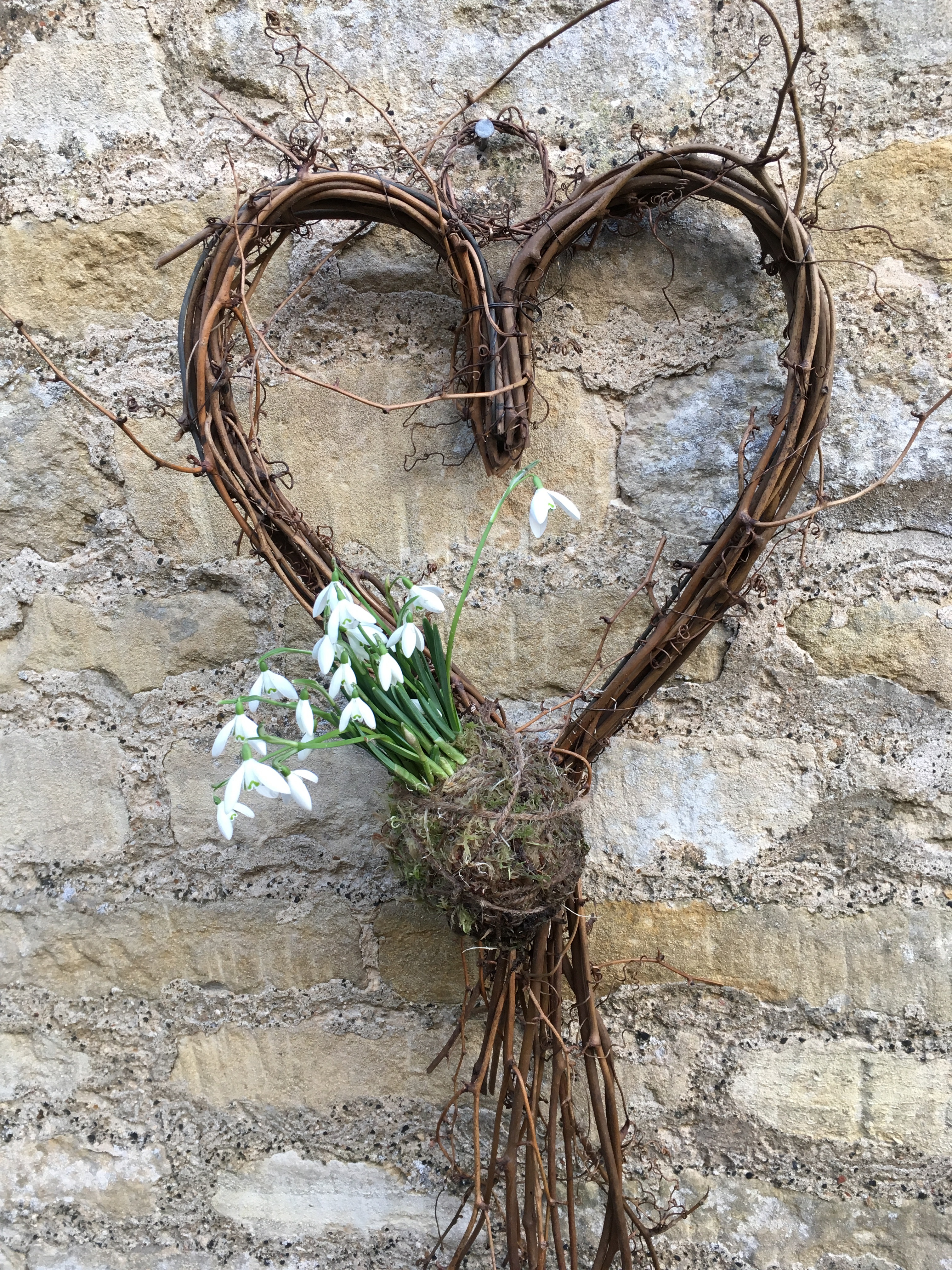
EASTON WALLED GARDENS

Easton Walled Gardens. Sells lovely little tins of sweet pea seed including heritage varieties, gardening gloves, twine, plant supports and all manner of gardening treats. There’s tickets for the snowdrop festival- or why not buy an annual pass. Worth more than one visit, all year round.

https://www.visiteaston.co.uk/shop

ORCHIDS

Orchids by post. High quality plants from the UK’s largest grower of phalaenopsis orchids. I like to support UK growers and these have proved to be reliable suppliers. Plants are well-grown and carefully packaged for posting. Beautifully displayed in glass vases and troughs.
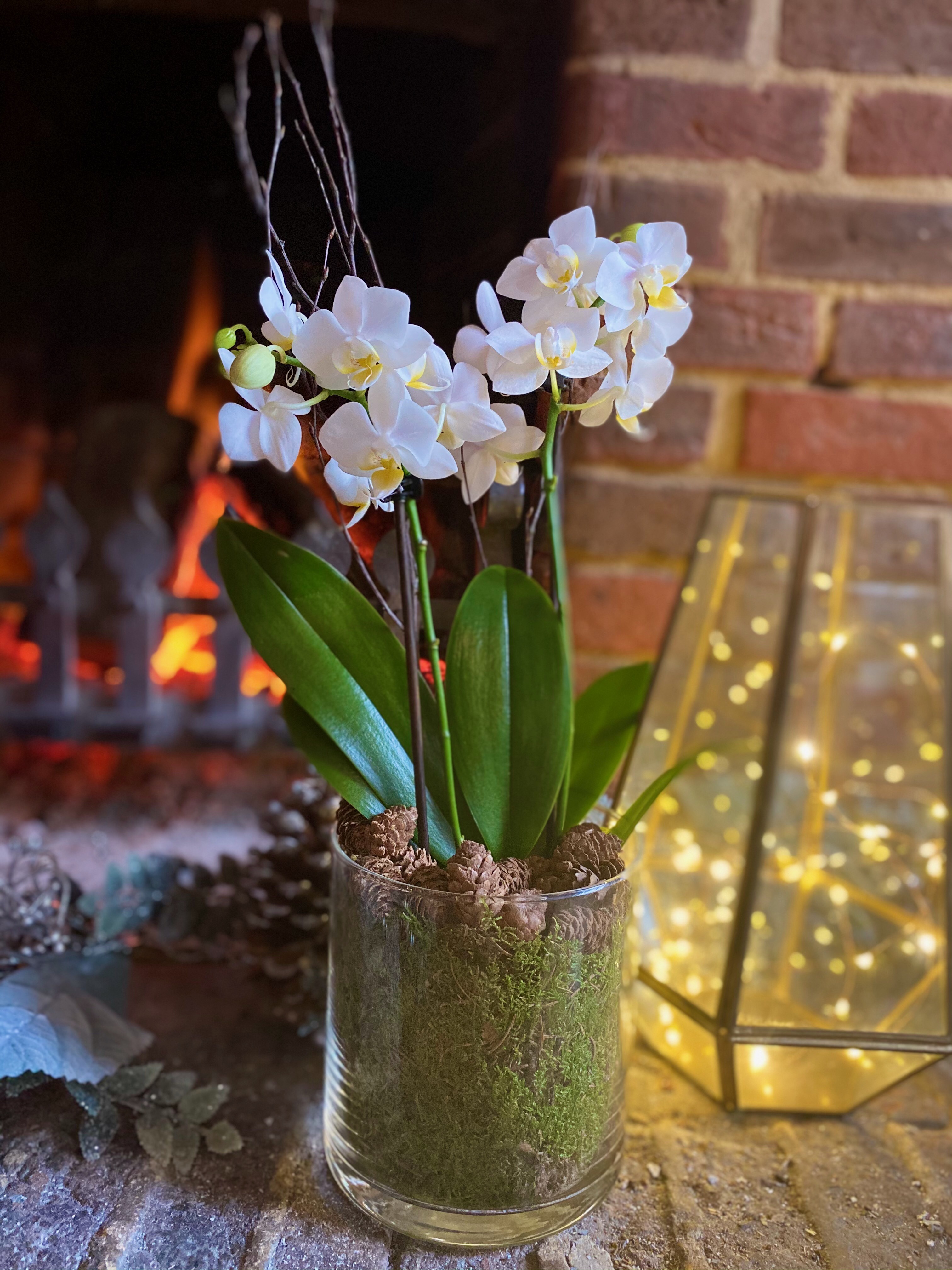
https://shop.loveorchids.co.uk/

PIPPA GREENWOOD

Why not buy a voucher for a veg patch- whatever size of plot you have. I’ve had plants from Pippa Greenwood before and they are beautifully fresh and well packaged. The best aspect of buying from Pippa is the e mail guides that accompany the kits giving expert hints and tips on getting the best out of your plants. Highly recommended. Good value.

https://pippagreenwood.com/product/grow-your-own-gift-card-pack-c/

GEORGIE NEWBERY FLOWERS AND COURSES

Photo credit: Common Farm

Floristry courses, how to be a flower farmer, growing wedding flowers, and a multitude of other wonderful inspirational floral courses are on offer at Common Farm Flowers. Georgie Newbery is running the courses in person in Somerset, and delightfully, you can now also join in from anywhere in the world, via zoom courses.

I wrote about taking part in one of the courses here: https://bramblegarden.com/tag/onlinecourse/

To buy vouchers, flowers etc : https://www.commonfarmflowers.com/collections/workshops

GENUS GARDENWEAR

Cotswold-based Genus Gardenwear has been making quality clothing and accessories since 2013. Well respected amongst gardeners, the clothing helps keep us warm and dry. Well made and long lasting. Above is the women’s Eden gardening jersey. There’s also silk liner gloves, merino wool wrist and neck warmers- amongst other clothing items. Also on the website, there’s Japanese secateurs and Hori Hori tools.

Beautiful seed packets and greeting cards. Gift cards start at £10.

https://www.genus.gs/

BURGON AND BALL

Everything I’ve had from Burgon and Ball has been good quality. Tools and equipment are well made and long lasting. Something for every budget.

https://www.burgonandball.com/pages/gardening-gifts

BELVOIR FLOWER AND GARDEN SHOW
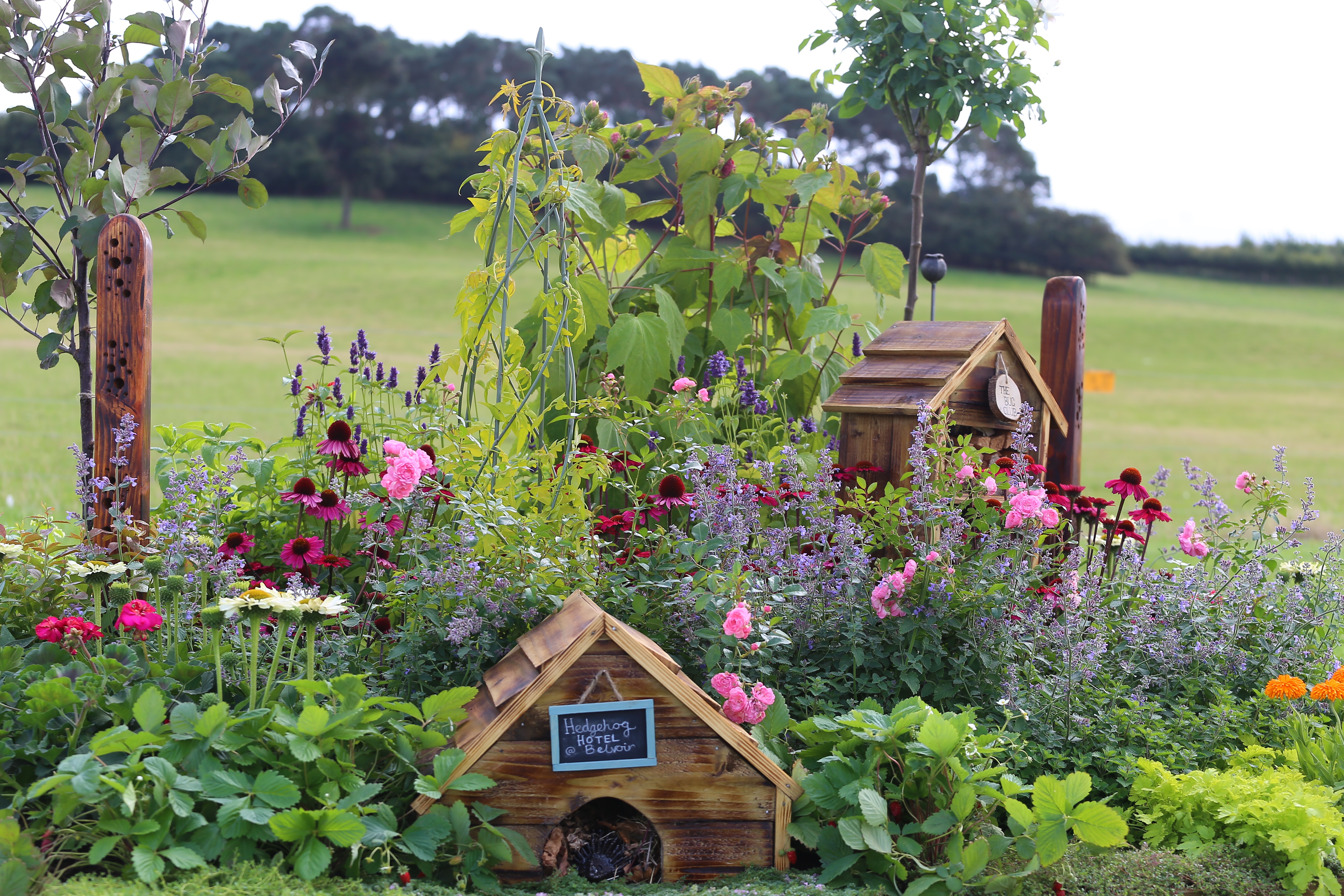
Advance tickets are on sale for the Belvoir Castle Flower and Garden Show. A lovely event held alongside the picturesque lake, set in the Capability Brown landscape. Plants and gardening equipment on sale, gardens to view, and horticultural talks to enjoy. A highlight of the summer calendar. 17-18 July 2021.

https://www.eventbrite.co.uk/e/the-belvoir-castle-flower-and-garden-show-17th-18th-of-july-2021-tickets-131319563349

Read more about the show here: https://m.facebook.com/BFGFJuly/

AQUAPROOF CLOTHING

Warm and waterproof clothing for gardeners. I haven’t tried these yet, but they are on my Christmas wish list. One thing I hate is to be cold and wet when I’m out and about. These look well made and stylish too.

https://aquaproofs.com/

THE LAUNDRY RETREAT – NORTH WALES

I’ve followed Tom and Jenny’s progress from start to finish creating a dream retreat at their beautiful North Wales home. I’ve earmarked a visit for myself and Mum as soon as we can travel. Vouchers for a holiday would be a welcome present for anyone, particularly garden-lovers, as Jenny has a dream garden alongside the roundhouse retreat.

https://thelaundryretreatnorthwales.co.uk/

ORGANIC PLANT FOOD -RICHARD JACKSON
This is what I used for my greenhouse and cut flower garden this year, and the results were fabulous. Everything grew robustly and flowers seemed to last longer. Using organic feed is important to me. I don’t want to kill beneficial insects, or poison the hedgehogs. Because plants were well grown and healthier, they were better able to fight off pest and diseases, and I didn’t need to use any chemicals. I’ll be ordering more for next season.

https://www.richardjacksonsgarden.co.uk/product-category/planting-feeding/

THE NGS – NATIONAL GARDEN SCHEME

The NGS has had a difficult year with most garden visits cancelled due to covid. One way to help is to buy something from the website. There’s cards, notebooks, aprons and tea towels, for example. Also look out for zoom lectures of NGS gardens. It all helps the NGS support nursing charities. I’ll be giving a zoom lecture next spring, talking about how to get colour and interest in the garden 12 months of the year.

https://ngs.org.uk/product-category/merchandise/

RAINBOWS HOSPICE

Rainbows Hospice helps children and young people who have life-limiting illnesses. They are £1 million down on fund raising due to covid lockdown and restrictions. Buy something from their website, or make a donation in the name of a friend or family member. You’ll be helping a wonderful charity doing essential work.

https://www.ebay.co.uk/str/rainbowshospiceshop

https://www.rainbows.co.uk/ways-you-can-help/shop

Buttonbury Bags
I treated myself to this gorgeous bag this summer. It’s beautifully made and I love using it. It’s hand -made in Shropshire. I like to support local businesses. Good value and unique.

https://www.buttonburycrafts.co.uk/

GOLD LEAF GLOVES
I’ve found these to be the best gardening gloves available. The gauntlets protect my hands from brambles and thorns. Comfortable and hard wearing. They make gardening a pleasure when there’s painful weeds to tackle, or rambling roses to prune.

http://www.goldleaf-gloves.com/drytouch.htm

GREENWORKS LAWNMOWER

I found this small, compact and lightweight lawnmower a dream to use. No pull cord start. No electric cable to trip over. No running-out-of-petrol to worry about. Just an easy to use battery -powered machine. The 48V machine has a 35cm cutting path and a 40ltr grass collector. It has a fold-down handle for easy storage. It will cut 250m2 on a single charge. The battery can be used for 21 other tools in the Greenworks range, including a hedge trimmer, line trimmer, and leaf blower. More are listed on the website. As regular readers know, my youngest daughter is a nurse, often working on covid wards. To protect us, she could not come home at all. Luckily she managed to buy her own house this summer, and we gave her this mower to help her look after her first garden. It makes cutting the grass a quick and easy task, which is really important if you’ve spent 12.5 hours on your feet working.https://www.greenworkstools.co.uk/product/40v-35cm-lawn-mower/

NIWAKI

I reviewed the Hori Hori here : https://bramblegarden.com/2020/07/10/niwaki-tools-review-and-some-garden-snips-to-give-away-gardening/

Buy from here : https://www.niwaki.com/store/hori-hori/

Garden News Magazine

A magazine subscription is such good value. There’s often free seeds. And you get the chance to peek into my greenhouse, potting shed and poly tunnel once a month, as I write a regular column all about what I’m growing on the plot.

https://www.greatmagazines.co.uk/garden-news-magazine?gclid=CjwKCAiA_eb-BRB2EiwAGBnXXmwcVhWNwLRIEx6Z9oW6jtqzkmpWu2C4E1lgcJIoLUvkgE78yeJU5xoCBMEQAvD_BwE

HENCHMAN LADDERS

One piece of equipment I could not have managed without this year is my Henchman ladder. No more wobbling about on unsafe steps. This one is solid and stable, with wide steps, side grab bars and a platform at the top for tools and baskets. The tripod shape means you can get closer to the tree, shrub or climber you are working on. No need to stand sidewards and lean over to work. Much safer to face forwards. It means I’ve been able to reach the top of my fruit trees safely in a year when all the fruit was needed, and it felt as if nothing should be wasted. Trees have been properly pruned for the first time in years. And now we are using the ladder to put up Christmas lights. No more swaying at the top of step ladders!

https://www.henchman.co.uk/winter-offer.html?gclid=CjwKCAiA_eb-BRB2EiwAGBnXXne0Otc_s-oPnxdWoe41YfH1j3HZ4Dhv2-SOl-DgsWoChSv4tk8lgRoCg04QAvD_BwE

HEDGEHOG BARN
We love this little hedgehog house from WildlifeWorld . And what’s more our hedgehogs do too, as we have a nice plump hedgehog in residence! The hedgehog barn won new product of the year at the virtual Glee awards in Birmingham this year. It’s well-designed with FSC -certified timber, weather proof, and strong enough to keep hedgehogs safe from predators.

https://wildlifeworld.co.uk/products/the-hedgehog-barn

BIRD BOXES – THE POSH SHED COMPANY

While on the subject of helping wildlife in our gardens, these bird boxes are well-made and look beautiful.

https://www.theposhshedcompany.co.uk/posh_gardening

EDIBLE FLOWERS

Adds that special touch to your cakes and biscuits. Especially beautiful on wedding cakes (my daughters please take note!)

https://maddocksfarmorganics.co.uk/maddocks-farm-organics

BUY A ROSE.

Rose of the year 2021 – Belle de Jour
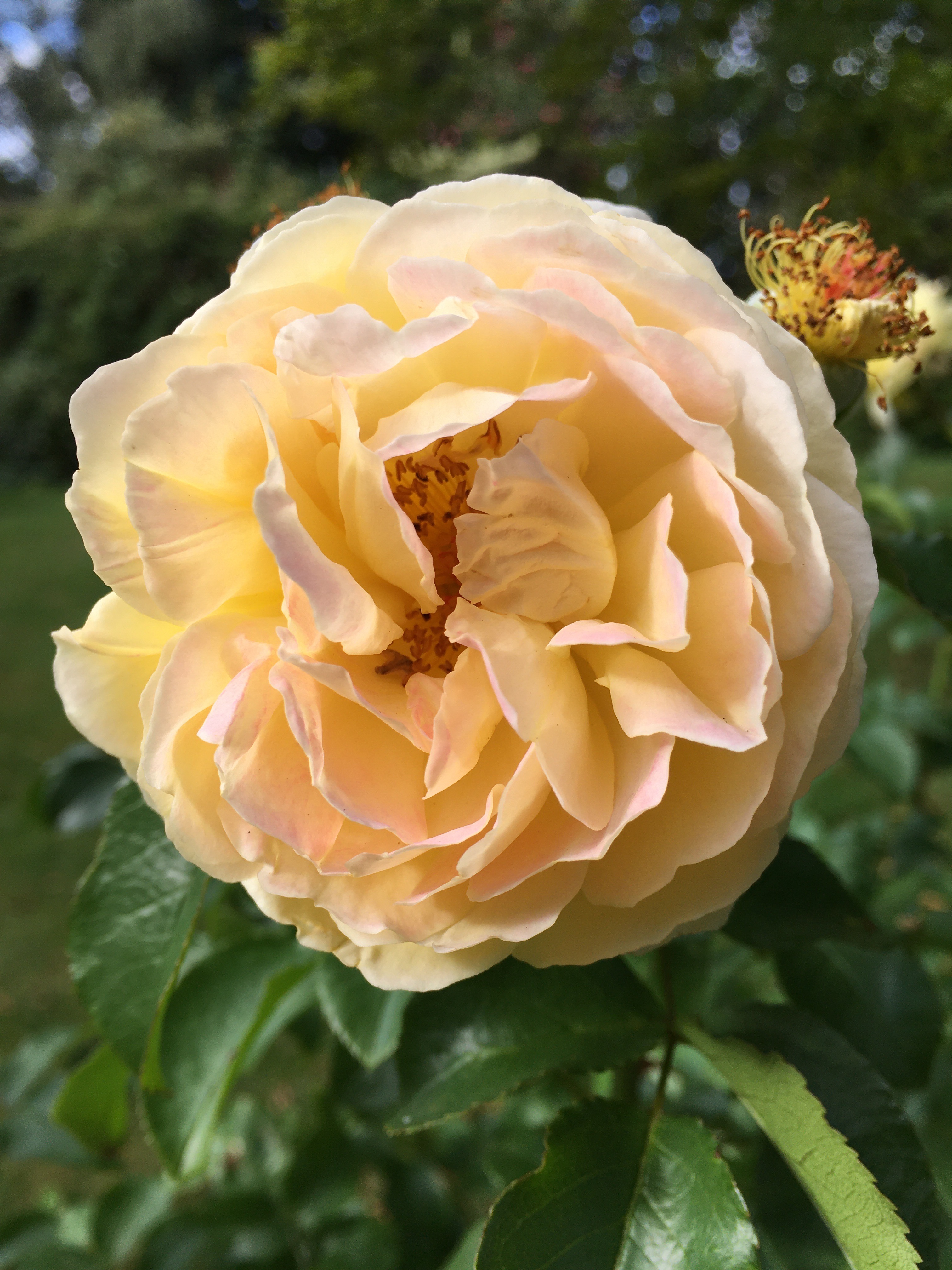
This has become my favourite rose this year. Flowers start bright yellow and fade to myriad apricot shades. There’s a lovely fruity scent, and flowers open out enough for bees to access the pollen, so it’s good for wildlife too.
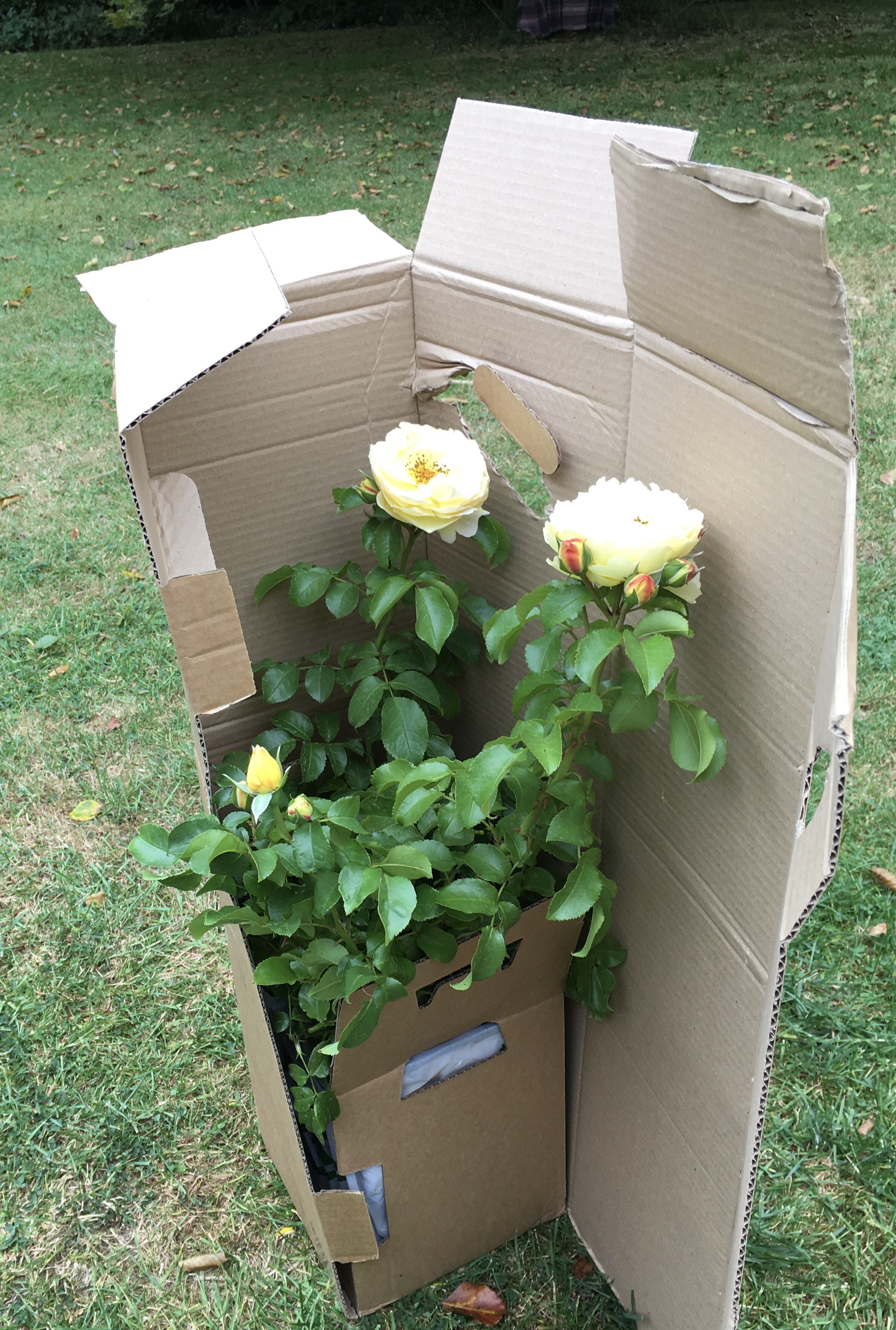
Our rose came from Pococks Roses. Well packaged with eco-friendly materials. Compostable bags and cardboard. A sturdy, disease-resistant rose. Highly recommended.

https://www.garden-roses.co.uk/shop/BELLE-DE-JOUR-floribunda-M1518

CAKES AND BROWNIES BY POST
Just received a parcel (from my brother and sister-in law ) of the most delicious brownies I’ve ever tasted. Sadly they are sold out for Christmas, but keep hold of the details, and remember them for birthdays, weddings, thank-yous, friendship. Highly recommended. Ours was the classic brownie. I’m going to try salted caramel next!

https://bowlandwhisk.co.uk/

CHOCOLATES BY POST

While we are talking about food, I’ve also just received a gorgeous box of salted caramels from a dear friend. It was just what the doctor ordered today, as I was starting to flag somewhat. These picked-me-up no end.

Beautifully packaged. Wonderful ingredients. Simply delicious.

https://www.bchocolates.co.uk/online-shop

CLAUDIA De YONG
Aprons, garden baskets, trugs, garden labels, garden tools, watering cans, garden bags. Stylish and rather lovely gifts for gardeners. A range of prices to suit all pockets.

https://shop.claudiadeyongdesigns.com/product-category/the-garden/

VISIT CHENIES MANOR HOUSE

One of the UK’s finest Tudor mansion houses. Grade 1 listed. Magnificent, inspirational gardens. Gift ideas include annual membership, guided tours, afternoon tea. See website for offers.

https://www.cheniesmanorhouse.co.uk/about/

PROPAGATORS

I have a Vitopod propagator, a present from a friend. I use it with grow lights, which stops seedlings becoming leggy. I start off all my flower and vegetables seeds in it, and have never had any problems with the kit.

https://www.greenhousesensation.co.uk/vitopod-heated-propagator-bundles.html/
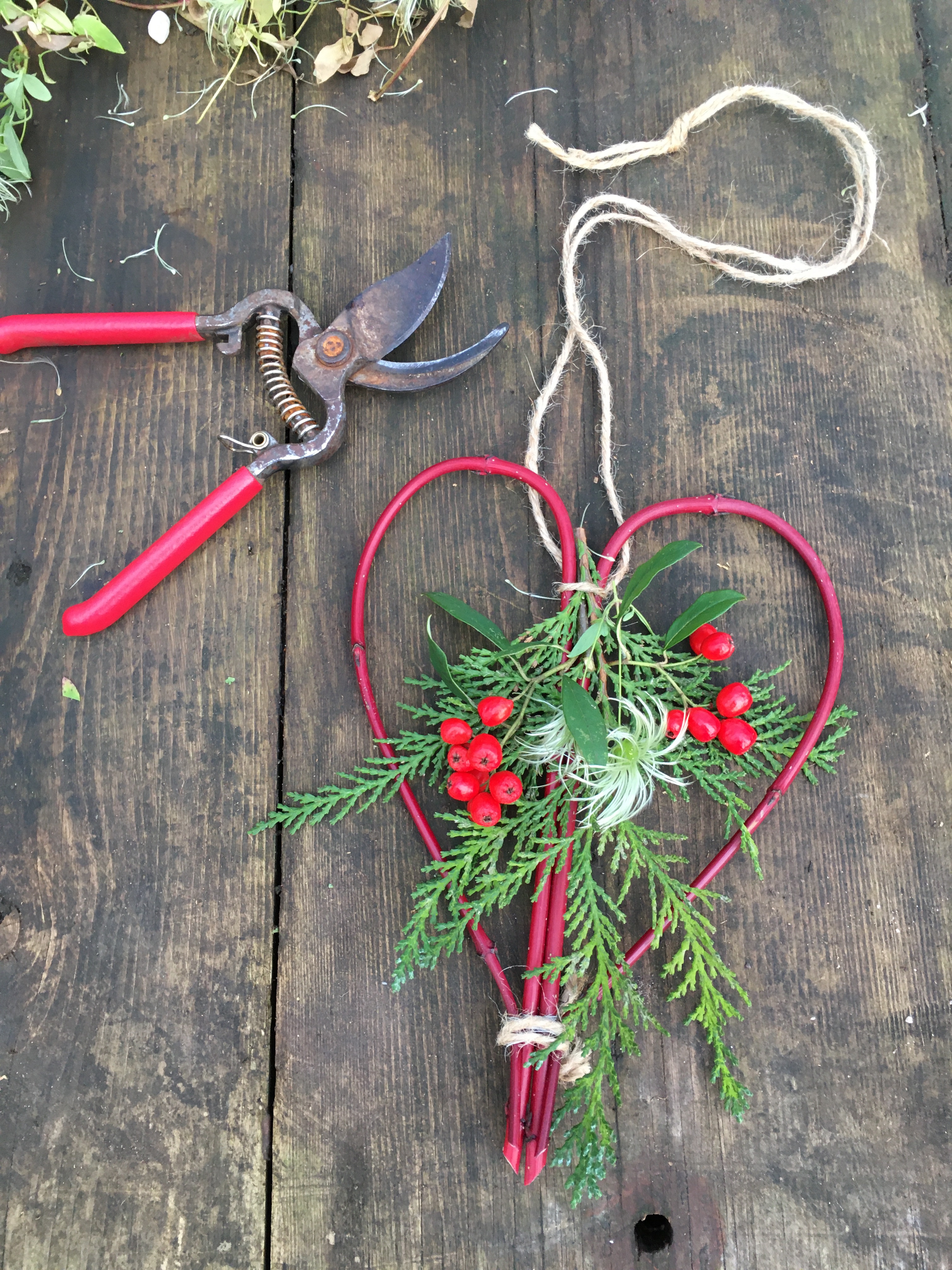
Do add any of your own suggestions in the comments below. This year we have all shared information, hints and tips to help one another get through. Gardening has been a great distraction from all the problems we’ve faced. And we are all looking forward to a better 2021, full of flowers, fruit, vegetables – and quite a bit of garden visiting, I hope.

Wishing you all a wonderful, happy Christmas. Thank you for reading and keeping me company this past year. It’s been much appreciated.

You are amongst 100,000 people who have read my blog posts. I’m truly grateful.

I’m @kgimson on twitter and karengimson1 on instagram.

Links:

Reader Sophie Boxall recommends Hive and Well https://www.thehiveandwellcompany.co.uk/

And Nutscene twine: https://nutscene.com/collections/twines
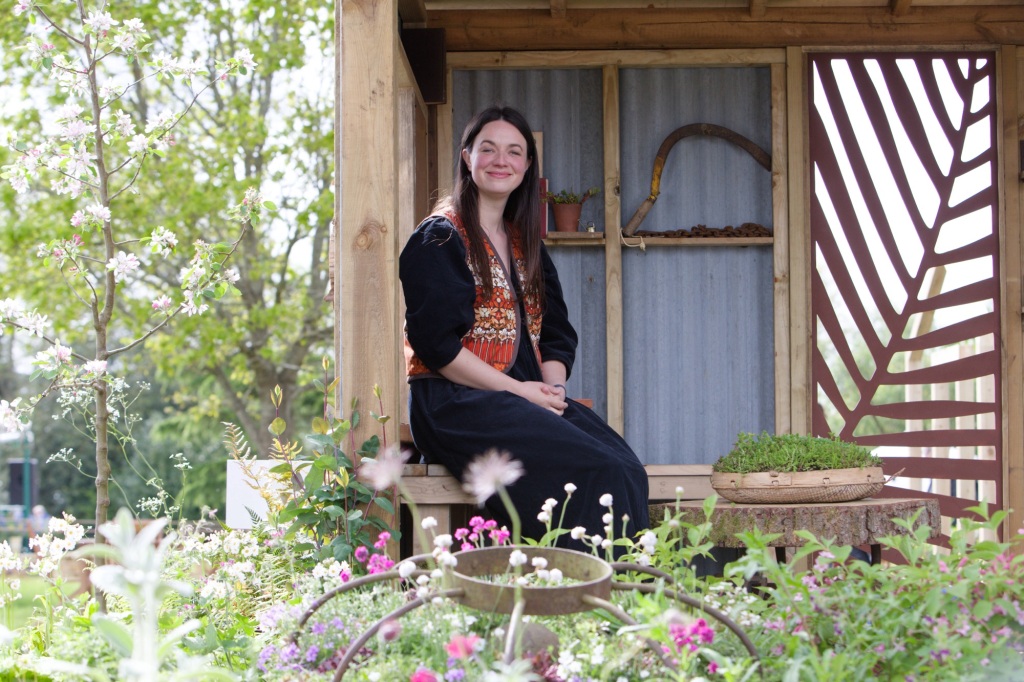
Garden News Magazine recipes for December

If you’ve received your copy of Garden News Magazine this week, here’s the recipes I mention in my column. Above is the summerhouse where I write my pieces, and where I sit and make my cherry marzipan chocolates.

The recipe link for Cherry Marzipan Chocolates is here :

https://bramblegarden.com/2018/12/04/family-favourite-recipes-chocolate-marzipan-cherries/

They are very quick to make and children love creating them. They make tasty home-made presents for Christmas.

I also write about Chocolate and Orange Panettone. Start saving your tins now to make these delicious treats. They are very easy to make and look beautiful. Get the children to make potato stamp labels. Be as creative as you like. Everyone can get involved.

Here’s the link: https://bramblegarden.com/2019/12/02/christmas-recipes-chocolate-panettone/

I write about turning my satsumas from the greenhouse into a liqueur. The recipe comes from Bob Flowerdew, replying to me on twitter when I asked what I could do with this year’s prolific harvest. It’s been a good summer for growing citrus. Bob always has great suggestions for what to do with produce from the garden, and is generous with his advice.

Here’s Bob’s recipe for Satsuma Liqueur :

And finally, I was talking on the radio last week, when I mentioned I was making Sloe Gin. Here’s the recipe, with thanks to garden writer Barbara Segall, who inspires me on a daily basis to try something new.

Sloe Gin

450g sloe berries -or whatever you can find. If you only have 300g, use those.

350g caster sugar

710ml gin

Kilner jar or lidded jar

Place the ripe sloe berries in the freezer to break the skins. Add all ingredients to a large kilner jar. Swirl the contents every day for a week, every week for a month, and every month for a year. Strain the gin. Use the berries for cakes or trifle.

It’s wonderful to have a bottle on the north-facing kitchen windowsill. Mine has changed colour now and it’s a joy to see. Almost like a stained glass window.

Barbara Segall has written many garden books, all highly recommended. One of my favourites is The Christmas Tree. A beautiful stocking-filler. Find out more here : https://thegardenpost.com/category/christmas-tree-book/

https://www.ebay.co.uk/itm/The-Christmas-Tree-book-by-Barbara-Segall-NEW-/174501320740?_trksid=p2349624.m46890.l49292

For more suggestions on books, I also recommend The Creative Kitchen by Stephanie Hafferty. I reviewed the book here:

https://bramblegarden.com/2018/11/18/the-creative-kitchen-book-review/

Here’s a link for Georgie Newbery at Common Farm Flowers for growing cut flowers, floristry and Christmas wreath workshops and courses, in person, and on-line. Vouchers make a great present for any gardener. https://www.commonfarmflowers.com/collections/workshops

Thanks for reading! Have a great week.

Honda Cordless Lawn Mower- Product Trial

I’ll be honest, cutting the lawn is not one of my favourite tasks. We have an old petrol mower which is a bit of a beast. It has a pull-cord start, and my arms are just not long enough. After the first painful attempt, I usually wheel the machine back in the shed and wait for help. So frustrating! I hate having to wait for someone stronger to help me. I feel defeated. Then along comes Honda with an offer to try out one of their new battery power machines. I must admit, I cheered.

Honda’s delivery driver arrived promptly with two boxes containing a lawn mower and a hedge trimmer. There was also a brand new Honda racing motorbike in the back of the van. My heart skipped a beat. Sadly I couldn’t persuade him to leave it behind ….. I tried. It’s 30 years since we had a motorbike. We had a British Triumph Bonneville- which took us all over Europe, up through Scotland, and all around the Ring of Kerry in Ireland. Before children arrived. And after that, we decided we should be sensible and sell it. Couldn’t really fit two babies on the back. Anyway, I digress. Back to lawn mowers…. So we sold the motorbike and settled down in a family home with an acre garden. Since then, we’ve had a division of power here. Mr B cuts the lawns, and I plant, weed and prune, grow flowers, fruit and veg. The problem comes when Mr B goes sailing- which is very often. He and his whole family are sailing-mad. We have a nephew John Gimson who is currently World Champion and part of the British Olympic Sailing Team (NACRA) sailing a catamaran. Mr B in the past has supported John by driving the racing boats across Europe on a low loader. Something he loves doing. Meanwhile, at home, the grass get longer and longer and starts to look messy.

This autumn, I wanted to cut the grass in the orchard really short, and sow wild flower seeds in the bare patches where there’s been molehills. With the new lawn mower, I was able to do it without asking for help. Independence at last!

Here’s a run down of the things I like about the new cordless mower.

1.

To start it, all you have to do is press the yellow button on the side of the handle. No shoulder-wrenching pull cord.

2.

To make the mower go forward, you just press the bar towards the handle. As a safety feature, if you let go, the mower stops. There’s no way it can run off with you ( like my old petrol -driven monster mower.)

3.

Another safety feature is the little turn key, which isolates the battery if you need to turn the mower on its side to remove excess grass from around the blades. I would also quickly remove the battery too. Fast and simple operations.

4.

The battery slides easily into the front of the machine. There’s three types of batteries with different run times.

The cheapest, battery, number 4, cuts for about 35 minutes and takes 35 minutes to charge. To be honest, 35 minutes was enough for me. I had a cup of tea and a rest while the battery was charging, and then we were off again. The handbook says this battery covers 365m2 lawn area.

Number 6 battery covers 485m2.

Number 9 battery covers 730m2 on one charge.

The battery charger is note-worthy. It has its own cooling fan and various flashing lights to tell you how it’s doing. It looks rather impressive.

5.

There’s a simple handle to change the cutting height. Easy to operate.

6.

There’s a pressed steel powder-coated deck. This made the whole machine look robust and substantial. Yet the weight was push-able at 22.5kg for the machine and 1.3kg for the battery. I didn’t struggle at all, and didn’t feel totally worn out after ten minutes, like I do with our petrol mower. Plus, it’s clean, there’s no petrol fumes, and the mower is relatively quiet. The handbook says the noise range is 91bB(a). I’m comparing it with the petrol mower, which we wear safety ear protectors with, and battery powered is much quieter. A small thing, but important to me, the battery powered machine didn’t scare off all the birds. We have a small stand of trees, and all summer we’ve had a tawny owl fledgling here. It’s such an joy to have these birds in the garden. I would hate to scare them away.

Above: Some of the wild flowers I’ve planted in the orchard. I hope they will spread and form a golden carpet in spring.

I thoroughly enjoyed my two-month trial with Honda’s new mower. There’s two available in the range. This one, the HRG416XB, has a 16 inch cut and there’s a larger machine which has an additional mulching option. There’s also a hedge trimmer, brush cutter and leaf blower in the new cordless range- and all use the same battery.

I haven’t been paid to write anything about the mower. I’m free to give my honest opinion. But I can say, I’ve enjoyed having the freedom to cut my lawn when I want to, and the Honda mower was a dream to use. I’ve still got my heart set on test driving the Honda racing motorbike though…… watch this space!

Thanks for reading and have a lovely weekend.

Links: New Honda range of cordless machines: https://www.honda.co.uk/lawn-and-garden/products/cordless/overview.html?gclid=Cj0KCQiAnb79BRDgARIsAOVbhRpdTbjHM8G3wFtmzG8qaxoynM9oOb6lgjVh7uT99NKRN4saKFpurlYaApo8EALw_wcB&gclsrc=aw.ds

I’m @kgimson on twitter, and karengimson1 on Instagram.

A video I made for instagram :

Pear and Almond Pastries- family favourite recipes

It’s been a bumper year for fruit. There’s crates of pears in the spare room, and little piles of rosy red apples all along the windowsills. The whole house smells like pear and apple crumble! I’ve never managed to reach the top of the fruit trees before. Our old ladders were too wobbly. But this year I’ve a fabulous new addition to the garden- a Henchman tripod ladder. It’s made everything easier – and safer. All the best, tastiest fruit- always at the top of the tree- has been harvested. This year, more than ever, it feels as if nothing should be wasted. Spare fruit has been distributed to friends and family in little paper bags. Damaged, over-ripe fruit has been enjoyed by hedgehogs and blackbirds, so wildlife has not been forgotten either.

One of our favourite autumn recipes is Pear and Almond Pastries. As usual, just a few ingredients are needed, and the little parcels of tasty pears only take minutes to make. Have a go at making them, and let me know how you get on.

INGREDIENTS

1 pack of ready rolled puff pastry

3 or 4 ripe pears

1 tbsp dark brown sugar

3 tbsp ground almonds

1 tsp ground cloves

1/2 tsp cinnamon

2tbsp flaked almonds for the top

1 egg, beaten (optional- use almond milk for vegans)

Icing sugar for dusting (optional)

Baking tray with baking paper or silicone sheet.

190C oven 15-20 minutes

METHOD

Unroll the pastry and cut into squares. Lay them on the baking tray.

Peel and halve the pears. Place slices on top of the pastry squares.

In a bowl, mix the sugar, ground almonds, ground cloves, cinnamon together. Pile spoonfuls of the mixture on top of the pears.

Take the corners of the pastry and draw them together to make a rough parcel. The pastries will stretch and turn out all shapes, and it doesn’t matter. They will still taste the same.

Brush the top with beaten egg (or almond milk) and sprinkle over the flaked almonds.

Cook in a preheated oven for 15 -20 minutes. Check them after 10 minutes to see how brown they are. The pastries will be ready when they are risen and light brown. They burn easily, so keep an eye on them. 20 minutes might be too long for fast ovens. Dust with icing sugar, if you have some.

Can be eaten cold or warm. Can be frozen for 3 months. Delicious with clotted cream, or custard. We also love them with home-made vanilla icecream.

Thanks for reading. Have a great gardening week and keep in touch.

Links: Henchman ladders https://www.henchman.co.uk/

Fruit trees: Six Acre Nursery, Costock, Leicestershire.

Silicone sheets are reusable from http://www.kitchenrangecookshop.com/

Photos above show two packets of puff pastry.

Little Green Paper Shop- Review

I need little excuse to send cards to friends and relatives. I love keeping in touch with cheerful notes, and this year it seems even more important that usual to try to keep a connection. But I’m usually disappointed with the cards I see for sale. They are often single -use items, covered with embellishments and glitter. Not always recyclable. So I was happy to see a sample pack of eco-friendly stationery from the Little Green Paper Shop.

Founded by Ana in Cheshire in 2014, the online shop stocks a range of beautiful cards made from such intriguing substances as elephant dung and cotton fibre, and apparently, reindeer droppings. The elephant dung paper is hand-made in India and provides a source of income for elephant sanctuaries which the makers support.

Ana started by supplying wedding stationery, but has branched out to provide cards, crackers and wrapping paper for Christmas and other special occasions. Ana designs, prints, cuts and packages the items, and it’s very much a family affair with her husband and two sons helping out.

The samples I received are so delightful – and made me smile- I have placed an order for Christmas, and I’m planning to have some business cards printed. I fancy the idea of having cards made from seed paper which can be planted and will grow. Truly something earth-friendly and worth giving. Quite different from the throw-away cards you usually see.

Kitten Monty likes them too! And cats, as you know, are never wrong.

Please leave a comment in the box at the bottom of the page and Ana will select one person to receive a sample pack of cards and paper.

Notes:

I didn’t pay for my samples, but as usual, there’s no obligation to write about them, and I only say nice things when I want to, and in this case, I think the cards are unusual and truly special. I’m happy to recommend the Little Green Paper Shop.

https://littlegreenpapershop.com/

Thanks for reading. I’m @kgimson on twitter, and karengimson1 on instagram, so do say hello there as well.

Book Review: American Gardens

By Monty Don

photos by Derry Moore

Published by Prestel

Hardback 223 pages

ISBN: 9783791386751

Published autumn 2020

£35

Such a lot has changed since Mum and I sat, side by side, watching Monty Don’s American Gardens television series over the winter. Little did we know corona virus was on the way, and we wouldn’t see each other for most of the spring and summer. One of our simple pleasures in life is to watch the gardening programmes mum has recorded the week before. Enjoying our home-made cake and cups of tea, we would um and ah over the gardens- much more fun than watching alone. We were unanimous in our admiration of glorious, colourful, plant-filled gardens, and sternly, dismissively critical of others. And laughter. There was much laughter. Such fun. Just watching in companionable silence too. I miss those moments. Mum has to be extremely careful. So our fledgling visits to each other’s gardens have been cautious and metres apart. Indoors, and television -watching, is rationed. I touch nothing and keep a distance. This is how it will be until we have faster, easier corona virus testing. Or a vaccine.

Just as I’m mulling over all the changes to our lives, and trying to solve a few impossible problems, Monty’s new book arrives. And I sit down and read it. From cover to cover. Monty Don asks, ‘What is an American garden.’ Well, if he can be as bold as to attempt to find the answer to that question, I’m sure I can overcome one or two tricky dilemmas of my own. I clearly remember Monty saying “The belief you can do anything, if you believe in it enough, is what defines the American Garden.” Reading his new book transports you to another place where anything is possible. And that’s certainly a message we all need right now.
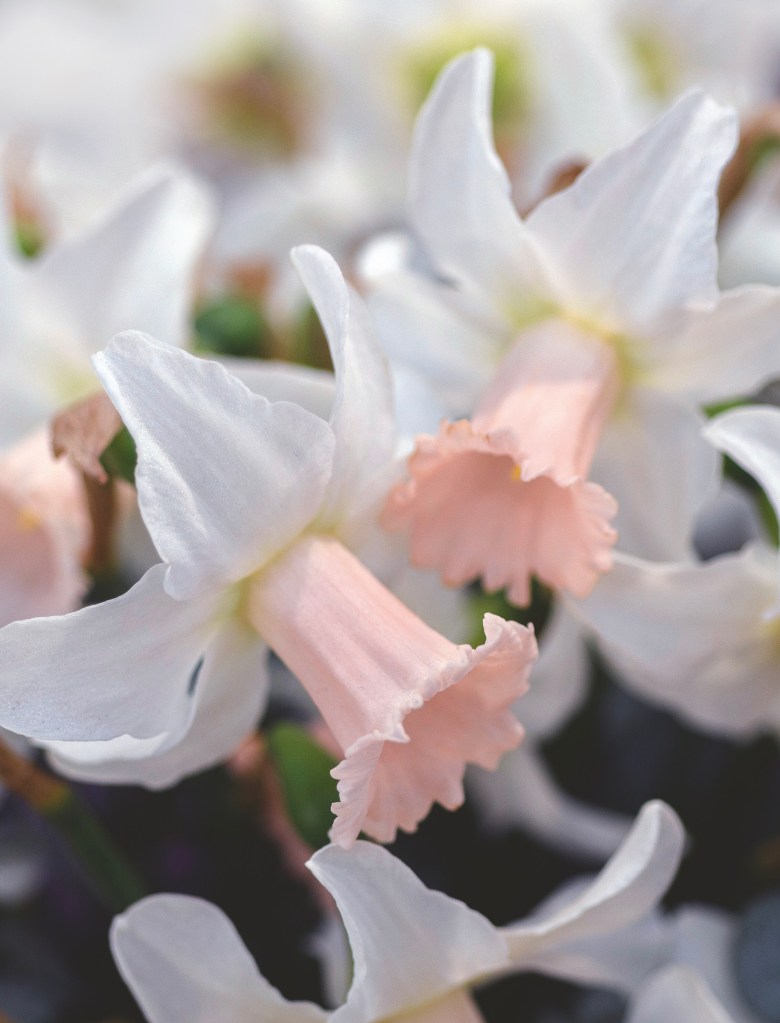
Here’s some of the gardens I picked out to show you, and ones I enjoyed in his new book.

The Federal Twist garden, Stockton, New Jersey is one that stands out.

I’m still chuckling over the quote from owner James Golden, who says,”I forgot to mention that I hate gardening.”
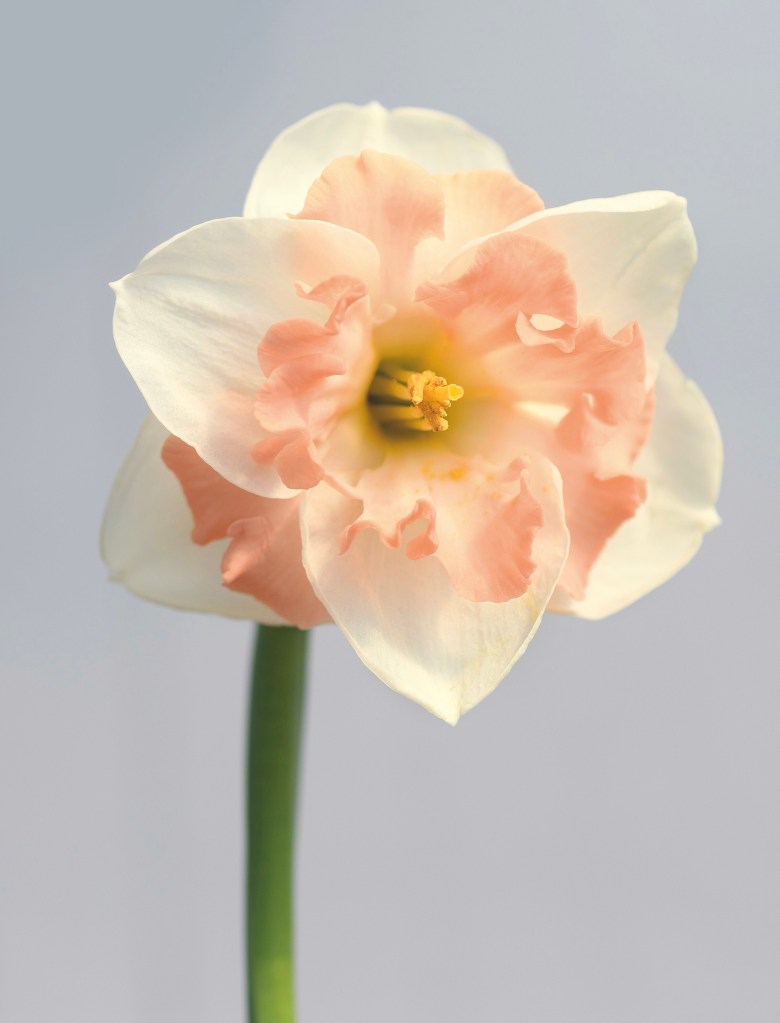
Monty notes “It was probably a well-rehearsed line but, given the extraordinarily beautiful garden he has created and the deep pleasure that it clearly gives him, an effective show-stopper. Why? I asked. ‘I hate getting my hands dirty. I hate struggling to separate roots and then digging a hole. I have someone to do that for me. I place the plants, pull plants out. I’m constantly working out what I need and where to move things. I don’t feel it necessary to dig or plant to be fully engaged with the garden.’ I suspect that the British, and in this I include myself, fetishise the actual process of gardening too much, sometimes to the extent that the hardworking, skilful means justify the rather dull ends.”

A revealing portrait of the gardener, and of the garden visitor, Monty Don.

These are my i-phone photos of the book taken in the potting shed, and do not do justice to the clarity of the stunning photography by Derry Moore.

Federal Twist.

Federal Twist.

The swimming pool at the Bob Hope House, Palm Springs.

Inside the Amazon Spheres in Seattle.

Climbing fig (Ficus pumila) in the orangery at Dumbarton Oaks, Washington DC.

Vizcaya, Miami, Florida. The house reflected in the Tuscan-inspired pool.

Prairie Garden Trust, New Bloomfield, Missouri. A field of coneflowers.

Central Park, New York City. The two towers of the San Remo apartment building designed by Emery Roth in 1930.

Longwood Gardens, Kennett Square, Pennsylvania.

Monty sitting under a banyan tree. He looks lost in thought. The sheer scale of the trees and the landscape. It’s mesmerising.

You’ll have to read the book to see what conclusions Monty arrives at. I found it a joy to read in these troubled times. If humans can create gardens such as these, surely it gives us hope. Anything is possible. And at the end of the day, that’s what we need most of all at the moment. Hope.

Links:

Leave a comment in the box at the bottom of the page, and Prestel will select one reader to receive a free copy. Sorry, uk addresses only at the moment. I’ll run another draw when the book is published in America. It would make a wonderful Christmas present. It’s certainly a ‘wow’ production, with glossy double page spreads of photographs and thought-provoking writing.

Prestel publishing: https://prestelpublishing.randomhouse.de/book/American-Gardens/Monty-Don/Prestel-com/e570814.rhd

Federal Twist garden: https://federaltwist.com/

I’m @kgimson on twitter and on instagram https://www.instagram.com/karengimson1/?hl=en.

Thank you for reading.

Talking on the radio – notes and photos for wednesday 22 July, BBC Radio Leicester Gardens Hour

I’m still talking on the radio once a fortnight – from the peace and quiet of my potting shed. It’s lovely to be at home rather than having to drive into Leicester. And when the music is playing between chats, I get on with a bit of watering or prick out a few seedlings, and nobody knows.

This week we talk about sweet peas. I’m growing new variety, Ripple Mixed, pictured above. It has mauve, pink, and purple markings on a pale pink background. The scent is strong, and stems are nice and long, making them ideal for cut flower posies. One to keep on my list for autumn sowing. I’m ordering seeds now to ensure I get the varieties I want. This year’s experience of buying plants and seeds – and the long delays receiving them- has taught me to plan ahead and order early.

Here’s a selection of sweet peas I’m putting in jam jars on the village green to raise money for Rainbows Hospice for children and young people. Rainbows cares for children with life-limiting illnesses and nearly all its funding comes from donations. The hospice has lost almost £1 million in fund raising this year, due to events being cancelled because of covid. I put leaflets alongside the flowers, hoping it might encourage someone to learn more about the hospice and make a regular donation. Every little helps.

Here’s the Wiltshire Ripple variety I mention, with its delicate picotee edge. I wouldn’t be without this one. Always a good strong performer.

This is Mayflower 400, another new variety, celebrating the 400th anniversary of the Pilgrim Fathers sailing to the New World. It’s highly-scented and a good strong grower. Long stems, and flowers last a week in a vase.

After talking about flowers, we move on to what I’m growing and harvesting from the plot. Plums are prolific again this year. This is Victoria, delicious and reliable. I’m making jam. It’s such a treat in winter to have a taste of summer. I stand the jars along the kitchen window and admire them. It’s like looking through pink stained glass. Very cheerful on a cold, dark day.

The recipe for plum crumble cakes and plum jam is here : https://bramblegarden.com/2017/08/22/peaches-and-plums-crumble-and-jam/

When my children were little, we fed them apple purée as their first solid food. BBC Radio Leicester programme host Naomi Kent is having a baby in two months, so we talk about the varieties of apple trees she might plant in her new garden.

I’m growing Spartan, a gorgeous deep red apple with a sweet honey taste. Apples are small and numerous, the perfect size for children’s lunch boxes. Lovely for juicing which is a somewhat messy process, but worth the effort.

I also grow Greensleeves (above) for cooking and eating. It’s sweet enough on its own, so you won’t need to add sugar for cakes, purée and puddings. Kept somewhere cool, apples will store until February.

Supermarkets often only sell a few apple varieties, typically Cox, Golden Delicious and Braeburn. Often they’ve been grown abroad and flown in. Sometimes they are coated with chemicals to improve their keeping qualities. And yet, in the UK, we have perfect conditions to grow your own apples. Traditionally, apple trees would have been 6m tall, but plant breeders have produced some compact varieties for small gardens and containers. Lubera have a range of ‘column’ fruit trees which have short side shoots and a narrow, vertical growing habit. I’m growing Malini Top Model which looks as if it will be about 50cm wide and eventually 3m tall. I’m growing it in a large plant pot and it has a good crop of apples in its third year. Lubera also have column types of pear, cherry and plum varieties on their website.

We had record amounts of cherries this year. I’ve been freezing them and preserving them in alcohol for winter treats. There’s a cherry marzipan chocolate recipe mentioned in the links at the end.

My cherry tree is Stella, a self fertile variety bred in Canada and introduced to Britain in the 1960s.

If you’ve got a small garden, opt for a cherry tree on dwarfing Gisela rootstock, which makes a compact tree. It’s much easier to protect trees from frost, if they are small enough to cover with fleece or an old bed sheet.

Good varieties to try include self-fertile Sunburst, Summer Sun and Celeste.

I’m fond of pears too. I have a Conference pear which provides plenty of fruit. If you are short of space, pears are easily trained along a fence or wall, in an espalier shape. Pears need more sunshine and warmth than apples, so it is a good idea to give them the protection of a warm wall. I’m going to plant a Concorde pear on the south wall of the house. Concorde is possibly a more reliable cropper than Conference.

If you have a more shadier garden, and you want to grow fruit, I’ve found success with Morello cherries, damson and quince, and crab apples for making jelly.

As well as apples, pears, plums and cherries, I wouldn’t be without my mini peach trees. I’m growing dwarfing variety Garden Lady and Bonanza in 45cm pots. We don’t get very many peaches yet, but the taste is so delicious and sweet. It’s a special treat to have home- grown ripe and tasty peaches.

I’d love to grow my own apricots. I’ve seen compact varieties Aprigold and Isabelle at nurseries. Our neighbour, Arthur, at our first house, had a fan-trained Moorpark apricot. He never did any other gardening, leaving it all to his wife Dorothy, but every day he fussed over his apricot tree, watered it and covered it up on cold nights. When it produced a magnificent crop each summer, he gave bags of fruit to his neighbours all along the little row of terraced houses. Happy memories of wonderful, kind neighbours. We have been so lucky to always have lovely people living next door.

So, to sum up, you don’t need a huge garden to grow fruit. It is possible to have a whole orchard- in pots on your patio. No need for rolling acres. Dwarfing varieties designed for growing in containers, some large pots, 45cm diameter, and John Innes no3 compost is all you’ll need. Set up an automatic drip watering system, or water the pots every day in summer. I add potash-rich seaweed feed every fortnight, and I refresh the top of the pots, taking out a small amount of compost and adding in some new compost, every year.

What fruit trees are you growing at home. Have you any recommendations for small gardens. Get in touch and let me know how you are getting on with your growing this summer.

Links:

Sweet pea seeds: https://www.mr-fothergills.co.uk/Flower-Seed/Tall_3/Sweet-Pea-Ripple-Mixed-Seeds.html#.XxrSvBB4WfA

Mayflower 400 : https://www.mr-fothergills.co.uk/Flower-Seed/Sweet-Pea-Seed/Sweet-Pea-Mayflower-400.html#.XxrS4hB4WfA

My plum jam recipe : https://bramblegarden.com/2017/08/22/peaches-and-plums-crumble-and-jam/

Apple and Almond Slice Recipe: https://bramblegarden.com/2019/11/07/apple-and-almond-slice-family-favourite-recipes/

Cherry marzipan chocolates: https://bramblegarden.com/2018/12/04/family-favourite-recipes-chocolate-marzipan-cherries/

BOOKS TO READ:

An Orchard Odyssey by Naomi Slade

https://bramblegarden.com/2019/09/27/an-orchard-odyssey-book-review-and-prize-draw/

The Creative Kitchen by Stephanie Hafferty

https://bramblegarden.com/2018/11/18/the-creative-kitchen-book-review/

BBC Radio Leicester : https://www.bbc.co.uk/sounds/play/p08jzr94. Gardening starts at 3.11.48 on the timeline.

Niwaki winner… prize draw

Thank you to everyone who read my Niwaki garden tools review. I got a message from WordPress saying my ‘stats were booming!’ Whatever that means! I am very grateful for all your support.

The winner for the prize draw for the Niwaki garden snips is Gardening Alice.

Keep an eye out for more reviews and prize draws. There’s plenty more to come…. Thank you again. And thanks to Niwaki for providing the garden snips.

You can read the review here: https://bramblegarden.com/2020/07/10/niwaki-tools-review-and-some-garden-snips-to-give-away-gardening/

Niwaki : https://www.niwaki.com/

Niwaki Jake : https://www.niwaki.com/jakehobson/

Gardening Alice https://gardeningalice.wordpress.com/

I am @kgimson on twitter and karengimson1 on instagram. And karen gimson on Pinterest.

Do come over and say hello. There’s a thriving and supportive gardening network on social media. I don’t know what I would have done without my twitter friends these past five months. They have distracted me from worrying and helped me focus on gardening-related matters. It’s been like team work.

Niwaki tools review – and some garden snips to give away

I don’t use chemicals in my garden. Some weeds are allowed to thrive, if they are useful to insects and pollinators. Dandelions are particularly good for bees, especially in early spring when pollen is scarce. There are some types of solitary bee that only feed on dandelions. I wouldn’t want to deprive them of their vital sustenance. But, I don’t want a lawn predominantly covered in dandelions. It’s all about striking a balance, so I start to thin them out in mid-summer. Niwaki sent a Hori Hori knife for a trial and It’s perfect for deep-rooted weeds such as dandelions. I was using a trowel before, which often didn’t get to the bottom of the tap root, and was hard work over a large area. The Hori Hori is sharp enough to easily slice through grass, and strong enough to gently lever weeds out of the soft wet ground. I notice, on the website, it says the knife is: “Mighty, but not invincible. It’s best not to stick it in heavy clay and yank back hard.”

When I’ve removed the dandelions, plantains and thistles, I pop a Seedball into the hole that’s left. Seedballs are wildflower seeds encased in clay. They can simply be scattered around the garden. They come in selections named bee, butterfly, poppy, urban, bat, bird and beetle. Hopefully, in time, I’ll end up with a flowering lawn, full of cowslips, self heal, wild marjoram and primroses. I’m aiming for a tapestry carpet effect.

The Hori Hori has a strong canvas holster which I think could be attached to a belt. The hand-forged carbon steel blade runs right through the handle, for strength. Tough and strong, it seems built to last. The handle is FSC beech wood and the blade is 7″ 17cm long.

As well as digging up weeds in the lawn, my knife is great for removing weeds from between paving slabs. I also spent a happy hour digging up ‘free’ plants which had self-seeded in the gravel. I found bellis daisies, perennial geraniums, sedums, erigeron daisies and several seedling trees- silver birch, maple and mountain ash. Much easier to lever them out with a sharp blade than using a trowel.

Bellis daisies seed readily around and make lovely bedding plants for borders and plant pots. Free plants are always welcome here.

Here’s a seedling mountain ash rescued from the gravel path. Beautiful spring flowers for bees, and autumn berries for birds. Great for any wildlife garden.

Erigeron karvinskianus also seeds readily between paving and in gravel. Another ‘free plant,’ dug up and transplanted into a 9cm pot.

My Hori Hori has quickly become a tool I reach for whatever task I’m doing, planting, weeding, slashing bramble roots. It’s comfortable to use and makes life much easier. And that’s what gardening is all about for me, managing the weeds, not totally obliterating them, just tipping the balance, and keeping me in charge, rather than always rushing around desperately trying to keep up.

I’ve asked the team at Niwaki to offer a reader prize. They have currently sold out of Hori Hori knives, probably due to the upsurge of interest in gardening over the covid period. So they are offering some forged garden snips instead. Keep an eye on the blog, and when they send me another item to try, the Hori Hori will probably be back in stock for a prize at a later date.

Meanwhile, to enter for the garden snips, just leave a comment in the box below and Niwaki will randomly select a name. Usual rules apply. Niwaki’s decision is final and there’s no cash alternative.

A winner will be announced on Monday. Please check back. Thank you.

Do you have any favourite garden tools. Nearly all of mine belonged to my grandfather Ted Foulds. And some belonged to his father, so they date back to the 1930s. They have certainly stood the test of time, and I wouldn’t be without them.

Links : Niwaki https://www.niwaki.com/store/hori-hori/

Seedball : https://seedball.co.uk/product/bee-matchbox/

I write for Garden News Magazine: https://www.gardennewsmagazine.co.uk/minimag

Online Hand Tie Posy Course with Georgie Newbery

Flowers for my Mum.

Finally, after four months, I can take flowers to my Mum. It’s been the hardest part of Covid, being separated from our families. It’s the first time in my life, I haven’t had her by my side. She’s usually there in everything I do, supporting me, encouraging me, passing on her knowledge. My setbacks and sorrows are hers. My successes and triumphs are hers. We are linked by invisible ties. If I stumble she is there to catch me. We are a team.

And we share a love of flowers. Mum has always helped me in the garden, bringing seedlings, divisions and cuttings from her plot. I grow them on, and take them back to her in simple bunches of flowers each week. It’s something I have really missed these past few months.

Luckily restrictions are easing and we can meet up again in the garden. And my little bunches of flowers are going with me.

And to add to my joy, I was invited to take part in a zoom lesson by flower farmer Georgie Newbery -just in time to make my first flower posy for mum.

I sat in my summerhouse with my i-pad on my knee- and just for an hour, forgot all about the desperate worries of the last few months. I’m sure I’m not alone in having fears for frail elderly relatives – and for youngsters. My youngest daughter is a newly qualified nurse, and my eldest works at a children’s hospice. No one is safe. The danger has been on my mind day and night. It’s been unrelenting worry. And yet, I’ve got through, concentrating on all the good people are doing- the inventiveness, finding ways to cope, the kindness.

Georgie is one such kind soul. I’m grateful for the invitation to join her first zoom session. She is launching online courses this summer, and asked me to be on a trial panel for the first lesson. I can’t tell you how excited I was to have something to put on my calendar, something to look forward to. It meant a lot.

Georgie, who runs Common Farm in Somerset, started the course by talking about the flowers chosen for the day’s arrangement. There’s the most sumptuous coral – pink Boscobel rose partnered with pink penstemon and a pretty mixed ‘ripple’ sweet pea. Purple fennel was added for scent. I could almost smell them from here! A dark chocolate-coloured Physocarpus Diabolo provided complementary foliage.

Georgie gave tips on harvesting flowers. They are cut early in the morning and plunged straight into cold fresh water while still out in the field. Leaves are stripped as flowers are picked. That’s a tip I’ll use to save time in future. And there’s a bucket of fresh water alongside which Georgie uses to plunge her hands and arms into. Sap from plants such as Alchemilla mollis and Ammi majus can cause an allergic reaction. Washing them straight away helps prevent painful sores.

There’s a special way to hold the flowers between thumb and finger, and something called a ‘florists twist’ which essentially means adding stems at 45 degrees and making a quarter turn with each additional new stem. The result is a posy that has flowers all the way round. And with a bit of practice your creation will stand up on its own, with all the flowers spiralling out like a beautiful layered ball gown. Georgie describes it as being a bit like “Painting with flowers.”

And here’s what I made with my own cut flowers after one session with Georgie on zoom:

The posy was swiftly popped into a glass vase of water. But I was so pleased to see my creation passed the ‘stand-up-alone’ test. The first time I’ve managed to do this.

In my posy, I have Cosmos Apricot Lemonade, a new variety I’m trying this year. The colour is a delicate pale lemon, with purple shades on the back of the petals. A perfect partner to Verbena Bonariensis.

I’m using pot marigold Calendula Snow Princess, a new variety launched three years ago. It has delicate pale overlapping petals that look as if they have been cut with pinking shears. I love the tiny stars in the centre of the flower. Beautiful in bud and at all stages of flowering.

I’m growing calendula down the centre of my sweet pea ‘A-frame.’ This creates weed-suppressing ground cover, and encourages the flower stems to grow tall, making them more suitable for floristry. I’m also growing butterfly gladioli down the middle. I tried this last year and it worked well. It saves time as there’s no need to mess about with canes and bits of string. The frame keeps them upright. They all seem to work well with sweet peas. Cosmos grows at the front of the border, tied in to the hazel frame to stop them flopping over the path.

It’s a jumble of flowers and vegetables. Not posh, or tidy, but I love meandering around the little paths, weaving in and out of the herbs, flowers billowing out of the borders.

One bed is full of wild flowers. You don’t have to have a meadow to enjoy them. My bed is 3.5m long by 1.3m wide. There’s pink campion, oxeye daisies and quaking grass.

Oxeye daisies make a lovely addition to any flower arrangements. They are good for bees and butterflies too. I like to attract pollinators to the plot.

There’s blue Campanula poscharskyana, Phlox Blue Paradise, Nigella love-in-a-mist, and yellow Verbascum in my posy.

Tomorrow, I’m attempting a much larger posy with 30 stems. Georgie advises to take flowers straight from the bucket, and not set them out on a table in a row -which is how I’ve been doing it until now. I’ve always wondered why my flowers look flat on one side. It takes some practice, but the results are amazing.

My hour or so was packed with information on growing the best cut flower varieties, how to condition stems, what materials to use, how to create everything from kitchen table flowers, to ‘all of the garden’ huge bouquets. There’s a chance to ask questions, and Georgie provides a fact sheet to accompany courses.

Georgie has new online courses on 10th and 17th July. Here’s the link to the website for more information: https://www.commonfarmflowers.com/workshops.html.

David Austin Boscobel Rose: https://www.davidaustinroses.co.uk/boscobel

Calendula Snow Princess : https://www.mr-fothergills.co.uk/Flower-Seed/Calendula-Seed/Calendula-Snow-Princess-Seeds.html#.Xvz8kxB4WfA

Phlox Blue Paradise: https://www.claireaustin-hardyplants.co.uk/products/phlox-paniculata-blue-paradise

How are you finding ways to cope with Covid and social distancing? I’d love to know if gardening has been a saving for you, as it has for me. I don’t know what I would have done without my garden to keep me busy. Thanks for reading my blog.

Winners! Thank you for entering the prize draws on this blog. Here are the recent winners’ names:

Hydrangeas by Naomi Slade.

Hydrangeas by Naomi Slade was won by Shirley . If she would kindly e mail me, I’ll ask the publishers to forward a copy of this gorgeous new book. k.gimson@btinternet.com.

Review : https://bramblegarden.com/2020/06/05/hydrangeas-book-review-and-1-copy-to-give-away/

Blagdon Pond-in-a-box : won by Jacksb50. Who was also sent some Blagdon pond clean pods to try out.

Review: https://bramblegarden.com/2020/05/07/blagdon-pond-in-a-box-review-and-prize-draw/

Corokia -My Adventrue by Mona Abboud. Won by Suella, who also won a bundle of new products including : Activearth sample.

https://bramblegarden.com/2020/03/29/corokia-my-adventure-my-bbc-garden-hour-book-of-the-week-book-review/

https://bramblegarden.com/?s=Activearth

Hozelock Pure Bokashi composter was won by Lucy Corrander.

Review: https://bramblegarden.com/2020/03/21/hozelock-pure-bokashi-composter-on-trial-and-one-to-give-away-saturday-21-march-2020/

Hozelock Tuffhoze was won by Mary Thomas.

Review: https://bramblegarden.com/2019/12/05/hozelock-tuffhoze-on-test-at-bramble-garden/

Wildlife World Wildlife Observation Camera was won by Sean.

Review: https://bramblegarden.com/2020/03/17/wildlife-watching-camera-on-trial-and-prize-draw-for-readers/

Diary of A Modern Country Gardener by Tamsin Westhorpe, won by Cathy Lyon -Green

Review: https://bramblegarden.com/2020/02/22/diary-of-a-modern-country-gardener/

I’m very grateful to all the gardening suppliers and companies offering prizes for readers. I love trying new ideas. I’ll try anything, providing it is suitable for organic gardening and doesn’t harm any living creature. I never accept payment for trying the samples. I prefer to be free to give my honest opinion.

Thank you also for reading and for leaving comments. Look out for more gardening books on the horizon, a Hozelock liquid feed kit, some Japanese Niwaki garden secateurs and some new organic pest and weed control products. It’s interesting to see what’s available for gardeners in modern times. My grandfather would have been amazed by the wide choice of products. He would have loved trialling them as much as I do. Things certainly have changed since he gardened in the 1940s and 1950s. Many products make life a lot easier, all round.

Hydrangeas – book review and 1 copy to give away

HYDRANGEAS

By Naomi Slade

Published by Pavilion Books 9th July

RRP £25.00 hardback 239 pages

Photography: Georgianna Lane

ISBN 978-1-911641-23-0

Photo: my i-phone photo of Hydrangea Bluebird from Naomi Slade’s new book.

Having a beautiful book to read has helped me cope with the Covid Lockdown. Learning about favourite plants, and how to grow them, has given me something positive to focus on. And there is nothing more colourful and wonderfully inspiring than ‘Hydrangeas’ by Naomi Slade.

Photo: Hydrangea Polestar.

Naomi brings the subject of hydrangeas right up to date by focussing on the very latest plant breeding successes. Polestar, for example, only grows to a height of 50cm and is compact enough for a container. It’s one of the earliest to flower, and in my garden it’s in bloom from early June and continues right through to October. Even in winter, the papery, dried flower heads hold interest, as snow and frost settle on them. Truly, if you can have only one hydrangea, this would be the one. It would even fit in a window box or balcony garden.

Photo: Runaway Bride Snow White.

Runaway Bride Snow White, the Royal Horticultural Society’s Plant of the Year in 2018, produces flowers at the tips of the stems, like most other hydrangeas, and also from every leaf node along the stem. Naomi describes it as “airy and graceful, the modest green shrub adorned with pearls and strewn with confetti; a vision of purity that starts off a fresh, green-tinted white, and blushes to pink as maturity takes hold.”

I’ve always wanted to know the background to all these lovely varieties. Naomi selects the best hydrangeas and reveals how they were developed. Runaway Bride is the work of Japanese breeder Ushio Sakazaki who created many bedding plants, including the popular Surfinia petunias. He turned his attention to hydrangeas when he found a remote Asian species in the wild and, seeing its potential, crossed it with common Hydrangea macrophylla. The resulting plant produces wispy ‘lacecap’ flowers from late spring until Autumn. It makes a striking container plant, or would happily cascade over the top of a low wall.

As well as showcasing the latest hydrangeas, Naomi highlights heritage varieties such as the beautiful pale blue Otaksa. This cultivar dates back to the 1820s and was, rather romantically, named by Philipp Franz von Siebold after his Japanese wife. It is suggested the variety might have been naturally occurring and was discovered while Philipp worked as a physician and scientist for the Dutch East India Company in Japan. The couple had a daughter, Kusumoto Ine, who also became a practicing doctor – thought to be the first Japanese woman to have received medical training at this level.

It’s fascinating to learn then, that one of my favourite sky blue hydrangeas, Generale Vicomtesse de Vibraye, is a hybrid of H.m. ‘Otaksa’ crossed with H.m. ‘Rosea.’ Bred by Emile Mouillere in 1909.

The back story of how hydrangeas were discovered, hybridised, and sent to Britain as early as in the 1700s, adds interest to a plant that I’ve always loved, but rather taken for-granted. Naomi’s easy-to-read writing style carries you along and takes you on an international journey from North America, Japan, Korea, China and through Europe. And along the way you’ll learn that in Victorian times, a bunch of hydrangeas left on your doorstep implied the sender thought you a braggart! A rejected suitor might similarly send hydrangeas as a floral slap in the face and accusations of frigidity. Nothing surely would rescue the breakdown in that relationship!

Naomi captures the very essence of hydrangeas and what makes them special. I shall look at my own plants and appreciate them all the more, knowing where they have come from and what work has gone into growing them for today’s gardeners to enjoy.

NOTES: The publishers have one copy to give away. Please leave a comment below to be included in the prize draw. Names will be randomly selected by Pavilion Books.

Naomi Slade is a writer, broadcaster, author, consultant, speaker and photographer. A biologist by training, a naturalist by inclination, and with a lifelong love of plants, she writes regularly for national newspapers, magazines and other gardening media.

Georgianna Lane is a leading floral, garden and travel photographer whose work has been widely published internationally in books, magazines, calendars and greetings cards.

Hydrangeas features 50 of the most beautiful varieties from the elegant and airy to the bold and brilliant. There’s tips on growing in pots, hydrangeas as houseplants, feeding, propagating, pruning, and dealing with pests and diseases.

These are i-phone photos of pages of the book for the purposes of the review and, as such, do not do justice to the quality of the photography. Copyright of original photos: Georgianna Lane.

https://www.pavilionbooks.com/book/hydrangeas/

Naomi has a web book shop where there’s signed copies of all her books. There’s a 20 percent off offer on Hydrangeas at the moment, and books are available ahead of the 9th July publication date : http://www.naomislade.com/shop

Walk Around My Garden Saturday 30 May 2020 #SixOnSaturday

Rose Constance Spry. Planted when my youngest daughter was born. Roses speak of celebration, and this one really shouts a welcome -to-the-world for Rachel. It flowers for three weeks in early June and fills the garden with a glorious fruit-salad perfume.

Where I am today. Up a ladder. Trying to control the tangle of clematis, jasmine and ivy. This has been allowed to run wild for four years. Little and often might be my approach to tackling the problem. Otherwise, it seems an impossible task. The pergola runs from the back garden to the front drive. A shady walkway in the heat. I’m not going to rush the task. Luckily I’ve got a new Henchman ladder to help with the task. No more wobbling on unstable step ladders.

Alongside the pergola there’s a wedding cake tree, Cornus controversa variegata. Some of the layers have deteriorated. I need to take advice on pruning to try to get it back in shape. Pruning the pergola will give it more light. Behind, climbing to the top of a mature ash tree is Rosa Cerise Bouquet which flowers on and off right through the summer into October.

Another rose looking lovely at the moment is Rhapsody in Blue which has been moved three times. Just goes to show, you can move roses, despite what it says in the books. Highly recommended. Disease resistant and free flowering. Lovely scent and unusual colour.

My grandfather’s rose, Zephirine Drouhin. He gave me this before he died. It’s wonderful to have something from his garden to remember him by. I know it was a favourite of his. I’m sure he knew it would give years of joy. And especially at the moment when everything seems uncertain and Covid has caused so much stress. It is as if he is still helping me, through all the plants coming into flower now. A reminder that life goes on, the seasons keep going. So must we.

My grandfather grew all his fruit and vegetables. People did in those days. Luckily, I watched, followed like a shadow and learned. And he gave me some of his garden tools, so when I’m hoeing the garden, I think of him, working his veg plot and feeding his family. I wonder what he was thinking while he was hoeing his garden. Did he find the peace that I’m finding right now. Was it a comfort to him, as it is to me, through all the trials and tribulations life throws at you.

Foxgloves have seeded in one of the veg plot beds. I’m digging these up and putting them in the wild garden, to make room for winter greens, Brussels sprouts and kale. Flowers will be picked for jam jar posies. I’m putting flowers on the village green again this summer to raise money for Rainbows Hospice for children. There will be an honesty box for donations.

The first sweet peas. Always popular in my jam jar posies. These were sown in root trainers in October. I’ve just sown some more for late flowering through to November. This one is from a packet of seed called Wiltshire Ripple Mixed. All have speckled flowers and a picotee edge. The scent is just wonderful.

As usual, when we’ve walked around the garden, there’s a short ramble along the ridgeway path to my ‘hole in the hedge’ porthole. It’s a viewing point I discovered a few years back. I didn’t make it, nature did, and I watch deer, rabbits, foxes, birds, owls, and hares, quietly and unnoticed.

Today, the May blossom has gone over, but there’s beautiful dogwood flowers framing the view. In an ancient hedge, there’s always something of interest. A tapestry of flowers, rosehips, crab apples, and seeds.

It’s just a humble wild dogwood. But it is as beautiful to me as any ornamental and expensive cornus tree.

And finally, after all that walking, sit a while in my 1930s summerhouse -on-a turntable. In the heat, it’s turned to the shade, facing the wood and pond. A perfect place to contemplate life and all the reasons to be grateful. All the things I value are not the things that can be bought. Hopefully my grandfather would be proud of the person I have become. I’d love to tell him how things have turned out. And that I’ve been happy, thanks to his good advice.

Links : I like to read and join in with the hashtag Six on Saturday why not go over and see what other gardens look like today, all over the world. https://thepropagatorblog.wordpress.com/category/six-on-saturday/

Henchman ladders like mine: https://www.henchman.co.uk/?gclid=CjwKCAjwiMj2BRBFEiwAYfTbCgG1JcfaQwtYjZ_lj7F3XBMAvXjIpri5d5vqMGjRlDY0i6E414m6RBoCRQMQAvD_BwE

Roses : https://www.davidaustinroses.co.uk/?gclid=CjwKCAjwiMj2BRBFEiwAYfTbCtnJOqLRzmev76pY_7u5maadGtrLFXf09qHEGmx4mHw71JE0ccaxkxoClDQQAvD_BwE

Sweet peas :https://www.mr-fothergills.co.uk/Flower-Seed/Sweet-Pea-Seed/#.XtIkQBB4WfA

ACTIVEARTH soil conditioner – product review

I’m extremely careful with products I bring into my garden. I’m mindful of the creatures that share this patch of earth with me. There’s the obvious: birds, hedgehogs, hares, rabbits, frogs, toads, grass snakes and newts. Then there’s the less noticeable, all the insects and beetles which fascinate me and play their part in the food chain for all the other inhabitants here. So I don’t use chemicals. No fertilisers, weed killers or poisonous pest and disease sprays are used. And yet, the garden thrives and is beautiful and productive. Flowers and food crops do well.

It’s well known I’m an organic gardener, so I’m often asked to try out new products. Recently I had a delivery of Envii Activearth an organic ‘soil fertility activator.’ This contains nutrients and beneficial bacteria which helps to enrich poor soil and encourages worm activity. I care about my earthworms, so the product was ‘sold’ to me when the makers said it would benefit them.

I sprinkled the granules around in my veg plot, especially where I’m growing some beans which need good fertile conditions to do well.

The product smells pleasantly of chocolate. A small sachet goes a long way. I spread it at about 40g per square metre. I saw on the packet the product is also suitable for flower borders and lawns. It contains magnesium, calcium, hydrogen and potassium.

I was pleased to see the packaging can be composted and doesn’t have to go into landfill. Mine went into my green compost bin.

Here’s a peaceful stroll around my garden. Aren’t the birds loud this spring, I can’t ever remember so much birdsong. Or perhaps I have just always been too busy to stop and properly listen. If you love cow parsley you’ll enjoy my woodland walk at the moment. The paths are lined with gorgeous lacy white flowers. I’m planting white foxgloves amongst them just now for next spring’s display.

There’s a patch of wild garlic and three-cornered leek too. I’ve tried making soup with the garlic. Very useful when there’s little in the cupboards at the moment. I’m still not getting out and about, keeping safe and busy at home. I’m resisting attempts to call me back into the world for work. I’m quite happy mooching here in the potting shed. It’s so peaceful here.

This is the view from the potting shed. A favourite layered viburnum. Possibly Viburnum plicatum Mariesii. There were wild violets all around the base. They are still there, hiding under the stinging nettles. I’m working on reducing some of the nettles and adding wild flowers this summer.

We planted these foxgloves, Pam’s Choice, last summer. They brighten up a shady patch round the back of the pond. They stand up to high winds, which is just as well as we’ve had gales gusting 42 knots (says my husband – who is a sailor).

I hope you’ve enjoyed today’s ramble around the garden. What’s looking good in your gardens today, and what plans have you for new plantings this summer?

Disclaimer: I didn’t pay for my sample product, but in common with most other bloggers, I only accept samples for review if there’s no payment given, and I can freely give my honest opinion.

Links : https://www.envii.co.uk/shop/activearth/

Blagdon Pond-In-A-Box. Review and prize draw

The sight of goldfish takes me back to my early 20s when I travelled several times to China. I was lucky to get the chance to visit many gardens, while working for a newspaper. The Leicester Mercury was invited to send a representative to the army base of the Leicestershire Regiment, stationed at Stanley Fort in Hong Kong. Luckily, the editor chose me. And while there, I flew back and forth all over China, including to Shanghai and Guilin to view the gardens. It was the experience of a lifetime, something I’ll never forget. Some of the gardens had huge ceramic bowls of water, filled with goldfish. I’ve always wanted a goldfish pool, to remind me of those fabulous care-free days of travel. Here at bramble garden, we have a large horseshoe pond with a stone and gravel beach. But it is mainly for wildlife and it’s away from the main house, in the paddock. I thought it would be lovely to have a pond right by the back door, under the kitchen window.

I’d heard of the pond-in-a-box concept, and recently, Blagdon asked if I would like to try one of their ‘Affinity’ ponds. This has been a wonderful project to work on during the covid lockdown. It’s given us something lovely to work on together. And the calming sound of water is very welcome. We haven’t finished our project. There’s no fish or pond plants available at the moment. But I thought I would share this with you now, especially as Blagdon have offered a smaller ‘ Affinity corner pond’ as a prize.

So here’s what arrives in the post:

It’s hard to believe that everything for the pond arrives in one box! The word ‘Tardis’ springs to mind.

There does seem to be an overwhelming number of parts to start with. But if you can put together a piece of furniture from IKEA, you can manage to make a pond. The instructions are clear, and after the initial panic, sorting all the parts into little piles and working methodically through the assembly leaflet, it’s possible to make the pond in just a few hours. We didn’t have any difficulty once we settled down to follow the step-by-step guide.

We first created a framework. We did this in the lounge in front of the fire. It might be much easier to work out on the patio. And a lot less overheated! Luckily we were able to turn it sideways and get it out of the doorway, which we hadn’t thought about when we started!

The side panels slide into the frame. I’d say this is easier with two pairs of hands. But you would manage, if you were on your own. A feature of the pond is the ‘porthole’ insets. Children will love being able to view the fish through the sides.

Here it is taking shape.

When it is all put together, there’s a liner that fits inside. Then it is just a case of carefully dropping in the pond pump. There’s lots of fountain and /or waterfall options. We started off with a sort of mushroom and played around with it until I found the gentle burble effect I was after.

There’s an LED spotlight that comes on automatically at dusk. And the Blagdon Inpond filters the water and keeps it clean. You can find out more about it on the website.

Here’s what it looks like at night. I must admit, sitting next to it at dusk, watching the fountain and hearing the splash of water is very soothing, especially in these troubled, stressful times.

Like any new feature, it can stand out and look quite stark at first. But I ‘dressed’ the sides of the pond with acers, ferns, hostas, grasses and rosemary plants. It blended in with the patio furniture then, and didn’t look so harsh. This is no criticism of the product, except to say that it is very new and fresh, and therefore stands out against ‘old’ paving and walls. Foliage definitely softens the hard edges. Pond plants would also help. There are planting pockets included in the package.

Luckily, I’ve got a few large potted grasses, which match the woven panels perfectly. I must admit, we forgot to remove the protective film from the portholes. The view is much clearer now!

I’m delighted with my pond-in-a-box. It’s been a fun project to focus on during a difficult time, and I’ve got all the pleasure of choosing fish and new pond plants to come. And finally I’ll have something that reminds me of those interesting times trekking all around China!

For the chance to win an ‘Affinity View’ corner pond, similar to mine, but with three woven front panels with viewing port holes, please leave a comment in the box below, right at the bottom of the page. A winner will be randomly selected by Blagdon. No purchase is necessary, and the usual rules apply. There’s no cash alternative and Blagdon’s decision is final.

Disclosure: I have not paid for my pond, or been paid to write about it. Views are my own and I’m free to comment as I wish.

Update: Two pond skaters, a water beetle and a water boatman have moved in! Within one day of setting it up. And a blackbird has decided it is a perfect place for a dip, balanced in the planting baskets at the side.

Links. Read all about Blagdon here: https://www.blagdonwatergardening.co.uk/Products/Ponds/Affinity-Pools-Complete-Kits

Available from all good aquatic retailers and also online.