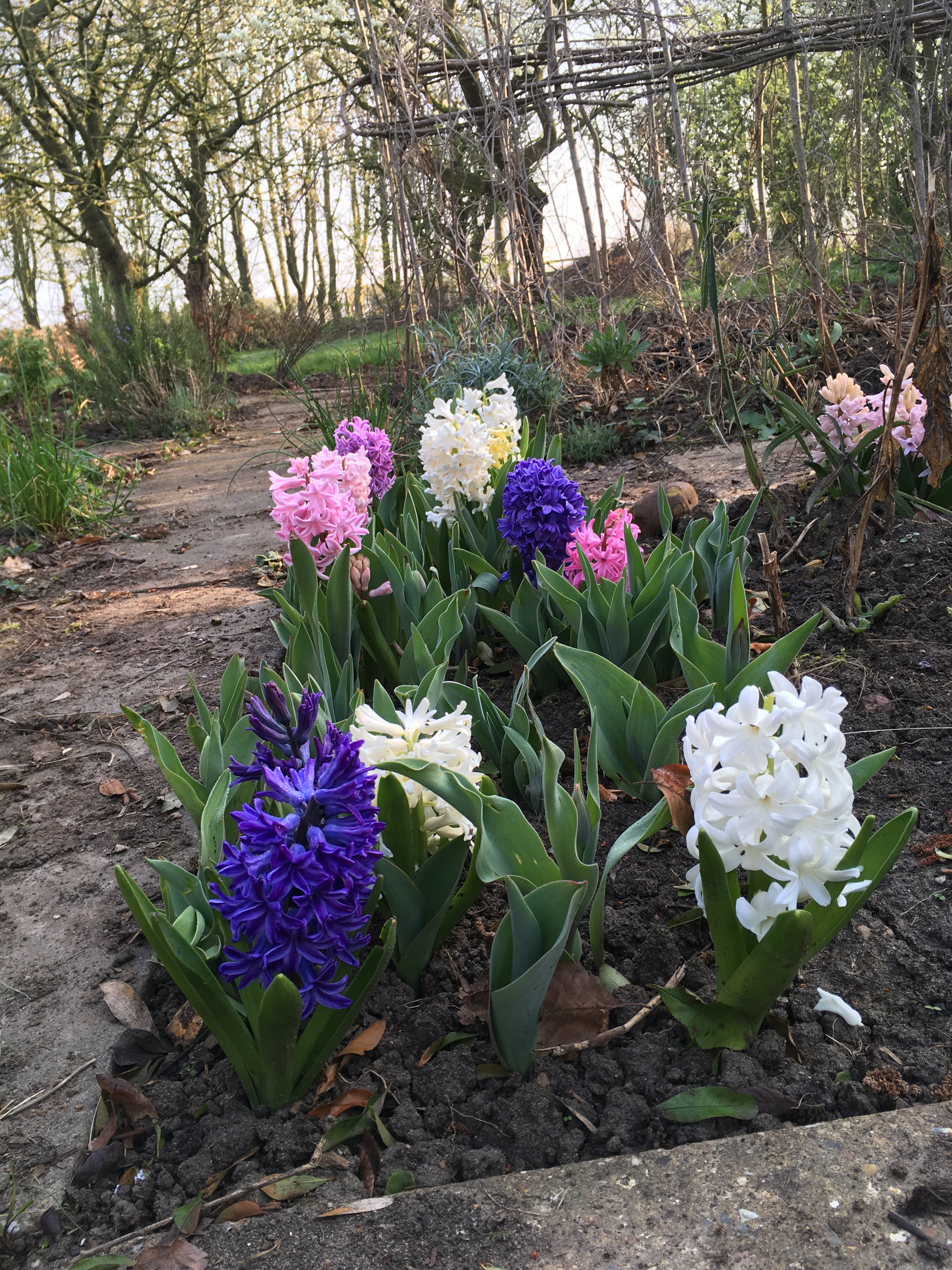
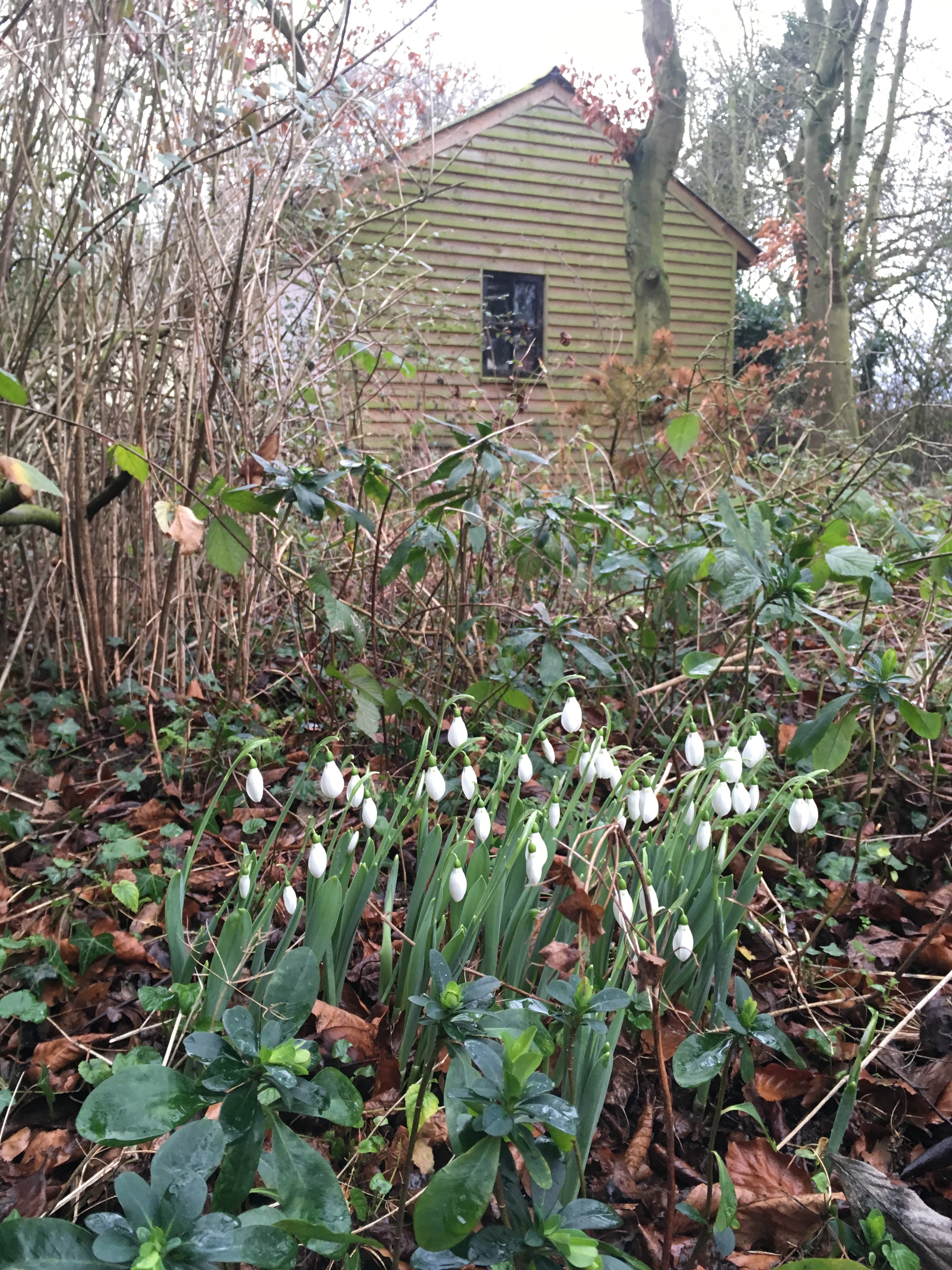
Six on Saturday- A walk around my garden 25 April 2020

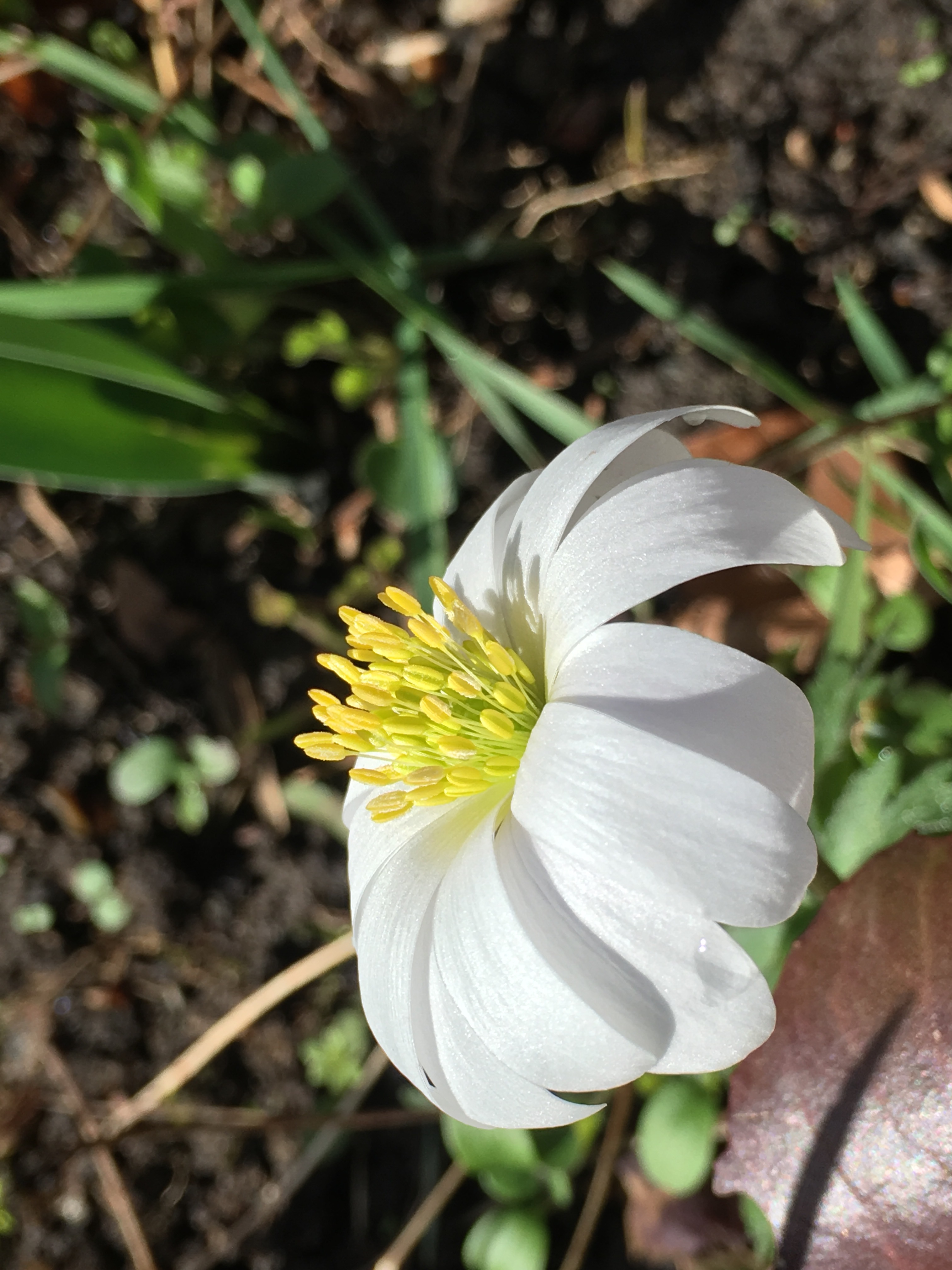
Bluebells. These came from my grandfather Ted Foulds’ garden originally. A lovely reminder of him. There was only a small patch to start with. Now they run from the front to the back garden. It’s surprising how fast they spread, without any help from me. There’s some wild garlic in amongst them too, which I’m trying to control a little this year.

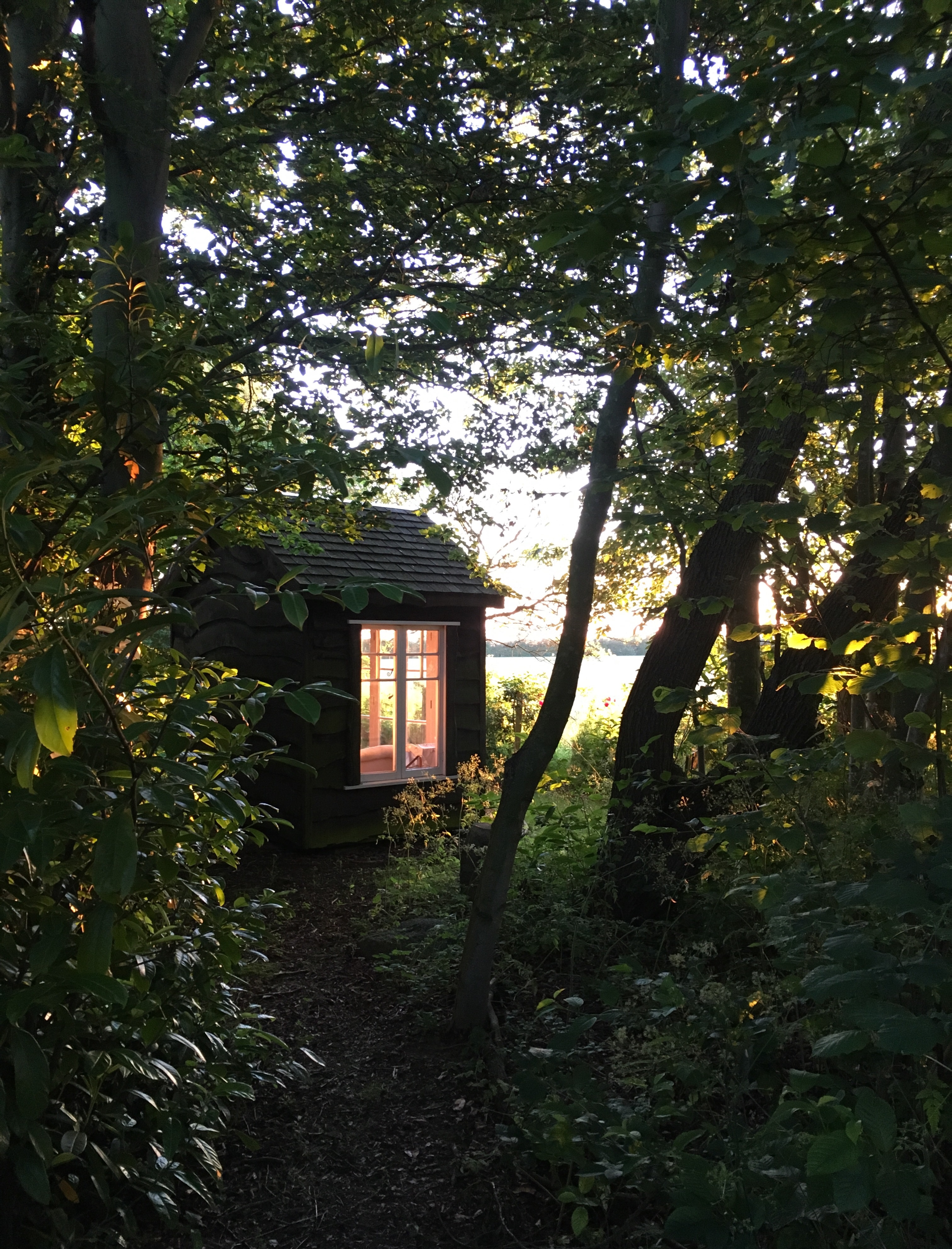
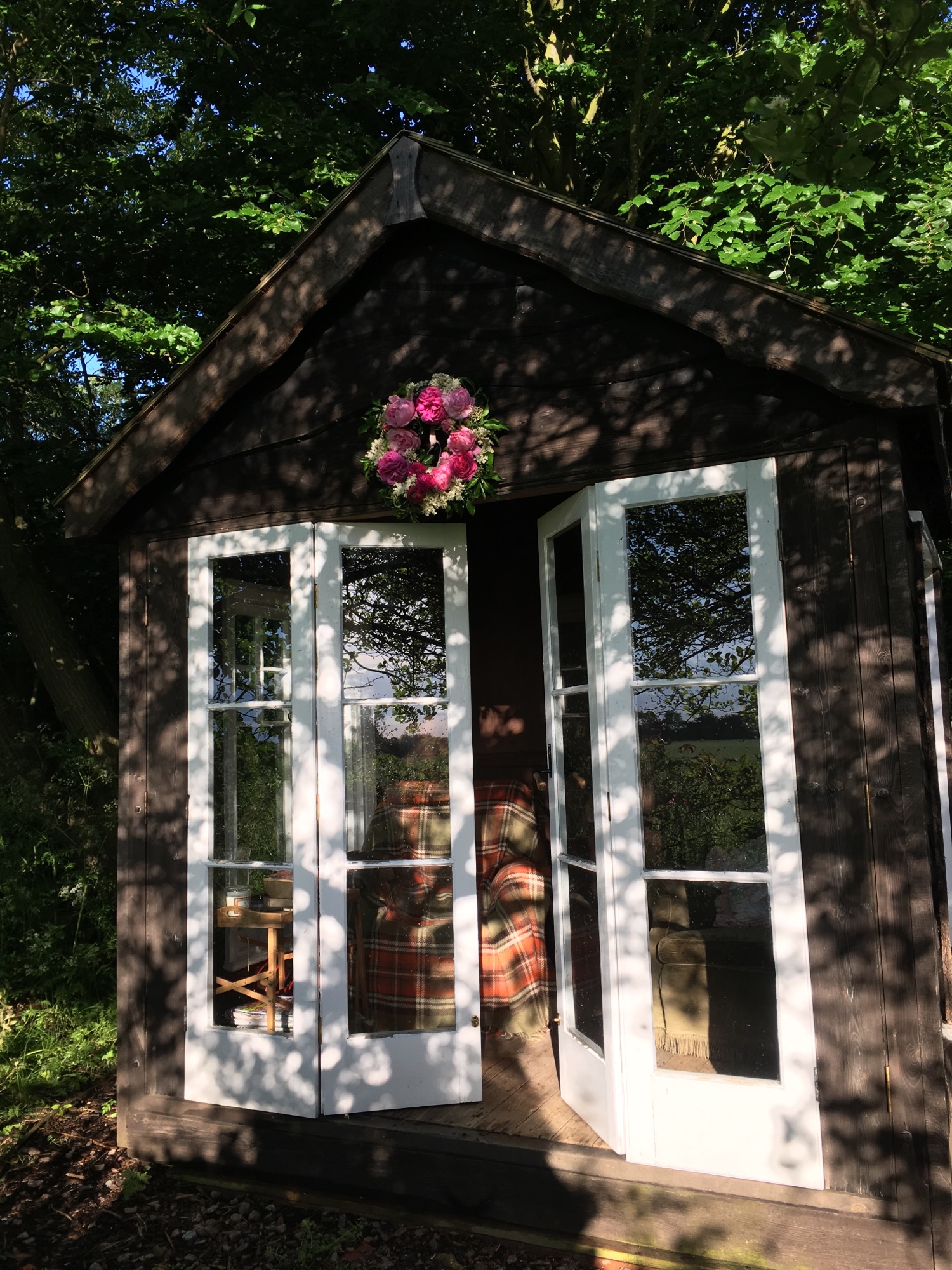
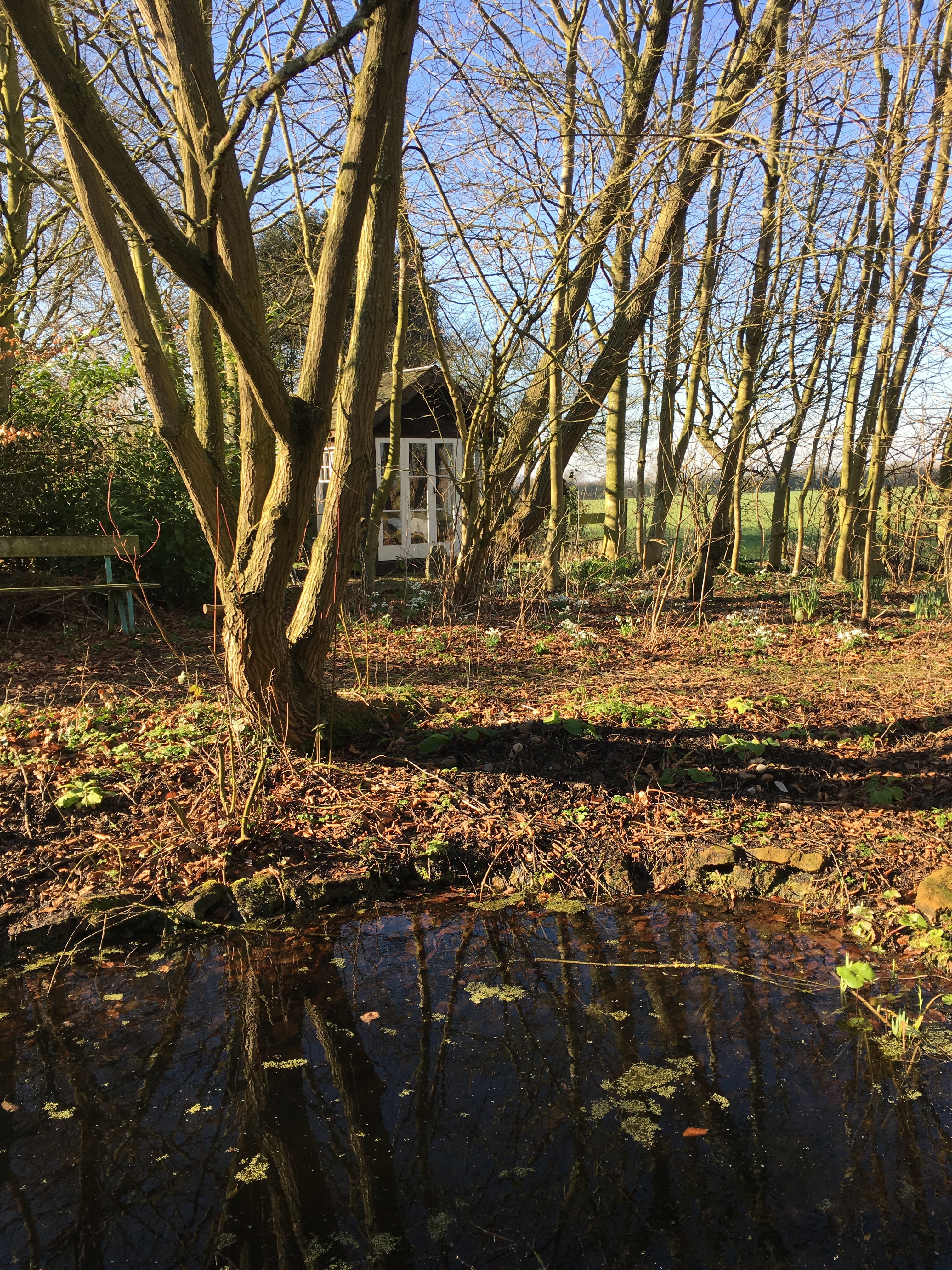
Trees are leafing up so quickly in the sunshine and heat this year. The bluebells will have to be quick to flower and set seed before they are shaded out. This is the path past the summerhouse to the pond.

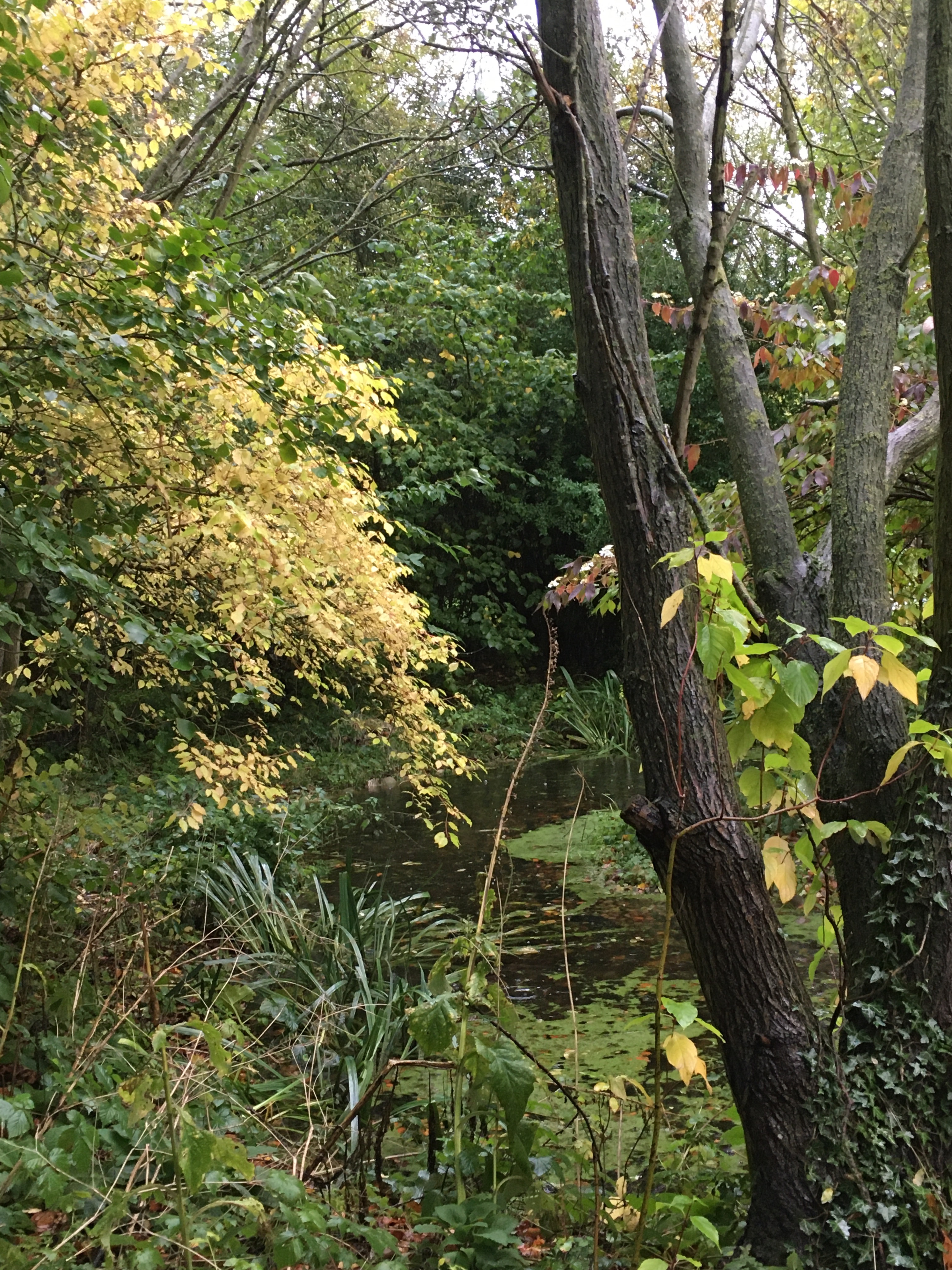
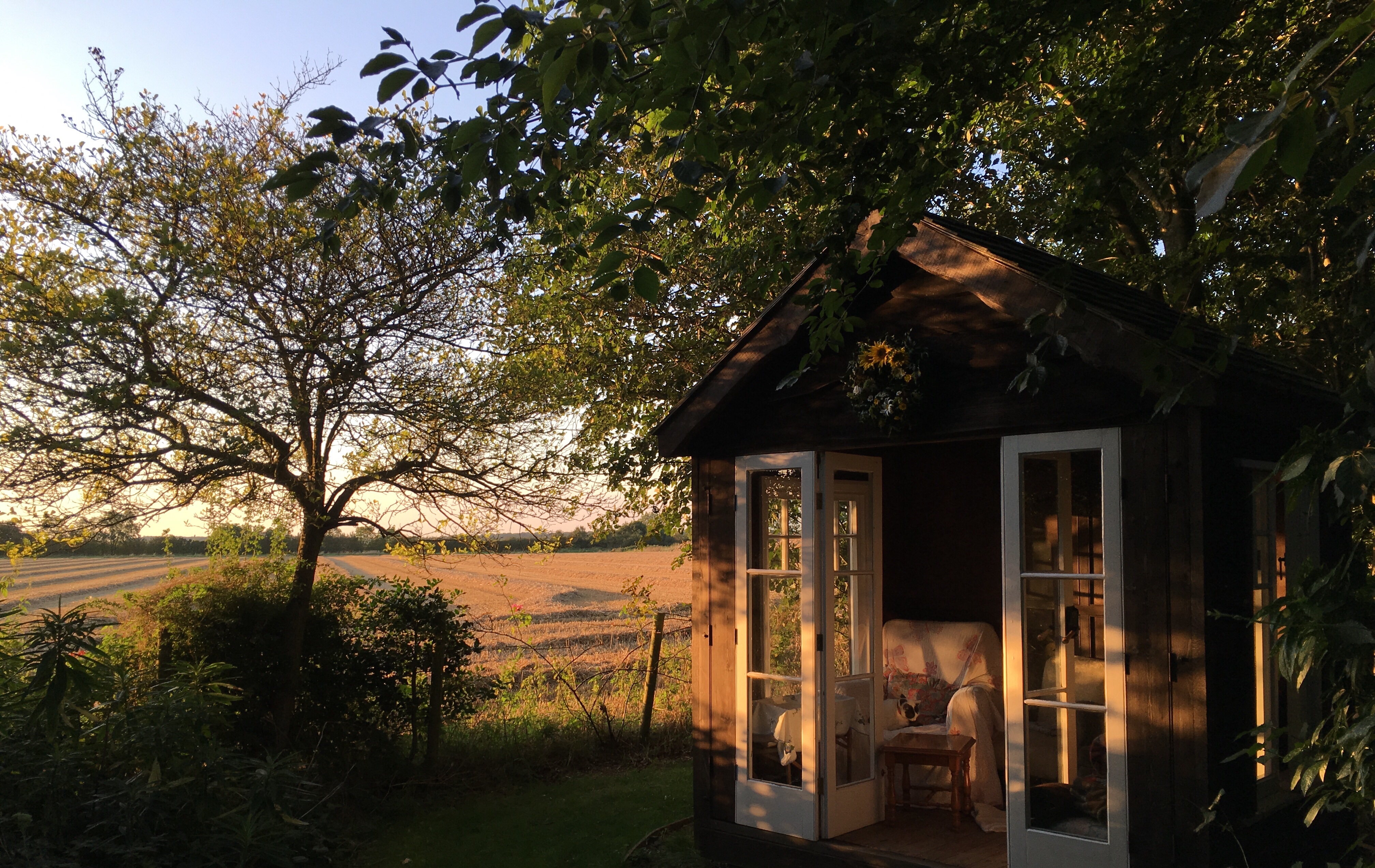
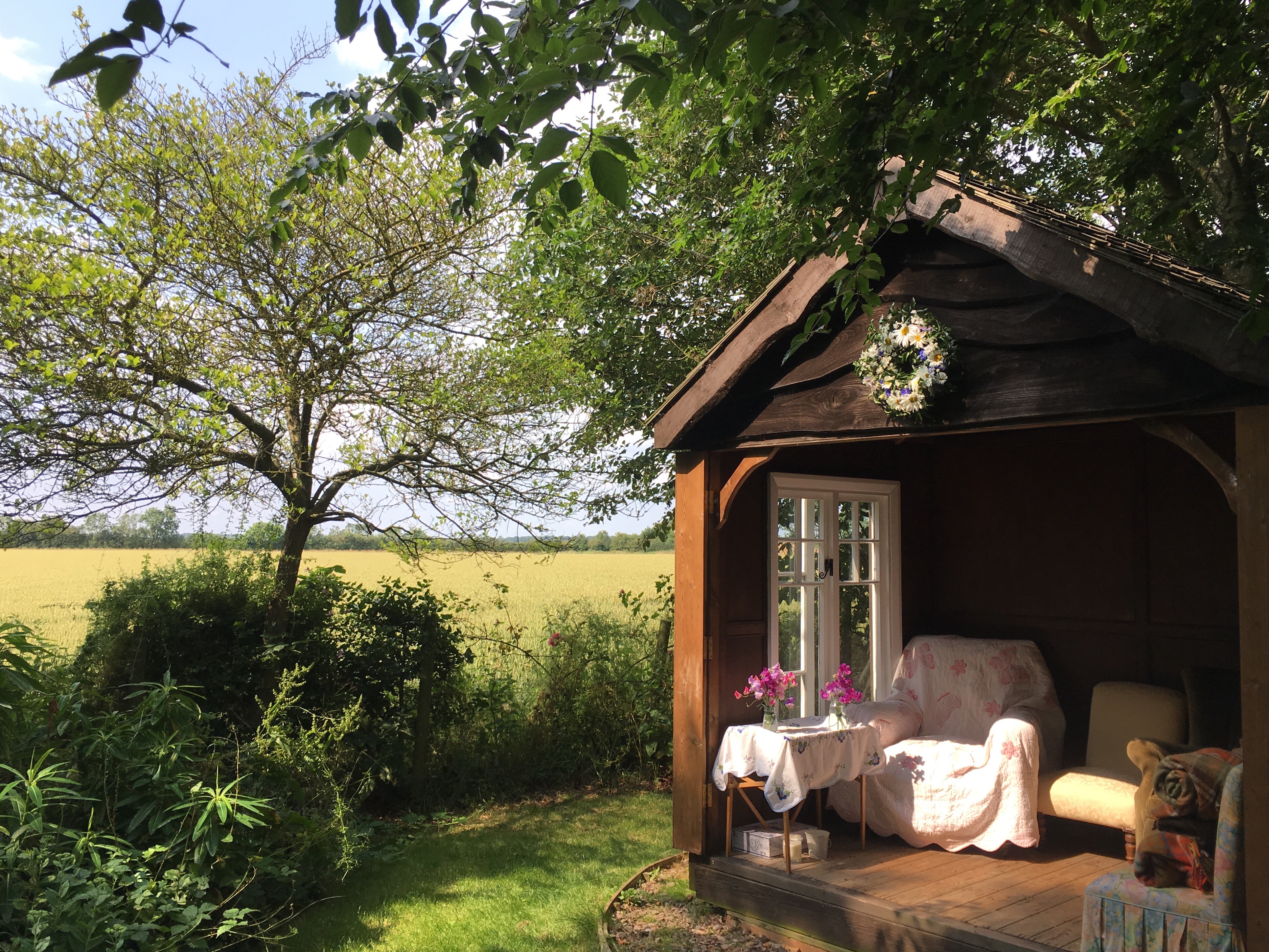
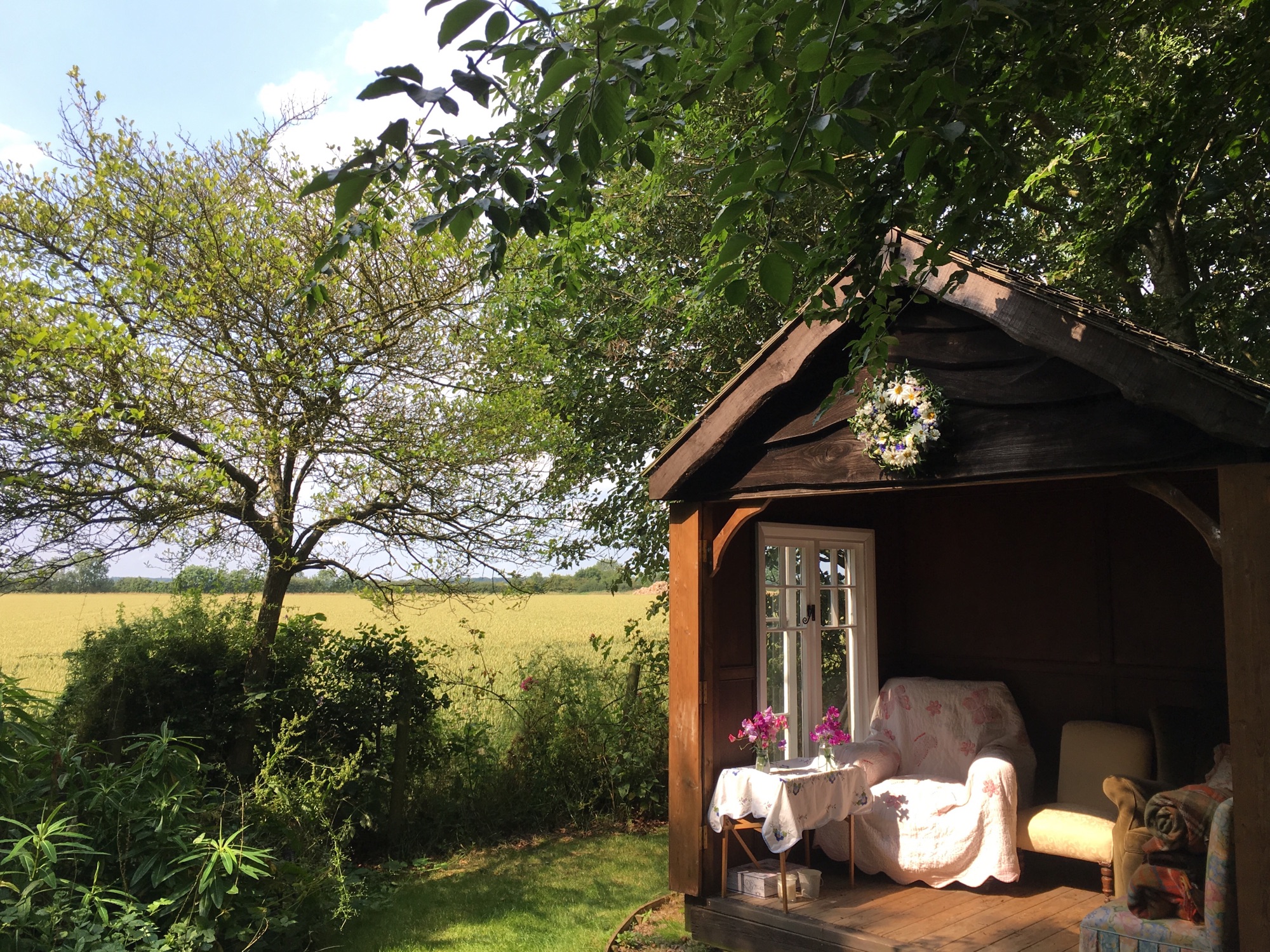
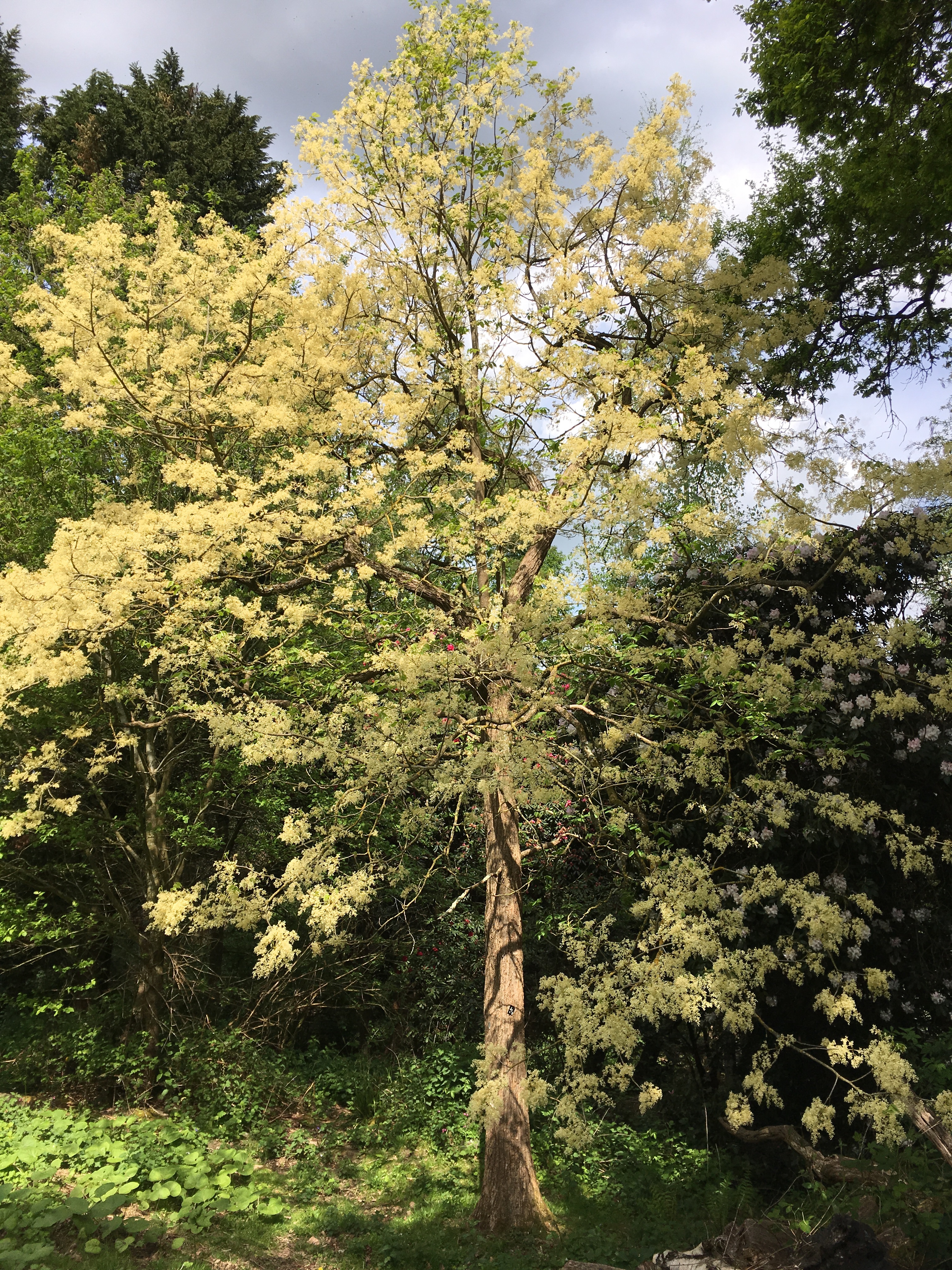
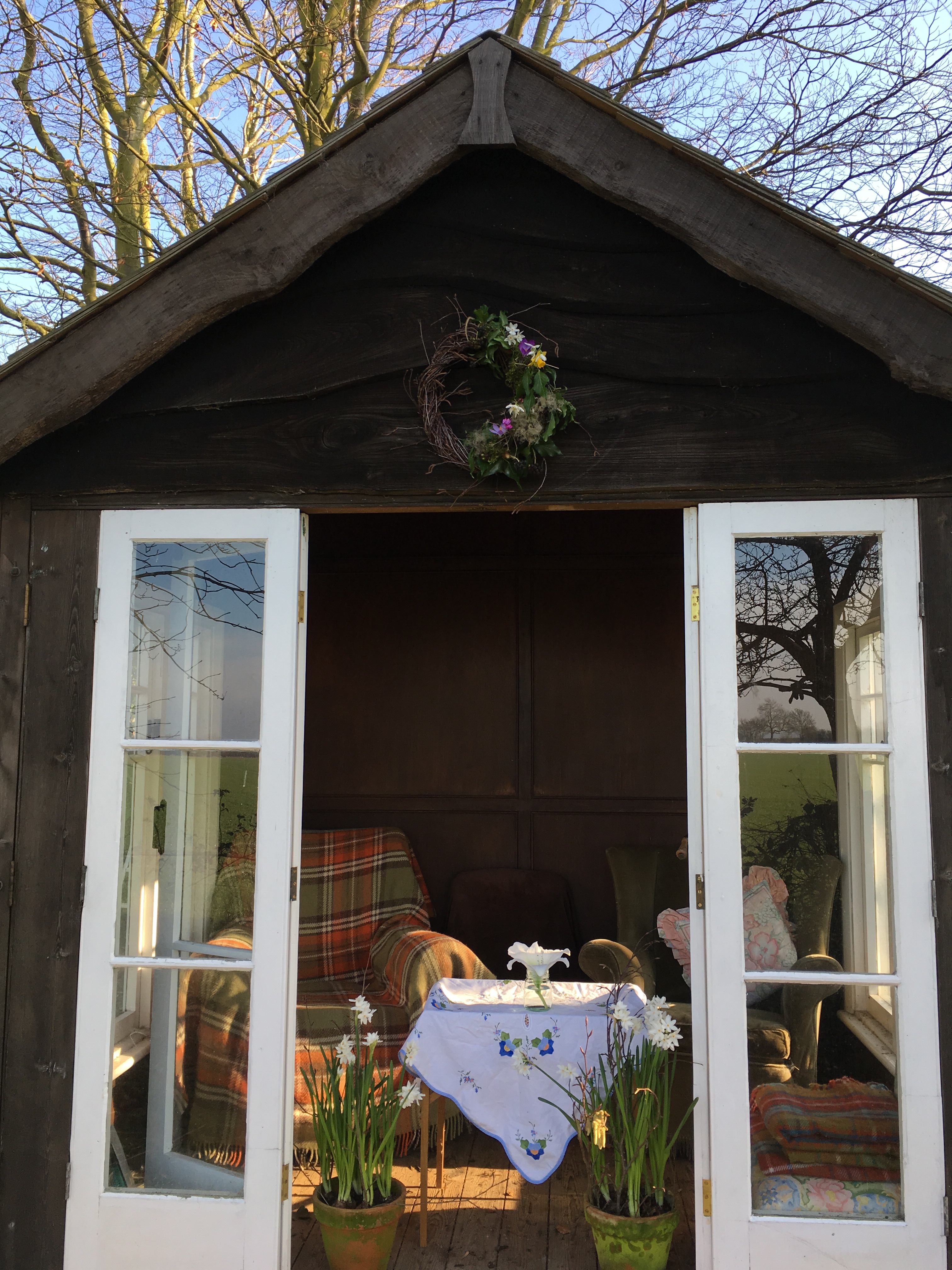
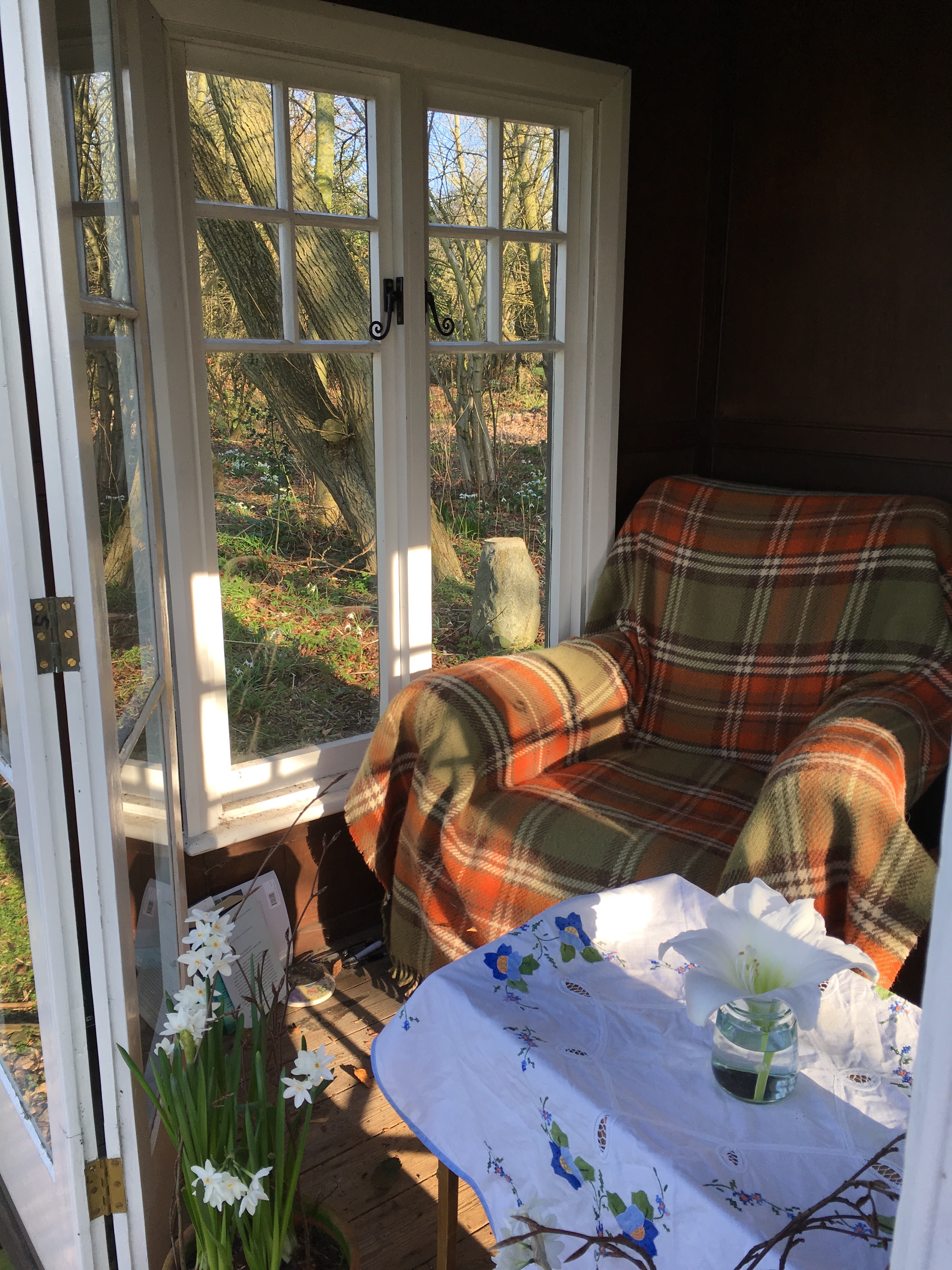
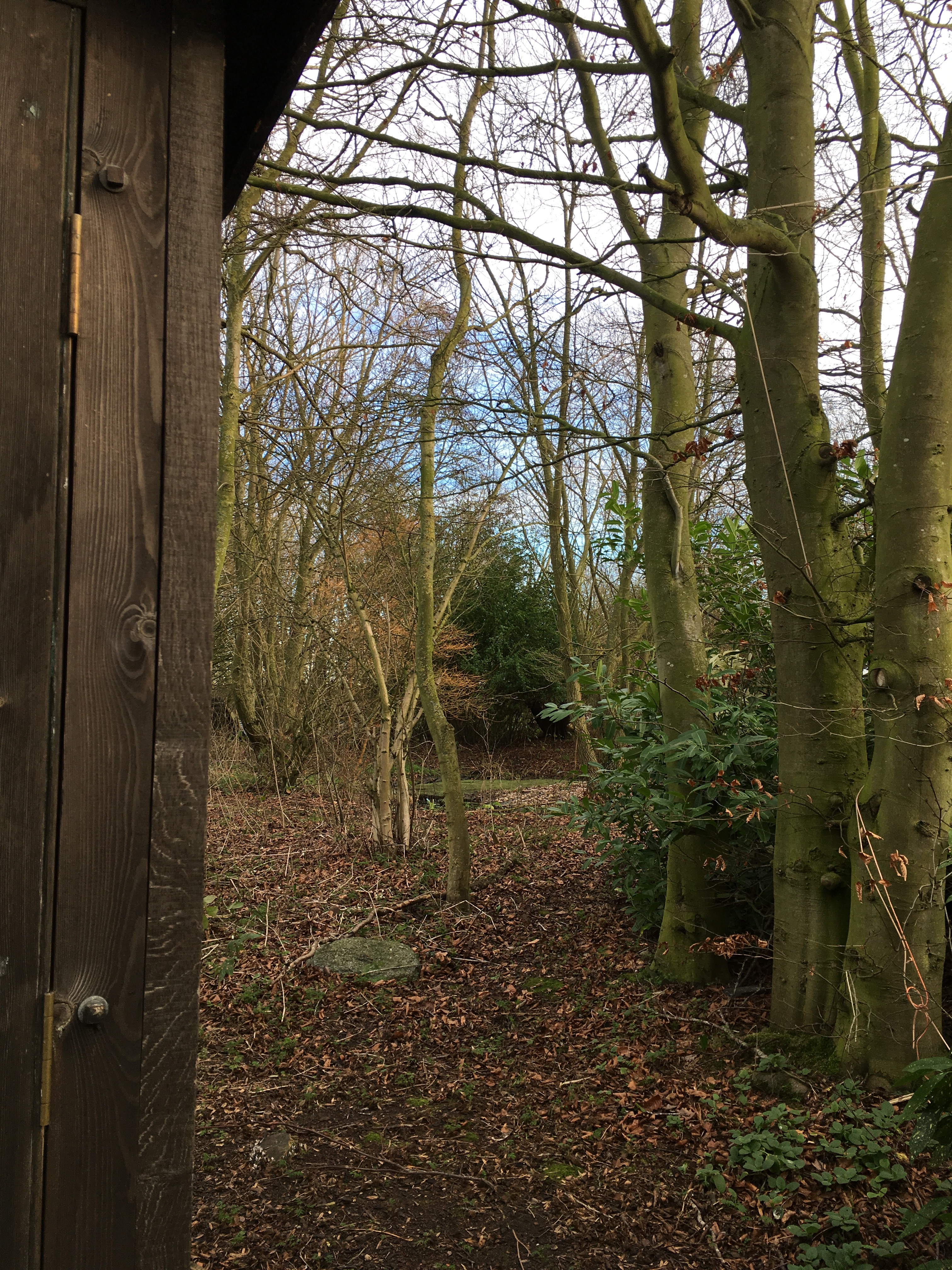
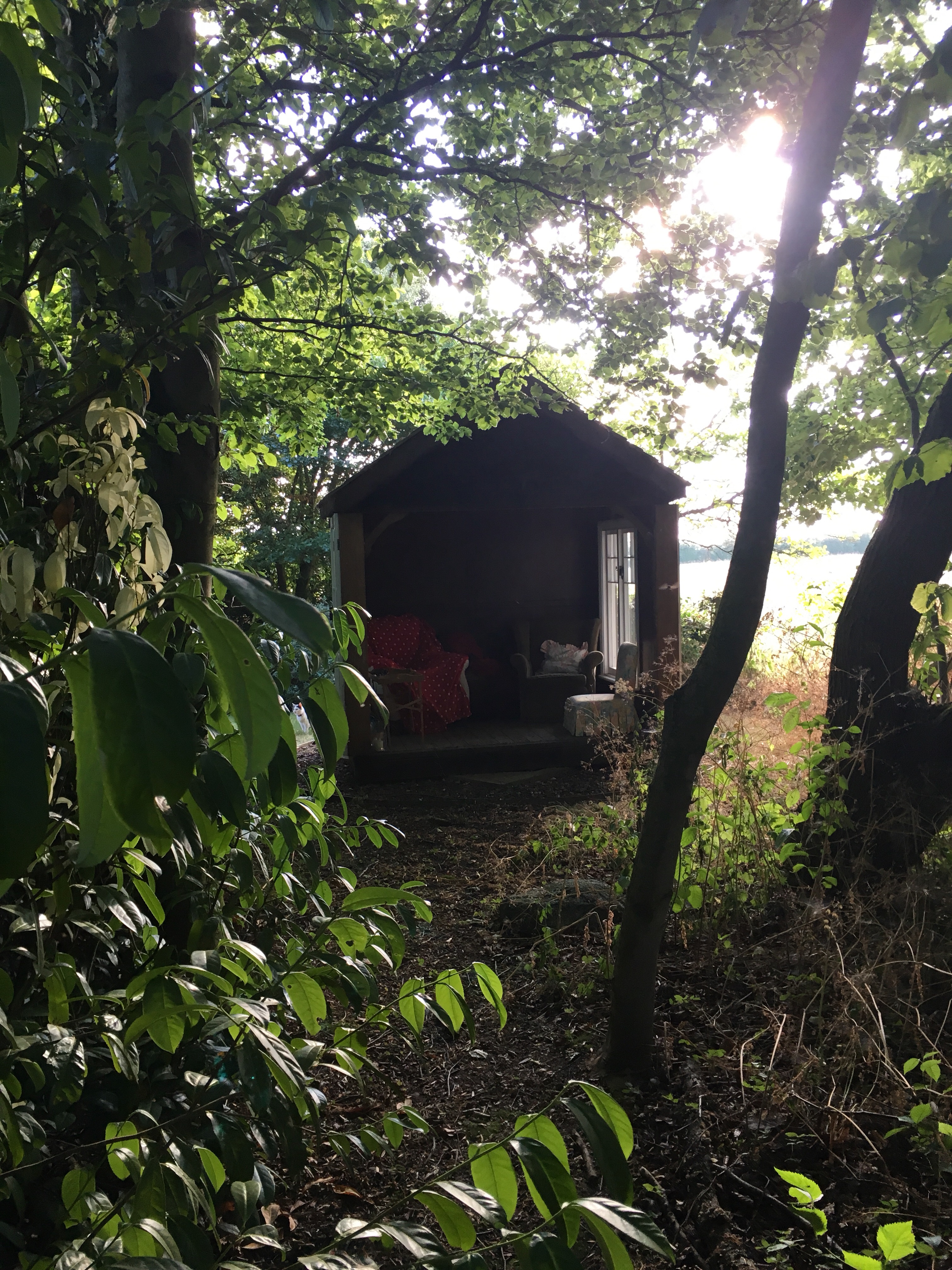
The view from the summerhouse. It looks like a jungle already. There’s oak, beech, hornbeams, cherry, willow and ash in the mini-wood. All the trees came as saplings from the borough council when we moved here 30 years ago. There was a scheme to plant trees on farmland. I think it was linked to the woodland trust. We applied, and they delivered 260 saplings for us to plant. The whole family set to and helped us plant them in a day or so.

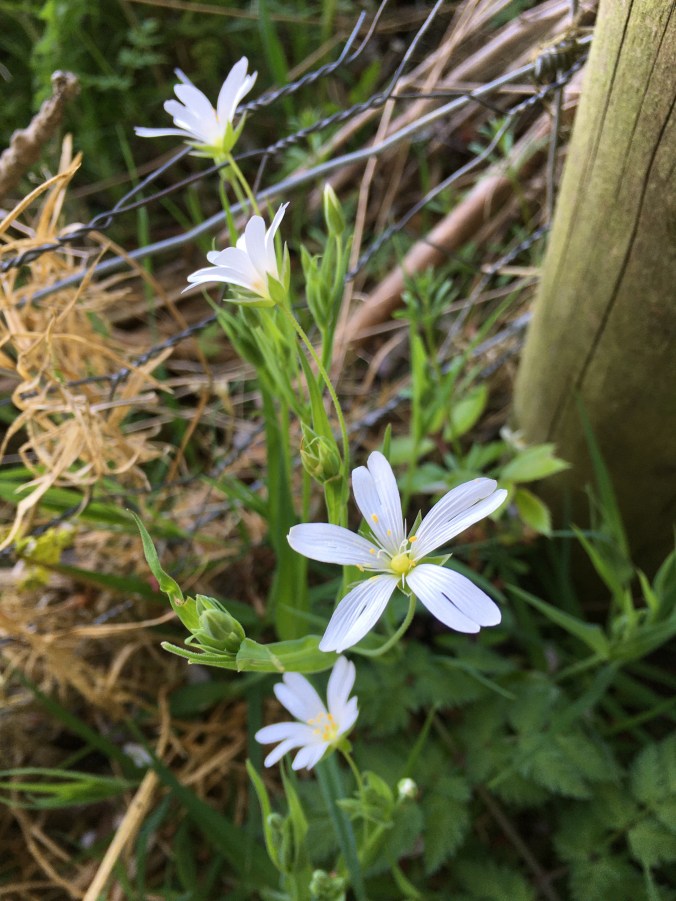
All along the woodland paths there’s a lovely white starry flower, I think it’s called stitchwort. I didn’t plant it, but it’s very welcome here.

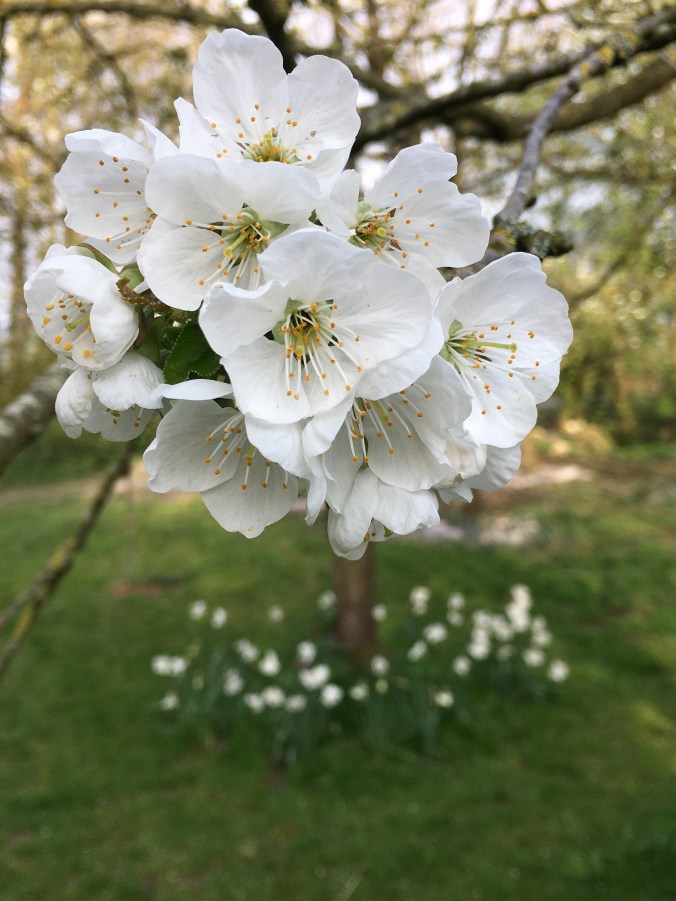
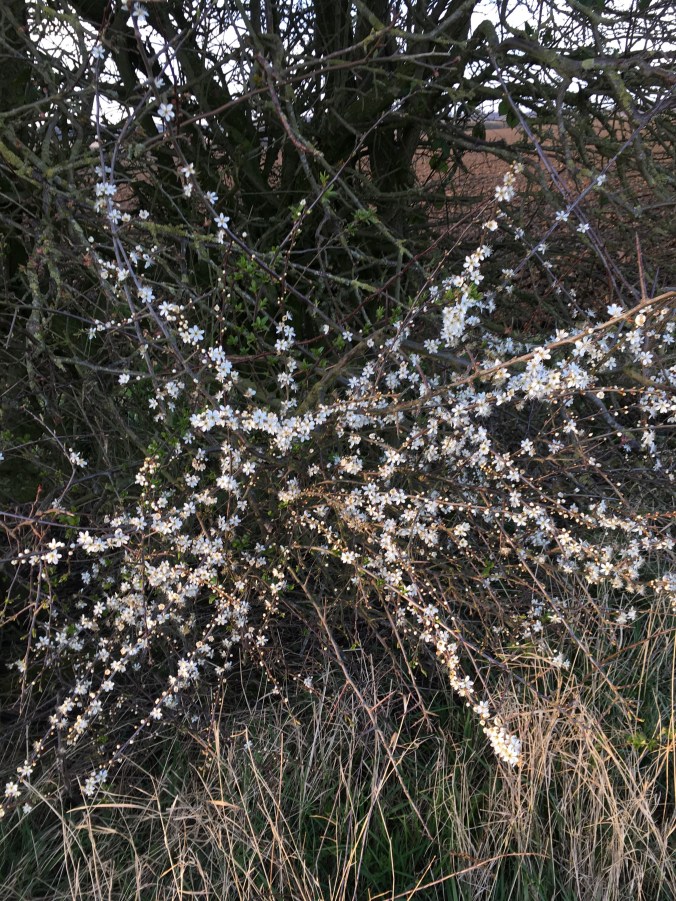
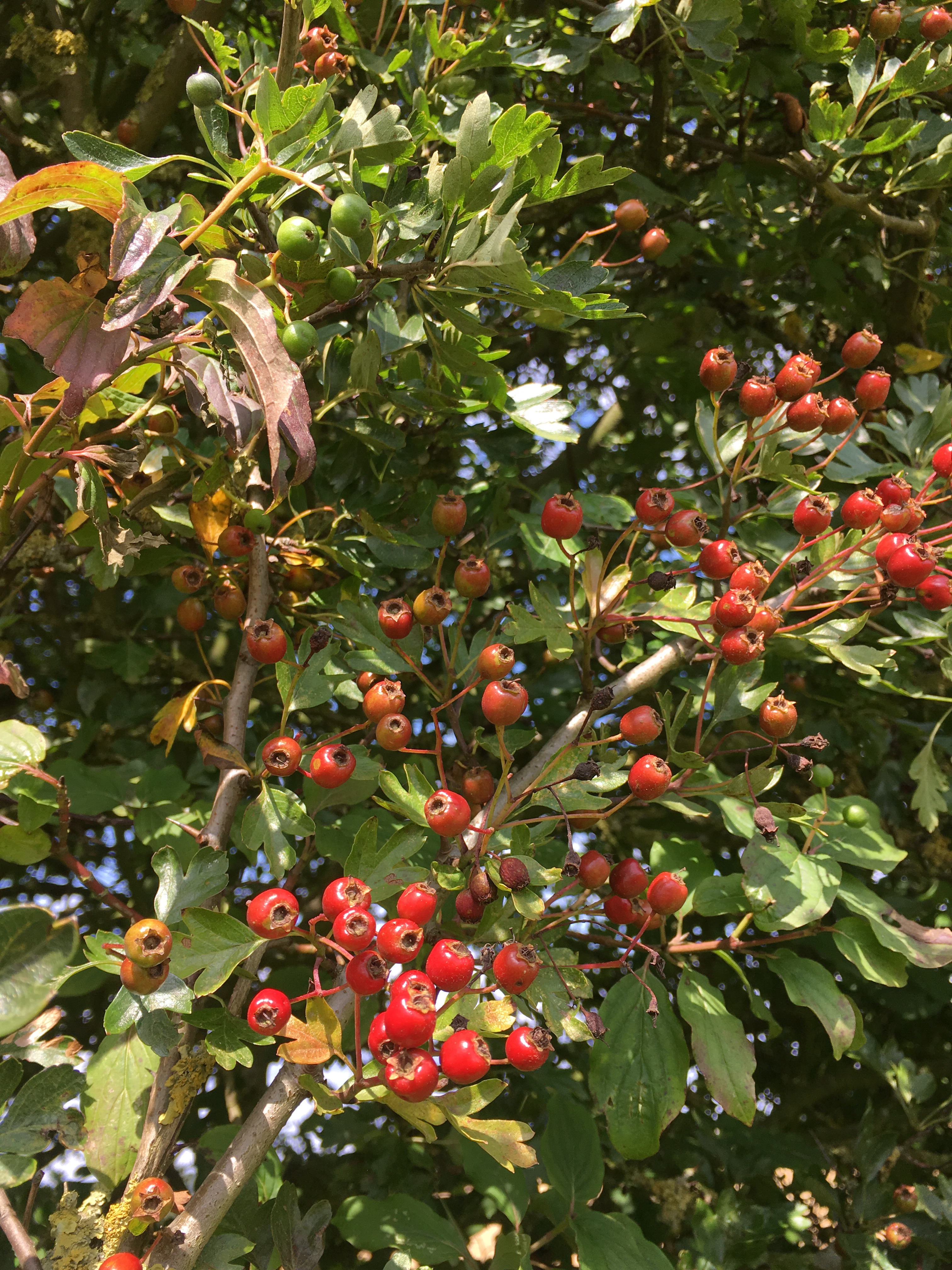
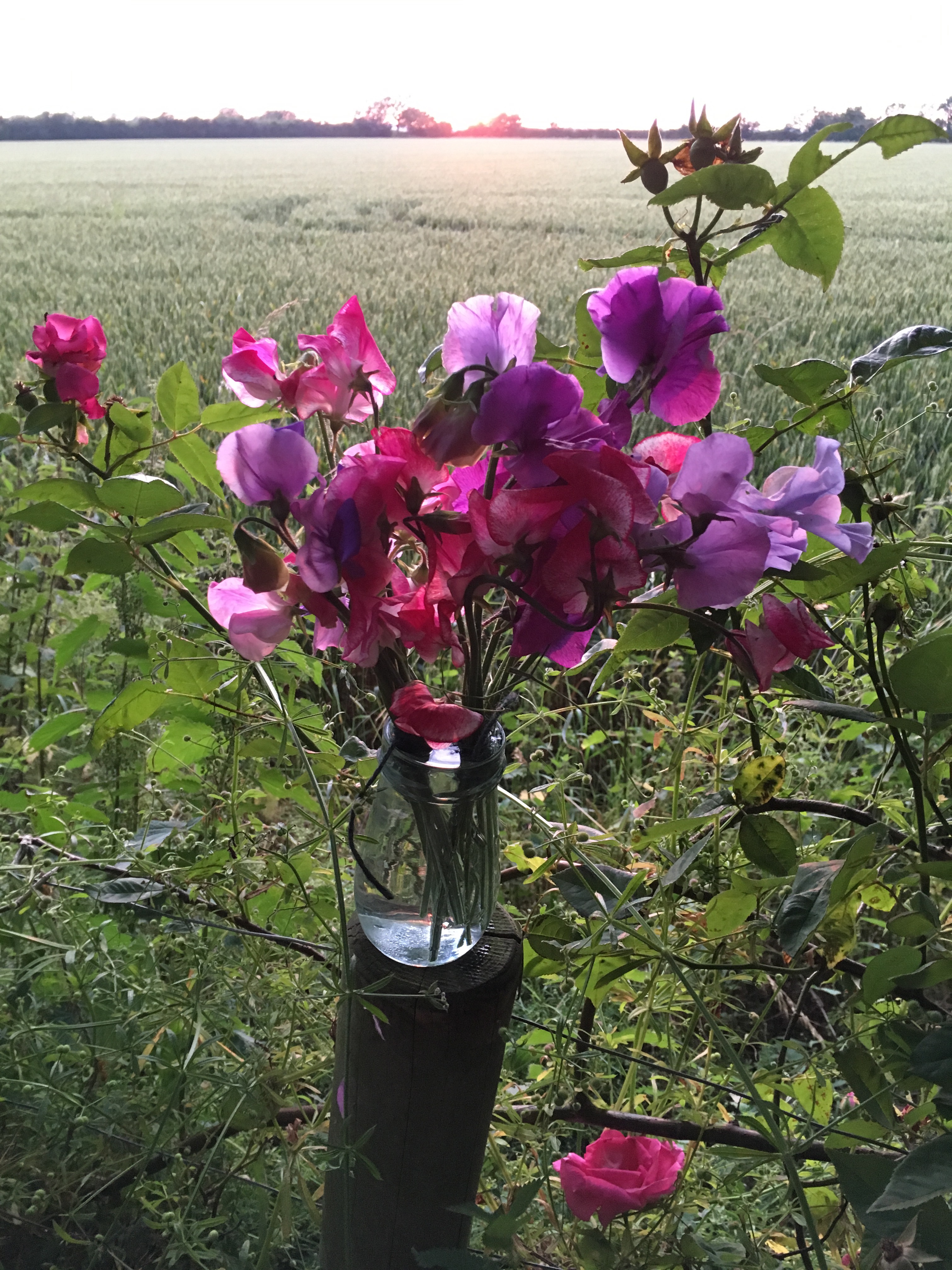
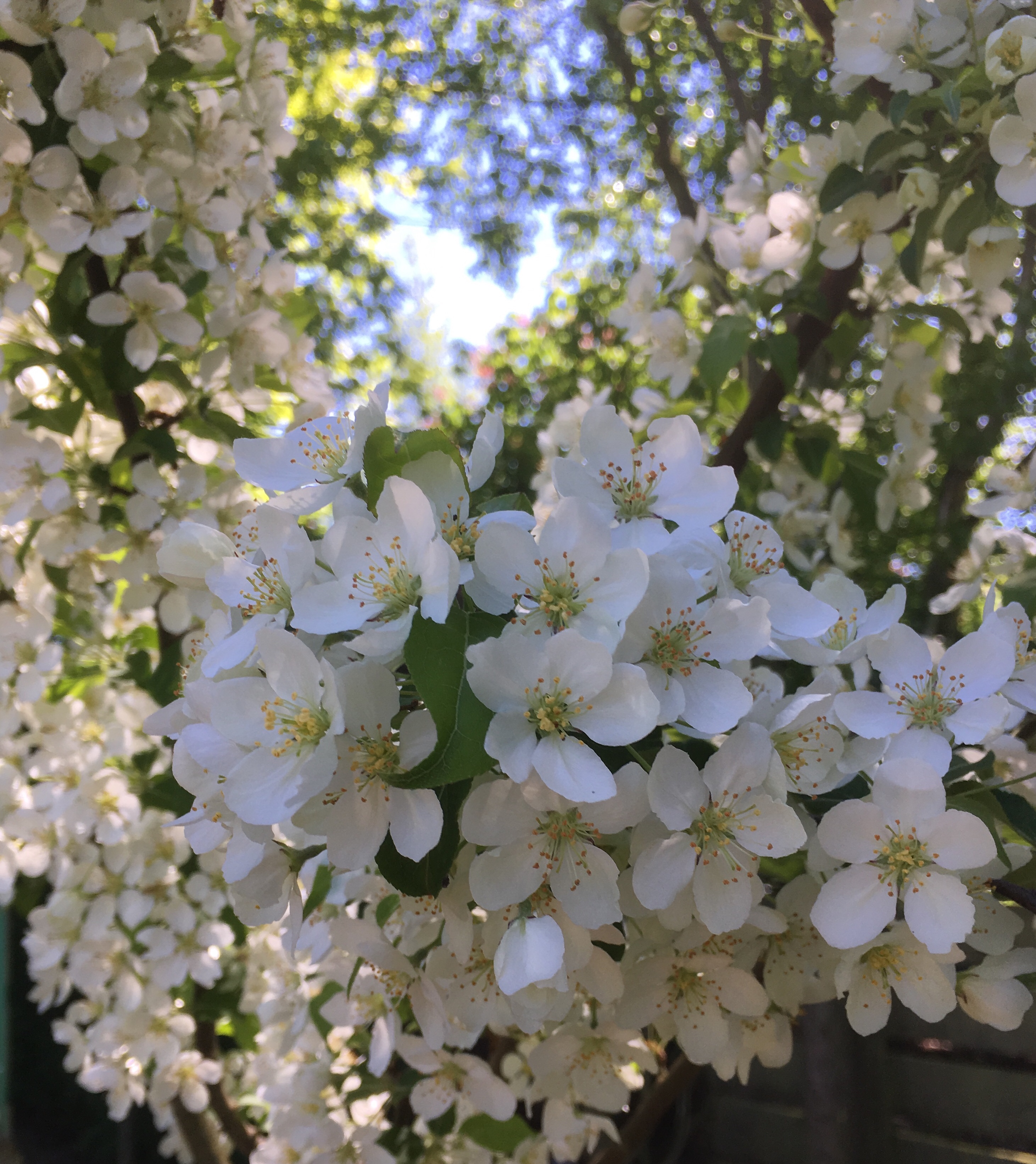
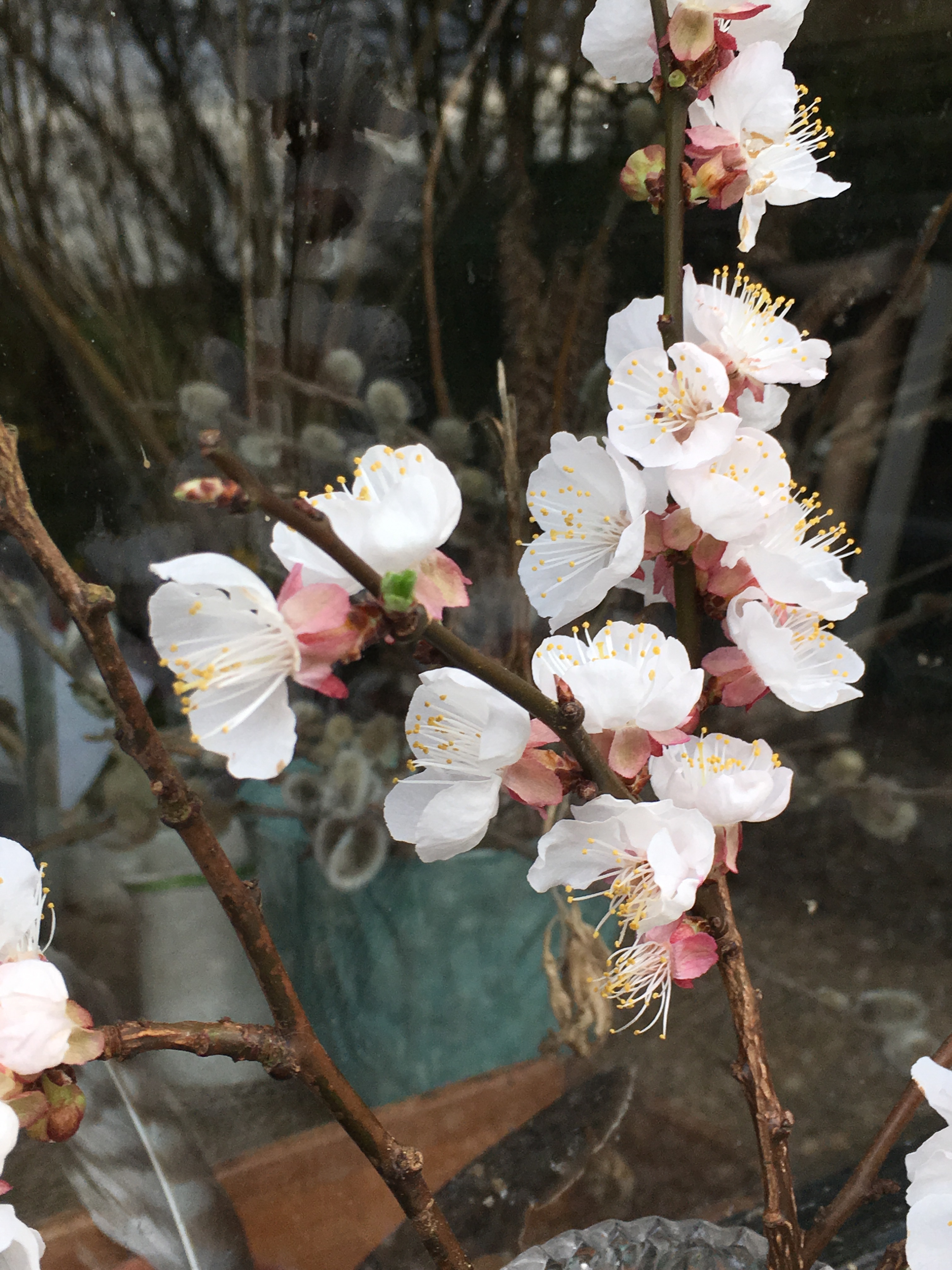
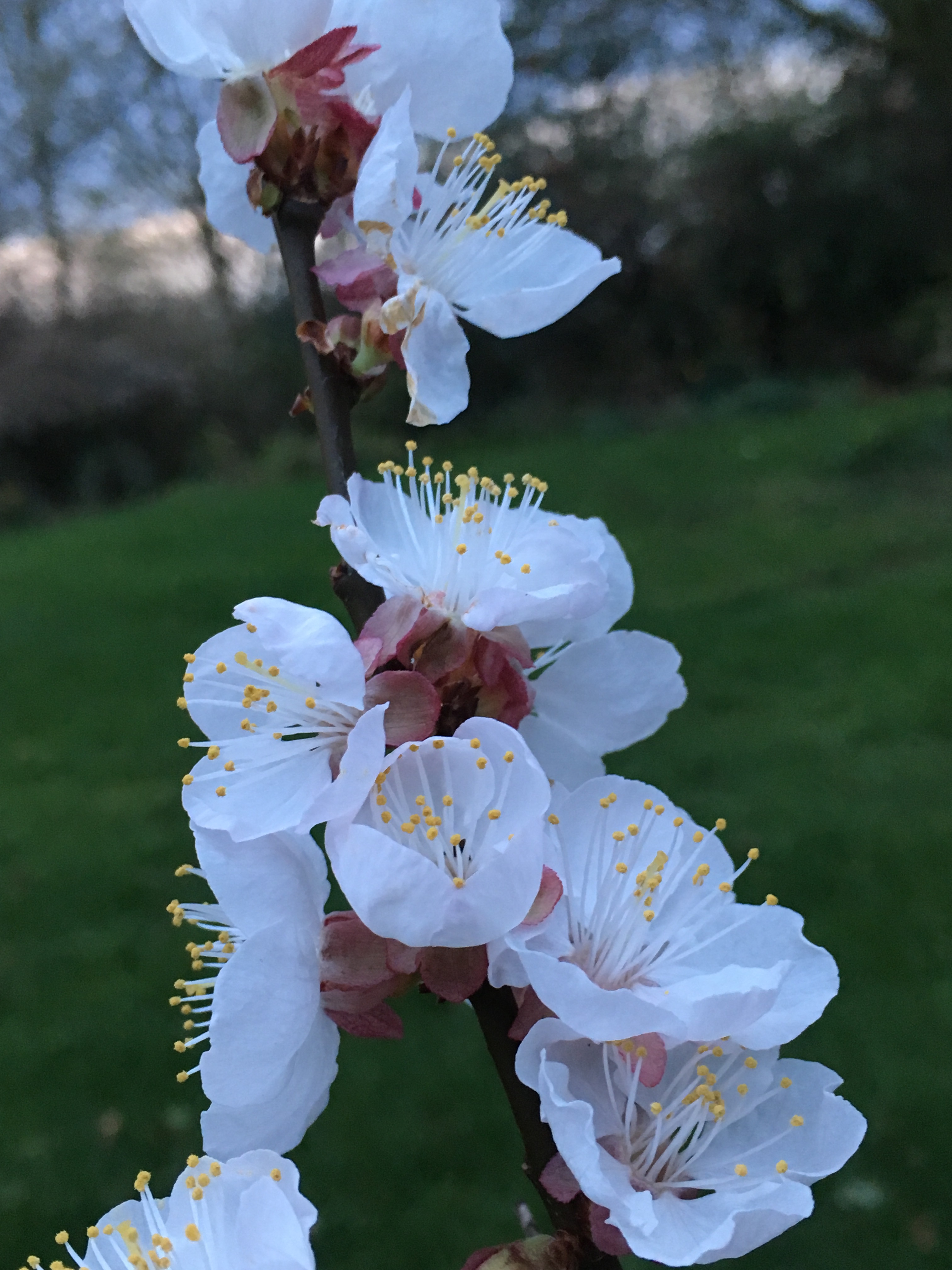
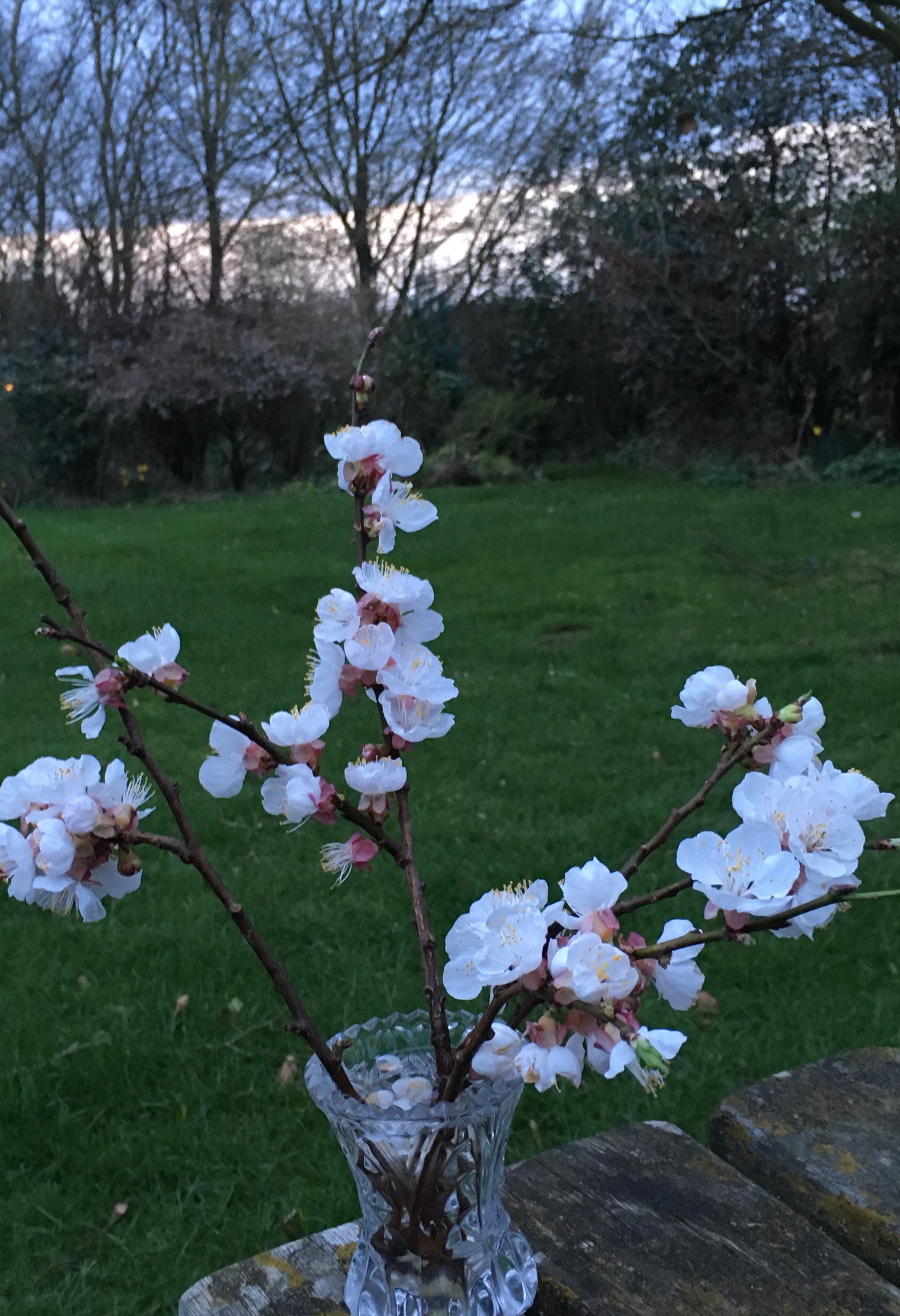
It seems to be all green and white shades today. May blossom or hawthorn is suddenly in flower.

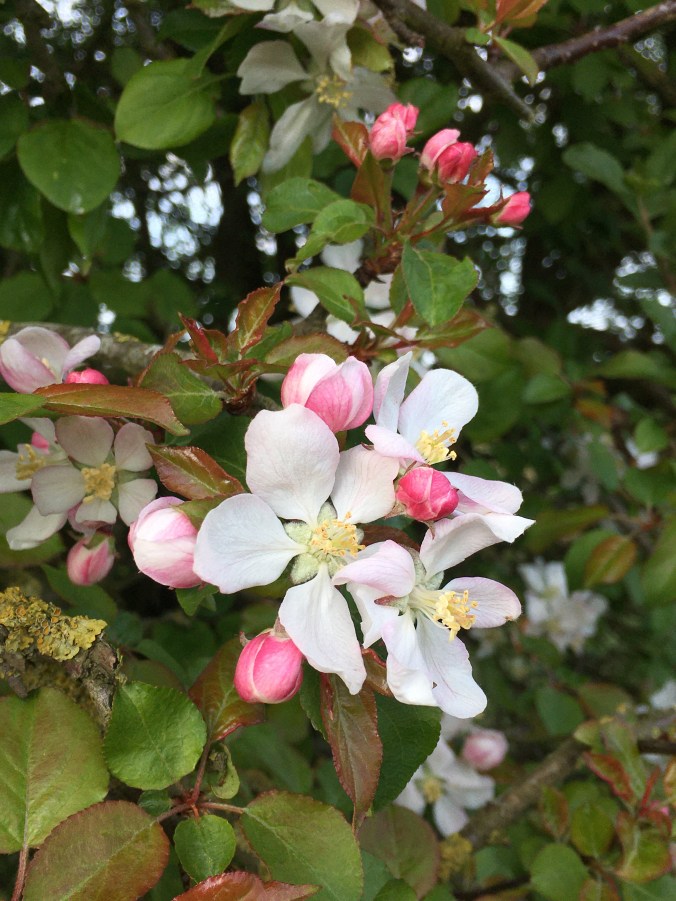
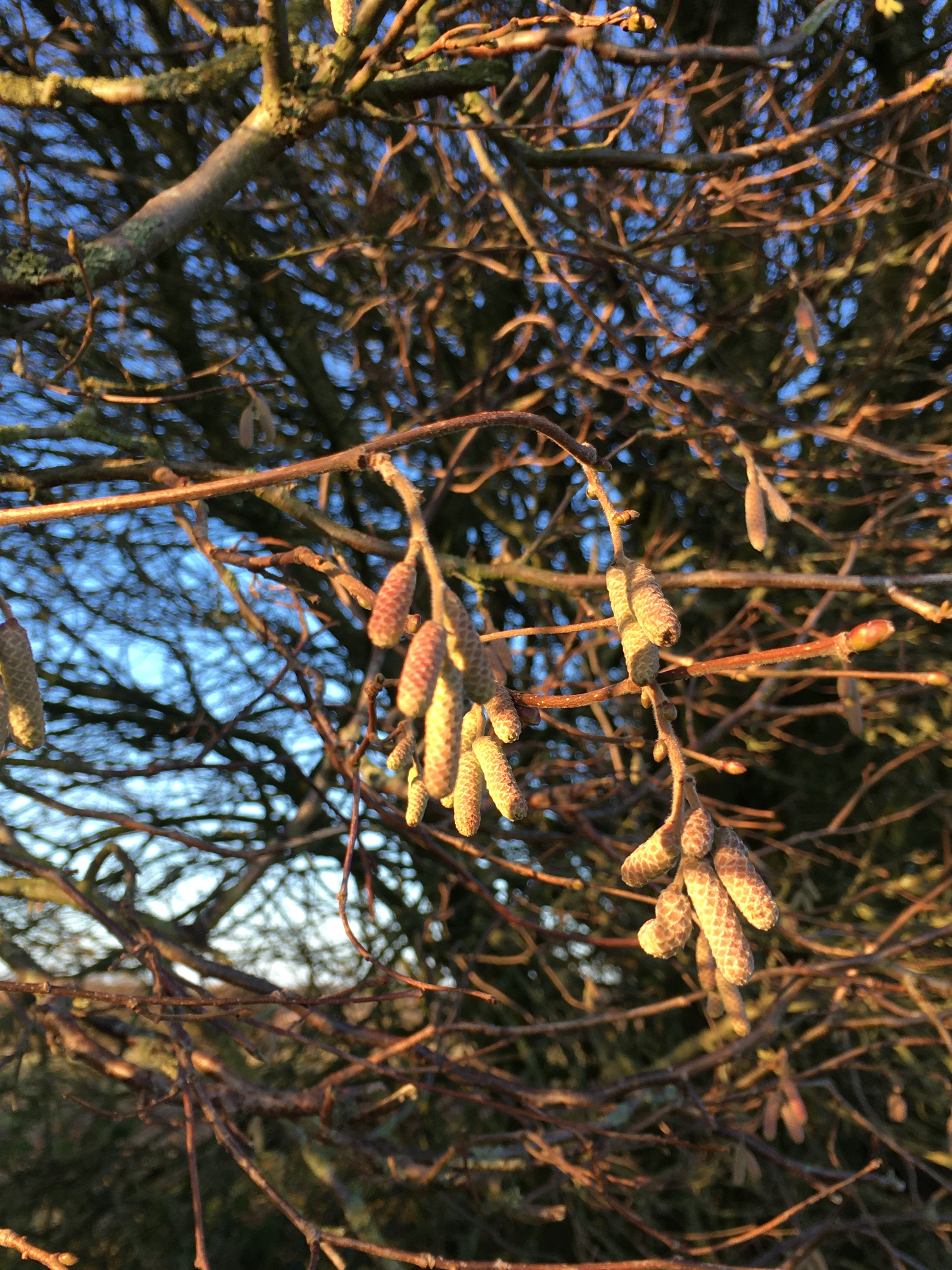
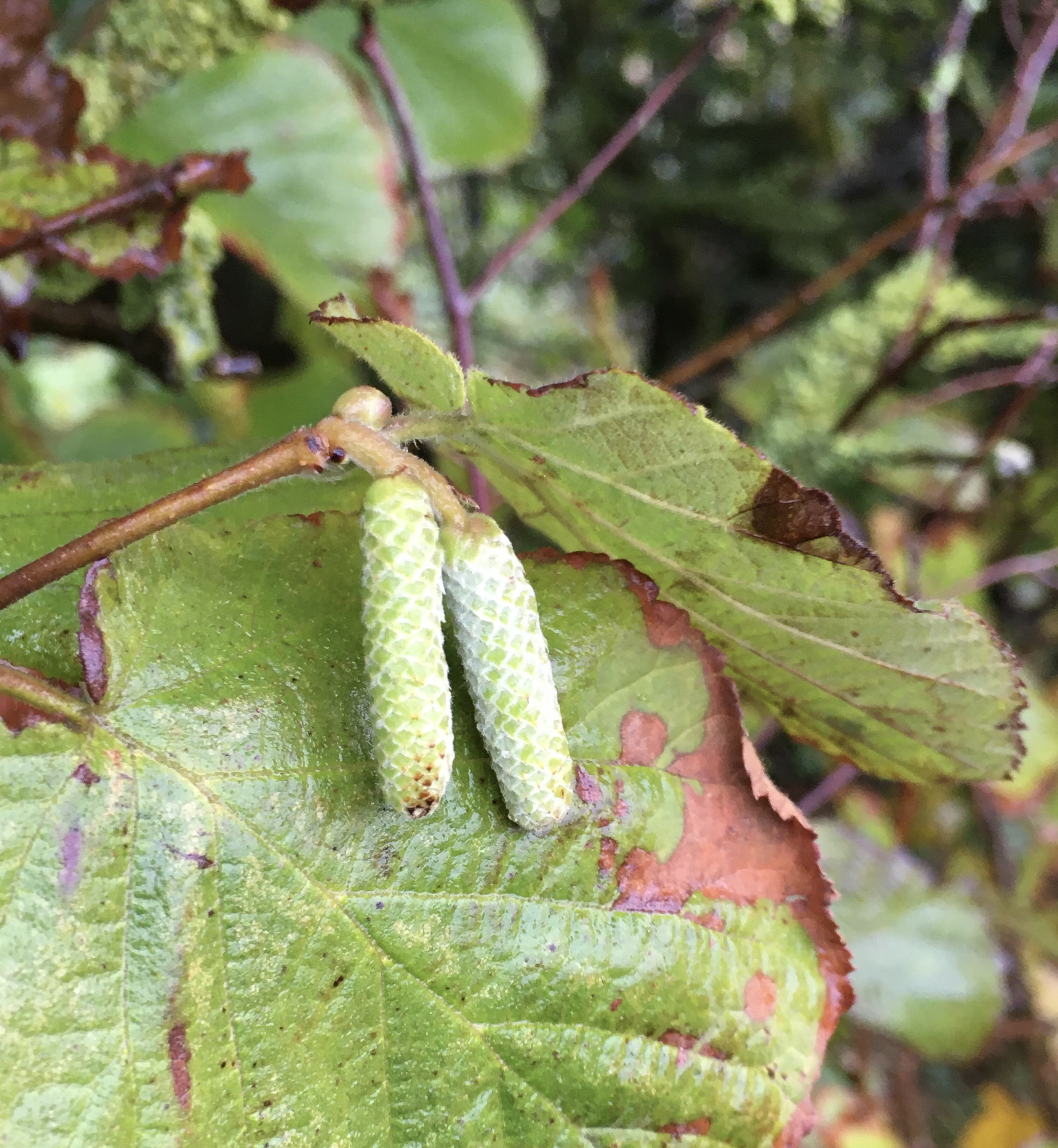
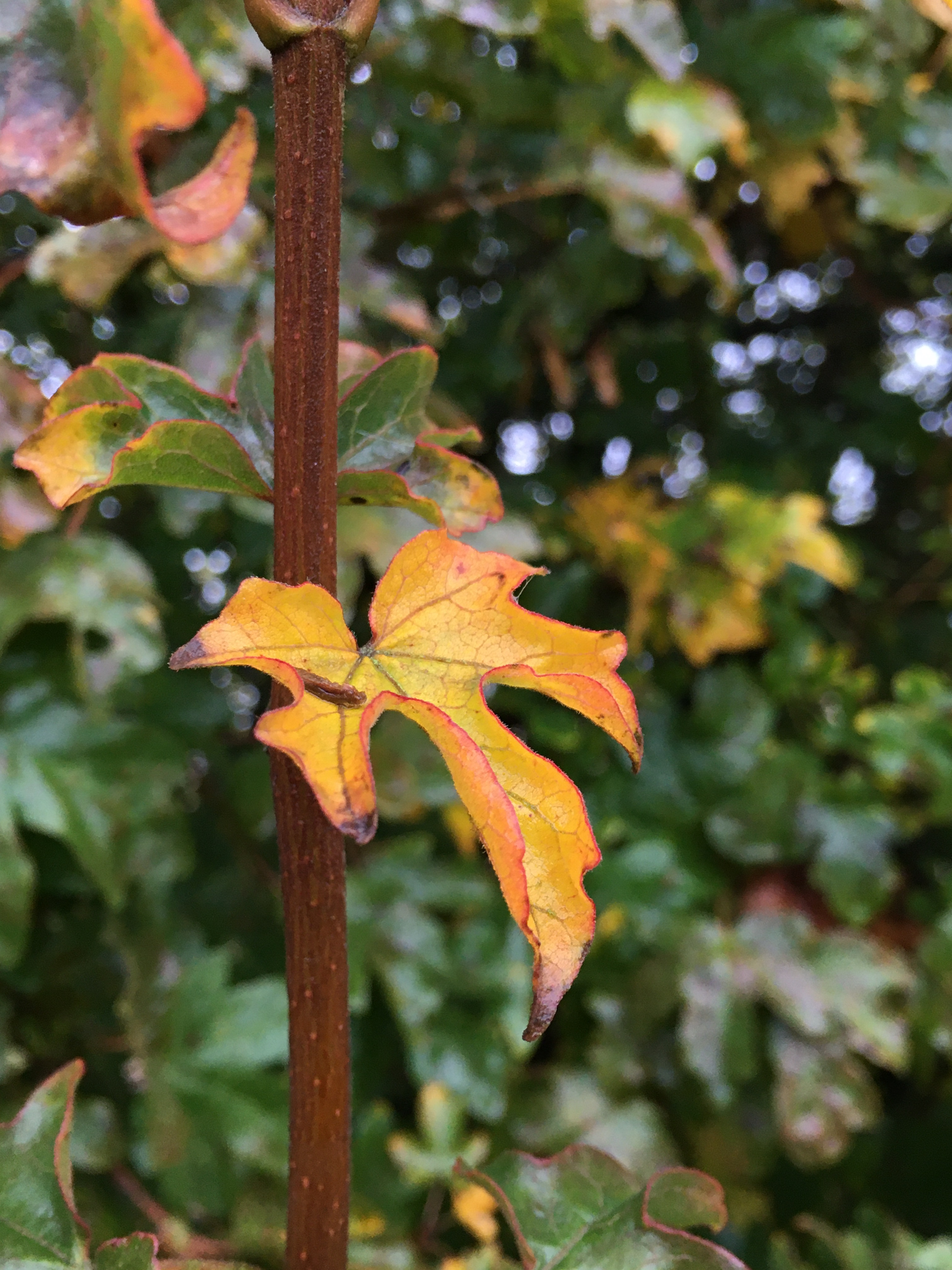
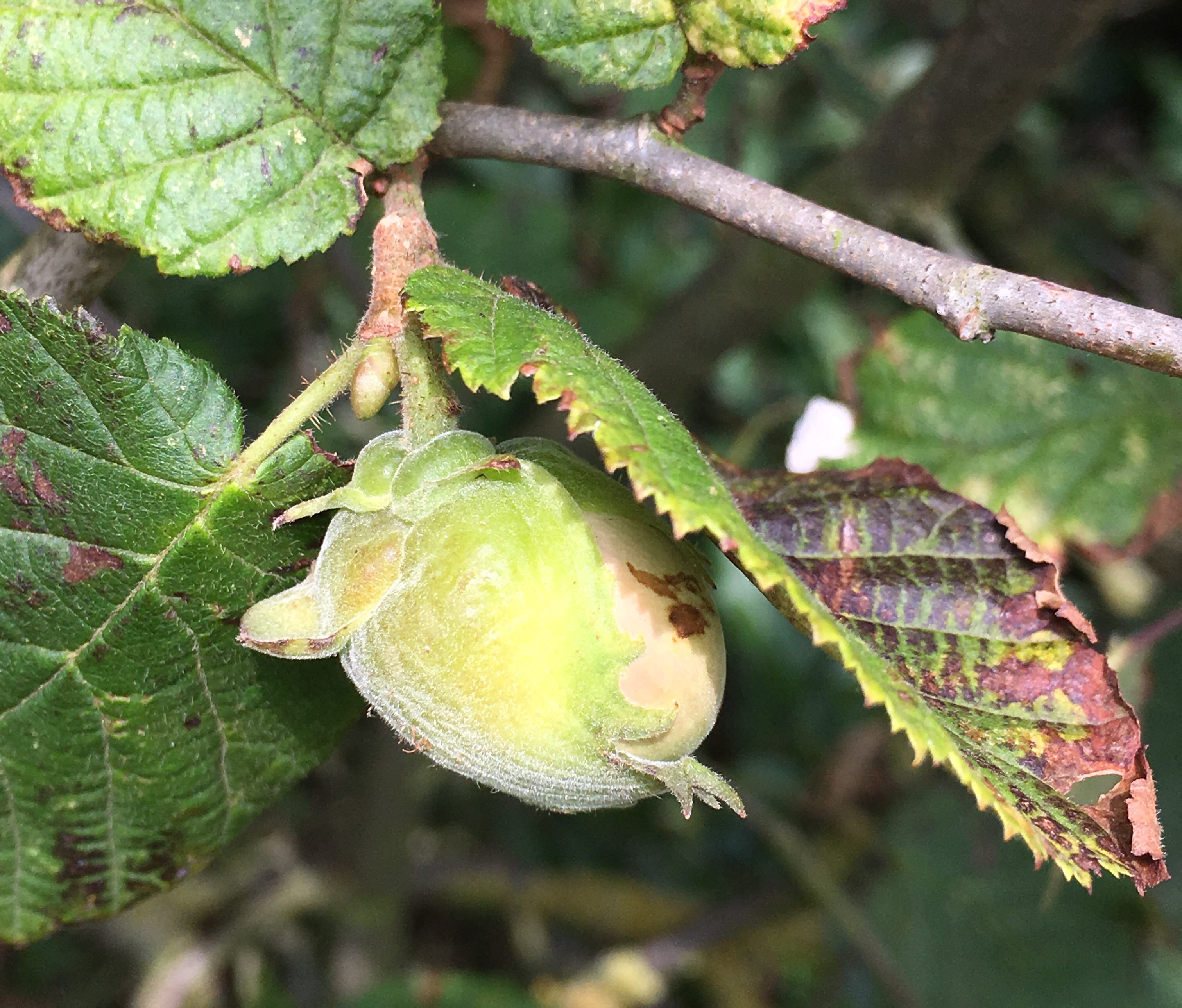
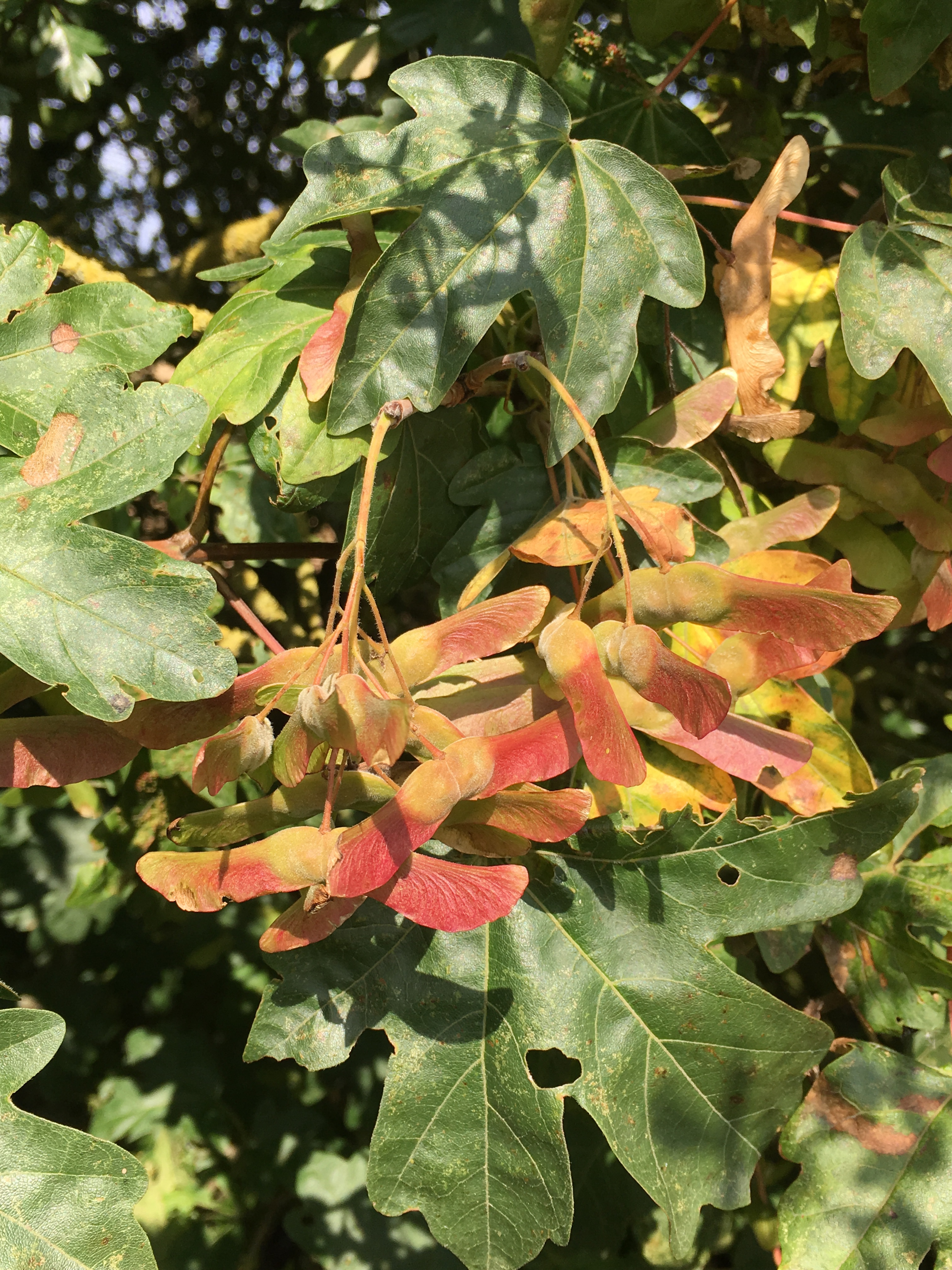
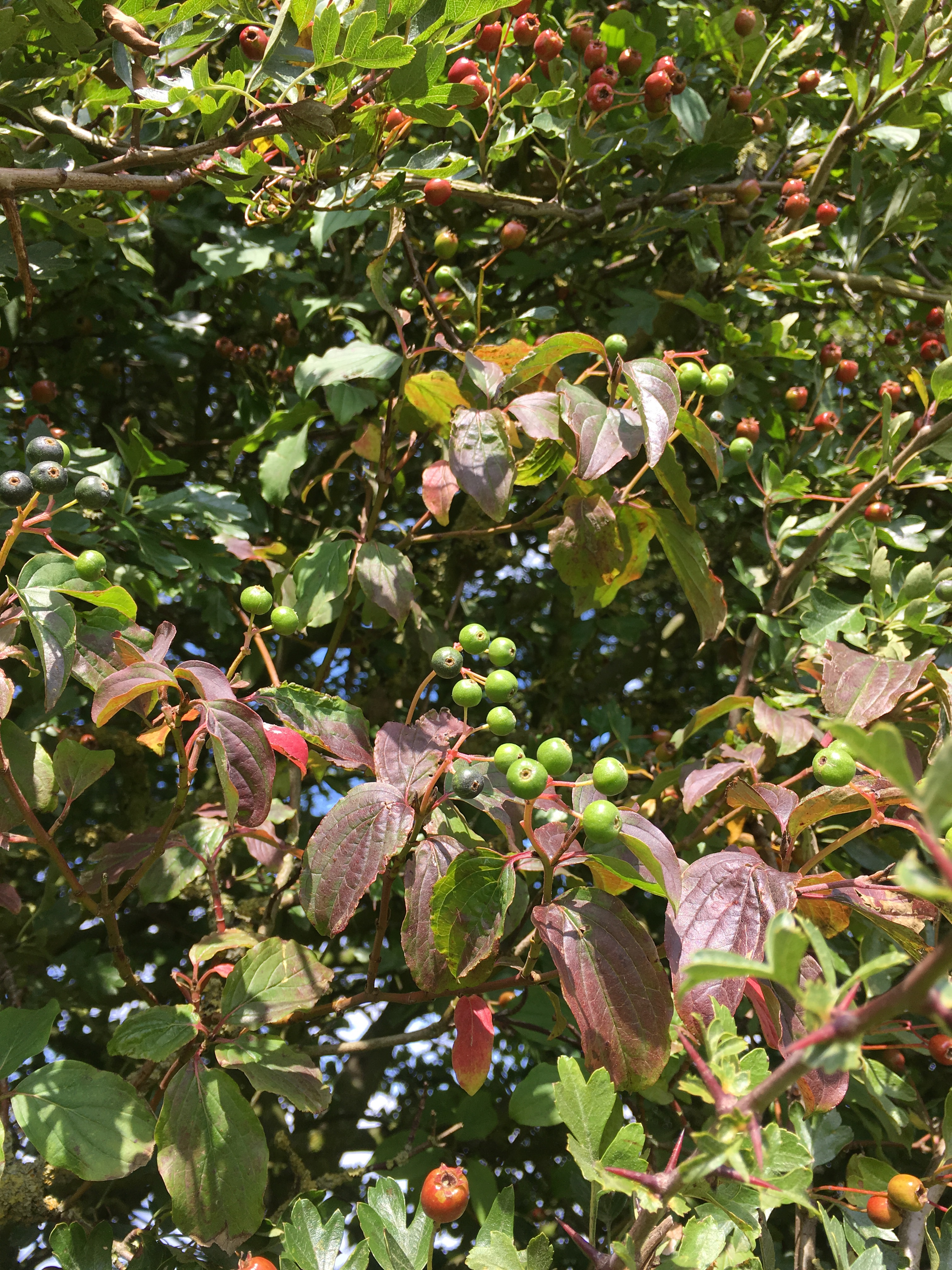
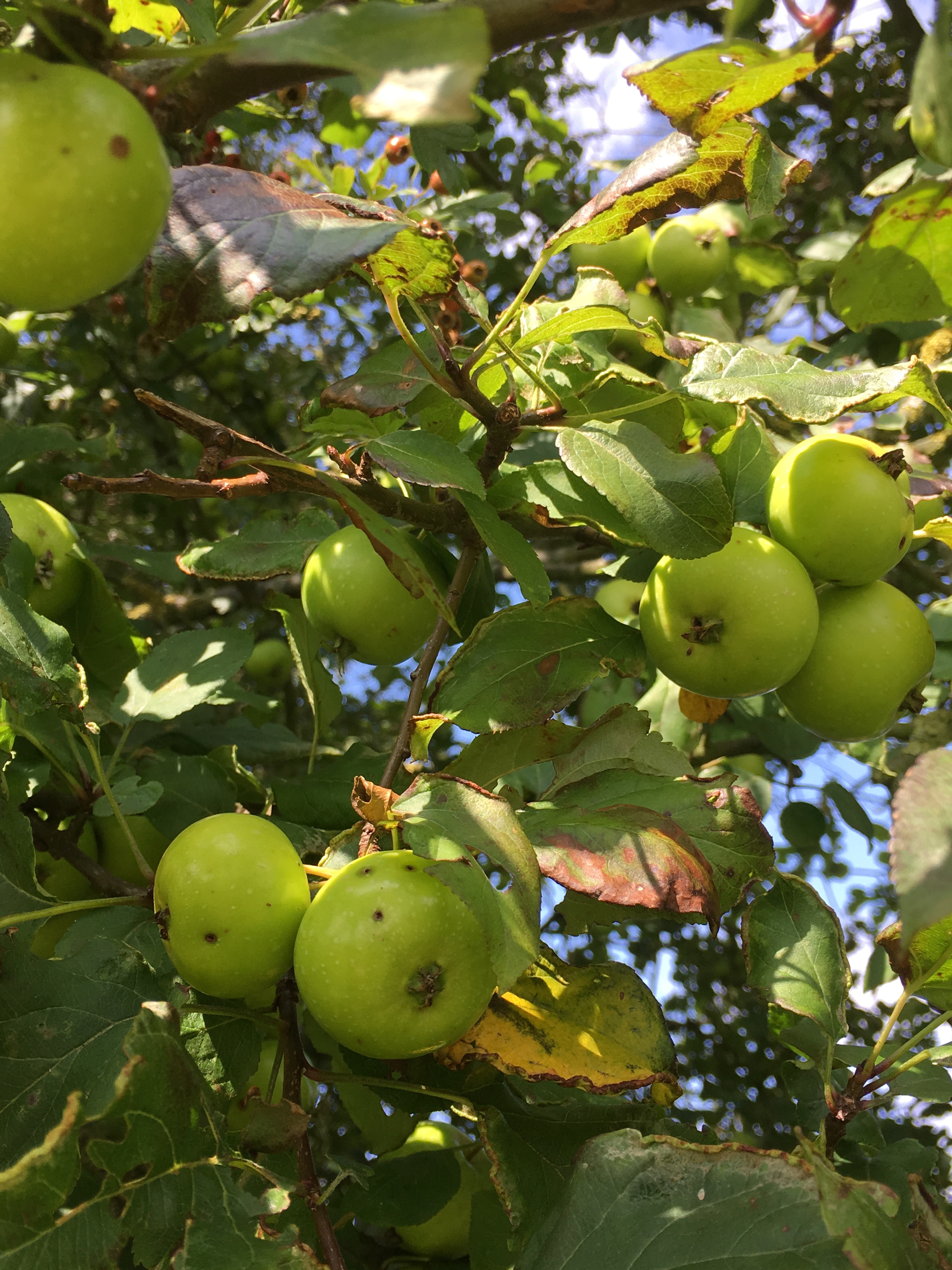
Such a beautiful sight at dawn. These flowers were just in bud yesterday. The hedgerow is so beautiful just now with sections of crab apple, maple, hazel and viburnum all in a hurry to wake from their winter sleep. The scent from the crab apple blossom is something I’ve never noticed before. I think the heat is enhancing the scent.

Oops, that eight photos. I’m sure no one’s counting…..

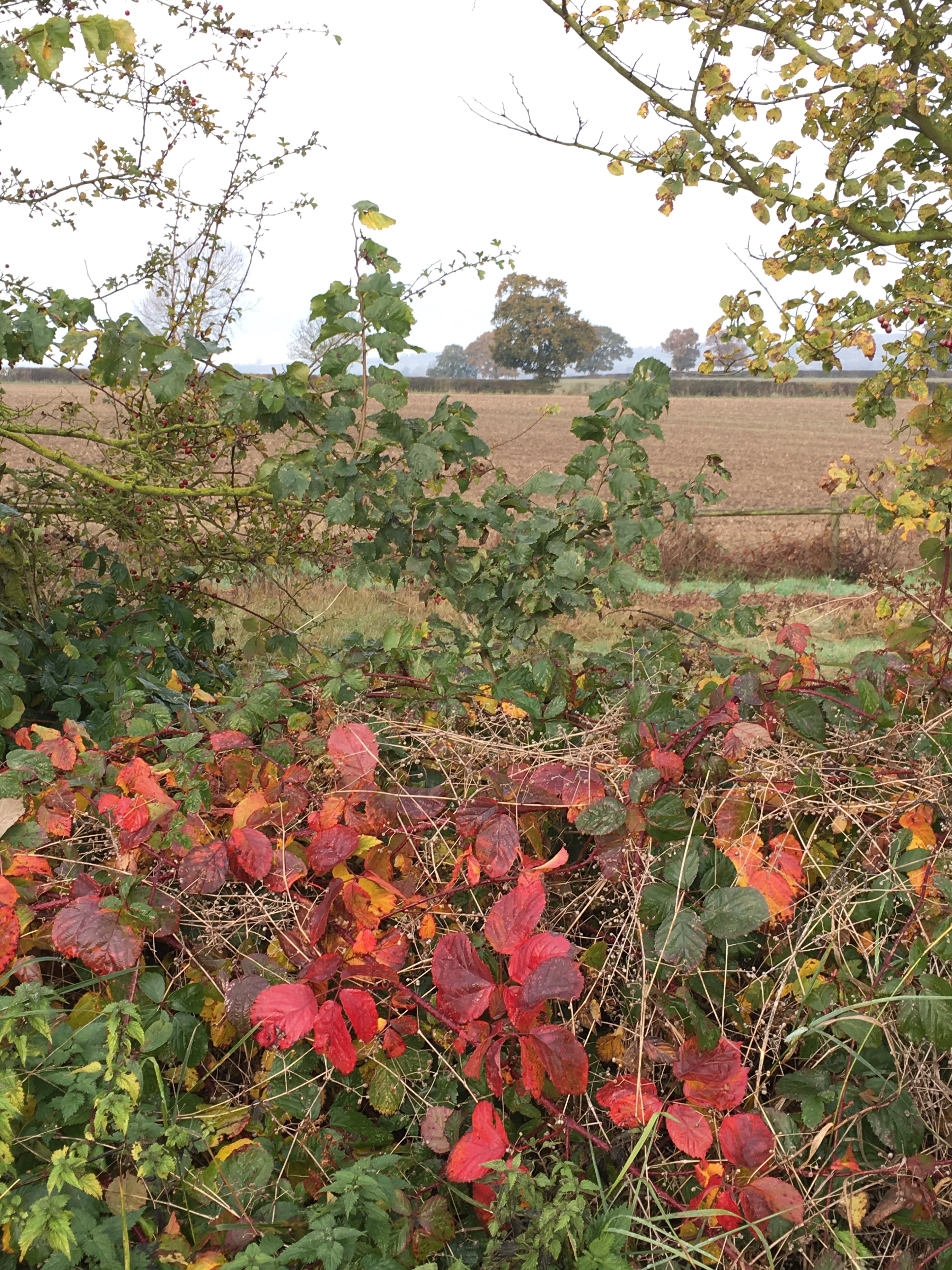
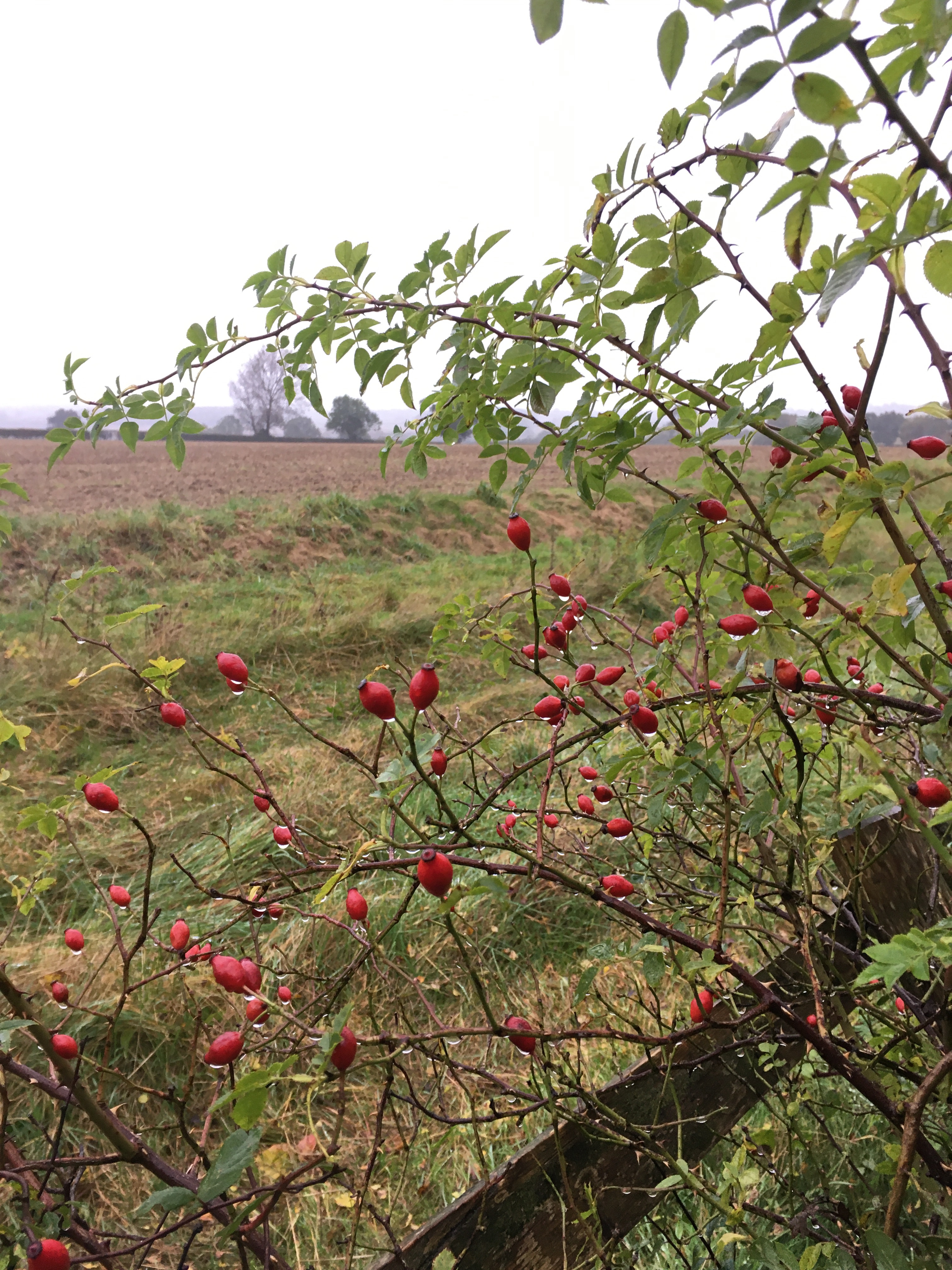
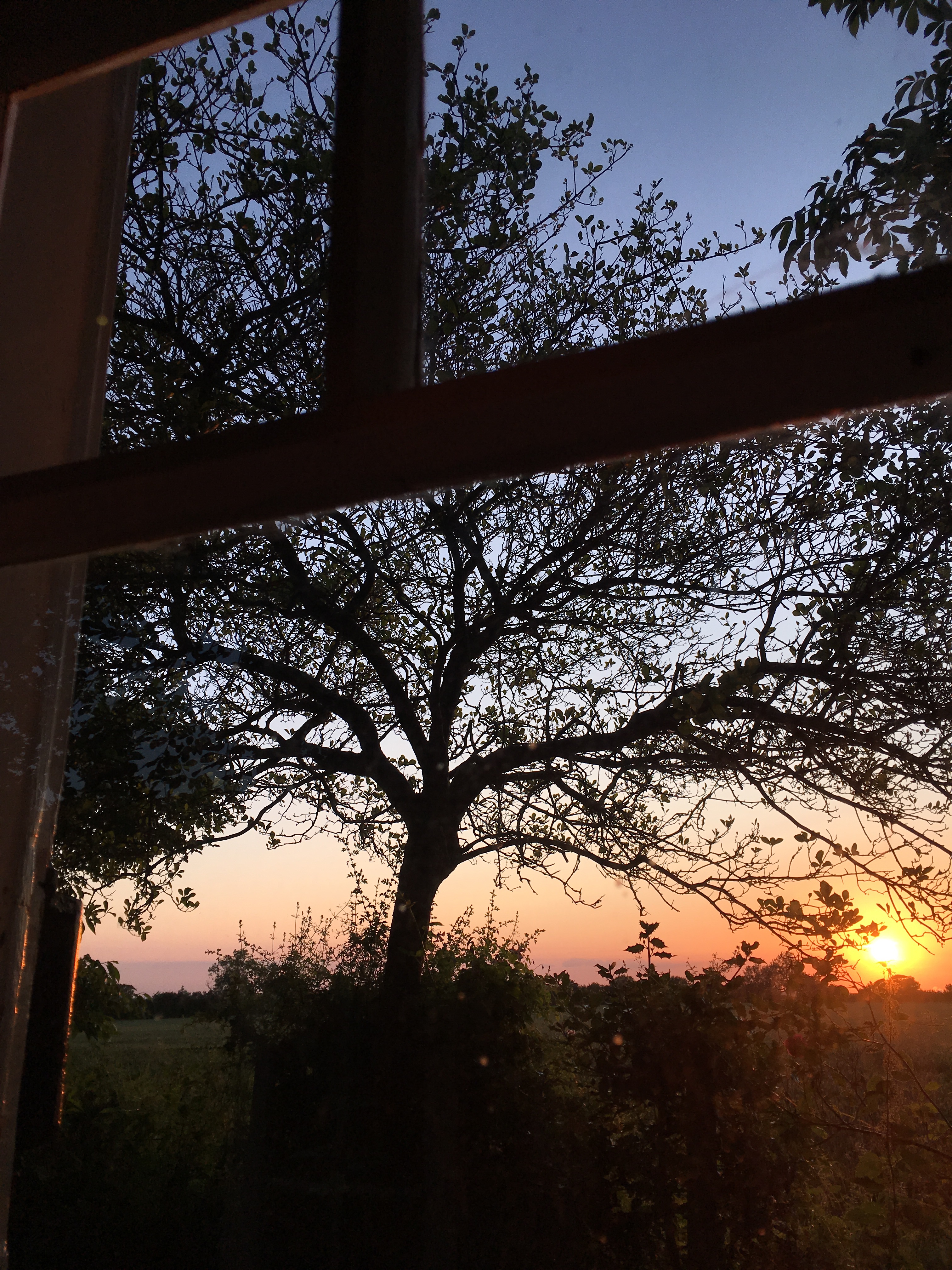
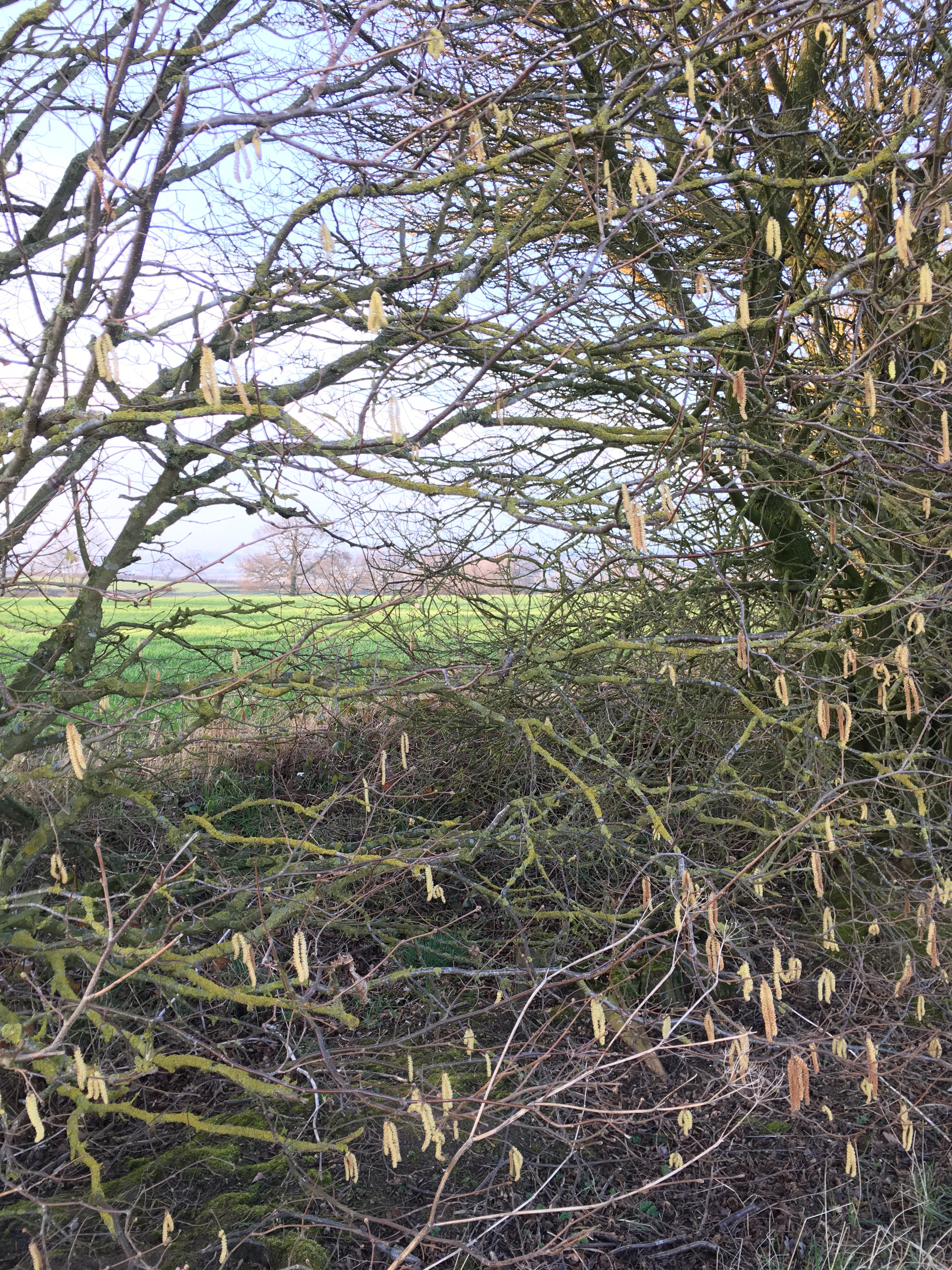
Enjoy your weekend. Here’s a view through my ‘gap in the hedge.’ I didn’t make this portal, nature did. I love to peer through and watch the wildlife. There’s always something happening in the back fields. Lovely to see some green shoots in the fields too. Fields have been bleak and bare all winter, after the flooding.

Links: Six on Saturday : https://thepropagatorblog.wordpress.com/category/six-on-saturday/

Please leave a comment at the bottom of the page. The comments box is below all the hashtags and social media sharing buttons. Please feel free to share too. Thank you.

BBC Radio Leicester Gardens Hour 22 April 2020

If you were listening in to BBC Radio Leicester for Gardens Hour today, I’ve written some notes to accompany the programme.

I’m working from home at the moment. The oak tree above has just burst into leaf. I can see the tree from the top of the paddock. The swallows returned here last Wednesday, and we’ve seen pipistrelle bats over the garden.

Blossom has been fabulous this year, with no rain to spoil the flowers. I’m sitting under this Prunus Kanzan cherry tree today to answer questions and talk about my gardening tasks.

We had a question about an apple tree failing to establish.

If your tree is failing to thrive, it usually indicates a problem with the growing conditions. Poor growing conditions will stunt any tree or shrub.

Water any newly -planted trees well. Soil may be dry around the roots even when the surface appears moist. Check with a trowel to see how far the water is penetrating the ground.

Weeds and grass compete with trees for moisture. Keep a weed and lawn -free zone at least 1m in diameter around the plant.

Mulch locks in the moisture and helps feed the tree. Apply a mulch a good couple of inches deep around the tree, avoiding the trunk. (mulch piled up against the trunk can cause ‘drowning,’ so take care it doesn’t get pushed up against the tree).

You can use your own home-made compost or composted bark for the mulch. Do not apply to dry ground, as it can also lock -in drought.

You can place a drainage pipe in the ground alongside the tree at planting time, which helps water reach the roots. However, take care, as too much water can cause water logging, which is also detrimental.

Feed with a potash fertiliser, which promotes fruit and flowers.

Salix Flamingo – wiki commons photo.

We had a question about a Salix Flamingo willow tree failing to thrive. The tree has come into leaf and the leaves have shrivelled.

I’ve found this tree difficult to grow. It’s grown for its new, shrimp pink leaves which emerge in April. These leaves are delicate and easily damaged by cold winds and frost. Too much direct sunshine on emerging leaves can also cause them to shrivel. We have had a combination of high daytime temperatures, cold east winds, and plummeting night time temperatures. In a sheltered garden you would have no problems, but in a slightly more exposed spot, the tree struggles. Also, being from the willow family it requires plenty of moisture. We haven’t had any rain for several weeks and the ground is parched- despite all the record-breaking amounts of rain we’ve had over autumn and winter.

Usually, the tree recovers and produces a new set of leaves to replace the ones that have shrivelled. Watering and throwing some fleece over at night usually nurses it along until we get more even growing conditions in early summer. I’ve known them to suffer from a type of rust, and also canker. But apart from that, they are very pretty trees. They either like you, or they don’t though!

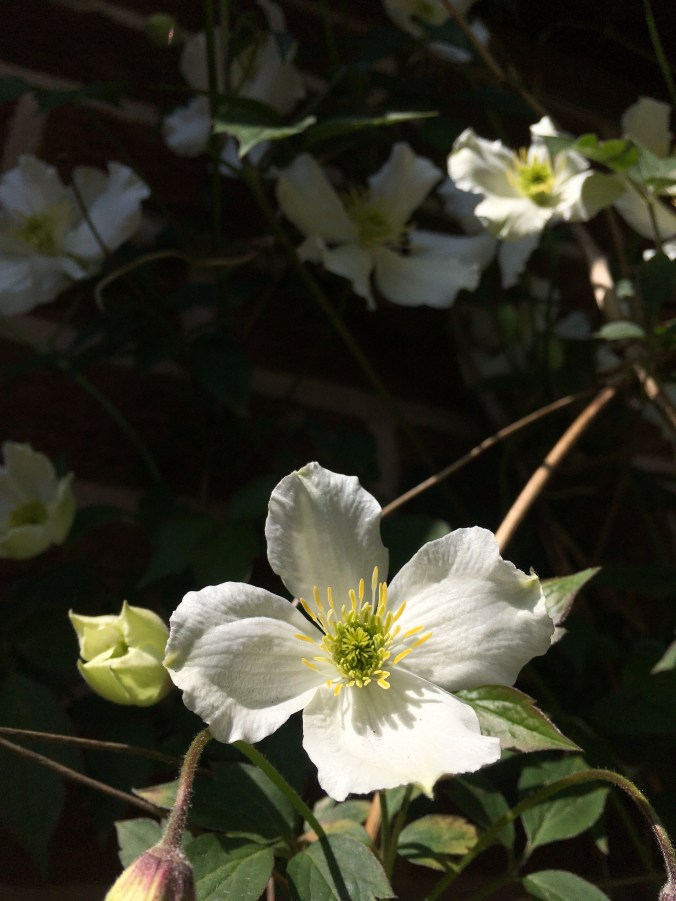
We had a question about a montana clematis failing to flower. This is my clematis Montana Wilsonii. The one the caller had was a pink variety, planted last year and growing in a pot next to an archway. The clematis on the other side of the arch was doing well.

Clematis montana flowers on the previous season’s wood. The caller hadn’t pruned it, but sometimes a montana clematis will take 2-3 years to settle into flowering as its first thought is to grow to the top of the archway.

Clematis don’t do as well in pots, unless they are a really good size and you can keep up with the watering requirements. So it would be best to plant the clematis in the ground and keep it well fed and watered. Potash feed, again, for flowers. And prune immediately after flowering, although I hardly prune my montana clematis to be honest. It’s pretty low maintenance, once established.

And finally, we had a caller wanting to buy a Venus fly trap. They are usually sold at local garden centres, which of course, are not open at the moment. However several are making deliveries, so it’s worth ringing round to source supplies of plants. I’ve found this one on line from QVC. I’ve bought various plug plants, bedding and bird food from QVC and found the service to be quick and reliable. However, I’ve never bought any fly trap plants from them, so can’t say more than I have managed to find a supplier.

I hope you’ve found these notes useful. Please listen in on Wednesdays at 12.30 with Ben Jackson and on Sundays (usually) with Dave Andrews at 1pm on your smart speaker, DAB 104.9FM or on BBC Sounds.

It’s great to be involved with local radio gardening and we try to offer something for experienced gardeners wanting to try new varieties and grow for shows, and also for those who have never grown anything before. All questions welcome. We will try our best to help. I am part of an experienced team.

Comments box is right at the bottom of the page, below hashtags, social media sharing and links.

BBC Sounds to listen back: https://www.bbc.co.uk/sounds/play/p088w205. At 2.37.30 on the timeline.

Links : https://www.qvcuk.com/Thompson%26-Morgan-Dionaea-Muscipula-%28Venus-Fly-Trap%29-9cm-Pot-x3.product.518780.html?sc=Froogle&ref=fgl&source=froogle&utm_source=google&utm_medium=base&utm_campaign=base&cm_mmc=PPCSHOPPING-_-Google_Shopping-_-SmartShopping-_-Garden&Leisure&gclid=CjwKCAjw1v_0BRAkEiwALFkj5nSbQtMrf4di1C69MLikRT3XMgWNUhDGsymlRFAS-4yMUnqRnj5vxRoCm6AQAvD_BwE&

BBC Radio Leicester Gardens Hour 19 April 2020

Notes for anyone listening to BBC Radio Leicester today. You can send e mails, texts and messages for free gardening advice. I’ve been a travelling head gardener and a garden designer for 25 years. I write for weekly Garden News Magazine. I grow my own fruit, veg and flowers at home on a one acre plot created from a ploughed field. Currently, I’m speaking each week from the potting shed during the corona virus epidemic. Here’s the view from the potting shed, for anyone who likes blossom. Turn up the sound to hear the birdsong.

Error
This video doesn’t exist

We cater for everyone. So if you’ve never gardened before and want some essential tips to get started, get in touch. We can help experienced gardeners wanting to grow the latest varieties or try something new. Maybe you want to grow more salads and veg for the family. Or you might fancy the challenge of growing for a “virtual” flower show. We can help.

This week we talk about growing tomatoes. I’m growing classic beefsteak variety Marmande for cooking, and tasty cherry tomato, Tumbling Tom for salads. My plants are 12cm (5″) tall and the roots are coming out of the bottom of the pots, so I’m potting them on. They’ve been growing in 7.5cm (3″) pots and I’m moving them up to 12.5cm (5″) pots. They will eventually go into 25cm (10″) pots and window boxes, but they have to be moved up in stages as tomatoes don’t like lots of cold wet compost around their roots.

Tomatoes like plenty of warmth, so I’ll keep mine indoors until the end of May. Tomato leaves turning yellow could be an indication the plants are getting too cold overnight, especially if they are right next to the greenhouse glass. Move them to the middle of the greenhouse and create a fleece tent to keep temperatures more stable between night and day. Remove fleece promptly in the morning. Alternatively, yellow leaves could mean the plants are running out of feed. Composts usually contain feed for about six weeks. But yellow leaves indicate a lack of nitrogen, so feed with a very dilute tomato fertiliser. Move plants on promptly when the roots have filled the pots. Don’t over water as plants also hate cold wet feet. Use tepid water. Bring the watering can in to the greenhouse to warm up. Cold water causes shock. Tomatoes need warm steady growing conditions and don’t like swings in temperature. Try to water them in the morning so they are not left cold and wet at night. Aim the watering can at the roots and keep the foliage dry.

While I’m stuck at home, I’m looking about to see what I can do to keep connected with the outside world. One thing I’m doing is joining in with the Rainbows 5K challenge.

Rainbows is a hospice in Loughborough, supporting children and young people with life-limiting conditions. They receive only 15 percent of their funding from the government and everything else has to come from donations. The corona virus lockdown means they can’t run all the usual fund-raising events. But the 5K challenge is one way everyone can help out.

You can take part anytime between now and May 31st. I’ll be logging my walking while I’m mowing the grass, weeding, raking, hoeing and plodding about the plot between the greenhouse and potting shed. I am sure digging also counts!

You can also help by tagging rainbows on social media to keep them in the public’s eye by posting photos on Facebook @rainbowsfanpage and on twitter and Instagram @rainbowshospice.

Children and all ages can take part. You can walk, run, hop, skip, cycle. Think of me weeding and cutting the grass for hours on end. At least the garden will look lovely, and it’s all in a good cause!

The National Gardens Scheme is also a charity close to my heart. Mum and I usually spend every Sunday visiting an NGS garden, having a cup of tea and piece of cake and buying a few plants. The lockdown means no gardens are open this summer. But the charity has launched a ‘Support Our Nurses’ campaign with virtual tours and JustGiving pages.

There are three gardens so far featured in leicestershire: Brook End in Wymeswold, with spring blossom, tulips and daffodils and ponds. There’s also Donna’s Garden at Snowdrop Ridge in Market Harborough, which should have opened for the first time this summer. There’s a wonderfully calming goldfish pond video.

Also a ‘walk through’ at Oak House, South Kilworth.

Donations support nurses working for MacMillan and Marie Curie, Hospice UK, Carers Trust, The Queens Nursing Institute. The NGS also helps Parkinson’s UK, Perennial and Horatio’s Garden for spinal injuries.

During the programme I mention our concerns for growers, garden centres and nurseries which are not allowed to open during the lockdown. There are fears many might go out of business with plants having to be skipped. Livelihoods are on the line.

I mention the Garden Centre Association #SupportYourLocalGardencentre campaign at gca.org. There’s a list of garden centres providing local deliveries.

Val and Steve Bradley from BBC Radio Kent, the Sun newspaper, have created a list of growers and nurseries offering mail order and/ or deliveries.

I’ve provided a limited and ever-changing list for Leicestershire here: https://bramblegarden.com/2020/04/05/contacts-and-information-to-help-you-through-corona-virus-lockdown/ If you want to be added, please get in touch.

Thank you for joining us at BBC Radio Leicester. These are strange and difficult times for all of us, but we can keep connected through social media and listening to the radio. It’s amazing how we can all help by taking little steps at a time. They all join up to a giant leap forward, don’t you agree. Get in touch and let me know what’s looking good in your garden and how you are getting on during this lockdown time. Are you managing to get on with your gardening? Is your garden providing a calm sanctuary. I know mine is right now.

Links:

Rainbows 5K Challenge : https://www.rainbows.co.uk/events/rainbows-virtual-5k-2020

National Gardens Scheme https://ngs.org.uk/virtual-garden-visits/

Garden Centre Association lists : https://gca.org.uk/

Val and Steve Bradley nurseries/growers list: https://47flt.r.ag.d.sendibm3.com/mk/cl/f/nsnLPDyBJajPGKKpPRt5x9TOx4tu9x1Dz-v5FiKvBC10LYC0JB45oC3rcwqKse2n5D7aQhdwFnOZEulP7NPET4tRxtfv-n5eUr7mNx6H7gjRIWSVXN-QVsXdmRICgr44KOhL_NeHecmmxD8URqGk4-jf5QBzcACiRe7I8jdByhWKnFH9LN4d2C-sA4qsiNVzl4nQDttx7wgdEKWIS89NuNt-XaZCrrIiTT3B

You can follow me on twitter @kgimson

On instagram @karengimson1

And Pinterest @karengimson

Some photos from my garden:

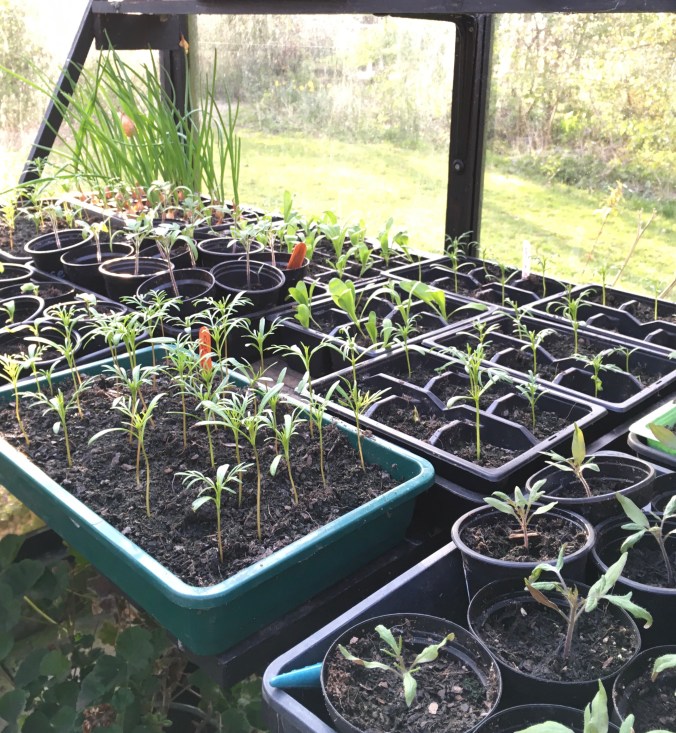
Seedlings in the greenhouse, tomatoes, cosmos, onions, cucumbers, aubergines, peppers.

Planting out calendula Snow Princess grown in plug trays.

We had some winter storms and dead elms in the hedgerow.

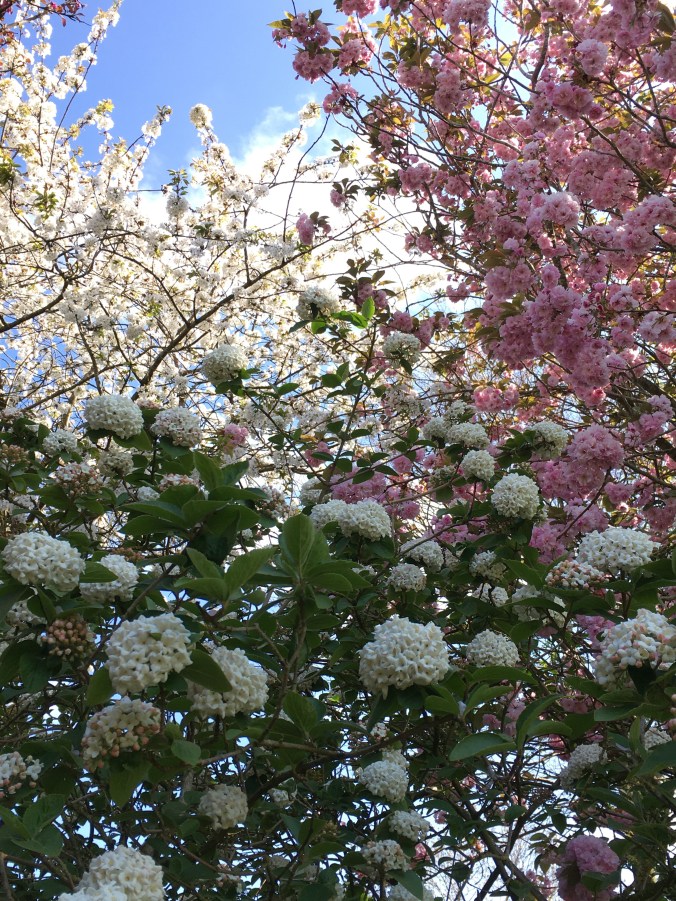
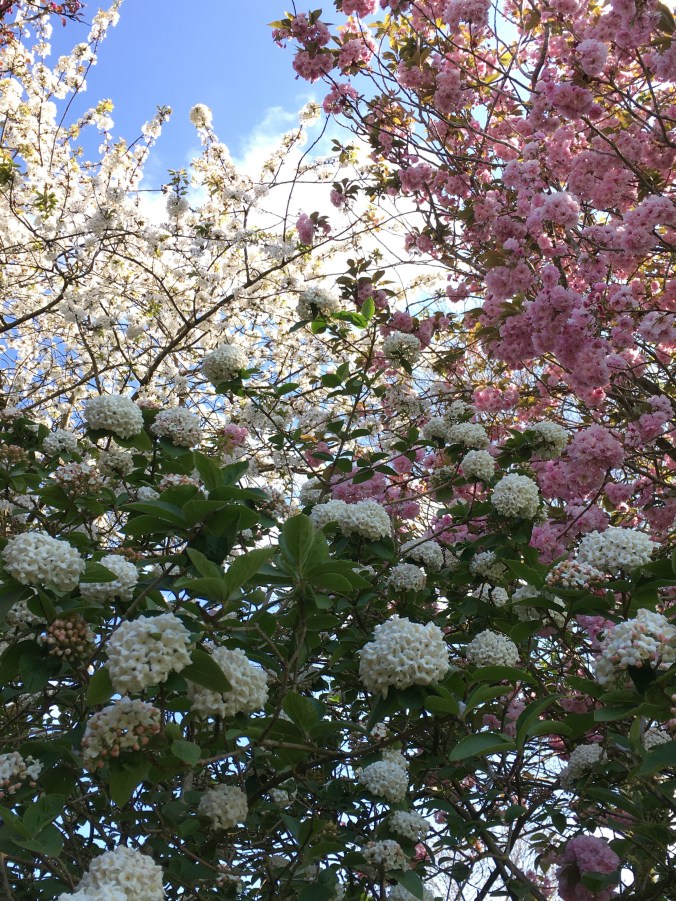
The whole garden is scented by this viburnum. Planted in front of white cherry tree, prunus avium, and pink cherry Prunus Kanzan.

Pheasants Eye narcissi, still looking good in the cut flower beds.

Not all things go according to plan.

Cherry blossom. Stella. Lots of fruit, hopefully. Have never seen blossom like it. A good year for fruit trees.

Pear blossom. I’m keeping an eye on the weather. Fleece will be thrown over at night if there’s a frost.

Thank you for reading!

Rhubarb Cakes- Family Favourite Recipes

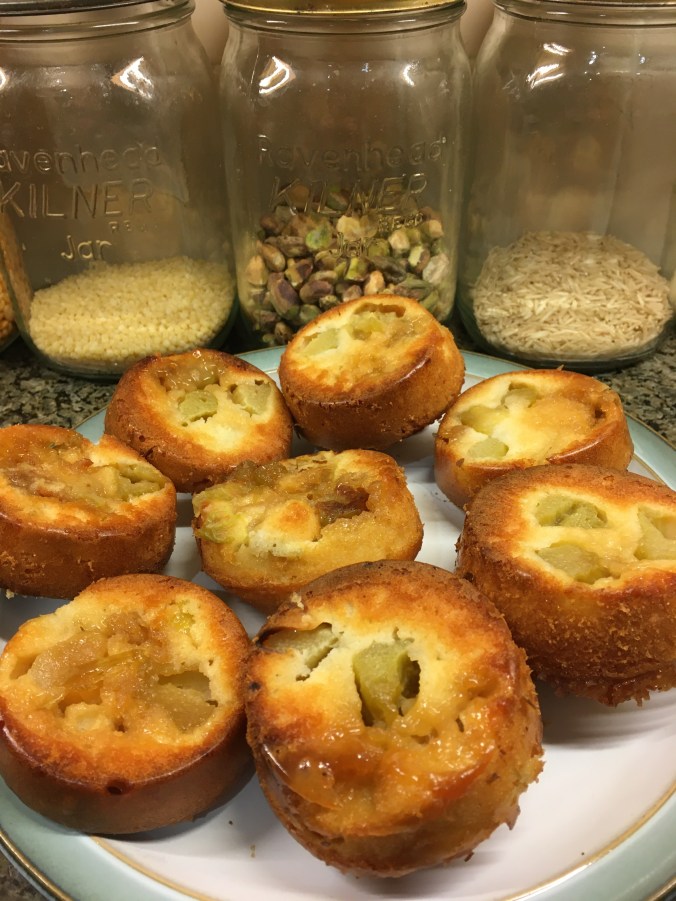
Here’s a quick and simple recipe using the first rhubarb of the season. We have literally run out of all treats in the house. I suddenly realised, if I wanted to have something nice for tea, I’d have to make it myself. Luckily the rhubarb clump we saved from Joan and Keith’s garden, now growing in a huge pot, is producing a daily supply of delicious fruit for baking. Enjoy!

INGREDIENTS

For the base:

25g butter or vegan spread

50g light brown sugar

400g approx rhubarb, or whatever you have in stock. Can be peaches, apples, mandarin, pears, cherries.

For the topping :

50g butter or vegan alternative

150g sugar

3 eggs or alternative

190g SR flour

120g plain yoghurt

Few drops vanilla essence

Icing sugar to dust the tops

Oven temperature 180C

A pie dish, or loose-bottom cake tin. I used a 12 hole silicone muffin pan. Use a circle of greaseproof paper if you are not using silicone.

METHOD

Melt the butter and sugar base ingredients together in the microwave. Take care not to burn it. Place in the bottom of the dish or muffin pans.

Remove the skin of the rhubarb and chop the sticks into small pieces.

Place rhubarb on top of the base mixture

Cream together the topping mixture butter, sugar, vanilla and eggs.

Fold in the flour and yoghurt.

Spoon the mixture over the rhubarb.

Cook for 35- 40 minutes or until the cakes slightly shrink from the sides, and a knife comes out clean. It will be less time for muffin cakes.

Leave to cool. Turn out onto a plate, upside down, and dust with icing sugar.

Keeps for three days in an airtight tin. Or can be frozen. Lovely with icecream, custard or just as they are with a cup of coffee at tea break time.

Enjoy!

Six on Saturday – views from my garden April 11 2020

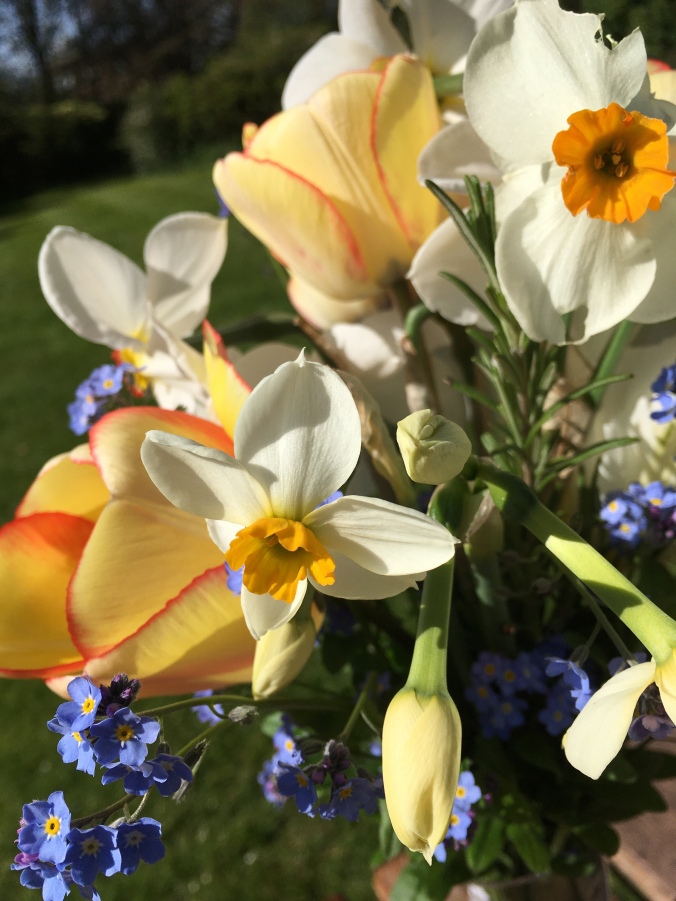
Tulip Mount Tacoma and forget-me-nots.

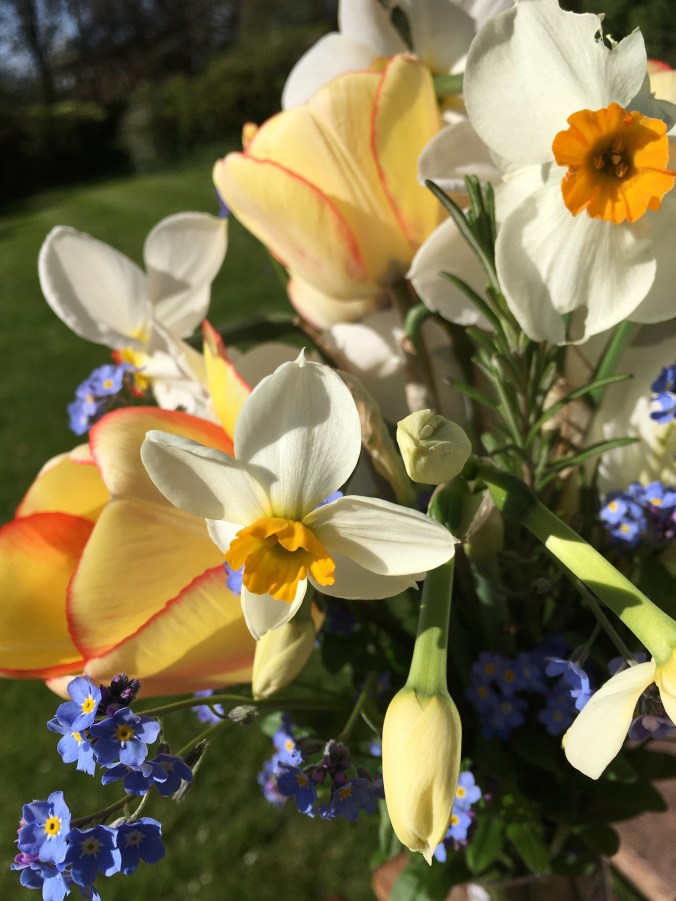
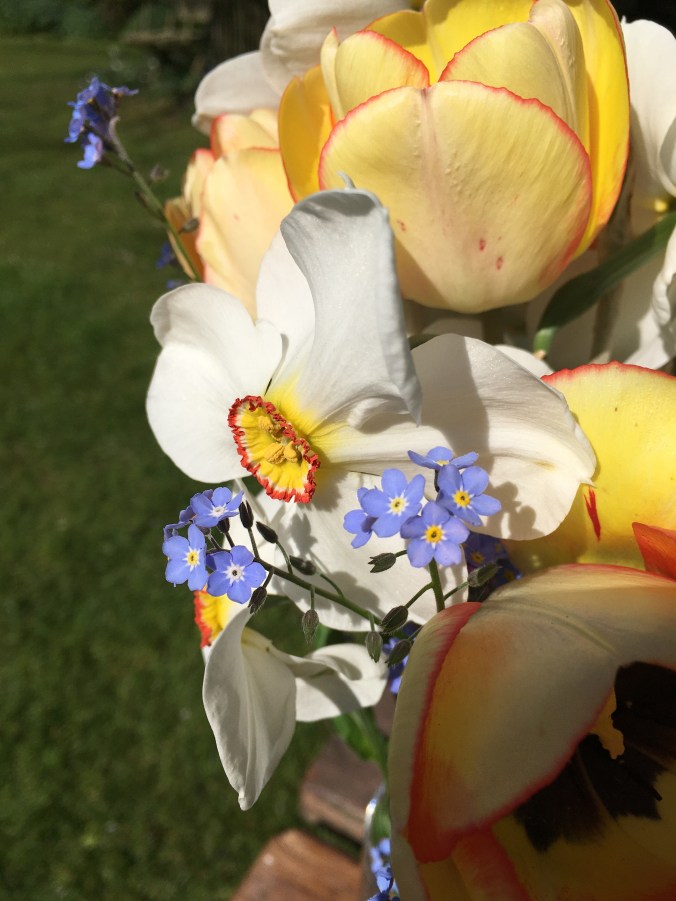
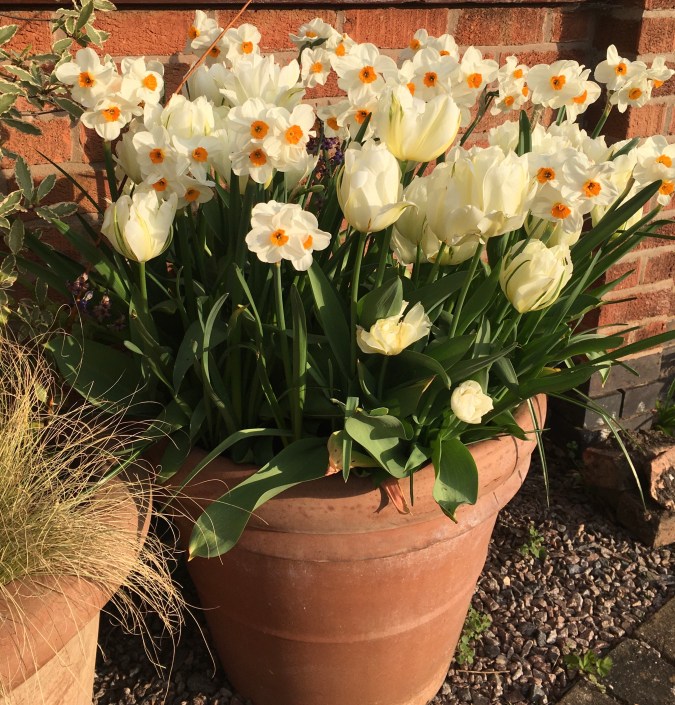
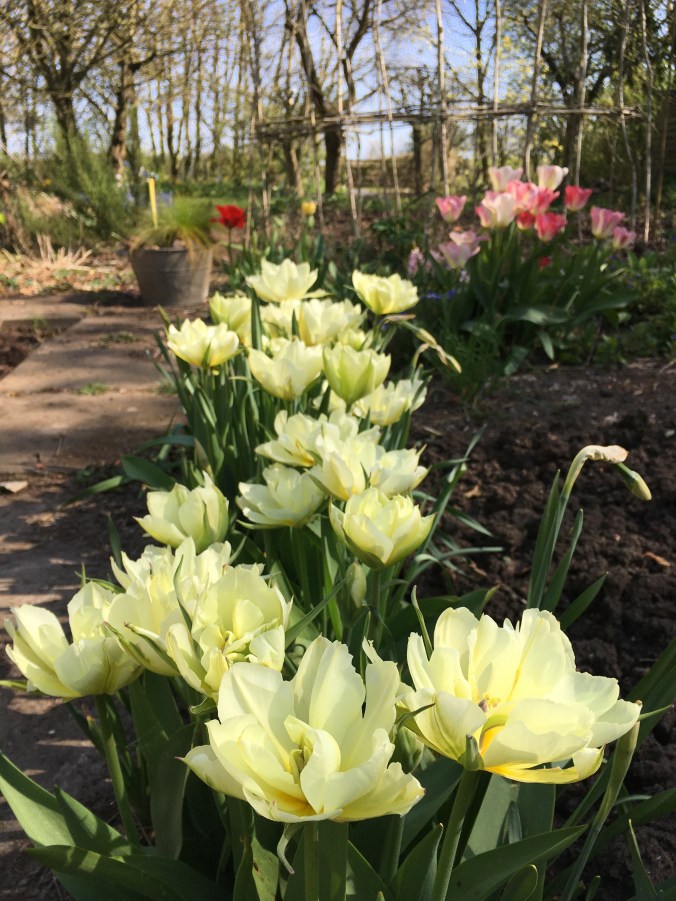
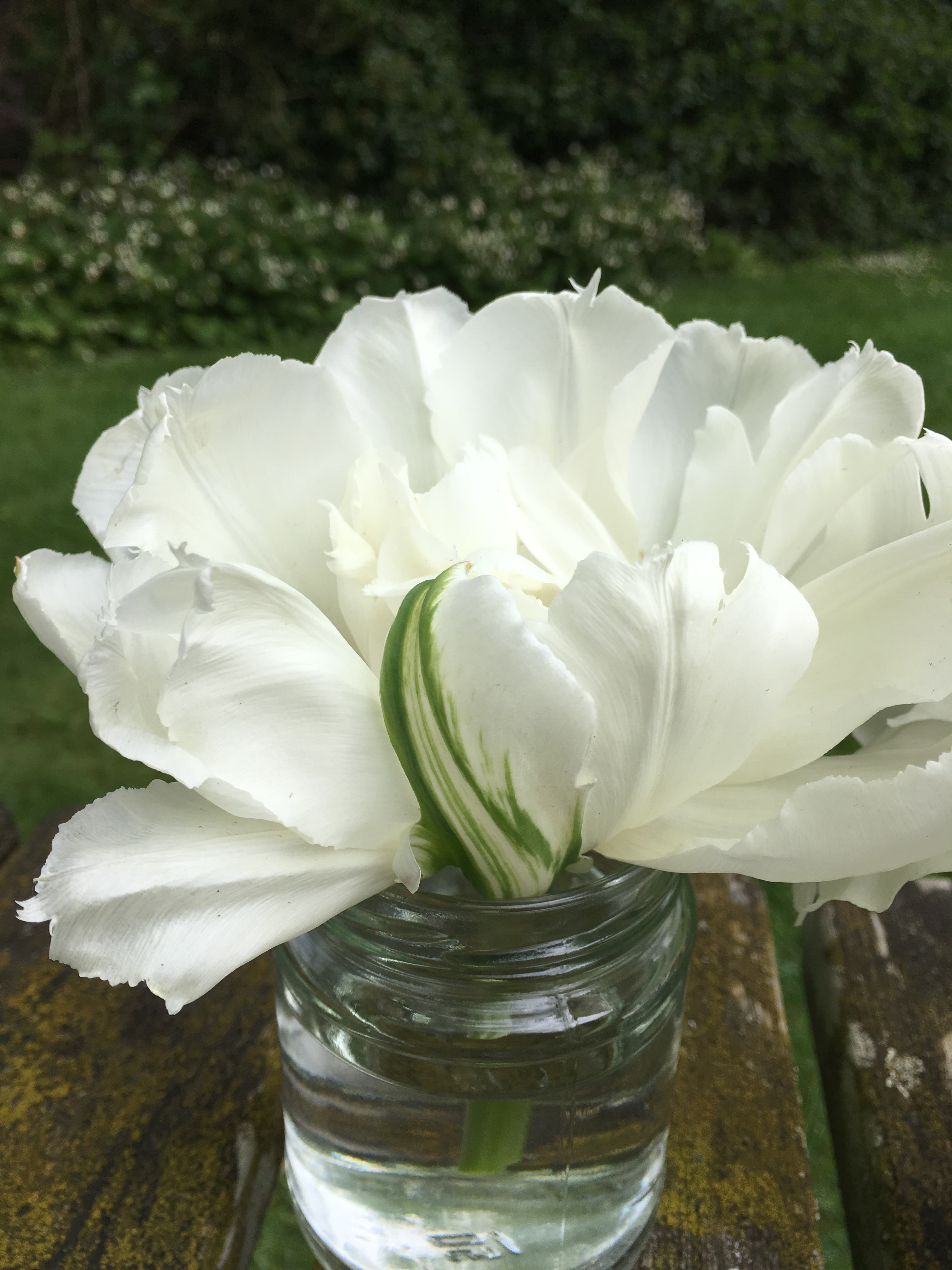
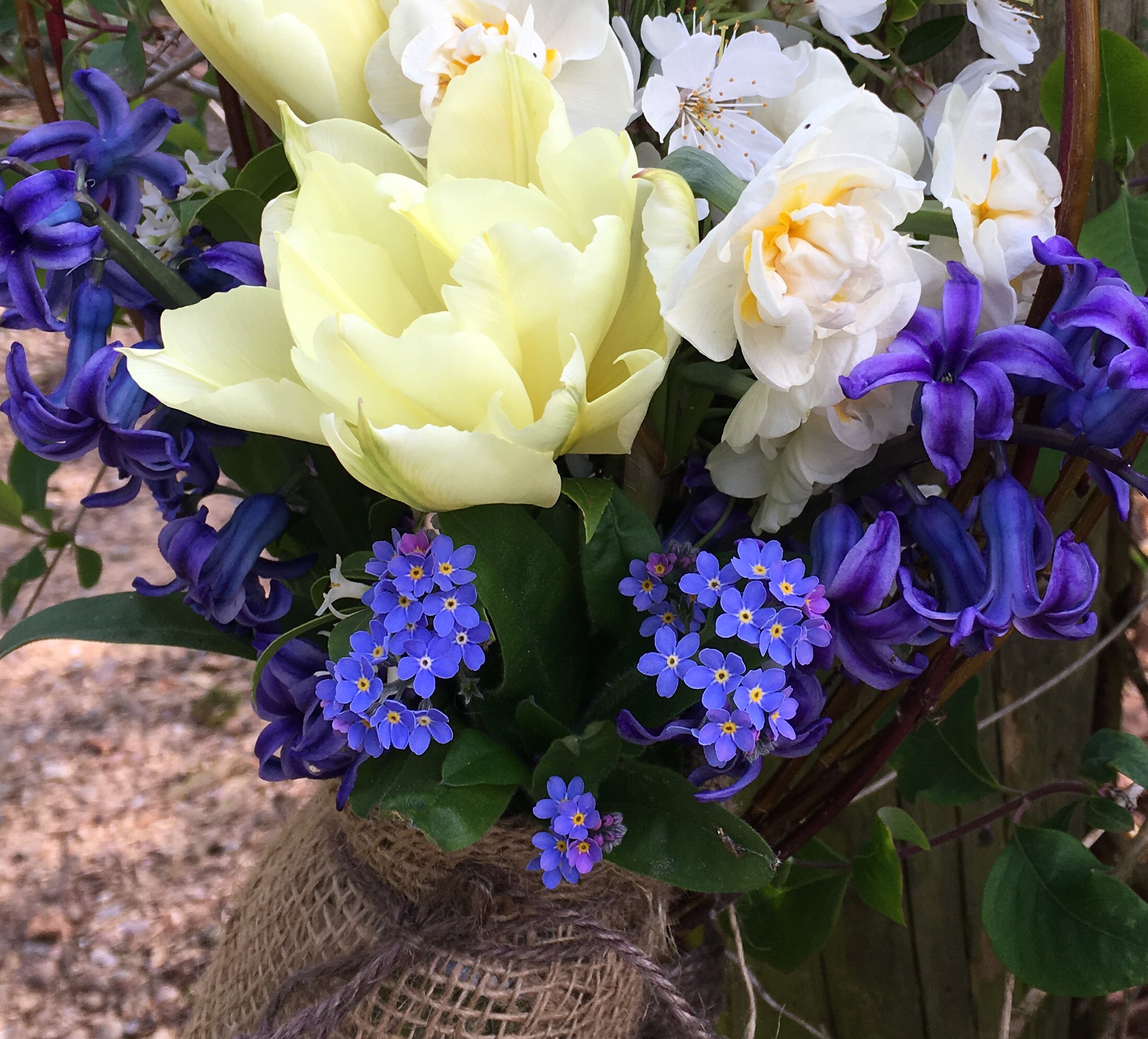
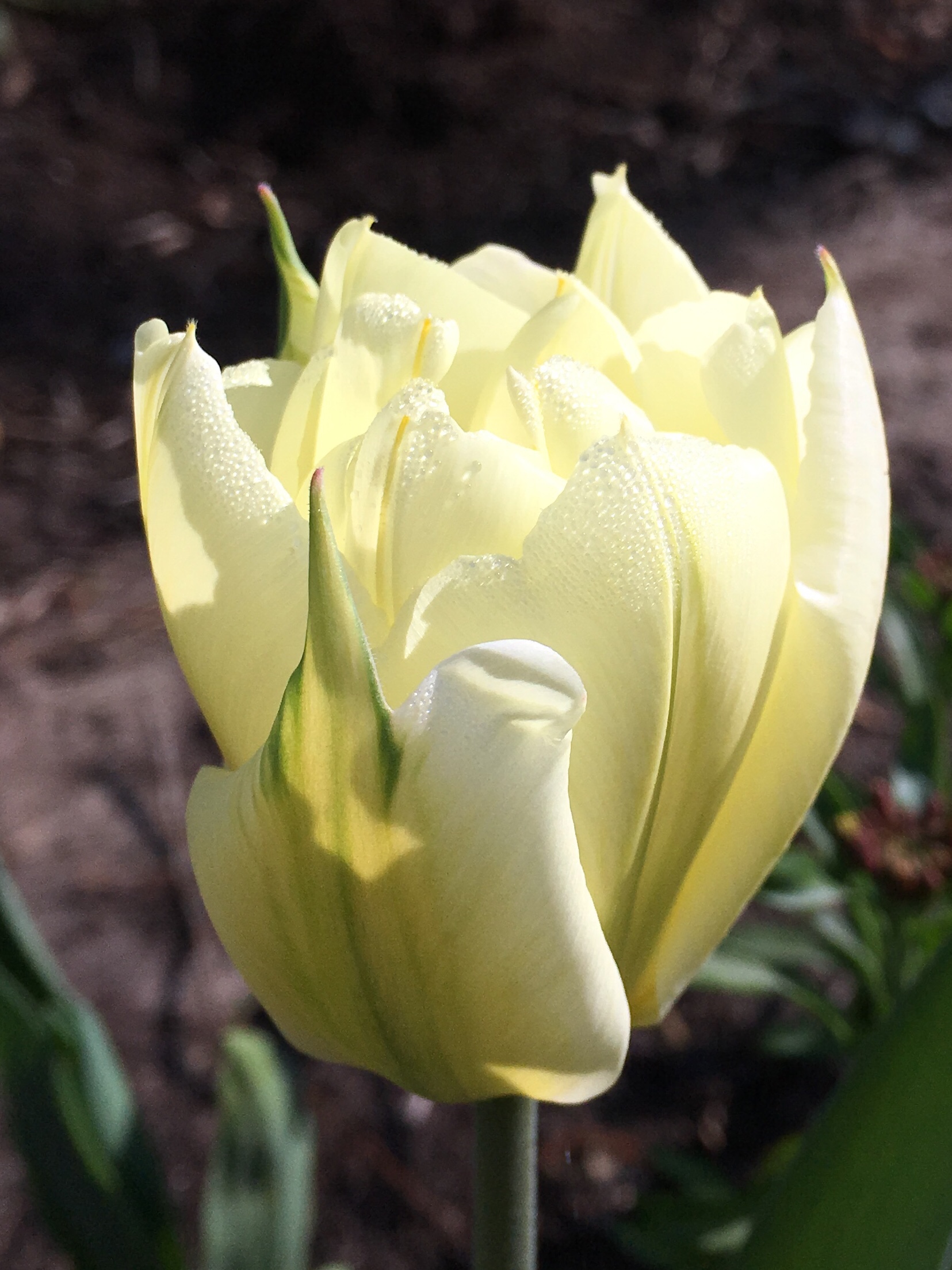
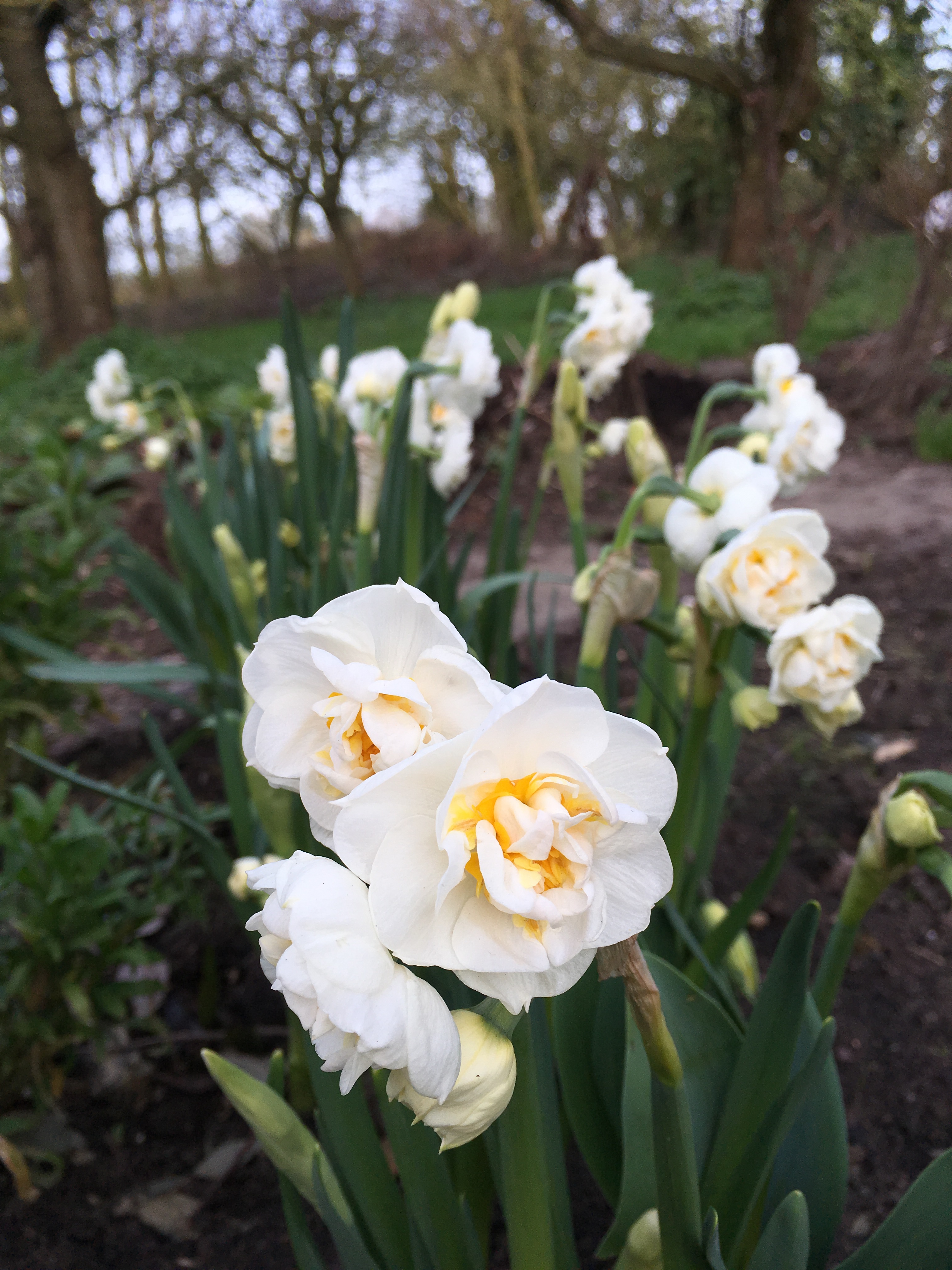
My favourite Italian terracotta pot near my front door. So sad there are no visitors to enjoy this lovely sight. I’m including it here, so you can all share in the magic of spring flowers. Fairly new introduction Exotic Emperor, a double form of the classic and popular Purissima. Has peony-like petals that curve and twist as they open, revealing a flash of green. Very lovely and my favourite. This is a fosteriana tulip, and here in the Midlands, it always flowers through April. Planted with Narcissus Geranium an heirloom bulb dating back to pre 1930. Beautiful, delicate fragrance. Perfect for cut flowers. I have a row in the veg garden for cutting. Multi-headed – some of the bulbs have four flowers to a stem. I love mixing the old with the new. I’m fond of traditional plants, but I love trying something new.

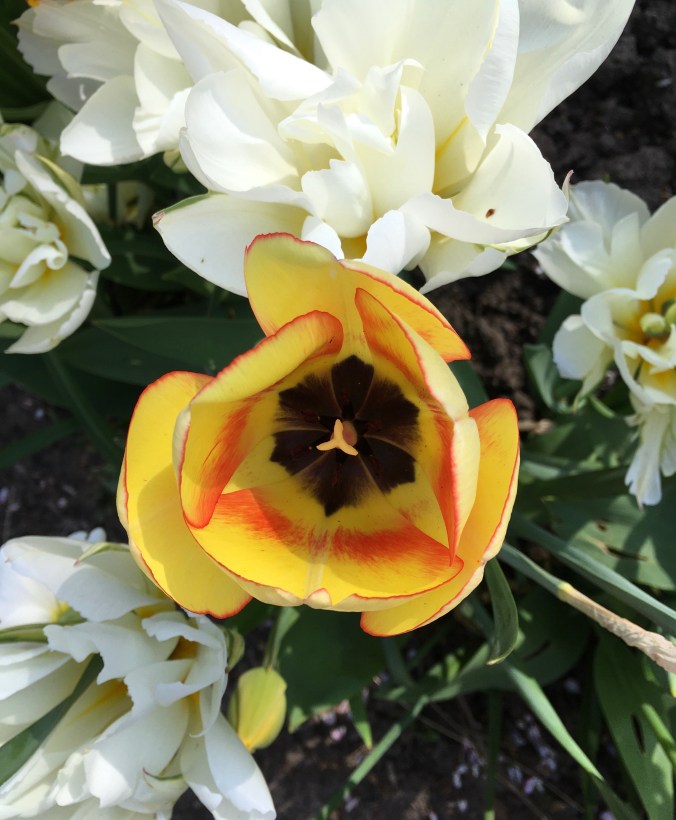
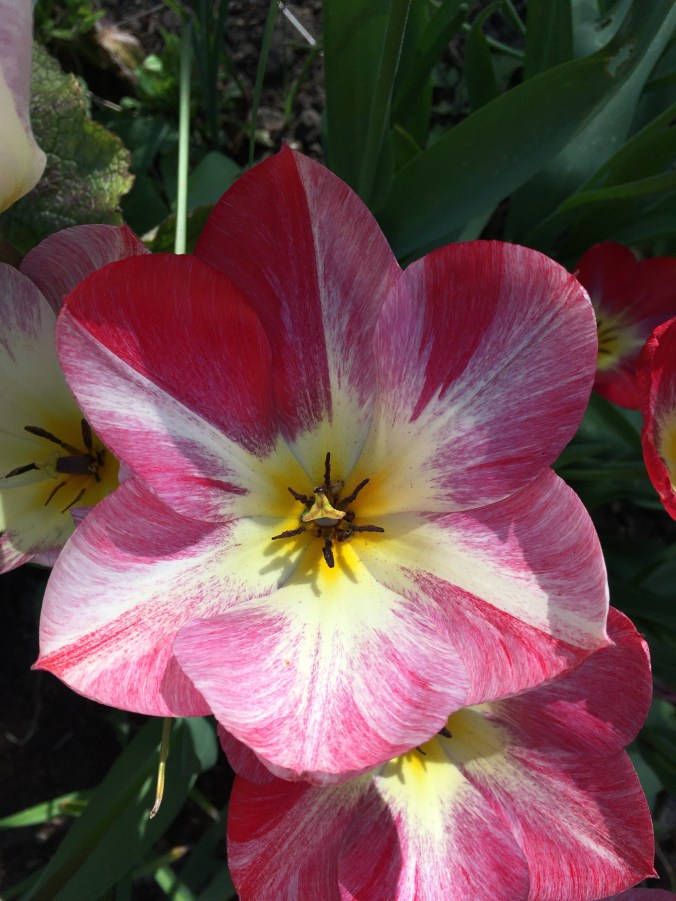
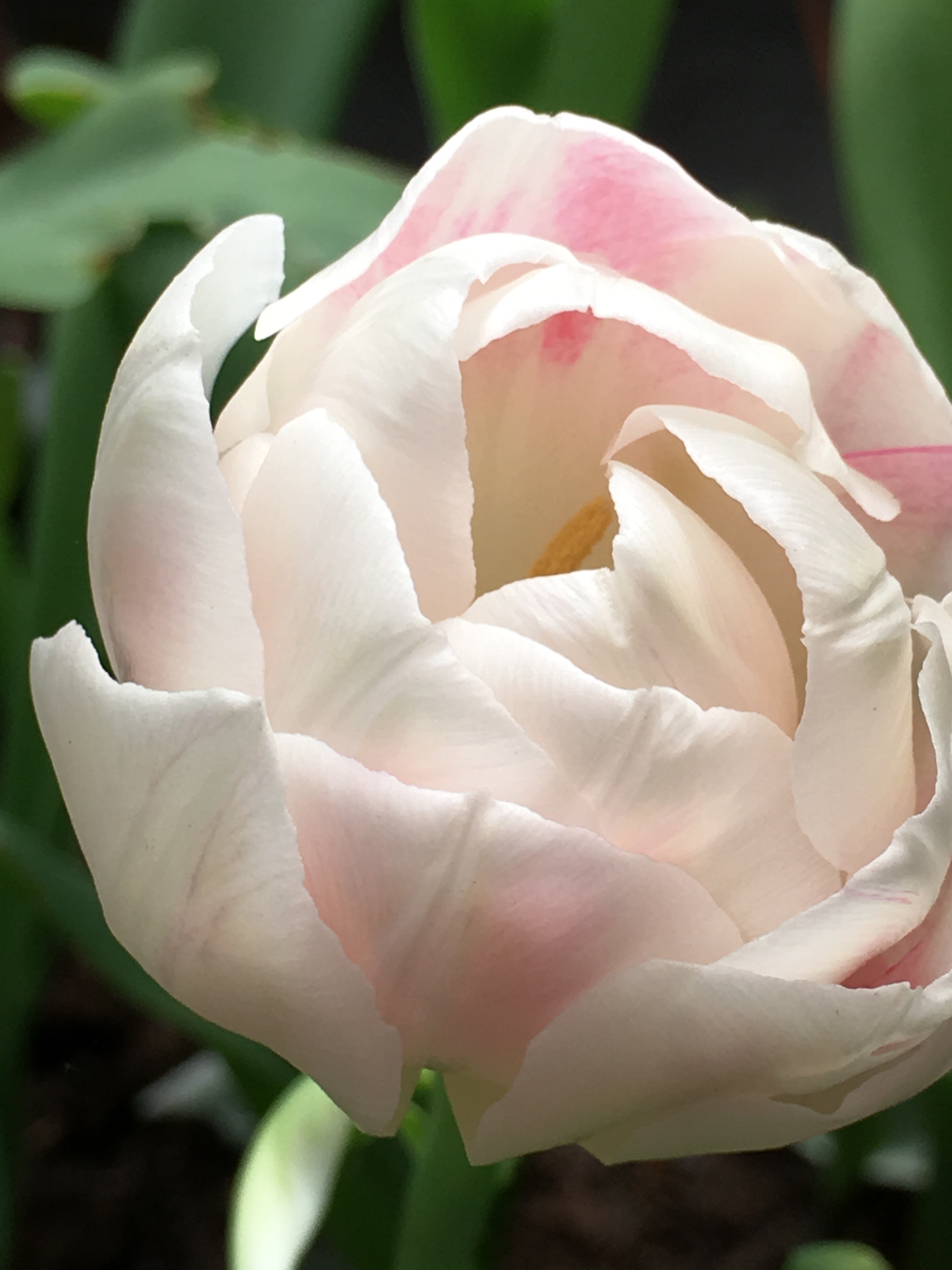
I’ve always grown the white Purissima tulip, so I thought I would try the new sport, Flaming Purissima, another fosteriana tulip. It is such a joy, with all shades of pink and red ‘flames’ over an ivory white background. Beautiful under a white cherry blossom tree. I’ve planted these in a trench on the veg plot for cut flowers. They last a week in a vase, and watching them turn from tight buds to open, flat, almost water lily-like flowers is a joy. These were introduced in 1999, and they reliably come through the winter and flower each spring for me.

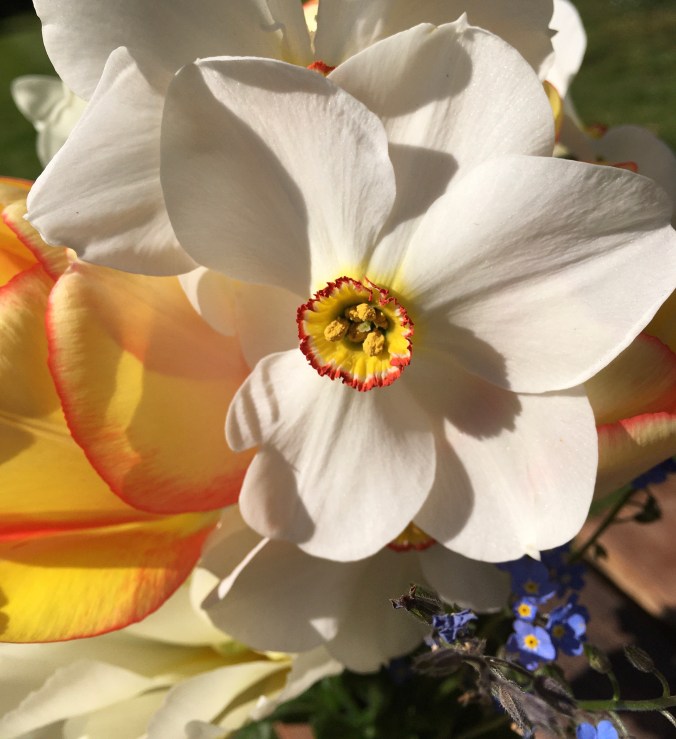
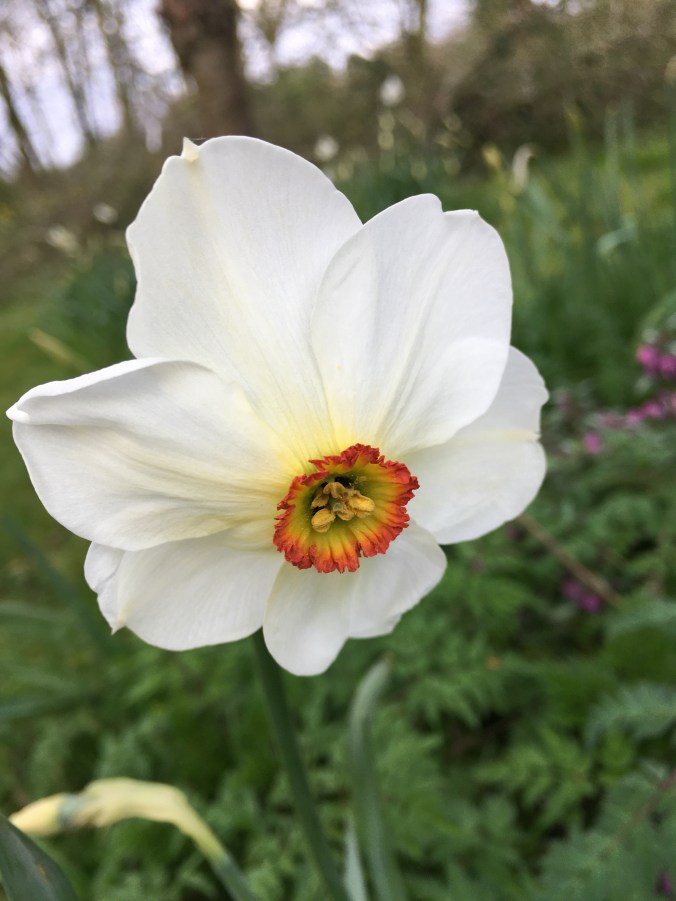
So comforting to know we will have masses of cherries this summer. We leave the trees unpruned. Blackbirds enjoy the crop at the top of the tree, and there’s more than we can use around the downward – arching lower branches. I’ve planted narcissus Pheasants Eye under the trees as an experiment. They flower at the same time. They look so glorious, I’ll fill the orchard with them next spring. They cost very little and are a joy to behold. I’ve taken photos of the garden and made notes to remind myself to order bulbs in July and plant in September. If I don’t make a note, I seem to forget!

In the wild garden around the pond we have this un-named beauty. We planted these 30 years ago. I wish I’d recorded the name as I’d love to plant more as pretty and reliable as these. They have a wonderful scent too. Petals glisten and remind me of sugar coated violets. I wonder if you know what I mean.

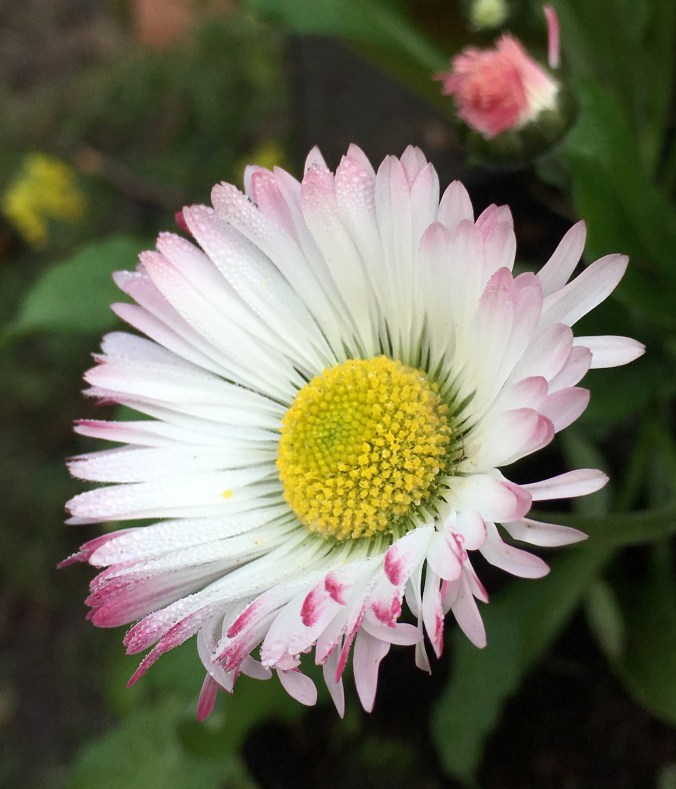
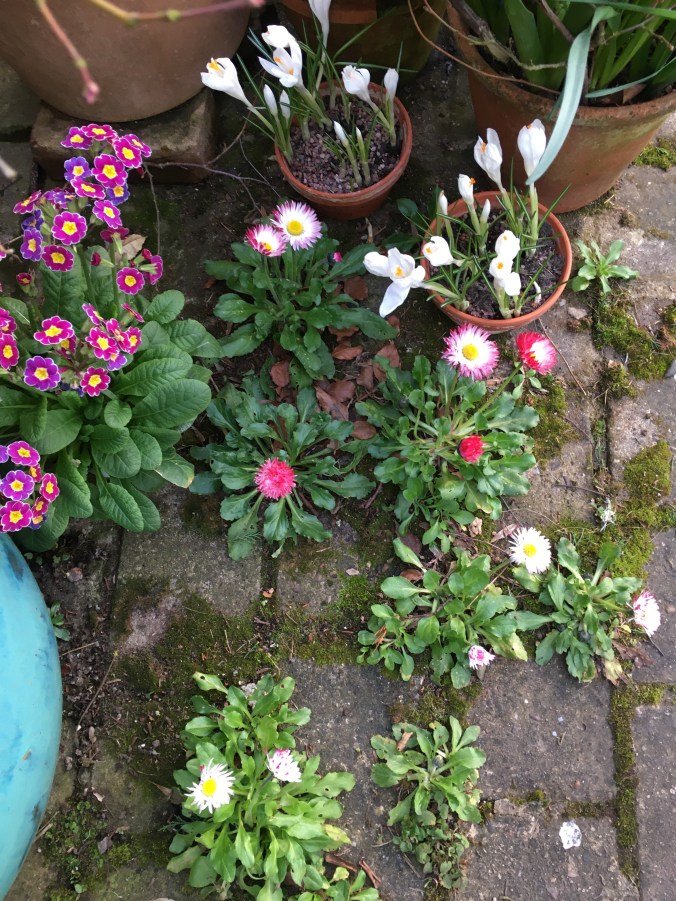
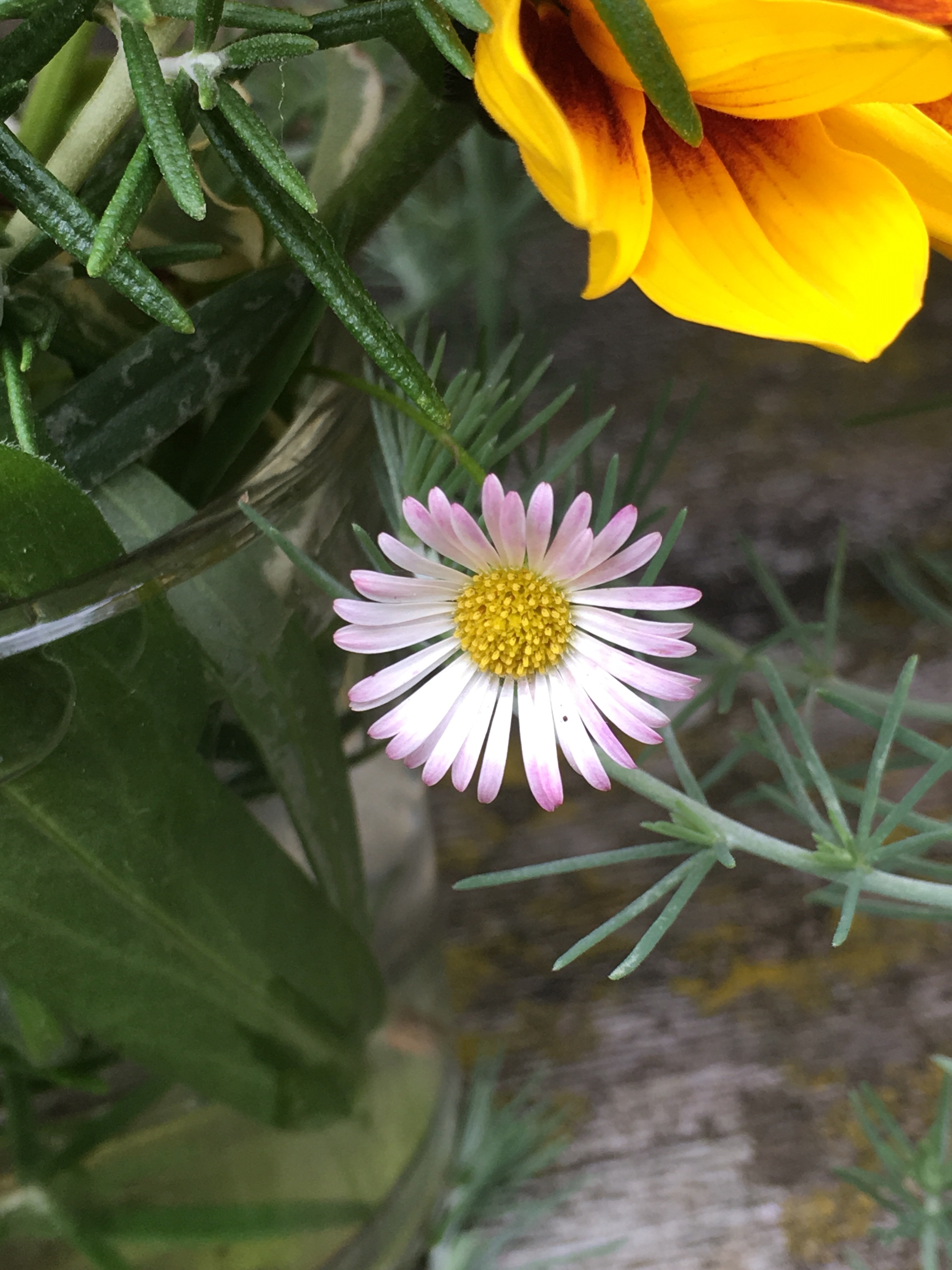
And finally, a humble bellis daisy, growing in the cracks between the paving by the back door. I’ve been imploring (nagging) the family not to step on them all winter. I have a little patch 60cm square of delightful little daisies. There’s absolutely no soil there. I feel they deserve to live, having made such an effort to survive.

Enjoy your weekend everyone. This is not to say that we are not all desperately worried by what’s going on in the world, and in our own country. But I’m thinking this sharing of garden photos may help someone keep calm and carry on. There is really nothing else we can do at the moment. Stay at home, help the NHS, stay safe. And look around you and enjoy the beauty of nature. When this is all over, our gardens will still be there waiting for us.

Links: all bulbs were bought from https://www.gee-tee.co.uk/

The bellis daisies came originally from my Mum in a little pot stood on the patio all summer. Seeds can be bought from https://www.mr-fothergills.co.uk/Flower-Seed/Bellis-Goliath-Mixed.html

Please leave comments below and let me know what’s flowering in your garden this Easter time.

What’s flowering in the garden 7th April 2020 -BBC Radio #SowAlong #BBCRadioSowAlong

If you have been listening in to Gardens Hour on Wednesdays on BBC Radio Leicester, you’ll have heard our ‘ten minute tips’ recorded in Ben Jackson’s garden. I always come home and plant the same varieties in my windswept country garden. Ben’s plot is in a lovely sheltered walled garden in a village. His soil is beautifully free-draining, in a garden which must have been worked for 100 years. Mine is cold wet clay, created from farm land over the past 30 years. It’s an interesting contrast and I love to see how plants perform in both our gardens.

Here’s an update on plants, showing what they are looking like today.

We planted tulips for cut flowers on 29th October. These are Exotic Emperor, a new early-flowering tulip, a double form of the popular White Emperor. It has a long flowering period with delicately green flamed cream petals. Looks good for nearly six weeks.

We planted a ‘cut flower mix’ and mine included this lovely Tulip Flaming Purissima. This comes in a range of creams and pinks. Very pretty and reminiscent of the old fashioned flame tulips made famous in the Tulip-Fever era. Very long lasting, and weather resistant.

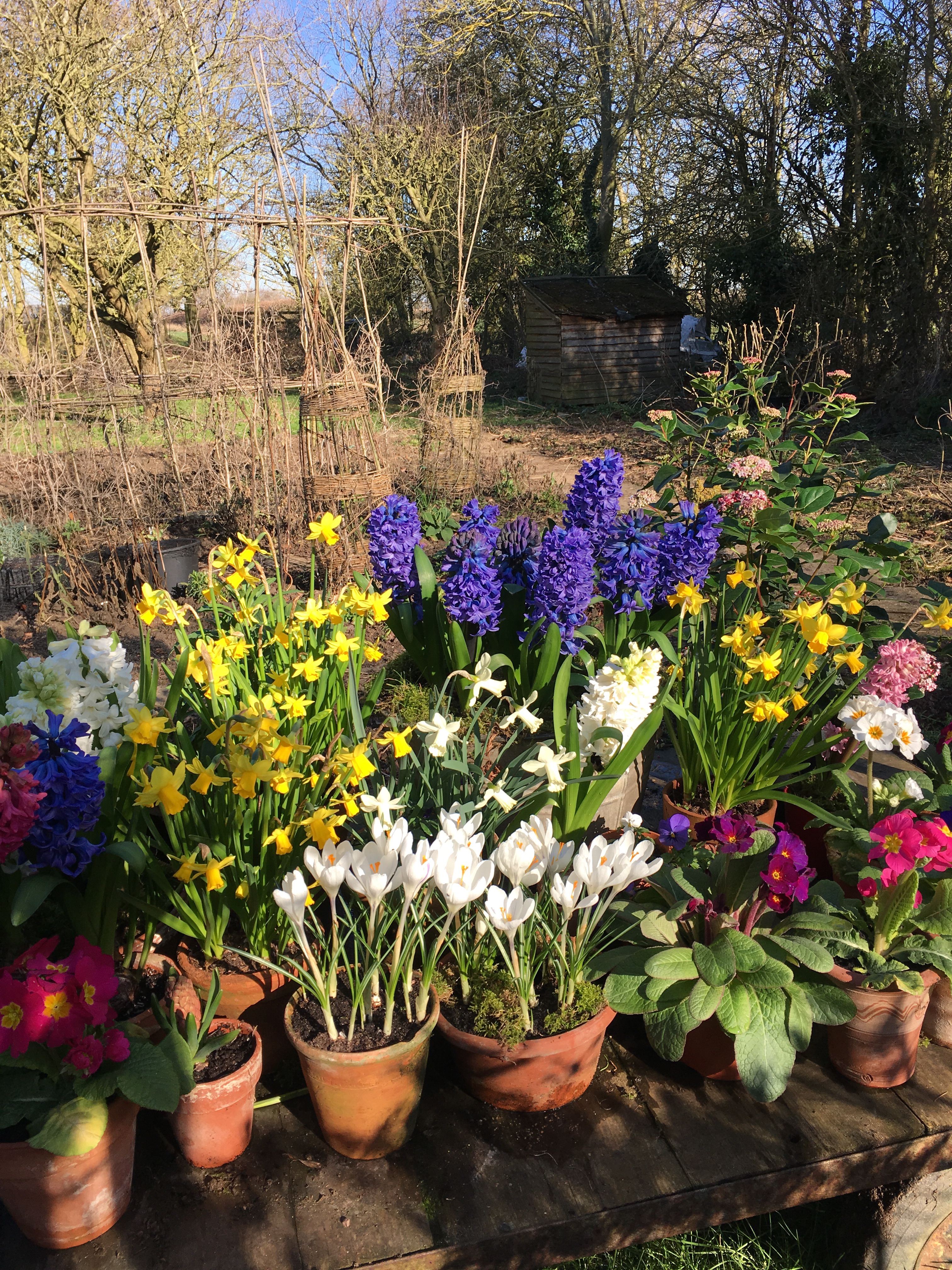
We planted bulbs ‘lasagna’ style in layers. Here’s my big Italian pot by my front door. This had snowdrops and dwarf iris in January, dwarf tete a tete daffodils in February, and now today has Hyacinth Blue Jacket, Exotic Emperor tulips and scented Geranium narcissi. When these are over, I’ll replant the pot with scented -leaved geraniums for summer.

In both our gardens we planted a range of daffodils to flower from February right through till the end of April. Here’s my pheasants eye narcissi planted under the cherry trees in the orchard. I’m so pleased with these, I’ll mass plant them in September for an even better display this time next year. I’ve gone round the garden making notes and taking photos to remind me where there are gaps and what changes I want to make. If I didn’t make notes, I’d forget by the time September arrives.

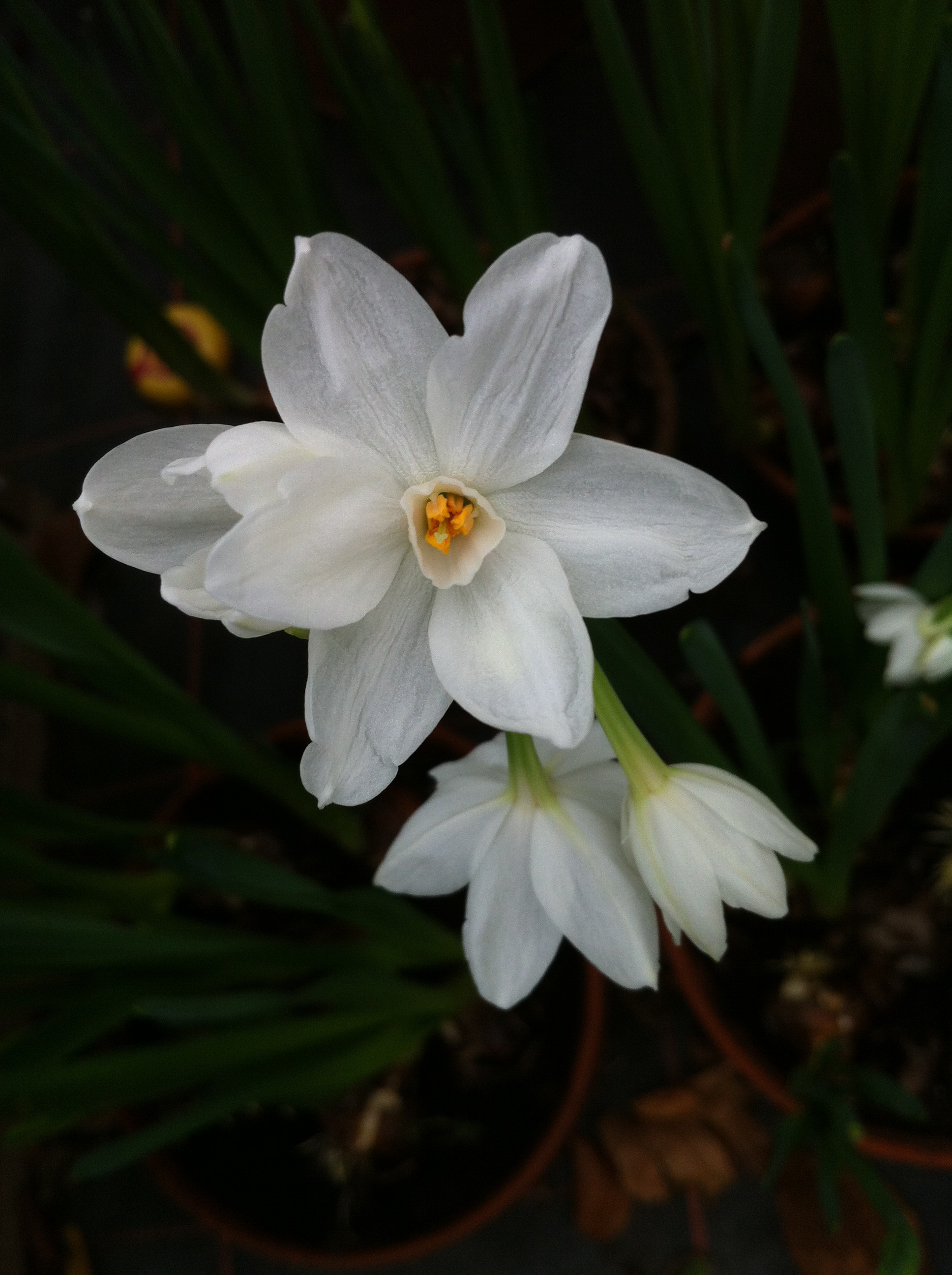
Talking about daffodils, we planted these Paperwhite narcissi on December 2nd. Some flowered at Christmas, but I held some pots back in the cold potting shed and brought them out a week apart so that I could have flowers for vases right through to the end of a March. Flowering times are dictated by amounts of daylight and heat. So plants can be manipulated to flower over a period of time.

We planted up our dahlias on 31st January. These were overwintered in a frost-free shed. I took 2″ cuttings in February and these have rooted in the propagator in 3″ pots at 18C. Above are the dahlias making really good growth in their seed trays, half filled with compost to start them off. They will stay in the greenhouse until the end of May.

We sowed our tomatoes on 28 February, and I pricked them out mid March. They are growing nicely just out of the propagator and on the greenhouse benches. I keep the greenhouse heated at 6C.

On 9th March we planted our tiny plug plants which cost about 60p each. We planted them individually in 3″ pots and put them on a sunny windowsill.

They have grown really well, and I’ve managed to take three lots of cuttings from the mother plants, which means lots of bedding plants for free. Taking cuttings makes them grow strong and bushy too, instead of tall and spindly.

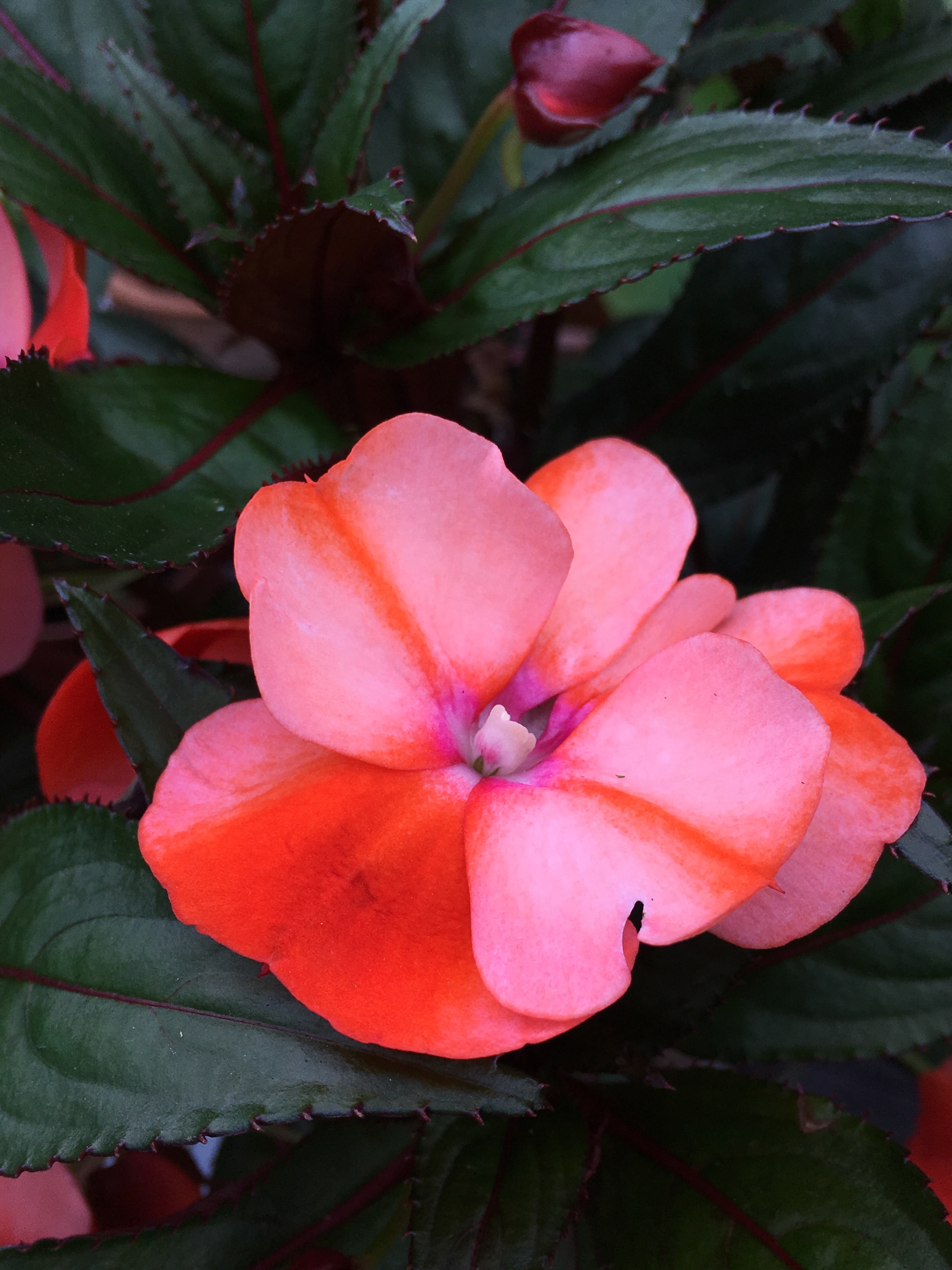
We also planted up some impatiens plugs into 3″ pots. These are now in flower and I’m putting them into their summer containers to grow on. I didn’t pay for these plants. They were free samples from the grower, Ball Colgrave.

If you are listening in today, Wednesday 8th April, this is where I’m talking from because I’m isolating due to covid. I’ve got 100 cosmos seedlings in 3″ pots including a new variety Apricot Lemonade. I’m also growing calendula pot marigolds which are great for bees and butterflies. I’m growing the very pale lemon Snow Princess, and pretty calendula Orange Flash.

I’ve just planted my new potatoes, Charlotte and Lady Christl in two of the divided beds. They are planted 12″ (30cm) apart, 4″ (9cm) deep.

I’ve also planted my broad beans, De Monica which is a new variety specially bred for spring sowing. I’ve sown double rows, with plants and seeds 9″ (23cm) apart. Seeds were planted 2″ (5cm) deep.

And this is the view from the greenhouse and potting shed. Turn up the sound to hear the birdsong. There’s a bank of wild cherry trees on two sides of the garden.

Error
This video doesn’t exist

I hope you’ve enjoyed this tour of my greenhouse and garden. Hopefully the photos have jogged your memory about what we’ve been growing for our ‘ten minute tips.’ I’ll keep you posted on the progress of all these plants. I’m hoping the garden is going to be quite productive and very colourful this summer. That’s three uses of the word ‘hope,’ but under the circumstances, I think we all need some hope, don’t we.

Links : BBC radio Leicester Gardening – Sundays 1-2pm and Wednesdays 12.30 -1pm at the moment, subject to change due to covid. https://www.bbc.co.uk/sounds/play/live:bbc_radio_leicester

DAB 104.9FM and at BBCSounds. Ask your smart speaker to tune in to BBC Radio Leicester.

Update: today’s programme starts at 2.36.23 on the timeline. https://www.bbc.co.uk/sounds/play/p087sjhn.

A Walk Around My Country Garden -27 Mar 2020

When I planted this walkway of trees, I never knew how essential they were going to be. I must meander along these paths at least 20 times a day, lost in thought.

I’m sharing as many cheerful photos as I can find today. The covid crisis initially knocked me for six. I am desperately worried about all our elderly relatives. For all those expecting babies in the summer. For my young daughters, one a newly qualified nurse, working with desperately ill patients right now. If I could solve everything with walking, I would have worn out my shoes. It’s the first time in my life I have no answers. I can’t do anything to make it ‘right.’ Normally I can think of something. In every other crisis, I have found a solution. Something to make things better.

So I am turning to what I know. Gardening. Giving out advice to anyone who needs it. Families have struggled to buy fresh salads and veg these past few weeks. I certainly haven’t managed to obtain what I’ve needed. I couldn’t find bread, flour or milk. It’s made me feel vulnerable and determined to be more self reliant when it comes to fruit and veg at least. So anyone who needs grow-your-own advice can contact me and I will help. For specific individual garden design advice, how to start a cut flower garden, grow a meadow, deal with a shady border, I am asking for a donation to Rainbows Hospice direct, any amount and I don’t need to know how much. All my garden club talks have been cancelled, and as you know, all my fees go to Rainbows. The clubs have all rebooked for next year, but I wanted to do something for this year to help. So anyone interested, please e mail me at k.gimson@btinternet.com for more information. I am learning to Skype and FaceTime live, and also using the phone and computer. Where there’s a will, there’s a way, as my grandparents used to say. Funny how their little sayings come back to you in times of trouble. It’s as if they are trying to help you, even though they are no longer here.

Enjoy the slide show of photos. I hope it lifts your spirits and makes a difference. From now on, I am solely focusing on people who are doing good, sharing information about what they are doing, supporting them in any way I can. That really is the only way forward for me.

Error
This video doesn’t exist

I took this video from the garden gate last night. It’s so heartening to see farmers out and about working their fields after such a dire autumn and winter. If they are out there preparing seed beds, then we can too in our own gardens. I shall be glad to see the green shoots of seedlings after a winter of brown, barren fields.

Hedgerow blossom. This looks like a shooting star to me. Such a beautiful sight. A heart-sing moment. The hawthorn too is coming into leaf. Soon there will be clouds of May blossom to cheer us along.

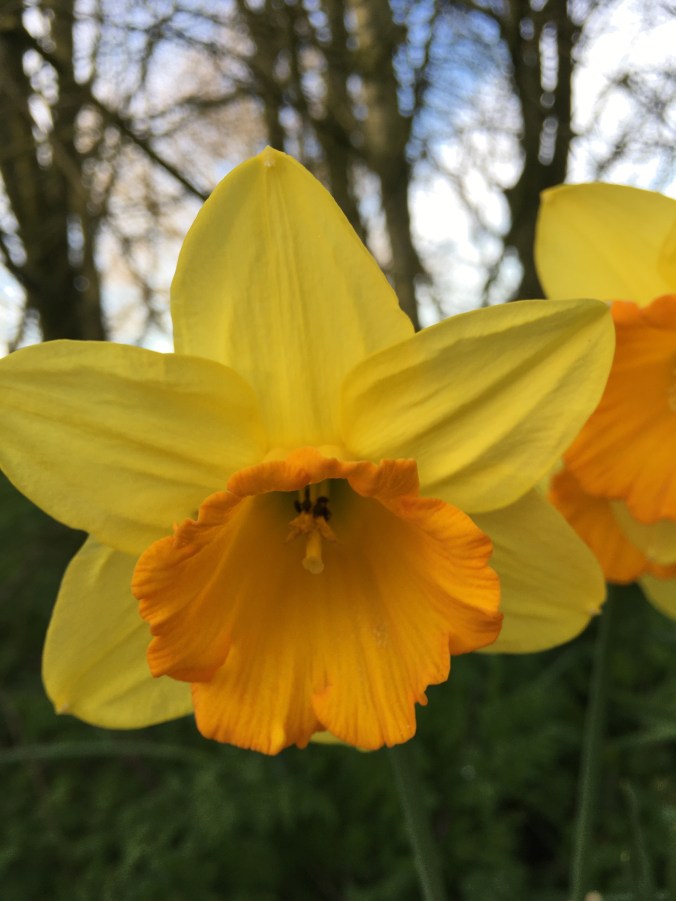
Lots of daffodils at the top of the paddock. These were a sack I bought from Dobbies at Christmas, reduced from £24 to £3. I couldn’t resist the bargain price, and took a risk. They’d been stored cool and dry so were in good condition. I didn’t expect flowers this year, but they are looking stunning. Every bulb has come up. I’ll water with a potash liquid to feed the bulbs for next year. And if I see another £3 sack, I’ll certainly buy it!

Yellow flowers symbolise friendship, and that is certainly what we all need right now to get us through this crisis. I’m relying on phone calls and my twitter friends to keep upbeat. I’ve just added my name to a list of local volunteers to ring round anyone who lives alone and needs someone to chat to once a day.

Today, the wild cherry trees (prunus avium) started to flower. What a wonderful sight. These trees only flower for a week or two, but we will sit under them with our cups of tea, have picnics outdoors and revel in every single moment they are in bloom.

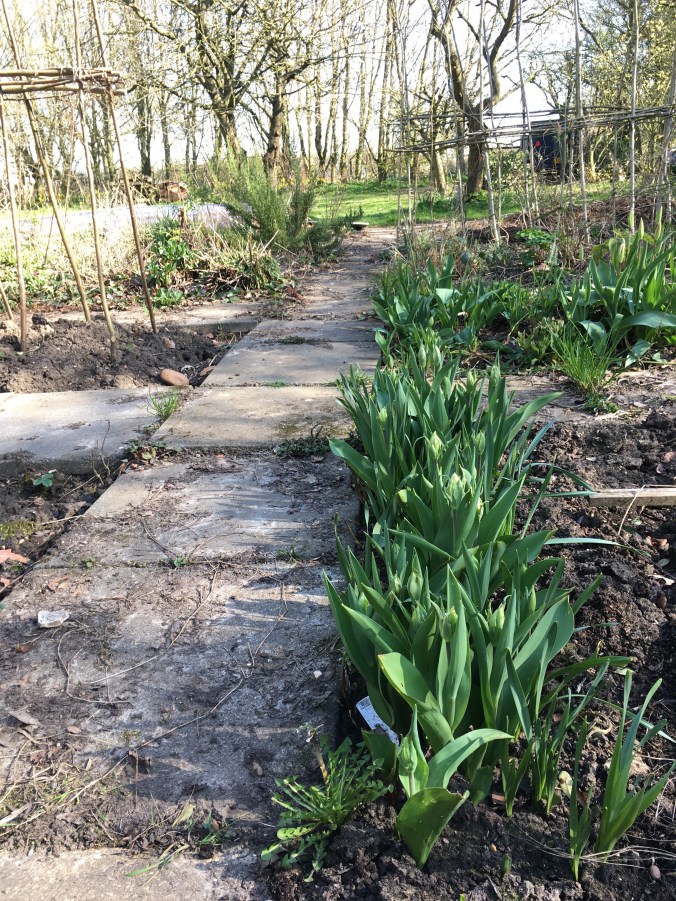
My cut flower tulips are in bud. Tulips in the sunny front garden are already flowering early. I’ll cut a huge bunch of daffodils and tulips for the front windows. Vases of flowers will cheer up anyone passing by, even though they can’t call in to visit.

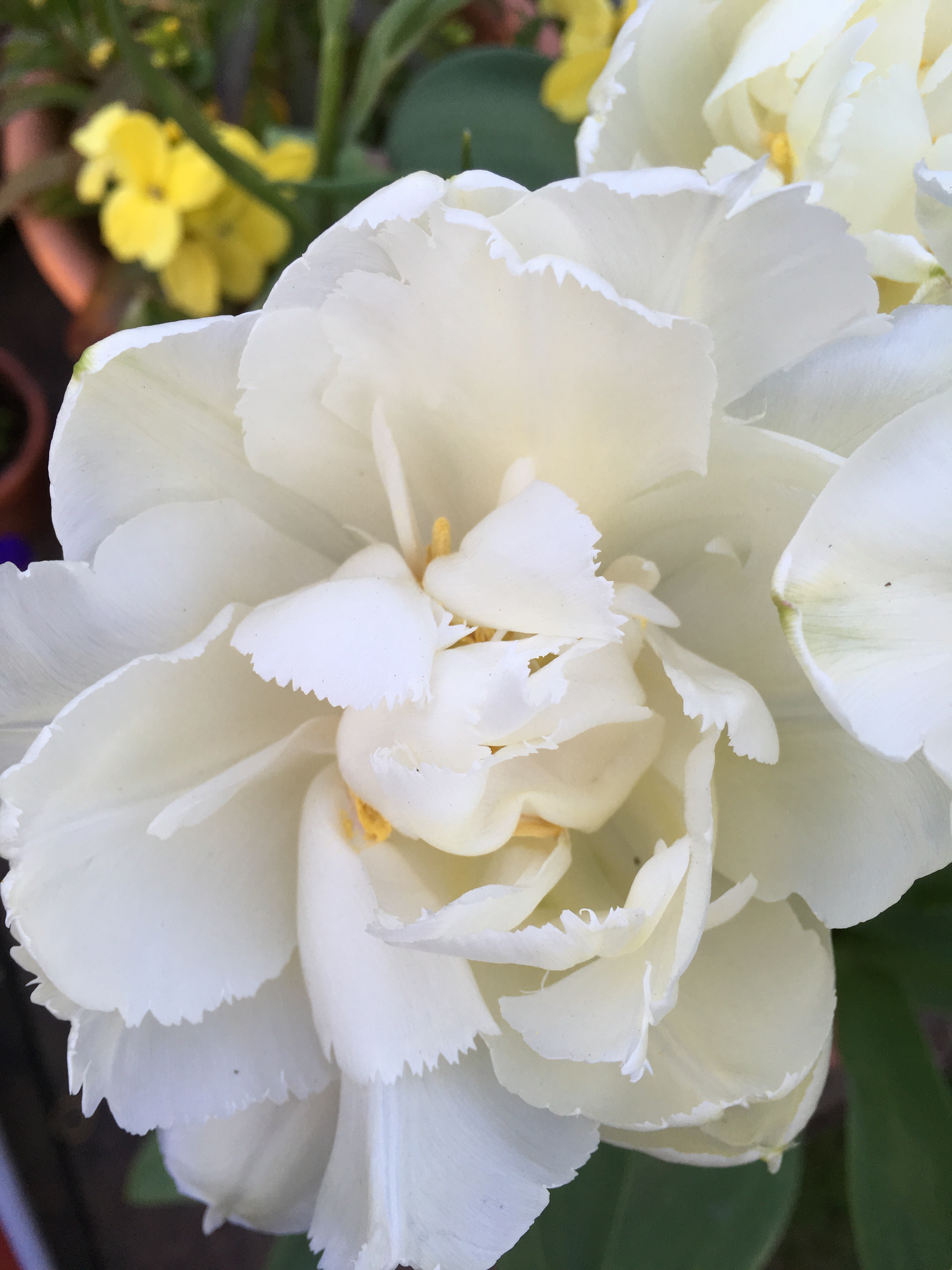
These double creamy tulips, Mount Tacoma, are favourites. They remind me of swan feathers. So graceful.

Scented narcissi, Geranium and Pheasants Eye, are starting to flower. Fabulous with yellow hyacinths and the first wallflowers.

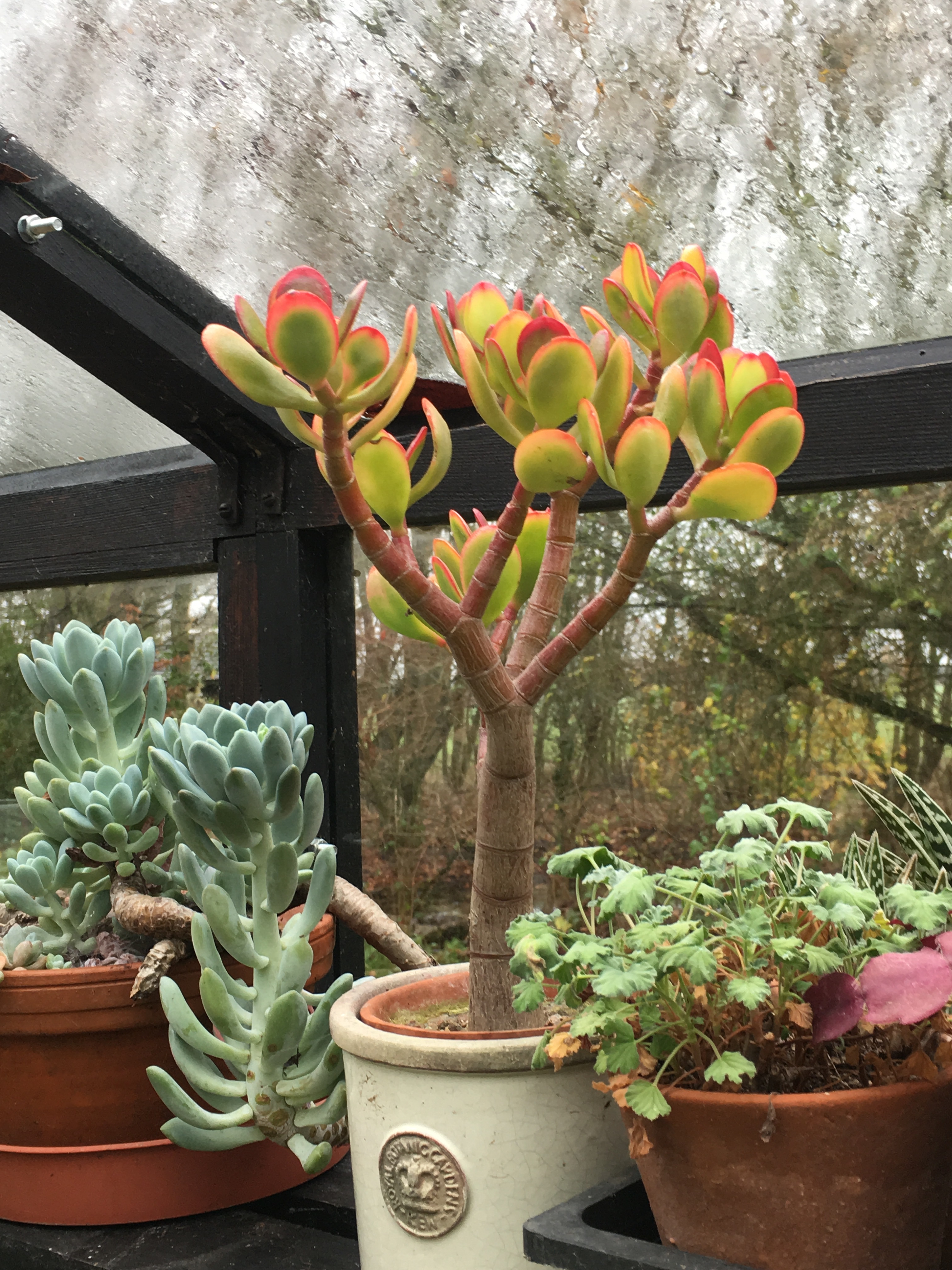
In the greenhouse, the succulents are starting to glow. I’ve started to water everything, and I’m pleased this aeonium has come through the winter.

There’s plenty of citrus fruit coming along. I’ll be able to make orange cakes and lemon meringues soon.

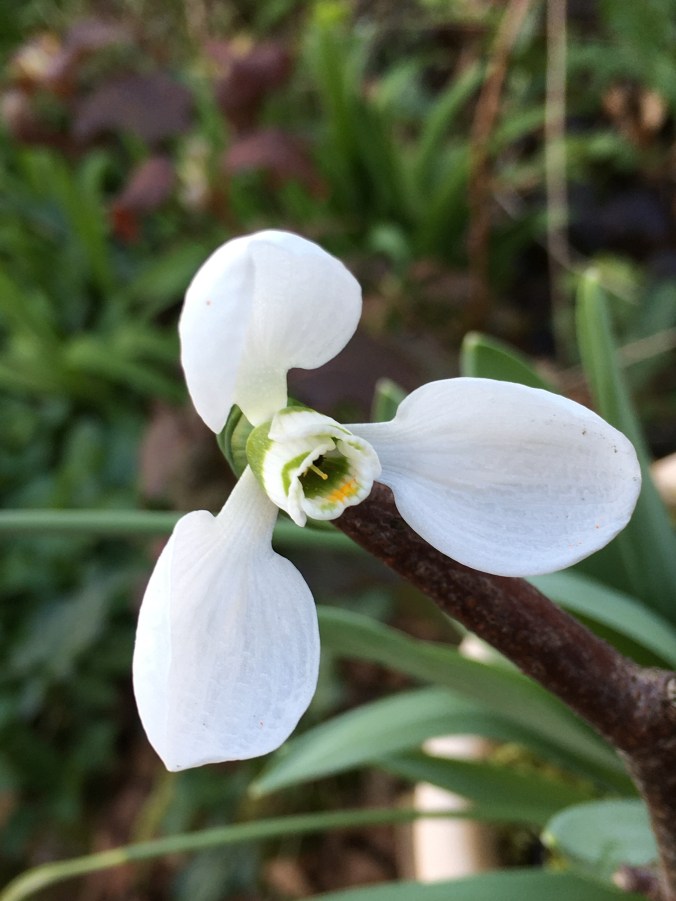
Would you believe it, my new Polar Bear snowdrop is still in flower – at the end of March. It’s a new elwesii type of snowdrop with huge rounded petals and short pedicels which make the flowers look up and out rather than hang down. It looks rather surprised to be out in the spring sunshine amongst daffodils. I wonder if next year it will flower much earlier.

There’s life in the pond. The tadpoles are forming. Lots of pond skaters, some newts, and we’ve even spotted a grass snake, on our new wildlife camera set up on bank.

I’ve mounted the camera on a log, so I can move it about the garden without it being knocked over. Tonight we are hoping to catch sight of the hedgehogs. They are out and about at dusk, making nests in the bottom of the ‘fedge’ and under the old disused hen house.

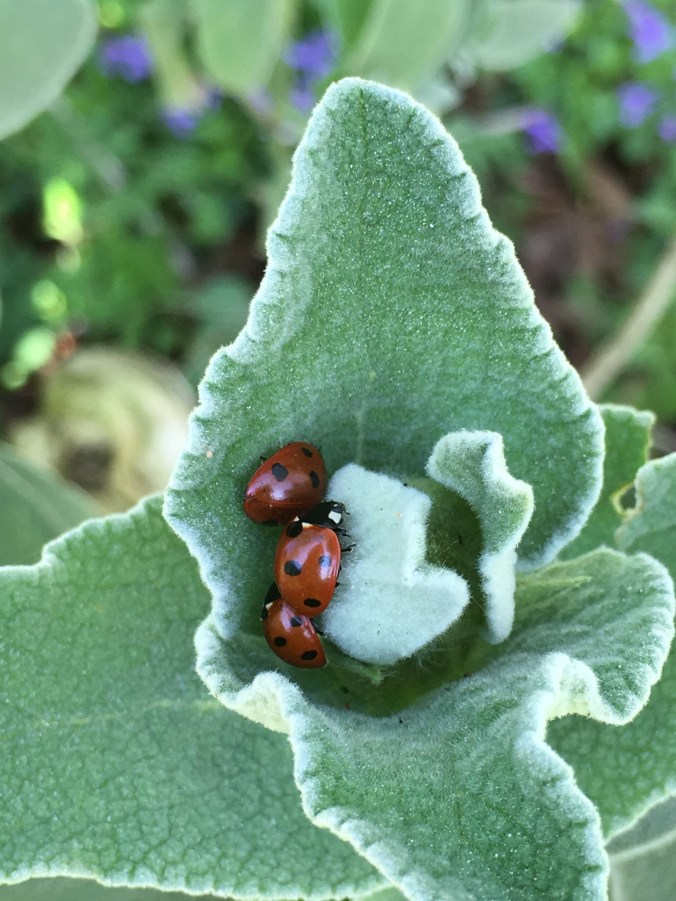
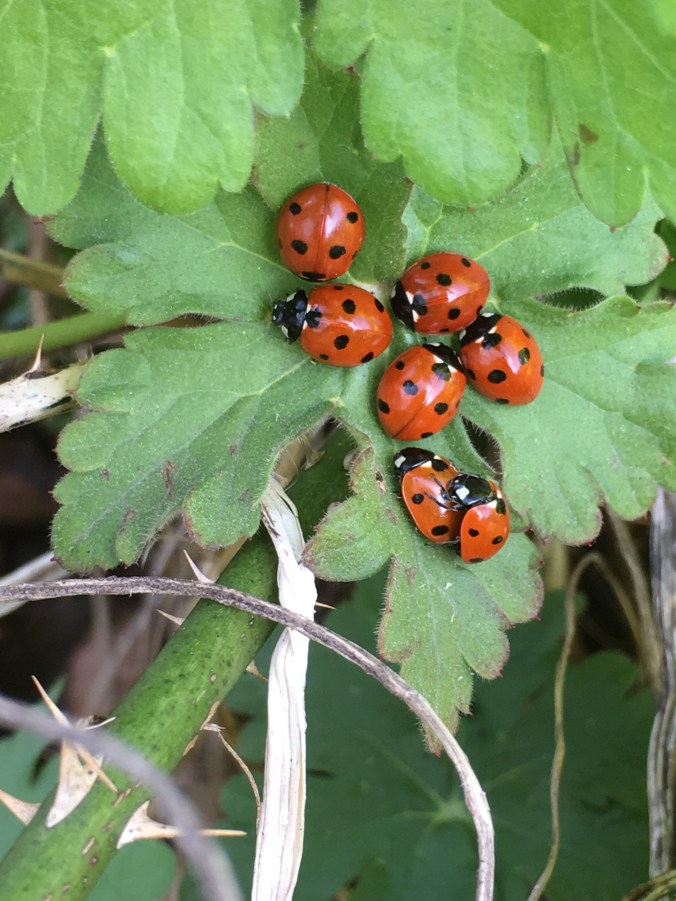
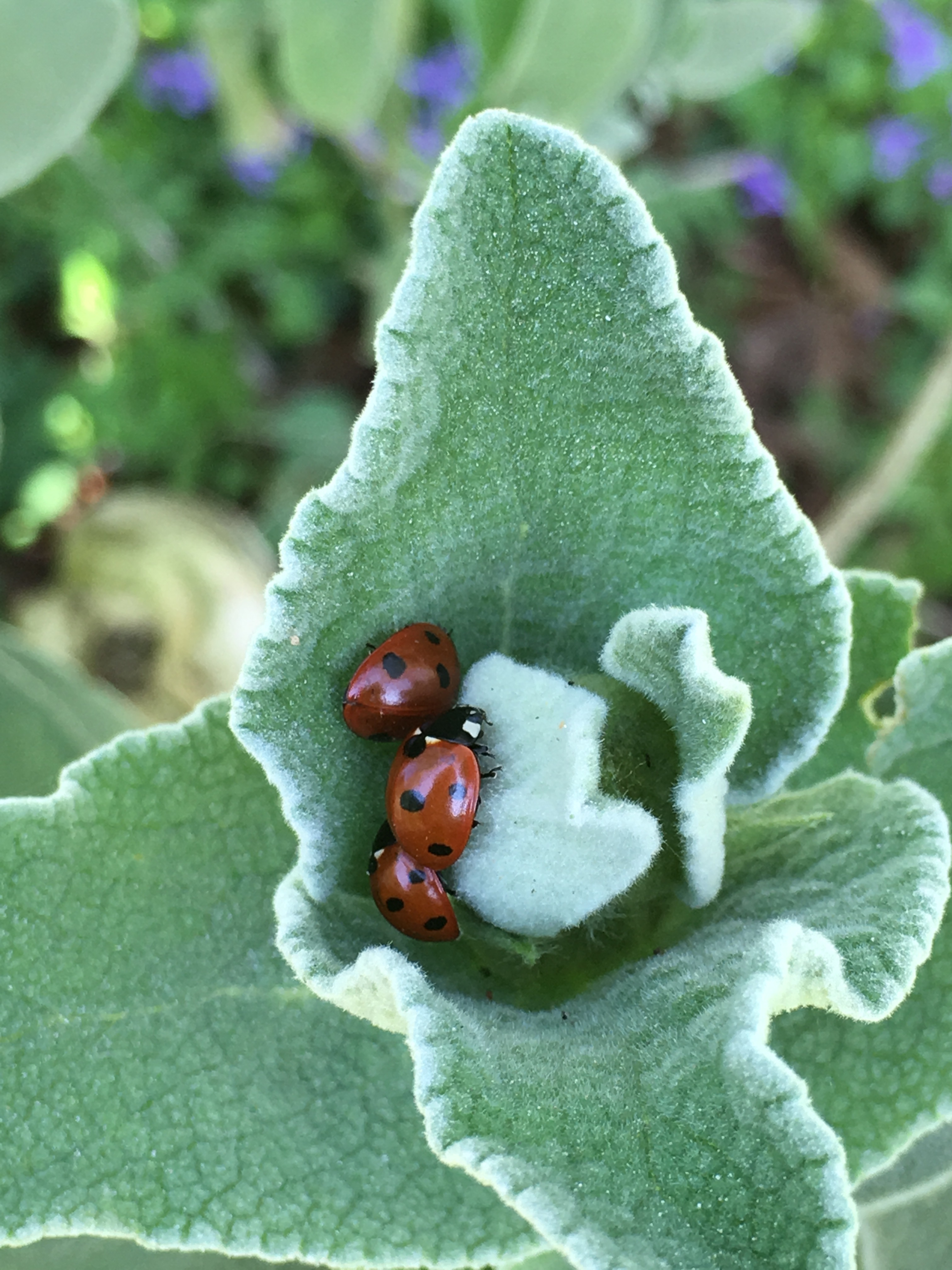
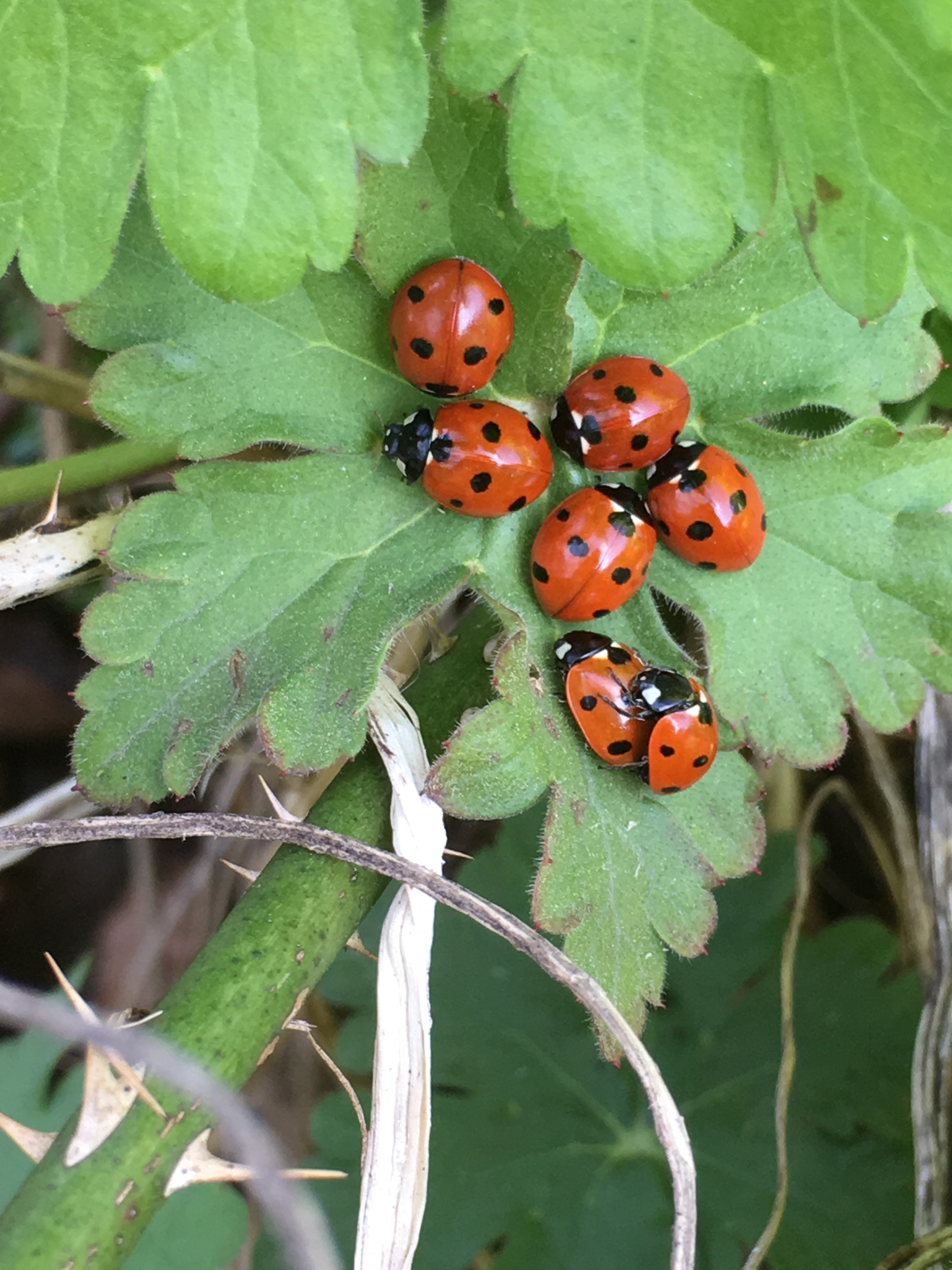
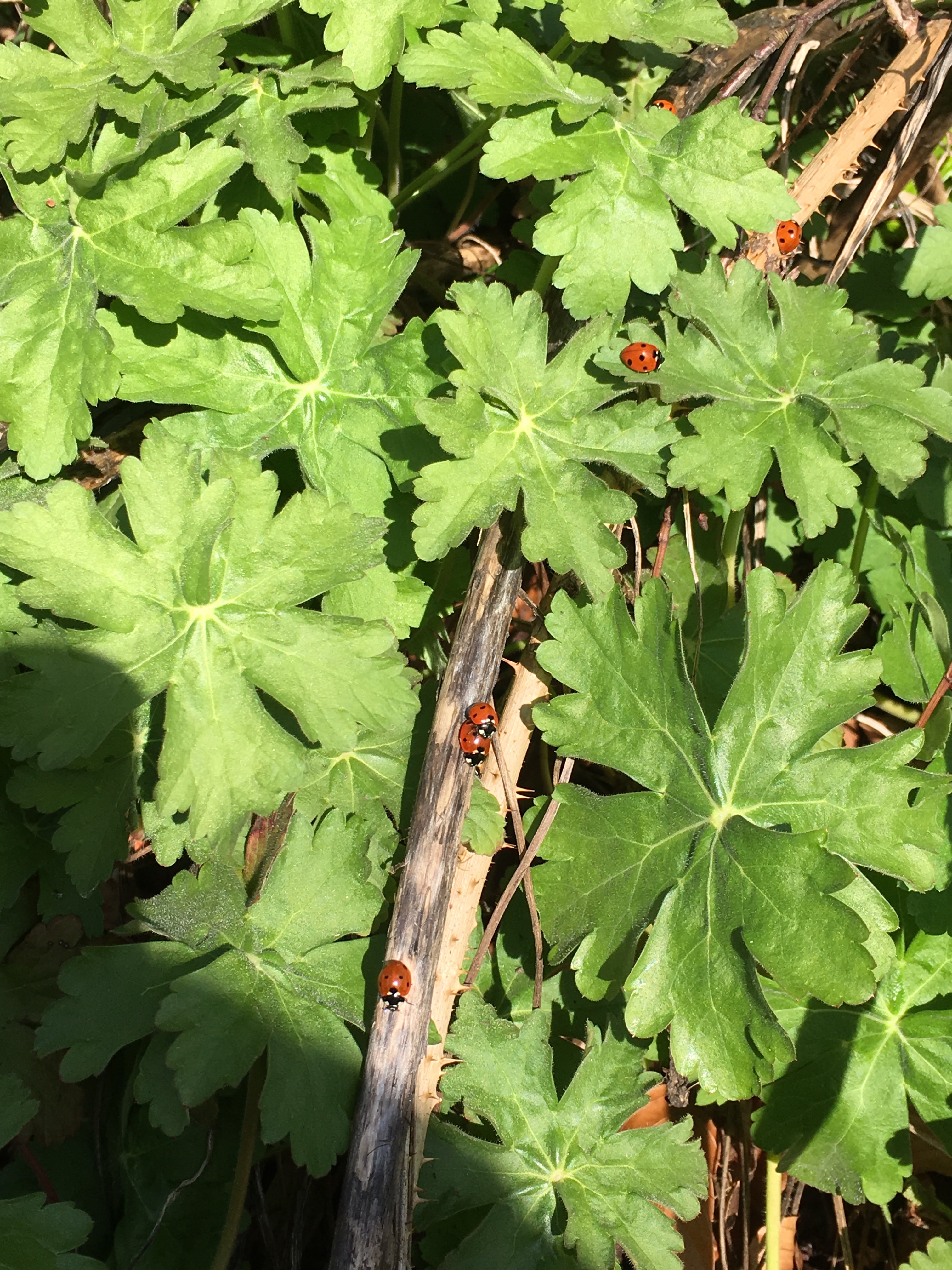
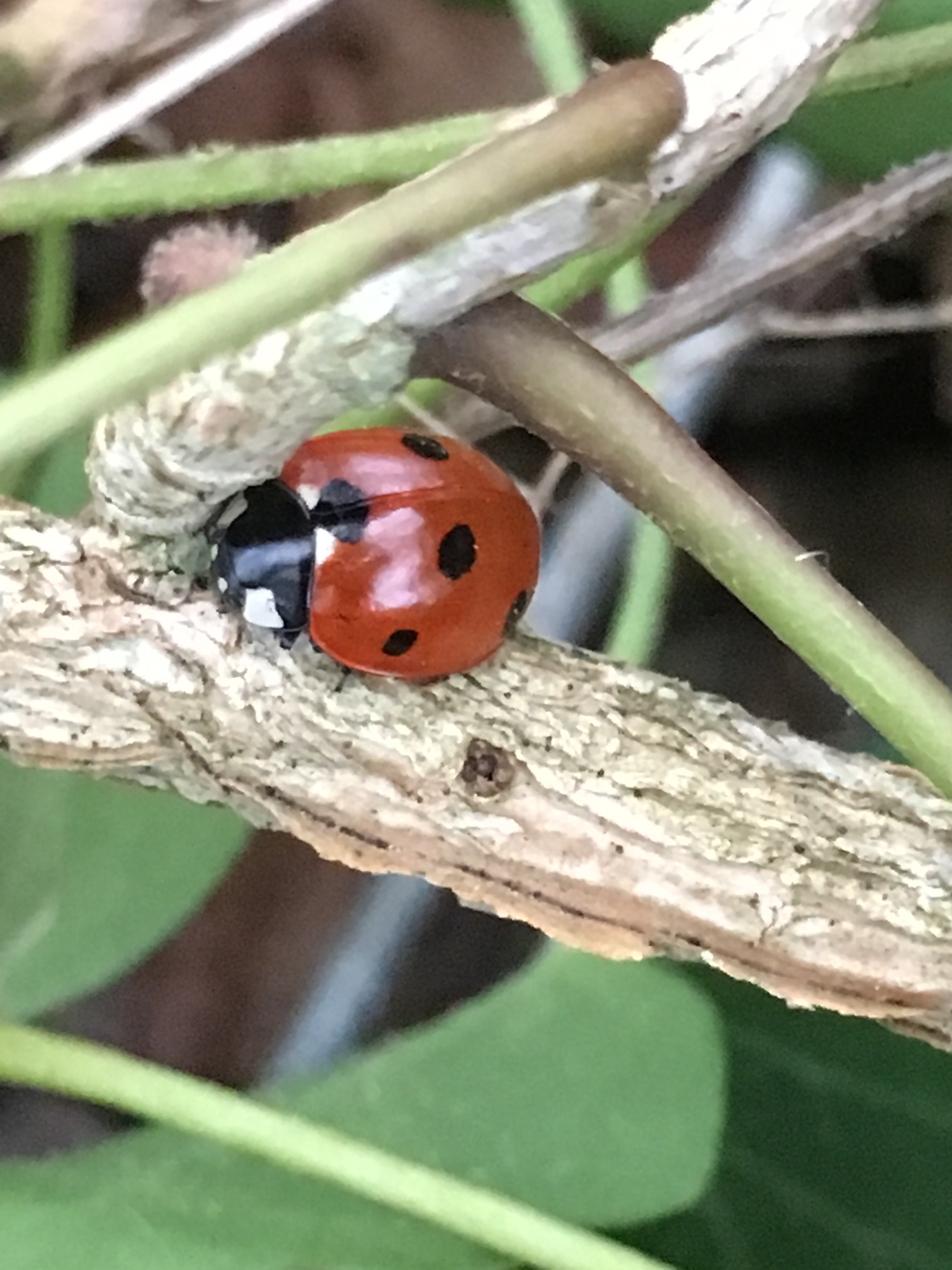
Ladybirds are much in evidence. Here they are on the phlomis. My army of pest control workers. I’ve left twiggy piles of stems all around the garden to give insects a place to hibernate. Hopefully they will repay me by eating the aphids.

And there’s plenty of bees, thankfully. Bumble bees and solitary bees of all shapes and sizes. I have a new book to review, The Secret Lives of Garden Bees by Jean Vernon. I can think of nothing better than sitting under my cherry trees and loosing myself in a book. It will be something soothing and calming. Much needed at the moment.

Here’s an enormous bumble bee on the wild anemones. It’s lovely to have a book you can go to to learn more about the bees visiting your garden. And look at ways you can help them to thrive. Something positive to focus on.

I hope you’ve enjoyed this walk around my garden today. The sun is shining and it’s 30C in the greenhouse. All the windows and doors are thrown open. Get in touch and let me know what’s looking lovely in your garden today. And if you are feeling alone or sad, let me know. We are in this together. And be reassured that lots of people are doing wonderful things to help one another. You just have to look for the positives in life. As ever.

Love Karen xx

Home Grown – salads and veg for quick return during Covid-19

The following notes accompany the BBC Radio Leicester Gardens Hour between 1 and 2pm on Sundays, on your smart speaker, DAB, 104.9FM and BBC Sounds. I’m writing this in advance so you can follow what seeds I might be talking about.

It’s been difficult over the past week getting hold of any fresh fruit and veg. Quite dismaying to see empty supermarket shelves. I didn’t stockpile, so we are literally running out of everything.

After a bit of a panic, I’ve settled down to this plan of action. Here’s what I’m growing.

Microgreens and Sprouting Seeds

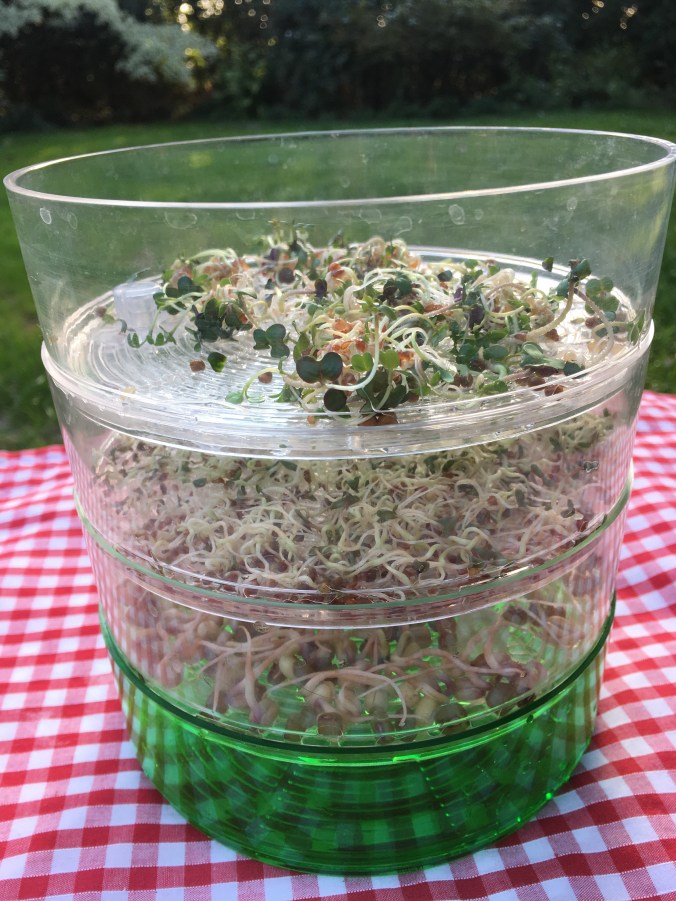
All you need is a kitchen windowsill to grow sprouting seeds. This tiered growing kit comes from Johnsons Seeds, but you could just use a plate with moist kitchen paper, or a shallow tray with compost for the microgreens. Cheap and easy to grow, adds nutrients to soups stews and sandwiches. Perhaps you’ve done this before with children, growing cress and mustard. It’s the same principle.

I’m growing:

Radish Mino Early

Microgreens Gourmet Garnish

Basil

Beetroot for leaves

Mung beans for stir fries.

Microgreens are grown until they are a couple of inches tall, and then trimmed using scissors. You can repeat this process a few times.

Bean sprouts and seeds are grown for 3-5 days and harvested when approx 2.5cm long

Mixed cut and come again salad

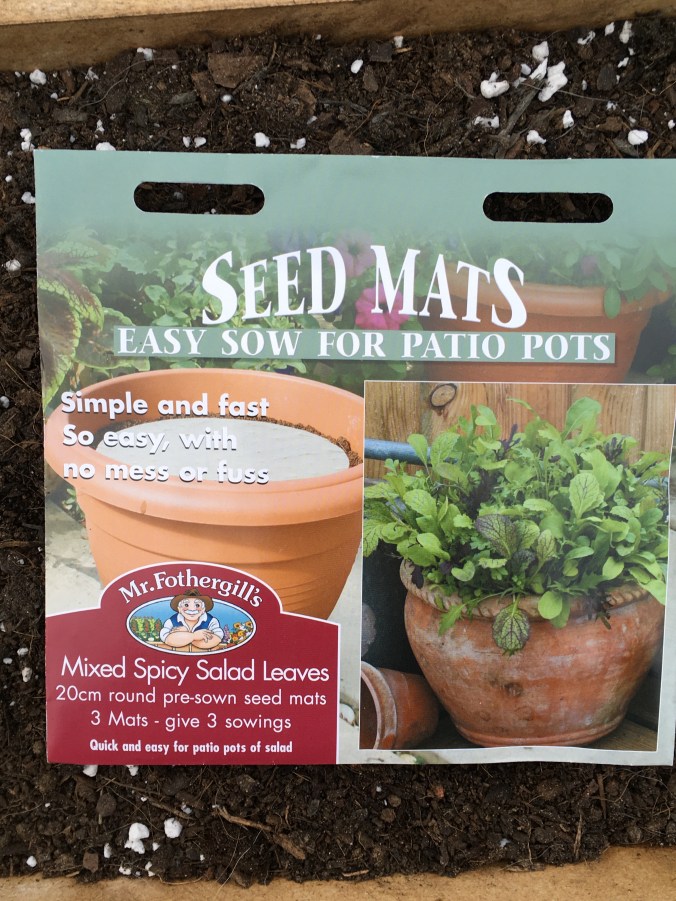
I like the idea of these pre-sown mats. All you have to do is pop the mats on top of a pot of compost snd water them. Fuss-free growing. Pick leaves from the outside when they are 5cm (2″) high, leaving the centre of the plants to carry on growing. Anyone can use these. They are great for children too.

PEASHOOTS

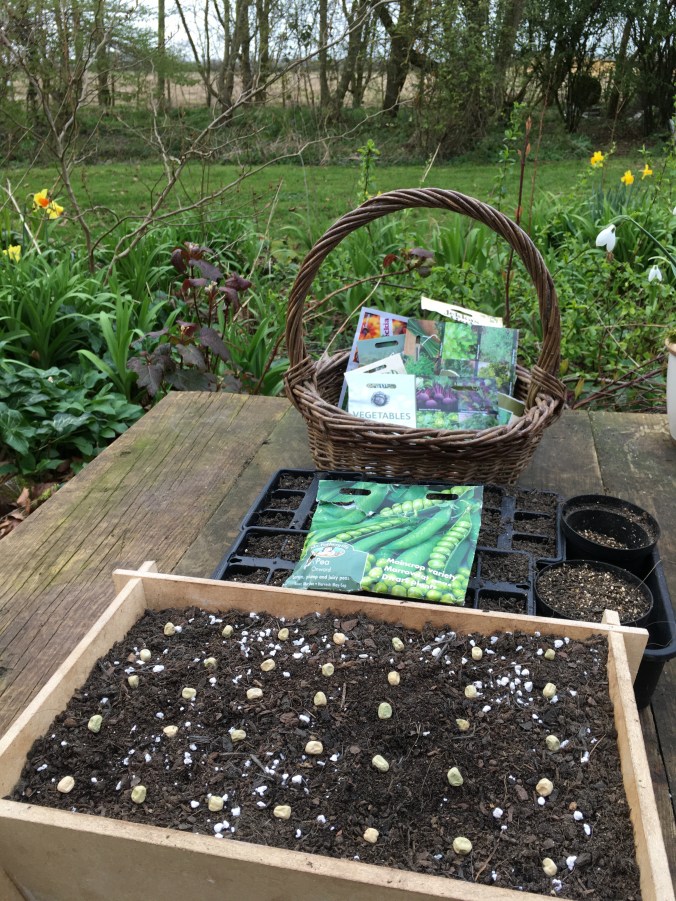
I’m growing peas in shallow trays. They will be harvested when the shoots are 4″. The plants will regrow snd you can repeat the process several times. After this, I plant the peas in a 10″ pot in the greenhouse and they grow on to produce a good crop of pea pods. Any edible pea variety can be used. Friends have even used dried peas from the supermarket.

Herbs in Pots

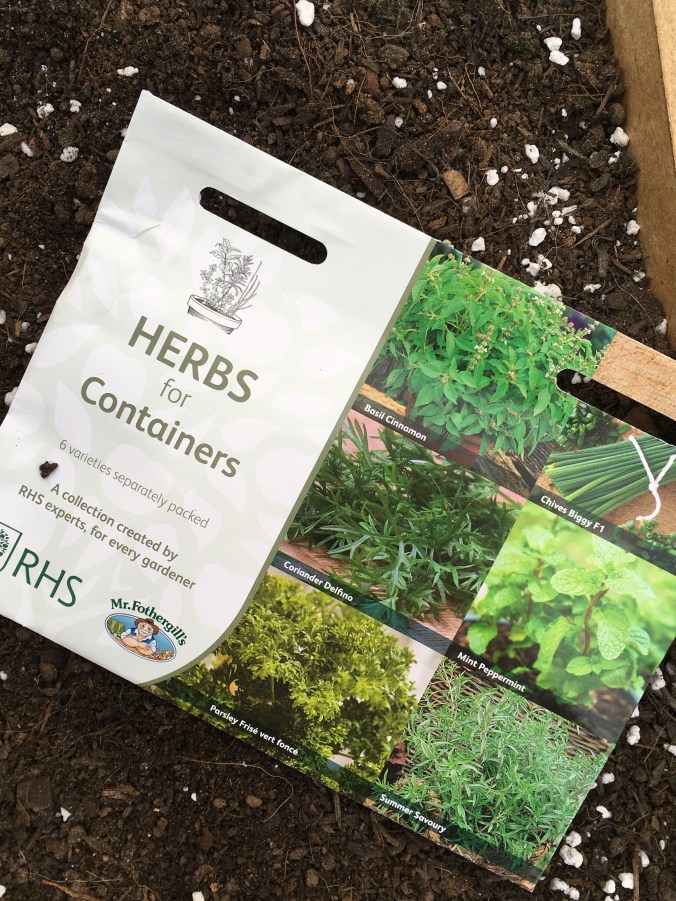
I’ll sow herbs in individual cells, a few seeds per cell. The cells will be moved on to 5″ pots and eventually they will stand on a sunny patio. Meanwhile, I will just keep pinching out the tips to use to liven up pasta and rice dishes, and this will also make the plants bushy.

Spring Onions

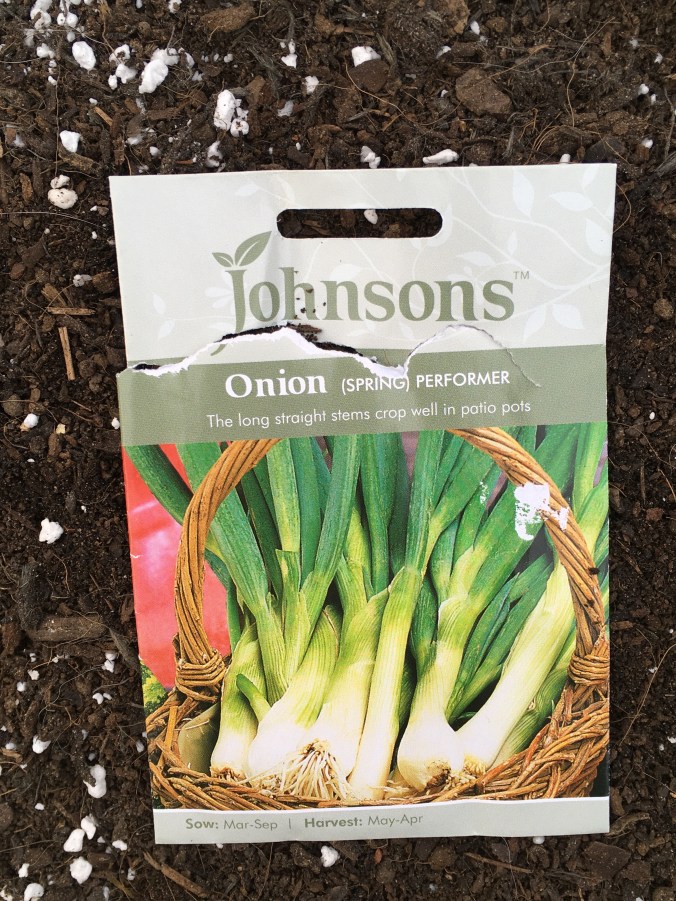
Spring onions will be sown in 10″ pots and kept in the cold polytunnel. They are ideal for growing in containers. They are quick growing and can be sown successionally from March to September. One item I do have is a huge bag of potatoes, luckily. Some mashed potato topped with grated cheese and chopped spring onions turns a simple dish into a tasty treat.

SPINACH

Baby leaf spinach is a favourite here, full of vitamins and goodness. I’ll grow these in recycled polystyrene boxes from a delicatessen, garden centre cafe. You could also use window boxes, or 10″ pots.

DILL

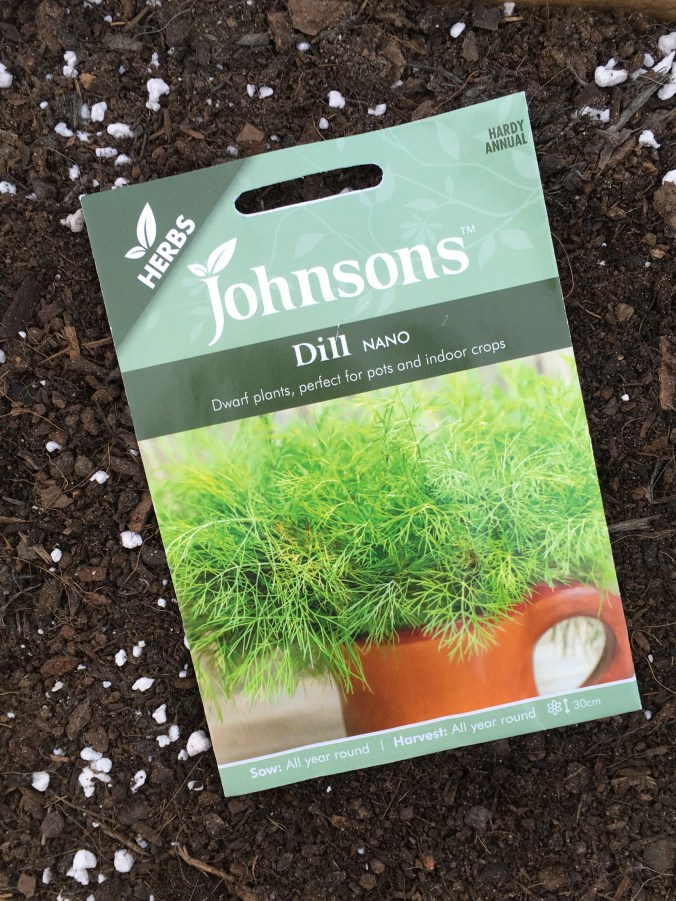
Nano is a new dwarf variety perfect for containers. A few clippings of dill turns any dish into a feast. I make a sauce with mayonnaise, butter and dill to add to fish. Totally delicious and full of vitamins. I’ll sow this 3 or 4 seeds to a cell and then the plants will be moved into window boxes.

CARROTS

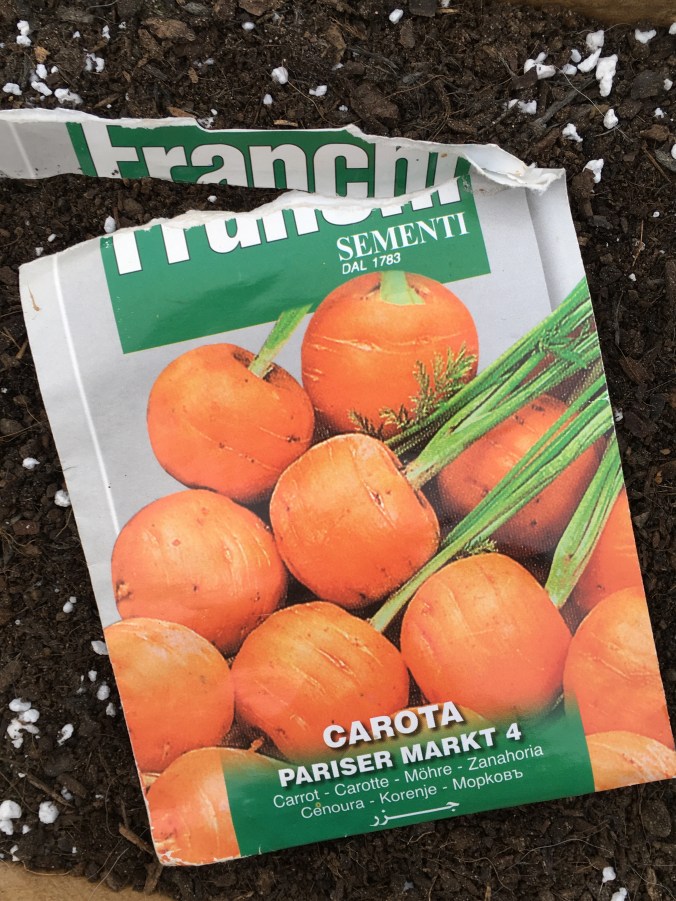
Round carrots, such as Paris Market or Rondo are perfect for containers and are relatively fast growing. You can also clip some of the leaves to use in salads without it depleting the roots.

TOMATOES – more long term, but starting now …

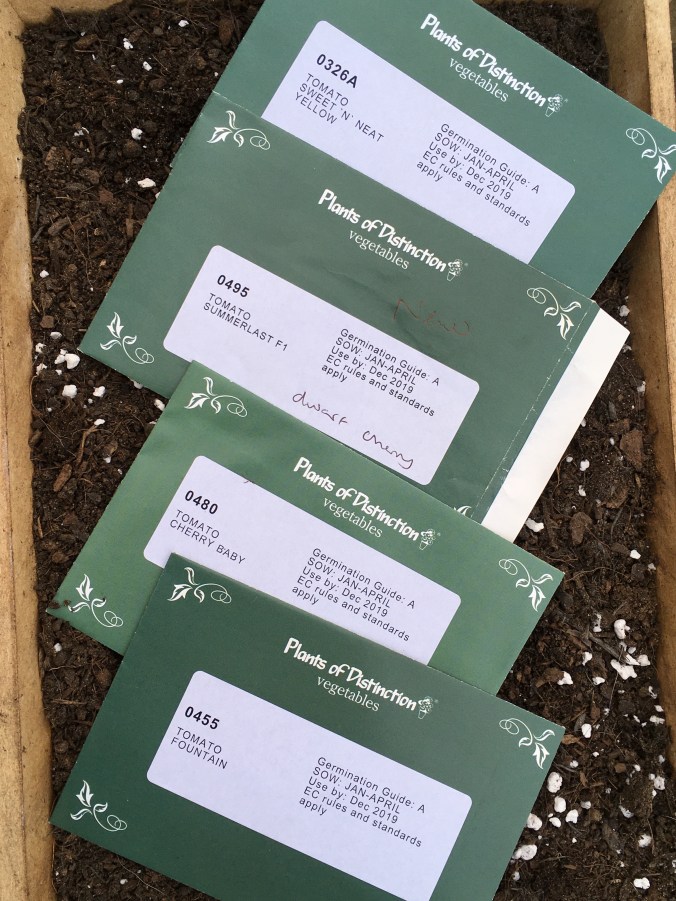
I’ve a selection of dwarf cherry tomatoes for eventually growing in pots on the patio. These won’t need tall canes for support and won’t need pinching out. They naturally branch into small bushy plants. Started now in a warm window or a propagator at 18C, I’ll be eating tomatoes in June. Hopefully.

CUCUMBERS

I like baby cucumbers for summer salads. I’m growing Beth and La Diva. I’m also trying a new variety, Swing this year. Half fill a 3″ pot with compost and place the seed on edge. Water with tepid tap water. Keep warm at 18-21C. As soon as the seeds grow out of the top of the pot, add more compost around the stem. Harden off carefully, putting the delicate plants in the propagator over night and out in the greenhouse in the day to prevent damping off disease. Keep warm until June. I’m planning to grow some outdoor and some in the poly tunnel.

SOMETHING FOR CHILDREN

With children off school, cress seeds will be a winner. And also start off sunflowers, not to eat, but to brighten the garden and maybe for a competition to see who can grow the tallest.

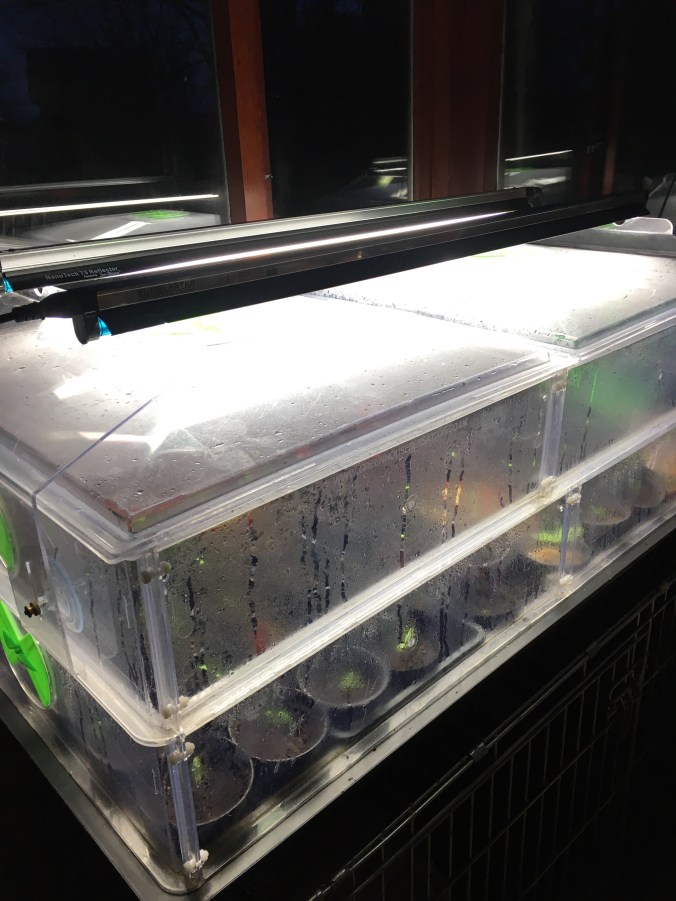
My propagator glowing in the dark

It’s been a challenging time where stress levels have been through the roof here. But I feel calmer with a plan of action. Just sowing a few seeds has given me some respite from worries. It’s been a welcome distraction from covid troubles.

Let me know how you are getting on. Have you found it difficult to buy supplies. What are you growing their spring?

Links : seeds from Mr Fothergills https://www.mr-fothergills.co.uk/

Johnson’s Seeds: https://www.johnsons-seeds.com/Home_4/Oriental-Seed_3/Sprouting-Seeds-Sunflower.html#.XnaUjoGnyfA

Little Gardeners https://www.johnsons-seeds.com/Home_4/Oriental-Seed_3/Sprouting-Seeds-Sunflower.html#.XnaUjoGnyfA

Plants of distinction : http://www.plantsofdistinction.co.uk/

In a Vase on Monday -March 16 2020

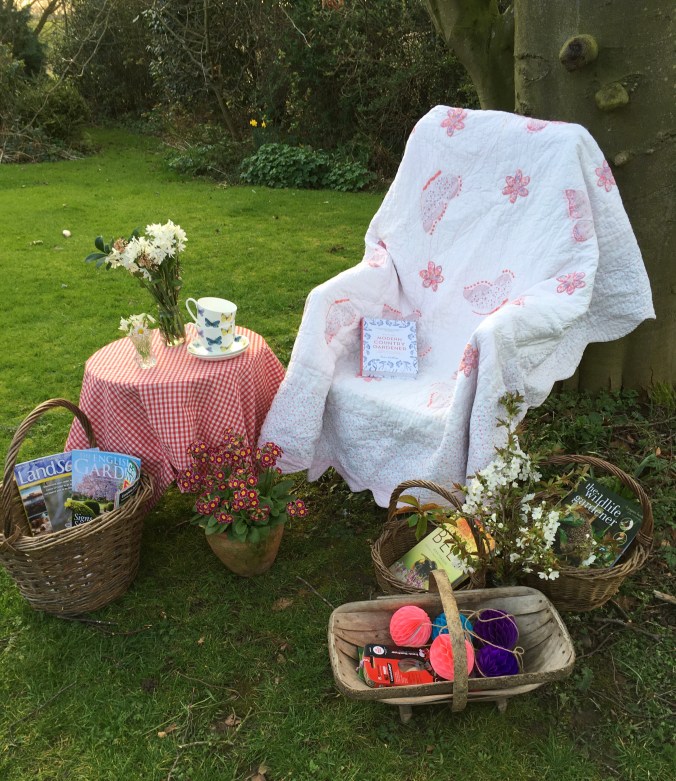
On the first warm, sunny day of the year, I’ve made a comfy place in the garden. I sit here, surrounded by familiar things: flowers, fresh from the garden, favourite books, magazines, tea, and mum’s lemon cake. And for a few minutes, I forget my worries. I am determined to enjoy the garden, birds singing all around, frogspawn in the pond. Trees bursting into leaf. I watch a wren creeping along the eaves of the house, searching for spiders. Spiders webs are used to glue their nests together, so I never clear them away. All of nature carries on, oblivious to the crisis we humans are facing. My small ginger spaniel Meg sleeps at my feet. My cat, Grace, chases a fly. They too are unconcerned. And yet I am a boiling cauldron of concerns. One minute panic stricken by the ‘what ifs’ the next, in warrior mode ready to fight. If only I knew exactly what I’m fighting. I return to voices, advice from my childhood, that some things cannot be changed and what will be, will be. I desperately try to remember comforting phrases from the past. I know my family, going back in time, suffered many illnesses and setbacks and survived. The suffering though. Those photos are etched on my mind. We, in modern times, have had it easy. Until now. And now, none of us know what’s going to happen. To give some respite from my thoughts, I turn to familiar things. For comfort I walk around my garden picking spring flowers, as I have done for the 30 years we’ve lived here. I’m posting them for you to enjoy, hoping they will bring you some comfort too, and for a few moments give you something else to think about. Stay safe all of you and keep in touch. Our gardens and our gardening community have never been needed more than they are today.

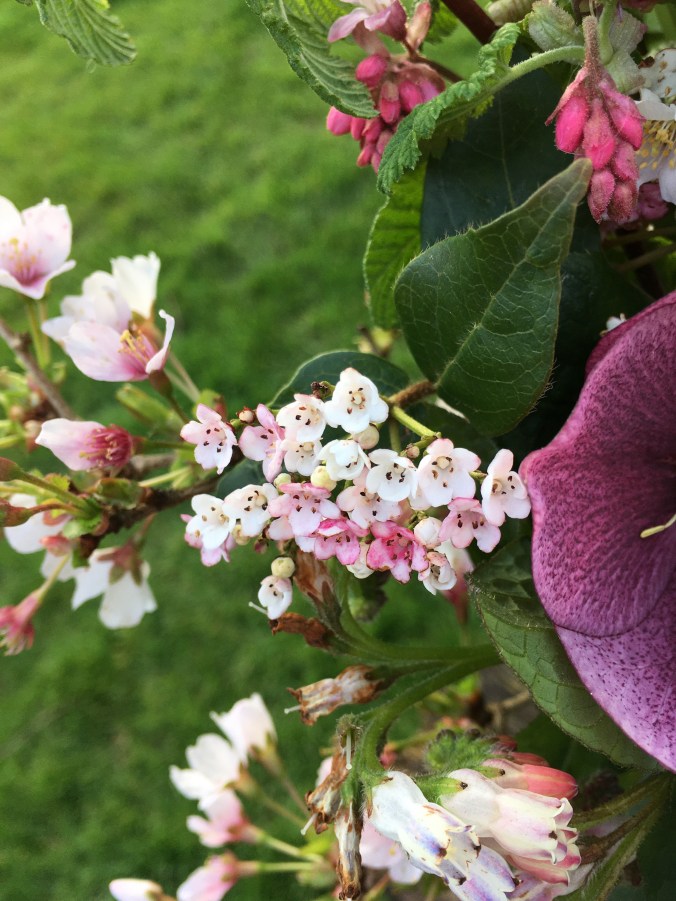
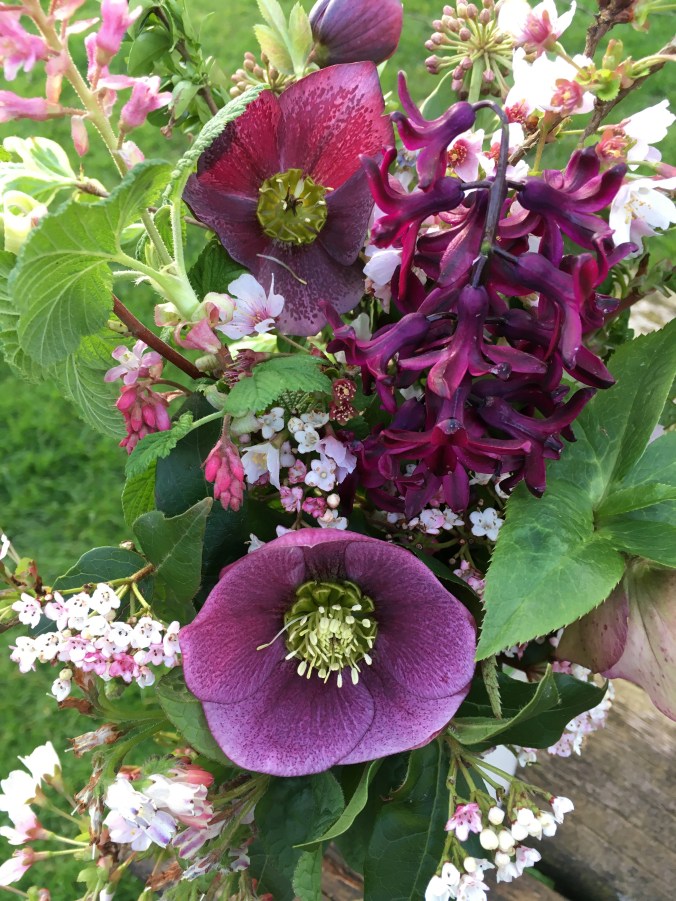
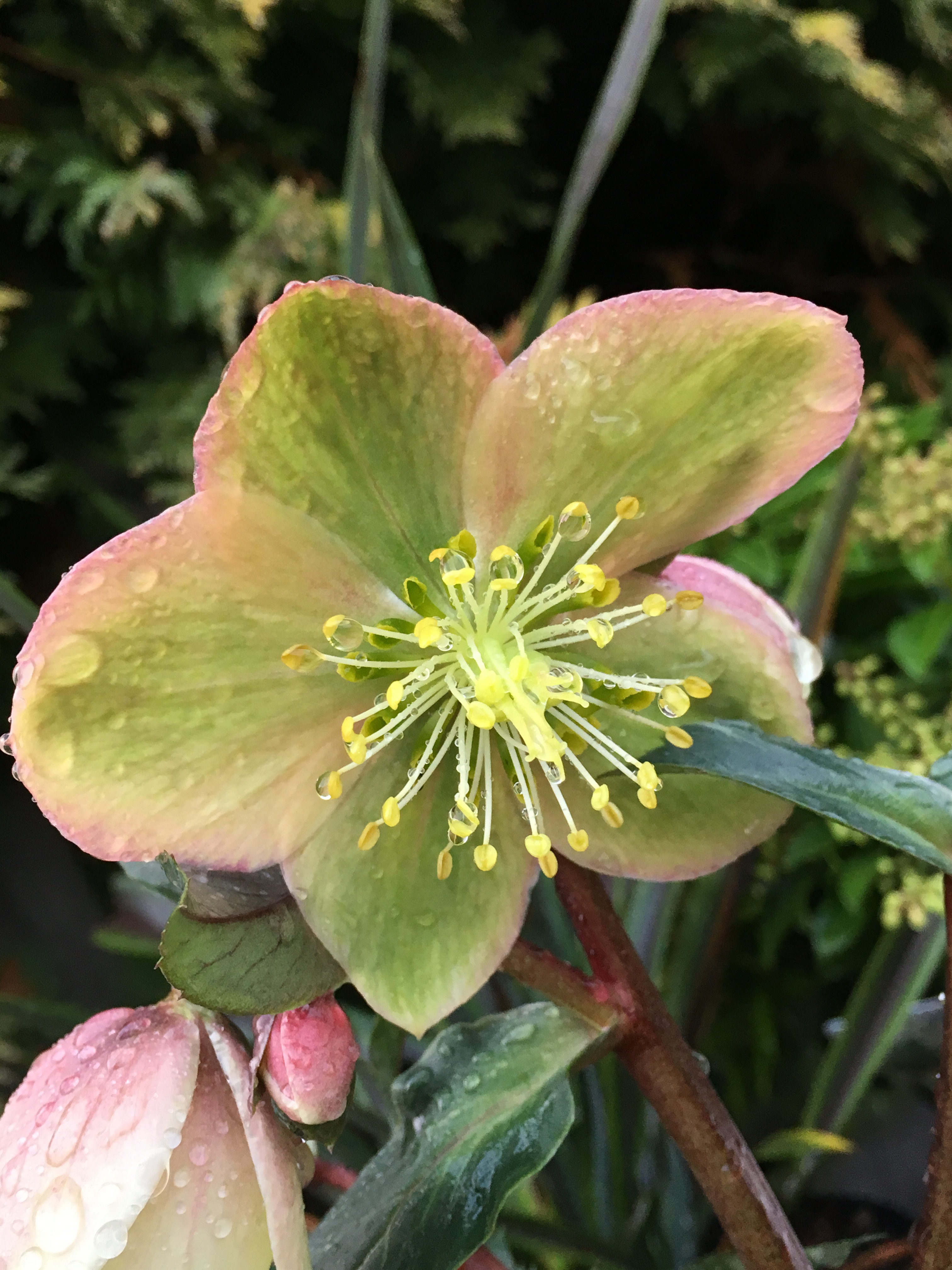
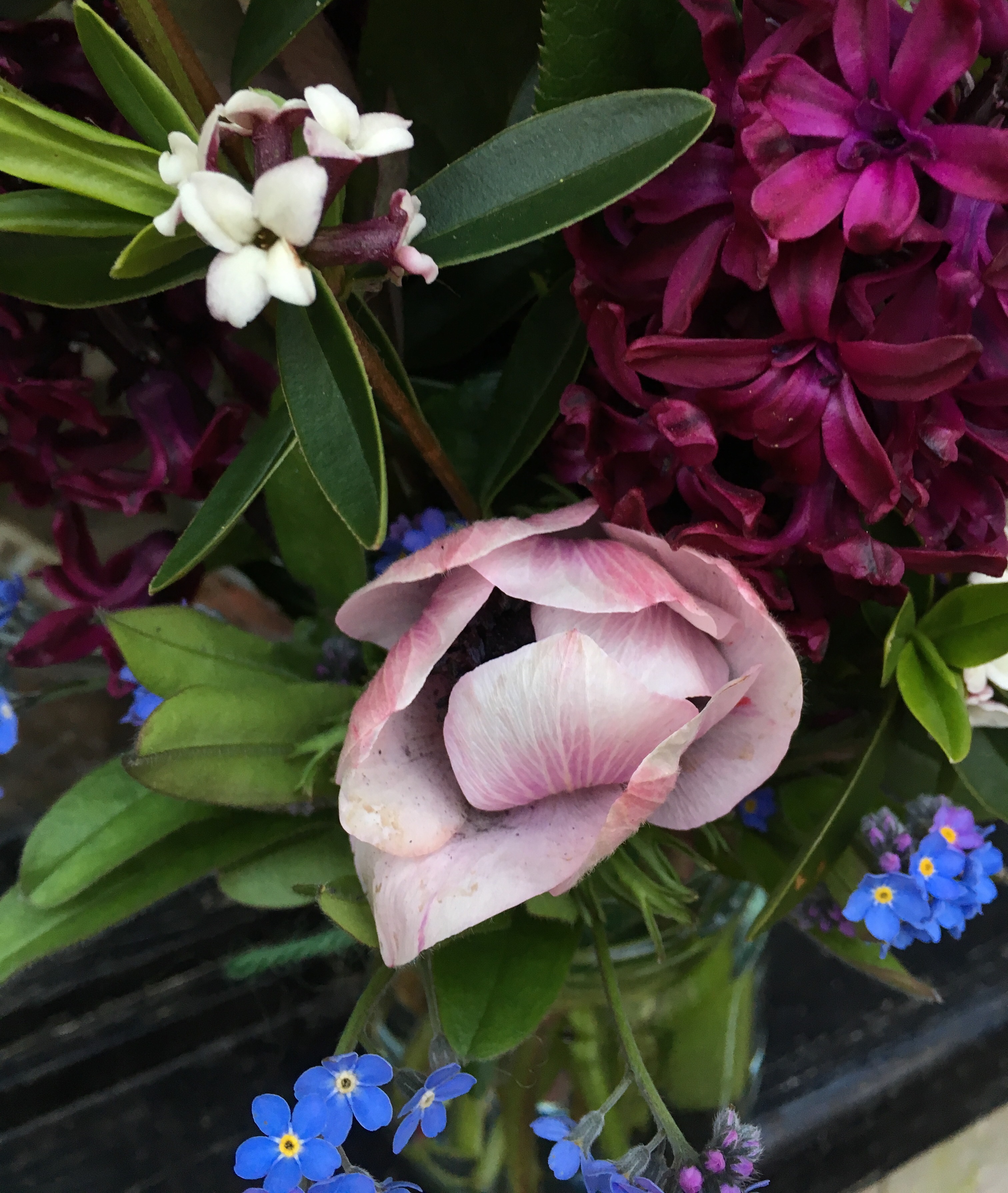
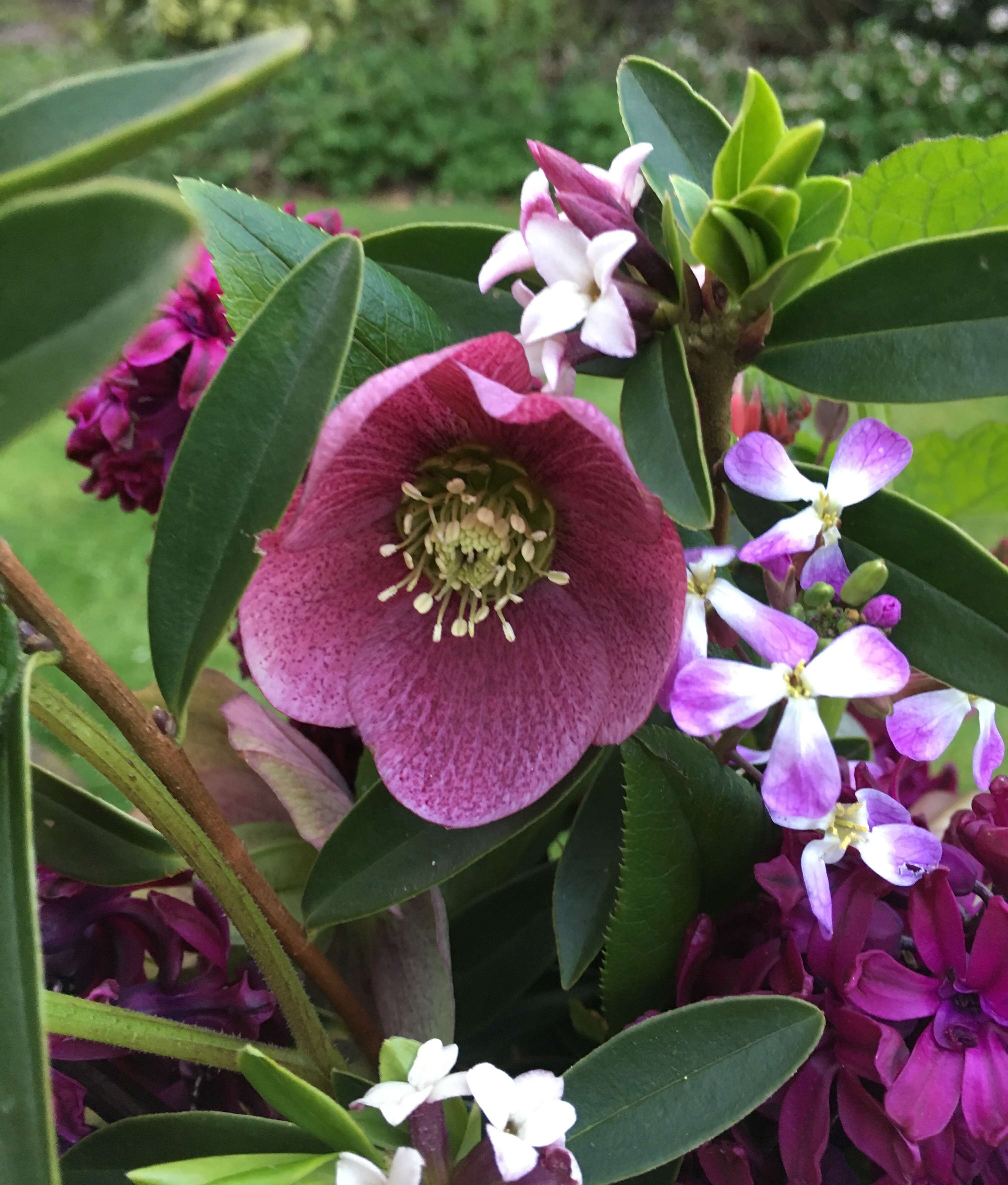
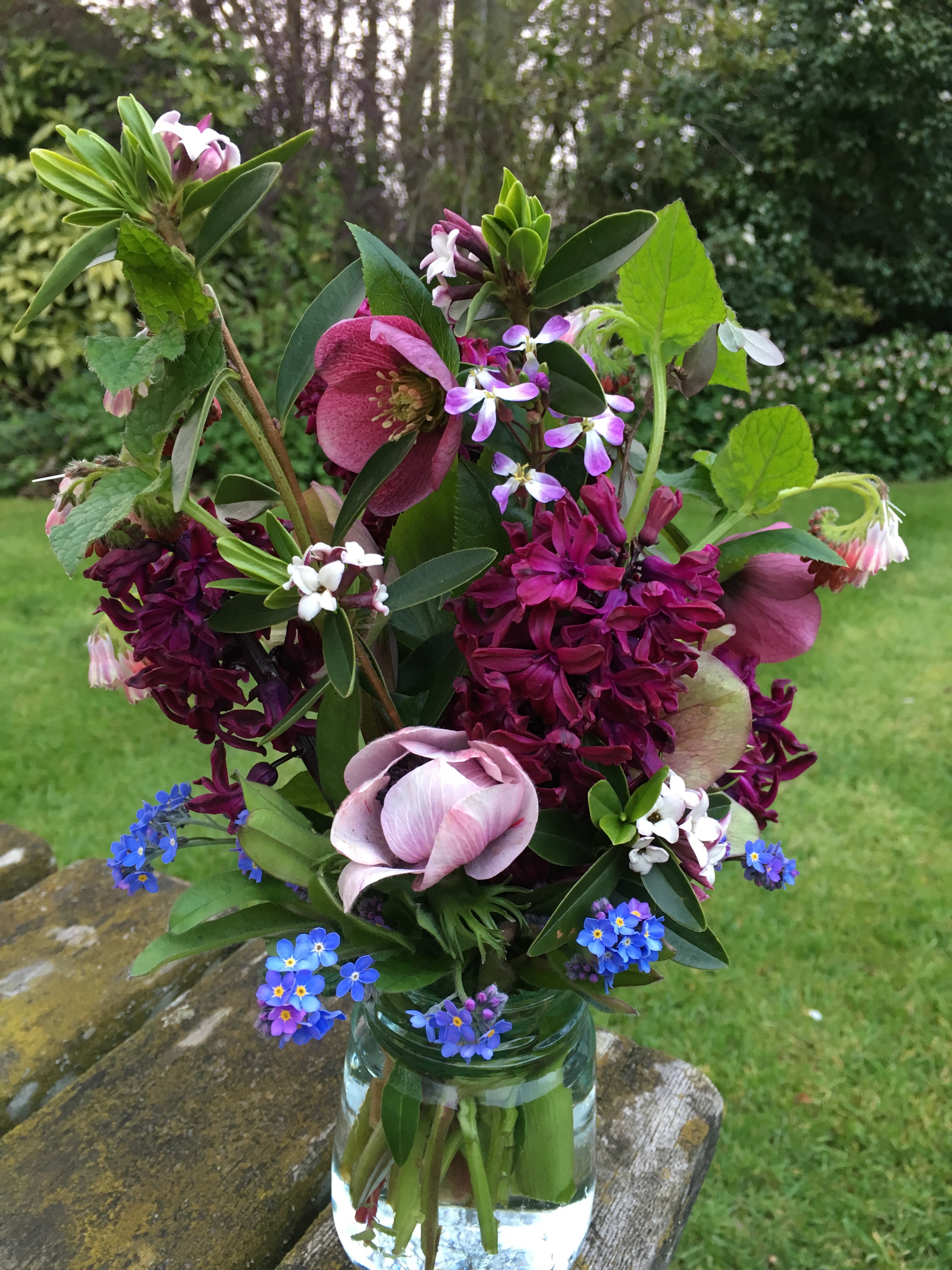
Dark, plum-toned Hellebore Rachel, with ruby hyacinth Woodstock, surrounded by Prunus Kojo-no-mai, ribes, Viburnum Eve Price, and pink comfrey.

The first of the wild cherry blossom. Simply beautiful. Pure and bright.

The last of the paperwhite narcissi and some skimmia. Deliciously scented.

Keep in touch and let me know what you are doing in your garden. Are you managing to get any seeds sown yet?

Sending love, hope and good wishes to you all. xx

Links: In a vase on Monday: https://ramblinginthegarden.wordpress.com/2020/03/16/in-a-vase-on-monday-change-of-plan/

Last of the late snowdrops – and snowy pictures of my garden

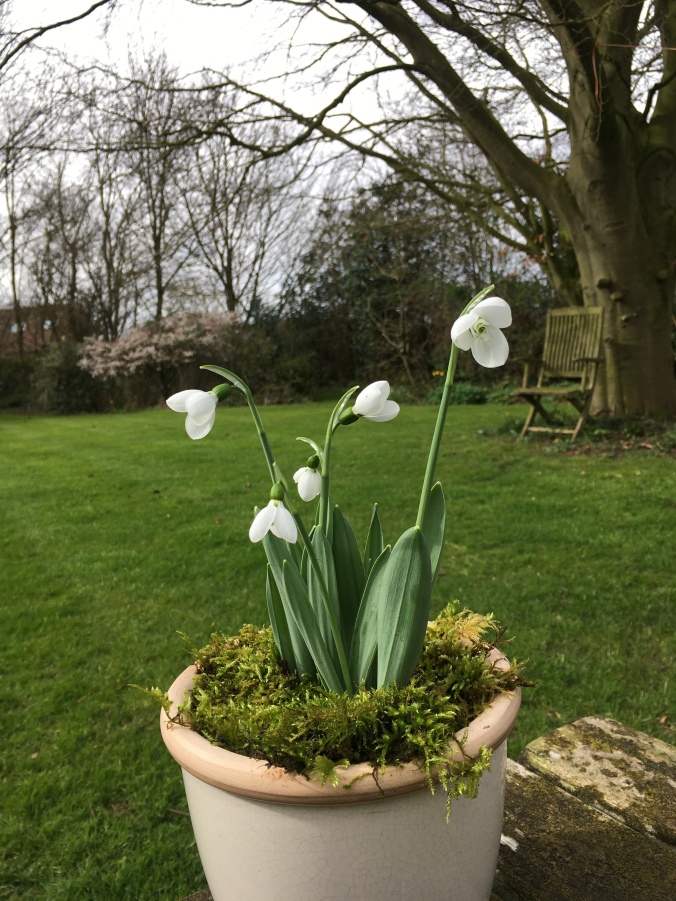
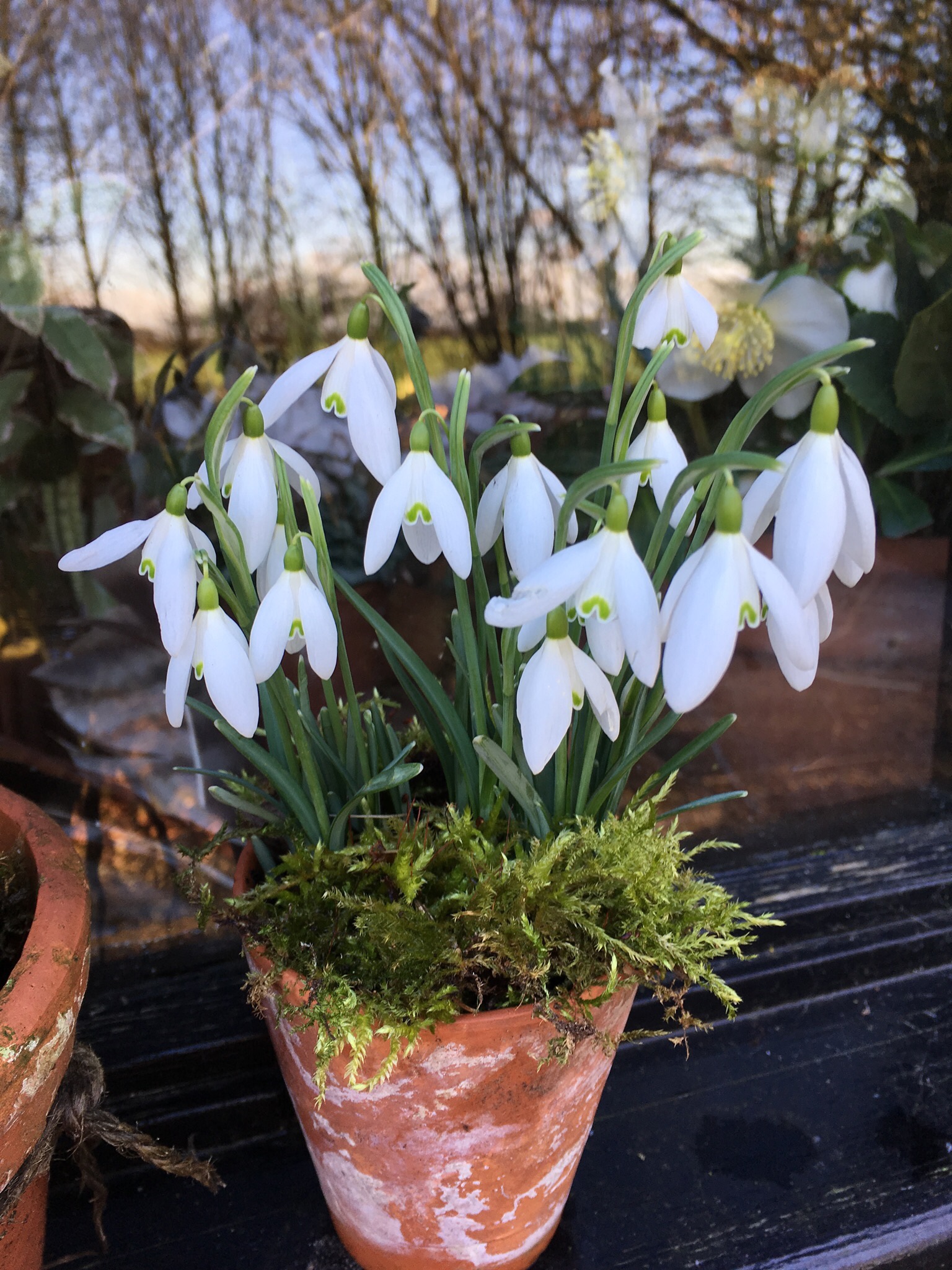
Patience often pays off. I’ve been watching the prices for this new and expensive snowdrop. Then, when most of the flowers had gone over, the garden centre reduced the price! It was my lucky day. Galanthus Polar Bear is my new favourite snowdrop, and it’s a quite a beauty, isn’t it.

I managed to find a pot with flowers still in bud. It’s a very late flowering type with short pedicels, making the flowers fling out and look up at you. So unusual, as most snowdrops bow their heads and look down. It’s got a lot of charm, and is the star of my potting shed windowsill at the moment.

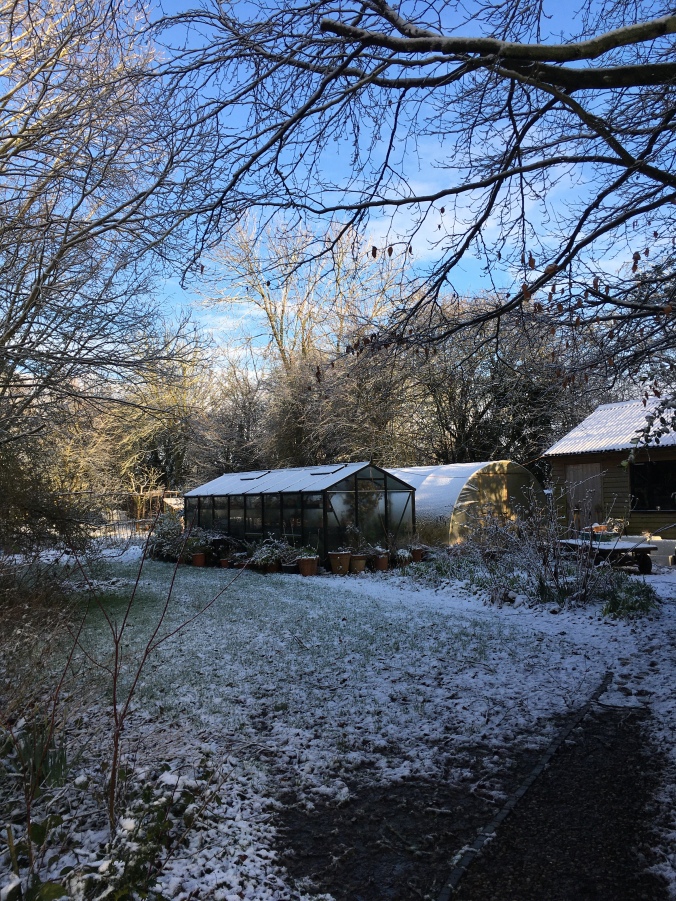
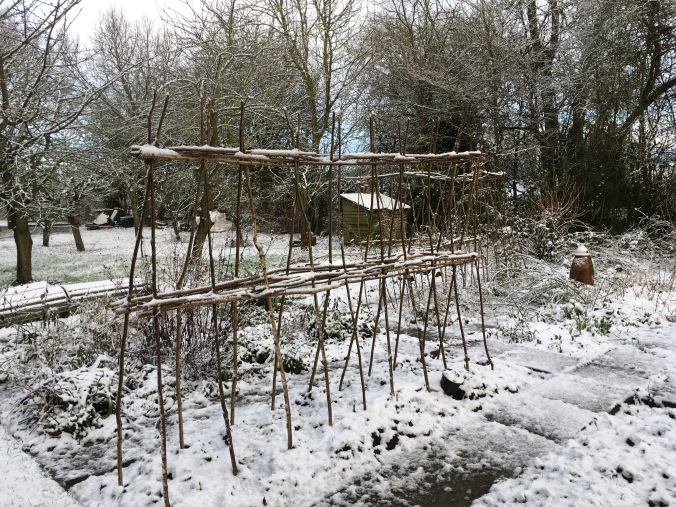
While we are still talking about snowdrops, I thought I’d show you some snowy photos of the garden. It’s been the mildest wettest winter on record here, and this is the first, and only snow we’ve had so far. It makes the garden look magical and hides all imperfections (fortunately.) No weeds are on show, and brambles look ornamental with an iced topping of snow. Here you can see my greenhouse, polytunnel and potting shed set up, all close together to save walking too far between them. In front of the potting shed there’s some renovated 1930s plant nursery trolleys. Very useful for moving plant pots about, and for staging potted displays. My second-hand poly tunnel has doors both ends which is great for good air circulation. The 20ft Alton Cedar greenhouse is also second-hand and renovated by my husband. We painted it black, and made matching black staging inside. Beyond is my cut flower and veg patch and then the orchard, before you reach the paddock gate leading to the ridgeway footpath.

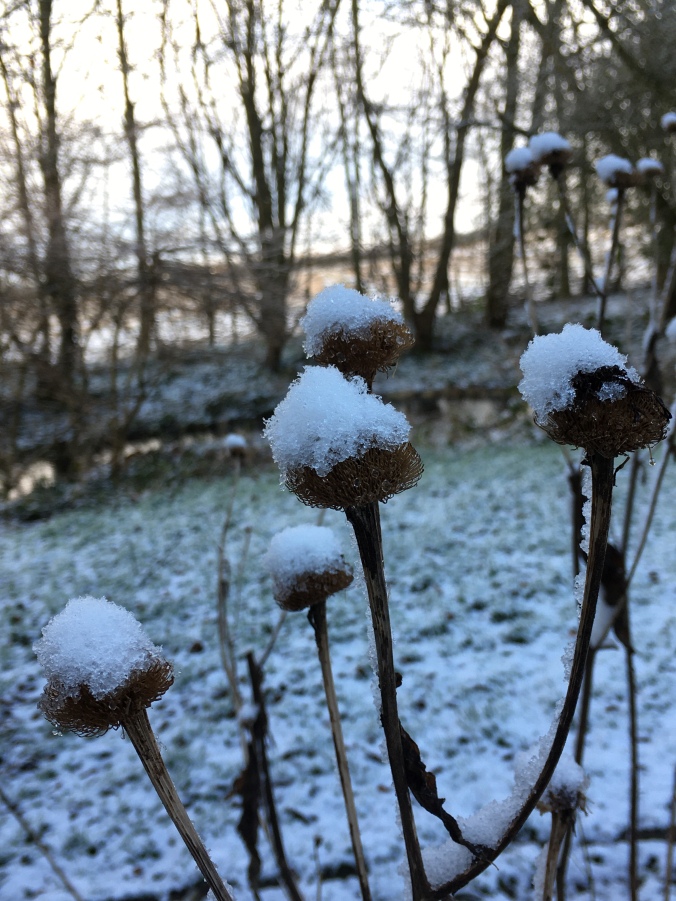
In the exotic border in front of the potting shed, I’ve left stems and seed heads intact for birds to eat and insects to find shelter. These innula seeds look pretty with a topping of snow.

The horseshoe pond can viewed from the potting shed windows. There’s a gently-sloping boulder beach to stand on, and this gives easy access for hedgehogs, frogs, newts and grass snakes. It’s very calming to stand and watch the ripples from raindrops. Today the pond is a cauldron of frogs, mating and producing frog spawn.

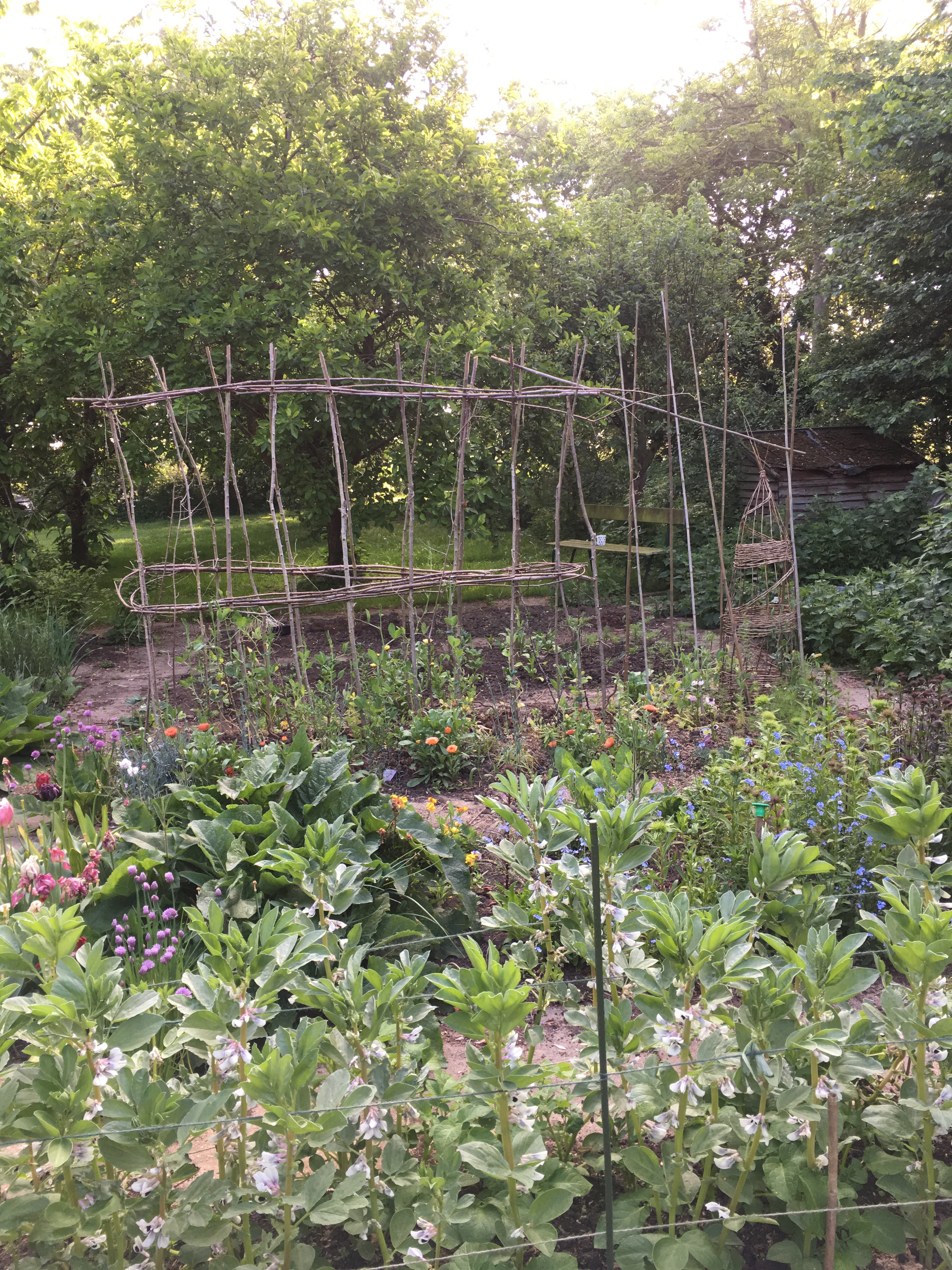
From the pond you can see the cut flower and veg patch. My hazel sweet pea supports have weathered three named storms on consecutive weekends. Really, if they can cope with all that, I think they will stand firm and strong for the summer display. There’s little slab paths between the plots so I don’t have to walk on the soil. It’s a no-dig garden inspired by Charles Dowding who’s been a patient and valued mentor these last few years, along with his partner Stephanie Hafferty. They’ve both given me lots of advice and I’ve got more value out of my plot thanks to their suggestions.

At the end of the veg plot there’s a small orchard, rather neglected. We’ve pruned it this winter which means we might lose some of the crop in the summer. But over a few years we will get the trees back into shape and down to a manageable size for harvesting. Under the trees I’m planning a wild flower patch. I’m going to leave some grass and see what happens, I will sow some plug plants in another area, and finally I’ll try a wild flower lawn, ready seeded. I’ll report back on the project.

Finally here’s the view down the field hedge tunnel. This path is made from bark and brushwood chippings from the garden, put through my new Stihl electric shredder. It saves a fortune on bagged bark supplies, plus helps me recycle waste from the garden.

Thank you for reading. Please share on any social media platform , and get in touch and let me know what your garden looks like just now. Comments box is right at the bottom of the page.

Links: Stihl shredders : https://www.stihl.co.uk/STIHL-Products/099364/Garden-shredders.aspx

Polar bear : https://www.avonbulbs.co.uk/spring-planted-bulbs-and-snowdrops/galanthus-snowdrops/collectors-snowdrops/galanthus-polar-bear

In a Vase on Monday- flowers from my plot 9th March 2020

Finding comfort in familiar things, I’m joining in with my favourite IAVOM theme today.

Spring flowers always bring hope. And we need plenty of hope at the moment, don’t we.

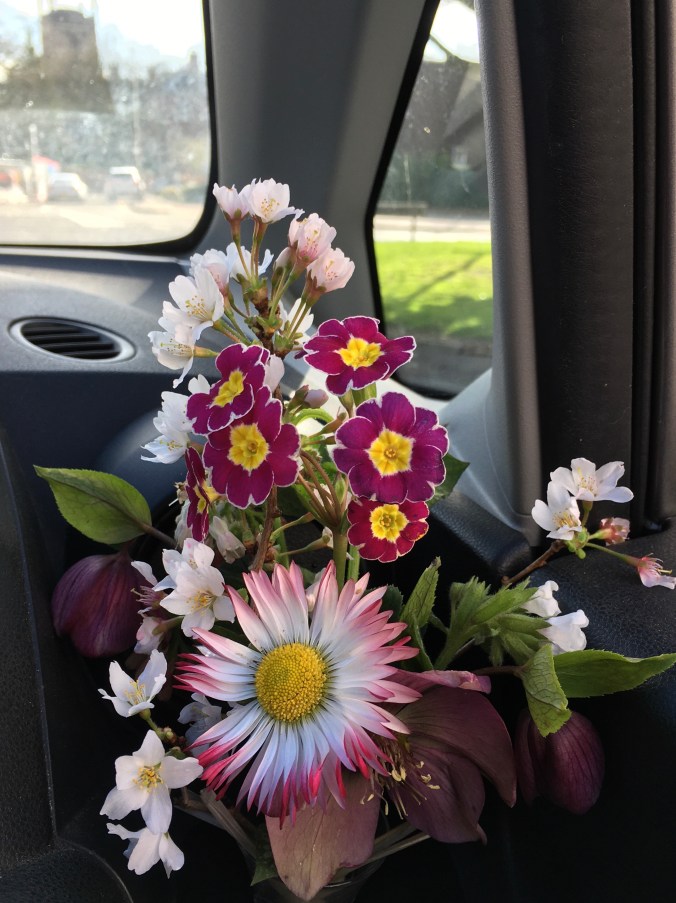
Here’s my flowers, picked fresh from the garden. They are in an unusual location, the drinks holder of my car. The perfect place for a jam jar of flowers, on their way to my mother’s house (via Radio Leicester, where I talk about what’s growing on my plot).

There’s some shoots of Japanese cherry, Prunus Kojo-no-mai, at the back of the posy. Some lace-edged heritage primulas, Pulmonaria Sissinghurst White, plum coloured Hellebores, and one very pretty bellis daisy.

The daises have grown all by themselves in the gaps between paving slabs at my back door. Something so pretty, just growing from seed carried on the wind. They have given me as much joy as anything I’ve planted and tended, probably because they have survived against the odds. There’s no soil there. And no loving care. But they have thrived. A message to us all, about resilience, maybe.

I love the slightly messy, many petaled flowers of bellis daisies. There are single and double forms. Seed packets cost a couple of pounds. Once you have them, they will always be with you. But not necessarily growing where you put them!

In my mother’s garden, the daisies romp delightfully across the lawn and into the border. She mows around them. It’s obvious where I get my empathy with plants from. My lovely mum has always been my greatest influence in life.

Wishing you all a peaceful, happy and successful week. I’d love to see what you are all sowing and growing in your garden just now. It’s very busy here, with plenty to do in the garden, as always. Hoping for some sunshine and nice weather – soon.

Links: In a Vase on Monday https://ramblinginthegarden.wordpress.com/2020/03/02/in-a-vase-on-monday-pillaged/

Bellis Daisy: https://www.mr-fothergills.co.uk/Flower-Seed/Bellis-Goliath-Mixed.html#.XmZXWoGnyfA

BBC Radio Leicester, gardening starts at 1pm every Sunday with Dave Andrews https://www.bbc.co.uk/programmes/p002zx56. Listen back on Sounds, or ask your smart speaker to tune in to BBC Radio Leicester

Please share via any social media platform. I do not pay for any advertising, and I’m always grateful to anyone who spreads the word and signs up to follow, via e mail. Thank you. 🙂 🌱

Note: I was not driving when I took the photos in my car. Naturally.

Six on Saturday – a celebration of snowdrops in my garden- 29th February 2020

We had beautiful sunny weather for precisely ten minutes today. I ran out, opened the summerhouse doors, took some deep breaths of lovely fresh air. And then it snowed. That was the end of my time in the garden. Me and the cat ran back inside.

I’m sharing six photos of snowdrops, as this is the last day for them here. The snow will finish the snowdrop season in my garden, but it has been a lovely long spell. Snowdrops opened early in the mild temperatures, and they’ve stood up well to the rain, being under flood water several times in the past few weeks.

My favourite snowdrop Galanthus Madeleine has been stunning again this year. I bought it three years ago from Thenford Gardens. I shared a pot of six bulbs with a friend. It’s the most I’ve ever paid for a pot of snowdrops, but it was worth it. This year, I had nine flowers and plenty of extra leaves which shows it is happy and spreading. Pictured above are some of them on show in the potting shed. I love the way the petals fold around each other like the wings of a bee. So delicate.

Here is Madeleine fully open on the potting shed windowsill. It’s a very pretty snowdrop at all stages. The yellow markings are brighter in sunnier situations, and bulbs don’t like to be too wet.

Viridapice is another snowdrop I love. It has such pretty delicate lime green markings. Another good do-er. It is spreading nicely under the ash trees in the wild garden.

Living on the boundary between Leicestershire and Nottinghamshire, I felt I had to have Galanthus Robin Hood. I’ve been many times to Sherwood Forest where Robin and his merry men are said to have lived. This snowdrop got its name from the crossbow X- shape green markings. It’s a very tall snowdrop and I have it at the top of the garden so you’ll pass by on the way to the back fields footpath. I have Galanthus Little John nearby, and I’m searching for a snowdrop called Maid Marian to complete the trio. They make me smile every time I see them.

Regular readers will know that I’m a bit lackadaisical with labelling. Sadly I’ve lost the name of this beauty. Maybe a reader will know what it’s called. Isn’t it striking though, with three petals spreading out like wings.

Quite honestly, I’m just as happy with our native snowdrop Galanthus nivalis. Plain and simple. It’s gorgeous.

I hope you’ve enjoyed this weekend snowdrop tour. I also hope you are having better weather than us at the moment. We’ve had a week with 12 Environment Agency flood alerts in one day. The greenhouse has flooded more times than I can count. I just keep sweeping the mud and water out of the door. I’ve never known a winter like it.

Please leave a message below to let me know what your gardens look like right now. How are you coping with the deluge?

Thank you for reading and please feel free to share on any social media platform as it all helps. I don’t pay for any promotions of any kind. I simply rely on your kindness in commenting and spreading the word.  Scroll down for the comments box, right at the bottom of the blog post.

Links: snowdrops from Easton https://www.visiteaston.co.uk/visit/opening-times-and-prices

Madeleine, https://jacquesamandintl.com/product/plicatus-madeleine/

Viridapice https://www.crocus.co.uk/plants/_/galanthus-nivalis-viridapice/classid.2000008237/

Robin Hood https://www.harveysgardenplants.co.uk/product/galanthus-robin-hood/

Sherwood Forest https://www.visitsherwood.co.uk/about-robin-hood/

Chocolate and Mandarin Crispy Cake Bars

Family Favourite Recipes.

Here’s the recipe for today’s BBC Radio Leicester cakes. I always take some home made cakes in each week for the Sunday staff. Our gardening programme is on at lunchtimes and we all get very hungry.

https://bramblegarden.com/tag/family/

This week’s recipe has the addition of some mandarins from the greenhouse. Add some zest to the mixture and place mandarin segments on top before the chocolate sets. Quite delicious for a cold wet day. You could also add Terry’s Chocolate Orange segments if you like.

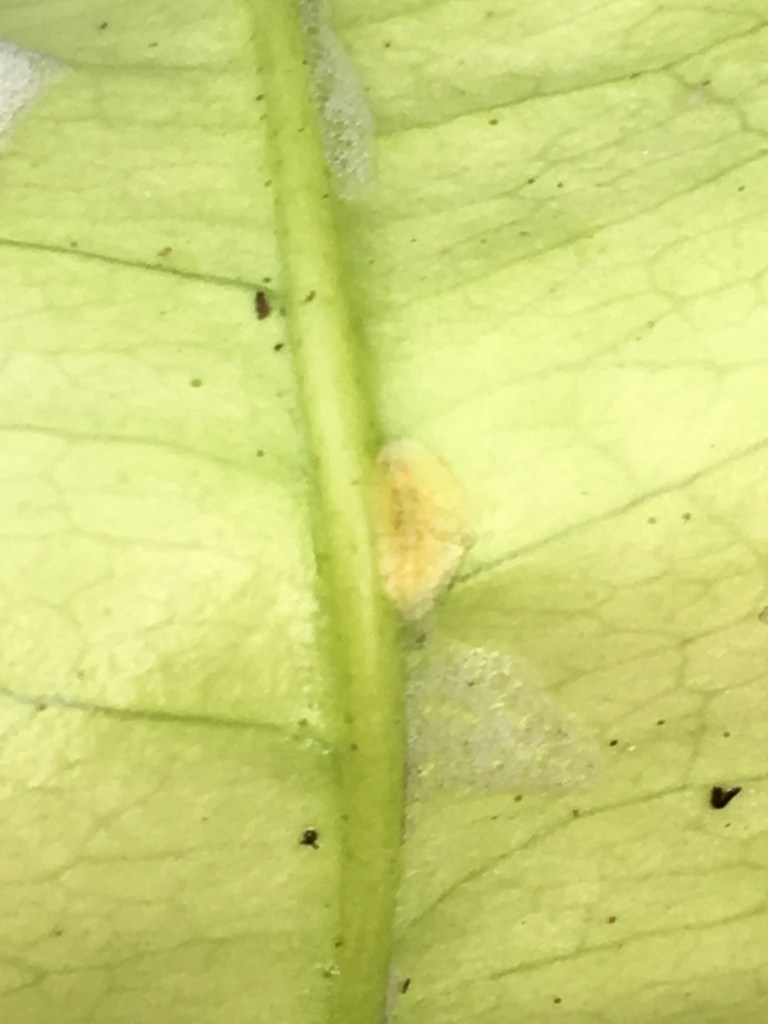
My cakes and home made treats relate to what I’m growing in the garden. This week I was talking about starting to water my citrus trees, feeding them and looking under the leaves for scale insects. You can sometimes find little flat insects attached to the leaves, and there might be black mould as well which is caused by their sugary excretions. You can scrape the scale insects off with a damp loofah sponge. Use horticultural soft soap to clean off the mould.

Scale insect on a citrus leaf

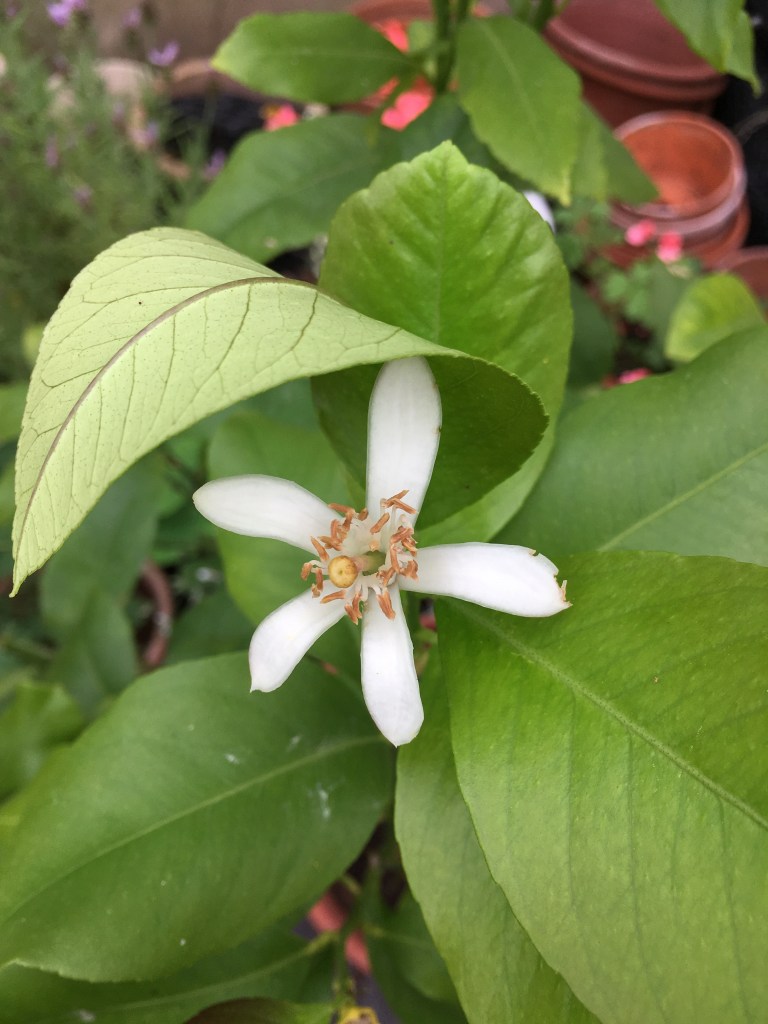
Citrus flower. Gloriously ~highly scented.

Links: https://bramblegarden.com/tag/family/

Citrus trees: https://www.victoriananursery.co.uk/Citrus-Fruits/

Caring for citrus trees https://www.rhs.org.uk/advice/profile?PID=94

A Walk Around my Garden Saturday 8th February 2020

Welcome again to a peaceful walk around my garden. Enjoy the sunshine and spring flowers. The temperature today is 9C. There was frost overnight. It’s still too wet to garden, so I’m continuing to tidy the potting shed and mooch in the greenhouse. I expect all the spring jobs will come at once and I’ll soon be dashing about. But for now, it’s a slow meander around the pathways, taking in every tiny jewel-like flower, breathing in the honey-scent of snowdrops. Looking in the pond for signs of life- no frogspawn yet. Soon though. There are stirrings. I peer into the water trough and watch a tiny water boatman. I watch like a child in a trance as the tiny oar-like legs propel the boatman around its miniature world. A world I created. A simple metal tank, with a few spare oxygenating plants thrown in. I marvel at how easy it is to help wildlife. I quietly whisper ” I made this for you.” The water boatman dips and dives and delights in its domain. And I revel in every second of quiet and calming observation, with no other purpose than to just enjoy this moment.

White primulas on the garden tables. We’ve had honey bees looking for pollen, and a few sleepy bumble bees ‘bumbling’ about crashing around the garden. I’ve rescued a few, utterly helpless and disorientated, and set them upon a patch of wild primroses.

Aconites, or gold coins, as we call them, are spreading nicely in the far corners of the garden, undisturbed. This is the first year they have had to fight with cowparsley leaves, emerging early due to warm temperatures. I might have to intervene.

There’s more cowparsley at the top of the garden. I’ve never seen it look so lush in February. The hellebores will have a race to flower and set seed before being over-run by the pretty but invasive weeds.

At the top of the garden we store our wood ready for chopping for the fire. I stood and marvelled at the beauty of this red-stained heartwood. Sadly the tree succumbed to disease and died. But it will have another purpose for a year or two as a home for spiders, woodlice, springtails, beetles – insects that will in turn provide food for mammals such as hedgehogs, and birds. Blackbirds and robins thrive in this garden.

Snowdrops are spreading along the leafmould paths. Each year I divide them and move them further along the tree-lined tracks.

Snowdrop corner. Filling out nicely. Snowdrops come from Easton Walled Gardens, Hodsock Priory and National Garden Scheme open garden days.

Snowdrops look cheerful placed on the potting shed windowsill where I can look out and see them while I’m working indoors.

I’m very fond of this snowdrop, Galanthus nivalis Viridapice. Such delicate green-tipped petals.

I bought just three Madeline snowdrops three years ago from Thenford gardens. It must be happy, as now there’s nine flowers. It grows in nice moist leaf-mould soil under deciduous trees.

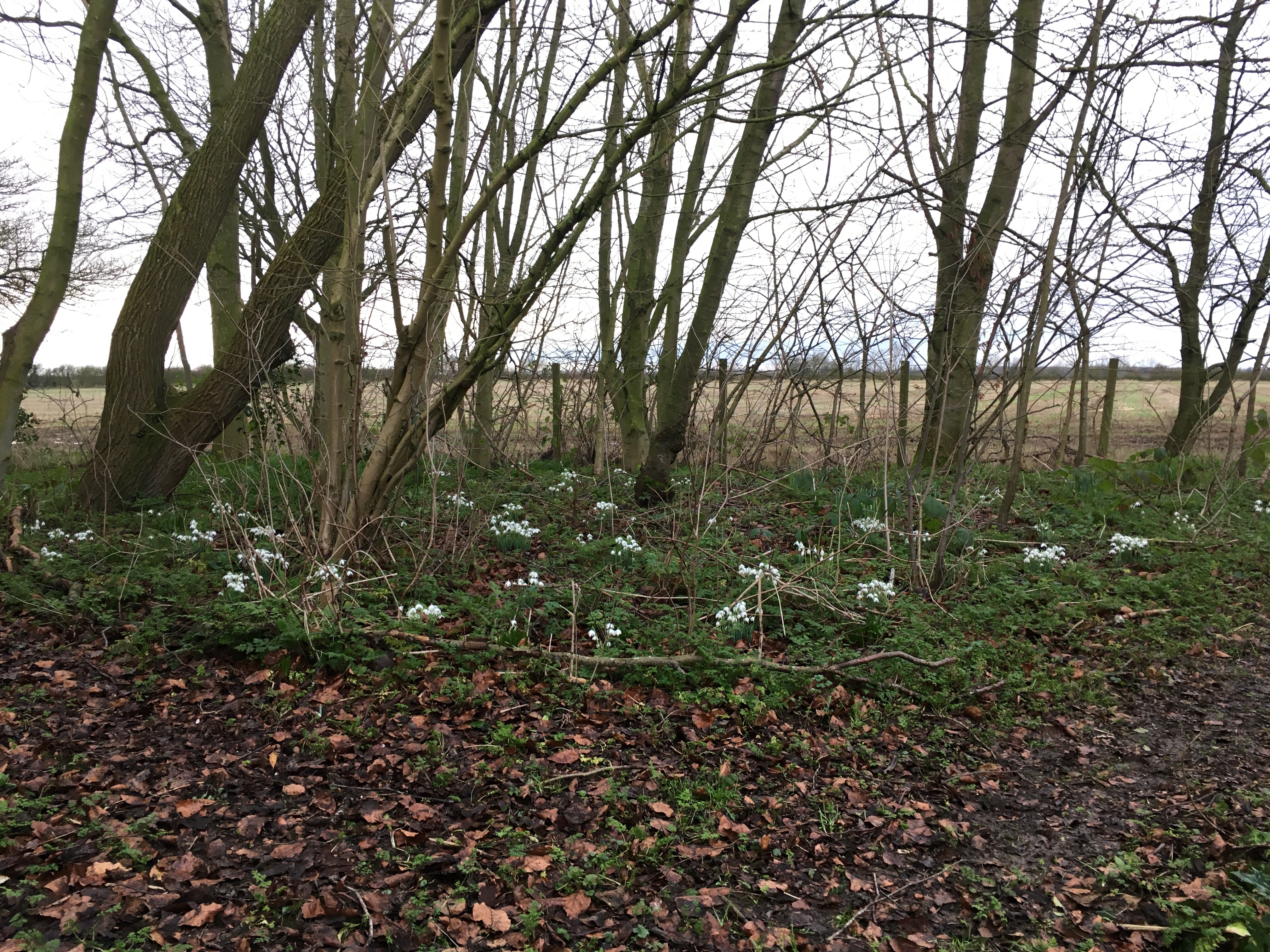
But I’m just as happy with my plain native snowdrops, Galanthus nivalis, growing all along the hedgerow between the garden and the lane.

Regular readers know that after a ramble around the garden, I always take you out of the top gate and along the ridgeway footpath behind my plot. It’s good to see the changing seasons in the countryside. Our neighbouring farmer has finally managed to plough the field. It’s the first time he’s been able to get on the land due to the record amounts of rain we’ve had here over autumn and winter. Ditches are still full, and overflowing at the bottom of the hill.

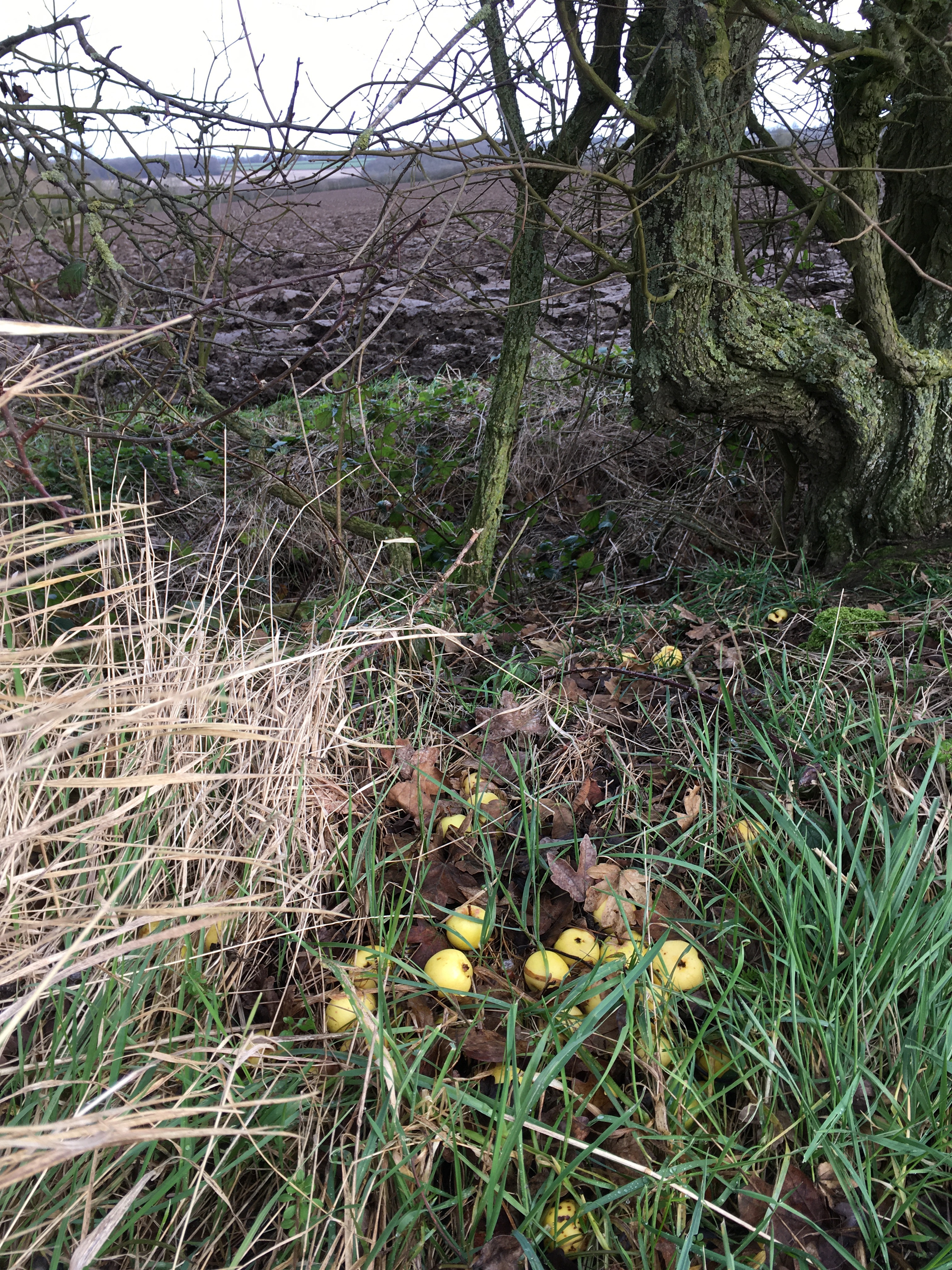
There’s still a few crab apples lying in the hedgerow. We had a record harvest last autumn. Good news for all the birds and mammals eating them through the winter.

Some welcome signs of spring. Blackthorn blossom is starting to emerge.

And elderflower leaves are unfurling. The hedgerow is waking up.

Almost hidden in the brambles is a concrete trig point. A reminder of the past. Measurements were taken from theodolites placed on top. This one dates back to around 1936. They were built between the 1930s and 1962 and sited on the peaks of hills. It’s no wonder our garden is so windswept. We are at the highest point for miles around.

I hope you’ve enjoyed your walk around my garden. Leave me a message to let me know what’s flowering in your garden right now. And thank you for reading. I’ve checked the ‘stats’ and I am amazed to see 140,000 views for the piece on the dangers of sepsis and gardening injuries, and 70,000 views of these quiet rambles around my garden. I’m very grateful for every single reader.

Links: Six on Saturday- I follow this blog and like to join in. https://thepropagatorblog.wordpress.com/2020/02/08/six-on-saturday-08-02-2020/

In a Vase on Monday- another blog I enjoy: https://ramblinginthegarden.wordpress.com/2020/02/03/ina-vase-on-monday-in-the-queue-for-green/

Waterboatman: https://www.wildlifetrusts.org/wildlife-explorer/invertebrates/bugs/lesser-water-boatman

Snowdrops, Easton https://www.visiteaston.co.uk/

Snowdrop festival NGS :https://ngs.org.uk/snowdrop-festival-brings-first-signs-of-spring/

Blackthorn https://www.woodlandtrust.org.uk/trees-woods-and-wildlife/british-trees/a-z-of-british-trees/blackthorn/

Elderflower https://www.woodlandtrust.org.uk/trees-woods-and-wildlife/british-trees/a-z-of-british-trees/elder/

All about the history of trig points : https://www.bbc.co.uk/news/in-pictures-36036561

In a Plant Pot on Wednesday – 5th February 2020

It’s a wonderful moment when potted spring bulbs suddenly flower. They seem to be in bud for weeks. Then virtually overnight, all the iris and dwarf daffodils burst into life. Colour at last. It’s much appreciated on a dark cold February day.

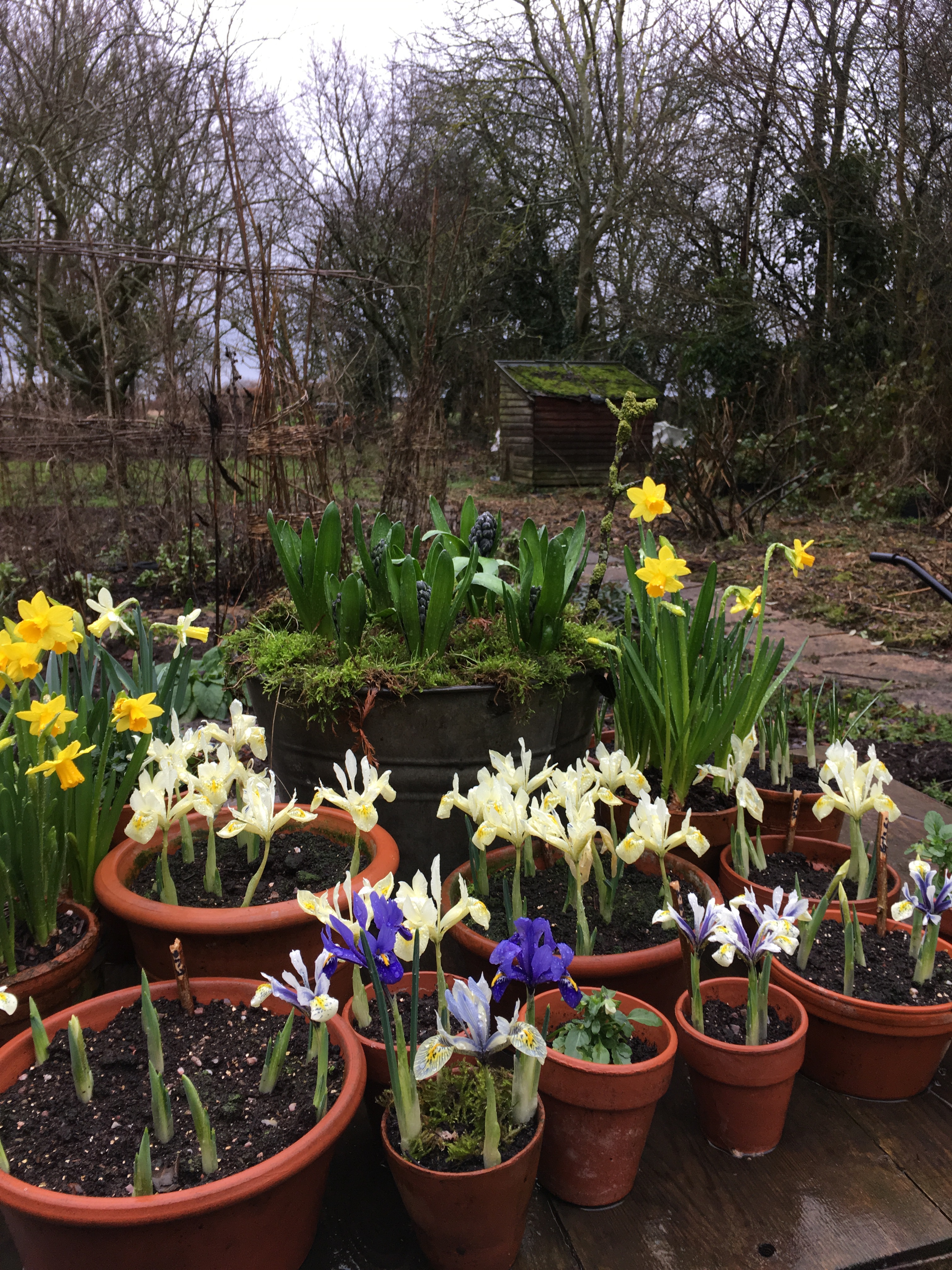
I planted shallow pans of bulbs on October 12th last year. Dwarf iris Katherine Hodgkin is a pale blue beauty with markings resembling blue ink pen lines. Each winter I try something new, and this time I’ve chosen iris reticulata Blue Note, very striking with deep indigo flowers and white markings on purple black falls.

Bulbs are grown on in the protection of the greenhouse over winter, but as soon as they flower I carry the pots about and set them on the garden tables. It’s so cheerful to look out of the house windows and see something colourful.

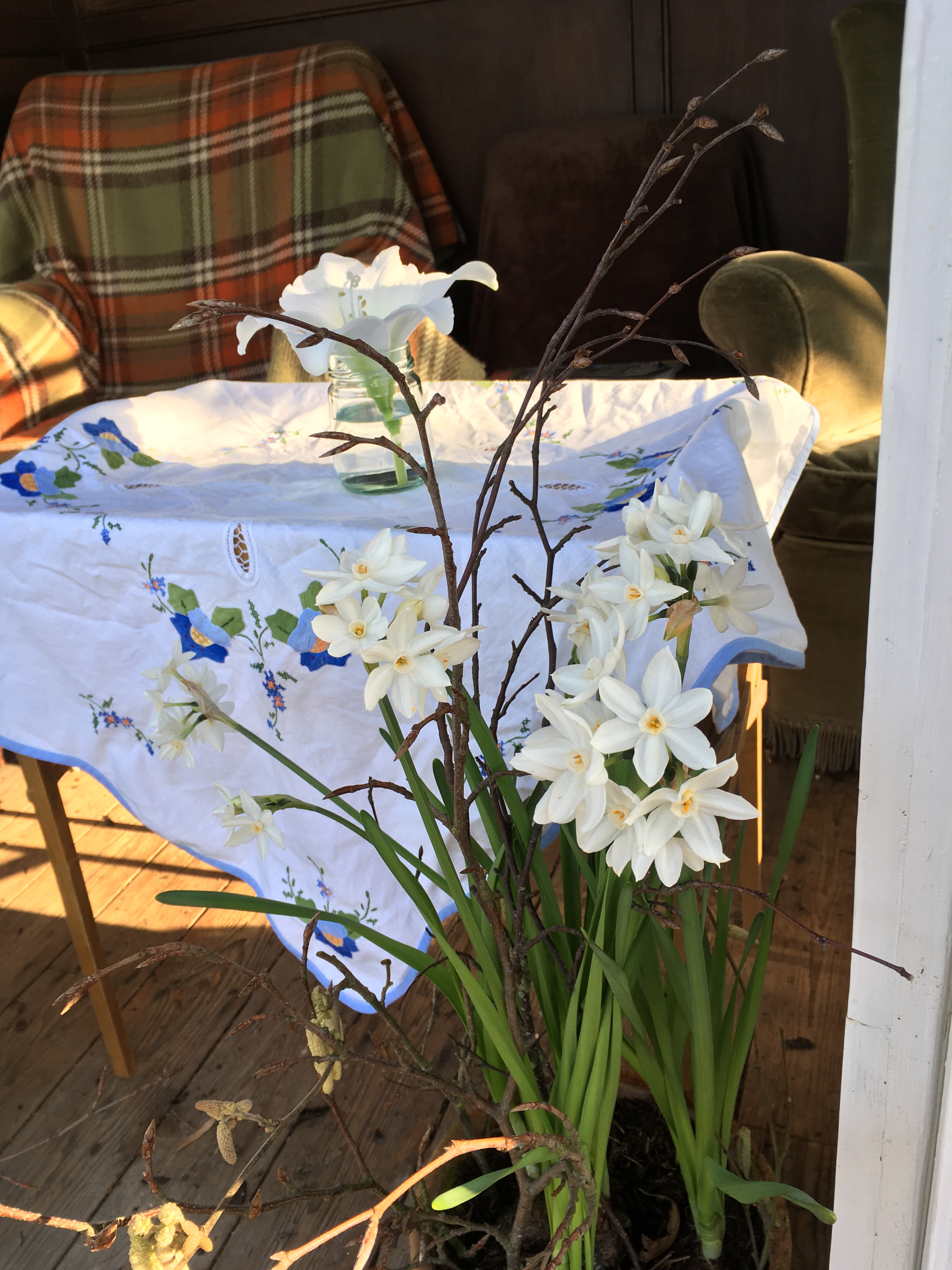
I’ve used pussy willow and hazel catkins to prop up the paper white narcissi. They have a habit of flopping everywhere, but look lovely with a few stems supporting them. On the right of the table there’s some cherry stems in a Kilner jar. Picked now and brought indoors they will open early for a glorious pink blossom display.

Scented paper whites might be too strong for indoors, but on the garden tables they are perfect. The creamy white flowers are a pretty accompaniment to emerging fluffy grey willow catkins.

A large Sankey terracotta plant pot of Narcissus February Gold makes a centrepiece for the picnic table. Hazel twigs are used for supports.

Here’s how I started out in October with a selection of terracotta plant pots, many inherited from my grandfather Ted Foulds.

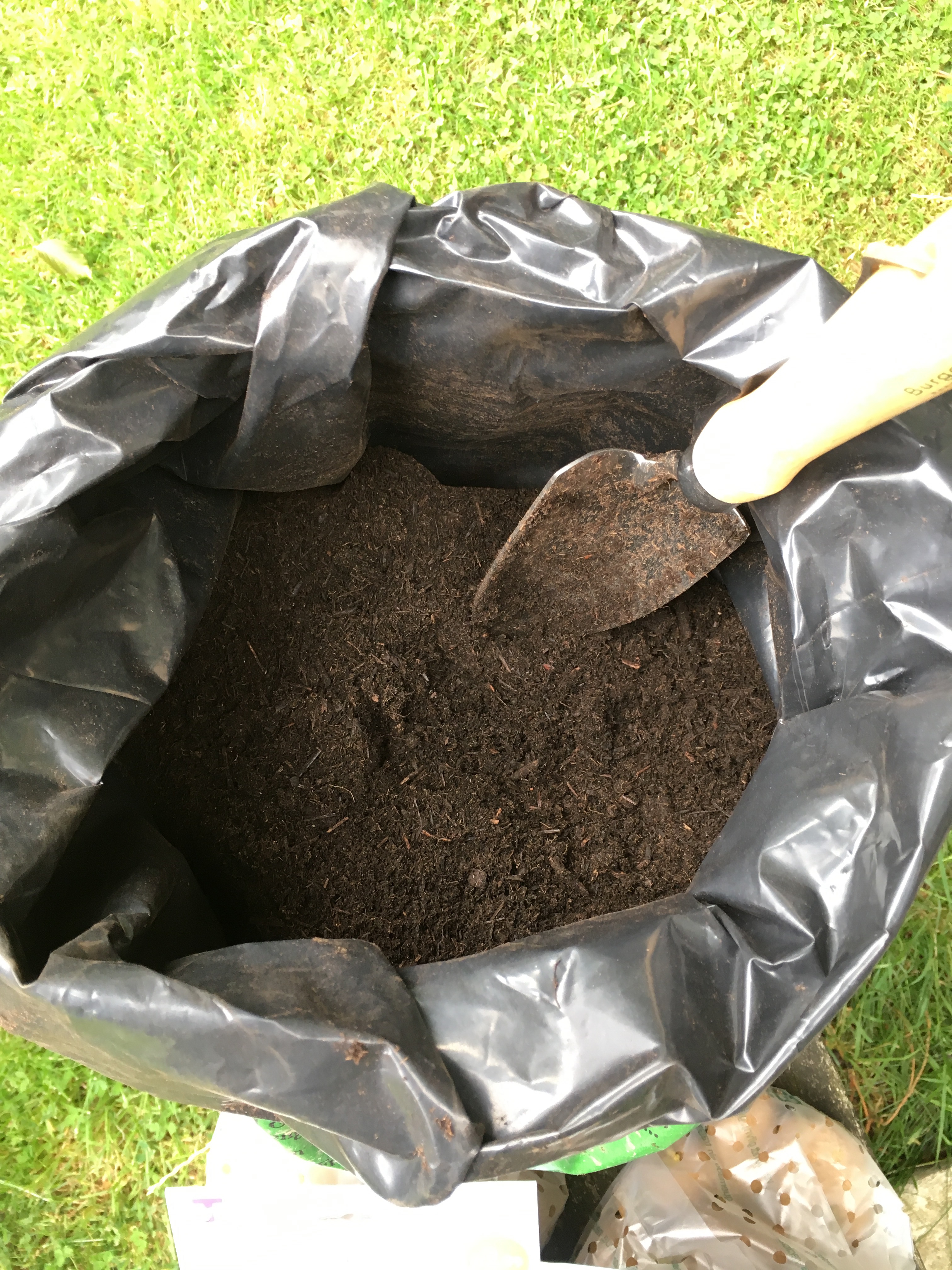
I use a mix of 50/50 peat free compost and grit for good drainage. Bulbs are planted half way down the pots. They are watered once and placed on the greenhouse staging.

Pots are topped with extra grit to finish them off. This keeps the flowers clean and stops them being splashed with soil when watering.

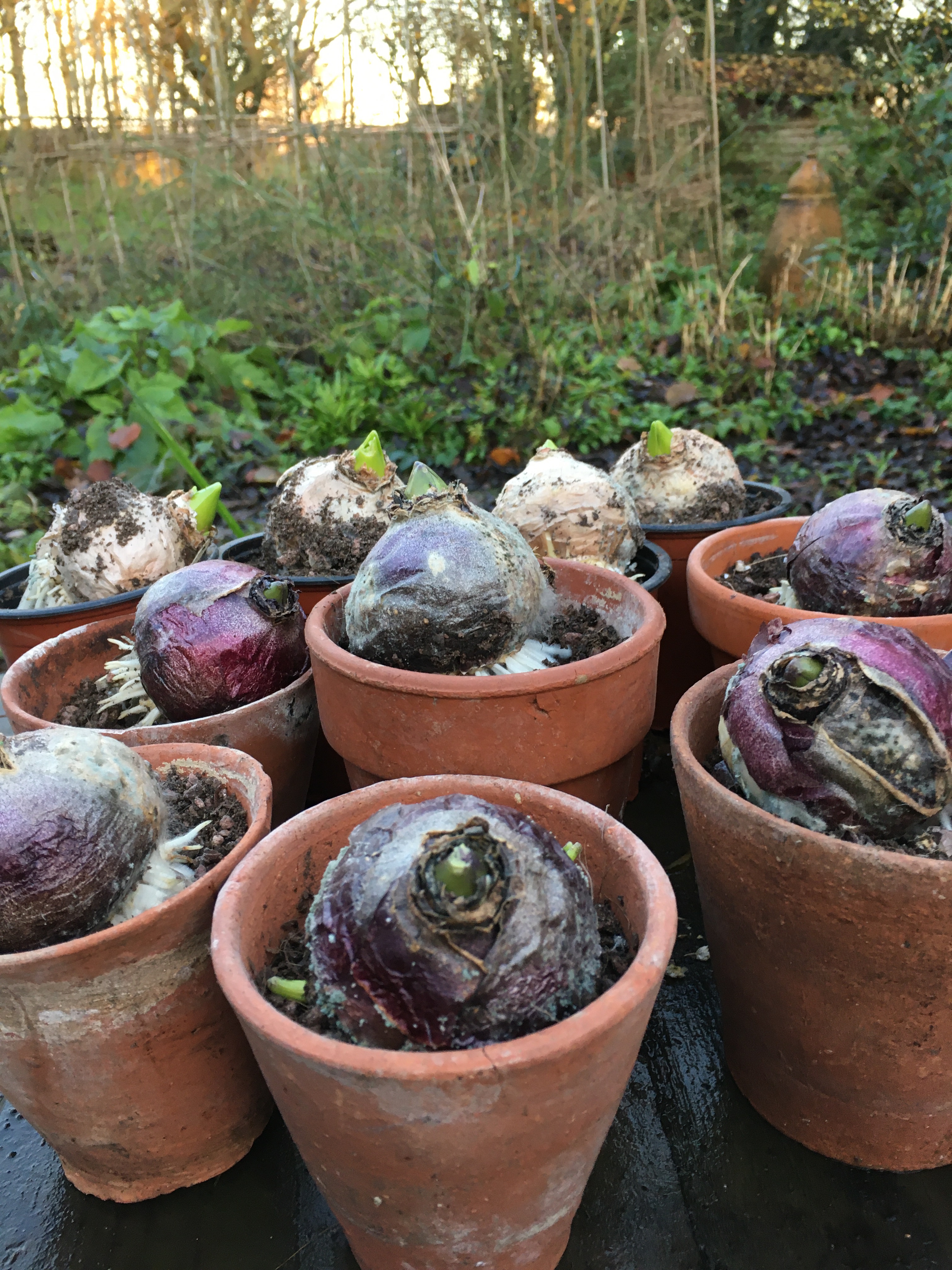
Hyacinths are almost perched on the top of compost in individual 4″ pots. These are placed in a huge plant pot under the potting shed bench in dark, cool, frost free conditions and brought out just before Christmas when flower spikes are showing.

Here’s the view from the potting shed in October as I’m planting all these bulbs. A lovely reminder of all the sunny autumn days we had.

For contrast, here’s an oak tree from the lane where I live. Just as beautiful. Like a charcoal pencil drawing.

Have your spring bulbs started to flower this week? Are you trying anything new, like me, as well as sticking to a few old favourites too.

Get in touch and let me know what’s happening in your garden at the moment.

I am @kgimson on twitter

Karengimson1 on instagram

Links: I like to join in with Cathy for #IAVOM In a vase on Monday, but this week is was working, and my flowers are in pots! But I’ve read and caught up with everyone’s postings

https://ramblinginthegarden.wordpress.com/2020/02/03/ina-vase-on-monday-in-the-queue-for-green/

Bulbs came from Gee Tee bulbs. https://www.gee-tee.co.uk/

Compost from Dalefoot : https://www.dalefootcomposts.co.uk/our-products.aspx

A Walk Around My Garden Saturday 1st February 2020

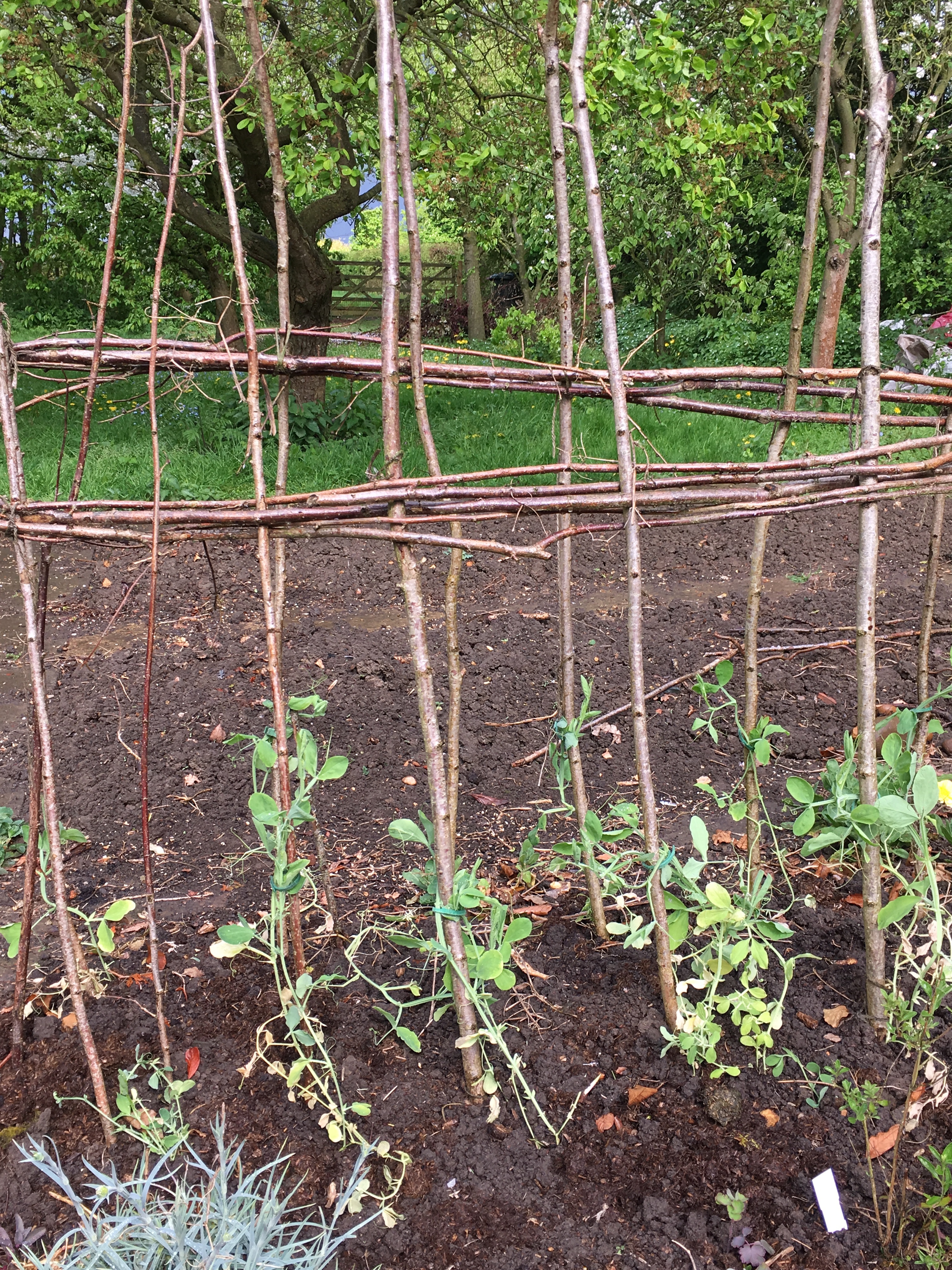
Suddenly we go from sorting seeds, writing lists and thinking about gardening- to actually getting out there and making a start. It’s a wonderful feeling to be outdoors. I can happily mooch about all day. This week I made a new sweet pea support out of hazel poles.

Usually I use our own hazel material, but I cut them down last year and I’m leaving them to grow taller for a pergola project. There’s always something planned for the future. For this year’s sweet pea frame I visited a local farm fencing suppliers and bought two bundles of rods. These are sold as binders for hedge laying, but make perfect pea and bean poles.

I push the rods into the ground in two rows 60cm apart, with 30cm between each pole. The ground is still very wet and it’s relatively easy to push them in. I tie each pair of rods at a height of 180cm and then weave more hazel and twiggy stems along the top and also at waist height to strengthen the frame.

Here’s my supports from last summer. I love the natural rustic look and sweet peas easily twine around the hazel poles without too much attention and minimal tying in. These supports will last about three years if they are reinforced each year. At the end of their useful life, they’ll be composted. For local supplies try https://coppice-products.co.uk/

Sweet pea seeds are growing well, but there’s still time to start yours now. Planted in early February, they will make good strong plants to flower from July until first frosts. I’m growing a mixture of heritage varieties from Easton Walled Gardens and some new ones from Mr Fothergill’s including Mayflower 400 celebrating 400 years since the Pilgrim Fathers sailed to The New World. There’s nothing like the scent of sweet peas. It’s difficult to buy them from florists, but luckily for us, they are cheap and easy to grow at home.

I’ve written about making a sweet pea support for the weekly Garden News Magazine. There will be photos from my garden in the 11th February edition. I’ve also written about starting my dahlias into growth to take cuttings, and refreshing the compost in my lemon tree pots and starting feeding and watering them. With temperatures being unusually mild for winter, I’m making the best of the sunshine and getting a head start for spring.

What projects have you got planned for 2020. Are you growing anything new, or sticking with old favourites. Get in touch and let me know what’s happening in your garden.

I am @kgimson on twitter

Karengimson1 on instagram

Links : SOS I like to join in with #sos at https://thepropagatorblog.wordpress.com/2020/02/01/six-on-saturday-01-02-2020/

And also with Cathy at #IAVOM https://ramblinginthegarden.wordpress.com/2020/01/27/in-a-vase-on-monday-a-good-spread/

Hazel supplies https://coppice-products.co.uk/

Mr Fothergills seeds http://blog.mr-fothergills.co.uk/mr-fothergills-launches-new-sweet-pea-mayflower-400/

Easton walled garden https://www.visiteaston.co.uk/

Blue Monday in My Garden and Ridgeway Walk – 20th January 2020

Lace-edge primulas, looking glorious in January

Today I’m celebrating. I’ve spent the first full day in the garden for three years. There was much to do! Brambles and nettles have invaded the boundaries, and I couldn’t get down the side of the poly tunnel. Something needed to be done. And luckily my strength and energy levels have returned and I can be outdoors all day. Something I took for granted until becoming seriously ill in 2016. So happily, it’s not Blue Monday for me- it’s three cheers, and hello garden, here I come!

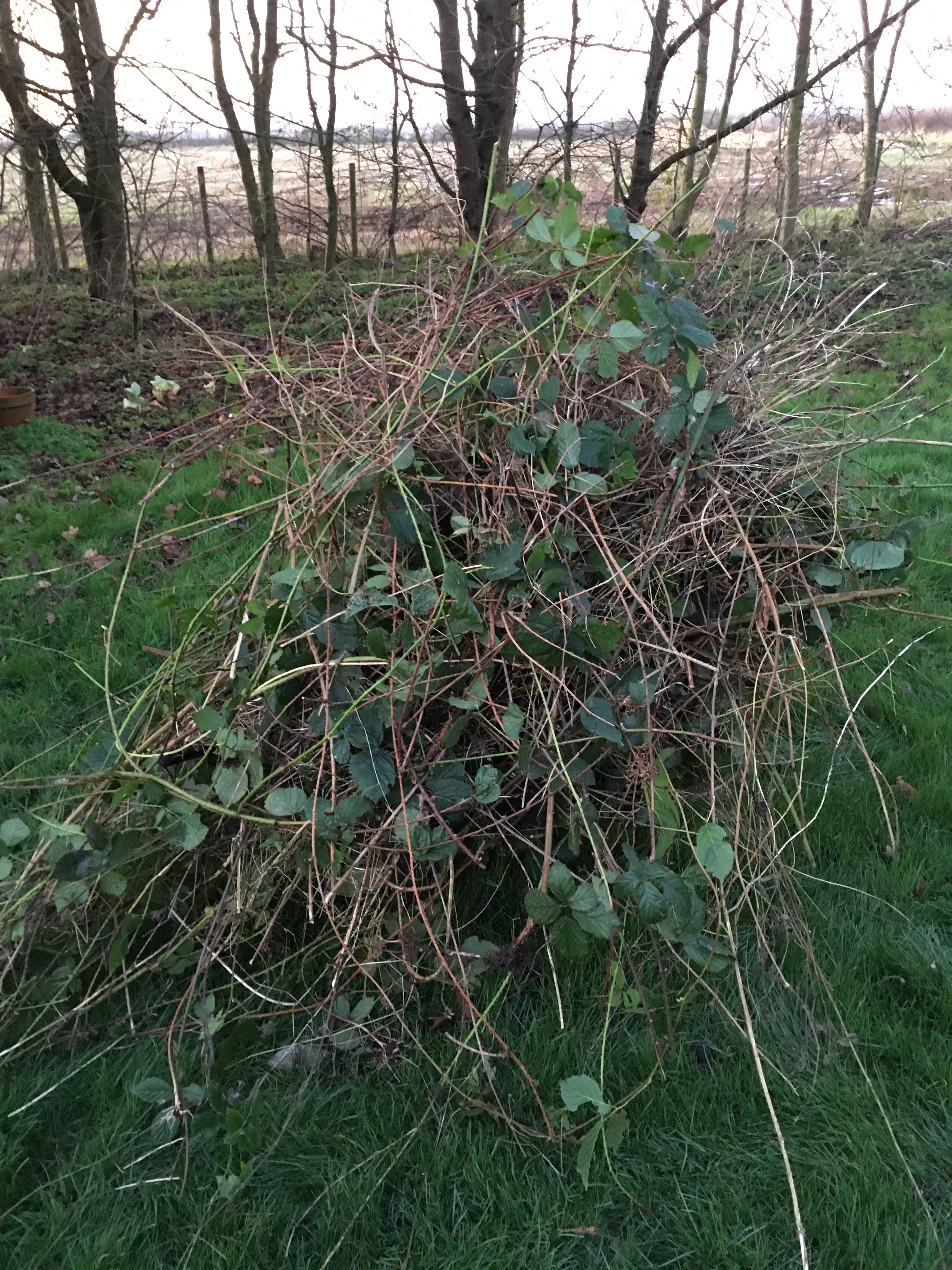
This area round the back of the potting shed and alongside the poly tunnel looks a mess. It’s out of sight and out of mind- until I need to clean the poly tunnel plastic covering. Then I can’t get access. So I set to and cut back all the nettle stems and blackberries. Some of the trailing stems are 4m long. Vicious, thorny things!

There’s a wheelbarrow under there.

Despite wearing tough clothing the brambles manage to ‘get me.’ But I fight back and win. It takes me a couple of hours, much longer than it used to, but I’ve learned to pace myself and celebrate every small achievement. By chipping away at the task the area is cleared, pots washed and neatly stacked and order restored. It’s such a nice feeling, to take back control.

I make a start on mulching the borders. Some of the boundary borders have become over run with plants such as geranium and euphorbia. Perennials like these can be rather too successful. Before 2016, the whole garden was planted with tender perennials, salvias, penstemons, exotics galore. Mum and I would visit rare plant fairs to seek out small treasures. But these require cosseting. I discovered there’s a good reason they are rare. They need splitting, dividing or they disappear. Cuttings require overwintering in a heated greenhouse. They are gone in a flash without tender loving care. I will replant, but hardier varieties are being selected. Newly acquired tender beauties will remain in plant pots, easily scooped up and swept into the greenhouse at the first sign of frost. I’m not giving up on delicate plants, just readjusting the balance.

A whole border of hellebores had to be dug up last autumn. The plants had become overrun with couch grass and weeds. We moved them to the woodland walk where the grass will die out eventually. And I’m delighted to report that hellebores can be moved and thrive. These are looking fabulous. Every one survived in the well-mulched wonderful leaf-mould soil. So pleased, as these were grown from seedlings given to me by a friend.

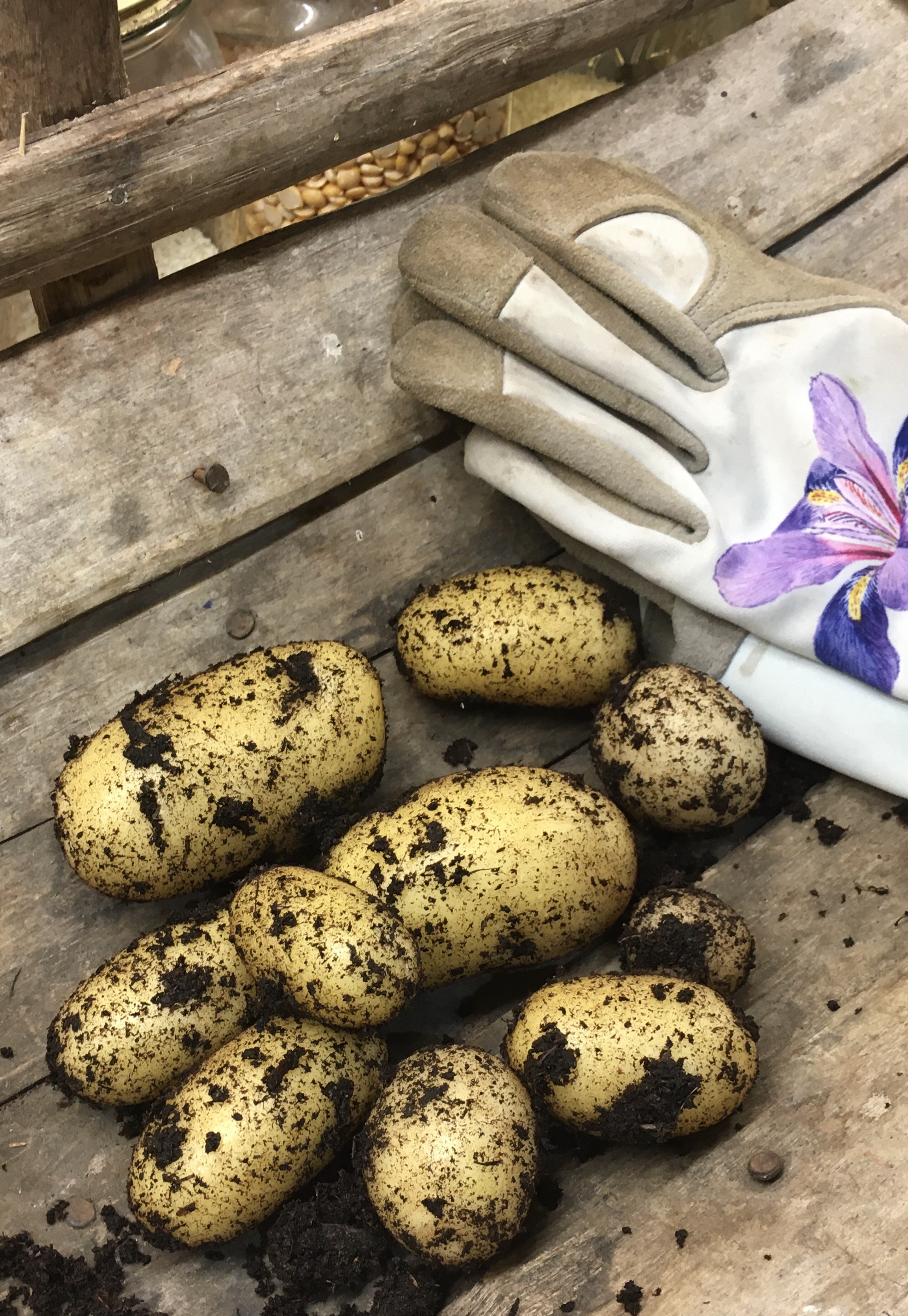
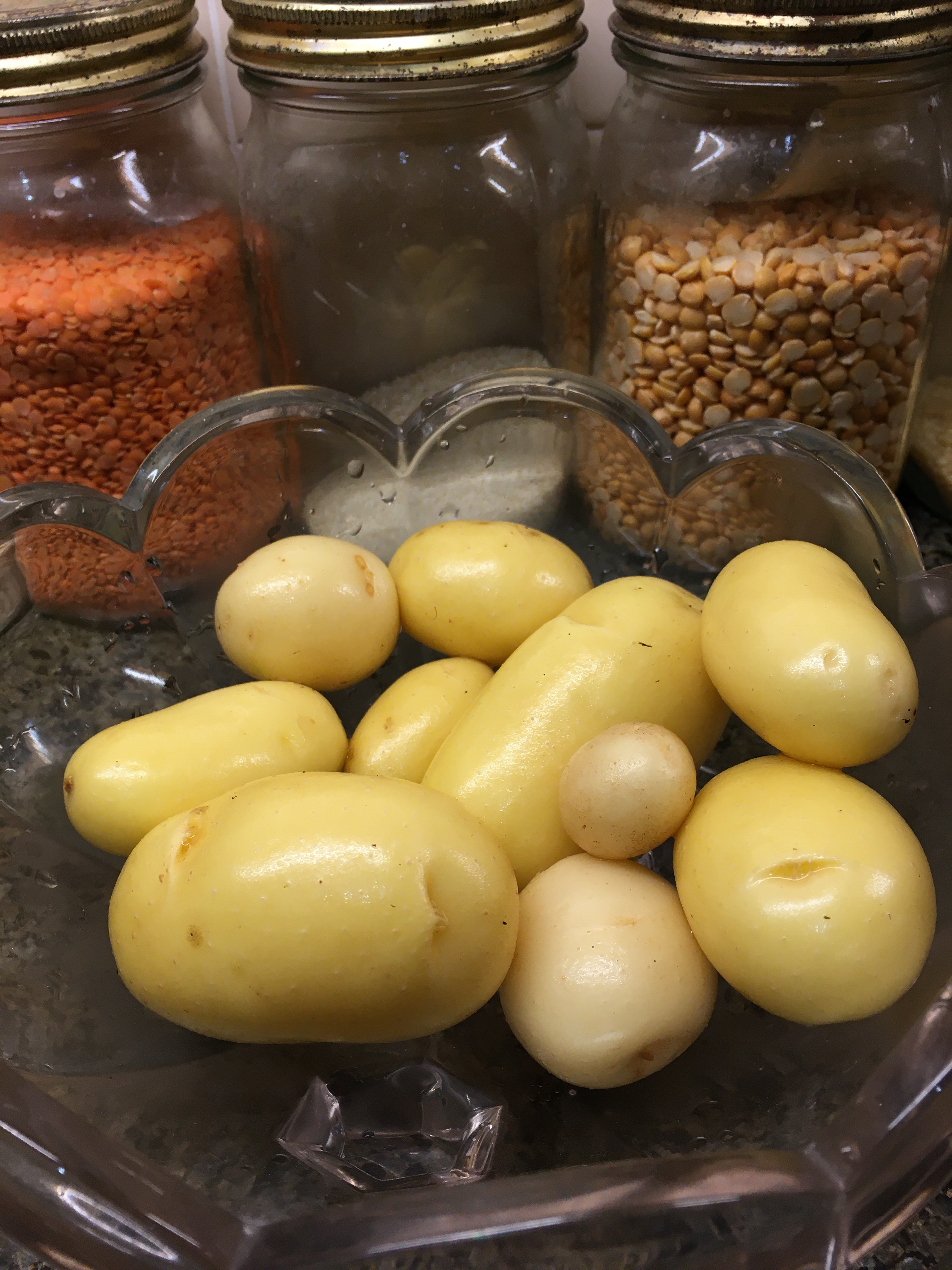
Another cause for celebration. My new potatoes for winter have been fabulous. We planted these on 7th August in recycled compost bags. Well watered through late summer, they grew like triffids. As soon as the weather turned cold, the bags were hauled into the greenhouse to be kept frost free. Since Christmas we’ve had a steady supply of tasty potatoes fresh from the greenhouse. There is nothing more cheerful than new potatoes in the depths of winter. I’ll be repeating the procedure again this year, with double the number of bags.

As always, after a hearty gardening session, as a reward, I head out of the top field gate and walk along the ridgeway path. Is there any finer sight than an oak tree set against a bright blue sky. It’s a sight I’ll never tire of.

A quick peek though the gap-in-the hedge. I wasn’t quick enough to take photos of the pheasants in the ditch on the other side. A magnificent thrill to see them skimming low across the field, their feathers rich and glowing in the late afternoon sun.

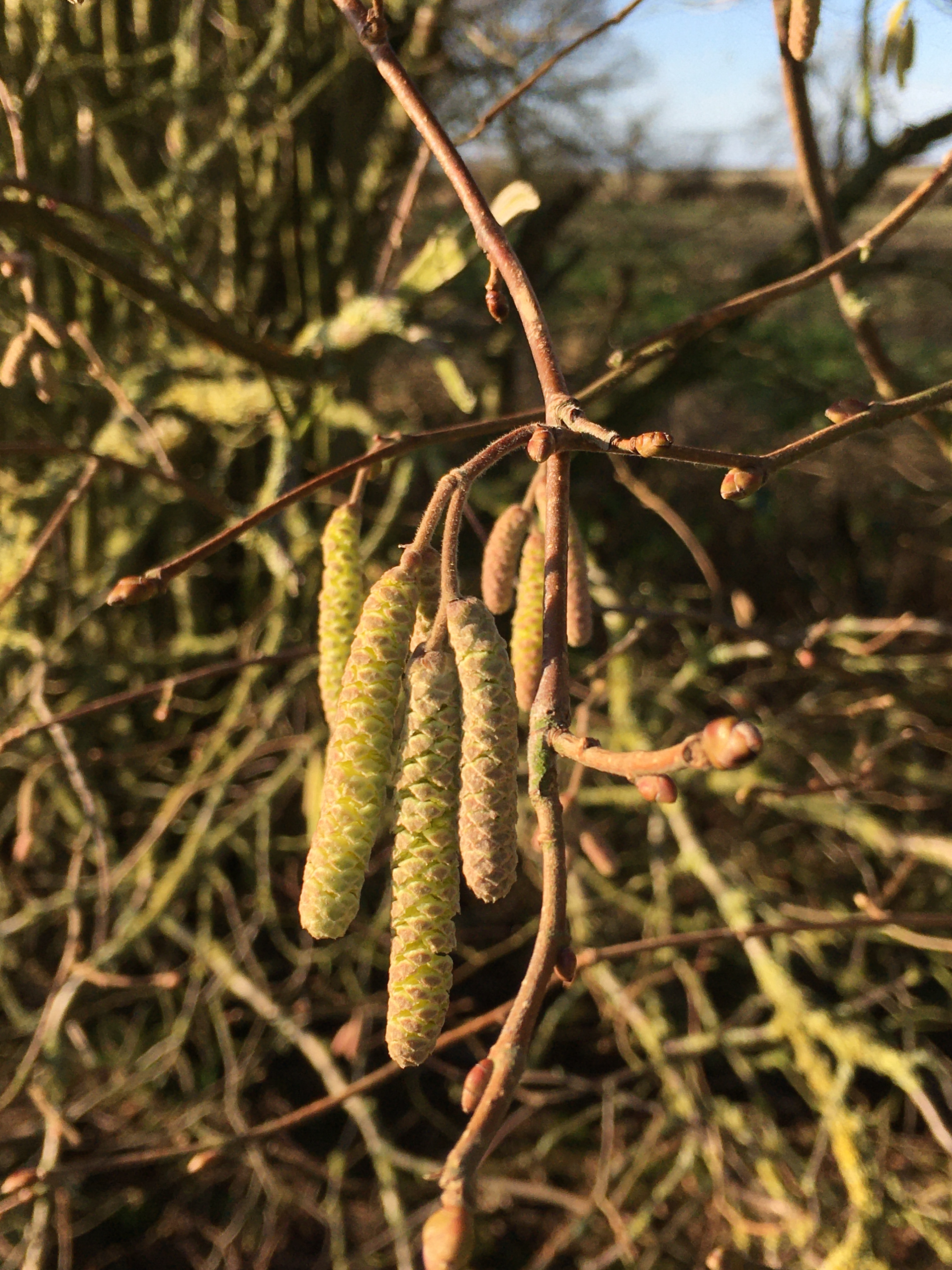
Hazel catkins, a welcome sign of spring. I cut a few twigs to prop up my amaryllis bulbs in the greenhouse. Flowers and catkins always bring cheer.

It’s a circular walk- along the path, down the lane and back home. This is the hedgerow alongside the lane. My favourite oak, on the ridgeway walk, is almost in the centre of this photo.

I stand and admire this 300 year old oak, one of a row. And I think about the farmer who planted them and didn’t live to see them grow to maturity. It’s such a generous act to plant a tree. It’s not for yourself, but for future generations to come. There are some gaps along the lane where elms have died. Perhaps I’ll ask the farmer if I can plant some replacement oaks. And someone else will stand before them, in time, and marvel at their beauty, like I do.

After a cup of tea, I potter about, collecting up plant labels – there are many- and wind-blown pots. I check the greenhouse, first tapping on the door to warn the wrens. They roost on the slider and if I don’t warn them, there’s a sudden flapping of wings around my head. I don’t mind sharing my greenhouse. It might mean the difference between survival and death, in a cold winter.

Turning for home, I notice the time is 5.05pm. It’s a wonderful sunset. And there’s still enough light to mooch about and easily find my way to the back door. Spring is on the way. And I feel ready for all the gardening challenges to come.

Have you spent any time in the garden today? What’s looking good or coming into flower on your plot. Get in touch and let me know.

Links : special primroses from Piecemeal Plants http://www.piecemealplants.co.uk/

Polytunnels, mine was second hand. New ones from https://www.firsttunnels.co.uk/?gclid=Cj0KCQiAvJXxBRCeARIsAMSkApqtMjv4FjaWKWNJbY1MEf_7o_CBJK1XrGe3UABgLDs1weAGIcT3A6caAk26EALw_wcB

I’m using mulch from https://www.bloominamazing.com/.

And also https://www.strulch.co.uk/.

And https://www.plantgrow.co.uk/products/

I wrote about growing new potatoes for winter here :https://bramblegarden.com/2019/08/07/im-growing-new-potatoes-for-christmas/

Compost from https://www.dalefootcomposts.co.uk/our-products.aspx

Seed potatoes from https://taylors-bulbs.com/

Oak trees https://www.woodlandtrust.org.uk/trees-woods-and-wildlife/british-trees/a-z-of-british-trees/english-oak/

Hazel https://www.woodlandtrust.org.uk/trees-woods-and-wildlife/british-trees/a-z-of-british-trees/hazel/

I am @kgimson on twitter, karengimson1 on instagram.

Six on Saturday 11th January 2020- Flowers in my Garden

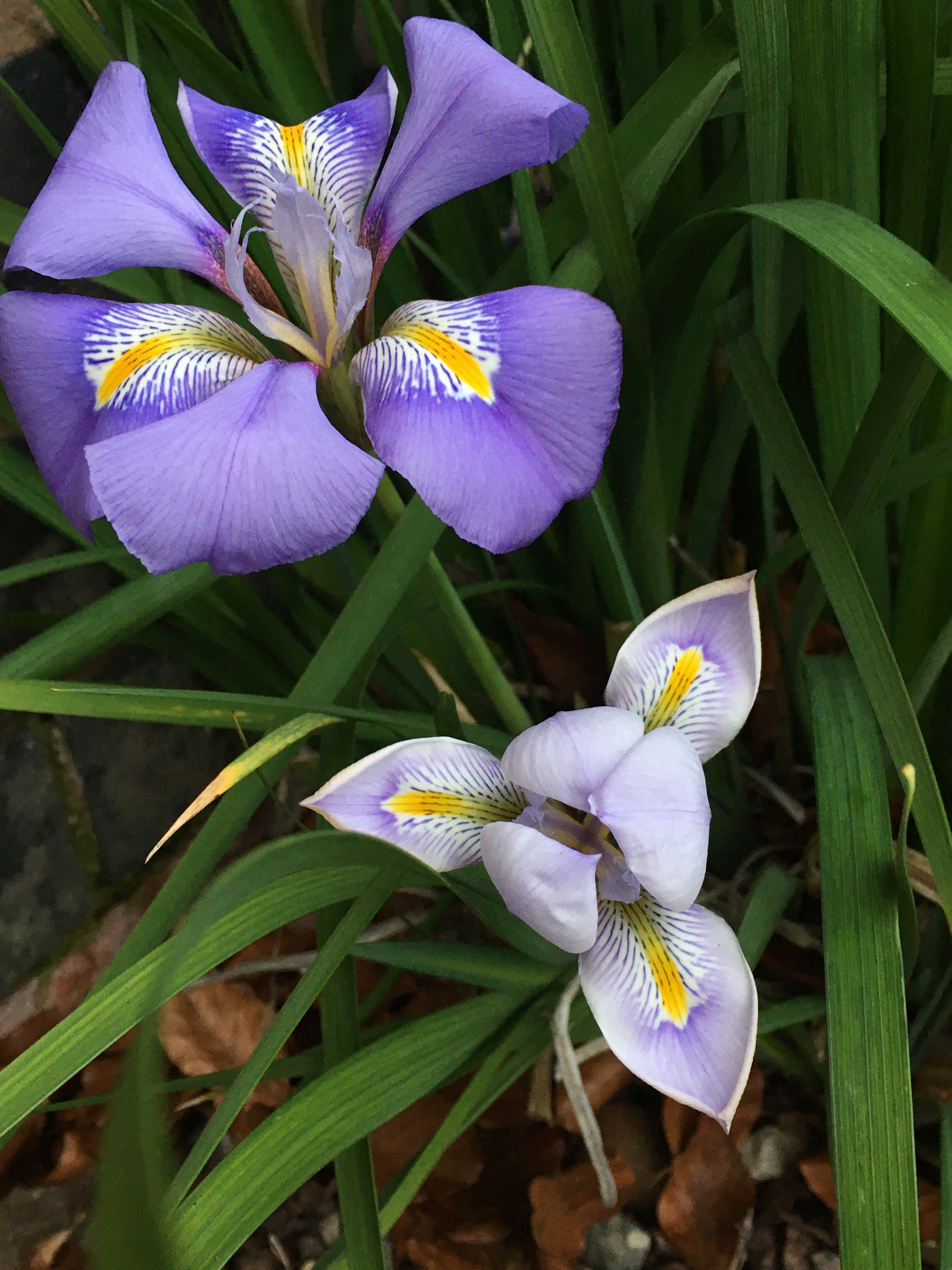
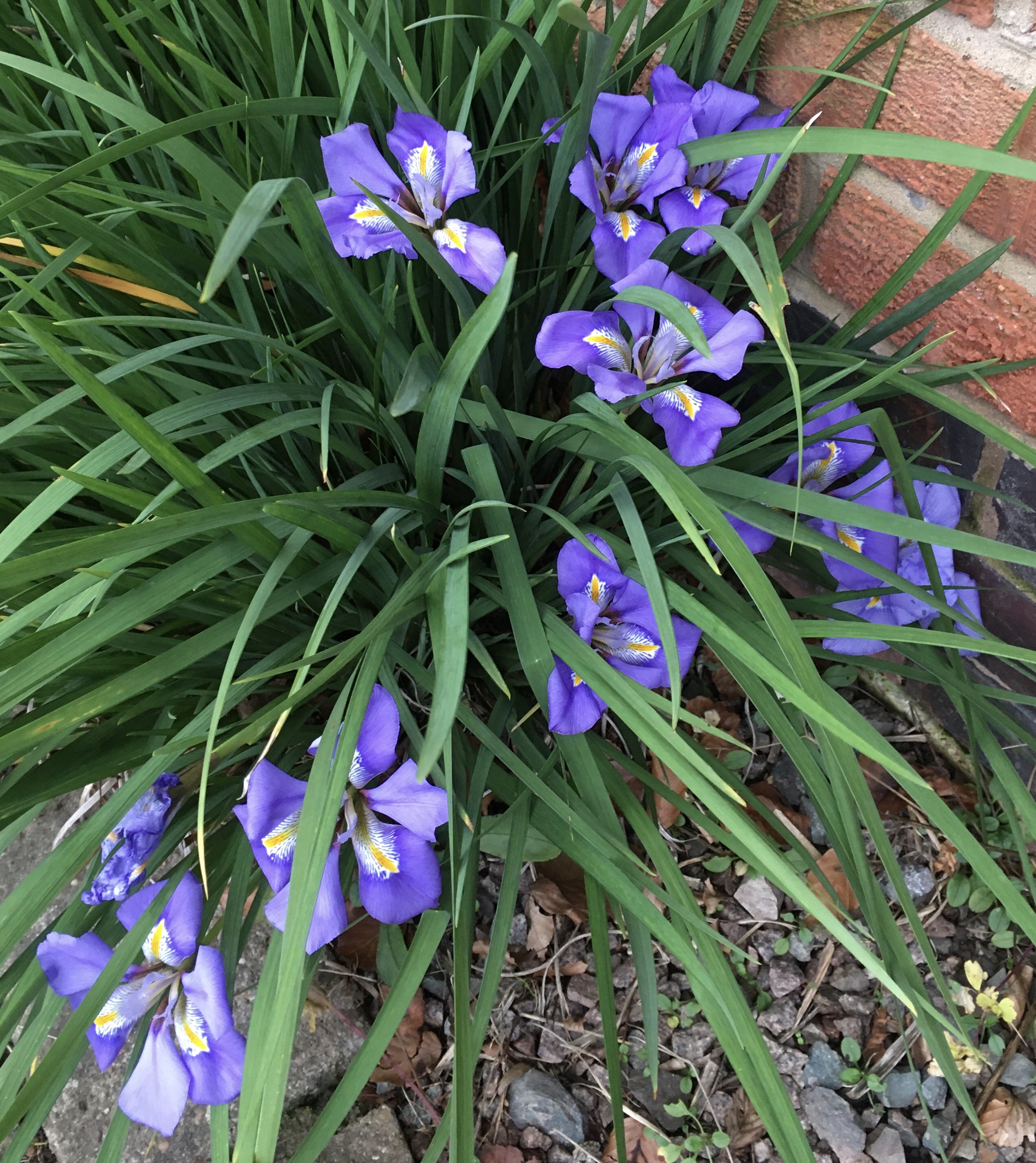
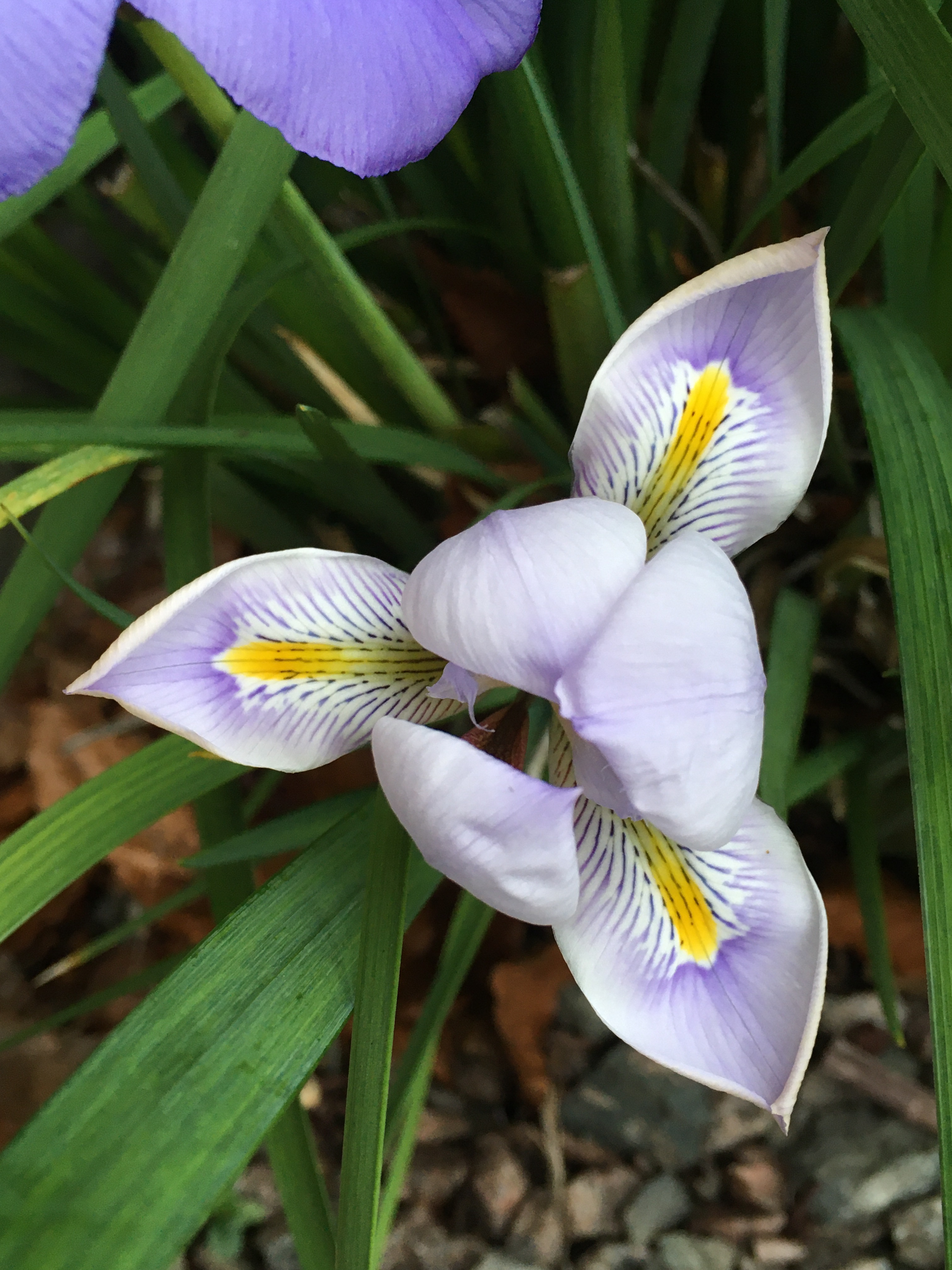
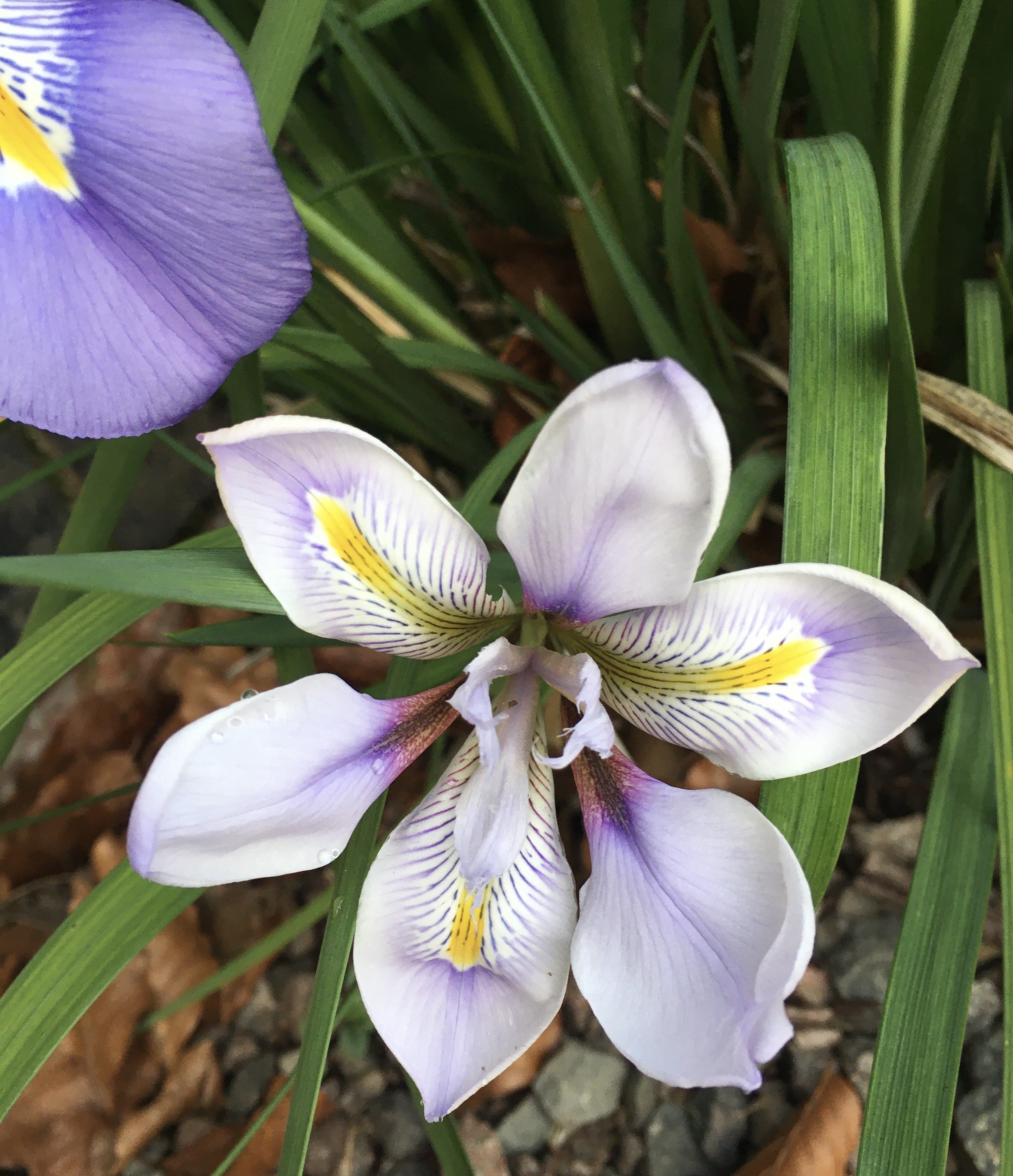
I love surprises. This beautiful lilac flower suddenly appeared in amongst my clump of deep blue iris. I’ve grown this plant by the front door for 20 years. The colour has always been rich indigo blue.

It’s a bit of an untidy grower. Long strappy leaves splay everywhere, tripping us up. I’ve threatened to dig it out many times. But then, midwinter, it starts to flower, and what a joy it is. The flowers resemble silk. Surely, too delicate to cope with frost and snow. But no, it shrugs off the cold, providing a steady supply of blooms right through from November to March. Planted in front of a south facing wall, with its roots in rubble, it thrives.

And then something wonderful happens. A sport perhaps, or a seedling. I don’t have the answer. I’m just in amazement at the beauty and wonder of plants.

I hope it’s a stable sport and will repeat flower through the winter. Maybe it’s a completely new variety. We shall have to wait and see.

You can find out more about iris unguicularis or Algerian iris at : https://www.rhs.org.uk/plants/24998/Iris-unguicularis/Details

Here’s some more flower photos from my garden today. We currently have 10C night-time temperatures. Unheard of for January. Consequently, all winter flowering shrubs are having a field day; the whole garden is suffused with a wonderful vanilla scent. It’s totally delicious.

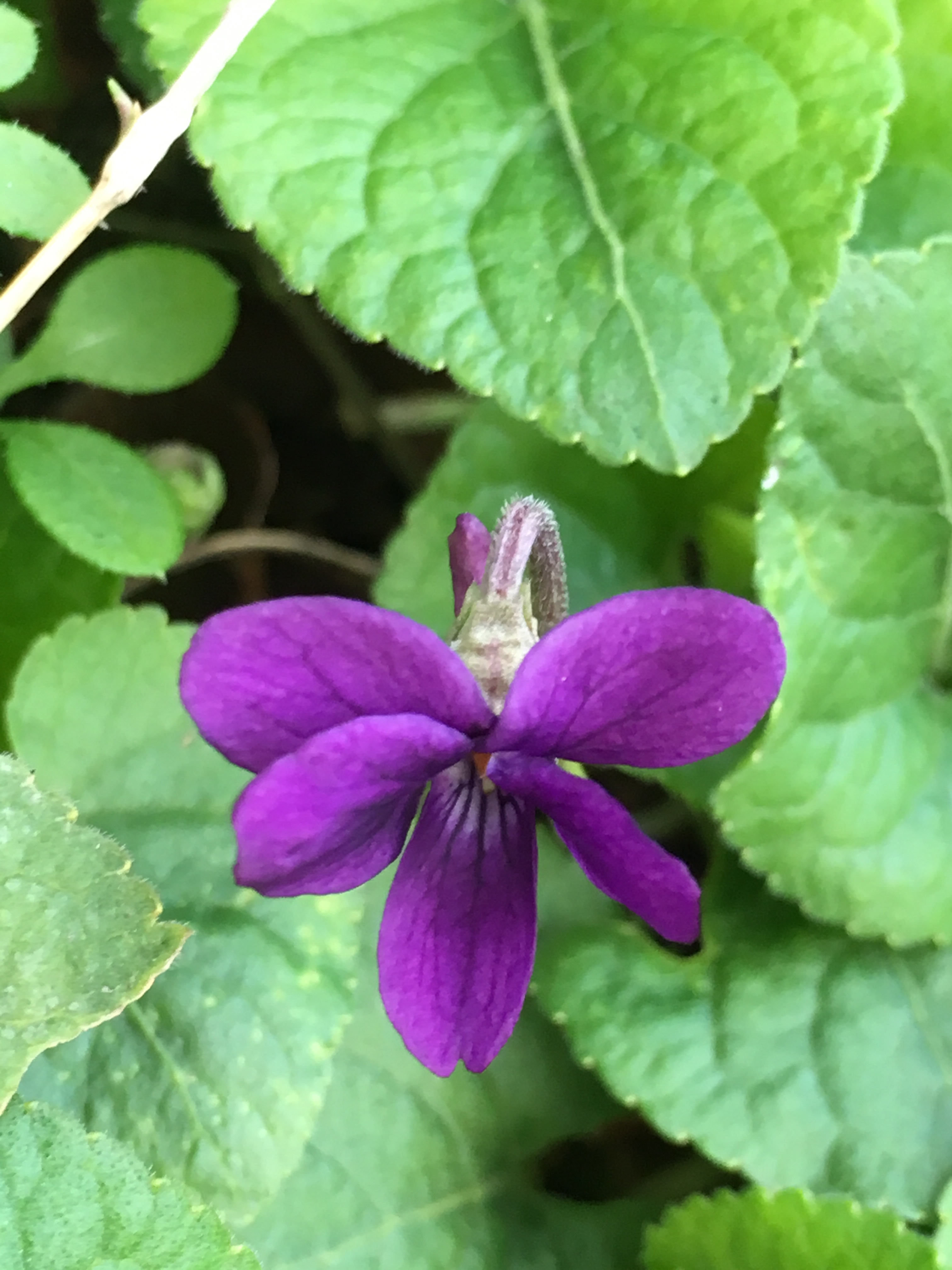
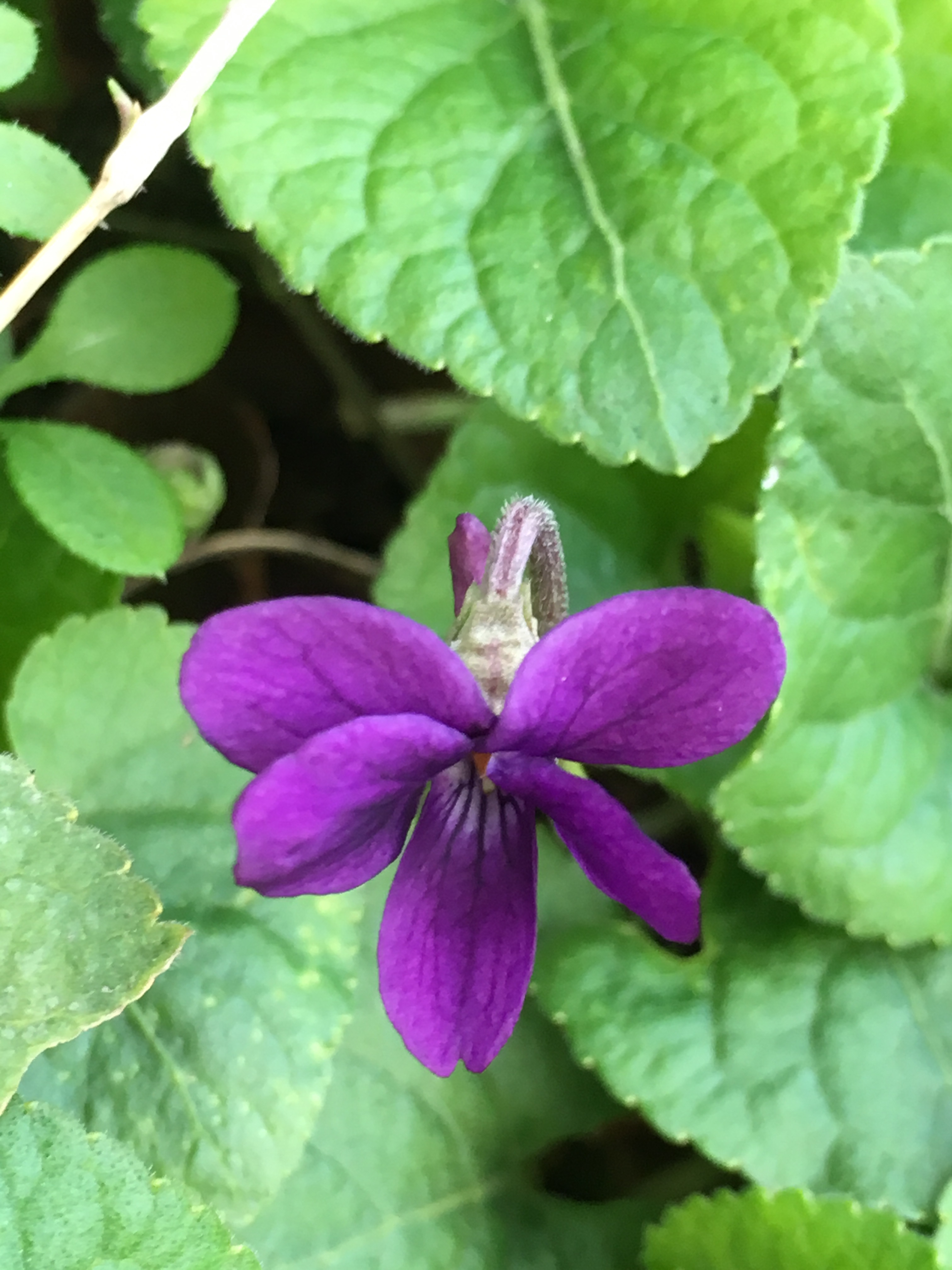
Violets by the front gate. These came from my grandfather, Ted Foulds. They started off from one small pot. Now there are drifts of them under all the deciduous trees and shrubs.

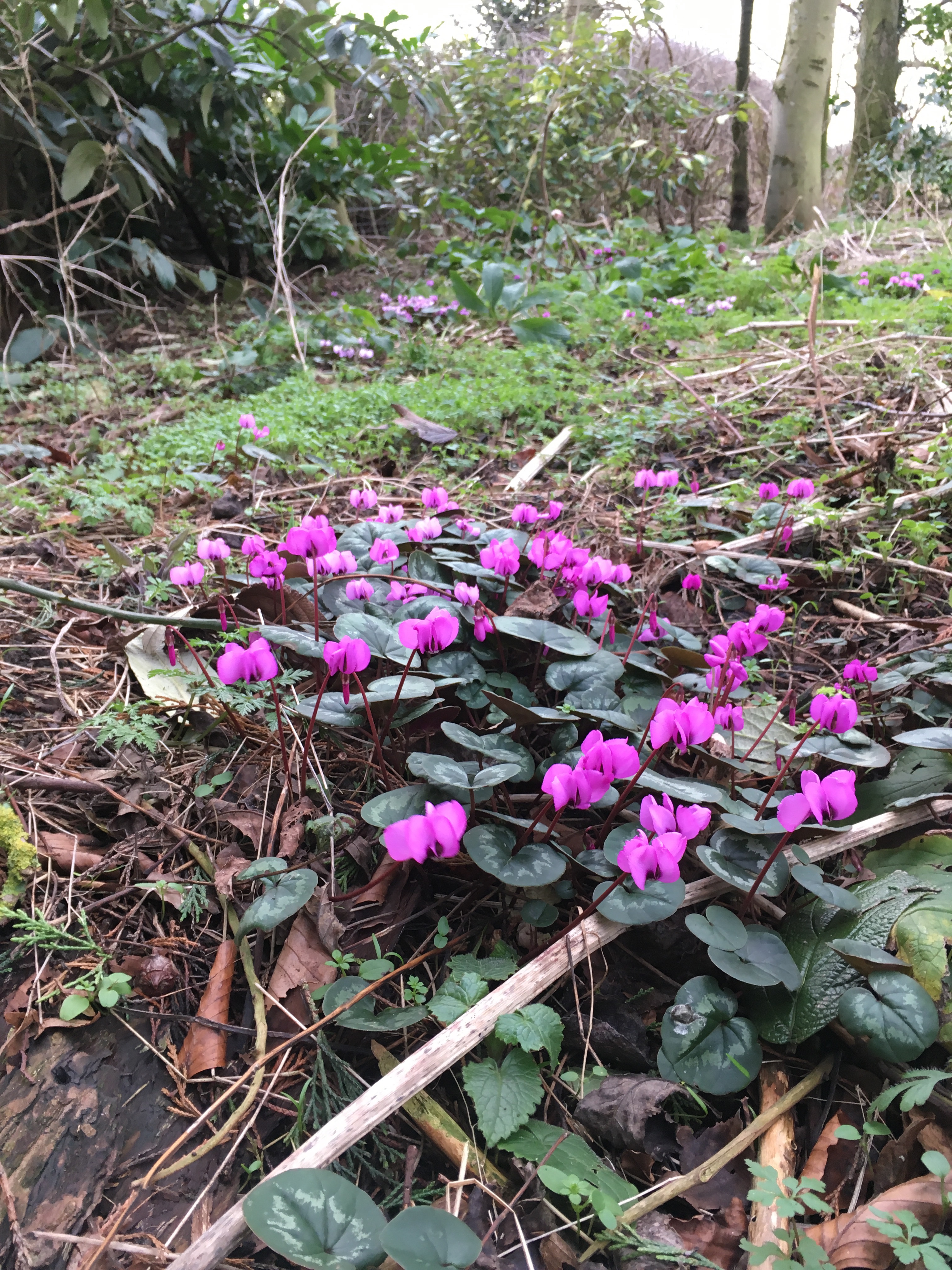
Cyclamen Coum. These are seeding nicely in the woodland in a bed of leafmould.

There’s also various types of viburnum. Deep pink viburnum Dawn being my favourite.

What’s in flower in your garden today? Are you having a mild spell, like we are? Get in touch and let me know.

Links: Six on Saturday https://thepropagatorblog.wordpress.com/2020/01/11/six-on-saturday-11-01-2020/

In a Vase on Monday – Jan 6 2020

I’m back to work today, so I’m posting a review of my past #IAVOM projects, one for each month of the year.

Good luck to everyone who’s back to work, school or college today. The days are getting lighter, ever so slightly, so we’ll be able to spend our evenings in the garden again soon.

Meanwhile, enjoy my ‘slide show’ of photos from my garden, though the year.

JANUARY

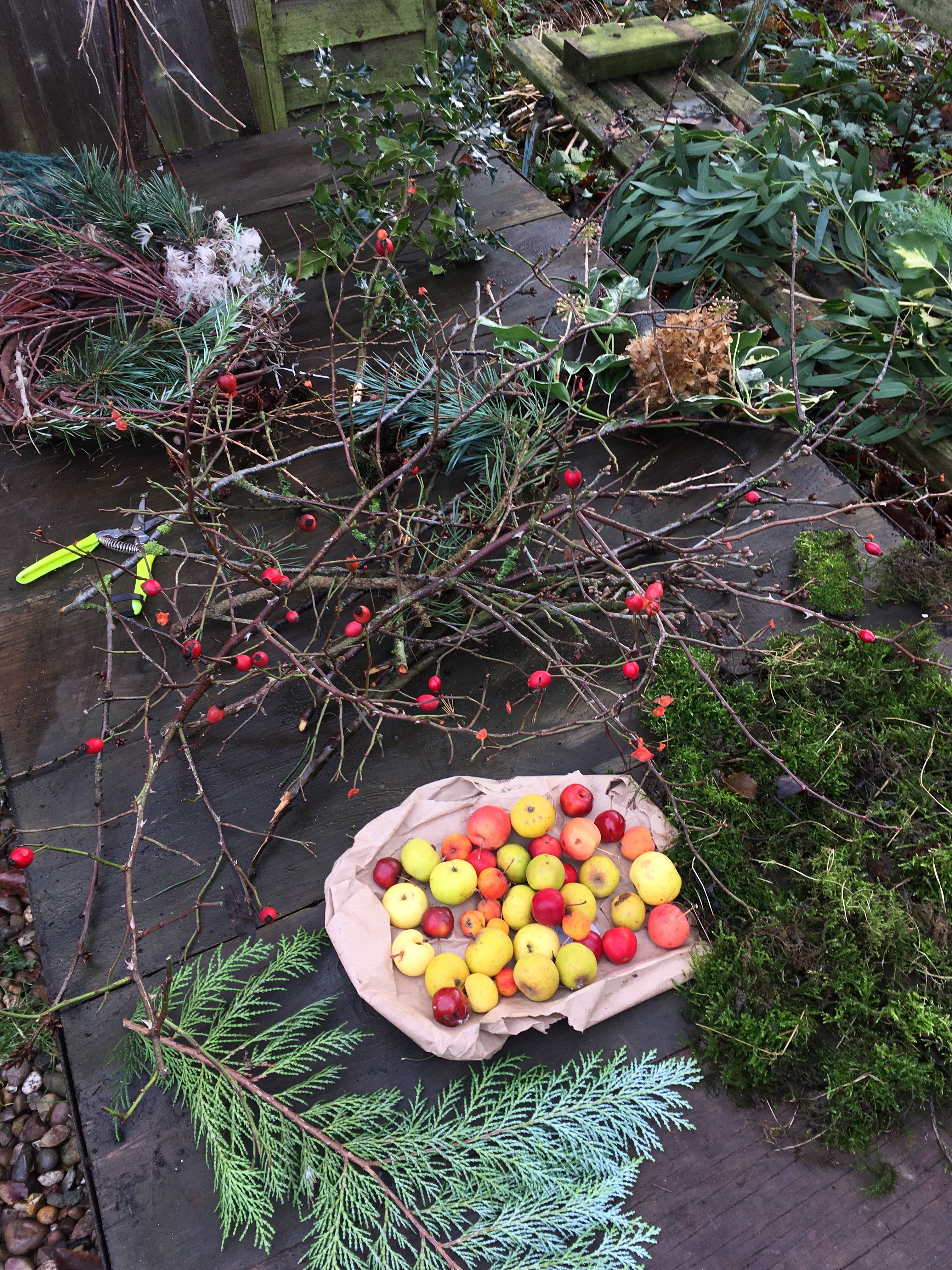
Paperwhite narcissi, black hellebores, pittosporum and eucalyptus foliage. Decorating a willow wreath with flowers in a jam jar hidden inside a moss kokadama ball.

FEBRUARY

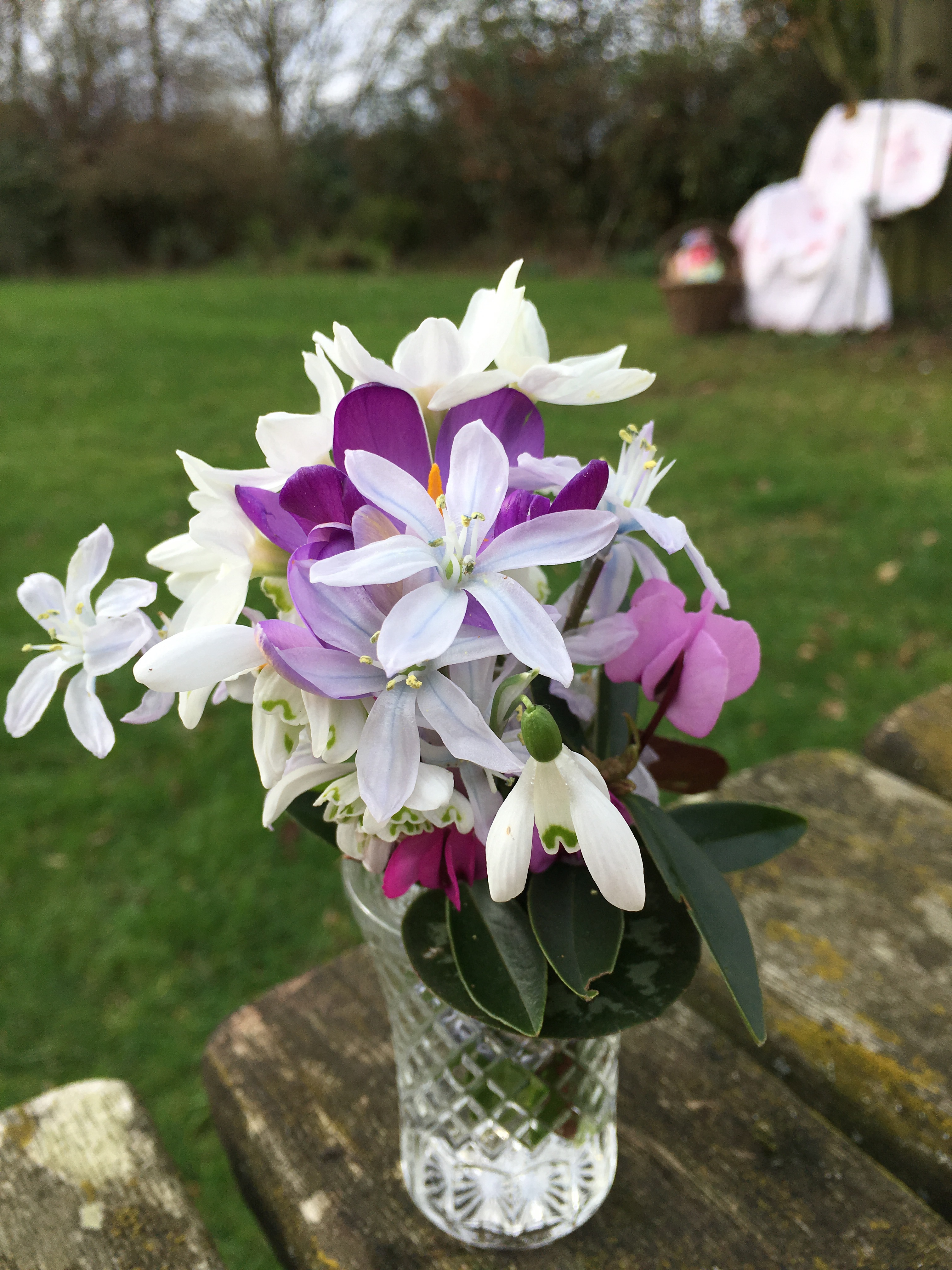
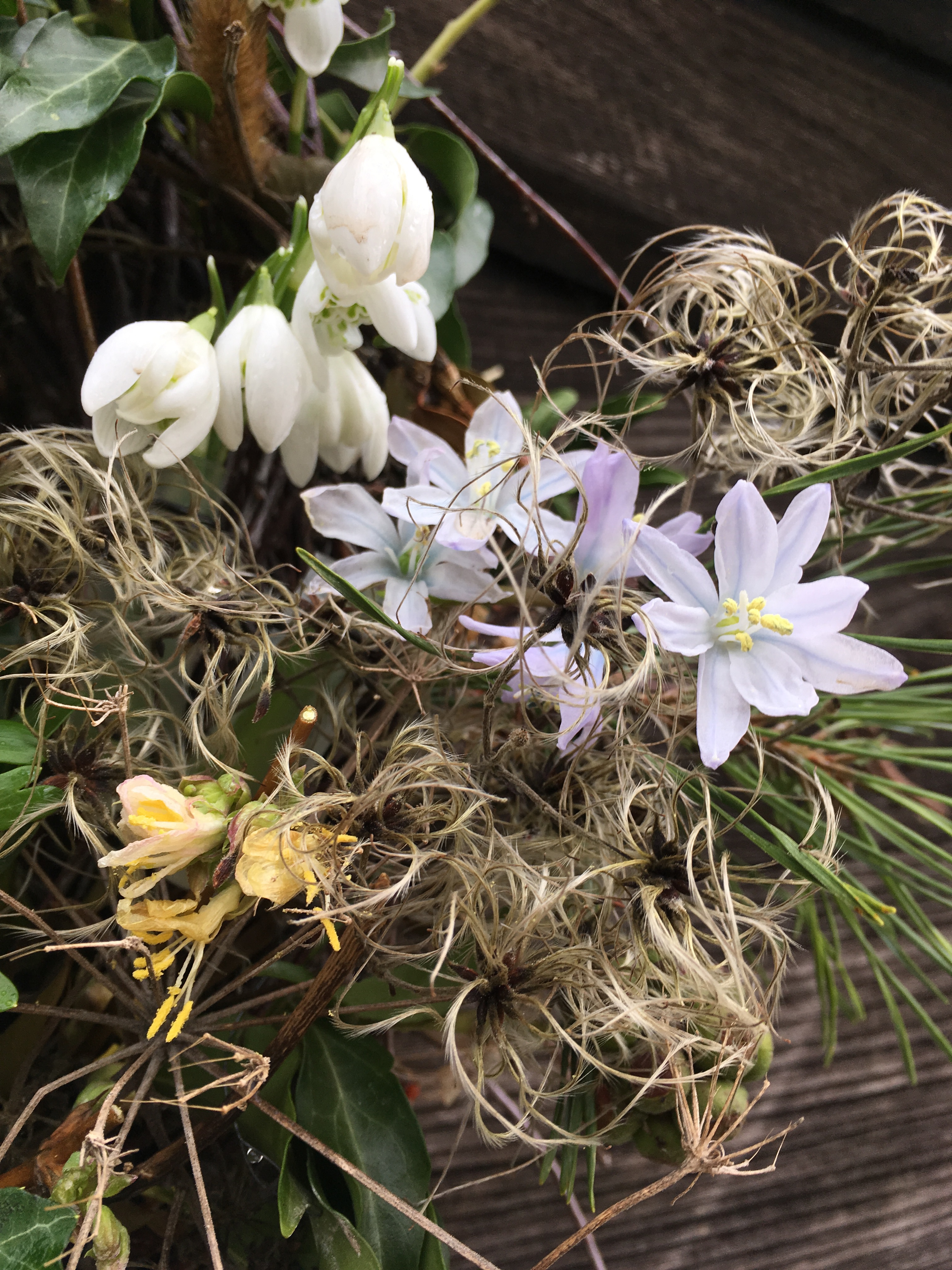
Snowdrops, crocus, cyclamen coum, puschkinia.

MARCH

Tulip Exotic Emperor, Narcissi Geranium, hyacinth, orange wallflower, and Westonbirt dogwood stems.

APRIL

Hyacinth Woodstock, pink hellebore, pink comfrey, daphne and forget-me-nots.

MAY

Forget me nots and Jack by the Hedge( Alliaria petiolata)

JUNE

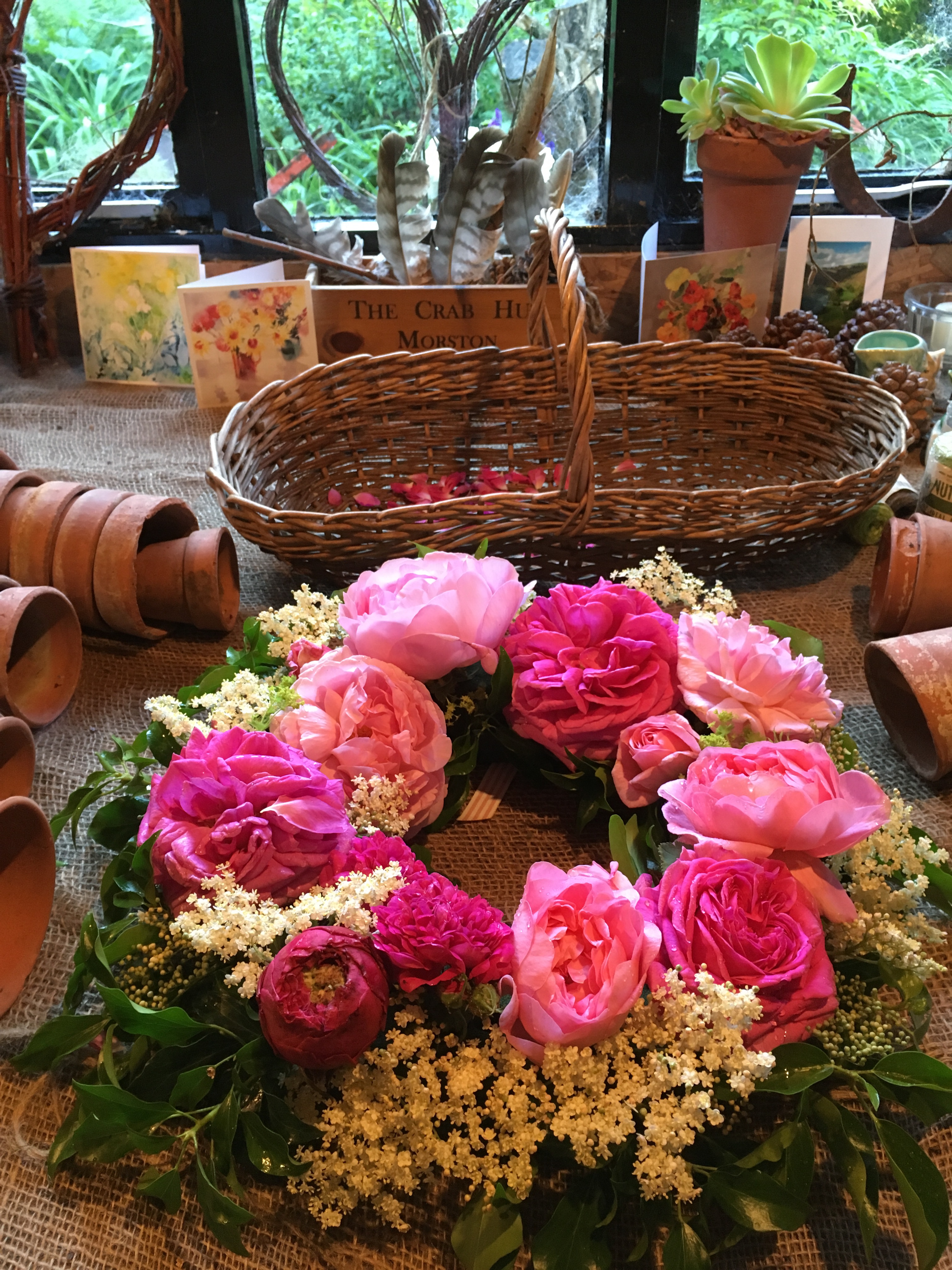
Roses, Gertrude Jekyll and Constance Spry with a lace frill edge of wild elder flower.

JULY

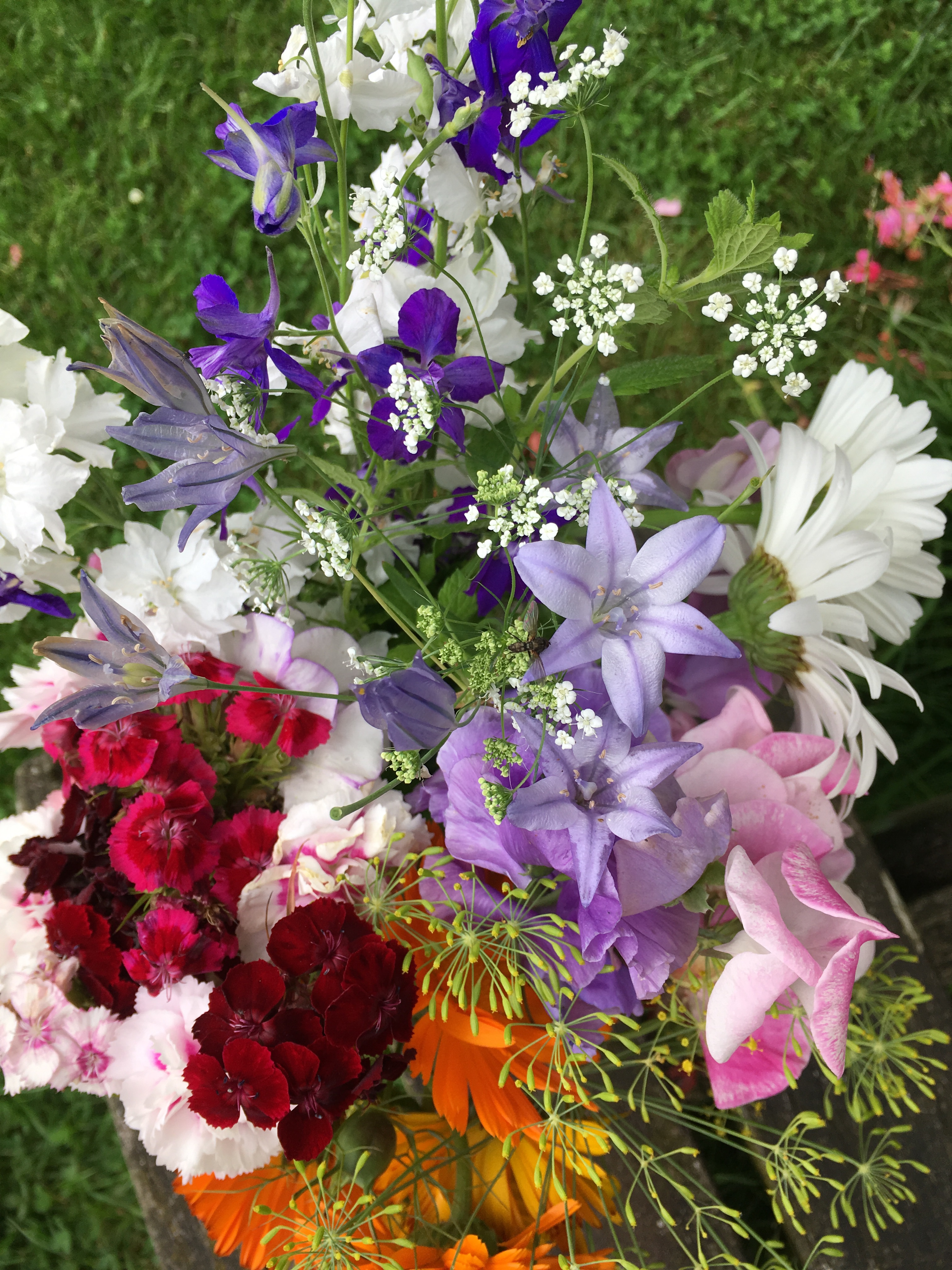
White daisies and larkspur, Blue Boy cornflower, with a frill of Ammi majus.

AUGUST

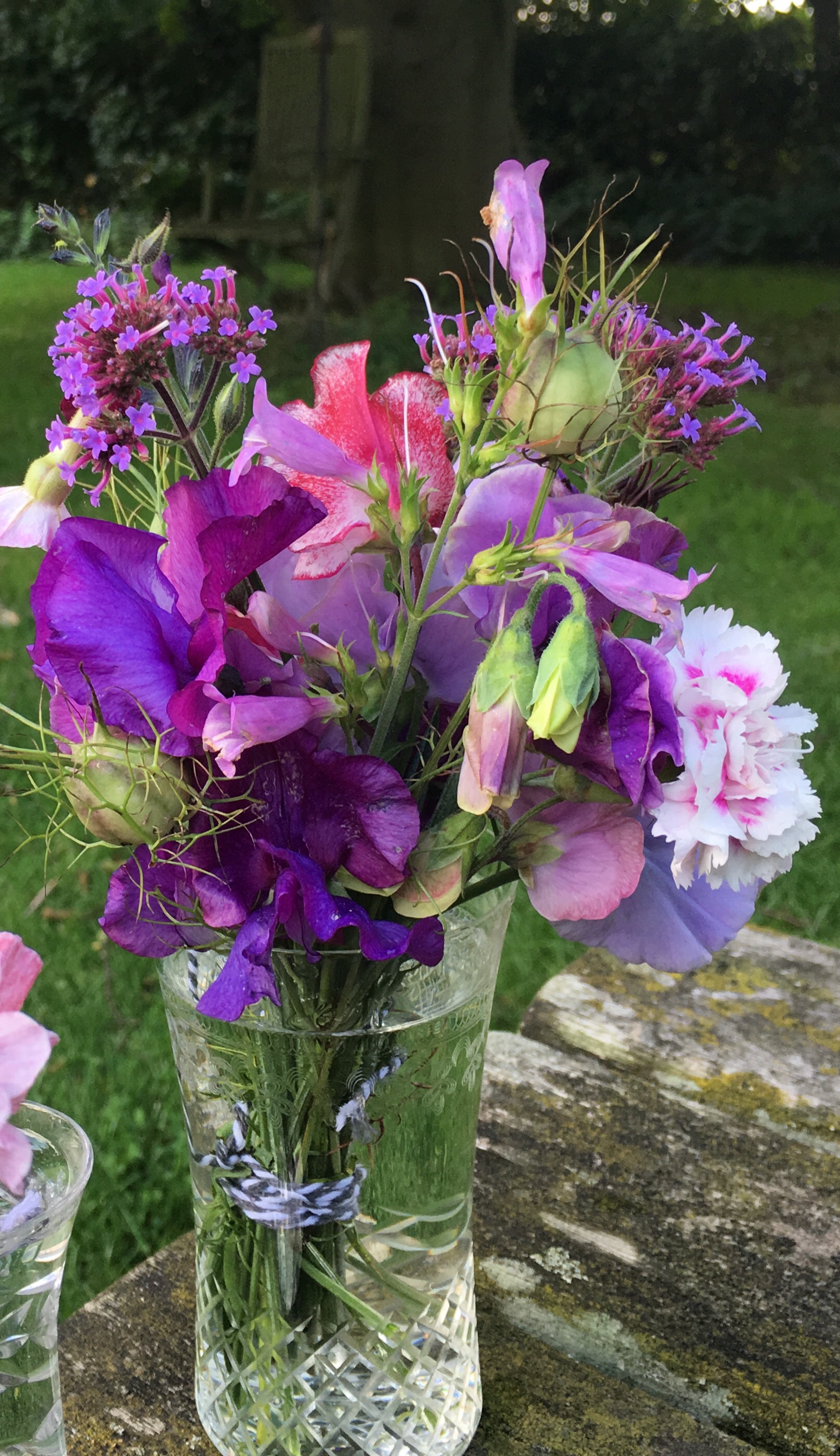
Sweet peas, carnations and verbena bonariensis.

SEPTEMBER

Blue shades gladioli, cosmos and dahlia Nuit deEte.

October (early)

Sunflowers and calendula Snow Princess.

October (late)

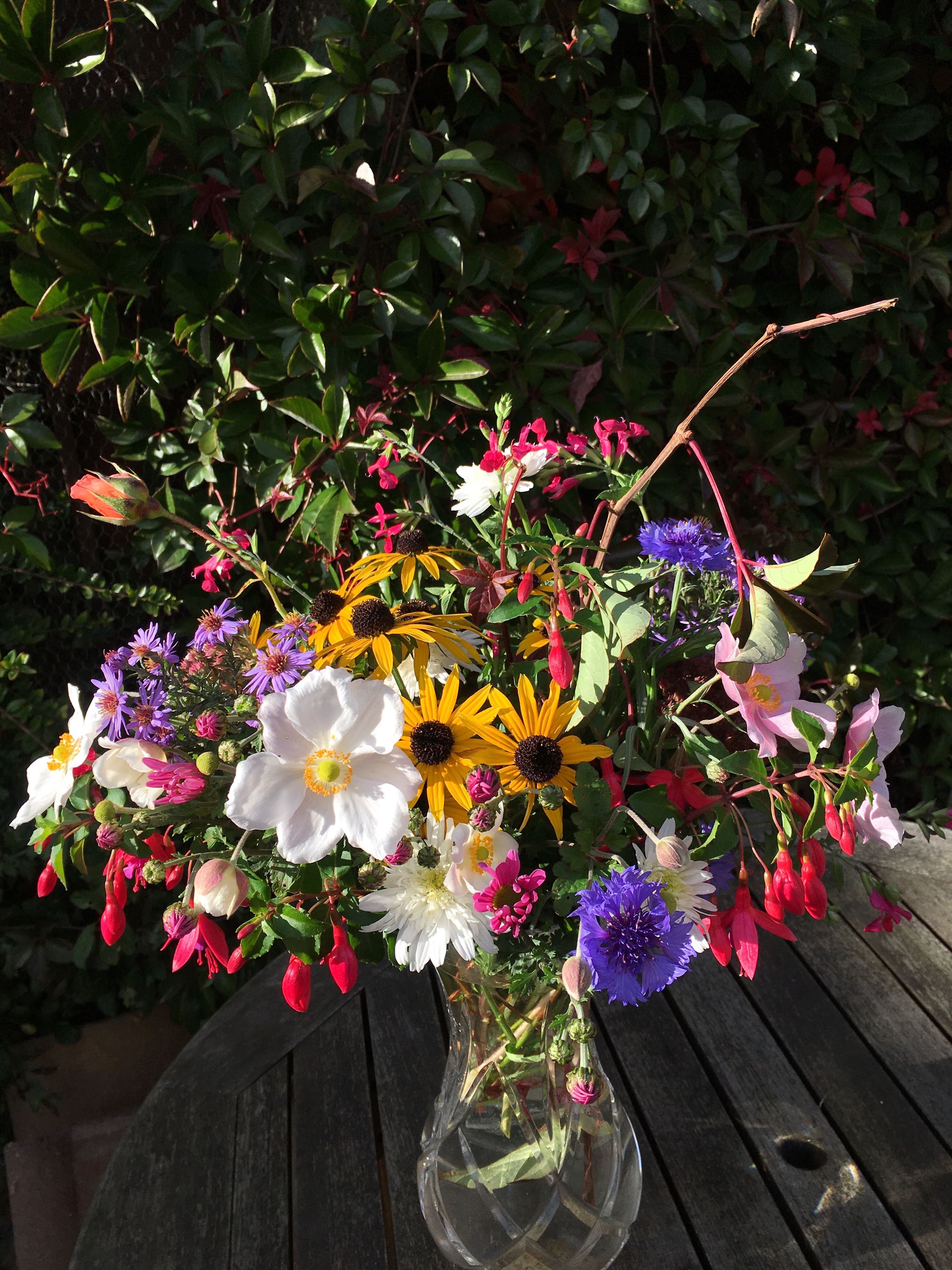
All of the garden, fuchsia, salvia,rudbeckia, aster, cornflower, white anemone, sedum, argyranthemum.

NOVEMBER

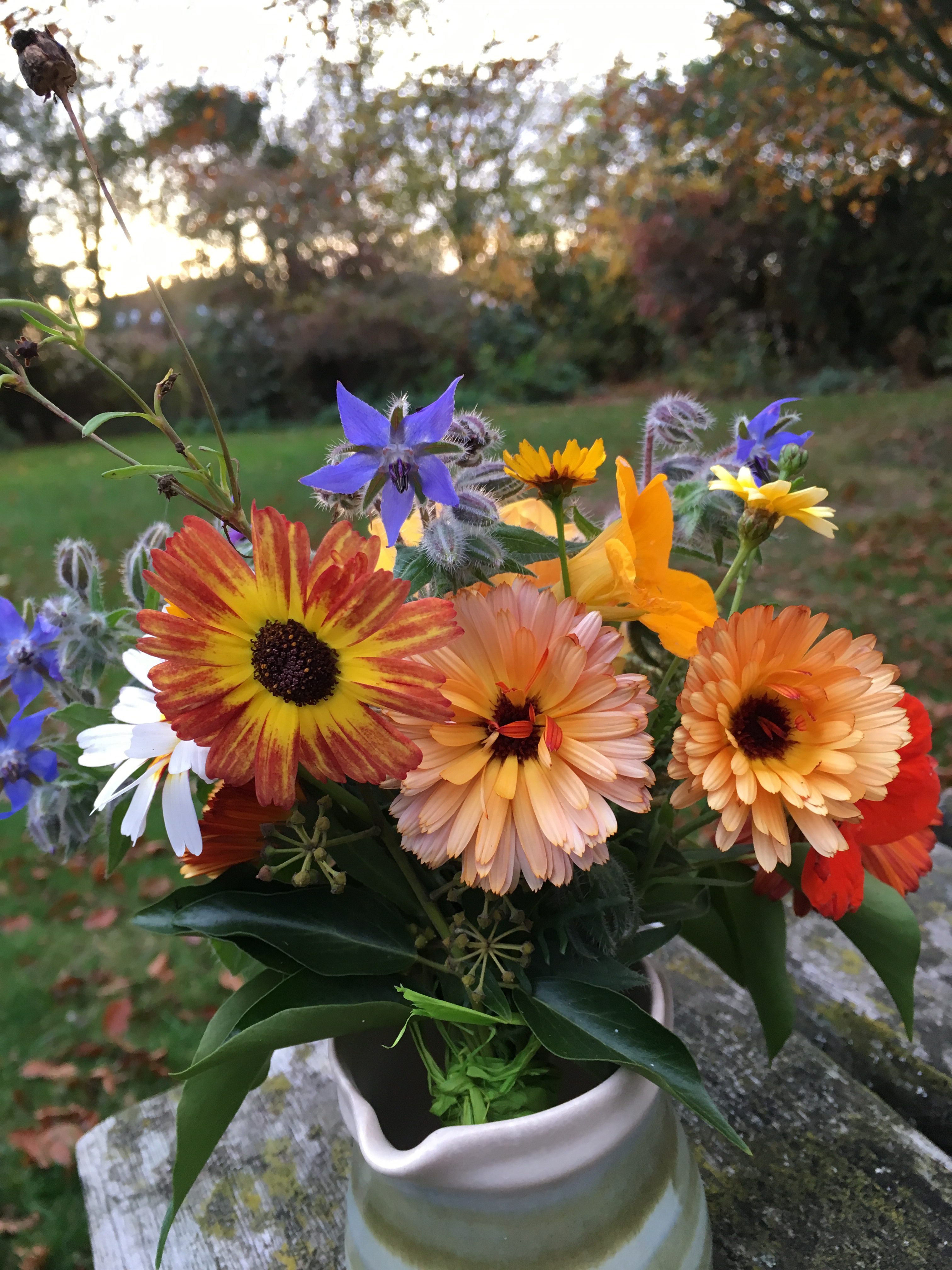
Dahlia David Howard and blue borage.

DECEMBER

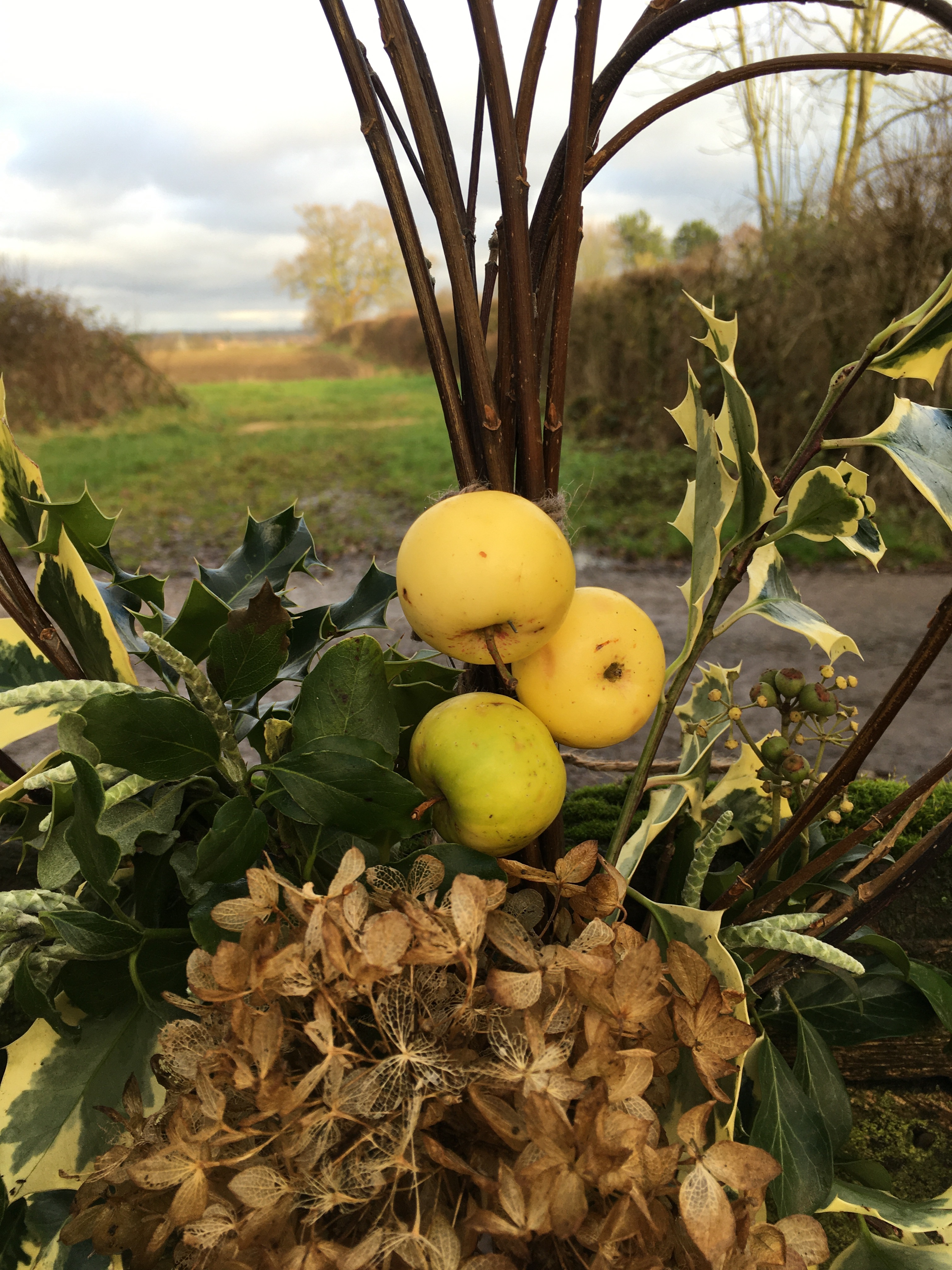
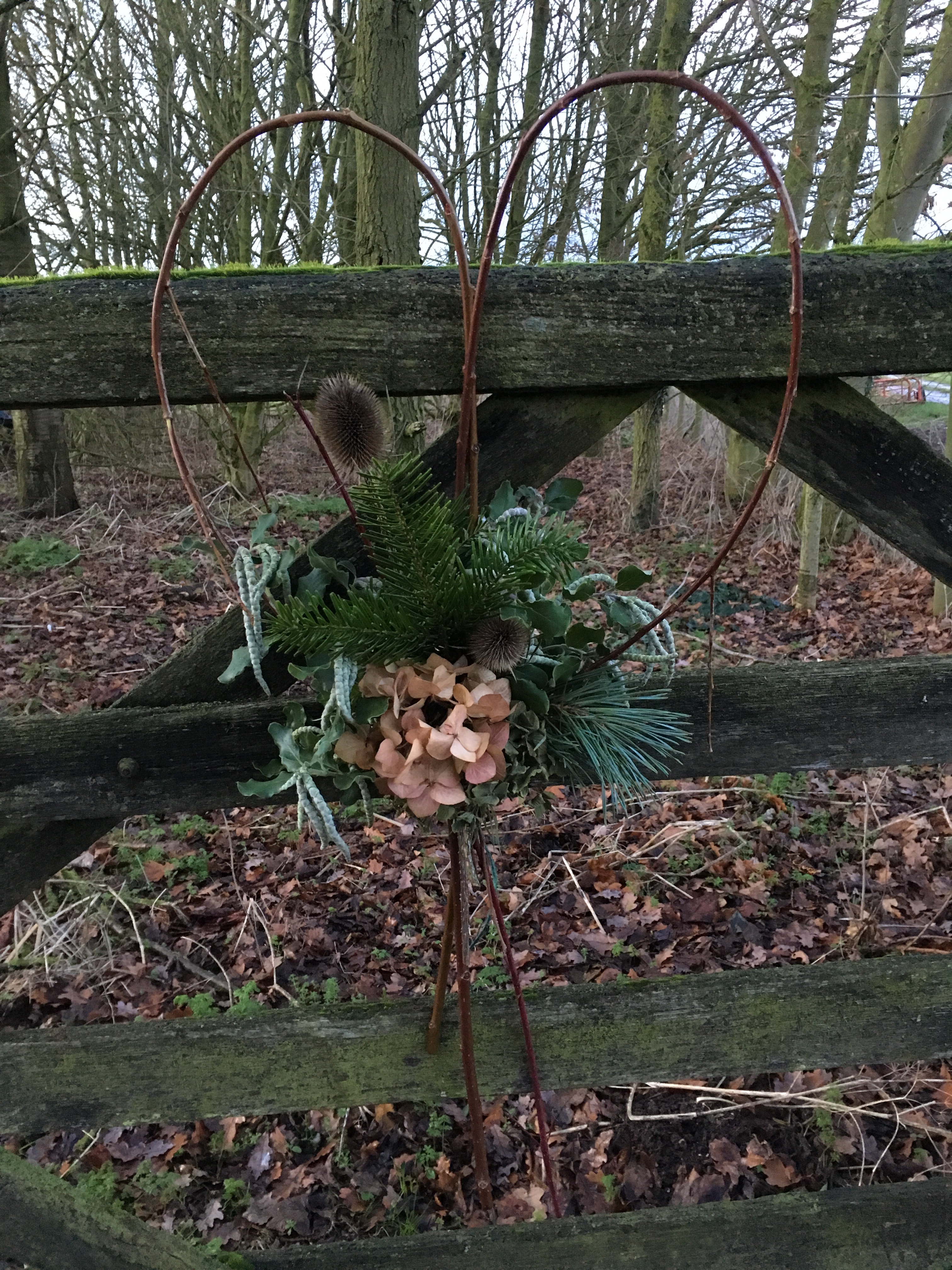
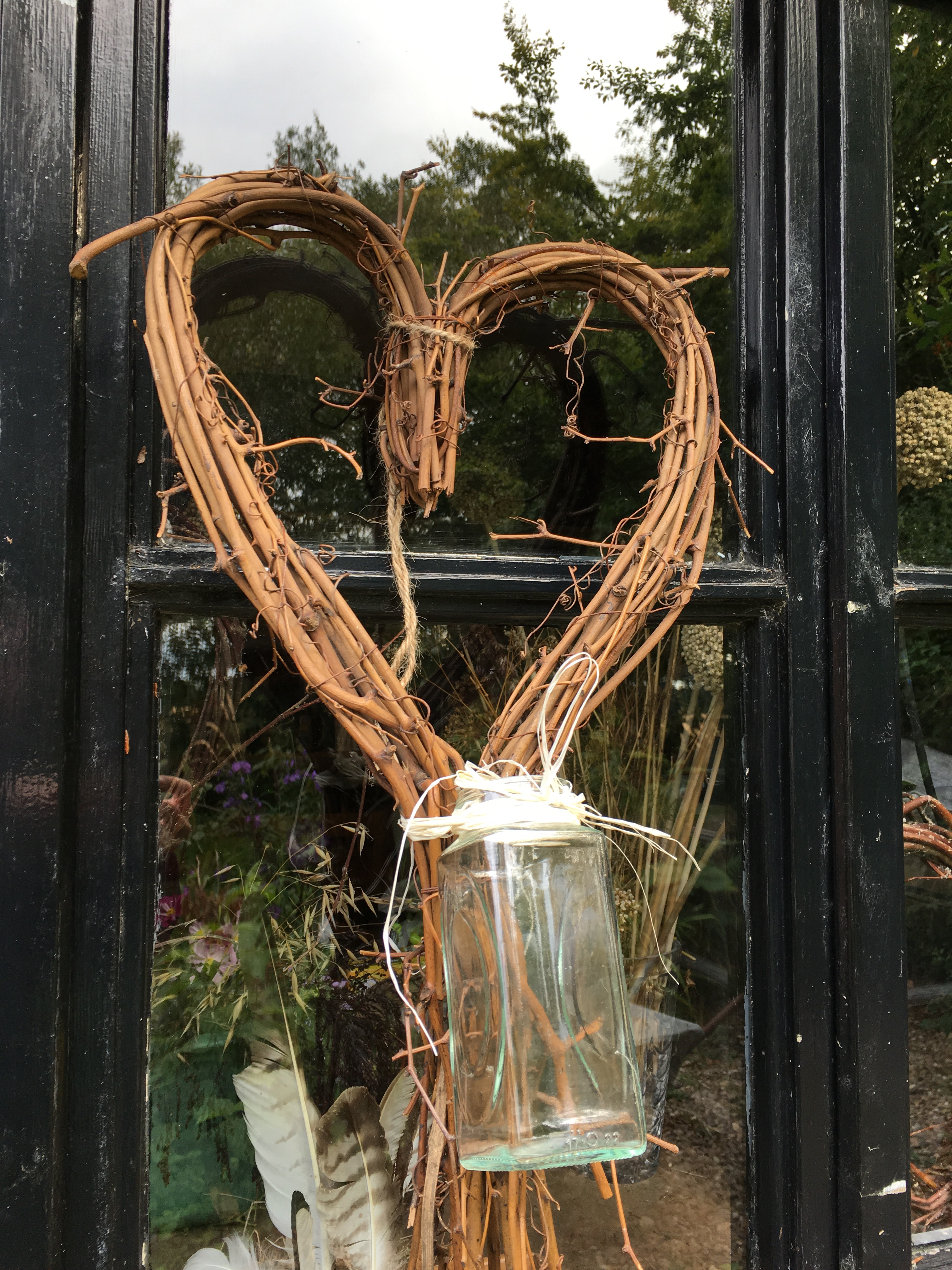
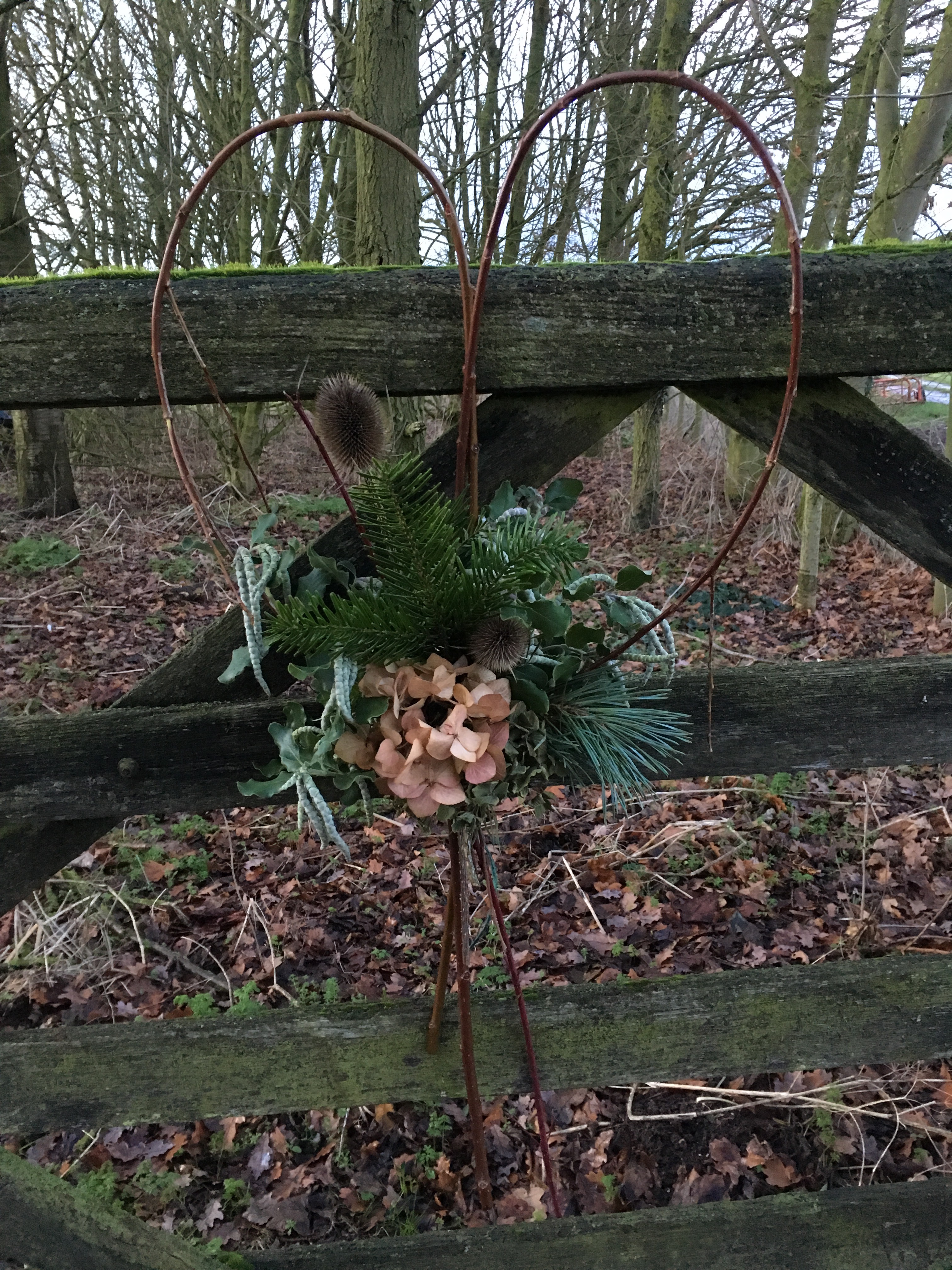
Sedum wreath on a moss-filled wire heart. No flower foam has been used again this year. Flowers are pressed into moss or plunged into tiny test tubes hidden amongst the foliage.

HAPPY NEW YEAR EVERYONE!

I am on twitter @kgimson

On instagram at karengimson1

On BBC Radio Leicester on Sundays and Wednesdays

At Garden News Magazine every month.

Links: In a Vase on Monday :https://ramblinginthegarden.wordpress.com/2019/12/30/in-a-vase-on-monday-hazel-and-hazel/. Thanks to Cathy for hosting #IAVOM

Bulbs and corms from Gee Tee Bulbs : https://www.gee-tee.co.uk/

Seeds from Mr Fothergills : https://www.mr-fothergills.co.uk/

Sweet pea seeds: https://www.kingsseeds.com/Products/Flowers-N-Z/Sweet-Pea

Heritage sweet peas and garden to visit : https://www.visiteaston.co.uk/gardens/sweet-peas

Flower farmer courses and willow wreath-making at Common Farm Flowers: https://www.commonfarmflowers.com/workshops.html

Six on Saturday- Flowers from my Garden 4th Jan 2020

Winter flowers are more precious to me than summer blooms. In summer there’s an abundance of riches, and sometimes flowers go unnoticed with too much rushing about, keeping on top of the weeding. But in winter there’s time to stop and pause, and jewel-like colours lift the mood. Today I’ve picked my favourite blue Algerian iris. How can anything so delicate survive the cold! It looks like it is made of silk. I have a huge untidy patch of Iris unguicularis right by my front door. All summer we trip over the long strap-like leaves, and constantly threaten to dig it up. But from November to May there’s a daily flush of flowers, arriving in ones and twos. They last for a week, brought indoors. Perfect for a tiny Victorian glass vase. Iris unguicularis likes to be planted at the base of a south-facing wall. Heat and drought seem to suit it well.

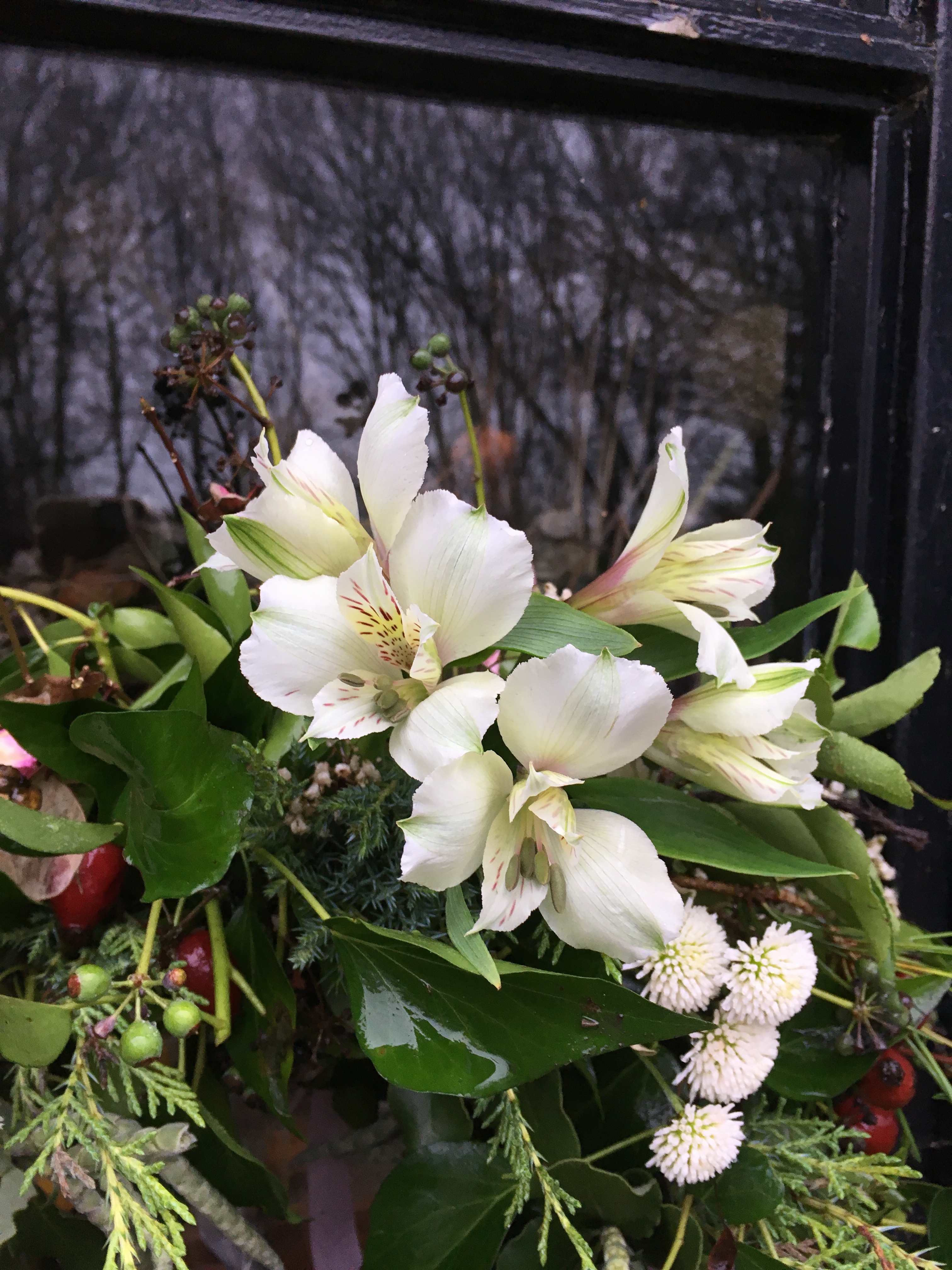
My iris naturally flowers in winter, but there are also roses in flower, quite out of season. This is Rosa Phyllis Bide, a wonderful rambler which reliably puts on a show from early summer right through to autumn. I’ve also managed to find some Viburnum Dawn and Lisarose, and a sprig or alstroemeria from the poly tunnel. A cheerful, scented posy for the kitchen table.

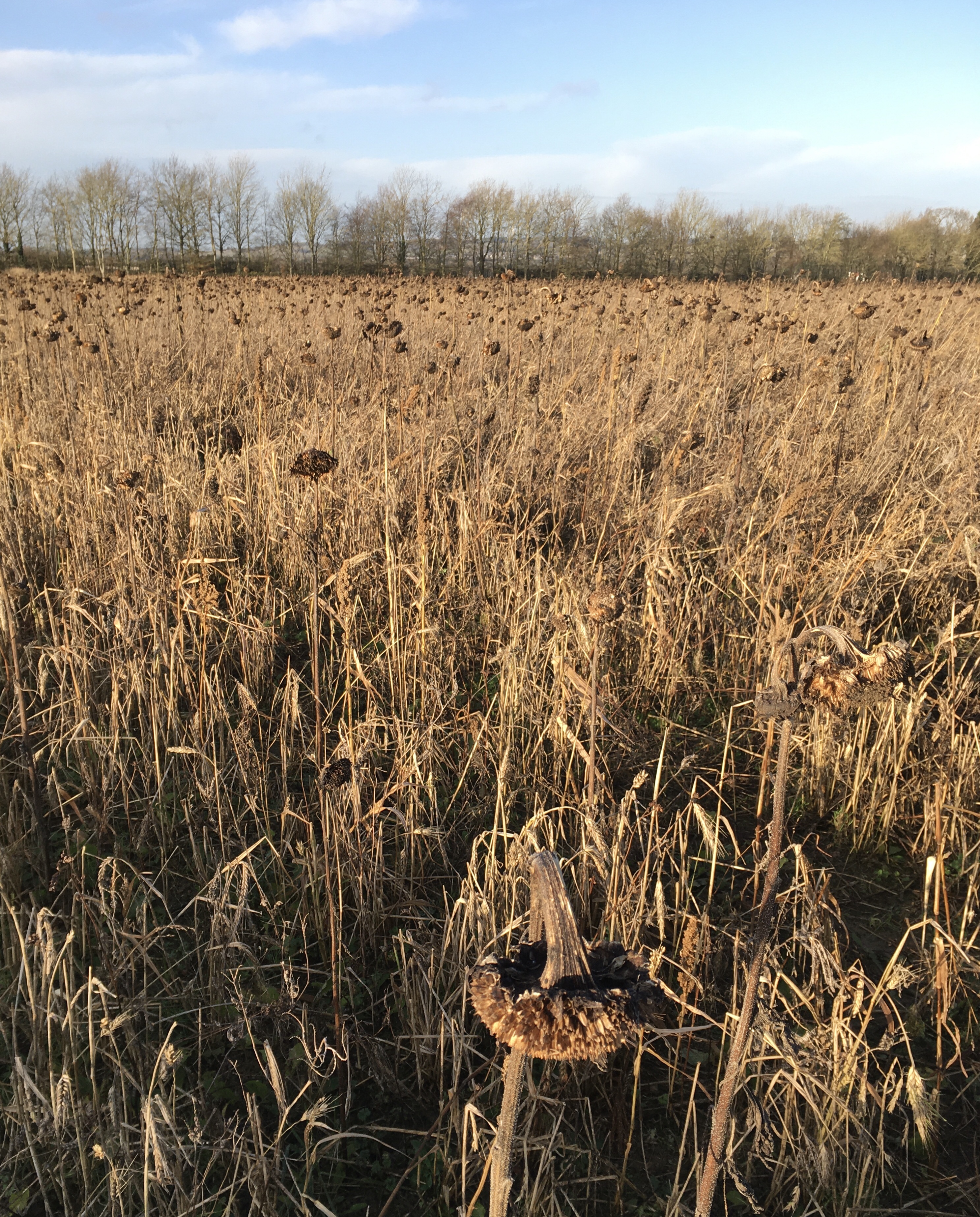
After meandering around the plot I head for the garden gate and set off along the ridgeway walk. Fortunately it’s a dry day and the footpath conditions are improving. It’s been the wettest autumn for 50 years and farmers struggled to get in the harvest or sow autumn crops. In the distance there’s field after field of maize still standing. As far as the eye can see, fields stand fallow. There’s no lovely green shoots of winter wheat, barley or oil seed.

There’s only two crab apples left. Mammals and birds have had a feast. There’s been an abundance of fruit and berries this winter. Rosehips dripped like blood from the hedgerow. Huge flocks of fieldfares fly overhead and alight on the hedges to strip them bare. Resident blackbirds try their best to defend their ‘larder,’ but they are defeated by the noisy, marauding visitors. Luckily I’ve a store of cooking apples at home and I’ll throw a few out every day if the weather turns cold. Sometimes this bounty, regularly distributed, is the difference between life and death for birds. I generally rely on planting berried shrubs in the garden to provide natural food. But if it turns really icy, I’ll buy some mealworms, nuts and seeds.

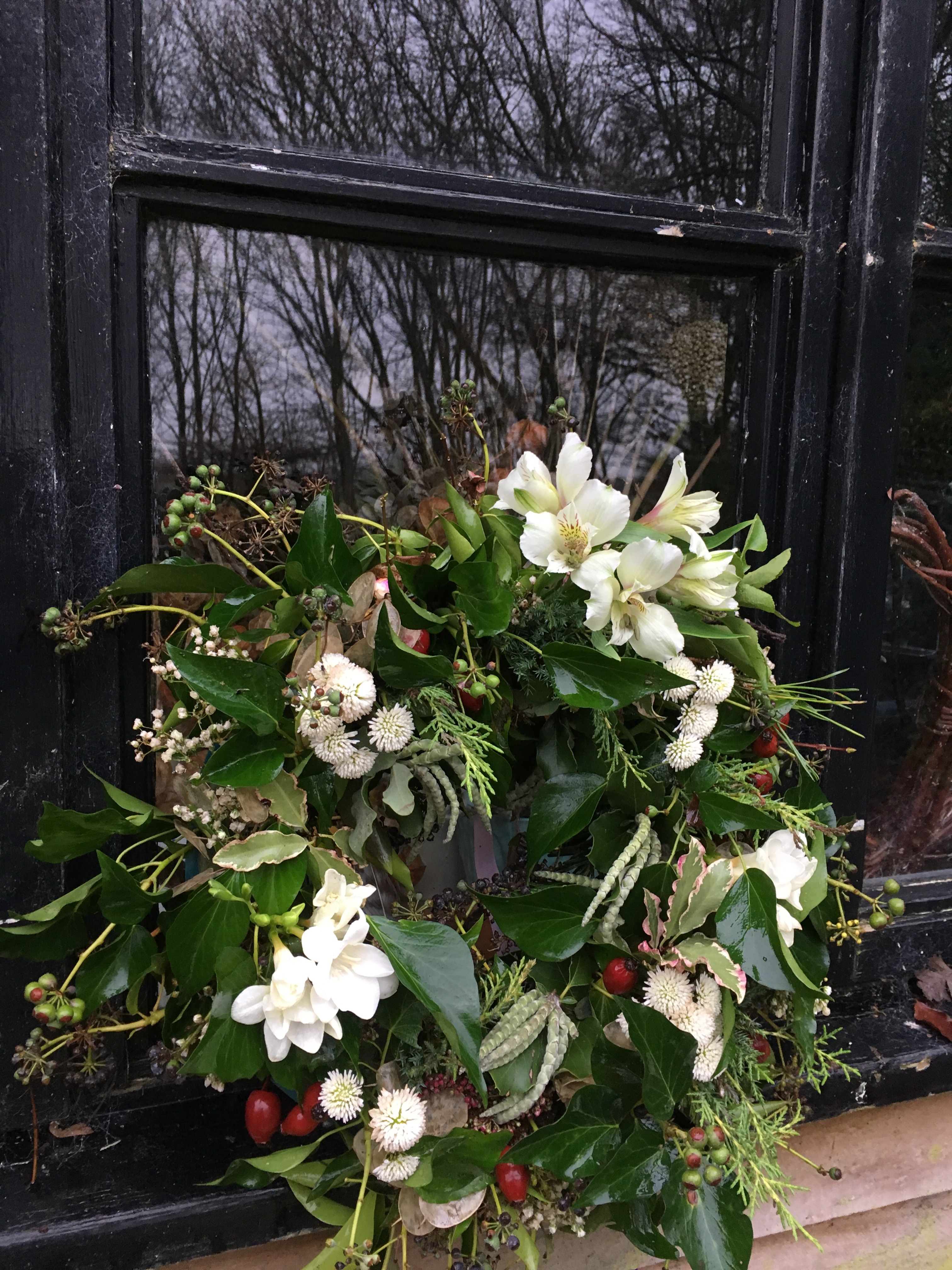
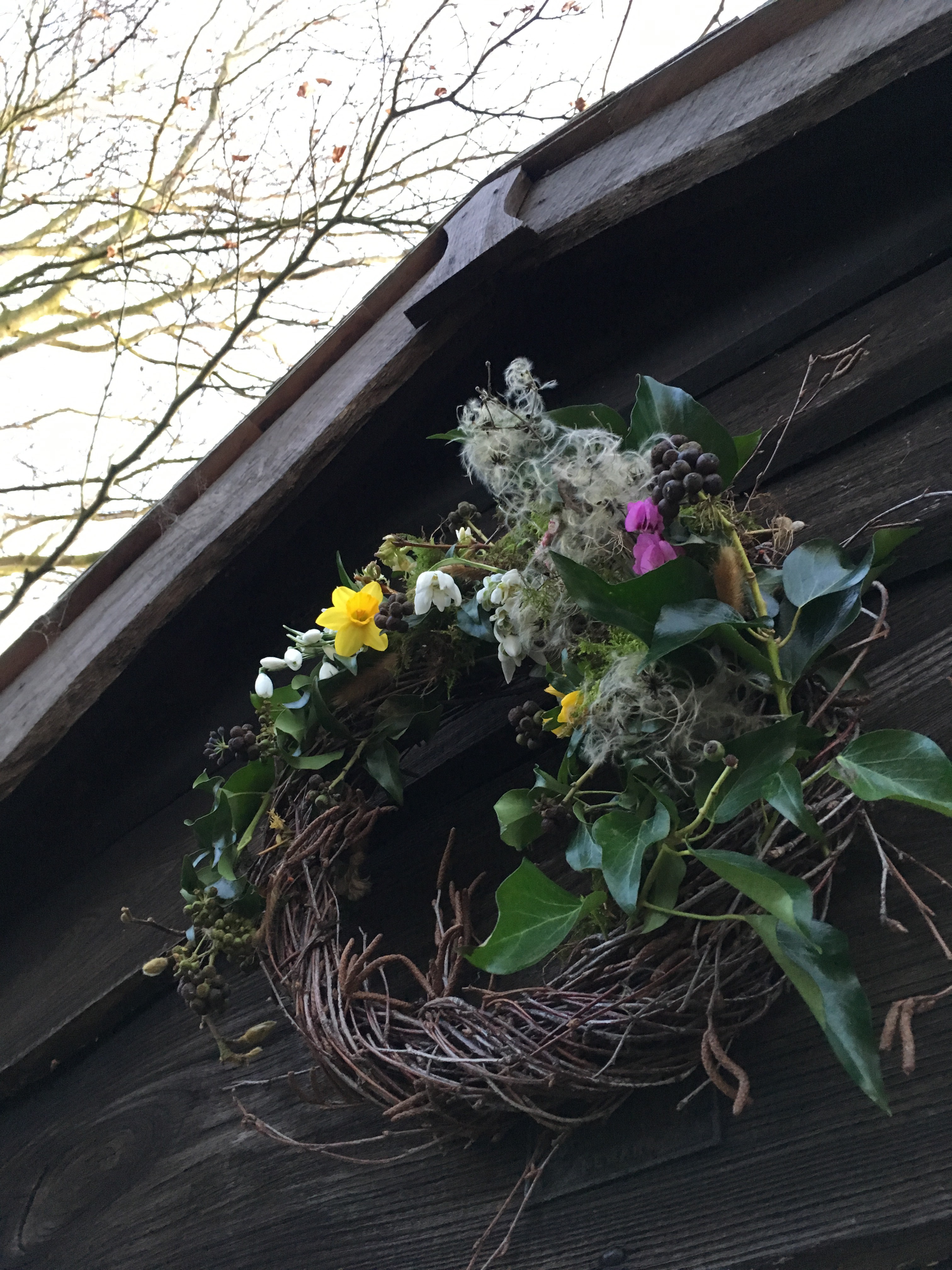
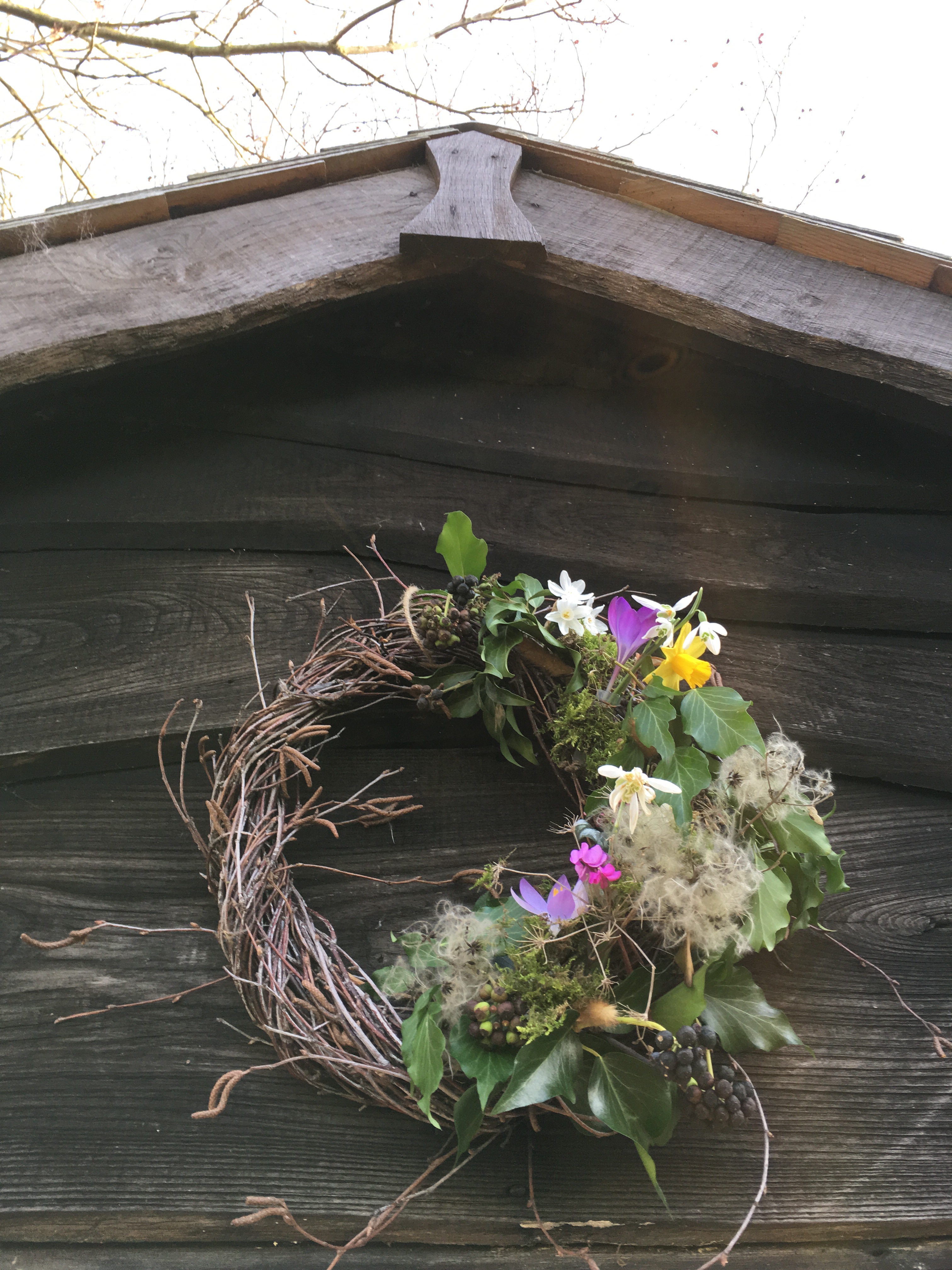
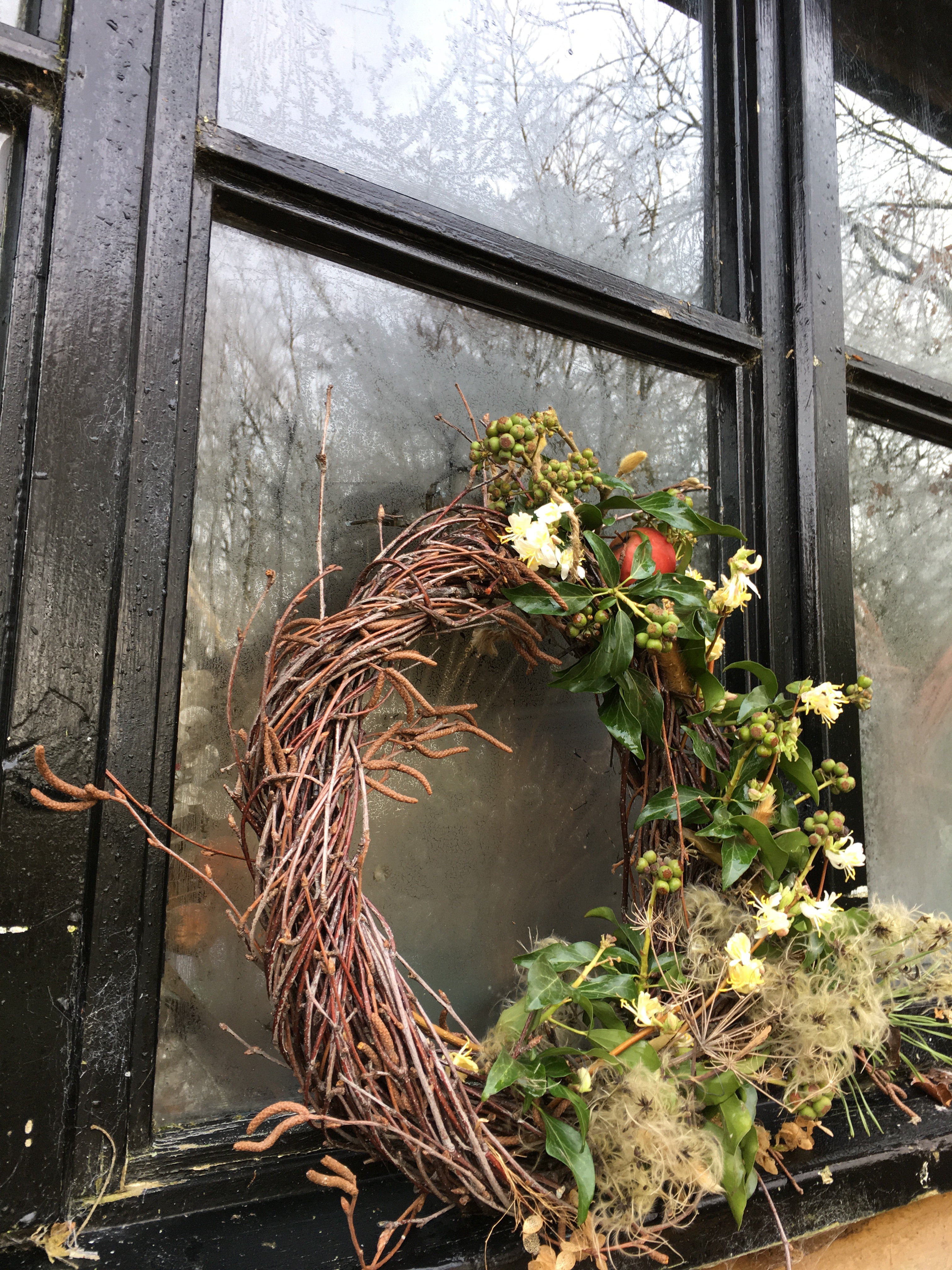
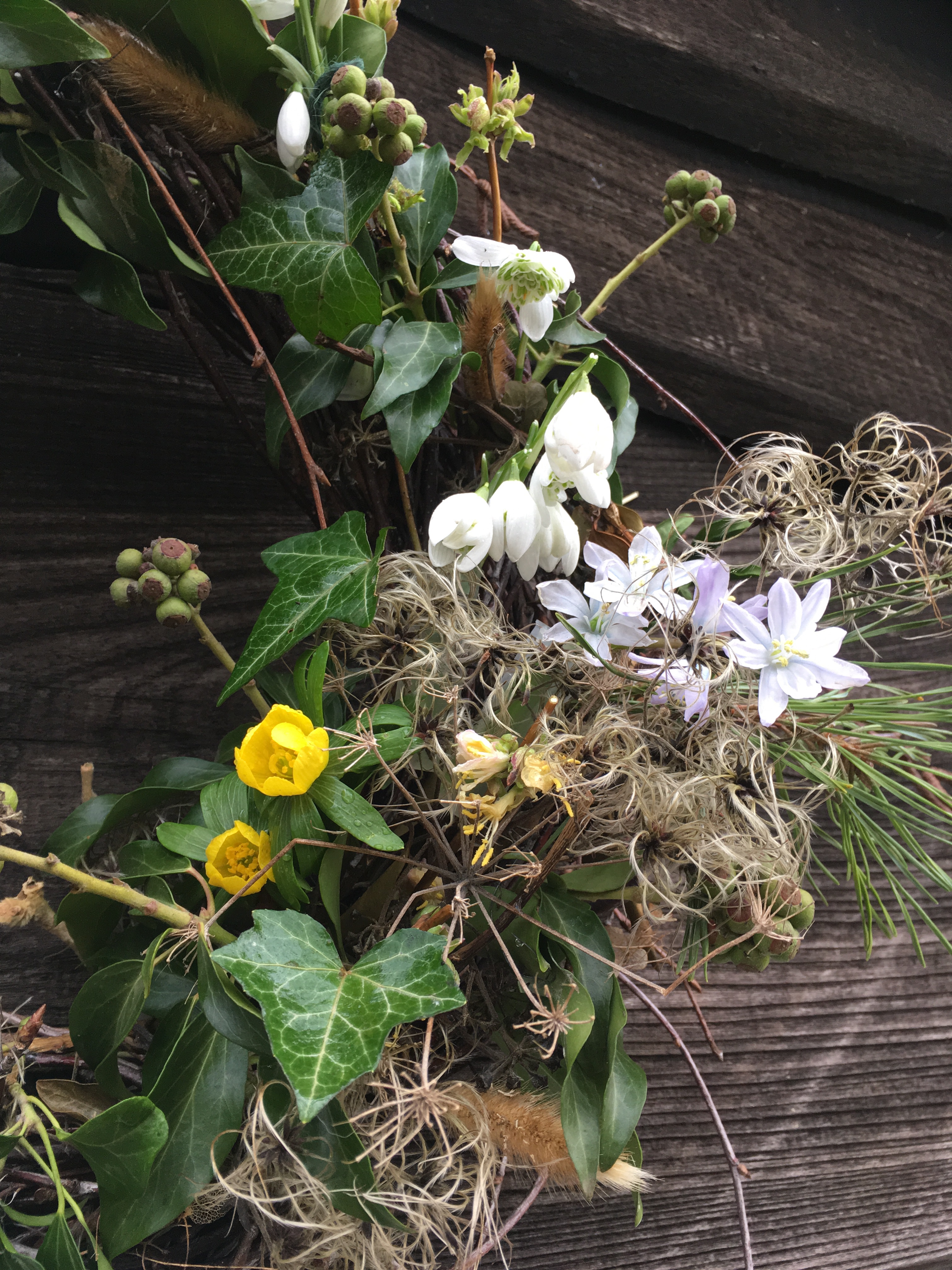
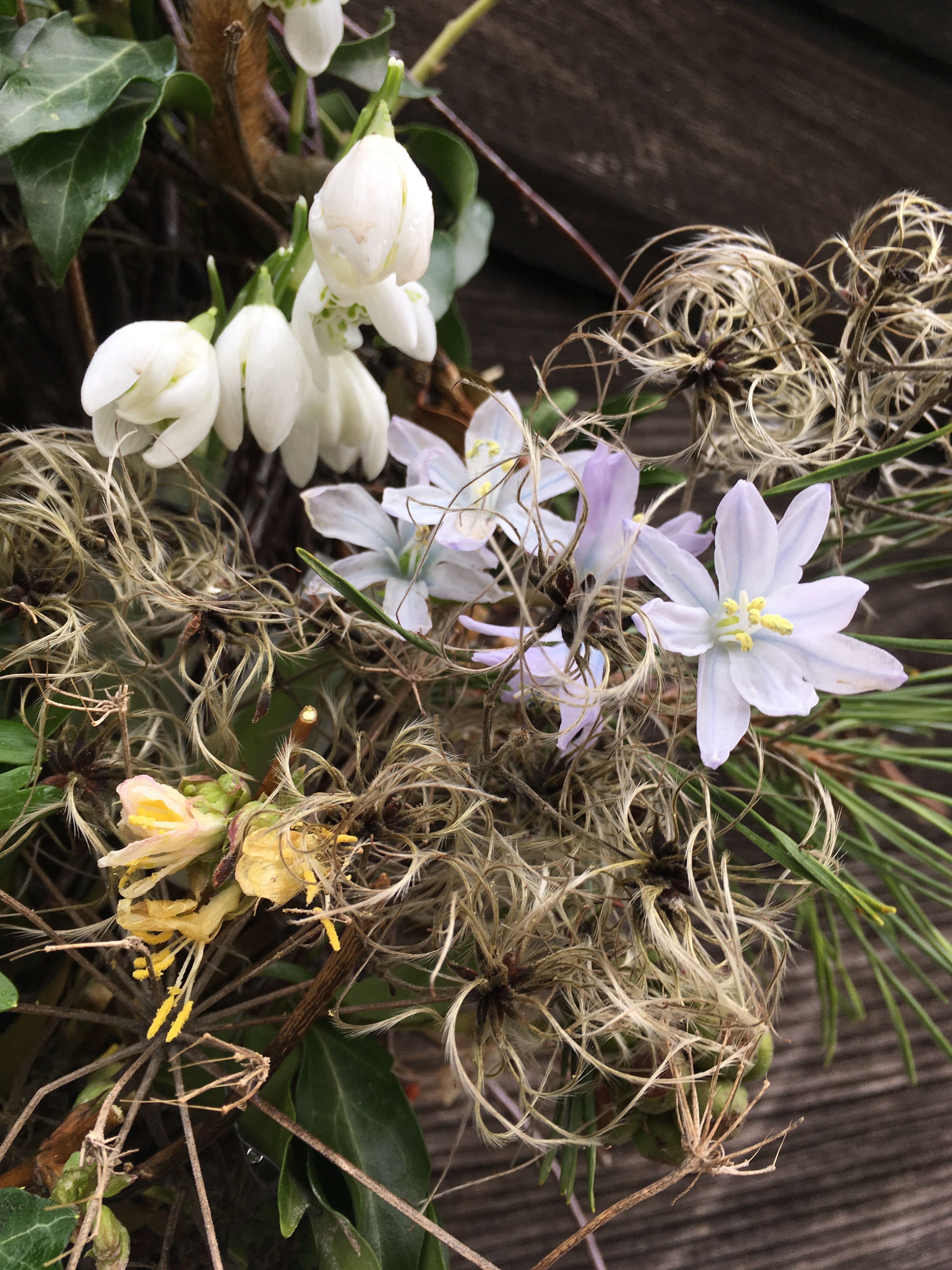
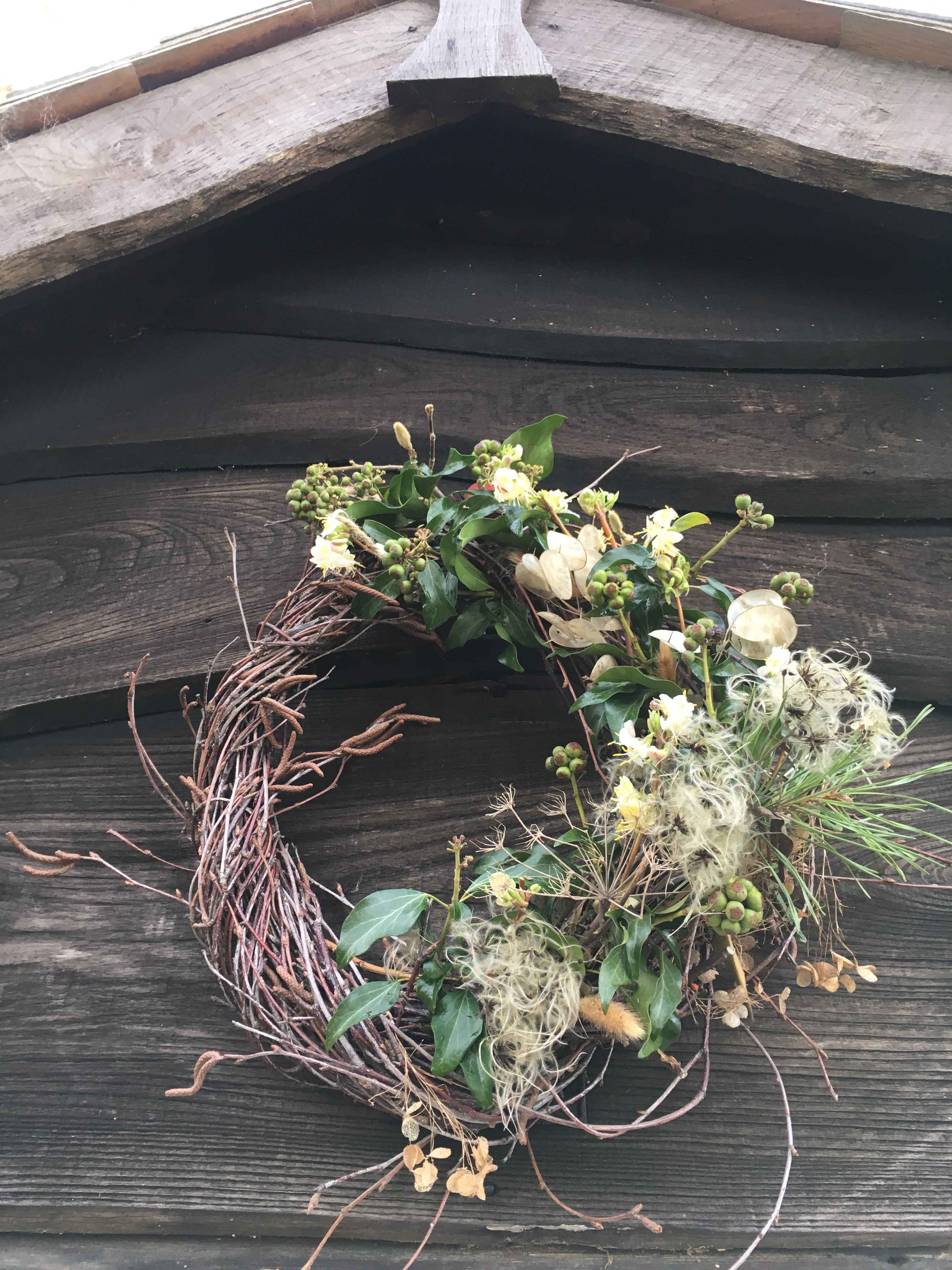
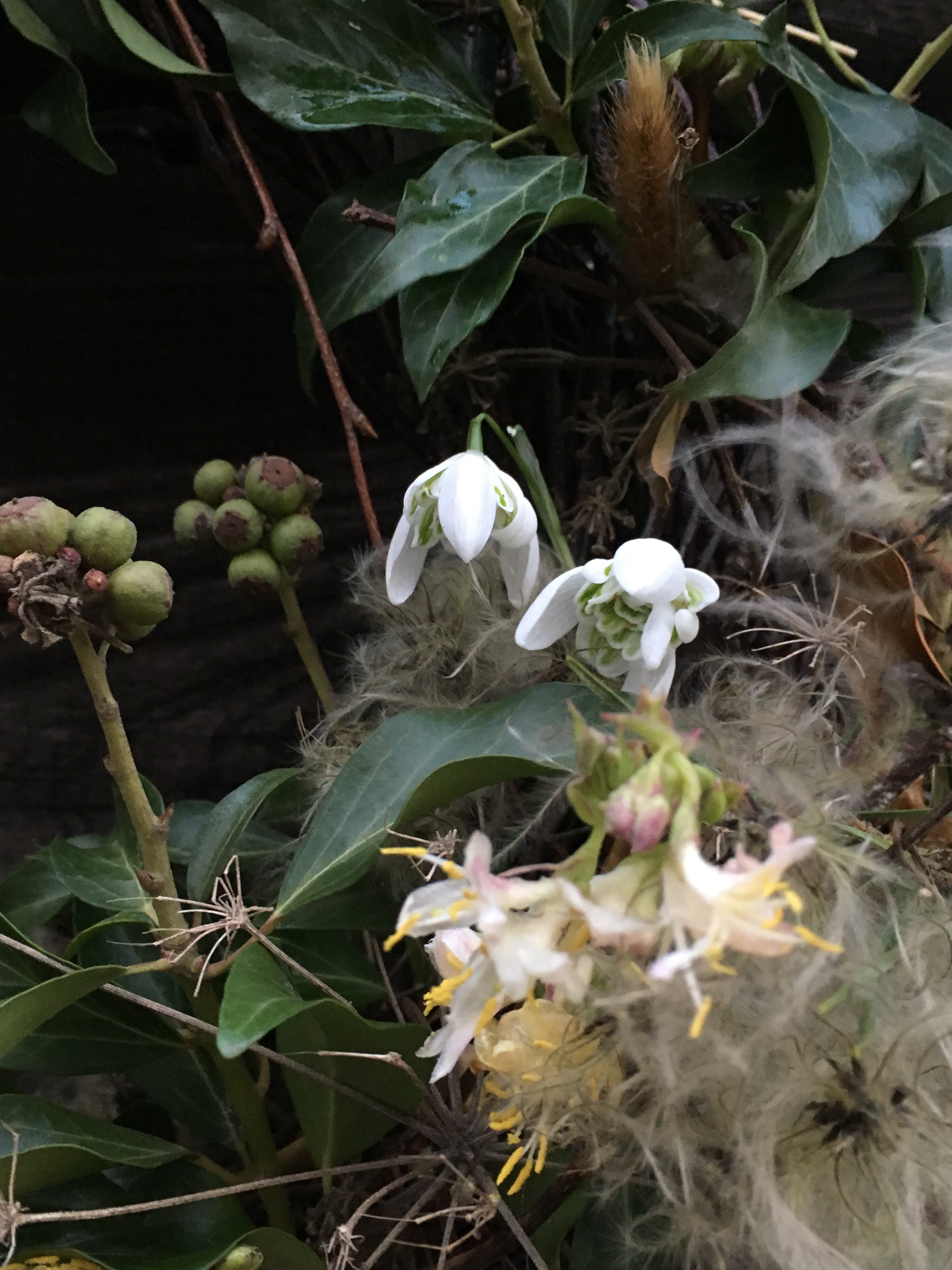
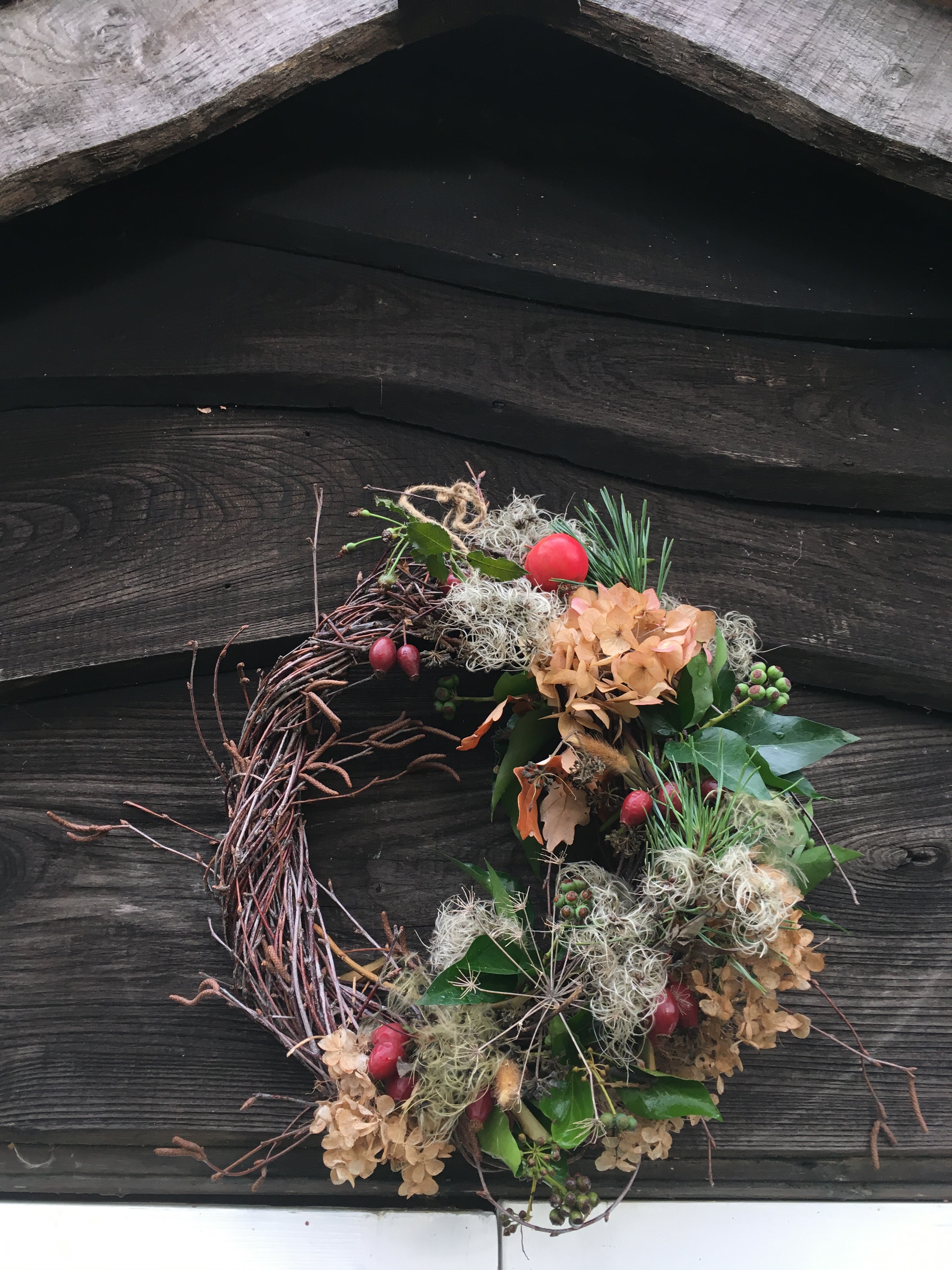
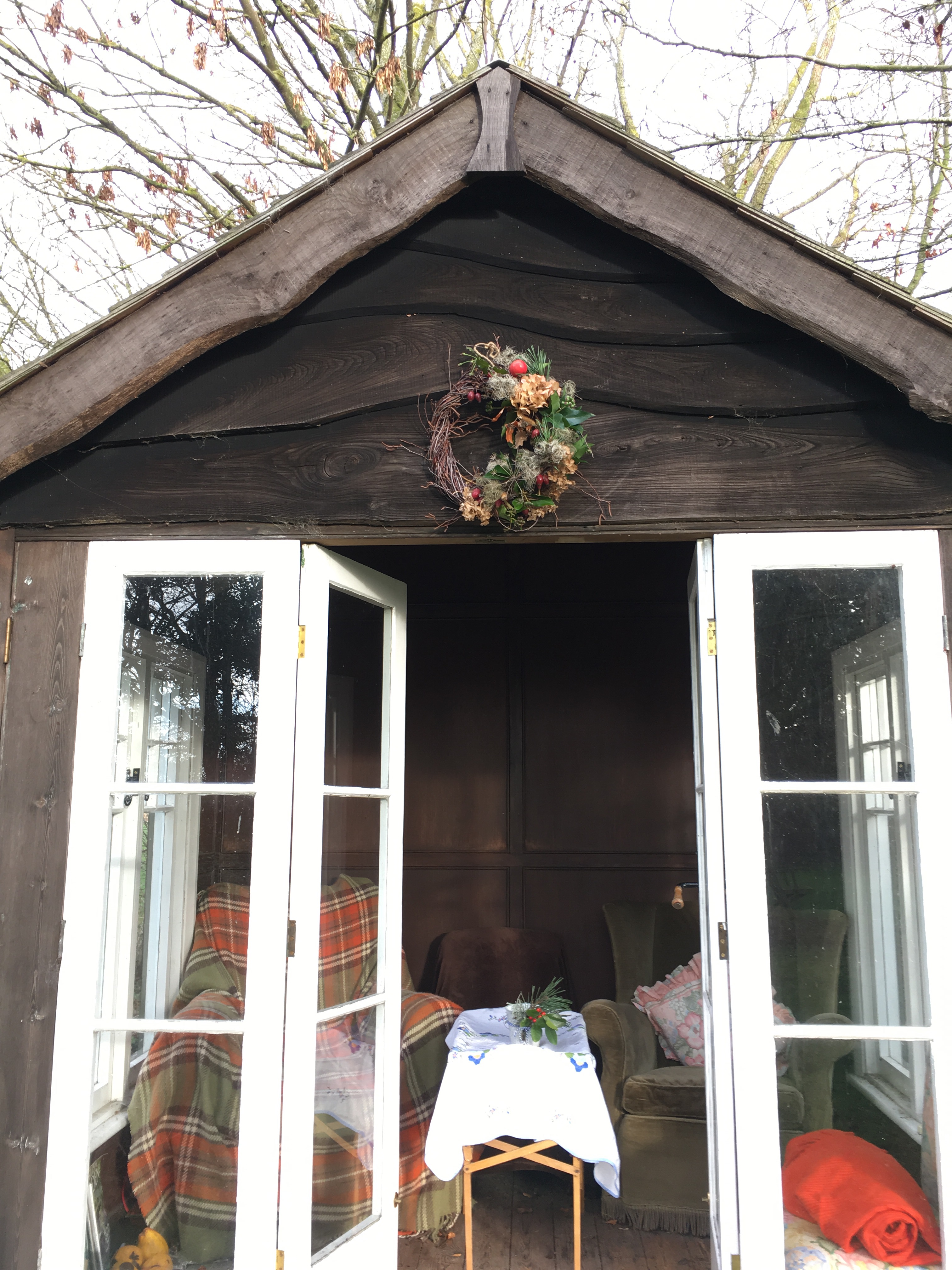
As usual, I look for signs of spring. I know there’s a months of cold weather to come, but it’s heartening to find fat buds on the oak trees, above, and grey catkins on willow. Back home, the winter-flowering honeysuckle is in bloom and the scent wafts around the garden. It’s always a surprise to find such a delicious scent emanating from such insignificant flowers. I’ve wound some stems through a silver birch wreath, along with fluffy wild clematis seed heads. After Christmas I miss the decorations. I keep the festive feeling going, but swap to spring flowers instead. This will look lovely and cheerful over the summerhouse door.

I hope you’ve enjoyed a walk around my garden and along the ridgeway today. What flowers have you seen in bloom already? Get in touch and let me know what’s bringing you joy in your garden over the winter.

Links: iris unguicularis https://www.woottensplants.com/product/iris-unguicularis/?gclid=CjwKCAiAjMHwBRAVEiwAzdLWGOy0g3Obpt8I_71GTzDsIURPiShw3RWDCpwp4RC80YOuRaFAqW3ikRoCDakQAvD_BwE

Rose Phyllis Bide: https://www.davidaustinroses.co.uk/phyllis-bide?gclid=CjwKCAiAjMHwBRAVEiwAzdLWGOQWws_A5vY11U8becLKemzBaIcwDJ3IzRUq2t10myMB88ssr2Rx4RoC2H0QAvD_BwE

Wild crab apples: https://www.woodlandtrust.org.uk/trees-woods-and-wildlife/british-trees/a-z-of-british-trees/crab-apple/

Lonicera winter flowering : https://www.crocus.co.uk/plants/_/lonicera-fragrantissima/classid.4101/

Fieldfares: https://www.bto.org/understanding-birds/species-focus/fieldfare

Happy New Year Everyone! Some news from my garden 31 December 2019

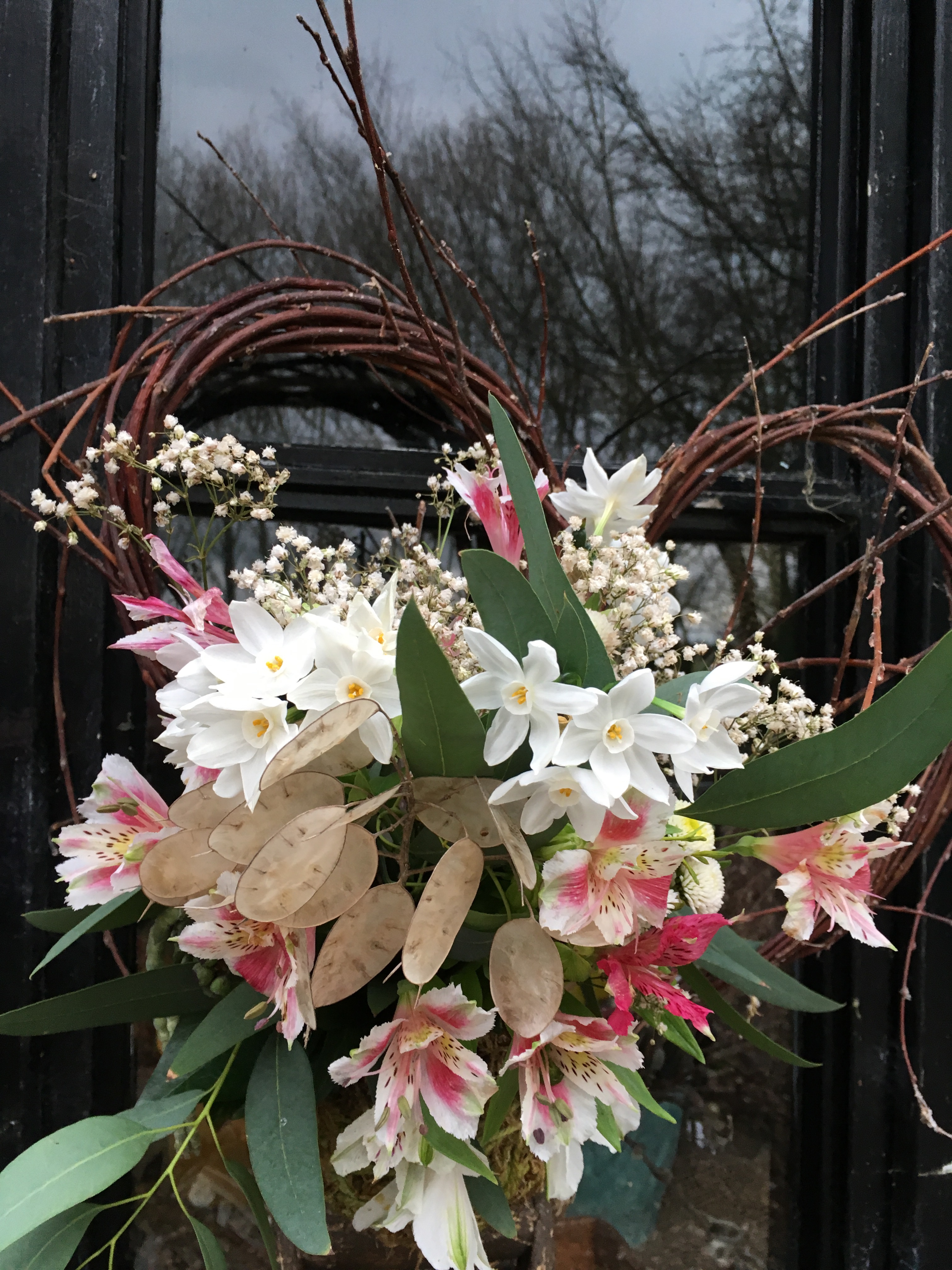
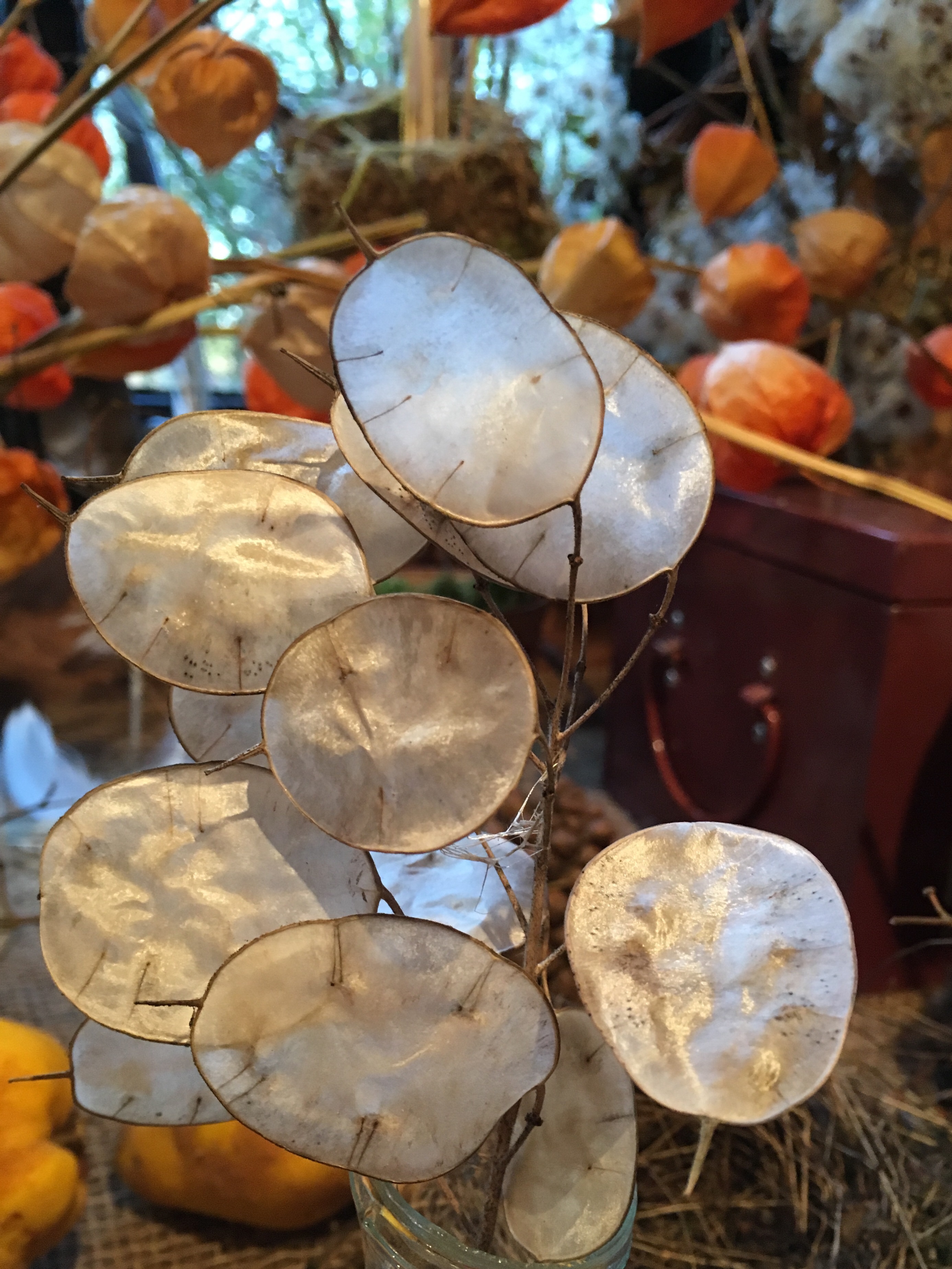
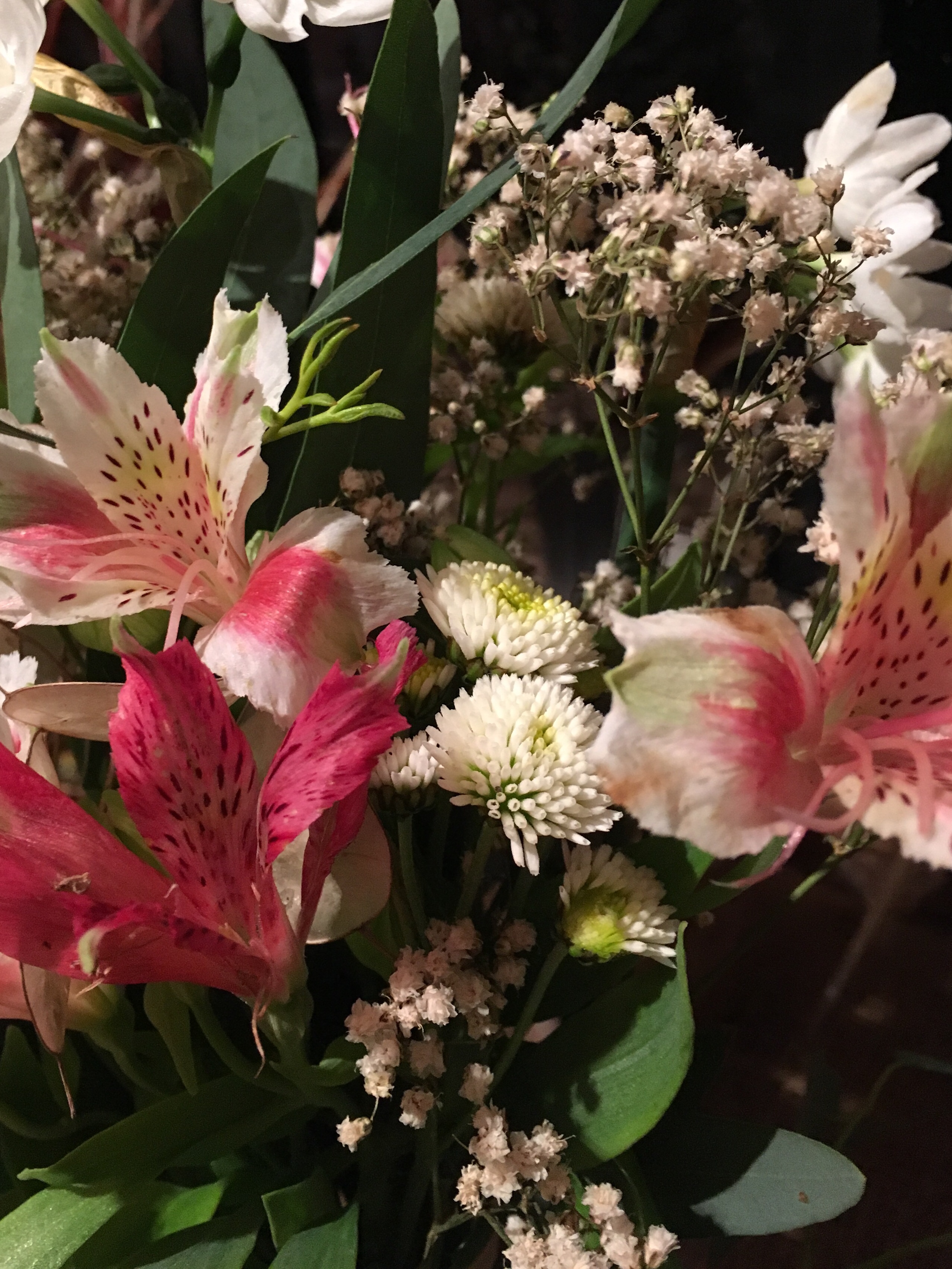
Photo: Paperwhite narcissi and pink alstroemeria from my greenhouse today. Gypsophila and honesty seed heads saved from the summer. Eucalyptus foliage and willow heart. Flowers are in a jam jar covered with moss and twine, kokadama-style. Lovely to have home-grown flowers for the New Year.

I love surprises. My grandmother used to say you can never predict what’s going to happen, so don’t worry about tomorrow. Concentrate on today. I’ve pretty much tried to follow her good advice. And just about everything she said has turned out to be true. So, I’ve been writing this blog for three years- not knowing where it would take me. And the biggest surprise is that it’s followed by a growing number of readers. I set out thinking I’d be pleased if just one person read it and was inspired to grow something from seed. Well, I’m amazed and pleased to say the blog was shortlisted this year for the Garden Media Guild Awards. The awards ceremony was quite a glitzy affair at the Savoy in London- not somewhere I ever expected to visit. It was hosted by Nick Bailey, and I sat next to Pippa Greenwood- someone I’ve always admired. Rachel DeThame and Anne Swithinbank were on the next table. Alan Titchmarsh won an award for practical gardener, and Carol Klein was given a lifetime achievement award, presented by Roy Lancaster. Marc Rosenberg won news journalist of the year. Bramblegarden didn’t win the blog category, but just to be a finalist was quite something for me. It took me right out of the potting shed and out of my comfort zone, which is a good thing, now and again, isn’t it.

My second lovely surprise came when the weekly Garden News magazine asked me to write about my garden, and the first of my articles is out this week!

Mum and I have been subscribers for about 20 years. Never in a million years did I think I would be sharing my garden with readers. But that’s what’s happened and they’ve asked me to write and send photos of what I’m growing on a regular basis.

There was a bit of a panic when they asked for photos of the garden. It’s not looking its best in winter, and the rain means I’m very behind with tasks. But I made an immediate decision not to have a frantic tidy up. My garden is what it is. There are too many brambles and stinging nettles, and those will be addressed over the winter. But, apart from that, it will be as it is, a rather messy garden with zones of productivity. I’ve got 10 beds, 1.3m wide by 3m long with little paving slab paths between. This means I never have to stand on the soil. For the past three years the whole garden has been ‘no-dig’ following the principles of Charles Dowding. There’s a 20ft Alton cedar greenhouse I’ve painted black, and alongside, a matching 20ft poly tunnel. The rest of the one acre garden is mostly trees, and low maintenance shade planting. It’s left to the owls, grass snakes and hedgehogs. I’m delighted to share space with them all.

Across the centre of the veg plot there’s a hazel wigwam or A-frame trellis. This has been patched up for the past two years and will be renewed this winter, ready for spring planting.

The hazel frame is perfect for growing sweet peas. The plants just scramble up by themselves. I don’t have much tying in to do. I plant gladioli down the middle of the structure to utilise the space. These grow about 1m tall and usually need staking, but the hazel frame supports them instead.

This is my favourite Wiltshire Ripple variety, which has a fabulous scent.

Here’s how I make my newspaper pots, using a spice jar to form the tube.

I stand the newspaper tubes in terracotta pans. It’s a good task to do when the ground is too wet to work on, which has been the situation here for the past three months.

Albutt Blue. It’s wonderful to be thinking about sweet peas – in the middle of winter.

I wish I could share the scent from all these flowers. Sweet peas are the essence of summer.

What plans have you for growing in 2020? Are you planting old favourites, or trying something new. Get in touch and let me know.

And remember, if you are writing a blog, you never know who might be reading, or what opportunities might come your way. Just enjoy your blogging.

Wishing you all a happy, peaceful and healthy New Year. Happy Gardening!

I am on twitter at https://mobile.twitter.com/kgimson/status/1149241935502225408

On instagram at https://www.instagram.com/karengimson1/?hl=en

Links: Garden News magazine: https://www.greatmagazines.co.uk/garden-news-magazine?gclid=Cj0KCQiAgKzwBRCjARIsABBbFujlf4tfcbFd4OxHcjvuH6NR9Uk54A_wVM0S9IDq_ZeSvA0FtiofT0oaAg9_EALw_wcB

Garden Media Guild: https://www.gardenmediaguild.co.uk/awards

Sweet peas Mr Fothergills https://www.mr-fothergills.co.uk/Flower-Seed/Sweet-Pea-Seed/#.Xgur1YGnyfA

Sweet Peas Easton Walled garden https://www.visiteaston.co.uk/whats-on

Higgledy Garden Seeds https://higgledygarden.com/

Savoy London https://all.accor.com/hotel/A597/index.en.shtml?utm_term=mafm&gclid=Cj0KCQiAgKzwBRCjARIsABBbFujh9QGSEjYNiJ8ON9HjLVkRMH3UNhpD8tpccFO4povH1E6R5zr5qXIaAikZEALw_wcB&utm_campaign=ppc-ach-mafm-goo-uk-en-uk-exa-sear-a&utm_medium=cpc&utm_content=uk-en-GB-V2352&utm_source=google

I like to join in with In a Vase on Monday, although it’s usually a different day : https://ramblinginthegarden.wordpress.com/category/gardens/in-a-vase-on-monday/

And Six on Saturday : https://thepropagatorblog.wordpress.com/

Happy Christmas Everyone!

I’ve escaped from the house for half an hour. There’s two dozen mince pies in a tin. All my cooking is done. Icing sugar is liberally sprinkled all over the kitchen table. But clearing up can wait. I need to get outside into the garden. Surely, no one will miss me for 30 minutes…..

I’ve been saving crab apples for Christmas decorations. There’s Red Sentinel, Jelly King, Transitoria, and the common malus sylvestris which grows wild in hedgerows around here.

I’m trying to use less plastic and wire in the garden. So as an experiment I’m using cocktail sticks to secure my apples. I’m not using floral foam either. Flowers can be tucked into little glass jars and test tubes. Foliage can be woven into willow. It just takes a bit of forward planning. And I’m pleased with the results.

Wild clematis, old man’s beard, highlights the rosy red apples and rosehips. Such a joy to use what’s to hand in the garden. Within a few minutes I’ve gathered everything I need.

I planted dozens of rosa canina when we made a garden here and rosehips are plentiful this year. I never take all of them from one place. Always leave some for the birds. They’ll need them to get through a cold wet winter.

My willow and crab apple wreath cheers up the summerhouse for Christmas. I’ve heaped woollen blankets in there and created a little library of favourite books. A peaceful place to rest and survey the garden birds. We’ve plenty of robins and blackbirds in the garden. They will be looking for nesting sites soon. Behind the summerhouse, the fields lie fallow this year. It’s been too wet to plough and sow any winter crops. Winter barley and wheat would usually be providing bright green shoots by now. It’s sad to see the ground so waterlogged and unproductive. However, birds and mammals are finding ‘leavings’ from the summer crops. Today we saw 300 field fares land in the field. They must be finding left over seeds and grains.

This is the field gate we walk through as we set off across the back fields. There’s a footpath along the hedgerow. Usually, there’s only us rambling along, but at Christmas the lane attracts a great many walkers. I like to decorate all the garden gates with willow and foliage. It only takes a few minutes to twist six willow stems into a heart and wind in some holly and garrya elliptica. Some dried hydrangea Annabelle makes a focal point, and hides the string tying everything together. Three crab apples glow yellow in the afternoon sunshine. It’s a constantly changing arrangement as birds peck at the hydrangea and apples. I don’t mind. It’s wonderful to watch them enjoying the juicy fruit. I can easily add some more. I enjoy the birds as much as the arrangements to be honest.

I hope you’ve enjoyed today’s walk around my garden. Thank you for all your lovely, kind and encouraging comments all year. Have a wonderful Christmas and a Happy New Year to you all. See you in 2020, when there will be some exciting new developments at bramble garden to show you. Enjoy your gardening as well as your festivities. Now, back to the icing sugar and that messy kitchen table….. there’s trifles still to make. And Christmas puddings to steam.

A walk around my garden Tuesday December 17 2019

Photo taken February 2019.

Something I love to do is pot up a lot of bulbs to make a table display. Bulbs are fantastic value right now. Today I bought two sacks of daffodils reduced from £24 to £3. They were virtually giving them away. I just couldn’t resist. So the morning was spent cramming them into 6″ pots with recycled compost saved from summer. As pots of compost are not very inspiring, I’m sharing a photo of my table display from February this year. Isn’t it cheerful to think we will be looking at all this colour in just a few months.

From left to right, there’s white Carnegie hyacinths, yellow tete a tete daffodils, Blue Jacket hyacinths, white Joan of Arc crocus, and various bright and wonderfully scented primulas and primroses. The perfume carries all around the veg garden. Such a joy after a cold, wet autumn and winter.

Some bulbs just starting to come into flower are Paper White narcissi. I started these off a few months ago in 10″ pots in the cold poly tunnel. There will be a steady stream of highly -scented pure white flowers for the next three months. Fabulous for cut flower displays for the potting shed and house. My favourites.

This week I harvested some of the new potatoes grown in recycled compost bags for Christmas.

I wrote about planting them here :https://bramblegarden.com/2019/08/07/im-growing-new-potatoes-for-christmas/

There were a few critical comments on social media when I posted this. Some people said it was a waste of time, there wouldn’t be much of a crop, the potatoes just didn’t grow for them. I was quite down-hearted for a while, thinking I might have wasted my money on the seed potatoes. But, this week, I tentatively plunged my hand into the compost bags, and found these beauties. There’s lots more to harvest. The good thing about growing them in bags is you can just take a few at a time. So I’m glad I didn’t listen to negative comments and give up. I’ll certainly grow them again for next Christmas, and I’ll double the number of bags; that new potato taste is absolutely wonderful in the middle of winter. A special treat. Which is what gardening is all about, pushing the boundaries and trying something new. A little bit of success is so encouraging.

Another winter task I love is making plant labels from twigs. I’ve lots of self-sown ash and hazel trees in the garden with nice straight stems. A good way to control them and make something useful from the wood is to cut them into 8″ -10″ lengths and shave off one side for the writing. It’s a lovely soothing job when you’ve spent time battling through crowds for Christmas shopping. Restores balance and good humour!

Following a wander around my garden, there’s always a trip through the top gate and out on to the back fields. These trees are much admired every day of the year. There’s usually a buzzard perched in this first one. It flies along to the next tree, keeping just ahead of me, as I amble along. Quite often there’s a pheasant in the ditch. Meg almost catches the tail feathers as they leave it until the very last moment to fly away. She is being trained to stop and do no harm. But the pheasants don’t know they aren’t in any danger. They make quite a noisy fuss, skimming low over the fields right to the other side and safety.

Along our walk today we visit the sunflower field. Great clouds of small birds rise out of the crop. The sunflowers are like statues- all facing south, their heads frozen in time, but determinedly facing the sun. Backs to the north wind. Like us really. Today, I’m facing south and trying to catch any slight rays of sunshine I can.

I find lambs’ tails. Hazel catkins. That’s sunshine to me. Soon be spring, they seem to be saying.

What signs of spring have you found in your garden today? Have you got snowdrops showing through yet? Here they are poking through the ground, tiny milky white buds like the eye of a needle.

I like to read Six on Saturday. Mine are always more than six, and I can’t always take part on the right day. Life is too short to worry about these things. https://thepropagatorblog.wordpress.com/2019/12/14/six-on-saturday-14-12-2019/

Christmas Flowers -In a Vase on Monday

There’s something very appealing about rooting around in ditches, searching for moss covered twigs and pieces of crumbly old bark. I like nothing better than finding bits and pieces that might come in handy for floral arrangements. It brings out the inner ‘Borrower’ in me. I suppose it’s the same as beachcombing for pretty shells and driftwood. Very soothing and satisfying.

It takes me an hour or so to gather enough twigs, moss, ivy and rosehips for today’s projects. The hedges are thick with swags of ivy all adorned with clusters of glossy green berries. These will ripen and turn black in time and provide a feast for the birds. Luckily, there’s enough for everyone to share. I never take too much from any one area.

Wild roses have taken years to climb to the top of the hedges and rosehips form great cascading arches right down to the ground in some places. Meg, my little puppy digs and burrows around in the ditch. She loves this occupation even better than I do, always keen to help, emerging with mouthfuls of sticks and an eager expression. By the end of the morning, my baskets are full, and Meg is happily muddy. We head home, mission accomplished. Setting the finds on the potting shed table, I’ve plenty of red-berried plain green holly, some trailing larch branches festooned with tiny gold fir cones, tendrils of old man’s beard or wild clematis and a pile of wild cherry stems, thick with flower buds already. These stems go into water and straight into the house where the warmth will bring them into flower by Christmas, if I’m lucky. I stand and survey the haul for quite some time. Then I wind willow and silver birch stems into hearts and circles and start to weave in the hedgerow bounty, adding crab apples and dried cow parsley seed heads which remind me of shooting stars. Meg sleeps on my coat in a box under the table, satisfied with her morning’s work. Occasionally, there’s a huge yawn, but mostly deep breathing, like a well fed baby. And in the peace and quiet, I can get on with my tasks.

White alstroemeria and tiny white Stallion chrysanthemum from the poly tunnel pots, adding colour to the hedgerow greens. White gypsophila, dried from the summer.

Hedgerow finds with dried hydrangea flowers and pine.

Teasels and Garryia elliptica on the field gates.

Hydrangea Annabelle with a clematis Montana and willow circle.

Hydrangea and old man’s beard clematis catching the sunlight.

A simple willow heart and ivy.

Christmas hellebore. One of the Gold Collection varieties. A welcome addition to seasonal arrangements. Slit the stem lengthways for 4″ and stand in water right up to the flower head, before using in arrangements.

Summerhouse posy. Holly, lavender and fir.

Rosy hydrangea flowers, wild clematis and pine.

Willow, dogwoods, skimmia and conifer stems.

Potting shed window. Rosehips, crab apples and cow parsley seeds.

Links : In a Vase on Monday. https://ramblinginthegarden.wordpress.com/2019/12/09/in-a-vase-on-monday-spike-revisited/

A Walk Around My Garden and Back Fields -7 December 2019

Can there be anything more cheerful in winter. Hyacinths, planted in October and grown in the dark, now brought out into the light. Roots climbing out of the pots. Emerald green flower spikes. The promise of flowers- and scent- at a time when we need promise. I potter about all day in the sunshine, planting bulbs, poking about in plant pots, looking for life. I find snowdrops. The tiny white flowers, tight closed. But soon they will be lighting up the garden.

In the greenhouse, the miniature iris bulbs are through. I’m growing Iris reticulata Harmony, a lovely deep inky blue; Katherine Hodgkin, pale blue, and a new variety, Katherine’s Gold, a sport which is a pretty pale yellow form.

These pots will be placed on garden tables in spring, but for now, they’ll stay protected in the greenhouse. Mice are very partial to bulbs.

All jobs completed- pots tidied for recycling, and a few leaves raked into piles to be turned into leafmould- I set off for my daily walk out though the top gate and along the hedgerow path.

Oak trees and hedgerows are almost bare now. A chance to enjoy the beautiful intricate structure of branches. Hidden views are revealed, and if we are lucky, we see a barn owl, hunting in the late afternoon as food becomes scarce.

Just a few crab apples remain on trees. Blackbirds and mice have had a feast this year. It’s been a record harvest.

I find a patch of oak leaves turning a glorious gold. But why haven’t the winter gales blown the leaves across the field, like the rest of them.

Looking closely, I find leaf galls on the undersides of the leaves. They are types of Oak Spangle galls. I wonder if they can somehow manipulate the chemical composition of the leaf to delay senescence. I have seen tiny insects, mine caterpillars, do this in my beech leaves. There are so many mysteries, so much more to learn. Who knows if this will be useful to humans in some way in the future.

On my beech tree leaves, a tiny green oasis remains. Evidence of tunnelling by the moth larvae of Stigmella tityrella. Have you ever noticed these on your trees before?

I find a hazel leaf cozily wrapped around a twig. I gently peep inside. Who could resist? A tiny cluster of ladybirds are snuggled at the base. I carefully fold the leaf back and hope they stay safe and sound until spring.

Turning back, the sun is starting to set. I can see our trees in the distance. A blackbird sings in the hedge. It sounds so loud on a still afternoon when there’s no one else around to hear it. Just me. It will be dark soon, so I hurry across the fields. Suddenly it feels cold. How quickly a sunny day can turn to dusk. Luckily I know the path well and could find the way with my eyes closed. Which is just as well, as it’s pitch black by the time I reach home.

Thank you for reading. Please feel free to share my blog and help me spread the word. Are you managing to get any gardening done at the moment. Get in touch and let me know.

Links: More than Six on Saturday https://thepropagatorblog.wordpress.com/2019/12/07/six-on-saturday-07-12-2019/

Stigmella tityrella :http://www.leafmines.co.uk/html/Lepidoptera/S.tityrella.htm

Moths: https://ukmoths.org.uk/species/stigmella-tityrella

Galls: https://www.woodlandtrust.org.uk/blog/2018/07/galls-to-spot-this-year/

A Walk Around My Garden – 23rd November 2019

If I could only have one tree, it would be a field maple. At this time of the year, there’s a golden carpet of leaves covering the whole garden. Even dark corners and shady woodland walks are glowing yellow. Much needed cheer, when the days are short and turning cold and dark. We must find our own warmth from nature, whenever we can.

This year, I’m experimenting with the boundary. Thin branches are laid horizontally to form a ‘fedge,’ a cross between a fence and a hedge. This creates a habitat and shelter for mice and hedgehogs, birds and insects. Smaller twigs are put through my new shredding machine to create woodland paths and mulch. The idea is to make use of everything in the garden and do away with the need for bonfires, which are bad for the environment. Sunflower and cow parsley stems will be woven into the ‘fedge’ creating useful hibernation sites for beetles, ladybirds and lacewings. Even earwigs are welcome here, useful predators of vine weevils and many orchard pests.

Looking up, you can see there’s plenty of twiggy growth in this garden. I rather like the pattern of black stems and yellow maple leaves. It looks like a pen and ink drawing and someone has ‘scribbled’ across the skyline.

Temperatures suddenly dropped below zero for the first time this autumn. We’ve been relatively mild until now, with record amounts of rain. The hazel trees responded by dropping all their leaves in one go- as if in fright. Overnight, puddles of ‘gold’ appeared all over the garden.

Searching for more gold, I found a dogwood, Midwinter Fire.

This dogwood is beautiful all year round, but particularly shines in November. When the leaves drop, bright orange stems will catch the winter sunlight. A wonderful sight in snow and frost. Well worth planting in any border, in full sun, or part shade. Needs minimal pruning, unlike the red-stemmed varieties which can be pruned to the 3″.

Mooching about the garden, I find a mini potted fruit tree with its first apple. This is a desert apple, Malini, growing on a dwarfing root stock. I’m growing it in a 12″ pot and it will go with my youngest daughter when she flies the nest. I have a patio full of tiny fruit trees, to form a fledgling orchard, for her first home.

Into the poly tunnel, I find some pretty chrysanthemums coming into flower. These are the hardy Stallion variety. They can cope with the cold, but do better if protected from rain. They are grown in 10″ pots, stood outdoors all summer, and brought under cover in October.

There’s plenty of yellow chrysanthemums too. We call these Aunty Dorris, as cuttings were given to my father law by his aunt in the 1950s. Much treasured in our family.

I hope you’ve enjoyed your walk around my garden this week. Are you searching for colour at this time of the year. What are you finding that’s cheering you up at the moment?

Finally, as a change from gold, I find these beautiful – and very late roses in the front garden hedge. I believe they are the Ballerina Rose, a really good, disease-resistant variety. It flowers on and off all summer- and right up until Christmas. In fact, these roses will be going into my Christmas door wreaths, along with rosehips, old man’s beard wild clematis, fir cones and crab apples. Guaranteed to bring good cheer.

Links :

Field Maple, Acer campestre https://www.woodlandtrust.org.uk/trees-woods-and-wildlife/british-trees/a-z-of-british-trees/field-maple/

Hazel : https://www.woodlandtrust.org.uk/trees-woods-and-wildlife/british-trees/a-z-of-british-trees/hazel/

Dogwood https://www.rhs.org.uk/plants/57639/i-cornus-sanguinea-i-midwinter-fire/details

Apple trees: http://www.lubera.co.uk/?gclid=Cj0KCQiAw4jvBRCJARIsAHYewPOyG2A6Q46HJPng2Xsb2BEURZuS09DZ69up4PWKOAp7k10agvT6HVgaAuxQEALw_wcB

Rose Ballerina: https://www.classicroses.co.uk/ballerina-shrub-rose.html

More than Six on Saturday : https://thepropagatorblog.wordpress.com/2019/11/30/six-on-saturday-30-11-2019/

In a Vase on Monday- 25th November 2019

Flowers from my garden. For Joan.

Today’s flowers feature my father-on-law’s hardy yellow chrysanthemums. We don’t know the proper name for them, but in our family they are known as ‘Aunty Dorris.’ My father-in-law had been growing them since Aunty Dorris gave him a cutting in the 1950s. He grew them for his wife Joan, who particularly loved the sunny yellow flowers. Now the cuttings have been passed to me, and I’m keeping up the tradition of growing flowers for Joan.

The flowers have a gorgeous lime green centre which sets off the bright yellow petals. They last at least three weeks in a vase, with water refreshed every day.

Variegated ivy with golden flower heads provide foliage for my chrysanthemum posy.

Oak and beech leaves gathered from the garden add some lovely warm burnished tones.

Autumn trees across the horseshoe pond are reflected in the potting shed windows.

There are rows of beech trees all around the garden, remnants of an old hedgerow. Trees stand bare all winter, but juvenile foliage at the base provides copper-coloured leaves through until next May.

Chrysanthemums are often winter hardy, but the flowers are spoiled by rain, so I grow them in many 12″ pots. They stand outdoors on the paving all summer, and are brought in to an unheated poly tunnel around first week of November. After very mild temperatures, we had one night of -2C so I covered the flowers to protect them from the sudden chill. They were uncovered the next day, and night time temperatures have been 8 to 11C since then. The pots will supply a steady flow of flowers until the new year. Plenty for Christmas. And plenty for Joan, who is now living in a care home with Keith. I’m glad to be keeping up our family tradition. I often think of Aunty Dorris and wonder if she realised her cutting would lead to so much joy shared down through the years.

Here’s a photo of Joan on her wedding day, standing on the steps of Cosby Methodist Chapel. Joan did the flowers for the chapel for 65 years and Keith played the organ for weddings and chapel services. This photo, in a home-made metal frame, is a little battered as Keith carried it all around Korea for his army national service.

Thank you for reading. Please share this blog on any social media platform, share with your friends and neighbours and help me spread the word. Hopefully I’ll inspire someone to grow flowers, fruit and vegetables. It’s really simple, if you have a few pointers and little hints and tips along the way. Enjoy your garden.

Links: In a Vase on Monday https://ramblinginthegarden.wordpress.com/category/gardens/in-a-vase-on-monday/

Egg Free, Fat Free, Sugarless Cake Recipe- Family Favourites (vegan)

I’m gathering another recipe here for my children. This is a much -loved recipe I’ve made for open gardens, picnics and school cake sales. It is suitable for vegans, vegetarians and people who are allergic to eggs. It’s so simple to make and the kitchen smells delicious when it’s being cooked. Enjoy!

INGREDIENTS

6oz brown SR flour ( if using plain flour, add 3 tsp baking powder)

2oz ground almonds (omit if allergic to nuts, and use ground oatmeal instead.)

2 tsp mixed spice

1lb mixed fruit

4 oz dates, finely chopped

4 oz apricots, finely chopped

Rind of 1 orange or lemon

1/2 pint water (you can use tea)

2 tbsp orange juice

METHOD

Soak the dried fruit in the liquid overnight.

Add the dried ingredients and fold in.

Bake in a 2lb loaf tin for 1.5 hours at 160C. Cover the cake for the last half an hour to prevent the top burning.

Check with a knife to ensure the cake is cooked.

Enjoy 😊 x

Garlic Wash Recipe for Hostas. Defeating Slugs…

On Sunday, we had a question on protecting hostas from slugs – on the BBC radio gardening programme I sit in on.

My panel team mate Nick Turrell and I talked about using Strulch Mulch – a mineralised straw mulch that’s got a scratchy surface that slugs don’t like.

We also mentioned a garlic wash spray we have both tried and tested. We found it works a treat. It deters slugs, but does not poison them. This means the slugs are left available as food for birds and mammals such as hedgehogs. You’ll need to repeat the treatment regularly, especially after rain. I put my mixture in a 3l Hozelock sprayer and leave it in the potting shed ready to treat them. I’ve found it also deters aphids and is good for spraying roses.

The recipe comes from Sienna Hosta, a multi- gold medal winning nursery specialising in hostas. They do not use any other chemical treatments.

Here is a snapshot of their website showing their recipe for the garlic spray.

Here’s a link to their website.

https://www.siennahosta.co.uk/pages/garlic-wash-recipe

We also talked about no-dig gardening, protecting soils and coping with flooding. Charles Dowding is the expert on no-dig.

https://charlesdowding.co.uk/courses/

Here’s the link for Strulch Mulch.

https://www.strulch.co.uk/

Here’s a link to the radio programme BBC Radio Leicester’s Sunday Supplement. We are the middle hour of Dave Andrews’ show.

At 1.09.16 on the timeline at https://www.bbc.co.uk/sounds/play/p07sc852

We also mentioned our appeal for hedgehog food from Leicestershire Wildlife Hospital. They have 260 hedgehogs in their care and are taking in around 10 a day. Hedgehogs are either ill, underweight or injured having been washed out of their nests in the floods. Hedgehogs eat meaty dog food, the solid loaf -type, and not containing gravy, jelly, or made with fish. They also desperately need puppy milk for the babies, and heat pads and incubators. They have an amazon wish list and an appeal fund.

http://www.leicesterwildlifehospital.org/

And also we talked about Belvoir Castle Flower and Garden Festival which was launched this week :

https://www.eventbrite.co.uk/e/belvoir-castle-flower-and-garden-show-tickets-77976360393

Dahlias -Overwintering Dilemmas- 19 November 2019

I’m not usually a ditherer. I have a plan of action and I just get on with it. But the weather this autumn has put a spanner in the works. Unprecedented amounts of rain mean we are five weeks behind schedule with all jobs in the garden. And I am only now managing to sort out and store my precious dahlia collection.

This year, I’ve decided to leave half in the ground – in a raised bed with free-draining soil- and bring half indoors. This way, I’ve cut my losses. I’ll have some plants indoors to take cuttings from next spring, even if the ones outdoors fail to survive.

Here’s what I’ve done with the ‘outdoor’ dahlias:

OVERWINTERING DAHLIAS IN THE GROUND

1. I’ve waited until all the foliage has been blackened by frost. This sends the plant instructions to go into dormancy.

2. I’ve removed half of the foliage and dead flower heads. The remaining foliage has been folded over to cover the plant. Stems are hollow, so if you cut back stems and leave them upright they act like straws, directing rainwater down to the tuber.

3. I’ve put a 3″ deep mulch of compost over the tubers, followed by 6″ of dry leaves or straw.

4. Dahlias need to be kept dry and frost free, so I’ve covered the bed with some cloches, and packed the ends with dried leaves. These 1.3m by 3m beds are mounded up like ridge and furrow farm land. They are no-dig which also seems to aid drainage over winter by protecting the soil structure. No-dig basically means adding a few inches of compost every time you harvest a crop, and simply re-planting through the compost. No back-breaking digging is required.

LIFTING DAHLIAS FOR INDOOR STORAGE

For my indoor ‘insurance policy’ dahlias I’ve done the following:

1. Waited until the frost has blacked the foliage. Checked the soil. It is like suet pudding, wet and claggy. Heavy clay. This is an area of garden due a lot of compost mulch over the winter.

2. I’ve gently dug out the dahlias, being careful not to bruise them. Wounds are vulnerable to rotting, so care needs to be taken.

3. I’ve cut the stems back to 3″ and turned the tubers upside down to drain. They will go into a frost free potting shed.

4. When drained, I’ll store the tubers in dry vermiculite, straw, or compost, in the dark, under the potting shed table. Temperatures need to be 2-3C. Dahlias will survive a few degrees of frost- if they are dry. If it gets very cold, I’ll throw some fleece or old blankets over the tubers.

In February, I’ll place the tubers in seed trays of compost in gentle heat to bring them back to life. When they have shoots 1″ tall, I will split the large tubers in half with a sharp knife, making sure both halves have some stem.

I’ll also take basal softwood cuttings when shoots are 1″ tall, using a sharp knife and taking a small sliver of tuber with the cutting. These will be grown on in a frost free greenhouse and planted out end of May. Cuttings will make good size tubers and will flower in one season.

You can lift and save tubers from seed-grown dahlias as well. Just save the best ones, as seed produces very variable results.

Which option are you taking with your dahlias?

A BIT ABOUT HISTORY

It’s fascinating to hear that dahlias have been grown in Europe for 200 years. They originally came from Mexico and were grown in the botanic gardens in Madrid towards the end of the 18th century.

Dahlias are named after Andreas Dahl, a Swedish botanist, scientist and environmentalist. Plants come in every colour -apart from blue! The smallest are the Lilliput Series and the largest are dinner plate sized, a foot in diameter.

Dahlias are categorised by their appearance; there are waterlily, Pompom, collarette and cactus types. Something for everyone, really.

Here’s some of my favourites from my cut flower garden.

Arabian Night. Deep, dark velvety red. A stunning dahlia for cut flower work.

Nuit de’Ete, a lovely deep red cactus type. Lasts two weeks in a vase.

Nuit de’Ete amongst cosmos, persicaria and Ammi.

An pretty un-named variety grown from a packet of seed. Single flowers are much loved by bees and butterflies.

Dahlia David Howard. The best orange variety. Strong growing with long lasting flowers. Very beautiful in low autumn sunshine.

A very good book on dahlias has been written by Naomi Slade. Highly recommended. Just beautiful to sit and peruse over the cold winter months to come. When we will all need something cheerful to look at.

There’s a review of the book here : https://bramblegarden.com/2018/06/24/dahlias-beautiful-varieties-for-home-and-garden/

My dahlia tubers come from Gee Tee Bulbs: https://www.gee-tee.co.uk/bulbs/dahlias

Links: National Dahlia Society: https://www.dahlia-nds.co.uk/

In a Vase on Monday ( although this is Tuesday- I still like to join in when I can ) https://ramblinginthegarden.wordpress.com/category/gardens/in-a-vase-on-monday/

Follow me on twitter @kgimson

On instagram at karengimson1

Thank you for reading. Please leave a comment below and let me know what you are growing in your garden at the moment.

And, a photo I haven’t shared before. A picture of my mother in law Joan. Regular readers will know that I grow my cut flowers to keep a connection with Joan. It’s something we both love and it’s a way of sharing my garden with her now she is living in a care home.

A walk Around My Garden – 16 November 2019

Today’s photos have a golden theme running through them. For a few short weeks, everything glows. It’s a last gift from the garden before we descend into cold dark days. And it’s a very welcome gift. Even the flowers are golden. The last dahlias make a cheerful posy for the garden table. Tubers of favourite David Howard dahlia are tucked up under a foot of dry leaves now. Here I’ve found some blue borage and a few nasturtiums to go with the solo dahlia bloom. I feast my eyes on the sight. It will be another 9 months before I see dahlia flowers again.

Luckily, in the poly tunnel, my ‘Aunty Dorris’ chrysanthemums are coming into flower. My father in law has been growing these since the 1950s after receiving cuttings from his aunt. Sadly he’s had to leave his garden, and the precious plants have come my way. I’m determined to keep them going, in memory of Aunty Dorris and as a tribute to their shared love of gardening. There will be a steady flow of flowers to the care home where my relatives now live, right up until Christmas time.

White Swan chrysanthemums are also flowering. I grow them in 12″ pots in an open-ended poly tunnel. They don’t mind the cold, but the rain spoils their flowers. There’s often enough for Christmas table decorations.

Stepping out of the poly tunnel door, this is the scene. A bank of wild cherry trees make a golden veil. Next spring there will be snowy white cherry blossom, followed by luscious red fruit. There’s always something to look forward to. Nothing stays the same. I remind myself this, when there’s bare stems and cold dark days ahead. Winter is not my favourite time of the year, but I store up memories of the past, and at the same time, look to the future. My garden provides a kind of winter armoury.

Alongside the greenhouse, there’s a group of hazel trees. We harvest a few cob nuts each year, but squirrels take most of them. It’s cheerful to see catkins – or lambs tails- forming already.

Through the hazel and maple trees, you can just spy the summerhouse. Fallen leaves make a golden footpath leading the way.

Tall golden beech trees make a backbone for the summerhouse. It will be six months before we see lime green shoots and new leaves again.

Surrounding trees and the back fields are reflected in the summerhouse windows. Sunset is a favourite time to sit here and ponder on the growing year coming to a close. And also think about all the flowers, fruit and veg I’ll be growing next year.

What plans have you for your garden next spring? Are you enjoying the autumn colours just now, as we are here in the Midlands? Get in touch and let me know how things are going in your garden right now.

While you are looking at these photos there’s some music to go with them. Here’s the link to Yellow (Coldplay) sung by Jodie Whittaker for Children in Need. It’s very appropriate for my post this week. At 1.35.09 on the timeline. Or number 12 on the playlist.

https://www.bbc.co.uk/sounds/play/p07sc6bw

Children in Need; https://www.bbcchildreninneed.co.uk/shows/got-it-covered/

Links : SOS. I like to join in with Six on Saturday, but always have more than six to share https://thepropagatorblog.wordpress.com/2019/11/16/six-on-saturday-16-11-2019/

Six on Saturday- A Walk Around My Garden and Back Fields- 9th Nov 2019

It’s a cold, misty start to today’s walk around my garden and back fields. Peering through the gap in the hedge, the old oak tree looks golden. We see a fox crossing the field, so brazen in the morning light. Fox and field blend into one. All autumnal tones merge today. The fox heads for the ditch, sending a pheasant flying into the next field. In the hedge where I’m standing, blackbirds and robin start up their alarm call. I think it must be the fox causing the upset. But then a buzzard glides low overhead- silent at first, then making a plaintive mewing cry. I shiver. Magnificent. Deadly. Owning the sky.

We walk along the ridgeway path. It’s been a slow start to autumn here. Field maples usually yellow-up by mid to end of October. Suddenly today, as temperatures dip below zero, the hedgerow takes on a golden hue. It reminds me of a patchwork quilt. ‘Squares’ of black dogwood stitched together with patches of golden maple. Such a pretty view. I gaze at it, and hold it in my memory. A few autumn gales and the magic will be gone. A whole year before we see such sights again.

Blackberries. The bane of my life this year. They have taken over my garden and this winter there will be serious chopping back. Meanwhile, leaves glow a glorious red. Quite pretty, if they were not so determined to take over the world.

It’s been wet here. So far this month there’s been 42mm of rain. In October we had 146mm, and in September, 118mm. The ground is waterlogged, ditches overflowing. We follow a path where horses have trod. The ground is so soft there’s deep hoof prints, full of water. It’s calming following footprints, the sky reflected in the little pools of water.

A dip in the hedge reveals our trees on the left. I can hardly believe we planted them, all those years ago, when I was in my 20s. They’ve been a source of joy ever since. On the right in the distance stands Polly’s Wood. I have a dream to join the two woods together- a corridor for wildlife. One day, perhaps. We shall see. Dreams do sometimes come true.

Back through the garden gate, on our boundary, there’s a green corridor running down past the pond to the summerhouse beyond. Autumn and spring are my favourite times for this part of the garden. In spring, the lime green new shoots are bright and cheerful. At this time of the year, field maples and cherry trees create a golden tunnel.

If you look carefully, you can just see our 1930s summerhouse, hidden amongst the trees.

Thank you for all your kind words last week, following our cousin’s funeral. It’s seems I am not alone in turning to nature as a balm when there are sorrows. Perhaps we all find solace and hope in nature all around us. And gardening is something we all turn to in moments of need. This week after walking for miles, and gardening all hours, I feel restored and ready to face whatever life brings. No doubt there will be many more ups and downs to deal with. Nothing stands still in life, or in gardening, for that matter. Does it.

Links : More about buzzards and listen to their call :https://www.rspb.org.uk/birds-and-wildlife/wildlife-guides/bird-a-z/buzzard/

Field Maples : https://www.woodlandtrust.org.uk/trees-woods-and-wildlife/british-trees/a-z-of-british-trees/field-maple/

Apple and Almond Slice- Family Favourite Recipes

At this time of year, my kitchen work surfaces are covered with piles of apples. Little pyramids of golden cooking apples, tiny rosy red eating apples, giant Bramleys. My family complain. There’s nowhere for anyone to put anything down. I usually store them wrapped in newspaper in the potting shed, but I’m still trying to evict the mice, making many trips back and forth to the woods with my tunnel-like humane traps baited with peanut butter. I can’t kill them. They will take their chances in the leaf litter under the trees. I’m trying to ignore the tawny owl fledglings in the branches above, still being fed by harassed parents. I feel slightly guilty. But watching the mice run when I let them out, I think they stand a fair chance of surviving.

Meanwhile, I’m steadily working my way through the apples. My mother always says, if you’ve got an apple, you’ve got a pudding. It can be an apple pie, a crumble, a cake, or if you are pressed for time, just apple purée with lashings of creamy custard, or Devon clotted cream. A special treat.

Today’s recipe is another family favourite, an apple tray bake which is quick and easy to make and tastes of autumn. As usually, I’m recording it here for my children, in case they can’t find the scraps of paper these recipes are written on. It’s so lovely to see my grandmother’s best copper plate hand writing, as she lovingly wrote these recipes for me. Food, and cooking, bring back such special memories, don’t they.


APPLE AND ALMOND SLICE:

INGREDIENTS – FOR THE TOPPING


30g butter or vegan margarine

30g SR flour

25g golden caster sugar

2 tbsp. Jumbo oats

1/2 tsp cinnamon

25g flaked almonds

METHOD

Mix the butter, flour and sugar together. Fold in the cinnamon, oats and flaked almonds to make a crumble topping. Place in the fridge while you make the base.

INGREDIENTS FOR THE BASE

150g SR flour

200g golden caster sugar

200g butter or margarine

3 eggs ( or use 6 tbsp. soya oat drink if vegan)

100g ground almonds

1/2 tsp baking powder

1/2 tsp almond extract

1/2 tsp cinnamon

2 large apples slices and tossed in lemon juice

100g any other fruit you have; blackberries, raspberries, blueberries, plums,

METHOD

Mix the flour, baking power , sugar and butter together. Whisk. Fold in the ground almonds and cinnamon. Add the beaten eggs.

Put half the mixture in the base of the tin. Put apples on top. Add the rest of the base moisture. Press the blackberries or other fruit on the top.

Cover with the crumble topping mixture.

Cook for 40-50 minutes, or until a skewer come out clean.

Gas mark 4, 180C oven, or 160C fan oven.

You’ll need a 20cm tray bake tin, at least 4cm deep, lined with baking parchment.

Put baking paper on top if it is browning too quickly. Leave to cool and slice into fingers.

Can be frozen for 3 months.

Enjoy!


You might also like : Review of Orchard Odyssey by Naomi Slade here :

https://bramblegarden.com/2019/09/27/an-orchard-odyssey-book-review-and-prize-draw/


Also The Creative Kitchen by Stephanie Hafferty https://bramblegarden.com/2018/11/18/the-creative-kitchen-book-review/

I’ll leave you with a photo of my 1930s summerhouse, looking autumnal today. There’s heaps of blankets to keep us warm when the temperatures start to dip. It’s quite cosy in here though.

Six on Saturday – A Walk Around My garden and Back Fields 2nd November 2019

It’s a rather somber walk around my garden and back fields today. We are mourning the loss of a cousin, taken too soon. It’s shaken us all. Someone our age, who should have lived another 30 years at least. These things are not within our power to change. A feeling of sorrow overwhelms me as I walk under leaden skies, the weather and landscape echoing my sadness.

This is a favourite view from the top of the back fields immediately behind my garden. It’s a view I stand and gaze at every day. You can see for miles. The fields that looked so golden all summer, so productive with wheat and barley, lay fallow today, waiting for the next phase. Waiting, like me, to see ‘what next.’ I’m thinking about my life today, and my cousin’s. I feel as if today is some kind of turning point.

Walking usually clears my thoughts. I make a lot of plans while putting one foot in front of the other. Just along from my garden there’s a ridgeway path. I’m usually in a hurry, marching, heart beating fast. Much better than sweating away in a gym. Today, I’m on a go-slow. Thoughts lost in the mist in the distance.

It’s been so wet here of late. Fields flooded, pond overflowing. We’ve had double the normal amounts of rain. Five months worth in five weeks. My spring bulbs, ordered in excitement and anticipation in July, lay still in their boxes in the potting shed. Waiting. If the ground doesn’t dry up soon, I shall have to throw them all into plant pots.

And yet, there is a glimmer of hope. Nature always supplies something to hearten, even something small and relatively insignificant. I find rosehips in abundance. Glowing red and spangled with raindrops. Food for the birds. I care about the birds and their survival, and am glad to see the rosehips and hedges full of hawthorn berries.

There’s crab apples too. Food for birds and mammals. A tiny mouse scampers and hides under a tussock of grass. We move away to allow it to feast in peace. It’ll need to build up reserves to get through the winter. Just behind the hedge, we see a family of roe deer, three adults and two fawn, this year’s young. They are like shadows, so quiet and calm. They melt away into a tangle of trees, unconcerned by our intrusion. A highlight of summer, we came upon one of the babies, left in the long grass by Polly’s Wood. Such a beautiful, heart-sing sight. Taught to stay still as a statue, it didn’t flinch, and we moved quietly away, knowing the mother was watching nearby.

I find a birds nest in the hedge. A mossy thing of beauty. How do they manage to create such intricate structures, merely using beak and claw. There are many wonders.

The hedgerow provides another message of hope. Hazel catkins or lambs tails. A reminder that spring will surely come. As it always has. The seasons carry on regardless.

Maple leaves are turning golden. Providing ‘sunshine’ – whatever the weather.

Back through the garden gate, dogwood Midwinter Fire is glowing in its autumn glory. Soon the orange stems will be revealed, a glorious sight through until spring.

Here’s a view of the potting shed from across the pond. I find myself standing gazing out of the potting shed window, thinking, planning, mulling things over. Then I set to and fill my grandfather’s old Sankey terracotta plant pots with compost. Thinking of him, and all my much-loved and sadly missed relatives, I plant my bulbs for spring. Spring will return and life goes on. We have to look forward, while not forgetting the past. And gardening thoughts and tasks will help to ease the pain. As it always has.

In A Vase on Monday- 28th October 2019

The first frost sees me running up the garden, collecting dahlia flowers in buckets. Even slightly faded, tatty flowers are harvested. Every bloom has suddenly become precious. It will be a whole nine months before we have any more of these glories.

In amongst the dark blood red dahlias are these interlopers. I didn’t plant them. I’ve been growing cactus dahlia Nuit d’Ete for around 20 years. Alongside, there’s some white dahlias called My Love. Could they have crossed to produce this striped flower? It’s a mystery. A very pretty interloper, even so. It can stay.

Frost means the end of tender flowers such as dahlias. Plants will collapse virtually overnight. Last year I left the tubers in the ground and covered them with a foot of dried leaves and a cloche. The secret is to keep them relatively dry. However, this year I will lift them all. The ground is sodden. We’ve had 266mm of rain over the past two months, double the usual amount. Five months worth of rain in the past five weeks. There’s no way I’m going to be able to keep the dahlias from rotting, unless I lift them.

So, using very sharp florists’ scissors, I collect buckets of flowers for the house, before tackling the tubers. Tubers are carefully lifted to avoid bruising. They are cut off leaving 3″ of stem. Turned upside down to drain. Then put in a dark, cool, frost free shed. After a week or two, I’ll wrap them in newspaper, or put them into pots of dry compost to overwinter. They will be started back into growth in the greenhouse in February, cuttings will be taken, and the whole cycle of planting and harvesting will go round again.

I also picked some verbena bonariensis, diascia, the last of the Nicotiana Mutabilis, some very late gladioli, and herbs such as rosemary and lavender.

There is one last flower from Dahlia Obsidian, a tuber I bought from East Ruston Garden in Norfolk a few years ago. I like to buy a few plants when I’m on holiday to remind me of the visit. This one is particularly good for pollinators, being an open, single flower.

Added some Amaranthus, love lies bleeding. I have grown the red and the white form this year.

And this is what the flowers look like, all put together. I had enough flowers for four or five vases.

I put the verbena mixture in a Kilner jar that used to belong to my great aunt Betty. She was a keen cook and preserved everything in those jars. She gave me about 100 when I first set up home. Happy memories; I use them every day and think of her.

It’s warm and sunny enough to sit in the garden today. After all that rain, I’m not spending a second shut indoors! I’ve even written this sitting outside on an old garden chair covered with a cosy woollen blanket. My feet are getting cold, so I’ve put a few bricks under them as a makeshift foot stool. No doubt there will be more frost ahead, but I’m determined to get outdoors as much as I can this winter and not get stuck by the fire.

Have you had a frost in your area yet? Are you leaving your dahlias in the ground or lifting them, like me? Let me know how things are growing in your part of the world.

Links : Cathy IAVOM https://ramblinginthegarden.wordpress.com/2019/10/28/in-a-vase-on-monday-not-fade-away-2/

Dahlia Nuit d-Ete https://www.peternyssen.com/nuit-d-ete.html

East Ruston Old Vicarage http://www.e-ruston-oldvicaragegardens.co.uk/pages/view/564/home.htm

Dahlia Obsidian https://www.sarahraven.com/dahlia-verrones-obsidian.htm

I am @kgimson on twitter

Karengimson1 on instagram.

Thank you for reading, and for getting in touch.

Six on Saturday- 26 October 2019

The last of the sunflowers. This one, above, looks like it can’t decide whether to open or not. It’s been wet here, 142mm of rain this month. Twice the usual amount. However, flowers coped well with the deluge. Dahlias love the rain. They just tip forward slightly to drain. Sunflowers have also thrived. My sunflowers are a mixture of Infrared and Allsorts Mix from Mr Fothergills. I sow them in seed compost in March in 9cm pots, grow on in the greenhouse until they have two pairs of leaves, and then plant out after all danger of frost has passed. I use Strulch mulch to protect from slugs. It’s a scratchy kind of mineralised straw mulch which slugs and snails don’t like. It helps to retain moisture and feeds the soil as it rots down. I also spray everything with home-made garlic liquid. The recipe comes from Sienna Hosta nursery. If it’s good enough for a multi- gold medal winning nursery, it’s good enough for me. It works, with the proviso that you have to spray repeatedly, especially after rain. I’ve got a 3L Hozelock sprayer set up ready, which makes life easier. It’s worth it to protect delicate seedlings from slugs, without resorting to chemicals. The garlic spray doesn’t kill slugs, but deters them, leaving them available as a food source for birds and mammals.

Seed merchants used to mostly supply yellow sunflowers, but in recent years there’s been a big increase in varieties available. I love the chocolate -coloured flowers and the mini-sunflowers, such as Teddy Bear, which can be grown in a container and only grows to 1m with 12cm wide very double ‘fluffy’ yellow flowers.

Glowing red, this sunflower reminds me of rich dark chocolate. This was the darkest flower in a packet of Velvet Queen seeds. Truly scrumptious.

Plenty of pollen for bees, and I leave the seeds on the plants for the birds to enjoy over winter. Insects hibernate in the sunflower stems.

Lovely markings on these sunflowers from the Allsorts Mix.

And finally, Thompson and Morgan produced a new and exclusive multi-branching sunflower which repeat flowers from spring until Christmas, if protected from frost. It has rather an unwieldy name- SunBelievable Brown-Eyed Girl. It’s perfect for containers. My potted sunflower was amazingly prolific, and produced about 100 flowers over the season. Plenty for mini flower arrangements like this one which has calendulas, and herbs mixed in with the sunflowers. It lasts about a week in a vase.

Tonight we put the clocks back and the evenings will gradually close in. We’ll just have to make our own sunshine- and grow more flowers. Don’t you agree?

Which plants have you grown this summer? Let me know which have been a success for you. It’s good to share ideas and information, and help one another- especially as winter draws near and we all need a bit of colour to keep our spirits up.

Links : SOS six on Saturday https://thepropagatorblog.wordpress.com/2019/10/26/six-on-saturday-26-10-2019/

Mr Fothergills Infrared https://www.mr-fothergills.co.uk/Flower-Seed/Sunflower-Infrared-F1-Seeds.html#.XbSrg4zTWfA

Allsorts Mix https://www.mr-fothergills.co.uk/Flower-Seed/Sunflower-Allsorts-Seeds.html#.XbSrtYzTWfA

Velvet Queen https://www.mr-fothergills.co.uk/Flower-Seed/Sunflower-Velvet-Queen-Seeds.html#.XbStyozTWfA

Thompson and Morgan https://www.thompson-morgan.com/p/sunflower-sunbelievabletrade-brown-eyed-girl/tka1036TM

Calendula Orange Flash https://www.mr-fothergills.co.uk/Flower-Seed/Calendula-Seed/Calendula-Orange-Flash.html#.XbSvAozTWfA

Garlic wash spray, Sienna Hosta Nursery https://www.siennahosta.co.uk/pages/garlic-wash-recipe

Karengimson1 on instagram

@kgimson on twitter

GardenMediaGuild member

In a Vase on Thursday 10th October 2019

Rich Venetian shades. Just the joy we need for October days. Temperatures are dipping and nights drawing in, but the cut flower patch is blazing with colour.

Dahlia Nuit d’Ete is flowering well, standing up to the wind and the rain. We had the wettest September for 20 years. And October doesn’t look like it’s getting any drier. We’ve had 134mm of rain in ten days. That amount usually falls in two and a half months! With swamp-like conditions it’s impossible to work on the borders. Luckily my cut flower patch is divided by little slabbed paths, so I never need to step on the soil.

Alstroemeria Laguna and Serenade

In amongst the dahlias there’s pink and red alstroemerias grown in pots. If you pull the flower stems out of the compost when you pick them, more blooms will follow. Pull instead of cut is the message. It seems destructive, but promotes further flowering. These are tall varieties suitable for cutting. I accidentally bought some dwarf types once, which looked pretty in the borders, but were hopeless for flower arranging. So take care when choosing plants.

Dahlia Arabian Night

An old favourite I’ve grown for years. Very reliable and doesn’t seem troubled by rain and wind. Earwigs don’t seem to go for the darker shades, preferring the whites and pale-flowered dahlias. If your plants are being nibbled by earwigs, place upturned pots of straw or corrugated cardboard on canes near the flowers. In the morning you can tip the earwigs and their bedding into a wildlife corner, or amongst fruit trees. Earwigs are voracious predators of aphids and vine weevils. Worth relocating away from your dahlias.

Amaranthus cordatus

Love lies bleeding. An easy to grow annual. Produces pendant tassel-like flowers. It’s also known as velvet flower, foxtail and prince’s feather. Sow seeds in half seed trays in March/April. Prick out seedlings into 9cm pots or full seed trays and plant out after frosts. Flowers all summer until the end of October and sometimes into November, depending on temperatures.

Penstemon Plum Jerkum.

A short-lived perennial. This came as a cutting from a friend. It’s a good idea to take insurance-policy cuttings in late summer. These plants are not totally hardy. It’s the winter wet that defeats them, so plant in well drained soil in full sun and protect from the worst of the weather with fleece. Take cuttings in July and August from non-flowering shoots. Cut below a pair of leaves, where there’s a concentration of hormones to promote rooting. Remove all but the top two leaves. Place the cuttings around the edges of a 9cm pot filled with 50/ 50 horticultural grit and compost. The edges of the pot provide the most free draining position for the cuttings, which helps roots to form.

Verbena Bonariensis

Another short-lived perennial requiring a sunny spot in well-drained soil. I lost all my plants in the Beast for the East big freeze last year. Luckily, it grows really well from seed and cuttings. Sow seed in the spring in half trays and prick out, as above. Or take cuttings in late summer. There are tiny side shoots just above a pair of leaves. Gently pull these down and you will have a short cutting.

Aeonium Zwartkop

Aeoniums are evergreen succulents with a shrubby growth habit. My plants collapsed in the wind and some of the stems broke off. They make a lovely, unusual addition to flower arrangements. It’s all about using what you’ve got in the garden. When I take the posy apart, I’ll cut the bottom few inches from the stems and stick them in a pot of very gritty compost. Kept frost free, the cuttings will readily root and I’ll have new plants to stand out on the patio next summer.

Trifolium pratense red clover

The lovely pink rounded flower on the left is just common clover. This year I grew a patch of wild flower meadow in a raised windowbox on legs. I’m always saying you don’t need acres of land to grow food, flowers, and veg. So I put it to the test. It worked a treat. I filled the containers with Dalefoot seed compost and sowed seeds direct in spring. Red clover flowered all summer, alongside blue harebells, yellow birds foot trefoil, scabious, corncockle, and vipers bugloss. It’s been a joy to watch bees, hoverflies and butterflies visiting my little patch of “meadow.”

Nicotiana mutabilis.

The pretty tubular flowers are colour-changing tobacco plants. These were sown and planted last year. They self-sowed over the winter, and have come up stronger and more beautiful this summer. I’m hoping they will do the same for next year, but I’ve saved seed and sown some more, just in case. Stems grow to 1.5m and produce clouds of trumpet-like flowers. They change colour as they age through various shades of white, pink and lilac. Glorious, and highly recommended. I’ll never be without it now I’ve seen it flower all summer long.

I hope you’ve enjoyed my Venetian shades bouquet, photographed on a windswept day in the garden. Golden beech tree leaves were swirling past my head as I was tying up the flowers. It seems autumn is on a fast forward setting. What is it like in your garden right now?

Links: I love to join in with Cathy’s In a Vase on Monday meme. But Mondays are my busiest working day. So I’m just going to post photos when I can. I’ll be reading all your posts when I get home from work.

IAVOM : https://ramblinginthegarden.wordpress.com/category/gardens/in-a-vase-on-monday/

Dahlias : https://www.gee-tee.co.uk/search-results?s=Dahlias+

Alstroemerias: http://www.postalplants.co.uk/catalogue.asp

Amaranthus :https://www.mr-fothergills.co.uk/Flower-Seed/Amaranthus-Love-Lies-Bleeding-Seeds.html

Penstemon : https://www.rhs.org.uk/Plants/162416/Penstemon-Pensham-Plum-Jerkum-(Pensham-Series)/Details

Verbena Bonariensis; https://higgledygarden.com/2011/11/21/verbena-bonariensis/

Aeonium: https://www.rhs.org.uk/plants/details%3Fplantid%3D64

I’m @kgimson on twitter and karengimson1 on instagram. Please feel free to share this post, linking back to bramblegarden.com

Clearing Out the Greenhouse & Taking Pelargonium Cuttings – Sunday September 15

I start off with good intentions. Each spring, I determine to keep the greenhouse tidy. By September, all manner of clutter- bits of string, old labels, empty plant pots and dead plants- trip me up. It looks a mess. So this weekend I’ve emptied all the plants and swept right through. Phew. It doesn’t get any easier. It’s a 20 foot Alton cedar greenhouse, bought second hand and painted black. First I take out all the pelargoniums. The one above is called Tomcat. It’s like burgundy velvet. It flowers non stop from March through to November. In a mild winter it carries on flowering for 12 months. This year, I’ve decided to cut everything back and keep all the plants as cuttings in 9cm pots. The mother plants, several years old and getting leggy, have been composted. It’s hard to do. I tend to hang on to plants even when they are past their best.

There’s still a lot of colour, but the cooler temperatures and damp atmosphere creates mould. Botrytis is a killer of tender plants such as pelargoniums. Cutting them back and reducing the watering helps to combat the problem.

I’ve got an ancient wood and metal garden nursery trolley which I station outside the greenhouse doors to hold the plants temporarily.

Luckily, it’s a beautiful sunny day with temperatures around 21C. We’ve had one night of frost, but no damage so far. Night time temperatures are dipping into single figures though, so there’s no time to waste.

I quickly snip off 3″ cuttings from non-flowering shoots and pile them in my trug. To take cuttings, I cut above a pair of leaves to start with. Then I use a sharp knife to cut below a leaf joint where there’s a concentration of hormones to aid rooting. I use my fingers to snap off all but three leaves at the top. Any large leaves are cut in two to reduce moisture loss. The soft, tiny winged growth on the stems is rubbed off as they attract mould. I gently rub over the leaves to check for aphids.

I fill 9cm pots with 50% peat-free multi-purpose compost and 50% grit or perlite for drainage. Tap the pots on the table to settle the compost. Cuttings need air as well as moisture to grow, so I don’t squash the compost down.

It’s still warm enough to work in the potting shed. There’s a robin in the eaves, quietly twittering away. Sometimes robins can be incredibly loud, at other times its almost a whisper. It’s as if they are singing to comfort themselves. It comforts me as well to have such calm and joyful company.

All potted up, I water them once and set them somewhere cool, bright and frost free to root. The west-facing potting shed window will do for now, out of direct sunshine. They will spend their winter in the greenhouse though with a fan heater set at 6C. Next spring, I’ll tip them out and pot them into individual 9cm pots.

Back in the greenhouse, all the staging is cleared and jet washed down. Any spiders are relocated to the poly tunnel. I can’t kill anything. Slugs and snails go into a dry ditch beyond the boundary hedge. Food for other creatures, I hope.

When I’ve cleaned the glass and repaired the sliding door mechanism, I’ll push the citrus trees back in for the winter. It’s been a good summer for lemons and oranges. A few lemon cakes and orange marmalade might be in order….

Winter salads and micro veg are springing up in shallow terracotta pans. There will be more room now I’ve cleared out the huge pelargonium pots.

Luckily, there’s a few pots of colour left. This orange gerbera has been flowering for months. And my purple bougainvillea usually flowers into December. I haven’t quite finished polishing the glass, or replacing the comfy armchair, the biscuit tin and the radio. That will be tomorrow’s finishing touches. For today, after all that work, I’m collapsing in the summerhouse with a nice cup of tea and mulling over the autumn and winter season to come. I’m ready for anything the weather might throw at us.

Thank you for reading. Please feel free to share this post.

Follow me on twitter @kgimson

On instagram at karengimson1

On #sixonsaturday with https://thepropagatorblog.wordpress.com/2019/09/14/six-on-saturday-14-09-2019/

On #IAVOM with Cathy https://ramblinginthegarden.wordpress.com/2019/09/09/in-a-vase-on-monday-daisies-and-an-infiltrator-2/

Pelargoniums https://www.fibrex.co.uk/collections/pelargoniums/ivy-leaved?page=4

In a Vase on Monday – 9th September 2019

I’m trying to find alternatives to floral foam. Today, I’ve used raffia to attach a coffee jar to my willow heart. A small posy of flowers nestles in the centre of the heart. I’ll be able to change the water each day, and flowers should last at least a week.

We are all having to re-think ways of working. For years I’ve used floral foam blocks for door wreaths and table decorations. But recently it’s become apparent that foam is not recyclable. I’m concerned about inhaling dust from the foam, and also what happens when particles of foam are flushed down drains and end up in water courses. So I’m using jam jars and glass test tubes instead, and hiding the mechanics with moss and fabric.

There’s still plenty of flowers on the cut flower patch. I’m growing blue and white gladioli from Gee Tee Bulbs, planted in June for a late summer display. Gladioli bloom in 90 days, so they are a good reliable flower for special occasions such as weddings. You know you are going to get flowers in time. I’ve planted mine in between sweet peas in the middle of the hazel A frame, which gives them support. And also in the middle of late-planted dwarf beans, a combination I discovered by accident last summer, and I’ve repeated it this year. It’s a successful way of saving space. The beans use the gladioli stems for support.

Gladioli can be cut into sections with each flower having a small stem. These individual flowers are good for tiny jam jars. They also make pretty corsages. It makes tall flower stems go further.

There’s a pretty deep red dahlia flower each side of the posy. I’ve grown this long-flowering dahlia, Nuit d’Ete, for 20 years. It’s a cactus type with huge flowers that last at least two weeks in an arrangement. I’ve noticed that waterlily and cactus types keep opening up with many petals packed in the centre. Single dahlias, good for pollinators, are not so long lasting as cut flowers.

Tucked in around the dahlias are cosmos flowers. This year I’ve been delighted with the seashells cosmos, and also a very pretty ‘all sorts” mix.

Double cerise cosmos flowers have a striking pale pink centre. Cosmos last a week in water. Pollinators love them too. Bees, hoverflies and butterflies were enjoying these today. They followed the flowers across the garden and continued working them after I’d created my heart arrangement.

Cosmos flowers I’m growing this year are pale pink, cerise, and white, and I’m trying some pink and white striped types too.

I’ve propped the heart up on the potting shed window to add finishing touches. There’s some amaranthus tucked in at the base of the posy. My flower heart ended up over the summerhouse door. Hopefully we’ll have some late summer sunshine to enjoy the flowers, and, fingers crossed, we’ll have a few more weeks of nice weather to sit outdoors.

Thanks for reading. Enjoy your week. Hope it’s sunny where you are too.

Links : Cathy IAVOM. https://ramblinginthegarden.wordpress.com/2019/09/09/in-a-vase-on-monday-daisies-and-an-infiltrator-2/

Geetee bulbs :https://www.gee-tee.co.uk/bulbs/gladioli/large-flowered-gladioli

Dahlias: https://www.peternyssen.com/nuit-d-ete.html

Cosmos: https://www.mr-fothergills.co.uk/Flower-Seed/Cosmos-Seed/Cosmos-Seashells-Mixed-Seeds.html#.XXbU5YzTWfA

Cosmos candy stripe :https://www.mr-fothergills.co.uk/Flower-Seed/Cosmos-Seed/Cosmos-Candy-Stripe-Seeds.html#.XXbVPYzTWfA

Amaranthus https://www.thompson-morgan.com/p/amaranthus-caudatus-love-lies-bleeding/tm01657TM?source=aw&affid=176013&awc=2283_1568068975_9d1ac917267a4f2bf8b84f6e84c0b540

Flower wreaths and eco flower arranging courses : Common Farm Flowers https://www.commonfarmflowers.com/

Apricot and Almond Flapjack- Family Favourite Recipes

My mother-in-law Joan used to make these flapjacks. It’s amazing how quickly a tray of them can disappear. Fresh apricots are in the shops now, and British growers have had a record-breaking crop this year. You can also grow your own fruit. There’s several new varieties for growing in small spaces, such as Compacta. Moorpark is traditionally grown, but there’s a newer apricot, USA-bred Goldcot recommended for flavour and hardiness. Tomcot produces large apricots, and there’s also New Large Early and Isabelle. Golden Glow is a delicious apricot variety, discovered in the Malvern Hills in Worcestershire.

FLAPJACK

Ingredients

400g fresh apricots. Other fruits can be used such as peaches/ plums/ raspberries/ strawberries. Roughly chopped. I didn’t have quite enough fresh apricots, so added 5 dried apricots to my mixture.

2 tablespoon lemon juice

130g light brown soft sugar

230g butter or margarine (use soya for vegan recipe)

100g golden syrup

100g blanched almonds

350g rolled porridge oats

Three quarter teaspoon of cinnamon

Half teaspoon of salt

20cm baking tray, lined with parchment

Recipe

Preheat the oven to 200C gas mark 6.

Place the apricots, lemon juice and 30g of the sugar in a saucepan and simmer gently until cooked. Stir occasionally. It will form a thick purée. Almost like jam.

Place the remaining sugar, butter or margarine and golden syrup in a saucepan and melt together on gentle heat.

Mix all the dry ingredients together and pour in the melted liquid ingredients. Mix together until all the oats are coated.

Place half of the mixture in the baking tray and level. Cover with a layer of the fruit purée. Top the fruit with spoonfuls of the oat mixture. Carefully level the topping, using a pallet knife or silicone spatula.

Bake for 25 minutes, or until the topping is brown. Check after 15 minutes and cover with parchment if it is turning too brown.

Cool completely and cut into fingers.

Can be kept for 3 days in a tin.

Enjoy! 🙂

I topped my flapjack with nasturtium flowers, which are edible. Take care when using flowers to decorate food to check that they are edible and haven’t been sprayed with any chemicals.

Links: Apricot trees : https://www.chrisbowers.co.uk/category/apricots/

Nasturtium Tip Top Apricot : https://www.chilternseeds.co.uk/item_1261g_tropaeolum_majus_tip_top_apricot_seeds

In a Vase on Monday – A flower wreath for the summerhouse. Bank holiday flowers #IAVOM

Escaping the heat- it’s 31C here today- I’m sitting in the summerhouse. Facing north. There’s a slight breeze skimming over the horseshoe pond. It can’t really be described as cooling. Alongside us, there’s the sound of straw, drying and crackling in the sun. The harvest is safely gathered in, and now there’s bales of straw scattered all over the field, like some kind of land art installation.

As I’ve moved outdoors for a few days, I’ve made a sweet pea posy for the summerhouse coffee table, the last of my flowers no doubt. And a sunflower wreath, to match the sunny weather.

Here’s how I made my wreath. I’ve recycled an old moss wreath I bought a few years ago. You could use a wire, or willow ring and pad it with moss.

Rake some moss from the lawn. You’ll be doing your lawn a favour; now is the perfect time to scarify and aerate your lawn. Or, buy some from a garden centre or nursery. It’s usually sold for making hanging baskets. Soak it in a bucket of water for a few hours.

Squeeze the moss into thick sausages and place on the ring. Wind all around with string, kokadama style. Or use recylable u-shape metal pegs. These are commonly called German mossing pegs. They can be carefully saved and re-used.

Next, collect sprigs of foliage such as ivy. Any evergreen will do. Plunge them into a bucket of cold fresh water for a few hours, or overnight.

Use sharp florists’ snips -or a kitchen knife to cut the ivy into 15cm sprigs. Don’t use seceteurs for flowers or ivy as it crushes the stems, rather than cutting them cleanly.

Push the ivy into the moss all around the outside of the ring, facing outwards. Push some ivy into the centre of the ring, facing inwards. Push a few vertically down into the ring. You need about 10cm of the stem showing. Secure with mossing pegs if needed.

Cut flowers from your plot, or buy from florists. You will need three focal point flowers for the top. These can be anything of a larger scale than the other flowers being used. I’ve used sunflowers, but you can use lilies, rudbeckia, dahlias, daisies, or gerbera.

Place all flowers up to their heads in ice cold fresh water in a cool dark place such as a potting shed or garage overnight. This conditions the flowers and makes them last longer.

I’ve used white argyranthemums (daisies) of various sizes and my fluffy filler is ammi, sown in the spring.

I’ve also picked out the colour of the yellow centres with some spikes of verbascum. My cut flower patch took a pasting in the wind and rain, but flowers seem to have survived, even if they are now horizontal.

Place three focal point flowers at the top first. Then add the next focal point flowers – large white daisies in a triangle, at each side and bottom of the wreath. It’s difficult to push into the moss, so you will find the flowers naturally fall to different angles, which looks best anyway. Next add a few verbascums. These are angled upwards to form a halo of flowers. Add some cow parsley-like ammi as a filler. You could also use gypsophila. Finally add some tiny white oxyeye daisies and field cornflowers. Mine grew from a packet of wildflower seed.

Spray the moss and flowers with water twice a day to keep fresh. Your arrangement will last about a week. You can reuse the base and ivy, adding fresh flowers to keep it going. The ivy will last for around a month. If you’d like to add heavy flowers such as roses and lilies, you can buy some tiny glass test tubes and hide them amongst the moss before adding the ivy. Use wire or twine to secure them. You can top them up with water each morning and the flowers will last even longer. I do this in the spring when I want to put bunches of snowdrops and dwarf irises in my door wreath. Their flower stems are delicate; it’s easier to tie small bunches and place them in the hidden test tubes.

This is a simple silver birch twig wreath. Lengths of twigs are wound around and secured with twine. Ivy is poked into the birch. In January, ivy will last a month without being watered simply because it is cold and damp.

I wrote about the winter wreath here: https://pin.it/iw5zqyz5idkhbe

View from the summerhouse today. My sunflower wreath is in tune with the seasons. It took me about half an hour to make. I enjoy using flowers from my veg plot to create arrangements for the house and garden. All it cost me is a few packets of seed, a bit of string and a couple of florist supplies, which I guard carefully to re-cycle and reuse.

I don’t use floral foam as it can’t yet be recycled. It goes into landfill and doesn’t break down. It’s bad for the environment. Using moss is a good alternative – and it’s natural. At the end if its use, it can simply be composted.

Some tips on cutting flowers comes from Georgie Newbery at Common Farm, where I learned how to grow cut flowers and make natural arrangements.

1. Cut flowers in the morning when stems are full of water.

2. Remove all the lower leaves on the stems.

3. Place flower stems up to their heads in cold, fresh water. Leave overnight in a cool place.

Take care with poisonous plants such as aconitum. Wear gloves and remember to wash hands after handling.

NOTES :

I paid for my courses at Common Farm, and also bought Georgie’s books. I have no hesitation in recommending courses and flowers from Georgie.

Common Farm flowers and courses : https://www.commonfarmflowers.com/?SID=o3dsu9kotrkrq5n05qkulm0433

The Flower Farmer’s Year by Georgie Newbery https://www.amazon.co.uk/dp/0857842331/ref=rdr_ext_tmb

German mossing pegs :https://www.countrybaskets.co.uk/german-mossing-pegs-40-mm-004650

Wild flower seed mix: https://www.mr-fothergills.co.uk/Flower-Seed/Wildflower-Seed/Wildflower-Cornfield-Mixture.html#.XWQcAEzTWfA

Ammi majus seeds and advice https://higgledygarden.com/2013/01/16/sowing-ammi-majus-seeds/

In a Vase on Monday. Why not go over and see what Cathy and the others are making for their IAVOM. https://ramblinginthegarden.wordpress.com/2019/08/26/in-a-vase-on-monday-a-first/

Six on Saturday. Enjoy your Bank Holiday Weekend Everyone. Home is where I’m spending mine.

I often share views through the gap in the hedge. It’s a window on the changing seasons. Today, I thought you might like to see what’s growing in the hedgerow around my ‘window.”

Hawthorn. Crataegus monogyna. Berries are ripening fast. It seems too soon. It feels as if it’s only a short while since snowy white May blossom heralded the end of winter. And here we are, it’s harvest time. It’s a good year for berries. A larder for the wildlife. Hawthorn supports more than 300 species of insect. Flowers are eaten by dormice, and berries called ‘haws’ are rich in antioxidants and eaten by migrating birds such as redwings.

Hazel. Corylus avellana. Again, I feel it’s only a while since I posted photos of ‘lambs tail’ catkins. It’s a good year for nuts. Our garden is ‘raining’ hazel nuts. Even the squirrels can’t keep up with the crop, which is really saying something as their appetites are legendary. I’m often gathering them as fast as I can, while five or six brazen squirrels, adults and this year’s babies, bound across the top of the hedgerow. Multiple holes in the lawn show evidence of where they have ‘hidden’ their harvest. I hope they remember where they’ve left them. Hazel leaves are good for the caterpillars of many moths including the large emerald, small white, barred, umber and nut tree tussock.

The dormouse eats hazel nuts to fatten up for hibernation, and also eats caterpillars in the spring. Nuts are also eaten by woodpeckers, nuthatches, tits, wood pigeons, and jays. We’ve had an adult and baby green woodpecker in our garden all summer. It’s been fascinating watching the adult showing the baby where all the best spots are for food- the rotten wood pile, orchard and patch of grass where chafer grubs thrive.

Field Maple. Acer campestre. Winged seeds are turning red. They will soon be dispersed by the wind. And it can get very windy up here on the ridgeway. I really should have consulted an ordnance survey map before moving here. Gardening is a challenge in gale force winds. Next time, I’d like a nice secluded walled garden, please. Everyone reading this, knows there will not be a next time. I love this wild and peaceful place. I will never move from here.

The Woodland Trust tells me that maple leaves are eaten by several moths, the sycamore moth, small yellow wave, mocha, and the maple prominent, among others. Moths are on the decline so it is a good plant to have in any garden or hedgerow. We have some grown as trees, as well as mixed in the hedge.

Flowers provide nectar and pollen for bees and birds, and small mammals eat the fruit.

This hedgerow is full of dogwood. Cornus sanguinea. Stems and leaves turns a rich burgundy in winter. A wonderful sight on a cold day. Leaves are already starting to take on polished and burnished tints. Green berries will soon turn black.

Leaves are eaten by moths, including the case-bearer moth. Flowers are valuable for insects, and berries are eaten by birds and small mammals. We enjoy standing and watching bats flitting over the hedgerows at night- catching the moths and flying insects. They seem to follow a repeated circuit, a figure of eight, over our heads. You can almost anticipate where they will be seen next. A joyful way to spend a few minutes, or longer if time allows. Owls fly in across the fields to take the small mammals- mice, rats and field voles. We have little owls, tawny and barn owls here. It can be quite noisy some nights, when they call out across deserted fields. The sound carries. We stand quietly and listen.

Crab Apple. Malus sylvestris. Abundant this year. Leaves are valuable for the eyed hawk moth, green pug, Chinese character and pale tussock. Wonderful names that conjure up all kinds of pictures in my mind. I decide to learn more about moths.

Fruit is eaten by blackbirds, thrushes and crows, and also mice and voles. Foxes and badgers forage in ditches for them. When fruit ripens and falls it seems to ‘cook’ gently in the heat. It’s a fabulous scent and always reminds me of apple pie and crumbles.

I read somewhere that you can measure the age of a hedge by the number of different plants growing in it. Apparently, it’s approximately 100 years for each variety. Looking around, I know that farming has been here since medieval times. There are ridge and furrow fields across from our garden and also half way to the village. They are particularly noticeable when fields flood. Furrows pool with water, while the ridges stay high and dry. You can just wonder and imagine how they grew their crops using hand tools, without the aid of machines.

Speaking of machines, the sound right now is combine harvesters north and south. To the west and east, there’s the monotonous chug, chug, chug of bailing machine. Soon there will be ploughing, and the growing season starts all over again.

I hope you’ve enjoyed my view through the gap. I didn’t make the gap, nature did. But I look through it each day to spy the changes, and sometimes there’s hares, pheasants, fox cubs, all unaware that I’m watching.

Links : New hedging plants for my garden come from Hopes Grove Nursery, a family business in Tenterden. They supply ‘hedge-in-a-box collections for wildlife, cutflowers, gin making. Their latest collection is a horse-friendly range, suitable for field boundaries.

Hopes Grove Nursery.

Woodland Trust: https://www.woodlandtrust.org.uk/

Barn Owl Trust https://www.barnowltrust.org.uk/barn-owl-nestbox/owl-boxes-for-trees/

Plum Cake. Family Favourite Recipes

These delicious little cakes travel well and are perfect for picnics and parties. We always make them if we are invited round to a friend’s house. They are quick and easy to make and really tasty.

INGREDIENTS

Makes 12

12 plums, stones removed and fruit chopped into chunks.

For the sponge:

85g (3oz )sugar

85g (3oz ) margarine or butter.( I use Lurpack which doesn’t contain palm oil.)

1 egg

113g (4oz) self raising flour

1 level teaspoon baking powder

1 tablespoon milk

1 teaspoon good quality vanilla extract

Few blanched almonds for the top.

METHOD

Cream together the sugar, margarine and egg with an electric hand whisk. Add the flour and baking powder and whisk. Add the milk and vanilla extract, and whisk.

Place the chopped plums in the base of a silicon cup cake mold which has 12 ‘cups.’

Top with the sponge mixture. It will be about one large heaped tablespoon per cup. Sprinkle blanched almonds on top.

Cook for approx 15 mins at 180C, 356F gas mark. They are cooked when a knife comes out clean from the sponge. Take csre not to burn the almonds.

Leave to cool in the trays. Use a pallet knife to remove them. Sprinkle with sugar. Serve warm or cold.

Can also be frozen on the day of baking.

Enjoy!

You might also like Plum Crumble : https://bramblegarden.com/2019/08/20/plum-crumble-family-favourite-recipes/

Please feel free to share this on any social media. Thank you.

Plum Crumble- Family Favourite Recipes

Crumbles are a simple family pudding which can be varied according to the fruits in season. At the moment, we have plums from our Victoria plum tree. We’ve filled the freezer and made jam. Here’s my favourite plum crumble, using a recipe that came from my grandmother.

BASIC CRUMBLE TOPPING

Ingredients:

225g (8oz) plain flour

150g (5oz) soft brown sugar

75g (3oz) butter

1 level teaspoon baking power

METHOD

Place all the ingredients in a food processor, or rub in with your fingertips, until combined.

You can freeze this mixture until needed, if required.

Sprinkle the mixture all over the fruit in a 1.75 litre (3 pint) pie dish, spreading it out with a fork.

Bake for 30-40 minutes or until the top is tinged with brown.

Oven temperature : 180C 350F gas mark 4

FRUIT SUGGESTIONS

Plum, Ginger and Almond : Add 1 teaspoon of powdered ginger to approx 900g plums cut in half with stones removed. Top the crumble mixture with a sprinkle of sliced almonds or chopped nuts. Take care not to burn the almonds.

Rhubarb and Ginger: 900g chopped rhubarb, 1 level teaspoon powdered ginger, 75g brown sugar.

Gooseberry: 900g fruit, topped and tailed. 6oz caster sugar.

Apple: 900g apples, 25g soft brown sugar, quarter teaspoon cloves, 1 level teaspoon ground cinnamon, 75g raisins. Cook all the ingredients in a saucepan until the apple is soft. Remove cloves and place apple mixture in a pie dish. Cover with the crumble topping.

Enjoy 😊

More fruit from the garden. Blueberries and blackberries. Can be added to apples for a delicious alternative crumble.

You might also like

https://bramblegarden.com/2017/08/22/peaches-and-plums-crumble-and-jam/

https://bramblegarden.com/2018/07/26/summer-fruit-harvest-and-making-garden-jam/

Six on Saturday. Wind-Swept Walk Around My Garden on 10th Aug 2019

I don’t like windy weather. It makes me unsettled. I worry about everyone’s gardens. So much effort goes into growing flowers, fruit and veg, it’s heartbreaking when it’s destroyed by the weather.

I’ve waited all day for the wind to drop. It hasn’t. So it’s a blustery, sort of a walk around my garden. My dahlia stems are pointing in all kinds of crazy directions. I should have staked them better. But I didn’t. This one is still looking lovely though. It’s a decorative double called David Howard. Beautiful, orange-blushed flowers 10cm across, set off by bronze-tinted foliage. Plants grow to about 75cm, unless toppled by the rain and wind……. sigh.

Double flowers like these last around two to three weeks in a vase. They keep on opening up, like a ripple effect, until the centre is revealed. Well-known florist Jonathan Mosley gave a demonstration at the Belvoir Castle Show recently and revealed a few tips on getting the best out of cut flowers: Use a very sharp kitchen knife to cut flowers, not secateurs which crush the stems rather than cut them cleanly. Walk round with a bucket of very cold fresh water, and drop stems straight in, so air bubbles don’t get the chance to form in the stems. Cut flowers early in the morning and stand them up to their heads in water in a cool dark place such as a potting shed or garage for at least 6 hours before using them in arrangements. Giving them a really good drink makes them last much longer.

I’ve decided to go for an apricot-coloured theme this week. It might help calm our shattered nerves. This is one of my favourite rambling roses, Ghislaine de Feligonde. It flowers in huge swathes in June, and then puts out the occasional flower right through the summer. Bees love it, it’s free flowering and doesn’t get blackspot. All cause for a celebration, I think. Plus is looks good in a a vase.

In keeping with the colour scheme, there’s some beautiful seedling spider day lilies bred by Pollie Maasz at Pollie’s Lilies. These ones don’t have a name as they are trial plants. Pollie selects the best from her trials and registers new names. It’s a fascinating process and I’m glad to have some of her “babies” to try out here.

I am very fond of New Guinea hybrid impatiens. They flower all summer for no effort other than watering and feeding with seaweed extract or liquid tomato fertiliser. I don’t even bother to dead head them, they seem to sort themselves out. This one is Magnifico Star Orange. Cheerful even when it’s raining and blowing a hooley in the garden. I can always pretend I’ve been transported to the tropics.

I love begonias. This one is from the Apricot Shades range and is good for containers and hanging baskets. It will flower its heart out until the first frosts, then I’ll bring it in to the frost free greenhouse for winter. Dried off and kept indoors, it can be started into growth each spring. A really good value plant and so many lovely colours to choose.

Finally, from my pelargonium collection, there’s this beauty. This is one of the species hybrid pelargoniums from Fibrex Nursery. I think it is Pelargonium Ignescens, but will stand to be corrected. I have quite a few from the nursery and the labels have long gone. This one dates back to the 18th century and has pretty soft, downy leaves too.

I hope you’ve enjoyed your walk round my garden today, despite the howling wind! This is the view from the far hedge, in the back field behind my garden. It’s a wonderful place to stand and observe the weather. You can see for miles and today the farmer has started – then stopped – harvesting the corn. In a day, the crop will be safely gathered in, and the scene will change again, with ploughing the next sound we’ll be hearing.

Links: sos are https://thepropagatorblog.wordpress.com/2019/08/10/six-on-saturday-10-08-2019/#comments

Dahlia David Howard: https://www.rhs.org.uk/Plants/57111/i-Dahlia-i-David-Howard-(D)/Details

Rosa Ghislaine de Feligonde https://www.ashwoodnurseries.com/shop/rosa-rambling-ghislaine-de-feligonde.html

Pollie’s dayliles https://www.polliesdaylilies.co.uk/

Fibrex https://www.fibrex.co.uk/

I’m Growing New Potatoes for Christmas.

New potatoes are more than just a treat for early summer, you can enjoy them into the winter too. Started now, they will be ready to eat by Christmas. Here’s how I’m growing mine.

Special seed potatoes are available online, in catalogues and in garden centres now. I’m growing Charlotte and Pentland Javelin which are favourites for taste. You can also buy Nicola and Maris Peer. These are cold stored potatoes, primed ready to plant in August. You can also hold back some of your spring-bought seed potatoes, but you have to keep them in the bottom of the fridge until now, before planting.

Royal Horticultural Trials at Wisley showed that potatoes grow best in bags rather than rigid-sided plastic plant pots. You can buy special potato sacks, but I’m re-using compost bags. It’s a good way to recycle them.

I’m using Dalefoot salad and vegetable compost. Roll the tops down to form a collar, spike the bags to give good drainage, and fill them with 30cm of loosened compost.

Sit the seed potatoes on top of the compost. Ensure they are not touching, place them about 20cm apart.

Cover the potatoes with 5cm compost and water well. Place outdoors on a sunny patio. As the shoots start to grow, cover them with more compost and roll up the compost collar. Keep doing this until there is a 5cm gap left at the top for watering. What you are doing is “earthing up” the potatoes, without all the effort involved on growing them in the ground.

Move the bags, before the first frosts, into a greenhouse, porch or conservatory. By now the top growth will have died back and can be removed. Stop watering and keep the potatoes stored in the dry compost until you want to cook them. Because they have not been harvested and exposed to sunlight and air, the potatoes will not form hard skins and will retain that new potato taste and texture. In the past growers would have stored them in damp sand. My grandfather used to make “clamps” for vegetables such as potatoes and carrots, when vegetables had to last right through the winter without the availability of fridges and freezers.

I use soil association-approved Dalefoot Compost which is made from sheeps wool and bracken. It gives farmers in the Lake District an income for their wool which might otherwise go into landfill. It’s 100 percent natural and peat free, and contains a source of potash which makes fruit and flowers grow well.

My summer potatoes did well this year. I’m hoping for a small but tasty crop of new potatoes just in time for my Christmas dinner.

After planting my potatoes, I am sitting in my summerhouse with Grace cat, enjoying sunny weather and 23C temperatures, thinking of winter days ahead. I’m sure those tasty treats will be so welcome when the days are cold and wet.

You can listen in to my 10 minute gardening tips during BBC Gardens Hour today at 1.40.47 on the timeline on Sounds https://www.bbc.co.uk/sounds/play/p07hst9m Each week we try something new, do pruning, take cuttings, grow something from seed, help wildlife. Sometimes our projects work, sometimes they fail, but it’s a lot of fun trying, aiming to get the best from our garden plots.

Links: Seed potatoes https://www.amazon.co.uk/Taylors-Autumn-Planting-Potatoes-Christmas/dp/B008M4MHFC

Dalefoot compost : https://www.dalefootcomposts.co.uk/

Karen twitter : https://mobile.twitter.com/kgimson/status/1149241935502225408

Karen on instagram: https://www.instagram.com/karengimson1/?hl=en

Please feel free to share this blog post. Thank you for reading!

You might also like to read: https://bramblegarden.com/about/

And : https://bramblegarden.com/2019/08/04/dancing-with-bees-a-journey-back-to-nature/

Response on twitter. @bimblegarden said:

Six on Saturday. A peaceful walk around my garden. 20th July 2019

Looking west.

Field boundaries awash with seedling clematis. I never cut them back. They grow as they please. Clematis Betty Corning is very similar. Long flowering in the shade of the hedge.

Rosa American Pillar survives without much care. This one came from a holiday cutting taken (with permission) from the front garden of a cottage at Sandsend. We used to rent the school house at the bottom of the valley for summer holidays with the family. A lovely reminder of sunny days, sea and sand.

Protected by tall hedges, the plot provides all the cut flowers, fruit and veg we need. No sprays or chemicals are used here. It’s a haven for wildlife – as well as me. Don’t look too closely. There’s plenty of weeds.

Flowers from the plot. On sale at Six Acre Nursery, Costock, Leicestershire. All proceeds to Rainbows Hospice for children and young people.

Sometimes I make door wreaths from the flowers. Here’s one I made this week.

Enjoy your weekend.

Links :

Six on Saturday : https://thepropagatorblog.wordpress.com/2019/07/20/six-on-saturday-20-07-2019/

Seeds from : https://higgledygarden.com/

Rainbows Hospice: https://www.rainbows.co.uk/

You might like to read : https://bramblegarden.com/2019/07/19/infection-update-19th-july-2019-gardening/amp/

Also, In a Vase on Monday: https://bramblegarden.com/2019/06/03/in-a-vase-on-monday-3-june-2019/

About Bramble Garden : https://bramblegarden.com/about/

Please share on any social media.

I’m @kgimson on twitter. https://mobile.twitter.com/kgimson?lang=en

karengimson1 on instagram https://www.instagram.com/karengimson1/?hl=en

Infection – Update- 19th July 2019 #gardening

I’ve just had a few weeks I would rather forget. I’ve spent a lot of time sitting here, recovering from an infection.

We spent a year renovating our 1930s summerhouse; it’s on a turntable, so it can follow the sun. I’ve watched the sunrise and sunset from my armchair, pondering on how a simple gardening injury can cause a potentially serious illness.

A few weeks ago I got a splinter in the palm of my hand. I was gardening and sweeping out my potting shed. A tiny drop of blood, it didn’t look serious. So I finished sweeping up before heading to the kitchen. I washed my hands in hot soapy water and extracted the splinter, put on a plaster and never gave it a second thought. I’ve had many thorns and splinters over the years, and always got away with it. This time I wasn’t so lucky and my hand became infected.

I wrote about it here: https://bramblegarden.com/2019/07/05/infection-a-warning-to-gardeners/

The infection spread another 10cm up my arm before stopping, thanks to antibiotics. This is called “tracking” and the pen line is a way of monitoring how fast the infection is progressing. Recovery has been challenging. I had a bad reaction to the tablets and the wound was slow to heal. I’ve finished two courses of antibiotics, but it’s possible there’s still a splinter in my hand as it is still red and sore.

What surprised me was the response on social media. My ‘warning to gardeners” post was viewed almost 120,000 times. It clearly resonated with many people.

I’m sharing some of the responses here. Hopefully it will spread the message to get urgent advice if you think you have any kind of infection, blood poisoning or sepsis. Speed is of the essence. If you don’t have time to read through, follow @SepsisUK and get to know the symptoms of serious infection so you can ask the question “Could it be sepsis.”

Infections were caused by gardening and other outdoor activities. Insect bites, plant sap allergic reactions and accidents with tools and equipment also featured amongst the 31,000 responses.

Here’s some snapshots from my twitter feed:

Abbie Jury wrote:

….

Nick Aikman wrote :

Georgie Newbery from Common Farm Flowers commented:

Vergette Gardens wrote:

T Dev wrote

Ella Beard wrote:

Owen Griffiths wrote:

Tara wrote :

Lucy Clements wrote:

Lou Nicholls wrote:

Reaction caused by cutting hellebores.

Mike Bray wrote:

Little Silver Hedgehog wrote:

Mrs Brambledown wrote:

Lunacy Towers wrote:

Janice Mills wrote:

Claudia de Yong wrote:

Plot Garden Design wrote:

Grow Like Grandad wrote:

Dorinda Sweales wrote:

Lynn Nothegger wrote:

Caroline Barrett wrote: ….

Fiona -Green Rhapsody- wrote:

Wee C wrote:

Peter Caton Books wrote:

Tanya Anderson wrote :

Val Bradley -Sun Gardening – wrote :

Dorinda Sweales wrote:

Jean Vernon wrote :

Elizabeth Atherton wrote:

Constance Craig Smith- Daily Mail Gardening – wrote:

Links:

karen Gimson on twitter @kgimson, https://mobile.twitter.com/kgimson?ref_src=twsrc%5Egoogle%7Ctwcamp%5Eserp%7Ctwgr%5Eauthor

Instagram : karengimson1, https://www.instagram.com/karengimson1/?hl=en

UK Sepsis Trust for further advice https://sepsistrust.org/

For good garden gloves : http://www.goldleaf-gloves.com/

For insect repellents, there’s currently 20 percent off on their website : https://lessmosquito.com/?gclid=Cj0KCQjw1MXpBRDjARIsAHtdN-02E9MDRwt0HxoUuXwEEnzH1EVBglUh_Bh0IrBNWvQnVr4sqPiWsNAaAlxDEALw_wcB

Weeding/ gardening gloves : https://bramblegarden.com/2019/05/11/mastergrip-gloves-on-trial

NHS 111 advice https://www.nhs.uk/using-the-nhs/nhs-services/urgent-and-emergency-care/nhs-111/

In a Vase on Monday – 15th July 2019

I’ve discovered, by accident, the magical effect of a sunset on sweet peas. It turns them into mini “stained glass” windows.

Picking them at 9pm, I suddenly find it’s too dark to take photos. Nights are rapidly drawing in. Mid-summer lulls you into a relaxed state of mind. Surely there will always be time to meander round the garden. Then, quite soon after the solstice, everything changes. There’s no streetlights here; dusk means picking your way through tall corridors of dark trees, along grassy paths, past the horseshoe wildlife pond. If you are lucky, you’re accompanied by a barn owl, sweeping along the hedge in eerie silence. You’ll marvel how such a large bird can ever catch any prey without being seen. But they make not the slightest sound and pass by like a shadow. If they see you, they don’t panic and madly swerve as some birds would. They barely acknowledge your intrusion, calmly changing direction and floating over the hedge to continue on the other side. They seem not to flap their wings, but soar and glide as if carried by the wind.

Our boundaries are made from farm posts and galvanised pig wire. We like to keep a connection with the surrounding fields. After all, our garden was once part of the farmland. We’ve simply borrowed the ground to grow fruit and flowers.

There are 10 beds, 1.3m wide by 3m long, divided by narrow slab paths. This year it’s a muddle of potatoes, broadbeans, Sweet williams, daisies and verbascum. A rickety A-frame of hazel rods runs through the centre, for sweet peas. This year I’m growing a combination of heritage types from Easton Walled garden and Higgledy Garden, and new varieties on trial from Mr Fothergills.

Amethyst and rubies; sweet pea flowers shine like jewels in the sunset.

My flowers are being sold at Six Acre Nursery, Costock, Leicestershire, with all proceeds going to Rainbows Hospice for children and young people. I am a voluntary fund-raising ambassador for Rainbows, and I also give slide shows and talks to garden groups for charity.

I hope you’ve enjoyed this peaceful walk around my garden at dusk. There’s much to see, even in the gloom.

Links : Cathy In a Vase on Monday : https://ramblinginthegarden.wordpress.com/2019/07/15/in-a-vase-on-monday-think-pink/

Easton Walled Gardens : https://www.visiteaston.co.uk/

Higgledy Garden Seeds. https://higgledygarden.com/

Mr Fothergill’s Seeds https://www.mr-fothergills.co.uk/Flower-Seed/Sweet-Pea-Seed/

Barn Owl Trust https://www.barnowltrust.org.uk/barn-owl-facts/

Notes: Most birds make a flapping, swooping sound when they fly. Owls have special edges to the front of the wing that breaks the air into small streams of wind that rolls to the end of the wing. Comb-like feathers further break down the air into even more smaller streams to create almost silent flight.

Infection – a Warning to Gardeners

I’ve been quiet for a few days. Here’s why.

Four days ago, I was sweeping out the potting shed when I got a tiny splinter in the palm of my hand. It looked like nothing serious. A tiny dot of blood. I inspected the wooden broom handle and could see a rough patch. I hadn’t noticed it before. I nearly always wear gloves. But this time I was in a hurry, and didn’t put them on. I finished sweeping before popping back to the house to run my hand under cold water. I fished out the splinter with tweezers, popped on a plaster and carried on gardening. And I never thought any more about it.

There’s always plenty to do here. Flowers to pick, weeds to pull out. But I started to feel ill. Not quite my usual chirpy self. I couldn’t think straight. I went on the radio on Wednesday, and I couldn’t think of any plant names. It seemed odd. I was struggling. Somewhat preoccupied with family matters, I didn’t notice my hand starting to itch and turn red. But on Thursday morning, I woke up at dawn and my hand was swelling and stiff. And there was a red line creeping up my arm.

I rang my local doctors surgery and told the receptionist what I was seeing. I said I thought it was an infection. I might have mentioned that I’d had sepsis before, three years ago. She said there were no appointments, but she could offer me a telephone consultation, which I accepted. Then I sat and thought about it. The doctor would surely want to see my hand. That would take time. If it was an infection I needed antibiotics, quickly. So I phoned 111, and explained what was wrong. The nurse on the line made an immediate appointment for me at the urgent care centre in Nottingham. I was there within 20 minutes and was seen by a triage nurse 20 minutes later. Within three and a half hours I had a prescription for oral antibiotics. I still had to find a chemist to buy them though, which can be a problem when you are feeling ill. Our chemist in the village closes at lunchtime, which can cause a delay.

Luckily, the antibiotics kicked in straight away and I started to feel better within a few hours. Today, the pain is easing, the redness is less and the line has disappeared. I feel exhausted and “not quite right,” but that might be the antibiotics, as well as the infection.

So the reason I am sharing this today is to remind everyone, especially gardeners, to look out for the symptoms of sepsis, blood poisoning, septicaemia or any kind of infection, and don’t delay in seeking help. Even a simple thing such a splinter, a rose thorn or a tiny cut can be deadly. An insect bite can be equally dangerous.

And listen to your inner voice. If you think you should get urgent help, ring 111 for advice or go straight to the A and E. I was embarrassed to ring up about a splinter! I apologised several times. Also, I’ve been brought up to do as I’m told by people in authority. So when told I must wait for a telephone consultation – I nearly did just that. But having experience of sepsis – following an operation three years ago- I knew not to take chances and delay treatment.

The first signs to look out for are listed on the NHS website :

. High or low temperature

.Chills and shivering

.Uncontrollable shaking

.Fast or irregular heart beat

.Feeling or acting differently from normal- you do not seem your usual self

. A feeling that something just isn’t “quite right”

There are 250,000 cases of sepsis in the uk every year. 46,000 people die every year as a result of the infection – says the UK Sepsis Trust.

Remember, it’s never too trivial a matter to seek advice. An infection can follow from a dental appointment, a tiny cut, a graze, a thorn, a splinter, an illness of some kind, such as a kidney infection. A throat infection. It can follow an operation.

I previously thought only babies or elderly people suffered from sepsis. Before I got it three years ago, I had never heard of a normal healthy adult getting sepsis.

Anyway, after this week’s episode, I’m sure I’ll feel much better in a few days. The antibiotic course is for 7 days and the doctor stressed the importance of taking all of the tablets to the end of the course.

This evening, I’m well enough to walk slowly to the gap in the hedge. The crop is ripening. It will soon be harvest time.

Links : NHS Advice https://www.nhs.uk/conditions/sepsis/

They say – Seek help immediately if you think you have an infection of any kind.

I am really grateful to the NHS for the excellent 111 service and walk-in centre. Nurses deserve a medal for all they do.

https://sepsistrust.org/get-support/support-for-survivors/post-sepsis-syndrome/

I’m on twitter @kgimson

On instagram karengimson1

Please share this post on social media.

Update: I’ve had to change antibiotics twice due to a bad reaction.

PLEASE NOTE: I am not medically trained to give advice. This blog post is merely re-telling my experience and hopefully promoting discussion and further thought. I am amazed to see this post has been viewed 140,000 times. It’s obviously a subject that resonates with many readers.

  • The red rose is Louis XIV introduced in 1859. Very thorny. I shall be wearing gloves to prune it! I’ve included a photo because I was standing next to it, mesmerised by the blood red of the rose and the matching slowly creeping red line on my arm. I kept looking from one to the other deciding what to do. It never occurred to me pottering around doing a bit of gardening could lead to a medical emergency. Hopefully, now you will recognise the signs and get help quickly.
  • https://www.classicroses.co.uk/louis-xiv-shrub-rose.html

Six on Saturday – a walk around my garden 29 June 2019

Foxglove. Sutton’s Apricot.

Ethereal. “Extremely delicate and light in a way that seems not to be of this world.”

Exquisite, dainty, graceful, lovely. Will it seed about and make a glade. I hope so. There is so much hope in gardening.

Already seeding about successfully; pale geraniums. A hybrid, crossed with the native geraniums all along the lane, and my Johnson’s Blue varieties inside the garden gate. Looks just as beautiful at dusk when moths find the flowers irresistible. Seedlings vary from white though mauve to deep violet. Always a lovely surprise to see what turns up. You can buy a similar variety called Geranium Mrs Kendall Clark, or grow your own from seed.

I wrote about geraniums in my garden here https://bramblegarden.com/tag/wild-geraniums/

Wild dog roses – Rosa canina. The scent. The essence of a summer’s day. And beetles are welcome here too. Food for the bluetits and wrens currently feeding noisy fledglings all around the garden.

Rosa New Dawn. Another pale beauty. Easy to grow, climbs to the top of a willow tree and drips petals on to the pond. Never needs any sprays or pruning. Just looks after itself.

I hope you’ve enjoyed your walk around my garden today. After all that rain, it feels like summer is starting at last. It’s sunny and the temperature is 28C. I’ll be spending a lot of time sitting in the shade. Enjoy your weekend.

Links: SOS : https://thepropagatorblog.wordpress.com/2019/06/29/six-on-saturday-29-06-2019/

Foxglove Sutton’s apricot: https://www.mr-fothergills.co.uk/Flower-Seed/Foxglove-Seed/Foxglove-Suttons-Apricot.html#.XRdUymfTWfA

Geranium pratense: https://www.rhs.org.uk/Plants/7914/Geranium-pratense/Details

Rosa canina : Hopes Grove Nursery

Rosa New Dawn :https://www.davidaustinroses.co.uk/new-dawn

You might also like to read : https://bramblegarden.com/tag/wild-geraniums/

https://bramblegarden.com/about/

Favourite Roses – Desprez a Fleur Jaune

None of the roses in my garden are sprayed. Desprez a Fleur June is tough and hardy and repeat flowers all summer. And it has a most beautiful scent.

Typically, all stages of flowering are on show at the same time. New buds are opening as the old flowers fade. It’s a beautiful combination. I love the range of colours from peach and apricot through to yellow and pink. One spray of roses could make a bouquet on its own.

Rose Type

Old fashioned heritage climber. Bred in France by Jean Desprez in 1830. Each rose has 26 to 40 petals, cluster flowering.

Habit

Climbing, up to 5m. I’m growing it on a trellis 1.5m wide, so it will be pruned to fit.

Repeat flowers, if deadheaded.

Very disease resistant. Leaves are pinnate, light green, glossy.

Very fragrant. Fruit salad/ pineapple scent.

Suitable For

Pergolas,arches, trellis, walls, fences, cut flower gardens, cottage gardens.

Soil Type

Any soil, but best on heavy clay, improved with well rotted farmyard manure, plant-based fertiliser and garden compost. As I’m a vegetarian gardener, I don’t use any bonemeal or chicken fertiliser pellets any more. My roses are beautiful- without causing any cruelty to any animal. I don’t use growmore either.

Planting position

Full sun, west and east facing. Can cope with semi-shaded position. Mine gets sun for a few hours in the morning. Then it’s in shade for the rest of the day.

Zones

Hardy in USDA zones 5/6/7/8/9

Tips

Mulch over the winter to conserve moisture. If there are aphids on the rose, tap the bush gently with a cane to dislodge ladybirds. As they are heavy, they will fall to the ground unhurt. Then blast the foliage with a hose pipe which will wash the aphids off. Water is a great natural inhibitor of sap-sucking aphids.

Links :https://www.classicroses.co.uk/desprez-a-fleurs-jaunes-climbing-rose.html

Also : https://www.davidaustinroses.co.uk/desprez-a-fleur-jaune

https://www.trevorwhiteroses.co.uk/shop/climbing-roses/desprez-a-fleurs-jaunes/

Mum’s Favourite Fruit Cake Recipe, with orange slices

If you were listening in to Gardens Hour today, this is the fruit cake we were eating in the studio. It’s a recipe from my Mum. You can put fresh fruit on top of the cake when you serve it. I put slices of mandarin orange on mine today. I’ve served it with slices of peach and pineapple too. Very moist and tasty. Can be served with cream or custard as a pudding, it is very versatile. Perfect for picnics too.

INGREDIENTS

285g SR flour

85g butter, softened

110g golden caster sugar

180g mixed dried fruit

1 tsp. mixed spice

1/2 tsp. bicarbonate of soda

1 egg

280ml milk

7″ round cake tin

METHOD

Mix flour and butter together. Add sugar, mixed fruit, spice and bicarbonate of soda. Mix well.

Beat egg and milk together. Mix in with dry ingredients.

Turn into a well-greased cake tin.

Cook at gas mark 4, 170C oven for 1 hr 15 minutes. Check after 1 hour and put foil on cake if it is getting too brown.

Citrus Trees Update

I’ve started to move my citrus fruit trees out of the greenhouse into the garden for the summer. I’ll start them off in a shady position until the plant cells have become accustomed to the outdoors. After about four days, you can gradually move them into full sun. Moving straight from greenhouse to bright sunshine can cause

leaf scorch.

In a Vase on Monday- All White

I’m practicing for wedding flowers. You never know when you might need some….

White larkspur and Ammi majus. Such a simple combination. I’d probably add white sweet peas for scent. I’ve got heritage variety Mrs Collier growing on the hazel A frame. And some white love-in-a-mist. The bouquet would be tied with white satin and pearl pins, and not grey twine. But you get the idea.

Larkspur White King was sown on 4th September in 12″ pots in the polytunnel. I used a 50 /50 mixture of peat- free multi purpose compost and John Innes no 2 compost with some added grit for drainage. I used Sarah Raven/ Johnsons Seed, sown thinly, covered with a sprinkle of compost and left to grow on without pricking them out.

I also chose seeds from Higgledy Garden. These were part of a cut flower patch kit. Very good value and nice fresh seed. Everything germinated and grew well. Highly recommended. Plus, I like to support independent companies such as Ben’s.

White “cow parsley” type flowers in my bouquet are Higgledy Garden’s Ammi majus. This lovely airy flower always does better from an autumn sowing. Once you start cutting them lots of side shoots appear and you can harvest flowers right through the summer.

Higgledy’s larkspur mix contains some beautiful ice blue flowers, shell pinks and whites. All packets of seeds cost between £1 and £2.50 each. I probably spent less than £10.

Once I’d sown the seeds, I laid the packets on the pots and took photos to remind me what I’d grown and when. Labels have a habit of moving – all by themselves- on my plot!

Seedlings germinated by 21st September.

I had a bit of a problem with mice. Luckily they just thinned the seedlings for me. I put down peanuts and bird food for them, which they preferred. Hopefully the barn owl will have helped me out over the summer. I know she is feeding fledglings as we see her most nights, and we hear them calling for food. Loudly.

Those few pots of plants have been supplying me with posies for a several weeks now. I’m not sure they produce blooms any sooner than plants grown outdoors; but they have super long stems with plenty of flowers and haven’t been damaged by rain.

I particularly love the green markings on the back of the petals.

Green-tinged buds make a lovely contrast to the white flowers.

If anyone wants to get married next summer- I have the perfect plan for the flowers! Just saying.

links : Cathy IAVOM : https://ramblinginthegarden.wordpress.com/2019/06/24/in-a-vase-on-monday-respite/

Sarah Raven / Johnsons Seeds : https://www.johnsons-seeds.com/Flower-Seed_0/Annuals_3/Larkspur-White-King.html#.XRDKaGfTWfA

Higgledy Garden, Ben Ranyard : https://higgledygarden.com/

Cut flower growing and arrangements -courses and books: Georgie at https://www.commonfarmflowers.com/

First Polytunnels :https://www.firsttunnels.co.uk/

Dalefoot peat free composts :https://www.dalefootcomposts.co.uk/

Twine : https://nutscene.com/collections/twines/products/candytwist-twine-nutscenes-bakers-twine-large-spools

Please feel free to share this post on any social media platform.

You might also like to read :

https://bramblegarden.com/2019/06/23/prize-draw-winner-hansford-coil-spring-chair/

And

https://bramblegarden.com/2019/06/20/ngs-garden-visit-oak-tree-house/

Or

https://bramblegarden.com/2019/06/15/six-on-saturday-a-walk-around-my-garden-15-june-2019/

Thank you 😊

In a Vase on Monday – 10th June 2019

It’s the much-awaited summer. And it’s raining. It’s pouring. And it’s 9C. So only one photo today for my Vase- and it’s sweet williams and sweet peas again. They are loving the cool temperatures and moisture. I must admit, I am not.

My dark red sweet williams, Dianthus barbatus Sooty, are suddenly providing buckets of flowers. Sweet williams are such good value plants. For a couple of pounds for a packets of seed, you can have a steady supply of flowers three months or more. They are like dark velvety chocolate. Dark colours don’t show up in photos very well, so I’ve screen shot the picture and homed in on the flowers.

There’s a few forget me nots left to go with the love in a mist. And sweet peas are also flowering faster than I can pick them.

Calendulas are looking fab with peach butterfly antirrhinums, and blue chives are being thrown in every bowl of salad, as well as every vase of flowers. Such a versatile perennial herb to grow. The antirrhinums are flowering for their second year, but I’ll sow some more seed for next summer, just in case they don’t overwinter. They last for nearly a fortnight in a vase, if you change the water each day.

I do hope the weather is better where you are. Hopefully we will all get some sunshine again soon. Meanwhile, it’s dark clouds and white cow parsley -aplenty!

Links :

I’ve been to visit the Cotswold Wildlife Park. Here’s a blog I wrote about it: https://bramblegarden.com/2019/06/10/the-cotswold-wildlife-park-a-celebration-of-the-gardens/

Here’s my recent blog listing the varieties of sweet peas I’m growing: https://bramblegarden.com/2019/06/03/in-a-vase-on-monday-3-june-2019/

Don’t forget to leave a comment on my blog review of Hansford Coil spring garden chairs- there’s one chair to win in our prize draw competition. They are wonderfully comfortable and easy to carry about the garden: https://bramblegarden.com/2019/05/31/product-review-hansford-coil-spring-chair/

In a Vase on Monday : https://ramblinginthegarden.wordpress.com/2019/06/10/in-a-vase-on-monday-the-very-pink-of-perfection/

In a Vase on Monday -3 June 2019

The first sweet peas are always for my Mum.

I’m growing a mix of old and new. Heritage varieties: Mrs Collier (cream) and Dorothy Eckford (white). New this year: Capel Manor. Old favourites: High Scent, Wiltshire Ripple Mix, Albutt Blue and Chatsworth.

The best Blue is Chatsworth. Five or six flowers per stem, prettily ruffled and gloriously scented. Long lasting in a vase, and flowers until the first frosts. The Duchess of Devonshire, the last of the Mitford Sisters, lived at Chatsworth and was president of the Sweet Pea Society for many years.

High Scent and Albutt Blue are modern grandiflora varieties with a picotee edge. Albutt Blue, bred by Harvey Albutt I’m 1999, has a blue rim on a white ground. High Scent is a cream flower with a mauve edge. High Scent is also known as April in Paris.

Seeds are planted in root trainers in October. Use 50/50 compost and grit for drainage. I start mine in a propagator at 15C. As soon as a green shoot is spotted, I remove them from the propagator and grow on in a cold poly tunnel. Sweet peas can cope with cold, but shouldn’t be too wet or they will rot. To out-wit the mice, I stand the root trainers in a deep straight-sided plastic storage box. When the seedlings are 3-4″ tall, I pinch out the tips to make bushy plants. The tips can be grown on as cuttings. Very useful if you are growing heritage varieties and only have a few seeds in the packet.

I planted mine in April in no-dig beds. I mulch the bed with Plant Grow (plant based) fertiliser. This feeds and holds in moisture, and seems to deter slugs and snails.

My sweet peas scramble up an A-frame of hazel rods. I grow them in the same place for four years, then move them to a different bed to prevent the build up of pest and diseases. By then, the hazel rods are collapsing anyway and need replenishing. Each year I weave in a few more twigs to strengthen the supports. I water with a liquid Plant Grow feed.

In front of the sweet peas there’s a row of calendulas and highly-scented pinks. Every space is crammed with flowers.

Alongside, there’s dianthus barbatus (sweet williams). These are sown in summer, make good strong roots and leaves in the first year, and flower in the next. This year I’m growing a dark red variety called Sooty which is just coming into bloom. Sweet williams follow wall flowers to give a continuous supply of cut flowers. I learned how to grow cut flowers at Common Farm Flowers with Georgie Newbery in Somerset.

Little extras in this posy are the last of the forget-me-nots and some pink alliums I always harvest, as a way of controlling them. They can become invasive.

And finally, a favourite pelargonium. This originally came as a cutting from my grandfather Ted Foulds. He loved his garden and each week came to visit and “inspect the plot.” He never arrived without a pot of something, a few seeds, an offset, a cutting. Half my garden came from my grandfather and my Mum. He died 22nd May 2005 aged 83. Still desperately missed, but not forgotten. I faithfully take cuttings of his pelargoniums each autumn, and they flower every summer, as a lovely reminder of him.

Links : In a Vase on Monday :https://ramblinginthegarden.wordpress.com/2019/06/03/in-a-vase-on-monday-oops/

Sweet peas at Easton :https://www.visiteaston.co.uk/whats-on/coming-up

Ripple Mixed varieties : https://www.mr-fothergills.co.uk/Flower-Seed/Tall_3/Sweet-Pea-Ripple-Mixed-Seeds.html#.XPTo-4zTWfA

Plant Grow fertiliser : http://www.plantgrow.co.uk/our-products.html

Root Trainers : https://www.haxnicks.co.uk/garden-products/rootrainers

Sweet William seed: https://www.mr-fothergills.co.uk/Flower-Seed/Sweet-William-Seeds/#.XPTptYzTWfA

Common Farm : https://www.commonfarmflowers.com/

You also might like to take part in a prize draw for a Coil Spring garden chair : https://bramblegarden.com/2019/05/31/product-review-hansford-coil-spring-chair/

In a Vase on Monday -27th May 2019

It’s been raining on and off all day, so by 8.30pm it was now or never to pick my Monday Vase. I just caught the last of the light. But the flowers are full of raindrops.

There’s a “first and last” theme to tonight’s posy. It’s the last of the forget me nots. They have been glorious for months, providing a blue accompaniment to all the spring bulbs. And it’s the last of the wallflowers. Their wonderful scent has drifted across the veg plot for weeks. The variety is Persian Carpet, and I’m just about to sow some more seed for next year’s display.

It’s a first for the dianthus barbatus ( sweet williams). I have some self-seeded magenta flowers, and some rows of a new dark red, almost black variety, called Sooty.

There’s the first flowers from the sweet peas too. I’ve got heritage varieties, Mrs Collier (white) and Dorothy Eckford (cream) – alongside modern varieties High Scent and Wiltshire Ripple, and new this year, Capel Manor.

It’s also first for the blue love-in-a-mist and Blue Diadem cornflower. The cornflowers will flower right through to October. Seed was sown last October and plants were over-wintered in the poly tunnel. To be honest, the flowers only seem a week or two earlier than the ones grown outdoors, so I probably won’t bother trying to over-winter them again. They took up a lot of space and needed a lot of watering. Too much trouble for something that grows so readily outside.

Self-seeded pot marigolds are putting on an early show. I love these pale orange flowers, sisters of a variety called Orange Fizz. I’ll definitely grow these again. I’ve just planted some tiny plug plants to flower until the first frosts. Variety unknown, as they came from my Mum. Her labelling system is worse than mine! I’m not complaining, as she’s also brought annual pinks, stocks, cosmos and some kind of daisies. I can’t wait to see what they look like. We hoed out a trench and planted them in rows, mum passing me the plants and me setting them in the ground. We got a system going and planted them in half an hour.

The last of the winter pansies have grown long and leggy. Perfect for jam jar flowers at this time of the year. I’ve just sown some new black varieties. They look as sumptuous as velvet on the seed packets.

As soon as I’d picked my flowers, the light began to fade. How lovely to still be able to wander about in the garden in the evening though. If I’m lucky I’ll catch sight of the barn owl again.

Links : In a Vase on Monday: https://ramblinginthegarden.wordpress.com/2019/05/27/in-a-vase-on-monday-more-sweeties/

Links : Dianthus Sooty https://www.chilternseeds.co.uk/item_450K_dianthus_barbatus_sooty

Six on Saturday- a view of my garden 18th May 2019

It’s a sad farewell to the tulips today. Cold weather has given them staying power this year, but I can see they are fading fast. I love the dark purple tulips. They remind me of a bishops’ sash, an amethyst ring, a royal cloak. A stained glass window. Silk.

This is Purple Queen of the Night. I’ve noticed tulips vary in colour, depending on supplier. So this one came from Taylors Bulbs, the one below is also Queen of the Night, from Parkers wholesale.

I’ll be planting more of the the Walkers variety; these stood up to the weather well, and didn’t “melt” when it rained.

I shall miss the jewel-like colours of tulips. It’s been the best display I’ve ever had, and didn’t cost much. Most of the bulbs were bought in the sale at Christmas and planted the first week of January. Waiting to plant until it’s really cold helps prevent viruses which spoil the flowers and leaves.

When the tulips fade, my garden turns green. This is the view from our bedroom window today. The beech trees are at their freshest now, lime green leaves highlighted by sunshine. Gradually they shade out the woodland floor and I say goodbye to the spring understory; bluebells, wild garlic and the last of the white narcissi. Wild clematis and honeysuckle provide some compensation. I didn’t plant these climbers, but they are welcome here. Honeysuckle crowns a silver holly pyramid. No harm seems to come to the holly. It’s a cheerful combination. A happy co-incidence.

The evening scent drifts around the garden and in though bedroom windows. A wonderful scent to end the day. A feast of nectar for night-flying moths. For daytime-flying insects, crab apple blossom provides a banquet. It’s usually smothered in bees. This one I think is Wedding Bouquet.

If you have a small garden, Malus Laura is the one to choose. This gorgeous small tree grows in an upright, vase- shape, doesn’t cast much shade and has wonderful dusky pink blossom, purple new leaves, and plum coloured crab apples. So much interest in just one tree.

Links: Six on Saturday : https://thepropagatorblog.wordpress.com/2019/05/18/six-on-saturday-18-05-2019/

Queen of the Night : https://taylors-bulbs.com/spring-flowering-bulbs/

Malus Laura : https://www.rhs.org.uk/Plants/124642/Malus-Laura/Details

Malus Wedding Bouquet : https://www.frankpmatthews.com/catalogue/malus/10139

Six on Saturday. A view of my garden on 11 May 2019

Here’s some photos from my garden diary today for #sixonsaturday. I’ll be sad to say goodbye to the tulips. They’ve provided colour and joy for two months. Surviving the torrential rain and hail, they are tougher than they look.

Carnival de Nice. Reminds me of summer days with striped bunting, deckchairs and raspberry ripple ice cream.

Angelique. Like apple blossom. Petals start a deep blush pink then fade to translucent white. I love the colour-changing beauty of tulips.

Black Parrot. More elegant than some of the parrot tulips around. A joy in terracotta pots amongst grey lavender. Viola Antique Shades provides a perfect match with purple and coppery tones. These have been flowering since last October. Good value.

Darwin hybrids, from a cut flower mix, planted at Christmas. Reminds me of a peach sundae.

I’ll be lifting these tulips and planting them in the orchard to flower next year. One tiny patch provides so much variety, planted only 1″ apart. I’ve earmarked the spot for cosmos and larkspur. Cut flowers until October. Behind them, sweet peas planted only a fortnight ago are half way up their hazel rod supports. There will be sweet-scented flowers by June.

Links : https://thepropagatorblog.wordpress.com/2019/05/11/six-on-saturday-11-05-2019/

Cut flower mix tulips : https://www.gee-tee.co.uk/bulbs/tulips/cutting-mixture-tulips

Carnival de Nice https://www.farmergracy.co.uk/products/tulip-carnaval-de-nice-bulbs-uk

Angelique : https://www.sarahraven.com/flowers/bulbs/tulips/tulip_angelique.htm

Black Parrot tulip https://www.gee-tee.co.uk/bulbs/tulips/parrot-tulips/tulip-black-parrot

You might like to read My Cut Flower Patch : https://bramblegarden.com/2018/06/18/in-a-vase-on-monday-my-cut-flower-patch/

Borde Hill Garden

Rhododendrons, azaleas, woodland, sculpture, rare and unusual trees and plants.

We stand still and listen. “There’s a great tit…a chaffinch…a goldfinch…a robin.” I’m writing the names in my notebook, but the list is recounted faster than I can record them.

We are on a tour of Borde Hill Garden. And, what luck, one of our party is an expert on birdsong. The chorus of sound drifts through the trees. Such a beautiful melody, and a wonderful place to be. An English woodland garden on a spring day. Just glorious.

I spot a tree creeper. To my shame, it’s the first time I’ve seen one. A tiny bird, the size of a wren. My first thoughts are that it’s a mouse. Its speckly brown feathers perfectly match the tree bark it’s clinging to. It scurries up a few metres, and then uses its long downward-curving bill to fish out an insect from a crevice. Suddenly it moves to the other side of the trunk. It knows it’s been spotted. Then, making a “see-see-see” call, it flies away. A magical moment- and we’ve only just arrived in this woodland paradise.

We start our tour in the Garden of Allah, a dell created in 1925 where the the owners nurtured many of the species brought back from the great plant hunters of the time. Head gardener Andy Stevens points to a towering Liriodendron chinense (Chinese tulip tree) which was raised from seed collected by Ernest Wilson in central China. Borde Hill bought the tree as a 16ft mature specimen from the famous Veitch’s nursery in 1913. There’s a huge Magnolia fraseri which arrived in the garden as a seedling from the south-eastern USA in 1933. And further into the garden there’s a Davidia involucrata (pocket handkerchief tree).

I can’t decide whether to look up, or down. Up, into the branches of so many rare and unusual trees. Or down, at the ribbons of pure white wild garlic flowing into drifts of bluebells. It’s easy to see why Borde Hill has been described as “unforgettable.”

Leaving the dell, walking past rhododendrons and camellias planted in the 1920s, and magnolias planted as seedlings in the 1930s, we reach Warren Wood and Stephanie’s Glade. It’s here that many of Borde Hill’s fabulous collection of champion trees can be found.

There are many trees I have never seen before. We stop and admire a rare Meliosma Beaniana which is smothered in delicate creamy coloured flowers. Like many of the trees and shrubs at Borde Hill, there’s a fascinating history and story behind them. This tree came via Ernest Wilson who was plant hunting in China in 1908. It was planted at Alderman (now a boarding school) and transplanted at Borde Hill in early 1930s. Records show it flowered for the first time in its new home in 1933.

I found a particularly lovely tree, possibly a type of photinia. It is smothered in white flowers. A magnet for bees and hoverflies.

Borde Hill is famous for rhododendrons and azaleas which are reaching their peak now. I’ve never seen such a striking and colourful display.

Some of the azaleas are scented which adds to their attraction.

Walking out of the woodlands, suddenly you come upon a more formal scene, an Italian garden with topiary flanking a rectangular pond. There’s a statue and waterfall at one end, and large terracotta plant pots each side of the water.

There’s always a surprise around every corner. At the top of the steps, near the sculpture, I found this Peony Mai Fleurie.

Further along the walk, I found more peonies, looking at their best right now.

Tree peonies and perennial forms seem to do very well at Borde Hill and I make a note to plant more in my own garden.

This week sees the start of Borde Hill’s 20th anniversary Sculpture Exhibition (10 May to 30 Sept). Visitors can walk through the 17 acre gardens and enjoy more than 80 pieces by well-known and up-and-coming artists.

I love this one, which I think is Little Owl by Paul Harvey. The labels were being put out on the day of our visit.

And this one, which I’m guessing is Icarus by Nicola Godden. Such a perfect setting in front of the house. Checking the website, I see this winged figure was commissioned for the London 2012 Olympic Village. There’s also a wind sculpture by Will Carr to look out for.

There’s something for everyone at Borde Hill, and all-year-round interest too. But for me, the magic of the place will always be the peaceful walks through those magnificent trees. And the sound of birdsong. The very essence of spring.

Borde Hill: Haywards Heath, West Sussex, RH16 1XP, opens from 25 March -3 Nov.

The garden, listed Grade II by English Heritage, is set within 200 acres of parkland.

Special events this year:

Roses. Talk and tour with Michael Marriott from David Austin Roses: 20 June 10.30-2pm

The Rabbit’s Eye View- long term plant performance, landscape masterclass by Noel Kingsbury, 11 Sept 10-4.30.

Practical Pruning – Juliet Sargeant 16 May 10.30-3pm

Designing a Romantic Rose Border – Juliet Sargeant, 11 July 10.30-3pm

Tasty Autumn Talk- Juliet Sargeant, 18 Oct 10.30-12noon.

Many thanks to Eleni and Andrewjohn Stephenson Clarke for hosting our visit, and to Constance Craig Smith and the Garden Media Guild for organising the tour.

Links :

For more information about Borde Hill : https://www.bordehill.co.uk/

More on birdsong : https://www.woodlandtrust.org.uk/blog/2019/04/identify-bird-song/

RSPB Let Nature Sing: https://www.rspb.org.uk/get-involved/campaigning/let-nature-sing/

In a Vase on Monday- 6th May 2019

Happy Bank Holiday Monday! I hope you are all managing to get some gardening done today. It’s still cold and windswept here. Only 11C, but feels much colder due to the biting north wind. Rain and high winds have caused some damage here. The beautiful lime green beech tree leaves have been blown into the paddock. They only opened a week ago. So soft and delicate. It looks as if someone has laid them as a fine velvet mulch everywhere. Some of the fancy double tulips look as if they’ve been cut with a scythe. They are all cleanly sheared off half way down their stems. Heads just too heavy for gale force winds. So today, I’ve made table arrangements with the casualties.

Mount Tacoma looks pretty in three glass jars in a row. The short stems don’t matter for this garden table arrangement.

This late-flowering double tulip is a favourite . I love the flash of green on the outer petals. The flowers remind me of feathers.

If I could re name it, I would call it Swan. Beautiful, simple table arrangements for a laid-back bank holiday.

I’m cutting some branches from the orchard for tonight’s dinner table. Flower arrangements don’t have to be complicated. Especially on a bank holiday.

Here’s a view of the garden today. The hawthorn hedge looks like seafoam in the wind. Looks like there will be more rain, judging by the colour of that sky.

Half an hour later, the downpour has passed. There’s some blue sky and we can see for miles from the top of the garden. Skylarks are singing overhead. Always a good sign.

Links : IAVOM In a Vase on Monday. https://ramblinginthegarden.wordpress.com/2019/05/06/ina-vase-on-monday-delicate/

Mount Tacoma tulips : https://www.gee-tee.co.uk/bulbs/tulips/double-late-tulips/tulip-mount-tacoma

Alton Cedar greenhouses : https://www.altongreenhouses.co.uk/

The view in the distance from the top of the garden is : https://www.nottinghamshirewildlife.org/nature-reserves/bunny-old-wood-west

Six on Saturday 4th May 2019

When it’s a freezing cold north wind and only 7C, the best place to be is in the greenhouse. So I’m starting this week’s tour of the garden, indoors.

Star of the greenhouse bench today is this bright pink amaryllis, or hippeastrum. It’s aptly named Flamingo. I’m not sure I’ve ever seen one with as many flowers before. The bulb came from Taylors in Holbeach during their centenary open day and sale. I’ll certainly visit them again next year for my summer bulbs. The quality is first class and all the bulbs are bargain prices. Like most things, it’s best to go direct to get the best deals.

I wrote about my visit to Taylors here : https://bramblegarden.com/2019/04/13/fields-of-gold-and-white-taylors-daffodil-day-2019/

My tulips are still looking colourful- despite the high winds. Most of the photos I took today are blurred because of the windswept conditions. It’s just starting to hail! I can hear it bouncing off the greenhouse roof. Luckily it’s nice and warm in here. A cedar greenhouse has few drafts in the winter; the wood expands with the cold wet weather and seals the gaps. A slabbed floor also absorbs any heat from the sun and act as a kind of storage heater.

I’ve nipped next door to the poly tunnel which is just 1m from the greenhouse and runs parallel. It was a 40ft tunnel when we bought it second hand, but we reduced it down to 20ft to match the greenhouse and fit the space. It has opening doors both ends through which the wind is billowing today. I can’t close them as I’m trying to harden off some plants to go into the veg plot. In one of the raised beds I’ve planted 50 mixed tulips for cut flowers. This one is either Uncle Tom or Hero. Either way, the double late tulips are fabulous this year. They are lasting a long time because of the cold.

In the cutting mix is this delicate pink tulip. It looks a little like Angelique, or could be Upstar. The flower started a deeper pink and faded to this almost translucent shell colour in a week. Very pretty in a vase with blue forget me nots and white crab apple blossom.

Braving the weather, I’ve stepped outdoors to look at my latest acquisition, Agapanthus Fireworks from Wyevale Nurseries ( not to be confused with Wyevale garden centres). It’s in a terracotta pot, so I could whizz it indoors, but it seems to be standing up to the weather and looks pretty on the trolley outside the greenhouse doors. Wyevale also sent me a new raspberry, a dwarf patio variety called Yummy, to try out. I hope it lives up to its name.

Not at all bothered by the cold is this calendula/ pot marigold that’s come through the winter undeterred and is flowering beautifully now. It is a seedling of Sunset Buff. I was also growing Orange Fizz last year, so it could be a mix of the two, calendulas being prone to hybridising. I love the extra little petal in the centre of the flower. And I’m fond of petals that look as if they have been cut with pinking shears.

Finally, I’ve ventured to the top of the garden to watch the clouds skimming across the ridgeway. It’s too cold to go for a walk. I think I’ll stay in the warm and potter in the greenhouse. There’s plenty to do inside at this time of the year. What’s in flower in your garden right now?

Links: Six on Saturday : https://thepropagatorblog.wordpress.com/2019/05/04/six-on-saturday-04-05-2019/

Taylors Bulbs : https://taylors-bulbs.com/

Gee Tee Bulbs cutting mixture : https://www.gee-tee.co.uk/bulbs/tulips/cutting-mixture-tulips

Wyevale Nurseries Agapanthus Fireworks :http://www.wyevalenurseries.co.uk/news/news/agapanthus-fireworks-wins-new-product-award-at-glee/

Mr Fothergills Seeds : Calendula :https://www.mr-fothergills.co.uk/Flower-Seed/Calendula-Seed/CALENDULA-Sunset-Buff.html#.XM2WOIzTWfA

Six on Saturday – My garden 27 April 2019

I’d forgotten how sweetly scented some tulips can be. This one has a fruit salad, pineapple scent. Reminds me of the tropical trifle my Aunty Betty used to make, liberally decorated with sugar strand sprinkles. Such happy memories of family outings, picnics and seaside trips. A kind and much-loved lady who seemed to have a never-ending supply of fairy cakes, toffee apples and other sweet treats.

Three weeks of joy with these double tulips; they take a long time to unfurl. This one is called Peaches and Cream. I’ve never grown it before and have made a note to plant a whole row for next spring.

Tulips can be grown anywhere. These are in a 2ft by 3ft portable raised bed on wheels. I’ve grown these in the unheated poly tunnel for early flowers. They will be planted out in the orchard for an informal display next year.

Tulips are also planted 2″ apart in a cut flower bed. These were bought in the half price sale at Christmas and planted in January. They were described as a “mixed cut flower patch kit.” It’s a great idea for trying out new varieties.

In the beds behind the tulips, there’s a rather rustic, ramshackle A -frame made from hazel rods. This week I finally planted out my sweet peas. These were sown in root trainers last October. There are heritage varieties such as creamy white Dorothy Eckford bred in 1904 at Wem in Shropshire by Henry Eckford and named after his daughter. How lovely to be immortalised as a beautiful, scented sweet pea. Also there’s new varieties such as Capel Manor which I’m trying out.

Step out of the gate at the top of the garden, and this is the view today. Yellow oil seed all across the ridgeway. You can see for miles around.

Thanks for joining me this week in my garden. What are you growing on your plot at this time of the year? Spring is my favourite season, with so much colour and frangrance all around.

Links : Six on Saturday : https://thepropagatorblog.wordpress.com/2019/04/27/six-on-saturday-27-04-2019/

Six on Saturday 20 April 2019

A quick whizz around my garden today. I’m busy watering, watering, watering. We have had no rain for weeks and the water barrels are low.

Amaryllis. Planted in October. Should have flowered at Christmas. I did all the right things, watered it, pampered it. I’m happy it is finally flowering in time for Easter. It was sold as Lemon Star. As with many spring bulbs, they sometimes turn out to be different from the name on the packet. Very pretty though. A table centre on its own, I think.

Tulip Mount Tacoma. Also just in time for Easter table arrangements. Fluffy, very double. As beautiful as a swan, wouldn’t you agree.

Forget me nots make a lovely ground cover for Mount Tacoma here.

Still on the theme of cream and white, new tulip Exotic Emperor. A delight to watch opening from a tight bud. I love the flashes of green on the edges of the petals. One I will grow again next year.

Here they are growing in a large Italian pot by my back door. A north facing position suits them well. They last longer out of the sunshine. Above them, the lime green new leaves of an Acer Palmatum Dissectum are just starting to unfurl. Perfect to complement the stripe in the tulips.

In the Exotic Daylily Border, my favourite quince is in flower. Chaenomeles speciosa Kinshiden starts off the colour of Devon clotted cream and fades to white. A lime green eye adds a simplicity to this beautiful double flower. 200 Tulip Orange Emperor form a backdrop. A recommended tulip for reliably coming back each year, and good for planting between low maintenance daylilies. I hardly ever have to work this border. It virtually looks after itself.

Wishing you all a very and happy and peaceful Easter. I hope you are getting some lovely sunny weather, as we are here. It’s 21C today- and 38C in the greenhouse! I have opened all the doors and windows! And now I must get back to that watering…. Enjoy your gardening.

Links

Dalefoot bulb composts https://www.dalefootcomposts.co.uk/products/bulb-compost.p.aspx

Six https://thepropagatorblog.wordpress.com/2019/04/20/six-on-saturday-20-04-2019/

Lemon Star : https://www.sarahraven.com/flowers/bulbs/amaryllis/amaryllis_lemon_star.htm

Mount Tacoma https://www.peternyssen.com/mount-tacoma.html

Tulip Exotic Emperor https://www.farmergracy.co.uk/products/tulip-exotic-emperor-bulbs-uk?gclid=Cj0KCQjwhuvlBRCeARIsAM720HpBjLnKuSBteZOYQAoqbVUBnXKLyKYitNQifojAteMGWV5JVRSKz2UaAt9oEALw_wcB

Quince Kinshiden https://www.shootgardening.co.uk/plant/chaenomeles-speciosa-kinshiden

karen Gimson on Twitter https://mobile.twitter.com/kgimson?ref_src=twsrc%5Egoogle%7Ctwcamp%5Eserp%7Ctwgr%5Eauthor

karen Gimson Instagram https://www.instagram.com/karengimson1/?hl=en

Facebook https://m.facebook.com/pages/category/Local-Business/bramblegarden/posts/

In a Vase on Monday – Venetian Shades

Monday 8th April 2019

Dashed home from work and, what a joy! It’s still light enough to run round the garden and cut some flowers. Photos taken at 7.30pm. I’ve chosen rich purple tones for my flower posy today.

Hyacinths have been the highlight of the garden this spring. I’ve managed to get them into flower from Christmas through to April, just by staggering the planting times and bringing them into light and warmth at different times. My favourite is hyacinth Blue Jacket, but today’s posy features deep plum/ purple hyacinth Woodstock. The scent is drifting across the garden as the light of the day fades to dusk.

Just unfurling is Anemone de Caen, pale pink with plum coloured streaks and black stamens. Planted last october in 4″ pots, these will be planted in the wild garden to flower again next year.

Hellebores are still looking good. This one is a seedling from a plant I bought at Hodsock Priory several years ago. It tones beautifully with spring bulbs. The tiny flowers alongside are Daphne Jacqueline Postill, and from the veg patch, some winter salad and mustard- which has run to seed.

Nestled in along side is pink comfrey flowers. I grow this for bees. They simply adore the plant. An important nectar source, early in the season. Also lasts for a week in a vase as a cut flower. There’s plenty for everyone.

When they have finished flowering, I cut the whole plant down to the ground. It will regrow and flower a second time. Nothing is wasted. The leaves are put into a barrel and topped up with water. After a few weeks, the resulting noxious -smelling brew makes a fabulous high potash liquid feed. Just dilute it 1 to 10 when you use it. Free plant food is always welcome.

Forget me nots form a cheerful frill around the base of my posy. Such a pretty biennial, it seeds itself freely around here and is growing in the wild garden- and where it shouldn’t- in all the gravel paths. Cutting them for vases stops forget me nots self seeding and is my attempt to control them, a little.

I hope you’ve enjoyed a mad dash round the garden with me. The sun set within minutes of taking these photos. Still, we must not complain. I’ve more than once has to cut flowers by torchlight, while tripping over the cat. Roll on lighter evenings. That’s what I say!

Thank you to Cathy for hosting In a Vase on Monday. https://ramblinginthegarden.wordpress.com/category/gardens/in-a-vase-on-monday/

Anemone :https://www.rhs.org.uk/Plants/26664/i-Anemone-coronaria-i-De-Caen-Group/Details

Hyacinth Woodstock : https://www.gee-tee.co.uk/bulbs/hyacinths/ordinary-hyacinths/ordinary-hyacinth-woodstock

Comfrey. https://www.rhs.org.uk/Plants/92452/Symphytum-Hidcote-Pink/Details

Six on Saturday. Surprises.

Plants often spring surprises. This is supposed to be Hippeastrum Apple blossom. It’s not. It was planted in October – to flower at Christmas. It didn’t. I’m not complaining, it’s given me a lovely surprise today.

I’ve given it pride of place on the the greenhouse coffee table. As you can see, there’s lots of potting on to do in there. I’m half way through my scented pelargoniums. I’m potting them into large terracotta pots to stand out on the terrace.

Speaking of surprises, my garden is full of ladybirds. They are everywhere. Look into the centre of any plant and you’ll find a cluster of them. Here they are nestled in the folds of a grey-leaved phlomis. Looking in my dictionary, I’ve discovered the group noun for ladybirds is a “loveliness.” What else could it be! Luckily I’ve left all my dead stems in the garden, giving ladybirds and other insects somewhere to hibernate.

And my final surprise is the pond. Not only is it holding water after springing a leak and causing us all kinds of trouble, but we now have tadpoles – week’s later than friends a few miles away. And joy! Today I spotted newts. I rather like surprises such as these!

Thank you to the Propagator for hosting Six on Saturday. https://thepropagatorblog.wordpress.com/2019/04/06/six-on-saturday-06-04-2019/#comments

Links :

Hippeastrum : https://www.rhs.org.uk/advice/profile?pid=118

Alton Cedar greenhouses. Mine was second-hand and we’ve painted it black. https://www.altongreenhouses.co.uk/

Ladybirds:

https://community.rspb.org.uk/wildlife/b/notesonnature/posts/a-loveliness-of-ladybirds

In a Vase on Monday…..or Wednesday.

I don’t know where the time goes. I’ve been trying to find a few spare minutes since Sunday. But every time I sit down, the phone rings, and that’s the end of any thoughts of escaping to the potting shed.

Anyway, apologies to Cathy for being late again with my IAVOM. Without further ado, and before the phone rings again, here are some photos of my jam jar flowers this week.

If you were listening in to Radio Leicester on Sunday, these are the flowers I took in to talk about. I’ve made a heart out of six stems of red dogwood and willow. It’s so simple to create. Basically, hold the stems in one hand. Bend three one way in a hoop and hold in the middle. Bend the other three the other way and hold in the middle. Bound with twine. Cut the long stems level at the bottom. Attach a jam jar wrapped in hessian or any pretty fabric around the middle of the heart. Then you can add whatever flowers you fancy.

I’ve used two stems of creamy white Exotic Emperor tulip. This is my new favourite. Its the colour of rich clotted cream. Outer petals have a beautiful green flash. In the heat of the radio studio the tulips opened flat like an orchid.

Here’s the same tulip with cherry blossom, Prunus Kojo-no-Mai, showing what it looks like as it opens. It reminds me of a peony.

Here’s where I’m growing them in the cut flower patch. I planted rows of tulips 10cm apart, mixed in with some Bridal Crown and Geranium narcissi. Rows of Blue Jacket hyacinths mingle with orange wallflowers. These were planted in November.

Planting closely in rows saves space. I never feel like picking the flowers in the main garden. It feels like I’m spoiling the display. These bulbs though are planted to be harvested for bouquets and vases.

In January, I tipped some more bulbs into a trench. These aren’t deeply planted as they will be dug up and planted in the orchard when they’ve been cut. At the top end of the trench you can see I’ve stood the bulbs up and spaced them out. I popped hyacinth bulbs in between. It’s much denser planting than for permanent displays.

Here’s the hyacinths coming up, with tulips to follow. This is a cutting mix from Gee Tee Bulbs. If you wait until Christmas, prices are reduced by half. They come up just the same, for bargain prices.

Thanks to Cathy for hosting IAVOM. Why not go over and see what everyone else is growing and cutting for their vases and flower arrangements this week. I’m often surprised to see we are growing similar flowers, all around the world.

Please feel free to share this blog.


links : Radio Leicester Down to Earth programme at 1.10.56 on the timeline

www.bbc.co.uk/sounds/play/p0738k4d

Karen with Andy Pierce. Have a listen in on bbc Sounds.

Tulips : https://www.gee-tee.co.uk/bulbs/tulips/fosteriana-tulips/tulip-exotic-emperor

Narcissi bridal https://www.gee-tee.co.uk/bulbs/daffodils-narcissus/double-narcissi/narcissus-bridal-crown

hyacinths Blue Jacket. https://www.rhs.org.uk/Plants/62630/Hyacinthus-orientalis-Blue-Jacket/Details

Prunus Ko-no-mai : https://www.rhs.org.uk/Plants/70924/Prunus-incisa-Kojo-no-mai/Details

Also mentioned on the radio programme:

Sweet peas Wiltshire Ripple : https://johnsonssweetpeas.co.uk/Sweet-Pea-Wiltshire-Ripple

Easton Walled Gardens: https://www.visiteaston.co.uk/

Sweet pea Best of the Blues : https://www.johnsons-seeds.com/Home_4/Tall_10/Sweet-Pea-The-Best-of-the-Blues.html#.XKUZAozTWfA

Growing pea shoots: Twinkle : https://www.suttons.co.uk/Gardening/Vegetable-Seeds/Popular-Vegetable-Seeds/Pea-Seeds/Pea-Shoots-Seeds—Twinkle_183100.htm?gclid=Cj0KCQjws5HlBRDIARIsAOomqA2jKG_vIuhdZsnRcADU0wvEhRMuHVQeysA1onKhhJlM9i5JHRXUazIaAqPPEALw_wcB

Calendula Snow Princess: https://www.chilternseeds.co.uk/item_235k_calendula_officinalis_snow_princess

In a Vase on Monday.

I dashed home from work – and it was still light. Hurray! These photos were taken at 5.52 pm. This week I found some delicate apricot blossom. Four stems, displayed in my mother-in-law Joan’s cut glass vase. Such beautiful flowers. They seem to need no other companions.

These flowers will be a fleeting beauty. The weather has turned cold and windy. Snow fell yesterday but didn’t settle. I expect there’s more to come. Meanwhile, I’ll bring my vase indoors. Such pretty flowers will cheer up my kitchen table- and me.

Links:

IAVOM https://ramblinginthegarden.wordpress.com/

Apricot trees https://www.chrisbowers.co.uk/category/apricots/

Six on Saturday – 9th March 2019

Flashes of light in the wild garden. Anemone blanda White Splendour. It’s full of bees today. White Stands out well against a leafmould carpet. I love the golden stamens.

Wild primroses escape from the hedgerow and colonise the lawn. We will mow around them.

Wild violets all along the hedgerow. Fabulous scent. More bees.

Talking of scent, these hyacinths, Carnegie White and Delft Blue, are still going strong on the greenhouse trolley. I’m enjoying shuffling the plant pots around for my “potted garden” display. Must admit, I got the idea from Monty Don. His “little pots of delight” always caught my attention. Last autumn, I threw lots of bulbs unceremoniously into shallow pans and Sankey pots, and stuffed them under the greenhouse benches. Corkscrew hazel twigs are holding the hyacinths up. ( Thank you Mary for dropping two sacks of twigs on the grass verge for me. 🙂)

From little terracotta pans – to this giant Italian pot, bulbs look great in any container. This is packed full with 50 white tulips. After I’d planted them, I thought I’d layer up with other bulbs to extend the flowering season. There’s white crocus Joan of Arc, anemone blanda, blue hyacinths, and blue violas, topped off with narcissi February Gold.

It’s really worth buying top-size bulbs. These crocus have three flower stems per bulb. It prolongs the crocus season. So cheerful now the weather has turned cold and windy. We need all the cheer we can get. It’s currently sleeting here, and snow is said to be on the way. Enjoy your gardening weekend, and try to keep warm. I will be in the greenhouse- with the heating switched on!

Links:

Six on Saturday https://thepropagatorblog.wordpress.com/2019/03/09/six-on-saturday-09-03-2019/

Anemone blanda https://www.rhs.org.uk/Plants/90635/i-Anemone-blanda-i-White-Splendour/Details

Bulbs : https://www.gee-tee.co.uk/

Bulb compost : https://www.dalefootcomposts.co.uk/products/bulb-compost.p.aspx

Six on Saturday- My Garden view March 2 2019

Snowdrops are fading fast. We’ve had the warmest February on record, which means they flowered early. But late-flowering varieties came into flower and withered within days.

Warm weather means an early start for daffodils. I’ve planted wild-type varieties here. Amongst the trees. Fancy doubles would look out of place.

Pots of Paperwhite Narcissi have been successionally flowering since November. For very little work, staggering the planting, a steady stream of flowers are produced for container and cut flowers. The scent is so welcome when it’s cold and dark.

New variety Snow Baby was an experiment this year. They are perfect for hanging baskets, window boxes and containers. Long flowering- whatever the weather. A little beauty. It’s earned its place on my order list for next spring.

Terracotta pots of white primroses and polyanthus are all around the garden today. Such a fabulous scent – and much loved by bees.

Pale yellow wild primroses are popping up all along the grass verge and our front garden. I haven’t used weed killer or feed on the lawns for years. Nature’s reward is a blanket of wild flowers starting with primroses, then wild violets, blue self heal, and in the damper areas, lady’s smock, cardamine pratensis, or cuckoo flower. I wonder if we’ll hear the cuckoo this year. We only heard it once last spring. Sad to think that in my Grandfather Ted Fould’s day, cuckoos were a common sound in the woods around his home. Now we are lucky to hear just one.

We have lost half of our cuckoo population over the past 20 years. I’m anxiously watching the BTO’s satellite tracking survey showing the position of tagged birds in the Congo rainforest. Soon they will set off for the long flight back to Britain, via the West African coast.

Climate change is causing the timings of the spring season to fluctuate. Evidence shows that migrant species are not advancing their arrival times sufficiently to keep pace with the change. One thing we can do is not spray our gardens so the cuckoo and other migrant birds find insects to eat when they get here. And I’ll leave our surrounding hedgerows tall and wild, to encourage all types of nesting birds.

You can learn more and watch the satellite tracking here https://www.bto.org/science/migration/tracking-studies/cuckoo-tracking

I’m joining the Propagator with his Six on Saturday meme. You can see more here :https://thepropagatorblog.wordpress.com/2019/03/02/six-on-saturday-02-03-2019/

In a Vase on Monday

It’s 25th February- and it feels like May. There’s a steady low hum of bumble bees on the hellebores by the front door. I’ve just seen a wren making a nest under the bedroom window; there’s been a nest there every year for the past 30 years. And joy! There’s frogs in the pond. So hopefully there will be frogspawn soon. Today I’m sharing a selection of photos of my containers. So it’s not strictly in a Vase on Monday- but rather in a container on Monday. I thought I would share photos of the places where I’m taking flowers from to make my daily arrangements for the summerhouse, and kitchen table. And of course some of the flowers will always go to the care home where my in-laws are now living. They can’t easily get out to see gardens, so I shall take spring joy to them.

These narcissi are Snow Baby, new to me, and a real beauty. Grows to only 6″ with flowers the same size as tete-a-tete. Flowers start off the colour of clotted cream and fade to white. Perfect in every way, and the bees love them too.

It’s good to try new varieties, while still planting old favourites such as February Gold and Paperwhites.

Speaking of Paperwhites, I’ve still got pots of deliciously scented flowers on my garden trolly next to the greenhouse. Very handy for picking and adding to bouquets. They are propped up with hazel twigs from the wild garden.

Hazel catkins- “lambs’ tails” – are a much awaited treat. A joyful sight. So full of bees today. I’ve never seen as many out in February before.

White crocus Joan of Arc has joined the trolly display. Also a wonderful pollen supply for bees.

Giving months of interest is hyacinth Delft Blue . Such a wonder to watch it slowly forming a flower spike and starting to unfurl. The scent is heavenly too!

I’m very fond of hyacinth Carnegie too. I love the green tinge to the petals followed by pure white flowers. Well worth growing.

And finally, even the humble daisy is putting on a show right now. Some of these dainty flowers will be going into my jam jar posies. I’m leaving plenty behind for the bees.

I hope you’ve enjoyed my roundup of what’s in flower in my garden. Thanks to Cathy for hosting In a Vase on Monday. Why not go over and see what Cathy and the others all around the world are growing and displaying in their pots, vases and containers this week. It’s a fascinating read.

Links : #IAVOM https://ramblinginthegarden.wordpress.com/2019/02/25/in-a-vase-on-monday-it-had-to-be-you-2/

Paperwhites https://www.gee-tee.co.uk/bulbs/daffodils-narcissus/tazetta-poetaz-narcissi/narcissus-paperwhite-grandiflora

Hazel https://www.woodlandtrust.org.uk/visiting-woods/trees-woods-and-wildlife/british-trees/native-trees/hazel/

Narcissi Snow Baby https://www.peternyssen.com/narcissus-snow-baby.html

crocus Joan of Arc https://www.gee-tee.co.uk/bulbs/crocus/large-flowering-crocus/crocus-joan-of-arc

Hyacinth Blue Jacket https://www.gee-tee.co.uk/bulbs/hyacinths/ordinary-hyacinths/ordinary-hyacinth-blue-jacket

Hyacinth Carnegie https://www.peternyssen.com/prepared-hyacinths-carnegie.html

Six on Saturday

For a change, I’m going to let you wander around peacefully on your own. I’m in the potting shed cleaning tools and generally getting set up for the growing season. There’s a lot to do.

Overhead there’s skylarks. I’ve turned the summerhouse towards the back fields so you can watch them. Such a wonderful sight and sound. Four years ago, we had only one. A lonely skylark is heartbreaking. No amount of frantic singing attracted a mate. Since then numbers have increased and I counted several today. They nest on the ground in the field behind ours.

Like a mirror, the field is reflected in the glass. In the top right window, you can see the trees on the other side of the field.

We peep through the gap in the hedge to watch the skylarks.

Bullfinches are investigating a bird box in the trees behind the summerhouse.

Finches have been eating the wild clematis seeds. Each day I replace the stolen wisps of old man’s beard.

Pots of Paperwhite narcissi sit on the steps. The scent drifts in through the doors.

There’s lots of white Joan of Arc crocus too. Plenty of bumble bees today. It feels more like April than February.

I hope you’ve enjoyed a walk around my garden.

Links : Six on Saturday https://thepropagatorblog.wordpress.com/2019/02/23/six-on-saturday-23-02-2019/#comments

Skylarks : https://www.rspb.org.uk/birds-and-wildlife/wildlife-guides/bird-a-z/skylark/

Bullfinches : https://www.rspb.org.uk/birds-and-wildlife/wildlife-guides/bird-a-z/bullfinch/

Paperwhites ; https://www.gee-tee.co.uk/bulbs/daffodils-narcissus/tazetta-poetaz-narcissi/narcissus-paperwhite-grandiflora

Joan of Arc crocus : https://www.gee-tee.co.uk/bulbs/crocus/large-flowering-crocus/crocus-joan-of-arc

In a Vase on Monday – Spring Flowers

Monday 18th February. I’ve run around the garden and picked flowers for a tiny posy. My mother in law Joan gave me the little cut glass vase. So cheerful, the reflection of light, and jewel- like flowers. How can such delicate beauties survive the cold.

There’s double and single snowdrops, chinodoxa glory of the snow, pink cyclamen coum, crocus, Paperwhite narcissi, and heavenly-scented daphne.

I’ve spun the vase round to show you the yellow aconites. What a joy to see them flowering in the wild garden. Just as the aconites start to go over crocus tommasinianus suddenly appear. A feast of pollen for emerging queen bumble bees.

Crocus are doing well in the woodland garden, but I didn’t plant these out in the meadow here. I wonder why an unexpected plant, growing where it wants to be, should make me so happy. I run out and check these little flowers each day and stand and ponder. I couldn’t be happier, and I’m not sure why.

For my summerhouse door wreath this week, I’ve popped a few crocus flowers in my recycled test tubes filled with water. No need to use florists foam which adds to pollution. Use little test tubes, glass spice jars or miniature jam jars.

Fresh green ivy berries and moss hide the workings, and wild clematis or old- man’s beard- makes a nest for the snowdrops.

There’s stirrings from the pond already. I’ve seen several frogs- maybe there will be frogspawn soon. A pair of bullfinches are investigating the nest box in the tree next to the summerhouse. They are going to be very noisy neighbours, judging by the racket they are making. A friend and I sat and watched them this afternoon, and marvelled at the weather being mild enough to sit outdoors, in the middle of February, the summerhouse doors thrown open. A moment to treasure.

Links; Cathy IAVOM https://ramblinginthegarden.wordpress.com/2019/02/18/in-a-vase-on-monday-alternative/

Bullfinch song https://www.rspb.org.uk/birds-and-wildlife/wildlife-guides/bird-a-z/bullfinch/

Crocus tommasinianus https://www.peternyssen.com/tommasinianus-ruby-giant.html

Cyclamen coum for autumn planting https://www.gee-tee.co.uk/bulbs/cyclamen/cyclamen-coum

Snowdrop, Galanthus nivalis https://www.cumbriawildflowers.co.uk/index.php?route=product/product&product_id=181

Chinodoxa https://www.avonbulbs.co.uk/autumn-planted-bulbs/chionodoxa/chionodoxa-forbesii-blue-giant

clematis vitalba https://www.woodlandtrust.org.uk/visiting-woods/trees-woods-and-wildlife/plants-and-fungi/woodland-wildflowers/travellers-joy/

In a Vase on Monday 11th February 2019

Spring flowers and a silver birch wreath. A honey -scented display for the summerhouse today.

Arriving home late from work, I’ve run round the garden and picked a few spring flowers to decorate the wreath.

This week, tete-a-tete narcissi and Iris Eye Catcher join the snowdrops in my display. I can report, the little test tubes I mentioned last week are working a treat. The double snowdrops have lasted seven days.

The test tubes arrived attached to a bouquet of orchids, a gift from a friend. As usual, I put them in the potting shed until I’ve thought of a use for them. We are all trying to manage without oasis florists foam, which is not recyclable and adds to pollution.

I twist a wire around the top of the test tube and press it into the twiggy wreath. It stays there securely, despite high winds. Storm Erik bashed the garden, but didn’t damage the display- with the summerhouse turned to face the shelter of the trees. I patch in some emerald green moss and fresh ivy to hide the workings.

Here’s where the flowers are growing, in the wild garden under beech, oak and cherry trees.

Double snowdrops came from Hodsock Priory. Singles, Galanthus nivalis, from Easton Walled Gardens.

Yellow aconites are finally starting to spread. They are slow to establish and like lots of leafmould.

I finish the day walking down the lane to pick willow stems for valentine hearts. And joy! The first lamb, born today. What a lovely surprise, and I’m glad it is a glorious sunny day. Not like last year, when they arrived in a snowstorm. Today is a good day to be born. I stand for a while watching the tiny lamb find its feet. Within minutes it’s jumping, all four feet off the ground. A sight I’ll never tire of, and another sure sign spring is not far away.

Links:

IAVOM with Cathy https://ramblinginthegarden.wordpress.com/2019/02/11/in-a-vase-on-monday-and-so-it-goes/

Easton Walled Gardens https://www.visiteaston.co.uk/

Hodsock Priory http://www.hodsockpriory.com/

Yellow aconites https://www.gee-tee.co.uk/bulbs/eranthis/eranthis-hyemalis

Floristry supplies Googies Flower Shop https://en-gb.facebook.com/googiesflowers/

Last week’s IAVOM https://bramblegarden.com/2019/02/04/in-a-vase-on-monday-february-4th-2019/

Six on Saturday- a walk round my garden, 9th February

I’ve got a pair of old nursery trolleys made out of metal with wooden plank tops. They are perfect for moving compost and plants about the garden. They hook together so in theory your could pull two. Usually we just use one at a time. They also make a good platform for a spring bulb display. It’s lovely to see my grandfather Ted Foulds’ Sankey terracotta pots out on show. He used to love to visit my garden each week and “walk the estate.” He had a good sense of humour and was a very kind man.

Iris Katherine Hodgkin is just coming into flower. So pretty, with markings that look as if they’ve been drawn in blue ink. Behind them, there’s royal blue Iris Harmony, and pale yellow Katherine’s Gold- a sport of Katherine Hodgkin, and new for me this year.

Behind the iris pots is an old zinc container full of Hyacinth Blue Jacket. It’s a beautiful deep velvety blue flower, and the scent is fabulous. I grew them from prepared bulbs, started last autumn. Some flowered for Christmas, but by leaving a few in a cold poly tunnel, I’ve spread the flowering over a longer period. It’s just now that I start to need some colour in the garden. I’ll put some hazel sticks in amongst the bulbs to support them. Those flower buds look so promising on a freezing cold day.

Still on the subject of bulbs … I never know how these posts are going to go on a Saturday, I usually just roam about the garden taking a few photos, and somehow a theme emerges. This week, it’s early bulbs. Here in the wild garden there’s cyclamen Coum and winter aconites Eranthis hyemalis. I didn’t plant them exactly in this spot. Mice or some other creature has carried them here. I actually planted them further across to the left, about 3 metres away. Still, they are thriving here, so who am I to complain. I’ll not disturb them now, or fight nature.

I’m pleased to see the snowdrop corner is finally starting to get going. I planted these yellow and white snowdrops two years ago after sharing a purchase with a friend. It’s the most I’ve ever spent on snowdrops, £12.50 for three little bulbs. And I probably won’t do it again. But they are such pretty things. I’m delighted to see they have doubled in number this year. They obviously like the leaf mould and undisturbed spot, under ash and willow trees.

Talking of trees, one of our huge beech trees had to be felled this week. It was leaning precariously towards the house roof. I can hear the chain saw sounds right now as my husband chops it up for next year’s firewood. I always feel sad when we have to chop down a tree. But it’s opened up a patch of sunlight in the paddock. Maybe I’ll plant something lovely there in its place. Meanwhile, I can’t stop gazing at the green mossy logs. They are a thing of beauty, don’t you think.

As you can see from my view from the potting shed window. There’s plenty more trees in the garden. We really ought to thin them out some more. But I can only face doing it a bit at a time. I’m very averse to change, and I’m getting worse. I would probably like time to stand still. But with gardens, as with everything in life, that’s not going to happen.

Six on Saturday https://thepropagatorblog.wordpress.com/2019/02/09/six-on-saturday-09-02-2019/

Cyclamen Coum https://www.gee-tee.co.uk/bulbs/cyclamen/cyclamen-coum

Eranthis hyemalis https://www.gee-tee.co.uk/bulbs/eranthis/eranthis-hyemalis

I wrote about Ted Foulds here https://bramblegarden.com/tag/tulips/

In a Vase on Monday-February 4th 2019

I’m starting to miss sunshine and warm weather. I’m muffled up with coat, scarves, gloves, two pairs of socks, and still the cold seeps in. There’s been such a cold wind. The ground is frozen and the pond iced over. And yet, mooching about looking for something cheerful, I find chinodoxa- untroubled by the cold, the colour of Mediterranean skies. A little bit of hope.

A circle of silver birch twigs makes a pretty background for spring flowers. I just twist the branches like rope and tie the ends together. I’m trying not to use florists’ foam as it’s currently not recyclable. I’ve found a solution. A friend sent me a box of orchids, each one with a 7cm test tube of water, keeping them fresh. Recycling them, I twist a piece of wire around the necks and stick them in amongst the twiggy coils. Topped with moss, and hidden with ivy, no one will know they are there. I just have to top up the water each morning, and at the same time, add fresh flowers as I please. The wreath here was made on Saturday with wild clematis -old man’s beard- ivy and winter flowering honeysuckle lonicera fragrantissima. It survived high winds, mostly. Silver honesty lasted a day, then blew into the back field hedge where it glistens like a tiny mirror. And the star-like cow-parsley seed heads have gone. It’s an arrangement that changes with the weather. I like that. It’s real life. A reflection of what’s happening in my garden today.

So this morning, I’ve picked some snowdrops and chinodoxa and added them to the arrangement. Chinodoxa known as “glory of the snow” seems untroubled by the cold north wind. Such a delicate flower, and yet so hardy.

To add my own sunshine, I’ve found some aconites, Eranthis hyemalis. We called these gold coins when we were growing up.

Snowdrops nestle amongst the foliage. I bought the single variety , galanthus nivalis, from Easton Walled Gardens. A little bit of history now growing in my wild garden. There’s been a garden at Easton for at least 400 years. A renovation project started almost 20 years ago, has rescued the garden for future generations to enjoy. The double snowdrops came from Hodsock Priory. Another favourite place to visit with my Mum.

My wreath sits above the doors on our 1930s turntable summerhouse. We’ve turned our backs to the wind and swung the summerhouse around to face the wild garden. There’s wild garlic thriving on the right, under the willow. I’m really pleased to see snowdrops I planted three years ago starting to form little clumps. How long, I wonder, before the scene is a sea of white. I shall have to wait and see.

Links :

I’m joining Cathy for her IAVOM meme. https://ramblinginthegarden.wordpress.com/2019/02/04/in-a-vase-on-monday-skinny/

Chonodoxa https://www.gee-tee.co.uk/bulbs/chionodoxa/chionodoxa-violet-beauty

Eranthis https://www.gee-tee.co.uk/bulbs/bulbs-in-the-green/eranthis-hyemalis-winter-aconite

Easton Walled Gardens https://www.visiteaston.co.uk/

Hodsock Priory snowdrops http://www.hodsockpriory.com/about-us/the-gardens/snowdrops/

NGS snowdrop gardens to visit https://www.ngs.org.uk/find-a-garden/snowdrop-gardens/

Lonicera fragrantissima https://www.rhs.org.uk/Plants/68665/i-Lonicera-fragrantissima-i/Details

Six on Saturday- photos from my garden

My grandfather Ted Foulds’ Sankey terracotta pots being put to good use on the potting shed window. Snowdrops from Hodsock Priory open day sales. Trees in the wild garden, reflected in the glass.

Iris Katherine’s Gold, a new sport of Katherine Hodgkin, thrives in my tiny terracotta pots in 50 /50 grit and compost for good drainage. Arriving home from work, I open the greenhouse door and all the iris flowers unfurl and pop open. A heart-lift moment in the middle of winter. Reminds me of a dragon fly, metamorphosing.

Citrus in the greenhouse. Each day I watch them ripen. I mull over my favourite recipes. Orange shortbread fingers. Lemons drizzle cake. Citrus marmalade. Pancakes. Lemon tea. What will it be? Scent from the flowers is another joy. Flowers open 12 months of the year.

In the potting shed, I wind some silver birch twigs into a circle. Winter flowering honeysuckle. Pale and beautiful. Lonicera fragrantisimma. A perfect partner for wispy wild clematis, old man’s beard. As always there’s ivy full of green berries. Simple beauty. And silver coins or honesty. Translucent in the February sunshine.

Perhaps a few snowdrops will match the icy chill in the garden today. It’s cold enough for snow.

Enjoy your weekend, and keep warm! I’m trying to weather the winter – any way I can. The garden is certainly helping. Though signs of spring are more than welcome.

I’m taking part in the Six on Saturday meme. Why not go over and join in. Here’s the link : https://thepropagatorblog.wordpress.com/2019/02/02/six-on-saturday-02-02-2019/

In a Vase on Monday

I always seem to be wandering about in the gloom. I rush home from work just in time to check over the greenhouse and poly tunnel. It’s always a delight to see what’s burst into flower while I’ve been away. So today, I’m sorry to say, my flower arrangements are a little dark- again.

Luckily, there’s just enough light to pick a few stems of Paperwhite narcissi. The scent is such a joy in winter. It’s a little overwhelming indoors, but three stems in a posy are just right.

I’ve partnered the Paperwhites with a chocolate hellebore. I bought this last spring at Ashwood Nurseries where the owner John Massey very kindly gave our group a tour of his private gardens, as well as delicious lunch in his cosy kitchen. It’s a memory I will always treasure, thanks to John’s kindness and generosity.

My little posy came on an outing with me to Leicester for the gardening phone-in programme at Radio Leicester. After answering listeners’ questions on everything from sowing seed to pruning, I set off for my Mum’s house. The posy looks just perfect on her sunny kitchen window.

Pittosporum has a purple wavy picottee edge in winter. I’m cutting back my eucalyptus gunii this spring as it’s got to about 8ft. Trimmings make a lovely background for any flower. I’m also cutting back a giant white jasmine. The foliage is almost every green, and there are a few purple-tinged seed heads that look very pretty.

By the time I finish messing about with flowers and foliage, the trees in the back field are charcoal outlines. I stand and marvel. Is there anything more beautiful than a native oak. The farmer who planted this has long gone, and his son also. We live next to the farm. No doubt, this tree will outlive me. Meanwhile I’ll stand and gaze, and make a promise to protect it, should anything ever come along to threaten it.

I’m joining Cathy again this week for her IAVOM meme. Here’s the link to join in and read about what the others are growing and putting in their vases this week.

Links:

Cathy https://ramblinginthegarden.wordpress.com/2019/01/28/in-a-vase-on-monday-it-makes-scents/

Ashwood Nursery black hellebores : https://www.ashwoodnurseries.com/shop/helleborus-xhybridus-single-black-pearl.html

I wrote about my visit to Ashwood here https://bramblegarden.com/2018/02/26/in-a-vase-on-monday-ashnurs-gdnmediaguild/

I wrote about growing Paperwhites here https://bramblegarden.com/2017/12/01/fairy-lights-for-the-greenhouse-and-an-update-from-this-weeks-bbc-radio-programme-for-gardeners/

Visit Ashwood https://www.ashwoodnurseries.com/visit-us/

In a Vase on Monday. Daylight photos

I feel rather guilty for the dark, poor quality photos posted last night. I shouldn’t have lingered on the footpath, looking at the wildlife. It was dark by the time I reached home.

So today, I rushed back – and it was still daylight! It feels as if it is getting lighter. It’s a month past the shortest day and plants in the garden are moving. The sap is starting to rise.

Anyway, thank you for your kind comments on all my photos – even when the quality leaves a lot to be desired.

Here’s the same flowers that were posted yesterday for IAVOM – in daylight conditions today.

The “workings ” are a willow heart with a kokedama vase tied on with string. I’m not using florists foam as there’s growing concern about it polluting water courses and not being recyclable. No one would ever know that the vase is a jam jar covered in moss from the garden, with green twine wound over and over to make the kokedama “nest.”

It’s easy to top up the water every day, and the flowers seem to last just as long. In fact they probably last longer, because each day you can fish out the posy and trim a tiny amount off the stems. Refresh the water, and all’s well.

We are all trying to find our way through the new circumstances we find ourselves in. No one can ”un- see” David Attenborough’s Blue Planet programme. The film of the whale carrying its dead calf will stay with us always. As will the pictures of the beeches and ocean polluted with plastic. I for one will find alternatives for florists foam, until a recyclable ”green” alternative is produced. I’m using test tubes and mini glass vases, hidden in moss. I don’t feel as if my flower arrangements are suffering.

Thank you to Cathy for hosting IAVOM at https://ramblinginthegarden.wordpress.com/category/gardens/in-a-vase-on-monday/.

In a Vase on Monday – flowers from my garden

I should have taken my photos in daylight. But a last minute walk around the fields won instead. We were just in time to see a buzzard swoop from the bottom field oaks across to the lane. By the time we’d walked around the margins of the field, the buzzard was on the move again. It flew overhead. We could see it was a young bird, one of last summer’s fledglings. Three quarters of young buzzards die before they mature at three years old. We are lucky to have them here. Every day we look for them. Often we hear their mewing cry before we see them. The sound carries into the potting shed where I’m working.

On the potting shed table today, I’ve a few stems of alstroemeria and some paper white narcissi. I’m growing alstroemeria in the unheated poly tunnel, protected under two layers of fleece. There’s a few stems with buds which I hope will open.

I spend a few minutes separating the layers from the honesty seed heads. A bit of silver is more than welcome in the winter gloom.

There’s a few sprigs of chrysanthemum White Stallion, and a halo of dried gypsophillia saved from the summer.

Emerging from the potting shed with my posy of flowers, there’s just enough light to follow the garden path home.

I’m joining with Cathy for this week’s IAVOM. Why not go over and see what everyone else is growing and cutting for their vase of flowers this week.

In a Vase on Monday https://ramblinginthegarden.wordpress.com/category/gardens/in-a-vase-on-monday/

Here’s this week’s links to find out more. RSPB on buzzards: https://www.rspb.org.uk/birds-and-wildlife/wildlife-guides/bird-a-z/buzzard/breeding-nesting-habits/

RHS growing Paperwhites : https://www.rhs.org.uk/Plants/48820/Narcissus-papyraceus-(13)/Details

Alstroemeria from http://www.postalplants.co.uk/

RHS advice on Honesty https://www.rhs.org.uk/Plants/98034/Lunaria-annua/Details

Six on Saturday- Photos from my Garden, 19th January 2019

Is there anything more beautiful than a January rose.

One of favourites is Rosa Pearl Drift. Rarely out of flower all summer. Throws out the occasional joyful surprise through winter. We had a posy of blooms for Christmas. Disease resistant and low maintenance. I can highly recommend this beautiful, hardy rose.

Picked at 4.30pm today: Paperwhite Narcissi from the unheated poly tunnel, black hellebore bought last spring from Ashwood Nurseries. Similar varieties are Hellebore Black Pearl. Partnered with blue green eucalyptus stems and jasmine. A joy for my potting shed window. I love fresh flowers in winter, probably more than in summer. There’s more need for cheer in the dark days of January.

Planted broad bean De Monica in my new hinged deep root trainers from Haxnix.

I planted Aquadulce in October and overwintered them in the greenhouse. They’ll be planted out next month for an early crop. De Monica will provide a successional crop later in spring.

I’m trialling a new peat-free potting compost from Westland being launched this year. I’ll report back as plants start to grow over the next few months. So far, so good. It’s nice to use, free draining, and consistent. There are no large lumpy bits in it. And it doesn’t grow a green algae on the surface of pots, like some of the compost I’ve tried in the past.

A view of the wild garden, taken from the summerhouse. I’ve been planting 200 foxgloves, grown from two packets of seed, sown in mid summer. It would have been expensive to buy ready-grown plants. These cost £4 for seed, and a few pounds for compost. It’s a good way to create a maplanting effect, on a budget. You can start sowing seed now to catch up. Plants grown this spring should provide some flower spikes late in summer. They will bulk up and provide a real show the following spring.

Scattered all around my garden are piles of twigs and logs, covered with leaf mould. Homes for invertebrates. Beetles, bugs and insects mean food for hedgehogs, frogs, toads and birds. My army, all ready to munch on pests such as slugs and snails. It’s a fair exchange, I think. I give them a home, they look after me.

And finally a day-time view, past the summerhouse, down the field to the woods where our tawny and barn owls live. At dusk we sit in the summerhouse and watch them glide by, silent as the night. The emerald green field is a joy in January. You can virtually see the crop growing! It’s almost a month past the shortest day, and the sap’s rising and plants are getting going.

I’m joining in with for Six on Saturday. Why not go over and see what others are posting for their six photos today. Here’s the link : https://thepropagatorblog.wordpress.com/2019/01/19/six-on-saturday-19-01-2019/.

LINKS:

I wrote about John Massey and Ashwood hellebores here ; https://bramblegarden.com/2018/02/26/in-a-vase-on-monday-ashnurs-gdnmediaguild/

Hellebores: https://www.ashwoodnurseries.com/shop/plants/hellebores/helleborus-xhybridus-single-black-pearl.html

Paperwhites came from Gee Tee Bulbs https://www.gee-tee.co.uk/ and were planted in October.

Vegetable seeds / foxglove seeds from Mr Fothergills http://www.mr-fothergills.co.uk/?gclid=CjwKCAiAsoviBRAoEiwATm8OYG3vsJS9JxyNd2rIPtJ1lZ4saSuPRVFTatI-9eqArW1r61_7P6cLbxoCQygQAvD_BwE

Deep root trainers for sweet peas and broad beans https://www.haxnicks.co.uk/deep-sherwood-rootrainers

Westland composts https://www.gardenhealth.com/product/natures-haven-multi-purpose-compost

Six on Saturday. What’s in flower today.

Enjoy a tour of my garden on a rainy Saturday. The temperature feels mild at 8C. I can hear a woodpecker in the orchard. Our farming neighbour is cutting the field hedge across the lane. We’ll be able to see the cows more clearly in spring. Speaking of spring…I was surprised to find so many flowers today.

Calendula Orange Flash. Grown from seed last summer. Supplied by Mr Fothergills. I’ll be growing these again in the cut flower/ veg patch. They last a week in a vase.

Calendula Fiesta seedling. Mr Fothergills again. Fades from lemon to white. Very pretty. The edges of the petals look like they’ve been cut with pinking shears.

Snowdrops. Earliest they have ever flowered here. Galanthus Elwesii variety. Originally from snowdrop festival sales at Hodsock Priory, Nottingham. It will soon be time to make a visit again. I always take my Mum, and we usually stay over in the converted stables. A little bit of luxury, midwinter. Does you no harm at all.

In my unheated poly tunnel, Chrysanthemum White Stallion is providing a few flowers for jam jar posies. Bought as tiny £2 cuttings from Chrysanthemums Direct at the RHS Malvern Show three years ago. The weather is so mild, the plants are starting to shoot early. I’m taking new cuttings today. Well worth growing. I also recommend Arctic White and Lollipop. They produce masses of blooms. All grow in 10″ pots, John Innes compost. Stand them outdoors all summer. Take in before frosts, to protect flowers. My father in law used to stand the pots in a glass-roofed corridor between the kitchen and the garage. A cold frame would also be suitable.

Alstroemeria from the poly tunnel. Just keeps on flowering. To force them into growth, pull all the flowers and leaves in September. Stop watering for three weeks, then feed and water well. The dormant period seems to encourage them to flower from November to February. Just when we all need something cheerful.

I love growing cut flowers for friends and family. I learned how to grow -for all seasons- on a course at Common Farm Flowers. Never has £100 been so well spent. I learned which varieties to grow and how to get the best out of my poly tunnel and greenhouse. I grow cosmos and sweet peas in the summer in 10 3m by 1.2m beds with little herb-edged paths in between. This year I’m growing love-in-a-mist, chrysanthemums, carnations, ammi majus, cornflowers and poppies.

And finally, I love green flowers and Helleborus foetidus is a favourite. I was just about to pick some flowers, when I spotted these ladybirds. Just shows how mild the weather has been recently. I left them undisturbed.

I’m joining in with Six on Saturday https://thepropagatorblog.wordpress.com/2019/01/12/six-on-saturday-12-01-2019/ . Thanks to the Propagator for hosting this meme. Please feel free to join us.

Continue reading

A walk around my garden 2nd January 2019

Cyclamen Coum. A cheering sight in a quiet corner of the wild garden. Perhaps I’ve missed my chance to clear away fallen cow parsley stems. They will just have to compost down naturally with the autumn leaves- which also didn’t get raked up last year. Time just evaporated.

I found hibernating ladybirds. They are welcome here. I hope they’ll munch the greenfly in the summer. I left them undisturbed.

And early snowdrops. Mrs Macnamara, bought from a sale at Hodsock Priory a few years ago. There seems to be an early flowering seedling too. I wonder if it’s a new variety.

Hellebores seem to get earlier every year. A sign of our changing unpredictable seasons.

Algerian Iris unguicularis suddenly flowers. Baked at the base of a south facing wall, it’s always a heart-sing moment. Such delicate blue flowers. How can they survive the cold.

Vinca, periwinkle is rarely out of flower. I love the sky blue hue – against a grey sky.

By the front gate, and all along our hawthorn hedge, there’s violets. Such a joy on a cold day. The scent is something you’ll never forget.

Thanks to Helen for hosting #EOMV meme at https://patientgardener.wordpress.com/. What’s flowering in your garden at the start of the new year?

In a Vase on Monday- flowers for Christmas

In haste. As I’ve just found another Christmas present to wrap. I bought it months ago and stashed it in a “safe place.” I’ve only just remembered where said place is! If ever I give the impression of being well organised, don’t take any notice. I’m running round in a panic half the time. Anyway, for my last IAVOM of the year, here’s some photos of my front door wreath. I’ve run round the garden and collected evergreen foliage. In the poly tunnel I found white alstroemeria, cut back in August and forced for December. White Stallion chrysanthemums have been flowering since October. They are just going over, with a pink tinge to the petals. A perfect match for pittosporum. There’s two sprigs of scented freesia left over from a birthday bouquet. They last for ages in a cool place. I always prop everything up in front of the potting shed window where I can see if there are any gaps.

My favourite hedgerow ivy and bits of conifer set off the flowers. Silk tassel bush and Scots pine add a Christmassy note. And there’s always rosehips in everything I make.

Meanwhile, all our five bar gates have been draped in willow hearts. Something to cheer the walkers as they pass by.

Wishing you all a wonderful, peaceful and happy Christmas. Thank you to Cathy for hosting my favourite meme, IAVOM. https://ramblinginthegarden.wordpress.com/category/gardens/in-a-vase-on-monday/. I’ve enjoyed joining in this past year. Looking forward to seeing what you are all growing in your gardens in 2019. I’m excitedly perusing the seed catalogues already! And hoping to be more organised in everything I do.

Six on Saturday. Simple Christmas Decorations from the Garden.

I should be making mince pies. Or cleaning the house. Instead, I creep outside and lose an hour or two, messing about with twigs and foliage. I am happy.

This simple wreath is made from silver birch twigs, twisted in a circle and bound with twine. It’s an ever-changing scene. Ephemeral. A fleeting beauty. Blackbirds feast on the rosehips. Gusts of wind carry off the old man’s beard, back to the hedgerow where it belongs. It mirrors nature. Nothing is static. I add fresh ivy leaves, Scots pine, crab apples. Dried hydrangea flowers amongst cow parsley “stars.”

For the front door, I’m copying an American idea. I’m mocking up a container. I cut some branches of blue fir and pine and stand them in a favourite terracotta plant pot.

Scrunched- up newspaper holds everything in place. I add coloured willow and dogwood stems. In front, I place a potted skimmia, as a focal point. You could add a white hellebore, or white cyclamen if you wish. A few hazel branches with cheerful early catkins complete the display.

A collar of moss hides the newspaper. It’s a cross between gardening and floristry and no one will know I’ve just used twigs and not splashed out on lots of new plants.

As a final flourish, I add mouldable fairy lights with thin copper wire. They cost £2.50 from Wilkinson’s and can be used with rechargeable batteries.

I’m joining in with Six on Saturday, https://thepropagatorblog.wordpress.com/2018/12/22/six-on-saturday-22-12-201/. Why not go over and see what others are doing in their garden at this time of the year.

As it’s Christmas, I’m sure no one will mind if I add a bonus photo. I made this heart from two willow stems. Hold them both in one hand, bend the first one over and then hold in the middle. Bend the second one over, and secure with twine. Easy, and costs nothing to make.

I’m heading indoors now to make those mince pies! I feel so much better for spending time in fresh air, and the house, garden – and me – are all ready for Christmas!

Have a wonderful, peaceful and happy Christmas. Try to make some time to “escape” to the garden, when you can.

Karen

Last Minute Christmas Presents for Gardeners

Here’s my last minute recommendations. I would love to receive any of these. They all last longer than Christmas Day. Prices vary, depending on special offers and discounts.

1. Vouchers for a course at Common Farm Flowers.

https://www.commonfarmflowers.com/workshops.html .

I joined the Grow Your Own Cut Flower Patch course a few years ago, and I’m self-sufficient in flowers for my friends and family. There was enough information to grow plants commercially, if I had wanted to. I’m delighted to be able to wander about my garden at any time of the year and create beautiful hand tied bouquets and pretty jam jar posies. There’s something special about home-grown flowers. It’s all a matter of planning and knowing what varieties to grow. Georgie is an excellent teacher. After attending one of her courses, you feel as if you can conquer the world. It’s a rather wonderful feeling!

Courses on offer range from £15 for a garden tour to £290 for a painting course.

Courses: Flower Farming, encouraging wildlife, social media for small businesses, starting a kitchen table business, grow your own wedding flowers, hand tied bouquets.

2. RHS Membership. From £61.

Develop your gardening skills with an RHS membership package. Membership includes unlimited entry to RHS gardens, discounts for show tickets, personalised advice, and entry to 200 partner gardens. The RHS magazine,The Garden, is worth the membership price alone. It is packed full of inspiring ideas and information. Written by experts we all trust. I always look forward to my copy, and it keeps me up to date with new plants, ideas for recycling, using less plastic in the garden and information on the latest research into plant diseases. It’s great to see The Garden magazine will be delivered in recyclable paper packaging instead of single-use plastic next spring.

https://www.rhs.org.uk/shop/special-offers/active-offers/rhs-gift-membership-offer

3. Support the Woodland Trust with a membership package. £48.

Explore 1,000 Woodland Trust woods. A walk in a wood lifts your mood and re-energises you. It will do you a power of good.

https://www.woodlandtrust.org.uk/membership/

4. Membership for St Tiggywinkles wildlife hospital. £36.

We all rely on our wildlife, hedgehogs in particular, to help us combat slugs. This is a wonderful way to support wildlife and learn more about them.

https://www.sttiggywinkles.org.uk/top-navigation/help-us/membership.html

5. Join The Hardy Plant Society. £17 a year.

A great way to discover more about hardy plants, find like- minded gardeners and join in with events such as talks and slide shows, conservation and plant sales. There’s two issues of the The Hardy Plant magazine a year, free advice and a chance to take part in the free seed distribution scheme.

http://www.hardy-plant.org.uk/whyjoinus

6. Charles Dowding No-dig course. Various prices. Approx £150 a day.

Learn all about growing all kinds of vegetables and fruit, productively and with less effort. Charles has helped me to garden with a poorly back. I fractured my spine in a car crash 15 years ago. Without his advice, I would probably have had to give up my one acre garden. With his no-dig techniques, I have managed to keep on top of weeds, and grow all the fruit, veg and flowers I want to, without aggravating my spinal injuries.

I hope these last-minute suggestions have been useful. If not for Christmas, they make a lovely birthday present.

What’s the best course, or membership, you would recommend? Let me know so I can share your ideas too.

Coming up in the new year, I’ve been invited to try out some weekend holidays for gardeners. I’ll let you know how I get on. I’ll be taking my Mum with me, of course. Something to look forward to in 2019.

Six on Saturday -Making Light

Midwinter. I love saying the word. It’s like a sigh. Midwinter. Dark and gloom until 21st of December – and then the days get lighter. Hurray! Meanwhile, to bring some cheer, there’s fairy lights.

It’s mild today, 9C but windy, so I wrap up warm and head off down the lane to forage for foliage. Sound seems to carry further in winter. I can hear our neighbouring farmer calling his cows. They are as tame as pets, and well tended. The calves line up along the hedge to watch me.

I find willow stems; soft grey catkins breaking through already. There’s plenty of twigs with dried oak leaves. On one side the hedges have been trimmed. But across the lane, the hedges are high. Dog roses wind around the trees and mingle with wild clematis. I have a basket to carry the findings home. There’s fluffy seed heads from Clematis vitalba, and rosehips as red as sealing wax.

Scott’s pine and trailing ivy will be useful evergreen. Above my head, a robin sings, quite unconcerned by my intrusion. It’s good to see a young hare in the field. He crouches down in the long grass when he spots me, but I can still see his ears.

Back through the field gate. A pheasant has taken up residence in our paddock this winter. He’s a joy to see, strutting around and flying into the cherry trees to roost at night. I hope he survives the winter – and evades the hunters. We can hear the guns from our garden. Glad to provide a sanctuary to any creature needing safety.

I’ve decorated the five bar gate with a circle of dried clematis stems. Not a perfect circle. Not a perfect gate. We’ve had it since we moved here. It’s covered in moss and creaking loudly, but I can’t bear to replace it. I get attached to old familiar things. Dried hydrangea heads make a focal point, and there’s always rosemary for scent.

Back to the potting shed to make my arrangements.

I’ve saved some Chinese’s lanterns, physalis, from the garden. It’s hanging from the rafters to dry, along with hydrangea heads. To add a bit of glitz (unusual for me, I know) I give the hydrangea heads some silver spray. It highlights the delicate flowers of hydrangea Annabel. So beautiful in summer, and winter too. It’s a favourite of mine. The fairy lights are mouldable wire florists lights from Wilkos. You can use rechargeable batteries.

I turn around and there’s a robin and two wrens in the potting shed roof. I shall have to leave the door open for them. They can stay, as long as they don’t eat all of my rosehips.

Luckily there’s a kettle in the potting shed. Time for tea, and a piece of Mum’s fruit cake. I hope you’ve enjoyed this ramble around my garden and down the lane. I’m joining with with https://thepropagatorblog.wordpress.com/2018/12/08/six-on-saturday-08-12-2018/ for his SixOnSaturday. Feel free to look around at my other posts while you are here. Catch up with you next Saturday.

Family Favourite Recipes – Chocolate Marzipan Cherries.

When I started this blog, my intention was to write down all our family favourite recipes in one place. It occurred to me that our much loved recipes exist on tatty pieces of paper. My children might want to find Aunty Betty’s toffee apple recipe, or the Gimson Christmas trifle. Stained and ripped pieces of paper might be difficult to find. So recipes are deposited here for future reference. Today I’m sharing my home made cherry chocolate recipe that I make every year. It’s a money saving recipe if you use your own fruit. And it’s simple to make. Even little children can have a go.

Ingredients

Home grown cherries, preserved in brandy. Choose good quality fruit that is slightly under ripe. Only preserve the best fruit, and none that has any blemishes.

Or

200g glacé cherries

500g marzipan

200g good quality dark chocolate.

Method

Soak the glacé cherries in cherry brandy overnight. Drain and reserve the liquid for adding to cakes.

If using your own preserved cherries, drain and gently pat dry with a clean tea towel.

Break the block of marzipan into four, and microwave for a few seconds to soften.

Take tablespoons of marzipan (about 13g).

Roll into a ball, and then flatten to enclose a cherry. Roll gently in the palm of your hand to smooth the marzipan. Leave to dry for a few hours.

Melt the chocolate in the microwave. Drop each marzipan cherry into the chocolate and use a spoon to roll them about to coat.

Stand the chocolates on foil until set.

Keeps for about 1 week in a cool dry place. If you can resist them that long!

Enjoy 😊

I made mine in the summerhouse, with the radio on and sunshine streaming through the open doors. It’s amazingly mild for December. We’ve had 12C for days, although last night it was -2 and we woke to a frost.

Here’s the ingredients. It’s a really simple recipe. Wonderful if you have a cherry tree in the garden.

I used white marzipan, but you can use golden if you like.

Drop into the chocolate. Make sure you don’t get any water in the chocolate, or it will go dull.

They take about an hour to set. The recipe makes about 35 cherry chocolates. There’s enough marzipan and chocolate to make another 30 if you buy more cherries. Or make 30 almond marzipan chocolates.

Simply enclose one whole blanched almond in the marzipan as above, and coat in the chocolate. Delicious! You can also use whole Brazil nuts and use milk or plain chocolate.

How to Preserve Cherries

450g cherries

75g sugar

2 drops almond essence

600ml brandy.

Remove the cherry stalks and stones and prick all over with a sterilised needle or cocktail stick.

Layer the cherries with the sugar in a large sterilised preserving jar, fill to within 2.5cm of the top. Add almond essence.

Pour the brandy to cover the cherries. Seal the jar and shake well.

Keep in a cool, dark place for at least three months to allow the flavours to develop. Shake the jar from time to time.

Strain the cherries through a funnel lined with muslin. Put the cherry brandy into sterilised bottles to give as presents. Use the cherries in the chocolate marzipan recipe above, or in pastries, ice cream and other winter treats. Enjoy 😊

In a Vase on Monday. White and Green.

A slide show of flowers from my garden. Paperwhite narcissi, Hellebore Jacob Royal, white heather, Ice Princess. Variegated pittosporum, hebe, juniper, ivy, conifers, Mossy green apple twigs, woven in.

It’s 12C today. No wonder the Paperwhites won’t wait until Christmas. I’ve planted more, a fortnight apart in 10″ pots in the poly tunnel.

There’s still some bees and hoverflies about. But the wasps have stopped coming. They left an empty paper nest in the long grass in the wild garden. We knew they were there and kept a respectful distance. We’ve had no trouble with aphids all summer; wasps have zoomed in and feasted on them with relish.

Dusk seems to descend all of a sudden. One moment I am mooching in the greenhouse, the next I’m plunged into darkness. I’ve strung some mouldable wire fairy lights through the lemon trees. They make little heat and will only be left on for an hour or so. Enough to cheer me through the gloom of December days to come.

Winter sunsets are glorious though. I stay out until the very last minute. Hopefully, I’ll spot a tawny owl before it’s time to go indoors.

Thanks to Cathy https://ramblinginthegarden.wordpress.com/ for this IAVOM meme. Why not go over and see what Cathy and all the others are growing and arranging this week. Let me know what’s looking good in your garden at the moment too.

Six on Saturday. A peek in my greenhouse

On such a horrible wet day, the only place to be is in my greenhouse.

Cacti and succulents rule on the top shelf. They virtually look after themselves. I won’t water them until the end of February. Perfect for anyone with a busy life.

There’s always baby plants to pot up. I’m using these in a Christmas wreath next week. I’ll make a circle of willow, cover it in sheet moss, and wire in the succulent cuttings. They’ll soon root into the moss and grow on. I’ll post some how-to photos as I go. The wreath can hang on the front door, or become a table setting with a candle in the middle.

The temperature in here is 10C today. A Parwins electric fan heater is set to 5C. Providing I keep the plants on the dry side, they survive the winter. It’s the wet that kills more plants than the cold. This pinky orange bougainvillea remains colourful right through until spring. I’ll prune it right back next March and it will produce fresh bracts on the new season’s growth. This one is being trained into a pyramid and I’ve also got a purple one trained into a ball.

Down the left of the greenhouse is a row of potted citrus plants. These are fabulous for making cakes. I never use chemicals, so the zest is safe to use. There’s oranges, tangerines, lemons and limes. I’m searching for something called a Buddhas Hand which apparently produces large quantities of peel for jams and marmalade.

I bring pots of herbs and annuals into the greenhouse in October to overwinter. My nasturtiums are still flowering. I’ll use the flowers and leaves in salads. Anything to cheer up dark and rainy days of December.

I hope you’ve enjoyed my whistle-stop tour of my greenhouse. I love to have somewhere to mooch when it’s horrible outdoors. What’s growing in your greenhouses, coldframes or porches this winter? Get in touch and let me know what you are nurturing, indoors.

Joining in with https://thepropagatorblog.wordpress.com/2018/12/01/six-on-saturday-01-12-2018/. Why not go over and see what the the others have chosen for their Six on Saturday slideshow photos.

Six on Saturday. Joining in for the first time.

Six photos from my garden and potting shed this week.

Catching the light in my potting shed window: Old Man’s Beard, wild clematis vitalba. Commonly called traveller’s joy. I stand on tip toe, reaching into hedgerows to harvest long stems with silver seed heads. They’re a lovely addition to winter flower arrangements.

Silver coins. Honesty seeds. Hanging from the rafters to dry. They will be tucked in amongst rosehips, holly and ivy for Christmas decorations.

Chinese lanterns, harvested in October. I love the various shades of orange. They fade to a delicate papery apricot colour. And left long enough, they become transparent.

My potting shed window looks out onto the wild garden. So heartening to see hazel branches with lambs-tail catkins. A welcome reminder that spring will return. The twigs make useful supports for my paperwhite narcissi and hyacinths which are in the dark under my point shed bench at the moment.

The last few golden leaves are fluttering in the breeze. Hazel, maple, ash trees make a mini woodland. I’ve planted 200 foxgloves in the wild garden. We sowed the seed in mid summer, pricked them out in August, and planted out, they will sit making roots over winter. I’m growing Sutton’s Apricot, a glorious silky, peach- coloured foxglove, and Pam’s Choice- white with a blackcurrant thumb print in each flower.

It’s dusk before I finish planting. I stand by the pond watching blackbirds taking a last-minute bath. I wonder how they can stand the cold water. I expect it keeps their feathers in good condition. A tawny owl glides silently along the field hedge. Short-tailed voles live in the long grass here. Within minutes, it’s dark. It’s not like in summer, where there’s enough moonlight to potter around. November dark is cold, pitch black. Time to go indoors, light a fire and make hot chocolate.

I hope you’ve enjoyed a walk around my garden with me tonight. I’m joining https://thepropagatorblog.wordpress.com/ for his Six on Saturday meme. What jobs are you doing in your garden this weekend?

In a Vase on Monday – flowers for a christening.

Pink roses for a baby girl. Just the right flower. That’s what I decided when a friend asked me to make a door wreath for her granddaughter’s christening.

Setting out with a wicker basket, I spend a happy hour searching the hedgerows around the garden. I’m looking for ivy leaves, and their lime green and black flower heads and seeds. The perfect background for any circle of flowers. I find jewel-like Euonymus europaeus, or spindle tree, growing wild amongst the ivy, dogwood and hawthorn. Their bright pink fruit split apart to reveal orange seeds inside. Leaves turn a burnished bronze and then red. I add them to the basket. It’s like finding treasure.

I find some silver coins. Well, they look like coins. Honesty seed heads have turned a glorious silvery grey. Perfect for tucking in amongst the flowers. I love the way they catch the light. No need for fairy lights here.

I search around for some sprigs of a newly- planted viburnum. This winter-flowering gem is called Viburnum tinus Lisarose. Clusters of small pink and white flowers look lovely at all stages from bud to fully open. It flowers from November to April, just when we most need some cheer.

It’s my lucky day. I’ve found some late-flowering roses. My favourites, The Fairy and Pearl Anniversary. They have small clusters of pearly pink semi-double flowers. Both are compact, easy to grow varieties. Mine are thriving in containers and are moved into the greenhouse to provide flowers right up until Christmas. Pearl Anniversary is a compact, patio rose, and The Fairy is a small shrub rose. Both are repeat flowering and disease resistant.

Roses make the perfect focal point at the top of the wreath. Not many are needed to make a display.

Rosehips. So glossy they look as if they’ve been dipped in varnish. They cascade from the top of the hedgerows. The birds will have a feast. I harvest some for today, and some for Christmas, not taking them all. It’s best to share. I weave them in and out of the ivy. It’s a happy combination of hedgerow and garden. Just perfect for a baby girl’s special day.

Each week I join Cathy for her IAVOM Meme. Luckily flowers don’t have to be in a vase to be included. Why not go over and see what Cathy and all the others are growing and harvesting for their flower arrangements this week. Let me know if you have ever made flowers for a special occasion like I have. It’s lucky when the garden and hedgerow provides such bounty, even in November.

Cathy : https://ramblinginthegarden.wordpress.com/

In a Vase on Monday- Autumn Jewels

It always seems as if flowers in mid November shine brighter than at any other time of the year. They are making a last ditch attempt to attract attention.

Dahlia David Howard, a glorious marmalade orange, takes centre stage. It’s on borrowed time. All the foliage is tipped black, touched by frost. Just a few flowers have escaped. For now.

The first pair of my 3 metre long cut flower beds lie under a weeping plum tree. The branches hang down almost to the ground. The canopy of branches gives just enough protection from the frost to extend the flowering season.

Making a backdrop to the beds is a small but prolific orchard. There’s two cherry trees, three apples, two pears- and a new quince tree that’s provided it’s first proper harvest this year.

It looks like this from the far side of the orchard. There’s plenty of pruning to do this winter.

My ten flower and veg beds are 3 metres long, by about 1.3 metres wide, with narrow paths between. I now garden on a no-dig system, following the principals made famous by Somerset farmer Charles Dowding. When each crop is finished, I don’t disturb the soil. I simply add two inches of compost and plant straight through. That way, weeds aren’t brought to the surface and the worms and mini- creatures living in my soil are not chopped into pieces. It seems to be working a treat, and my back appreciates being let off all that digging!

Dotted about, in amongst the kale and the cabbages, are patches of flowers. I wrote about annual chrysanthemum rainbow mixed https://bramblegarden.com/tag/chrysanthemums/ here. Seeds from Mr Fothergills cost £1.75 and were sown in March and planted out in May. They have been providing non-stop flowers since.

I particularly love this orange chrysanthemum. It is a perfect match for the autumn hues in this little bunch of flowers.

I’m lucky enough to be given new seeds to try out. This summer, my favourite calendula was Orange Flash from Mr Fothergills. It’s been an outstanding performer. http://www.mr-fothergills.co.uk/Flower-Seed/Calendula-Seed/Calendula-Orange-Flash.html#.W-nyCyenyfA

There are a few tiny coreopsis left. And yellow, orange and burgundy nasturtium flowers. Very welcome in posies – and the salad bowl where nasturtiums add a lovely peppery tang to the winter mizuna, mustard and miners lettuce. Such a treat as the weather turns cold.

I rarely take part in prize draws, but this week, on a whim, I joined in with one from the English Garden Magazine. It must have been my lucky day as I won! Now I’ve got some new music to garden to. Just as well, as I’ve found some more tulips I’d ordered and forgotten about. That’s my job for tomorrow sorted.

David Howard dahlias came from https://www.gee-tee.co.uk/bulbs/dahlias/dark-leaved-dahlias/dahlia-david-howard.

As always, I’m linking with Cathy for this week’s IAVOM. Why not go over and see what Cathy and all the others are growing and picking for their flower vases this week. And don’t forget to let me know what plants are still in flower in your garden this autumn. https://ramblinginthegarden.wordpress.com/.

Late October Blooms

I love the way the garden provides a last-minute rush of colour. Late October flowers have such magic. A message of hope. Winter is on the way, but spring will return – and so will the flowers.

Today’s flowers are like jewels. They are as welcome as the intermittent bursts of sunshine. There’s little warmth in the sun’s rays, but these flowers light up any room.

Shining brightly in the middle of the posy is rudbeckia. I believe this variety is Goldsturm. A reliable plant that flowers on and off all summer and then puts on a show stopping display in October. Goldsturm is a perennial form with flowers growing to 60cm tall. I love its dark brown central cone which sets off the yellow flowers a treat. It’s great for pollinators too. In my garden, the flowers are covered in bees and hoverflies.

Another daisy flower I’m particularly fond of is the white argyranthemum. Sadly the name has been lost in the mists of time. Perhaps someone will read this and let me know what it’s called. It’s been growing here for 30 years, so I can attest to its longevity! The centre for the flower starts off greeny-yellow and fades to pure swan white. Flowers last for at least a fortnight in a vase. Such a good value, reliable plant.

Adding a shot of blue is this wonderful aster- now renamed tongue-twisting symphyotrichum. I think I’ll be sticking with the original name to be honest.

October roses are so precious. Of course, they are glorious in the heat of mid summer. But they really are a joy just as the weather turns cold and miserable. I appreciate the scent more now than in June. In summer I’m always rushing around, too busy to smell the roses. By October, I’m slowing down. I drink in the scent, knowing I’ve got to hold on to that memory right through the cold days ahead. I’m kind of winter-proofing myself. Looking for a floral armoury to protect me from winter.

This hybrid tea rose is called Special Occasion. It has a fruity scent and is easy to grow and disease resistant. It’s a rose I can highly recommend.

There’s two varieties of anemone in today’s posy. One is pink, possibly September Charm, and one white, Honerine Joubert. You need plenty of space to grow anemones. We divide them every three years to keep them compact. There’s always plenty of spare plants to give to friends.

Fuchsias and salvias provide a splash of pink, and there’s a few Blueboy cornflowers too. There hasn’t been a week when the cornflowers haven’t provided a few flowers. They’ve been fabulously prolific, despite the heat and drought.

I hope you’ve enjoyed my slide show of today’s flowers. As always, I’m joining Cathy for her In a Vase on Monday meme. Why not go over and see what Cathy and all the others are growing and putting in their vases this week.

And let me know what plants you are growing at the moment. Are you, like me, winter-proofing yourself in some way. The colours of my October flowers remind me of a stained glass window. Wouldn’t you agree.

In a Vase on Monday

Today’s posy is for restless hands. Hands that once embroidered, sewed, knitted, baked. Soothed small children. Typed. Wrote. Created. And now they are restless.

Hands clasping and unclasping. Reaching for mine and leading me to the door. Beseeching. “Lets go home. We’ll leave a note. They won’t notice we’ve gone.”

We cannot go home. We are here for tests. She’s in hospital for the first time in her life. And I am mesmerised by the hands. Literally, the ringing of hands.

While I wait in a corridor, I look for “hand-wringing.” Noun. Cambridge Dictionary. “If you wring your hands, you show that you are worried or unhappy.”

Collins English Dictionary: “Expressing or showing feelings. When you are expressing sorrow that a situation is so bad, but are saying you are unable to change it.”

‘Hand-wringing: the repeated clasping and unclasping or squeezing of the hands as a symptom of distress. In the face of a dilemma or crisis.”

An example of use is given:” No amount of hand wringing can change the situation.”

Powerless. Great distress. Confusion. The words go round my head.

I hold those hands. And in my desperation to know what to do I supply all that I can think of to soothe and comfort. A small posy of herbs; rosemary and lavender for memory. Scented pelargonium tomentosum. Leaves as gentle as velvet. Sunflowers for joy. Calendula for healing. A tiny hand posy. A corsage for courage. There’s no need for armfuls of flowers. What’s needed right now is the small, the familiar. Something to hold. As I work the flowers back and forth, binding and sealing in moisture and life, my hands echo hers. Twisting and turning. Clasping. Unclasping. Until we are finally both still. Calm. Patient. Accepting. Still.

Alzheimers.org.uk

In a Vase on Monday – Cathy at ramblinginthegarden

Sunflowers for Joan

I’m glad I planted sunflowers on every spare inch of ground this summer. Somehow, I must have known we would need them.

When my mother-in-law Joan was diagnosed with Alzheimers a few years ago, I started a cut flower garden. Each week I’d run round picking twigs from shrubs and flowers from the patch, anything to give her an idea of what my garden looked like- and keep her connected to me.

In my heart, I knew that one day I would simply be, the girl who brings flowers.

Nothing could have prepared me for the heartbreak when that moment arrived. It was literally overnight. One minute, I was her Karen, married to her son for 30 years. Mum to her two granddaughters. With all our shared memories of the ups and downs of family life; illnesses overcome, failures commiserated, success celebrated. The pain and triumphs of ordinary family life. A life shared. And the next, I was just someone. Someone who brought flowers.

The sense of loss is overwhelming. I’m standing on their front doorstep, flowers in my hand, and she doesn’t really know who I am. I have to remind myself to breathe. I’m literally holding my breath, hoping I’m wrong.

I stay overnight – we’ve all been taking it it turns. I’m part of a large and very supportive family. Everyone has stepped in over the past few years to help out. No one could have done more. Next morning, I find Joan standing by my bed. “Tell me who you are, and who am I to you?” she asks. I try not to cry. It wouldn’t help. I say we’ll have tea and toast and over breakfast I’ll explain everything. I can’t face the task without a cup of tea. Simple things. One step at a time. We have a really lovely breakfast together. There’s hand embroidered table cloths and pretty china cups. Joan tells me she loves honey because her father kept bees at the bottom of the garden when she was little. I didn’t know that. She likes honey every day because it reminds her of him. After breakfast I get out the family photo album and explain who everyone is. She’s delighted to have such a large happy family. Joan was an only child and always wanted a big family. Her three children have produced five grandchildren and one great grandson. And she’s always been very close to all of them. And yet. On this day. She can’t remember any of them. Only her father who she says is upstairs. Did I know he was there, she asks? I gently explain he’s been dead a long time. Five minutes later, we are still taking about her Dad. I can’t face telling her again that he’s not here. Joan seems to be going back in time. A parallel universe. I’m going forward, she’s going back. Only when we talk about flowers are we in the same world. The sunflowers look so cheerful, she says. It’s the only thing we can both agree on.

The cruelty of the illness is that it is like a bereavement. I’ve “lost” someone who always backed me up. Someone I could always turn to for help and support. A recipe, a knitting pattern. A costume for my daughter when she came home from school and cheerfully announced she needed a reindeer outfit for the play- the next day. Joan had a brown zip up suit she’d made for her son when he was eight. She’s kept it safe, and could put her hand on it straight away. How I love her resourcefulness. Make do and mend. Help everyone if you can. Nothing wasted. A lesson in life for all of us.

Now Joan needs our help and support and love. And luckily there are a lot of us willing and able to give it. The family have been amazing. But this blog is just about my thoughts and feelings and how I face challenges in life. And so I only mention what I am doing. Their stories are their own to speak about. But I want to make clear that everyone has played their part and been unstinting in their help.

I’m not the kind of person to be defeated by anything. So I have a new challenge now. My cut flower bouquets will fill the window ledges of the care home Joan’s just moved to. She’s there with her wonderful husband of 65 years. There will be flowers for the dining room tables, and flowers for the reception hall. I’ve sowed hardy annual seeds. Larkspur, calendula, love-in-a-mist, cornflowers. And I’ve ordered my sunflower seed for next spring.

I read somewhere about living in the “now” and creating moments of joy. My beloved Joan has a life made up of lots of moments of joy. We are all helping her find reasons to smile. And who can fail to smile when they see a sunflower.

Thank you to Cathy and everyone from IAVOM who have supported me these last few years when I’ve posted my posies for Joan. And for all the kind messages these past few weeks. They have been much appreciated.

For more information look on the Alzheimers Society website Here

These sunflowers were grown from Mr Fothergills All Sorts Mix. Click on the link to see the varieties. Sown in March in a propagator. Pricked out in April and planted out the first week of June. They’ve been providing multi-headed flowers all summer long.

In a Vase on Monday – cut flowers from my garden

Despite the drought, my cut flower beds provide a steady flow of blooms for my MIL Joan and my Mum Marion. Here are a few of my favourites for this week’s IAVOM.

Chrysanthemum Rainbow Mixed- from Mr Fothergill’s – were sown in March, planted out at the end of May, and flower right through June to October. Seeds cost £1.75 a packet. I’m always looking for good value for money and these fit the bill.

In this tiny posy, I’ve placed them with cosmos, fringed dianthus, and sprigs of blue agapanthus. They’ll last five days in a vase.

Colours range from white and pale pink to red, all with lovely chocolate coloured centres.

Looks good with white goat’s rue, Galega Alba from Chiltern Seeds. Pure white spikes of pea-like flowers from June to September.

With white Catanache alba from Mr fothergill’s seeds.

With fringed pinks, meant to be grown as annuals, but are in their second year. Chiltern Seeds have a pretty frilly variety here.

Add in some easy to grow cosmos. This one is Seashells from Thompson and Morgan. Ferny foliage is an added bonus and excellent for making button holes or filling out bouquets.

Looks fabulous with Verbena Pink Spires, a perennial plant from Miles Nurseries, Hoby, Leicestershire. Never seems to be out of flower.

I wrote about my cut flower garden – and sharing the plot with hedgehogs and other wildlife Here.

Thanks to Cathy for hosting this IAVOM meme. Why not take a look to see what Cathy and all the others are growing and displaying. It’s fascinating to see that sometimes we are growing the same varieties in different countries all around the world.

Please kindly share this via any social media you like, and don’t forget to leave a comment in the box below.

BBC Radio #SundaySupplement flowers/ hedgehogs/ my garden, 12 August programme

Some photos to accompany today’s BBC Radio Leicester gardening Sunday Supplement programme. It was my turn to sit in and answer listeners’ gardening queries on the phone-in today.

As always, I ran round the garden and picked some flowers for my mother-in-law Joan and my Mum Marion to take in to the programme. Despite the heat and drought, my cut flower patch hasn’t let me down. There’s plenty of colour just now.

In the pink and blue theme posy there’s zinnia, Mophead hydrangea, cosmos seashells and white wild goats rue. The green umbels are actually parsley that’s gone to seed, and the whole bouquet is wreathed with blue borage. The pink whirls are Diascia Hopleys. Plants have grown to 5ft and been in flower for 8 weeks. There’s just one glorious inky-blue gladioli, and one annual pink chrysanthemum (Tricolor Mixed) which are only just starting to flower.

In the orange-theme bouquet there’s calendula, rudbeckia, spikes of verbascum, and seed heads from love-in-a-mist. White jasmine provides a wonderful scent, even if there are only two sprigs included here. Any more would be overpowering.

I could talk for hours about flowers, but the conversation steered towards wildlife in my garden. So for anyone wondering how my hedgehogs are getting on, we have four precious babies this year, one less than last summer. They are a month later than last year, but very healthy and active. I am feeding them with Spike hedgehog food to try to build them up for the winter. Fresh water is also really important and in scare supply, so lots of little dishes are placed all around the garden.

So far these hoglets are just 5″ long. I’ll keep an eye on them to ensure they meet the target weight of 650g by winter hibernation time.

I wrote about last summer’s hedgehogs Here. There’s also hints and tips on helping hedgehogs on the highlighted link.

Radio Leicester Sunday Supplement is available on i-player. There’s a link Here. https://www.bbc.co.uk/programmes/p06fs2mb . Gardening starts at 1.09.31. Put your feet up and have a listen in.

Let me know what flowers are doing well in your garden right now, and do any of you have hedgehogs nesting in the garden this summer?

Please kindly share this on any social media platform, and don’t forget to say hello in the comment box below.

Wordless Wednesday -Cosmos Snow Puff

I’ve had a wonderful day at the field trials ground at Mr Fothergill’s Seeds in Suffolk. This new cosmos caught my eye. Perfect for pollinators. More words to follow when I’ve recovered from the journey. I will be growing this and many other new seeds next spring.

Please feel free to share on social media, and say hello in the message box below.

It’s hot, hot, hot….. what the garden looks like on 5th August 2018

Plants in my garden are matching the heatwave! These sunny rudbeckias were sown last summer and planted out in autumn. They make much stronger plants grown as biennials.

These are Rudbeckia hirta Glorious Daisies , also known as cone flowers, from Mr Fothergill’s Seeds. Bees and butterflies love them. They are easy to grow and last a week as a cut flower.

They remind me of sunflowers. I love the yellow petals and the deep chocolate cone centre. To get them to flower as annuals, sow seeds in a 3″ pot of good quality seed compost in February/ March. Place in a propagator at 18C. Prick out as soon as there are two true leaves. Prick out into individual 3″ pots to give the plants room to grow. Grow on in a frost free place in bright light, but not direct sunshine as the tender new leaves will scorch. Plant outside in a sunny sheltered position at end of May. They will flower all summer long.

If you have a very sheltered garden, you can overwinter them. To grow them as biennials, sow them in summer and plant out in early autumn into soil that has been well prepared. Incorporate lots of good garden compost, well rotted manure and leafmould. This will improve drainage over the winter when it’s the wet that tends to kill plants rather than the cold.

As temperatures are regularly hitting 28C to 30C these rudbeckias really shine out and match the sunny weather. I’ve not watered these, but any planted since Christmas would need a thorough soaking once a week.

To add to the sunshine look, I’m trialling the new Thompson and Morgan sunflower Sunbelieveable Brown Eyed Girl. These are making lovely short stocky plants suitable for containers. They arrive in the post well packaged and soon grow into 50cm plants.

I’m also growing various sunflowers from Mr Fothergill’s including Evening Sun which has a stunning range of colours. And bees absolutely adore them.

These last a week in a vase and make a lovely centrepiece of any cut flower posy. Calendulas are also doing well on my plot despite the heat and dreadful drought. I am only watering containers and succulent crops such as runner beans and courgettes. Everything else is relying on good winter mulching with home made compost and Plant grow fertiliser. We haven’t had any rain since May.

Regular readers know that I always cut my flowers for my MIL Joan and my Mum Marion. This summer has been a particularly difficult one, health wise, and sunshiny flowers have been much needed.

Calendula Snow White and subsequent seedlings are a firm favourite. I post photos of my posies on IAVOM which Cathy hosts on Mondays. Thanks for joining me on a ramble round my rather hot and parched garden. Let me know what you are growing in your garden the first week of August.

Thanks to Helen for hosting the End of Month View.

Summer fruit harvest and making garden jam

What a summer! My poor garden is burned to a crisp and everything’s wilting, including me. But the fruit garden is producing bumper crops. You’d think they would shrivel in 32C heat, but the black and red currants, gooseberries and blackberries are sweet and juicy.

Last night I wandered round the garden collecting a basket of fruit to make jam. I had planned to make strawberry jam from the pots of runners planted in April. But the tiny plants only yielded a handful of fruit. So delicious though. The plants only cost 60p each, mail order. I wrote about planting them Here. I’m hopeful of larger crops next summer.

The blackberries were the best I’ve ever seen though. A bumper crop and large fruit. Sometimes wild blackberries are so tiny they are hardly worth picking. But these soon filled a basket.

I threw the whole lot in a heavy based pan to make garden jam. Wow, what a scent. If it’s possible to capture sunshine and summer in a jar, this is the way to do it.

Garden Jam

To make 2 jars I used 500g fruit, 500g sugar 75ml water, juice of 1 lemon.

Method:

Place a saucer in the freezer for testing the setting point later.

Put fruit, water and lemon juice in a heavy based pan. Cook the fruit gently until soft.

Add sugar and simmer carefully until all the sugar crystals are absorbed.

Increase the heat to a rolling boil. After 10- 15 minutes, put a teaspoon of jam on the plate and gently push. If it wrinkles, it has reached setting point. If not, cook for another 5 minutes, taking care not to burn the jam.

Stand for 15 minutes

Pot into sterilised and warmed jars.

Fresh scones :

3oz butter

1lb plain flour

Pinch salt

1oz caster sugar

1.5 tsp. baking power

2 eggs and 6floz milk beaten together.

Add all the dry ingredients and rub together. Add liquids and mix carefully. Don’t over handle the mixture

Roll out thickly and cut into circles. Brush top with a little of the reserved egg/ milk mixture.

Bake for 10 mins until golden, oven temp. 230C, gas mark 8

Eat whilst still warm – or as soon as possible. Can be frozen as soon as cooled, to keep fresh.

I often ask twitter friends for recipes and gardening advice. Here’s a reply that came from Bob Flowerdew. I’m looking forward to trying his recipe.

And this came from June Girvin, which is similar to the recipe I ended up with. It’s absolutely delicious.

After all that foraging and cooking, we sat in the 1930s summerhouse, turned to face the cool woodland and pond and feasted on the jewels of the garden.

Surrounding us, there’s sounds of harvesting and baling. There’s a scent of new hay and oats on the breeze, and we watch entranced as barn owls swoop across the empty fields, like ghosts. They don’t notice us sitting quietly amongst the trees.

Here’s this week’s Garden Hour on BBC Radio Leicester where I chat away about what’s happening in my garden. Put your feet up and have a listen in sometime. The programme starts at 2.10.27 on the timeline. And the music’s not bad this week too.

http://www.bbc.co.uk/programmes/p06cd1bd

I am @kgimson on twitter and karengimson1 on instagram. Please share this on any social media platform you like, and don’t forget to leave a comment below. Thank you.

We made a garden for Rainbows Hospice : Belvoir Show 2018

My very wise Welsh grandmother was full of quaint little sayings. I used to laugh at the time. “Pick yourself up, dust yourself down; ” and “Something good always comes out of adversity.” But I didn’t heed them at the time. Then two years ago, suddenly, out of the blue, I became seriously ill. In the middle of the crisis, those words came back to me.

While I was lying in my hospital bed, I decided, if I survived, I would raise money for Rainbows Hospice for children. Being so ill was frightening, and it took all my inner resources to cope. How much worse, I thought, must it be for a child to be ill and in pain. Since then, I’ve been hosting garden club talks, afternoon teas and book launch events. But my biggest challenge came last weekend when I helped build a show garden.

And this is how it started. Over the bridge is the lake-side setting for the first ever Belvoir Castle Flower and Garden Festival. It’s a glorious Capability Brown landscape with rolling hillsides and ancient oak plantations.

We had four and a half days to make a garden. It’s a historic site, so we couldn’t dig down or hammer anything into the ground. Everything had to be built up from a protective ground cover.

We had no budget. Everything was begged or borrowed. Any money, I thought, should go to Rainbows.

David Greaves co-designed the garden and donated all the labour for the build. While I concentrated on the plants, David co-ordinated all the materials and deliveries we would need.

First the garden was marked out. Lewis lays the foundation for the dry stone wall. Alfie’s on the cement mixer.

The first stone is laid.

The beautiful honey -coloured stone was donated by Goldholme Stone.

A lorry load of topsoil arrives, a donation from Richard Fenton.

Such a stunning setting for a garden. Everyone works at breakneck speed, in 28C heat. There’s Sam, Pete, Gareth and David cracking on, mindful of the deadline.


Parents told me being given devastating news your children are not going to live long and full lives is like a hammer blow. They feel as if they’ve been knocked down and can’t get back up. One mother said she felt like Rainbows “picks you up and gives you a hug. ” Something she said was most needed when you’re at your lowest ebb. So I made a seating area in the shape of open arms, or a hug.

This is the artist’s impression of the garden. We designed the garden in two halves. On one side is a parent’s garden with the hug-shape seat set in a woodland glade with native trees and plants. It’s a calm haven. The idea was to highlight the message that Rainbows isn’t just for children; it’s for parents, relatives and siblings who need help, counselling and support.

Parents said, when told their child had a life-limiting illness, all their hopes and dreams for the future collapse. They can’t see what lies ahead. The future is clouded. The Perspex screens puts their words into our garden.

On the other side of the screens is the children’s garden, giving an idea of what it’s like at Rainbows; an insight for anyone who has never visited. There’s a music therapy corner, bird watching hide and wildlife area, water play wall, and a quiet retreat with swing seat covered in rainbow-coloured cushions.

I’ve been going back and forth to the hospice for months, helping the children and young people to grow their own plants for the containers. I loved working with them. I wanted them to share in telling the Rainbows story. Here’s my daughter Clare helping with the planting of seeds and bulbs.

Although nothing was said, I realised some of the children couldn’t see. They enjoyed the feel of dry compost running through their fingers and they spent a long time turning over and feeling the different shaped bulbs- gladioli, lily and begonia. It was an experience I will never forget.

The containers were sited in the middle of the chidren’s garden, and also all around a fund-raising marquee set up by Rainbows alongside our garden.
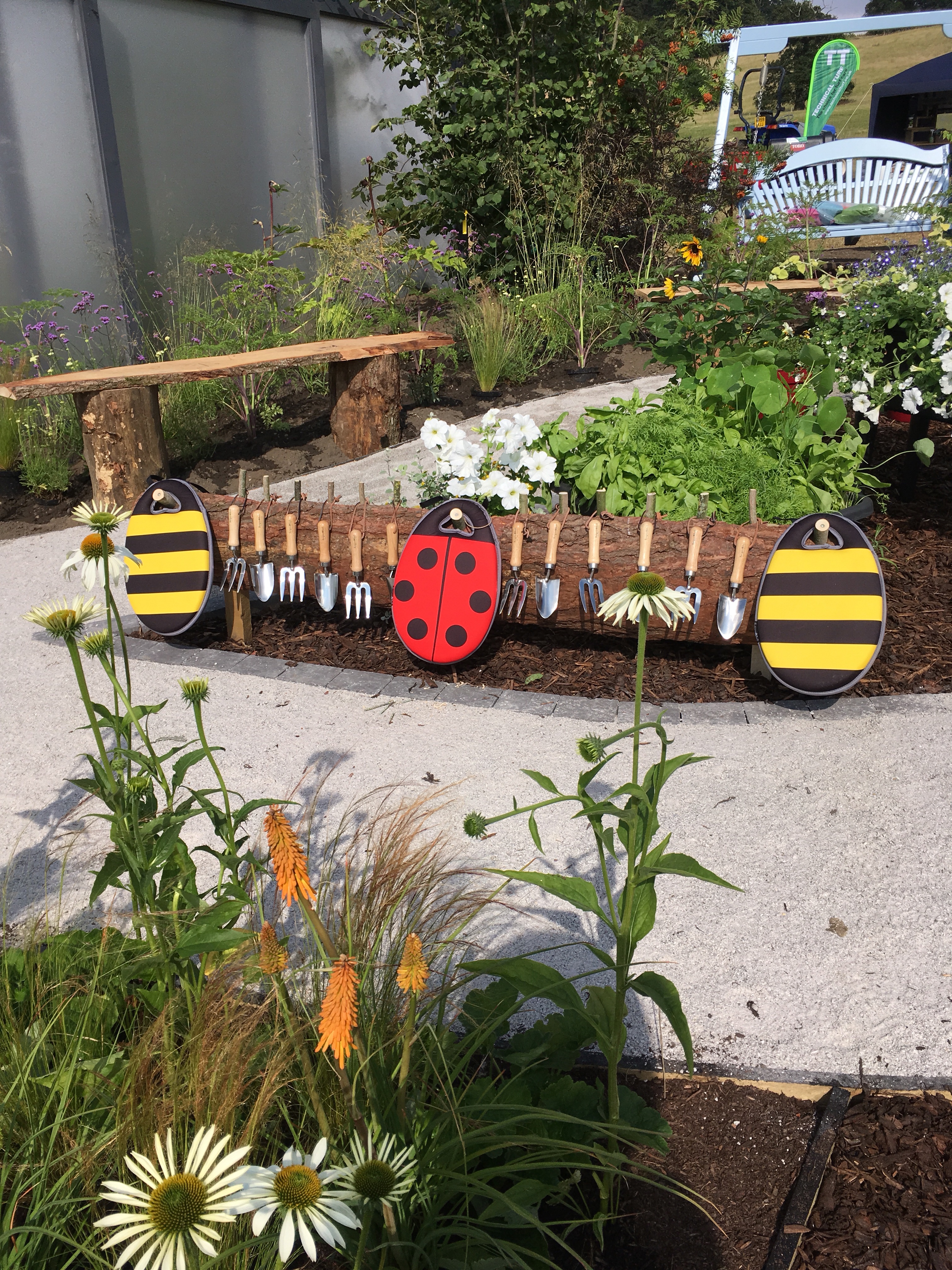
All the beautiful trees, shrubs and perennials were grown by Miles Nurseries Hoby Leicestershire. Thanks to Tom, Bel and Lawson for providing such fabulous plants. And for all your deliveries to the site. We could not have built the garden without your kind support.

Our water play and music wall.
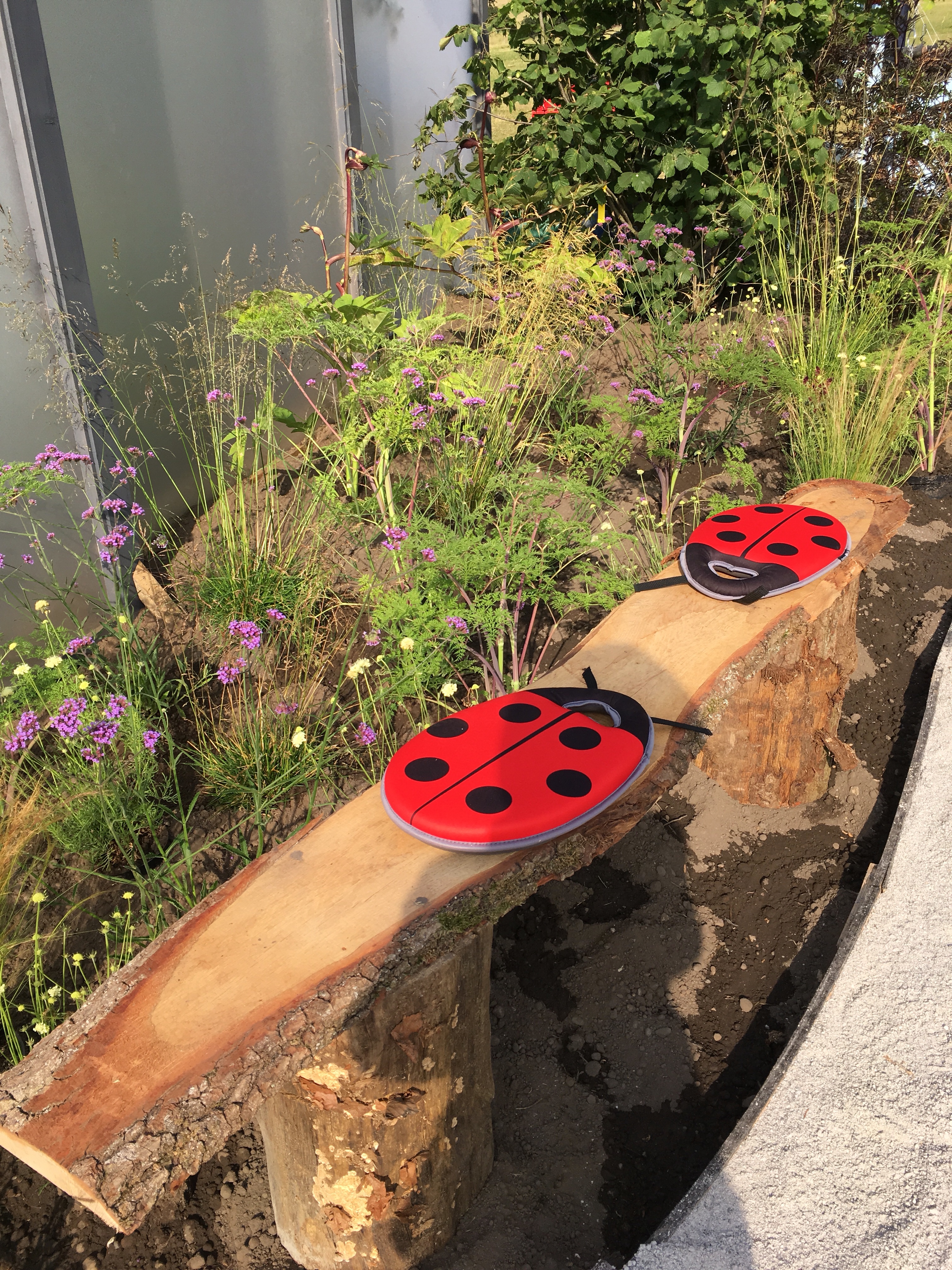
Here’s the Duchess of Rutland viewing our garden, with David Greaves explaining the design. The good news is we won Best in Show. And even better, the garden is going to be re-built in the castle grounds.

The duchess tried out the drum kit in the music therapy corner.
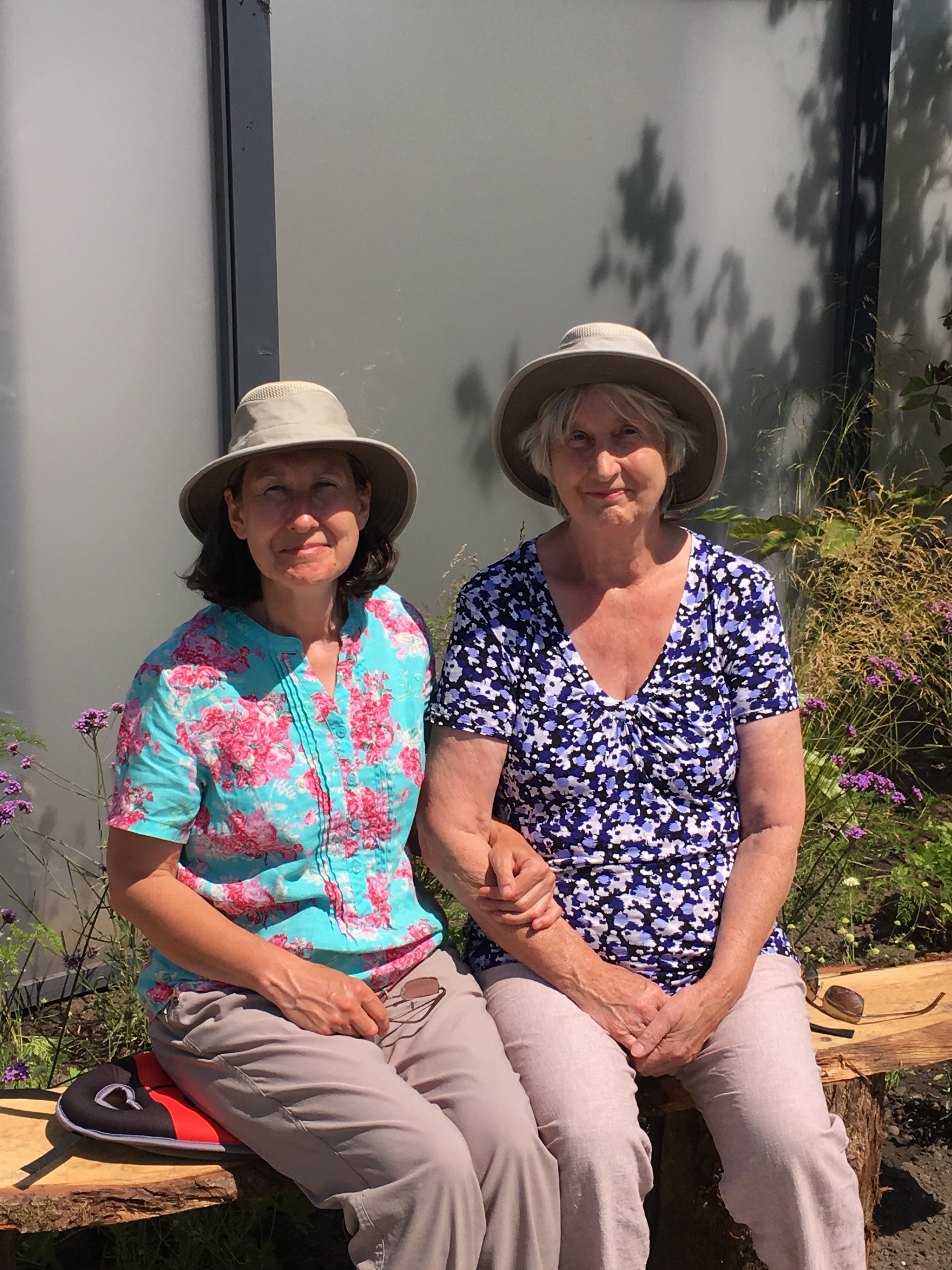
My Mum, who’s been very ill too this year, recovered enough to come and see the garden. That really made my day to be honest.
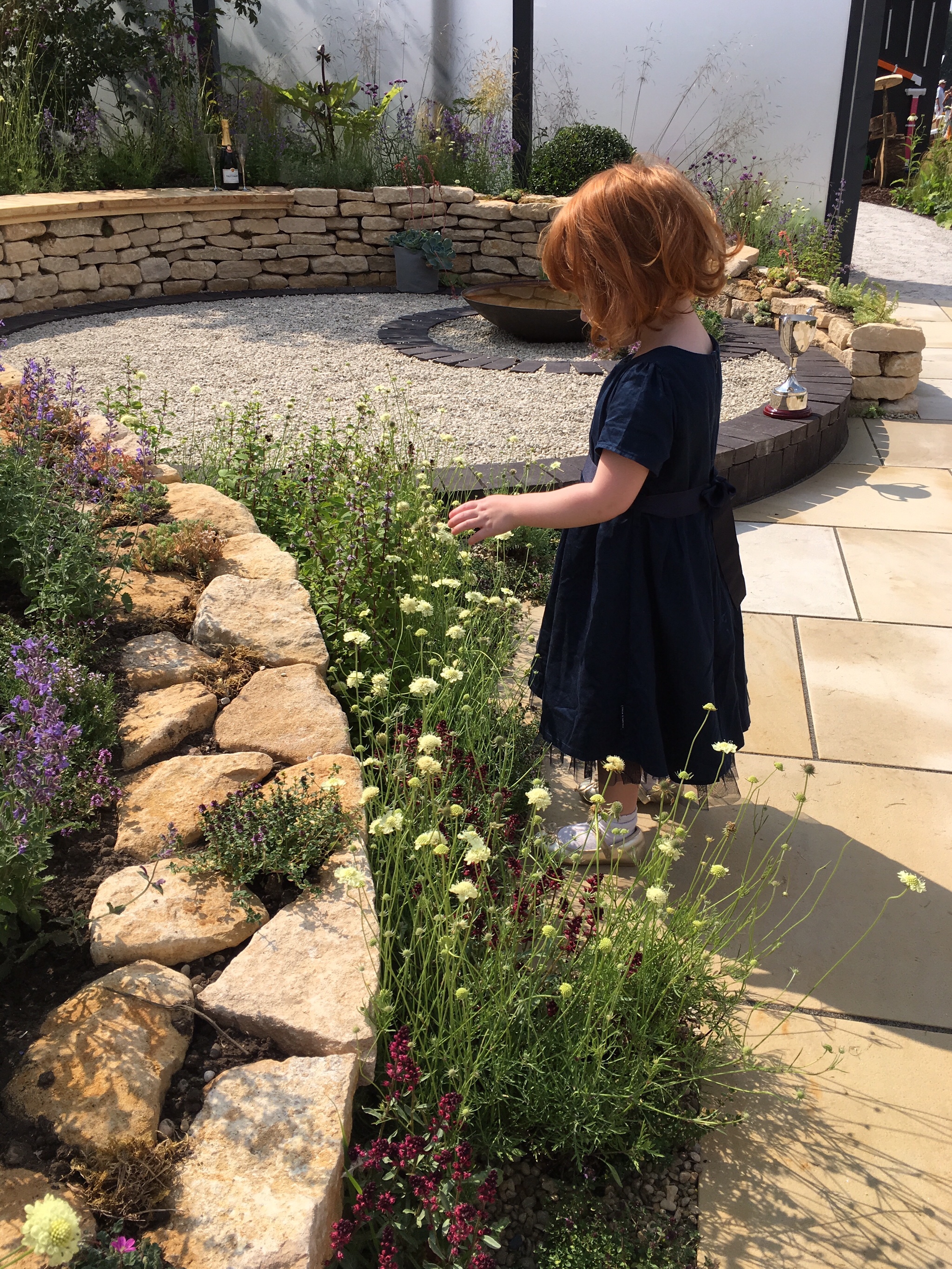
This little visitor to the show was enchanted by the butterflies that arrived as soon as we’d planted the garden.

I hope you’ve enjoyed my diary of building a show garden. We raised several thousand pounds with donations, pledges and people joining the Rainbows lottery. Here’s the link if you would like to support the work of this amazing hospice.

Rainbows Hospice – Ways you can help.
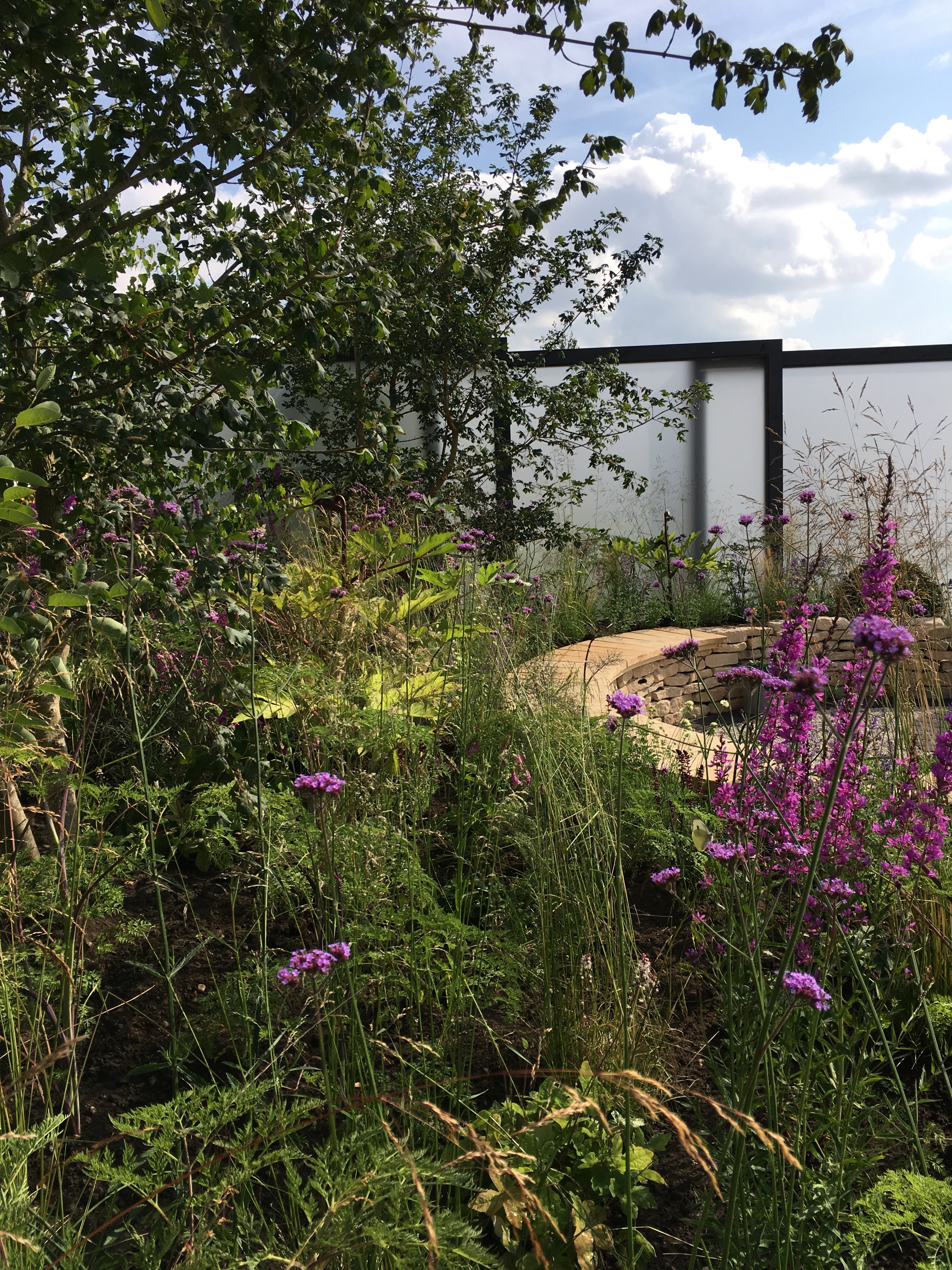
With many thanks to all our sponsors: David Greaves Landscape Design and Construction for co-design and build , Miles Nurseries for all trees, shrubs and plants, Bagforce Aggregates , William Hercock Builders Merchants , CED paving and stone Belvoir Saw Mill, Chris Cooper-Hayes for artists impression, Goldholme Stone , David Musson Fencing , Motorpoint for perspex screens and leaflets, Richard Fenton for topsoil ,Melcourt for compost and bark, Burgon and Ball children’s tools and kneeling pads, Mr Fothergill’s Seeds for children’s pots, Gee Tee Bulbs for children’s container bulbs, Elho for children’s containers and plant pots, CJ Wildlife for bird and wildlife corner supplies, Cooks Lane Herbs , Sitting Spiritually swing seat, Pete Brown Carpentry, Libby Greaves for planning and co-ordination, publicity and planting.

Also many thanks to Soo Spector, Marissa Ewing-Gerrard, Clive Gimson for planting and Gary and Alison at Rainbows for helping me; Emma Scarborough for mentoring, and Sue Blaxland who taught me everything at Brooksby College.

Please share this on twitter, facebook, and any other social media platform, and don’t forget to say hello below.

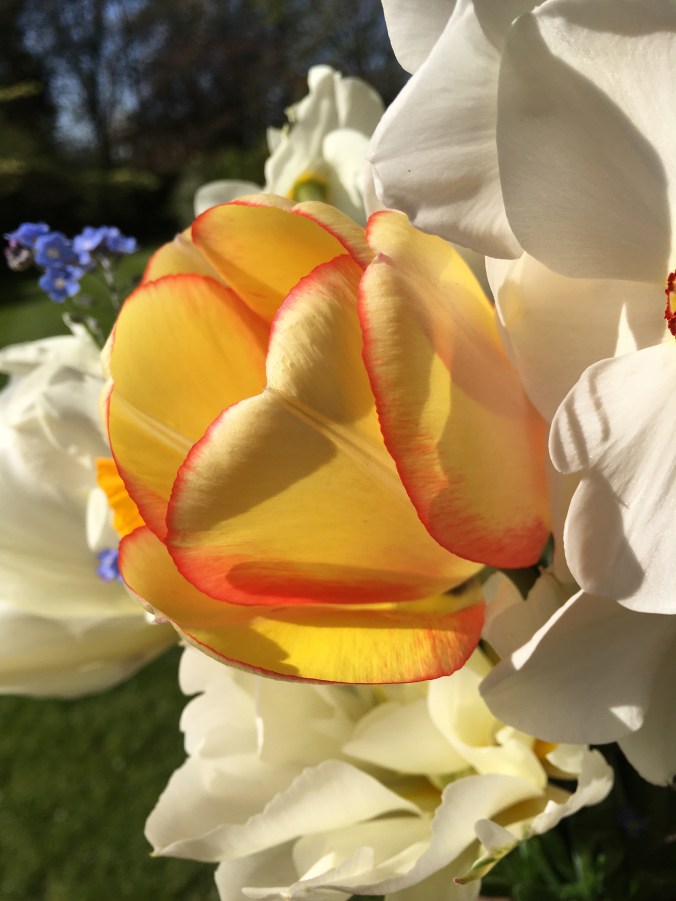
In a Vase on Monday

My cut flower patch is in full swing. Luckily, flowers sown last summer and planted out in autumn are weathering the heatwave. Here’s a selection for this week’s vase. As always, my posies are for my mother in law Joan and my Mum, Marion.

Sweet peas High Scent are top favourites this year. I love the creamy buds that open to pale lilac. There’s a pretty violet picotee edge to the flowers. And the scent really is amazing. Only a few are needed in a jam jar posy to make an impact.

Seeds were sown last October in root trainers and kept all winter in straight-sided clear plastic storage boxes to outwit mice. It worked. And in April the well-rooted plants were set out along a wonky network of hazel twigs.

I pick flowers at dawn and drop them straight into buckets of cold fresh tap water. To travel, I pop ice cubes in the buckets to keep them cool.

In amongst the sweet peas this week there’s beautiful cornflowers Blue Boy. These are really prolific. I’m picking these flowers most days and there’s lots more to come. Great value for a small area.

For a pop of pink, there’s corncockle, an easy to grow wildflower that’s growing all around my garden.

Creamy white double chamomile reliably comes back every year and seems to go with everything.
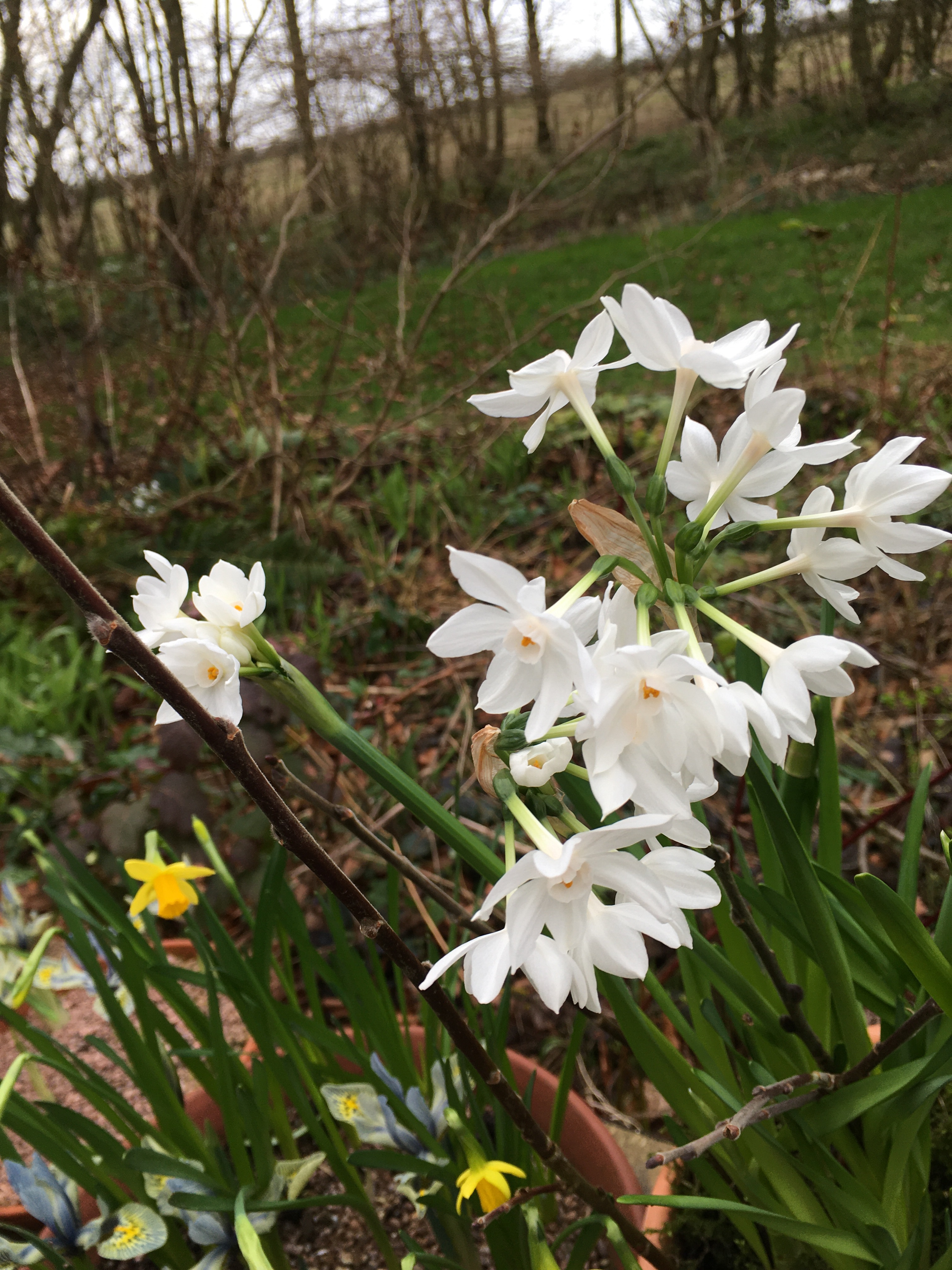
As usual, I’m joining in with Cathy at Ramblinginthegarden blog for this week’s IAVOM. Why not go over and see what Cathy and all the others are growing and displaying at the moment. It’s fascinating to see how many of us are growing the same plants in gardens all around the world.

https://ramblinginthegarden.wordpress.com/