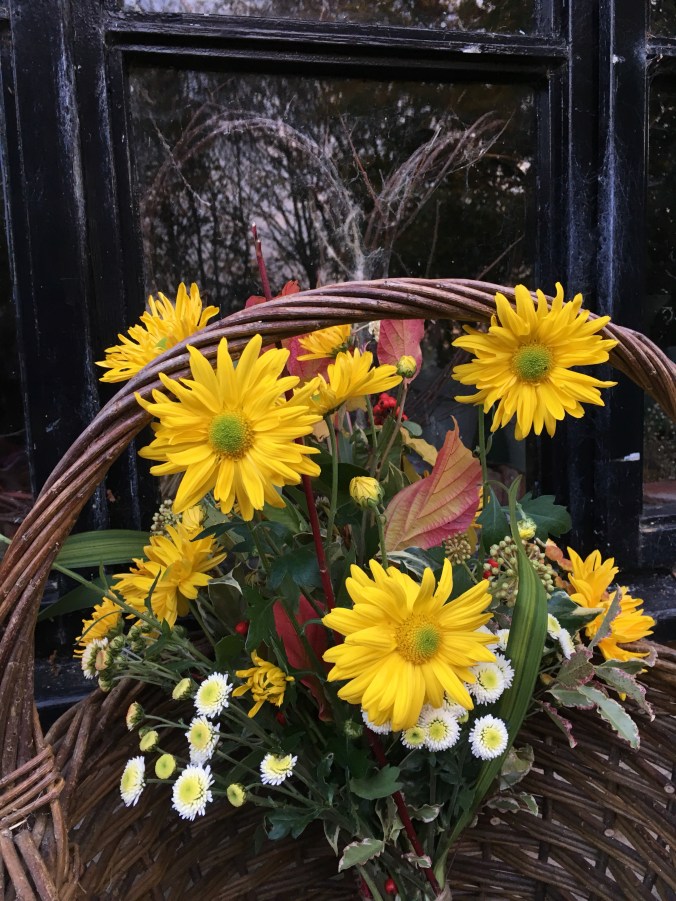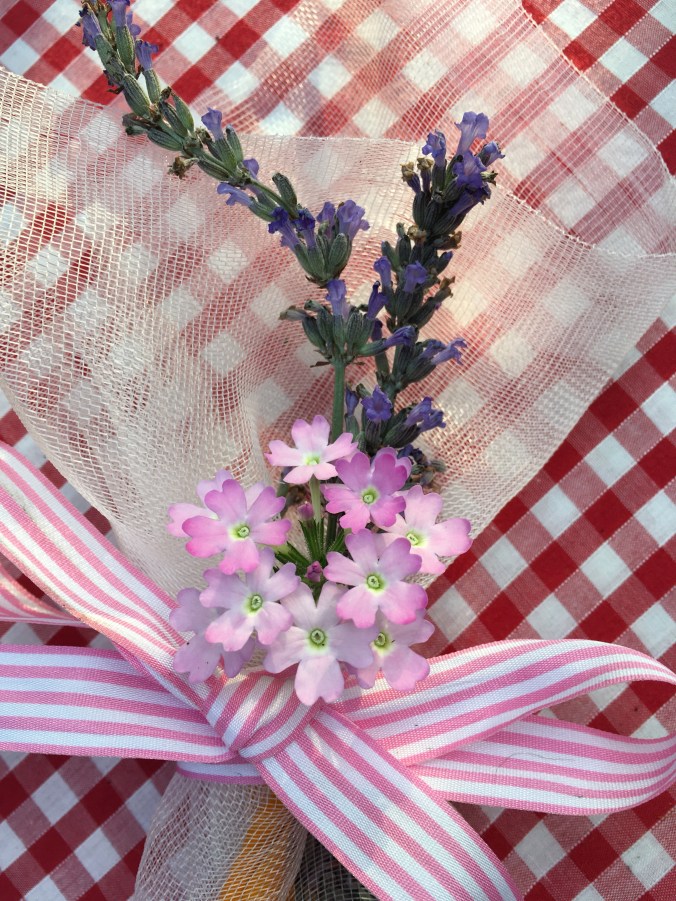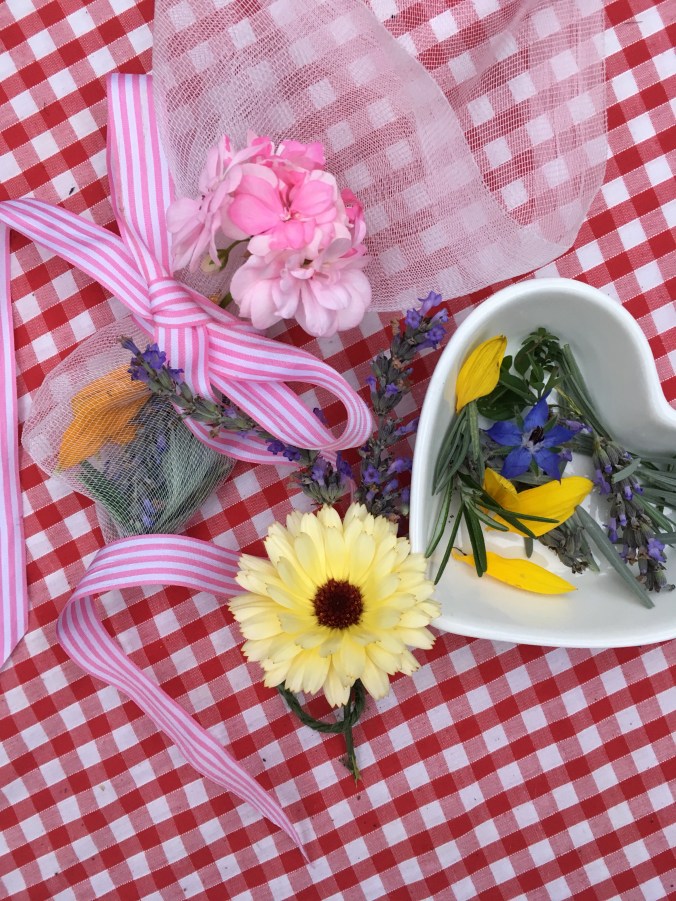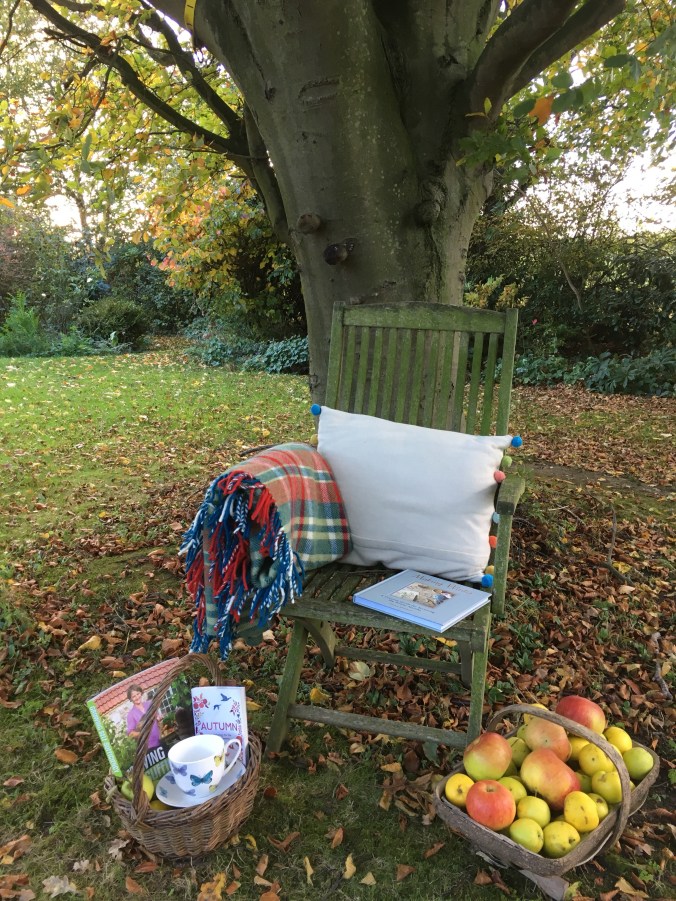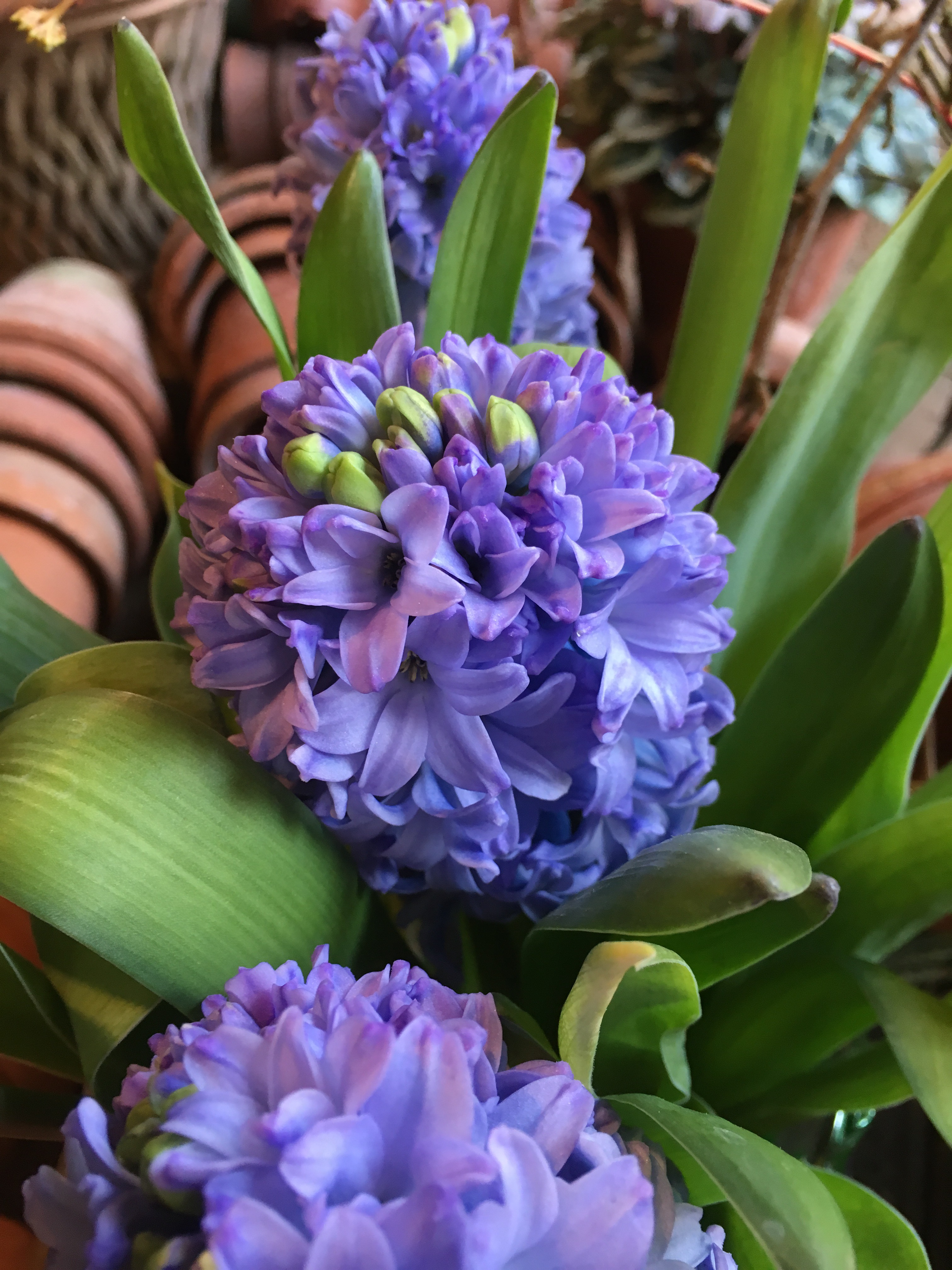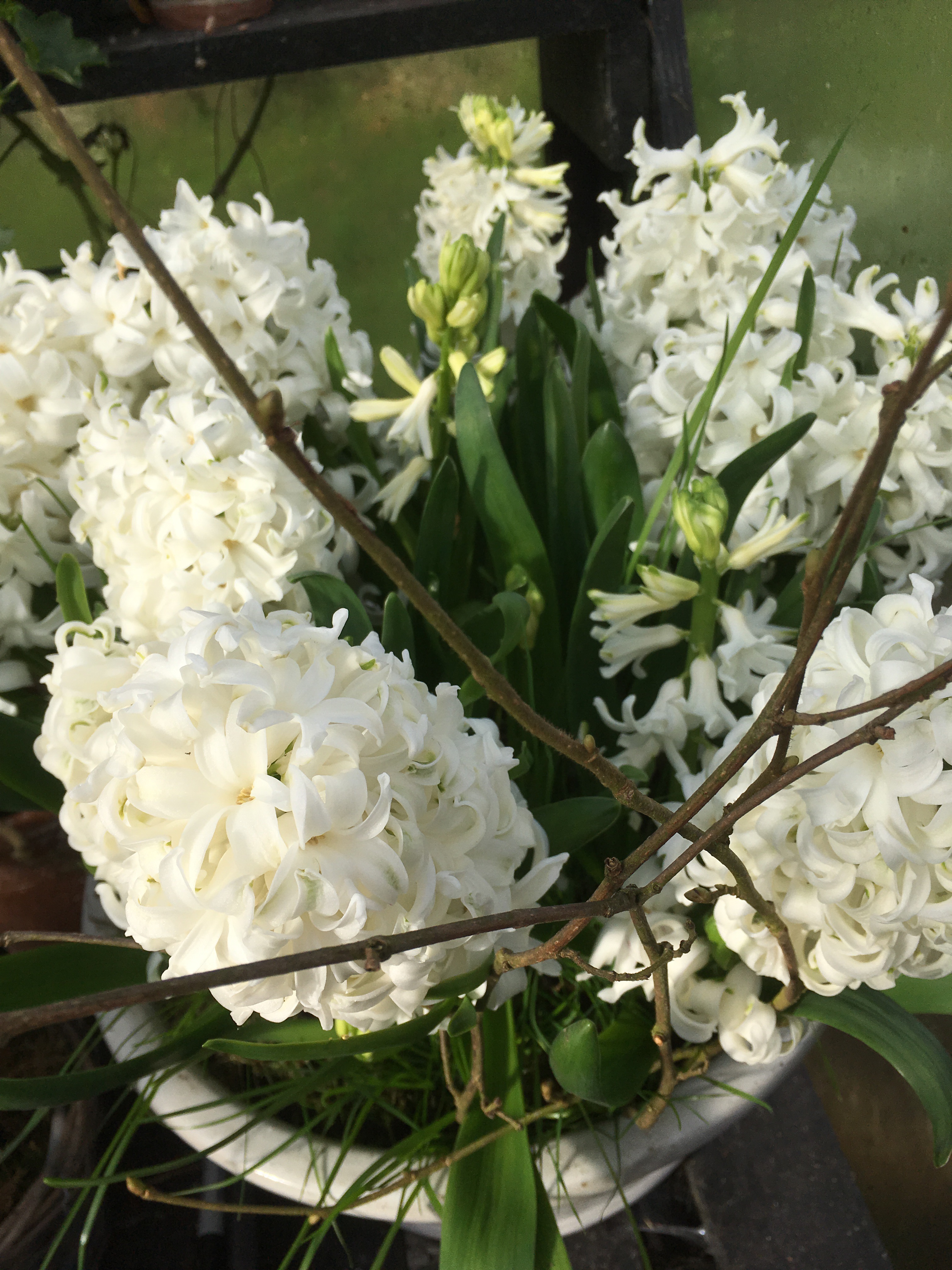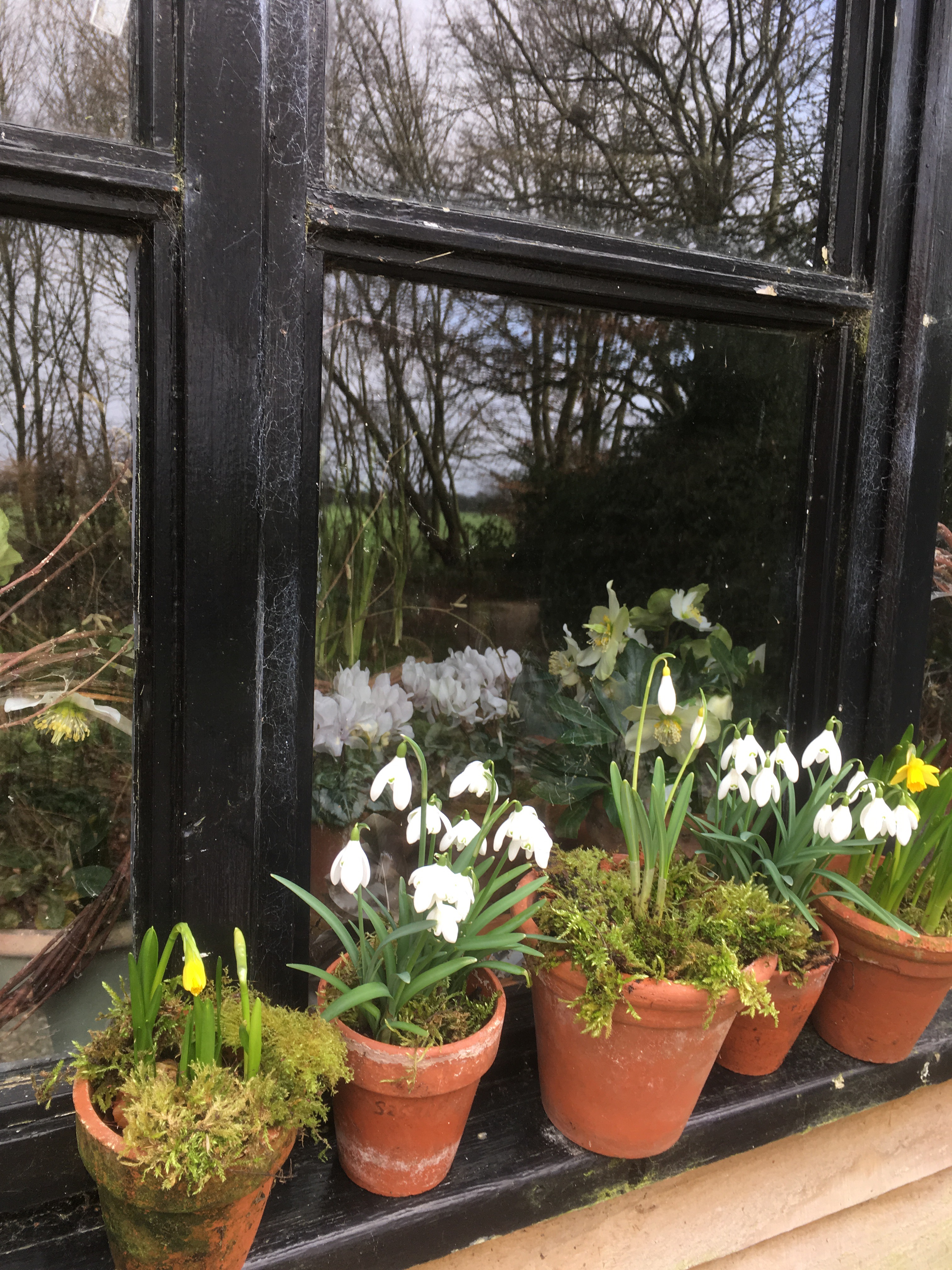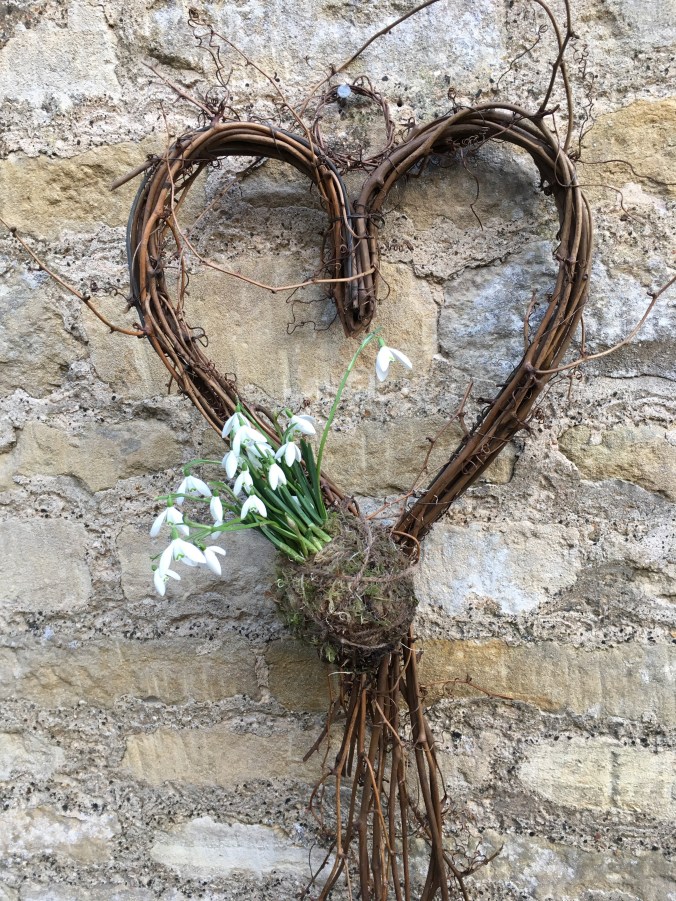
BBC Radio #SundaySupplement flowers/ hedgehogs/ my garden, 12 August programme

Some photos to accompany today’s BBC Radio Leicester gardening Sunday Supplement programme. It was my turn to sit in and answer listeners’ gardening queries on the phone-in today.

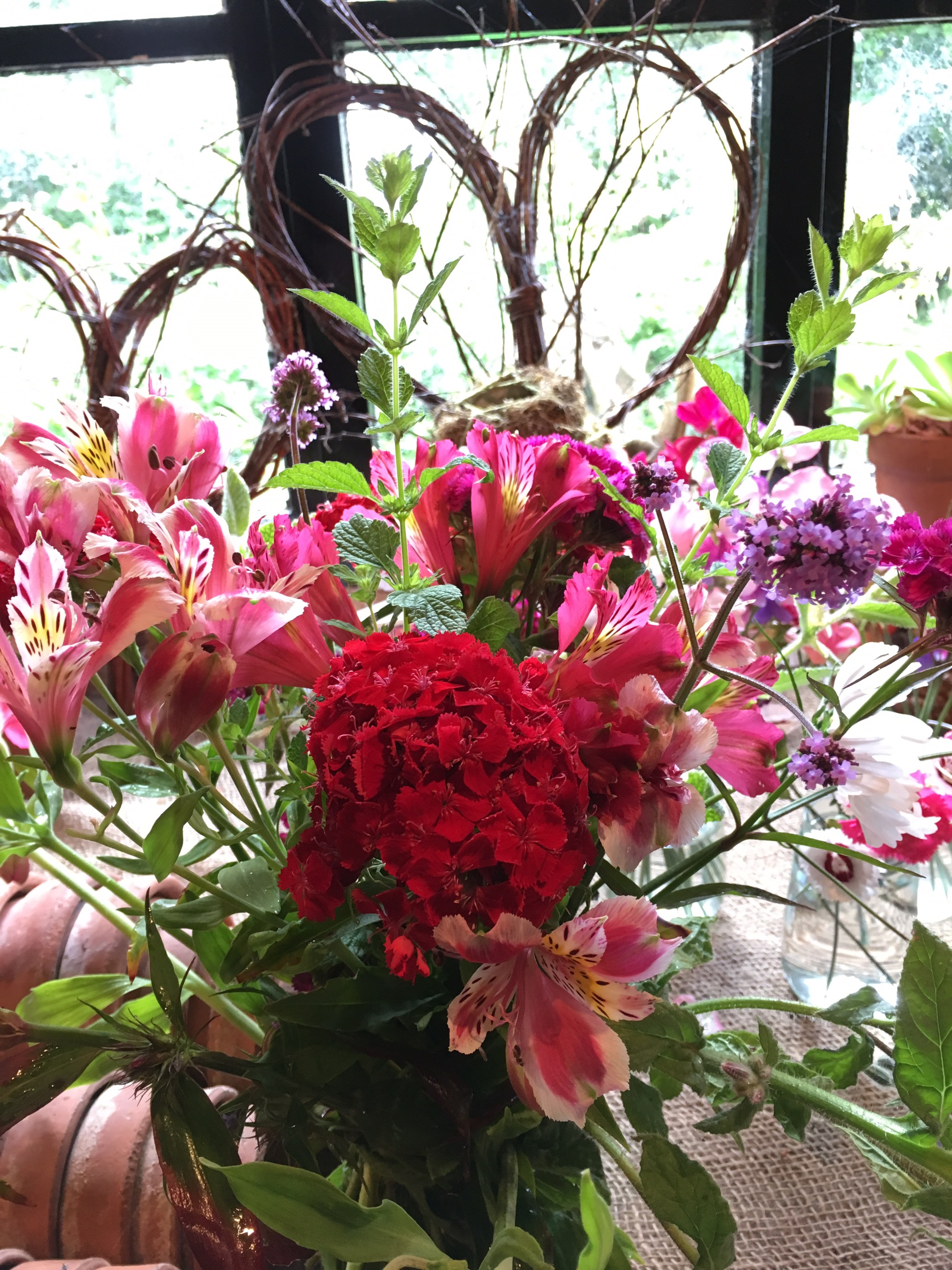
As always, I ran round the garden and picked some flowers for my mother-in-law Joan and my Mum Marion to take in to the programme. Despite the heat and drought, my cut flower patch hasn’t let me down. There’s plenty of colour just now.

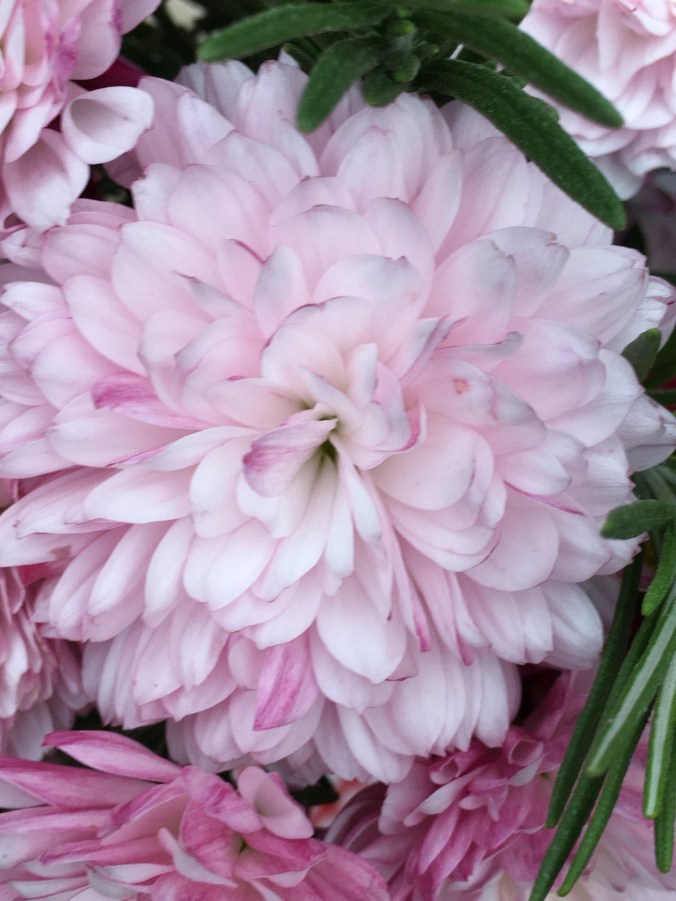
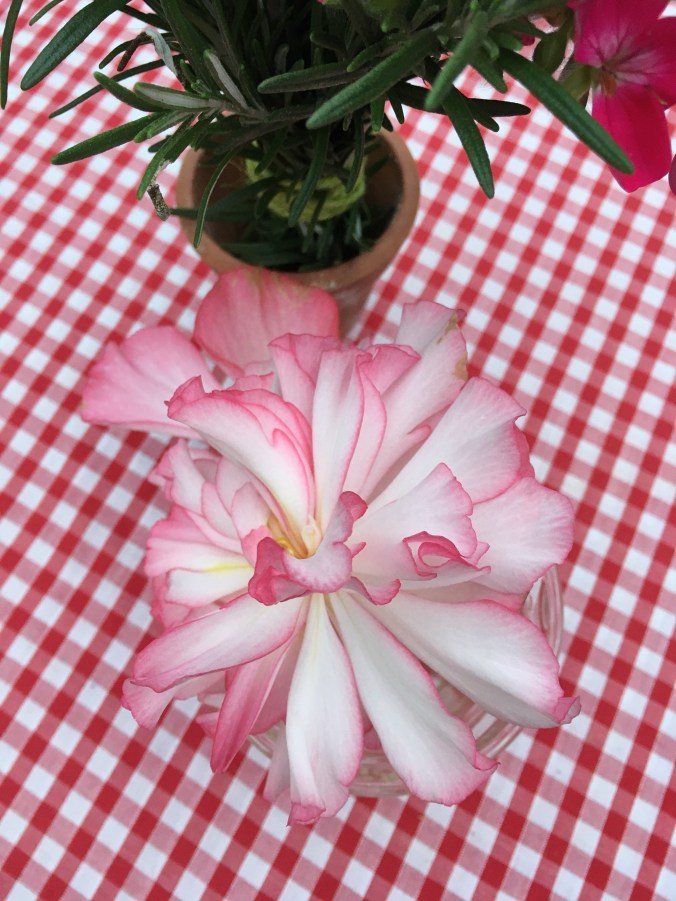
In the pink and blue theme posy there’s zinnia, Mophead hydrangea, cosmos seashells and white wild goats rue. The green umbels are actually parsley that’s gone to seed, and the whole bouquet is wreathed with blue borage. The pink whirls are Diascia Hopleys. Plants have grown to 5ft and been in flower for 8 weeks. There’s just one glorious inky-blue gladioli, and one annual pink chrysanthemum (Tricolor Mixed) which are only just starting to flower.

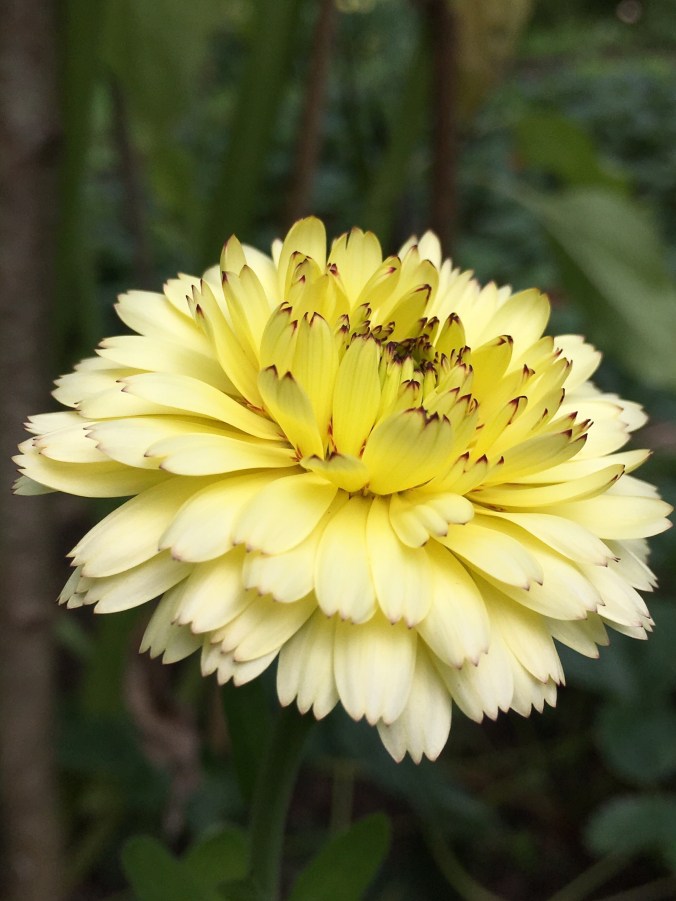
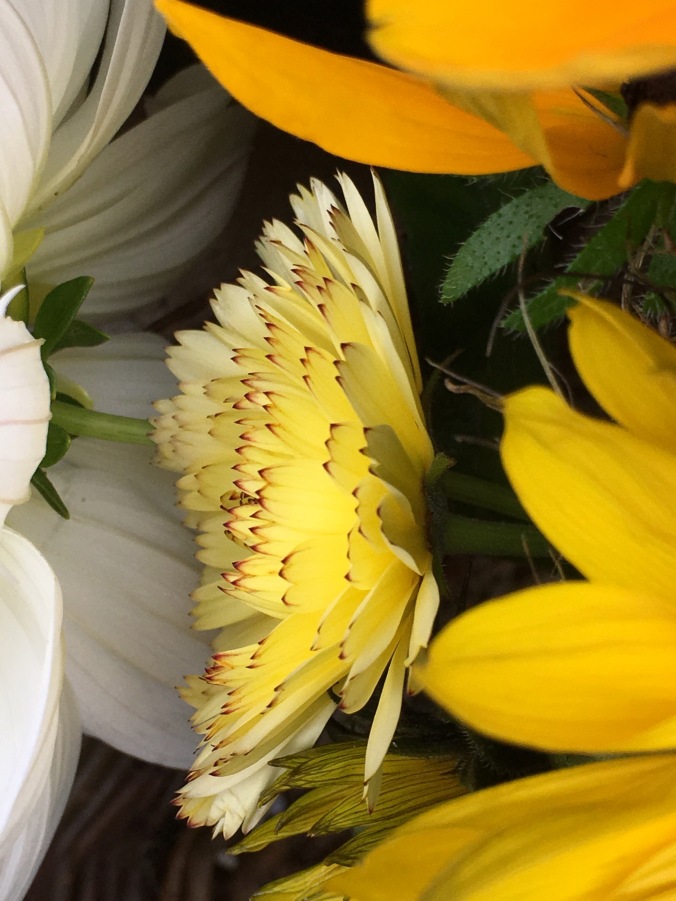
In the orange-theme bouquet there’s calendula, rudbeckia, spikes of verbascum, and seed heads from love-in-a-mist. White jasmine provides a wonderful scent, even if there are only two sprigs included here. Any more would be overpowering.

I could talk for hours about flowers, but the conversation steered towards wildlife in my garden. So for anyone wondering how my hedgehogs are getting on, we have four precious babies this year, one less than last summer. They are a month later than last year, but very healthy and active. I am feeding them with Spike hedgehog food to try to build them up for the winter. Fresh water is also really important and in scare supply, so lots of little dishes are placed all around the garden.

So far these hoglets are just 5″ long. I’ll keep an eye on them to ensure they meet the target weight of 650g by winter hibernation time.

I wrote about last summer’s hedgehogs Here. There’s also hints and tips on helping hedgehogs on the highlighted link.

Radio Leicester Sunday Supplement is available on i-player. There’s a link Here. https://www.bbc.co.uk/programmes/p06fs2mb . Gardening starts at 1.09.31. Put your feet up and have a listen in.

Let me know what flowers are doing well in your garden right now, and do any of you have hedgehogs nesting in the garden this summer?

Please kindly share this on any social media platform, and don’t forget to say hello in the comment box below.

Tour of MrFothergill’s Seed Trial Grounds

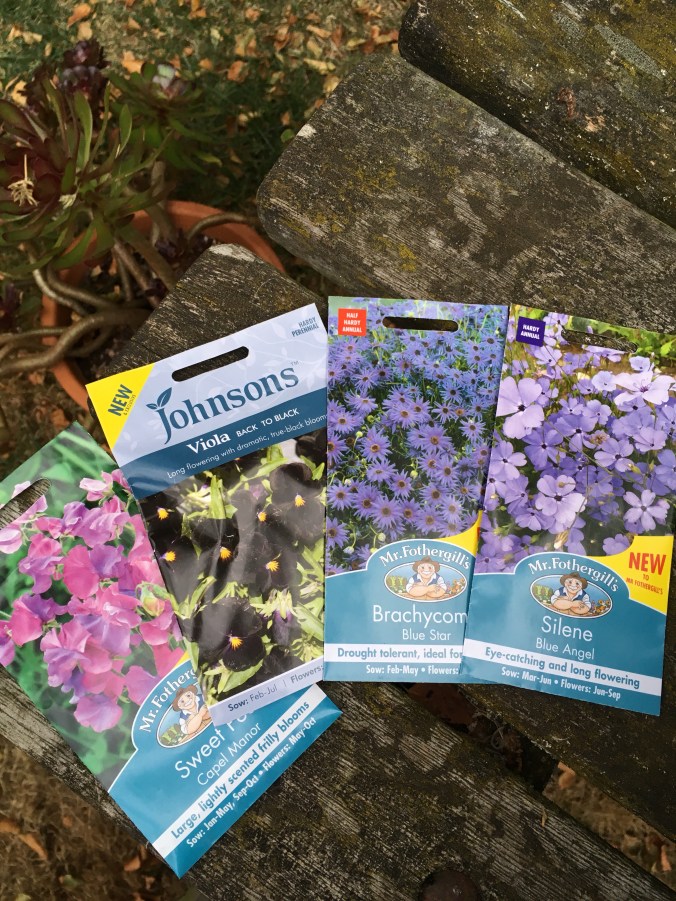
Photo : Silene Blue Angel. New for 2018/19

Growing plants from seed is a passion for me. It’s an affordable way to bulk up annual, perennial and biennial displays in the garden. And each year I try something new, as well as sticking with tried and trusted old favourites.

Next spring, I’ll be adding Silene Blue Angel to my seed sowing plans. It’s one of the new varieties on offer at Mr Fothergill’s. And this week I was absolutely delighted to be invited to view the trial grounds at the company’s headquarters in Suffolk.

These are the plants that caught my eye. The silene was top of my list. A hardy annual, sown in March and planted out in early June. Plants form neat cushions 25cm tall. For a continuous display, I’ll sow a few seeds at two to three week intervals. I’m picturing drifts of electric blue flowers running through the borders and flowering all summer long.

Brachycome Blue Star is another new variety available for 2019. I’m going to partner it with this one I spotted from the Brachycome Blue/White Mix range. I’ve always loved any kind of daisy flower.

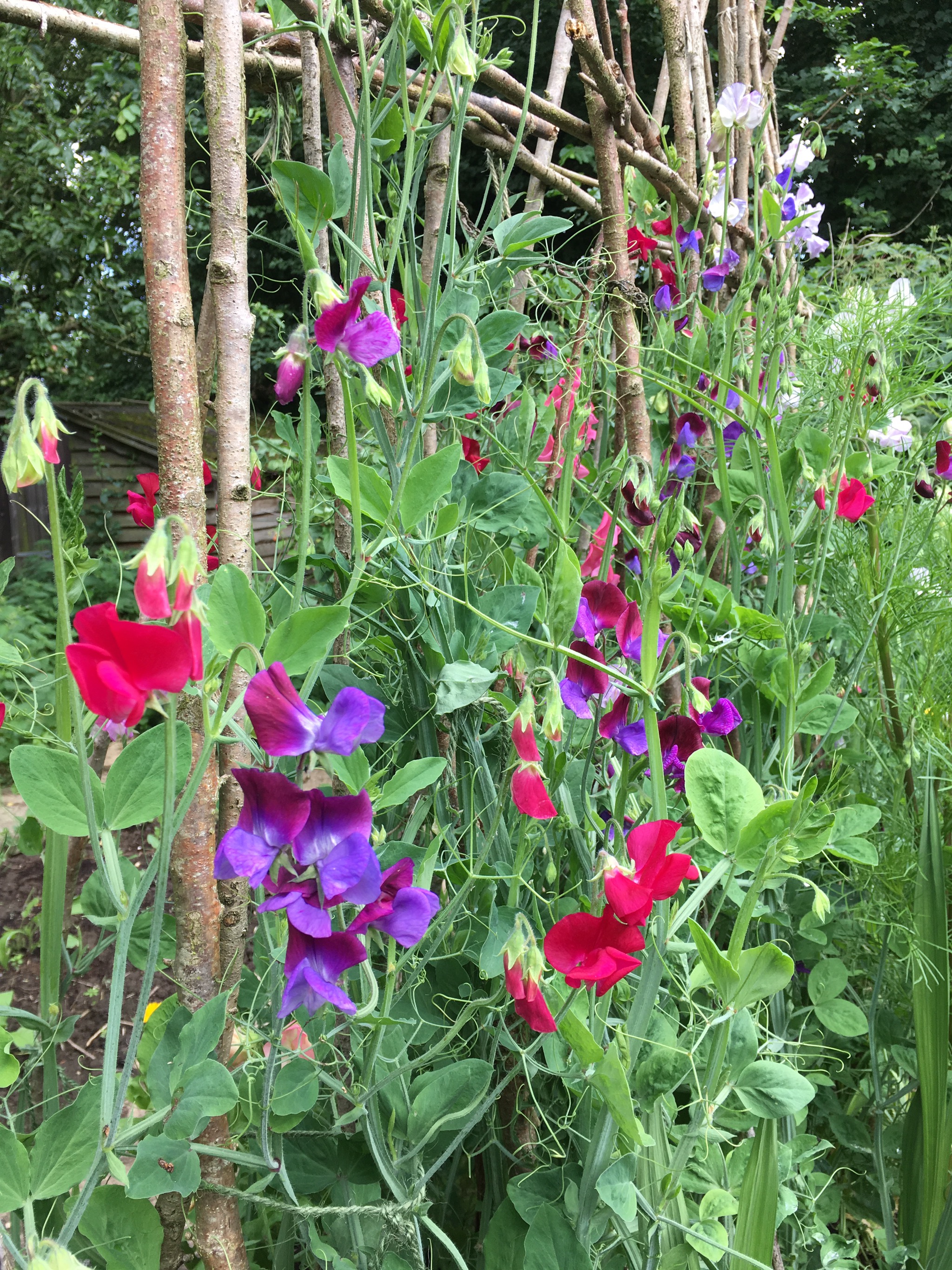
Regular readers know I also love sweet peas. I grow a range of heritage and modern varieties along a rather wonky hazel wigwam structure. Next year I will be adding new variety Capel Manor to the garden. It’s a pretty pinky blue and has a delicate, though not overpowering scent.

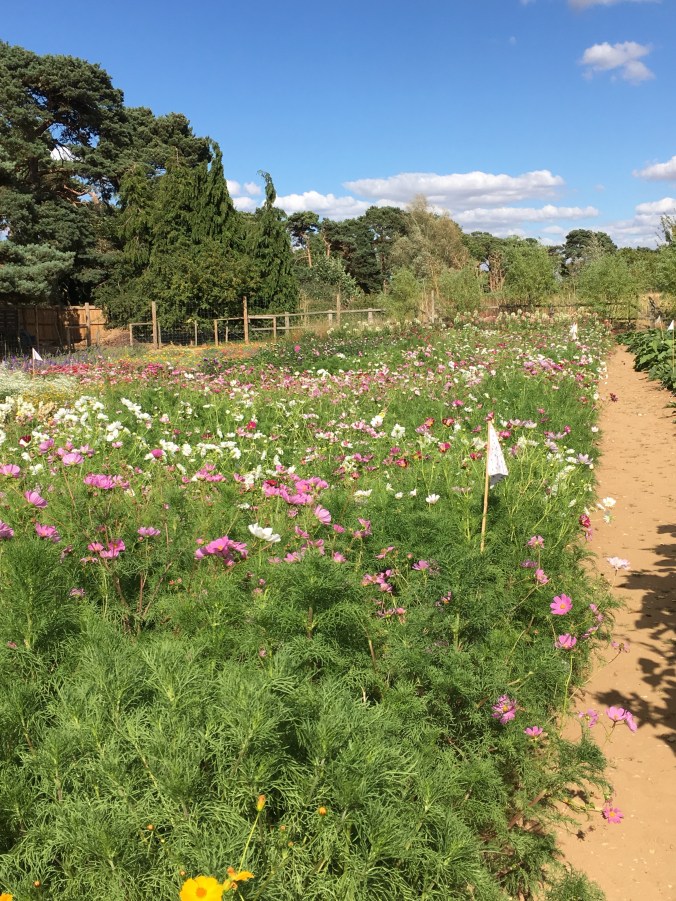
I always plant cosmos in the cut flower garden. They are easy to grow and provide flowers from early summer right through to the first frosts. I spotted this beautiful new white variety called Snow Puff. Bees seem to love cosmos, so that’s a bonus too. I’m always trying to find ways to help pollinators.

Here’s some photos of the trial grounds. It was fabulous to wander about amongst so many beautiful flowers, jotting down names for future planting plans. The scent in the heat of the day just added to the wow factor.

Mr Fothergill’s is celebrating its 40th anniversary. In May, the company won Product of the Year at RHS Chelsea for its new Optigrow range of seeds. Optigrow is a revolutionary non-chemical seed priming treatment that uses only water and air to get the seeds biologically ready for germination. I’ll be trying out some of the 19 vegetable varieties available – including tricky to grow parsnips- next spring. I’ll need to write another post about all the new vegetable varieties. There are quite a few I’ve made a note of. And there are many more new flower varieties. I’ve just picked out a few. I’ll definitely have to write another post soon….

Please share this via any social media you like, and don’t forget to say hello in the comments box below. Let me know what new seed you are planing to try out for the spring growing season. I am @kgimson on twitter and karengimson1 on instagram.

Wordless Wednesday -Cosmos Snow Puff

I’ve had a wonderful day at the field trials ground at Mr Fothergill’s Seeds in Suffolk. This new cosmos caught my eye. Perfect for pollinators. More words to follow when I’ve recovered from the journey. I will be growing this and many other new seeds next spring.

Please feel free to share on social media, and say hello in the message box below.

It’s hot, hot, hot….. what the garden looks like on 5th August 2018

Plants in my garden are matching the heatwave! These sunny rudbeckias were sown last summer and planted out in autumn. They make much stronger plants grown as biennials.

These are Rudbeckia hirta Glorious Daisies , also known as cone flowers, from Mr Fothergill’s Seeds. Bees and butterflies love them. They are easy to grow and last a week as a cut flower.

They remind me of sunflowers. I love the yellow petals and the deep chocolate cone centre. To get them to flower as annuals, sow seeds in a 3″ pot of good quality seed compost in February/ March. Place in a propagator at 18C. Prick out as soon as there are two true leaves. Prick out into individual 3″ pots to give the plants room to grow. Grow on in a frost free place in bright light, but not direct sunshine as the tender new leaves will scorch. Plant outside in a sunny sheltered position at end of May. They will flower all summer long.

If you have a very sheltered garden, you can overwinter them. To grow them as biennials, sow them in summer and plant out in early autumn into soil that has been well prepared. Incorporate lots of good garden compost, well rotted manure and leafmould. This will improve drainage over the winter when it’s the wet that tends to kill plants rather than the cold.

As temperatures are regularly hitting 28C to 30C these rudbeckias really shine out and match the sunny weather. I’ve not watered these, but any planted since Christmas would need a thorough soaking once a week.

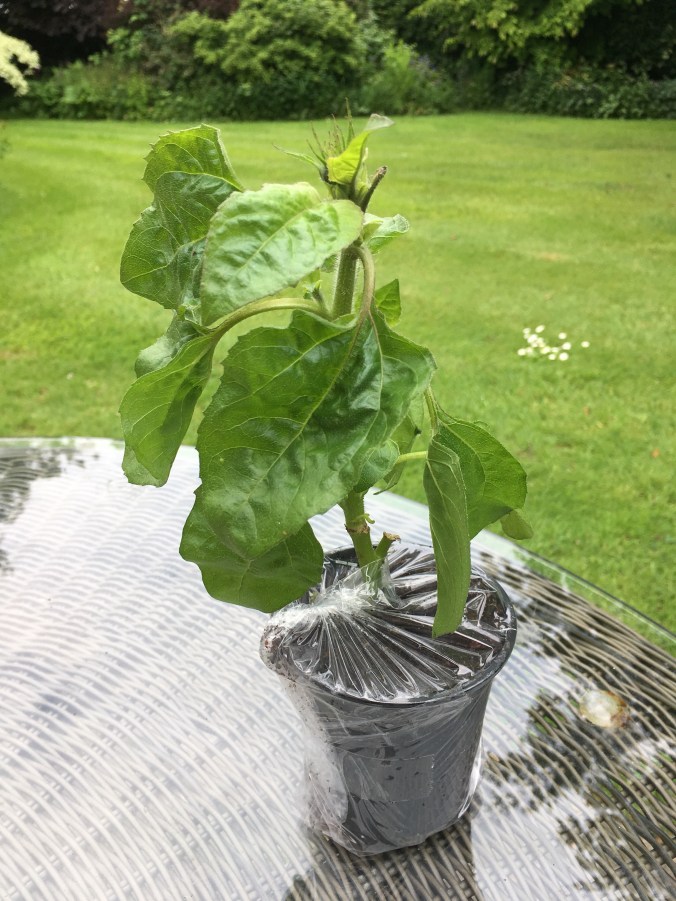
To add to the sunshine look, I’m trialling the new Thompson and Morgan sunflower Sunbelieveable Brown Eyed Girl. These are making lovely short stocky plants suitable for containers. They arrive in the post well packaged and soon grow into 50cm plants.

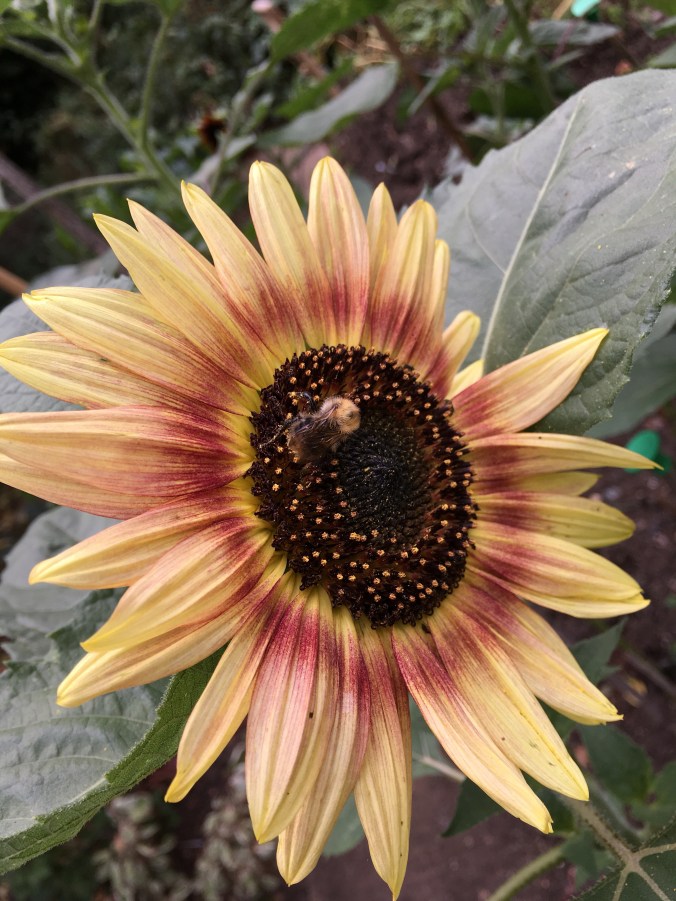
I’m also growing various sunflowers from Mr Fothergill’s including Evening Sun which has a stunning range of colours. And bees absolutely adore them.

These last a week in a vase and make a lovely centrepiece of any cut flower posy. Calendulas are also doing well on my plot despite the heat and dreadful drought. I am only watering containers and succulent crops such as runner beans and courgettes. Everything else is relying on good winter mulching with home made compost and Plant grow fertiliser. We haven’t had any rain since May.

Regular readers know that I always cut my flowers for my MIL Joan and my Mum Marion. This summer has been a particularly difficult one, health wise, and sunshiny flowers have been much needed.

Calendula Snow White and subsequent seedlings are a firm favourite. I post photos of my posies on IAVOM which Cathy hosts on Mondays. Thanks for joining me on a ramble round my rather hot and parched garden. Let me know what you are growing in your garden the first week of August.

Thanks to Helen for hosting the End of Month View.

Summer fruit harvest and making garden jam

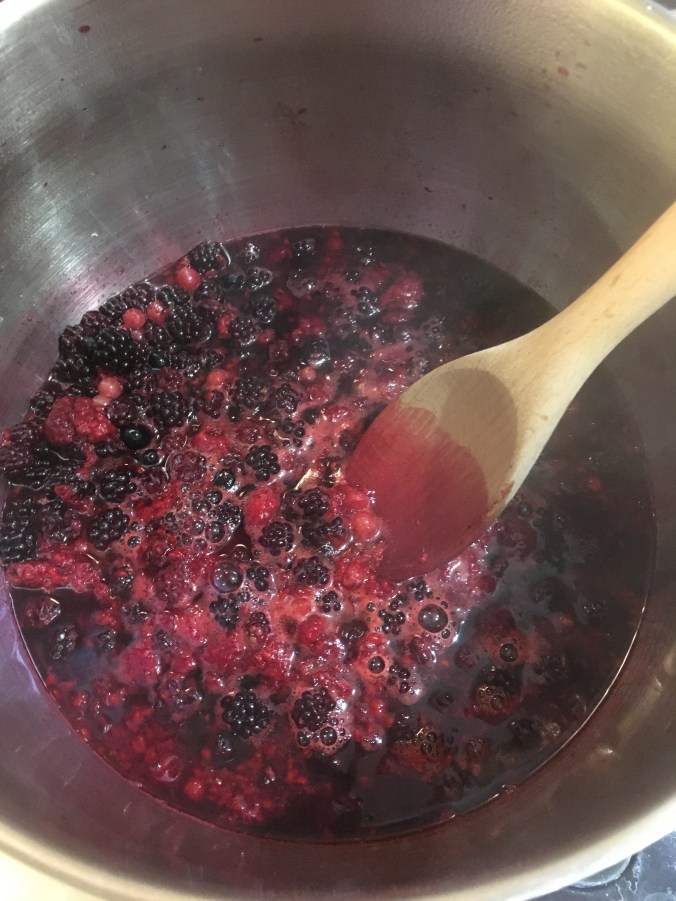
What a summer! My poor garden is burned to a crisp and everything’s wilting, including me. But the fruit garden is producing bumper crops. You’d think they would shrivel in 32C heat, but the black and red currants, gooseberries and blackberries are sweet and juicy.

Last night I wandered round the garden collecting a basket of fruit to make jam. I had planned to make strawberry jam from the pots of runners planted in April. But the tiny plants only yielded a handful of fruit. So delicious though. The plants only cost 60p each, mail order. I wrote about planting them Here. I’m hopeful of larger crops next summer.

The blackberries were the best I’ve ever seen though. A bumper crop and large fruit. Sometimes wild blackberries are so tiny they are hardly worth picking. But these soon filled a basket.

I threw the whole lot in a heavy based pan to make garden jam. Wow, what a scent. If it’s possible to capture sunshine and summer in a jar, this is the way to do it.

Garden Jam

To make 2 jars I used 500g fruit, 500g sugar 75ml water, juice of 1 lemon.

Method:

Place a saucer in the freezer for testing the setting point later.

Put fruit, water and lemon juice in a heavy based pan. Cook the fruit gently until soft.

Add sugar and simmer carefully until all the sugar crystals are absorbed.

Increase the heat to a rolling boil. After 10- 15 minutes, put a teaspoon of jam on the plate and gently push. If it wrinkles, it has reached setting point. If not, cook for another 5 minutes, taking care not to burn the jam.

Stand for 15 minutes

Pot into sterilised and warmed jars.

Fresh scones :

3oz butter

1lb plain flour

Pinch salt

1oz caster sugar

1.5 tsp. baking power

2 eggs and 6floz milk beaten together.

Add all the dry ingredients and rub together. Add liquids and mix carefully. Don’t over handle the mixture

Roll out thickly and cut into circles. Brush top with a little of the reserved egg/ milk mixture.

Bake for 10 mins until golden, oven temp. 230C, gas mark 8

Eat whilst still warm – or as soon as possible. Can be frozen as soon as cooled, to keep fresh.

I often ask twitter friends for recipes and gardening advice. Here’s a reply that came from Bob Flowerdew. I’m looking forward to trying his recipe.

And this came from June Girvin, which is similar to the recipe I ended up with. It’s absolutely delicious.

After all that foraging and cooking, we sat in the 1930s summerhouse, turned to face the cool woodland and pond and feasted on the jewels of the garden.

Surrounding us, there’s sounds of harvesting and baling. There’s a scent of new hay and oats on the breeze, and we watch entranced as barn owls swoop across the empty fields, like ghosts. They don’t notice us sitting quietly amongst the trees.

Here’s this week’s Garden Hour on BBC Radio Leicester where I chat away about what’s happening in my garden. Put your feet up and have a listen in sometime. The programme starts at 2.10.27 on the timeline. And the music’s not bad this week too.

http://www.bbc.co.uk/programmes/p06cd1bd

I am @kgimson on twitter and karengimson1 on instagram. Please share this on any social media platform you like, and don’t forget to leave a comment below. Thank you.

We made a garden for Rainbows Hospice : Belvoir Show 2018

My very wise Welsh grandmother was full of quaint little sayings. I used to laugh at the time. “Pick yourself up, dust yourself down; ” and “Something good always comes out of adversity.” But I didn’t heed them at the time. Then two years ago, suddenly, out of the blue, I became seriously ill. In the middle of the crisis, those words came back to me.

While I was lying in my hospital bed, I decided, if I survived, I would raise money for Rainbows Hospice for children. Being so ill was frightening, and it took all my inner resources to cope. How much worse, I thought, must it be for a child to be ill and in pain. Since then, I’ve been hosting garden club talks, afternoon teas and book launch events. But my biggest challenge came last weekend when I helped build a show garden.

And this is how it started. Over the bridge is the lake-side setting for the first ever Belvoir Castle Flower and Garden Festival. It’s a glorious Capability Brown landscape with rolling hillsides and ancient oak plantations.

We had four and a half days to make a garden. It’s a historic site, so we couldn’t dig down or hammer anything into the ground. Everything had to be built up from a protective ground cover.

We had no budget. Everything was begged or borrowed. Any money, I thought, should go to Rainbows.

David Greaves co-designed the garden and donated all the labour for the build. While I concentrated on the plants, David co-ordinated all the materials and deliveries we would need.

First the garden was marked out. Lewis lays the foundation for the dry stone wall. Alfie’s on the cement mixer.

The first stone is laid.

The beautiful honey -coloured stone was donated by Goldholme Stone.

A lorry load of topsoil arrives, a donation from Richard Fenton.

Such a stunning setting for a garden. Everyone works at breakneck speed, in 28C heat. There’s Sam, Pete, Gareth and David cracking on, mindful of the deadline.


Parents told me being given devastating news your children are not going to live long and full lives is like a hammer blow. They feel as if they’ve been knocked down and can’t get back up. One mother said she felt like Rainbows “picks you up and gives you a hug. ” Something she said was most needed when you’re at your lowest ebb. So I made a seating area in the shape of open arms, or a hug.

This is the artist’s impression of the garden. We designed the garden in two halves. On one side is a parent’s garden with the hug-shape seat set in a woodland glade with native trees and plants. It’s a calm haven. The idea was to highlight the message that Rainbows isn’t just for children; it’s for parents, relatives and siblings who need help, counselling and support.

Parents said, when told their child had a life-limiting illness, all their hopes and dreams for the future collapse. They can’t see what lies ahead. The future is clouded. The Perspex screens puts their words into our garden.

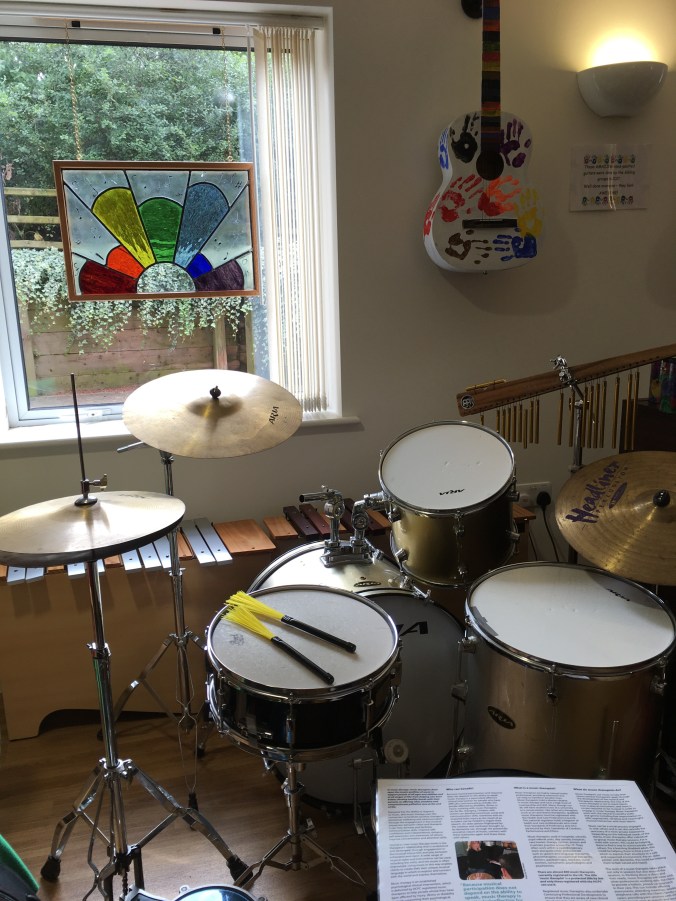
On the other side of the screens is the children’s garden, giving an idea of what it’s like at Rainbows; an insight for anyone who has never visited. There’s a music therapy corner, bird watching hide and wildlife area, water play wall, and a quiet retreat with swing seat covered in rainbow-coloured cushions.

I’ve been going back and forth to the hospice for months, helping the children and young people to grow their own plants for the containers. I loved working with them. I wanted them to share in telling the Rainbows story. Here’s my daughter Clare helping with the planting of seeds and bulbs.

Although nothing was said, I realised some of the children couldn’t see. They enjoyed the feel of dry compost running through their fingers and they spent a long time turning over and feeling the different shaped bulbs- gladioli, lily and begonia. It was an experience I will never forget.
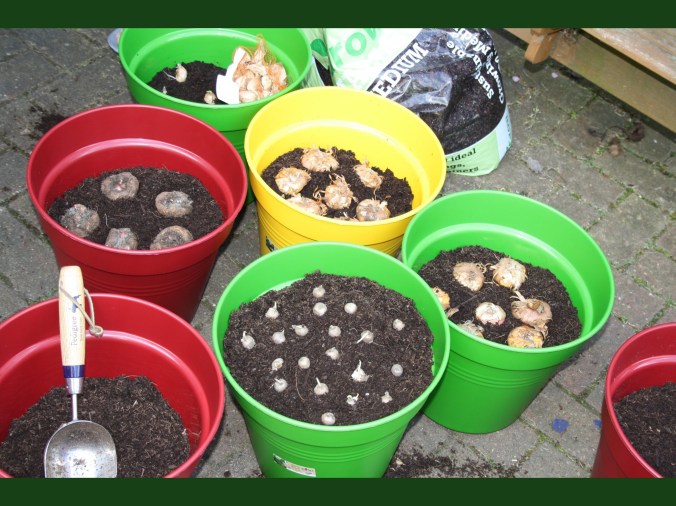
The containers were sited in the middle of the chidren’s garden, and also all around a fund-raising marquee set up by Rainbows alongside our garden.

All the beautiful trees, shrubs and perennials were grown by Miles Nurseries Hoby Leicestershire. Thanks to Tom, Bel and Lawson for providing such fabulous plants. And for all your deliveries to the site. We could not have built the garden without your kind support.

Our water play and music wall.

Here’s the Duchess of Rutland viewing our garden, with David Greaves explaining the design. The good news is we won Best in Show. And even better, the garden is going to be re-built in the castle grounds.
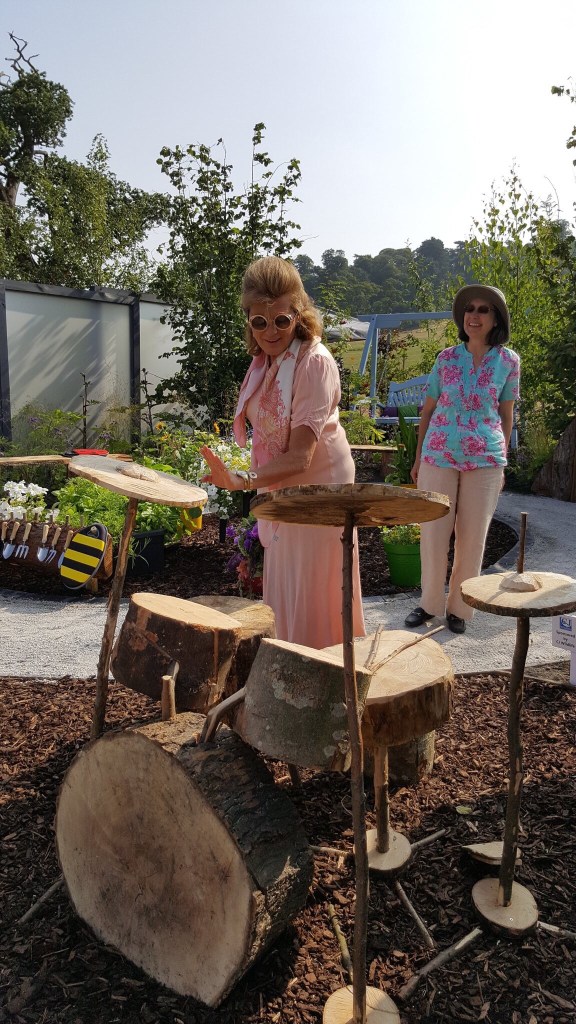
The duchess tried out the drum kit in the music therapy corner.

My Mum, who’s been very ill too this year, recovered enough to come and see the garden. That really made my day to be honest.
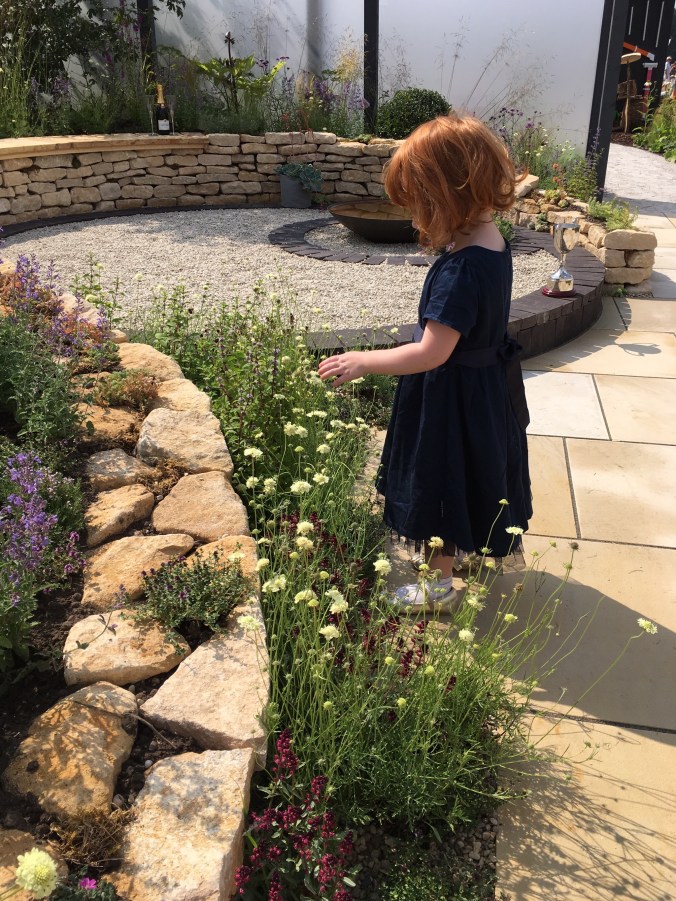
This little visitor to the show was enchanted by the butterflies that arrived as soon as we’d planted the garden.

I hope you’ve enjoyed my diary of building a show garden. We raised several thousand pounds with donations, pledges and people joining the Rainbows lottery. Here’s the link if you would like to support the work of this amazing hospice.

Rainbows Hospice – Ways you can help.
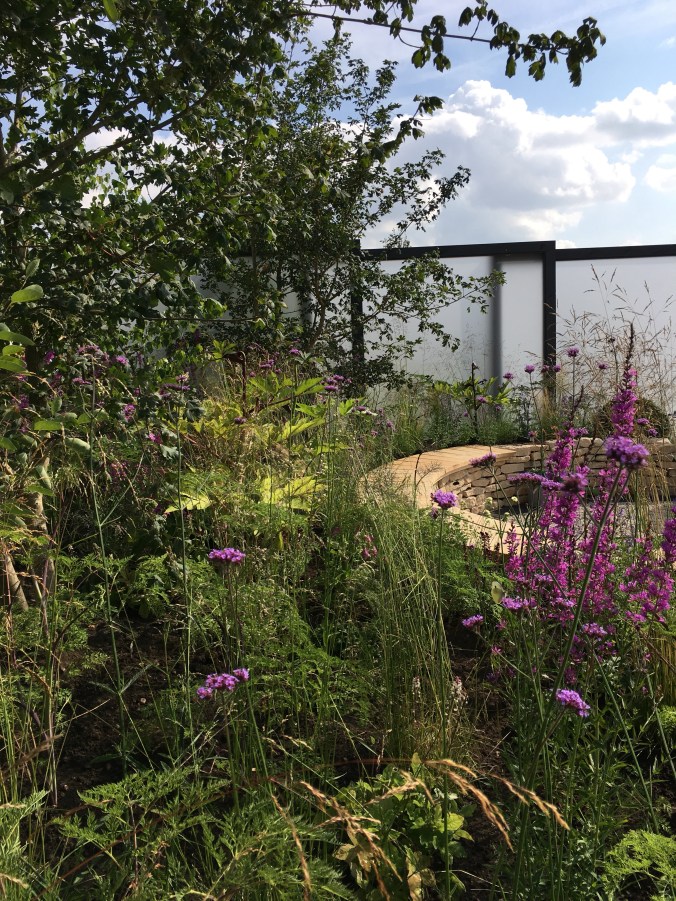
With many thanks to all our sponsors: David Greaves Landscape Design and Construction for co-design and build , Miles Nurseries for all trees, shrubs and plants, Bagforce Aggregates , William Hercock Builders Merchants , CED paving and stone Belvoir Saw Mill, Chris Cooper-Hayes for artists impression, Goldholme Stone , David Musson Fencing , Motorpoint for perspex screens and leaflets, Richard Fenton for topsoil ,Melcourt for compost and bark, Burgon and Ball children’s tools and kneeling pads, Mr Fothergill’s Seeds for children’s pots, Gee Tee Bulbs for children’s container bulbs, Elho for children’s containers and plant pots, CJ Wildlife for bird and wildlife corner supplies, Cooks Lane Herbs , Sitting Spiritually swing seat, Pete Brown Carpentry, Libby Greaves for planning and co-ordination, publicity and planting.

Also many thanks to Soo Spector, Marissa Ewing-Gerrard, Clive Gimson for planting and Gary and Alison at Rainbows for helping me; Emma Scarborough for mentoring, and Sue Blaxland who taught me everything at Brooksby College.

Please share this on twitter, facebook, and any other social media platform, and don’t forget to say hello below.

Winner of Dahlias book by Naomi Slade

Congratulations to June at The Cynical Gardener who has won my prize draw for a copy of Naomi Slade’s new book, Dahlias.

I wrote a review of the book Here.

I absolutely love the book, and find I’m dipping into it whenever I sit down and rest a moment in my potting shed armchair.

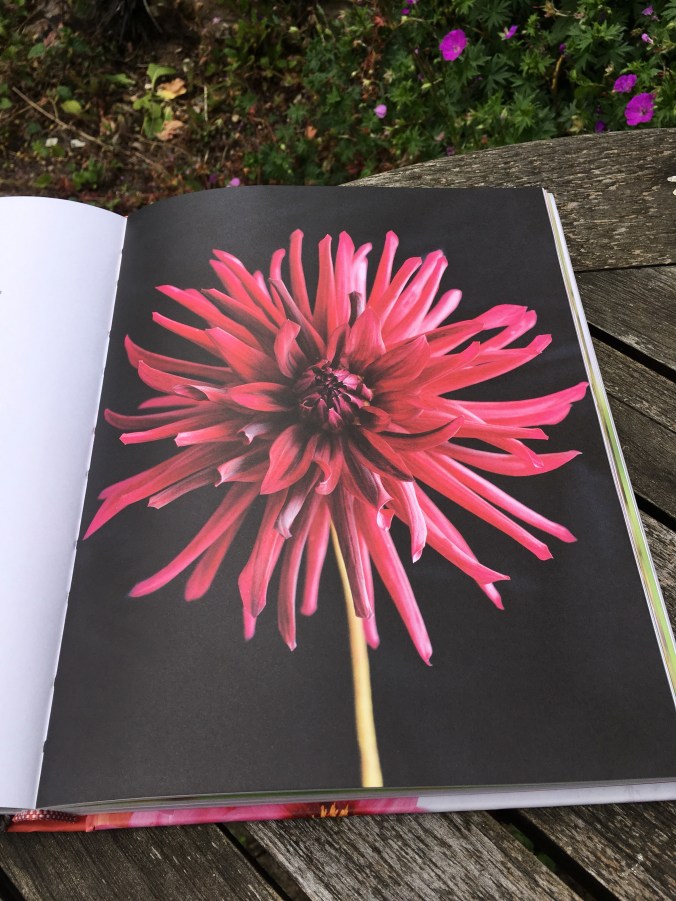
The book features mouth-watering photographs by Georgianna Lane. It’s easy to read and there are lots of hints and tips on getting the best out of your dahlias.

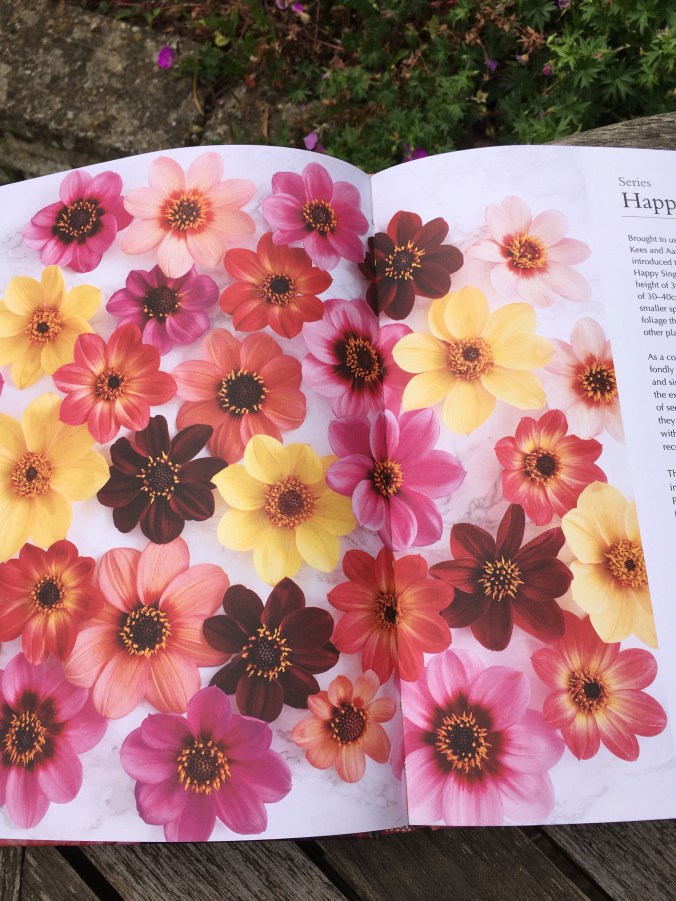
Who could resist these lovely, brightly-coloured single varieties.

Here’s some photos of my own dahlias in my cut flower patch. I’m looking forward to trying out some of the newer varieties highlighted in the book. I’m particularly keen to try the dark red and chocolate types, as well as the cheerful sounding “happy” series.

Some of mine have been grown from seed. They produce good size plants in one year.

Dahlias will be published by Pavilion Books on 2nd August, RRP price £25. Here’s the Amazon link for more information.

Please kindly share this blog on twitter, Pinterest, facebook or any other social media platform. Thank you. And don’t forget to say hello in the comments below.
In a Vase on Monday

My cut flower patch is in full swing. Luckily, flowers sown last summer and planted out in autumn are weathering the heatwave. Here’s a selection for this week’s vase. As always, my posies are for my mother in law Joan and my Mum, Marion.

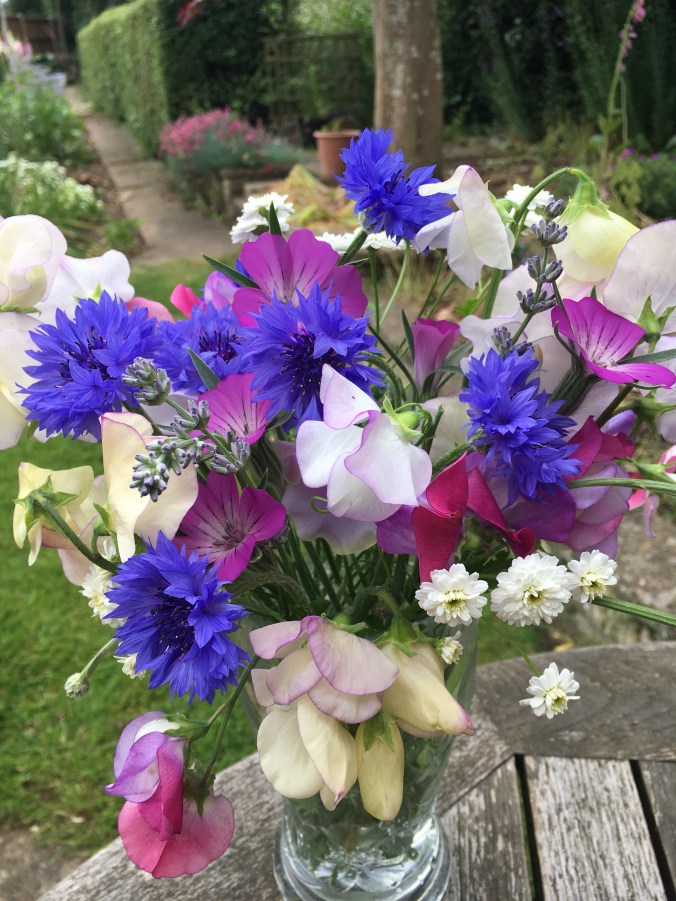
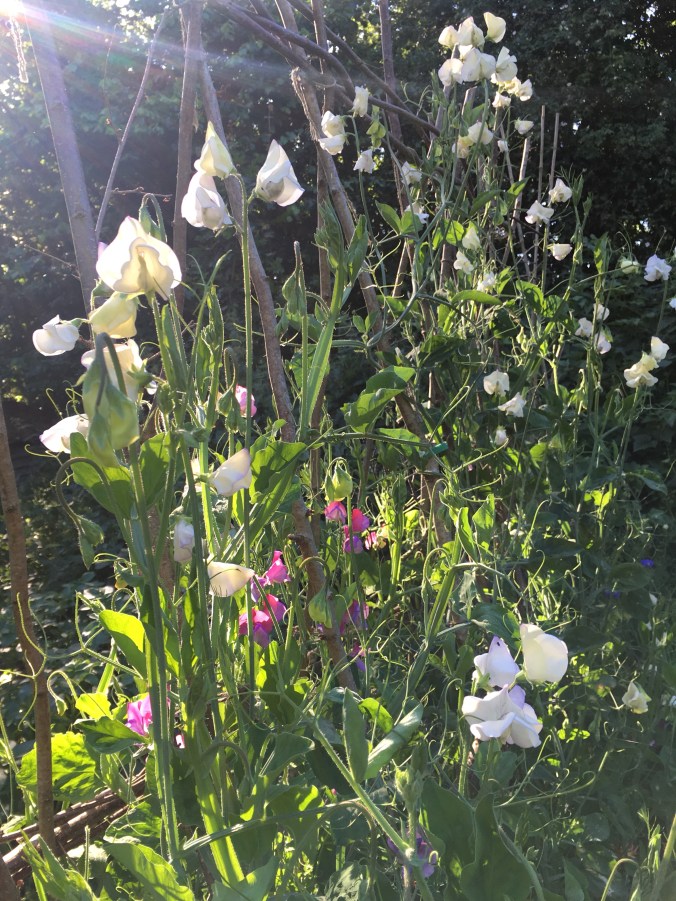
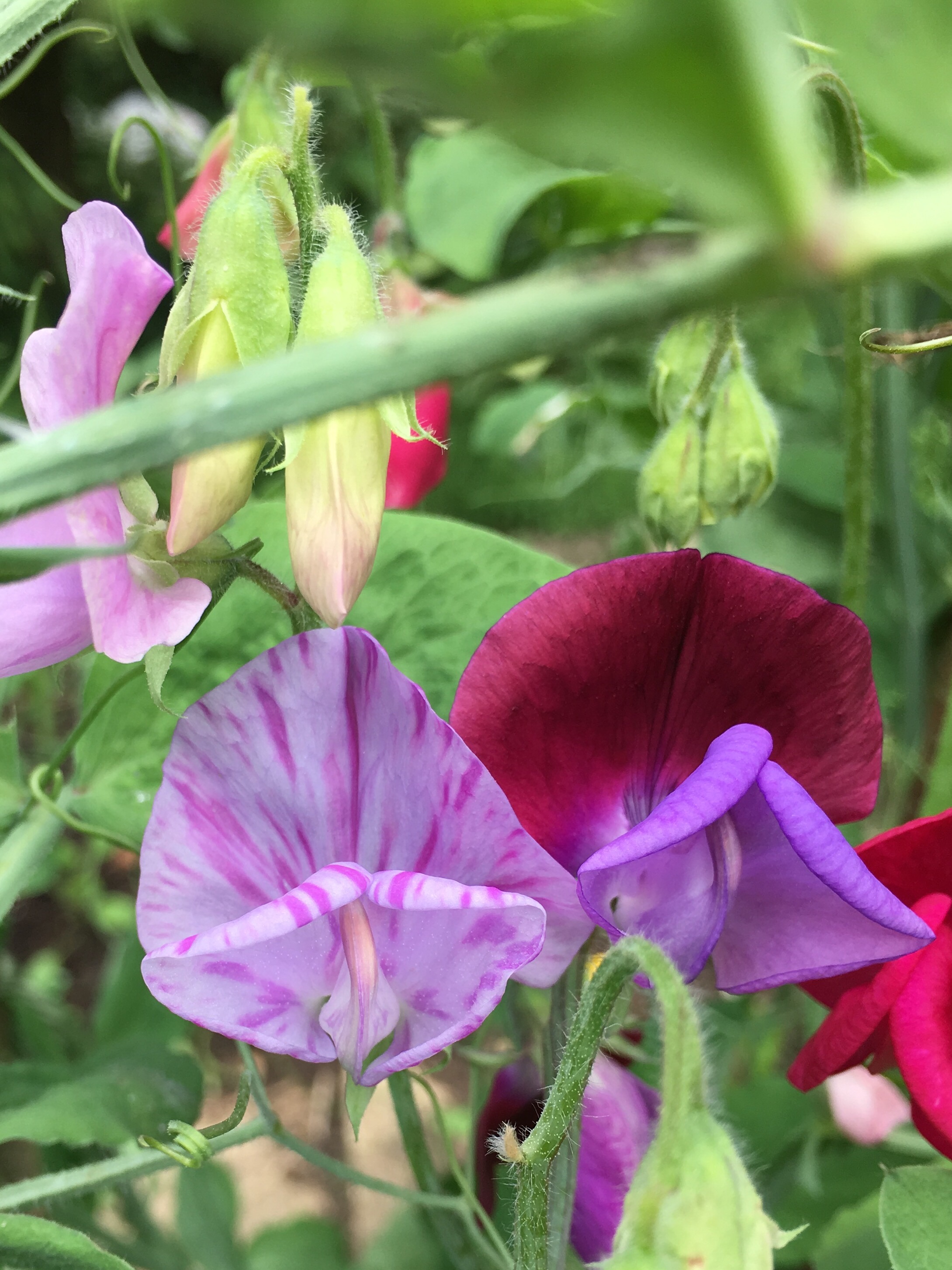
Sweet peas High Scent are top favourites this year. I love the creamy buds that open to pale lilac. There’s a pretty violet picotee edge to the flowers. And the scent really is amazing. Only a few are needed in a jam jar posy to make an impact.

Seeds were sown last October in root trainers and kept all winter in straight-sided clear plastic storage boxes to outwit mice. It worked. And in April the well-rooted plants were set out along a wonky network of hazel twigs.

I pick flowers at dawn and drop them straight into buckets of cold fresh tap water. To travel, I pop ice cubes in the buckets to keep them cool.

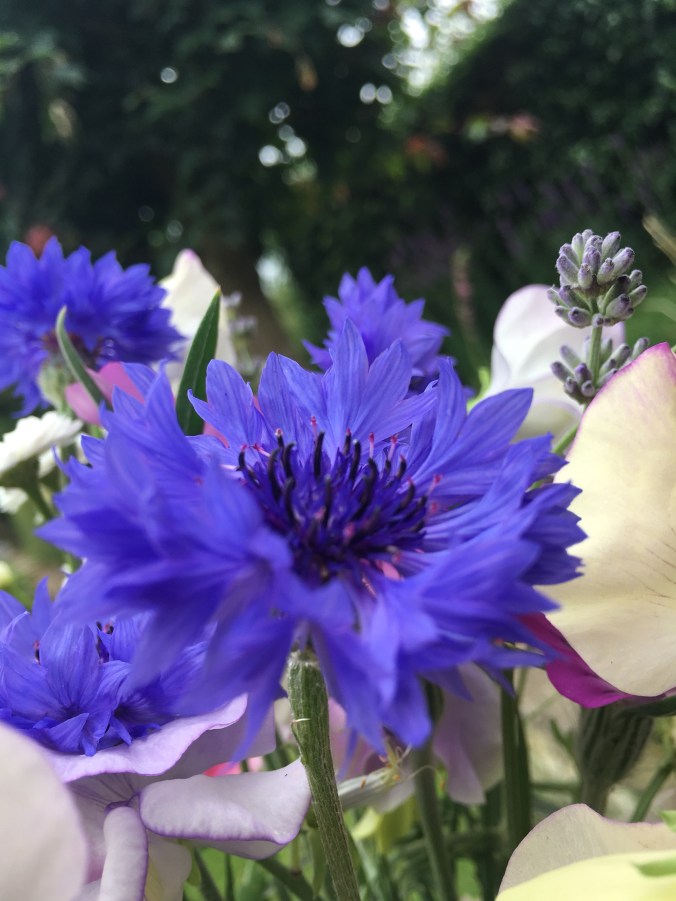
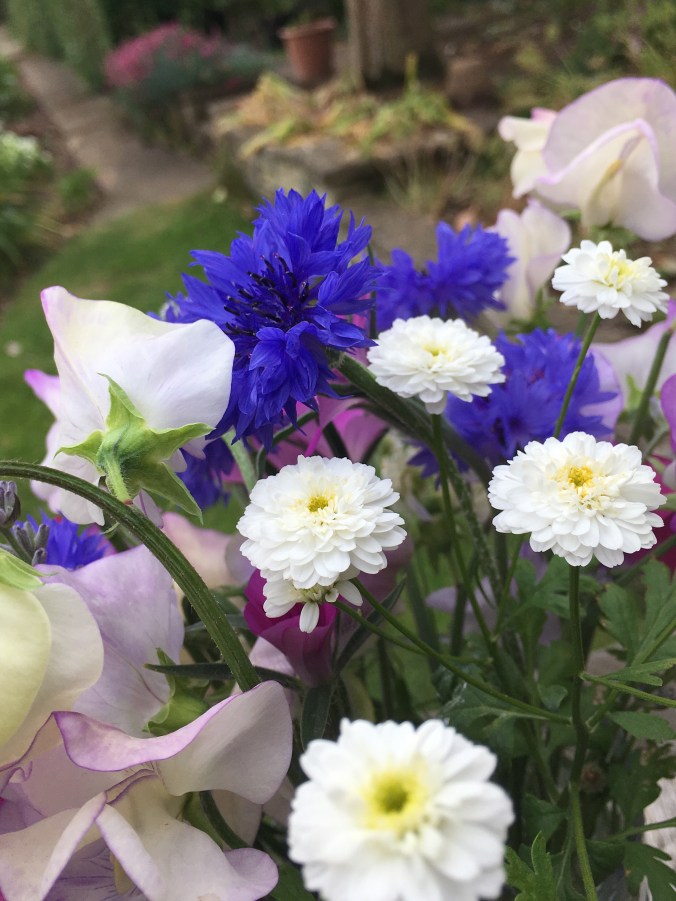
In amongst the sweet peas this week there’s beautiful cornflowers Blue Boy. These are really prolific. I’m picking these flowers most days and there’s lots more to come. Great value for a small area.

For a pop of pink, there’s corncockle, an easy to grow wildflower that’s growing all around my garden.

Creamy white double chamomile reliably comes back every year and seems to go with everything.

As usual, I’m joining in with Cathy at Ramblinginthegarden blog for this week’s IAVOM. Why not go over and see what Cathy and all the others are growing and displaying at the moment. It’s fascinating to see how many of us are growing the same plants in gardens all around the world.

https://ramblinginthegarden.wordpress.com/

Dahlias- beautiful varieties for home and garden

Book Review

Naomi Slade. Photography by Georgianna Lane

http://www.pavilionbooks.com. £25. August 2018.

Leave a comment below if you’d like your name to be put in the hat for a chance to win one free copy of the book. The publishers will draw out a name. Their decision is final. Sorry, it’s open to UK entries only.

Photo : My favourite dahlia Nuit d’Ete in my own cut flower plot in Leicestershire.

I’m away from home for a few days, staying with my mother-in-law Joan. Everything here is at a slower pace. Breakfast takes an hour, and over tea and toast she tells me how her husband Keith once won awards at the local flower show with his dahlias and chrysanthemums. The whole garden from the back lawn, to the greenhouse was set in regimented rows of flowers. I can picture the scene. This garden has been lovingly tended by my in laws for more than 60 years. And now everyone in the family is stepping in to keep it looking perfect. It’s quite a challenge, but one we all enjoy.

Today, between hoeing and weeding and keeping them company, I’ve got time to sit down and catch up with some reading. And top of the pile of new books is Dahlias by Naomi Slade.

photo: Naomi Slade with her latest book. My photo, taken at Chelsea Flower Show.

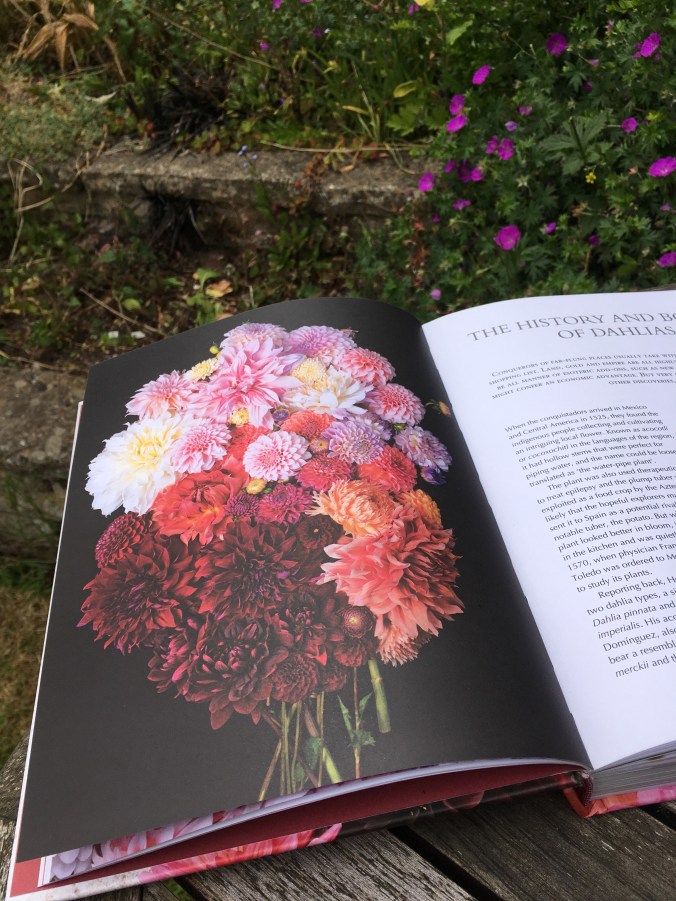
Over 65 types of dahlias are profiled in the book. There’s 240 pages of mouthwatering photographs and inspiring, easy to read descriptions. There’s an introduction followed by sections on history and botany; and the dahlias are split into themes such as “romantic,” “dramatic and daring,” “fabulous and funky,” “classic and elegant.” A growing and care guide gives cultivation techniques, information on selecting varieties, choosing a suitable site and soil and planting tips.

Photos are sumptuous. I’m particularly drawn to the darker shades; deep red and almost black. Rip City is one I’d love to try.

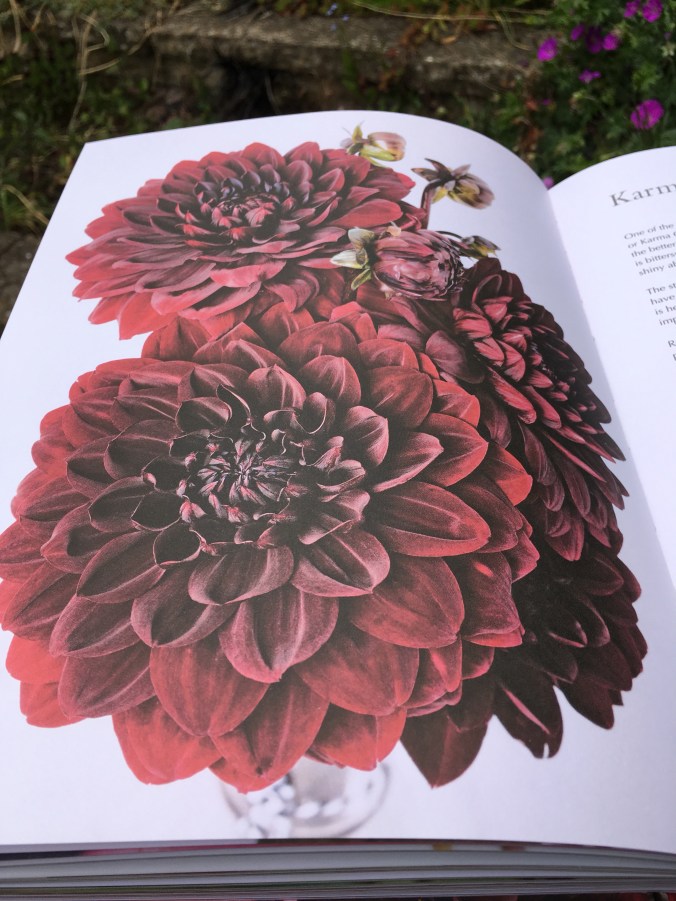
Karma Choc is another on my wish list. This small waterlily flower is excellent as a cut flower and lasts at least a week in a vase.

I’d never heard of the Happy Single range of dahlias. These are perfect for small spaces and containers, growing to 30-60cm high by 30-40cm wide. Such a wide range of cheerful, rich colours. You couldn’t fail to be happy with them! Varieties include Happy Single Flame, Happy Single Party, Princess and First love. Even the names made me smile.

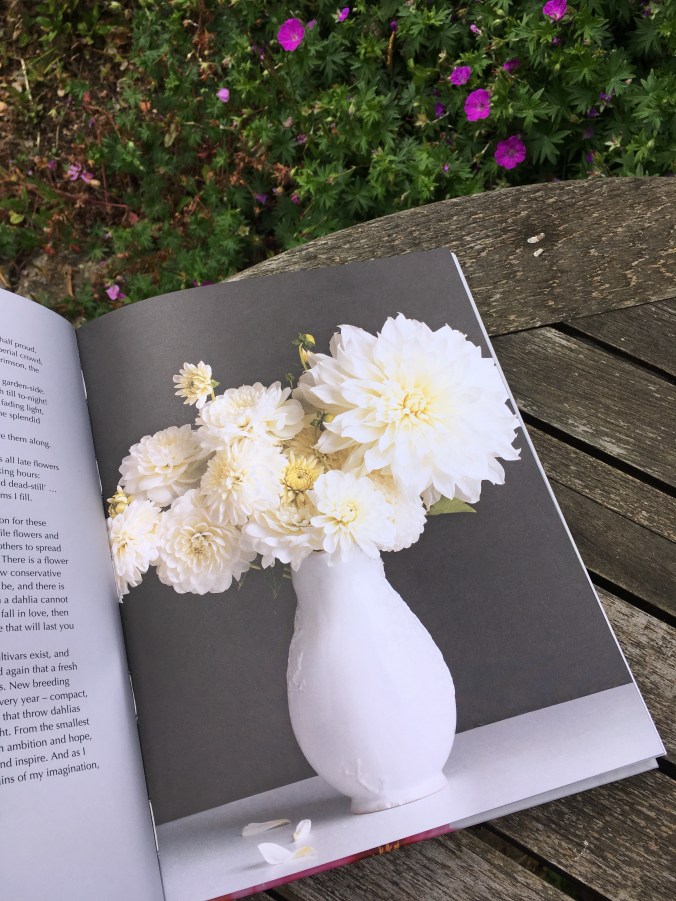
To calm things down after all that colour, there’s some dazzling and very beautiful white dahlias. I enjoyed learning about all the different kinds of dahlias. I knew about cactus and water lily types, but didn’t know much about collarettes, and anemone- flowered forms. And ones called star, or orchid-flowering sound particularly appealing.

Here’s some photos of dahlias from my own garden. I’ve taken cuttings from mine to grow in my in laws garden. Having read Naomi’s inspiring book, I’ve made a list of new varieties to share between our two plots. And I’m hoping to learn some prize winning tips from my father in law. You never know, I might even enter the local flower show.

Naomi Slade is a writer, broadcaster, consultant, speaker and photographer. A biologist by training, a naturalist by inclination, and with a lifelong love of plants. She writes regularly for national newspapers and magazines. Her books include The Plant Lover’s Guide to Snowdrops and An Orchard Odyssey.

I really enjoyed reading her latest book. It’s brought back some lovely memories for my mother in law and sparked off a new plan in my head to grow more dahlias in their garden.

Right then…. back to the weeding. Must not let my in laws down! 🙂

REVIVE YOUR GARDEN book review

Nick Bailey. Photography by Jonathan Buckley

Kyle Books £25 Hardback. Published spring 2018

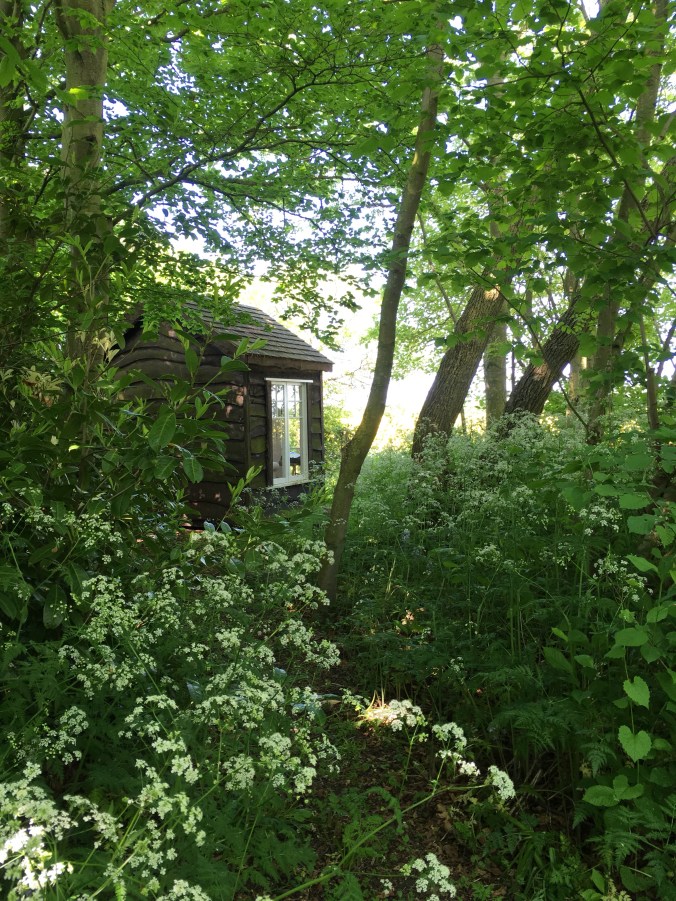
My garden blends seamlessly with the surrounding countryside. If you drive along our country lane, you wouldn’t be able to tell anyone lived there. The garden shelters behind mature hawthorn hedges with scented wild roses and honeysuckle. I love its wildness. But there comes a point where the wild garden starts to get the upper hand; some paths are no longer accessible. The woodland is expanding and cow parsley taking over. And don’t even mention the brambles.

Just in time, Nick Bailey has produced a book that seems to be written specially for me! Revive Your Garden is a step by step guide to restoring order.

When a garden has got out of control, the task to get it back into shape seems overwhelming. It’s difficult to know where to start. This book sets out a sensible plan of action, starting with a section on “understanding the opportunities and limitations” of your plot.

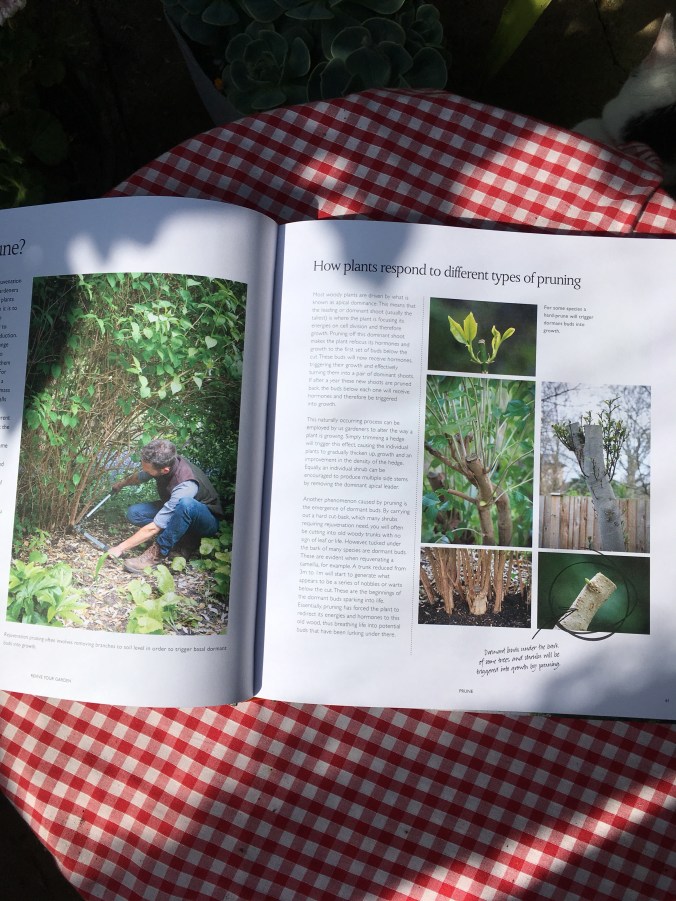
Next there’s a back-to-basics approach on pruning. I should really know when and how

to prune my shrubs, but Nick’s guide gives me reassurance that I’m doing it right. There’s a master class on renovation pruning with plenty of photographs to illustrate different techniques.

For beginners, there’s a very good section on identifying the difference between weeds and useful plants worth saving. My daughters found this particularly good – as they are starting to look for their first-time homes. All the houses we’ve looked at in their (low) price range have terrible, ramshackle gardens.

There’s a section on renovating lawns. Mine have been attacked by all kinds of creatures, gouging holes in the grass. I just need a nudge in the right direction to tackle the eyesore.

One idea in the book I’ve copied involves taking photos of the garden and laying tracing paper over the top. Draw on the changes you’d like to make. In my case, I want to create a new breakfast terrace near the summerhouse; a sunny spot first thing in the morning. Drawing it out first gives an impression of what it would look like- before you’ve spent any money on the scheme, and you can play around with various options.

Practical advice on restoring paving, reviving gravel and fences is followed by a section called “How to Wow.” I need to revamp some of my planting areas- once I’ve hacked back the brambles.

Revive Your Garden gives you confidence to tackle any garden work, whether it’s bringing a tired and neglected garden back into shape, or putting your own stamp on a newly acquired plot. It’s written in an enthusiastic way. You can definitely hear Nick’s voice as he explains the techniques. It’s just the encouragement you need to get going.

Here’s some photos of my garden, before I start work on our renovation project. Wish me luck. I might be out there for a while!

There’s a path through there……

And there.

Honestly, there’s a path through there. Leading to the outside world, and this view.

NICK BAILEY, a regular presenter on BBC2’s Gardeners’ World, has worked as a professional horticulturalist for more than 20 years and won silver gilt for his first show garden at Chelsea Flower Show in 2016. Until recently he was head gardener at Chelsea Physic Garden.

#wordlesswednesday – RHS Chatsworth

Cosmos Razzmatazz. 12,000 of them!

This is the first mass planting at an RHS Flower Show. Cosmos, an annual daisy that hails from Mexico, is planted on a bank between Chatsworth House and the River Derwent. There will be two more mass plantings this summer; Verbena bonariensis at RHS Hampton Court and Rudbeckia Prairie Sun at RHS Tatton Park.

Packets of annual seeds are relatively inexpensive. They often contain hundreds of seeds. So you too could create your own “river of flowers.” Bees and butterflies love them too.

RHS Chatsworth is open until 10th June.

#wordlesswednesday- Malus Wedding Bouquet- with the Royal Wedding in mind.

Crab apple trees are among my favourites. I love the spring blossom- and then there’s the fruit in the autumn, which makes wonderful jams and jellies.

Malus Wedding Bouquet is highly recommended. It has soft pink buds which open ivory white and mature to a dazzling pure white. Finely tapering green leaves turn red in the autumn. Very disease resistant, it grows to 3.5m by 2.5m, although can be easily pruned to keep in a smaller space.

We’ve got our patriotic flags and bunting out, and my grandmother’s coronation glassware trifle bowls- all set for Saturday. Whatever you’ve got planned, enjoy your weekend celebrations.

Visit to Bowood House and Gardens

My invitation read: “Come and visit Bowood’s famous spring planting; and Lord Lansdowne will lead a tour of his woodland garden.”

Who could resist such a missive. Not me! So I set off for Wiltshire- dreaming of camellias, magnolias, rhododendrons and azaleas galore!

And what I found was one of the best spring gardens I’ve ever visited. Over two miles of paths meander through the 30 acre garden- set within a former quarry. A stream runs through the valley with banks of ferns, candelabra primroses and bluebells either side.

Now, I’ve been on these garden visits before, where tours are promised. The owner is often there for a welcoming reception- but then frequently hands over to staff for the tour itself. So I was surprised and pleased to see Lord Lansdowne standing by his offer and giving us a walking tour of his garden – and one that ran an hour longer than planned.

If you come to visit my garden, I’ll take you around, show you the tree I planted when we moved here, my favourite seat, my favourite shrub and the plants I inherited from my grandparents’ garden. To be honest, our visit to Bowood felt just like that; a keen gardener showing us around his plot – with all his favourite trees and shrubs and viewing points. As soon as we arrived, Lord Lansdowne pointed to a group of cornus dogwood trees and described them as his “pride and joy.” And then followed a chat about how difficult they are to grow, and how “wonderful” they look when the white bracts appear in spring. His enthusiasm is something we all share as gardeners. We nurture and plant something, and then stand back and admire it, and want to share that moment with fellow gardeners. It’s something I recognise and understand.

One thing I haven’t got though (ok, there’s no rolling acres and stately home either) is a rhododendron named after me. This one is Lord Lansdowne’s – it’s rather lovely, with peachy cream petals and pink buds.

I can see why this is one of his favourite views, looking out from the garden. We are standing on the mausoleum steps looking out across the tops of the rhododendrons through a gap in the trees.

Some of the rhododendrons are called Bowood Hybrids, and Lord Lansdowne showed us the nursery beds where his selected seedlings are planted. He said they could be sitting there for 10 years before he’d know if they were something special or not. Patience is obviously a virtue when you are growing new varieties like these.

I must admit, there were a dizzying array of variety names as we walked through the woods. I should have written them down, but I was just listening to the commentary and enjoying what turned out to be a most unusual and special day. I mean, how often can you report that you were meandering through the woods and suddenly there on the path is the celebrated plantsman Roy Lancaster!

Roy, who is writing about the gardens, stopped for a chat and joined our group for a photo. It was fascinating to hear the two friends talking, the Latin names flying back and forth. And later, we visited a patch called Roy’s Corner, where specimens brought back from Roy’s plant-finding expeditions are being nurtured. Altogether, it had been, a day like no other.

Bowood Woodland Garden opens from 28th April until early June. Check the website for details. http://www.bowood.org

No wonder the owner admits he spends every Saturday lunchtime having a picnic in the gardens. I think I would too.

Many thanks to the Garden Media Guild for organising this visit to Bowood. If you work in horticulture, you can become an associate member. Membership is open to anyone working in garden writing, broadcasting and photography. Probationary membership may also be available for new starters in the profession and there are training courses and mentoring schemes available.

Weeds. Geranium robertianum

I’m writing a piece about weeds at the moment. Suddenly, in the sunshine, after all that cold weather, weeds have gone whoosh!

In my woodland garden, there are thousands of wild geranium, robertianum. It has so many common names: herb Robert, stork’s bill, crane’s bill, red robin, stinking Bob, fox geranium, cuckoo flower.

“Herb Robert is very familiar. It lives with man: much as the robin flips into his garden and to his back door” – Geoffrey Grigson- The Englishman’s Flora.

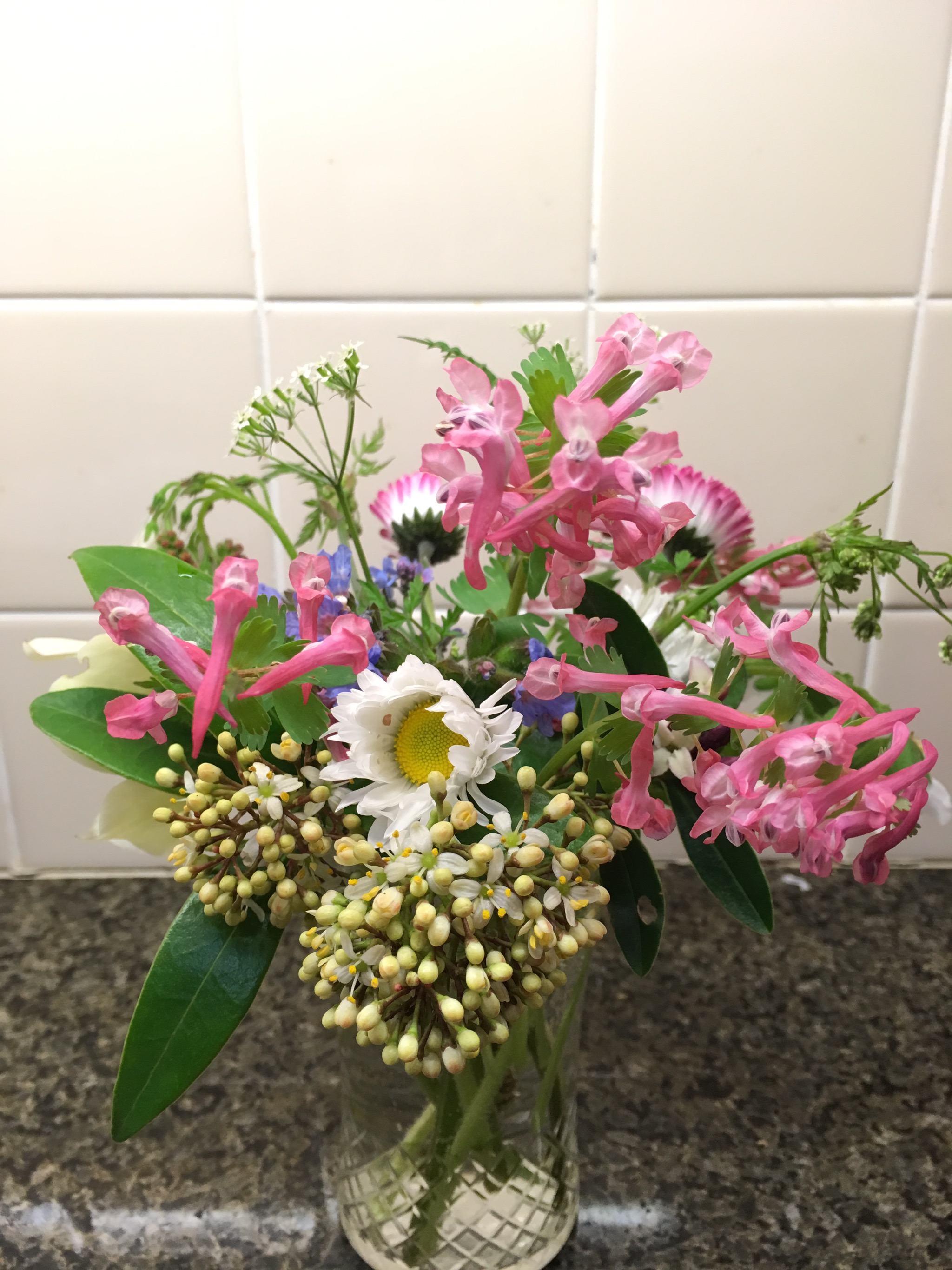
I’m enjoying reading up and investigating more about this common weed we usually pass by without noticing. And meanwhile, a posy of herb Robert sits in my potting shed window today. Mixed in with some wild violets -which are so numerous they could be considered a weed. Both very pretty indeed.

What “weeds” are growing in your garden right now.

End of the Month View -April 2018

We leave cold, wet April behind, and May finally brings some warm, settled weather.

The potting shed window ledge soon has a jug of cow parsley and forget-me-nots from the wild garden.

We’ve waited for this display all winter. Wild cherry trees in the paddock. Alive with bees. An avalanche of white blossom.

Scented narcissi Geranium pop up in the long grass around the pond. I love the egg yolk centres.

Needing some work this summer, the pond is ringed with marsh marigolds and lady’s smock wild flowers- and brambles and stinging nettles! A bit of cutting back and control is planned.

Our front lawn is a blue haze. My Grandfather Ted Foulds brought the first wild violets here, seedlings from his garden. They spread over the whole plot, and I love them.

I’ve planted my sweet peas. The hazel rods are a bit ramshackle, but they’ll soon be covered with flowers. I planted seed in October. I’m growing old favourites: High Scent, Wiltshire Ripple and creamy white Mrs Collier, plus heritage varieties from Easton Walled Gardens .

Suddenly, these dog’s tooth violets pop up through cow parsley in the woodland. I forget I’ve planted them – and then they emerge. Sunshine on a cold, cloudy day. Erythronium Pagoda is the variety growing here.

Shining out from the shade, Tulip Purissima. Reliably comes back every year. Copes with everything the weather throws at it.

I grow Orange Emperor tulips in the daylily bed in front of the greenhouse. Another good do-er. Always comes up every year if planted deeply on a bed of grit for drainage.

Favourite shrubs in flower at the moment are daphne and quince. This one is Japanese quince, Chaenomeles Kinshiden. Double flowers open pale lime green and change to clotted cream as they age.

Pleased to see my plectranthus has survived the winter, tucked up in the greenhouse. A striking plant for summer containers. Easy to grow from cuttings.

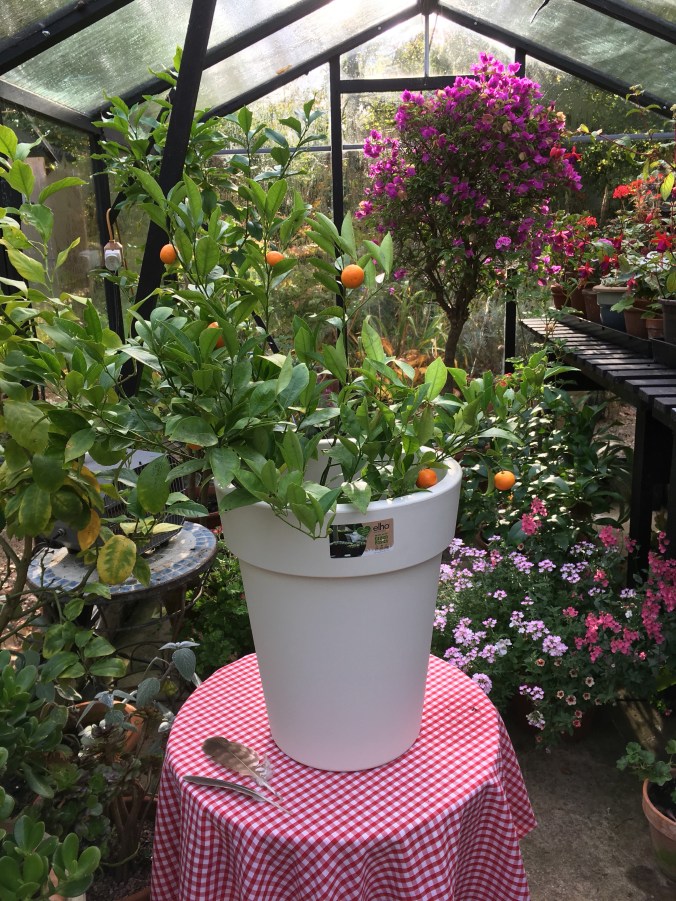
There will be plenty of citrus fruit for summer preserves. This plant flowered all winter, filling the greenhouse with such a wonderful scent.

We do quite a bit of owl watching from the top of the garden. Delighted to report the barn owls and tawny owls have survived the freezing winter. We’re hoping they bring their fledglings into our garden again this summer.

Another cause for celebration. The hedgehogs- we think they are last year’s babies- also survived the cold, and have come out of hibernation, ravenous. They are doing a great job of clearing pests in the garden.

I hope you’ve enjoyed this slide show of my garden at the end of April and into the first week of May. Enjoy your Bank Holiday weekend. I’m hoping to spend some time just sitting in my favourite garden chair. If I can possibly ignore all the weeds growing rampant in the background!

Thanks to Helen Patient Gardener for hosting the EOMV. Why not go over and see how Helen’s garden looks at the end of April.

What are your plans for the garden over the coming weeks? Get in touch and let me know.

Fact sheet for growing strawberries /recipe for ten minute strawberry jam biscuits

If you listened in to the gardeners’ phone-in programme this week on BBC Radio Leicester you’ll have heard us giving hints and tips on planting and growing strawberries. Here’s a list of do’s and don’ts to get the best from home grown crops.

Buying bare-rooted runners, or root stock, is an affordable way to buy strawberries online or via seed and plant catalogues. It’s a good way to buy named varieties and virus free stock.

I’ve chosen the Plant Heritage Collection from Marshalls. 30 runners for around 66p each.

Royal Sovereign : A well-known mid season strawberry famed for flavour. Large juicy fruit. Crops in early summer- and again in autumn.

Cambridge Favourite : Reliable and popular variety. Good for jams and preserves.

Red Gauntlet: Mid season, heavy cropper. Fruit is held well above the ground. Good for damper soil, or for growing under cloches or in tunnels. Some resistance to botrytis.

1. When the plants arrive, take them straight out of the Jiffy bag and either plant into 3″ pots or straight into the garden, if soil and weather conditions are suitable.

2. Choose a sunny, well drained spot – not in a frost pocket

3. Enrich the soil with well rotted garden compost, organic Plantgrow fertiliser, or peat-free sheeps wool and bracken compost from Dalefoot Compost.

4. Planting depth is crucial to success of the runners. The crown, the thickened area where the leaves are attached to the roots, should be resting at soil level. Too high and the plants will dry out. Too deep, and they will drown.

5. Don’t plant where tomatoes, chrysanthemums or potatoes have been grown. The soil may harbour wilt disease.

6. Watering techniques are important. Do not drench the leaves and leave them wet overnight. The plants are more likely to suffer from moulds and the fruit will rot. Either use a leaky pipe, or push the watering can through the leaves to water at ground level.

7. Feed every 7-14 days with a high potash liquid fertiliser. I use seaweed extract, but you can also use tomato fertiliser. Plantgrow also has a handy liquid fertiliser in its range.

8. Protect the flowers from frost using a layer of fleece. The flowers are easily damaged and turn black. A whole crop can be lost to frost overnight.

9. Cut back all leaves and remove straw mulch after fruiting to prevent a build up of pests and diseases. We use chopped mineralised Strulch.

10. The plants will naturally produce runners. Stems will arch over and where they touch the ground, new plants will grow. Pot these up and renew your strawberry beds every 3-4 years. The old plants are best discarded after this length of time as pests and diseases start to take hold.

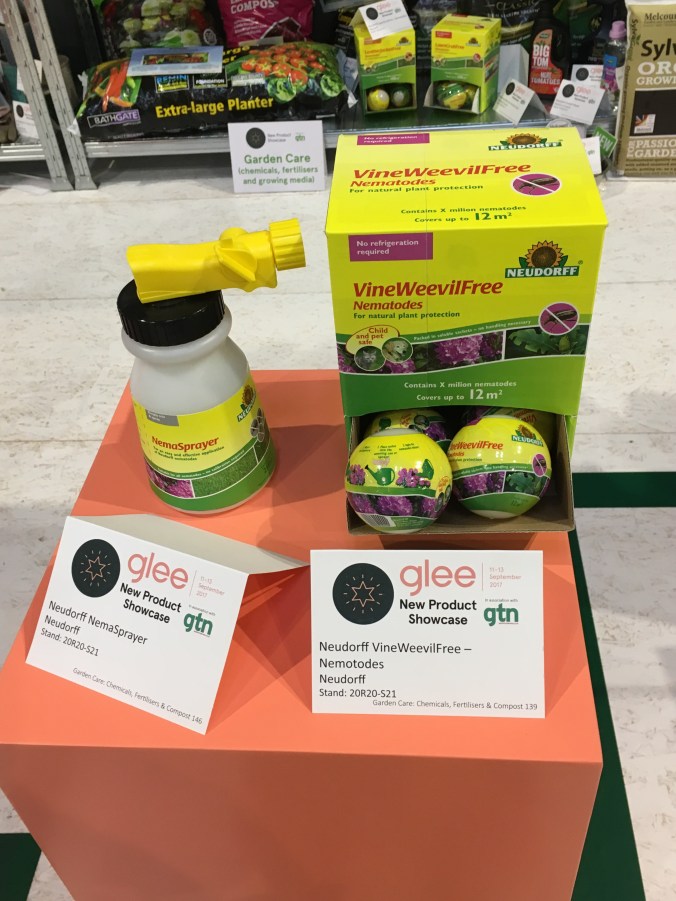
11. Vine weevils love strawberry plants. There’s a new organic nematode treatment that can be bought off the shelf. Previously treatments had to be posted out and used fairly quickly. The new nematodes from Neudorff are easier to buy and use.

STRAWBERRY JAM ALMOND BISCUITS

These are a family favourite and only take 10 minutes to make. Lovely with morning coffee, or for afternoon tea.

Ingredients: whizz together

200g caster sugar

115g butter

115g ground almonds

115g plain flour

1tspn baking power.

1 egg

3 drops almond essence.

Rest dough in the fridge for one hour if you want biscuits to retain their round shape. I was in too much of a hurry, so mine turned out flat.

Take teaspoons full of dough and roll in the palm of your hand. Place on a baking tray. Make a well in the centre with a spoon handle or little finger. Fill with strawberry jam. Top with slivers of almond.

Cook in oven at 200C for 10 minutes. Keep a close eye on them as they soon burn.

Will last for three days in a sealed container. If you can resist them that long.

Here’s a link to the radio programme. Have a listen in at 2.08.18 on the timeline.

bbcleicester http://www.bbc.co.uk/programmes/p063rcnf

Here’s some fruit tarts I also made with the home-made jam. Totally delicious! Wonderful after a hard day working in the garden.

Click on the highlighted links for more information. These are not affiliate links.

What new plants are you trying out this spring and summer?

In a Vase on Monday- spring flowers for Mum

Flowers for my Mum this week. There’s nothing as beautiful as spring bulbs and ranunculus are among my favourites. They are easy to grow. Plant them 8cm deep and the same distance apart in bulb fibre or John Innes compost. I grow mine in pots, starting them off in the greenhouse for an early crop. But they can be grown outdoors in full sun and well-drained soil. Plant them with the “fingers” facing downwards. The RHS has a sale on – 12 corms for £1.60 instead of £4. Aviv Rose is an excellent variety. I also grow Purple Heart . They last for a week in a vase. I made a small posy for the kitchen table with mine.

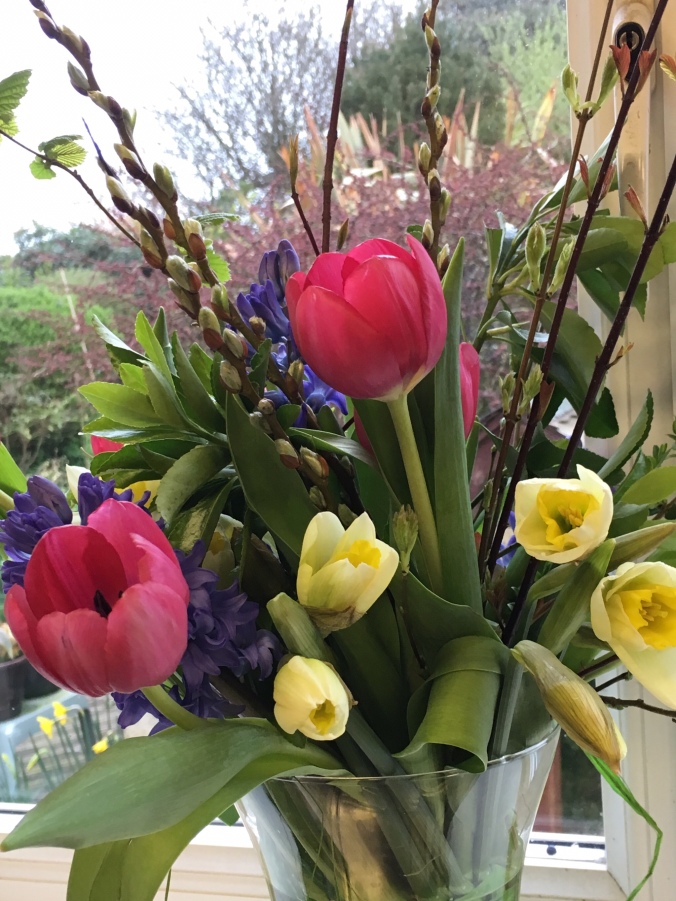
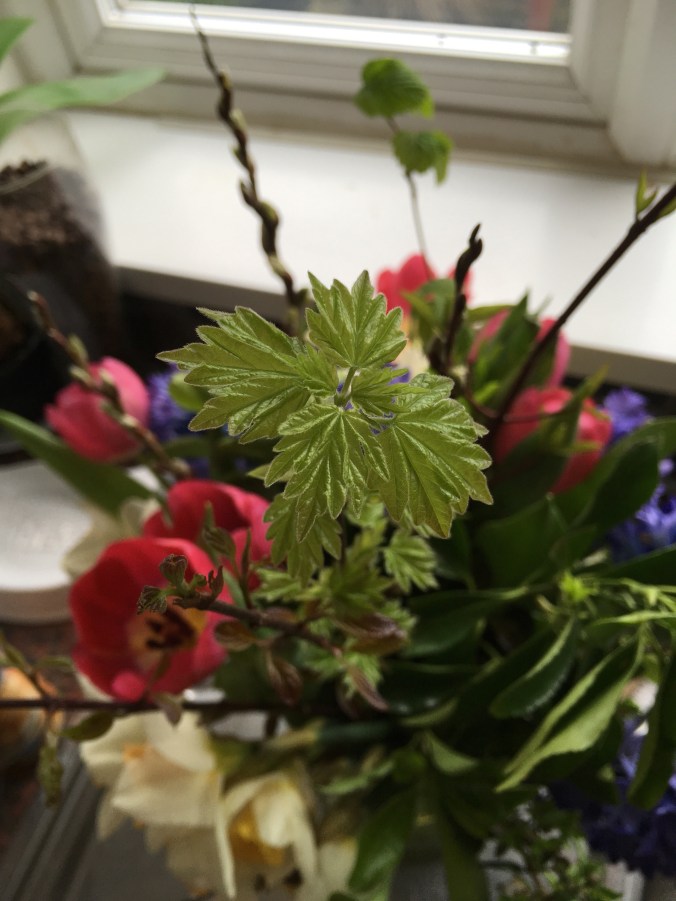
Red tulips look fabulous with blue hyacinths. I’ve placed these with lots of twigs from the garden. I’ve got grey catkins, red dogwood, spirea, and field maple. Some of the stems came from my new “Hedge in a Box” kit from Hopes Grove Nurseries. I wrote about planting my new florists’ hedge Here.

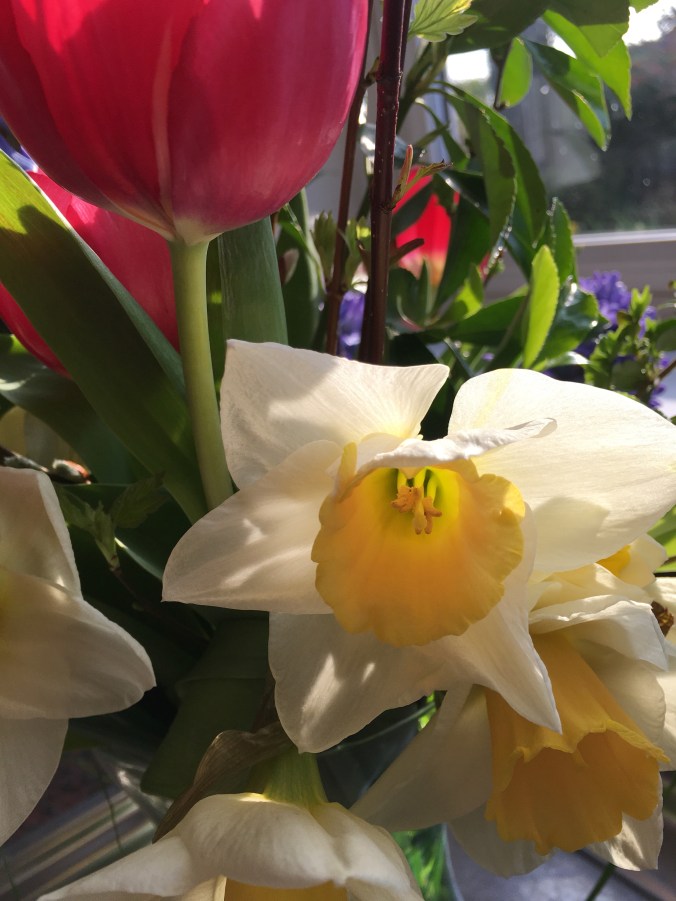
In amongst the stems are daffodils from Waitrose, grown in West Cornwall. “Surprise Bouquets ” contain 30 different stems for £4. You can’t tell what they are while they are in bud. The mystery is only revealed as they open. I love something a bit different and new marketing ideas to promote British flowers. Greenyard Flowers have been supplying Waitrose with daffodils for 23 years and grow more than 1,000 different varieties.

Some of the daffodils open up with creamy- white outer petals and a darker lemon trumpet. They have a delicate scent too.

All my bouquets for friends and family contain some of this evergreen glossy-leaved shrub that originally came from my Grandfather Ted Foulds. It’s called Euonymus Japonicus. I loved his visits here each week. He would always bring a little pot of seedlings from his garden, or a cutting from one of his plants. It’s lovely to walk around the garden now and remember him from all the flowers and shrubs in my garden.

There’s nothing more cheerful than popping a few twigs in amongst the spring flowers and watching them burst into leaf in the heat of the windowsill. This one I think is common field maple. The lime green leaves are almost as beautiful as any flower.

Thank you to Cathy at Ramblinginthegarden for hosting this meme. Why not go over and see what Cathy and all the others are putting in their vases this week. It’s an international favourite.

In a Vase on Monday – 9th April 2018

Just dashed home from work. Wonderful to still have some light in the evening for mooching in the garden. Each week I join Cathy at ramblinginthegarden for IAVOM. Here’s a slide show of photos showing what I’m growing and putting in my flower arrangements his week.

The silver and gold-laced primulas are just at their peak. They last for a week in water and have a faint but delicate scent.

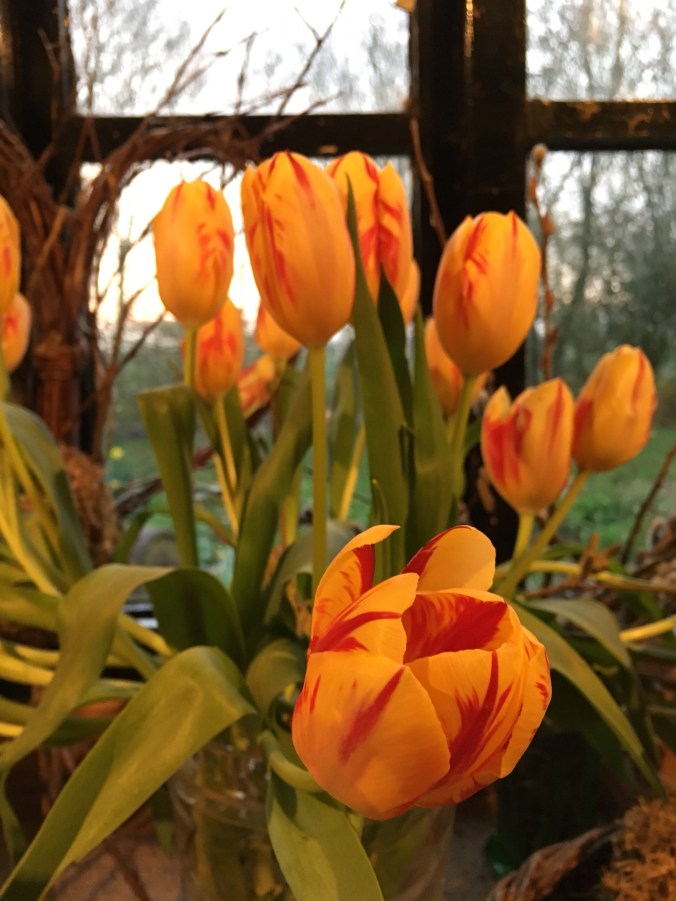
Tulips always cheer up any arrangement. These yellow and red blooms go really well with the fancy primulas.

Flower vases are still very much focusing on bulbs. I think I’ve had Carnegie white hyacinths in my flower vases every week since Christmas. These are the very last of them. I shall miss them to be honest. The scent in the potting shed is just wonderful.

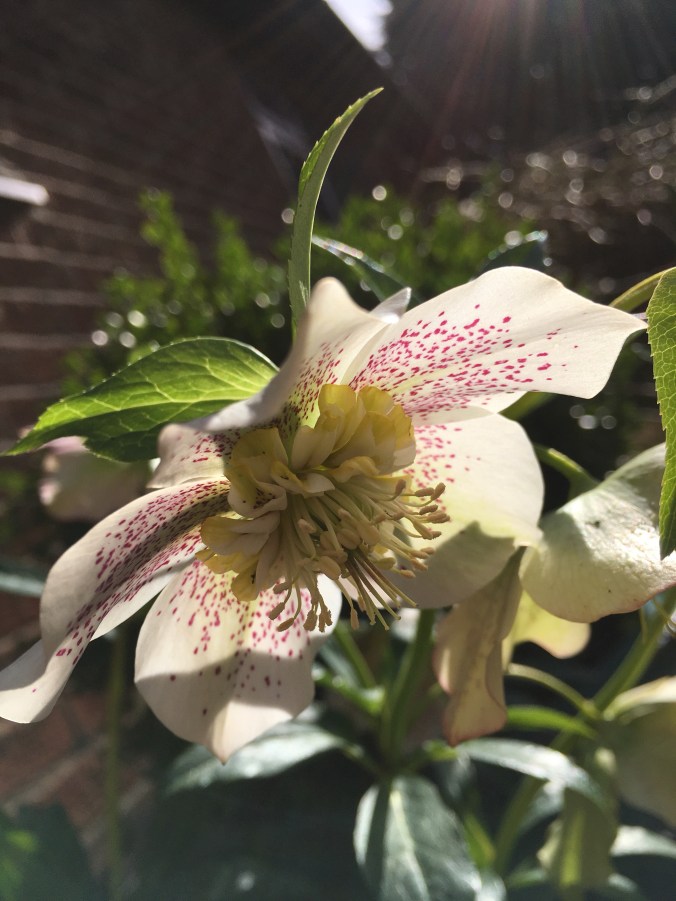
Hellebores are still in flower here. This one has a pretty, frilled anemone centre and holds its head up, which is always a good trait in any hellebore. I bought this one from Hodsock Priory in February.

Hellebores have survived everything the weather has thrown at them. This one came from Ashwood Nurseries in Kingswinford when we had a a tour of owner John Massey’s private garden. Well worth a visit. Probably the best spring garden I’ve ever seen. All fees from the open days go to local charities.

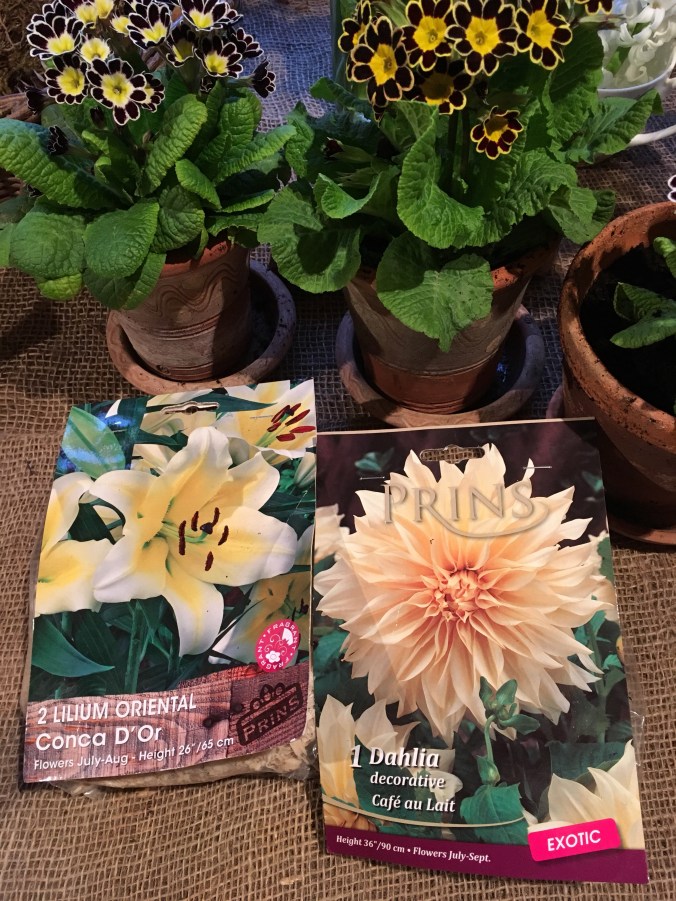
Couldn’t resist these summer bulbs. Lilium Conca D’Or is a favourite for fabulous scent. And the dahlia is new to me. I’ve watched others on IAVOM growing and using this variety, so I’m looking forward to trying it out for the first time this year.

Potting shed reading this week is Secret Houses of the Cotswolds by architectural historian Jeremy Musson, published by Frances Lincoln, part of the Quarto Homes group. Photographer Hugo Rittson Thomas allows us to peek into 20 homes, varying from castles and manor houses to grand mansions. It’s like stepping into another world to be honest. And a glimpse of the gardens through open windows- so tantalising! I just wanted to jump in the car and visit them all. But of course they are not open to the public. So I shall have to be content with gazing longingly at the book.

Click on the links to find out more. These are for information only and are not affiliate links.

Product Trial : Hopes Grove Nurseries- Hedge-in-a-Box Kit

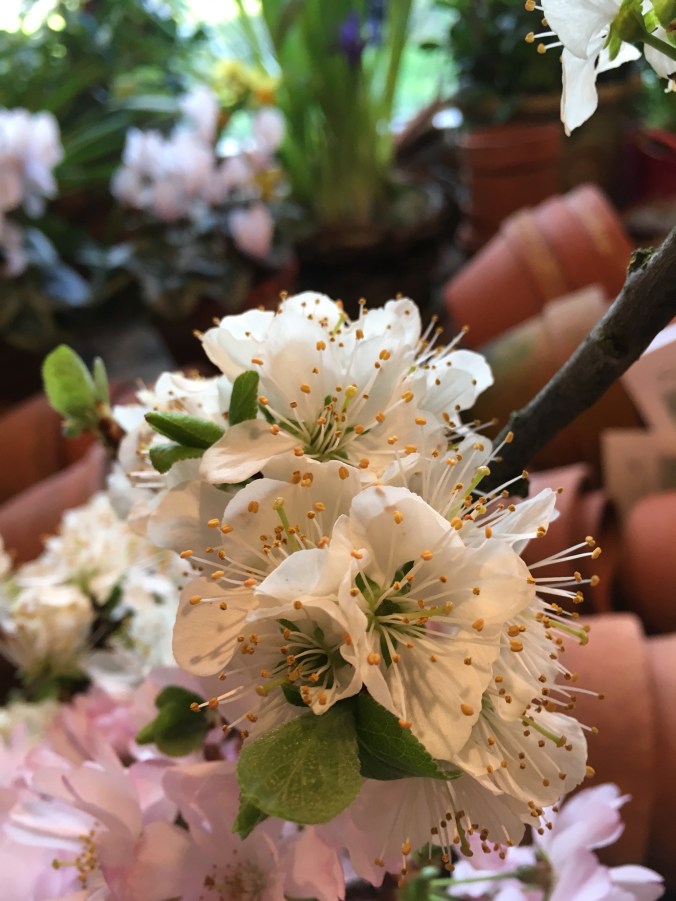
Photo: Prunus blossom from my hedgerow.

Visitors to my garden sometimes look surprised when they see the state of my hedges. They don’t often know what to say. Or they launch into a lecture offering kindly advice which usually involves grubbing out the rampant species and cutting everything back. I say nothing.

Truth is, I know the hedges are untidy. But I love them that way. There are gaps – but they allow ramblers on the lane to view the snowdrops. And me to watch the barn owls glide silently by at dusk. Yes, there are tangles of wild clematis, ivy and honeysuckle. Bees love the ivy flowers and birds love the berries. It’s a living tapestry of colour all year round.

Even the scruffiest, wild and untamed hedge provides nesting and cover for birds. A home for insects and small mammals. A microclimate, baffling the wind. Far better than any fence or wall, allowing frost to filter through and creating shelter.

Being a fan of all kinds of hedges, I made a beeline for Hopes Grove Nurseries at a recent garden trade fair in London. Hopes Grove are launching new themed hedging kits. I asked if they could design a florists’ hedge for me, and three days later my hedge-in-a-box arrived on the doorstep.

My new hedging kit contains a mixture of plants to give colourful stems, flowers and evergreen foliage. There’s a mixture of bare-rooted stock and potted plants including deutzia, escallonia, ribes, forsythia, hydrangea, mock orange, spirea. A lavender has been included as a sample of what the nursery sells. I think I’ll plant that in my herb garden. For glossy evergreen leaves there’s griselinia littoralis and osmanthus burkwoodii. And for winter colour there’s dogwoods with black, yellow, red and orange stems. My wild and untamed hawthorn hedge marks the boundary of my acre plot, but nearer the house and around the veg plot I’m going to plant a new mixed hedge, one I can harvest for my flower arrangements.

The plants, well packed, arrive in cardboard boxes. Boxes and paper packaging are all recyclable.

You wouldn’t know they have been packed in a box and been on a journey. The plants are really well grown and fresh. There are plenty of new buds on the Hydrangea Annabelle, and the osmanthus is just about to flower.

Bare- rooted plants are also substantial, well grown stock. We’ve heeled them in to the veg plot temporarily, until the ground is less waterlogged for planting. Each week I join in with the IAVOM (In a Vase on Monday) meme. I post a photo of what I’ve grown and harvested from my garden and take a look to see what other people all around the world are growing for their flower and foliage arrangements. Have a look at Cathy’s site to learn more.

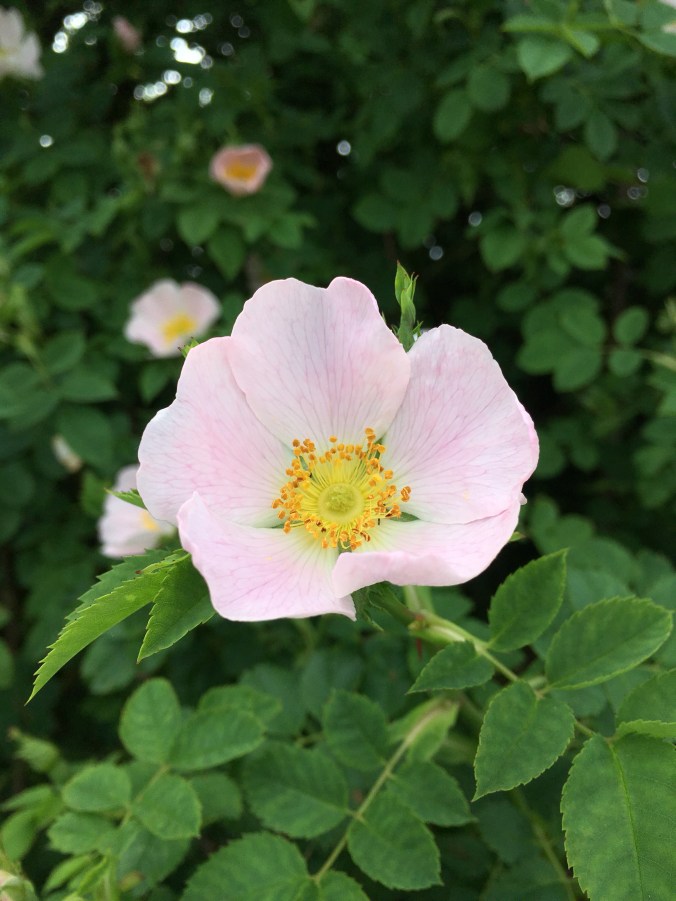
Another new hedge-in-a-box kit is the Gin Makers’ Hedgerow, with fruit and berries for alcoholic infusions. There’s wild pear, crab apple, plum, and cherry amongst the long list of suggestions. And I noticed dog roses too, which grow freely in my garden.

Of course, my wild informal hedge might not be everyone’s cup of tea. It’s important to say that Hopes Grove supplies plants for more structured hedges such as yew, privet, box and beech. Plant sizes vary from economical one year old cuttings, bare rooted transplants, 2- 4 year old feathered whips, right up to 25ltr pots and troughs of well grown plants for instant effect. There are hundreds of plants listed in the catalogue.

Hopes Grove send out a well-written site preparation, planting and aftercare guide. Morris Hankinson is the founder of Hopes Grove and grew up in the tiny oast house on the small family farm that is now in the centre of the nursery site. Morris has grown the business from a “one-man-band planting, growing and selling hedging” to a nursery covering 50 acres and employing 18 local staff.

Contact Details: Hopes Grove Farm, Smallhythe Road, Tenterden, Kent, TN30 7LT.

I’m delighted that Hopes Grove have asked me to trial this hedge-in-a-box kit. I love to hear of innovative ways of growing and selling plants. I’m very happy to wholeheartedly recommend their hedging plants and I’m grateful for the chance to give my honest opinion.

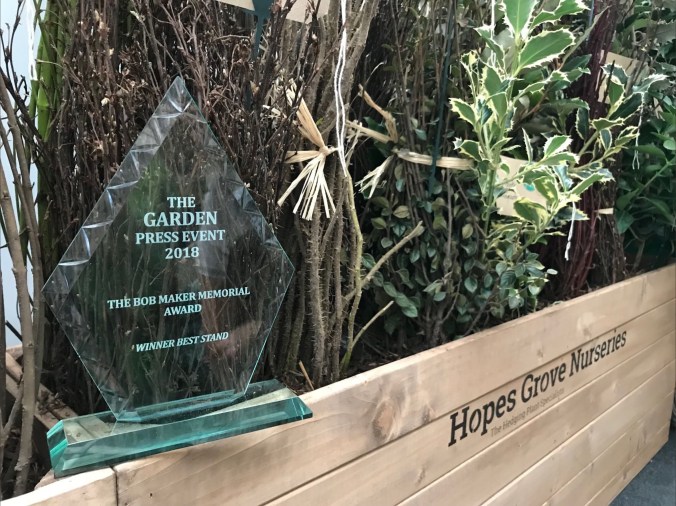
Hopes Grove won the Bob Maker Memorial Award for the best stand at the trade fair, the Garden Press Event in London.

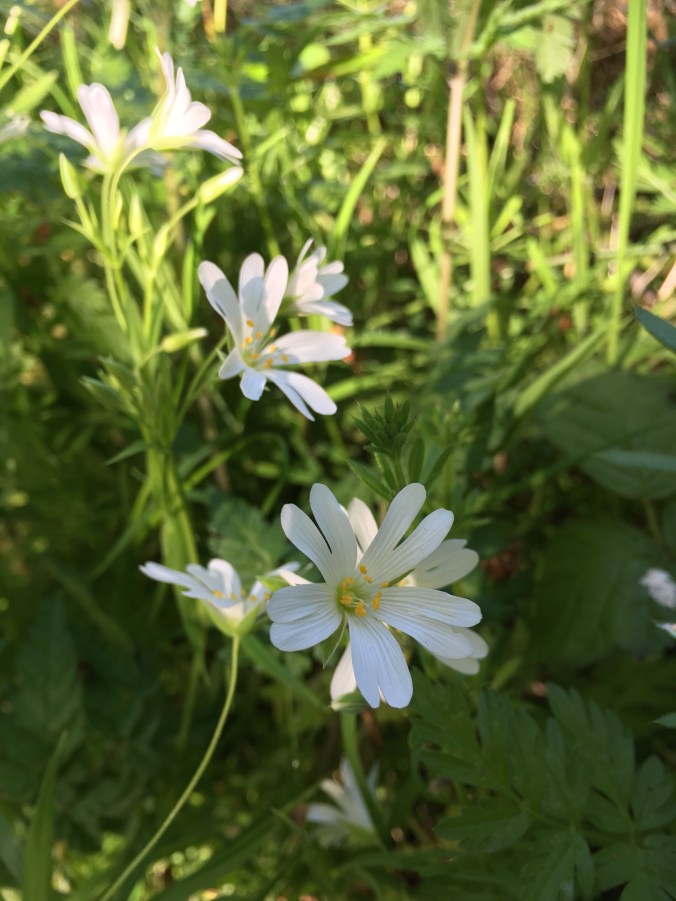
Photo. Wild flowers – stitchwort- growing in the hedge at home.

In a Vase on Monday ….. er Wednesday.

Defeated by torrential rain, I’d given up on gardening until today. Here’s a brief glimpse into my day.

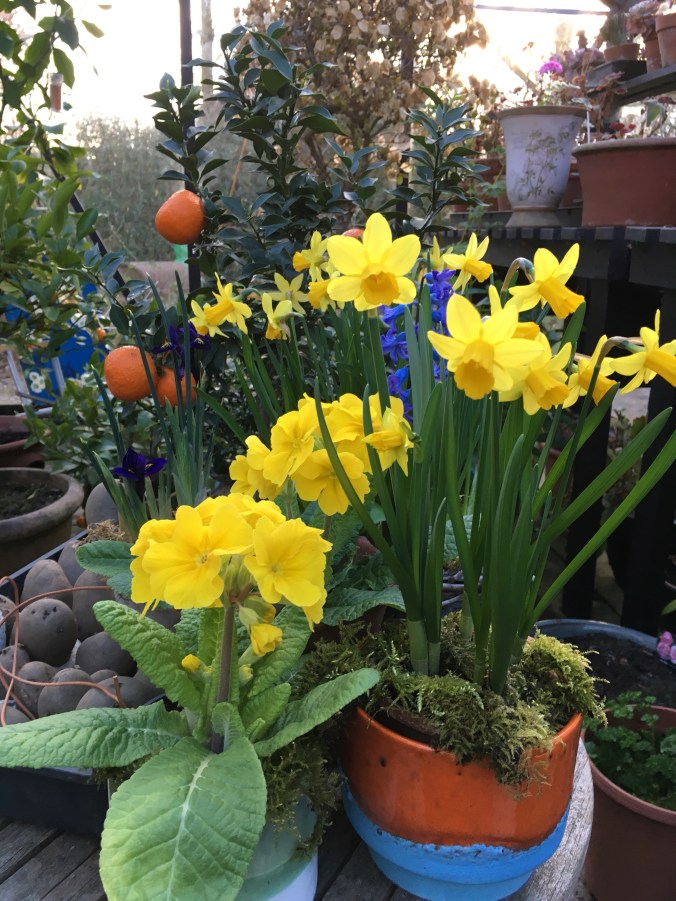
A quick peek in the greenhouse before I go off to work. And it’s sunny in here. At last. Yippee!!! Windows opened. Wonderful scent. Just love primulas. So cheerful.

Second year hyacinths are never as good. But they still have a value. I love the intense blue of this one, set against the yellow of the dwarf daffodils. I’m growing Tete-a-tete in pots for picking. And in honour of my wonderful Welsh grandmother, Tenby daffodils, which grow wild in Wales.

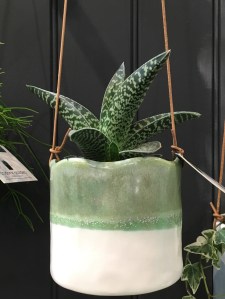
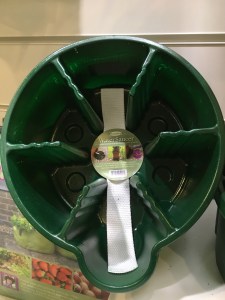
Love my newly acquired plant pots. The green one on the left is from Burgon and Ball , and the one on the right is from new company Plant Furniture.

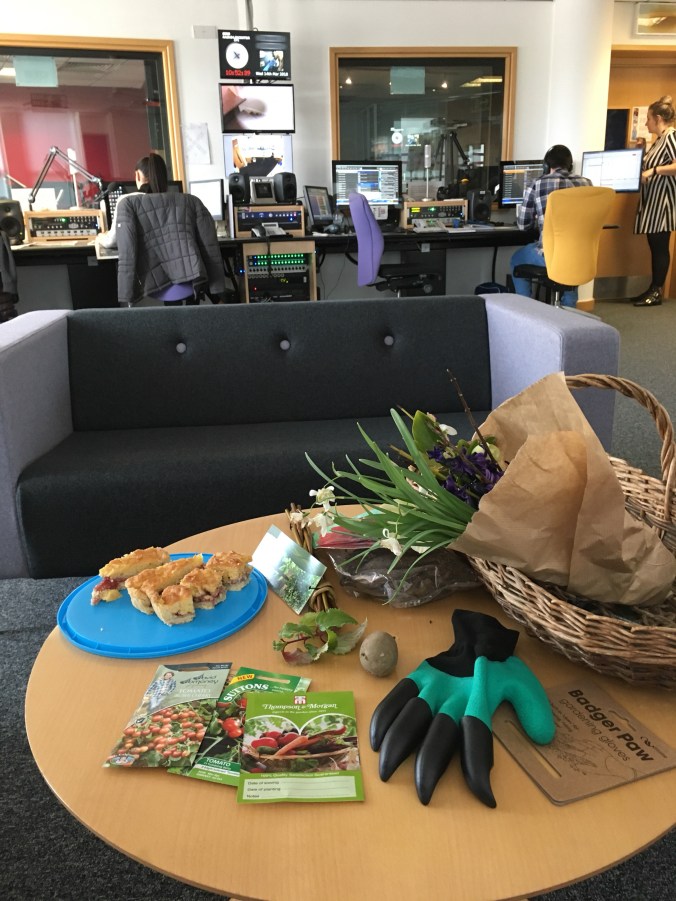
After a quick snip of flowers for the show, I’m off to Radio Leicester for the Gardeners’ phone-in, 11-12 on a Wednesday. A fun place to work. Sophie and Jack the producers look after me. I’m always so grateful for all the encouragement and support they give. I probably couldn’t do it without their kindness to be honest.

We chatted about growing tomatoes. I’m growing bush tomatoes in containers and hanging baskets alongside programme host Ben Jackson. We’ve got cherry tomatoes from Mr Fothergill’s, Suttons and Thompson and Morgan to try out. And we’ll be growing them in Dalefoot sheep wool and bracken compost as an alternative to peat. It’s always more fun growing something with another person. I haven’t got an allotment, for example, where you would have neighbours to chat with and share hints and tips. so I’m going to grow along with Ben, and we’ll share seeds and compost and compare results. It will be a fun project to do over the summer.

We always have a laugh on the gardeners’ programme. If I see something a bit unusual, I’ll take it in to show the team. Today I took in these Badger Paw gloves. I spotted them at the Garden Press Event a few weeks ago and thought they looked interesting. The event showcases new ideas, new seeds, tools and machinery, containers and plant pots- all heading for supermarkets, garden centres and nurseries this summer. The Badger Paw is said to be perfect for preparing soil, planting, weeding and clearing roots. It’s made by Creative Products and has breathable stretchy fabric. What we couldn’t work out though was why the claw is only on one hand. It’s an interesting concept and I’ll let you know how I get on with it.

My posy of flowers this week also contains hyacinths – which just seem to keep on flowering. They love the cold weather. Tucked inside my paper wrapping are iris reticulata, hellebores, snowdrops, and dogwood twigs from my new florists’ “Hedge-in-a-Box” kit from Hopes Grove Nursery. I spotted their ingenuous hedge kit for gin makers at the GPE. On the stand there was a sign saying make any suggestions for new hedge kits. So I asked if they could design a hedge for florists with coloured stems and flowers for all year round picking. And my wonderful “hedge-in-a-box”arrived on Monday! I’m really thrilled with it.

Thanks for joining me today. Thanks also to Cathy for hosting this meme and kindly allowing me to join in later in the week when either the internet – or the weather – has let me down.

Click on the highlighted words for more information. They are not affiliate links.

In a Vase on Monday

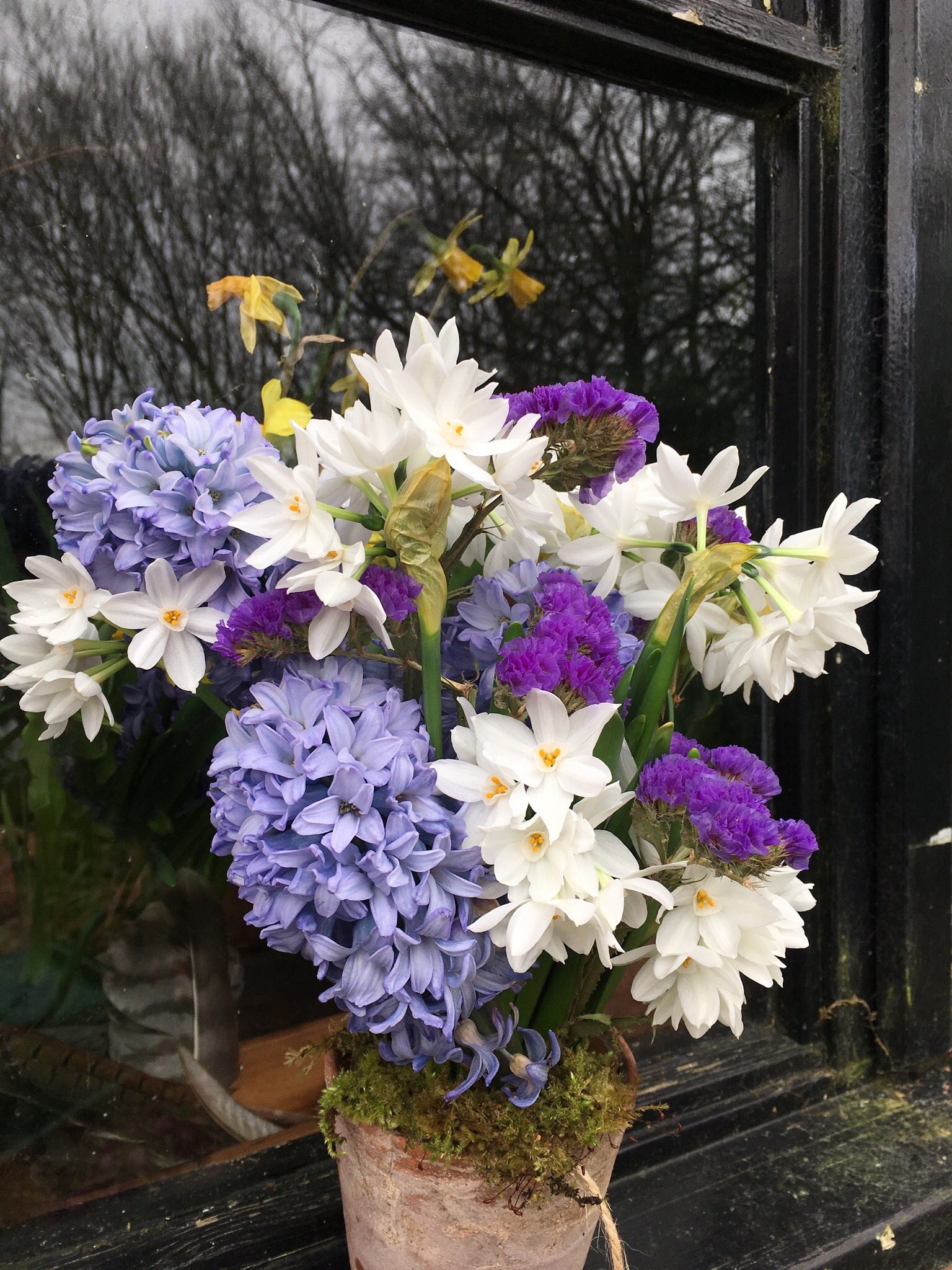
If you look carefully, you’ll see little ice cubes floating in the vases in my potting shed today. The jam jars and jugs froze solid. And I was away in London, so couldn’t rescue them. Luckily the flowers didn’t seem to mind. They perked up as soon as the temperature started to rise. These are the very last of my Paperwhite narcissi. They’ve been fantastic value, giving flowers for cutting for three months.

For my IAVOM I have recycled my spring flowers. I’ve cut off the bottom 2cm of each stem, given them all fresh water and added lots of grey willow catkins and hazel “lambs tails.” It looks like it’s a yellow and white theme this week. I haven’t planned it, but doesn’t it look cheerful. We’ve had temperatures go from -10 to 10c in just 24 hours.

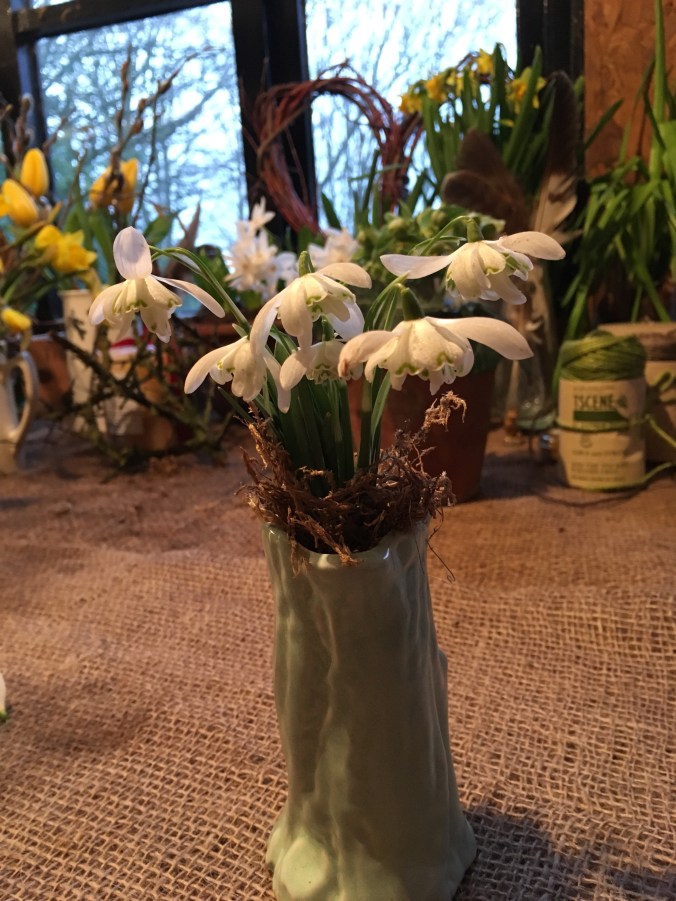
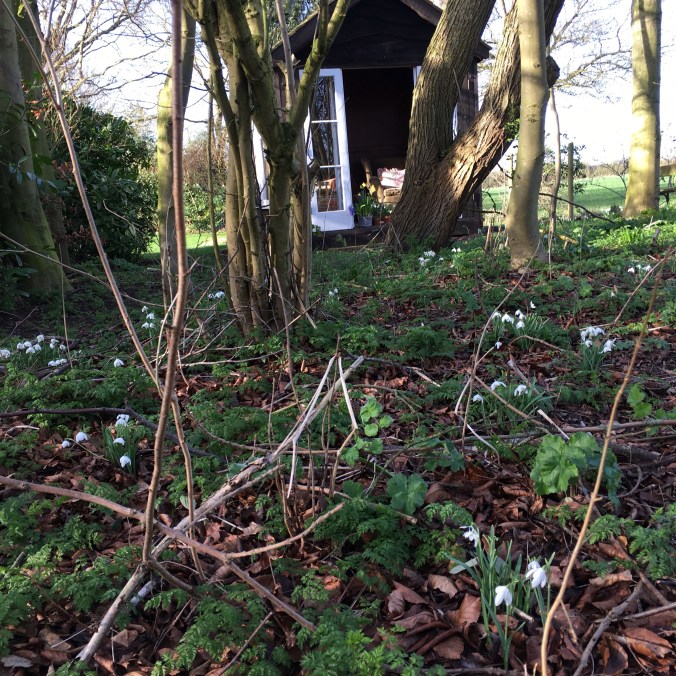
Double snowdrops, Galanthus flore pleno, from my “Hodsock” corner are still flowering well. The freezing temperatures have prolonged the display. Every year Mum and I visit Hodsock Priory in Nottinghamshire. We always stay overnight so we can walk in the woodlands just before dusk and again at sunrise -before the crowds arrive. It’s a special treat to have the gardens virtually to ourselves. Each year we buy a few pots of snowdrops for a couple of pounds. And over the years they have spread to make a corner of my garden that reminds me of our special holidays together.

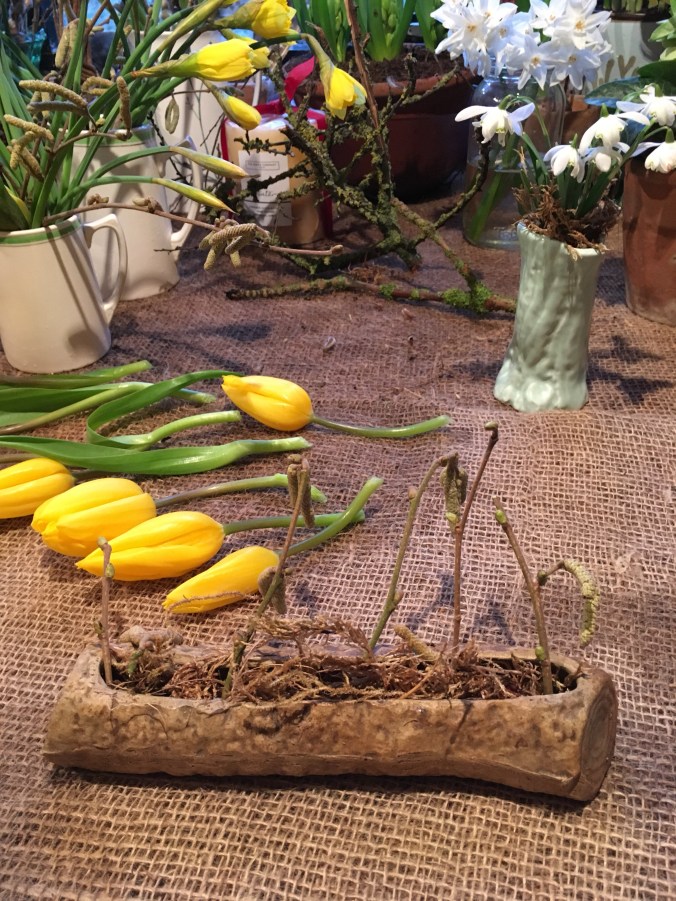
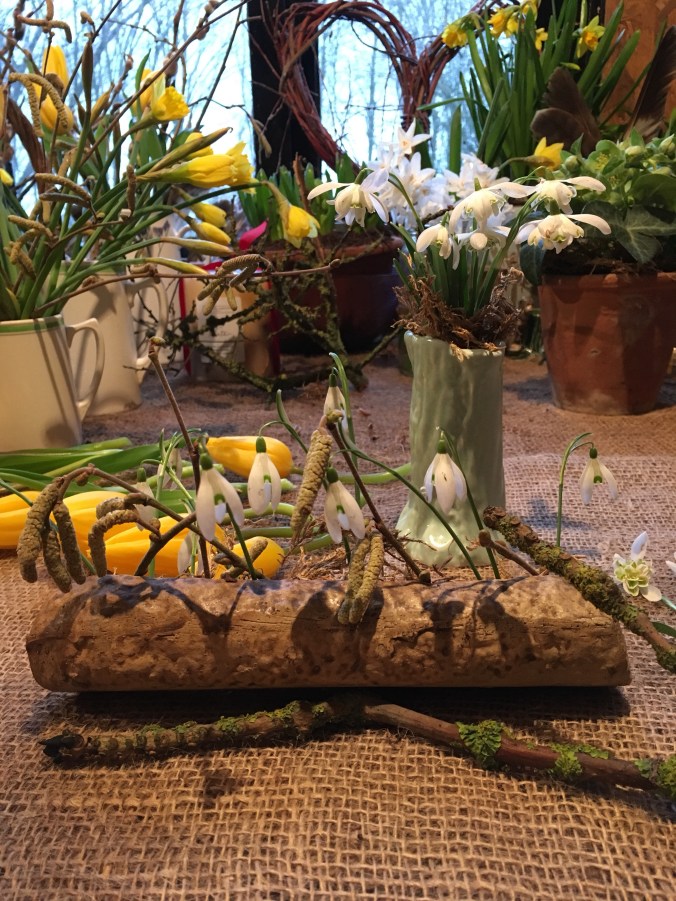
Noticing that I haven’t got many vases, a relative has taken pity on me and donated these little containers. The snowdrop vase has a lovely green glaze. The brown container looks like it is made of wood, but it is actually ceramic. I’ve never seen these type of vases before. I think they date back to the 1920s and were family wedding presents. So happy they have made their way to my potting shed to be treasured for years to come.

I put some moss in the container and added some hazel twigs. It is just perfect for holding a few tiny snowdrops.

The potting shed window has miniature green hellebores this week. The leaf and flower shape looks like Hellebore Corsicus, but I’ve never seen one as petite as this. I love the lime green flowers.

Here’s a quick peek at what it’s been like outdoors here. The farm pond was frozen solid for a week. We spotted a kingfisher on an overhanging branch staring intently at the water. Many of the garden birds came closer to the house during the freeze. A little gold crest has been roosting in the potted acer by the back door all week. I’ve fed it mealworms and crushed sunflower seeds saved from the veg plot.

And the gap in the hedge view. I didn’t linger long. There were hares racing across the field and pheasants in the ditch.

Today, there is no evidence of wintry weather. I feel like I’ve stepped from one country to another – a much warmer one at that. 7c feels positively balmy after what we’ve been though. And the willow catkins give us hope.

Thanks to Cathy for hosting the IAVOM meme. Why not go over and see what Cathy and all the others are growing in their gardens and cutting for their flower arrangements this week.

How has your garden fared in the bad weather? As you can see, I’ve written it on a Monday, but not managed to post it until today. Our internet is on the blink again. BT no doubt will blame the snow. Have a good week all of you.

End of the Month View – March 2nd 2018

Thank goodness there’s some colour in the greenhouse right now. I planted these Iris reticulata last October. And just when I need something cheerful to look at, they’ve sprung open like a jack-in-a-box. As soon as the sun hit the greenhouse glass, they pinged open. A lovely moment. Glad I was there to see it.

Such an inky blue. I planted Iris Pixie and Harmony, and then somehow lost the labels. A common occurrence in my garden. I must address the problem of how to keep labels this year.

I’ve no need to tell you what the temperatures are like at the moment. One look out of the window and you can see for yourself. We are white over in the UK. So today I’ve been mooching in the potting shed and greenhouse.

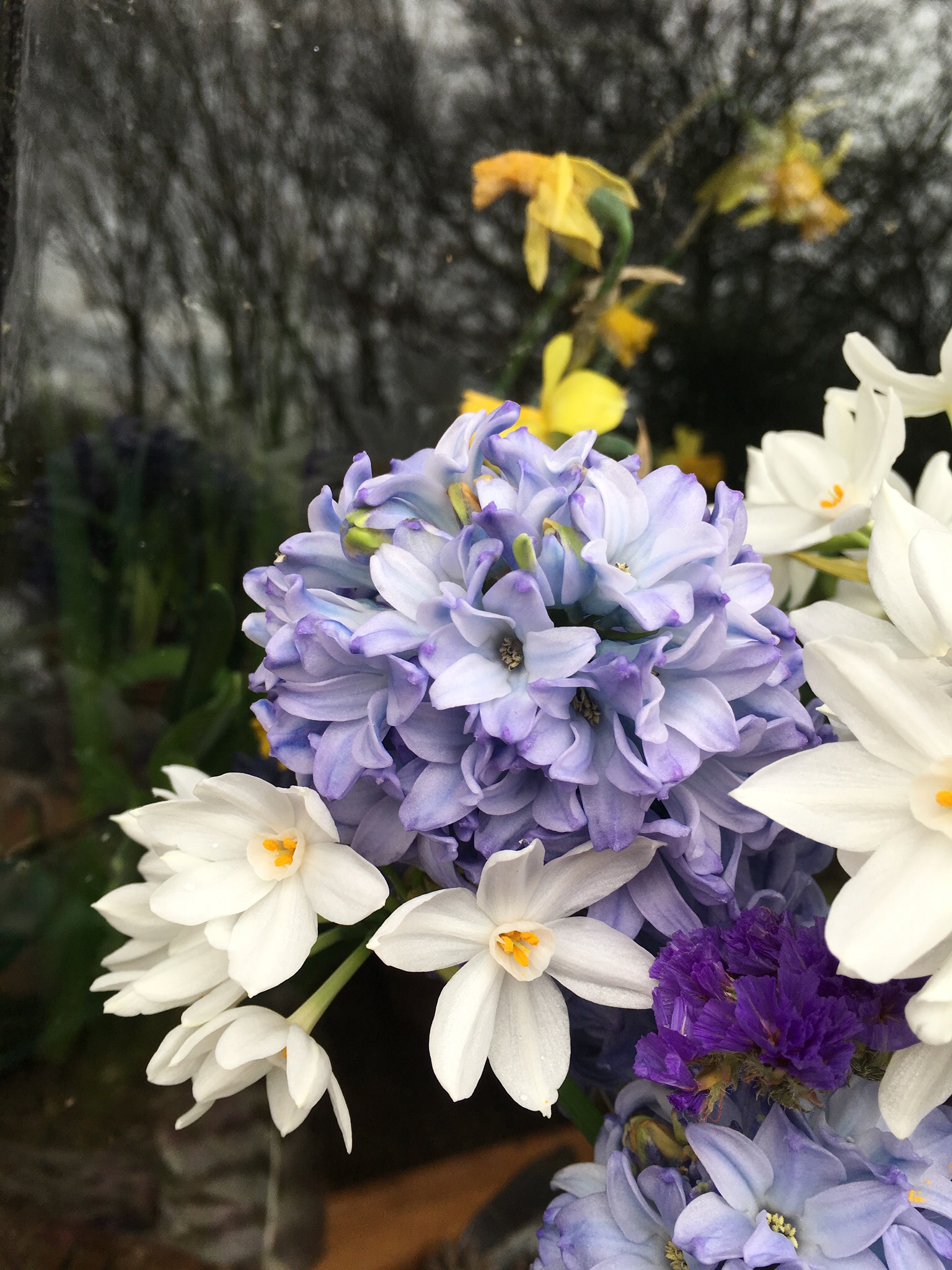
Planted last September, these Carnegie hyacinths are a joy for months. The buds are pretty, with just the green tips showing. I think there’s as much pleasure in anticipating what’s to come, as there is when the buds finally burst into bloom. The scent fills the whole greenhouse and makes it a pleasure to work in there on a freezing cold day. I heat the greenhouse to between 5 and 7 degrees. It is an old Alton Cedar greenhouse -second hand, renovated and painted black. Being cedar, the wood swells in the winter and cuts off any draughts – keeping it warm and cosy in there.

Prepared -or temperature treated bulbs – are planted in September in individual 3″ pots. The bulbs are given a cold period to fool them into thinking they have been through winter. We then put them in a cool, dark cupboard in the potting shed or garage for 20 weeks which finishes the treatment. Then, the bulbs are gradually brought out into a cool greenhouse and grown on. You can delay development by just keeping them cold and on the dry side, which is how I’ve managed to keep them flowering right through winter.

Choose bulbs that have flowers roughly the same size to plant into bowls and create displays for the house.

Today, I’m looking out at a snow, right across the back fields, and there’s icicles dangling from the greenhouse roof.

All along the top shelves are succulents and cacti- which need virtually no water between November and mid-March. These Echeverias have grey -blue leaves and striking orange flowers in summer.

The potatoes are starting to chit. Hard to believe, I will be planting them in a few weeks. I’m growing Charlotte and Lady Christl- both delicious. These varieties are on the RHS recommended list for growing in containers. If you are thinking of growing in containers, you need 8 litres of compost per potato. So put five in a 40 litre bag or 16″ -18″pot. Start off filling the bags with 20 litres of compost and 125g organic potato fertiliser. Sink the potatoes into the compost, and water. As the haulms or stems grow, add more compost to cover them and gradually fill up the pots. The secret to success is not to overwater. Soggy compost deprives the plants of oxygen and leads to stunted growth. Start feeding with potash when the leaves are out of the top of the pots. Other varieties I’ve tried and are RHS recommended include Casablanca, Golden Nugget, Sharpes Express, Maris Bard, Jazzy and Vales Emerald. I don’t grow Sharpes Express as much though, as it tends to disintegrate when it’s cooked and you end up with a pan full of soupy water.

Just behind the potatoes and bedding plant cuttings is a pot of wild rocket. I sowed the seed in autumn and now have lots of little pots like these from which I can pick a few leaves each day. Pick from the outer leaves, leaving the centre of the plants to keep growing.

Here’s a quick peek in the potting shed at dusk. The last of the Paper White narcissi are cheering up the potting bench. Another fabulous scented flower.

And in the potting shed window there’s snowdrops. This one is a very pretty Galanthus Viridapiece which has delicate green-tipped flowers. A favourite of mine.

Thank you to Helen at Patient Gardener for hosting this EOMV meme.

How are you coping with the weather? Get in touch and let me know how your garden is faring in the snow. Keep warm everyone.

#WordlessWednesday #GardenPressEvent

Sending you these photos today from the London Garden Press Event. I reckon we all need some colour and cheer right now . It’s -4 here in the city, and -6 at home. So here’s a gallery of David Austin Roses for you to enjoy.

These are from the cut flower range.

All the latest flowers, seeds, machinery, products- you name it – are showcased at the Garden Press Event . It’s a whirlwind of a day. I’m sitting here surrounded by a huge pile of brochures, catalogues, samples. It will take me a week to work though them, so this is just a little taster for now. Keep warm and safe all of you. Hope we get better weather soon.

In a Vase on Monday – @ashnurs @GdnMediaGuild

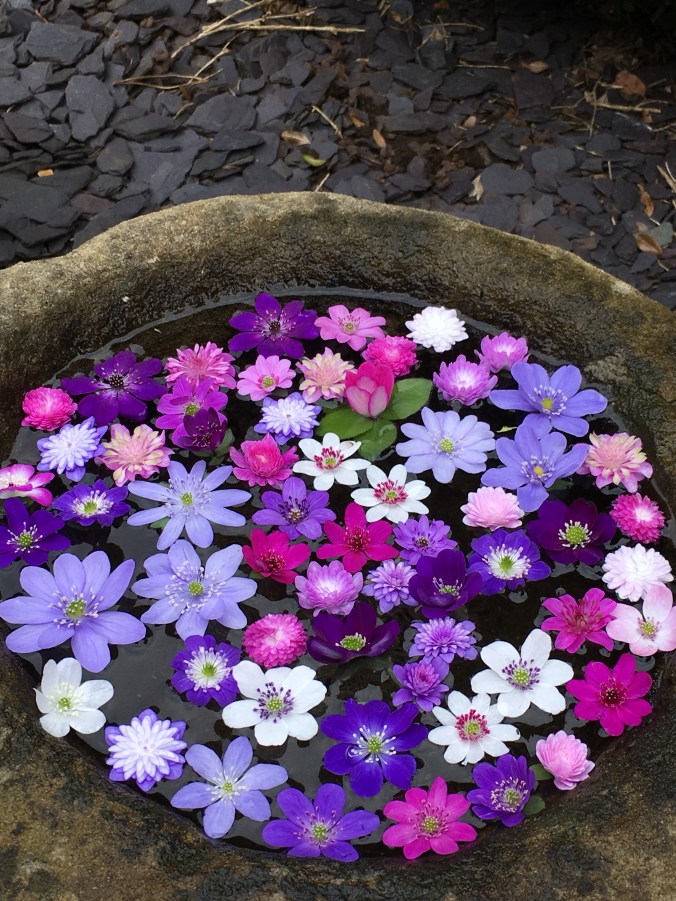
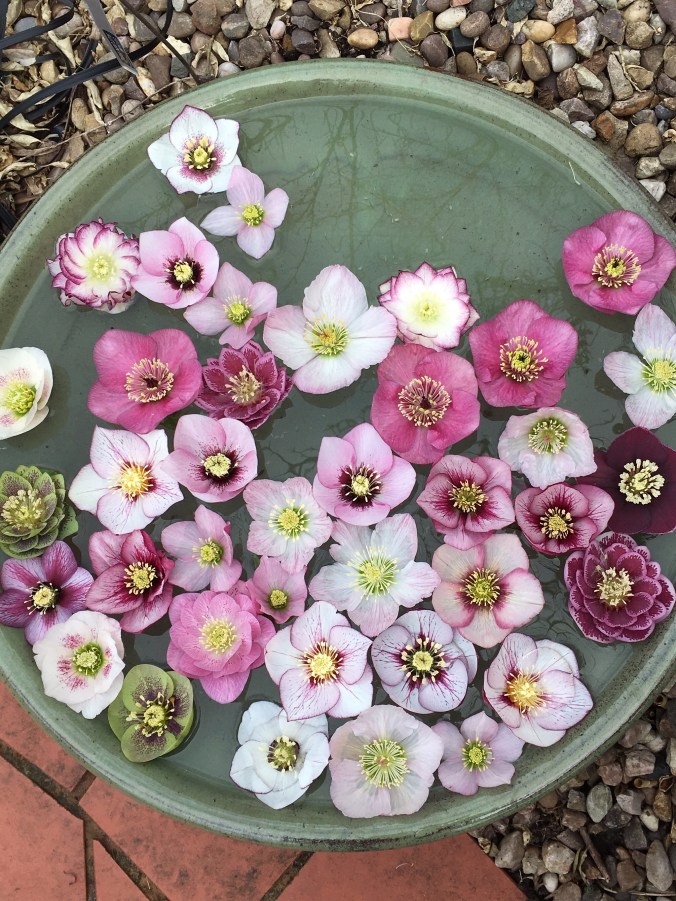
Vases full of spring tulips and daffodils are frozen solid in the potting shed today. They will be fine when they thaw out. Hopefully. Meanwhile, I’ve run round the garden and collected some flower heads to float in water. All the window ledges in the house now shine with colour and cheer. I’m determined not to be downhearted by the big freeze. The Beast from the East- I’m not scared!

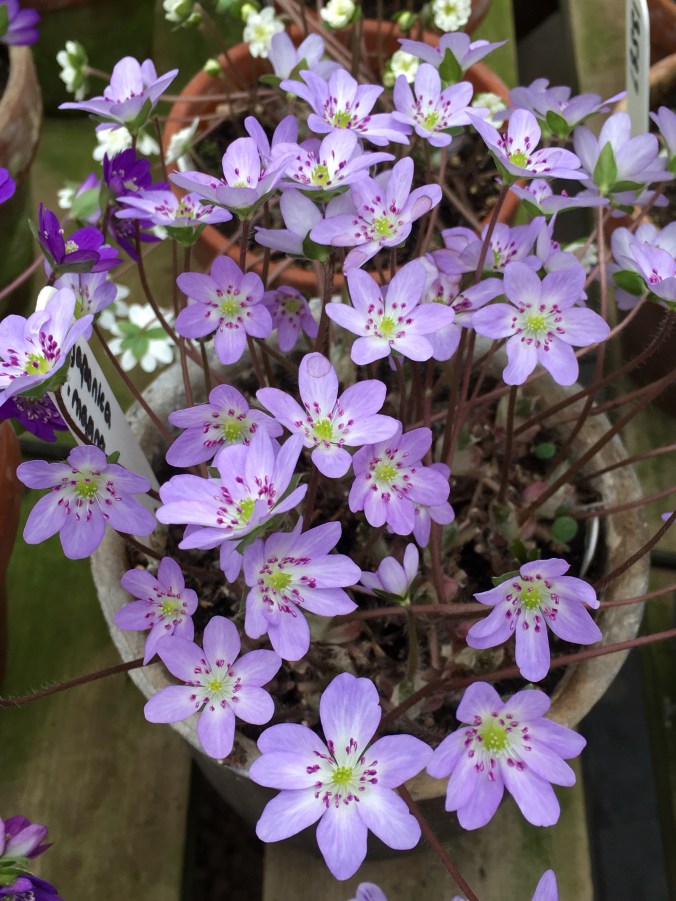
Inspiration for my flowers this week comes from John Massey’s garden at Ashwood Nurseries. I was incredibly lucky to be invited to a tour of John’s private garden. It’s three acres of sheer delight. A plantaholic’s paradise. I couldn’t stop looking at this gorgeous bowl of jewel-like flowers. John, who has a passion for hepaticas, says they last a week outdoors in a shallow stone trough. They have been frozen overnight several times, and still look fresh the next day. You learn something new every day!

I’ve seen hellebores floating in water before, but never hepaticas. And it’s useful to know they last so long. I’ve put a bowl by my front door as a welcome to visitors.

Some more photos from the garden, which is open on selected days for charity. There’s a link for more information on John’s Garden.

I came home and copied theses pink-themed hellebores. Such a simple idea for a spring display and so effective.

On a tour of the nursery, I fell in love with a deep red hellebores.

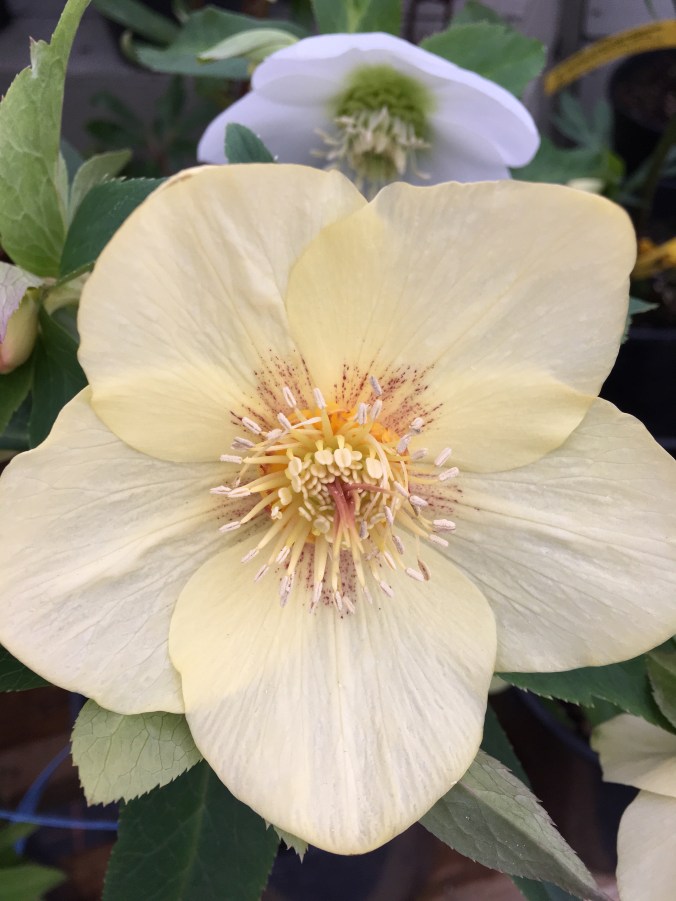
And this cream hellebore. In the sunshine the petals look like satin.

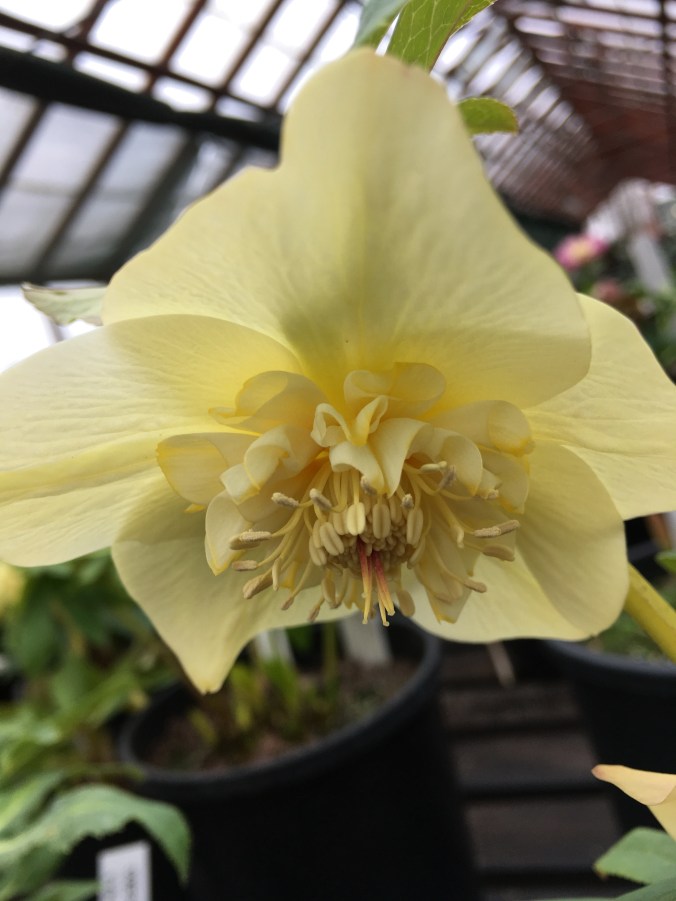
These are the new 2018 Evolution Hybrids; double and anemone centre golden forms. This is the first year they have gone on sale.

We learned how to grow hepaticas. They need really good drainage. Some of the pots had virtually no bottoms. That much drainage!

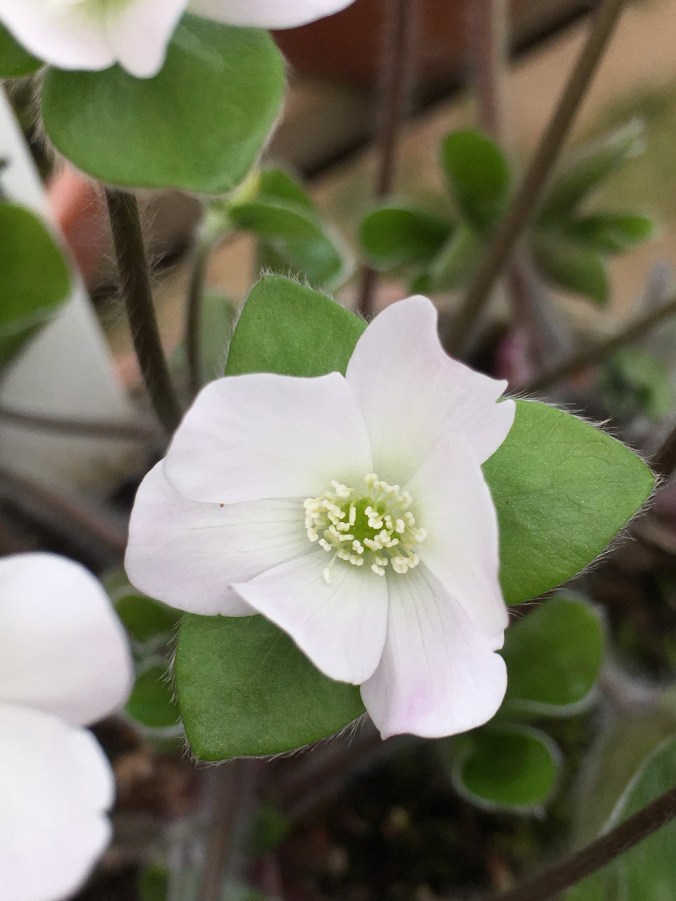
White flowers are always quite difficult to photograph, but I persevered with this one.

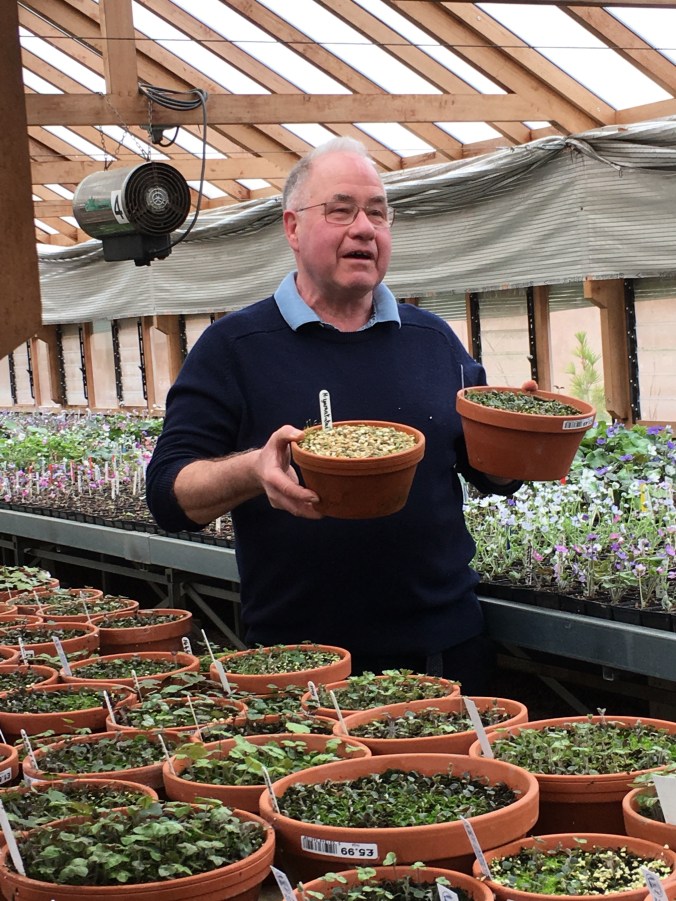
Here’s John explaining how to grow hepaticas from seed.

John’s garden is open on March 17, April 22, June 2, and other selected days through the year. See website for details. All entry fees will go to Wings, Wombourne special needs support group for children and young adults. Last year, the garden openings made almost £25,000 for the Beacon Centre for the Blind.

My behind the scenes tour was organised by the Garden Media Guild. I’m pleased to have been a member for about a year. Membership can be for full, probationary and associate membership. I’ve found the GMG networking and training events very useful and I’ve met a lot of new friends. A recent newsletter states: “The guild welcomes any new garden communicator who wishes to embrace professional standards and work towards earning an income from their work. ” Courses, trips and mentoring schemes all assist probationary members. A lot of people have helped me with my work over the years. I’m always thinking of ways to help others. This might be the incentive you need to go for it and join in. Let me know if you do. Find out more Here . www.gardenmediaguild.co.uk

Opening times and details for the nursery Here

Thank you to Cathy ramblinginthegarden for hosting this meme. Why not go over and see what everyone else is growing, and putting in their vases this week for IAVOM.

And feel free to share this blog on twitter, Facebook and Instagram (crediting me with the pics and words, thank you). This photo of hepaticas appeared on my twitter account this week @kgimson. And on Instagram at karengimson1. Do come over and say hello.

Snowdrops and Botanical Art at Easton Walled Gardens @EWGardens

If you’ve never visited Easton Walled Gardens, you’ve got until 4pm tomorrow to view their stunning snowdrops. The gardens are open today and tomorrow 24/25th February, from 11am. And you are in for a treat. The winter displays have never looked better and feature snowdrops, iris, crocus, hellebores and masses of scented flowering shrubs.

I wrote about the history of Easton in a blog post last winter Here.

Here’s a gallery of photos I took earlier in the week.

If you are lucky, you will see kingfishers flying along the river. Such a special moment when you catch sight of that bright flash of blue feathers.

A favourite view of the stone bridge crossing from the meadow to the walled garden.

Always a poignant moment to stop and look at the ruins, all that remains of the mansion house that once stood on this site. New this year, there’s some marker stones set in the grass to show where the front door would have been.

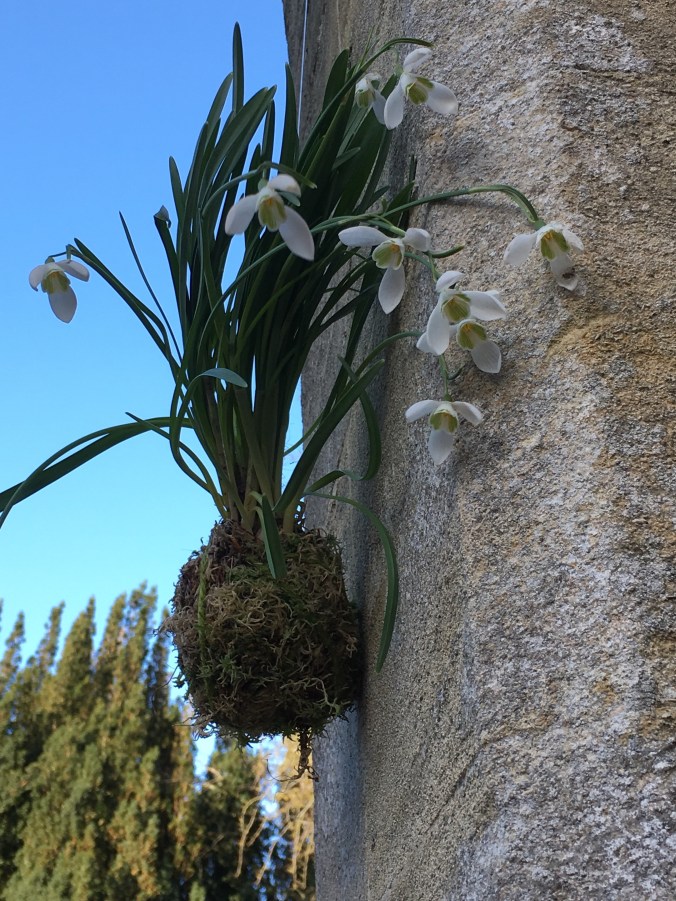
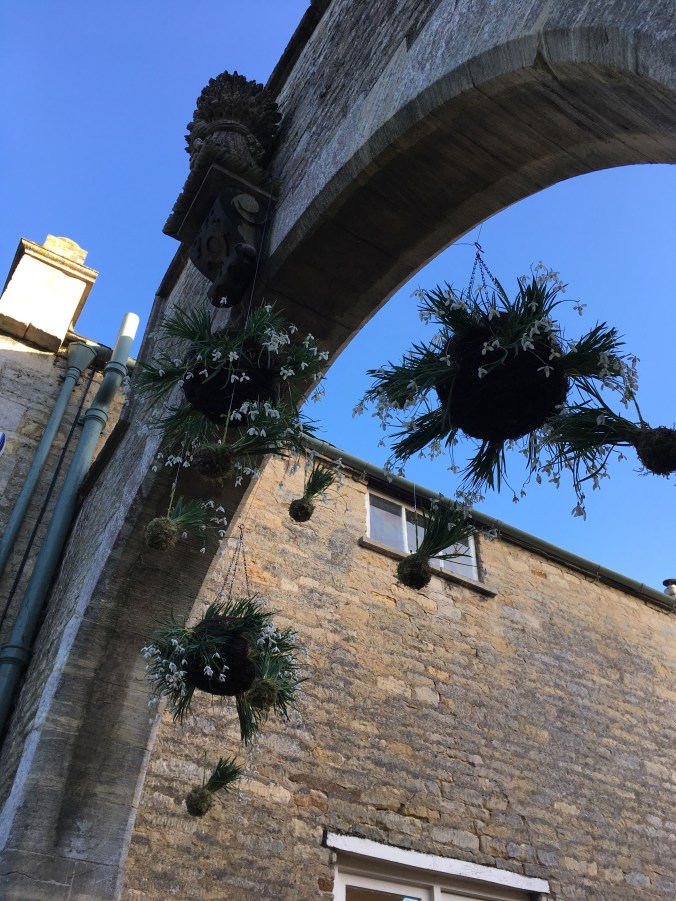
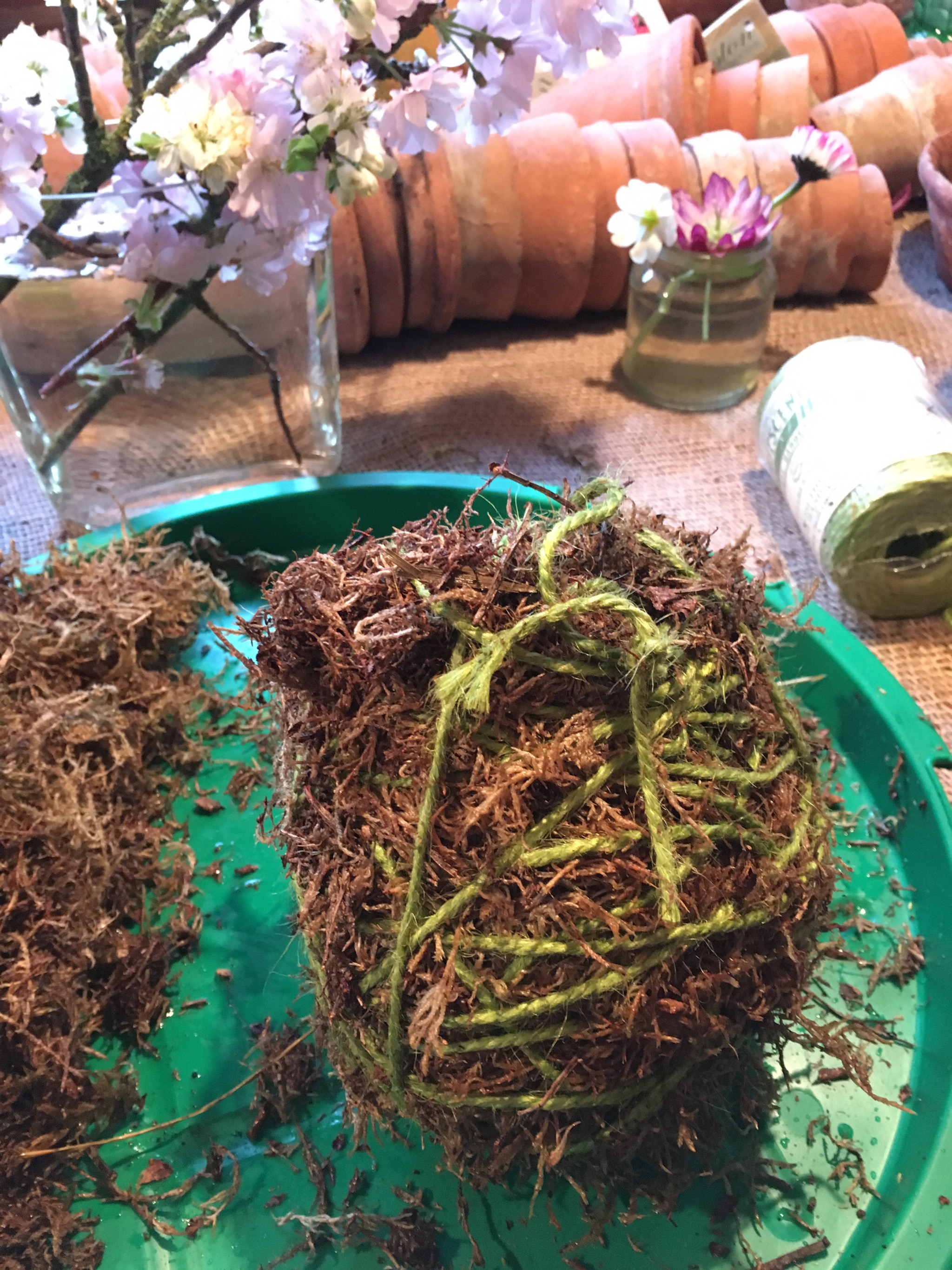
We love the kokedama displays. Such an unusual and pretty way to display snowdrops.

I might try this idea, hanging basket kokedamas look spectacular in the gatehouse stone archway.

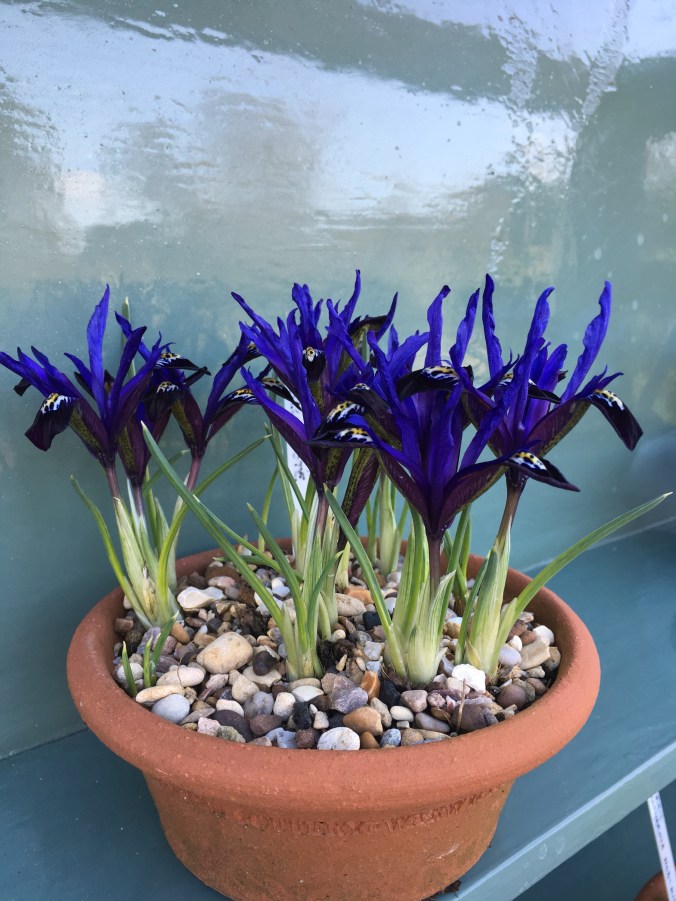
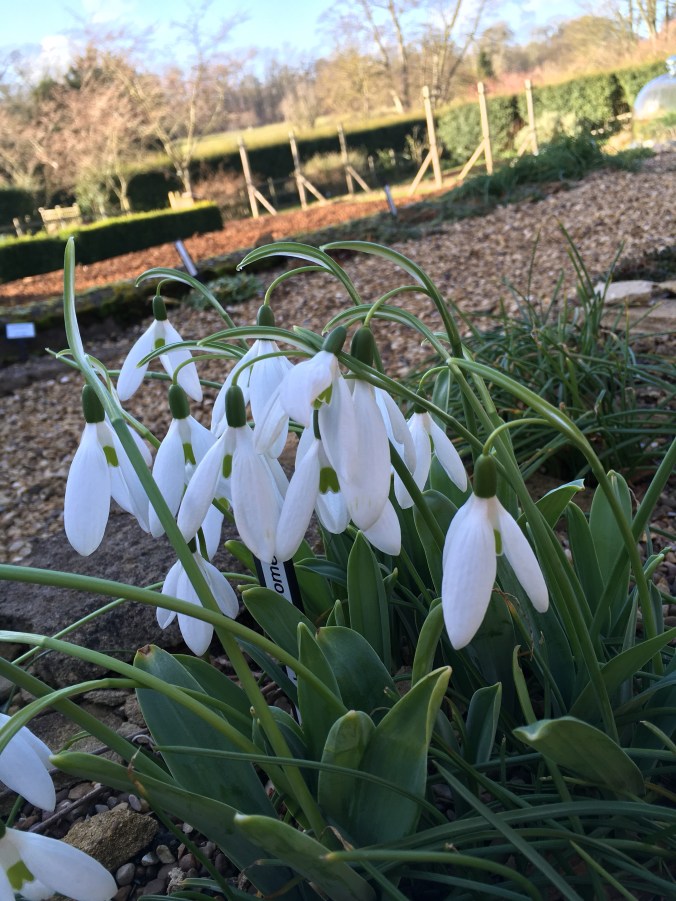
There are displays of little potted bulbs all around the gardens. This one is Iris Blue Note. The huge snowdrops are Comet.

Discovering secrets. How to dry and store seed, so that the mice can’t get at them. Easy when you know how.

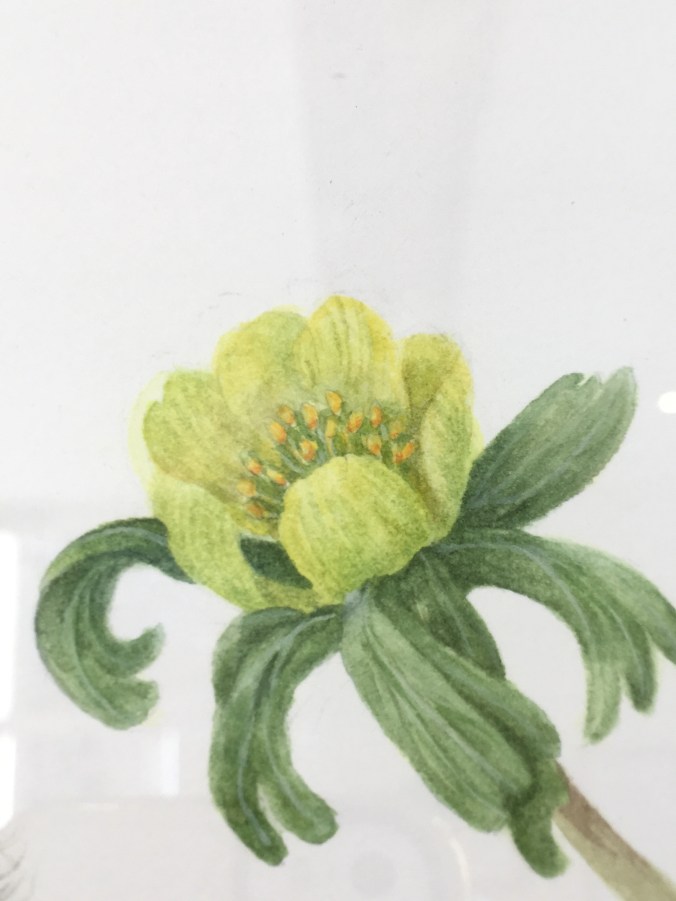
There’s always something new to find at Easton. This year it’s a botanical art exhibition in the courtyard which runs until 11th March -on Easton’s usual opening days.

I loved this aconite. My camera phone doesn’t really do it justice.

The artists taking part are Norma Gregory, Dawn Wright and Sue Vize.

For more information go to www.visiteaston.co.uk .

Easton is just off the A1 near Grantham in Lincolnshire.

Ellicar Gardens -open for NGS 25th February @ellicargardens

There aren’t many invitations that start with the warning “beware of the goose!” But when Sarah Murch sent an e-mail inviting us to visit, she told us to sound our horn when we arrived. She would safely let us in past the goose.

Now, I had a very unfortunate experience with a gander some years ago. I only just managed to outrun him. They are surprisingly scary at full speed, with their necks out stretched and wings flapping. Not an experience I particularly wished to repeat.

But to be honest, we didn’t need to worry. The Ellicar garden goose was more concerned with guarding his “family” of adopted bantam chicks. But we gave him a very wide berth anyway.

The newly-hatched chicks and goose combination were just the start of what turned out to be a most surprising visit. We found a llama, goats, rare breed sheep, cows and two adorable rescue pigs. And they all clearly love their owner. They all come racing across the field as soon as they catch sight of Sarah.

This is Orlando, Sarah’s newest acquisition; a birthday present, she explains. Well, I’ve never met anyone who’s had a llama as a birthday present before, but I’m soon quite envious. I find myself enquiring exactly where one could obtain such a gorgeous creature, how much they eat, how much they cost…… I’m nearly ready to order one on the spot when I hear the coat can be brushed and fluff woven and knitted into jumpers! What a joy. We move swiftly on. Turning our thoughts to the gardens, around the corner, past the paddocks, is a sight of great beauty- a natural swimming pool.

The pool is frozen over when we visit, but Sarah explains the water is warm enough to swim in from March to November. The temperature is 17C in spring, and 20-26C in summer. The pool is naturally filtered and surrounded by grasses and willows that cast their reflections on the water. Sarah painted a lovely picture when she described swimming with kingfishers flying by, just above their heads.

The garden is planted with wildlife in mind and many of the perennials and shrubs provide nectar for bees and butterflies, and seeds for birds. Grasses are a special feature of the garden. At this time of the year, they look stunning, backlit by a sunset, which is when I took these photos.

The grasses include various stipa, silver feather grass Miscanthus Silberfeder, and feather reed grass Calamagrostis Overdam.

Seed heads shine amongst the colourful dogwoods and willows; eupatorium, aster and sedums in particular.

Coral bark willow, Salix Britzensis- pollarded to produce bright red stems- looks fabulous set against a background of white silver birches. They are underplanted with masses of emerging spring bulbs, including crocus, snowdrops, iris and narcissi.

We love this living willow “fedge” a cross between a fence and a hedge, with teasel heads in front. And there’s a children’s garden, with bug hotel, wild flower planting- and even a willow den.

Ellicar Gardens covers five acres and has been created over the past eight years by Sarah and her husband Will. The gardens open this Sunday February 25, 12-4pm for the NGS charity. There are other opening dates on the website. Adults £4.50, children free. Carr Road, Gringley-on-the- Hill, Doncaster, DN10 4SN. For more information : ngs.org.uk. Hodsock Priory is about 20 minutes drive away and the winter garden there is open until March 4th. Their last opening day is also in aid of the NGS.

Hodsock Priory .

Ellicar Gardens

Two happier pigs have never been seen! Just irresistible.

Wordless Wednesday

@kgimson on twitter, karengimson1 on instagram, bramblegarden.com

In a Vase on Monday- a peek inside my potting shed

This week I’ve potted up some prepared hyacinths. I started them off in a cold, dark potting shed in September. The bulbs were put through a cold treatment before I bought them – to trick them into thinking they had gone through winter. Putting them in a dark cupboard for 10 weeks completes the treatment. They grow fabulous roots in the dark and form a strong flower shoot. Some hyacinths were brought on in warmer conditions to flower for Christmas. But spare bulbs have been kept cold and dry to stagger the flowering display.

I grow them individually in 3″ pots. To create a display, I simply choose bulbs that have flower spikes about the same size.

I love the green edge on these Carnegie white hyacinths and the scent cheers up the potting shed. It’s a joy to work in there at the moment.

My grandfather Ted Foulds gave me these terracotta Sankey plant pots. I love using them and always think of him. Happy memories – I had a carefree childhood. For which I’m very grateful. They were simpler times then, when we made our own entertainment. Mud pie gardens, surrounded with stones and topped with flower heads. Making gardens in a biscuit tin lid, with tin foil ponds and tiny twig “trees.” Keeping snails as pets and feeding them lettuce; and great delight when the snails produced eggs, hatching into a family of miniature baby snails with translucent shells.

Here’s some hyacinths that have been flowering in the greenhouse for several weeks. They are such great value. Below, I’ve used foliage from the garden, dogwood stems, salix catkins and hazel lambs tails, with a single pink hyacinth flower and some double snowdrops.

And finally, in my mother-in-law Joan’s posy, there’s white hellebores, and the first daffodils, surrounded with ivy, and twigs and some green foliage which is actually a weed. It’s known as shepherd’s purse, and has tiny hearts all along the stem.

Thank you to Cathy at Ramblinginthegarden for hosting this meme. Why not go over and see what Cathy and all the others are growing and using for their flower arrangements this week. As you can see, you don’t have to use a vase. Any container will do.

I hope you enjoyed a peek inside my potting shed. Get in touch and let me know what you are growing.

Garden Restoration Plans for Holme Pierrepont Hall

There’s nothing more cheerful than turning up at a favourite garden to find everyone happy and smiling. This week I visited Holme Pierrepont Hall to find the owners and gardeners busy with renovation plans. Funds from a Heritage Lottery grant and the Country Houses Foundation means work can start on restoring garden walls which date back to the 16th century.

The funding will also enable research into the site’s history. During my tour of the gardens, I learned the topiary courtyard once housed aviaries for tropical birds, and a monkey house in the centre. I can’t wait to see what else is revealed when historical documents are studied by experts.

Built in 1500, the hall is thought to be the oldest brick building in Nottinghamshire and is still lived in by descendants of the Pierrepont family. Three generations of the family live here now, Robin and Elizabeth, Robert and Charlotte and their children Oliver and Cicely. Elizabeth, whose great grandmother was Lady Mary Pierrepont, moved here in 1969 and undertook some major restoration work in the house and garden. Today, the new conservation work is being led by Robert and Charlotte. And their enthusiasm is catching. It’s easy to get caught up in the optimistic atmosphere at Holme Pierrepont. They love their home, and genuinely enjoy sharing it with visitors. It’s heartening to hear plans to open on more days in the future. Currently the house and garden opens Sunday to Wednesday, February and March, and Sundays in April, 2-5pm. (Closed Easter Sunday). New for this year, there’s additional garden open days in May and June. Dates and times are on the website http://www.holmepierreponthall.com

As well as the courtyard, the hall is famous for its Spring Walk, featuring daphne, hamamelis, rhododendrons and acers, underplanted with hellebores, primula and masses of early bulbs. To help visitors identify the varieties, a guide has been produced and new signs installed in the garden.

Scent is important in the garden and mature hamamelis and daphnes are fabulous at this time of the year. This one is Daphne Jacqueline Postill.

There are several Hamamelis planted alongside the pathways. Hamamelis mollis, Diana and Westerstede, (pictured below) among them. It’s good to have a guidebook and new signs to be able to identify them correctly.

Snowdrops, these pictured below, are Galanthus Sam Arnott, are looking spectacular at the moment in the spring garden, and also in the Woodland Walk.

New signs direct you through the old walled orchard and on to the woodland where there’s also large drifts of wild Tulipa Sylvestris. These have been growing in the grounds since the 17th century. They were apparently first planted in the main garden, and then seemingly “thrown out” in to the woodland – where they’ve thrived.

It’s a peaceful walk, amongst the Jacob sheep, now occupying the walled orchard. There’s a possibility in the future these kitchen gardens might be restored.

The old walls curve around the orchard at the back of the hall. So many layers of history in those beautiful red bricks. I’d love to know what the research reveals about them.

There’s a circular walk around the woods, which were opened up to visitors in 2011. You’ll find evidence the family’s young children enjoy this space. There’s various dens and piles of sticks and vegetation made into bug hotels and wildlife habitats.

It’s inspiring to meet the gardeners and volunteers ( pictured below) and all the other experts working on the restoration project. Their enthusiasm and obvious love for this special place is evident. I was pleased to hear students from Brooksby College will be involved in the scheme, and will be learning conservation brickwork skills. I’m in favour of passing traditional skills on to young people. And opportunities like this are all too scarce today.

Until 29th April, visitors can view an art exhibition at the hall, made possible by the new funding. There are paintings by the last Countess Manvers, Marie-Louise Pierrepont, and also a relative, Georgina Brackenbury. Georgina, a militant suffragette, is renowned for her painting of Emmeline Pankhurst which hangs in the National Portrait Gallery, London. You can learn more about the exhibition at http://www.holmepierreponthall.com/georgina-brackenbury/.

Many thanks to Robert and Charlotte for inviting me to visit the hall and for taking the time to explain the plans. It’s an exciting time ahead and I wish them all the very best with their conservation project, preserving the garden for future generations- and visitors as well.

Contact details: http://www.holmepierreponthall.com e.mail: rplb@holmpierreponthall.com Tell: 0115 9332371

BBC Radio Leicester Gardeners’ phone-in recipes

CITRUS MARMALADE AND ORANGE FLAPJACK

February is a cold, dark, short month. But everywhere there’s signs of spring. Wild violets and the first primroses pop up by the front gate. And snowdrops cheer up the hedgerow, pushing up through hats of curled, brown leaf mould.

It’s traditionally a month of self-denial and fasting. Many people give up something for Lent – chocolate, wine, or favourite foods. Shrove Tuesday or Pancake Day is a way of using up egg supplies before the fasting period begins. I make orange curd to use up eggs and butter.

But I also like to make marmalade now. An antidote to winter. I line up pots of marmalade along my kitchen window. A kind of ribbon of orange light. My own stained glass window. Here’s my favourite recipe, which I make with Seville oranges – and some citrus fruits from my heated greenhouse. Tucked up indoors and standing over a steaming pan of oranges makes for a heart-sing moment. And we need plenty of those in February. My grandmother’s old saying is usually true. As the days lengthen, the cold strengthens. I highly recommend staying indoors, keeping warm and making marmalade.

ORANGE MARMALADE

2lb or 900g fruit ( I used Seville oranges, and some kumquats and calamondin fruit from the greenhouse.)

1 lemon

4lb or 1.8kg granulated sugar, warmed

4 pints water

6 x 1lb jam jars

Square of muslin

Cut the lemon and oranges in half and squeeze out the juice. Put any pips or pith that cling to the squeezer into a square of muslin placed over a pudding bowl. Now cut the peel into quarters. Scrape off the pith and add to the muslin. Cut the quarters into thin shreds. Add the juice and peel to the water in a heavy-based preserving pan. Tie up the muslin square and tie loosely to the pan handle with the bag suspended in the water. The pith contains pectin which will help the marmalade set. Simmer gently uncovered for 2 hours until the peel is completely soft. Remove the muslin bag and set aside to cool. Put a plate in the freezer. Pour in the sugar and heat gently until the sugar crystals have melted. Squeeze the muslin bag to extract the jelly-like pectin. I used plastic gloves, or you can press it between two saucers. Increase heat. As soon as the mixture reaches a fast boil, start timing. After 15 minutes, spoon a little of the marmalade onto the cold plate and pop in the fridge. If it has a “set” the marmalade will crinkle when you push it with your finger. If not, continue to boil for another 10 minutes. Remove pan from heat and stand for 20 minutes. Add a tsp butter to disperse scum. Pop the jam jars in the oven to warm for five minutes. Pour the marmalade into jars with the aid of a funnel, cover with wax disks and seal while still hot. Label pots- and enjoy!

A visit to my mother-in-law’s house would always find us searching the pantry for the cake tin. Over the past 50 years, you could pretty much guarantee to find some flapjack in there. Joan recently gave me all her treasured recipe books. Here’s my own version, adapted from Joan’s family favourite. It travels well and is ideal for picnics.

ORANGE AND WALNUT FLAPJACK

250g or 9oz unsalted butter, chopped into pieces

250g or 9oz golden caster sugar

175g or 6oz golden syrup

425g or 15oz porridge oats

50g or 2oz walnut halves,slightly crushed.

Grated zest of 1 orange.

3 tbsp orange marmalade

160C gas / mark 4 for 30 minutes

28cm x 18cm shallow baking tin

Melt together in a microwave the butter, sugar, and golden syrup. Stir into the oats, walnuts, and orange zest. Tip the mixture into a lined tin and level it off. Bake for 30 minutes or until the edges are golden brown and the centre is still slightly soft. It will firm up as it cools. Mark into 12 pieces while it’s still warm. Leave to cool and then brush the top with melted orange marmalade. Keeps for a week in an airtight tin.

Each week on BBC Radio Leicester there’s a Gardeners’ Phone-in programme between 11am and 12 noon. I like to take in a posy from my garden, showing what’s in flower all year round. And I also take in something I’ve made using produce from my plot. This week it was a jar of marmalade and some flapjack. Tune in on the i player to listen to the programme which starts at 2.11.31 on the timeline at http://www.bbc.co.uk/programmes/p05t8n69. Meanwhile, I’ll leave you with a photo of my greenhouse from last summer. A reminder of lovely warm weather to come.

End of Month View – January 2018

Reasons to be cheerful. The first spring lamb has been born in crossroads field at the bottom of our lane. It’s been a daily ritual, walking downhill to check on the flock. Each time, we are hopeful. And then today, we stand at the gate and scan the field. And there, by the hedge, one tiny white lamb. Newborn and softly steaming in early morning sunshine. A joy. A reassurance. After all the family illness of the past few months, worry and fretting, one tiny lamb sends a subliminal message- all will be well. The season moves on and the familiar sights and sounds of our daily life returns to normal. We have weathered the storm and spring is coming.

There’s been some catching up to do in the potting shed. Seed packets are inspected, catalogues perused, and a list produced. It’s a start. Little pots of snowdrops are dotted along the windowsill. I marvel at the variety of markings. Those little green hearts. I could quite easily become a galanthophile.

Hyacinths, set in a dark cupboard in September and brought out in December, are in full flower now. And what a scent! Carnegie, my favourite white variety, brightens the gloom.

On one glorious sunny day, with temperatures reaching 12 degrees, a red-tailed bumblebee sleepily blunders in through the shed door and buries itself in a potted hellebore. I gently shoo her out for fear she’ll be caught in a spiders web indoors. And at any rate, there’s plenty of pollen outside with sarcococca, viburnum and winter flowering honeysuckle in full flower.

Sarcococca humilis attracts bees – and hoverflies. These, I’m told are Eristalis hoverflies, mimicking a bee. They had me fooled.

On sunny days, the snowdrops have a wonderful honey scent. I must admit, I didn’t know this fact until a few years ago when I visited Easton Walled Gardens. We stood at the top of a sunny bank, and the fragrance drifted up. It was breathtakingly beautiful. Sadly, a dull wet day doesn’t produce the same scent. And many snowdrop garden visits since have been on cloudy days. So I’ll just have to hold on to that memory.

This is my “Hodsock” corner at home. Each year we visit Hodsock Priory and buy one little pot of snowdrops for a couple of pounds. It’s amazing how quickly they bulk up. It’s a nice reminder of a lovely day out.

The potting shed makes an ideal reading retreat. It’s so peaceful in there. High in the tops of the overhanging beech trees, songbirds are singing, staking their claim to spring territories. A cheeky robin is taking an interest in the shelving at the back of the shed. There will probably be a nest.

Thanks to Steve at Glebe House blog for hosting this meme and for encouraging me to write. Go over and have a look what his garden looks like at the end of the month and visit some of the others joining in, from all around the world. What signs of spring are you seeing in your gardens at the moment?

In a Vase on Monday- Sweet scented flowers and shrubs.

For the past few weeks my bedside table has contained little jam jars of water, into which small posies of “twigs” have been placed. Never have I been so grateful for a garden full of winter-flowering shrubs. For the twigs are smothered with tiny flowers- bursting with scent. Top of my list of favourites is Sarcococca Purple Stem, also known as sweet box. This one, in a pot by my front door, has shiny evergreen leaves and pink and white spidery flowers. A joy at any time between December and March, but particularly welcome when you are stuck in bed with the flu.

Here’s a quick peek in my potting shed. I’m sad to report that I’ve only managed to visit the potting shed twice since Christmas. Something I intend to remedy now that I’m up and about and almost, but not quite, back to normal.

The sugar pink flowers are Viburnum Dawn. In the centre there’s Hamamelis Jelena, and on the right, winter flowering honeysuckle, Lonicera purpusii. There’s also some daphne and to add more cheer, pussy willow catkins and hazel or corylus “lambs tails.” The Hamamelis was a bargain basement purchase for just a few pounds, but didn’t have any labels. Cathy – who hosts the IAVOM meme – writes about Hamamelis this week and I learned that Jelena is named after Mrs Jelena De Belder, and Diane is named after her daughter. You can read all about Cathy’s Hamamelis collection Here .

Covered with snow, it looks spectacular. The delicate scent is noticeable on a sunny day, or when twigs are brought into a warm room. I think the yellow- flowering Hamamelis have perhaps a stronger scent though.

Just getting into its stride is Daphne odora Aureomarginata. When fully open this will scent the whole garden and perfume will drift through open windows and in through the front door.

In my vase this week I’ve added some hellebore Jacob which has been in flower since mid- December. And also some hyacinths. These were prepared bulbs planted and put in a cold, dark cupboard in the potting shed for 10 weeks and then grown on in a polytunnel for another 22 days. Gradually I brought them into a warmer room as they came into flower. Slow, cool growing conditions ensures the flower bud forms properly, and prolongs the display.

I love the velvet blue colour and white edge. I’ll plant the bulbs out in the garden when I’ve harvested the flowers.

Here’s a pot I forgot about. I’ve only just taken it out of the dark cupboard and you can see the bulbs are really well rooted. The roots are climbing out of the sides. And the flower spikes are well formed. These are going to be pure white. Something to look forward to over the coming weeks, a good two or three months before the ones in the garden start to flower.

Hiding amongst the flowers are some stems of Pelargonium Tomentosum from the heated greenhouse. The hairy leaves have a lovely fresh minty scent when they are crushed.

On my potting shed window are little terracotta pots of honey-scented snowdrops, flowering a few weeks earlier than the ones in the ground. The Sankey pots came from my Grandad Ted Foulds. I love to use them and think that he held them in his hands. It’s a reminder of happy times. He loved visiting my garden each week and giving me hints and tips on what to grow and how. I still miss him. But I have his garden tools and his plant pots. And my whole garden is planted with little seedlings and divisions from his garden. So I feel as if he is still here with me really, keeping an eye on me and my family. I like to think so anyway.

Thank you to Cathy for hosting IAVOM meme. Go over and have a look at what Cathy is putting in her vase this week, and then have a look what others are growing and cutting from their gardens – all around the world. It’s a fascinating story and one I love being a part of.

Wordless Wednesday

Hellebores – to bring joy to anyone who needs some today.

End of Month View December 2017

Tucked up in bed with the flu, I have my i-pad balanced on a heap of rugs. I am shivering like a new born lamb. My garden in December isn’t making me feel any warmer. Snow features in most of the photos. I won’t attempt to add too many words. I doubt they would make much sense at the moment. I just want to send a cheery wave to you and wish you a wonderful, Happy New Year. Wishing all your dreams for a peaceful, happy and prosperous new year come true. Much love- karen xx

Luckily, just when I need some cheer, there’s viola odorata flowering at the garden gate. A much loved cutting from my Grandfather Ted Foulds. They are all over my garden now. A happy reminder of such a lovely man.

By the front door there’s more flowers. Iris unguicularis. A reliable winter-flowering joy.

There’s plenty of Paperwhite Narcissi. I planted them in tall glass vases for Christmas. I wrote about them Here .

And then there was snow. And -7C temperatures. Our windswept top of the hill garden took a battering. Here’s the frozen pond.

View through the pergola to the shady shelter.

And the view from the end of the garden.

Looking towards the village

Trees on the ridge. A favourite view.

And after all that snow, here’s what I’m hoping for in 2018- lots of colour; roses and peonies, tulips and daffodils and cut flowers galore!

The scent! Roses from my plot and a wreath for the summerhouse.

Thanks to Steve at glebehouse garden for hosting this meme. Go over and see what others are posting for their end of month view.

Enjoy your New Year’s celebrations! Much love- karen xx

In a Vase on Monday – Happy Christmas everyone!

Wishing you all a wonderfully happy Christmas and a peaceful and prosperous New Year.

Anyone visiting Bramble Garden this week would have found me covered in flour. Mince pies emerged from the oven at regular intervals. Hot pies disappeared before they had time to cool. In between all that cooking, I dashed around the garden gathering armfuls of foliage; sprigs of rosemary, Scott’s pine, some wild Clematis and willow; and wove them into wreaths.

I added some dried hydrangea flowers. I love the faded antique pink and cream hues. And some willow stems with the grey catkins just starting to emerge. A welcome sign that spring is just around the corner.

I twisted some Clematis Montana stems into a circle and decorated our five bar gate. Some festive cheer for anyone walking along our country lane on Christmas and Boxing Day. I hope you all have a wonderful Christmas holiday. Thank you as always to Cathy at Ramblinginthegarden for the IAVOM meme. I always love to see what you are all growing and using for flower arrangements, all around the world. So many inspiring ideas. Meanwhile, I’m off to make some more mince pies. It is Christmas, after all!

Fact Sheet- BBC Down to Earth gardening programme -recipes and home-made presents

From the latest BBC Radio Leicester Christmas Party programme. Each week I take in something I’ve made, using produce from my garden. It’s usually cake, or a vegetable pie, jam or preserves. This week it is festive Beetroot and Spice Cake. I sowed a 1.3m by 3m plot with mixed beetroot seeds in August and September. The mild autumn means I’ve now got a bumper crop, and I’m trying all different kinds of recipes to use them.

Here’s a link to the programme. You can listen again on your computer or i-pad, or live each Sunday 12-1pm on Freeview 721. http://bbc.co.uk/programmes/p05nbmln The programme starts at 06.06 on the timeline,

This is a lovely moist cake with a spicy lemon tang. The recipe came via a shout out on twitter where I am known as @kgimson. I must credit The Propagator @cavershamjj for this wonderful recipe.

Beetroot cake

3 small beetroot 250g

250g Butter

1 lemon -grated rind and juice

1 cup caster sugar -220g

4 free range eggs

1 cup – 150g dried currants or mixed dried fruit

1 cup- 150g plain flour

1 cup- 150g SR. Flour

Pinch mixed spice

Caster sugar for dusting

20cm deep cake tin, lined with greaseproof paper

Method :

Peel and coarsely grate the beetroot.

Use a hand whisk or food processor to mix sugar, butter and lemon rind.

Add the eggs a little at a time. Mixture might curdle, but it will come back again.

Fold in flour, mixed spice and currants.

Add the beetroot and lemon juice.

Cook for one and half hours in a moderate oven, 160 to 180 degrees. Cover with baking parchment after 15 minutes, to prevent burning.

When cooked and cool, sprinkle with icing sugar. Can be frozen for 3 months. Lasts one week in a sealed container.

Cherry marzipan chocolates

As it’s Christmas, I took in these home-made chocolates. So easy to make. I preserved my home-grown cherries in alcohol in the summer. Here’s the recipe

Cherries preserved in alcohol and drained- or glacé cherries soaked overnight in cherry brandy.

Block of marzipan

Bar of Bourneville dark chocolate or similar 70 percent cocoa butter chocolate.

Method:

Slightly warm the marzipan in the microwave so that it is mouldable. Drain the cherries and dry on paper towel. Make a small circle of marzipan in your hand and enclose the cherry. Roll the marzipan cherries in melted chocolate and place in the fridge to cool. These make delicious home-made presents.

Family favourite – Aunty Doris – Crispy Cakes

Something we make every Christmas. Much loved by all the family- as was our Aunty Doris. Hopefully, writing this here preserves this recipe for my children, should they ever come looking in the future. It’s good to have traditions that pass from one generation to another.

The recipe is very simple. It is equal amounts of butter, marshmallows and dairy toffee, all melted together in a heavy-based jam pan. When melted, add Kellogg’s Rice Crispies until all the melted mixture is coated. Pour out into a shallow metal tray and leave to cool slightly. Cut into squares before it cools completely.

I also like to use materials from my garden for home-made presents. The team got some of these fir cone bird feeders.

Simply melt a block of lard in a heavy based jam pan. Add bird seed, grated cheese, breadcrumbs, apple peelings, dried fruit and crushed peanuts. You can spoon the mixture onto the fir cones. It makes a marvellously messy project for young children. If time is short, you can simply add the fir cones to the pan and stir around. The mixture gets caught up in the open fir cone scales. Tie with a piece of festive ribbon, or some string and wrap in foil to dry. I’ve hung mine on the tips of my beech tree. Squirrels so far can’t get to them because the tips of the branches are too springy for them. I’ve also dangled them along my office window where a little robin comes each day for treats.

Each week I take in flowers I’ve grown in my garden. For Christmas I’ve harvested some Annabelle hydrangea seed heads and sprayed them silver. I wrote about these arrangements Here.

It certainly brightened up the radio station for the afternoon. And costs nothing, apart from a quick blast of florists spray.

Wishing you all a wonderful, happy Christmas. Down to Earth will be back on air in the New Year with lots of exciting ideas for what to grow in your garden, and the whole team giving help and advice to get the most from your plot. Thanks for listening in during 2017. I’ve enjoyed being the new girl on the team.

(I am not representing the BBC. Views are my own, and not necessarily those of the BBC.)

In A Vase On Monday -Christmas flowers and foliage from the garden

One of the joys of winter is mooching around the garden and still finding flowers and foliage to bring indoors. This week’s mooching produced hydrangea Annabelle flower heads. They have dried to a beautiful pale parchment colour.

In late summer, Hydrangea Annabelle has creamy white flower heads, often the size of footballs. I leave them to create architectural shapes in winter. They look fabulous with a topping of frost or snow. At Christmas I cut a few for the house. A quick spray of silver gives them a festive flourish. I use Oasis floral spray for my arrangements. It dries in seconds and gives a good finish. You don’t need to use very much to give foliage and flowers a silver sheen. I love the way it highlights the veins on the back of the petals.

In keeping with the silver theme, I’ve added some willow twigs. They are just starting to produce soft, furry grey catkins. A welcome sight and a reminder that spring won’t be far away. Some fluffy seed heads add texture. These are Clematis tangutica orientalis Engelina, also know as My Angel. It scrambles up through the hawthorn hedge and produces the most beautiful, delicate flowers in autumn. I wrote about it Here.

Adding a touch of colour is my Mum’s Chinese lanterns, Physalis alkegengi. This grows by Mum’s front door and is always such a cheerful welcome to any visitors. It’s rather a rampant plant and to be honest it looks like it’s trying to get in through the front door. Every autumn we pick a few of the seed heads to dry, leaving most of them to provide a glowing approach all along the front drive.

I’ve added some Scott’s pine, Pinus sylvestris, complete with beautiful resin-scented cones. A little pile of cones stands beside our fireplace ready to be thrown into the fire. Along with some precious apple tree logs, saved for Christmas. The scent drifts through the house to the kitchen where I’m making spiced ginger biscuits.

Thank you to Cathy at ramblinginthegarden for hosting this, my favourite meme. Go over and have a look what Cathy and all the other gardeners are doing for their IAVOM this week. You can also follow me on twitter @kgimson and Instagram karengimson1 and on iPlayer at BBC radio Down to Earth.

Have a wonderful Christmas. Thank you all of you for reading and sending such lovely, encouraging comments each week. It is always appreciated. Love from Karen x

Last minute Christmas Present Ideas for Gardeners

I am always so pleased to be asked for my opinions on anything garden-related. After working in horticulture for 25 years, it is very nice to be asked by magazines, newspapers and the BBC. This week I was on the radio again, giving recommendations for Christmas present ideas. Have a listen in to BBC Radio Down to Earth programme to hear my suggestions. Here’s a link http://www.bbc.co.uk/programmes/p05n7fh1 The programme starts at 9 minutes 10 on the timeline.

I’m practically living in these RHS Gold Leaf Gloves. They are so comfortable to use, and beautiful too. Here’s the link for more information at RHS shops. I absolutely love them. They are so practical – and pretty. British made, quality material, they have a padded palm, and little tabs to get them on and off easily. Well designed and well priced.

There are three designs, iris, rose and poppy, based on artwork from the RHS Lindley Library.

Mike Salotti – Brooksby College lecturer and DTE team member recommends Adopt a Vine Scheme as a great present idea for wine lovers. Here’s the details for the Hanwell Scheme. Hanwell Estate

My second suggestion is handmade soap from Cooks Lane Herbs, a Leicestershire company run by Sian and Richard. All natural ingredients, not tested on animals, and the packaging is recyclable. The scent is fabulous. They can be purchased mail order, or locally from farmers markets. Here’s the website link for Cooks Lane Herbs .

My third suggestion is an Urbalive worm composter from Wiggly wigglers .

Can be used in the greenhouse, garden shed, potting shed or kitchen even. The resulting liquid feed will be diluted down and used all around the garden next spring and summer. A great way to compost kitchen waste, and make free compost.

I wrote about my trial composter Here.

My fourth suggestion is Making Winter by Emma Mitchell, a creative guide for surviving the winter months, published by Michael O’Mara books. A delight from cover to cover. The photography is a mood-lifter to start with. I could just sit looking at the beautiful pictures to be honest. There’s crafts, cooking and activities to while away the winter months and survive cold, grey rainy days.

Recipes include Plum, Orange and Ginger Blondies. Delicious!

There’s knitting and crochet scarves to create.

A feast for the senses. Click on the Link to read read more about the book.

There are more great ideas on the rest of the hour-long programme. There’s suggestions for garden lighting, seeds, weather stations and bird feeders. Have a listen and let me know what you think of our ideas.

Wordless Wednesday- December Roses

Peach beauty- captured in ice. My garden is gently thawing today. #wordlesswednesday #uksnow #snow

What has survived the freeze in your garden?

What’s New in My Greenhouse- A Review of Urbalive Worm Farm

I have a natural inclination to feed people. Visitors to Bramble Garden will more than likely find me in the kitchen cooking something -usually with produce just harvested from the plot. There will be cake and home made biscuits aplenty- accompanied by steaming pots of tea. My urge to feed everyone in sight extends to pets- my own – and any waifs and strays I encounter. Wild and tame are all nurtured here. For the past month I have also been feeding my own little “farm.” The creatures contained in the farm are worms.

It has become a strangely compelling task. I’m chopping apple cores and peelings at the moment for them. I’m making fruit pies for the freezer using our glut of Bramley apples. And while the pies are cooking, I’ll run up the garden path to feed the peelings to the worms. They are a thriving little colony of creatures turning all my kitchen waste into free compost for the garden. And it’s a project I’m really enjoying.

The Urbalive worm farm comes in kit form. It’s very simple to put together. The wooden legs are first screwed into the base, and there’s a tap to attach as well. The composter will provide valuable liquid plant food when it’s established. I’ll dilute it down 1:10 with water to feed house plants and for growing on seedlings and plants I’ve propagated.

The worm composter comes with everything needed, an easy to read set-up guide and starter worm food.

There’s even a bag of Worm Treat, a special mix of all the things that worms love to eat, in pellet form.

To get things going, soak the coir block in a bowl of warm water for a couple of hours.

The coir expands to form a starter home for the worms. This bedding goes into the first of two stacking trays.

Then you can add the pack of live worms which comes with the kit.

Add your kitchen scraps, peelings, left over food. Teabags are brilliant, as apparently the worms lay their eggs in them. Crushed egg shells help with digestion. A little bit of cardboard is a special treat. After a week, I’m virtually writing menus for the worms. I care about them. Are they getting a balanced diet? Are they warm enough? Do they have enough moisture? They have virtually become pets! When I lift the lid one morning and find baby worms, well, I can’t stop smiling, to be honest. Such a little thing makes me happy.

For winter, the wormery will be quite happy in the greenhouse. But I’m going to move it to the potting shed in the summer when things warm up. It’s such a pretty design, I could probably put it in the kitchen to be honest.

My Urbalive worm farm composter came from Wiggly Wigglers and was supplied as a free trial, in return for an honest review. The composters come in lime green or stone grey colours. There wasn’t anything I didn’t like about the kit. It was easy to put together and works well. It does what it says on the box- turning kitchen waste into free compost for the garden. The mail order process was quick. My farm arrived within two days of ordering.

There is only one word of warning. It becomes a totally engaging occupation. But on the plus side- it will definitely make you smile.

My Garden Right Now and End of the Month View – Dec 3rd 2017

I’m joining in with Michelle with #my-garden-right-now and Steve Glebe House #End-of-month-view. Enjoy a slideshow of photos from my garden today. There’s still plenty of colour thanks to the alstroemerias and chrysanthemums in the open-ended ploy tunnel. Keeping the rain off the flowers helps to make them last until Christmas.

I talked about mouldable fairy lights Here. You can listen in to BBC Radio Leicester Down to Earth programme here http://www.bbc.co.uk/programmes/p05mf51m where we talk about my cut flowers, grown all the year round for friends and family.

The alstroemerias from Viv Marsh postal Plants grow in 40cm pots and flower nearly 12 months of the year. Choose the long stem varieties if you are growing for cut flowers.

White Stallion chrysanthemums came from Chrysanthemums Direct Nursery as cuttings at the RHS Malvern show last autumn. The yellow chrysanthemums are cuttings from my father in law and have been grown in the family since the 1950s. Originally they came from an Aunty Doris. It’s lovely to keep up the tradition of growing these cheerful plants.

The mouldable lights came from Wilco Christmas range and cost £3.50 including the batteries. I’ve wound them around the lemon trees And plant pots to give a cheerful glow.

Just two weeks ago, the view from the greenhouse and potting shed was this :

Now the golden beech trees are bare and the view from the potting bench -where I’m planting up hyacinth bowls for Christmas and putting amaryllis bulbs in terracotta pots -looks like this:

Luckily there’s some early hellebores in flower to brighten things up. This one is called Jacob.

And still on the white theme, this beautiful rose Pearl Drift is in flower today. What a star. It blooms all summer and is free of black spot. I can highly recommend this easy modern shrub rose. It is delicately scented too.

I’m keeping an eye on these huge red rose hips for my Christmas decorations. Rosa Scarlet Fire is another disease resistant variety with large open single red roses and hips the size of marbles. Birds don’t seem to bother with them, probably due to their enormous size.

Something that is also in flower now- and not waiting until Christmas- are these Paperwhite narcissi. I wrote about planting them in jam jars and tall glass vases a few weeks back. Well, November has been so mild with above average temperatures that forced bulbs like these are weeks ahead of schedule. The scent is truly glorious.

This week I also appeared on the Ben Jackson radio show talking about making Christmas presents from items collected from the garden. Here’s my succulent /cacti in a jam jar idea. I used pea gravel, a recycled jam jar and an offset from one of my plants to make this simple display.

Pimpernel Press sent me this award-winning book to review. Head Gardeners by Ambra Edwards would make an ideal Christmas present. It’s full of behind-the-scenes tips and glorious photos. An inspiring insight into what motivates head gardeners at some of the country’s most beautiful gardens. Photos are by Charlie Hopkinson and the book won Inspirational Book of the Year at the recent Garden Media Guild Awards. I rarely sit down and read a book cover to cover- but I just couldn’t put this one down. It is fascinating to hear the voices of the head gardeners. I kept nodding agreement, and scribbling down notes. It’s one of my favourites this year. Easy to see why it is a winner.

To be honest, it was dark by the time I stepped out of the potting shed.

Just in time to see the tawny owls that hatched in our garden this summer. What a wonderful end to a beautiful winter’s day.

I hope you’ve enjoyed this tour of my garden in December. Go over to Michelle at Vegplotting to see what others are posting for #my-garden-right-now. And also Steve at glebehouse for the #end-of-month-view. It would be great to see what you are getting up to on your plot just now.

How to Plant Prepared Hyacinths. Fairy Lights for the Greenhouse- and an update from this week’s BBC radio programme for gardeners

It’s amazing how a few little touches can make all the difference. In defiance of the cold, dark days, I’ve brightened up the greenhouse with mouldable lights. These are tiny fairy lights on a copper wire. They can be twisted around floral arrangements and basically they hold their shape without damaging the flowers. I’ve used chrysanthemums from the poly tunnel for this display. It makes a lovely warm glow at a time when we all need some winter cheer.

I’ve chosen indoor battery-powered lights from the Christmas range at Wilco . The 2.2m cable contains 20 warm white lights for £3.50 and includes the battery. I’m going to wrap them around plant pots in the greenhouse next.

We talked about mouldable lights on this week’s BBC radio gardener’s phone-in programme. You can listen in on your phone or computer on the i-player. I wrote about how to tune in Here. https://bramblegarden.com/tag/radiogardening-howto-i-player-bbc/.

You can listen to any radio programme for 28 days after the broadcast. And there are special programme clips and podcasts too. The gardeners’ phone-in is on BBC Radio Leicester every Wednesday between 11am and 12 noon on 104.9 FM and digital. And on Sunday there’s local radio’s longest-running gardening programme, Down to Earth hosted by Dave Andrews, between 12 and 1pm. We will be taking phone calls live in the studio this coming Sunday, December 3rd.

Here’s a link to this week’s Wednesday programme hosted by Ben Jackson. http://www.bbc.co.uk/programmes/p05m8p6x. Move the timeline round to 2.07.57 where the programme starts. We talk about making Christmas presents from materials found in the garden- including jam jar succulents and cacti, and making bird feeders with fir cones. And our mid-morning studio treat, for all the staff, was Chocolate Tiffin made with fresh autumn raspberries from the plot.

Here’s some details on the prepared hyacinths we mentioned. These are some I grew to flower for Christmas 2016.

You will need to buy “prepared” hyacinths which means they have been put into cold storage to fool the bulbs into thinking they have had winter already. To complete the treatment at home, place the bulbs in John Innes No2 compost in 3″ pots. Put the pots in a cold dark cupboard in the potting shed, garage or basement. Or put them into a black plastic bag. Store them for 9 to 10 weeks at 9C. Water just once. At the end of 10 weeks, check over the pots and those with about an inch of leaves and a flower tip showing can be brought out into a cool bright place to grow on. You can make up displays for Christmas by selecting bulbs that look about the same height and putting them into larger plant pots together. Don’t bring them straight into a centrally heated house or the flowers won’t develop properly. The bulbs need to be grown on in cool conditions for another 22 days.

Here’s some hyacinths and forced narcissi I used to create an early spring display this year. You can also bring twigs of cherry blossom into the house and they will give an earlier flowering too. I wrote about forcing Paperwhites Here.

The scent is quite glorious. Interestingly, different varieties of hyacinths need varying periods of cold/dark treatment. The variety Pink Pearl needs 10 weeks, but Anna Marie needs just 8. So experimentation is needed if you wish to mix the varieties in a display. I would set the 3″ pots at weekly intervals and grow more than I needed so that I could select the right number of plants for my display. Just a reminder- always wear gloves when handling bulbs as they can cause skin irritation.

A very quick and cheap Christmas present idea we mentioned was jam jar succulents. Here’s the materials I took into the studio. You will need a small recycled jam jar, handful of ornamental washed shingle, small amount of moss from the garden, and a succulent or cacti from the garden centre. Mine is an offset from one of my own plants. You half fill the jar with shingle, wrap the succulent stem with moss and plant. Finish the present with a ribbon. Plants need virtually no water over the winter. In summer, water once a week with a tablespoon of water. Tip the jar up to allow any excess water to drain out. Do not allow the succulent to become waterlogged.

This one has been in the jam jar for two years.

Talking of Christmas presents ideas I love these RHS Gold Leaf Gloves. I’m practically living in them, they are so comfortable. I may be a fairly scruffy gardener, with old trousers and holes in my jumpers, but my hands are glamorous.

Here’s a quick peek of Ben’s garden, which we talk about on the show. It’s a 2.5 by 2m raised bed, a bit overshadowed and plagued by slugs. But we’ve planted winter veg, salads and flowers – to see how much we can grow in a small, less than perfect plot. The kale and chard keeps growing through the cold weather. You just harvest the outer leaves, leaving the growing tips to keep going. I’ll keep popping by now and again to see how Ben’s getting on with the project. I’ve got a matching plot at home so we can compare progress. I have to say, Ben’s is looking better than mine at the moment. My plot is on a windswept ridge, and his is in a pretty, walled garden.

And after all that talking- we tucked into my Chocolate and Raspberry Tiffin. I wrote the recipe the recipe Here. Click on the link to see the recipe.

Do you have any recipes to share – or ideas for Christmas presents using materials from your garden? I’d love to hear your views.

Bee Brick on Trial

Solitary bees are responsible for around a third of all food we eat. But they are under threat. Numbers are dropping alarmingly and the jury’s out on the reasons why. Some say chemicals used by gardeners and farmers are causing the crisis. But there’s also a loss of habitat. More intensive farming methods and building and renovation work are having a detrimental effect on bees.

We can do our bit to help. Not using sprays such as weed and insect killer is a start. Planting pollen rich plants- all year round can help. And providing a suitable habitat can also give bees a helping hand.

I’ve been sent this Bee Brick from Green & Blue to try out. I had never seen one before, so was intrigued. It’s such a simple idea. Basically, when you are undertaking any construction work, you can incorporate this bee brick into the design. They come in three different sizes and can be stacked together or used individually. They can also be used free-standing.

Female bees collect pollen and lay a single egg in one of the brick cavities. They seal it off with mud or cut leaves – usually rose or wisteria. The pollen parcel is essential. The eggs develop into larvae and stay in the nest feeding until the following spring when they emerge and start to collect their own food. If the flowers have been sprayed with anything, the poison could be carried into the nest and affect the developing bee.

There are more than 250 species of solitary bees in the UK and these pollinate a range of plants including early spring flowers such as cherries, currants, rosemary, and peas. They are less temperature sensitive than honeybees and can forage much earlier in the season. Honey bees can’t fly in temperatures below about 13C. Their flight muscles do not work if it is too cold. But did you know that bumble bees can shiver to warm up.

Above is the bee brick incorporated into a planter. Such an unusual idea,and a win, win situation for the bees if you plant pollen rich plants in the top. In my garden I’ve planted lavender, herbs and daisy-type flowers for bees. They particularly love echinaceas. The plants pictured below were a magnet to all kinds of bees all summer.

Brightly-coloured zinnias have also been popular.

And verbena bonariensis has been fabulous for bees and butterflies too. I am sure I have never seen such a fluffy bee before.

You can make your own solitary bee homes out of logs, drilling a selection of different sized holes and then hanging the log in a warm sheltered place. Bumble bees often over-winter in old mouse nests. You can help them out by providing artificial bumble bee homes. Place an upturned terracotta plant pot in the ground with a piece of hose pipe into it. Cover the top with a slate to keep out the rain. If you can obtain some used pet mouse bedding from a pet shop you can place it inside the plant pot. If not, some straw will suffice. For more information on bees contact Bumble Bee Conservation here.

I was sent this bee block from Green and Blue free of charge in return for an honest review. Opinions are my own and I haven’t been paid to write about this product.

Green and Blue won an innovation award from the Soil Association. You can read about it here.

Have you made any habitats for bees in your garden? Please share your ideas here.

In A Vase on Monday- a view from the potting shed

Sorry isn’t a very good word to start a blog with. But yet again, I’m a day late. We simply do not have any broadband signal at home. So, having given up yesterday, I’m posting this from the Waitrose cafe! At least there’s tea and cake here. Anyway, please forgive me for always being late. Here’s some photos from my potting shed -taken on Monday.

In my vase this week there’s my yellow Aunty Doris chrysanthemums -still going strong, and a beautiful white variety called Swan. This one starts with a green centre which gradually over several days fades to pure white to match the outer petals. It is a thing of beauty, just like its namesake.

Here’s where I’m growing my chrysanthemums- in a 20 foot second-hand poly tunnel. It’s suddenly turned really cold -going down to freezing- so I’ve covered the flowers with fleece. The doors at both ends stay open to reduce condensation which damages the flowers. They can cope with the cold, but not the rain. Having said that, I’ve experimented this year and grown some outdoors. They were fine for early cropping and even coped with a couple of nights of frost. So I’ll do that again next year. The ones in the poly tunnel last until Christmas. Grace cat is on mouse duty! My seedling sweetpeas are in the Vitopod propagator.

Just as I’m starting to despair at the dark nights, these hazel trees burst into life. A million catkins to bring cheer. We called them lambs tails when we were little. They are a sign that spring is not far off really.

And so I’ve cut a few twigs to incorporate into this week’s Vase on Monday. And I’ve brought the vase into the greenhouse, as it’s getting quite gloomy in the potting shed. I’m putting up fairy lights in there next week!

Back in the potting shed, I’ve got a lot of rosemary clippings to use. The shed smells wonderful. And they a perfect partner to pink geraniums and cosmos.

Even a tiny posy for the kitchen window is welcome at this time of year.

And the rosemary helps support the very lax stems of chrysanthemum Lolypop. Mild autumn temperatures have made the stems grow long, so I’ve propped them up with greenery.

There’s a few chrysanthemum Sound nestling in the middle.

Such a pretty double chrysanthemum, Lolypop lasts for about a fortnight in a vase. The flowers just keep getting fluffier by the day. I love the slightly picotee edge to the petals.

And finally, there are a few begonia Pink Petticoat flowers left. Just one in a glass dish is enough to cheer up the kitchen breakfast table. I can’t stop gazing at the ruffled loveliness. How can anything be so pretty and delicate. Aren’t flowers cheerful- especially in late November.

Thanks to Cathy at Ramblinginthegarden for hosting this meme. Go over and see what everyone else is growing and cutting to create their vases on a Monday. It’s fascinating to see what everyone is growing- all over the world.

And if anyone knows the solution to broadband problems out in the sticks, please let me know. I’m thinking of ditching BT and going over to an EE mobile version called hawk or owl, or some-such other bird. If anyone has any experience of these please let me know. Meanwhile, you can find me at… Waitrose!

Chocolate Fridge Tiffin- with Autumn Raspberries

On the first day we’ve had snow, I’m sharing my favourite chocolate recipe. Guaranteed to bring cheer, for anyone struggling with the onset of cold weather. Like all my recipes, it’s quick to make and uses produce from the garden. Autumn Bliss raspberries are still producing fruit. An unbelievably long cropping season this year. I’m still picking a few for my breakfast porridge each day. And think of all that vitamin C. Makes this recipe seem almost healthy! Go on, treat yourself.

Chocolate Tiffin

100g Butter

2 mars bars- chopped

2 tbsp golden syrup

240g milk or dark chocolate

5 digestive biscuits

9 rich tea biscuits

One and a half teacups rice crispies

15g glacé cherries

Three quarters of a cup of sultanas

120g chocolate for the top. I used Cadbury’s Bournville.

Melt the chocolate, mars bars, syrup and butter together in the microwave.

Mix with the crushed biscuits, crispies and dried fruit. Cool slightly and add a handful of fresh raspberries.

Spread in a 9″x9″ foil or paper-lined tray.

Cover top with melted chocolate

Place in the fridge.

Cut into slices and serve with fresh raspberries.

Will last three days in a cool place. If you can resist them that long.

Wrapped in cellophane and ribbon, they make a lovely home-made present.

Have a listen in to the BBC Down to Earth radio programme where we answer gardeners’ questions on the live phone-in. We are all sitting in the studio – munching my chocolate tiffin- this week. Here’s the link for the radio i-player http://www.bbc.co.uk/programmes/p05l50wv

I wrote about how to listen to radio programmes on the I-player at https://bramblegarden.com/2017/11/08/how-to-listen-to-gardening-programmes-on-the-bbc-i-player/

Do you have any favourite recipes for cold weather?

For more inspiration – read Making Winter- a creative guide for surviving the winter months, by Emma Mitchell. Published by LOM Art, an imprint of Michael O’Mara Books. Emma’s mouthwatering recipes and pretty craft ideas turn even the bleakest wintery day into a warm and cheerful celebration. The book is like a warm hug on a frosty day.

I can highly recommend it. There’s a link Here .

There’s recipes for chocolate fondant, lemon and ginger bars and even hawthorn gin. Ideas for things to make include a crochet shawl and matching scarf, and knitted wrist warmers. Perfect for coping with the winter chill ahead.

Baking a cake always makes me feel better when it’s freezing outdoors. Emma’s guide entices you to embrace the drab days and fill them with “baked goodness.” I wholeheartedly agree with her there.

#wordlesswednesday – Smoke

Gardener’s Cottage at dusk at Easton Walled Gardens in Lincolnshire.

Visiting the Food Fair in the courtyard. Famous for its jam and chutney, fudge and cake. The gardens look fabulous. Wonderful to see the topiary pruned and the beds prepared – all ready for Snowdrops 17-25 February. A highlight of our winter calendar. The photo below was taken this February.

Meanwhile. Some more autumn photos to brighten your day:

I worked here, the winter before last. Such a beautiful place. Historic gardens dating back 400 years. Visit the website to see more photos. Sadly the house was demolished after the war.

The terraces and walled gardens have been lovingly restored.

A special place to visit at any time of the year. Do you have a favourite garden you like to visit to see the changing seasons?

In a Vase on Monday – my fund-raiser flowers.

Table flowers are a joy. They set the scene for leisurely lunches, or cosy friends-and-family dinners. Even a picnic has to have flowers. Usually I linger over the selection and mooch around the garden searching for material. This weekend, I ran round the plot at a gallop. The flowers thrown into jam jars in haste. I was planning an afternoon tea for 45 people! I just had time to gather these gloriously sunny chrysanthemums. I picked variegated ivy flowers and some beech and oak leaves. Here are the chrysanthemums, not looking very glamorous, in the corner of my poly tunnel.

Variegated ivy Glorie de Marengo covers one end of my 40 foot pergola. It provides cutting material all year round. I particularly love the starry flowers at this time of the year. The huge beech tree in the middle of the lawn casts a golden glow and its autumn leaves look so cheerful in amongst my Aunty Doris chrysanthemums.

I threw the lot into a wicker basket on the potting shed window while I searched for suitable jam jars. You can see my garden, the beech, cherry and maple trees around the pond, reflected in the potting shed windows.

Then I left the peace and quiet of the potting shed to head over to Spring Barrow Lodge near Coalville. It’s the home of my garden design clients Pat and John Stanley, where we were hosting my afternoon tea and gardeners’ talk for Rainbows Hospice. Author Barbara Segall kindly agreed to come and present a talk and slide show on her newly-launched book Secret Gardens of East Anglia.

And I thought you’d like see the flowers on the tables- arranged so hurriedly. They contain the Aunty Doris chrysanthemums I wrote about last year Here

Barbara’s talk transported us all to the fabulous gardens contained in her wonderful book. I wrote a review here. I am so grateful to Barbara for her kindness in agreeing to come and help me stage this event- my first ever fund-raiser for charity. I am still counting the proceeds. But I think the admission tickets, book sales, raffle tickets and generous donations from people who could not attend but wanted to support us, amounts to just short of £1,000. To say I’m over the moon, is an under statement! I’ll write more tomorrow when I have gathered my thoughts. At the moment, I am still on cloud nine to be honest. There’s so many people to thank……

But I wanted to join in and congratulate Cathy at rambling in the garden for her 4th anniversary of In a Vase on Monday. Every week, I look in to see what everyone is growing, picking and arranging in their gardens- all around the world. It’s a fascinating blog, and I love joining in when I can. Go over and have a look. For the anniversary celebration the theme was any container- but a vase. So I was delighted to be able to join in with my great Aunty Betty’s Kilner jars, wicker baskets and simple glass jam jars. Thank you Cathy for hosting such a lovely meme, and for the friendship the blog has created amongst our growing and gardening community. I certainly appreciate all you do.

For more on Rainbows Hospice, click on the link here. All other highlighted words contain further information and are not affiliate links.

How to listen to gardening programmes on the BBC i-Player

There’s a lot of new technology that goes right over my head. My potting shed radio is 30 years old- and still working, I might add. But recently I made a rare impulse buy. I invested in an Apple i-pad and soon discovered I could create my own radio play list. I can download gardening programmes from all over the country and listen to them at my leisure.

Here’s how to do it. First search on line for http://www.bbc.co.uk/radio. Press “search” and type in the name of a programme on the menu.

This one shows Ben Jackson on BBC Radio Leicester. Every Wednesday between 11am and 12 there’s a gardeners’ phone-in. Quite often I’m the one in the hot seat answering all kinds of questions. It’s live and we don’t get the questions in advance. I’m new to all this, but Ben is extremely kind and takes the time and trouble to explain radio matters to me. I still haven’t quite got the hang of it.

On the right of the screen you can see some ticks. You can download the programme to listen off line. You can add to “My Radio” which allows you to easily find more from Ben Jackson. You can also share the programme by e mail, or social media. If you click the little arrow bottom right, the following screen comes up:

So now you can whizz the little red line round to 2.07.51 on the timeline where you will come to 11am and the garden phone-in. The beauty of this is that you can stop and start the programme, go back by pressing the -20, or go forward by pressing +20. So if you want to hear the name of a plant again, of write down some information it is easy to do. I must admit, I use those buttons to whizz past the news and travel and some of the music.

If you type Down to Earth in the search section you will find Radio Leicester’s hour long gardening programme which is on every Sunday between 12 and 1pm hosted by Dave Andrews. It celebrated its 50th anniversary this year. Amazing to think that a programme has been running that long. I’ve been one of the team answering questions for about two years. Two of the panel members, Derek Cox and John Smith have been on the programme almost from the start. You can have a listen in to a recent programme where we were out and about giving advice in front of an audience at http://www.bbc.co.uk/programmes/p05hv08r. In the studio, I often take in cakes made with produce from my garden. Recently I made chocolate pots with autumn raspberries. The recipe was on the blog- a few weeks back.

I also take in posies from my cut flower patch. If just one person is encouraged to grow flowers or fruit and veg, I shall be happy, to be honest. Here’s this week’s flowers on the potting shed window ledge.

Do you have any favourite radio programmes? Anyone else out there using the i-Player? Let me know if you have any hints or tips on listening to the radio with i-pads, computers and mobile phones. There’s no stopping me now. I can listen in whatever I’m doing, even while I’m gardening.

#wordlesswednesday -view from the potting shed

Beech trees. I love them. For about a week, the potting shed windows are illuminated by a golden glow. It looks like all the walls inside are painted ochre yellow. Such a cheerful sight and a treat before we are plunged into the darkness of winter.

Recipes and Christmas present ideas from this week’s radio programme

Well, no one’s perfect. That’s what I’ve been trying to convince myself, after this week’s disastrous start to the gardeners’ phone-in programme. Last week I wrote about my battles with the studio head phones. This week- I am still searching for the right size headphones -when the programme starts. You can have a listen in and a chuckle. You’ll hear me riffling through the headphones in a panic- as presenter Ben Jackson starts without me! What I also learn quite quickly is the show must go on- even if you are feeling mortified. Luckily no one can see embarrassed, red faces on the radio.

Anyway, this week the recipe is Apple and Almond slice – and the Christmas present idea is a parcel of herbs to throw in the bath or hang in the shower. Here’s what you’ll need:

Herb Bath Parcel

Square of fine horticultural netting from any garden centre or Harrod Horticulture

Herbs from the garden: lavender, sage, rosemary, thyme, mint

Few calendula petals

Few sprigs of lavender

String or ribbon

Simply make a parcel with the herbs and calendula, tie tightly with string or ribbon. Tuck some lavender flowers into the ribbon at the front. Simple as that. The herb parcels can be hung under the taps on the bath, or shower, and will scent the water as it flows through. It makes a pretty present for not much money. And the scent is very soothing after a hard day spent in the garden. You can also use muslin instead of netting, but you won’t be able to see the calendula petals as well.

I added some borage flowers to the one I made today. I also discovered that it’s possible to sew the mesh to make larger herb pillows which could be used as pomanders for wardrobes.

Takes only minutes to make. Everything I do has to be quick and cheap to create. I’ve dried some scented pelargonium leaves and flowers to include in this one pictured below. The ribbon came from Georgie at Common Farm Flowers where I learned how to grow cut flowers and make door wreaths. I can highly recommend Georgie’s courses. They are fun and informative. I’m so grateful for all her advice and support over the past few years. It’s given me confidence to charge customers for my floral arrangements.

Let me know if you make any of these parcels, and what ingredients you put in to yours. It’s good to share ideas, isn’t it.

Apple and Almond Slice

180g Butter

140g golden caster sugar

1tspn vanilla extract

3 eggs

100g flaked or ground almonds

150g SR flour

1tpsn baking powder

80ml milk

4 small eating apples, chopped

Whizz all ingredients- apart from apples-together in a food processor. Put the cake mixture on top of the chopped apples. I used two silicone loaf tins from Lakeland. You can use a 20cm cake tin, greased and lined with parchment paper. Cook for 30 mins at 170c gas mark 3. Check half way through cooking, and put parchment paper on top to prevent burning. The cake is cooked when a knife comes out clean.

Suitable for afternoon tea and picnics. You can sprinkle the top with flaked almonds or icing sugar. It’s deliciously moist and tasty. A good use of apples from my orchard at home.

What recipes have you got to share to make the best use of the apple harvest? Do get in touch and let me know.

You can listen in to Radio Leicester’s gardeners’ phone-in on the i-player at http://www.bbc.co.uk/programmes/p05jmv5h Whizz the time round to 2.07.51 for the start of the programme. You can press the plus button in the centre of the dial if you want to go past the music. Don’t forget to laugh. We could all do with more laughter, and I don’t mind. Honestly. But next time, I shall be sat down in front of the microphone ready to go. I promise!

End of Month View – as October closes.

Determined to spend every last minute of good weather outdoors, I piled blankets and cushions on our old garden chairs. It makes a cosy place to read and survey the autumn colours. A place to rest and have a cup of tea after all that apple picking!

Here’s a kind of ‘slide show’ of photos from my garden, taken over the past couple of weeks. I take photos as a record of what’s in flower and looking good at different times of the year. At the end of each month I sit down and make notes of what needs moving, pruning, changing around.

Alongside the drive, in a rubble-filled spot I planted one eucomis bulb a few years ago. These love the well-drained, sunny conditions. This year the bulbs have increased and we have eight flower stems, making a lovely colourful display. The photo shows the top of the plant, which is as beautiful as the flower spike. It’s nice to have something as exotic as this at the tail-end of the growing season.

Next to the drive we have a dogwood called Midwinter Flame, sometimes sold as Midwinter Fire. Just now it is taking centre stage as the leaves turn a beautiful bright yellow and the shrub is smothered in delicate white flowers. Late foraging solitary bees and Red Admiral butterflies are enjoying the plentiful supply of pollen today. The dogwood has bright orange stems all winter. A stunning sight covered in frost and snow. I find this dogwood doesn’t need such a drastic cut-to-the-ground approach that I use for Cornus Westonbirt planted nearby. In fact, I just take out a few stems every year to encourage new growth, and I tip back the ends to stop it encroaching on the driveway.

In the hedgerows surrounding the garden, common wild dogwood, Cornus sanguinea, is literally glowing with deep purple leaves and black berries. In full sun, the stems turn an electric red for winter. But in shade the stems remain a mossy green. Berries provide valuable food for small mammals and birds, as well as floristry material for my cut flower posies and door wreaths.

This door wreath made from my hedgerow foraging has ivy, dogwood, sloe berries, rosehips and crab apples. It cheered up the potting shed door for a week and cost £0 to make. A lovely sight to come home to.

I thought I would share the view from the back fields behind my garden. I took this photo whilst I was collecting materials for the door wreath. The gap is where an elm tree stood, before it succumbed to the dreaded Dutch elm disease. The elm managed to get to about 10 feet tall, and we always hope they will somehow develop a resistance to the disease. But every year another one dies. It’s a favourite gap-in-the-hedge view which changes so much with the seasons.

I garden on a windswept ridgeway. It’s cold and unprotected. But the views are glorious. I particularly love this viewing point, 20 paces from my paddock gate. There’s a woodpecker in that tree, taking no notice of me while I’m taking this photo. And high above us, a family of buzzards are circling and calling to each other with their curious mewing cry. When we first moved here, I spent hours searching for a cat I was sure had been abandoned in the hedgerow. Eventually realising it was a buzzard we could hear. Mind you, over the years, because of where we live in an isolated spot along a country lane, we have had to rescue quite a few sadly abandoned pets. All have found safe refuge here.

This is turning into a bit of a country walk. But I thought you’d like to see what I look at – just across the lane from where I live. We make daily trips to look at these cows. They are so tame and very well cared for. It’s rare to see calves allowed to stay with their mothers nowadays. Further along the lane, the cows can look thorough the fence to see me working in my orchard. They seem as curious about me as I am about them. Good company for me, indeed.

The grass verges here are full of wild flowers and what would be weeds in a garden setting. These rosebay willow herb plants grow in drifts and their colourful pink spikes provide nectar in summer for bees and butterflies. I watched some goldfinches enjoying the seed heads. A thing of beauty, caught in the sunlight.

Back in the garden, these seed heads are looking glorious at the moment. I’ve forgotten the name of them. If anyone knows, please remind me. The leaves look like burnt toffee at the moment. I’ve got a feeling sky rocket is in the name somewhere?

The hamamelis leaves are also turning colour now, and I’m excited to see the tiny flower buds just starting to form. I’m hoping for a colourful display right in the middle of winter when we all need cheering up.

I’m still looking for the name for this fungi. Autumn wouldn’t be the same without this beauty in the mini woodland part of the wild garden. I went back the next day to take some more photos and it had been eaten. We have a thriving colony of short-tailed voles living in the long grass there. Just wondering if they eat mushrooms. There’s so much to learn, isn’t there.

As we started with reading, I’ll leave you with this view of the potting shed. I’m tidying it up to give me somewhere to mooch to over the winter. Much perusing of seed catalogues and plotting and planning will go on in there on cold, wet days. I try to make it as cosy as I can with a kettle and toaster. Anyway, thank you for joining me on a walk around bramble garden.

Thank you to Steve at Glebe House who has taken up the mantle of EOMV from Helen at Patient Gardener who launched the meme eight years ago. Go over and have a look what other gardeners are doing at this time of the year. It’s fascinating to see what everyone is growing around the world.

Leave a comment and let me know what is looking good in your garden right now. I haven’t shown you all the weeds or brambles. There are many, I can promise you.

Flowers in a Vase

We all need more sunshine and smiles. And these multi-headed sunflowers have provided both this summer. Regular readers will know that I grow flowers for my mother in law Joan as a way of keeping her connected with me and my garden. Joan, who is 88, can’t come to visit as often as she would like, and so each week I run round the garden and gather a sample of everything in flower. Joan enjoys flower arranging. She did the chapel flowers for 65 years. She loves arranging my bundles of flowers and filling every window ledge and hall cupboard with colour.

I’ve had the best year yet with these sunflowers from Mr Fothergills seeds. Some of the multi-headed varieties provided 9 flowers per stem. Almost a bouquet in themselves. I will be growing varieties Halo, Buttercream, and Solar Flash again next year. I’ll start them off in the spring and plant out in May, using Slug Gone wool pellets to protect them from being nibbled. This year I grew morning glory up the stems, and under-planted them with calendulas.

I have been in love all summer with new Calendula Snow Princess. In truth, it’s a very pale cream, not white. But so frilly. It reminds me of a tutu. And so prolific. Every time I’ve walked up the plot there’s been a handful of stems to pick. Such a pretty flower, and accommodating as it didn’t mind being planted under sunflowers.

No two plants are alike, but I particularly love this one with the delicate caramel picotee edging. Lasts for 7 days in a vase. I’ve just planted out some for next year. If you have a spare bit of ground or a few large pots, there’s still time to sow some from seed. There’s also time to sow other hardy annuals- cornflowers, nigella, larkspur, poppies. They will grow slowly over winter and provide early flowers next spring.

in just about every bouquet of flowers this summer I managed to include one of these white water lily dahlias. This tuber cost £1 from Wilkinson’s in the spring. I started it off in a pot in the greenhouse and planted it out end of May. It grew to nearly 5 feet and has been smothered in flowers. I will pay better attention to earwigs next year, putting plant pots of straw or corrugated cardboard on canes amongst the plants. As I don’t like to kill anything, the straw etc will be shaken out in a wild part of the garden every morning. Interestingly, the earwigs didn’t attack a deep red cactus-flowering dahlia growing right along side.

Another stalwart of my summer cut flower garden is rudbeckia. These were gown from a packet of seeds called All Sorts Mixed from Thompson and Morgan. I love the twisty edges of this one, and the lime green stripe on the back of the petals. Truly scrumptious.

Rudbeckia Marmalade from Mr Fothergills seed has beautiful shiny, chocolate-coloured centres.

Rudbeckias last for at least 7 days in a vase and brighten any posy of flowers. I grow mine in semi-shade under a plum tree, as that’s the only space I have. Seed packets cost just a couple of pounds each, and Mum and I share a packet between us as there are too many seeds for one garden.

Fitting in with the daisy theme are these Snow White asters which flower reliably every October under my old plum tree.

I hope you’ve enjoyed this gallery of photos of my MIL’s flowers this week. I love to join in with Cathy and her meme In a Vase on Monday. But my flowers are always picked on Saturdays and Sundays when we go over to the in laws to do their gardening, shopping and look after them. However, I always read what the others are growing and picking in their gardens- all over the world. Go over and have a look. It’s fascinating to see how many are growing the same plants in different climates.

Do you grow cut flowers for your home or friends and family? I have 10 1.2m by 3m beds with little paths between. Four of them are filled with flowers, and the others are packed with kale, beetroot, chard, onions and strawberries. There’s quite a few weeds too! Leave a comment and let me know what you are growing right now, or what plans you have for next spring. Flowers have certainly kept everyone cheerful here this summer. And you can never have too many smiles, can you.

Paperwhite narcissi for Christmas – and my apple cake recipe

My wonderfully wise Welsh grandmother used to say speaking before thinking would get me into trouble one day. And she was right. The predicaments I get myself into! I’m always agreeing to something, without thinking it through first. If she was here now, she would be having a good laugh.

Just one of those “now, why-did-I-agree-to-do-that” moments came earlier this year when the BBC rang and asked if I would sit in on the gardeners’ phone-in for local radio.

All I would have to do was sit in a studio, answer a few questions, they would play a bit of music, and job’s done. Easy as that, I think they said. I should have known better, as my grandmother would have said. Since then, every other Wednesday morning between 11 and 12, I’ve been in the hot seat. It’s live – and there’s no time to think about the answers. Anyway, if you want a good laugh- and we all need more laughter in our lives- have a listen in. And you can feel sorry for me if you like, I won’t mind, as I struggle to remember the name of that illusive plant, or I try to identify some pest or disease, by mere description only! I can tell you, the headphones are always falling off my head, the studio chair is too high -and my feet are dangling in the air. But the people who work there are so cheerful and a delight to be with, and it’s a complete change from what I do all week. So I’ll keep going- until they find someone who can speak a bit faster and not um and ah quite as much as me!

This week I talked about home-made Christmas presents and promised to put the details on the blog. So here’s everything you need.

It’s time to plant Paperwhite narcissi if you want them to flower by Christmas. You don’t need to use compost. You can simply put the bulbs in a glass jar, vase or tank, and they will grow and flower in about nine weeks.

I used Shingle Beach decorative chippings by Meadow View Stone from my local garden centre. A large bag costs about £5 and I used about 1kg in the bottom of the vase.

.

The gravel fills about one third of the 25cm x 12cm glass cylinder vase. Similar vases can be purchased from Oasis floral supplies.

Simply place the bulbs on top of the chippings, making sure the bulbs aren’t touching. Fill the container with water to just below the bulbs. The roots will grow down into the gravel.

Paperwhite narcissi have a habit of growing tall and floppy. If you decide to plant some in compost, you have to use thin canes to support them. You can also use willow or hazel twigs, which look pretty. But the beauty of growing them in tall vases or tanks is that the glass sides help to support the stems.

You won’t have to feed the plants. Spring bulbs are like mini-batteries, packed with all the power they need to flower in the first year. So there you have a money-saving present you can make now, and stand in a cool, frost-free, bright place to grow on. I can promise you, the scent will be amazing.

Apple and Raspberry Crumble Cake.

Each week, I take in something I’ve made using produce from the garden. My aim is to spread the message, you don’t need a huge space to grow food. The autumn raspberries were a bumper crop this year. It’s nice to have something for us all to eat at tea break time. Here’s the recipe. The cake can be served hot or cold and is perfect for a picnic- even one in a radio studio.

You will need :

4 eating apples – sliced and cooked for several minutes in 1tspn butter or margarine in a frying pan. Put to one side.

—-

For the cake base- mix together

175g margarine

150g caster sugar

3 eggs

60ml or 4tbsp creme fraiche – or full cream milk

Stir in :

200g self-raising flour

5ml or 1 teaspoon baking powder

Spoon cake mixture into a 23cm Pyrex dish, or 12 hole silicone muffin tray.

Top with the sliced apples and 150g of raspberries and the crumble mixture.

To make the crumble mix

50g margarine

75g self-raising flour

50g demerara sugar

Cook for about 1 hour at 180c or 350f gas mark 4. Check After 40 minutes. Cover with foil if the top is browning before the centre is cooked. The muffins will cook more quickly than the larger cake.

The best autumn raspberries are Autumn Bliss More information from the RHS here.

Look out for new varieties Malling Happy and Malling Passion from Lubera. Let me know how you get on with the cakes. Do you have any ideas or tips I might be able to share on the radio? I’d be grateful if you would let me know. I’m only really doing this because it might just prompt even one person to have a go at growing fruit and flowers. And you never know, I might eventually be able to identify the odd pest and disease now and then.

#WorldMentalHealthDay

For anyone out there who’s feeling blue today. Remember, the Perennial charity gives help and support. Contact them on 0800 093 8543. E mail at services@perennial.org.uk. It’s the first step- but it might make all the difference. Don’t keep problems to yourself. Someone will be able to help.

I found this iris flowering by the front doorstep today. It’s early this year. Iris Unguicularis , or Algerian iris, flowers on and off right through the winter. It grows in gravel at the base of a south facing wall. I try to plant flowers for winter cheer. We all need as much of that as we can get.

I wrote about Perennial earlier in the summer at https://bramblegarden.com/2017/07/04/rhshampton-Perennial-charity-sanctuary-garden- If you need help, contact them Here. And support their work, if you can.

Sending you all my best wishes and love today. x

Win a copy of Secret Gardens of East Anglia- and here’s an update on my fund-raising plans

I have always believed people are amazingly kind and generous. Now I have the proof.

A week ago I wrote here about combining my gardening skills to raise money for Rainbows Children’s Hospice. And the response has been overwhelming. I wrote about giving talks to garden groups- and hosting open gardens. And immediately my lovely garden design customers Pat and John Stanley agreed to help. And best-selling writer Barbara Segall offered to give a talk on her new book Secret Gardens of East Anglia.

Here’s a poster for the event.

As soon as I mentioned Rainbows, Fiona from The Printers company in Loughborough offered to do the artwork and produce the posters for me. Thank goodness she did, as my first attempts were very amateurish and you’d have laughed to see them! Here’s Fiona, left with her assistant Maggie, right.

As soon as I had my posters, I whizzed around local shops and businesses asking them to put them in their front windows. Not one person turned me down. Here’s Googie in her shop – Googie’sFlowers at East Leake, near Loughborough. And as well as letting all her customs know, Googie has offered some gifts for the raffle.

The response on social media has been truly wonderful and supportive. On the day I announced my fund-raising plans, writer and gardener Gill Heavens sent the most fabulous card wishing me all the best with my projects. Such lovely, encouraging words. It actually made me cry, to be honest. I was so grateful for her generous donation as well, which I just kept looking at, as I couldn’t believe that I had set in motion a series of events that would lead to kind people sending money for Rainbows. Gill is also on twitter @GillHeavens which is where we first met.

Writer and blogger Alison Levey of blackberrygarden.co.uk @papaver on twitter very kindly offered to give Barbara accommodation for the night. I’m so grateful, as our spare room doesn’t bear inspection at the moment! It is in need of a complete renovation. I feel another blog post coming on…..

My dear friend and neighbour Charles Geary from award-winning Leicestershire company Geary’s Bakeries has promised to donate all the bread for our afternoon tea. And my amazing and ever-supportive Mum is making the cakes! Our local Co-op supermarket at East Leake is supplying the tea, sugar and milk.

I wrote a review of Barbara’s book Here . Publishers Frances Lincoln, part of the Quarto Publishing Group, have offered two copies to give away to readers of my blog. To win a copy please post a comment below and two will be picked out at random. Terms and conditions: The competition closes on 12th November. Entries after this time will not be counted.Open to readers world wide. Prize cannot be exchanged for a cash alternative. Winners chosen at random and will be contacted via the blog or on twitter. Winners to provide their postal address and books will be sent in the post via Frances Lincoln. Secret Gardens of East Anglia can also be purchased from amazon Here. Please also say in your comment if you don’t wish to be included in the give-away. Good luck everyone! And never underestimate the power of a smile 😊

<

Raising funds for Rainbows Children’s Hospice and Garden

Photo:A young supporter runs a fund-raising sponsored “hand print” wall at Rainbows open day.

Regular readers will know I’ve been mulling over ways to use my gardening skills to raise money for Rainbows, our local children’s hospice. And I’ve come up with a plan. I’m giving slide shows and talks to local garden groups. And I’ve asked some of my garden design customers to open their gardens for afternoon teas and guided tours – with all proceeds going to the hospice. Within a week of announcing my plans, I’ve got two talks booked, and one open garden. Times, dates and further details to follow! It’s a start!

Rainbows recently held their annual open day. Hundreds of people turned up to support the charity, and I joined them on a tour of the facilities. With Rainbows’ permission, I’m sharing photos here, to show you why I’ve decided to raise money for this amazing charity. The hydrotherapy pool, above, is used by children, their siblings and families. The key message I learned on my first visit is that Rainbows is a place to have fun. All members of the family are welcome. Aunts, uncles, grandparents, brothers and sisters come to the centre to spend time with poorly children. They all benefit from specialist care and support so they can spend precious time together- and make memories.

A key part of Rainbows’ work is symptom control and pain relief. This helps children enjoy and make the most of the time they have left. Rainbows provides a wide range of therapies and there are a number of dedicated rooms to help relieve pain and improve comfort. The multi-sensory room, has interactive light tubes, floor pads, and fibre optic features.

For children in wheelchairs, there’s a chance to take part in a cycle ride with this specially adapted bike.

Young people have their own rooms where they can chill out, use computers, watch tv, do some cooking or use a sewing machine with specially adapted equipment and aids.

No matter how small a movement a child is able to make, there’s a special piece of equipment or an instrument which will allow them to make music. Music therapy is accessible to all. Again the emphasis is on having fun, building memories for families, and enabling children to express themselves and relieve frustration.

The rainbows garden is a place for fun and games for children- and for peace and quiet and contemplation for parents, relatives and staff. I would be really pleased if some of the money I raise goes towards maintaining and developing the garden.

Rainbows provides respite, palliative and end of life care for babies, children, teenagers and young people who have life-shortening conditions. It’s every parent’s worst nightmare to be told their child will die before them. But for the families who come to rainbows, and an estimated 20,000 families across the uk each year, this is a reality.

I have pledged to do all I can to support the work of this amazing hospice.

Wherever I went within the hospice and surrounding gardens, I found a positive attitude -and plenty of smiles. The staff are fabulous and deserve all the help we can give them. Overwhelmingly there’s a message of love and hope.

I found this sunflower in the Hospice garden. I think it sums up the sunshine spread though their fantastic work.

I’ve never launched a fund-raising campaign before- and I’m not sure how good I will be at it. But I believe every little helps. Just by reading this blog you have helped. You can spread the message about Rainbows and help to raise their profile even further.

I still panic at the sight of an audience. I am terribly shy at heart, and quietly spoken. I shall need a loud microphone and plenty of Bach Flower remedies to calm my nerves. Wish me luck!

Read more about the hospice at www.rainbows.co.uk

rainbows.co.uk/giftsthatgive

@rainbowshospice on twitter and instagram

@rainbowsfanpage on Facebook

Chocolate and raspberry pots -Family Favourite Recipes- and how to plant autumn raspberries

Autumn raspberries are easy to grow and so prolific. I’m growing a variety called Polka – much earlier, and larger fruiting, than Autumn Bliss. Now is the perfect time to plant raspberries. They are sold bare-rooted, mail order, or from nurseries and garden centres. They are grown in nursery fields and lifted for sale at this time of the year. In garden centres, you’ll find them bundled together and plunged into 10″ pots with some compost to keep the roots moist. Tip up the plants and separate them out. Roots are fibrous and need to be planted shallowly in well-drained soil. I plant mine no deeper than 2″ and incorporate lots of well rotted home-made compost to improve drainage. It’s possible to buy soil improvers in bags from garden centres. There’s also composted maize fertilisers which I recommend as they are easy to use and weed free. Plant Grow is the one I use most often at Bramble Garden. Choose a sunny, or semi-shaded site and plant the canes 2ft apart, with rows 6ft apart. If space is limited, it’s no problem to grow them in pots on the patio. There’s dwarf varieties bred specially for containers and small raised beds. New variety Yummy grows to 45cm and fruits on the first year’s wood. There’s also a new variety called Ruby Falls which is very compact and prolific.

Here’s a favourite recipe, quick to make and cooks in just a few minutes in the microwave. It’s great not to have to turn on the oven, saving electricity or gas. It’s ready in a flash.

INGREDIENTS

3oz SR flour

3oz caster sugar

3oz butter (or vegetable margarine for a vegan recipe)

1 egg (or 2 tbsp oat milk for vegans)

1 tsp baking powder

1 tsp vanilla extract

1 tbsp milk (or milk substitute)

1 tbsp cocoa powder

Handful of fresh or frozen raspberries

You can use small mugs, cups – or a deep glass Pyrex soufflé dish as long as they are microwaveable.

METHOD

Throw all ingredients apart from raspberries in a food processor and whizz, or use a hand whisk to incorporate.

Place some raspberries in the base of the containers and top with the sponge mixture. Reserve some raspberries for the top.

Cook for 3 minutes. Open the door promptly and let steam escape. The sponge carries on cooking for another 2 minutes. They will be cooked when the sponge shrinks slightly from the sides of the dish. Use a skewer to check the mixture has cooked. If the skewer is clean, they are ready. If the skewer comes out with some liquid mixture, pop the dishes back in the microwave for another minute.

Serve hot with custard or double cream. Or allow to cool, sprinkle with reserved raspberries and icing sugar.

Makes a wonderful recipe for picnics and parties. Easily transported. Can be dressed up for a party with chocolate leaves.

This recipe can be used for any fruit. I use blueberries, pear, apple, blackberries, mandarins, whatever you can get your hands on. If you have no fruit, the sponge on its own is wonderful, or you can add a spoon of berry jam at the base instead as a change. To change it again slightly, omit the cocoa powder and you have a plain vanilla sponge. Add golden syrup to the base, if you like. Quick, easy and affordable. Just what’s needed to get us through this difficult time and with winter on the horizon.

Thanks for reading, and let me know if you make the recipe and how it turns out.

I’m talking on BBC Radio Leicester every other Wednesday at 1.10 am just after the news. Have a listen in on BBC Sounds, or DAB.

I’m also on twitter @kgimson and karengimson1 on instagram

More reading! I also write for Garden News Magazine. Here’s my most recent column.

Some listening as well….. Garden Chat At 13.12 on the timeline on BBC radio Leicester with Rupal Rajani. https://www.bbc.co.uk/sounds/play/p08v54lm

Links:

Raspberry canes Six Acre Nurseries : https://www.sixacrenurseries.co.uk/

Plant Grow fertiliser: https://www.plantgrow.co.uk/shop

Greenfingers charity : https://www.greenfingerscharity.org.uk/

Rainbows hospice for children: https://www.rainbows.co.uk/

Open gardens NGS: https://ngs.org.uk/

Garden News magazine: https://www.greatmagazines.co.uk/garden-news-magazine?gclid=Cj0KCQjwreT8BRDTARIsAJLI0KI75BpU1bb-p70Y54fdPoRq0TWoQw5dLmfJxEBPn2reluyg7pQCC70aAuWtEALw_wcB

What’s new for gardeners- what I’ve spotted at Glee

I am always on the look out for the latest gadget to make life easier in the garden. So I was really pleased to be invited to the garden industry event called Glee. Sadly there’s no singing and dancing – like the American tv show my daughters love to watch. Honestly, I didn’t think there would be….but I was hoping! Instead, there’s an array of new products you’ll get to see in garden centres, high street stores and supermarkets over the next 12 months.

Here’s what caught my eye at the sneak preview -held at the NEC in Birmingham this week.

Top of my list at Number 1 is a new nematode product from Neudorff. It controls chafer grubs, leatherjackets and vine weevils- but doesn’t need to be stored in the fridge. Neudorff is the first company to develop a nematode product that has a long shelf life- up to six months. This will make life so much easier. Currently, we have to order on line, or buy a voucher in a shop or garden centre, then wait for the nematodes to arrive in the post. Nematodes normally have to be stored in the fridge and used within a few weeks. I had an expensive failure when they were delivered by mistake to a neighbour, who was on holiday. By the time they arrived home, the nematodes were dead. Nematodes are a safe, natural biological control of pests and we are all trying to use them in preference to chemicals. Neudorff won the award for the best new garden care product at Glee.

No. 2 on my top list is this self-watering fruit and vegetable tower. I’m always on the look out for space-saving ideas, and this would be great for people with small gardens or patios. I’m going to grow strawberries, herbs and salads in mine. There’s a new compact blackberry that I might grow in there, called Little Black Prince, from the Lubera breeding programme. The self-watering tower was a runner up in the growing accessories awards category.

No. 3 on my list: Also from Haxnicks is this water saucer with a wick. You stand your container on top, feed the wick through the bottom of the pot – and off you go on holiday. No coming home to dead or wilting plants. Such a simple idea – and it works.

No. 4 on my list is this cream plastic container from elho. It has a see-through lid which makes it great for starting off seedlings in the spring. But the selling point for me is the integral hooks. The container will balance on a fence, or balcony rail. I’m going to use these at a school where they will brighten up a playground fence. The Green Basics Growhouse Flowerbridge won first place in the growing accessories category at Glee.

No. 5 on my list is this new weeding tool from Burgon and Ball. I never use chemicals on my lawn, and I don’t mind the primroses and self heal that flourish there. But I need to keep an eye on dandelions and thistles. So I’ve ordered one of these to keep a balance between weeds and grass. I’m hoping it will be better for my back, as less bending will be needed. The Wonder Weed Puller won first place in the new tools and machinery category.

No. 6 is this pretty and practical pin board, also from Burgon and Ball. Regular readers will know that I have a little potting shed at home. You might also have noticed a lack of photos recently from said potting shed. It is a complete mess in there. After a very busy summer, all my tools and equipment are in a heap and I can’t find the string. I’m determined to restore order and a pin board for keys, flower snips, string and my “jobs to-do” list would be just the thing.

N0. 7 on my list is this snazzy apron with lots of pockets- also from, you’ve guessed it- Burgon and Ball. To be honest, I could have just brought home the whole stand from Burgon and Ball. I loved everything from their new range at the show. The apron would be useful for me because I am always losing things. Tonight I’ve got to go outdoors and upturn five green recycling bins in search of the secateurs- last seen balancing on a wheelbarrow full of weeds. Sigh.

Also on show, and winning the home, gifts and clothing section, were some super comfy new gardening gloves from a company called Gold Leaf. The RHS Collection poppy, rose and Iris decorated gloves would be perfect for Christmas or birthday presents. I’ve made strong hints to my family. Several, in fact. No photos here I’m afraid, as the stand was so busy, I couldn’t get near it. Which is a good sign indeed for the company.

No. 8 are these new ceramic planters from……Burgon and Ball. I said I liked that company, didn’t I. I think it’s just become my new favourite. I was impressed B&B knew the plant names too. This one apparently is a rhipsalis – or mistletoe cactus. Isn’t it gorgeous. I hope they send me a cutting – and the pot! Fingers crossed.

Yes, I could really see these swinging from the potting shed roof. It would certainly draw attention away from the messy compost-strewn floor.

No. 9 Now, I can really picture this little oven outside my potting shed door. It would be great for impromptu snacks for visitors to my shack. Isn’t it adorable. It’s a fire pod- from the company with the same name called The Fire Pod. It won best new product in the outdoor entertaining category. I am not at all surprised. I love it.

Not on my list -but to give you a taste of what else is in store for autumn 2017/18 – I spotted these. Not at all sure where I would put them to be honest. I would love to know which gardens they are destined for. There seems to be a bit of a giraffe theme going on here.

However, at no. 10 on my must-buy list is this. Well, it really made me laugh. And who doesn’t need a baby dragon in their garden. It would be quite happy next to the fire pod, no doubt.

What do you think of my selection from Glee? Which are your favourites from the new product line-up. I’m just heartened to see money being invested in innovation. It’s good news for gardeners and also for the gardening industry.

Taking Mum to the Dahlia Show

Regular readers will know that Mum and I spend every Sunday visiting gardens -especially NGS gardens raising money for charity. But this week – we had a change in our routine, we visited a dahlia show.

We marvelled over the blousy, dinner plate- size flowers. None were nibbled by slugs or dashed by the weather, like mine have been.

We loved these huge white flowers, Kenora Challenger. They won the prize for best exhibit in show. They were literally perfect.

Here’s a slide show of our favourites. I loved this coral pink cactus dahlia.

Mum loved this single ruby collarette-type dahlia called Mills Purple Velvet.

My favourite was this small cactus dahlia with needle-like petals. Such a pretty delicate pink.

The show by Leicestershire Dahlia Society was held at Palmers Plant Nursery in Enderby. Mum and I have signed up for more information and will go along to talks and events to find out more. And in November there’s an event where members sell off their spare tubers. I’ve earmarked a few for my cut flower patch.

Best of all- at the end of the show, the flowers were sold off in an auction. I came home with armfuls for my MIL Joan. All her window ledges are now bursting with colour. Happy memories of when my dear Father-in-law had an allotment full of cut flowers- dahlias and chrysanthemums – and regularly came home with an array of first prize awards.

Have you attended -or entered any produce or flowers in any shows this year? I’d love to know how you got on.

#wordlesswednesday: Update on hedgehogs in the garden…..

Just a quick update on my baby hedgehogs. I wrote about them last week Here. I can report back that the Hogilo hedgehog house is a huge success. Three of the babies are in there this evening, and the roof is keeping them nice and dry.

I got in touch with the British Hedgehog Preservation Society to find out more about them. My babies need to weigh 600 grams before they can successfully hibernate. I will be weighing them tomorrow. Meanwhile I am feeding them up. Here’s a list of what we can give them.

Meat-based dog or cat food

Dried mealworms- not too many

Unsalted chopped or crushed peanuts

Sunflower hearts

Specially made hedgehog dried food- bought from pet shops and supermarkets.

Most importantly- they need a dish of fresh water. Not milk, which gives them stomach problems.

In the wild, my hedgehogs are eating the following:

Worms, beetles, earwigs, caterpillars, leatherjackets, millipedes, frogs, slugs, and fallen fruit. I know for a fact, they absolutely love windfall apples and plums.

Here are two of them with their dinner. They soon tucked in when I retreated to the house.

I was shocked to learn we have lost one third of our hedgehog population since the Millennium. The severe decline has been caused by the following:

Use of pesticides, reducing the number of invertebrates that make up the hedgehogs’ diet

Larger field sizes, making it difficult for them to move about

Mechanical hedge trimming which leaves gappy hedge bottoms and leads to poor nesting opportunities

Permanent pasture being lost to crops

Impenetrable fencing, limiting the area of connected land available for foraging

Gardens being lost to car parking, decking, etc, reducing the land available for foraging

Busy roads

Increased development

Over managed / tidied gardens reducing hibernation opportunities

Pesticide and slug pellet use, poisons invertebrates

Ponds. Hedgehogs are excellent swimmers, but they can’t get out of straight-sided ponds.

What we can do to help:

Leave untidy corners in our gardens with piles of logs and twigs.

Leave some fallen leaves, dry fern foliage, straw which can be used as nesting material.

Make or buy hedgehog shelters. Old wine crates can be converted, with the addition of a 30cm long tunnel entrance, to keep out predators, and a waterproof roof. Put the nesting material alongside as hedgehogs will carry it in themselves.

Create a safe, dry feeding area out of a clear plastic storage box with 13cm entrance hole.

Cut holes in fences so that hedgehogs can forage over a large area. The hole needs to be 13cm wide and 13cm high.

Use organic methods to protect plants. The Slug Gone wool pellets are really effective deterrents.

Make sure all ponds have a shallow beach made of stones at one end, or a plank wrapped in chicken wire, so that hedgehogs can escape.

I hope you’ve found this quick mini-guide useful. Certainly our hedgehogs need all the help they can get. It’s a sad fact that some children have never even seen a hedgehog- they were a very common sight when we were growing up.

I love this photo of a ceramic hedgehog 3,800 years old, found in an Egyptian tomb. It would be sad if they became extinct on our watch.

Photo credit : Brooklyn Museum and Big Hedgehog Map project where you can log sightings of hedgehogs in your area and find out more about them.

#mygardenrightnow: the autumn edition

If you ever visited my garden, you wouldn’t describe it as “lovely.” You’d probably shake your head and walk round muttering “what a flipping mess!” Waist-high stinging nettles and thickets of brambles are definitely an acquired taste. But despite its terrible weedy bits and uncontrollable corners- I love my garden and like nothing better than to ramble about picking a few flowers here and there and munching on blackberries (there are plenty).

So I’m joining Michelle at Veg Plotting again for #mygardenrightnow meme. Enjoy the view, but remember, I only show you the flowery bits. Behind the scenes- there is chaos!

Flowers from the veg plot are still going strong. New Calendula Snow Princess is a firm favourite. So prolific and pretty.

Jam jar flowers include annual chrysanthemums, white dahlias,verbascum and grasses from the hedgerow bottom. Here’s a posy I took into BBC Radio Leicester recently. I’m sitting in the reception area- waiting to join Ben Jackson for the gardeners’ phone-in programme. You can have a listen in at http://bbc.co.uk/programmes/p05btvd7 whiz past the news to 2.08.10 on the timeline. I’ll never get used to wearing headphones. They never seem to fit me. But Ben and the production team are very kind and let me mess about with the height of the chair and plug and unplug the headphones until I’m comfortable. Then the only thing to worry about is the fact that it’s live….and we never know the questions in advance. It’s an awful long time since I attended horticultural college. I might need a refresher course to be honest!

The sweet peas have been amazing this year. I used some new Plant Grow fertiliser which seems to have kept them going for months. Plus they are still healthy. Usually by now they are getting brown and mildewy. I’ll definitely be using Plant Grow again next spring.

In between the sweet peas I’m growing some white and pale blue gladioli. To save the trouble of staking them, I just tie them up with the sweet peas and grow them down the middle of my hazel rod wigwam. It doesn’t matter what the weather throws at them, they still grow upright. Much less trouble.

I love the way the flowers open from the bottom of the stems and work their way up. They last for two weeks in a vase.

My £1 cactus dahlia Chat Noir from Wilkos has been such a bargain. It’s 6ft tall and full of glorious flowers. I do love a bargain.

Mum grew trays of pansies to pop in amongst the vegetables. They are perfect under tall brassicas such as kale and Brussels. We both love these jet black ones. They remind us of velvet.

It’s not just us appreciating the cut flower patch. This has to be the fluffiest bee ever to visit the garden.

In compensation for all these overgrown weeds and brambles, we had five baby hedgehogs born in the garden this summer. They are currently living under the rose pergola by the back door, and I’m trying to feed them up in time for their winter hibernation. Of all the things I’ve ever grown in my garden, I am the most overjoyed with these beautiful hedgehogs.

The hedgehog house was half price too. I’m sure it will keep them warm and dry over the winter. Do feel free to join in with Michelle’s meme and share your news on what your garden looks like this weekend. It’s fun to see what we are all getting up to in our gardens all over the country- and also abroad!

#wordlesswednesday- Mum’s garden -grown from seed

A gallery from Mum’s garden today, to show how a plot can be filled -just by growing seeds. Most of the seed packets came free from garden magazines. Our favourites are Amateur Gardening and Garden News. All we needed was some compost and seed trays, and both our gardens are currently overflowing with colour. Everyone knows I am a thrifty gardener. Do you have any money saving tips?

Dahlias grown from seed last year have overwintered in the ground. These are supposed to be annuals, but the mild winters mean we get two years out of the plants.

I love this deep red dahlia, part of a mixed colour packet of seed.

This double white dahlia shines out in a semi-shady spot under some trees.

Morning Glory climbs up through the standard roses and mini fruit trees in Mum’s garden. Great for attracting beneficial pollinators such as bees and butterflies.

We have pale blue and white varieties flowering this year, as well as the usual deep blue ipomoea.

Rudbeckia. We think this is Marmalade. Grown from a mixed variety pack. Bees absolutely love this plant and it flowers until first frosts.

New to us this year, this is Osteospermum Limpopo or African Daisy. This is a lovely mixed white, yellow and apricot pack from Mr Fothergill’s Seeds – free in Amateur Gardening Magazine.

Another Mr Fothergill’s seed, Chrysanthemum Eastern Star, in a range of colours – yellow, white with a yellow centre ring, and lemon. So beautiful, and lasts two weeks in a vase. Our new favourite cut flower and one we will grow again next year.

Mum’s garden looks so sunny with these annual chrysanthemums, sown in the spring and planted out in early summer. We think they will flower until October at least.

Our Thompson and Morgan Zinnia Candy Cane Mixed have been delighting us all summer. Such a fabulous range of colours and sizes. We love the mini flowers in the centre of each bloom. Truly beautiful. This packet came free from Garden News.

Cosmos Seashells make good cutting flowers. We love the intricate petals on these flowers.

More Chrysanths. We’ve never grown such a lovely range of colours before.

Rudbeckias mixed varieties. These often over-winter if the weather is not too severe.

Love this delicate cosmos Seashells. Such a pretty petal shape.

Have you grown any flowers from seed this year? What are your favourites? I hope there’s not too many photos in my gallery. I got rather over excited because Mum has a good internet connection and photos only take seconds to load. Sadly at my house it takes about 15 minutes per photo, and even then it sometimes all disappears before I get the chance to post my news. Sigh.

#wordlesswednesday – Garden Table Flowers

I love a jam jar of flowers on the garden table- as much as indoors. I am trying to have breakfast, lunch and tea outdoors every day- while the sunshine lasts. So I set our old wooden bench with a red checked table cloth and sling cheap bed quilts over the rickety old chairs. Instant transformation! I hope you are all enjoying your summer and getting to spend time in the garden.

Have you got any favourite places you like to sit in the garden? Mine is under this stately beech tree, in the middle of our back garden lawn. It’s always a nice shady spot. A good place to sit and read. Or just survey the garden.

Art in the garden- a visit to Cathy’s glorious plot.

When Cathy Lyon-Green wanted a garden room – she set to and built it herself. "Building really is as simple as laying one brick on top of another- and checking the levels regularly." And the result is stunning- a pink painted summerhouse with grey windows and pretty pantile roof. It's the perfect place to sit and survey Cathy's extraordinary garden.

Readers might recognise Cathy's name from the popular meme In a Vase on Monday and Rambling in the Garden blog. I've enjoyed joining in with the meme for about a year, so when I saw Cathy's garden would be open for the National Garden Scheme for the first time, I couldn't resist a visit. Mum and I were in for a real treat. Everything about Cathy's garden is out of the ordinary. There's a surprise around every corner. Quite honestly, I got out my notebook and started writing down ideas for my own plot. We loved these photo canvasses which brighten up the garden walls.

We spotted these pretty metal plant supports with jewel-like flowers.

Simple ideas are often best, and we loved finding little painted stones around the garden. Some said, empathy – peace, and love. Mum and I pondered what our stones might say. Mum said "giving," and "caring." Mine would say "sharing," and "loyalty." Doesn't it make you think.

You never know what you are going to find next in Cathy's garden. Nestled against the shed wall we found this character. Mum and I had an argument as to whether it was a male or a female of the species. We both agreed it was friendly though.

We thought this beautiful metal sculpture reminded us of wild flowers and cow parsley in particular.

These two birds on top of the garden wall made us laugh. Are they pigeons or crows? We couldn't decide. Just about everything in the garden sparks a debate. It's all a talking point.

I am always looking for new ideas- especially if they save money. So I loved this idea for a cane- topper. It's a painted wooden cube. So simple, but is a brilliant way to protect eyes, and make a statement. The cubes were in bright fuchsia pink and purple shades. They looked gorgeous contrasting with the lime green leaves, and popping up through the cottage garden flowers.

I might copy this idea on my cut flower and veg plot. The plant supports would also be a good idea to hold up the netting over the cabbages etc.

For once, Mum and I were in total agreement on something. This message.

It's always lovely to see items saved and re-purposed in the garden. We loved this little stained glass window set into one of the garden walls.

We found plenty of places to sit and relax in the garden. This cosy seat is enveloped in a pink planting scheme of astrantia, geranium and alliums. We loved the little green checked cushions which were a feature on all benches and seats throughout the garden.

And finally, after much backtracking and going round the garden several times to make sure we hadn't missed anything, we found the terrace in front of the garden room that Cathy describes as her sitooterie.

"I have always 'made' things, and if something is needed, I will want to make it if at all possible. I built my first low brick wall about 40 years ago, but my great interest in bricklaying was well and truly kick-started when we were constructing the extension in 1998 and I have created many more opportunities to continue bricklaying since then. The opportunity for the sitooterie came about when we dismantled the original greenhouse that was on the site. "

I asked Cathy how long it had taken her to create the garden. "We didn't really do anything in the garden except cut the grass until about 2000, then gradually we began reducing the grass by creating beds over the next few years, before coming to a standstill when work well and truly got in the way. Listening to my heart instead of my head and retiring in 2011 was when I was able to focus on the garden as a whole and consolidate or improve on what had been done up until then. There was still no overall plan, and many of the best ideas were created as a response to something that just wasn't working, or something that would otherwise have been a waste- such as the shrub border which came about because our neighbour was filling a skip with topsoil!"

We can report back that the home-made cakes were all delicious and Cathy's helpers Janet and Chris made us feel very welcome. We sat for quite a long time, making mental notes of all the planting combinations we loved and all the little touches that made this such an inspirational garden. Driving home, we kept saying to each other "and did you notice that……," and "what about that……." But neither of us could say how big the garden was because it was so deceptive. The little paths twist and turn through shady fern- filled corners and out into a stream- filled glade. We looked on the NGS website when we got home and it stated- one third of an acre. The blurb also says 'Plant-lovers garden, full of surprises." Mum and I nodded our heads in agreement!

Cathy's garden, East View Cottages, Tamworth, Warwickshire, will be open again for the Yellow Book NGS towards end of June next summer. Cathy had a good turn out for her first ever open gardens. 155 people in total over two days. Click on the highlighted words for more information.

#wordlesswednesday At Pensthorpe, Norfolk

I'm still trying to identify this fluffy bee. Spotted in the glorious wildlife garden at Pensthorpe.

The plant is a purple coneflower, Echinacea purpurea. Recommended on the RHS Perfect for Pollinators list.

Echinacea fact file:

Common name: hedgehog plant, coneflower

Family: Asteraceae

Genus: Echinacea. Clump forming, rhizomatous perennials with simple, pinnately-lobed leaves. Long-stemmed daisy-like flowers with prominent conical centre.

Height: 0.5-1.5m with a spread of 0.1-0.5m There are some low-growing varieties such as Kim's Knee High (60cm). See RHS info link here.

Grows in: Full sun, tolerates some shade.

Aspect: Prefers south facing. Can cope with sheltered or exposed conditions. Any really well-drained soil.

Propagate: From seed. Available from Chiltern Seeds. Or divisions in spring.

Recommended: Elton Knight, Magnus, Ruby Giant, Pallida (drooping petals), White Swan, Green Envy and Green Jewel (lime). I haven't found the orange, yellow and apricot-coloured hybrids to be very long-lived.

Tips: Avoid damp spots for planting and don't heavily mulch over the crown in the winter. Add plenty of grit when planting to improve drainage. The cold weather doesn't seem to bother them, it's the mild, prolonged wet spells that kills them.

Anyone know the name of my bee?

A peek at my week. What I’ve seen- where I’ve been

Took Mum to Norfolk to see East Ruston Old Vicarage. A feast for the eyes. Loved this sunny wild flower meadow.


Got lots of container planting inspiration. Much scribbling down of names and taking of photos went on. Just look at the size of that brugmansia! You can see why it is called angel’s trumpets. The scent is out of this world. It’s underplanted with yellow argyranthemum, purple verbena, and lobelia. There’s even a grey-leaved melianthus squeezed in. Such an enticing entrance to an archway. 


Every second word we used had “exotic” in front of it! Loved this avenue of cannas planted with blue verbena bonariensis and orange tagetes. 

Saw two sumptuous deep red dahlias. Sadly no labels so we don’t know the names. I’m searching books though, so will post an update when I know for certain. 


I grow this tender purple-leaved Aeonium plant in the greenhouse at home. I might set it outdoors for the summer, now I’ve seen how lovely it looks. 

Also have this blue-tinged echeveria in a pot in my greenhouse. And I’ve got this Stewart Garden low planter which looks like stone, but is actually plastic. Much lighter to carry in and out of the greenhouse. 


Should NOT  have looked at the plant sales area. Fell in love with these two dahlias. Can’t wait to get home to plant them in my cut flower patch. 


Here’s a quick look at the barn we stayed in. It gets a five star rating from us. More information to follow. 


Do get in touch and let me know what you have been up to this week. It’s been sunny and hot in Norfolk and I’m expecting to arrive home to a lot of weeding and dead heading on the plot! 

A Peek at my week. What I’ve seen, where I’ve been….

What I’ve Seen:

This glorious sunset from the lane where I live. We can see these trees from our field gate. 


VISITED  some fabulous gardens at Smeeton Westerby near Market Harborough, open in aid of GEMS Charity. GEMS was founded in June 2012 by Sally and Andy Anderson after they had accompanied four close friends on weekly visits to the Osbourne Chemotherapy Suite at Leicester Royal Infirmary.
  Inspired by the hard work and dedication of the nurses, and the courage of their four friends, they set out to raise funds to make patients and supporters more comfortable during their treatment. The  funds have been used to buy specialist treatment chairs and refurbishing the waiting room. 

This is the view from one of the open gardens, Highfields. Green undulating countryside in the distance. 


Chocolate box thatched cottage, overlooking the allotments in the village. Full of colourful plants including this wine-coloured hollyhock. 


Mooched around the allotments. Got lots of ideas for companion planting.


Mum and I sat in this pretty summerhouse, enjoying the peaceful scene.


Sat on a bench encircled by water, under a shady tree. Heavenly.


Saw this beautiful late summer-flowering Clematis recta. A floppy, sprawling variety which looks good amongst perennials and wild flowers. Bees love it too.


Laughed at this cheerful sight. Even the scarecrows in Smeeton Westerby are posh. This one is wearing Le Chameau welly boots!


Back home to spot two fledgling tawny owls in the wild garden. Made our day to find them in the cherry trees around the horseshoe pond. Watched them until dusk as they bumbled from one branch to another, flexing unfamiliar wings.  

More info on GEMS charity at www.gemscharity.com  

Donate online at virginmoneygiving.com

Email: gemscharity@gmail.com. 0116 279 3814 

#wordlesswednesday  Frilled. 


Cut flowers from my garden today. Carnations, sweet peas, dahlias and alstroemerias. Have a listen at 2.08.20 on the timeline for the gardeners’ phone in programme. http://www.bbc.co.uk/programmes/p056qg0d. Regular readers will know that I joined the BBC’s Down to Earth programme about a year ago. The programme has been running for 50 years. I’m not a natural speaker. Much happier listening to be honest. But I’ve been given this opportunity to encourage others to grow flowers, food, fruit. So I push myself out of my comfort zone. Today I did my second weekday gardeners’ phonin programme. Sadly there was only one caller – right at the end. So if I sound a bit nervous, that is the reason why. A whole hour to fill is rather a daunting  prospect! Somehow, I survived. But I feel as if I’ve lost a stone in weight! 


Brownfield Metamorphosis at Hampton Court Flower Show

We are all captivated by projects such as the High Line in New York  where  former industrial spaces are transformed into havens for wildlife.
Martyn Wilson’s garden at Hampton Court this year is all about nature taking over. Rubble and decay is replaced by trees and self-seeded plants amongst the rusting monolithic steel structures. 

“Inspiration came from places such as the High Line in New York and the Landschaft Park in Druisburg, Germany, and also the regeneration of the former MG Rover site in Longbridge, Birmingham.  The High Line is an example of a successful project, turning  a derelict brownfield site into a thriving contemporary space. The  public is invited into what was a forbidden and dangerous space.  

“For the Hampton Court garden, sculpted  steel and  concrete blocks form the structure. I wanted to soften the urban features by introducing grasses, ferns, perennials, self-seeded annuals and shrubs such as buddleja.” 


In amongst the silver birches – multi-stemmed Betula pendula are Buddleja davidii Wisteria Lane and white-stemmed Rubus cockburnianus. The perennial plant list features golden Achillea Walther Funcke, Terracota and softer yellow moonshine. 


Herbs thyme, fennel and origanum  mix in with verbena bonariensis, scabious, leucanthmums and umbellifers.  Grasses such as the quaking grass Briza media mingle with Deschampsia cespitosa and flexuosa and Festuca amethystina. 


Annuals featured in the garden are Dauca carota Dara, Californian poppies, eschscholzia Sun Shades and Red Chief, poppy Peshawar White and albiflora, and poppy rhoeas.


Wild flower orange Hawkweed, Pilosella aurantiaca- also known as fox and cubs- stands out against the crushed concrete scree and monolithic steel structures which were designed by Ledbury-based sculptor Simon Probyn.


Martyn Wilson’s garden shows a new approach to weaving our industrial heritage into new landscapes for the benefit of wildlife and people. He wants us to see the beauty in these spaces-  not just walk on by without a second thought. 

For me, I understood his “beauty in decay and regeneration,” theme. With some show gardens, the ideas behind them can be puzzling to say the least. But this one was obvious. A new approach which celebrates the relics of our past, to create flower-filled spaces for wildlife, insects and people. 


The garden, which was awarded a gold medal, was sponsored by St Modwen Properties PLC and raises awareness for UCARE  urology cancer charity  www.ucare-oxford.org.uk.

Simon Probyn http://www.simonprobyn.co.uk    sculptures

The Pot Company http://www.thepotcompany.com

Easymix http://www.easymixconcrete.com

Smiths of Bletchington http://www.smithsbletchington.co.uk

Louis Masai- London-based artist outdoor murals for the hoardings http://www.louismasai.com

hortus Loci plants http://www.hortusloci.co.uk

Cotswold gardening School http://www.cotswoldgardeningschool.co.uk

Keyscapes Ltd http://www.keyscapes-easigrass.co.uk

If you visited Hampton Court  this year, or watched the television coverage, which gardens caught your eye? Have any of you visited the High Line garden? It’s on my must-visit list. Thank you for reading, and for taking the time to comment. 

#wordlesswednesday- RHS Hampton Court

I wish you could smell these Malmaison carnations. They are old fashioned glorious! 


More like a rose than a carnation, these historic flowers were displayed by Jim Marshall at RHS Hampton Court this week. They rightly  won Gold and Best in Show in the plant heritage section of the floral marquee.


They remind me of buttonholes, Floris soap, and country house glasshouses. Such a romantic clove-like scent, and a story of rescue and revival. The Malmaison carnation originated in France as a chance seedling. It was named Souvenir de la Malmaison after the rose grown in the Empress Josephine’s garden and quickly became fashionable. Nurserymen started to breed new forms in a sumptuous range of colours. Favourites of English country houses until the Second World War,  they gradually died out due to disease and labour intensive requirements. Malmaison carnations are prone to damping off disease and red spider and need constant renewal by cuttings and layering. 

Grower Jim Marshall has made it his life’s work to save the carnation and now uses micro-propagation to improve vigour and disease resistance. Plant supplies for sale are still in relatively short supply and favourite colours soon sell out. They are a bit of a challenge, but well worth the effort for the beautiful colours and unforgettable scent.

For more information contact Plant Heritage,  jim@malmaisons.plus.com. 01473822400 Hullwood Barn, Bolton Lane,Shelley, Ipswich IP75RE. 

In a Vase on Monday 

I’m cheating this week- as I’m on a train to London to visit the RHS Hampton Court Flower Show. So I haven’t even got a jam jar with me. But, as always, I’ve picked a bunch of flowers from home to keep me company on my journey. There’s a comfort in a reminder from home.


The scent of my sweetpeas is an antidote to diesel fumes and the ever -louder tannoy announcements. I enjoyed wandering around the veg plot at dawn picking  these flowers.
This year I’m growing a variety of new and heritage varieties. My favourites are High Scent, Albutt Blue and Mrs Collier white. I love the small flowered heirloom type. They seem to have the strongest scent. Here’s a slideshow from my garden this morning.

img_8417

img_8107


I wish you could smell the sweet peas. It’s the scent of summer. As always i’m grateful to Cathy from Rambling in the Garden for hosting this meme. Go and have a look at what Cathy’s growing and showcasing in a Vase this week.
Meanwhile…. I’ve made it to Hampton Court. What a trek! ….here’s a taster of the gardens …..


#wordlesswednesday- wild geraniums on the march.

Wild geraniums billow in the long grass on the lane outside my house. Back lit, they look like mini- stained glass windows. This pretty white seedling turned up on its own- probably a hybrid with one of my garden plants. I am thanking the bees for this little beauty. 


The common name, cranesbill, comes from the shape of the seedhead which resembles the long tapering beak of a bird. Meadow cranesbill, or Geranium pratense, comes in a range of colours from white to deep blue. I love the violet-blue veins and the dark plum anthers. The flowers glisten in the sun as if they’ve been coated in sugar.


A favourite of mine is this pale violet flower with delicate silver veins. I ought to be getting on with my work, but I spend more time than I should just gazing at these beauties, comparing their hues and pondering on the wonders of nature.


And luckily for me, these gorgeous plants have drifted in through the front gate and settled in the garden- all along the path to my front door. It’s a wonderful welcome home- and I haven’t done a thing to create it. It’s happened all on its own. Isn’t nature grand. 

I’ve found a beautiful violet form called Beth Chatto  on the RHS website. Click on the highlighted word to find out more. Geraniums can be grown from seed. Flowers appear from June to September and plants grow to about 70cm in sun or slight shade. Perfect for grass meadows- or you can plant in drifts in amongst shrubs and perennials. Highlighted in the RHS Perfect for Pollinators list. Bees and butterflies will certainly thank you for planting geraniums.

In a Vase on Monday….er…Friday 

Having tried and failed to upload this from home, I’ve finally given up on our dodgy internet connection and decamped to Mum’s house. We haven’t got fibre optic cables to our village yet. And we live a mile down a single track lane. So there’s really no hope for us. The only up-side to this story is that mum made a cake. And regular readers know how much I love cake! As I’ve said before, I grow and pick flowers for my MIL Joan as a way of keeping her connected with me and my garden- showing her what’s in flower 52 weeks of the year. But this time I also picked a bouquet for a friend who is having an operation today. Hopefully the sweet williams, alstroemeria and first sweet peas of the season will brighten her day. Flowers do have the power to calm and reassure. 


Pink alstroemeria -from Viv Marsh Postal Plants, flowers virtually all year round in my unheated poly tunnel. I grow them in 60cm pots, as the roots have a reputation for spreading. Growing them under cover protects them from the weather and also from snail and slug damage. Flowers last  for about three weeks in a vase. Easy to grow, repeat flowering, and long lasting. They are no trouble at all. Please excuse the state of my poly tunnel, which needs a good clean. I’ve bought some special detergent from LBS Horticulture, which apparently just needs spraying on. Will report back when I’ve tried it. The one problem with poly tunnels is the algae. It’s not like having glass which can easily be washed down. And it builds up on the inside and outside surfaces. Still, it was cheap to put up and gives me a dry working area in the winter. 

I planted these sweet williams last summer. They arrived in a parcel as a twitter plant swop. I love free plants, and always have loads of my own to spare. I’m quite often posting margarine containers full of little seedlings all around the country. You can see my rather rickety hazel A-frame structure for sweet peas in the background. I just hope it doesn’t blow over in a storm. 

I love the jewel-like colours of these sweet williams. They last for ages in a vase and produce large quantities of flower in a small space. I’ve just sown some more to plant out in the autumn. The seeds germinated in two days in all the hot weather we’ve been having, and there are hundreds of little seedlings to prick out.

My sweet peas have just started flowering. I had a disaster with the autumn-sown seed. A mouse got in the propagator and snaffled the lot in one night. There was just a sea of snapped off stems. Not to be deterred, I planted the stems as if they were cuttings, and amazingly they carried on growing. Another tip if you are growing sweet peas is to use the pinched-out tips as cuttings. They will produce plants that will flower right up until November. I discovered this by accident when I left the pinched-out tips on a tray of moist compost and they rooted down and planted themselves.  Aren’t plants just amazing.

I’m growing High Scent, a good reliable sweet pea variety- and it really does have a wonderful old fashioned scent. It was raised by Keith Hammett and introduced in 2003. It has a creamy  ruffled flower with a delicate lilac edge. I’m also growing Albutt Blue, a very pretty pale blue flower with a deeper blue picotee rim.  It was raised by Harvey Albutt and introduced by Eagle Seeds in 1999. It’s been a favourite of mine ever since. I buy seed from Easton Walled Gardens, Roger Parsons and Eagles. If you don’t have  facilities to grow your own, you can buy mail order plants in the spring from Easton. Also, Mum and I spotted some really great sweet pea plants at Coton Manor garden nursery in Northampton in May, for just a few pounds each.  It’s good to have a back up plan. 

I always put lemon balm and mint in my cut flower bouquets. It goes so well with the sweet peas and roses. And for my friend, who’s spending the day in hospital, it will be a lovely scent to come home to. 

My potting shed, where I’m sowing seeds and making cut flower posies, overlooks a horseshoe pond and tall willows. On the other side of the trees is this view of surrounding countryside. I’ve cut holes in the hedge to make viewing points through. And all my hedgerows are woven with scented roses and honeysuckle. It’s a peaceful place….just don’t look at the weeds! 

Are you growing any cut flowers for friends and family this year? I’d love to hear  what’s  growing in your garden. And thanks, as always, to Cathy at https://ramblinginthegarden.wordpress.com  for hosting In a Vase on Monday.  You can join in even if you have jamjars like me.  And if anyone knows any miracle cures for low internet speeds in the countryside…..please, please let me know! Sigh 🙂 x 

Wordlesswednesday- will it be Britain’s hottest June day for 176 years?

 Sunset view from the garden. Phew 30 degrees here for the last few days. Predicted temperature is 31 today. Grace cat flattens herself to the cool stone path. Hedgehogs drinking from saucers of water. Bats feasting on insects over the pond. Baby frogs swarming in the long grass of the orchard. It’s too hot for me. 

Behind the scenes tour at Gardeners’ World Live Show

It’s always a treat to get a behind-the-scenes tour. This week I was lucky enough to be invited to the preview of Gardeners’ World Live. So I found myself wandering  around the show gardens, instead of pressed up against the boundary ropes and fences surrounding them.  Here’s a few highlights from my special day out. 

My favourite garden was a wildflower haven with climbing roses galore. Claudia de Yong won gold and best show garden for her Romance in the Ruins 


Castles,with their history and romance, inspired the design. I loved the ruins with trickling waterfall, wild roses, foxgloves and ferns. The pink spires at the base of the waterfall are purple loosestrife, Lythrum salicaria.


A rustic pergola was swathed in Albertine and Mortimer Sackler roses. Walking through the garden, the scent was so delicious on a hot sunny day. Salvia Love and Wishes is the focal point plant in the old stone urn in the centre. CED Stone supplied the Golden Amber pathway material- a self-compacting gravel. It makes a beautiful and affordable surface for cut flower gardens and veg plots.


One stand-out feature for me was the white Desdemona rose. Bred by David Austin, it is exquisitely beautiful with peachy pink buds opening to pure white blooms. It has a strong perfume and flowers until November. Grows to about 4ft and is disease resistant, plus  the flowers cope with rain. The designer has used it as a low hedge underplanted with Nepeta Six Hills Giant. 


I spotted vetches, yellow rattle, clover and crested dog’s tail  grass in the wild flower turf. The focal point tree is  Malus Rubra- brilliant for spring blossom, autumn crab apples, and attractive plum-coloured leaves all summer. The multi-stem tree used in the garden looks like a river birch, with peeling bark blending in with the colour of the ruins alongside. 


Winning my prize for the garden I’d most want to roll up and take home – and providing the garden bench I would most like to recline on,  a show garden with many elements worth “borrowing.” A triumph of great design and plant knowledge.


Designer: Claudia de Yong Designs,

Contractors: Twigs Landscapes Design, Big Fish Landscapes

Sponsor: Wyevale Garden Centres

Supporters: Parkers Building Supplies,CED Stone, Home and Garden Ironworks, Woody Fox Willow, Hilliers, Rolawn.

I hope you’ve enjoyed my behind-the-scenes tour. If you are going to Gardeners’ World Live, let me know which gardens you  love this year, and which is your favourite feature. There’s plenty to see…. and I haven’t even mentioned the floral marquee. That’s a wonderful place worthy of a blog post all on its own. More to follow!  

#wordlesswednesday

Calendula – a balm to soothe and comfort the heart. Sending love and a hug to anyone who is in need of it today. 


#wordlesswednesday -Jewel-like flowers

Haven’t the spring bulbs been gorgeous this year. They seem to have loved the cold April temperatures. March was mild and brought them into flower early. Then the cold weather and lack of rain made them last for weeks.

img_3853
This is Leucocoryne ixiodes purpurea -or purple glory-of-the-sun. originating from Chile, these are bulbous perennials with grassy foliage and umbels of star-like purple, white or blue flowers in spring. The flowers are 2.5cm across and scented. Plant 10cm deep in very well drained soil, or in containers with lots of sharp sand.

And the tulips have had the longest flowering time I can ever remember.

img_9120
img_3985
Have the bulbs done well in your garden this year?

Words and Pictures

THE GARDEN PHOTOGRAPHY WORKSHOP

Andrea Jones (Timber Press £17.99)

The postman arrived to find me wobbling at the top of a step ladder, peering through a piece of black cardboard with a square cut out of the middle. “I’m composing photos of my garden,” I heard myself saying. Oh dear. How mad does that sound! I rather sheepishly climbed down and made him a cup of tea while he chuckled away. 

Over tea and biscuits in the potting shed, I explained that my new photography workbook recommended using a piece of card to practise framing a view.  It works close up, as well as for landscape views. I just had to learn how to squint through the cut out square- while up a ladder, and while keeping my balance. The postman declared it could all end in tears.

Anyway, as he continued his round, laughing as usual, I went back to my new book. Andrea Jones has produced a fabulous masterclass giving hints and tips on the best ways of capturing the garden. 


 Some of the ideas were a complete revelation. I had never heard of making a viewfinder to try out different angles. And I had never thought of looking down on my garden- or looking up.  Most of my photos are straight shots, taken from a standing position. So I tried it out on these tiny species rockery tulips. Looking down: 


Looking up. A worm’s-eye view. 

I haven’t quite got the best shot. They are so tiny, I needed to move some of the stems out of the way.  But it’s still an interesting view. I shall work on the idea. 

And here’s another photo I took from a standing position. A glorious garden at Burghley House near Stamford, open for the NGS scheme. 


And the worm’s-eye view, crouching down amongst the flowers: 

Over the past 25 years, Andrea has built an international reputation for her photography of landscapes, gardens and plants. Among the many awards, she was voted Photographer of the Year by her peers at the Garden Media Guild. Her website for more information is andreajones.co.uk

Andrea suggests making a plan of action- rather than just casually wandering  around the garden taking random shots (like I do now). Some of the best ideas I gathered from the book include:

Use a compass – a smart phone has a compass app- to get an idea of the light direction and potential shadows.

The best light for taking photos is the “golden hour” the first hour after the sun rises and the last hour of light before the sun sets. Use an online sunrise and sunset app to estimate the time. 

Tripods make a world of difference for taking good photos. But if, like me, you are using a camera phone, a small piece of tack or Plasticine can be used to position a phone temporarily on a secure surface to avoid camera shake. I tried this on top of the garden gate. 

If taking shots in bright, contrasty light, use your body to create a shadow and reduce the amount of light reaching the plant or subject of the photo.

Other headings in the book include: Photography in all Seasons, Photographing Pets and Wildlife, Working with Weather, Light, Macro, Micro, and Close-up, Essential Kit, and Catching the Moment. 

I am working my way through the rest of the book. There are 10 inspiring gardens featured with step-by-step lessons on observation, storytelling, composing, and editing. Andrea’s book helps you take your photography to another level, whether you are using a smart phone like me, or have the latest DSLR. It’s a master course on capturing the magic of gardens. 

Unfurling. My Black Parrot Tulip. A favourite this spring. Except, my foot is also in the photo. Sigh. I still have some work to do then. 


Thank you to Timber Press  for supplying The Garden Photography Workshop-  in exchange for an honest review. I will leave you with my cat Grace who shares my home- and garden- and who sits very patiently while I practise my new photography skills. 


Do you enjoy taking photographs of your garden? 

Last chance to visit bluebell woods…..

Cold weather has held back the bluebells this year. They are still looking glorious. Last chance to visit Coton Manor tomorrow.  Here’s some photos from our visit today. As usual, we started with a picnic. Spreading our rugs under the branches of some apple trees, we  tucked into home-made bread and warming soup, followed by an array of cakes and shortbread. A great start to our garden visit.


Our little haven can be found at the far end of the car park. Funnily enough, we’d never noticed the orchard before. But full of blossom today, we could hardly miss it. Next we set out to visit the bluebells.

img_3383-1
As you can see, the bluebells are at their peak of perfection. It’s a sight I’ll hold in my memory until next spring. That blue, with the unfurling lime green leaves, and the honey scent. Just glorious!

We found the dogs’ graves. What a peaceful resting place.


The gardens always provide breathtaking planting, deserving of a separate post. But for now, here’s a taster of what we found.  Luckily the wisteria escaped any damage from the recent hard frosts.


I love this view from the terrace steps.

img_3436
I wrote about visits to bluebell woods here mentioning Coton Manor  and Hodsock Priory .  For more information click on the highlighted words. Also look at the Woodland Trust website for bluebell woods all over the country.  Be quick to visit. They are at their best right now.

#wordlesswednesday 

First picnic of the season. We visited Hodsock Priory for the bluebells.


No picnic is complete without jam jar flowers- and chocolate cake.


And this is the glorious view. 


I wrote about Hodsock snowdrops here. Also a must-visit for bluebells. Last chance to see them this coming weekend 6th and 7th May, 10-3pm. I’ve shared more photos over on twitter @kgimson. 

Do you have any favourite bluebell woods you like to visit? Are you a fan of picnics? 

#wordlesswednesday. Last of the Narcissi- until next year 

Quick peek in my Potting shed. These flowers have been such a joy. The scent is perhaps too strong for the house, but perfect for the potting shed. Drowns out the aroma of compost and tractor fuel. I shall be planting Paperwhites again in October  for Christmas presents, and January/ February for spring cheer. 

Words and Pictures

THE DECKCHAIR GARDENER.

Anne Wareham (Michael O’Mara Books Ltd, £8.99)

In my little potting shed there is a kettle, toaster, radio- and a small bookcase. Between potting and sowing, I dip into the latest books, all with a gardening theme.

So, picture the scene, I’m sitting here, listening to a storm outside. The overhanging beech tree branches are beating a tune on the roof, and a there’s a howling wind which sounds like the sea. It would be easy to imagine the potting shed  perched on a cliff edge. Cold, driving sleet is thrashing the daffodils. There’s nothing more dispiriting than seeing spring flowers blown horizontal.

I’m feeling unusually glum, when our cheery postman (wearing shorts, of course) appears at the potting shed door. He’s in search of a hot cup of tea, and while he dips into the potting shed biscuit tin, I open the day’s post. And what I find is instant sunshine! Anne Wareham’s book gets us laughing from the very first page. The postman declares the Deckchair Gardener is the first gardening book ever written especially for him! I can still hear him laughing as he goes on his way. I, meanwhile, am  happily ensconced with my new book for the rest of the day.


Subtitled, An Improper Gardening Manual, Anne’s book sets out to suggest 101 “cunning stratagems”  for gardening avoidance, and sensible advice on your realistic chances of getting away with it.  I love gardening, but I’m always after short cuts and tips, and Anne has many good ideas for basically giving yourself the day off  to enjoy the garden you’ve created.

I loathe books that set out “five jobs to do today.” My heart sinks, as I’m set to fail and get behind. And there’s nothing worse than feeling the garden is getting away from you. But Anne delightfully lists “What Not to Do in Your Garden,” for spring, summer, autumn and winter. I could quite honestly kiss her.

One thing I won’t have to do now is dig the garden. Anne quotes advice from organic vegetable expert Charles Dowding on making compost, no-dig gardens and mulching. In fact mulching seems to feature quite regularly through the book as the answer to most problems. Also, I won’t sow lettuce seed every few weeks to keep the harvest coming. I’ll just pick off the outside leaves. The lettuce will apparently just keep growing through the summer. The secret is to pick, not cut the leaves, it seems.

It’s hard not to laugh at some of Anne’s mad ideas, but her book makes you think. Have I  just been doing things the same way for years and years, when there’s a better tactic? I know I am guilty  of doing daft things like growing vegetables I don’t particular like just because they are supposed to be in  a veg garden in the summer.

I am still chuckling over her tips and witty observations. And I love the gnome pictures drawn by Kate Charlesworth. So I shall be taking Anne’s advice to “accept the challenge and be brave.”

Anne describes herself as a garden maker – at Veddw, an editor of thinkingardens.co.uk and on twitter, @AnneWareham, as “trouble.” The Deckchair Gardener is available from Michael O’Mara Books  @OMaraBooks, and also as an e-book.  It would make a perfect Easter present for anyone looking to put the word “fun” back into gardening.

#wordlesswednesday

Tiny flowers on trees grown mainly  for their leaves. Such a spring surprise, and a treat. This one is Crimson King, Acer Platanoides. Also known as the Norwegian maple. Photo taken at Burghley House near Stamford. 


What surprises have you found this spring? Have you noticed any tiny flowers on trees? I love to hear your comments. 

End of the Month View 

Everything in my garden has suddenly gone whoosh! I’m running round the plot at breakfast, lunch and tea break – finding flowers that I’m certain were not there earlier in the day. Plants just seem to pop up overnight.


My favourite tulip, Burgundy, was only in bud for a day or two. Then by lunchtime, the flower was wide open. When the wind blows, they look like ribbons of silk scarves, dancing in the breeze. Lily-flower tulips have a certain elegance and movement. Much better than their stiff, cottage cousins, I think.


 Hellebores make perfect ground cover in fading shades of purple and pink. As a contrast there’s tiny forget-me-nots in the borders, and the lawn is edged with a frill of scented wild violets. Blue and cerise pink make very happy companions.


Looking up, banks of cherries make a white cloud over the wild garden. There will be lots of fruit for the blackbirds- and us. 


Hasn’t it been a fabulous year for blossom. Cold temperatures in January, followed by sunny, mild days in March, mean we’ve had the best year for cherries and magnolias for a long time. My planting is the wild cherry Prunus Avium. Simply beautiful- all year round. 


If we don’t have any frost, there will be a record plum harvest. There’s enough to pick for the house too. Blossom on the breakfast table and by my bedside. One of the joys of spring. 


Pieris  Flaming Silver is planted in an enormous pot. It wouldn’t like my heavy clay soil, so I cheat with containers and ericaceous compost. It’s beautiful all year round with  white heather, bell-like flowers and red new growth. 


My favourite narcissi is white Pheasant’s Eye. Reliably comes back every year, and naturalises in borders and under trees. 


White, highly-scented Narcissi Geranium  is another glorious treat. My children used to call it the poached egg flower. 


Brightening up a dark corner- Devon Red. The petals look sugar-coated in sunshine. A hardy flower which copes with hail and high winds in my garden. 


Narcissus Ice Follies, viewed from the summerhouse, replace the snowdrops and wild anemones. Cowparsley will soon compete with native bluebells. It’s an ever changing scene. 

I love these cheerful jonquils on the potting shed windowsill. A perfect match for forget-me-nots, and just the right size for jam jar flowers. Trees by the pond show a reflection in the window. And the last of the paperwhites, hyacinths and cyclemen are pressing at the glass. 

And I’ve got company again! Opposite the garden gate are these beauties, let out onto grass for the first time this year. They look on incredulous as I dig and weed. 

What sights do you love to see in your garden in April? Do get in touch and let me know. Thanks to Helen for hosting this end of the month view. Click on the highlighted words for more information. They are not advertising or affiliate links. 

Spring Garden Visit for Mothering Sunday

It’s always to treat to discover a garden you haven’t visited before- especially when they open for only one day a year. Gunthorpe Hall proved to be the perfect place to take Mum for our special Mothering Sunday outing.


We stood and admired these iron gates and views over the Rutland farmland. One thing we wished we had was a guide for all the rare breed sheep. Mum and I thought we recognised a few, but there were many we’d never seen before. The lambs were a springy delight. 


The park surrounding the formal garden is awash with daffodils, and every kind of spring bulb you can think of. 


Daffodils have naturalised in the grass around the magnolia, cherry and lime trees. Backed by a south facing wall, there’s a new kitchen garden with raised beds and a new Hartley Botanic greenhouse.


We all love to mooch in greenhouses, looking to see what other people are  growing. We found broad beans and  beetroot seedlings  looking very healthy and thriving. 


I would just love to get my hands on these sleeper-edged beds. There would be sweetpeas, and dahlias, and cut flowers galore! 


And after all that gardening, I’m sure I would be quite comfortable lying on these outdoor couches, with wonderful canvas sails to shade the sun. 


Well, some people have gnomes, stone statues etc. And then there’s……plastic penguins! Not sure what the story is behind these slightly grumpy-looking penguins, but there were quite a few about the place- all in different colours. And a white plastic gorilla, and a red teddy bear. I will try to find out and report back…….


We weren’t sure about the scary-looking eyes. But we did love the cowslip bank and the mulberry tree underplanted with thousands of bulbs. 


Gunthorpe Hall, near Oakham, opens for the Leicestershire National Gardens Scheme once a year. I can highly recommend a visit. The garden is a wonderful spring delight. Mum loved her outing – and the delicious afternoon tea made by all the hard working volunteers.  

Do you have any favourite spring gardens you like to visit? Or have you, like us, found somewhere new and special to visit? 

#wordlesswednesday 

There will be jam, and plum pudding, and cakes….. Mirabelle Ruby. Such a beauty. 

The largest fruiting mirabelle, with sweet, deep red flesh. Picking time is early September. A great way to move into autumn. A blossom delight in spring. 

In a Vase on Monday- the first day of spring 

If you could see me today you would notice a huge smile. Not only is it the first day of spring- the days are getting noticeably lighter- but it is also my youngest daughter’s birthday.

So for this happy day, I have dashed around the garden picking spring flowers and blossom to fill the house with colour and scent. I always put cherry blossom in every room  for my daughter’s special day. There’s little pots of scented violets and wild primroses on all the windowsills. And for the front door I’ve made a willow kokedama bouquet.


The “ingredients” for the kokedama comprise a willow heart I made last winter, a cut down plastic juice bottle, some moss from the garden and some twine. I spotted this  idea at  Easton Walled Gardens last month. Snowdops wrapped in moss and twine made strikingly beautiful displays. I made a note of how they were put together.


Here’s my ingredients in the potting shed. I used a Robinsons juice bottle cut down to 10cm for a vase and some lime green Nutscene heritage twine. 


I made a nest around the vase with wet moss, and simply wrapped back and forth until the moss was secured. It was much easier than I expected, and only took a few minutes to make. The vase was easily tied to the front of the willow heart. 


The mossy vase was packed with winter- flowering Algerian Iris Unguicularis, hellebore Ashwood hybrids, pulmonaria, comfrey, fogetmenot, Prunus Kojo no Mai and vinca. 


For the dining table posies, delicate Victorian glasses  were filled with  Sissinghurst white pulmonaria, bellis daisies, comfrey, cowparsley, and pink corydalis. 

Ŷ

And lots of glass jars of  pink and white blossom. 


You can never have too much blossom…..


Do you like making flower arrangements for special occasions at home?

 Many thanks to Cathy at Rambling in the Garden for hosting this meme. Each week Cathy encourages us to go out into our gardens and find material for In a Vase on Monday. Cathy is celebrating her 5th anniversary of blogging today. She was one of the first people I followed on here, and I’ve really appreciated her helpful support and advice from the start. Finding friends and sharing ideas and information is for me, the best reason for joining in. 

In a Vase on Monday 

Regular readers will know that I grow flowers for my mother in law Joan. She’s 88 now and not able to visit as often as she would like. A posy of flowers  gives Joan a flavour of what’s growing in my garden each week. As well as flowers, I take twiggy sticks with green buds, hazel “lambs tails,” and fluffy grey willow. A taste of spring. 


This week there’s plenty of scented Paper White Narcissi- planted in the poly tunnel at Christmas. The blue and white hyacinths were planted last October and grown on in the cool dark potting shed in containers. Blue statice was grown in the veg garden last summer and hung upside down to dry in the potting shed eaves. It was the first time I’d grown statice. Choosing just the right moment to pick the flowers took a bit of practice. Some I left too late and were too far open. Others, picked on a wet day, sadly faded. 


I’m also picking this white bergenia at the moment. It makes beautiful  mini posies all on its own and lasts for a week in water. This variety is called Bergenia Jelle. 

Thanks to Cathy at Rambling in the Garden for hosting this meme. Why not go over and see what  other people from all over the world are growing in their gardens right now. It’s fascinating to see the variety of plants and flowers and the different ways they are used.

#wordlesswednesday 

After the storm- there’s always hope. 


From my garden gate I can see this willow. The tree had five massive branches, all toppled by high winds last year. Now there’s new shoots from the fallen branches. Willows were seen as trees of celebration in Biblical times. At church,when I was little, I remember willow branches being used instead of palms to celebrate Palm Sunday. 

Willows are often associated with sadness and mourning. As a young teenager  I read Shakespeare’s Hamlet at school and  can vividly recall the scene where  Ophelia drowns  beside a willow tree. A sad and lonely vision that stayed with me for some time. I was always too inclined to dwell on injustice and wrongs. But then, at that time, I still thought I had the power to change the world. On my bedroom wall I had a poster of  the famous 1850s Ophelia by Millais. 

Instead of sadness, I associate willows with catkins and the first signs of spring. Today is the Meteorological first day of spring. But in the Old Farmer’s Almanac spring doesn’t start until March 20th. I will be cutting back our willows today to make plant supports and arches. And the grey catkins will be a happy addition to my flower arrangements. 

Out of my pottingshed- again …..

Regular readers will know, I live a peaceful life. I’m happiest in my potting shed. I work as a garden designer so most days are spent with plants. It doesn’t sound exciting, but it suits my nature, and I’m happy.


I’m always surprised when opportunities come along- taking me out of my comfort zone. I’m even more surprised at myself when I say yes!

Two years ago, out of the blue, a producer from  BBC local radio phoned  and asked me to talk about  work. I’d designed some school gardens and was working with a charity to create  a garden for disabled children.

A week later I found myself at the studios of BBC Radio Leicester, chatting on the Ben Jackson afternoon show. There were a few moments of panic when I learned it would be live- and I’d have to talk for an hour. But luckily- being radio- no one could see my knees shaking.

Despite feeling like a fish out of water, and going completely blank, I survived the ordeal. And then I was really amazed when they asked me to join the gardeners question time team on Radio Leicester’s Down to Earth programme. I am more of a listener than a talker, but it’s a lot of fun. There’s laughter and support from the more experienced members on the team.

Here’s  a link to a recent programme. Whizz past the news to 06.00 on the timeline:

http://www.bbc.co.uk/programmes/p04qg2v6

I’m telling you this to encourage you to ring up your local radio station and tell them about YOUR work- whatever it is. They have space to fill- every day! And they want to hear from you. It doesn’t have to be work. It can be a hobby. Or you might want to promote an event, or perhaps open gardens. It’s an opportunity you might not have thought about. And a little gentle encouragement might be all you need…..

Be brave- and remember, If I can do it, so can you. And you never know where it might lead. This week I went along to the Garden Press Event in London to report on the latest plants, seeds and growing techniques. I’ll share a link to the programme when it’s out on the BBC website. And more photos next time.

Ring up- and  please let me know how you get on.


I love  blue hyacinths, planted last October, and scenting the potting shed today


I’ve propped up the Carnegie white hyacinths with hazel twigs

Pottingshed shed window. I have to really tear myself away from my garden.

Thanks for reading.

#Snowdrop love, at Easton Walled Gardens

img_7925-1

In celebration of Valentine’s Day, I’m sharing my photos of Britain’s most romantic garden renovation project.  Easton Walled Gardens.

There was once a magnificent mansion at the top of this flight of stone steps. The orangery windows looked over the glorious gardens below.

Franklin D Roosevelt, visiting the gardens on his honeymoon tour, described them as “A dream of Nirvana- almost too good to be true.” Sadly, the house  was demolished in 1951 and the gardens slowly abandoned. The gatehouse only survived when the bulldozer broke down. The gardens were lost under brambles and tree saplings.

Strolling around today, there’s a feeling of walking in the footsteps of those who lived and worked there in its heyday.

A stone bridge has been restored and leads to the great yew tunnel- which survived the neglect and abandonment.


Sheets of snowdrops lay dormant under the brambles. Just waiting to bloom again. There’s a fairytale feel to the place.  A Sleeping Beauty garden, lost and re-discovered.


And really, only love could have saved this garden. Ursula Cholmeley,  whose family lived at Easton for 400 years, has poured love, energy, passion, and time into the renovation project.  Work, started in 2001, continues today. And it’s a triumph. The “lost gardens of Easton” have been rescued and revived.


What’s your most romantic garden?  How will you be celebrating Valentine’s Day?

Click on the highlighted words for more information

Easton Walled Gardens   just off the A1 near Grantham in Lincolnshire, is open until 19th February for snowdrops.

Buy Snowdrops from Easton by post

Events calendar
Courses/ workshops at Easton
Sweet peas at Easton

#snowdrops. Out of Hibernation-for Hodsock Press Day 

img_9173All winter I’ve found a kind of sanctuary in the potting shed. There’s a deep peaceful silence. A protection from the cold. A place to think. I can plot the progress of the seasons from the pottingshed window. Just now I can see gaunt willows bordering the pond. They look like charcoal drawings. I think of my farming ancestors who would have lopped the willows to make sheepfolds at this time of year.


I’m fascinated by old farming almanacs. My grandmother used to read them and occasionally I’d hear talk of Imbolc and Candlemas, mentioned in the first week of February. Imbolc meaning lambs milk or the start of the lambing season. And Brigantia, the Celtic female deity of light, St Brigid in the Christian tradition, calling  us to celebrate the sun – halfway on its advance from winter solstice to the spring equinox.

I map the progress of winter through the pottingshed  windows, watching the angle of the sunlight as it hits the huge table where I work.

Suddenly there’s a day -usually in the second week of February – when I notice the light has returned to the garden.  There’s a shaft of sunlight that shines through the side window like a wake up signal for spring. A kind of sundial for the seasons.


It’s a signal for me to reconnect with the world and leave the pottingshed behind.


So I make my annual pilgrimage to Hodsock Priory- accompanied by my Mum, as always.  And it is a place of pure magic. I stand in wonder under a 500 year old oak- the same age as the  brick tower gatehouse.

We call Hodsock the Chelsea of the snowdrop season. This is the first of many gardens Mum and I will visit over the coming weeks. We are lucky, and grateful, to be invited to the annual press day and enjoy a guided tour of the garden.


The woodland walk makes the heart sing.  Pyramid-pruned beech trees flank each side of the path. Such a simple idea, and it works, adding interest without being too formal.


Pools of colour from the Cyclamen Coum look  as bright as stained glass windows in the sunshine.


This Garrya Elliptica wrapped around the corner of the house always puts on a stunning display. It has every right to be called the silk tassel bush. We all decide it’s the best we have seen.

Wintersweet   or Chimonanthus Praecox. Glorious Scent  is as much a special feature of the garden as snowdrops. I particularly love  the winter honeysuckle walk. Lonicera Fragrantissima has  such tiny, almost translucent flowers  A delicious treat for the senses.


We take a new tour around the house and underground tunnels, and emerge in the dry moat. This is a view of  the house I haven’t  seen before.


We find an inviting side door to the tower. Amazing to think this stone and brickwork has been here for 500 years.


Before setting off for home we find  Narcissus Cedric Morris along a bank in front of the house. Such a cheerful sight for mid February.

There’s a  plant sale at the entrance to the cafe. I treat myself to this beautiful hellebore, Harvington Yellow. I’m drawn to the  dark eye in the centre. Such a beauty.  I shall plant it in front of my pottingshed  to remind me of  our visit.


And on the pottingshed window to welcome me home- there’s a pot of snowdrops I bought at Hodsock last year. They are just the common Galanthus Nivalis. But I like them just as much as all the fancy  named varieties. They suit the humble setting.

Hodsock Priory is open every day until March 5th.

#WordlessWednesday  #Hodsock sunshine 

Who doesn’t need some sunshine today. Bank of narcissus Cedric Morris after the rain at Hodsock Priory. Gardens open daily until 5th March. Not just snowdrops; scented shrubs, hellebores, dwarf Iris, crocus, aconites, plant sales, and most importantly – cake and tea! 

End of the Month View

Taking photos for the end of the month view was  bit of a struggle. We garden on a windswept ridge. A  wonderful viewing point  for the surrounding countryside. Disasterous for tender plants- and for taking photos. Everything was a blur as Storm Doris  hit the garden.

The snowdrops opened today, about a week earlier than last year. Temperatures for January varied between -6 degrees and 14 degrees. It’s caused many winter flowering plants to open early. I  just hope we don’t get a cold spell now to damage the flowers.


This is my “Hodsock Priory ” corner. I always buy a little pot of snowdrops at the open gardens we visit. It’s a nice reminder of a lovely day out. Mum and I are going to the famous snowdrop press day next week. We call it the Chelsea of the snowdrop season. For us it marks the end of our winter hibernation, and the start of lots of lovely snowdrop garden trips out.  Hodsock opens from 4th Feb to 5th March, 10am to 4pm. Click on the link for more information. The gardens are full of wonderful scented plants. A real treat for the senses. –

The Easton Walled Garden snowdrops are cheering up the pottingshed window. Easton, just off the A1 near Grantham, opens 11th to 19th Feb, 11am to 4pm. A wonderful place for a winter walk. I can highly  recomend the little cafe where there’s home made cake and tea. Mum and I have spent many happy hours there. And I was lucky enough to work for Easton  last winter, writing newspaper and magazine articles.  I had no trouble finding nice things to say about this historic garden and the renovation work that has saved it for future generations of visitors to enjoy. It’s such an inspiring place. 


These Elwesii snowdrops have been in flower since the beginning of January. They have long stems  and last well in water. I’ve been picking them for jam jar posies for the house.


Mum and I bought these cyclamen from Hodsock plant sales a few years ago. They seem really happy in the leafmould in the wild garden. We just buy one pot every time we visit. They soon build up into lovely display. So cheerful at this time of the year.


Finally, the yellow aconites have got going. I’ve been trying for years to get these to grow. They love a good mulch of leaf mould. 


I bought some hellebores from Ashwood Nurseries years ago. This one is a seedling from the original plants. It flowers from  mid January in a shady spot.


I’ve been picking  Phlomis fruiticosa foliage all winter for flower arrangements. The leaves look sugar frosted all year round. 


The star of the front garden in winter is this dogwood, Cornus Westonbirt. Brightens even the gloomiest day. 

Thanks to Helen for hosting this meme. Why not go over and see what’s looking good in Helen’s end of the month view. 

#WordlessWednesday

Balanced. The last quince.
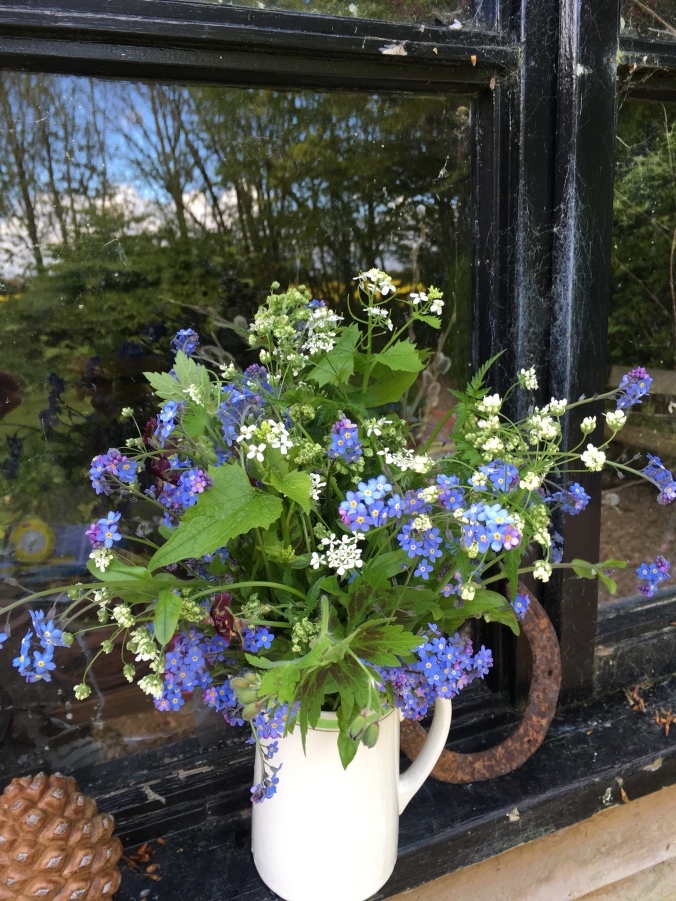

But there are new green buds. 

#Perennial Party…..Taking a piece of my garden with me.

I don’t travel well. I’m much happier surrounded by familiar sights and sounds. I’ve become accustomed to green fields and birdsong.  My favourite place is the potting shed. A quiet, peaceful haven- shared with a cheeky robin. The scent of potted Carnegie white hyacinths and creamy Paperwhite narcissi wafts around. I’m reluctant to leave….

But I need to travel to London. So after much fussing with packing and checking train times and tickets, at least 50 times,  I set off for the unfamiliar.

Just at the garden gate, I see some violets in flower.   Nearby, the first snowdrops are in bud. There’s a primrose poking through the leafmould. And there’s a tiny hellebore flower wearing a hat of  compressed beech leaves. The leaves have protected the plant and forced the flowers into early growth.

So I pick a few flowers and gather them into a tiny posy. I wrap them in dark green gutta tape  to lock in moisture. I twirl around some string, add some lavender from the potting shed table, and set off for London- carrying a tiny piece of my garden with me. A talisman. A kind of amulet. Protection against the noise, hustle and bustle.


Propped up on the flip-down table on the train, the scent from the violets is a welcome reminder of home. I look about to see if anyone else is bothered by the noise and diesel fumes. They don’t seem to notice.


I’d forgotten that snowdrops have a strong honey scent. The flowers start to open as we travel along. These are   Galanthus elwesii, the first to flower in my garden.


The hellebore is called Jacob. It’s a  strong, healthy variety. Dependable and hardy. The violets and primroses arrived  as seedlings from my grandfather’s garden. I have happy memories of grandad Foulds arriving each Sunday with a little piece of his garden; a cutting, a seedling, or division. He loved walking around the plot, pointing out the weeds, giving advice on growing veg and cut flowers. After we had  pottered in the greenhouse and orchard, he’d settle down in a cosy armchair with home-made cake and tea. Such memories are a comfort, brought back to life by these few flowers.


And this is the place I’m travelling to. The Barbican conservatory, for the annual party for Perennial. I’m a fish out of water. A country mouse. But I’ve stepped out of my comfort zone to support a charity that is dedicated to helping all people who work in horticulture.  I’ve been lucky enough to make my living from horticulture for this past 20 years, and I care about the gardeners, contractors and tree surgeons I work with. Perennial provides a “lifebelt” to anyone in a crisis. Advice, help and financial support, for anyone of any age.


The auction featuring luxury holidays and events  raised more than £11,000, and there were raffle prizes too. It’s the most hectic and noisy event I’ve ever attended. But I’m glad I’ve pushed myself out of my little potting shed. The chance to support a valued charity, and see friends from all over the country, has been worth it.


Looking in the pink are from left to right  Fran SuermondtTanya BatkinPerennial’s Laura Garnett,  host James Alexander-Sinclair,   writers Naomi Slade , Alison Levey, and in front, Barbara Segall.

Do you have a favourite charity to support? Do you ever carry a piece of your garden with you on your travels? What measures do you take to cope when you are stepping outside of your comfort zone? I’d love to hear your news and views. 

Read more about Perennial here.

#WordlessWednesday 

Hellebore Jacob, caught in a shaft of sunlight from the tiny side window in the pottingshed. Brightened my day. Happy New Year to all of you. 

WordlessWednesday. Walled garden doors 

Found at the National Trust’s Calke Abbey. We love the panel sides. Someone took a pride in this job. It’s right next to the Orangery, which dates back to 1777.

 How many gardeners have walked through this doorway into the walled kitchen garden over the past 250  or so years. It’s good to stop and ponder as we close one door on 2016 and think about opening new doors in 2017. 

Day 20 of my #AdventCalendar for gardeners- a visit to Calke Abbey. 

Mossy roofed potting shed in the walled garden at  the national Trust’s Calke Abbey. There’s a tiny bed in there for the garden boy whose job it was to keep the greenhouse boilers stoked. Alison and I have started a tradition to walk the gardens in the week before Christmas, and reflect on what life was like for the gardeners. Then there’s a food fair in the old riding school where we sample local honey, Leicestershire cheese, home made fudge and chocolates- and we stock up for the festive season. It’s rather a wonderful tradition to have started. 


The walled kitchen garden is looking beautifully tidy. The beds are mulched and weeded.  All set for the spring sowing season. Quite a cheerful sight to behold.


It’s nice to find something new in a favourite- much visited garden. This area was being excavated last time we stopped by.  What treasures  were under the mounds of earth, we wondered.  It looks like a boiler for the hypocaust heated wall. Isn’t it amazing it’s still here. And the beautiful  brick floor is still intact.


We mooched in the peach house. I think this blue paint  is my all-time favourite colour. I’d love to paint my potting shed the same hue. It reminds me of the Mediterranean.


We peered through the misty  peach house  windows. In the summer these open right up. There are deckchairs to sit and gaze at the wild flowers and waist high grass.


View of the peach house /orangery  from the church. We spotted these glorious giant white-painted cloches. And coveted them! 


A few ancient espalier  fruit trees  remain in the walled garden. We love their mossy-covered boughs. 


We hadn’t noticed this door in the walled garden before. In summer there’s so much to see. But in winter,  we notice the bare bones of the garden and home in on  wonderful details like this.

We’ve never seen the sheep grazing right to the house before. We like this seasonal change. The sheep set a scene that could easily grace any Christmas card. We just need some snow to complete the picture. 

I hope you’ve enjoyed my tour of Calke Abbey and the kitchen gardens. Do you have a garden that you love to visit as often as you can? Do you find new treasures each time you visit? Thanks for stopping by, and please feel free to comment- so I know I’m not just talking to myself. 

Day 16 of my #AdventCalendar for gardeners. Spiders web in the middle of my pergola. Snow from last winter. Have a great weekend, all x
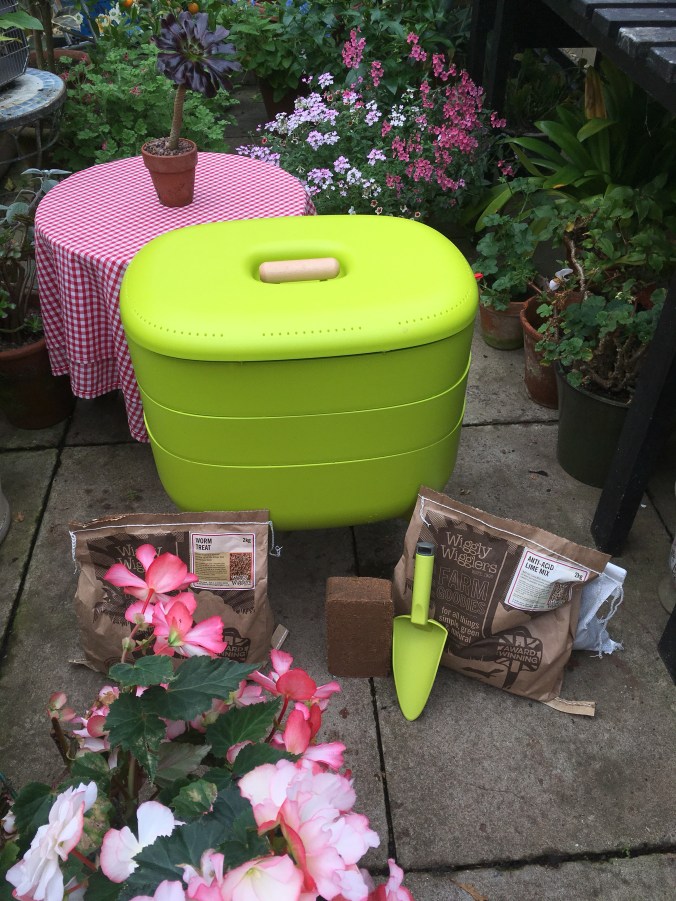
The pergola goes from the back patio to the corner of the house and then round to the front drive. On the corner turn, there’s a spiders web. It’s totally overgrown with ivy and Montana clematis at the moment. Another winter renovation project. I’m choosing lots of new climbing roses and clematis for the replanting. 

Day 12 of my #AdventCalendar for gardeners

Have a great week, all of you. x

Day 11 of my #AdventCalendar for gardeners

Have a great week all of you. xxx 

Wordless Wednesday – 7th December 2016 -a line of oak trees.

View from my garden gate.   A flurry of  leaves fall like snow,  in golden bands across the lane. Such a picture of beauty. A temporary -catch-it-now moment in time. Before the season moves on.