Six on Saturday- 26 October 2019

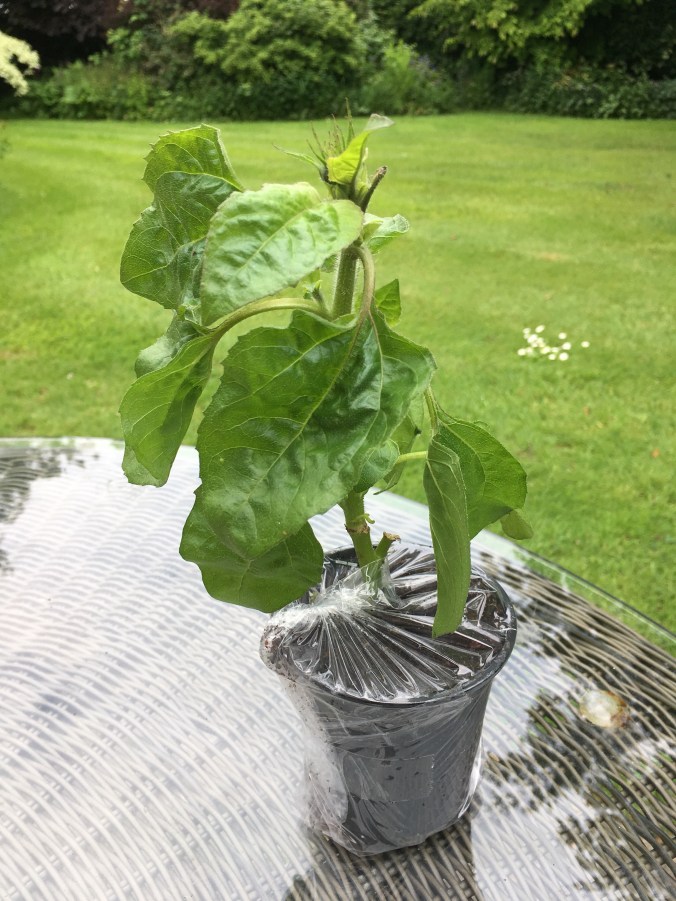
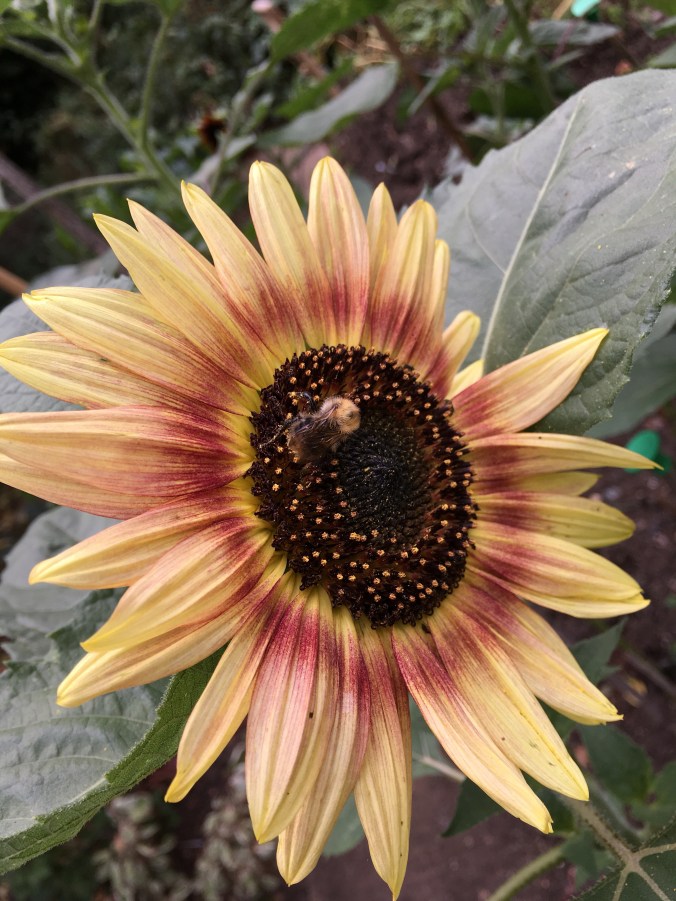
The last of the sunflowers. This one, above, looks like it can’t decide whether to open or not. It’s been wet here, 142mm of rain this month. Twice the usual amount. However, flowers coped well with the deluge. Dahlias love the rain. They just tip forward slightly to drain. Sunflowers have also thrived. My sunflowers are a mixture of Infrared and Allsorts Mix from Mr Fothergills. I sow them in seed compost in March in 9cm pots, grow on in the greenhouse until they have two pairs of leaves, and then plant out after all danger of frost has passed. I use Strulch mulch to protect from slugs. It’s a scratchy kind of mineralised straw mulch which slugs and snails don’t like. It helps to retain moisture and feeds the soil as it rots down. I also spray everything with home-made garlic liquid. The recipe comes from Sienna Hosta nursery. If it’s good enough for a multi- gold medal winning nursery, it’s good enough for me. It works, with the proviso that you have to spray repeatedly, especially after rain. I’ve got a 3L Hozelock sprayer set up ready, which makes life easier. It’s worth it to protect delicate seedlings from slugs, without resorting to chemicals. The garlic spray doesn’t kill slugs, but deters them, leaving them available as a food source for birds and mammals.

Seed merchants used to mostly supply yellow sunflowers, but in recent years there’s been a big increase in varieties available. I love the chocolate -coloured flowers and the mini-sunflowers, such as Teddy Bear, which can be grown in a container and only grows to 1m with 12cm wide very double ‘fluffy’ yellow flowers.

Glowing red, this sunflower reminds me of rich dark chocolate. This was the darkest flower in a packet of Velvet Queen seeds. Truly scrumptious.

Plenty of pollen for bees, and I leave the seeds on the plants for the birds to enjoy over winter. Insects hibernate in the sunflower stems.

Lovely markings on these sunflowers from the Allsorts Mix.

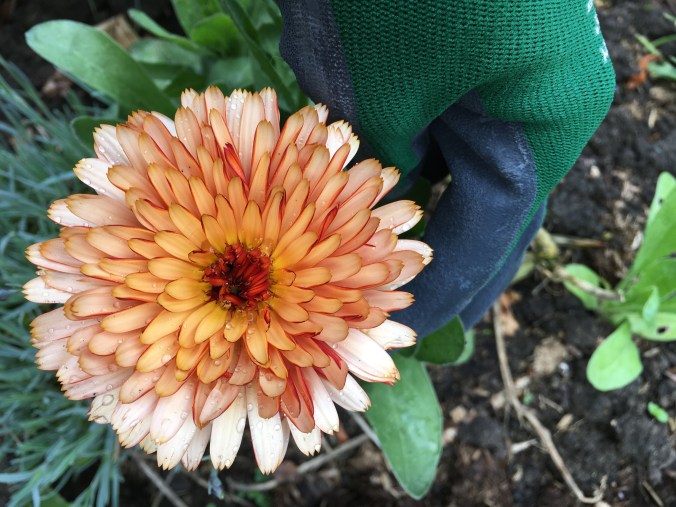
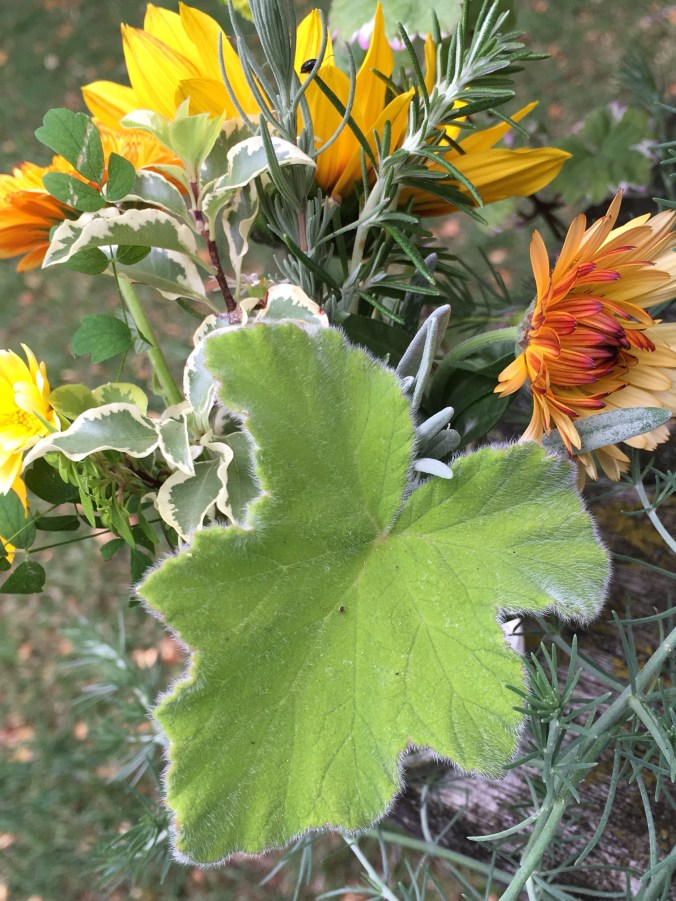
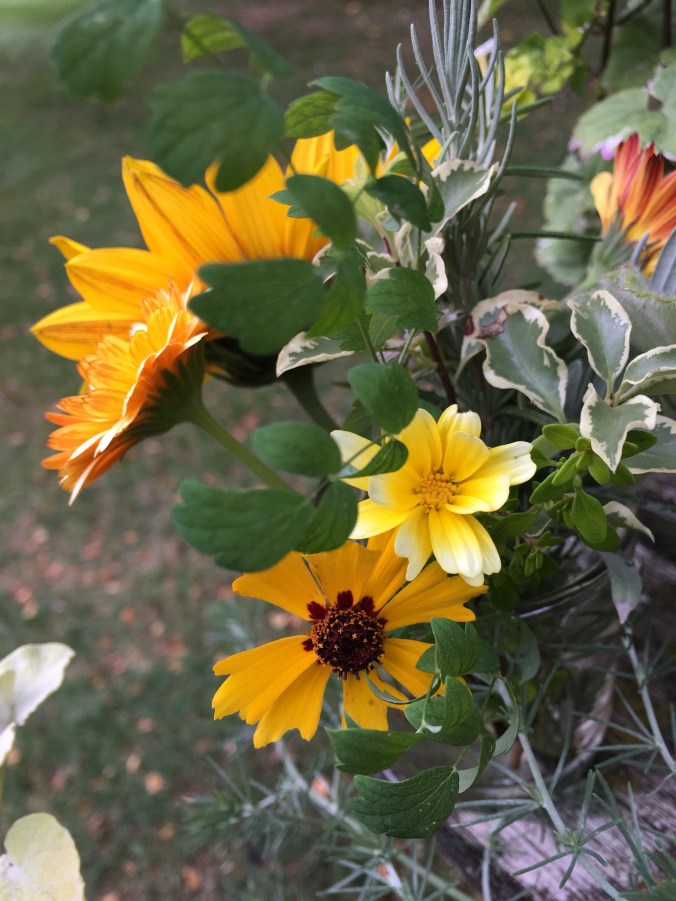
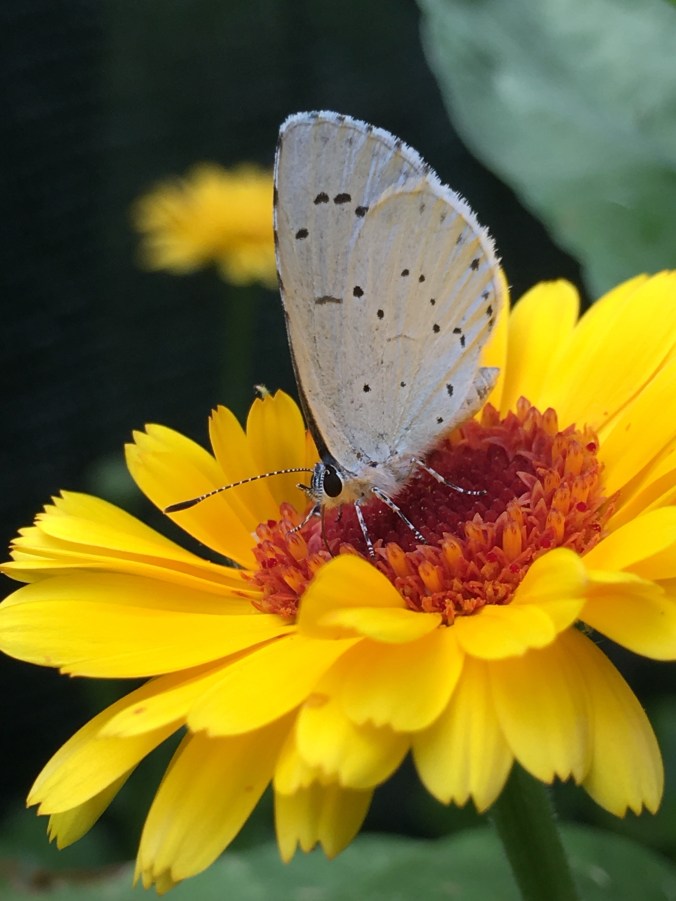
And finally, Thompson and Morgan produced a new and exclusive multi-branching sunflower which repeat flowers from spring until Christmas, if protected from frost. It has rather an unwieldy name- SunBelievable Brown-Eyed Girl. It’s perfect for containers. My potted sunflower was amazingly prolific, and produced about 100 flowers over the season. Plenty for mini flower arrangements like this one which has calendulas, and herbs mixed in with the sunflowers. It lasts about a week in a vase.

Tonight we put the clocks back and the evenings will gradually close in. We’ll just have to make our own sunshine- and grow more flowers. Don’t you agree?

Which plants have you grown this summer? Let me know which have been a success for you. It’s good to share ideas and information, and help one another- especially as winter draws near and we all need a bit of colour to keep our spirits up.

Links : SOS six on Saturday https://thepropagatorblog.wordpress.com/2019/10/26/six-on-saturday-26-10-2019/

Mr Fothergills Infrared https://www.mr-fothergills.co.uk/Flower-Seed/Sunflower-Infrared-F1-Seeds.html#.XbSrg4zTWfA

Allsorts Mix https://www.mr-fothergills.co.uk/Flower-Seed/Sunflower-Allsorts-Seeds.html#.XbSrtYzTWfA

Velvet Queen https://www.mr-fothergills.co.uk/Flower-Seed/Sunflower-Velvet-Queen-Seeds.html#.XbStyozTWfA

Thompson and Morgan https://www.thompson-morgan.com/p/sunflower-sunbelievabletrade-brown-eyed-girl/tka1036TM

Calendula Orange Flash https://www.mr-fothergills.co.uk/Flower-Seed/Calendula-Seed/Calendula-Orange-Flash.html#.XbSvAozTWfA

Garlic wash spray, Sienna Hosta Nursery https://www.siennahosta.co.uk/pages/garlic-wash-recipe

Karengimson1 on instagram

@kgimson on twitter

GardenMediaGuild member

The Flower Market Year – Book Review and Prize Draw

12 MONTHS AT NEW COVENT GARDEN FLOWER MARKET

By SIMON LYCETT

Published by Simon J Lycett Ltd

Hardback 192 pages, £21 approx

ISBN 978-1-9160912-0-7

Book photography by Michelle Garrett

Blog photos: bramblegarden

Florist Simon Lycett thinks nothing of working with 20,000 stems of roses for a wedding. I am trying to picture the scene, and finding it hard to imagine 20,000 flowers. Then Simon tells me this isn’t a one off. It’s something he gets to do on a very regular basis. I’m lucky enough to have a window on his extraordinary life, for just one day. I am visiting the New Covent Garden Flower Market, and Simon is my guide.

It’s still dark outside as I set off at 6am to meet Simon at the Flower Market in Nine Elms, London. We are standing amongst more flowers than I’ve ever seen, and we are inspecting the roses. Simon who has written a book about the market, explains that his customers have “magical weddings, the world over.” He loves the buzz of creating “magical settings in a world where everything is possible and the words ‘can’t do’ are never uttered.” It’s a revealing conversation, as he explains his customers expect total perfection. “They must have the best of everything. They’ll notice a little mark on the petal, and that’s no good. Utter perfection is what counts. The client is king.”

Simon, who regularly appears on television and radio, explains that everything starts with the selection of flowers at the market. And it’s clear that his relationship with the flower sellers is key. They seem almost like family, and it’s not surprising as Simon has been buying from the same people for 30 years.

We are introduced to Dennis Edwards who has been getting up at 2am to sell flowers for 54 years. His family are porters and sellers of fruit and vegetables. He’s the only one in his family to go into the flower market business. He describes it as a passion, rather than job. A life’s work to supply the creme de la creme.

In his book, The Flower Market Year, Simon says Dennis always has a few “specials” – buckets and trays of unusual items which he sets aside and keeps for Simon. “Dennis was the first person to ever serve me when, as a timid 20 year old, I ventured into the Flower Market for the first time. Dennis was then, and still is now, a Flower Market institution, always going above and beyond to find the very finest flowers and foliage, and ever in search of the unusual and the innovative, wanting to offer the largest, the biggest and the best blooms in the building.

“Born in Drury Lane, Dennis has worked in all three of the Flower Markets, firstly in the original Covent Garden Market, then, when it moved in 1974 to Vauxhall, in the New Covent Garden Flower Market, and now in the current (interim) market site a little further along Nine Elms Lane. In 2022, when all development is complete and he moves into the ‘New’ Covent Garden Market, he will be a record breaker!”

It’s fascinating to watch them talking. It’s as if each one knows already what the other is thinking. It’s clear Dennis instinctively knows which flowers Simon will need for his projects, and as I look around, perfection is key. I can’t fault anything. I’ve never seen flowers of such superb quality. It’s a scene that stays in the memory like a photograph because it’s so out of the ordinary.

Simon set out to record the workings of the flower market to “capture a real sense of the place,” with its salesmen and women, customers, porters, buyers and suppliers.

His book captures month by month what he’s seen and bought, and what’s inspired him to create floral decorations for his clients, for weddings, parties and corporate events. Simon doesn’t mention it, but on his website there are ‘thank you’ letters relating to HRH Princess Eugenie’s wedding (state entrance, grand staircase and reception room “absolutely stunning”) and also the marriage of Prince Charles and the Duchess of Cornwall (reception flowers, “magnificent”). Simon simply says “From humble beginnings we have grown into one of the most sought-after and well known names in the industry.”

Although Simon wrote the book to highlight the flower market year, his own fascinating life story is woven into the pages. Talking about buckets of blackberries, for example, he writes: ” When I worked at Pulbrook and Gould, stems of blackberries sold for the same price as spray roses and I will never forget the posies and arrangements created by the workroom there, featuring jewel-like bright berries glistening amongst stems of Oceana and Doris Ryker roses.

“Having left Pulbrook and Gould to become a freelance florist, I started to travel about the country, as much of my work was outside the city. For several summers when visiting my family in Warwickshire, or staying as I often did with friends in Northamptonshire, I used to fill the boot with anything I could gather from friends and family and sell it to one or more of the foliage suppliers in New Covent Garden Flower Market. The stems of blackberries that I cut and bunched used to pay for my petrol each week, and the car tax was funded by the branches of rosehips, damsons and wild apples that I crammed into the car before heading up the A40. ”

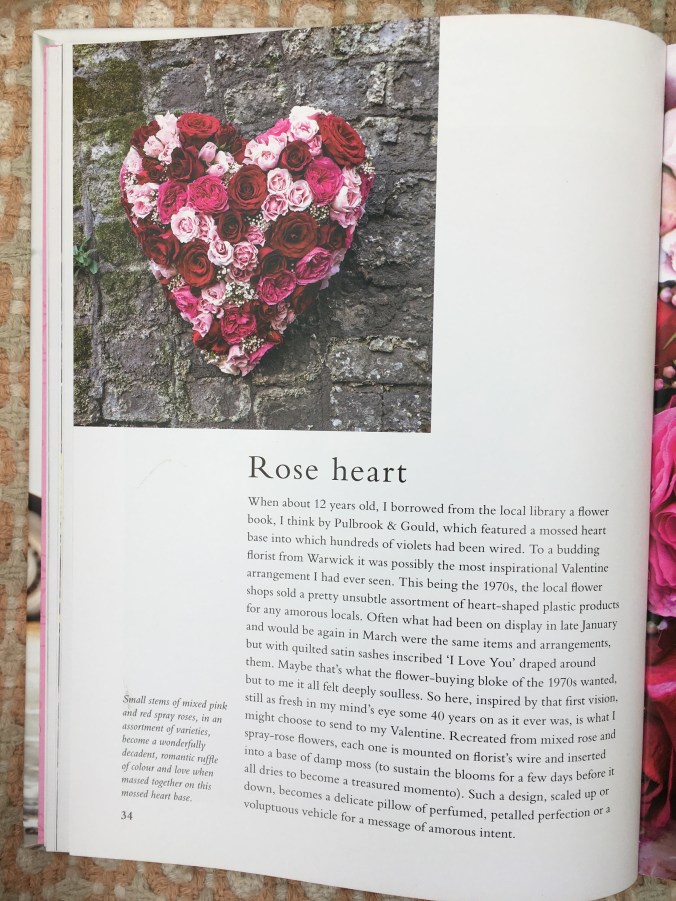
Selecting flowers from the market, Simon provides 30 ideas for flower arrangements, with step-by-step photographs and instructions. My favourites are the rose heart, the sweet peas in tins, and the artichoke bowl.

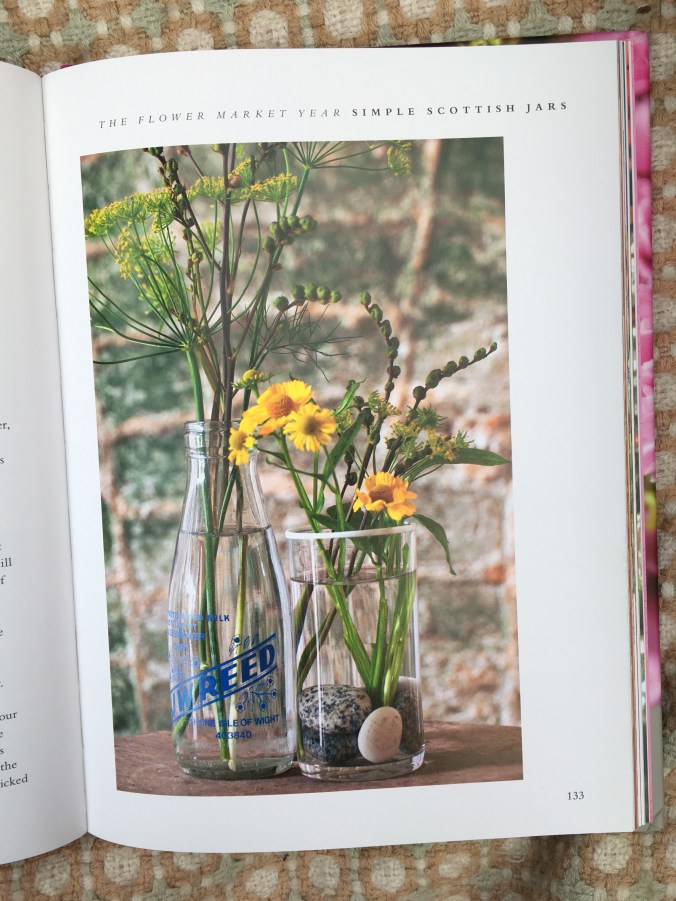
Having seen photos of his wedding and party flowers, it’s interesting to see the preferred choice for his own flowers- for his Scottish Highlands holiday home- is simple bottles filled with tiny sprigs of flowers and a few pebbles from the beach. Truly, he can make anything look special.

I’ve had a wonderful time with Simon, seeing the flower market in all its glory. What I’ve learned is that Simon relishes the magical weddings and corporate events with the ‘wow factor’ flowers. But he also sees the beauty in the simple things -a bunch of narcissi- the first of the season from the Scilly Isles. The scent of the flowers will always remind me of a lovely day spent at the market with a truly inspirational florist.

There’s one copy of the book to give away in a prize draw. Please leave a comment below to be included in the draw. Names will be randomly pulled out of a hat. International entries are welcome, as well as the UK. The publisher’s decision is final. There’s no cash alternative. Usual rules apply.

Links : https://www.amazon.co.uk/Flower-Market-Year-2019-Months/dp/1916091202

https://www.simonlycett.co.uk/

https://www.facebook.com/pages/category/Florist/Simon-Lycett-Ltd-1503980453205762/

https://www.facebook.com/pages/category/Local-Business/bramblegarden/posts/

Garden Media Guild events https://www.gardenmediaguild.co.uk/

@kgimson on twitter.

Karengimson1 on instagram.

Thank you to my amazingly loyal and growing band of readers. I appreciate your taking the time to read my blog, and for leaving comments.

In a Vase on Thursday 10th October 2019

Rich Venetian shades. Just the joy we need for October days. Temperatures are dipping and nights drawing in, but the cut flower patch is blazing with colour.

Dahlia Nuit d’Ete is flowering well, standing up to the wind and the rain. We had the wettest September for 20 years. And October doesn’t look like it’s getting any drier. We’ve had 134mm of rain in ten days. That amount usually falls in two and a half months! With swamp-like conditions it’s impossible to work on the borders. Luckily my cut flower patch is divided by little slabbed paths, so I never need to step on the soil.

Alstroemeria Laguna and Serenade

In amongst the dahlias there’s pink and red alstroemerias grown in pots. If you pull the flower stems out of the compost when you pick them, more blooms will follow. Pull instead of cut is the message. It seems destructive, but promotes further flowering. These are tall varieties suitable for cutting. I accidentally bought some dwarf types once, which looked pretty in the borders, but were hopeless for flower arranging. So take care when choosing plants.

Dahlia Arabian Night

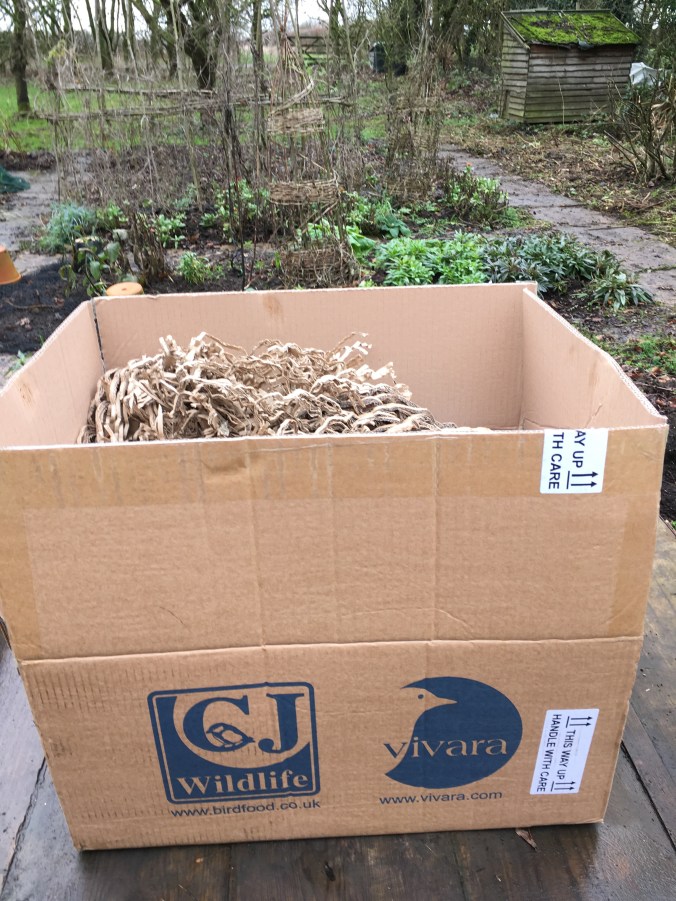
An old favourite I’ve grown for years. Very reliable and doesn’t seem troubled by rain and wind. Earwigs don’t seem to go for the darker shades, preferring the whites and pale-flowered dahlias. If your plants are being nibbled by earwigs, place upturned pots of straw or corrugated cardboard on canes near the flowers. In the morning you can tip the earwigs and their bedding into a wildlife corner, or amongst fruit trees. Earwigs are voracious predators of aphids and vine weevils. Worth relocating away from your dahlias.

Amaranthus cordatus

Love lies bleeding. An easy to grow annual. Produces pendant tassel-like flowers. It’s also known as velvet flower, foxtail and prince’s feather. Sow seeds in half seed trays in March/April. Prick out seedlings into 9cm pots or full seed trays and plant out after frosts. Flowers all summer until the end of October and sometimes into November, depending on temperatures.

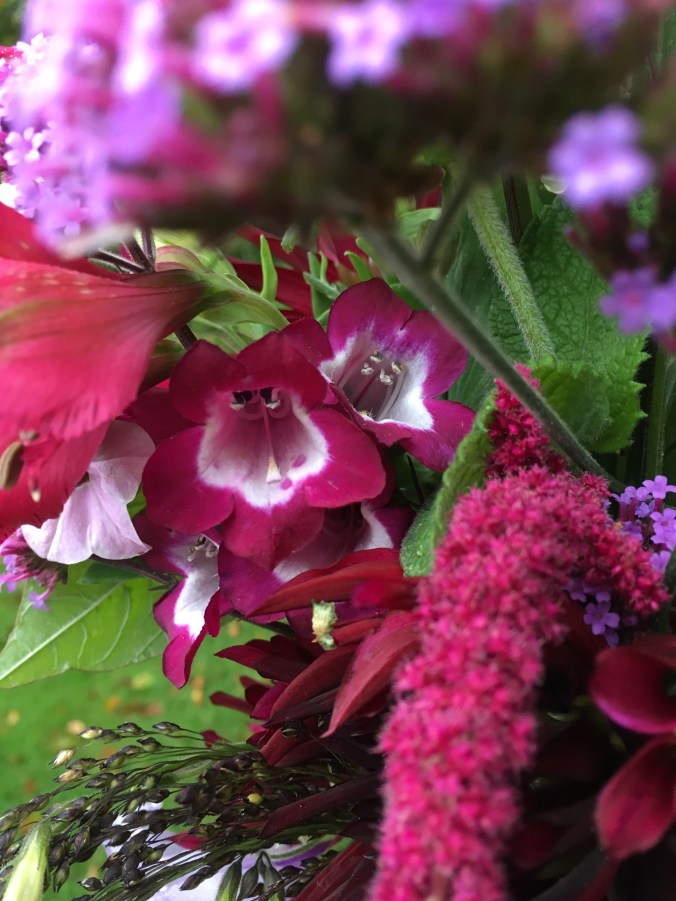
Penstemon Plum Jerkum.

A short-lived perennial. This came as a cutting from a friend. It’s a good idea to take insurance-policy cuttings in late summer. These plants are not totally hardy. It’s the winter wet that defeats them, so plant in well drained soil in full sun and protect from the worst of the weather with fleece. Take cuttings in July and August from non-flowering shoots. Cut below a pair of leaves, where there’s a concentration of hormones to promote rooting. Remove all but the top two leaves. Place the cuttings around the edges of a 9cm pot filled with 50/ 50 horticultural grit and compost. The edges of the pot provide the most free draining position for the cuttings, which helps roots to form.

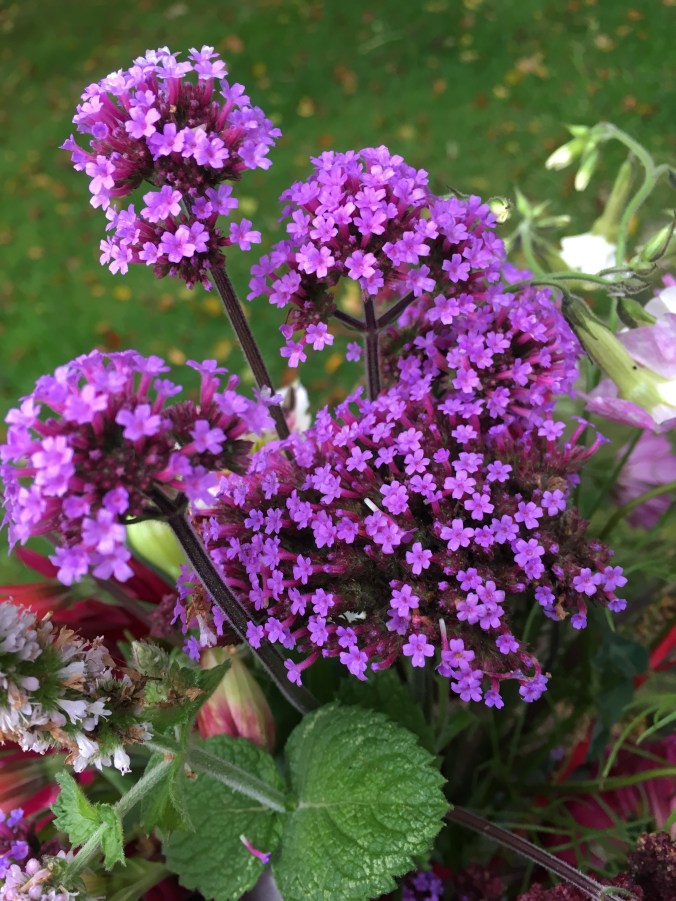
Verbena Bonariensis

Another short-lived perennial requiring a sunny spot in well-drained soil. I lost all my plants in the Beast for the East big freeze last year. Luckily, it grows really well from seed and cuttings. Sow seed in the spring in half trays and prick out, as above. Or take cuttings in late summer. There are tiny side shoots just above a pair of leaves. Gently pull these down and you will have a short cutting.

Aeonium Zwartkop

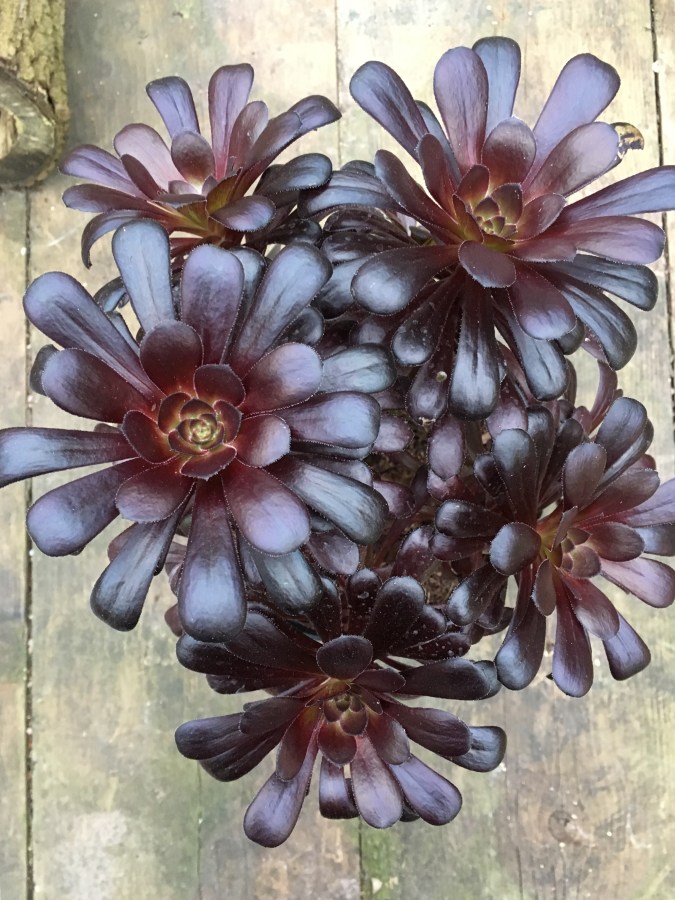
Aeoniums are evergreen succulents with a shrubby growth habit. My plants collapsed in the wind and some of the stems broke off. They make a lovely, unusual addition to flower arrangements. It’s all about using what you’ve got in the garden. When I take the posy apart, I’ll cut the bottom few inches from the stems and stick them in a pot of very gritty compost. Kept frost free, the cuttings will readily root and I’ll have new plants to stand out on the patio next summer.

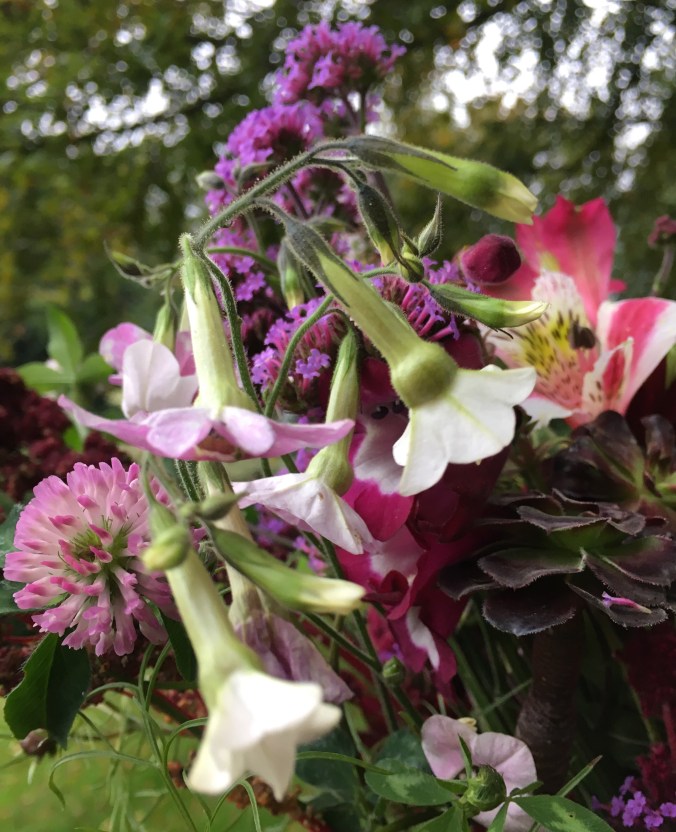
Trifolium pratense red clover

The lovely pink rounded flower on the left is just common clover. This year I grew a patch of wild flower meadow in a raised windowbox on legs. I’m always saying you don’t need acres of land to grow food, flowers, and veg. So I put it to the test. It worked a treat. I filled the containers with Dalefoot seed compost and sowed seeds direct in spring. Red clover flowered all summer, alongside blue harebells, yellow birds foot trefoil, scabious, corncockle, and vipers bugloss. It’s been a joy to watch bees, hoverflies and butterflies visiting my little patch of “meadow.”

Nicotiana mutabilis.

The pretty tubular flowers are colour-changing tobacco plants. These were sown and planted last year. They self-sowed over the winter, and have come up stronger and more beautiful this summer. I’m hoping they will do the same for next year, but I’ve saved seed and sown some more, just in case. Stems grow to 1.5m and produce clouds of trumpet-like flowers. They change colour as they age through various shades of white, pink and lilac. Glorious, and highly recommended. I’ll never be without it now I’ve seen it flower all summer long.

I hope you’ve enjoyed my Venetian shades bouquet, photographed on a windswept day in the garden. Golden beech tree leaves were swirling past my head as I was tying up the flowers. It seems autumn is on a fast forward setting. What is it like in your garden right now?

Links: I love to join in with Cathy’s In a Vase on Monday meme. But Mondays are my busiest working day. So I’m just going to post photos when I can. I’ll be reading all your posts when I get home from work.

IAVOM : https://ramblinginthegarden.wordpress.com/category/gardens/in-a-vase-on-monday/

Dahlias : https://www.gee-tee.co.uk/search-results?s=Dahlias+

Alstroemerias: http://www.postalplants.co.uk/catalogue.asp

Amaranthus :https://www.mr-fothergills.co.uk/Flower-Seed/Amaranthus-Love-Lies-Bleeding-Seeds.html

Penstemon : https://www.rhs.org.uk/Plants/162416/Penstemon-Pensham-Plum-Jerkum-(Pensham-Series)/Details

Verbena Bonariensis; https://higgledygarden.com/2011/11/21/verbena-bonariensis/

Aeonium: https://www.rhs.org.uk/plants/details%3Fplantid%3D64

I’m @kgimson on twitter and karengimson1 on instagram. Please feel free to share this post, linking back to bramblegarden.com

The Light in the Dark- book review and prize draw

The Light in the Dark- A Winter Journal

Horatio Clare

Published by Elliott&Thompson

£9.99 ISBN: 978-1-78396-462-8

There have been times when I’ve stood and stared in despair at the depths of human cruelty. One winter, in a muddy field on the boundaries of our village, I came upon a heartbreaking sight. Four ponies lay, dumped, one on top of the other, their necks broken, legs tangled. Filthy, caked in mud, flea ridden, they had literally been tipped out of a truck and left in a pile. Such sickening callousness. It’s a sight that will never leave me. Sadly, the perpetrators were never found. I raged for a long time. Such a senseless act. Why couldn’t they just have handed them over to someone who’d care. It made me unhappy for a very long time. Then one day on twitter, I saw an appeal for a pony called Eggsy. He’d been abandoned, left to starve, and was in a very poor state. But this time, the story has a happy ending. Carol Caton rescued him and set up a Go Fundme page for support. Since then, I’ve been regularly sending funds their way. I couldn’t help the ponies dumped as if they were unwanted trash. But I can help Carol. There’s a link at the bottom of the blog if you’d like to learn more.

What has prompted me to tell you this story? Well, in Horatio Clare’s new book, The Light in the Dark, he writes about his own sad discovery. I won’t spoil the book by revealing the details. Suffice to say he describes the discovery as “a nauseous thump in the gut, and a sudden hard drum of the heart as the world narrows, my vision tunnelling.” Travelling to his mother’s farm to face the crisis he says “Somewhere between Newtown and Llandrindod a rage bursts in the pit of me, a howling, violent thing exploding, and the furies come screaming out, and I roar in the car.”

But, the book is not all about grief and tragedy. It is a story of hope. It’s about overcoming the pain and sadness in life, and finding a way through the dark.

“Let grief be a fallen leaf, at the dawning of the day. Let grief be a fallen leaf, I think. There is much to do. And indeed, the days that followed the winds blew, the leaves fell and winter’s occupation began. ”

The Light in the Dark is a journal written from October to March. It’s a deeply moving account of surviving depression. Seasonal sadness, the winter blues, depression are widespread in the cold, dark months. Horatio Clare struggles to eat, to sleep, to work. But by “looking outwards, by being in and observing nature,” we can all learn to celebrate winter. It is magical to witness how the natural world becomes his salvation.

It’s impossible to put the book down. We are travelling on Clare’s journey, sharing moments of despair and joy. Beautiful words carry us along.

The book more than shines a light in winter, it beams! A brilliant, radiant, glowing light. For many, it will be a beacon of hope, leading the way to spring.

Please feel free to share this post. Leave a comment if you’d like to be included in the prize draw. The publishers have one copy to give away. Names will be randomly selected.

Links : https://eandtbooks.com/book/light-dark-winter-journal

Eggsy : https://www.gofundme.com/f/z8gpxg

Eggsy on twitter https://twitter.com/eggsypony

Winners….

Many thanks for reading my book and product reviews. Here are the names of recent winners:

An Orchard Odyssey by Naomi Slade : won by 30 Days of Wild Parenting, Joshua Johnson.

Clip garden gloves: won by Wilma Wilson

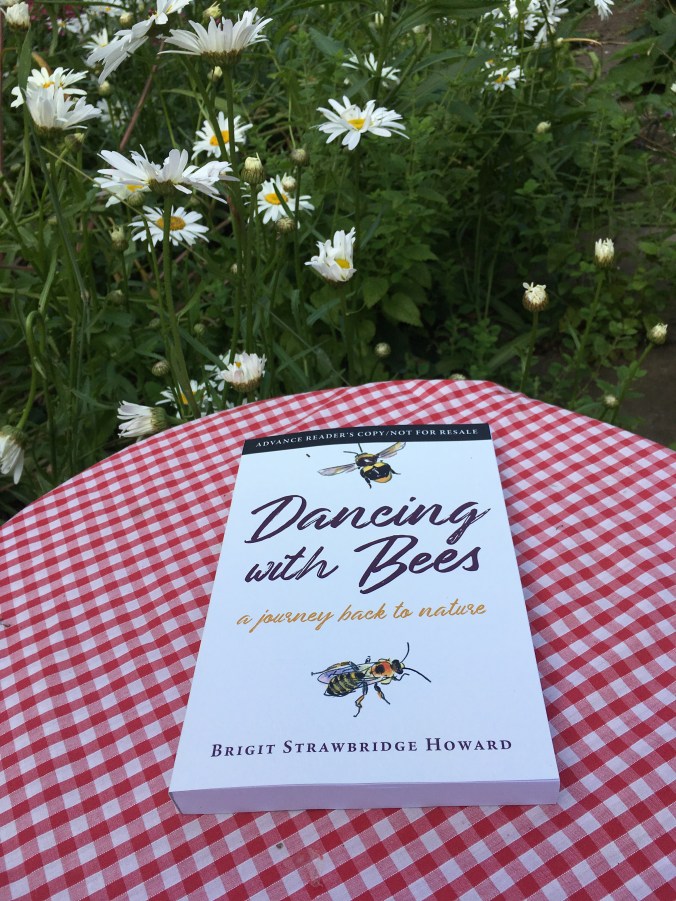
Dancing with Bees by Brigit Strawbridge Howard won by Debi Holland.

Incognito insect sprays and sun cream collection won by Suella.

The Good Bee Book, won by Florasforum.

Links: Orchard Odyssey review: https://bramblegarden.com/2019/09/27/an-orchard-odyssey-book-review-and-prize-draw/

Clip Gloves: https://bramblegarden.com/2019/09/15/clip-glove-on-trial/

Dancing with Bees https://bramblegarden.com/2019/08/04/dancing-with-bees-a-journey-back-to-nature/

Incognito https://bramblegarden.com/?s=Incognito+

Good Bee Book https://bramblegarden.com/?s=Good+bee+book

Thanks again for reading and taking part. New Books to Follow: Wilding by Stephen Rutt. We Made a Meadow, Yvette Verner. The Light in the Dark by Horatio Clare. There’s also new watering hosepipes from Hozelock and a biomix plant feed maker. Are there any new products/ books you would recommend?

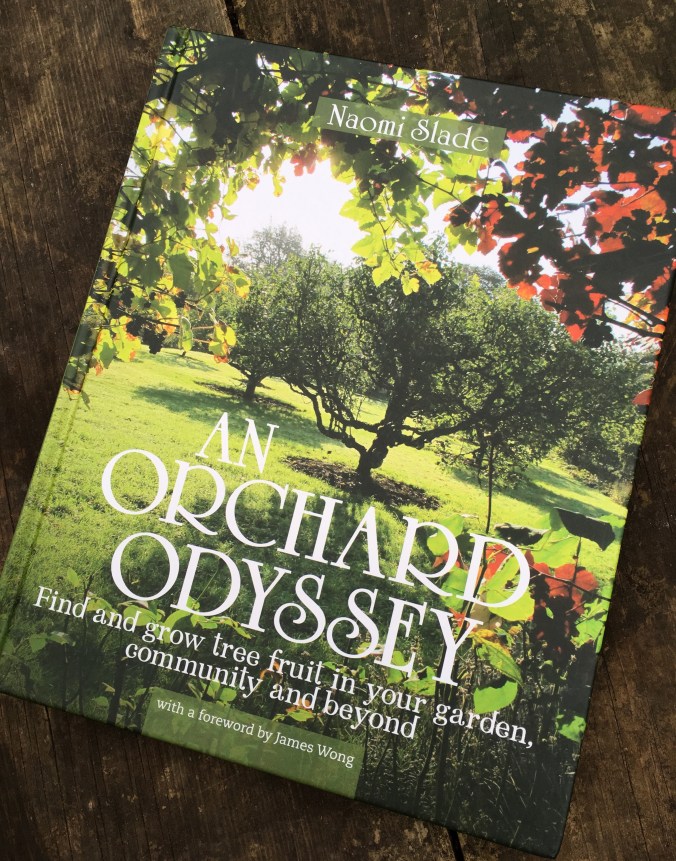
An Orchard Odyssey- Book Review and Prize Draw

By Naomi Slade

Published by Green Books

Hardback 224 pages £24.99

ISBN: 978-0-85784-326-5

There are many things in life I’m not able to change at the moment. I’m sure some of you will be feeling the same. I am worried and unsettled by what’s happening in the UK, and around the world. I feel as if I’m just watching and waiting for people in power to start making some sensible decisions- or decisions I understand at least.

Focussing on something positive, I’ve decided to plant fruit trees. Reading through Naomi Slade’s book, An Orchard Odyssey, there’s hope written on every page. To plant a tree is to believe in a better future. I’m planning a community orchard. Something to bring people together. Sharing and caring is the way forward. I’ve been mulling this over for a while, and Naomi’s book gives me the answers I need to take the first steps.

It’s fascinating and reassuring to hear about restoration projects for old orchards. There’s a renewed interest in traditional methods of orchard management and on locally grown and heritage fruit . “Orchards are increasingly being reclaimed by communities and used in new ways. Not only are they a social resource, but as an archetype of sustainable agriculture there is also potential for enterprise, skills acquisition and learning activities- all on the back of biodiversity.”

I’m keen to know more about newly- planted orchards providing a shared resource and the book has a section on how to make a community orchard happen. There’s tips on creating a plan, getting local support, forming a group and thinking about management. There are activities for children and encouraging wildlife with log piles and bee hotels. Using the site as an exhibition area for local artwork sounds inspiring too.

I’ve been involved with many school gardens, designing and project managing builds. It’s something I loved doing. Naomi gives many fresh ideas, practical suggestions on planting and selecting varieties. What she also emphasises is that anyone can grow fruit. With modern dwarfing root stocks, fruit trees can be grown in small spaces. There are types which can be grown in a pot. You don’t even need a garden, some varieties can be grown on a balcony.

Naomi’s beautifully- illustrated book is packed with practical advice written with enthusiasm and passion. Sections on the history of orchards, the origins of apples, and gardening through the ages, contrast with modern breeding projects to develop new varieties and ways to combat pests and diseases.

Reading Naomi’s book should really be on prescription. It’s a joy. A few hours reading and my feeling of calm and sense of equilibrium has returned. Of course, the problems of the world have not gone away. But I feel as if I can do something to make a difference – even if it is planting just one tree. We have to believe small gestures, kindness, a willingness to make things better, actually work. I believe it works magic. What do you say?

The publishers have offered one copy to give away in a prize draw. Please leave a comment below to be included. No purchase is necessary, there’s no cash alternative and the publisher’s decision is final. Names will be randomly selected.

links: Green Books https://www.greenbooks.co.uk/an-orchard-odyssey

Clip Glove – on trial

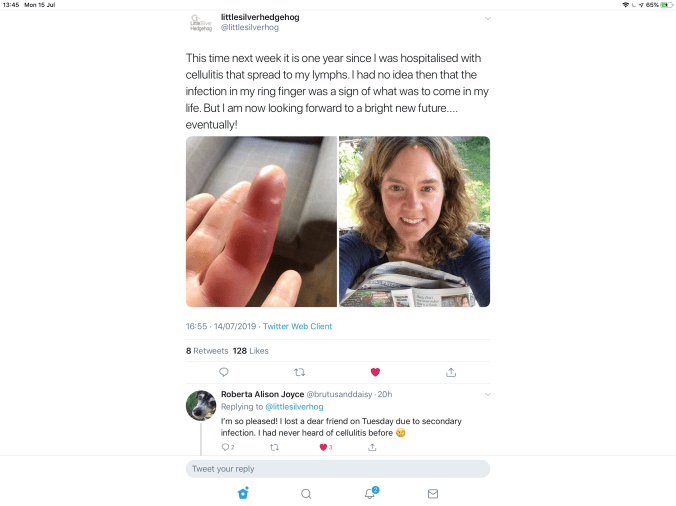
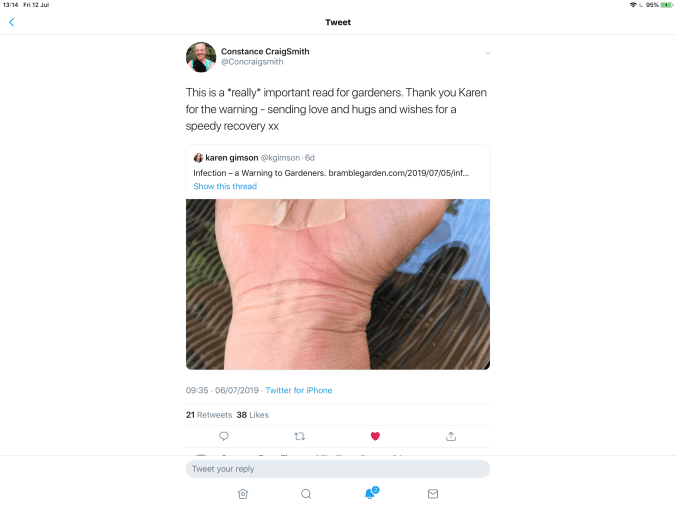
Ever since my brush with blood poisoning earlier this summer, I’ve been extremely careful. I wear gloves for every gardening activity. I’m not taking any chances. I guard against thorns, insect bites and splinters.

Treadstone Products saw my post warning gardeners to take care:

Here’s the original blog post: https://bramblegarden.com/2019/07/05/infection-a-warning-to-gardeners/

It’s a warning that’s been read 150,000 times. Clearly a subject that resonates with many people, not just gardeners.

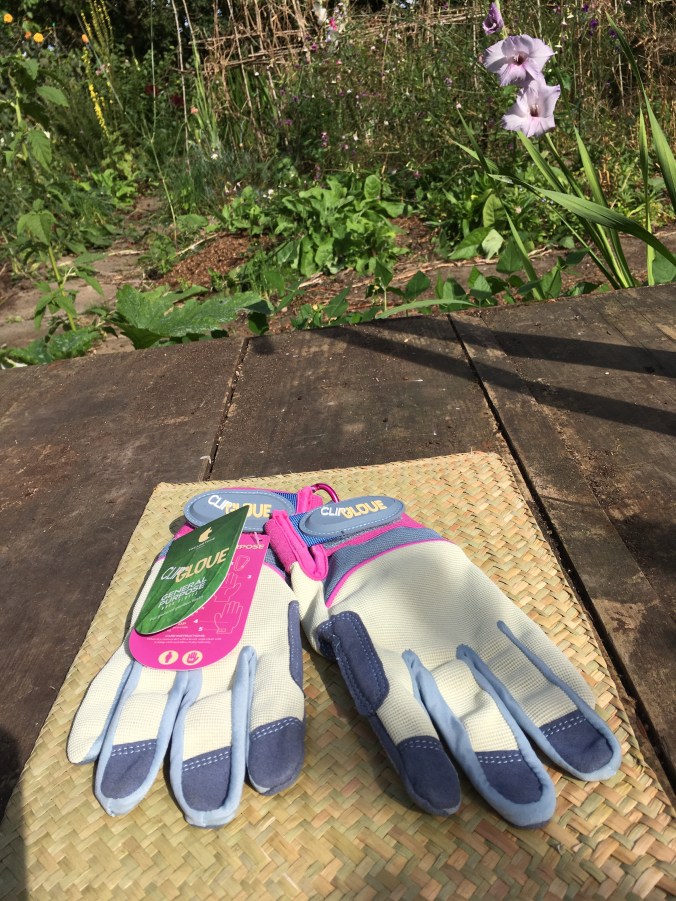
I’ve been trying out a range of different gloves. The latest is the Clip Glove, a new product from Treadstone. As usual, I’ve asked for a pair to give away in a prize draw. Please leave a comment at the end of the post to be included in the draw. Sorry, uk addresses only, due to postage.

What I like about the gloves:

  • Skin-friendly fabric. Cool and comfortable
  • Synthetic leather fabric. Hard wearing
  • Flexible enough to handle delicate cuttings and tiny weeds
  • Strong and durable materials
  • Special feature: clip attachment. Gloves can be clipped to belt, bag or for hanging up in the potting shed, or on the line to dry after washing
  • Loops to help you pull the gloves on and off
  • Recent winners of the garden centre industry GIMA awards
  • A choice of sizes for hands

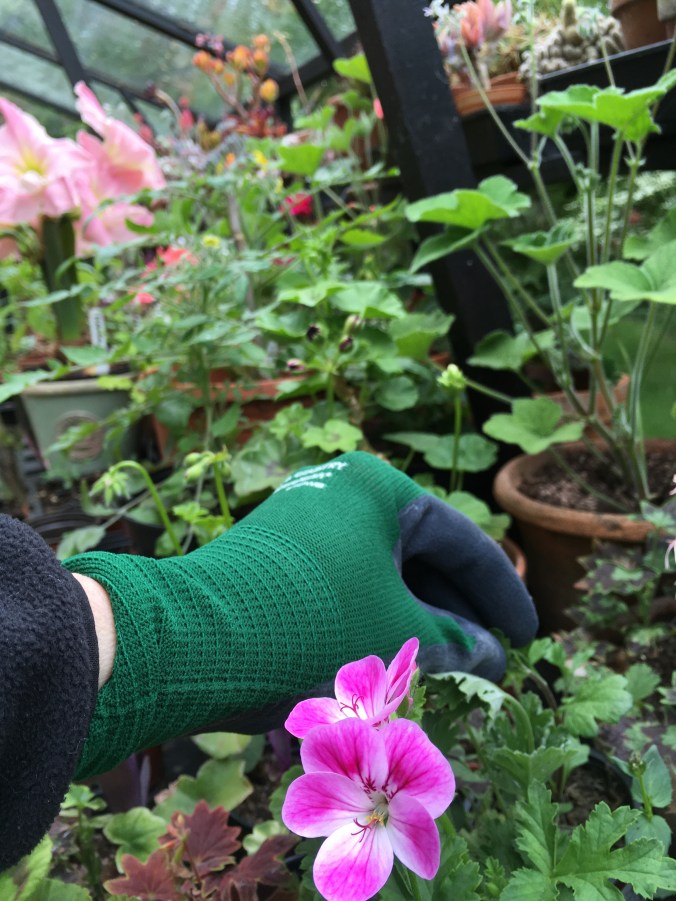
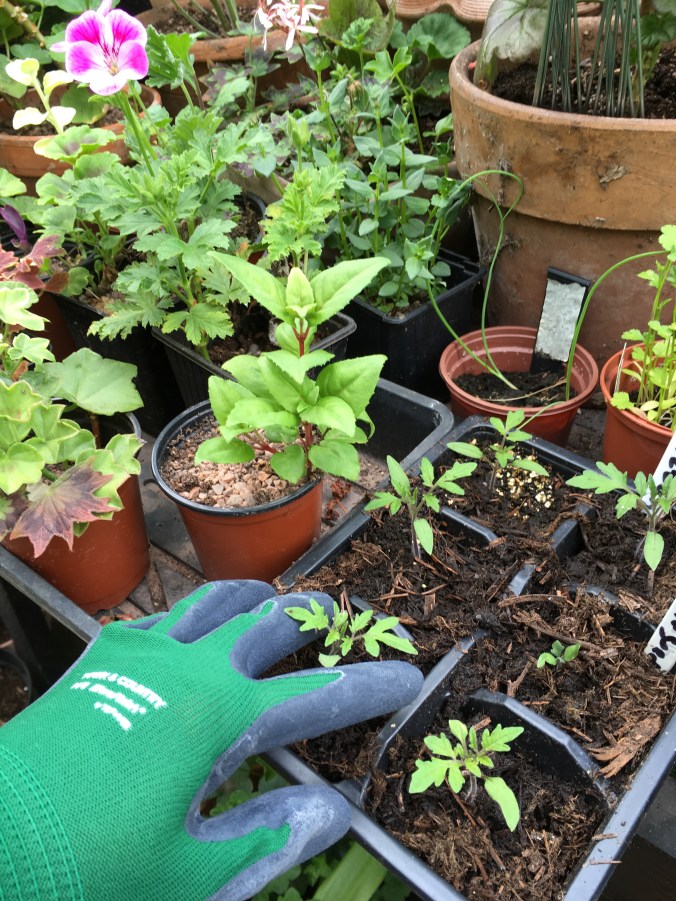
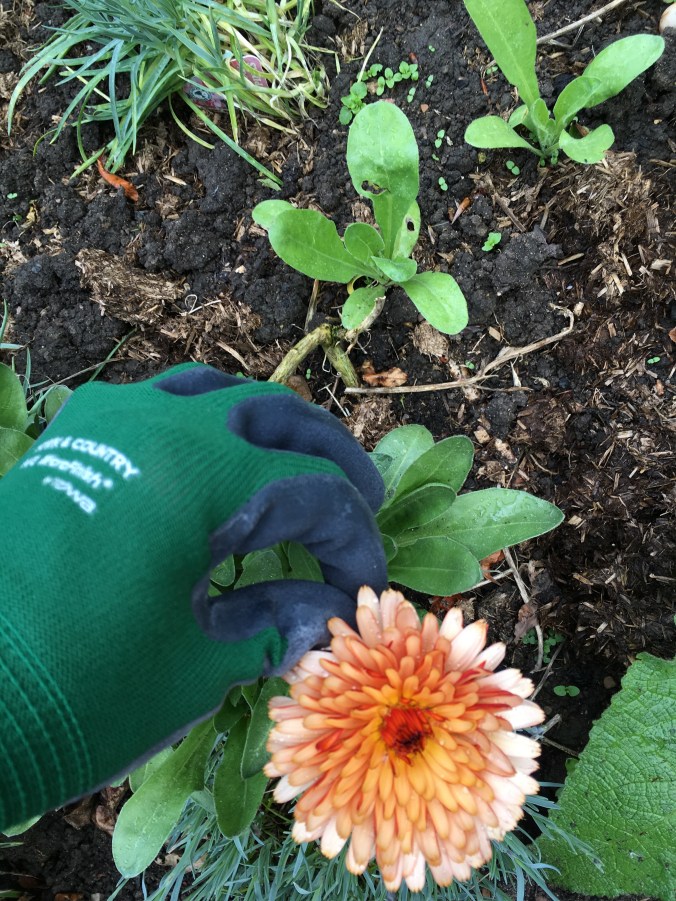
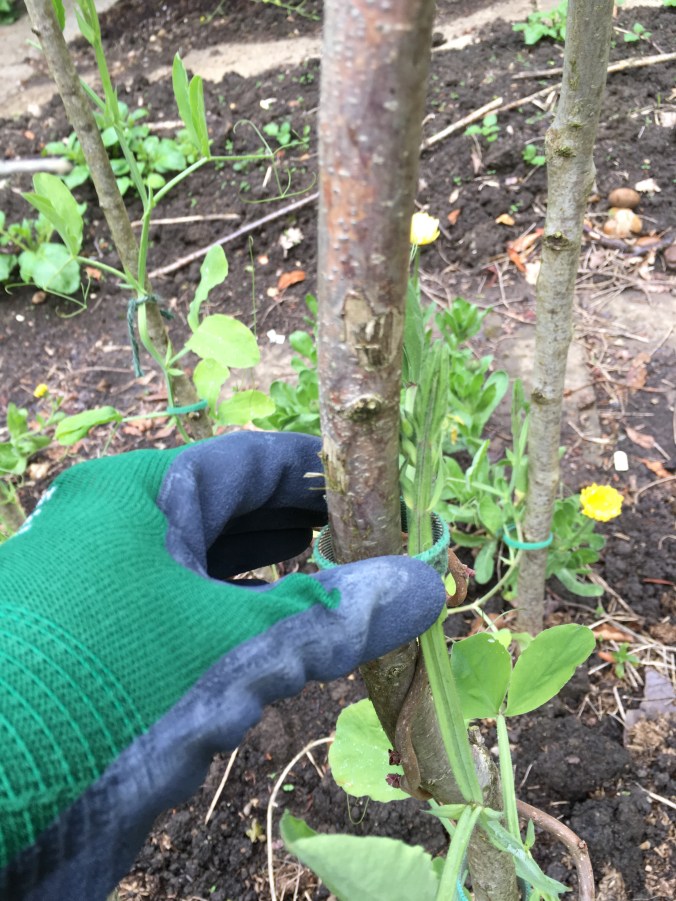
I used them to weed the cut flower patch and plant out some sweet williams and wallflowers. On a hot day, 21C, my hands didn’t feel uncomfortable. In fact, I forgot I was wearing them.

The little tabs are really welcome. There’s nothing worse than struggling to get gloves on and off. Elasticated cuffs stopped compost going inside the gloves.

Flexible enough to easily grip garden tools. Stiffer fabric gloves make my hands ache after a while. These were worn all day with no problems.

I harvested my spring -planted garlic. Small but incredibly tasty. I’m just about to plant some for overwintering. I buy them from the Garlic Farm, Isle of Wight.

Sorted through my saved bulbs, removed old stems and placed them in paper bags ready for re-plating in November. These will be planted in the orchard, and fresh bulbs will go in winter containers,

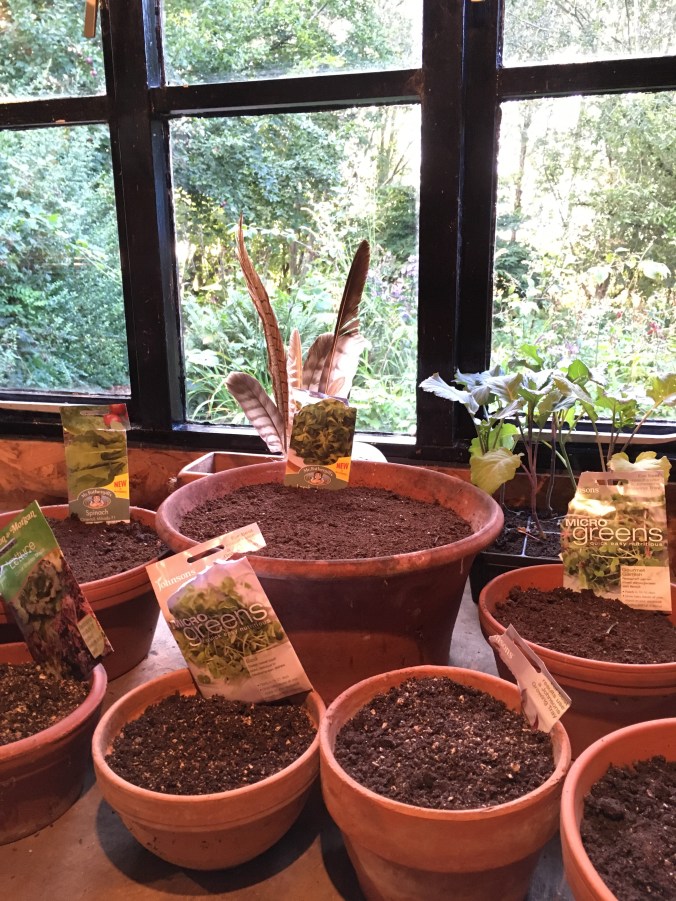
Mixed some compost, added grit for drainage and filled terracotta pans ready for sowing winter micro-greens, herbs, salads, rocket, lambs lettuce, beetroot and watercress.

Weeded, tied in and mulched my favourite rose; Rosa Mutabilis ( https://www.classicroses.co.uk/mutabilis-shrub-rose.html ) This variety flowers on and off from spring to Christmas in various shades of peach and cream, opening cerise pink. Adorable and disease resistant. Good for pollinators, being a single flower. Just look at that golden pollen!

A good day’s work in the garden.

Links: Clip Glove https://www.treadstoneproducts.com/treadstone-garden/clip-glove/

Garlic Farm: https://www.thegarlicfarm.co.uk/

Tulips : https://www.gee-tee.co.uk/bulbs/tulips

Compost https://www.dalefootcomposts.co.uk/products/wool-compost-for-seeds.p.aspx

Seeds: https://www.mr-fothergills.co.uk/Vegetable-Seeds/Salad-Leaves/#.XX6wPozTWfA.

Note: Names will be put in a hat and randomly selected by Treadstone. There’s no cash alternative. One pair of gloves will be sent to the winner. No purchase is necessary. Usual rules apply.

Clearing Out the Greenhouse & Taking Pelargonium Cuttings – Sunday September 15

I start off with good intentions. Each spring, I determine to keep the greenhouse tidy. By September, all manner of clutter- bits of string, old labels, empty plant pots and dead plants- trip me up. It looks a mess. So this weekend I’ve emptied all the plants and swept right through. Phew. It doesn’t get any easier. It’s a 20 foot Alton cedar greenhouse, bought second hand and painted black. First I take out all the pelargoniums. The one above is called Tomcat. It’s like burgundy velvet. It flowers non stop from March through to November. In a mild winter it carries on flowering for 12 months. This year, I’ve decided to cut everything back and keep all the plants as cuttings in 9cm pots. The mother plants, several years old and getting leggy, have been composted. It’s hard to do. I tend to hang on to plants even when they are past their best.

There’s still a lot of colour, but the cooler temperatures and damp atmosphere creates mould. Botrytis is a killer of tender plants such as pelargoniums. Cutting them back and reducing the watering helps to combat the problem.

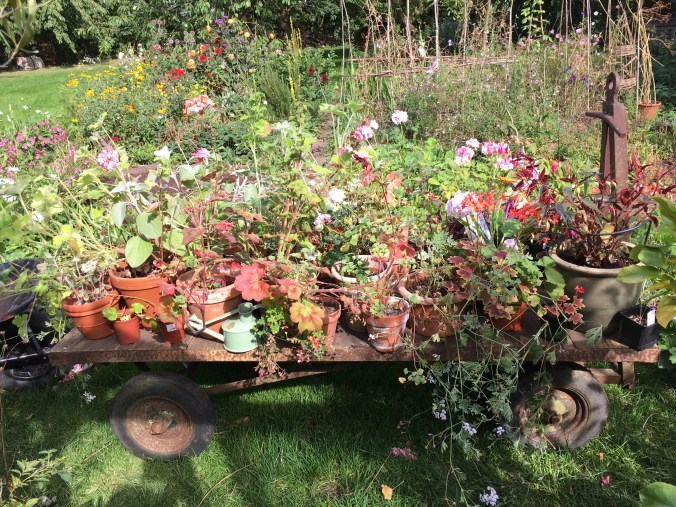
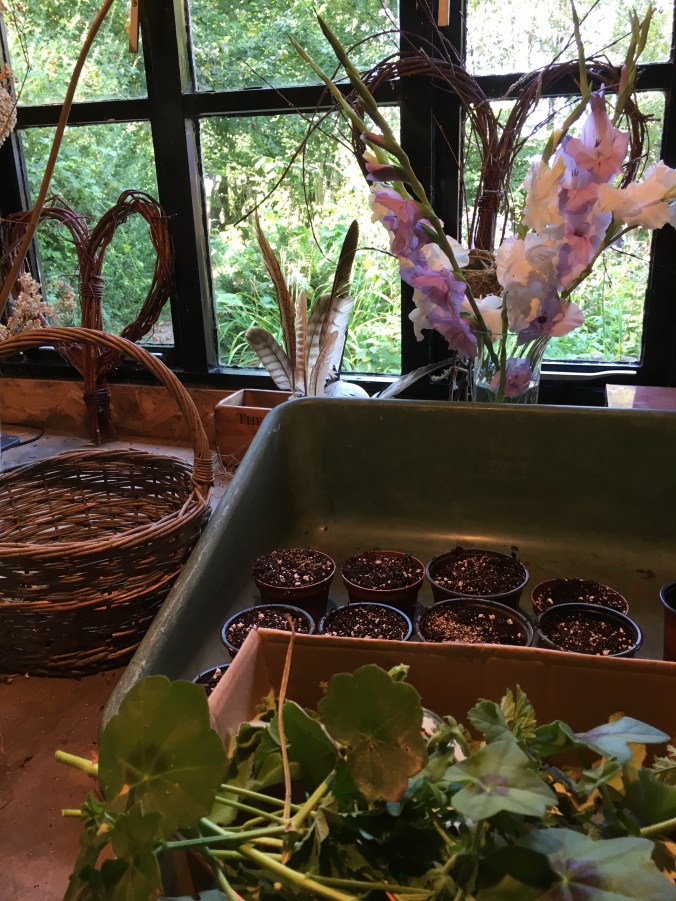
I’ve got an ancient wood and metal garden nursery trolley which I station outside the greenhouse doors to hold the plants temporarily.

Luckily, it’s a beautiful sunny day with temperatures around 21C. We’ve had one night of frost, but no damage so far. Night time temperatures are dipping into single figures though, so there’s no time to waste.

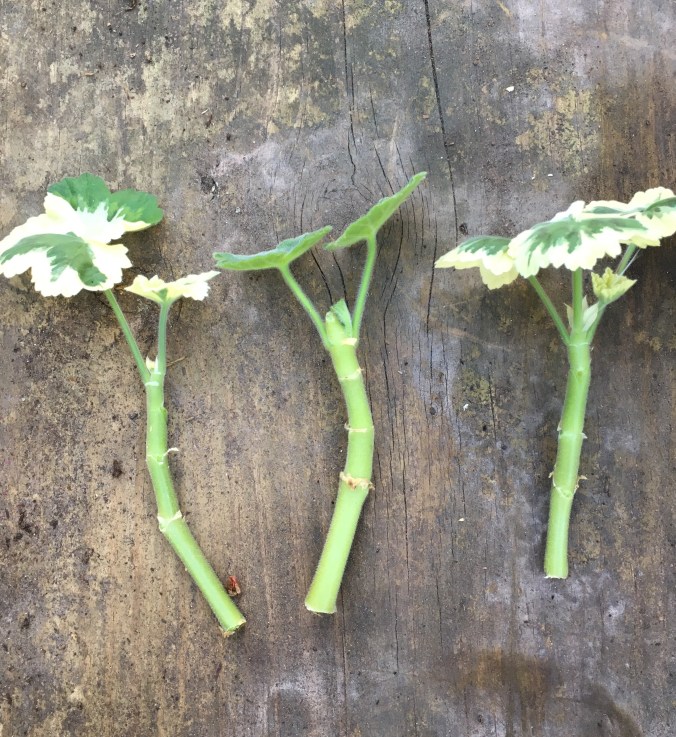
I quickly snip off 3″ cuttings from non-flowering shoots and pile them in my trug. To take cuttings, I cut above a pair of leaves to start with. Then I use a sharp knife to cut below a leaf joint where there’s a concentration of hormones to aid rooting. I use my fingers to snap off all but three leaves at the top. Any large leaves are cut in two to reduce moisture loss. The soft, tiny winged growth on the stems is rubbed off as they attract mould. I gently rub over the leaves to check for aphids.

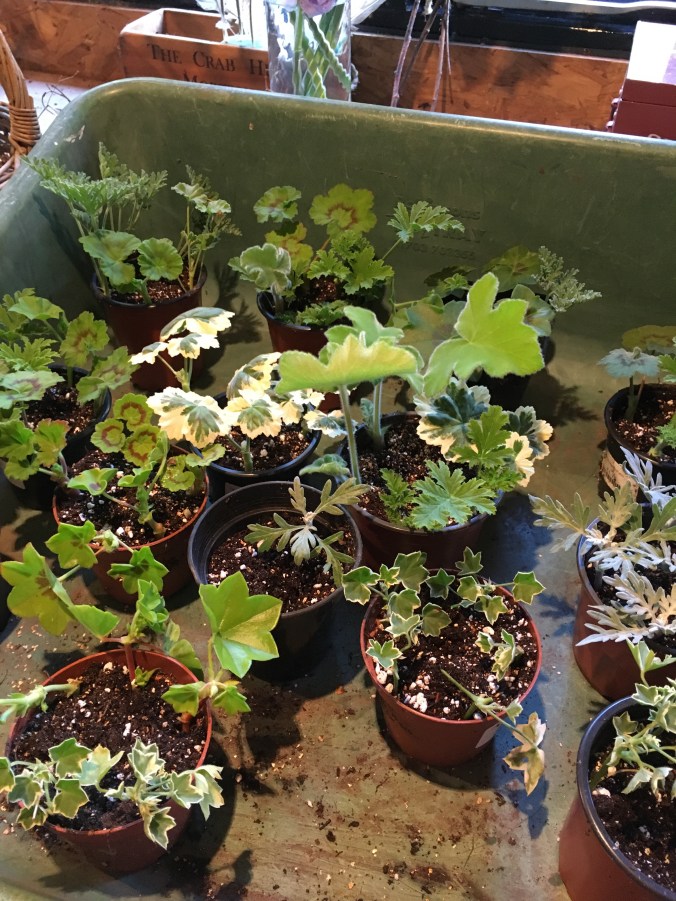
I fill 9cm pots with 50% peat-free multi-purpose compost and 50% grit or perlite for drainage. Tap the pots on the table to settle the compost. Cuttings need air as well as moisture to grow, so I don’t squash the compost down.

It’s still warm enough to work in the potting shed. There’s a robin in the eaves, quietly twittering away. Sometimes robins can be incredibly loud, at other times its almost a whisper. It’s as if they are singing to comfort themselves. It comforts me as well to have such calm and joyful company.

All potted up, I water them once and set them somewhere cool, bright and frost free to root. The west-facing potting shed window will do for now, out of direct sunshine. They will spend their winter in the greenhouse though with a fan heater set at 6C. Next spring, I’ll tip them out and pot them into individual 9cm pots.

Back in the greenhouse, all the staging is cleared and jet washed down. Any spiders are relocated to the poly tunnel. I can’t kill anything. Slugs and snails go into a dry ditch beyond the boundary hedge. Food for other creatures, I hope.

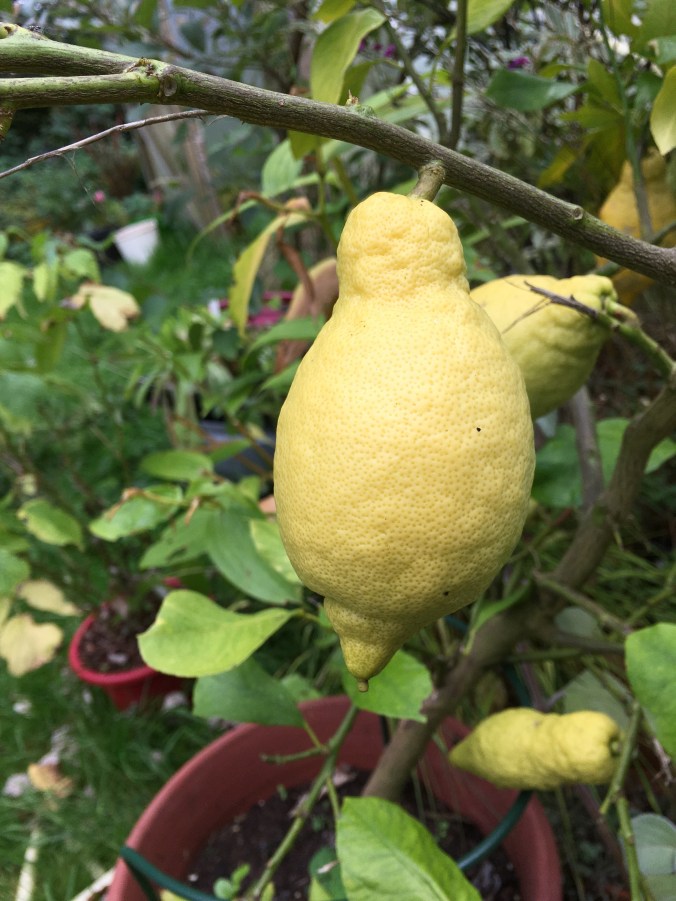
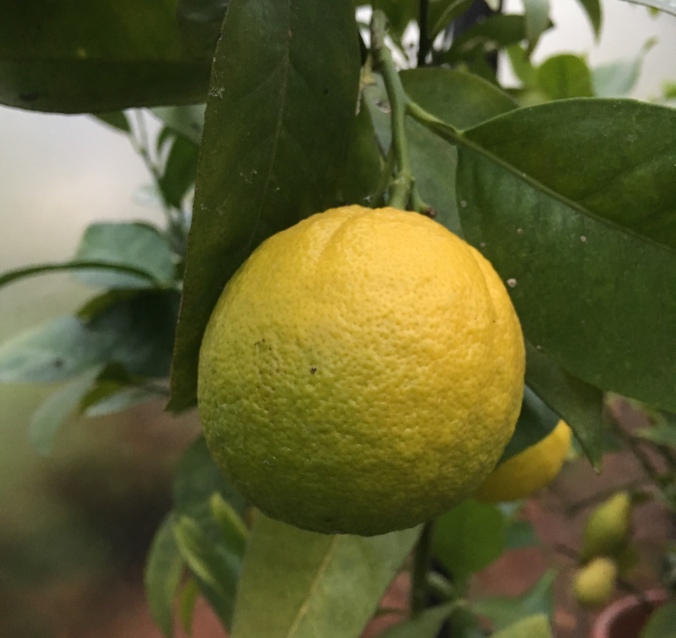
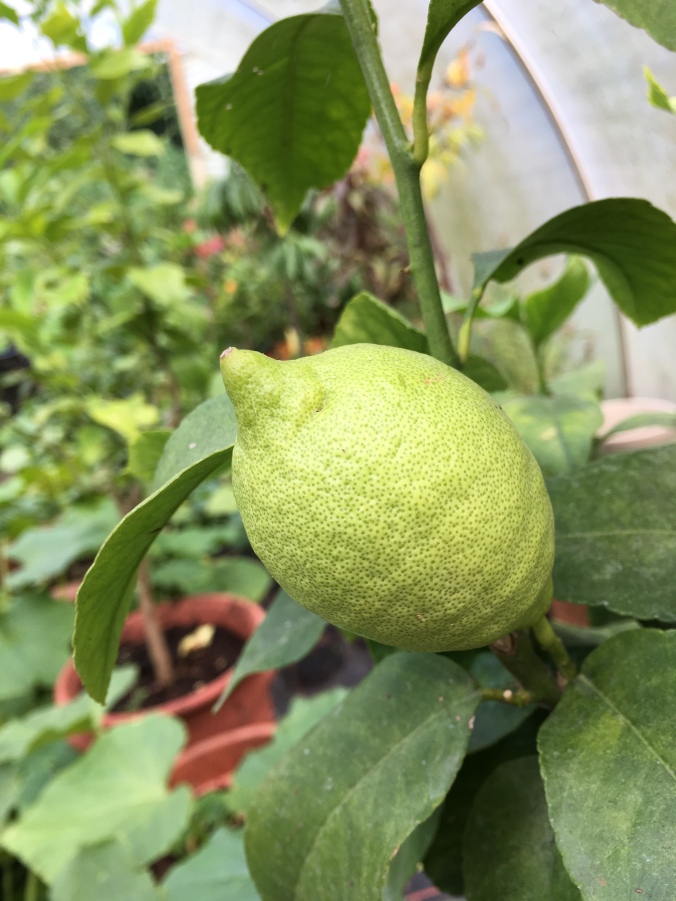
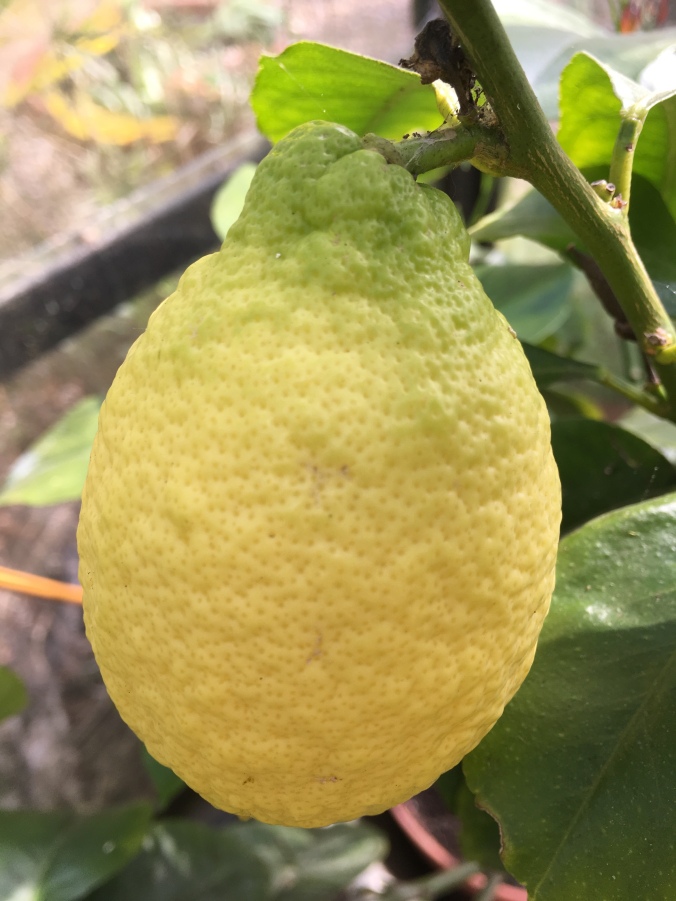
When I’ve cleaned the glass and repaired the sliding door mechanism, I’ll push the citrus trees back in for the winter. It’s been a good summer for lemons and oranges. A few lemon cakes and orange marmalade might be in order….

Winter salads and micro veg are springing up in shallow terracotta pans. There will be more room now I’ve cleared out the huge pelargonium pots.

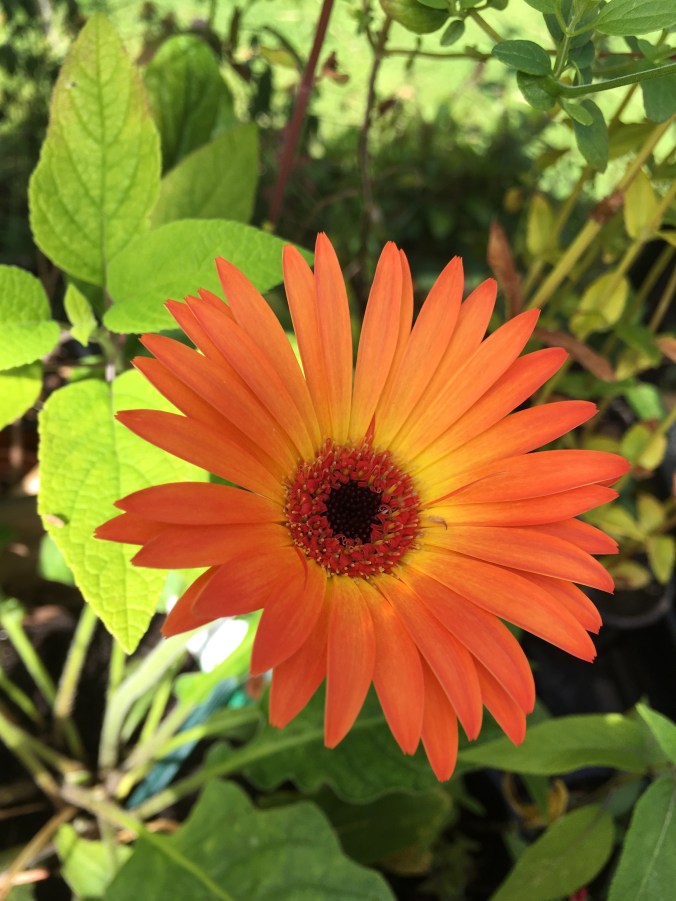
Luckily, there’s a few pots of colour left. This orange gerbera has been flowering for months. And my purple bougainvillea usually flowers into December. I haven’t quite finished polishing the glass, or replacing the comfy armchair, the biscuit tin and the radio. That will be tomorrow’s finishing touches. For today, after all that work, I’m collapsing in the summerhouse with a nice cup of tea and mulling over the autumn and winter season to come. I’m ready for anything the weather might throw at us.

Thank you for reading. Please feel free to share this post.

Follow me on twitter @kgimson

On instagram at karengimson1

On #sixonsaturday with https://thepropagatorblog.wordpress.com/2019/09/14/six-on-saturday-14-09-2019/

On #IAVOM with Cathy https://ramblinginthegarden.wordpress.com/2019/09/09/in-a-vase-on-monday-daisies-and-an-infiltrator-2/

Pelargoniums https://www.fibrex.co.uk/collections/pelargoniums/ivy-leaved?page=4

In a Vase on Monday – 9th September 2019

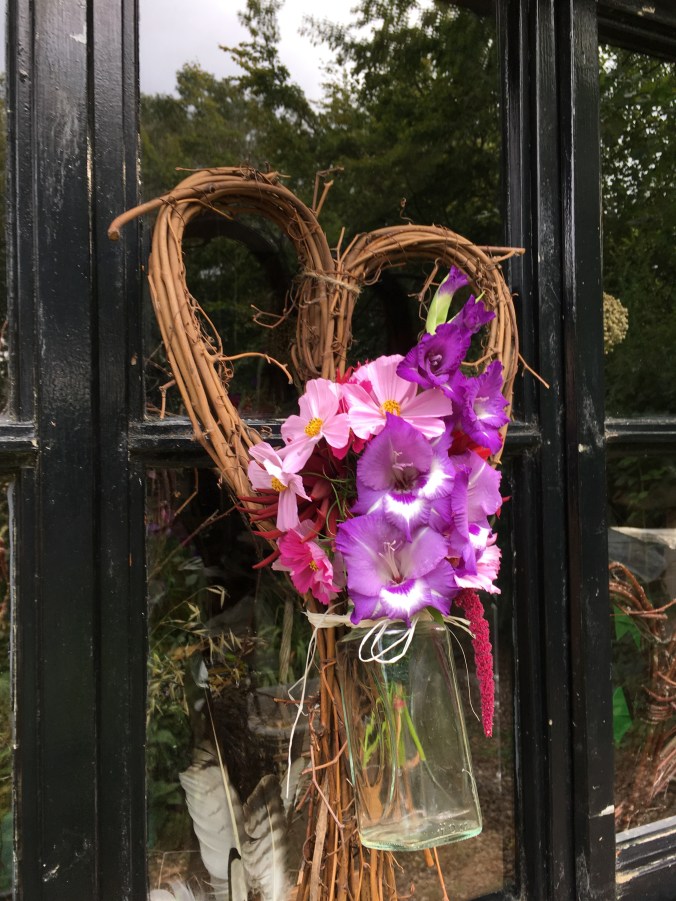
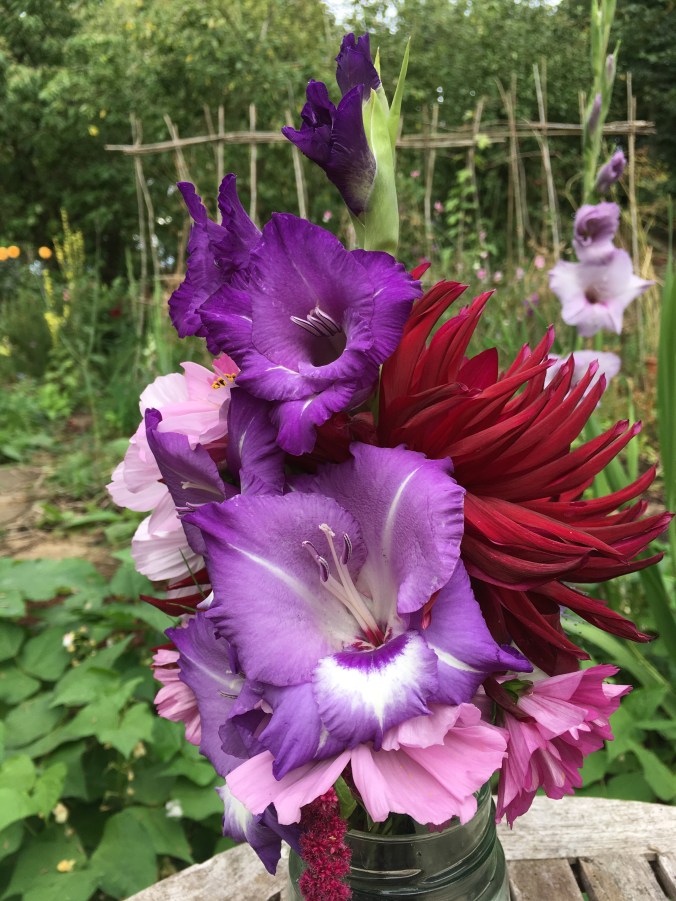
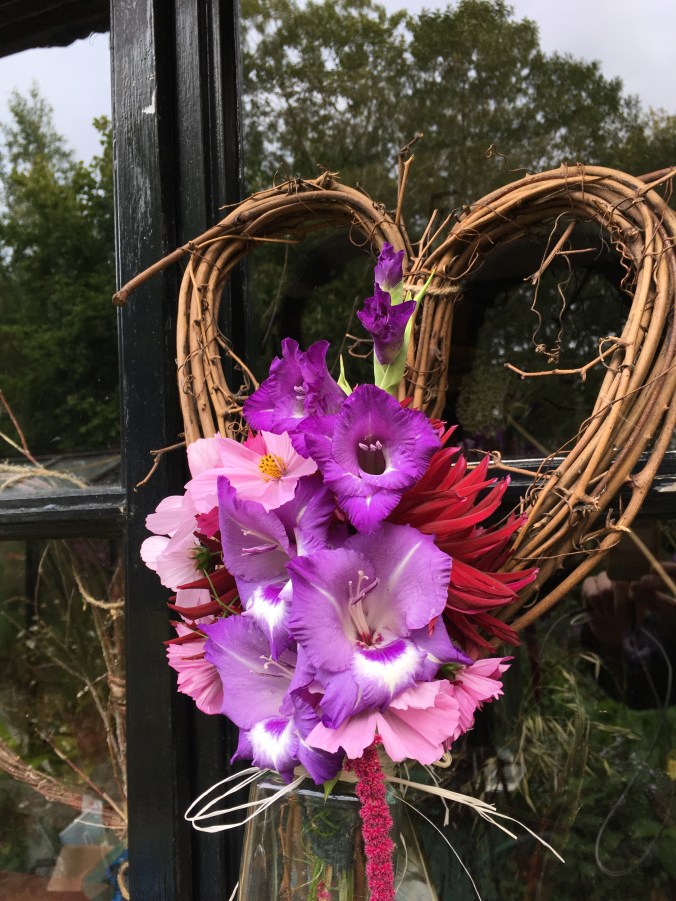
I’m trying to find alternatives to floral foam. Today, I’ve used raffia to attach a coffee jar to my willow heart. A small posy of flowers nestles in the centre of the heart. I’ll be able to change the water each day, and flowers should last at least a week.

We are all having to re-think ways of working. For years I’ve used floral foam blocks for door wreaths and table decorations. But recently it’s become apparent that foam is not recyclable. I’m concerned about inhaling dust from the foam, and also what happens when particles of foam are flushed down drains and end up in water courses. So I’m using jam jars and glass test tubes instead, and hiding the mechanics with moss and fabric.

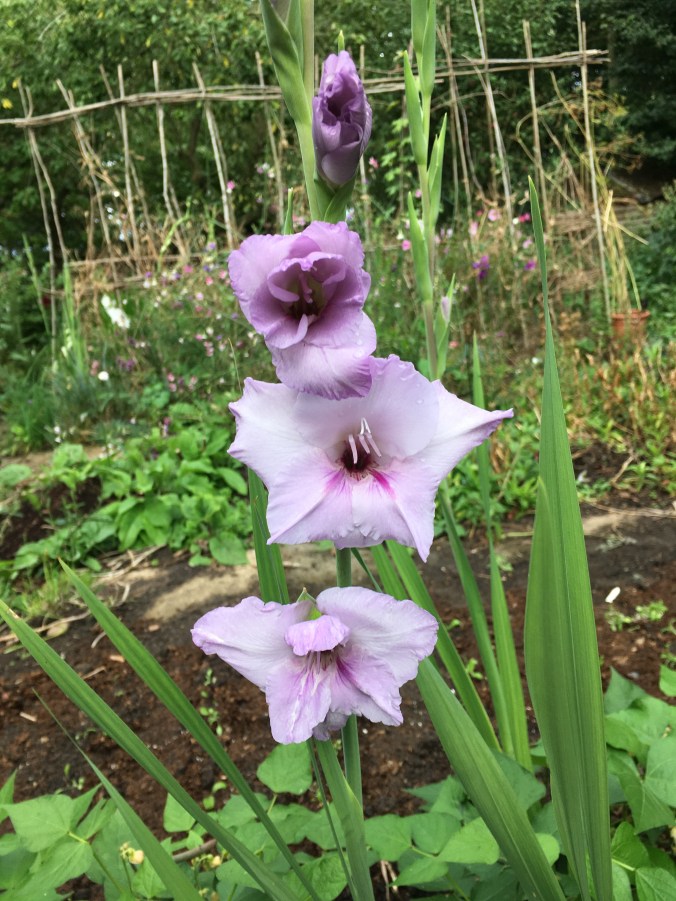
There’s still plenty of flowers on the cut flower patch. I’m growing blue and white gladioli from Gee Tee Bulbs, planted in June for a late summer display. Gladioli bloom in 90 days, so they are a good reliable flower for special occasions such as weddings. You know you are going to get flowers in time. I’ve planted mine in between sweet peas in the middle of the hazel A frame, which gives them support. And also in the middle of late-planted dwarf beans, a combination I discovered by accident last summer, and I’ve repeated it this year. It’s a successful way of saving space. The beans use the gladioli stems for support.

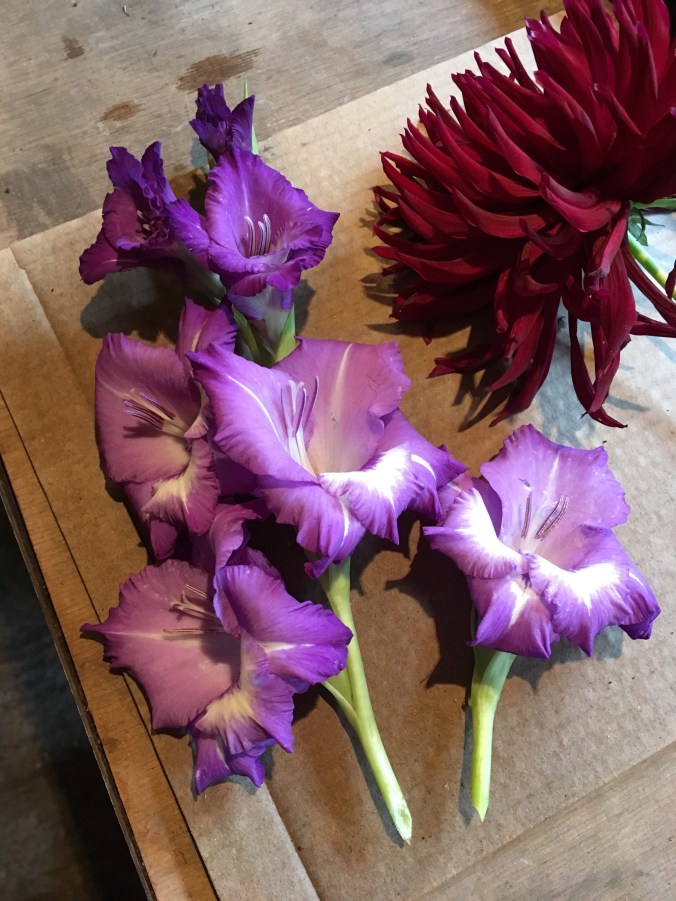
Gladioli can be cut into sections with each flower having a small stem. These individual flowers are good for tiny jam jars. They also make pretty corsages. It makes tall flower stems go further.

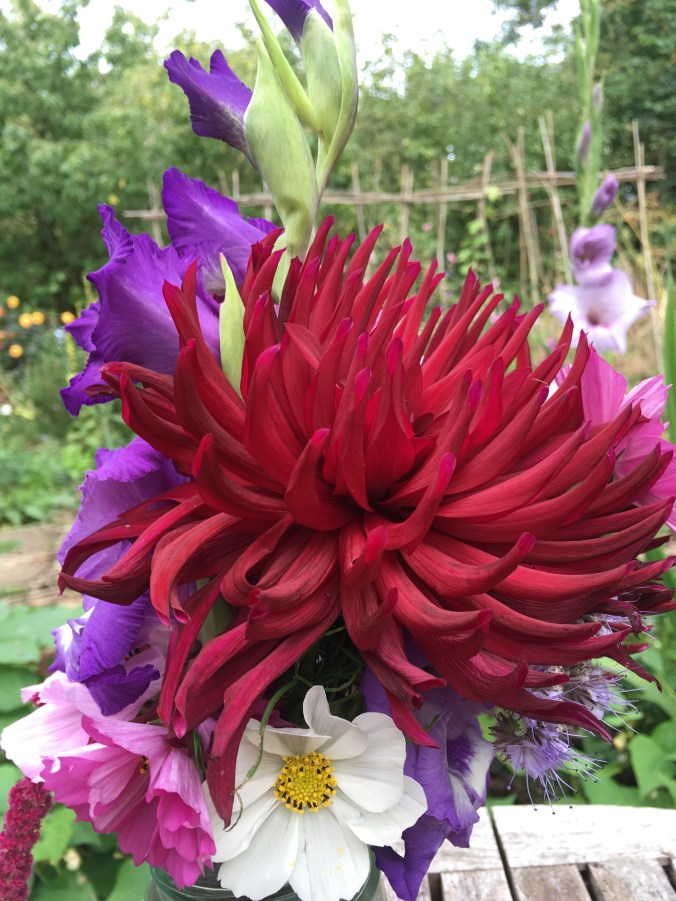
There’s a pretty deep red dahlia flower each side of the posy. I’ve grown this long-flowering dahlia, Nuit d’Ete, for 20 years. It’s a cactus type with huge flowers that last at least two weeks in an arrangement. I’ve noticed that waterlily and cactus types keep opening up with many petals packed in the centre. Single dahlias, good for pollinators, are not so long lasting as cut flowers.

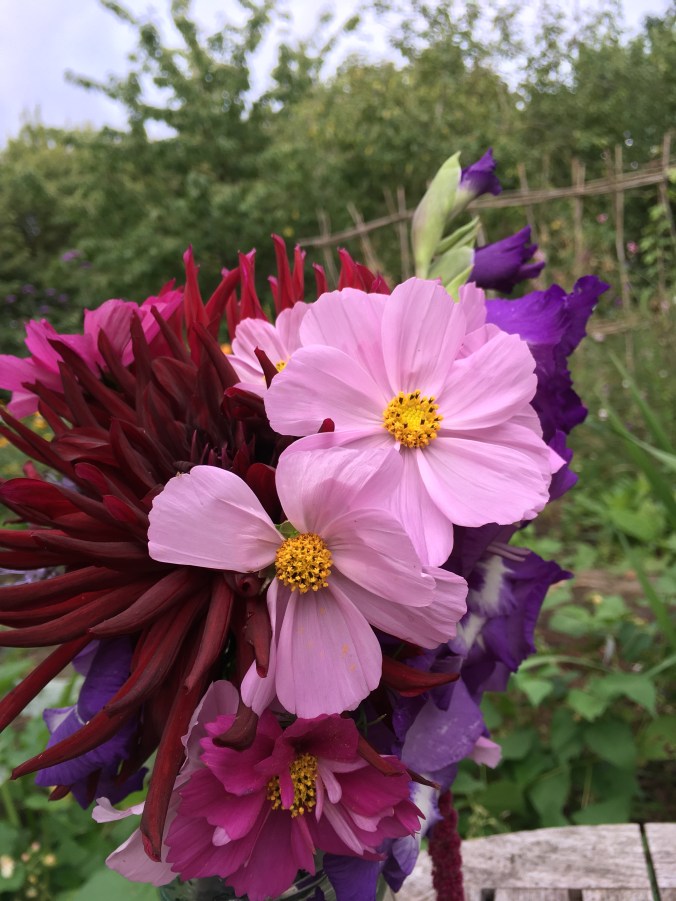
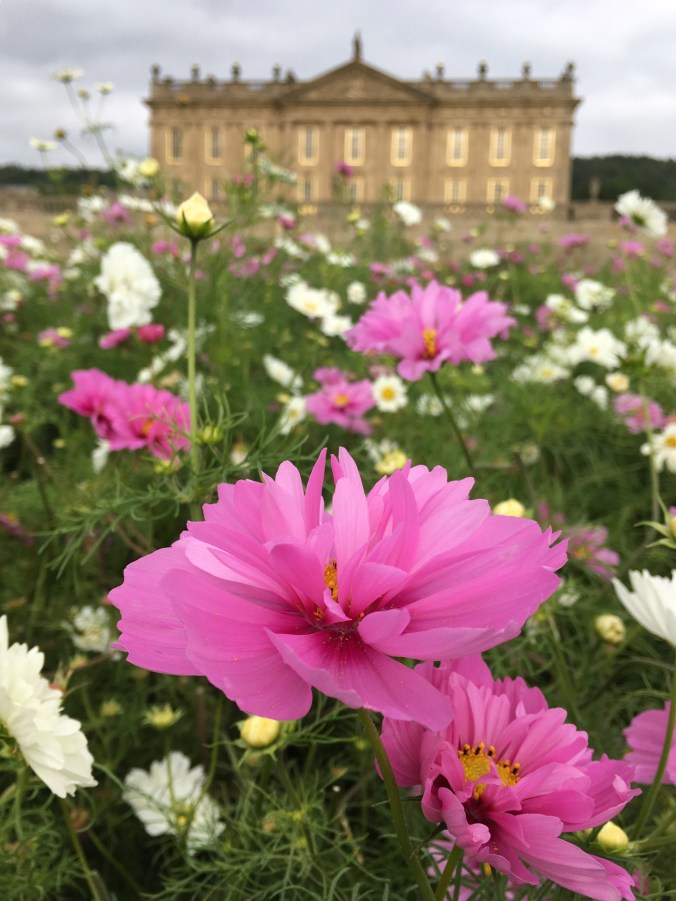
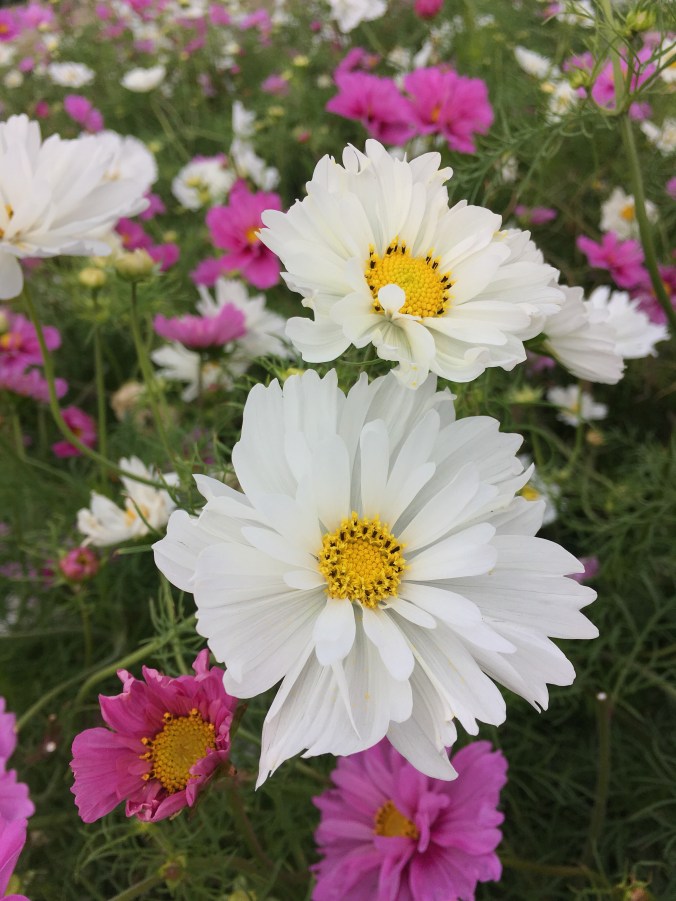
Tucked in around the dahlias are cosmos flowers. This year I’ve been delighted with the seashells cosmos, and also a very pretty ‘all sorts” mix.

Double cerise cosmos flowers have a striking pale pink centre. Cosmos last a week in water. Pollinators love them too. Bees, hoverflies and butterflies were enjoying these today. They followed the flowers across the garden and continued working them after I’d created my heart arrangement.

Cosmos flowers I’m growing this year are pale pink, cerise, and white, and I’m trying some pink and white striped types too.

I’ve propped the heart up on the potting shed window to add finishing touches. There’s some amaranthus tucked in at the base of the posy. My flower heart ended up over the summerhouse door. Hopefully we’ll have some late summer sunshine to enjoy the flowers, and, fingers crossed, we’ll have a few more weeks of nice weather to sit outdoors.

Thanks for reading. Enjoy your week. Hope it’s sunny where you are too.

Links : Cathy IAVOM. https://ramblinginthegarden.wordpress.com/2019/09/09/in-a-vase-on-monday-daisies-and-an-infiltrator-2/

Geetee bulbs :https://www.gee-tee.co.uk/bulbs/gladioli/large-flowered-gladioli

Dahlias: https://www.peternyssen.com/nuit-d-ete.html

Cosmos: https://www.mr-fothergills.co.uk/Flower-Seed/Cosmos-Seed/Cosmos-Seashells-Mixed-Seeds.html#.XXbU5YzTWfA

Cosmos candy stripe :https://www.mr-fothergills.co.uk/Flower-Seed/Cosmos-Seed/Cosmos-Candy-Stripe-Seeds.html#.XXbVPYzTWfA

Amaranthus https://www.thompson-morgan.com/p/amaranthus-caudatus-love-lies-bleeding/tm01657TM?source=aw&affid=176013&awc=2283_1568068975_9d1ac917267a4f2bf8b84f6e84c0b540

Flower wreaths and eco flower arranging courses : Common Farm Flowers https://www.commonfarmflowers.com/

Apricot and Almond Flapjack- Family Favourite Recipes

My mother-in-law Joan used to make these flapjacks. It’s amazing how quickly a tray of them can disappear. Fresh apricots are in the shops now, and British growers have had a record-breaking crop this year. You can also grow your own fruit. There’s several new varieties for growing in small spaces, such as Compacta. Moorpark is traditionally grown, but there’s a newer apricot, USA-bred Goldcot recommended for flavour and hardiness. Tomcot produces large apricots, and there’s also New Large Early and Isabelle. Golden Glow is a delicious apricot variety, discovered in the Malvern Hills in Worcestershire.

FLAPJACK

Ingredients

400g fresh apricots. Other fruits can be used such as peaches/ plums/ raspberries/ strawberries. Roughly chopped. I didn’t have quite enough fresh apricots, so added 5 dried apricots to my mixture.

2 tablespoon lemon juice

130g light brown soft sugar

230g butter or margarine (use soya for vegan recipe)

100g golden syrup

100g blanched almonds

350g rolled porridge oats

Three quarter teaspoon of cinnamon

Half teaspoon of salt

20cm baking tray, lined with parchment

Recipe

Preheat the oven to 200C gas mark 6.

Place the apricots, lemon juice and 30g of the sugar in a saucepan and simmer gently until cooked. Stir occasionally. It will form a thick purée. Almost like jam.

Place the remaining sugar, butter or margarine and golden syrup in a saucepan and melt together on gentle heat.

Mix all the dry ingredients together and pour in the melted liquid ingredients. Mix together until all the oats are coated.

Place half of the mixture in the baking tray and level. Cover with a layer of the fruit purée. Top the fruit with spoonfuls of the oat mixture. Carefully level the topping, using a pallet knife or silicone spatula.

Bake for 25 minutes, or until the topping is brown. Check after 15 minutes and cover with parchment if it is turning too brown.

Cool completely and cut into fingers.

Can be kept for 3 days in a tin.

Enjoy! 🙂

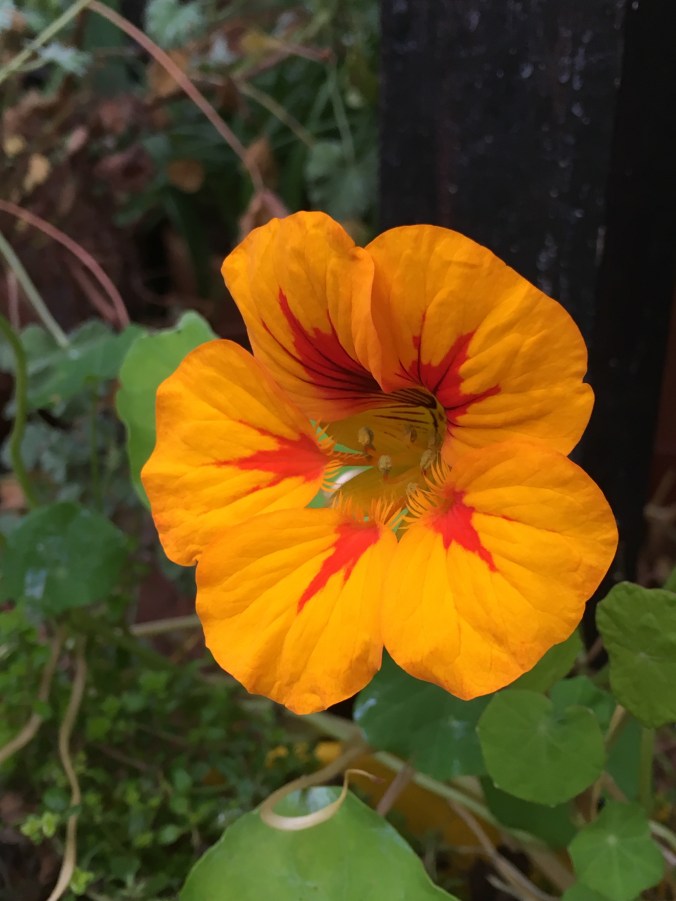
I topped my flapjack with nasturtium flowers, which are edible. Take care when using flowers to decorate food to check that they are edible and haven’t been sprayed with any chemicals.

Links: Apricot trees : https://www.chrisbowers.co.uk/category/apricots/

Nasturtium Tip Top Apricot : https://www.chilternseeds.co.uk/item_1261g_tropaeolum_majus_tip_top_apricot_seeds

In a Vase on Monday – A flower wreath for the summerhouse. Bank holiday flowers #IAVOM

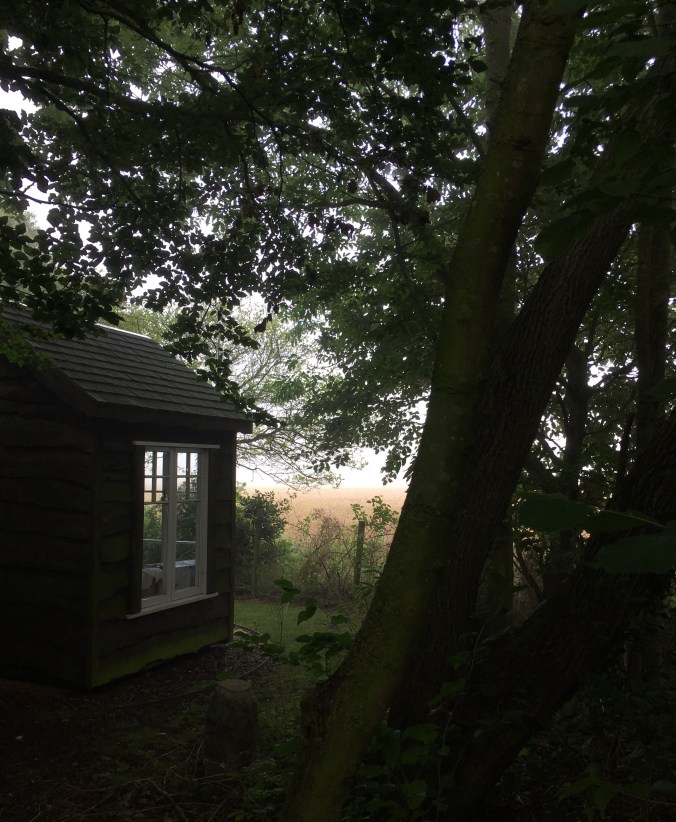
Escaping the heat- it’s 31C here today- I’m sitting in the summerhouse. Facing north. There’s a slight breeze skimming over the horseshoe pond. It can’t really be described as cooling. Alongside us, there’s the sound of straw, drying and crackling in the sun. The harvest is safely gathered in, and now there’s bales of straw scattered all over the field, like some kind of land art installation.

As I’ve moved outdoors for a few days, I’ve made a sweet pea posy for the summerhouse coffee table, the last of my flowers no doubt. And a sunflower wreath, to match the sunny weather.

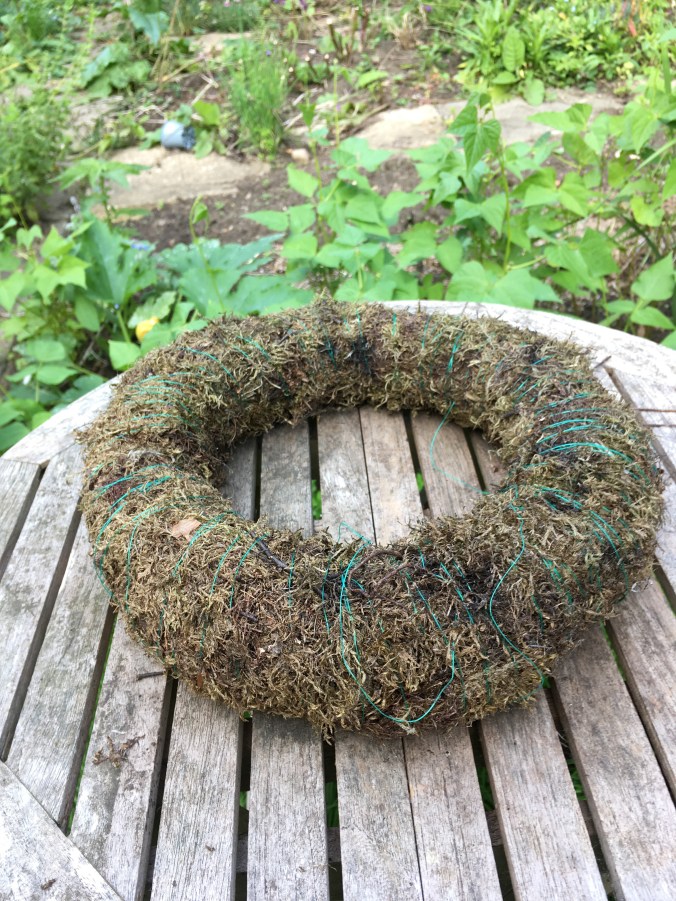
Here’s how I made my wreath. I’ve recycled an old moss wreath I bought a few years ago. You could use a wire, or willow ring and pad it with moss.

Rake some moss from the lawn. You’ll be doing your lawn a favour; now is the perfect time to scarify and aerate your lawn. Or, buy some from a garden centre or nursery. It’s usually sold for making hanging baskets. Soak it in a bucket of water for a few hours.

Squeeze the moss into thick sausages and place on the ring. Wind all around with string, kokadama style. Or use recylable u-shape metal pegs. These are commonly called German mossing pegs. They can be carefully saved and re-used.

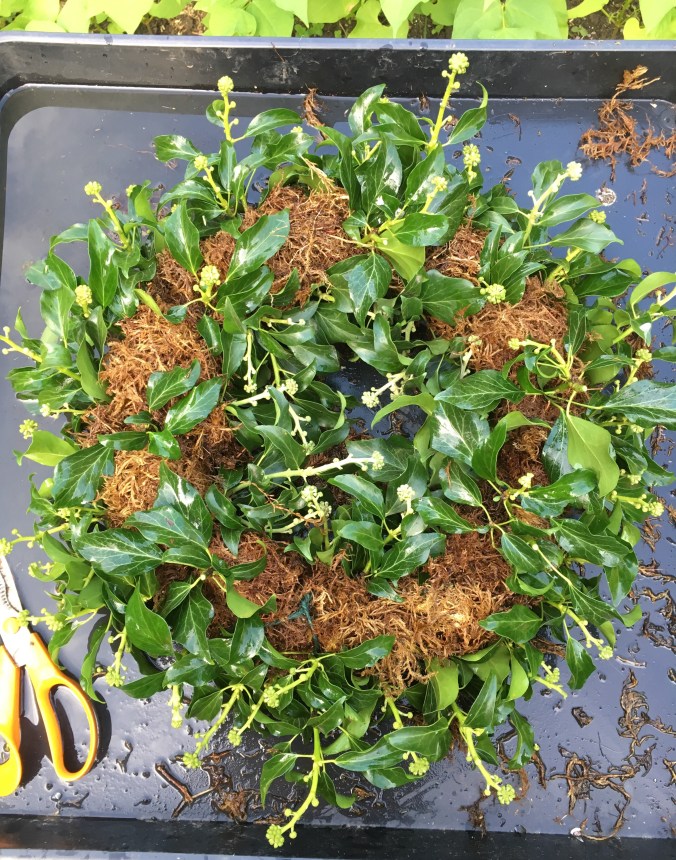
Next, collect sprigs of foliage such as ivy. Any evergreen will do. Plunge them into a bucket of cold fresh water for a few hours, or overnight.

Use sharp florists’ snips -or a kitchen knife to cut the ivy into 15cm sprigs. Don’t use seceteurs for flowers or ivy as it crushes the stems, rather than cutting them cleanly.

Push the ivy into the moss all around the outside of the ring, facing outwards. Push some ivy into the centre of the ring, facing inwards. Push a few vertically down into the ring. You need about 10cm of the stem showing. Secure with mossing pegs if needed.

Cut flowers from your plot, or buy from florists. You will need three focal point flowers for the top. These can be anything of a larger scale than the other flowers being used. I’ve used sunflowers, but you can use lilies, rudbeckia, dahlias, daisies, or gerbera.

Place all flowers up to their heads in ice cold fresh water in a cool dark place such as a potting shed or garage overnight. This conditions the flowers and makes them last longer.

I’ve used white argyranthemums (daisies) of various sizes and my fluffy filler is ammi, sown in the spring.

I’ve also picked out the colour of the yellow centres with some spikes of verbascum. My cut flower patch took a pasting in the wind and rain, but flowers seem to have survived, even if they are now horizontal.

Place three focal point flowers at the top first. Then add the next focal point flowers – large white daisies in a triangle, at each side and bottom of the wreath. It’s difficult to push into the moss, so you will find the flowers naturally fall to different angles, which looks best anyway. Next add a few verbascums. These are angled upwards to form a halo of flowers. Add some cow parsley-like ammi as a filler. You could also use gypsophila. Finally add some tiny white oxyeye daisies and field cornflowers. Mine grew from a packet of wildflower seed.

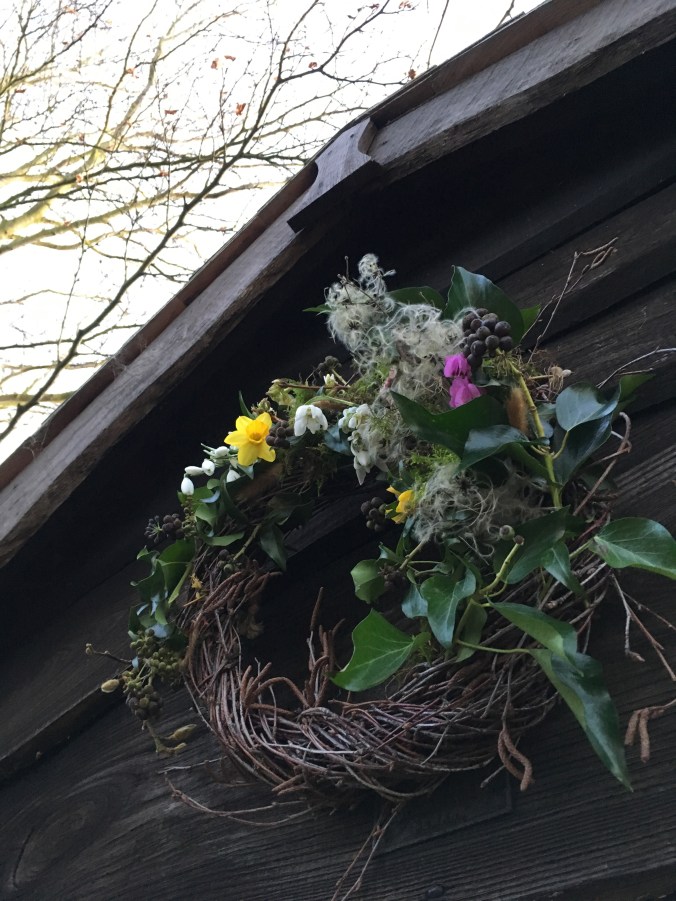
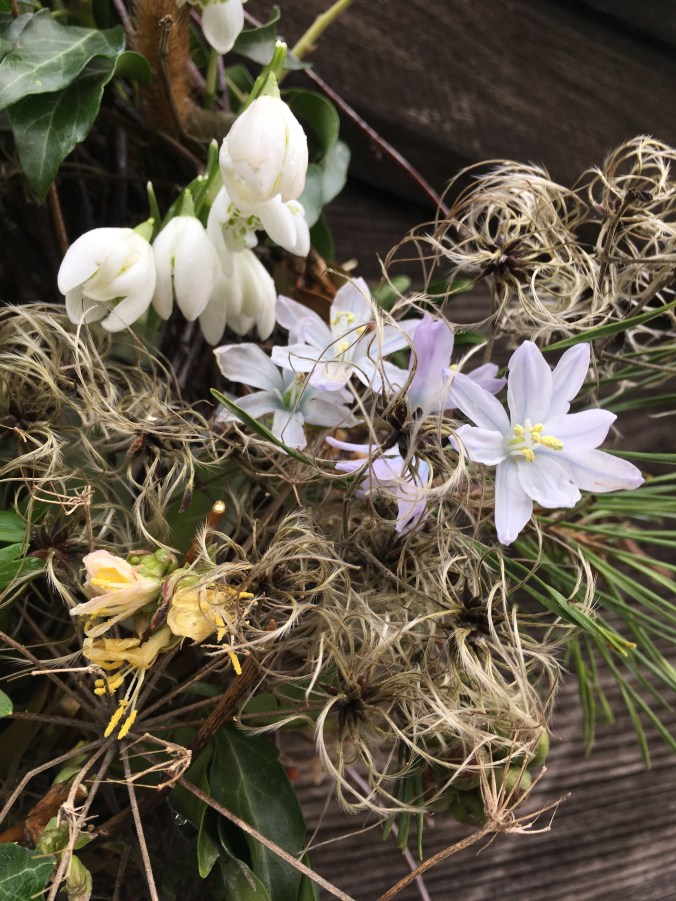
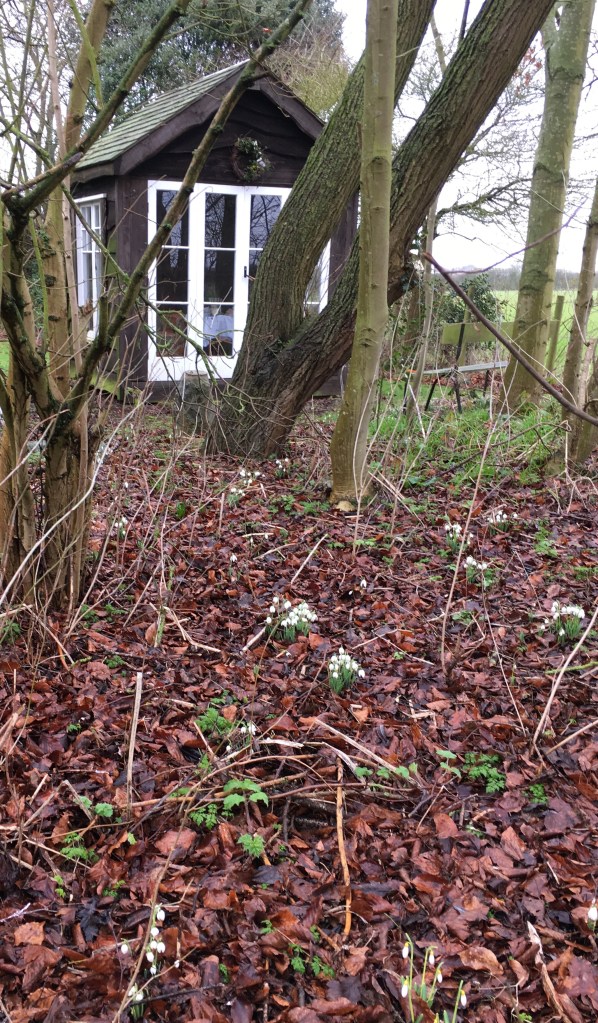
Spray the moss and flowers with water twice a day to keep fresh. Your arrangement will last about a week. You can reuse the base and ivy, adding fresh flowers to keep it going. The ivy will last for around a month. If you’d like to add heavy flowers such as roses and lilies, you can buy some tiny glass test tubes and hide them amongst the moss before adding the ivy. Use wire or twine to secure them. You can top them up with water each morning and the flowers will last even longer. I do this in the spring when I want to put bunches of snowdrops and dwarf irises in my door wreath. Their flower stems are delicate; it’s easier to tie small bunches and place them in the hidden test tubes.

This is a simple silver birch twig wreath. Lengths of twigs are wound around and secured with twine. Ivy is poked into the birch. In January, ivy will last a month without being watered simply because it is cold and damp.

I wrote about the winter wreath here: https://pin.it/iw5zqyz5idkhbe

View from the summerhouse today. My sunflower wreath is in tune with the seasons. It took me about half an hour to make. I enjoy using flowers from my veg plot to create arrangements for the house and garden. All it cost me is a few packets of seed, a bit of string and a couple of florist supplies, which I guard carefully to re-cycle and reuse.

I don’t use floral foam as it can’t yet be recycled. It goes into landfill and doesn’t break down. It’s bad for the environment. Using moss is a good alternative – and it’s natural. At the end if its use, it can simply be composted.

Some tips on cutting flowers comes from Georgie Newbery at Common Farm, where I learned how to grow cut flowers and make natural arrangements.

1. Cut flowers in the morning when stems are full of water.

2. Remove all the lower leaves on the stems.

3. Place flower stems up to their heads in cold, fresh water. Leave overnight in a cool place.

Take care with poisonous plants such as aconitum. Wear gloves and remember to wash hands after handling.

NOTES :

I paid for my courses at Common Farm, and also bought Georgie’s books. I have no hesitation in recommending courses and flowers from Georgie.

Common Farm flowers and courses : https://www.commonfarmflowers.com/?SID=o3dsu9kotrkrq5n05qkulm0433

The Flower Farmer’s Year by Georgie Newbery https://www.amazon.co.uk/dp/0857842331/ref=rdr_ext_tmb

German mossing pegs :https://www.countrybaskets.co.uk/german-mossing-pegs-40-mm-004650

Wild flower seed mix: https://www.mr-fothergills.co.uk/Flower-Seed/Wildflower-Seed/Wildflower-Cornfield-Mixture.html#.XWQcAEzTWfA

Ammi majus seeds and advice https://higgledygarden.com/2013/01/16/sowing-ammi-majus-seeds/

In a Vase on Monday. Why not go over and see what Cathy and the others are making for their IAVOM. https://ramblinginthegarden.wordpress.com/2019/08/26/in-a-vase-on-monday-a-first/

Six on Saturday. Enjoy your Bank Holiday Weekend Everyone. Home is where I’m spending mine.

I often share views through the gap in the hedge. It’s a window on the changing seasons. Today, I thought you might like to see what’s growing in the hedgerow around my ‘window.”

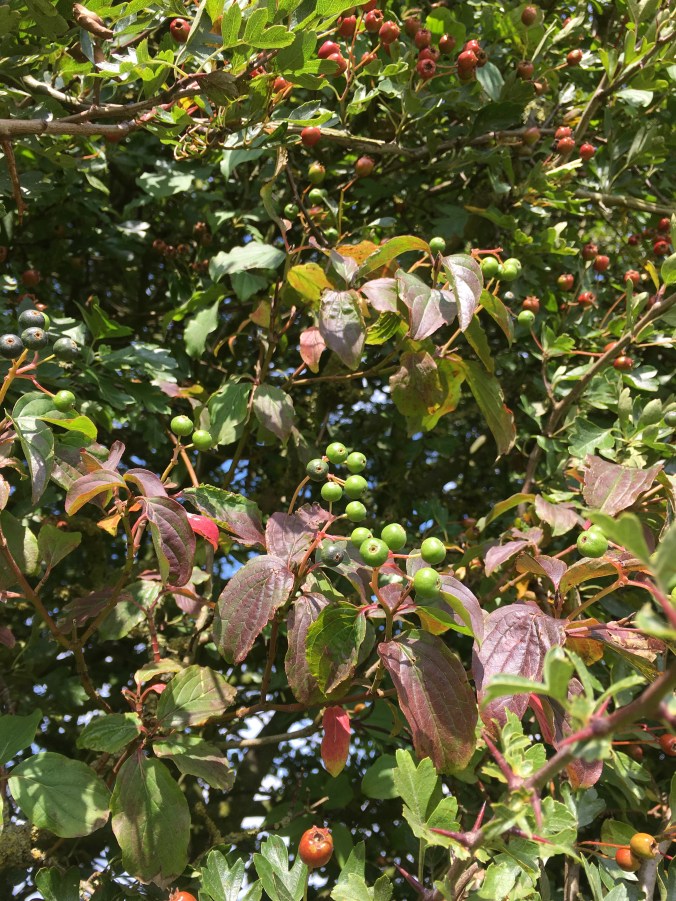
Hawthorn. Crataegus monogyna. Berries are ripening fast. It seems too soon. It feels as if it’s only a short while since snowy white May blossom heralded the end of winter. And here we are, it’s harvest time. It’s a good year for berries. A larder for the wildlife. Hawthorn supports more than 300 species of insect. Flowers are eaten by dormice, and berries called ‘haws’ are rich in antioxidants and eaten by migrating birds such as redwings.

Hazel. Corylus avellana. Again, I feel it’s only a while since I posted photos of ‘lambs tail’ catkins. It’s a good year for nuts. Our garden is ‘raining’ hazel nuts. Even the squirrels can’t keep up with the crop, which is really saying something as their appetites are legendary. I’m often gathering them as fast as I can, while five or six brazen squirrels, adults and this year’s babies, bound across the top of the hedgerow. Multiple holes in the lawn show evidence of where they have ‘hidden’ their harvest. I hope they remember where they’ve left them. Hazel leaves are good for the caterpillars of many moths including the large emerald, small white, barred, umber and nut tree tussock.

The dormouse eats hazel nuts to fatten up for hibernation, and also eats caterpillars in the spring. Nuts are also eaten by woodpeckers, nuthatches, tits, wood pigeons, and jays. We’ve had an adult and baby green woodpecker in our garden all summer. It’s been fascinating watching the adult showing the baby where all the best spots are for food- the rotten wood pile, orchard and patch of grass where chafer grubs thrive.

Field Maple. Acer campestre. Winged seeds are turning red. They will soon be dispersed by the wind. And it can get very windy up here on the ridgeway. I really should have consulted an ordnance survey map before moving here. Gardening is a challenge in gale force winds. Next time, I’d like a nice secluded walled garden, please. Everyone reading this, knows there will not be a next time. I love this wild and peaceful place. I will never move from here.

The Woodland Trust tells me that maple leaves are eaten by several moths, the sycamore moth, small yellow wave, mocha, and the maple prominent, among others. Moths are on the decline so it is a good plant to have in any garden or hedgerow. We have some grown as trees, as well as mixed in the hedge.

Flowers provide nectar and pollen for bees and birds, and small mammals eat the fruit.

This hedgerow is full of dogwood. Cornus sanguinea. Stems and leaves turns a rich burgundy in winter. A wonderful sight on a cold day. Leaves are already starting to take on polished and burnished tints. Green berries will soon turn black.

Leaves are eaten by moths, including the case-bearer moth. Flowers are valuable for insects, and berries are eaten by birds and small mammals. We enjoy standing and watching bats flitting over the hedgerows at night- catching the moths and flying insects. They seem to follow a repeated circuit, a figure of eight, over our heads. You can almost anticipate where they will be seen next. A joyful way to spend a few minutes, or longer if time allows. Owls fly in across the fields to take the small mammals- mice, rats and field voles. We have little owls, tawny and barn owls here. It can be quite noisy some nights, when they call out across deserted fields. The sound carries. We stand quietly and listen.

Crab Apple. Malus sylvestris. Abundant this year. Leaves are valuable for the eyed hawk moth, green pug, Chinese character and pale tussock. Wonderful names that conjure up all kinds of pictures in my mind. I decide to learn more about moths.

Fruit is eaten by blackbirds, thrushes and crows, and also mice and voles. Foxes and badgers forage in ditches for them. When fruit ripens and falls it seems to ‘cook’ gently in the heat. It’s a fabulous scent and always reminds me of apple pie and crumbles.

I read somewhere that you can measure the age of a hedge by the number of different plants growing in it. Apparently, it’s approximately 100 years for each variety. Looking around, I know that farming has been here since medieval times. There are ridge and furrow fields across from our garden and also half way to the village. They are particularly noticeable when fields flood. Furrows pool with water, while the ridges stay high and dry. You can just wonder and imagine how they grew their crops using hand tools, without the aid of machines.

Speaking of machines, the sound right now is combine harvesters north and south. To the west and east, there’s the monotonous chug, chug, chug of bailing machine. Soon there will be ploughing, and the growing season starts all over again.

I hope you’ve enjoyed my view through the gap. I didn’t make the gap, nature did. But I look through it each day to spy the changes, and sometimes there’s hares, pheasants, fox cubs, all unaware that I’m watching.

Links : New hedging plants for my garden come from Hopes Grove Nursery, a family business in Tenterden. They supply ‘hedge-in-a-box collections for wildlife, cutflowers, gin making. Their latest collection is a horse-friendly range, suitable for field boundaries.

Hopes Grove Nursery.

Woodland Trust: https://www.woodlandtrust.org.uk/

Barn Owl Trust https://www.barnowltrust.org.uk/barn-owl-nestbox/owl-boxes-for-trees/

Plum Cake. Family Favourite Recipes

These delicious little cakes travel well and are perfect for picnics and parties. We always make them if we are invited round to a friend’s house. They are quick and easy to make and really tasty.

INGREDIENTS

Makes 12

12 plums, stones removed and fruit chopped into chunks.

For the sponge:

85g (3oz )sugar

85g (3oz ) margarine or butter.( I use Lurpack which doesn’t contain palm oil.)

1 egg

113g (4oz) self raising flour

1 level teaspoon baking powder

1 tablespoon milk

1 teaspoon good quality vanilla extract

Few blanched almonds for the top.

METHOD

Cream together the sugar, margarine and egg with an electric hand whisk. Add the flour and baking powder and whisk. Add the milk and vanilla extract, and whisk.

Place the chopped plums in the base of a silicon cup cake mold which has 12 ‘cups.’

Top with the sponge mixture. It will be about one large heaped tablespoon per cup. Sprinkle blanched almonds on top.

Cook for approx 15 mins at 180C, 356F gas mark. They are cooked when a knife comes out clean from the sponge. Take csre not to burn the almonds.

Leave to cool in the trays. Use a pallet knife to remove them. Sprinkle with sugar. Serve warm or cold.

Can also be frozen on the day of baking.

Enjoy!

You might also like Plum Crumble : https://bramblegarden.com/2019/08/20/plum-crumble-family-favourite-recipes/

Please feel free to share this on any social media. Thank you.

Plum Crumble- Family Favourite Recipes

Crumbles are a simple family pudding which can be varied according to the fruits in season. At the moment, we have plums from our Victoria plum tree. We’ve filled the freezer and made jam. Here’s my favourite plum crumble, using a recipe that came from my grandmother.

BASIC CRUMBLE TOPPING

Ingredients:

225g (8oz) plain flour

150g (5oz) soft brown sugar

75g (3oz) butter

1 level teaspoon baking power

METHOD

Place all the ingredients in a food processor, or rub in with your fingertips, until combined.

You can freeze this mixture until needed, if required.

Sprinkle the mixture all over the fruit in a 1.75 litre (3 pint) pie dish, spreading it out with a fork.

Bake for 30-40 minutes or until the top is tinged with brown.

Oven temperature : 180C 350F gas mark 4

FRUIT SUGGESTIONS

Plum, Ginger and Almond : Add 1 teaspoon of powdered ginger to approx 900g plums cut in half with stones removed. Top the crumble mixture with a sprinkle of sliced almonds or chopped nuts. Take care not to burn the almonds.

Rhubarb and Ginger: 900g chopped rhubarb, 1 level teaspoon powdered ginger, 75g brown sugar.

Gooseberry: 900g fruit, topped and tailed. 6oz caster sugar.

Apple: 900g apples, 25g soft brown sugar, quarter teaspoon cloves, 1 level teaspoon ground cinnamon, 75g raisins. Cook all the ingredients in a saucepan until the apple is soft. Remove cloves and place apple mixture in a pie dish. Cover with the crumble topping.

Enjoy 😊

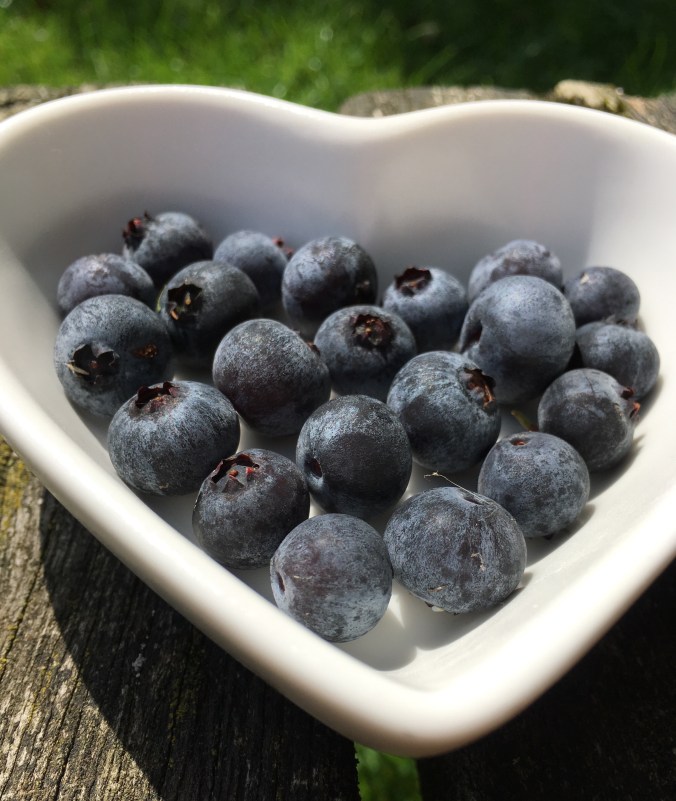
More fruit from the garden. Blueberries and blackberries. Can be added to apples for a delicious alternative crumble.

You might also like

https://bramblegarden.com/2017/08/22/peaches-and-plums-crumble-and-jam/

https://bramblegarden.com/2018/07/26/summer-fruit-harvest-and-making-garden-jam/

Garden Visit : Little Ash Bungalow, Devon NGS

Plant Paradise

It takes a lot for me to leave my cosy potting shed. I’ve created a happy little haven, with all creature comforts; kettle, toaster, comfy chair, reading corner. Cat and new puppy for company. But, I was enticed out recently to visit a garden I’ve heard a lot about, Little Ash Bungalow at Fenny Bridges, Devon. And I’m happy to say, it was well worth the journey. The garden is a delight. Rare and unusual perennials, trees and shrubs. A plant paradise. Here’s a photo ‘slide show’ of my visit. The garden is open this Sunday, 18th August from 1-5 for the National Gardens Scheme.

Francoa sonchiflolia. Known as bridal wreath. An evergreen perennial with lance-shaped basal leaves and 80cm tall spires of rich pink flowers. Not totally hardy in more exposed gardens.

Astrantia Little Ash Seedling, blue echium vulgare and pink Salvia Penny’s Smile. A lovely contrast of flower forms. This combination has a long flowering season. Astrantias have a good ‘skeleton’ structure once the flowers have gone over.

Purple Veronicastrum Fascination partnered with red Persicaria amplexicaulis and white Persicaria alpina. I’ve just discovered ‘persicum’ is Latin for peach and refers to the long peach-like leaves.

Grey-leaved Melianthus major (honey flower) creates a background to blue agapanthus, bright pink Diascia personata and mauve Verbena officianalis grandiflora Bampton.

Agapanthus thrive in the well-drained gravel beds up by the house. The evergreen agapanthus is deep blue africanus variety.

From the top terrace, looking down the right hand side of the garden, to the glorious East Devon country views beyond.

Owner Helen Brown has made the most of the views. Here she’s framed them with a series of arches covered with climbers such as ornamental vine, Vitis Purpurea and scrambling viticella clematis.

In the gravel just in front of the steps, there’s Dierama, known as angel’s fishing rods. Grass-like leaves with tall graceful flowering spikes. The flowers dangle down, hence the common name. I’ve found this difficult to grow in my wet Leicestershire clay. It’s a plant that needs a perfect balance of good fertile soil with excellent drainage. Not easy to achieve.

The view through the second arch. There’s a white clematis Paul Farges, or summer snow, on the right.

At the end of the view, there’s a granite and metal sculpture. These were originally rollers in wooden frames, pulled by horses to flatten clods in the surrounding fields. The metal parts came from more modern Cambridge rolls, pulled by tractors. In the background you can see an area of moisture-loving planting alongside a stream, with a path leading to a pond.

A focal point metal seed head sculpture in the centre of the mini-meadow.

Umbellifers in the meadow. Very attractive to bees, butterflies and hoverflies.

Looking over a low farm fence, there’s a paddock full of grasses and wild flowers such as yellow rattle and yellow Lotus corniculatus, bird’s foot trefoil.

The whole field is covered in tiny white flowers. We know this as stitchwort, a type of stellaria.

Helen leaves flowers to set seed for birds to enjoy. This is a Silybum marianum with thistle-like seeds just about to take flight. I’m glad I captured the moment, and I’m glad I made the effort to leave my potting shed to see Helen’s garden in all its glory.

Little Ash Bungalow is a 1.5 acre garden regularly open for the NGS, and also open by arrangement for groups of 10 or more on pre-arranged dates. Admission is £4 adults, children are admitted free. Cakes and refreshments usually available. Dogs on leads welcome.

Little Ash Bungalow, Fenny Bridges, Devon, EX14 3BL

https://ngs.org.uk/view-garden/21320/

Notes:

Other plants I noted, if you are a keen plants person: Roscoea Royal Purple, Crinum powellii Album, umbellifera Conopodium majus, Hedychium spicatum, Buddleja weyeriana, Clethra alnifolia for perfume, Grevillea victoriae, Cuphea blepharophylla, Buddleja lindleyana, pitcher plants, rudbeckia, Catalpa erubescens Purpurea, Phlox Starfire, Crinodendron patagua, Lobelia urens, Gladiolus papilio Ruby, Miaianthemum racemosum, bamboos, pond plants, bog plants and clematis – many unusual varieties.

Six on Saturday. Wind-Swept Walk Around My Garden on 10th Aug 2019

I don’t like windy weather. It makes me unsettled. I worry about everyone’s gardens. So much effort goes into growing flowers, fruit and veg, it’s heartbreaking when it’s destroyed by the weather.

I’ve waited all day for the wind to drop. It hasn’t. So it’s a blustery, sort of a walk around my garden. My dahlia stems are pointing in all kinds of crazy directions. I should have staked them better. But I didn’t. This one is still looking lovely though. It’s a decorative double called David Howard. Beautiful, orange-blushed flowers 10cm across, set off by bronze-tinted foliage. Plants grow to about 75cm, unless toppled by the rain and wind……. sigh.

Double flowers like these last around two to three weeks in a vase. They keep on opening up, like a ripple effect, until the centre is revealed. Well-known florist Jonathan Mosley gave a demonstration at the Belvoir Castle Show recently and revealed a few tips on getting the best out of cut flowers: Use a very sharp kitchen knife to cut flowers, not secateurs which crush the stems rather than cut them cleanly. Walk round with a bucket of very cold fresh water, and drop stems straight in, so air bubbles don’t get the chance to form in the stems. Cut flowers early in the morning and stand them up to their heads in water in a cool dark place such as a potting shed or garage for at least 6 hours before using them in arrangements. Giving them a really good drink makes them last much longer.

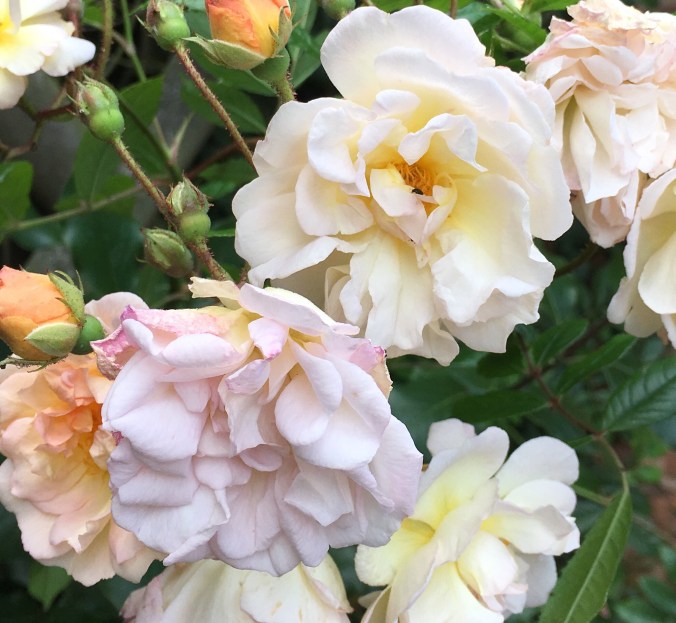
I’ve decided to go for an apricot-coloured theme this week. It might help calm our shattered nerves. This is one of my favourite rambling roses, Ghislaine de Feligonde. It flowers in huge swathes in June, and then puts out the occasional flower right through the summer. Bees love it, it’s free flowering and doesn’t get blackspot. All cause for a celebration, I think. Plus is looks good in a a vase.

In keeping with the colour scheme, there’s some beautiful seedling spider day lilies bred by Pollie Maasz at Pollie’s Lilies. These ones don’t have a name as they are trial plants. Pollie selects the best from her trials and registers new names. It’s a fascinating process and I’m glad to have some of her “babies” to try out here.

I am very fond of New Guinea hybrid impatiens. They flower all summer for no effort other than watering and feeding with seaweed extract or liquid tomato fertiliser. I don’t even bother to dead head them, they seem to sort themselves out. This one is Magnifico Star Orange. Cheerful even when it’s raining and blowing a hooley in the garden. I can always pretend I’ve been transported to the tropics.

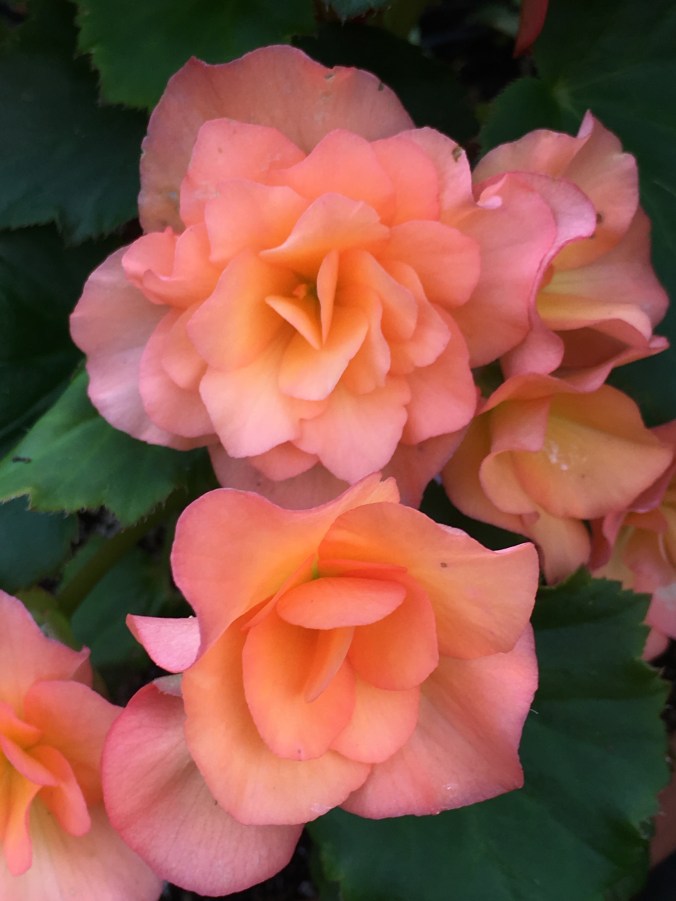
I love begonias. This one is from the Apricot Shades range and is good for containers and hanging baskets. It will flower its heart out until the first frosts, then I’ll bring it in to the frost free greenhouse for winter. Dried off and kept indoors, it can be started into growth each spring. A really good value plant and so many lovely colours to choose.

Finally, from my pelargonium collection, there’s this beauty. This is one of the species hybrid pelargoniums from Fibrex Nursery. I think it is Pelargonium Ignescens, but will stand to be corrected. I have quite a few from the nursery and the labels have long gone. This one dates back to the 18th century and has pretty soft, downy leaves too.

I hope you’ve enjoyed your walk round my garden today, despite the howling wind! This is the view from the far hedge, in the back field behind my garden. It’s a wonderful place to stand and observe the weather. You can see for miles and today the farmer has started – then stopped – harvesting the corn. In a day, the crop will be safely gathered in, and the scene will change again, with ploughing the next sound we’ll be hearing.

Links: sos are https://thepropagatorblog.wordpress.com/2019/08/10/six-on-saturday-10-08-2019/#comments

Dahlia David Howard: https://www.rhs.org.uk/Plants/57111/i-Dahlia-i-David-Howard-(D)/Details

Rosa Ghislaine de Feligonde https://www.ashwoodnurseries.com/shop/rosa-rambling-ghislaine-de-feligonde.html

Pollie’s dayliles https://www.polliesdaylilies.co.uk/

Fibrex https://www.fibrex.co.uk/

Dancing with Bees- prize draw winner. And The Good Bee Review. New books

Thank you everyone who left a comment on my review of Brigit Strawbridge Howard’s new book, Dancing with Bees. All names were put in a hat and a winner randomly selected. A copy will be posted to Debi Holland when it’s published on 5th September.

photo: Bees loving Echinacea White Swan in my cut flower patch.

I wrote about Brigit’s new book here: https://bramblegarden.com/2019/08/04/dancing-with-bees-a-journey-back-to-nature/

Chelsea Green Publishing. Publication date: 5th September. £20, hardback.

Meanwhile, more new books….I have one prize draw copy to give away of :

The Good Bee- A Celebration of Bees and How to Save Them

by Alison Benjamin and Brian McCallum.

Published by Michael O’Mara Books, 2019.

Hardback. £9.99

It’s a delightful little book, full of insights into the secret lives of bees. The section on gardening for bees is particularly helpful. There are five simple steps to start helping bees:

* plant year round flowers, shrubs and trees

*provide nesting sites and materials

*ditch the weedkiller and bug sprays

*leave the mower in the shed

*create a bee watering hole.

There’s ideas for making DIY bee hotels and info on where to site them. A charming, well-written book packed full of interesting facts. It would make a perfect stocking -filler present for anyone wanting to know more about bees.

Alison Benjamin and Brian McCallum discovered their passion for bees and beekeeping twelve years ago. Since then they’ve set up Urban Bees, working with communities, charities, businesses and the public to raise awareness about all bees and support bee populations through education. They established a number of apiaries around London, including in Regent’s Park. They have written three books together, including their bestseller, A World Without Bees.

Please leave a comment below to be included in the draw. No purchase is necessary. A name will be randomly selected by the publishers. There’s no cash alternative.

Links:

The Good Bee : https://www.mombooks.com/book/the-good-bee/

Dancing with Bees : https://www.chelseagreen.com/product/dancing-with-bees/

Next Review coming up, with a prize draw copy is:

The Garden Jungle, or Gardening to Save the Planet, by Dave Goulson.

https://www.penguin.co.uk/authors/1070593/dave-goulson.html

It’s been a fantastic summer for books- for wildlife-friendly gardeners.

I’m Growing New Potatoes for Christmas.

New potatoes are more than just a treat for early summer, you can enjoy them into the winter too. Started now, they will be ready to eat by Christmas. Here’s how I’m growing mine.

Special seed potatoes are available online, in catalogues and in garden centres now. I’m growing Charlotte and Pentland Javelin which are favourites for taste. You can also buy Nicola and Maris Peer. These are cold stored potatoes, primed ready to plant in August. You can also hold back some of your spring-bought seed potatoes, but you have to keep them in the bottom of the fridge until now, before planting.

Royal Horticultural Trials at Wisley showed that potatoes grow best in bags rather than rigid-sided plastic plant pots. You can buy special potato sacks, but I’m re-using compost bags. It’s a good way to recycle them.

I’m using Dalefoot salad and vegetable compost. Roll the tops down to form a collar, spike the bags to give good drainage, and fill them with 30cm of loosened compost.

Sit the seed potatoes on top of the compost. Ensure they are not touching, place them about 20cm apart.

Cover the potatoes with 5cm compost and water well. Place outdoors on a sunny patio. As the shoots start to grow, cover them with more compost and roll up the compost collar. Keep doing this until there is a 5cm gap left at the top for watering. What you are doing is “earthing up” the potatoes, without all the effort involved on growing them in the ground.

Move the bags, before the first frosts, into a greenhouse, porch or conservatory. By now the top growth will have died back and can be removed. Stop watering and keep the potatoes stored in the dry compost until you want to cook them. Because they have not been harvested and exposed to sunlight and air, the potatoes will not form hard skins and will retain that new potato taste and texture. In the past growers would have stored them in damp sand. My grandfather used to make “clamps” for vegetables such as potatoes and carrots, when vegetables had to last right through the winter without the availability of fridges and freezers.

I use soil association-approved Dalefoot Compost which is made from sheeps wool and bracken. It gives farmers in the Lake District an income for their wool which might otherwise go into landfill. It’s 100 percent natural and peat free, and contains a source of potash which makes fruit and flowers grow well.

My summer potatoes did well this year. I’m hoping for a small but tasty crop of new potatoes just in time for my Christmas dinner.

After planting my potatoes, I am sitting in my summerhouse with Grace cat, enjoying sunny weather and 23C temperatures, thinking of winter days ahead. I’m sure those tasty treats will be so welcome when the days are cold and wet.

You can listen in to my 10 minute gardening tips during BBC Gardens Hour today at 1.40.47 on the timeline on Sounds https://www.bbc.co.uk/sounds/play/p07hst9m Each week we try something new, do pruning, take cuttings, grow something from seed, help wildlife. Sometimes our projects work, sometimes they fail, but it’s a lot of fun trying, aiming to get the best from our garden plots.

Links: Seed potatoes https://www.amazon.co.uk/Taylors-Autumn-Planting-Potatoes-Christmas/dp/B008M4MHFC

Dalefoot compost : https://www.dalefootcomposts.co.uk/

Karen twitter : https://mobile.twitter.com/kgimson/status/1149241935502225408

Karen on instagram: https://www.instagram.com/karengimson1/?hl=en

Please feel free to share this blog post. Thank you for reading!

You might also like to read: https://bramblegarden.com/about/

And : https://bramblegarden.com/2019/08/04/dancing-with-bees-a-journey-back-to-nature/

Response on twitter. @bimblegarden said:

Products on Trial- Bloomin’ Amazing Soil Enricher

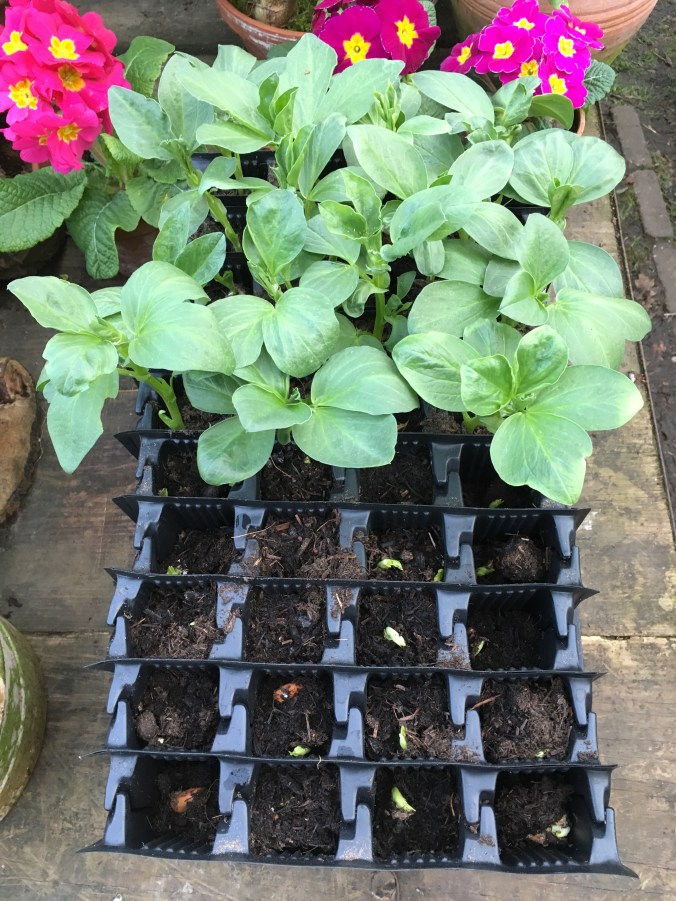
As we are in August now, it might seem odd starting with a photo taken on the 5th March. There’s scented spring bulbs in pots, and root trainers contain broad beans. Summer days full of flowers, fruit and veg are months away.

But I’ve been carrying out a six month trial of new soil improver, Bloomin’ Amazing. So I needed to re-wind back to spring, where it all started. I sowed broad bean De Monica on February 25th, but half were eaten by mice. I re-sowed the root trainers March 1st, and you can just see they sprouted by March 5th.

On March 25th I weeded the plot and spread the soil improver. I have 10 beds, 1.3m wide by 3m long, with little slab paths between. It’s a no-dig garden following the system of growing made famous by Charles Dowding. No-dig means no heavy double digging over the winter. Basically, after harvesting crops, you just add a few inches of compost and plant through. Not digging the soil means weed seeds are not brought to the surface to germinate. And soil creatures such as worms and black beetles are not damaged. Worms are left in peace to aerate the soil, and beetles eat the slugs.

Bloomin’ Amazing is a by-product of a renewable energy business, following from a joint venture between the Duchy of Cornwall and three farmers. It’s made from farm crops, maize and rye.

I found it easy to handle. It’s fairly light, I didn’t have any difficulty manoeuvring the bag, and the product is dry and easy to spread.

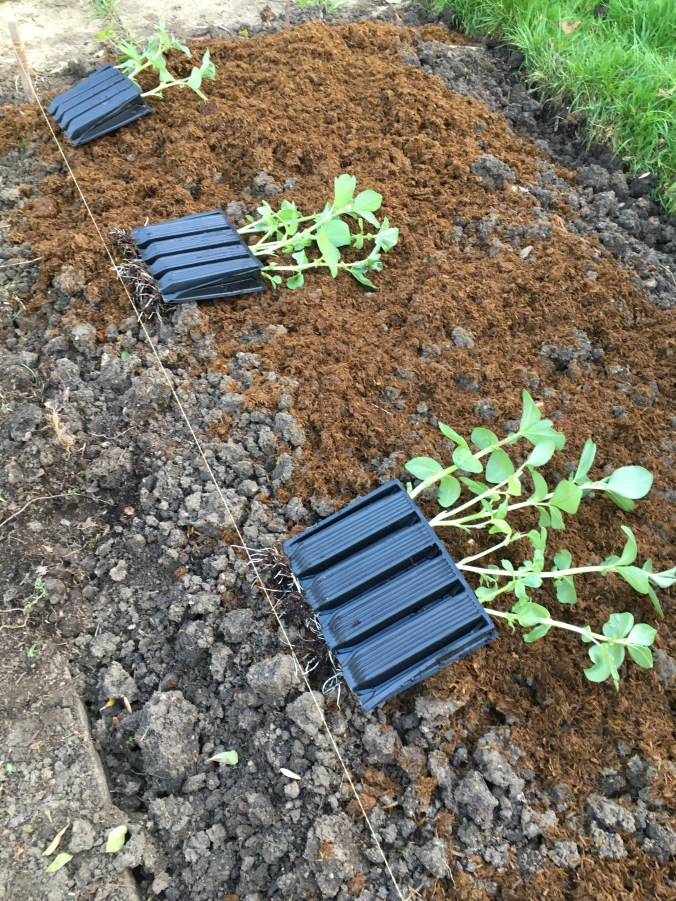
I set out my broad beans in two rows along the bed, and then drew the soil improver around them as a mulch.

The plants thrived and grew strongly. The mulch seemed to deter slugs. I didn’t use any other slug killers or deterrents and the plants were hardly touched. I realise this might be partly down to the weather. It was a cold spring and few slugs were about initially.

I started off with really good, healthy plants using the Haxnicks root trainers. Although they are plastic, I will carefully wash and re-use them. They are strong enough to last for years. I must admit, I ordered them before we all became aware of the problems with plastic.

I didn’t have time to weed or work on this bed again until July 12th when these photos were taken. I’m really delighted with the weed -control element of the mulch, and it must have fed the beans because they are the best I’ve ever had. No other fertilisers were used on this bed.

We’ve been eating broad beans for weeks, and I’ve filled the freezer too so there will be a little taste of summer in the middle of winter.

In amongst the beans I grew Lady Christl and Charlotte potatoes. I didn’t have time to earth them up, just relying on the mulch to keep in the moisture and exclude the light. And again, none of the potatoes were munched by slugs. Usually a few have holes in them.

Links : Blooming Amazing and supplier info: https://www.bloominamazing.com/

De Monica broad beans: Mr Fothergill’s : https://www.mr-fothergills.co.uk/Vegetable-Seeds/Broad-Bean-De-Monica-Seeds.html#.XUmuNmfTWfA

Charlotte potatoes: https://www.marshalls-seeds.co.uk/charlotte-seed-potatoes-pid1890.html

Lady Christl potatoes : https://www.mr-fothergills.co.uk/Potatoes/Early-Seed-Potatoes/Potato-Extra-Early-Lady-Christl.html#.XUmvL2fTWfA

Charles Dowding no dig courses: http://www.charlesdowding.co.uk/courses/

Six on Saturday – a walk around my garden- 3rd August 2019

Short of time, I usually post photos of my garden at dusk in a last-minute dash about the place. Today, I got up early at 6am. And, surprisingly, the back fields are as misty as an October morning. We are having some really strange weather conditions this year.

I opened up the summerhouse in the hope of a nice day. The weather report says it’s going to be 23C.

Things I can hear at this time in the morning: Cows in the field opposite. They line up along the hedge to see what I’m doing. Snorting, sniffing and generally jostling for space, they are noisy and rather nosy neighbours.

I like to walk the perimeter of the plot twice a day, at dawn and dusk. We’ve made a kind of avenue of trees accidentally. We just happened to place the cherry, maple and ash trees wide enough apart to drive a lawn mower between. It makes a lovely calm leafy track, and the view out across the field changes daily. This path is good for watching the owls. They can’t see us, but we can see them.

On the other side of the trees, there’s a small paddock, an orchard and veg plot. This year, there’s more cut flowers than veg, although we are enjoying Charlotte Potatoes, and broad beans at the moment. I planted some French beans a fortnight ago and they will be cropping in another couple of weeks. The cut flowers have all been battered down by the rain. We had a whole month’s worth of rain in 36 hours. Floods are out in surrounding fields. Growing in a total jumble is Ammi, dahlias, rudbeckia, nicotiana, borage, verbascum, sweetpeas, cosmos and pot marigolds. There’s cabbage and garlic squeezed in there somewhere.

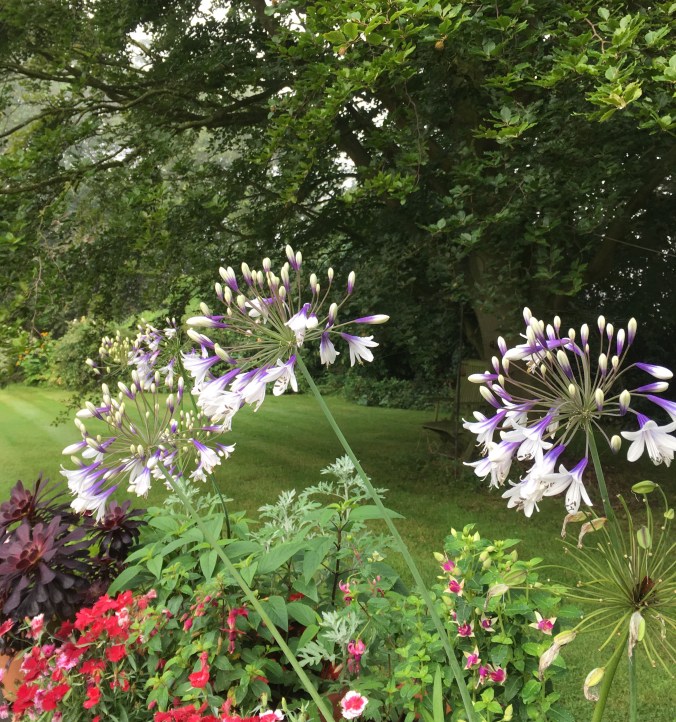
On the garden table there’s pots of the new Agapanthus Fireworks. My trial plants flowered from March and have now produced another three stems. I’m delighted with my plants and can highly recommend them. They are easy to grow and flower for a long period without needing anything more than watering.

My trial Aeonium plant is also looking really lovely. It’s a gorgeous colour and shape.

That’s my six photos for this week. I hope you’ve enjoyed your ramble around my garden- at an much earlier time than usual!

links :

Six on Saturday : https://thepropagatorblog.wordpress.com/2019/08/03/six-on-saturday-03-08-2019/

Agapanthus Fireworks : I wrote about them here : https://bramblegarden.com/tag/tulips/

Agapanthus from Wyvale Nurseries : http://www.wyevalenurseries.co.uk/news/news/agapanthus-fireworks-wins-new-product-award-at-glee/

Aeonium Review here : https://bramblegarden.com/2019/04/12/review-of-garden-beauty-web-shop-and-prize-draw-for-aeonium-schwarzkopf/

Please feel free to share this blog post.

Summer Lemon Biscuits Recipe

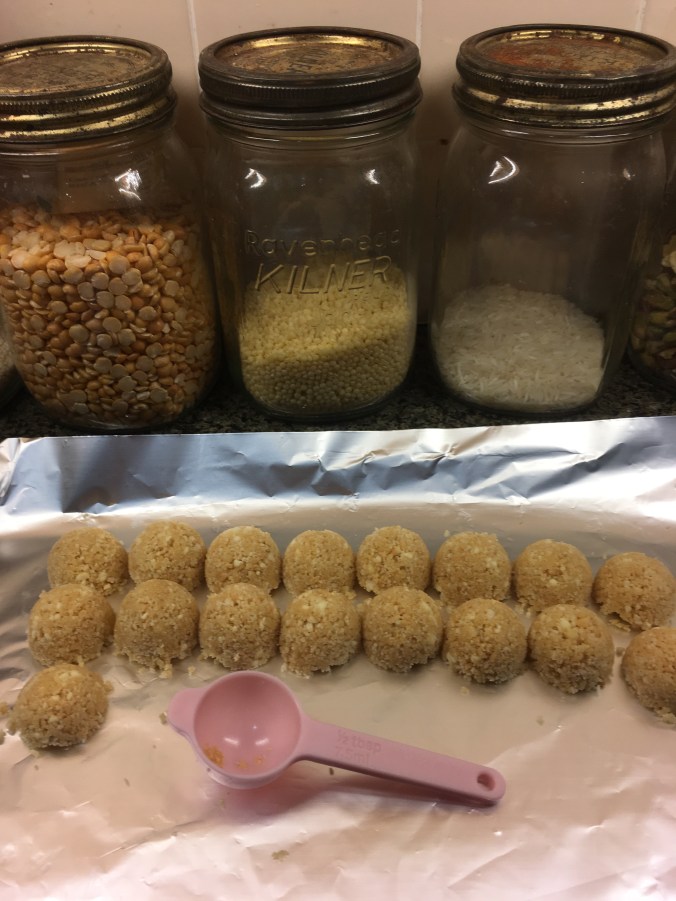
If you were listening in to the radio for Garden Hour, these are the biscuits I took in for the team. I made the lemon and white chocolate version yesterday. Today I made them with dark chocolate. Delicious!

Recipes featured here use produce from my garden. I’m always looking for ways to use up my citrus fruit from the greenhouse. This is a favourite recipe. It only takes ten minutes to make. Perfect if friends turn up unexpected and you want to give them a quick home-made treat.

Ingredients

180g biscuits ( I’ve used home-made Scottish shortbread, but you can use any biscuits. Custard creams are delicious, as are chocolate bourbons.)

3 tbsp lemon curd. Home-made (recipe below) is totally delicious, but any will do.

100g best quality dark chocolate, or white chocolate.

Few bits of fine lemon peel for decoration

Recipe

Crush the biscuits in a food processor, or in a plastic bag, bashing them with a rolling pin.

Add the lemon curd and mix to combine.

Use a melon baller or a 7.5ml measuring scoop to form balls. Press them slightly while in the scoop so they hold together.

Tap out on to a tray covered with foil. Place in a fridge.

Melt the chocolate in a Pyrex bowl suspended over a pan of boiling water. Ensure the water doesn’t get into the chocolate mixture. Or melt in a microwave in several 10 second bursts. Take care not to over cook.

Drizzle the chocolate over the biscuits in long lines. Add some fine lemon peel to decorate. Return to the fridge to set.

Will keep in the fridge for 3 days. But they won’t last that long. They are truly delicious!

Lemon Curd Recipe

Makes 1.15kg

Ingredients

6-8 large lemons (unwaxed, organic, or home-grown)

225g butter

575g caster sugar

5 large eggs

Recipe

Grate the zest from the lemons on the finest setting. Squeeze the juice and strain into a jug. You will need 300ml of juice.

Cut the butter into small pieces and put into a glass bowl along with the sugar, zest and juice. Set over a pan of hot water and stir until the sugar has dissolved. The bottom of the bowl must not touch the water which must simmer and not boil.

Lightly beat the eggs in a bowl but don’t whisk them. Strain the eggs through a sieve into the lemon mixture. Simmer on a low heat, sitting continuously until the mixture thickens. Will take about 20 minutes. Do not allow to boil or it will curdle.

Pour into warmed sterilised jars. (pop the washed jars in an oven for 10 minutes until sterilised).

Place wax disk over the lemon curd ( wax -side down). Smooth down the disk to remove any air.

Cover with dampened cellophane circles, label and store in the fridge.

Makes a lovely filling for cakes and scones.

Can also be orange, lime or grapefruit curd.

Enjoy!

Incognito Insect Repellent- Review and Prize Draw

Working in the garden, I’m often trying to fend off flies and mosquitoes intent on biting me. Flapping my arms around is my usual method of defence. It doesn’t always work. And as I found out recently, a bite or sting can turn into a nasty infection – or even blood poisoning.

I wrote about a recent accident in the garden here :

https://bramblegarden.com/2019/07/05/infection-a-warning-to-gardeners/

Readers replied with their own stories – as well as those who suffered serious infections from insect bites.

https://bramblegarden.com/2019/07/19/infection-update-19th-july-2019-gardening/

My write-up has been viewed 122,000 and liked, retweeted and commented on 31,000 times. It’s obviously a subject that resonates with many gardeners.

Since then, I’ve been careful to always wear gloves. I’ve got different gloves for the various jobs in the garden. And I make sure I cover my arms and legs – and use insect repellent.

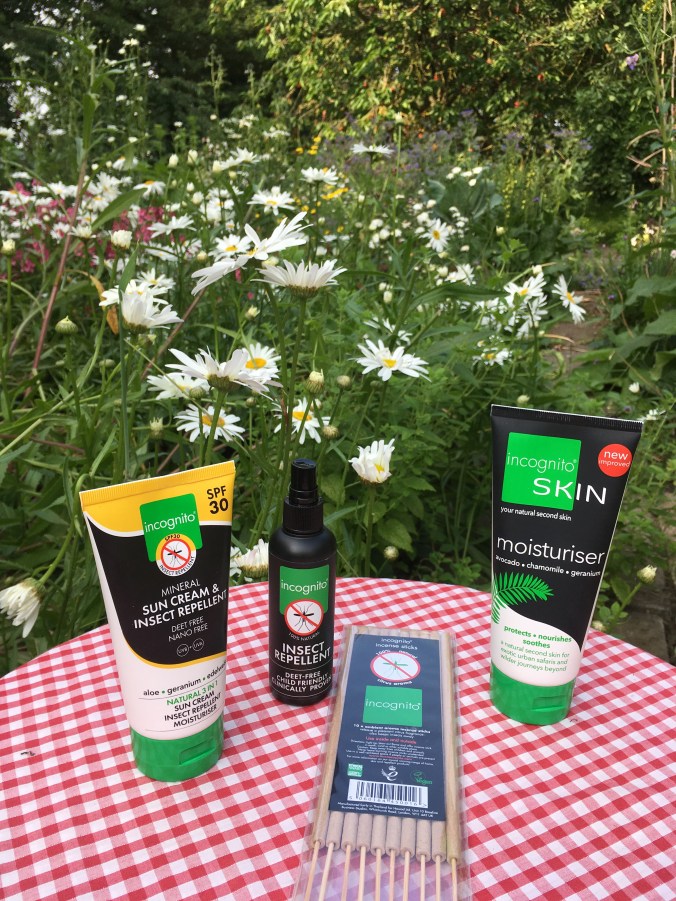
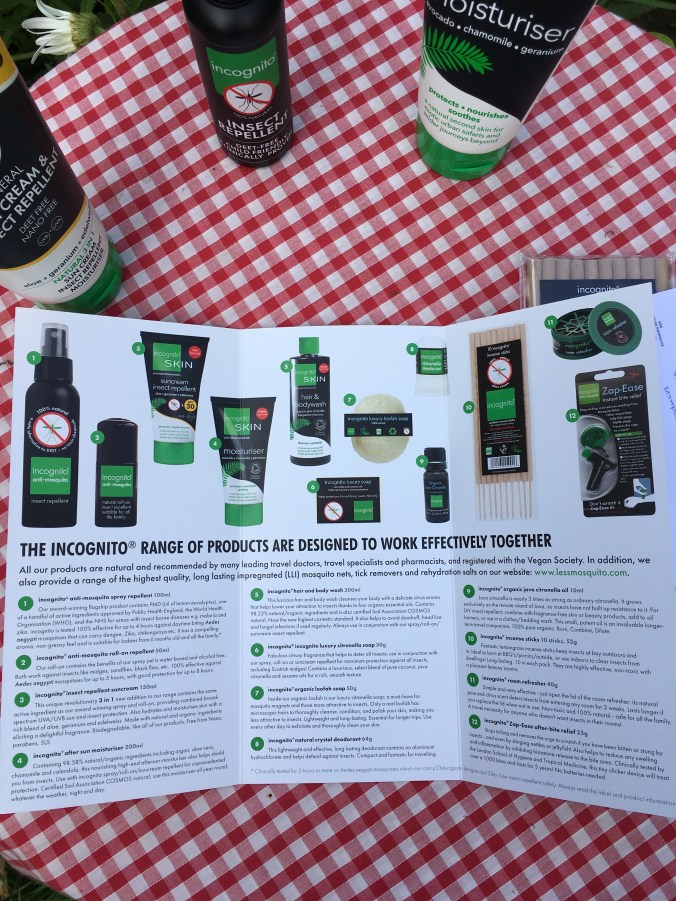
Through Twitter, I learned about UK company Incognito and sent off for some samples to try out.

I love the anti- mosquito spray which is quick and easy to apply first thing in the morning, under and over clothing. Mosquitoes and other blood sucking insects home in on ears, wrists and ankles where blood vessels are nearer the surface. So I pay particular attention to those areas.

I’m liberally spraying the insect repellent over my clothing as well to repel ticks.

Here’s a summary of what I liked about Incognito insect repellent:

* Deet Free

* 100 percent natural ingredients

* Protects against malaria, dengue and zika-carrying mosquitos

* Recommended by NHS Public Heath England for use anywhere in the world

* Easy to apply and doesn’t leave skin feeling sticky or greasy

* Pleasant citrussy scent (oil of lemon eucalyptus )

*Protection lasts up to 4 hours against daytime biting. Easy to reapply for extended evening coverage.

I found the products to be easy and pleasant to use, and I can report that a horsefly and a whole cloud of mosquitoes were sharing my gardening space, and didn’t come anywhere near me. Also, I spent a day working alongside a lake, a situation I usually dread in the summer. And again, no bites while using the spray and creams.

I tried out the combined sun cream and insect repellent. Very useful for SPF 30 requirements. And there’s a natural moisturiser too, containing avocado, chamomile and geranium. I haven’t had a chance to try the incense sticks yet, but we are planning a family party in the garden soon where they will be very useful. They are non-toxic and have a lemony aroma.

Incognito is offering a prize of a 100ml anti-mosquito spray, and a 150ml insect repellent suncream. Please leave a comment below to be included in the draw. No purchase is necessary. Incognito will draw the winning name “out of a hat” and post the prize direct. Please also say if you don’t want to be included in the draw. All comments are very welcome.

Please feel free to share this blog post on any platform.

I am https://mobile.twitter.com/kgimson?lang=en on twitter

Also https://www.instagram.com/karengimson1/?hl=en

Links : Incognito https://lessmosquito.com/

NHS advice re insect bites : https://www.nhs.uk/conditions/insect-bites-and-stings/

NHS advice re sepsis : https://www.nhs.uk/conditions/sepsis/

UK Sepsis Trust https://sepsistrust.org/

You might also like my recent posts : https://bramblegarden.com/

About: https://bramblegarden.com/about/

* Currently (25 July) the repellent spray and roll-on are buy one,get one half price at Boots.

Six on Saturday. A peaceful walk around my garden. 20th July 2019

Looking west.

Field boundaries awash with seedling clematis. I never cut them back. They grow as they please. Clematis Betty Corning is very similar. Long flowering in the shade of the hedge.

Rosa American Pillar survives without much care. This one came from a holiday cutting taken (with permission) from the front garden of a cottage at Sandsend. We used to rent the school house at the bottom of the valley for summer holidays with the family. A lovely reminder of sunny days, sea and sand.

Protected by tall hedges, the plot provides all the cut flowers, fruit and veg we need. No sprays or chemicals are used here. It’s a haven for wildlife – as well as me. Don’t look too closely. There’s plenty of weeds.

Flowers from the plot. On sale at Six Acre Nursery, Costock, Leicestershire. All proceeds to Rainbows Hospice for children and young people.

Sometimes I make door wreaths from the flowers. Here’s one I made this week.

Enjoy your weekend.

Links :

Six on Saturday : https://thepropagatorblog.wordpress.com/2019/07/20/six-on-saturday-20-07-2019/

Seeds from : https://higgledygarden.com/

Rainbows Hospice: https://www.rainbows.co.uk/

You might like to read : https://bramblegarden.com/2019/07/19/infection-update-19th-july-2019-gardening/amp/

Also, In a Vase on Monday: https://bramblegarden.com/2019/06/03/in-a-vase-on-monday-3-june-2019/

About Bramble Garden : https://bramblegarden.com/about/

Please share on any social media.

I’m @kgimson on twitter. https://mobile.twitter.com/kgimson?lang=en

karengimson1 on instagram https://www.instagram.com/karengimson1/?hl=en

Infection – Update- 19th July 2019 #gardening

I’ve just had a few weeks I would rather forget. I’ve spent a lot of time sitting here, recovering from an infection.

We spent a year renovating our 1930s summerhouse; it’s on a turntable, so it can follow the sun. I’ve watched the sunrise and sunset from my armchair, pondering on how a simple gardening injury can cause a potentially serious illness.

A few weeks ago I got a splinter in the palm of my hand. I was gardening and sweeping out my potting shed. A tiny drop of blood, it didn’t look serious. So I finished sweeping up before heading to the kitchen. I washed my hands in hot soapy water and extracted the splinter, put on a plaster and never gave it a second thought. I’ve had many thorns and splinters over the years, and always got away with it. This time I wasn’t so lucky and my hand became infected.

I wrote about it here: https://bramblegarden.com/2019/07/05/infection-a-warning-to-gardeners/

The infection spread another 10cm up my arm before stopping, thanks to antibiotics. This is called “tracking” and the pen line is a way of monitoring how fast the infection is progressing. Recovery has been challenging. I had a bad reaction to the tablets and the wound was slow to heal. I’ve finished two courses of antibiotics, but it’s possible there’s still a splinter in my hand as it is still red and sore.

What surprised me was the response on social media. My ‘warning to gardeners” post was viewed almost 120,000 times. It clearly resonated with many people.

I’m sharing some of the responses here. Hopefully it will spread the message to get urgent advice if you think you have any kind of infection, blood poisoning or sepsis. Speed is of the essence. If you don’t have time to read through, follow @SepsisUK and get to know the symptoms of serious infection so you can ask the question “Could it be sepsis.”

Infections were caused by gardening and other outdoor activities. Insect bites, plant sap allergic reactions and accidents with tools and equipment also featured amongst the 31,000 responses.

Here’s some snapshots from my twitter feed:

Abbie Jury wrote:

….

Nick Aikman wrote :

Georgie Newbery from Common Farm Flowers commented:

Vergette Gardens wrote:

T Dev wrote

Ella Beard wrote:

Owen Griffiths wrote:

Tara wrote :

Lucy Clements wrote:

Lou Nicholls wrote:

Reaction caused by cutting hellebores.

Mike Bray wrote:

Little Silver Hedgehog wrote:

Mrs Brambledown wrote:

Lunacy Towers wrote:

Janice Mills wrote:

Claudia de Yong wrote:

Plot Garden Design wrote:

Grow Like Grandad wrote:

Dorinda Sweales wrote:

Lynn Nothegger wrote:

Caroline Barrett wrote: ….

Fiona -Green Rhapsody- wrote:

Wee C wrote:

Peter Caton Books wrote:

Tanya Anderson wrote :

Val Bradley -Sun Gardening – wrote :

Dorinda Sweales wrote:

Jean Vernon wrote :

Elizabeth Atherton wrote:

Constance Craig Smith- Daily Mail Gardening – wrote:

Links:

karen Gimson on twitter @kgimson, https://mobile.twitter.com/kgimson?ref_src=twsrc%5Egoogle%7Ctwcamp%5Eserp%7Ctwgr%5Eauthor

Instagram : karengimson1, https://www.instagram.com/karengimson1/?hl=en

UK Sepsis Trust for further advice https://sepsistrust.org/

For good garden gloves : http://www.goldleaf-gloves.com/

For insect repellents, there’s currently 20 percent off on their website : https://lessmosquito.com/?gclid=Cj0KCQjw1MXpBRDjARIsAHtdN-02E9MDRwt0HxoUuXwEEnzH1EVBglUh_Bh0IrBNWvQnVr4sqPiWsNAaAlxDEALw_wcB

Weeding/ gardening gloves : https://bramblegarden.com/2019/05/11/mastergrip-gloves-on-trial

NHS 111 advice https://www.nhs.uk/using-the-nhs/nhs-services/urgent-and-emergency-care/nhs-111/

In a Vase on Monday – 15th July 2019

I’ve discovered, by accident, the magical effect of a sunset on sweet peas. It turns them into mini “stained glass” windows.

Picking them at 9pm, I suddenly find it’s too dark to take photos. Nights are rapidly drawing in. Mid-summer lulls you into a relaxed state of mind. Surely there will always be time to meander round the garden. Then, quite soon after the solstice, everything changes. There’s no streetlights here; dusk means picking your way through tall corridors of dark trees, along grassy paths, past the horseshoe wildlife pond. If you are lucky, you’re accompanied by a barn owl, sweeping along the hedge in eerie silence. You’ll marvel how such a large bird can ever catch any prey without being seen. But they make not the slightest sound and pass by like a shadow. If they see you, they don’t panic and madly swerve as some birds would. They barely acknowledge your intrusion, calmly changing direction and floating over the hedge to continue on the other side. They seem not to flap their wings, but soar and glide as if carried by the wind.

Our boundaries are made from farm posts and galvanised pig wire. We like to keep a connection with the surrounding fields. After all, our garden was once part of the farmland. We’ve simply borrowed the ground to grow fruit and flowers.

There are 10 beds, 1.3m wide by 3m long, divided by narrow slab paths. This year it’s a muddle of potatoes, broadbeans, Sweet williams, daisies and verbascum. A rickety A-frame of hazel rods runs through the centre, for sweet peas. This year I’m growing a combination of heritage types from Easton Walled garden and Higgledy Garden, and new varieties on trial from Mr Fothergills.

Amethyst and rubies; sweet pea flowers shine like jewels in the sunset.

My flowers are being sold at Six Acre Nursery, Costock, Leicestershire, with all proceeds going to Rainbows Hospice for children and young people. I am a voluntary fund-raising ambassador for Rainbows, and I also give slide shows and talks to garden groups for charity.

I hope you’ve enjoyed this peaceful walk around my garden at dusk. There’s much to see, even in the gloom.

Links : Cathy In a Vase on Monday : https://ramblinginthegarden.wordpress.com/2019/07/15/in-a-vase-on-monday-think-pink/

Easton Walled Gardens : https://www.visiteaston.co.uk/

Higgledy Garden Seeds. https://higgledygarden.com/

Mr Fothergill’s Seeds https://www.mr-fothergills.co.uk/Flower-Seed/Sweet-Pea-Seed/

Barn Owl Trust https://www.barnowltrust.org.uk/barn-owl-facts/

Notes: Most birds make a flapping, swooping sound when they fly. Owls have special edges to the front of the wing that breaks the air into small streams of wind that rolls to the end of the wing. Comb-like feathers further break down the air into even more smaller streams to create almost silent flight.

Infection – a Warning to Gardeners

I’ve been quiet for a few days. Here’s why.

Four days ago, I was sweeping out the potting shed when I got a tiny splinter in the palm of my hand. It looked like nothing serious. A tiny dot of blood. I inspected the wooden broom handle and could see a rough patch. I hadn’t noticed it before. I nearly always wear gloves. But this time I was in a hurry, and didn’t put them on. I finished sweeping before popping back to the house to run my hand under cold water. I fished out the splinter with tweezers, popped on a plaster and carried on gardening. And I never thought any more about it.

There’s always plenty to do here. Flowers to pick, weeds to pull out. But I started to feel ill. Not quite my usual chirpy self. I couldn’t think straight. I went on the radio on Wednesday, and I couldn’t think of any plant names. It seemed odd. I was struggling. Somewhat preoccupied with family matters, I didn’t notice my hand starting to itch and turn red. But on Thursday morning, I woke up at dawn and my hand was swelling and stiff. And there was a red line creeping up my arm.

I rang my local doctors surgery and told the receptionist what I was seeing. I said I thought it was an infection. I might have mentioned that I’d had sepsis before, three years ago. She said there were no appointments, but she could offer me a telephone consultation, which I accepted. Then I sat and thought about it. The doctor would surely want to see my hand. That would take time. If it was an infection I needed antibiotics, quickly. So I phoned 111, and explained what was wrong. The nurse on the line made an immediate appointment for me at the urgent care centre in Nottingham. I was there within 20 minutes and was seen by a triage nurse 20 minutes later. Within three and a half hours I had a prescription for oral antibiotics. I still had to find a chemist to buy them though, which can be a problem when you are feeling ill. Our chemist in the village closes at lunchtime, which can cause a delay.

Luckily, the antibiotics kicked in straight away and I started to feel better within a few hours. Today, the pain is easing, the redness is less and the line has disappeared. I feel exhausted and “not quite right,” but that might be the antibiotics, as well as the infection.

So the reason I am sharing this today is to remind everyone, especially gardeners, to look out for the symptoms of sepsis, blood poisoning, septicaemia or any kind of infection, and don’t delay in seeking help. Even a simple thing such a splinter, a rose thorn or a tiny cut can be deadly. An insect bite can be equally dangerous.

And listen to your inner voice. If you think you should get urgent help, ring 111 for advice or go straight to the A and E. I was embarrassed to ring up about a splinter! I apologised several times. Also, I’ve been brought up to do as I’m told by people in authority. So when told I must wait for a telephone consultation – I nearly did just that. But having experience of sepsis – following an operation three years ago- I knew not to take chances and delay treatment.

The first signs to look out for are listed on the NHS website :

. High or low temperature

.Chills and shivering

.Uncontrollable shaking

.Fast or irregular heart beat

.Feeling or acting differently from normal- you do not seem your usual self

. A feeling that something just isn’t “quite right”

There are 250,000 cases of sepsis in the uk every year. 46,000 people die every year as a result of the infection – says the UK Sepsis Trust.

Remember, it’s never too trivial a matter to seek advice. An infection can follow from a dental appointment, a tiny cut, a graze, a thorn, a splinter, an illness of some kind, such as a kidney infection. A throat infection. It can follow an operation.

I previously thought only babies or elderly people suffered from sepsis. Before I got it three years ago, I had never heard of a normal healthy adult getting sepsis.

Anyway, after this week’s episode, I’m sure I’ll feel much better in a few days. The antibiotic course is for 7 days and the doctor stressed the importance of taking all of the tablets to the end of the course.

This evening, I’m well enough to walk slowly to the gap in the hedge. The crop is ripening. It will soon be harvest time.

Links : NHS Advice https://www.nhs.uk/conditions/sepsis/

They say – Seek help immediately if you think you have an infection of any kind.

I am really grateful to the NHS for the excellent 111 service and walk-in centre. Nurses deserve a medal for all they do.

https://sepsistrust.org/get-support/support-for-survivors/post-sepsis-syndrome/

I’m on twitter @kgimson

On instagram karengimson1

Please share this post on social media.

Update: I’ve had to change antibiotics twice due to a bad reaction.

PLEASE NOTE: I am not medically trained to give advice. This blog post is merely re-telling my experience and hopefully promoting discussion and further thought. I am amazed to see this post has been viewed 140,000 times. It’s obviously a subject that resonates with many readers.

  • The red rose is Louis XIV introduced in 1859. Very thorny. I shall be wearing gloves to prune it! I’ve included a photo because I was standing next to it, mesmerised by the blood red of the rose and the matching slowly creeping red line on my arm. I kept looking from one to the other deciding what to do. It never occurred to me pottering around doing a bit of gardening could lead to a medical emergency. Hopefully, now you will recognise the signs and get help quickly.
  • https://www.classicroses.co.uk/louis-xiv-shrub-rose.html

Gardening On the Menu -Book Review

MARTIN AND Jill FISH

2QT Ltd (Publishing ) rrp £15.99 -or £12.95 plus £3.95 postage direct from Martin.

ISBN: 9781912014569

This week I made the most delicious chocolate cake I’ve ever tasted, and it had a surprising ingredient: Beetroot! You couldn’t taste the beetroot, but it created a really moist and flavoursome cake.

Here’s the recipe, taken from Martin and Jill Fish’s new book Gardening on the Menu.

Ingredients

30g cocoa powder

180g plain flour

2 tsp baking powder

225g caster sugar

Pinch of salt

225g beetroot, boiled until tender and left to cool

200ml sunflower oil

1tsp vanilla essence

3 eggs, beaten

100g plain chocolate, chopped small in a food processor

2lb loaf tin, greased and lined.

Method

Sieve the flour, salt and cocoa powder together in a bowl. Stir in sugar and chocolate.

Peel and finely grate the betteroot. I whizzed it in a food processor then added the oil, eggs and vanilla essence and whizzed some more.

Make a well in the centre of the dry ingredients. Pour in the beetroot mixture. Fold in slowly and don’t over-work.

Pour the batter into a prepared loaf tin and cook at 180C, 160C (fan oven) gas 4 , for 1- 1 1/4 hours. It is cooked when a skewer comes out clean. I placed tin foil over the cake after 45 mins as it was burning on top. Leave to cool in the tin for five minutes, then turn out on a wire rack to cool. Sprinkle top with icing sugar.

I found mine kept for 2 days – it was so tasty everyone dived in and ate it! I froze some to see if that worked, and it was fine.

Here I am adding the beetroot mixture to the dry ingredients.

Looks a lovely colour

lovely for a picnic in the garden. Travels well, wrapped in foil.

I’m going to try the next recipe in the book – beetroot chutney, which looks delicious.

Martin Fish, who ran his own nursery, and presents gardening programmes on tv and radio, gives talks all around the country on growing all kinds of fruit and vegetables. For the last few years, his wife Jill has joined him for a talk called Gardening on the Menu. The cookery and gardening book is based on their talk.

Martin has been growing vegetables since he was a teenager and he draws on his many years of practical experience to give easy-to-follow tips and advice on getting the best from your crops.

Jill shares her selection of family favourites with recipes including roasted feta stuffed onions, red onion marmalade, parsnip cake, chilli jam, apple flapjack trifle, and raspberry chocolate pots.

Strawberry and Chocolate Muffins with a Cheesecake Topping

Toffee Apple Pie

Tomato Soup

Martin gives expert advice on choosing the varieties to grow, and how to get the best crops. There’s useful advice on what to do when things go wrong including how to deal with pests and diseases.

Here they are, giving a growing/ cookery talk and demonstration. I met them last summer when they spoke at a Rainbows Hospice fund-raising festival lunch.

Photo credit: the last five photos are by Jill and Martin Fish.

A really useful book, helping you grow better crops and showing you what to do with bountiful harvests. Highly recommended.

Links: www.martinfish.com

E mail : Martin@martinfish.com

Martin was show director for Harrogate Flower Show for five years, and now writes for various publications including the weekly Garden News and broadcasts for the BBC Radio Nottingham and BBC Radio York.

I have one free copy to give away in a prize draw. Please leave a comment below to be included. Do also say if you don’t want to be included in the draw. All comments are welcome. Please feel free to share this post.

Six on Saturday – a walk around my garden 29 June 2019

Foxglove. Sutton’s Apricot.

Ethereal. “Extremely delicate and light in a way that seems not to be of this world.”

Exquisite, dainty, graceful, lovely. Will it seed about and make a glade. I hope so. There is so much hope in gardening.

Already seeding about successfully; pale geraniums. A hybrid, crossed with the native geraniums all along the lane, and my Johnson’s Blue varieties inside the garden gate. Looks just as beautiful at dusk when moths find the flowers irresistible. Seedlings vary from white though mauve to deep violet. Always a lovely surprise to see what turns up. You can buy a similar variety called Geranium Mrs Kendall Clark, or grow your own from seed.

I wrote about geraniums in my garden here https://bramblegarden.com/tag/wild-geraniums/

Wild dog roses – Rosa canina. The scent. The essence of a summer’s day. And beetles are welcome here too. Food for the bluetits and wrens currently feeding noisy fledglings all around the garden.

Rosa New Dawn. Another pale beauty. Easy to grow, climbs to the top of a willow tree and drips petals on to the pond. Never needs any sprays or pruning. Just looks after itself.

I hope you’ve enjoyed your walk around my garden today. After all that rain, it feels like summer is starting at last. It’s sunny and the temperature is 28C. I’ll be spending a lot of time sitting in the shade. Enjoy your weekend.

Links: SOS : https://thepropagatorblog.wordpress.com/2019/06/29/six-on-saturday-29-06-2019/

Foxglove Sutton’s apricot: https://www.mr-fothergills.co.uk/Flower-Seed/Foxglove-Seed/Foxglove-Suttons-Apricot.html#.XRdUymfTWfA

Geranium pratense: https://www.rhs.org.uk/Plants/7914/Geranium-pratense/Details

Rosa canina : Hopes Grove Nursery

Rosa New Dawn :https://www.davidaustinroses.co.uk/new-dawn

You might also like to read : https://bramblegarden.com/tag/wild-geraniums/

https://bramblegarden.com/about/

Favourite Roses – Desprez a Fleur Jaune

None of the roses in my garden are sprayed. Desprez a Fleur June is tough and hardy and repeat flowers all summer. And it has a most beautiful scent.

Typically, all stages of flowering are on show at the same time. New buds are opening as the old flowers fade. It’s a beautiful combination. I love the range of colours from peach and apricot through to yellow and pink. One spray of roses could make a bouquet on its own.

Rose Type

Old fashioned heritage climber. Bred in France by Jean Desprez in 1830. Each rose has 26 to 40 petals, cluster flowering.

Habit

Climbing, up to 5m. I’m growing it on a trellis 1.5m wide, so it will be pruned to fit.

Repeat flowers, if deadheaded.

Very disease resistant. Leaves are pinnate, light green, glossy.

Very fragrant. Fruit salad/ pineapple scent.

Suitable For

Pergolas,arches, trellis, walls, fences, cut flower gardens, cottage gardens.

Soil Type

Any soil, but best on heavy clay, improved with well rotted farmyard manure, plant-based fertiliser and garden compost. As I’m a vegetarian gardener, I don’t use any bonemeal or chicken fertiliser pellets any more. My roses are beautiful- without causing any cruelty to any animal. I don’t use growmore either.

Planting position

Full sun, west and east facing. Can cope with semi-shaded position. Mine gets sun for a few hours in the morning. Then it’s in shade for the rest of the day.

Zones

Hardy in USDA zones 5/6/7/8/9

Tips

Mulch over the winter to conserve moisture. If there are aphids on the rose, tap the bush gently with a cane to dislodge ladybirds. As they are heavy, they will fall to the ground unhurt. Then blast the foliage with a hose pipe which will wash the aphids off. Water is a great natural inhibitor of sap-sucking aphids.

Links :https://www.classicroses.co.uk/desprez-a-fleurs-jaunes-climbing-rose.html

Also : https://www.davidaustinroses.co.uk/desprez-a-fleur-jaune

https://www.trevorwhiteroses.co.uk/shop/climbing-roses/desprez-a-fleurs-jaunes/

Mum’s Favourite Fruit Cake Recipe, with orange slices

If you were listening in to Gardens Hour today, this is the fruit cake we were eating in the studio. It’s a recipe from my Mum. You can put fresh fruit on top of the cake when you serve it. I put slices of mandarin orange on mine today. I’ve served it with slices of peach and pineapple too. Very moist and tasty. Can be served with cream or custard as a pudding, it is very versatile. Perfect for picnics too.

INGREDIENTS

285g SR flour

85g butter, softened

110g golden caster sugar

180g mixed dried fruit

1 tsp. mixed spice

1/2 tsp. bicarbonate of soda

1 egg

280ml milk

7″ round cake tin

METHOD

Mix flour and butter together. Add sugar, mixed fruit, spice and bicarbonate of soda. Mix well.

Beat egg and milk together. Mix in with dry ingredients.

Turn into a well-greased cake tin.

Cook at gas mark 4, 170C oven for 1 hr 15 minutes. Check after 1 hour and put foil on cake if it is getting too brown.

Citrus Trees Update

I’ve started to move my citrus fruit trees out of the greenhouse into the garden for the summer. I’ll start them off in a shady position until the plant cells have become accustomed to the outdoors. After about four days, you can gradually move them into full sun. Moving straight from greenhouse to bright sunshine can cause

leaf scorch.

In a Vase on Monday- All White

I’m practicing for wedding flowers. You never know when you might need some….

White larkspur and Ammi majus. Such a simple combination. I’d probably add white sweet peas for scent. I’ve got heritage variety Mrs Collier growing on the hazel A frame. And some white love-in-a-mist. The bouquet would be tied with white satin and pearl pins, and not grey twine. But you get the idea.

Larkspur White King was sown on 4th September in 12″ pots in the polytunnel. I used a 50 /50 mixture of peat- free multi purpose compost and John Innes no 2 compost with some added grit for drainage. I used Sarah Raven/ Johnsons Seed, sown thinly, covered with a sprinkle of compost and left to grow on without pricking them out.

I also chose seeds from Higgledy Garden. These were part of a cut flower patch kit. Very good value and nice fresh seed. Everything germinated and grew well. Highly recommended. Plus, I like to support independent companies such as Ben’s.

White “cow parsley” type flowers in my bouquet are Higgledy Garden’s Ammi majus. This lovely airy flower always does better from an autumn sowing. Once you start cutting them lots of side shoots appear and you can harvest flowers right through the summer.

Higgledy’s larkspur mix contains some beautiful ice blue flowers, shell pinks and whites. All packets of seeds cost between £1 and £2.50 each. I probably spent less than £10.

Once I’d sown the seeds, I laid the packets on the pots and took photos to remind me what I’d grown and when. Labels have a habit of moving – all by themselves- on my plot!

Seedlings germinated by 21st September.

I had a bit of a problem with mice. Luckily they just thinned the seedlings for me. I put down peanuts and bird food for them, which they preferred. Hopefully the barn owl will have helped me out over the summer. I know she is feeding fledglings as we see her most nights, and we hear them calling for food. Loudly.

Those few pots of plants have been supplying me with posies for a several weeks now. I’m not sure they produce blooms any sooner than plants grown outdoors; but they have super long stems with plenty of flowers and haven’t been damaged by rain.

I particularly love the green markings on the back of the petals.

Green-tinged buds make a lovely contrast to the white flowers.

If anyone wants to get married next summer- I have the perfect plan for the flowers! Just saying.

links : Cathy IAVOM : https://ramblinginthegarden.wordpress.com/2019/06/24/in-a-vase-on-monday-respite/

Sarah Raven / Johnsons Seeds : https://www.johnsons-seeds.com/Flower-Seed_0/Annuals_3/Larkspur-White-King.html#.XRDKaGfTWfA

Higgledy Garden, Ben Ranyard : https://higgledygarden.com/

Cut flower growing and arrangements -courses and books: Georgie at https://www.commonfarmflowers.com/

First Polytunnels :https://www.firsttunnels.co.uk/

Dalefoot peat free composts :https://www.dalefootcomposts.co.uk/

Twine : https://nutscene.com/collections/twines/products/candytwist-twine-nutscenes-bakers-twine-large-spools

Please feel free to share this post on any social media platform.

You might also like to read :

https://bramblegarden.com/2019/06/23/prize-draw-winner-hansford-coil-spring-chair/

And

https://bramblegarden.com/2019/06/20/ngs-garden-visit-oak-tree-house/

Or

https://bramblegarden.com/2019/06/15/six-on-saturday-a-walk-around-my-garden-15-june-2019/

Thank you 😊

Prize draw winner – Hansford Coil Spring Chair

Congratulations to Julie Skelton who has won a Hansford Coil Spring garden chair. Hansford’s James Samuels drew the name (out of a hat) at the Gardeners’ World Live Show where the garden furniture company staged a display.

I wrote a review of the chair here : https://bramblegarden.com/2019/05/31/product-review-hansford-coil-spring-chair/

Thank you to James for helping to organise the prize draw and supplying the chair.

Mine is perfect for relaxing after a long day in the garden. I particularly like the rocking element of the design, which is quite soothing if you suffer from a bad back. I’ve been sitting in mine while listening to the birds, watching the fledglings find their way around the wild garden. It’s been a joy this week. All the nests are now empty and I can report that the blackbirds who made precarious nests just 3ft off the ground, under the house windows, have successfully fledged their chicks.

Today, mum came to visit, and we planted out the rest of the dahlias grown from cuttings. We planted anything we could find in the greenhouse. I like taking cuttings, but I’m slow to move plants on. They languish in little pots. Eventually, I take pity on them, and plant the whole pot in a clump. More or less thrown into the ground. It’s amazing how resilent plants are. Mum goes home with two posies we cut from the garden; one of white flowers, and the other sweet williams, pinks, carnations and sweet peas.

The chair is light enough to carry around the garden. When I’ve finished working on the plot, I move it under a cascading New Dawn Rose. The evening scent is fabulous.

I never prune or spray this rose, it just looks after itself. Wonderful as the sun sets behind it and shines through delicate shell pink petals.

A lovely place to sit at the end of the day.

Links : https://hansfordfurniture.com/

Julie Skelton : https://www.julieskelton.com/category/garden/

NGS Garden Visit- Oak Tree House

Pam Shave has a garden packed full of plant treasures. There’s wonderful scented roses, clematis, special perennials, and a whole border of foxgloves. And the good news is, you can visit the garden and see them too. Pam is county organiser for the NGS-Yellow Book – open gardens scheme, which raises money for cancer care and nursing charities.

I was lucky enough to visit today for a preview. Here’s a slide show of plants that caught my eye.

Foxgloves stand out in a border packed full of geraniums, campanulas, poppies and day lilies galore.

Thalictrum aquilegifolium or meadow rue. A pretty filler between the standard and bush roses.

David Austin Roses are beautifully healthy and deliciously scented. This one pictured above is Princess Alexandra of Kent. Blue herbaceous geranium provides a pretty weed-smothering ground cover beneath them.

This James Galway rose with very frilled petals is growing along the boundary fence. The scent is like a summer fruit salad, all pineapple, peaches and melon combined.

Pink sanguisorba is a lovely “fluffy filler” in amongst the roses and echoes the spires of the foxgloves.

Geranium Summer Skies is a perennial worth searching for. It makes a statement plant mid-June, and then blooms again if cut to the ground after flowering.

Oriental poppies are another high summer attraction, and this one is a particularly pretty pale pink, with ink-black stamens. It’s called Papaver Royal Wedding.

I grow blue and white love-in-a-mist. I wouldn’t be without its delicate starry flowers and pretty seed heads. Pam grows this variety, with a range of pinks and whites, called Nigella Mulberry Rose.

There are little collections of containers all around the garden. I’ve never seen so many in one garden. Even some of the vegetables are grown in pots. Here there’s annual cosmos with scented-leaved pelargoniums.

Roses also grow in huge 50cm terracotta pots. This is a David Austin rose. I’m just waiting for confirmation on the names of some of these plants. I was enjoying my visit so much, I forgot to look at the labels. (Pam has reported back- this one is Lady Emma Hamilton. A must-have for me.)

Clematis Versailles grow in 45cm pots, as a pair, each side of the back door. Such a beautiful purple colour, with a deeper stripe down the centre of each petal.

Underplanting for the clematis is this pretty scented nemesia, an annual which can be kept going from one year to the next by taking cuttings and overwintering in a frost -free greenhouse .

Masses of flowers and full of bees and hover flies .

Bees love the violas, also growing in a collection of plant pots. Viola Florence and Martin came from Jack and Laura at Bouts Nursery.

A raised brick-edged pond spills into another horseshoe-shaped pond on a lower level. We sat on the pond side, watched the fish and admired the miniature water lilies.

Exotic-looking gazanias grow well in free draining compost with added grit, in a sunny spot, or in containers.

Oak Tree House opens this Weekend, 22 and 23 June. North Road, South Kilworth, Leicestershire, LE17 6DU.

Links : NGS Oak Tree House https://www.ngs.org.uk/find-a-garden/garden/20265/

David Austin Roses: https://www.davidaustinroses.co.uk/

Perennials : https://www.hardysplants.co.uk/

clematis : https://www.raymondevisonclematis.com/

Many thanks to the Garden Media Guild for organising today’s visit : https://www.gardenmediaguild.co.uk/

Please feel free to share this post and spread some good news. And follow me on twitter @kgimson, on Instagram karengimson1 . Thank you 😊

BBC Gardeners’ World Live

We did a little dance in celebration when The Watchmaker’s Garden at BBC Gardeners’ World Live won platinum and best in show. Our family’s nursery grew some of the plants for the garden.

I was lucky enough to attend the preview and meet the designer, Alexandra Froggatt.

Birmingham’s Jewellery Quarter is a bustling, cosmopolitan area steeped in history. In the late Victorian era it was booming with trade as the jewellery and watchmaking industries expanded. Craftsmen set up workshops in their back gardens to meet demand. Alexandra’s design is inspired by these 19th century back garden horologists. Inside the workshop, the city’s iconic Chamberlain clockface is in mid-production with a workbench covered in original tools and artefacts. Antique specialists loaned jewellers’ equipment to add authenticity to the scene.

Outside the workshop, the garden is full of heirloom and heritage vegetables, including some varieties which would have been grown in the Victorian era; herbs growing alongside cottage garden plants.

I love the doorway planting. You really want to walk through that door to see what’s on the other side.

Wild flowers grow in the grass surrounding the garden, and nasturtiums, peas and beans scramble over fences and supporting hazel posts.

Sponsors for the garden include Odeon Antiques, St Paul’s Church, La Mons Jewellery, Stonebarn landscapes, Terry Porter- plants, Vande Moortel- landscaping materials, and RPG Herbs, run by my brother-in-law Paul Gimson and his wife Rozanne.

Gardeners’ World Live runs until 16 June at Birmingham NEC.

https://www.bbcgardenersworldlive.com/

RPG Herbs http://www.rpgherbs.co.uk/conta.html

Alexandra Froggatt http://www.alexandrafroggatt.com/

In a Vase on Monday – 10th June 2019

It’s the much-awaited summer. And it’s raining. It’s pouring. And it’s 9C. So only one photo today for my Vase- and it’s sweet williams and sweet peas again. They are loving the cool temperatures and moisture. I must admit, I am not.

My dark red sweet williams, Dianthus barbatus Sooty, are suddenly providing buckets of flowers. Sweet williams are such good value plants. For a couple of pounds for a packets of seed, you can have a steady supply of flowers three months or more. They are like dark velvety chocolate. Dark colours don’t show up in photos very well, so I’ve screen shot the picture and homed in on the flowers.

There’s a few forget me nots left to go with the love in a mist. And sweet peas are also flowering faster than I can pick them.

Calendulas are looking fab with peach butterfly antirrhinums, and blue chives are being thrown in every bowl of salad, as well as every vase of flowers. Such a versatile perennial herb to grow. The antirrhinums are flowering for their second year, but I’ll sow some more seed for next summer, just in case they don’t overwinter. They last for nearly a fortnight in a vase, if you change the water each day.

I do hope the weather is better where you are. Hopefully we will all get some sunshine again soon. Meanwhile, it’s dark clouds and white cow parsley -aplenty!

Links :

I’ve been to visit the Cotswold Wildlife Park. Here’s a blog I wrote about it: https://bramblegarden.com/2019/06/10/the-cotswold-wildlife-park-a-celebration-of-the-gardens/

Here’s my recent blog listing the varieties of sweet peas I’m growing: https://bramblegarden.com/2019/06/03/in-a-vase-on-monday-3-june-2019/

Don’t forget to leave a comment on my blog review of Hansford Coil spring garden chairs- there’s one chair to win in our prize draw competition. They are wonderfully comfortable and easy to carry about the garden: https://bramblegarden.com/2019/05/31/product-review-hansford-coil-spring-chair/

In a Vase on Monday : https://ramblinginthegarden.wordpress.com/2019/06/10/in-a-vase-on-monday-the-very-pink-of-perfection/

The Cotswold Wildlife Park – A Celebration of the Gardens

BOOK REVIEW

By Harriet Rycroft and Tim Miles

Produced by Reef Publishing for Cotswold Wildlife Park

£18 inc p&p.

Looking through the mansion window, I see a pretty stone terrace, balustrading covered in rambling roses, mighty English oak trees in the distance. And a rhinoceros. Or two. I’m at the Cotswold Wildlife Park and it’s not your traditional garden view!

I can hear blackbirds, robins -and yes, there’s a lion’s roar, and black siamang gibbons “whooping.” I’m having a special behind the scenes tour with head gardener Tim Miles and gardener and writer Harriet Rycroft.

Tim and Harriet have spent the past 18 months working on a new book The Cotswold Wildlife Park- A Celebration of the Gardens. And there’s plenty to celebrate. The gardens are a paradise of exotic plants, special trees and shrubs, and wild flowers.

Photo: Front cover.

There are more than 250 species of animals and birds living at the wildlife park where important conservation and breeding work is being undertaken. The star attraction is undoubtably the white rhinos – saved from poachers in Africa, and now producing offspring.

Photo: my i-phone pic of page 60 in the book. Original photo credit: Harriet Rycroft.

Rhinos appear to have free rein in the parkland setting, but in fact, their paddock is ringed by a ha ha. It means there are no fences. They can clearly be seen from all surrounding paths. When I say “clearly seen,” I might add that the paths meander around flower beds containing thousands of ornamental onions, Allium hollandicum Purple Sensation, and grasses such as Stipa gigantea (giant oat grass) and cultivars of Miscanthus and Cortaderia (pampas grass). It’s rather a wonderful combination. Rhinos and alliums. You’ll not see that anywhere else in the world.

Planting provides browse material for many species, but also, importantly, shelter for the animals. This might be shade from summer sunshine, or protection from wind and rain. Planting must, of course, let visitors see into enclosures, but it is so exhuberant that the the lines are blurred between visitors, animals and the wider landscape.

I did manage to get a good look at African Spoonbills and Madagascan Teal. But if they wanted to hide from me, they could.

It is interesting to see trained fruit trees along the walled garden enclosures. There’s a perfectly-pruned fig, and around the corner there are espalier cherry and pear trees, fruiting kiwi and grape vines. Bamboo, a favourite fodder for many animals, grows inside and outside of the enclosures, again blurring the boundaries between them.

In the Tropical House I spy a Linne’s Two-towed Sloth. It’s the first time I’ve seen one. He’s nestled in amongst the foliage, rubber plants (Ficus elastica) cheese plants (Monstera deliciosa) and bromeliads and orchids. Branches of oak provide “perches” and there’s an illusion that house plants have “escaped” to take root in this mini-jungle. In a fascinating insight into the relationship between keepers and gardeners Tim explains that any plant plagued with pests such as greenfly, is given to the keepers to be placed in the Tropical House. Exotic birds clean up the plants by eating the pests. A win-win situation all round. Natural pest control at its best.

Continuing the tropical theme, in the protection of the Walled Garden, there’s palm trees, bananas and cannas interplanted with dahlias, Begonia luxurians and Begonia fuchsioides. Plants overspill onto the paving so you don’t notice the concrete kerbs. Creeping plants such as Tradescantia, Plectranthus and Verbena cascade and intermingle.

Phormiums, banana plants and bedding such as geraniums and coleus (solenostenum) provide a contrast in form, colour and texture.

Container planting features fuchsias, begonias, scented pelargoniums, trailing Scaevola Sapphire, twining Thunbergia African Sunset, nemesia- and even a Protea cynaroides (king protea). It’s rightly described as a “theatre with plants.”

There’s a conservatory- leading to the Bat House and Reptile House- where I spotted a pretty pink Cantua buxifolia.

Some sort of pink grevillea also thrives in the protection of the glass.

I’m still searching for the name of this pretty blue flowering plant. Let me know if you have a name for it. It’s rather lovely to visit a garden and find something you haven’t seen before.

No surface seems to be left without cover. This is the end wall of the rhino house, smothered in golden-flowering Fremontodendron California Glory.

We just throw our weeds in a compost bin, but certain weeds growing at the park provide food for the animals. Giant tortoises love stinging nettles, and goose grass or cleavers are relished by some of the herbivorous reptiles. Banana leaves are popular with stick insects and locusts, but are also given to squirrel monkeys. Honey treats are stuck to the leaves. The monkeys have fun picking off the treats, and then spend time cleaning themselves of the delicious sticky honey.

Gardeners don’t just get requests for plant material for food and nesting; prunings such as lavender and rosemary provide useful enrichment / active entertainment for the lions. Keepers fill bags with the clippings to make giant catnip toys.

With so many rare and glorious plants, the gardens at Cotswold Wildlife Park are a delight to visit all year round. Visiting transports you to another world. A world that’s been created with imagination and passion. There’s nowhere else quite like it.

All pics, apart from the front cover and the baby rhino, are i-phone photos from my head gardener tour.

Links:

Harriet and Tim’s book is available from Cotswold Wildlife Park https://shop.myonlinebooking.co.uk/cotswoldwildlifepark/shop/product-list.aspx?catid=8

In a Vase on Monday -3 June 2019

The first sweet peas are always for my Mum.

I’m growing a mix of old and new. Heritage varieties: Mrs Collier (cream) and Dorothy Eckford (white). New this year: Capel Manor. Old favourites: High Scent, Wiltshire Ripple Mix, Albutt Blue and Chatsworth.

The best Blue is Chatsworth. Five or six flowers per stem, prettily ruffled and gloriously scented. Long lasting in a vase, and flowers until the first frosts. The Duchess of Devonshire, the last of the Mitford Sisters, lived at Chatsworth and was president of the Sweet Pea Society for many years.

High Scent and Albutt Blue are modern grandiflora varieties with a picotee edge. Albutt Blue, bred by Harvey Albutt I’m 1999, has a blue rim on a white ground. High Scent is a cream flower with a mauve edge. High Scent is also known as April in Paris.

Seeds are planted in root trainers in October. Use 50/50 compost and grit for drainage. I start mine in a propagator at 15C. As soon as a green shoot is spotted, I remove them from the propagator and grow on in a cold poly tunnel. Sweet peas can cope with cold, but shouldn’t be too wet or they will rot. To out-wit the mice, I stand the root trainers in a deep straight-sided plastic storage box. When the seedlings are 3-4″ tall, I pinch out the tips to make bushy plants. The tips can be grown on as cuttings. Very useful if you are growing heritage varieties and only have a few seeds in the packet.

I planted mine in April in no-dig beds. I mulch the bed with Plant Grow (plant based) fertiliser. This feeds and holds in moisture, and seems to deter slugs and snails.

My sweet peas scramble up an A-frame of hazel rods. I grow them in the same place for four years, then move them to a different bed to prevent the build up of pest and diseases. By then, the hazel rods are collapsing anyway and need replenishing. Each year I weave in a few more twigs to strengthen the supports. I water with a liquid Plant Grow feed.

In front of the sweet peas there’s a row of calendulas and highly-scented pinks. Every space is crammed with flowers.

Alongside, there’s dianthus barbatus (sweet williams). These are sown in summer, make good strong roots and leaves in the first year, and flower in the next. This year I’m growing a dark red variety called Sooty which is just coming into bloom. Sweet williams follow wall flowers to give a continuous supply of cut flowers. I learned how to grow cut flowers at Common Farm Flowers with Georgie Newbery in Somerset.

Little extras in this posy are the last of the forget-me-nots and some pink alliums I always harvest, as a way of controlling them. They can become invasive.

And finally, a favourite pelargonium. This originally came as a cutting from my grandfather Ted Foulds. He loved his garden and each week came to visit and “inspect the plot.” He never arrived without a pot of something, a few seeds, an offset, a cutting. Half my garden came from my grandfather and my Mum. He died 22nd May 2005 aged 83. Still desperately missed, but not forgotten. I faithfully take cuttings of his pelargoniums each autumn, and they flower every summer, as a lovely reminder of him.

Links : In a Vase on Monday :https://ramblinginthegarden.wordpress.com/2019/06/03/in-a-vase-on-monday-oops/

Sweet peas at Easton :https://www.visiteaston.co.uk/whats-on/coming-up

Ripple Mixed varieties : https://www.mr-fothergills.co.uk/Flower-Seed/Tall_3/Sweet-Pea-Ripple-Mixed-Seeds.html#.XPTo-4zTWfA

Plant Grow fertiliser : http://www.plantgrow.co.uk/our-products.html

Root Trainers : https://www.haxnicks.co.uk/garden-products/rootrainers

Sweet William seed: https://www.mr-fothergills.co.uk/Flower-Seed/Sweet-William-Seeds/#.XPTptYzTWfA

Common Farm : https://www.commonfarmflowers.com/

You also might like to take part in a prize draw for a Coil Spring garden chair : https://bramblegarden.com/2019/05/31/product-review-hansford-coil-spring-chair/

Product Review – Hansford Coil Spring Chair

*Please leave a comment at the end of this review to be entered in a prize draw to win a Hansford Coil Spring Chair.

Gardening is hard work. By this time of the year, I’m starting to groan at the size of the brambles and painful stinging nettles. It’s a job to keep up with the weeds. So I really look forward to flopping down on a comfortable chair at the end of a gardening session.

I jumped at the chance to try out a Hansford Coil Spring Chair. I didn’t pay for this product. As usual, words and opinions are my own. By now, you’ll know I always give my honest view on books, products, composts, seeds, and plants that come to the potting shed for review.

My chair arrived three days after ordering. Email updates were reassuring and meant I was at home when the box arrived.

The chair arrived well packaged and undamaged. It took five minutes to assemble the chair which comes in two parts. Tools, a spanner and some screws, were included. I meant to take photos of the before and after, but it was so quick to put together, I got carried away.

The chair is light enough to carry about the garden and so I tried it out in various locations, under the sweet chestnut tree, in the wild flower border and in the orchard. I didn’t find it too difficult to move about.

I love the way the chair blends in to the planting, and doesn’t dominate the scene. It looks lovely set amongst cow parsley and pink campion. Which is just as well as 90 percent of my garden is cow parsley at the moment.

I have a black painted greenhouse and summerhouse, so I chose a black chair. Alternative colours are duck egg blue and green.

The mesh seat is comfortable in hot weather, and very lovely with lavender and rosemary poking through. I will probably have to buy another one to go with my review chair, as really a pair is needed. You could add cushions, but the chair is comfortable enough without them to be honest.

Information sheets that come with the chair say the product is powder coated and there’s a one year warranty. The web site states the chair is suitable for indoors, conservatories, and outdoors.

James, who set up Hansford Furniture with a friend is offering one chair as a prize draw win to readers of this blog and my instagram page. Please leave a comment below to be included in the draw. No purchase is necessary and Hansford are running this competition. James will randomly select (pull a name out of a hat) on 13 June at Gardeners World Live, where they have a stand this year. Please also say if you do not wish to be entered in the prize draw, which is also fine. Sorry, uk entries only, and there’s no cash alternative. Hansford decisions are final.

Information from the website:

*look in the comments below, James has sent a link for 15% off the price, for readers of bramblegarden.com. This discount is a promotion being offered by Hansford Furniture and I am simply passing on the information.

Links: https://hansfordfurniture.com/

Instagram https://www.instagram.com/karengimson1/?hl=en

Twitter : https://mobile.twitter.com/kgimson?lang=en

Six on Saturday- a view of my garden 18th May 2019

It’s a sad farewell to the tulips today. Cold weather has given them staying power this year, but I can see they are fading fast. I love the dark purple tulips. They remind me of a bishops’ sash, an amethyst ring, a royal cloak. A stained glass window. Silk.

This is Purple Queen of the Night. I’ve noticed tulips vary in colour, depending on supplier. So this one came from Taylors Bulbs, the one below is also Queen of the Night, from Parkers wholesale.

I’ll be planting more of the the Walkers variety; these stood up to the weather well, and didn’t “melt” when it rained.

I shall miss the jewel-like colours of tulips. It’s been the best display I’ve ever had, and didn’t cost much. Most of the bulbs were bought in the sale at Christmas and planted the first week of January. Waiting to plant until it’s really cold helps prevent viruses which spoil the flowers and leaves.

When the tulips fade, my garden turns green. This is the view from our bedroom window today. The beech trees are at their freshest now, lime green leaves highlighted by sunshine. Gradually they shade out the woodland floor and I say goodbye to the spring understory; bluebells, wild garlic and the last of the white narcissi. Wild clematis and honeysuckle provide some compensation. I didn’t plant these climbers, but they are welcome here. Honeysuckle crowns a silver holly pyramid. No harm seems to come to the holly. It’s a cheerful combination. A happy co-incidence.

The evening scent drifts around the garden and in though bedroom windows. A wonderful scent to end the day. A feast of nectar for night-flying moths. For daytime-flying insects, crab apple blossom provides a banquet. It’s usually smothered in bees. This one I think is Wedding Bouquet.

If you have a small garden, Malus Laura is the one to choose. This gorgeous small tree grows in an upright, vase- shape, doesn’t cast much shade and has wonderful dusky pink blossom, purple new leaves, and plum coloured crab apples. So much interest in just one tree.

Links: Six on Saturday : https://thepropagatorblog.wordpress.com/2019/05/18/six-on-saturday-18-05-2019/

Queen of the Night : https://taylors-bulbs.com/spring-flowering-bulbs/

Malus Laura : https://www.rhs.org.uk/Plants/124642/Malus-Laura/Details

Malus Wedding Bouquet : https://www.frankpmatthews.com/catalogue/malus/10139

Mastergrip Gloves on Trial.

Review and prize draw for gardening gloves.

I’m not keen on cold wet hands, so I always wear gloves in the garden. Town and Country sent me some new Mastergrip gloves to try out.

The problem with gloves is you’ve often got a choice of wearing gloves- or doing some gardening. They aren’t always very flexible. So I’m often taking them on and off- and losing them.

In the past, I’ve just worn kitchen rubber gloves, but they are not ideal. They get hot and uncomfortable, and are easily damaged. However, Mastergrip have the advantage of being flexible and breathable.

I used them for dead heading in the greenhouse.

Pricking out and transplanting the delicate cherry tomatoes.

Weeding around the pot marigolds. These are seedlings of last year’s Calendula Orange Fizz.

The gloves are flexible enough to pick out tiny weeds. I’m not using any chemicals, so trying to keep on top of weeds is important for me.

Usually, I have to take my gloves off to do fiddly jobs like tying in the sweet peas. Luckily these gloves were easy to wear and stayed on for the whole morning while I was working in the veg plot, cut flower patch and greenhouse.

The information that comes with them says the palm and fingers have a latex coating. The back of the gloves are made from a breathable material for comfort and flexibility.

Mastergrip gloves, for everyday tasks, costs £6.99. There’s also Mastergrip Pro for tougher tasks, A thermal version for winter warmth, and a Mastergrip Patterns version for lighter tasks. There’s also versions for children, which is great. I’m always keen to get youngsters involved in gardening. They don’t usually take much persuading.

Town and Country sent these gloves unconditionally for a trial. I didn’t pay for them. However, I’ve been delighted with them, and I’m happy to recommend them.

The company has offered one pair for a prize draw. Please leave a comment below to be included in the draw. No purchase is necessary; names will be randomly selected by the company, and their decision is final. There’s no cash alternative. The deadline is Sunday 12th May, 8pm. Please also say if you don’t want to be included in the draw as all comments are welcome here. Enjoy your weekend gardening.

Links : https://www.townandco.com/

Six on Saturday. A view of my garden on 11 May 2019

Here’s some photos from my garden diary today for #sixonsaturday. I’ll be sad to say goodbye to the tulips. They’ve provided colour and joy for two months. Surviving the torrential rain and hail, they are tougher than they look.

Carnival de Nice. Reminds me of summer days with striped bunting, deckchairs and raspberry ripple ice cream.

Angelique. Like apple blossom. Petals start a deep blush pink then fade to translucent white. I love the colour-changing beauty of tulips.

Black Parrot. More elegant than some of the parrot tulips around. A joy in terracotta pots amongst grey lavender. Viola Antique Shades provides a perfect match with purple and coppery tones. These have been flowering since last October. Good value.

Darwin hybrids, from a cut flower mix, planted at Christmas. Reminds me of a peach sundae.

I’ll be lifting these tulips and planting them in the orchard to flower next year. One tiny patch provides so much variety, planted only 1″ apart. I’ve earmarked the spot for cosmos and larkspur. Cut flowers until October. Behind them, sweet peas planted only a fortnight ago are half way up their hazel rod supports. There will be sweet-scented flowers by June.

Links : https://thepropagatorblog.wordpress.com/2019/05/11/six-on-saturday-11-05-2019/

Cut flower mix tulips : https://www.gee-tee.co.uk/bulbs/tulips/cutting-mixture-tulips

Carnival de Nice https://www.farmergracy.co.uk/products/tulip-carnaval-de-nice-bulbs-uk

Angelique : https://www.sarahraven.com/flowers/bulbs/tulips/tulip_angelique.htm

Black Parrot tulip https://www.gee-tee.co.uk/bulbs/tulips/parrot-tulips/tulip-black-parrot

You might like to read My Cut Flower Patch : https://bramblegarden.com/2018/06/18/in-a-vase-on-monday-my-cut-flower-patch/

Borde Hill Garden

Rhododendrons, azaleas, woodland, sculpture, rare and unusual trees and plants.

We stand still and listen. “There’s a great tit…a chaffinch…a goldfinch…a robin.” I’m writing the names in my notebook, but the list is recounted faster than I can record them.

We are on a tour of Borde Hill Garden. And, what luck, one of our party is an expert on birdsong. The chorus of sound drifts through the trees. Such a beautiful melody, and a wonderful place to be. An English woodland garden on a spring day. Just glorious.

I spot a tree creeper. To my shame, it’s the first time I’ve seen one. A tiny bird, the size of a wren. My first thoughts are that it’s a mouse. Its speckly brown feathers perfectly match the tree bark it’s clinging to. It scurries up a few metres, and then uses its long downward-curving bill to fish out an insect from a crevice. Suddenly it moves to the other side of the trunk. It knows it’s been spotted. Then, making a “see-see-see” call, it flies away. A magical moment- and we’ve only just arrived in this woodland paradise.

We start our tour in the Garden of Allah, a dell created in 1925 where the the owners nurtured many of the species brought back from the great plant hunters of the time. Head gardener Andy Stevens points to a towering Liriodendron chinense (Chinese tulip tree) which was raised from seed collected by Ernest Wilson in central China. Borde Hill bought the tree as a 16ft mature specimen from the famous Veitch’s nursery in 1913. There’s a huge Magnolia fraseri which arrived in the garden as a seedling from the south-eastern USA in 1933. And further into the garden there’s a Davidia involucrata (pocket handkerchief tree).

I can’t decide whether to look up, or down. Up, into the branches of so many rare and unusual trees. Or down, at the ribbons of pure white wild garlic flowing into drifts of bluebells. It’s easy to see why Borde Hill has been described as “unforgettable.”

Leaving the dell, walking past rhododendrons and camellias planted in the 1920s, and magnolias planted as seedlings in the 1930s, we reach Warren Wood and Stephanie’s Glade. It’s here that many of Borde Hill’s fabulous collection of champion trees can be found.

There are many trees I have never seen before. We stop and admire a rare Meliosma Beaniana which is smothered in delicate creamy coloured flowers. Like many of the trees and shrubs at Borde Hill, there’s a fascinating history and story behind them. This tree came via Ernest Wilson who was plant hunting in China in 1908. It was planted at Alderman (now a boarding school) and transplanted at Borde Hill in early 1930s. Records show it flowered for the first time in its new home in 1933.

I found a particularly lovely tree, possibly a type of photinia. It is smothered in white flowers. A magnet for bees and hoverflies.

Borde Hill is famous for rhododendrons and azaleas which are reaching their peak now. I’ve never seen such a striking and colourful display.

Some of the azaleas are scented which adds to their attraction.

Walking out of the woodlands, suddenly you come upon a more formal scene, an Italian garden with topiary flanking a rectangular pond. There’s a statue and waterfall at one end, and large terracotta plant pots each side of the water.

There’s always a surprise around every corner. At the top of the steps, near the sculpture, I found this Peony Mai Fleurie.

Further along the walk, I found more peonies, looking at their best right now.

Tree peonies and perennial forms seem to do very well at Borde Hill and I make a note to plant more in my own garden.

This week sees the start of Borde Hill’s 20th anniversary Sculpture Exhibition (10 May to 30 Sept). Visitors can walk through the 17 acre gardens and enjoy more than 80 pieces by well-known and up-and-coming artists.

I love this one, which I think is Little Owl by Paul Harvey. The labels were being put out on the day of our visit.

And this one, which I’m guessing is Icarus by Nicola Godden. Such a perfect setting in front of the house. Checking the website, I see this winged figure was commissioned for the London 2012 Olympic Village. There’s also a wind sculpture by Will Carr to look out for.

There’s something for everyone at Borde Hill, and all-year-round interest too. But for me, the magic of the place will always be the peaceful walks through those magnificent trees. And the sound of birdsong. The very essence of spring.

Borde Hill: Haywards Heath, West Sussex, RH16 1XP, opens from 25 March -3 Nov.

The garden, listed Grade II by English Heritage, is set within 200 acres of parkland.

Special events this year:

Roses. Talk and tour with Michael Marriott from David Austin Roses: 20 June 10.30-2pm

The Rabbit’s Eye View- long term plant performance, landscape masterclass by Noel Kingsbury, 11 Sept 10-4.30.

Practical Pruning – Juliet Sargeant 16 May 10.30-3pm

Designing a Romantic Rose Border – Juliet Sargeant, 11 July 10.30-3pm

Tasty Autumn Talk- Juliet Sargeant, 18 Oct 10.30-12noon.

Many thanks to Eleni and Andrewjohn Stephenson Clarke for hosting our visit, and to Constance Craig Smith and the Garden Media Guild for organising the tour.

Links :

For more information about Borde Hill : https://www.bordehill.co.uk/

More on birdsong : https://www.woodlandtrust.org.uk/blog/2019/04/identify-bird-song/

RSPB Let Nature Sing: https://www.rspb.org.uk/get-involved/campaigning/let-nature-sing/

In a Vase on Monday- 6th May 2019

Happy Bank Holiday Monday! I hope you are all managing to get some gardening done today. It’s still cold and windswept here. Only 11C, but feels much colder due to the biting north wind. Rain and high winds have caused some damage here. The beautiful lime green beech tree leaves have been blown into the paddock. They only opened a week ago. So soft and delicate. It looks as if someone has laid them as a fine velvet mulch everywhere. Some of the fancy double tulips look as if they’ve been cut with a scythe. They are all cleanly sheared off half way down their stems. Heads just too heavy for gale force winds. So today, I’ve made table arrangements with the casualties.

Mount Tacoma looks pretty in three glass jars in a row. The short stems don’t matter for this garden table arrangement.

This late-flowering double tulip is a favourite . I love the flash of green on the outer petals. The flowers remind me of feathers.

If I could re name it, I would call it Swan. Beautiful, simple table arrangements for a laid-back bank holiday.

I’m cutting some branches from the orchard for tonight’s dinner table. Flower arrangements don’t have to be complicated. Especially on a bank holiday.

Here’s a view of the garden today. The hawthorn hedge looks like seafoam in the wind. Looks like there will be more rain, judging by the colour of that sky.

Half an hour later, the downpour has passed. There’s some blue sky and we can see for miles from the top of the garden. Skylarks are singing overhead. Always a good sign.

Links : IAVOM In a Vase on Monday. https://ramblinginthegarden.wordpress.com/2019/05/06/ina-vase-on-monday-delicate/

Mount Tacoma tulips : https://www.gee-tee.co.uk/bulbs/tulips/double-late-tulips/tulip-mount-tacoma

Alton Cedar greenhouses : https://www.altongreenhouses.co.uk/

The view in the distance from the top of the garden is : https://www.nottinghamshirewildlife.org/nature-reserves/bunny-old-wood-west

Six on Saturday – My garden 27 April 2019

I’d forgotten how sweetly scented some tulips can be. This one has a fruit salad, pineapple scent. Reminds me of the tropical trifle my Aunty Betty used to make, liberally decorated with sugar strand sprinkles. Such happy memories of family outings, picnics and seaside trips. A kind and much-loved lady who seemed to have a never-ending supply of fairy cakes, toffee apples and other sweet treats.

Three weeks of joy with these double tulips; they take a long time to unfurl. This one is called Peaches and Cream. I’ve never grown it before and have made a note to plant a whole row for next spring.

Tulips can be grown anywhere. These are in a 2ft by 3ft portable raised bed on wheels. I’ve grown these in the unheated poly tunnel for early flowers. They will be planted out in the orchard for an informal display next year.

Tulips are also planted 2″ apart in a cut flower bed. These were bought in the half price sale at Christmas and planted in January. They were described as a “mixed cut flower patch kit.” It’s a great idea for trying out new varieties.

In the beds behind the tulips, there’s a rather rustic, ramshackle A -frame made from hazel rods. This week I finally planted out my sweet peas. These were sown in root trainers last October. There are heritage varieties such as creamy white Dorothy Eckford bred in 1904 at Wem in Shropshire by Henry Eckford and named after his daughter. How lovely to be immortalised as a beautiful, scented sweet pea. Also there’s new varieties such as Capel Manor which I’m trying out.

Step out of the gate at the top of the garden, and this is the view today. Yellow oil seed all across the ridgeway. You can see for miles around.

Thanks for joining me this week in my garden. What are you growing on your plot at this time of the year? Spring is my favourite season, with so much colour and frangrance all around.

Links : Six on Saturday : https://thepropagatorblog.wordpress.com/2019/04/27/six-on-saturday-27-04-2019/

Six on Saturday 20 April 2019

A quick whizz around my garden today. I’m busy watering, watering, watering. We have had no rain for weeks and the water barrels are low.

Amaryllis. Planted in October. Should have flowered at Christmas. I did all the right things, watered it, pampered it. I’m happy it is finally flowering in time for Easter. It was sold as Lemon Star. As with many spring bulbs, they sometimes turn out to be different from the name on the packet. Very pretty though. A table centre on its own, I think.

Tulip Mount Tacoma. Also just in time for Easter table arrangements. Fluffy, very double. As beautiful as a swan, wouldn’t you agree.

Forget me nots make a lovely ground cover for Mount Tacoma here.

Still on the theme of cream and white, new tulip Exotic Emperor. A delight to watch opening from a tight bud. I love the flashes of green on the edges of the petals. One I will grow again next year.

Here they are growing in a large Italian pot by my back door. A north facing position suits them well. They last longer out of the sunshine. Above them, the lime green new leaves of an Acer Palmatum Dissectum are just starting to unfurl. Perfect to complement the stripe in the tulips.

In the Exotic Daylily Border, my favourite quince is in flower. Chaenomeles speciosa Kinshiden starts off the colour of Devon clotted cream and fades to white. A lime green eye adds a simplicity to this beautiful double flower. 200 Tulip Orange Emperor form a backdrop. A recommended tulip for reliably coming back each year, and good for planting between low maintenance daylilies. I hardly ever have to work this border. It virtually looks after itself.

Wishing you all a very and happy and peaceful Easter. I hope you are getting some lovely sunny weather, as we are here. It’s 21C today- and 38C in the greenhouse! I have opened all the doors and windows! And now I must get back to that watering…. Enjoy your gardening.

Links

Dalefoot bulb composts https://www.dalefootcomposts.co.uk/products/bulb-compost.p.aspx

Six https://thepropagatorblog.wordpress.com/2019/04/20/six-on-saturday-20-04-2019/

Lemon Star : https://www.sarahraven.com/flowers/bulbs/amaryllis/amaryllis_lemon_star.htm

Mount Tacoma https://www.peternyssen.com/mount-tacoma.html

Tulip Exotic Emperor https://www.farmergracy.co.uk/products/tulip-exotic-emperor-bulbs-uk?gclid=Cj0KCQjwhuvlBRCeARIsAM720HpBjLnKuSBteZOYQAoqbVUBnXKLyKYitNQifojAteMGWV5JVRSKz2UaAt9oEALw_wcB

Quince Kinshiden https://www.shootgardening.co.uk/plant/chaenomeles-speciosa-kinshiden

karen Gimson on Twitter https://mobile.twitter.com/kgimson?ref_src=twsrc%5Egoogle%7Ctwcamp%5Eserp%7Ctwgr%5Eauthor

karen Gimson Instagram https://www.instagram.com/karengimson1/?hl=en

Facebook https://m.facebook.com/pages/category/Local-Business/bramblegarden/posts/

Fields of Gold- and White. Taylors Daffodil Day 2019

Today I’m trying to describe the scent from 341 acres of daffodils- that’s about 300 football pitches. I’m almost lost for words. It’s like a tidal wave of “spring.” That scent at dawn on an April morning. Dew on the flowers, and the sun just starting to shine. Bees buzzing all around. And then it hits you. Pure joy!

I am at Taylors’ bulb fields in Lincolnshire for their Daffodil Day to celebrate the company’s centenary. And what a celebration! Daffodils as far as the eye can see. Birds singing, blue skies and a line of trees in the distance. The trees are so far away they look like miniatures. I’ve never seen anything like it. Bands of gold and yellow daffodils ripple in the wind. And wow, is it windy here. I’m holding on to my hat.

Taylors grow around 500 daffodil varieties on their farm at Holbeach near Spalding. It’s a real treat to learn how they are grown, the machinery used, and the processes involved.

Daffodils are planted in August – 850 tonnes of them. Bulbs remain in the ground for two years and are harvested over a six week period in June and July. The daffodil lifting machine digs up about one tonne per minute. Around 2,000 tonnes are harvested annually.

It’s the same machine that’s used for lifting potatoes. Daffodils are taken by trailer to a sorting conveyor belt machine that separates the bulbs from soil and stones.

Bulbs then go to a grading machine that sorts them into sizes. 7-10cm bulbs are kept to replant. Sizes then are separated into 10-12, 12-14, 14-16. The largest will obviously be the premium bulbs that will cost the most, but provide the best flower display.

Here’s John Cubley explaining the grading process. The bulbs pass through a kind of riddle to separate the sizes. John has worked for Taylors for 25 years. In fact, I spoke to three other workers who’ve all been there for at least 25 years. It’s obviously a company that attracts dedicated and loyal staff.

Here’s the grading machine inside the warehouse. Bulbs travel along a conveyor belt to be stored or packed into individual sizes and varieties.

It’s a treat to see any behind-the-scenes production. I’ve now got a better understanding of just what goes into growing and selling the bulbs I buy and plant each year.

These are some of the varieties I picked out as favourites. I particularly love the scented white daffodils and narcissi.

Kimmeridge. Pure white broad petals with a bowl crown of deep orange red.

Tibet. Creamy white, frilled cup, with a green “eye.”

High Society. Pure white with pink-edged centre. Good strong stems.

Pastorale. Pale lime yellow flower. The corona becomes white.

Tranquil Morn. Very pretty rounded pure white perianth. White flat disk, almost geometrically perfect. My favourite.

Pueblo. A jonquil. Multi -headed lemon flowers that become white as they mature. Simply stunning.

I’m looking out for some of the new varieties for 2019: Worcester- a creamy white variety. Pacific Rim- yellow with an orange rim; Arctic Bells- a white hoop petticoat type; Sinopel- unusual white with a green cup.

I came home laden down with catalogues, packets of summer bulbs, Taylors also sell these, dahlias, lilies, gladioli- and bunches of beautiful cut flowers. I’ve no need to travel to Holland. Lincolnshire – and Taylors Bulbs -is the place to see spring flowers in all their glory. And I’ve found the word I was searching for to describe the scent. It’s heavenly!

Links: Taylors Bulbs also home of Walkers Daffodils : http://www.taylors-bulbs.com/

Walkers Bulbs : https://bulbs.co.uk/

Review of Garden Beauty web shop – and prize draw for Aeonium Schwarzkopf

Who could resist the charms of Aeonium Swarzkopf. Not me! I spotted this beautiful plant on a stand at the Garden Press Event in February. It’s a glowing dark chocolate colour. I always think it looks as if it’s been polished.

These plants were showcased by Garden Beauty web shop, part of Lowaters Nursery in Hampshire. The mail-order shop was launched in 2015 and specialises in hebes, Southern Hemisphere plants and new and unusual varieties.

Plants arrive well-packaged in recyclable cardboard. There was no damage to the box, or the delicate plant inside.

Plants seem to fit snugly and there was no loose compost.

It is simple to get the plant out of the box without damaging it. The sides of the box “peel” away along perforated guidelines.

There’s a recyclable plastic frame support around the plant. I’ve taken it off and re-used it on another plant in the greenhouse.

The plant pot was contained in a plastic- type bag which is made from a material that’s fully compostable and biodegradable.

Garden Beauty sent this plant for review. As always, I’m giving my honest opinion of the plant and delivery service. Rather wonderfully, and to my complete surprise, after working quietly away in the gardening industry for 20 years, I find I’m being asked for my opinion on new plants and products. With this delivery from Garden Beauty, I couldn’t fault anything. The plant arrived in perfect condition and looks stunning on a table in my black painted greenhouse.

The company is offering one Aeonium in a 3L pot, for a prize draw for readers of this blog. No purchase is necessary to take part. Please leave a comment below to be included in the draw. Sorry, UK entries only as plants can’t be sent abroad. Garden Beauty will pull a name out of a hat to randomly select a winner. There’s no cash alternative and our decision is final. Also let me know if you don’t want to be included in the draw, but just wish to comment, as that is also fine. A winner will be chosen on Sunday 6pm.

Here’s some snapshots from the Garden Beauty website. Lowaters was established in 1963 by Peter Lowater with initially 7.5 acres growing strawberries. In 1969 another 5 acres were acquired and they started growing tomatoes. In 1970 they added rhubarb. In 1983 they started growing ornamental plants and carved out a niche growing and selling hebes and rare and unusual plants.

Please feel free to share this blog post on any social media platform, kindly linking back to bramblegarden.com.

I am on twitter @kgimson

On instagram at karengimson1

On Facebook at Karen Gimson Landscape Design https://m.facebook.com/bramblegarden/.Links:

I wrote about visiting the Garden Press Event here :https://bramblegarden.com/2019/02/27/garden-press-event-trip-to-london-for-me/

Garden Beauty website : https://www.gardenbeauty.co.uk/

Garden Press Event https://www.gardenpressevent.co.uk/

All about aeoniums : https://www.rhs.org.uk/plants/26342/i-Aeonium-i-Zwartkop/Details

In a Vase on Monday – Venetian Shades

Monday 8th April 2019

Dashed home from work and, what a joy! It’s still light enough to run round the garden and cut some flowers. Photos taken at 7.30pm. I’ve chosen rich purple tones for my flower posy today.

Hyacinths have been the highlight of the garden this spring. I’ve managed to get them into flower from Christmas through to April, just by staggering the planting times and bringing them into light and warmth at different times. My favourite is hyacinth Blue Jacket, but today’s posy features deep plum/ purple hyacinth Woodstock. The scent is drifting across the garden as the light of the day fades to dusk.

Just unfurling is Anemone de Caen, pale pink with plum coloured streaks and black stamens. Planted last october in 4″ pots, these will be planted in the wild garden to flower again next year.

Hellebores are still looking good. This one is a seedling from a plant I bought at Hodsock Priory several years ago. It tones beautifully with spring bulbs. The tiny flowers alongside are Daphne Jacqueline Postill, and from the veg patch, some winter salad and mustard- which has run to seed.

Nestled in along side is pink comfrey flowers. I grow this for bees. They simply adore the plant. An important nectar source, early in the season. Also lasts for a week in a vase as a cut flower. There’s plenty for everyone.

When they have finished flowering, I cut the whole plant down to the ground. It will regrow and flower a second time. Nothing is wasted. The leaves are put into a barrel and topped up with water. After a few weeks, the resulting noxious -smelling brew makes a fabulous high potash liquid feed. Just dilute it 1 to 10 when you use it. Free plant food is always welcome.

Forget me nots form a cheerful frill around the base of my posy. Such a pretty biennial, it seeds itself freely around here and is growing in the wild garden- and where it shouldn’t- in all the gravel paths. Cutting them for vases stops forget me nots self seeding and is my attempt to control them, a little.

I hope you’ve enjoyed a mad dash round the garden with me. The sun set within minutes of taking these photos. Still, we must not complain. I’ve more than once has to cut flowers by torchlight, while tripping over the cat. Roll on lighter evenings. That’s what I say!

Thank you to Cathy for hosting In a Vase on Monday. https://ramblinginthegarden.wordpress.com/category/gardens/in-a-vase-on-monday/

Anemone :https://www.rhs.org.uk/Plants/26664/i-Anemone-coronaria-i-De-Caen-Group/Details

Hyacinth Woodstock : https://www.gee-tee.co.uk/bulbs/hyacinths/ordinary-hyacinths/ordinary-hyacinth-woodstock

Comfrey. https://www.rhs.org.uk/Plants/92452/Symphytum-Hidcote-Pink/Details

Six on Saturday. Surprises.

Plants often spring surprises. This is supposed to be Hippeastrum Apple blossom. It’s not. It was planted in October – to flower at Christmas. It didn’t. I’m not complaining, it’s given me a lovely surprise today.

I’ve given it pride of place on the the greenhouse coffee table. As you can see, there’s lots of potting on to do in there. I’m half way through my scented pelargoniums. I’m potting them into large terracotta pots to stand out on the terrace.

Speaking of surprises, my garden is full of ladybirds. They are everywhere. Look into the centre of any plant and you’ll find a cluster of them. Here they are nestled in the folds of a grey-leaved phlomis. Looking in my dictionary, I’ve discovered the group noun for ladybirds is a “loveliness.” What else could it be! Luckily I’ve left all my dead stems in the garden, giving ladybirds and other insects somewhere to hibernate.

And my final surprise is the pond. Not only is it holding water after springing a leak and causing us all kinds of trouble, but we now have tadpoles – week’s later than friends a few miles away. And joy! Today I spotted newts. I rather like surprises such as these!

Thank you to the Propagator for hosting Six on Saturday. https://thepropagatorblog.wordpress.com/2019/04/06/six-on-saturday-06-04-2019/#comments

Links :

Hippeastrum : https://www.rhs.org.uk/advice/profile?pid=118

Alton Cedar greenhouses. Mine was second-hand and we’ve painted it black. https://www.altongreenhouses.co.uk/

Ladybirds:

https://community.rspb.org.uk/wildlife/b/notesonnature/posts/a-loveliness-of-ladybirds

Six on Saturday – 30 March 2019

Suddenly, there’s blossom and flowers everywhere. Sunny 17C days. Cold 1C nights. In the cut flower patch, there’s rows of double narcissi Bridal Crown and Winston Churchill. Single daffodil Geranium is a favourite. Wonderful in a vase. Highly scented. They seem to shout “spring is here.”

Tulips are a few weeks early. I hope there’s some to come for Easter. This one’s new to me. Exotic Emperor. Double creamy white with green feathering. A glorious sight at dawn, all covered in tiny beads of dew.

Above the cut flower beds, a plum tree spreads it’s branches. Such a wonderful sight on a beautiful sunny morning.

My plot is edged by a bank of wild cherry trees. There’s Tenby daffodils at their feet. Small and simple. They look “right” in their semi-wild setting.

Looking up, I can hear the bees working the pollen. There will be plenty of cherries this year.

I hope you’ve enjoyed a walk around my garden today. What flowers and trees are you seeing today?

Links : six on Saturday https://thepropagatorblog.wordpress.com/2019/03/30/six-on-saturday-30-03-2019/#comments

Narcissi bridal crown https://www.gee-tee.co.uk/bulbs/daffodils-narcissus/double-narcissi/narcissus-bridal-crown

Narcissi geranium https://www.gee-tee.co.uk/bulbs/daffodils-narcissus/special-mixtures-of-daffodils-narcissi/mixed-daffodils-narcissi

Wild Cherry https://www.woodlandtrust.org.uk/visiting-woods/trees-woods-and-wildlife/british-trees/a-z-of-uk-native-trees/wild-cherry/

Plum https://www.chrisbowers.co.uk/category/plums/

Karen on twitter @kgimson

On instagram at karengimson1

Join us also for In a Vase on Monday : https://ramblinginthegarden.wordpress.com/2019/03/25/in-a-vase-on-monday-goodbye-to-all-that/

Death in the Garden – Book Review

Poisonous Plants & Their Use Throughout History

Michael Brown

Pen and Sword Books. Paperback £16.99

ISBN 1526708388

I once turned up at a client’s garden to find foxgloves growing amongst the cut-and- come-again lettuce. Horrified, I carefully weeded them out, but decided I couldn’t be sure I’d found them all. The whole plot had to be dug up and replanted. Growing flowers in the veg plot has become fashionable. But mixing flowers with salads and veg can be deadly. We know foxgloves or digitalis has links with modern medicine to treat heart disorders. All parts of the plant are, however, highly poisonous. Michael Brown, in his book Death in the Garden, says on a toxicity scale of 1 to 20, with 1 being the most lethal, foxgloves are at number 3. The difference between a beneficial and lethal dose being minute.

Foxgloves are just one of the plants listed in Brown’s fascinating book. I’ve grown up knowing about the dangers of deadly and woody nightshade, and giant hogweed. But who knew that aquilegia could be poisonous.

Brown describes how powdered aquilegia seeds were used historically as medicine for jaundice and liver problems right up until the early nineteenth century. The plant, apparently high in vitamin C, was also rather dubiously used to treat scurvy. Luckily, modern medicine has moved on and the plant has reverted back to being used just to decorate our gardens.

Other plants I’ll look at in a different light in future include autumn crocus, bindweed, broom, cherry laurel, daffodils, morning glory and celandine, to name but a few.

And as for basil, I’ll not be able to eat it again without thinking of Brown’s rather bizarre and gory murder story involving a severed head and a pot of herbs! His book is a mixture of fact and fiction – all revolving around plants and poisons. Highly entertaining as well as informative. But you might not be able to sleep at night after reading it.

The book cover says :” Mankind has always had a morbid fascination with poisonous plants; how their poisonous properties were discovered and developed will most likely be left unknown. Over the centuries poisonous plants have been used to remove garden pests, unwanted rivals, and deceitful partners. They have also been used for their medicinal qualities, as rather dangerous cosmetics, even to help seduce a lover, when perceived as an aphrodisiac.

“Death in the Garden is based on Michael Brown’s most popular talk, popular as this subject holds a strange interest, for many will enjoy learning about these treacherous and peculiar plants, their defensive and deadly traits as well as the folklore that has grown around them. ”

Michael Brown has been a head gardener, a college lecturer and designed the medieval gardens at Prebendal Manor, Nassington. He now gives talks and demonstrations on historical gardening .

The publishers have one copy to give away. Please leave a comment below to be included. Comments without wishing to be in the draw are also fine.

Please do not try any of the “recipes” or remedies mentioned in the book.

DISCLAIMER: All the plants mentioned in this blog piece and the above book can cause death or injury. The contents of the review and book are for interest only and the author and publisher accept no liability for any injury caused by the use of the plants.

Links : kindle https://www.pen-and-sword.co.uk/Death-in-the-Garden-Kindle/p/14944

Amazon https://www.amazon.co.uk/Death-Garden-Poisonous-Throughout-History/dp/1526708388

Prize Draw Winner -Slot Planter

Last week I wrote about Slot Planters as an alternative to plastic. Company owners Kay and Colin kindly offered a planter for a prize draw. Names were put into a cheese dome, apparently. Kay and Colin didn’t have a hat! I couldn’t stop laughing, to be honest. Anyway, a name was randomly pulled out of the cheese dome and Creoscribe won the draw.

I am delighted with my planter and I wish Colin and Kay all the best with their new product. They are a lovely couple with lots of enthusiasm, and a sense of humour – which always helps! I like to support British companies, and although I’m not giving up my plastic trays, I’m trying not to buy any more if I can help it. The plastic I have here will be carefully used, washed and reused. But if I can think of alternatives I’ll try them out and report back on the blog. I’ll be buying several more planters in different sizes for the coming growing season.

I’m just about to transplant my edible peas into the veg plot. Peas are hardy, but it’s best to start them off indoors as they are a tasty treat for mice and pigeons. I’m going to use the Slot Planter for sweet peas now. Here’s what the cut flower patch looked like last summer. Gladioli came from Tee Gee Bulbs.

Sweet pea Wiltshire Ripple is a favourite. Flowers over a long period and is very pretty. Lasts well in a vase.

Thank you everyone who read the review, commented and took part in the prize draw. Please let me know if you have tried anything new in your garden. It’s good to share ideas.

Links: I wrote the review here : https://bramblegarden.com/2019/03/14/slot-planter-seed-tray-on-trial/

Slot Planter :https://slotplanter.co.uk/wooden-planter.html

Sweet peas : https://www.mr-fothergills.co.uk/Flower-Seed/Sweet-Pea-Seed/

Gee Tee Bulbs: https://www.gee-tee.co.uk/bulbs/gladioli

Slot Planter Seed Tray- On Trial

Searching for alternatives to plastic, I’ve come across a new product called a Slot Planter. And if you’d like to try it, there’s one available in my prize draw this week.

The Slot Planter is made from interlocking panels and comes flat packed through the post.

It’s well packaged with recyclable cardboard materials.

Opening the parcel, I find four panels that simply slot together. No screws, glue or fixings are needed.

Drainage holes are already drilled.

I filled mine with good quality compost. I use Dalefoot salad and vegetable peat-free compost made from sheeps wool and bracken. I sowed some Twinkle seeds from Suttons. These produce tasty pea shoots, and after three harvests, can be planted outside and allowed to grow on.

Grown in a greenhouse with the heater set at 5C, the pea shoots looked like this after three weeks. I’ve only watered the compost once.

After another couple of weeks, the pea shoots are ready to harvest. Just pinch out the top two or three inches, and the peas will branch out and grow back.

The Slot Planter has proved sturdy enough to be moved about from potting shed to greenhouse and outdoors for the photos to be taken. I’m delighted with it so far. It could also be used for sweet peas or broad beans. I’m going to try sweet corn and salads too.

It’s made from Medite Tricoya Extreme. The blurb that comes with the planter says this is a durable, sustainable, environmentally-friendly wood panel product with a 25 year guarantee against rot and decay. Planters are available in various sizes. The seed tray size above costs £12.99, or £35.99 for three. £3.50 postage per order.

I have one seed tray, as shown above, worth £12.99, to give away in a prize draw. Please leave a comment and let me know if you would like to be included in the draw. The owners Colin and Kay Thompson will pull a name out of hat. Winners are randomly selected and our decision is final. There’s no cash alternative. No purchase is necessary to take part. A winner will be selected on Sunday 17th March.

What products have you found, as alternatives to buying plastic for the garden? Let me know. We are all trying our hardest to recycle and reuse what plastic pots we have. It’s interesting to see alternative materials and products come on to the market, specially designed for gardeners.

Links for more information: slotplanter.co.uk Order online or telephone 01728 684433

https://slotplanter.co.uk/

Colin and Kay Thompson, from Tuddenham, Suffolk, also make beautiful wooden garden obelisks. https://woodengardenobelisk.co.uk/slot-planter-wooden-plant-pot.htm

Dalefoot compost https://www.dalefootcomposts.co.uk/

Sutton’s seeds https://www.suttons.co.uk/

In a Vase on Monday.

I dashed home from work – and it was still light. Hurray! These photos were taken at 5.52 pm. This week I found some delicate apricot blossom. Four stems, displayed in my mother-in-law Joan’s cut glass vase. Such beautiful flowers. They seem to need no other companions.

These flowers will be a fleeting beauty. The weather has turned cold and windy. Snow fell yesterday but didn’t settle. I expect there’s more to come. Meanwhile, I’ll bring my vase indoors. Such pretty flowers will cheer up my kitchen table- and me.

Links:

IAVOM https://ramblinginthegarden.wordpress.com/

Apricot trees https://www.chrisbowers.co.uk/category/apricots/

Six on Saturday- My Garden view March 2 2019

Snowdrops are fading fast. We’ve had the warmest February on record, which means they flowered early. But late-flowering varieties came into flower and withered within days.

Warm weather means an early start for daffodils. I’ve planted wild-type varieties here. Amongst the trees. Fancy doubles would look out of place.

Pots of Paperwhite Narcissi have been successionally flowering since November. For very little work, staggering the planting, a steady stream of flowers are produced for container and cut flowers. The scent is so welcome when it’s cold and dark.

New variety Snow Baby was an experiment this year. They are perfect for hanging baskets, window boxes and containers. Long flowering- whatever the weather. A little beauty. It’s earned its place on my order list for next spring.

Terracotta pots of white primroses and polyanthus are all around the garden today. Such a fabulous scent – and much loved by bees.

Pale yellow wild primroses are popping up all along the grass verge and our front garden. I haven’t used weed killer or feed on the lawns for years. Nature’s reward is a blanket of wild flowers starting with primroses, then wild violets, blue self heal, and in the damper areas, lady’s smock, cardamine pratensis, or cuckoo flower. I wonder if we’ll hear the cuckoo this year. We only heard it once last spring. Sad to think that in my Grandfather Ted Fould’s day, cuckoos were a common sound in the woods around his home. Now we are lucky to hear just one.

We have lost half of our cuckoo population over the past 20 years. I’m anxiously watching the BTO’s satellite tracking survey showing the position of tagged birds in the Congo rainforest. Soon they will set off for the long flight back to Britain, via the West African coast.

Climate change is causing the timings of the spring season to fluctuate. Evidence shows that migrant species are not advancing their arrival times sufficiently to keep pace with the change. One thing we can do is not spray our gardens so the cuckoo and other migrant birds find insects to eat when they get here. And I’ll leave our surrounding hedgerows tall and wild, to encourage all types of nesting birds.

You can learn more and watch the satellite tracking here https://www.bto.org/science/migration/tracking-studies/cuckoo-tracking

I’m joining the Propagator with his Six on Saturday meme. You can see more here :https://thepropagatorblog.wordpress.com/2019/03/02/six-on-saturday-02-03-2019/

In a Vase on Monday

It’s 25th February- and it feels like May. There’s a steady low hum of bumble bees on the hellebores by the front door. I’ve just seen a wren making a nest under the bedroom window; there’s been a nest there every year for the past 30 years. And joy! There’s frogs in the pond. So hopefully there will be frogspawn soon. Today I’m sharing a selection of photos of my containers. So it’s not strictly in a Vase on Monday- but rather in a container on Monday. I thought I would share photos of the places where I’m taking flowers from to make my daily arrangements for the summerhouse, and kitchen table. And of course some of the flowers will always go to the care home where my in-laws are now living. They can’t easily get out to see gardens, so I shall take spring joy to them.

These narcissi are Snow Baby, new to me, and a real beauty. Grows to only 6″ with flowers the same size as tete-a-tete. Flowers start off the colour of clotted cream and fade to white. Perfect in every way, and the bees love them too.

It’s good to try new varieties, while still planting old favourites such as February Gold and Paperwhites.

Speaking of Paperwhites, I’ve still got pots of deliciously scented flowers on my garden trolly next to the greenhouse. Very handy for picking and adding to bouquets. They are propped up with hazel twigs from the wild garden.

Hazel catkins- “lambs’ tails” – are a much awaited treat. A joyful sight. So full of bees today. I’ve never seen as many out in February before.

White crocus Joan of Arc has joined the trolly display. Also a wonderful pollen supply for bees.

Giving months of interest is hyacinth Delft Blue . Such a wonder to watch it slowly forming a flower spike and starting to unfurl. The scent is heavenly too!

I’m very fond of hyacinth Carnegie too. I love the green tinge to the petals followed by pure white flowers. Well worth growing.

And finally, even the humble daisy is putting on a show right now. Some of these dainty flowers will be going into my jam jar posies. I’m leaving plenty behind for the bees.

I hope you’ve enjoyed my roundup of what’s in flower in my garden. Thanks to Cathy for hosting In a Vase on Monday. Why not go over and see what Cathy and the others all around the world are growing and displaying in their pots, vases and containers this week. It’s a fascinating read.

Links : #IAVOM https://ramblinginthegarden.wordpress.com/2019/02/25/in-a-vase-on-monday-it-had-to-be-you-2/

Paperwhites https://www.gee-tee.co.uk/bulbs/daffodils-narcissus/tazetta-poetaz-narcissi/narcissus-paperwhite-grandiflora

Hazel https://www.woodlandtrust.org.uk/visiting-woods/trees-woods-and-wildlife/british-trees/native-trees/hazel/

Narcissi Snow Baby https://www.peternyssen.com/narcissus-snow-baby.html

crocus Joan of Arc https://www.gee-tee.co.uk/bulbs/crocus/large-flowering-crocus/crocus-joan-of-arc

Hyacinth Blue Jacket https://www.gee-tee.co.uk/bulbs/hyacinths/ordinary-hyacinths/ordinary-hyacinth-blue-jacket

Hyacinth Carnegie https://www.peternyssen.com/prepared-hyacinths-carnegie.html

Six on Saturday

For a change, I’m going to let you wander around peacefully on your own. I’m in the potting shed cleaning tools and generally getting set up for the growing season. There’s a lot to do.

Overhead there’s skylarks. I’ve turned the summerhouse towards the back fields so you can watch them. Such a wonderful sight and sound. Four years ago, we had only one. A lonely skylark is heartbreaking. No amount of frantic singing attracted a mate. Since then numbers have increased and I counted several today. They nest on the ground in the field behind ours.

Like a mirror, the field is reflected in the glass. In the top right window, you can see the trees on the other side of the field.

We peep through the gap in the hedge to watch the skylarks.

Bullfinches are investigating a bird box in the trees behind the summerhouse.

Finches have been eating the wild clematis seeds. Each day I replace the stolen wisps of old man’s beard.

Pots of Paperwhite narcissi sit on the steps. The scent drifts in through the doors.

There’s lots of white Joan of Arc crocus too. Plenty of bumble bees today. It feels more like April than February.

I hope you’ve enjoyed a walk around my garden.

Links : Six on Saturday https://thepropagatorblog.wordpress.com/2019/02/23/six-on-saturday-23-02-2019/#comments

Skylarks : https://www.rspb.org.uk/birds-and-wildlife/wildlife-guides/bird-a-z/skylark/

Bullfinches : https://www.rspb.org.uk/birds-and-wildlife/wildlife-guides/bird-a-z/bullfinch/

Paperwhites ; https://www.gee-tee.co.uk/bulbs/daffodils-narcissus/tazetta-poetaz-narcissi/narcissus-paperwhite-grandiflora

Joan of Arc crocus : https://www.gee-tee.co.uk/bulbs/crocus/large-flowering-crocus/crocus-joan-of-arc

Congratulations to the Winner of The Wild Remedy Prize Draw

Congratulations to Kathy Lewington who has won my prize draw for a copy of Emma Mitchell’s wonderful new book The Wild Remedy.

The publishers Michael O’ Mara Books kindly offered one copy to give away.

I wrote a review of Emma’s book here : https://bramblegarden.com/2019/02/14/the-wild-remedy-book-review/

I love the book and can’t recommend it highly enough. I’ve always enjoyed Emma’s drawings and photographs on social media. To have them in a book I can look at every day of the year is a special treat. A treasury of nature.

Thank you to everyone to read my review and left a comment. There will be many more books and gardening products to follow.

Links : https://bramblegarden.com/2019/02/14/the-wild-remedy-book-review/

Amazon :https://www.amazon.co.uk/Wild-Remedy-Nature-Mends-Diary/dp/1789290422

Michael O’Mara Books https://www.mombooks.com/

Review of Making Winter https://bramblegarden.com/2017/12/16/last-minute-christmas-present-ideas-for-gardeners/

Please share on any social media platform you like. Thank you.

In a Vase on Monday – Spring Flowers

Monday 18th February. I’ve run around the garden and picked flowers for a tiny posy. My mother in law Joan gave me the little cut glass vase. So cheerful, the reflection of light, and jewel- like flowers. How can such delicate beauties survive the cold.

There’s double and single snowdrops, chinodoxa glory of the snow, pink cyclamen coum, crocus, Paperwhite narcissi, and heavenly-scented daphne.

I’ve spun the vase round to show you the yellow aconites. What a joy to see them flowering in the wild garden. Just as the aconites start to go over crocus tommasinianus suddenly appear. A feast of pollen for emerging queen bumble bees.

Crocus are doing well in the woodland garden, but I didn’t plant these out in the meadow here. I wonder why an unexpected plant, growing where it wants to be, should make me so happy. I run out and check these little flowers each day and stand and ponder. I couldn’t be happier, and I’m not sure why.

For my summerhouse door wreath this week, I’ve popped a few crocus flowers in my recycled test tubes filled with water. No need to use florists foam which adds to pollution. Use little test tubes, glass spice jars or miniature jam jars.

Fresh green ivy berries and moss hide the workings, and wild clematis or old- man’s beard- makes a nest for the snowdrops.

There’s stirrings from the pond already. I’ve seen several frogs- maybe there will be frogspawn soon. A pair of bullfinches are investigating the nest box in the tree next to the summerhouse. They are going to be very noisy neighbours, judging by the racket they are making. A friend and I sat and watched them this afternoon, and marvelled at the weather being mild enough to sit outdoors, in the middle of February, the summerhouse doors thrown open. A moment to treasure.

Links; Cathy IAVOM https://ramblinginthegarden.wordpress.com/2019/02/18/in-a-vase-on-monday-alternative/

Bullfinch song https://www.rspb.org.uk/birds-and-wildlife/wildlife-guides/bird-a-z/bullfinch/

Crocus tommasinianus https://www.peternyssen.com/tommasinianus-ruby-giant.html

Cyclamen coum for autumn planting https://www.gee-tee.co.uk/bulbs/cyclamen/cyclamen-coum

Snowdrop, Galanthus nivalis https://www.cumbriawildflowers.co.uk/index.php?route=product/product&product_id=181

Chinodoxa https://www.avonbulbs.co.uk/autumn-planted-bulbs/chionodoxa/chionodoxa-forbesii-blue-giant

clematis vitalba https://www.woodlandtrust.org.uk/visiting-woods/trees-woods-and-wildlife/plants-and-fungi/woodland-wildflowers/travellers-joy/

The Wild Remedy- Book Review

A Diary. How Nature Mends Us.

Emma Mitchell

Michael O’Mara Books. Hardback £14.99

ISBN: 978-1-78929-042-4

It’s entirely appropriate for a review of Emma Mitchell’s diary The Wild Remedy to appear here on Valentine’s Day. For Emma’s beautiful new book is a love letter to nature.

In almost 200 pages, Emma walks with us through woodland and the quiet country lanes of her Cambridge home. Through her eyes, we see wild flowers, birds and wildlife, bees and insects. It’s an inspiring and joyful journey. Her commentary is like taking a walk with a friend. She’s talking about how she feels and I’m nodding agreement at her side. Sometimes I find myself mumbling soft words of comfort and encouragement.

It’s a personal journey, written from the heart. Emma has suffered from depression for the past 25 years. Her response to illness is to walk, taking photographs and drawing what she sees. As I follow her journey, I’m hoping she finds solace in the beauty around her, in being outdoors in fresh air and sunshine. And although she never simplifies the struggles of depression and mental illness, Emma shines a light on her own discoveries, detailing how her encounters with nature significantly influence her mental well-being. Emma touches on new research into natural remedies, how nature affects our neurochemistry, for example.

Fortunately, I’ve never suffered from depression. But I’ve watched friends and relatives suffer, and felt lost and helpless to know what to do for the best. Alongside the medical treatments available, we are all realising that maybe nature has more to offer. Reconnecting with nature might be the salve we need as life becomes more pressured and stressful.

It can only be a good thing to take time to stop, look about us, and appreciate the beauty of simple things; watching the birds, finding a feather, turning over a smooth stone in our hands. Simple things. Powerful as any medicine, maybe.

The publishers have kindly offered one book free for a prize draw. Please comment below to be included. There’s no cash alternative and the publisher’s decision is final. The publishers will randomly pull a name out of a hat and will send the book direct from their offices.

Thank you for reading, and please feel free to share this review on any social media platform. The pictures above are my camera phone photos from Emma’s book.

Links :

The Wild Remedy contains 100 hand-drawn illustrations and 35 colour photographs.

The Wild Remedy https://www.amazon.co.uk/Wild-Remedy-Nature-Mends-Diary/dp/1789290422.

I wrote about Emma’s book, Making Winter here: https://bramblegarden.com/2017/12/16/last-minute-christmas-present-ideas-for-gardeners/

About Emma Mitchell https://silverpebble.net/about-me

About Michael O’Mara Books https://www.mombooks.com/

In a Vase on Monday 11th February 2019

Spring flowers and a silver birch wreath. A honey -scented display for the summerhouse today.

Arriving home late from work, I’ve run round the garden and picked a few spring flowers to decorate the wreath.

This week, tete-a-tete narcissi and Iris Eye Catcher join the snowdrops in my display. I can report, the little test tubes I mentioned last week are working a treat. The double snowdrops have lasted seven days.

The test tubes arrived attached to a bouquet of orchids, a gift from a friend. As usual, I put them in the potting shed until I’ve thought of a use for them. We are all trying to manage without oasis florists foam, which is not recyclable and adds to pollution.

I twist a wire around the top of the test tube and press it into the twiggy wreath. It stays there securely, despite high winds. Storm Erik bashed the garden, but didn’t damage the display- with the summerhouse turned to face the shelter of the trees. I patch in some emerald green moss and fresh ivy to hide the workings.

Here’s where the flowers are growing, in the wild garden under beech, oak and cherry trees.

Double snowdrops came from Hodsock Priory. Singles, Galanthus nivalis, from Easton Walled Gardens.

Yellow aconites are finally starting to spread. They are slow to establish and like lots of leafmould.

I finish the day walking down the lane to pick willow stems for valentine hearts. And joy! The first lamb, born today. What a lovely surprise, and I’m glad it is a glorious sunny day. Not like last year, when they arrived in a snowstorm. Today is a good day to be born. I stand for a while watching the tiny lamb find its feet. Within minutes it’s jumping, all four feet off the ground. A sight I’ll never tire of, and another sure sign spring is not far away.

Links:

IAVOM with Cathy https://ramblinginthegarden.wordpress.com/2019/02/11/in-a-vase-on-monday-and-so-it-goes/

Easton Walled Gardens https://www.visiteaston.co.uk/

Hodsock Priory http://www.hodsockpriory.com/

Yellow aconites https://www.gee-tee.co.uk/bulbs/eranthis/eranthis-hyemalis

Floristry supplies Googies Flower Shop https://en-gb.facebook.com/googiesflowers/

Last week’s IAVOM https://bramblegarden.com/2019/02/04/in-a-vase-on-monday-february-4th-2019/

Six on Saturday- a walk round my garden, 9th February

I’ve got a pair of old nursery trolleys made out of metal with wooden plank tops. They are perfect for moving compost and plants about the garden. They hook together so in theory your could pull two. Usually we just use one at a time. They also make a good platform for a spring bulb display. It’s lovely to see my grandfather Ted Foulds’ Sankey terracotta pots out on show. He used to love to visit my garden each week and “walk the estate.” He had a good sense of humour and was a very kind man.

Iris Katherine Hodgkin is just coming into flower. So pretty, with markings that look as if they’ve been drawn in blue ink. Behind them, there’s royal blue Iris Harmony, and pale yellow Katherine’s Gold- a sport of Katherine Hodgkin, and new for me this year.

Behind the iris pots is an old zinc container full of Hyacinth Blue Jacket. It’s a beautiful deep velvety blue flower, and the scent is fabulous. I grew them from prepared bulbs, started last autumn. Some flowered for Christmas, but by leaving a few in a cold poly tunnel, I’ve spread the flowering over a longer period. It’s just now that I start to need some colour in the garden. I’ll put some hazel sticks in amongst the bulbs to support them. Those flower buds look so promising on a freezing cold day.

Still on the subject of bulbs … I never know how these posts are going to go on a Saturday, I usually just roam about the garden taking a few photos, and somehow a theme emerges. This week, it’s early bulbs. Here in the wild garden there’s cyclamen Coum and winter aconites Eranthis hyemalis. I didn’t plant them exactly in this spot. Mice or some other creature has carried them here. I actually planted them further across to the left, about 3 metres away. Still, they are thriving here, so who am I to complain. I’ll not disturb them now, or fight nature.

I’m pleased to see the snowdrop corner is finally starting to get going. I planted these yellow and white snowdrops two years ago after sharing a purchase with a friend. It’s the most I’ve ever spent on snowdrops, £12.50 for three little bulbs. And I probably won’t do it again. But they are such pretty things. I’m delighted to see they have doubled in number this year. They obviously like the leaf mould and undisturbed spot, under ash and willow trees.

Talking of trees, one of our huge beech trees had to be felled this week. It was leaning precariously towards the house roof. I can hear the chain saw sounds right now as my husband chops it up for next year’s firewood. I always feel sad when we have to chop down a tree. But it’s opened up a patch of sunlight in the paddock. Maybe I’ll plant something lovely there in its place. Meanwhile, I can’t stop gazing at the green mossy logs. They are a thing of beauty, don’t you think.

As you can see from my view from the potting shed window. There’s plenty more trees in the garden. We really ought to thin them out some more. But I can only face doing it a bit at a time. I’m very averse to change, and I’m getting worse. I would probably like time to stand still. But with gardens, as with everything in life, that’s not going to happen.

Six on Saturday https://thepropagatorblog.wordpress.com/2019/02/09/six-on-saturday-09-02-2019/

Cyclamen Coum https://www.gee-tee.co.uk/bulbs/cyclamen/cyclamen-coum

Eranthis hyemalis https://www.gee-tee.co.uk/bulbs/eranthis/eranthis-hyemalis

I wrote about Ted Foulds here https://bramblegarden.com/tag/tulips/

Lemon Crunch Triangles – family Favourite recipes

If you were listening to Radio Leicester this week for the Gardens Hour, you will have heard us munching on Lemon Triangles. It’s a nice quick recipe that everyone seems to love. It keeps for a week in a tin, or can be frozen. But to be honest, it disappears quite fast in our house ( and at the radio station). Lemons come straight from my greenhouse. It’s been a good winter for them, with plenty continuing to grow and ripen. Now is the time to re-pot them or if they are in the maximum size pots, remove the top inch or so of soil and top dress them with fresh compost. Start to increase watering and add feed every time. I’m still battling scale insect. It’s a slow task of removing them with a washing up sponge and warm soapy water. I just turn on the radio and settle down to the task. At least it’s warm in the greenhouse. And the citrus flowers smell divine.

INGREDIENTS

175g butter or margarine

175g soft light brown sugar

175g self raising flour

2 medium eggs

Grated rind of 1 lemon

TOPPING

Juice of 1 lemon

100g caster sugar.

METHOD

Heat oven to 180C gas mark 4. Grease and line a 19cm x 29cm shallow tin.

  1. Melt butter and sugar together in a saucepan and stir to incorporate.
  2. Remove from heat and beat in the flour, rind and eggs using a wooden spoon, until smooth.
  3. Pour into the tin and bake for 25-30 minutes.
    Stand for a few minutes and then remove the grease proof paper. Return cake to the tin and cool slightly.
    Mix juice and sugar together and pour evenly over the cake. When cold, cut the cake into squares, and then halve to make triangles. Perfect for morning coffee, or afternoon tea.

I wrote about my citrus trees and greenhouse here https://bramblegarden.com/2019/02/02/six-on-saturday-photos-from-my-garden/.

Announcing my prize draw winner. CJ Wildlife bird feeder.

I’m pleased to announce that Chloris has won my prize draw for a bird feeder kindly donated by CJ Wildlife.

Thank you to everyone who left a comment and took part in this draw.

Look out for my next prize draw which will be for a copy of Emma Mitchell’s new book The Wild Remedy. I’m enjoying reading this beautiful book, and a review will follow shortly.

Shropshire company CJ Wildlife kindly send a selection of bird feeders and nest boxes for me to try out,

The items arrived well packed in a cardboard box, with recyclable shredded cardboard and paper packaging inside.

Inside the box was an Apollo feeder, HighEnergy No-Mess feed, a Shannon peanut butter feeder and jar of special Peanut Butter for Birds. Also some suet and seed hearts. And a bird table scraper and some disinfectant to keep everything safe and hygienic.

APOLLO FEEDER

The Apollo feeder is made from UV stabilised polycarbonate materials which should be long lasting. I found the feeder easy to disassemble in seconds, with no tools needed, making it simple to clean and refill. There is ventilation in the lid part, which prevents condensation in the tube, helping to keep food fresh for longer.

My feeder has three port holes. There are five and seven-hole- types available. The distance between ports ensures birds don’t feel stressed by being too close together. I like the perching rings which allow birds to feed in a forward facing position.

HIGH ENERGY NO-MESS FEED

This was very popular with the birds in my garden and disappeared quite quickly. The seeds have been de-husked which minimises wastage and mess. This is great for ground, seed feeders, and bird tables. It contains kibbled sunflower hearts, kibbled peanuts, yellow millet, and pinhead oatmeal. It’s interesting to see that 100g gives 550 K/Cal energy. Some other feeds have a lower energy value.

SHANNON PEANUT BUTTER FEEDER

This feeder made from polypropylene hangs in a wall, fence or tree. Mine is on the front of the potting shed. The Peanut Butter for Birds jar slides under the roof. I found this was very popular with bluetits and great tits. There is a perch for them so they can feed in a forward -facing position. Simple to use, and clean, with no mess.

CJ Wildlife have a variety of peanut cakes containing seeds and insects, berries and mealworms. The robins love the little heart suet and seed cakes.

BIRD FEEDING TIPS

Common garden birds can be divided into three groups: seed eaters, insect eaters, and birds that eat both. Seed eaters such as sparrows and finches love food that consists of sunflower seed, corn, oats, and chopped peanuts. Insect eaters such as robins will prefer food containing mealworms or dried fruit. Tits are among the group of birds that will eat both seeds and insects.

Birds have an energetic lifestyle and need lot of calories each day just to survive. By providing high energy food we can help them through difficult times, such as when there’s bad weather, and when they are building nests or feeding their young. Sunflower hearts and peanuts have a high energy value.

Most seeds have a kernel- the part the birds are going to eat- surrounded by a tough outer case that is discarded by the bird. In some feeds the outer case is removed, meaning there is less waste. If you buy sunflower seeds for example that haven’t been shelled, birds use more effort to take the husks off and don’t get as much energy.

In a recent BBC Gardeners’ World magazine report it was revealed that we spend, as a nation, a staggering £813,698 a day on bird food. The figures come from the Horticultural Trades Association.

I was surprised to read, in the magazine investigation by Marc Rosenberg, the RSPB claim that dried peas, beans and small pieces of dog biscuits can be added to low-end mixes. It says birds will not choose to eat them. If you see coloured pieces in the mix, red, green and yellow, it might possibly be reconstituted dog biscuits.

So, from now on, I shall buy from reputable suppliers. I’ll choose kibbled sunflower seeds, knowing that birds lose energy removing the husks. I’ll clean the feeders out once a week, using hot water or bird- safe disinfectant, rather than just topping up the feeders as they get low. And I’ll remember to put out fresh water each day. Birds need water to keep their plumage in good condition and it’s fun to watch them splashing about.
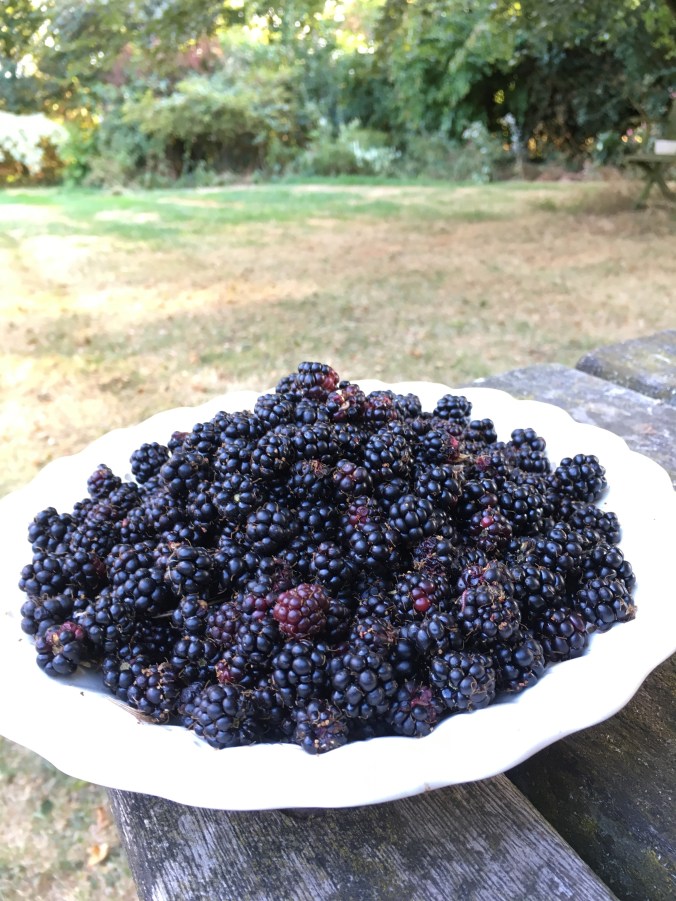
I wrote about my low bird count for the RSPB BigGardenBirdWatch here : https://bramblegarden.com/2019/01/30/nest-boxes-and-bird-feeders-for-the-garden/

Climate change is having an impact on all our wildlife. Caterpillars are not emerging until later in the season due to cold, wet spring conditions. This is having an impact on birds such as bluetits who hunt caterpillars to feed their young.

I’ll certainly be doing all I can to provide a lifeline for all the birds visiting my garden. I just hope numbers increase before too long.

In a Vase on Monday-February 4th 2019

I’m starting to miss sunshine and warm weather. I’m muffled up with coat, scarves, gloves, two pairs of socks, and still the cold seeps in. There’s been such a cold wind. The ground is frozen and the pond iced over. And yet, mooching about looking for something cheerful, I find chinodoxa- untroubled by the cold, the colour of Mediterranean skies. A little bit of hope.

A circle of silver birch twigs makes a pretty background for spring flowers. I just twist the branches like rope and tie the ends together. I’m trying not to use florists’ foam as it’s currently not recyclable. I’ve found a solution. A friend sent me a box of orchids, each one with a 7cm test tube of water, keeping them fresh. Recycling them, I twist a piece of wire around the necks and stick them in amongst the twiggy coils. Topped with moss, and hidden with ivy, no one will know they are there. I just have to top up the water each morning, and at the same time, add fresh flowers as I please. The wreath here was made on Saturday with wild clematis -old man’s beard- ivy and winter flowering honeysuckle lonicera fragrantissima. It survived high winds, mostly. Silver honesty lasted a day, then blew into the back field hedge where it glistens like a tiny mirror. And the star-like cow-parsley seed heads have gone. It’s an arrangement that changes with the weather. I like that. It’s real life. A reflection of what’s happening in my garden today.

So this morning, I’ve picked some snowdrops and chinodoxa and added them to the arrangement. Chinodoxa known as “glory of the snow” seems untroubled by the cold north wind. Such a delicate flower, and yet so hardy.

To add my own sunshine, I’ve found some aconites, Eranthis hyemalis. We called these gold coins when we were growing up.

Snowdrops nestle amongst the foliage. I bought the single variety , galanthus nivalis, from Easton Walled Gardens. A little bit of history now growing in my wild garden. There’s been a garden at Easton for at least 400 years. A renovation project started almost 20 years ago, has rescued the garden for future generations to enjoy. The double snowdrops came from Hodsock Priory. Another favourite place to visit with my Mum.

My wreath sits above the doors on our 1930s turntable summerhouse. We’ve turned our backs to the wind and swung the summerhouse around to face the wild garden. There’s wild garlic thriving on the right, under the willow. I’m really pleased to see snowdrops I planted three years ago starting to form little clumps. How long, I wonder, before the scene is a sea of white. I shall have to wait and see.

Links :

I’m joining Cathy for her IAVOM meme. https://ramblinginthegarden.wordpress.com/2019/02/04/in-a-vase-on-monday-skinny/

Chonodoxa https://www.gee-tee.co.uk/bulbs/chionodoxa/chionodoxa-violet-beauty

Eranthis https://www.gee-tee.co.uk/bulbs/bulbs-in-the-green/eranthis-hyemalis-winter-aconite

Easton Walled Gardens https://www.visiteaston.co.uk/

Hodsock Priory snowdrops http://www.hodsockpriory.com/about-us/the-gardens/snowdrops/

NGS snowdrop gardens to visit https://www.ngs.org.uk/find-a-garden/snowdrop-gardens/

Lonicera fragrantissima https://www.rhs.org.uk/Plants/68665/i-Lonicera-fragrantissima-i/Details

In a Vase on Monday

I always seem to be wandering about in the gloom. I rush home from work just in time to check over the greenhouse and poly tunnel. It’s always a delight to see what’s burst into flower while I’ve been away. So today, I’m sorry to say, my flower arrangements are a little dark- again.

Luckily, there’s just enough light to pick a few stems of Paperwhite narcissi. The scent is such a joy in winter. It’s a little overwhelming indoors, but three stems in a posy are just right.

I’ve partnered the Paperwhites with a chocolate hellebore. I bought this last spring at Ashwood Nurseries where the owner John Massey very kindly gave our group a tour of his private gardens, as well as delicious lunch in his cosy kitchen. It’s a memory I will always treasure, thanks to John’s kindness and generosity.

My little posy came on an outing with me to Leicester for the gardening phone-in programme at Radio Leicester. After answering listeners’ questions on everything from sowing seed to pruning, I set off for my Mum’s house. The posy looks just perfect on her sunny kitchen window.

Pittosporum has a purple wavy picottee edge in winter. I’m cutting back my eucalyptus gunii this spring as it’s got to about 8ft. Trimmings make a lovely background for any flower. I’m also cutting back a giant white jasmine. The foliage is almost every green, and there are a few purple-tinged seed heads that look very pretty.

By the time I finish messing about with flowers and foliage, the trees in the back field are charcoal outlines. I stand and marvel. Is there anything more beautiful than a native oak. The farmer who planted this has long gone, and his son also. We live next to the farm. No doubt, this tree will outlive me. Meanwhile I’ll stand and gaze, and make a promise to protect it, should anything ever come along to threaten it.

I’m joining Cathy again this week for her IAVOM meme. Here’s the link to join in and read about what the others are growing and putting in their vases this week.

Links:

Cathy https://ramblinginthegarden.wordpress.com/2019/01/28/in-a-vase-on-monday-it-makes-scents/

Ashwood Nursery black hellebores : https://www.ashwoodnurseries.com/shop/helleborus-xhybridus-single-black-pearl.html

I wrote about my visit to Ashwood here https://bramblegarden.com/2018/02/26/in-a-vase-on-monday-ashnurs-gdnmediaguild/

I wrote about growing Paperwhites here https://bramblegarden.com/2017/12/01/fairy-lights-for-the-greenhouse-and-an-update-from-this-weeks-bbc-radio-programme-for-gardeners/

Visit Ashwood https://www.ashwoodnurseries.com/visit-us/

In a Vase on Monday. Daylight photos

I feel rather guilty for the dark, poor quality photos posted last night. I shouldn’t have lingered on the footpath, looking at the wildlife. It was dark by the time I reached home.

So today, I rushed back – and it was still daylight! It feels as if it is getting lighter. It’s a month past the shortest day and plants in the garden are moving. The sap is starting to rise.

Anyway, thank you for your kind comments on all my photos – even when the quality leaves a lot to be desired.

Here’s the same flowers that were posted yesterday for IAVOM – in daylight conditions today.

The “workings ” are a willow heart with a kokedama vase tied on with string. I’m not using florists foam as there’s growing concern about it polluting water courses and not being recyclable. No one would ever know that the vase is a jam jar covered in moss from the garden, with green twine wound over and over to make the kokedama “nest.”

It’s easy to top up the water every day, and the flowers seem to last just as long. In fact they probably last longer, because each day you can fish out the posy and trim a tiny amount off the stems. Refresh the water, and all’s well.

We are all trying to find our way through the new circumstances we find ourselves in. No one can ”un- see” David Attenborough’s Blue Planet programme. The film of the whale carrying its dead calf will stay with us always. As will the pictures of the beeches and ocean polluted with plastic. I for one will find alternatives for florists foam, until a recyclable ”green” alternative is produced. I’m using test tubes and mini glass vases, hidden in moss. I don’t feel as if my flower arrangements are suffering.

Thank you to Cathy for hosting IAVOM at https://ramblinginthegarden.wordpress.com/category/gardens/in-a-vase-on-monday/.

Six on Saturday- Photos from my Garden, 19th January 2019

Is there anything more beautiful than a January rose.

One of favourites is Rosa Pearl Drift. Rarely out of flower all summer. Throws out the occasional joyful surprise through winter. We had a posy of blooms for Christmas. Disease resistant and low maintenance. I can highly recommend this beautiful, hardy rose.

Picked at 4.30pm today: Paperwhite Narcissi from the unheated poly tunnel, black hellebore bought last spring from Ashwood Nurseries. Similar varieties are Hellebore Black Pearl. Partnered with blue green eucalyptus stems and jasmine. A joy for my potting shed window. I love fresh flowers in winter, probably more than in summer. There’s more need for cheer in the dark days of January.

Planted broad bean De Monica in my new hinged deep root trainers from Haxnix.

I planted Aquadulce in October and overwintered them in the greenhouse. They’ll be planted out next month for an early crop. De Monica will provide a successional crop later in spring.

I’m trialling a new peat-free potting compost from Westland being launched this year. I’ll report back as plants start to grow over the next few months. So far, so good. It’s nice to use, free draining, and consistent. There are no large lumpy bits in it. And it doesn’t grow a green algae on the surface of pots, like some of the compost I’ve tried in the past.

A view of the wild garden, taken from the summerhouse. I’ve been planting 200 foxgloves, grown from two packets of seed, sown in mid summer. It would have been expensive to buy ready-grown plants. These cost £4 for seed, and a few pounds for compost. It’s a good way to create a maplanting effect, on a budget. You can start sowing seed now to catch up. Plants grown this spring should provide some flower spikes late in summer. They will bulk up and provide a real show the following spring.

Scattered all around my garden are piles of twigs and logs, covered with leaf mould. Homes for invertebrates. Beetles, bugs and insects mean food for hedgehogs, frogs, toads and birds. My army, all ready to munch on pests such as slugs and snails. It’s a fair exchange, I think. I give them a home, they look after me.

And finally a day-time view, past the summerhouse, down the field to the woods where our tawny and barn owls live. At dusk we sit in the summerhouse and watch them glide by, silent as the night. The emerald green field is a joy in January. You can virtually see the crop growing! It’s almost a month past the shortest day, and the sap’s rising and plants are getting going.

I’m joining in with for Six on Saturday. Why not go over and see what others are posting for their six photos today. Here’s the link : https://thepropagatorblog.wordpress.com/2019/01/19/six-on-saturday-19-01-2019/.

LINKS:

I wrote about John Massey and Ashwood hellebores here ; https://bramblegarden.com/2018/02/26/in-a-vase-on-monday-ashnurs-gdnmediaguild/

Hellebores: https://www.ashwoodnurseries.com/shop/plants/hellebores/helleborus-xhybridus-single-black-pearl.html

Paperwhites came from Gee Tee Bulbs https://www.gee-tee.co.uk/ and were planted in October.

Vegetable seeds / foxglove seeds from Mr Fothergills http://www.mr-fothergills.co.uk/?gclid=CjwKCAiAsoviBRAoEiwATm8OYG3vsJS9JxyNd2rIPtJ1lZ4saSuPRVFTatI-9eqArW1r61_7P6cLbxoCQygQAvD_BwE

Deep root trainers for sweet peas and broad beans https://www.haxnicks.co.uk/deep-sherwood-rootrainers

Westland composts https://www.gardenhealth.com/product/natures-haven-multi-purpose-compost

Six on Saturday. What’s in flower today.

Enjoy a tour of my garden on a rainy Saturday. The temperature feels mild at 8C. I can hear a woodpecker in the orchard. Our farming neighbour is cutting the field hedge across the lane. We’ll be able to see the cows more clearly in spring. Speaking of spring…I was surprised to find so many flowers today.

Calendula Orange Flash. Grown from seed last summer. Supplied by Mr Fothergills. I’ll be growing these again in the cut flower/ veg patch. They last a week in a vase.

Calendula Fiesta seedling. Mr Fothergills again. Fades from lemon to white. Very pretty. The edges of the petals look like they’ve been cut with pinking shears.

Snowdrops. Earliest they have ever flowered here. Galanthus Elwesii variety. Originally from snowdrop festival sales at Hodsock Priory, Nottingham. It will soon be time to make a visit again. I always take my Mum, and we usually stay over in the converted stables. A little bit of luxury, midwinter. Does you no harm at all.

In my unheated poly tunnel, Chrysanthemum White Stallion is providing a few flowers for jam jar posies. Bought as tiny £2 cuttings from Chrysanthemums Direct at the RHS Malvern Show three years ago. The weather is so mild, the plants are starting to shoot early. I’m taking new cuttings today. Well worth growing. I also recommend Arctic White and Lollipop. They produce masses of blooms. All grow in 10″ pots, John Innes compost. Stand them outdoors all summer. Take in before frosts, to protect flowers. My father in law used to stand the pots in a glass-roofed corridor between the kitchen and the garage. A cold frame would also be suitable.

Alstroemeria from the poly tunnel. Just keeps on flowering. To force them into growth, pull all the flowers and leaves in September. Stop watering for three weeks, then feed and water well. The dormant period seems to encourage them to flower from November to February. Just when we all need something cheerful.

I love growing cut flowers for friends and family. I learned how to grow -for all seasons- on a course at Common Farm Flowers. Never has £100 been so well spent. I learned which varieties to grow and how to get the best out of my poly tunnel and greenhouse. I grow cosmos and sweet peas in the summer in 10 3m by 1.2m beds with little herb-edged paths in between. This year I’m growing love-in-a-mist, chrysanthemums, carnations, ammi majus, cornflowers and poppies.

And finally, I love green flowers and Helleborus foetidus is a favourite. I was just about to pick some flowers, when I spotted these ladybirds. Just shows how mild the weather has been recently. I left them undisturbed.

I’m joining in with Six on Saturday https://thepropagatorblog.wordpress.com/2019/01/12/six-on-saturday-12-01-2019/ . Thanks to the Propagator for hosting this meme. Please feel free to join us.

Continue reading

Winter Walk at Melbourne Hall.

Melbourne Hall in Derbyshire will be open this Sunday, January 13. It’s a rare chance to see the house and gardens in winter. I usually post reviews of gardens I’ve visited. But this time I’m giving advance notice as it’s such a lovely opportunity to see behind the scenes, out of season.

Photo credit : Andrea Jones.

Lady Ralph Kerr will host the event between 11am and 3pm. There will be a guided tour of the house, accompanied by classical guitar music, after which you’ll be able to explore the gardens. The special opening coincides with a feature in the January edition of Homes and Gardens Magazine.

Tickets cost £10 and include a glass of mulled wine and a slice of apple and pear pie provided by Master Chef professionals finalist Sven-Hanson Britt.

There’s also a tearoom just outside the garden gates which will be open for lunch, teas and cake. I can vouch for the cake. It’s absolutely delicious. And there’s usually a log fire to sit by.

For more information, the website is http://www.melbournehallgardens.com. Tickets are available on the day. Note: There’s no card reader, so payment is cash.

The magazine article was by award winning photographer Andrea Jones. I reviewed Andrea’s book, The Garden Photography Workshop, in a blog post here. https://bramblegarden.com/tag/workshop/

Six on Saturday – My Tribute to David Austin

I’m ignoring the sudden plunge in temperatures. Instead I’m dreaming of summer- and roses in particular. This is my tribute to the wonderful rose grower David Austin who died last month aged 92.

My first roses planted here were David Austin’s. Constance Spry, a glorious old fashioned-looking rose, drapes along the 40 foot pergola. A wonder. Such beauty when it’s in bloom. A fleeting glory, gone in just a few weeks. But the anticipation, waiting for the scent, is worth it.

I gather a basket of blooms. Soon the scent fills the potting shed. In a few moments, I’ve wound the roses into a mossy ring. A halo of elderflower completes the wreath.

I always prop up flower arrangements in the potting shed window to look for gaps, and to add finishing touches.

Then it’s on to the summerhouse. The evening breeze sends the scent through the open doors. A perfect place to sit and contemplate the day’s work.

You can read more about David Austin here https://www.theguardian.com/lifeandstyle/2019/jan/01/david-austin-obituary. A life- and work which brought so much joy to so many people, including me. My garden wouldn’t be the same without my David Austin roses.

Joining in with the Propagator for Six on Saturday meme, https://thepropagatorblog.wordpress.com/2019/01/05/six-on-saturday-05-01-2019/ . Why not go over and see what others are choosing for their six photos today.

What roses are you planning to grow in your gardens this year?

A walk around my garden 2nd January 2019

Cyclamen Coum. A cheering sight in a quiet corner of the wild garden. Perhaps I’ve missed my chance to clear away fallen cow parsley stems. They will just have to compost down naturally with the autumn leaves- which also didn’t get raked up last year. Time just evaporated.

I found hibernating ladybirds. They are welcome here. I hope they’ll munch the greenfly in the summer. I left them undisturbed.

And early snowdrops. Mrs Macnamara, bought from a sale at Hodsock Priory a few years ago. There seems to be an early flowering seedling too. I wonder if it’s a new variety.

Hellebores seem to get earlier every year. A sign of our changing unpredictable seasons.

Algerian Iris unguicularis suddenly flowers. Baked at the base of a south facing wall, it’s always a heart-sing moment. Such delicate blue flowers. How can they survive the cold.

Vinca, periwinkle is rarely out of flower. I love the sky blue hue – against a grey sky.

By the front gate, and all along our hawthorn hedge, there’s violets. Such a joy on a cold day. The scent is something you’ll never forget.

Thanks to Helen for hosting #EOMV meme at https://patientgardener.wordpress.com/. What’s flowering in your garden at the start of the new year?

In a Vase on Monday- flowers for Christmas

In haste. As I’ve just found another Christmas present to wrap. I bought it months ago and stashed it in a “safe place.” I’ve only just remembered where said place is! If ever I give the impression of being well organised, don’t take any notice. I’m running round in a panic half the time. Anyway, for my last IAVOM of the year, here’s some photos of my front door wreath. I’ve run round the garden and collected evergreen foliage. In the poly tunnel I found white alstroemeria, cut back in August and forced for December. White Stallion chrysanthemums have been flowering since October. They are just going over, with a pink tinge to the petals. A perfect match for pittosporum. There’s two sprigs of scented freesia left over from a birthday bouquet. They last for ages in a cool place. I always prop everything up in front of the potting shed window where I can see if there are any gaps.

My favourite hedgerow ivy and bits of conifer set off the flowers. Silk tassel bush and Scots pine add a Christmassy note. And there’s always rosehips in everything I make.

Meanwhile, all our five bar gates have been draped in willow hearts. Something to cheer the walkers as they pass by.

Wishing you all a wonderful, peaceful and happy Christmas. Thank you to Cathy for hosting my favourite meme, IAVOM. https://ramblinginthegarden.wordpress.com/category/gardens/in-a-vase-on-monday/. I’ve enjoyed joining in this past year. Looking forward to seeing what you are all growing in your gardens in 2019. I’m excitedly perusing the seed catalogues already! And hoping to be more organised in everything I do.

Six on Saturday. Simple Christmas Decorations from the Garden.

I should be making mince pies. Or cleaning the house. Instead, I creep outside and lose an hour or two, messing about with twigs and foliage. I am happy.

This simple wreath is made from silver birch twigs, twisted in a circle and bound with twine. It’s an ever-changing scene. Ephemeral. A fleeting beauty. Blackbirds feast on the rosehips. Gusts of wind carry off the old man’s beard, back to the hedgerow where it belongs. It mirrors nature. Nothing is static. I add fresh ivy leaves, Scots pine, crab apples. Dried hydrangea flowers amongst cow parsley “stars.”

For the front door, I’m copying an American idea. I’m mocking up a container. I cut some branches of blue fir and pine and stand them in a favourite terracotta plant pot.

Scrunched- up newspaper holds everything in place. I add coloured willow and dogwood stems. In front, I place a potted skimmia, as a focal point. You could add a white hellebore, or white cyclamen if you wish. A few hazel branches with cheerful early catkins complete the display.

A collar of moss hides the newspaper. It’s a cross between gardening and floristry and no one will know I’ve just used twigs and not splashed out on lots of new plants.

As a final flourish, I add mouldable fairy lights with thin copper wire. They cost £2.50 from Wilkinson’s and can be used with rechargeable batteries.

I’m joining in with Six on Saturday, https://thepropagatorblog.wordpress.com/2018/12/22/six-on-saturday-22-12-201/. Why not go over and see what others are doing in their garden at this time of the year.

As it’s Christmas, I’m sure no one will mind if I add a bonus photo. I made this heart from two willow stems. Hold them both in one hand, bend the first one over and then hold in the middle. Bend the second one over, and secure with twine. Easy, and costs nothing to make.

I’m heading indoors now to make those mince pies! I feel so much better for spending time in fresh air, and the house, garden – and me – are all ready for Christmas!

Have a wonderful, peaceful and happy Christmas. Try to make some time to “escape” to the garden, when you can.

Karen

Last Minute Christmas Presents for Gardeners

Here’s my last minute recommendations. I would love to receive any of these. They all last longer than Christmas Day. Prices vary, depending on special offers and discounts.

1. Vouchers for a course at Common Farm Flowers.

https://www.commonfarmflowers.com/workshops.html .

I joined the Grow Your Own Cut Flower Patch course a few years ago, and I’m self-sufficient in flowers for my friends and family. There was enough information to grow plants commercially, if I had wanted to. I’m delighted to be able to wander about my garden at any time of the year and create beautiful hand tied bouquets and pretty jam jar posies. There’s something special about home-grown flowers. It’s all a matter of planning and knowing what varieties to grow. Georgie is an excellent teacher. After attending one of her courses, you feel as if you can conquer the world. It’s a rather wonderful feeling!

Courses on offer range from £15 for a garden tour to £290 for a painting course.

Courses: Flower Farming, encouraging wildlife, social media for small businesses, starting a kitchen table business, grow your own wedding flowers, hand tied bouquets.

2. RHS Membership. From £61.

Develop your gardening skills with an RHS membership package. Membership includes unlimited entry to RHS gardens, discounts for show tickets, personalised advice, and entry to 200 partner gardens. The RHS magazine,The Garden, is worth the membership price alone. It is packed full of inspiring ideas and information. Written by experts we all trust. I always look forward to my copy, and it keeps me up to date with new plants, ideas for recycling, using less plastic in the garden and information on the latest research into plant diseases. It’s great to see The Garden magazine will be delivered in recyclable paper packaging instead of single-use plastic next spring.

https://www.rhs.org.uk/shop/special-offers/active-offers/rhs-gift-membership-offer

3. Support the Woodland Trust with a membership package. £48.

Explore 1,000 Woodland Trust woods. A walk in a wood lifts your mood and re-energises you. It will do you a power of good.

https://www.woodlandtrust.org.uk/membership/

4. Membership for St Tiggywinkles wildlife hospital. £36.

We all rely on our wildlife, hedgehogs in particular, to help us combat slugs. This is a wonderful way to support wildlife and learn more about them.

https://www.sttiggywinkles.org.uk/top-navigation/help-us/membership.html

5. Join The Hardy Plant Society. £17 a year.

A great way to discover more about hardy plants, find like- minded gardeners and join in with events such as talks and slide shows, conservation and plant sales. There’s two issues of the The Hardy Plant magazine a year, free advice and a chance to take part in the free seed distribution scheme.

http://www.hardy-plant.org.uk/whyjoinus

6. Charles Dowding No-dig course. Various prices. Approx £150 a day.

Learn all about growing all kinds of vegetables and fruit, productively and with less effort. Charles has helped me to garden with a poorly back. I fractured my spine in a car crash 15 years ago. Without his advice, I would probably have had to give up my one acre garden. With his no-dig techniques, I have managed to keep on top of weeds, and grow all the fruit, veg and flowers I want to, without aggravating my spinal injuries.

I hope these last-minute suggestions have been useful. If not for Christmas, they make a lovely birthday present.

What’s the best course, or membership, you would recommend? Let me know so I can share your ideas too.

Coming up in the new year, I’ve been invited to try out some weekend holidays for gardeners. I’ll let you know how I get on. I’ll be taking my Mum with me, of course. Something to look forward to in 2019.

Six on Saturday -Making Light

Midwinter. I love saying the word. It’s like a sigh. Midwinter. Dark and gloom until 21st of December – and then the days get lighter. Hurray! Meanwhile, to bring some cheer, there’s fairy lights.
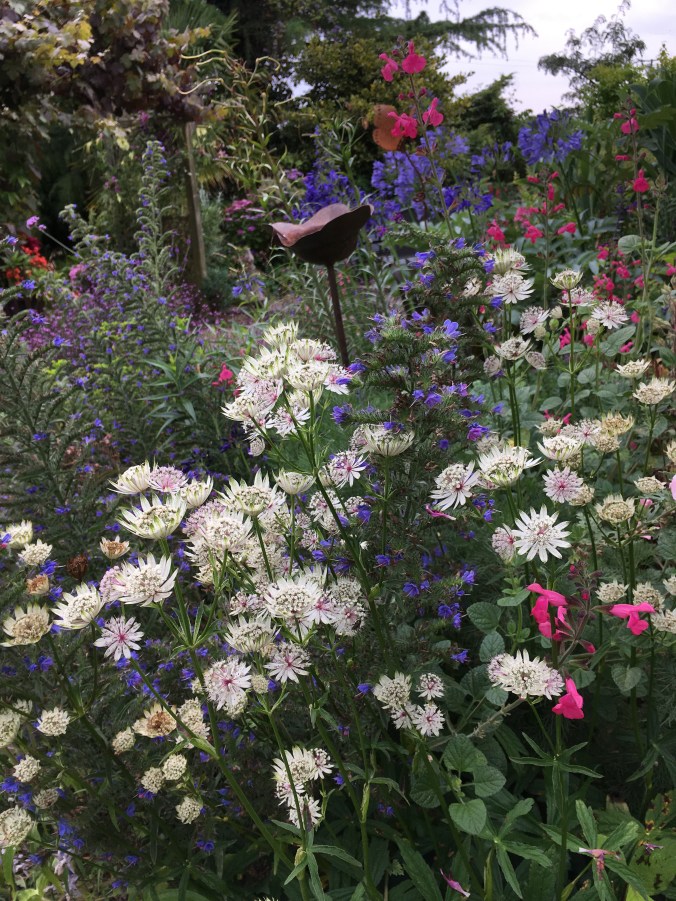
It’s mild today, 9C but windy, so I wrap up warm and head off down the lane to forage for foliage. Sound seems to carry further in winter. I can hear our neighbouring farmer calling his cows. They are as tame as pets, and well tended. The calves line up along the hedge to watch me.

I find willow stems; soft grey catkins breaking through already. There’s plenty of twigs with dried oak leaves. On one side the hedges have been trimmed. But across the lane, the hedges are high. Dog roses wind around the trees and mingle with wild clematis. I have a basket to carry the findings home. There’s fluffy seed heads from Clematis vitalba, and rosehips as red as sealing wax.

Scott’s pine and trailing ivy will be useful evergreen. Above my head, a robin sings, quite unconcerned by my intrusion. It’s good to see a young hare in the field. He crouches down in the long grass when he spots me, but I can still see his ears.

Back through the field gate. A pheasant has taken up residence in our paddock this winter. He’s a joy to see, strutting around and flying into the cherry trees to roost at night. I hope he survives the winter – and evades the hunters. We can hear the guns from our garden. Glad to provide a sanctuary to any creature needing safety.

I’ve decorated the five bar gate with a circle of dried clematis stems. Not a perfect circle. Not a perfect gate. We’ve had it since we moved here. It’s covered in moss and creaking loudly, but I can’t bear to replace it. I get attached to old familiar things. Dried hydrangea heads make a focal point, and there’s always rosemary for scent.

Back to the potting shed to make my arrangements.

I’ve saved some Chinese’s lanterns, physalis, from the garden. It’s hanging from the rafters to dry, along with hydrangea heads. To add a bit of glitz (unusual for me, I know) I give the hydrangea heads some silver spray. It highlights the delicate flowers of hydrangea Annabel. So beautiful in summer, and winter too. It’s a favourite of mine. The fairy lights are mouldable wire florists lights from Wilkos. You can use rechargeable batteries.

I turn around and there’s a robin and two wrens in the potting shed roof. I shall have to leave the door open for them. They can stay, as long as they don’t eat all of my rosehips.

Luckily there’s a kettle in the potting shed. Time for tea, and a piece of Mum’s fruit cake. I hope you’ve enjoyed this ramble around my garden and down the lane. I’m joining with with https://thepropagatorblog.wordpress.com/2018/12/08/six-on-saturday-08-12-2018/ for his SixOnSaturday. Feel free to look around at my other posts while you are here. Catch up with you next Saturday.

Family Favourite Recipes – Chocolate Marzipan Cherries.

When I started this blog, my intention was to write down all our family favourite recipes in one place. It occurred to me that our much loved recipes exist on tatty pieces of paper. My children might want to find Aunty Betty’s toffee apple recipe, or the Gimson Christmas trifle. Stained and ripped pieces of paper might be difficult to find. So recipes are deposited here for future reference. Today I’m sharing my home made cherry chocolate recipe that I make every year. It’s a money saving recipe if you use your own fruit. And it’s simple to make. Even little children can have a go.

Ingredients

Home grown cherries, preserved in brandy. Choose good quality fruit that is slightly under ripe. Only preserve the best fruit, and none that has any blemishes.

Or

200g glacé cherries

500g marzipan

200g good quality dark chocolate.

Method

Soak the glacé cherries in cherry brandy overnight. Drain and reserve the liquid for adding to cakes.

If using your own preserved cherries, drain and gently pat dry with a clean tea towel.

Break the block of marzipan into four, and microwave for a few seconds to soften.

Take tablespoons of marzipan (about 13g).

Roll into a ball, and then flatten to enclose a cherry. Roll gently in the palm of your hand to smooth the marzipan. Leave to dry for a few hours.

Melt the chocolate in the microwave. Drop each marzipan cherry into the chocolate and use a spoon to roll them about to coat.

Stand the chocolates on foil until set.

Keeps for about 1 week in a cool dry place. If you can resist them that long!

Enjoy 😊

I made mine in the summerhouse, with the radio on and sunshine streaming through the open doors. It’s amazingly mild for December. We’ve had 12C for days, although last night it was -2 and we woke to a frost.

Here’s the ingredients. It’s a really simple recipe. Wonderful if you have a cherry tree in the garden.

I used white marzipan, but you can use golden if you like.

Drop into the chocolate. Make sure you don’t get any water in the chocolate, or it will go dull.

They take about an hour to set. The recipe makes about 35 cherry chocolates. There’s enough marzipan and chocolate to make another 30 if you buy more cherries. Or make 30 almond marzipan chocolates.

Simply enclose one whole blanched almond in the marzipan as above, and coat in the chocolate. Delicious! You can also use whole Brazil nuts and use milk or plain chocolate.

How to Preserve Cherries

450g cherries

75g sugar

2 drops almond essence

600ml brandy.

Remove the cherry stalks and stones and prick all over with a sterilised needle or cocktail stick.

Layer the cherries with the sugar in a large sterilised preserving jar, fill to within 2.5cm of the top. Add almond essence.

Pour the brandy to cover the cherries. Seal the jar and shake well.

Keep in a cool, dark place for at least three months to allow the flavours to develop. Shake the jar from time to time.

Strain the cherries through a funnel lined with muslin. Put the cherry brandy into sterilised bottles to give as presents. Use the cherries in the chocolate marzipan recipe above, or in pastries, ice cream and other winter treats. Enjoy 😊

Book prize draw winner- The Creative Kitchen

It’s been a good year for new books. One of my favourites recently arrived in the potting shed is The Creative Kitchen by Stephanie Hafferty.

The publishers kindly offered one free copy for a prize draw for this blog. I’m always grateful for a chance to pass on goodies to readers. And I’m delighted to announce that the winner is June at https://thecynicalgardener.com/ .

Please take a look at the discount code on my review which gets you the book for £16 including postage. Here’s the link for the review https://bramblegarden.com/2018/11/18/the-creative-kitchen-book-review/

I’m making peppermint creams for Christmas presents using Stephanie’s idea for mint sugar. The kitchen smells divine, and the mints look really pretty.

Thank you for reading this blog. Keep popping back for more news. A whole pile of books have just arrived in the potting shed and I’m just starting to work my way through them, so keep an eye open for more prize draws and offers.

Are you making any Christmas presents this year? Get in touch and share your favourite recipes and ideas for gardeners and cooks. It’s great to share hints and tips with each other.

I always look forward to your comments. Please also feel free to share this blog on any social media platform you like. It all helps to spread the news.

In a Vase on Monday. White and Green.

A slide show of flowers from my garden. Paperwhite narcissi, Hellebore Jacob Royal, white heather, Ice Princess. Variegated pittosporum, hebe, juniper, ivy, conifers, Mossy green apple twigs, woven in.

It’s 12C today. No wonder the Paperwhites won’t wait until Christmas. I’ve planted more, a fortnight apart in 10″ pots in the poly tunnel.

There’s still some bees and hoverflies about. But the wasps have stopped coming. They left an empty paper nest in the long grass in the wild garden. We knew they were there and kept a respectful distance. We’ve had no trouble with aphids all summer; wasps have zoomed in and feasted on them with relish.

Dusk seems to descend all of a sudden. One moment I am mooching in the greenhouse, the next I’m plunged into darkness. I’ve strung some mouldable wire fairy lights through the lemon trees. They make little heat and will only be left on for an hour or so. Enough to cheer me through the gloom of December days to come.

Winter sunsets are glorious though. I stay out until the very last minute. Hopefully, I’ll spot a tawny owl before it’s time to go indoors.

Thanks to Cathy https://ramblinginthegarden.wordpress.com/ for this IAVOM meme. Why not go over and see what Cathy and all the others are growing and arranging this week. Let me know what’s looking good in your garden at the moment too.

Six on Saturday. A peek in my greenhouse
On such a horrible wet day, the only place to be is in my greenhouse.
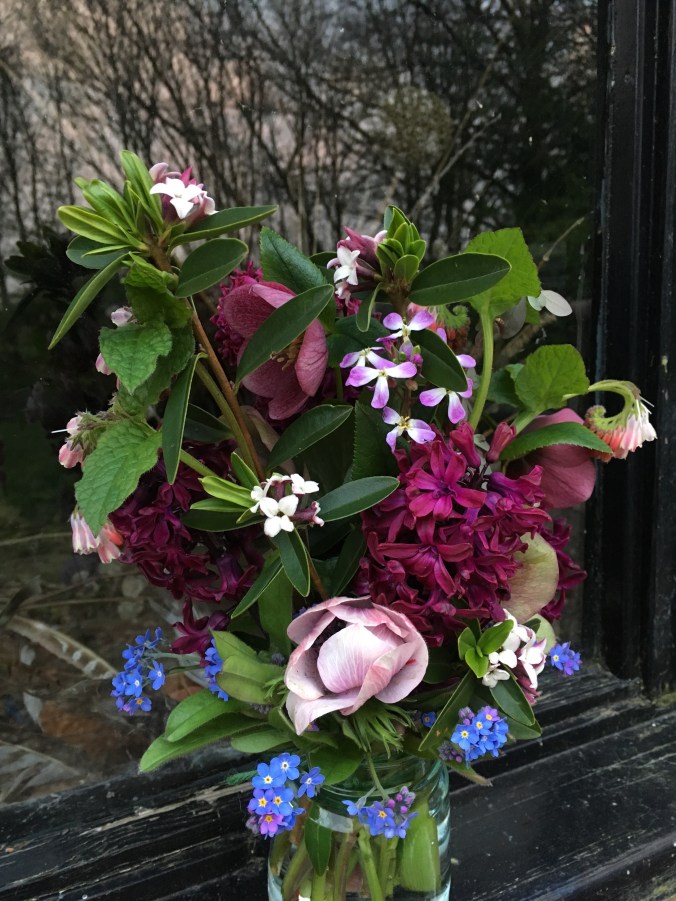
Cacti and succulents rule on the top shelf. They virtually look after themselves. I won’t water them until the end of February. Perfect for anyone with a busy life.

There’s always baby plants to pot up. I’m using these in a Christmas wreath next week. I’ll make a circle of willow, cover it in sheet moss, and wire in the succulent cuttings. They’ll soon root into the moss and grow on. I’ll post some how-to photos as I go. The wreath can hang on the front door, or become a table setting with a candle in the middle.

The temperature in here is 10C today. A Parwins electric fan heater is set to 5C. Providing I keep the plants on the dry side, they survive the winter. It’s the wet that kills more plants than the cold. This pinky orange bougainvillea remains colourful right through until spring. I’ll prune it right back next March and it will produce fresh bracts on the new season’s growth. This one is being trained into a pyramid and I’ve also got a purple one trained into a ball.

Down the left of the greenhouse is a row of potted citrus plants. These are fabulous for making cakes. I never use chemicals, so the zest is safe to use. There’s oranges, tangerines, lemons and limes. I’m searching for something called a Buddhas Hand which apparently produces large quantities of peel for jams and marmalade.

I bring pots of herbs and annuals into the greenhouse in October to overwinter. My nasturtiums are still flowering. I’ll use the flowers and leaves in salads. Anything to cheer up dark and rainy days of December.

I hope you’ve enjoyed my whistle-stop tour of my greenhouse. I love to have somewhere to mooch when it’s horrible outdoors. What’s growing in your greenhouses, coldframes or porches this winter? Get in touch and let me know what you are nurturing, indoors.

Joining in with https://thepropagatorblog.wordpress.com/2018/12/01/six-on-saturday-01-12-2018/. Why not go over and see what the the others have chosen for their Six on Saturday slideshow photos.

Six on Saturday. Joining in for the first time.

Six photos from my garden and potting shed this week.

Catching the light in my potting shed window: Old Man’s Beard, wild clematis vitalba. Commonly called traveller’s joy. I stand on tip toe, reaching into hedgerows to harvest long stems with silver seed heads. They’re a lovely addition to winter flower arrangements.

Silver coins. Honesty seeds. Hanging from the rafters to dry. They will be tucked in amongst rosehips, holly and ivy for Christmas decorations.

Chinese lanterns, harvested in October. I love the various shades of orange. They fade to a delicate papery apricot colour. And left long enough, they become transparent.

My potting shed window looks out onto the wild garden. So heartening to see hazel branches with lambs-tail catkins. A welcome reminder that spring will return. The twigs make useful supports for my paperwhite narcissi and hyacinths which are in the dark under my point shed bench at the moment.

The last few golden leaves are fluttering in the breeze. Hazel, maple, ash trees make a mini woodland. I’ve planted 200 foxgloves in the wild garden. We sowed the seed in mid summer, pricked them out in August, and planted out, they will sit making roots over winter. I’m growing Sutton’s Apricot, a glorious silky, peach- coloured foxglove, and Pam’s Choice- white with a blackcurrant thumb print in each flower.

It’s dusk before I finish planting. I stand by the pond watching blackbirds taking a last-minute bath. I wonder how they can stand the cold water. I expect it keeps their feathers in good condition. A tawny owl glides silently along the field hedge. Short-tailed voles live in the long grass here. Within minutes, it’s dark. It’s not like in summer, where there’s enough moonlight to potter around. November dark is cold, pitch black. Time to go indoors, light a fire and make hot chocolate.

I hope you’ve enjoyed a walk around my garden with me tonight. I’m joining https://thepropagatorblog.wordpress.com/ for his Six on Saturday meme. What jobs are you doing in your garden this weekend?

In a Vase on Monday – flowers for a christening.

Pink roses for a baby girl. Just the right flower. That’s what I decided when a friend asked me to make a door wreath for her granddaughter’s christening.

Setting out with a wicker basket, I spend a happy hour searching the hedgerows around the garden. I’m looking for ivy leaves, and their lime green and black flower heads and seeds. The perfect background for any circle of flowers. I find jewel-like Euonymus europaeus, or spindle tree, growing wild amongst the ivy, dogwood and hawthorn. Their bright pink fruit split apart to reveal orange seeds inside. Leaves turn a burnished bronze and then red. I add them to the basket. It’s like finding treasure.

I find some silver coins. Well, they look like coins. Honesty seed heads have turned a glorious silvery grey. Perfect for tucking in amongst the flowers. I love the way they catch the light. No need for fairy lights here.

I search around for some sprigs of a newly- planted viburnum. This winter-flowering gem is called Viburnum tinus Lisarose. Clusters of small pink and white flowers look lovely at all stages from bud to fully open. It flowers from November to April, just when we most need some cheer.

It’s my lucky day. I’ve found some late-flowering roses. My favourites, The Fairy and Pearl Anniversary. They have small clusters of pearly pink semi-double flowers. Both are compact, easy to grow varieties. Mine are thriving in containers and are moved into the greenhouse to provide flowers right up until Christmas. Pearl Anniversary is a compact, patio rose, and The Fairy is a small shrub rose. Both are repeat flowering and disease resistant.

Roses make the perfect focal point at the top of the wreath. Not many are needed to make a display.

Rosehips. So glossy they look as if they’ve been dipped in varnish. They cascade from the top of the hedgerows. The birds will have a feast. I harvest some for today, and some for Christmas, not taking them all. It’s best to share. I weave them in and out of the ivy. It’s a happy combination of hedgerow and garden. Just perfect for a baby girl’s special day.

Each week I join Cathy for her IAVOM Meme. Luckily flowers don’t have to be in a vase to be included. Why not go over and see what Cathy and all the others are growing and harvesting for their flower arrangements this week. Let me know if you have ever made flowers for a special occasion like I have. It’s lucky when the garden and hedgerow provides such bounty, even in November.

Cathy : https://ramblinginthegarden.wordpress.com/

The Creative Kitchen – Book Review

By Stephanie Hafferty

Published by Permanent Publications. November 2018

*Win a free copy in the prize draw by leaving a comment at the end of the blog. And there’s a discount code for readers.

New reading in the potting shed this week is Stephanie Hafferty’s latest book on seasonal recipes for meals and drinks and making items for the garden and home.

I have to admit, I have a passion for cookery books. Many of my favourites have been handed down through the family. I’ve got Bero baking books from my grandma Betty, which bring back happy memories of delicious cakes. She never ate them herself, but just liked to make everyone smile. All our trips to the seaside- and local beauty spots such as Bradgate Park – would be accompanied by her butterfly fairy cakes. Her trifles were liberally sprinkled with hundreds and thousands. And I bet my brothers remember her home-made toffee apples. It’s amazing our teeth survived, but they did.

When you think about it, many of our strongest memories relate to sitting around a table together, sharing food. All our celebrations, birthdays, anniversaries- and Christmas being the highlight of the year- revolve around food.

With my own family and friends, I’ve tried to carry on the cooking and nurturing tradition. Although, it’s not always easy to get everyone together at the same time. We live such busy lives. When I do manage to corral the family together, I’ll usually make a massive pot of soup, a casserole, a cheese and potato pie, a vegetable lasagne, or similar. And for afters, there’s nearly always something involving apples- we have them in store all winter, and they’re free.

My cooking revolves around what I’m growing. And this is where Stephanie’s new book comes in handy; all the recipes are seasonally based. So they are relevant to what I’m growing all year round. I always start with what I’ve got available, rather than choosing a recipe. Stephanie helps by suggesting what I can do with the gluts of the season. I often have that “what-on-earth-am-I-going-to-do-with-all-this-kale” moment. Hearty bean and vegetable soup might be the answer.

I’m very keen on throwing everything in a pan together and just leaving it to cook. It gives me more time to garden- and chat. My two favourite pastimes! Stephanie must have written this book specially for me. Her Bean Stew with Red Wine is simple to make, fabulously tasty, and looks pretty too.

Alongside the main meals, soups and salads, there’s recipes for store cupboard ingredients such as flavoured salts, vinegars, herb mixes, and infused sugars. I’m definitely going to try making mint sugar. Imagine adding it to hot chocolate. Such a treat on a freezing cold day.

I’ve been thinking about what to do about vegetable stock powers since my favourite brand decided to add palm oil to its ingredients. There will be no palm oil in my house. Apart from not trusting the “ethically sourced” statement, we do not want or need palm oil. Only if we reject it will the rainforests be saved. I am just one person, but it seems the message is getting stronger. People are picking up packets of food and reading the labels and realising that palm oil has insidiously crept into so many food and household products. Anyway, now I can make my own stock powers with Stephanie’s recipes for wild herb, mushroom and tomato bouillon. And there’s a fruit bouillon for adding to yoghurts, cakes and biscuits. Such a clever idea, and easily do-able.

I’ve had a go at making herb teas, but never tried gin or brandy recipes. Stephanie’s Rhubarb and Sweet Cicely Gin sounds- and looks glorious. And wouldn’t it make a fabulous present for someone.

Sugar Plum Brandy looks equally divine. Apparently, this makes a lovely after dinner liqueur as well as a cocktail base. I’d probably add it to fruit cakes as well.

You wouldn’t think you could fit so many good ideas into one book, but Stephanie seems to have thought of everything. I particularly love her Gardeners’ Hand Scrub, Floral Bath Bombs, and Herb Candles. I’m going to be busy for the next few weeks, trying all the recipes and making presents for friends. And I’m going to enjoy every single minute of it.

Stephanie’s book is paperback and £19.95 from https://shop.permaculture.co.uk. There’s a discount code for blog readers purchasing from the shop which is BRAMBLE. Apply the code in the discount section at checkout to obtain the book for £16. Postage is extra. The book is also available via Amazon here https://www.amazon.co.uk/Creative-Kitchen-Seasonal-Recipes-Drinks/dp/1856233235 . There’s one copy available in the prize draw. Names will be randomly selected. Publisher’s decision is final. There’s no cash alternative. Worldwide delivery, for a change. Usually it’s UK only. Nice to have an international prize.

Meanwhile, the view from the potting shed is sunny today. As well as reading, I’ll be deciding what to grow next year, and Stephanie’s book will come in handy while I’m making my seed lists. What books are you enjoying at the moment? What are you planning to grow on your plots for 2019? Get in touch and let me know.

The Bumblebee Flies Anyway

Book Review

Kate Bradbury. Published by Bloomsbury Wildlife. Hardback £16.99

It’s been a difficult year. I’m only just getting over serious illness myself, and then three relatives have been ill. I’ve been stretched to the limits trying to help everyone. So when I picked up Kate Bradbury’s book, it seemed to have been written specially for me. There’s a message of hope on every page.

Kate’s struggling too. Some kind of crisis. A broken heart. She ends up homeless, sleeping on friends’ sofas. She has to leave London and make a new home in a damp dark, basement flat. Even worse, the garden is a dead place. Decked over and full of rubbish. And yet, Kate’s book is not a tale of woe. It’s about struggling and striving. But ultimately, there’s a message of hope. After pain and suffering there can be triumphs and happiness again. It’s a message I needed to hear. I made myself a reading corner in the greenhouse and tried to absorb the positive vibes. It’s not easy when you are in the middle of a crisis. Sometimes I’d read the same paragraph over and over again, without registering the words. Stress is such a debilitating thing.

Kate turns her decked-over garden into a wildlife paradise. She makes a pond, puts up bird boxes and revels in every creature that comes to live in her tiny plot. It’s not just a book about rescuing a garden, it’s about rescuing a person too. It’s about the resilience of the human spirit. We may be bowed down and almost defeated by life’s events, but we will triumph. Nature, wildlife and gardens are a balm. Wouldn’t you agree.

I particularly love Kate’s descriptions of making a bee hotel and building a pond. I learn that a pond doesn’t need to be more than 30cm deep to be of value to wildlife. I could manage that. There’s plenty of places where I could fit a pond. And her tales of rescuing bees. I’d heard about giving bees spoons of sugar. Kate talks about finding an exhausted bumblebee on the pavement. She pops it in her pocket to keep it warm while she walks home. I’d never thought of doing that. She puts the red-tailed bee in a box with a pop bottle lid full of sugar water. It’s too cold and wet for the bee to go outside, so Kate gently places some shredded paper in the box to make a cosy nest until the morning. Apparently, some bees can be helped by gently stroking their thorax. I looked it up. That’s the part of the body between the wings. I can have a go at that too, if needed. Kate gives me confidence to try. Next day, Kate releases the revived and now grumbling bee. She searches for a mahonia plant to give the bee the best chance of survival.

There are lots of hints and tips sprinkled through the book for anyone wanting to make a wildlife garden.

Regular readers will know that we planted a mini-wood when we moved here, and I grow flowers and plants for pollinators. Now I have a few more good ideas for helping wildlife in my garden. Kate’s inspiring book and joyful message was just the pick-me-up I needed, to be honest.

The publishers have kindly given one free book as a prize for readers of this blog. Usual rules apply. One name will be randomly selected in the prize draw. There’s no cash alternative. Publishers decision is final. Please leave a comment to be included in the draw. Sorry, UK entries only.

In a Vase on Monday

Today’s posy is for restless hands. Hands that once embroidered, sewed, knitted, baked. Soothed small children. Typed. Wrote. Created. And now they are restless.

Hands clasping and unclasping. Reaching for mine and leading me to the door. Beseeching. “Lets go home. We’ll leave a note. They won’t notice we’ve gone.”

We cannot go home. We are here for tests. She’s in hospital for the first time in her life. And I am mesmerised by the hands. Literally, the ringing of hands.

While I wait in a corridor, I look for “hand-wringing.” Noun. Cambridge Dictionary. “If you wring your hands, you show that you are worried or unhappy.”

Collins English Dictionary: “Expressing or showing feelings. When you are expressing sorrow that a situation is so bad, but are saying you are unable to change it.”

‘Hand-wringing: the repeated clasping and unclasping or squeezing of the hands as a symptom of distress. In the face of a dilemma or crisis.”

An example of use is given:” No amount of hand wringing can change the situation.”

Powerless. Great distress. Confusion. The words go round my head.

I hold those hands. And in my desperation to know what to do I supply all that I can think of to soothe and comfort. A small posy of herbs; rosemary and lavender for memory. Scented pelargonium tomentosum. Leaves as gentle as velvet. Sunflowers for joy. Calendula for healing. A tiny hand posy. A corsage for courage. There’s no need for armfuls of flowers. What’s needed right now is the small, the familiar. Something to hold. As I work the flowers back and forth, binding and sealing in moisture and life, my hands echo hers. Twisting and turning. Clasping. Unclasping. Until we are finally both still. Calm. Patient. Accepting. Still.

Alzheimers.org.uk

In a Vase on Monday – Cathy at ramblinginthegarden

Book Review winner – The Almanac by Lia Leendertz.

Thank you everyone who commented on my review for Lia Leendertz’ New Almanac for 2019. The review was published Here

The winning name selected is https://watchingthedaisies.com.

Thanks again to everyone who read the review and took part in the prize draw. I’m grateful to the publishers for supplying a copy to give away.

I shall be buying several copies for Christmas presents. A little bit of joy for every day of the year. Lovely to dip into to keep pace with the seasons.

Here’s my gap-in-the-hedge view from the top field. A lovely spot to stand and gaze at nature, while gathering rosehips and crab apples for autumn preserves. There are lots of enticing seasonal recipes in the new Almanac. A good excuse to try something new.

The Almanac – A Seasonal Guide to 2019

Book Review

Lia Leendertz. Illustrated by Celia Hart

Octopus Books/ Mitchell Beazley. Hardback £10. September 6 2018.

Captivated from the first page, I keep dipping into the new Almanac, published this week. I loved Lia Leendertz’ first seasonal guide created for 2018. The new version for 2019 is just as magical, if not better.

I’ve made a kind of nest in the summerhouse, heaping cushions and old quilts on a comfy armchair. It’s peaceful in here, only the sound of thrushes tap taping snail shells on the stone path. It’s just the place to settle down and delve into Lia’s book.

There’s something comforting about being in tune with the natural world around us. Checking the times for sunrise and sunset, sea temperatures, tides, moon phases. I haven’t tried planting by the moon, but there’s dates and times to get me started. It seems to make perfect sense. I love the little moments of joy. Reading that day length increases by 1 hour and eight minutes during the course of January. It gives hope when it’s needed most. Here’s the page for January. Plough Monday is included in the dates listed. I heard my grandfather talk of Plough Monday- traditionally the start of the agricultural year. The book is like a siren call leading me back through time to my farming family ancestors. A reminder to keep in my heart their customs and celebrations.

There’s recipes such as Epiphany tart, a kind of jam pastry, with a star made with overlapping triangles and each “well” containing a different flavour. I hadn’t heard of this; it sounds delicious. There’s a tradition dating back to the 1600s of creating tarts with intricate pastry patterns, coloured with different jams. I wonder if my great grandmother Annie Foulds – who was head cook at Bradgate House- would have made such a dish. She made the most delicious cakes at home at Carters Rough Cottage, Groby.

Lia’s writing is perfectly complemented by illustrations from artist Celia Hart. The prints are so beautiful they draw you in, much as a photograph of a glorious scene makes you want to step into the landscape. It’s impossible not to stare longingly at Celia’s drawings- and wish you could step into the page. I’d like to see those swifts and swallows soaring above my head and turn over the seashells she so wonderfully captures.

A mesmerising read, totally spellbinding. A beautiful month by month companion for me. For anyone, like me, who tries to weave the stories of the past into the journey to the future.

The publishers have kindly offered one copy to give away. Please leave a comment below if you’d like to be included in the prize draw. The publishers will pick a name and send out a copy. The publisher’s decision is final. Sorry UK entries only.

Please share this review on any social media platform you like. Thank you.

Here is the Amazon Link for The Almanac.

In a Vase on Monday – cut flowers from my garden

Despite the drought, my cut flower beds provide a steady flow of blooms for my MIL Joan and my Mum Marion. Here are a few of my favourites for this week’s IAVOM.

Chrysanthemum Rainbow Mixed- from Mr Fothergill’s – were sown in March, planted out at the end of May, and flower right through June to October. Seeds cost £1.75 a packet. I’m always looking for good value for money and these fit the bill.

In this tiny posy, I’ve placed them with cosmos, fringed dianthus, and sprigs of blue agapanthus. They’ll last five days in a vase.

Colours range from white and pale pink to red, all with lovely chocolate coloured centres.

Looks good with white goat’s rue, Galega Alba from Chiltern Seeds. Pure white spikes of pea-like flowers from June to September.

With white Catanache alba from Mr fothergill’s seeds.

With fringed pinks, meant to be grown as annuals, but are in their second year. Chiltern Seeds have a pretty frilly variety here.

Add in some easy to grow cosmos. This one is Seashells from Thompson and Morgan. Ferny foliage is an added bonus and excellent for making button holes or filling out bouquets.

Looks fabulous with Verbena Pink Spires, a perennial plant from Miles Nurseries, Hoby, Leicestershire. Never seems to be out of flower.

I wrote about my cut flower garden – and sharing the plot with hedgehogs and other wildlife Here.

Thanks to Cathy for hosting this IAVOM meme. Why not take a look to see what Cathy and all the others are growing and displaying. It’s fascinating to see that sometimes we are growing the same varieties in different countries all around the world.

Please kindly share this via any social media you like, and don’t forget to leave a comment in the box below.

BBC Radio #SundaySupplement flowers/ hedgehogs/ my garden, 12 August programme

Some photos to accompany today’s BBC Radio Leicester gardening Sunday Supplement programme. It was my turn to sit in and answer listeners’ gardening queries on the phone-in today.

As always, I ran round the garden and picked some flowers for my mother-in-law Joan and my Mum Marion to take in to the programme. Despite the heat and drought, my cut flower patch hasn’t let me down. There’s plenty of colour just now.

In the pink and blue theme posy there’s zinnia, Mophead hydrangea, cosmos seashells and white wild goats rue. The green umbels are actually parsley that’s gone to seed, and the whole bouquet is wreathed with blue borage. The pink whirls are Diascia Hopleys. Plants have grown to 5ft and been in flower for 8 weeks. There’s just one glorious inky-blue gladioli, and one annual pink chrysanthemum (Tricolor Mixed) which are only just starting to flower.

In the orange-theme bouquet there’s calendula, rudbeckia, spikes of verbascum, and seed heads from love-in-a-mist. White jasmine provides a wonderful scent, even if there are only two sprigs included here. Any more would be overpowering.

I could talk for hours about flowers, but the conversation steered towards wildlife in my garden. So for anyone wondering how my hedgehogs are getting on, we have four precious babies this year, one less than last summer. They are a month later than last year, but very healthy and active. I am feeding them with Spike hedgehog food to try to build them up for the winter. Fresh water is also really important and in scare supply, so lots of little dishes are placed all around the garden.

So far these hoglets are just 5″ long. I’ll keep an eye on them to ensure they meet the target weight of 650g by winter hibernation time.

I wrote about last summer’s hedgehogs Here. There’s also hints and tips on helping hedgehogs on the highlighted link.

Radio Leicester Sunday Supplement is available on i-player. There’s a link Here. https://www.bbc.co.uk/programmes/p06fs2mb . Gardening starts at 1.09.31. Put your feet up and have a listen in.

Let me know what flowers are doing well in your garden right now, and do any of you have hedgehogs nesting in the garden this summer?

Please kindly share this on any social media platform, and don’t forget to say hello in the comment box below.

Tour of MrFothergill’s Seed Trial Grounds

Photo : Silene Blue Angel. New for 2018/19

Growing plants from seed is a passion for me. It’s an affordable way to bulk up annual, perennial and biennial displays in the garden. And each year I try something new, as well as sticking with tried and trusted old favourites.

Next spring, I’ll be adding Silene Blue Angel to my seed sowing plans. It’s one of the new varieties on offer at Mr Fothergill’s. And this week I was absolutely delighted to be invited to view the trial grounds at the company’s headquarters in Suffolk.

These are the plants that caught my eye. The silene was top of my list. A hardy annual, sown in March and planted out in early June. Plants form neat cushions 25cm tall. For a continuous display, I’ll sow a few seeds at two to three week intervals. I’m picturing drifts of electric blue flowers running through the borders and flowering all summer long.

Brachycome Blue Star is another new variety available for 2019. I’m going to partner it with this one I spotted from the Brachycome Blue/White Mix range. I’ve always loved any kind of daisy flower.

Regular readers know I also love sweet peas. I grow a range of heritage and modern varieties along a rather wonky hazel wigwam structure. Next year I will be adding new variety Capel Manor to the garden. It’s a pretty pinky blue and has a delicate, though not overpowering scent.

I always plant cosmos in the cut flower garden. They are easy to grow and provide flowers from early summer right through to the first frosts. I spotted this beautiful new white variety called Snow Puff. Bees seem to love cosmos, so that’s a bonus too. I’m always trying to find ways to help pollinators.

Here’s some photos of the trial grounds. It was fabulous to wander about amongst so many beautiful flowers, jotting down names for future planting plans. The scent in the heat of the day just added to the wow factor.

Mr Fothergill’s is celebrating its 40th anniversary. In May, the company won Product of the Year at RHS Chelsea for its new Optigrow range of seeds. Optigrow is a revolutionary non-chemical seed priming treatment that uses only water and air to get the seeds biologically ready for germination. I’ll be trying out some of the 19 vegetable varieties available – including tricky to grow parsnips- next spring. I’ll need to write another post about all the new vegetable varieties. There are quite a few I’ve made a note of. And there are many more new flower varieties. I’ve just picked out a few. I’ll definitely have to write another post soon….

Please share this via any social media you like, and don’t forget to say hello in the comments box below. Let me know what new seed you are planing to try out for the spring growing season. I am @kgimson on twitter and karengimson1 on instagram.

Wordless Wednesday -Cosmos Snow Puff

I’ve had a wonderful day at the field trials ground at Mr Fothergill’s Seeds in Suffolk. This new cosmos caught my eye. Perfect for pollinators. More words to follow when I’ve recovered from the journey. I will be growing this and many other new seeds next spring.

Please feel free to share on social media, and say hello in the message box below.

It’s hot, hot, hot….. what the garden looks like on 5th August 2018

Plants in my garden are matching the heatwave! These sunny rudbeckias were sown last summer and planted out in autumn. They make much stronger plants grown as biennials.

These are Rudbeckia hirta Glorious Daisies , also known as cone flowers, from Mr Fothergill’s Seeds. Bees and butterflies love them. They are easy to grow and last a week as a cut flower.

They remind me of sunflowers. I love the yellow petals and the deep chocolate cone centre. To get them to flower as annuals, sow seeds in a 3″ pot of good quality seed compost in February/ March. Place in a propagator at 18C. Prick out as soon as there are two true leaves. Prick out into individual 3″ pots to give the plants room to grow. Grow on in a frost free place in bright light, but not direct sunshine as the tender new leaves will scorch. Plant outside in a sunny sheltered position at end of May. They will flower all summer long.

If you have a very sheltered garden, you can overwinter them. To grow them as biennials, sow them in summer and plant out in early autumn into soil that has been well prepared. Incorporate lots of good garden compost, well rotted manure and leafmould. This will improve drainage over the winter when it’s the wet that tends to kill plants rather than the cold.

As temperatures are regularly hitting 28C to 30C these rudbeckias really shine out and match the sunny weather. I’ve not watered these, but any planted since Christmas would need a thorough soaking once a week.

To add to the sunshine look, I’m trialling the new Thompson and Morgan sunflower Sunbelieveable Brown Eyed Girl. These are making lovely short stocky plants suitable for containers. They arrive in the post well packaged and soon grow into 50cm plants.

I’m also growing various sunflowers from Mr Fothergill’s including Evening Sun which has a stunning range of colours. And bees absolutely adore them.

These last a week in a vase and make a lovely centrepiece of any cut flower posy. Calendulas are also doing well on my plot despite the heat and dreadful drought. I am only watering containers and succulent crops such as runner beans and courgettes. Everything else is relying on good winter mulching with home made compost and Plant grow fertiliser. We haven’t had any rain since May.

Regular readers know that I always cut my flowers for my MIL Joan and my Mum Marion. This summer has been a particularly difficult one, health wise, and sunshiny flowers have been much needed.

Calendula Snow White and subsequent seedlings are a firm favourite. I post photos of my posies on IAVOM which Cathy hosts on Mondays. Thanks for joining me on a ramble round my rather hot and parched garden. Let me know what you are growing in your garden the first week of August.

Thanks to Helen for hosting the End of Month View.

Summer fruit harvest and making garden jam

What a summer! My poor garden is burned to a crisp and everything’s wilting, including me. But the fruit garden is producing bumper crops. You’d think they would shrivel in 32C heat, but the black and red currants, gooseberries and blackberries are sweet and juicy.

Last night I wandered round the garden collecting a basket of fruit to make jam. I had planned to make strawberry jam from the pots of runners planted in April. But the tiny plants only yielded a handful of fruit. So delicious though. The plants only cost 60p each, mail order. I wrote about planting them Here. I’m hopeful of larger crops next summer.

The blackberries were the best I’ve ever seen though. A bumper crop and large fruit. Sometimes wild blackberries are so tiny they are hardly worth picking. But these soon filled a basket.

I threw the whole lot in a heavy based pan to make garden jam. Wow, what a scent. If it’s possible to capture sunshine and summer in a jar, this is the way to do it.

Garden Jam

To make 2 jars I used 500g fruit, 500g sugar 75ml water, juice of 1 lemon.

Method:

Place a saucer in the freezer for testing the setting point later.

Put fruit, water and lemon juice in a heavy based pan. Cook the fruit gently until soft.

Add sugar and simmer carefully until all the sugar crystals are absorbed.

Increase the heat to a rolling boil. After 10- 15 minutes, put a teaspoon of jam on the plate and gently push. If it wrinkles, it has reached setting point. If not, cook for another 5 minutes, taking care not to burn the jam.

Stand for 15 minutes

Pot into sterilised and warmed jars.

Fresh scones :

3oz butter

1lb plain flour

Pinch salt

1oz caster sugar

1.5 tsp. baking power

2 eggs and 6floz milk beaten together.

Add all the dry ingredients and rub together. Add liquids and mix carefully. Don’t over handle the mixture

Roll out thickly and cut into circles. Brush top with a little of the reserved egg/ milk mixture.

Bake for 10 mins until golden, oven temp. 230C, gas mark 8

Eat whilst still warm – or as soon as possible. Can be frozen as soon as cooled, to keep fresh.

I often ask twitter friends for recipes and gardening advice. Here’s a reply that came from Bob Flowerdew. I’m looking forward to trying his recipe.

And this came from June Girvin, which is similar to the recipe I ended up with. It’s absolutely delicious.

After all that foraging and cooking, we sat in the 1930s summerhouse, turned to face the cool woodland and pond and feasted on the jewels of the garden.

Surrounding us, there’s sounds of harvesting and baling. There’s a scent of new hay and oats on the breeze, and we watch entranced as barn owls swoop across the empty fields, like ghosts. They don’t notice us sitting quietly amongst the trees.

Here’s this week’s Garden Hour on BBC Radio Leicester where I chat away about what’s happening in my garden. Put your feet up and have a listen in sometime. The programme starts at 2.10.27 on the timeline. And the music’s not bad this week too.

http://www.bbc.co.uk/programmes/p06cd1bd

I am @kgimson on twitter and karengimson1 on instagram. Please share this on any social media platform you like, and don’t forget to leave a comment below. Thank you.

We made a garden for Rainbows Hospice : Belvoir Show 2018

My very wise Welsh grandmother was full of quaint little sayings. I used to laugh at the time. “Pick yourself up, dust yourself down; ” and “Something good always comes out of adversity.” But I didn’t heed them at the time. Then two years ago, suddenly, out of the blue, I became seriously ill. In the middle of the crisis, those words came back to me.

While I was lying in my hospital bed, I decided, if I survived, I would raise money for Rainbows Hospice for children. Being so ill was frightening, and it took all my inner resources to cope. How much worse, I thought, must it be for a child to be ill and in pain. Since then, I’ve been hosting garden club talks, afternoon teas and book launch events. But my biggest challenge came last weekend when I helped build a show garden.

And this is how it started. Over the bridge is the lake-side setting for the first ever Belvoir Castle Flower and Garden Festival. It’s a glorious Capability Brown landscape with rolling hillsides and ancient oak plantations.

We had four and a half days to make a garden. It’s a historic site, so we couldn’t dig down or hammer anything into the ground. Everything had to be built up from a protective ground cover.

We had no budget. Everything was begged or borrowed. Any money, I thought, should go to Rainbows.

David Greaves co-designed the garden and donated all the labour for the build. While I concentrated on the plants, David co-ordinated all the materials and deliveries we would need.

First the garden was marked out. Lewis lays the foundation for the dry stone wall. Alfie’s on the cement mixer.

The first stone is laid.

The beautiful honey -coloured stone was donated by Goldholme Stone.

A lorry load of topsoil arrives, a donation from Richard Fenton.

Such a stunning setting for a garden. Everyone works at breakneck speed, in 28C heat. There’s Sam, Pete, Gareth and David cracking on, mindful of the deadline.

Parents told me being given devastating news your children are not going to live long and full lives is like a hammer blow. They feel as if they’ve been knocked down and can’t get back up. One mother said she felt like Rainbows “picks you up and gives you a hug. ” Something she said was most needed when you’re at your lowest ebb. So I made a seating area in the shape of open arms, or a hug.

This is the artist’s impression of the garden. We designed the garden in two halves. On one side is a parent’s garden with the hug-shape seat set in a woodland glade with native trees and plants. It’s a calm haven. The idea was to highlight the message that Rainbows isn’t just for children; it’s for parents, relatives and siblings who need help, counselling and support.

Parents said, when told their child had a life-limiting illness, all their hopes and dreams for the future collapse. They can’t see what lies ahead. The future is clouded. The Perspex screens puts their words into our garden.

On the other side of the screens is the children’s garden, giving an idea of what it’s like at Rainbows; an insight for anyone who has never visited. There’s a music therapy corner, bird watching hide and wildlife area, water play wall, and a quiet retreat with swing seat covered in rainbow-coloured cushions.

I’ve been going back and forth to the hospice for months, helping the children and young people to grow their own plants for the containers. I loved working with them. I wanted them to share in telling the Rainbows story. Here’s my daughter Clare helping with the planting of seeds and bulbs.

Although nothing was said, I realised some of the children couldn’t see. They enjoyed the feel of dry compost running through their fingers and they spent a long time turning over and feeling the different shaped bulbs- gladioli, lily and begonia. It was an experience I will never forget.

The containers were sited in the middle of the chidren’s garden, and also all around a fund-raising marquee set up by Rainbows alongside our garden.

All the beautiful trees, shrubs and perennials were grown by Miles Nurseries Hoby Leicestershire. Thanks to Tom, Bel and Lawson for providing such fabulous plants. And for all your deliveries to the site. We could not have built the garden without your kind support.

Our water play and music wall.

Here’s the Duchess of Rutland viewing our garden, with David Greaves explaining the design. The good news is we won Best in Show. And even better, the garden is going to be re-built in the castle grounds.

The duchess tried out the drum kit in the music therapy corner.

My Mum, who’s been very ill too this year, recovered enough to come and see the garden. That really made my day to be honest.

This little visitor to the show was enchanted by the butterflies that arrived as soon as we’d planted the garden.

I hope you’ve enjoyed my diary of building a show garden. We raised several thousand pounds with donations, pledges and people joining the Rainbows lottery. Here’s the link if you would like to support the work of this amazing hospice.

Rainbows Hospice – Ways you can help.

With many thanks to all our sponsors: David Greaves Landscape Design and Construction for co-design and build , Miles Nurseries for all trees, shrubs and plants, Bagforce Aggregates , William Hercock Builders Merchants , CED paving and stone Belvoir Saw Mill, Chris Cooper-Hayes for artists impression, Goldholme Stone , David Musson Fencing , Motorpoint for perspex screens and leaflets, Richard Fenton for topsoil ,Melcourt for compost and bark, Burgon and Ball children’s tools and kneeling pads, Mr Fothergill’s Seeds for children’s pots, Gee Tee Bulbs for children’s container bulbs, Elho for children’s containers and plant pots, CJ Wildlife for bird and wildlife corner supplies, Cooks Lane Herbs , Sitting Spiritually swing seat, Pete Brown Carpentry, Libby Greaves for planning and co-ordination, publicity and planting.

Also many thanks to Soo Spector, Marissa Ewing-Gerrard, Clive Gimson for planting and Gary and Alison at Rainbows for helping me; Emma Scarborough for mentoring, and Sue Blaxland who taught me everything at Brooksby College.

Please share this on twitter, facebook, and any other social media platform, and don’t forget to say hello below.

Winner of Dahlias book by Naomi Slade

Congratulations to June at The Cynical Gardener who has won my prize draw for a copy of Naomi Slade’s new book, Dahlias.

I wrote a review of the book Here.

I absolutely love the book, and find I’m dipping into it whenever I sit down and rest a moment in my potting shed armchair.

The book features mouth-watering photographs by Georgianna Lane. It’s easy to read and there are lots of hints and tips on getting the best out of your dahlias.

Who could resist these lovely, brightly-coloured single varieties.

Here’s some photos of my own dahlias in my cut flower patch. I’m looking forward to trying out some of the newer varieties highlighted in the book. I’m particularly keen to try the dark red and chocolate types, as well as the cheerful sounding “happy” series.

Some of mine have been grown from seed. They produce good size plants in one year.

Dahlias will be published by Pavilion Books on 2nd August, RRP price £25. Here’s the Amazon link for more information.

Please kindly share this blog on twitter, Pinterest, facebook or any other social media platform. Thank you. And don’t forget to say hello in the comments below.

In a Vase on Monday

My cut flower patch is in full swing. Luckily, flowers sown last summer and planted out in autumn are weathering the heatwave. Here’s a selection for this week’s vase. As always, my posies are for my mother in law Joan and my Mum, Marion.

Sweet peas High Scent are top favourites this year. I love the creamy buds that open to pale lilac. There’s a pretty violet picotee edge to the flowers. And the scent really is amazing. Only a few are needed in a jam jar posy to make an impact.

Seeds were sown last October in root trainers and kept all winter in straight-sided clear plastic storage boxes to outwit mice. It worked. And in April the well-rooted plants were set out along a wonky network of hazel twigs.

I pick flowers at dawn and drop them straight into buckets of cold fresh tap water. To travel, I pop ice cubes in the buckets to keep them cool.

In amongst the sweet peas this week there’s beautiful cornflowers Blue Boy. These are really prolific. I’m picking these flowers most days and there’s lots more to come. Great value for a small area.

For a pop of pink, there’s corncockle, an easy to grow wildflower that’s growing all around my garden.

Creamy white double chamomile reliably comes back every year and seems to go with everything.

As usual, I’m joining in with Cathy at Ramblinginthegarden blog for this week’s IAVOM. Why not go over and see what Cathy and all the others are growing and displaying at the moment. It’s fascinating to see how many of us are growing the same plants in gardens all around the world.

https://ramblinginthegarden.wordpress.com/

Dahlias- beautiful varieties for home and garden

Book Review

Naomi Slade. Photography by Georgianna Lane

http://www.pavilionbooks.com. £25. August 2018.

Leave a comment below if you’d like your name to be put in the hat for a chance to win one free copy of the book. The publishers will draw out a name. Their decision is final. Sorry, it’s open to UK entries only.

Photo : My favourite dahlia Nuit d’Ete in my own cut flower plot in Leicestershire.

I’m away from home for a few days, staying with my mother-in-law Joan. Everything here is at a slower pace. Breakfast takes an hour, and over tea and toast she tells me how her husband Keith once won awards at the local flower show with his dahlias and chrysanthemums. The whole garden from the back lawn, to the greenhouse was set in regimented rows of flowers. I can picture the scene. This garden has been lovingly tended by my in laws for more than 60 years. And now everyone in the family is stepping in to keep it looking perfect. It’s quite a challenge, but one we all enjoy.

Today, between hoeing and weeding and keeping them company, I’ve got time to sit down and catch up with some reading. And top of the pile of new books is Dahlias by Naomi Slade.

photo: Naomi Slade with her latest book. My photo, taken at Chelsea Flower Show.

Over 65 types of dahlias are profiled in the book. There’s 240 pages of mouthwatering photographs and inspiring, easy to read descriptions. There’s an introduction followed by sections on history and botany; and the dahlias are split into themes such as “romantic,” “dramatic and daring,” “fabulous and funky,” “classic and elegant.” A growing and care guide gives cultivation techniques, information on selecting varieties, choosing a suitable site and soil and planting tips.

Photos are sumptuous. I’m particularly drawn to the darker shades; deep red and almost black. Rip City is one I’d love to try.

Karma Choc is another on my wish list. This small waterlily flower is excellent as a cut flower and lasts at least a week in a vase.

I’d never heard of the Happy Single range of dahlias. These are perfect for small spaces and containers, growing to 30-60cm high by 30-40cm wide. Such a wide range of cheerful, rich colours. You couldn’t fail to be happy with them! Varieties include Happy Single Flame, Happy Single Party, Princess and First love. Even the names made me smile.

To calm things down after all that colour, there’s some dazzling and very beautiful white dahlias. I enjoyed learning about all the different kinds of dahlias. I knew about cactus and water lily types, but didn’t know much about collarettes, and anemone- flowered forms. And ones called star, or orchid-flowering sound particularly appealing.

Here’s some photos of dahlias from my own garden. I’ve taken cuttings from mine to grow in my in laws garden. Having read Naomi’s inspiring book, I’ve made a list of new varieties to share between our two plots. And I’m hoping to learn some prize winning tips from my father in law. You never know, I might even enter the local flower show.

Naomi Slade is a writer, broadcaster, consultant, speaker and photographer. A biologist by training, a naturalist by inclination, and with a lifelong love of plants. She writes regularly for national newspapers and magazines. Her books include The Plant Lover’s Guide to Snowdrops and An Orchard Odyssey.

I really enjoyed reading her latest book. It’s brought back some lovely memories for my mother in law and sparked off a new plan in my head to grow more dahlias in their garden.

Right then…. back to the weeding. Must not let my in laws down! 🙂

In a Vase on Monday – My Cut Flower Patch

One of the joys of June is to walk out into the garden and pick a bunch of flowers for the house- flowers that have been nurtured all winter, and are now ready to harvest.

Sweet williams are currently my favourite. They provide masses of flowers which last at least a week in a vase. Sown in June last year, they were pricked out and grown on, and then planted out in late August. And today I’m picking basketfuls of fragrant flowers.

Regular readers will know that all my flowers are grown for my mother in law Joan and my wonderful mum, Marion. Once a week I fill every vase they own with home-grown flowers.

Here’s some photos from my cut flower patch. I have 10 3m by 1.2m beds. Half are planted with sweet peas, dahlias and sweet williams. Half are set out with potatoes, beetroot, beans, courgettes and strawberries

In the background you can see the fruit garden. It’s completely overwhelmed with brambles and stingers this year. A renovation project is planned, when I get a minute to spare.

I’m growing a range of old-fashioned Sweet williams with seed from Higgledy Garden. As you can see, bees love them too. I’m always thinking of what would be best for pollinators.

I particularly love the auricular-eyed sweet williams. Rich Venetian colours really stand out in the summer sunshine. And they go so well with summer roses. This one is called William Shakespeare. Looks like red velvet to me.

And another favoured rose for picking right now is the highly-scented Constance Spry. It only flowers once, but what a spectacular show.

I’m sowing more sweet williams right now, preparing for next summer’s bounty. I use half seed trays filled with good quality seed compost. Fill them right to the top of the trays. Press down gently to level. Sow seeds thinly to prevent moulds and damping off disease. Seeds germinate at 17 – 19C, room temperature at this time of the year. So no propagators are needed. When seedlings have two leaves, I prick them out into full size seed trays to give each plant more space to grow. I’ll place the trays in a bright place to grow on, making sure the plants don’t dry out. And I’ll plant them out into the garden in August, 25cm apart, when I’ve harvested one of the vegetable crops to make space. I water plants with seaweed extract and home-made comfrey liquid which makes them grow healthy and strong. I’m adding some almost black sweet williams Nigricans and white alba for next year.

Here’s another view of my cut flower patch with Diascia Hopleys in the foreground. Another good do-er for flower arranging.

I’m joining in with Cathy for her In a Vase on Monday meme. Why not go over and see what Cathy and the others are growing and putting in their flower arrangements this week. Let me know how your gardens are doing this summer. How are you coping with unpredictability weather, rain and high winds? I think summer storms are becoming the norm.

REVIVE YOUR GARDEN book review

Nick Bailey. Photography by Jonathan Buckley

Kyle Books £25 Hardback. Published spring 2018

My garden blends seamlessly with the surrounding countryside. If you drive along our country lane, you wouldn’t be able to tell anyone lived there. The garden shelters behind mature hawthorn hedges with scented wild roses and honeysuckle. I love its wildness. But there comes a point where the wild garden starts to get the upper hand; some paths are no longer accessible. The woodland is expanding and cow parsley taking over. And don’t even mention the brambles.

Just in time, Nick Bailey has produced a book that seems to be written specially for me! Revive Your Garden is a step by step guide to restoring order.

When a garden has got out of control, the task to get it back into shape seems overwhelming. It’s difficult to know where to start. This book sets out a sensible plan of action, starting with a section on “understanding the opportunities and limitations” of your plot.

Next there’s a back-to-basics approach on pruning. I should really know when and how

to prune my shrubs, but Nick’s guide gives me reassurance that I’m doing it right. There’s a master class on renovation pruning with plenty of photographs to illustrate different techniques.

For beginners, there’s a very good section on identifying the difference between weeds and useful plants worth saving. My daughters found this particularly good – as they are starting to look for their first-time homes. All the houses we’ve looked at in their (low) price range have terrible, ramshackle gardens.

There’s a section on renovating lawns. Mine have been attacked by all kinds of creatures, gouging holes in the grass. I just need a nudge in the right direction to tackle the eyesore.

One idea in the book I’ve copied involves taking photos of the garden and laying tracing paper over the top. Draw on the changes you’d like to make. In my case, I want to create a new breakfast terrace near the summerhouse; a sunny spot first thing in the morning. Drawing it out first gives an impression of what it would look like- before you’ve spent any money on the scheme, and you can play around with various options.

Practical advice on restoring paving, reviving gravel and fences is followed by a section called “How to Wow.” I need to revamp some of my planting areas- once I’ve hacked back the brambles.

Revive Your Garden gives you confidence to tackle any garden work, whether it’s bringing a tired and neglected garden back into shape, or putting your own stamp on a newly acquired plot. It’s written in an enthusiastic way. You can definitely hear Nick’s voice as he explains the techniques. It’s just the encouragement you need to get going.

Here’s some photos of my garden, before I start work on our renovation project. Wish me luck. I might be out there for a while!

There’s a path through there……

And there.

Honestly, there’s a path through there. Leading to the outside world, and this view.

NICK BAILEY, a regular presenter on BBC2’s Gardeners’ World, has worked as a professional horticulturalist for more than 20 years and won silver gilt for his first show garden at Chelsea Flower Show in 2016. Until recently he was head gardener at Chelsea Physic Garden.

#wordlesswednesday – RHS Chatsworth

Cosmos Razzmatazz. 12,000 of them!

This is the first mass planting at an RHS Flower Show. Cosmos, an annual daisy that hails from Mexico, is planted on a bank between Chatsworth House and the River Derwent. There will be two more mass plantings this summer; Verbena bonariensis at RHS Hampton Court and Rudbeckia Prairie Sun at RHS Tatton Park.

Packets of annual seeds are relatively inexpensive. They often contain hundreds of seeds. So you too could create your own “river of flowers.” Bees and butterflies love them too.

RHS Chatsworth is open until 10th June.

#wordlesswednesday- Malus Wedding Bouquet- with the Royal Wedding in mind.

Crab apple trees are among my favourites. I love the spring blossom- and then there’s the fruit in the autumn, which makes wonderful jams and jellies.

Malus Wedding Bouquet is highly recommended. It has soft pink buds which open ivory white and mature to a dazzling pure white. Finely tapering green leaves turn red in the autumn. Very disease resistant, it grows to 3.5m by 2.5m, although can be easily pruned to keep in a smaller space.

We’ve got our patriotic flags and bunting out, and my grandmother’s coronation glassware trifle bowls- all set for Saturday. Whatever you’ve got planned, enjoy your weekend celebrations.

Visit to Bowood House and Gardens

My invitation read: “Come and visit Bowood’s famous spring planting; and Lord Lansdowne will lead a tour of his woodland garden.”

Who could resist such a missive. Not me! So I set off for Wiltshire- dreaming of camellias, magnolias, rhododendrons and azaleas galore!

And what I found was one of the best spring gardens I’ve ever visited. Over two miles of paths meander through the 30 acre garden- set within a former quarry. A stream runs through the valley with banks of ferns, candelabra primroses and bluebells either side.

Now, I’ve been on these garden visits before, where tours are promised. The owner is often there for a welcoming reception- but then frequently hands over to staff for the tour itself. So I was surprised and pleased to see Lord Lansdowne standing by his offer and giving us a walking tour of his garden – and one that ran an hour longer than planned.

If you come to visit my garden, I’ll take you around, show you the tree I planted when we moved here, my favourite seat, my favourite shrub and the plants I inherited from my grandparents’ garden. To be honest, our visit to Bowood felt just like that; a keen gardener showing us around his plot – with all his favourite trees and shrubs and viewing points. As soon as we arrived, Lord Lansdowne pointed to a group of cornus dogwood trees and described them as his “pride and joy.” And then followed a chat about how difficult they are to grow, and how “wonderful” they look when the white bracts appear in spring. His enthusiasm is something we all share as gardeners. We nurture and plant something, and then stand back and admire it, and want to share that moment with fellow gardeners. It’s something I recognise and understand.

One thing I haven’t got though (ok, there’s no rolling acres and stately home either) is a rhododendron named after me. This one is Lord Lansdowne’s – it’s rather lovely, with peachy cream petals and pink buds.

I can see why this is one of his favourite views, looking out from the garden. We are standing on the mausoleum steps looking out across the tops of the rhododendrons through a gap in the trees.

Some of the rhododendrons are called Bowood Hybrids, and Lord Lansdowne showed us the nursery beds where his selected seedlings are planted. He said they could be sitting there for 10 years before he’d know if they were something special or not. Patience is obviously a virtue when you are growing new varieties like these.

I must admit, there were a dizzying array of variety names as we walked through the woods. I should have written them down, but I was just listening to the commentary and enjoying what turned out to be a most unusual and special day. I mean, how often can you report that you were meandering through the woods and suddenly there on the path is the celebrated plantsman Roy Lancaster!

Roy, who is writing about the gardens, stopped for a chat and joined our group for a photo. It was fascinating to hear the two friends talking, the Latin names flying back and forth. And later, we visited a patch called Roy’s Corner, where specimens brought back from Roy’s plant-finding expeditions are being nurtured. Altogether, it had been, a day like no other.

Bowood Woodland Garden opens from 28th April until early June. Check the website for details. http://www.bowood.org

No wonder the owner admits he spends every Saturday lunchtime having a picnic in the gardens. I think I would too.

Many thanks to the Garden Media Guild for organising this visit to Bowood. If you work in horticulture, you can become an associate member. Membership is open to anyone working in garden writing, broadcasting and photography. Probationary membership may also be available for new starters in the profession and there are training courses and mentoring schemes available.

Weeds. Geranium robertianum

I’m writing a piece about weeds at the moment. Suddenly, in the sunshine, after all that cold weather, weeds have gone whoosh!

In my woodland garden, there are thousands of wild geranium, robertianum. It has so many common names: herb Robert, stork’s bill, crane’s bill, red robin, stinking Bob, fox geranium, cuckoo flower.

“Herb Robert is very familiar. It lives with man: much as the robin flips into his garden and to his back door” – Geoffrey Grigson- The Englishman’s Flora.

I’m enjoying reading up and investigating more about this common weed we usually pass by without noticing. And meanwhile, a posy of herb Robert sits in my potting shed window today. Mixed in with some wild violets -which are so numerous they could be considered a weed. Both very pretty indeed.

What “weeds” are growing in your garden right now.